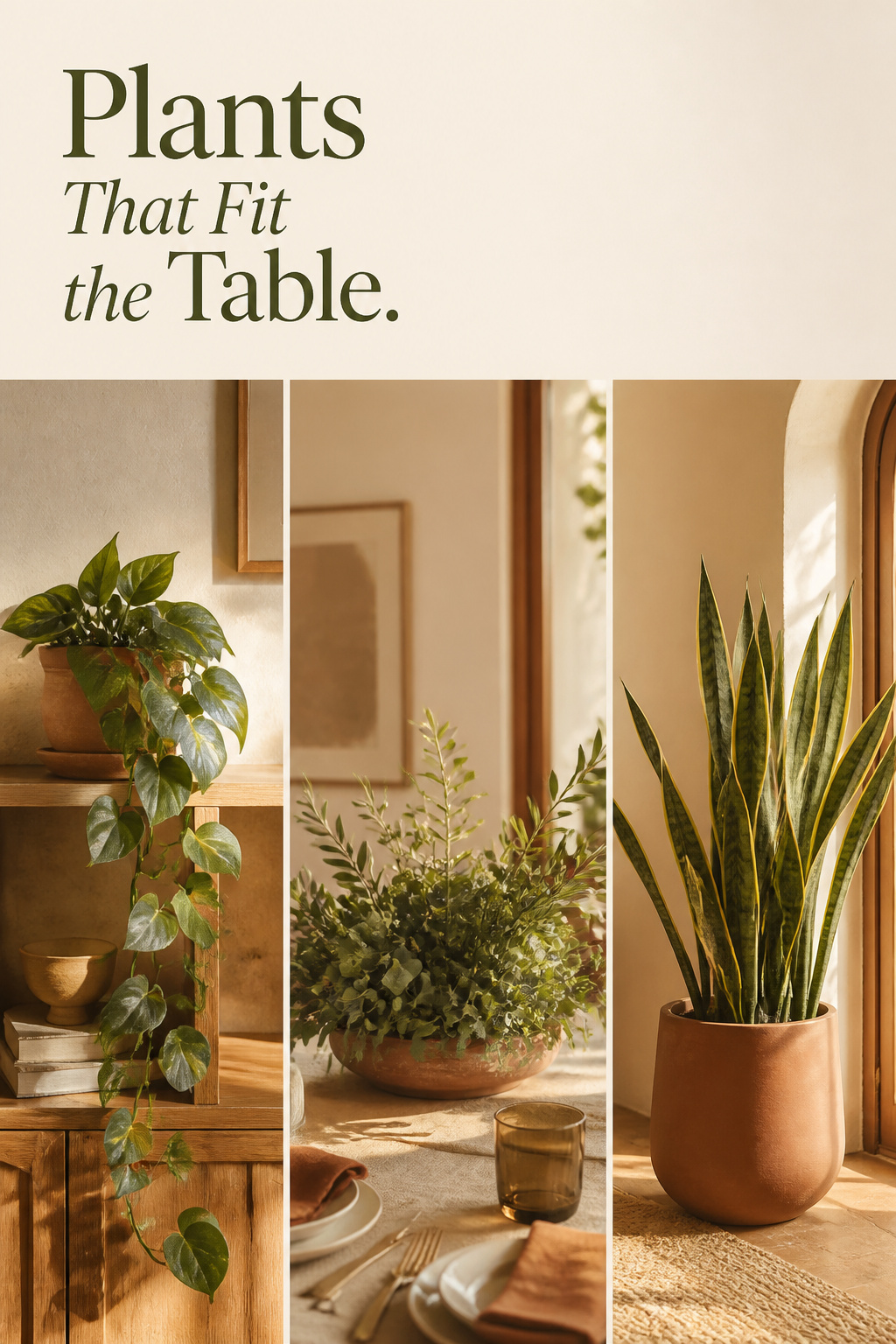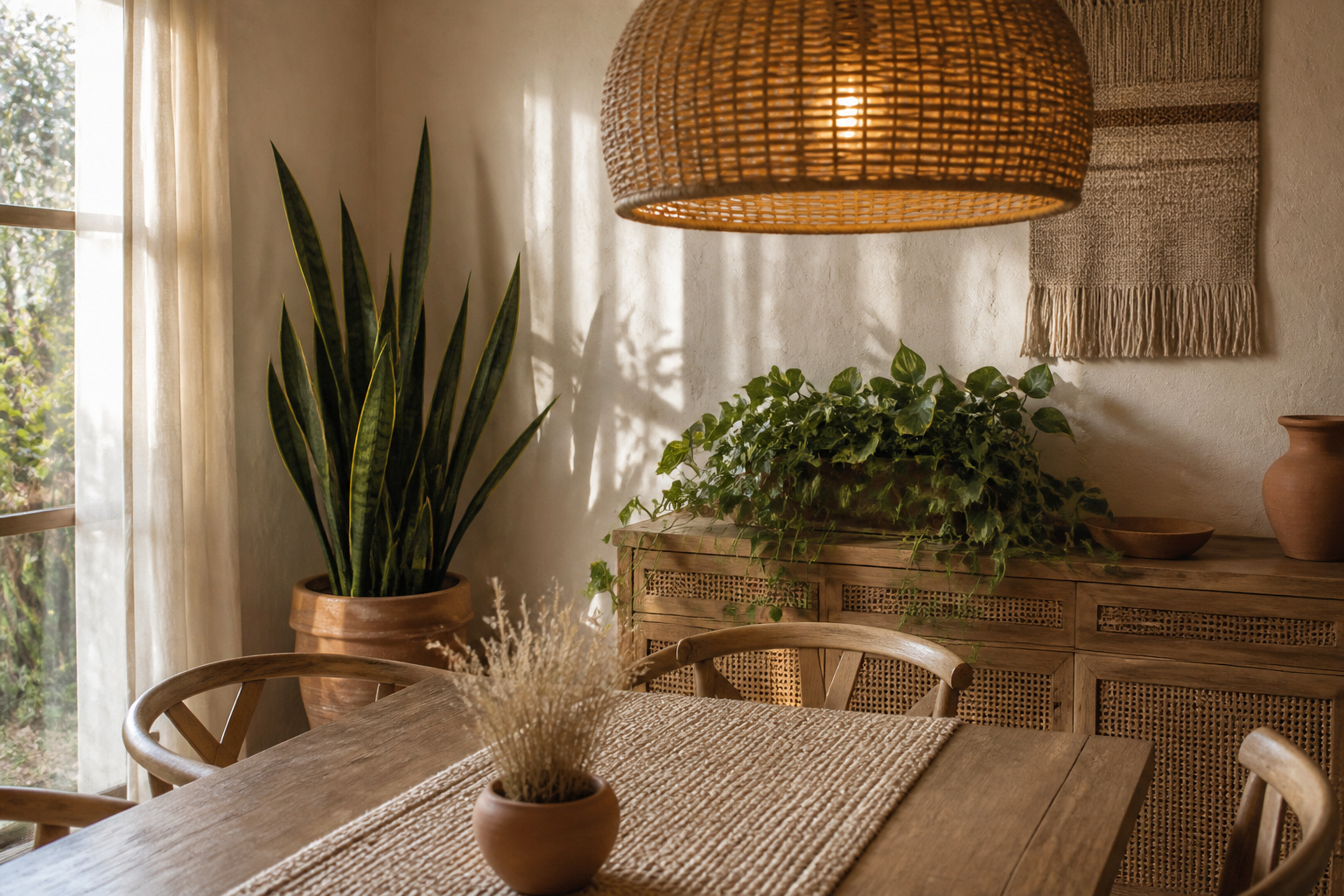

Picture the table you eat at most nights. A trailing pothos softens the sideboard behind it, a snake plant fills the corner that used to sit empty, and down the center — low enough to see the person across from you — sits a run of small terracotta pots holding something green. Nothing blocks the meal; nothing has been moved to make room for a fork. Most boho dining room plants fail at exactly that last point: they arrive beautiful and leave the table within a season. This is how to place greenery that stays.
TL;DR
- Keep anything on the table under about 14 inches, or clear 24 inches with open space beneath; the 15–23 inch range blocks sightlines and is the reason most table plants migrate to the sideboard.
- Trailing pothos and philodendron carry the shelf and sideboard because both live on as little as 25–75 foot-candles — enough to thrive well away from the room’s one window.
- For a dim dining room, pothos, ZZ plant and cast iron plant genuinely tolerate low light; give each a quarter turn every two to three weeks so it doesn’t lean.
Greenery is the most sensory of the boho dining decisions — leaf texture, filtered light, the smell of watered soil. But it settles a room only when each plant is placed for its light and its height, not its looks.
The Table Plant That Always Ends Up on the Sideboard
Notice how often the plant bought for the table isn’t on the table anymore — it’s on the sideboard, the windowsill, anywhere but where it was meant to be. That migration isn’t neglect; it’s a height problem the plant was always going to lose.
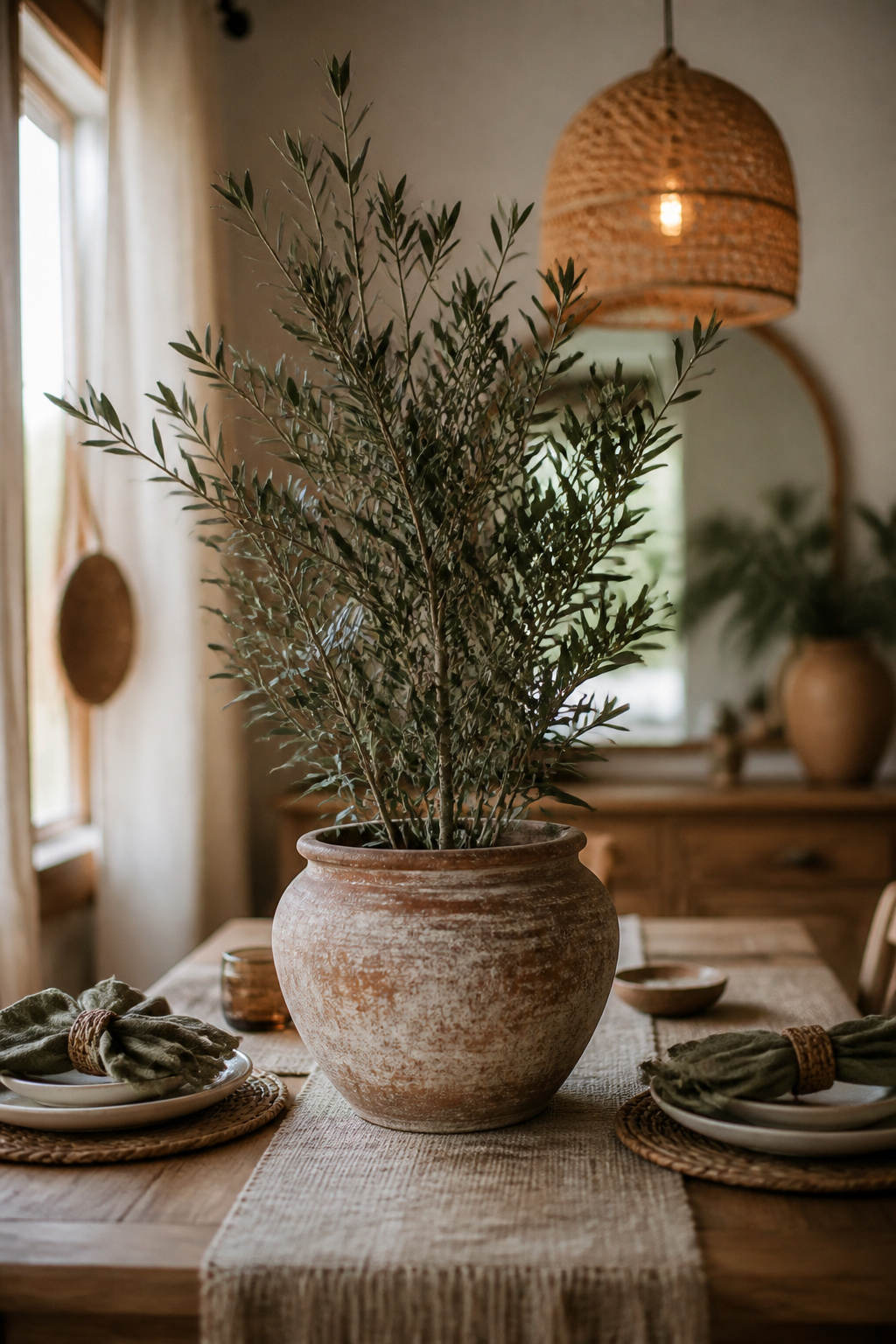
The moment a centerpiece plant gets moved because no one can see across the table
Seated eye height at a standard dining table sits around 42 inches from the floor. Anything taller than about 12 to 14 inches starts to cut across that line, and conversation routes around it. The real trouble is the middle: a plant between roughly 15 and 23 inches is the worst possible height — too tall to see over, too short to see comfortably underneath. Most impulse-bought table plants land exactly there.
What that says about where greenery actually belongs in a room that gets used daily
So the plant gets moved. The correction is to shift it off the table — to a shelf, sideboard, or floor — not swap it for another that will do the same thing. The plant was never wrong, only its placement.
The feeling a dining room settles into once plants stop competing with the meal
A particular quiet arrives when nothing on the table asks anything of you — the grounding presence biophilic guidance credits greenery with, but only when the plant belongs to the room.
Trailing Plants for Shelves and Sideboards
Start where there’s no sightline risk: the shelf and sideboard behind the table, where the boho look does most of its softening.
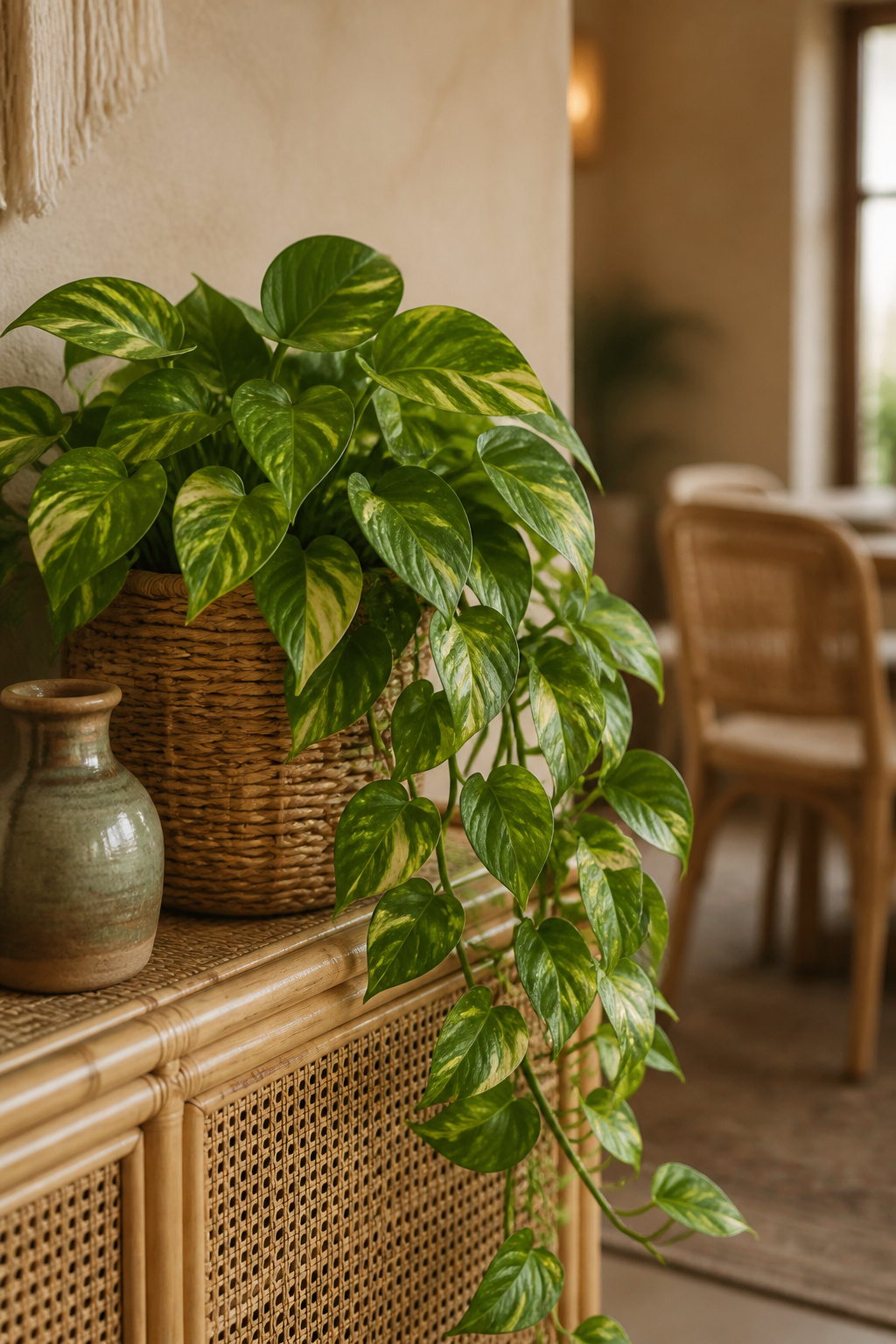
Pothos and philodendron as the low-maintenance boho standards
Pothos and heartleaf philodendron are the two standards here, for the same reason: both live on very little. Pothos tolerates 25 to 75 foot-candles and shrugs off irregular watering, though growth slows 30 to 50 percent in the dimmest spots. Philodendron scandens survives on as little as 50 foot-candles, better with 100. One caution — both are toxic to cats and dogs, causing oral irritation if chewed, so keep trailing vines out of reach in a pet household.
Letting trailing growth soften a shelf edge or sideboard corner
Group these in odd numbers — threes or fives read as more natural than even pairs — and break the vines with something upright, a ZZ or snake plant or simple ceramic, to give the trailing growth an anchor. A woven basket planter or turned-wood pot pulls the grouping toward the room’s rattan.
Placement height that keeps trailing leaves out of the walking path
Stagger trailing plants across shelf levels — a ladder shelf does this naturally — so vines drop cleanly, and set the trailing pothos where its longest vine falls short of the chair pull-out path.
What Belongs on the Table Itself
Now the harder ground: the table surface, where the sightline rule becomes the whole decision.
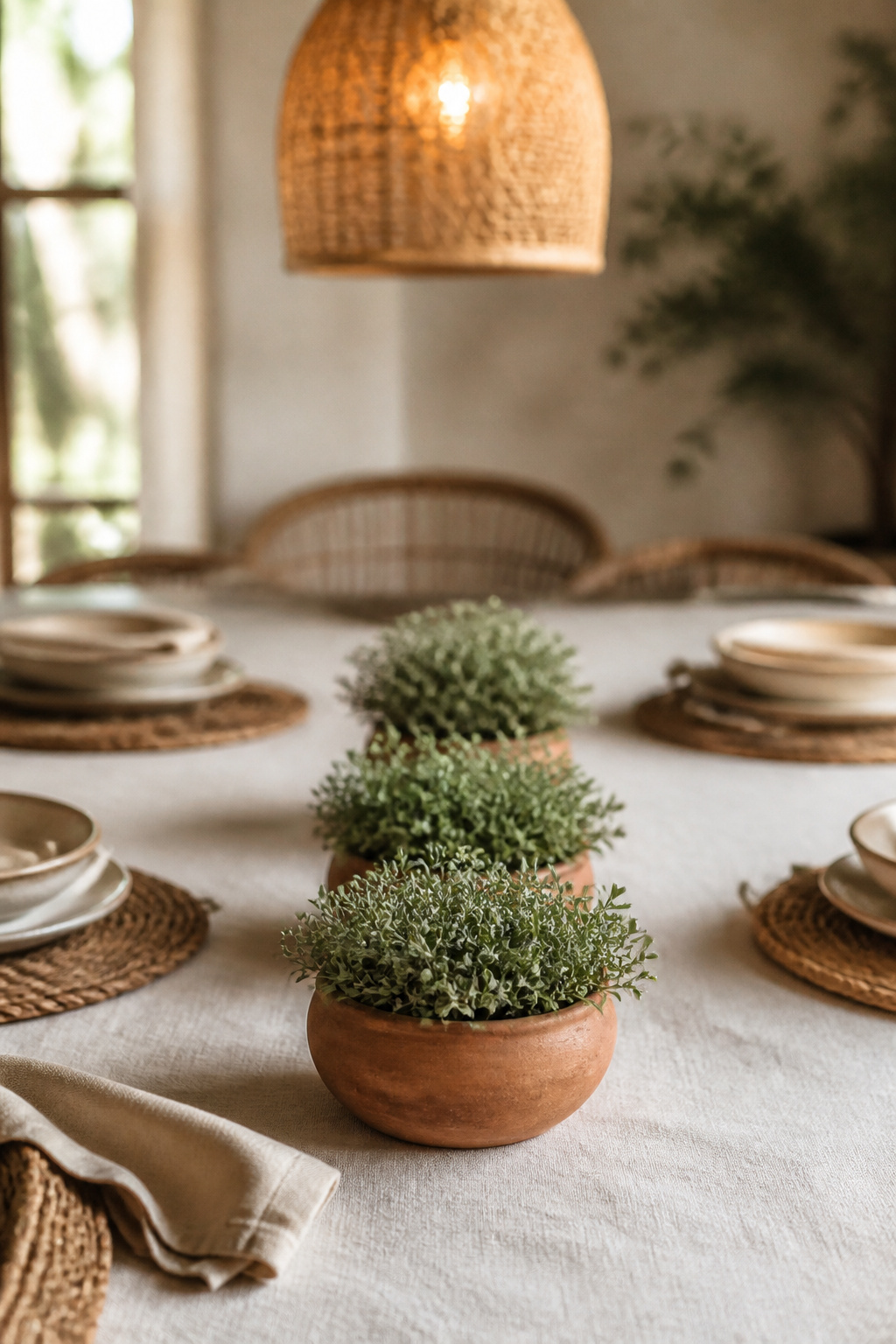
Low, wide arrangements that sit below eye line across the table
A low, wide arrangement under about 14 inches lets everyone seated see over it without craning. That’s the safe zone; the only other is its opposite — 24 inches or taller, measured from table to the bottom of the foliage, so people see clear underneath.
Single small pots versus a runner of several small ones
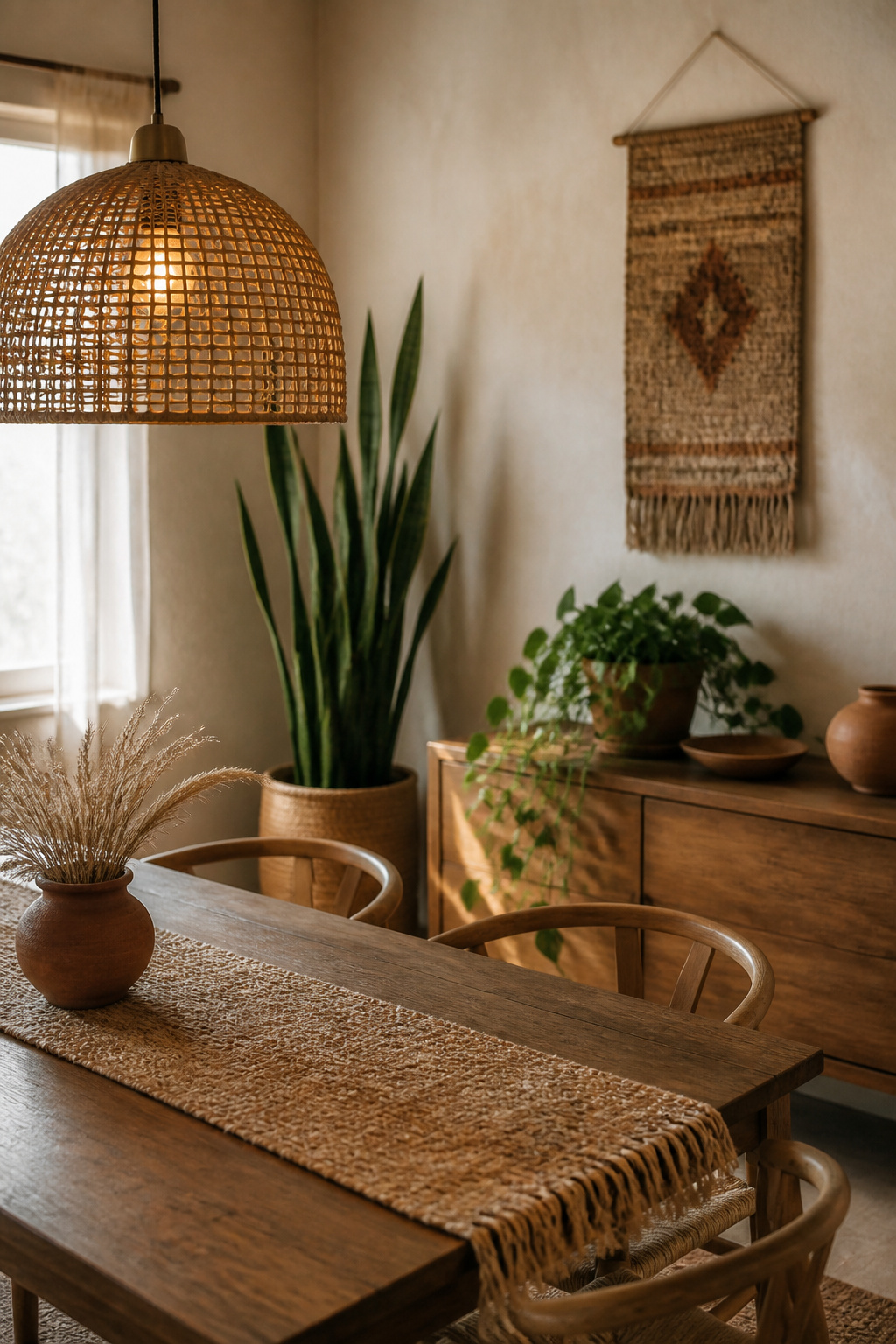
A runner of several small, low pots spreads greenery down the table’s length while keeping every pot well under the threshold — easier than balancing one larger piece. Keep the count odd, and spaced along a jute runner they carry texture end to end.
Dried and preserved greenery as a table-safe alternative when live plants aren’t practical there
Sometimes a living plant doesn’t suit the table it would sit on — daily spills, shifting light, constant use. High-grade silk and UV-treated greenery now mimics real leaf texture and movement closely enough to hold its own, and dried arrangements ask nothing at all. Dried stems also open the door to a seasonal centerpiece rotation you can change with the light.
Floor and Corner Greenery That Fills the Room
Above the table, greenery softens; on the floor, it anchors — a larger plant becomes architecture, filling an empty corner with a vertical line to rest on.
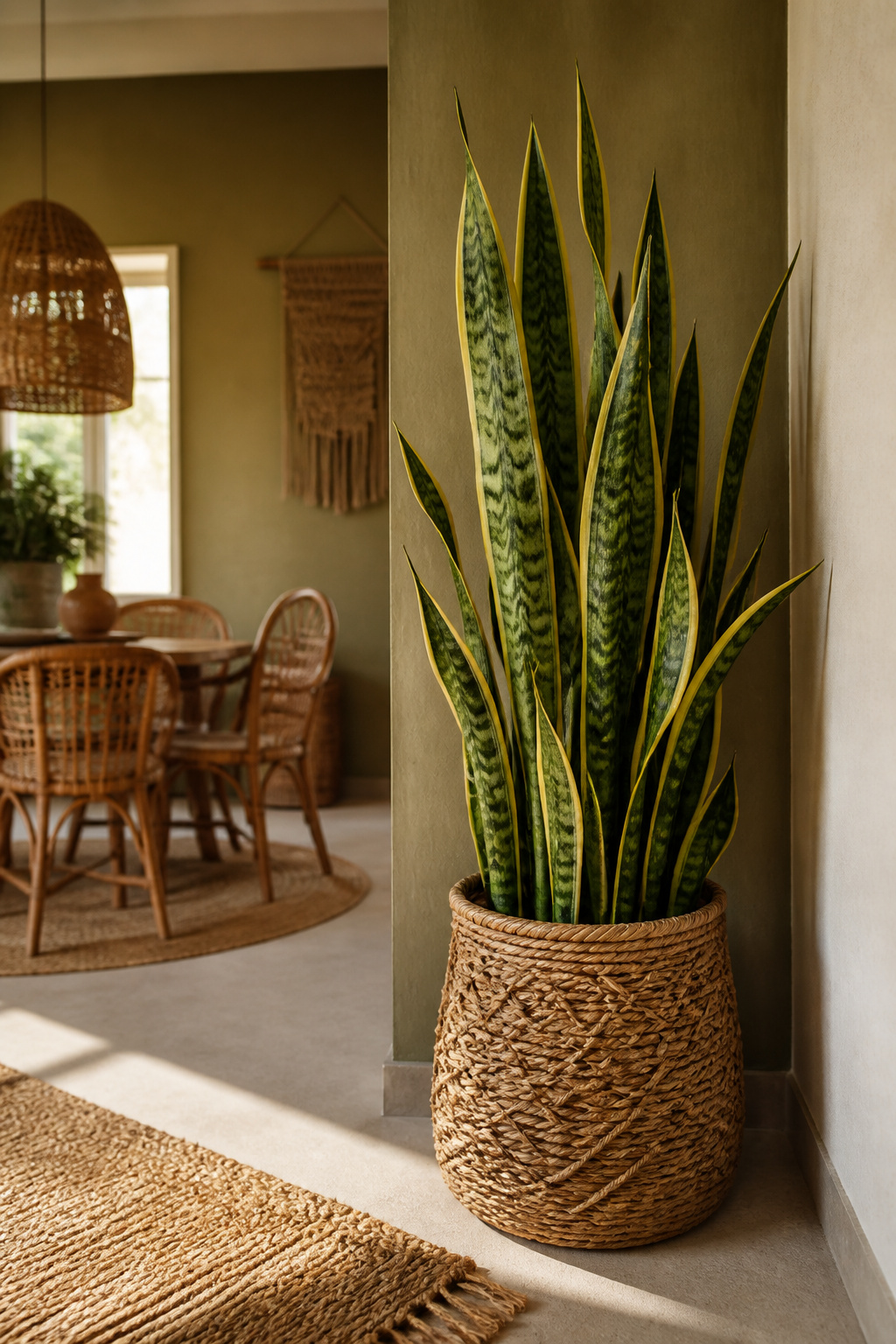
A larger floor plant (fiddle leaf, rubber plant, or snake plant) for an empty corner
A fiddle leaf fig reaches 6 to 10 feet over three to five years — a statement for a corner with height to spare. A rubber plant offers similar scale, up to 8 feet, with a more forgiving care profile and a decade-plus lifespan indoors. A snake plant stays far more compact at 6 to 20 inches, the honest pick for a smaller corner. Stand any of them in a woven basket planter and the scale lands soft.
Scaling floor plant size to the room without crowding chair pull-out space
Leave at least 36 inches between the table edge and the nearest wall or furniture so chairs pull out comfortably — a floor plant set in that band eats straight into it. Where people walk behind seated diners, the clearance widens to 42 to 48 inches. Only a genuinely unused corner is the right home for a large plant.
Grouping heights instead of a single row of matched pots
One plant anchors; a matched row flattens. Where a corner takes more than one specimen, group varied heights — an upright beside a trailing or low variety — so the grouping reads as gathered.
When the Room Doesn’t Get Much Sun
Dining rooms are often interior or single-window spaces, so plant choice starts from light tolerance, not looks. Three species carry a low-light dining room honestly — and the word matters, because plenty of plants labeled “low light” quietly decline in one.
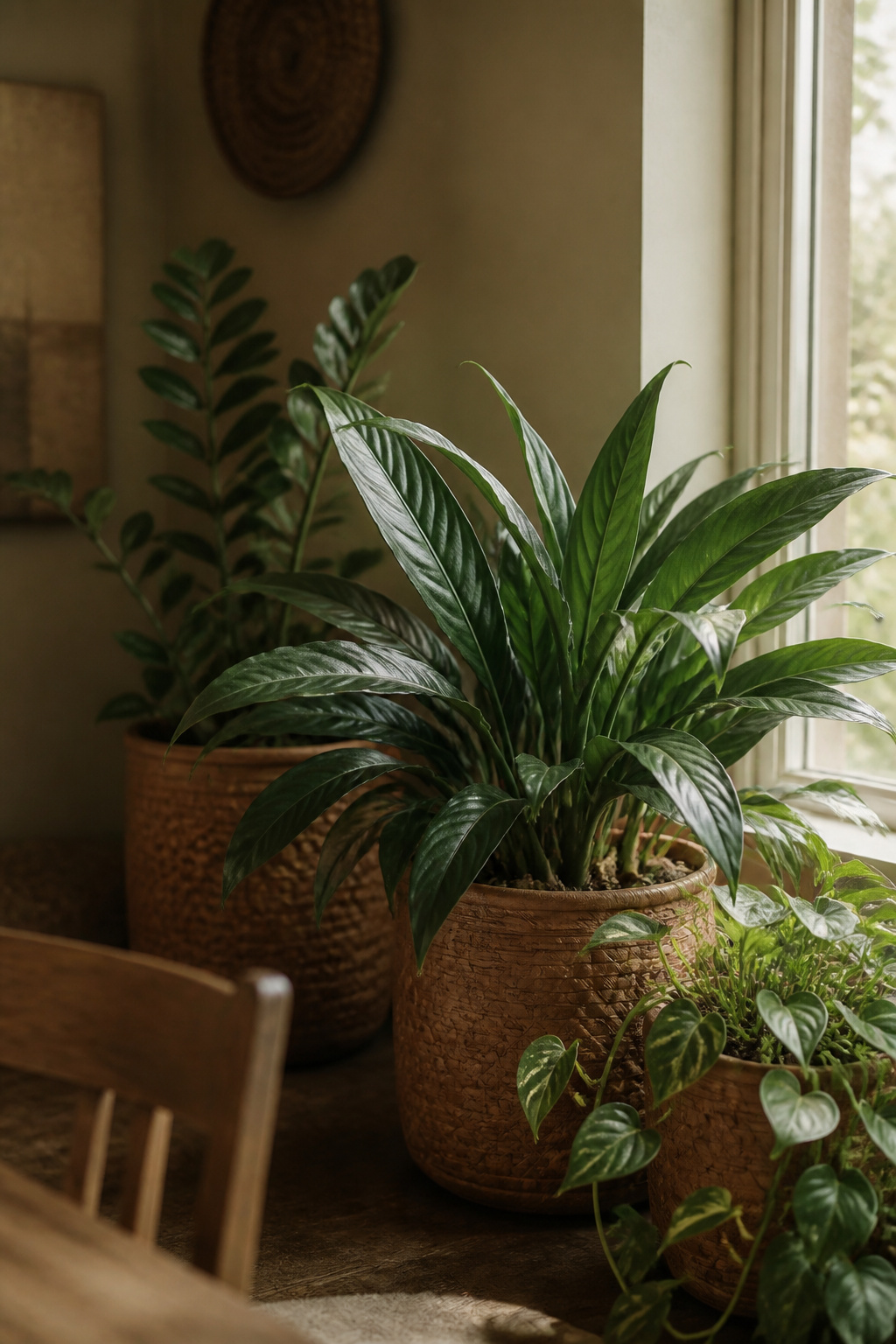
Low-light options that still read as lush (pothos, ZZ plant, cast iron plant)
The three that genuinely tolerate a dim room:
| Plant | Low-light tolerance | Why it works in a dining room |
|---|---|---|
| Pothos | Lives on 25–75 foot-candles | Trails from a shelf; growth slows and variegation may fade at the dim end, but it lives |
| ZZ plant | Tolerates extended low light | Potato-like rhizomes store water, so it forgives infrequent watering too |
| Cast iron plant | Native to forest-understory shade | Its low-light tolerance is a real evolutionary adaptation, not marketing |
The cast iron plant earns a note of its own. It arrived in Europe in the 1820s and became the Victorian dining room plant precisely because it survived low light, gas fumes, dust and drought. Its patience with a modern north window is nothing next to what it already weathered.
Rotating plants toward whatever window light the room does get
Plants lean toward light — phototropism, the hormone auxin stretching cells on the stem’s shaded side faster than the lit side, bending growth toward the window. Left alone, a plant grows permanently lopsided. A quarter turn every two to three weeks evens its exposure; turn each plant when you water it, so rotation folds into a routine you already keep.
During my teacher training in Dharamshala, the practice hall had no decoration but the window light moving across a plank floor through the day. I learned to watch where light lands and where it doesn’t — and a dim dining room asks the same attention. Put your plants where the light reaches, and turn them so no side goes hungry.
Knowing when a silk or dried arrangement is the honest choice over a live plant that won’t thrive
There’s no failure in choosing a faux plant for a room that won’t sustain a live one. Realistic silk and UV-treated greenery is made for low-light rooms, rentals and pet-safe homes — places where a living plant would struggle, not simply need more care. A thriving faux plant beats a live one dying slowly in a dark corner.
A Table You Can Finally See Across
Return to that table from the opening — trailing plant on the sideboard, runner low enough to see across. It stays that way now.
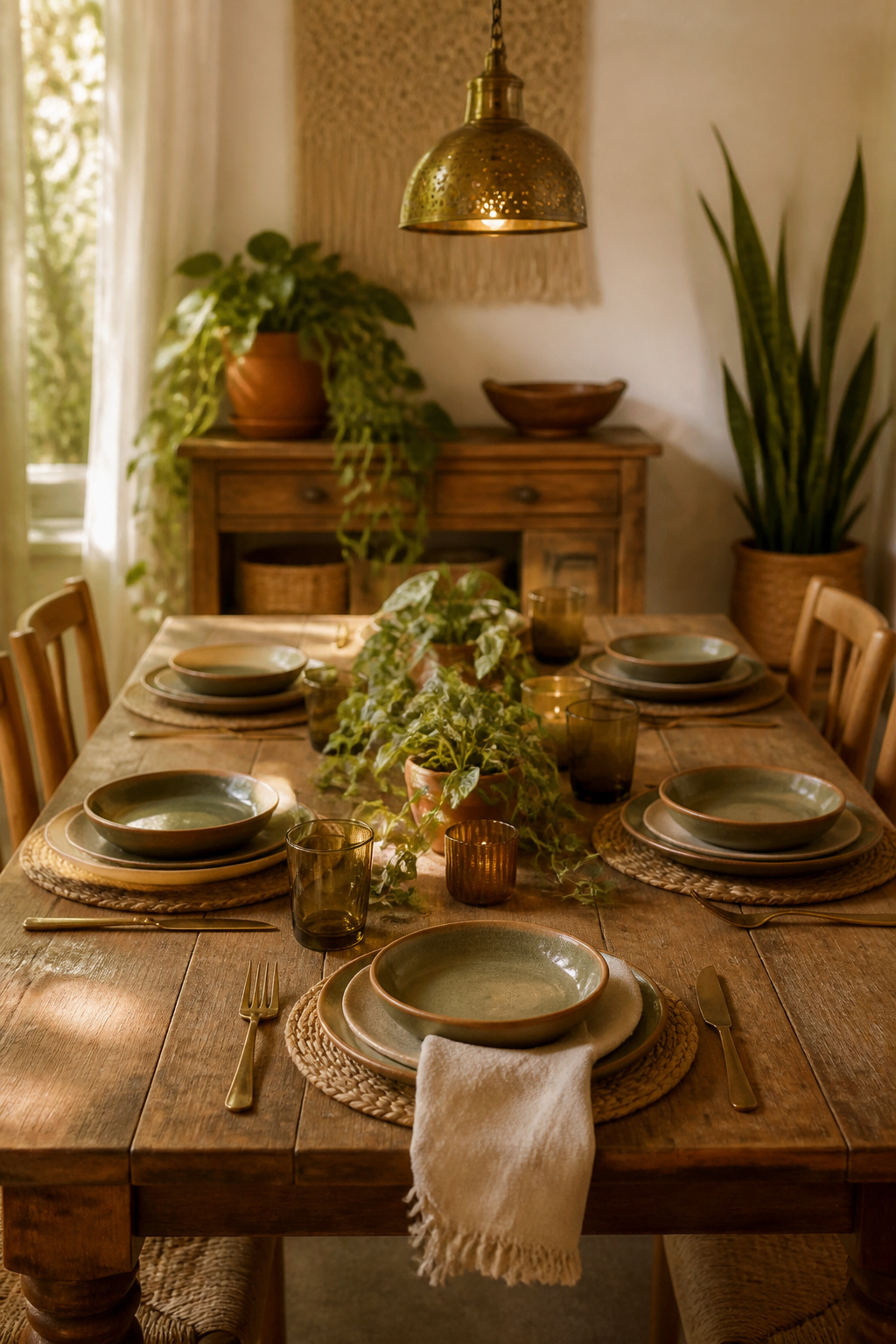
Returning to the opening scene, now resolved: greenery that stays where it’s placed
Every plant has a level matched to its height and its light. The centerpiece stays under 14 inches, the trailing pothos lives on the shelf, the floor plant fills the one corner with room to spare. Nothing migrates, because nothing was misplaced.
How plant choices settle once the room’s palette is set
Greenery is easiest to place once the room’s colors are decided — sage, olive and eucalyptus are named accent shades in the boho palette, so foliage color is a note the room already anticipates. Choose greenery that suits your color palette and the plants reinforce the scheme instead of interrupting it. It sits inside the wider set of boho dining room ideas: place each plant for its light and its height, and the table finally reads clear.
FAQ
Are fake plants acceptable in a boho dining room?
Yes. High-grade silk, polyester and UV-treated faux greenery now closely replicates real leaf texture, color variation and movement, and it’s specifically recommended for low-light rooms, rentals and pet-safe homes. Faux and dried arrangements are also the more practical choice directly on a table surface that sees daily spills and shifting light, where a live plant may struggle regardless of species.
What’s the best low-maintenance plant for a dining table centerpiece?
A ZZ plant tolerates low light and infrequent watering thanks to its water-storing rhizomes, but its mature height often exceeds a safe centerpiece — it belongs on a sideboard or floor. Directly on the table, keep it low: a wide arrangement or a runner of small pots under about 14 inches, or a trimmed, compact pothos that tolerates 25–75 foot-candles.
How often should dining room plants be rotated toward the light?
A quarter turn every two to three weeks is the most commonly recommended frequency, which evens out a plant’s exposure to a dining room’s often-limited window light and prevents lopsided growth. Turning the plant each time you water it folds rotation into an existing routine, so it becomes a habit you keep rather than a separate reminder to forget.