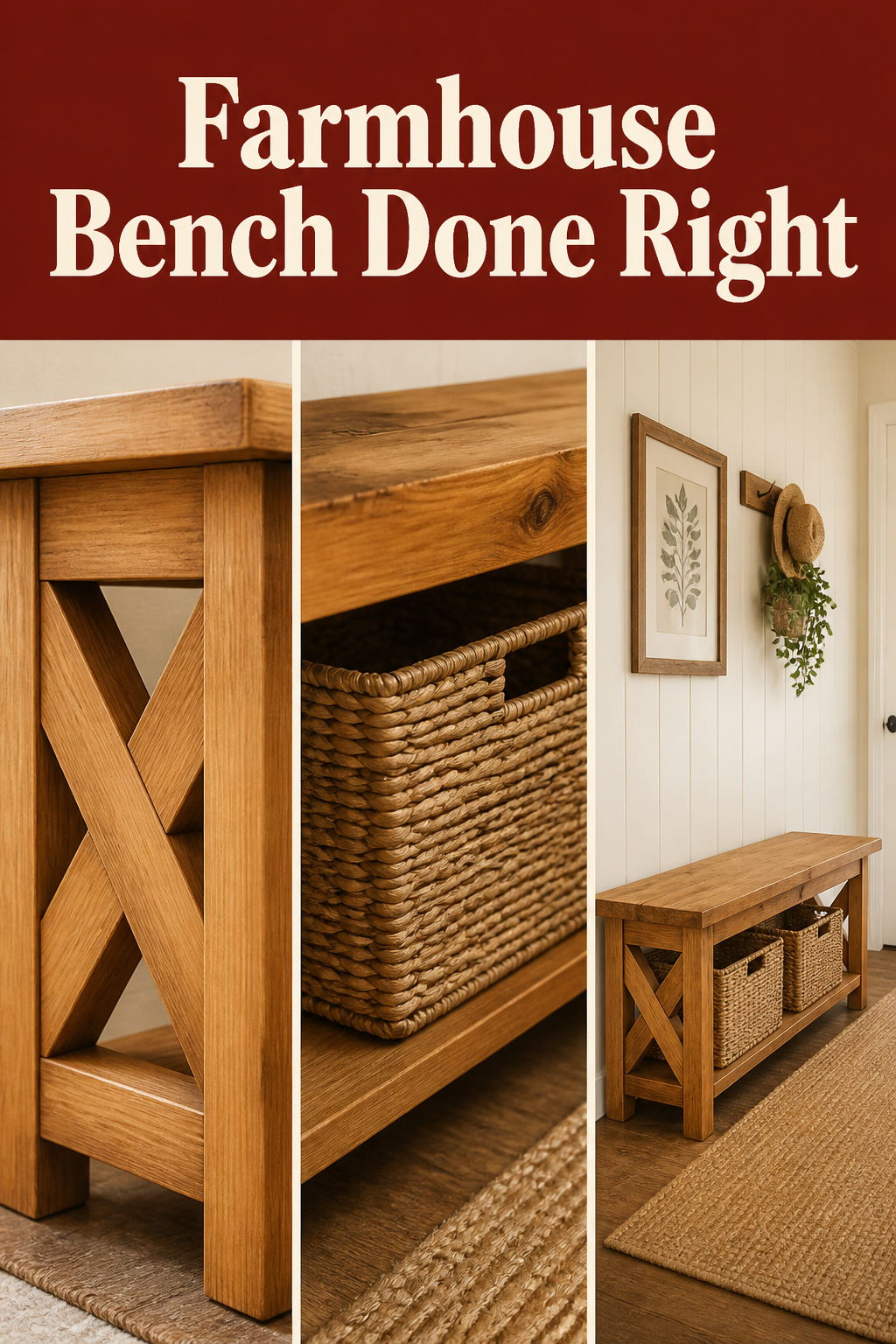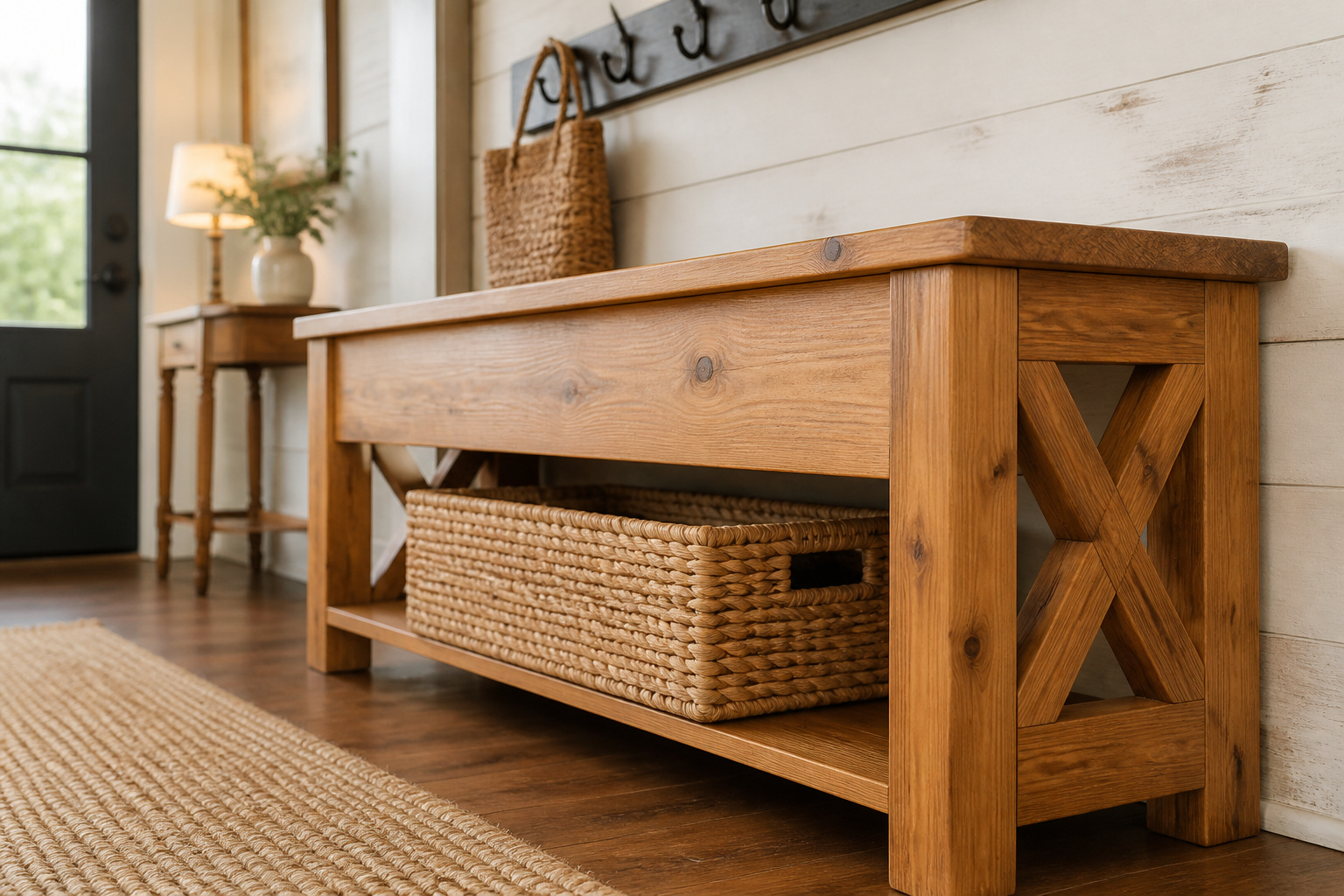

Stand in a hallway where a farmhouse entryway bench is done right and you can almost feel the wood before you touch it. Warm honey-toned pine, knots reading dark against the grain, the X-brace legs throwing a clean shadow across the floor. One seagrass basket sits underneath, dry and rough under your fingers. No varnish glare, no fake-aged chipping — just timber that looks like it came off a working farm. That feeling comes down to honest material choices, not a finish you spray on at the end.
TL;DR
- A real farmhouse entryway bench shows genuine material: No. 2 knotty pine with visible grain and knots, square-cut legs, and an X-brace — not a distressed finish over MDF.
- Knotty pine costs $8–$16 per 1×6×8 board and needs a pre-stain conditioner to avoid blotching; poplar is the better species if you’re painting the bench white.
- One large rectangular seagrass basket (18–21 in wide for a 48-in bench) completes the look; X-brace benches rate 300–450 lbs, plenty for daily use.
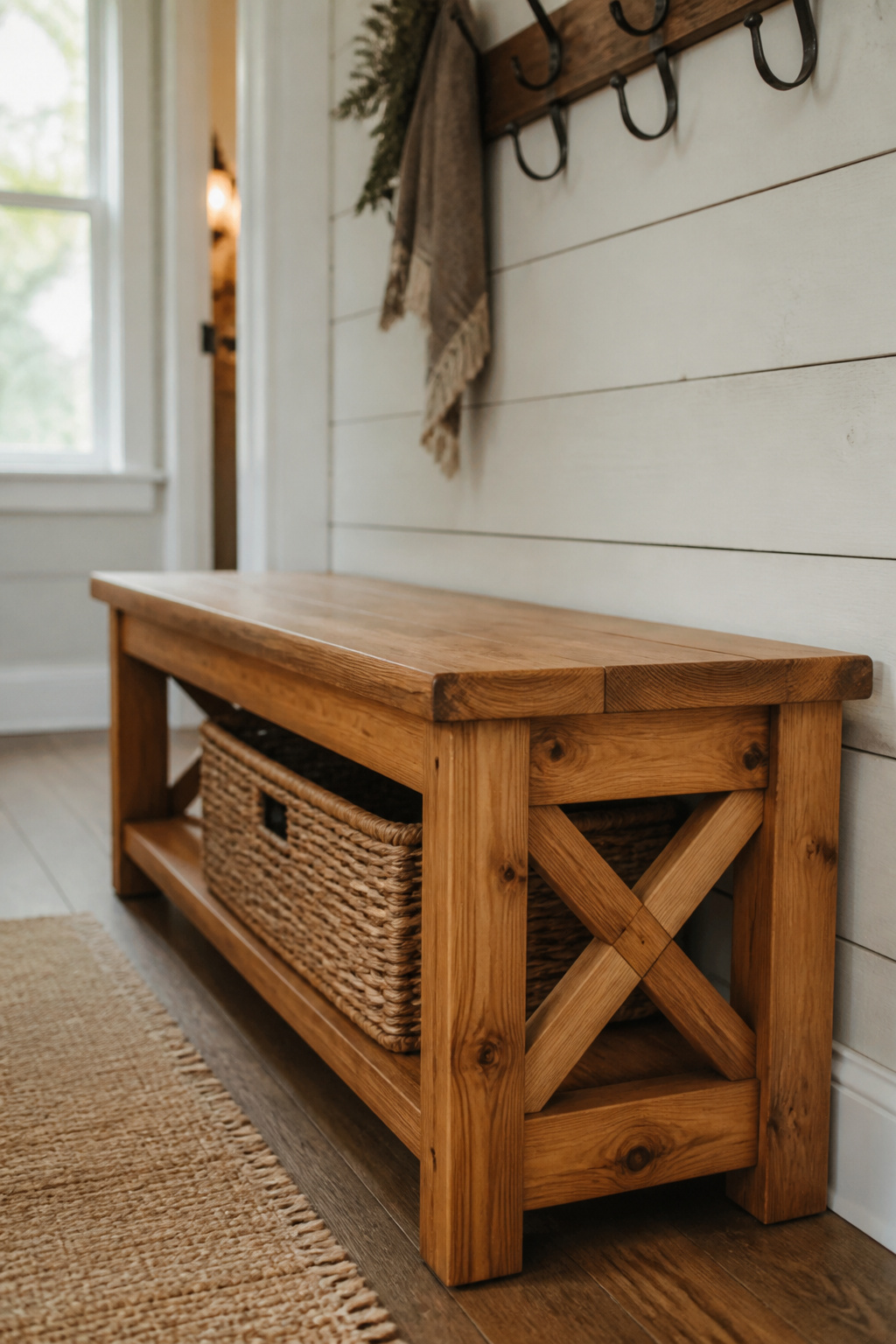
Running crews on remodeling jobs teaches you fast that the good stuff and the costume stuff often cost about the same to make. The difference is whether the character is in the wood or sprayed on top.
What Makes a Farmhouse Entryway Bench Look Honest (Not Costume)
The farmhouse bench comes in two versions at the same price: solid wood whose grain, knots and wear are real properties of the timber, and engineered board wearing a costume — a distressed surface mimicking what honest pine earns on its own over twenty years.
Visible grain and honest wood
In solid pine, rustic character means natural variation: distinct knots, grain that changes direction, tonal shifts between sapwood and heartwood. The field test: solid wood grain runs continuously across the surface, the edges, and the end grain. In veneer over MDF, the edges reveal a smooth, grainless core. Solid wood refinishes many times; a veneer skin sands through the first time you fix a scuff.
The farmhouse tells: X-brace, trestle base, square-cut profiles
Three form details signal farmhouse before you read a label. The X-brace on the end panels is the loudest — it appears on the Ana White Rustic X Bench, the Kreg DIY plan, and commercial pieces across Wayfair and Pottery Barn; it’s become the category’s signature. The trestle base is the other dominant form: a horizontal stretcher connecting two supports, lifted from farm-table construction that predates the 20th century. Third is the square-cut profile — flat aprons and legs at 90 degrees, no turned spindles, no tapers — what separates farmhouse from Shaker (tapered legs) or Victorian (turned posts).
Avoiding the farmhouse-chic trap
Real wear concentrates on contact points: the front edge of the seat, the ends of the aprons, the top faces of the leg posts. Factory distressing scatters marks evenly because a machine doesn’t know where hands and shoes land. As the team at Entryway Storage puts it, once applied distressing replaces material character, the look tips from farmhouse into “farmhouse-themed.” For the wider survey of styles and sizing, the entryway bench styles and sizing guide sets the frame.
Wood Species and Finish for the Farmhouse Look
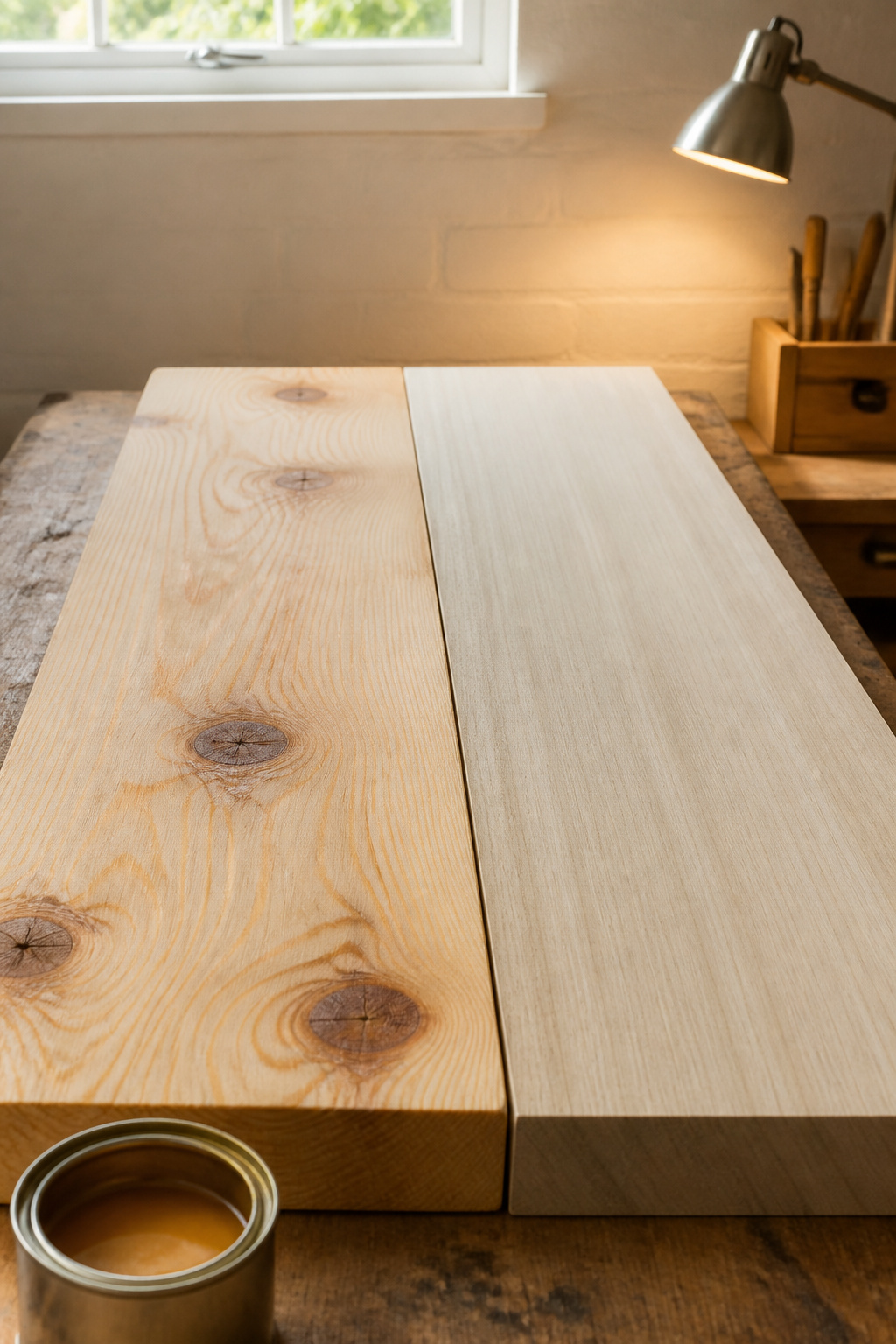
Three species cover almost every build. Pick the species for the finish you want — the wrong pairing fights you.
| Species | Grain character | Farmhouse suitability | Approx cost |
|---|---|---|---|
| No. 2 pine | Knotty, high variation | Best for stained/natural | $8–$16 per 1×6×8 |
| Douglas fir | Wide, straight, red-brown | Good for clear oil finish | Mid (varies by region) |
| Poplar | Fine, uniform, no knots | Best for painted white/cream | ~$2–$5 per board-foot |
Pine: the honest choice
No. 2 common pine is knot-filled and grain-heavy — exactly what reads as farmhouse. But knots repel stain while the surrounding wood absorbs it fast, producing dark blotches around every knot. The fix is a pre-stain wood conditioner applied 5–15 minutes before staining. As Carolina Classic Pine advises, it evens out absorption and prevents the resin-blotch.
Douglas fir and poplar
Douglas fir has large, straight grain with a light-brown colour and a touch of red between growth rings — closer to reclaimed barn wood than knotty pine. Fir tends to splinter at cut ends more readily than pine (forum wisdom rather than a tested standard), so sand apron ends to 120 grit before assembly. Poplar has fine, uniform grain and no knots — wrong for a stained rustic look, right for paint. For a white or cream bench, poplar at roughly $2–$5 per board-foot is worth the premium.
Stain, clear coat, or milk paint
Oil-based stain on pine brings the grain out dramatically — Minwax Early American or Golden Oak give that honey-brown tone where knots read as dark accents rather than defects. A clear polyurethane topcoat pushes grain to the maximum; oil-based poly’s amber deepens over time. Milk paint goes on like coloured water — sheer enough that grain texture shows through. As Miss Mustard Seed puts it, the first coat leaves a lot of the wood showing, exactly right when you want colour without coverage. Seal with clear wax for a matte surface that spot-repairs easily; polycrylic reads more modern.
The X-Brace Leg: Building the Signature Farmhouse Form
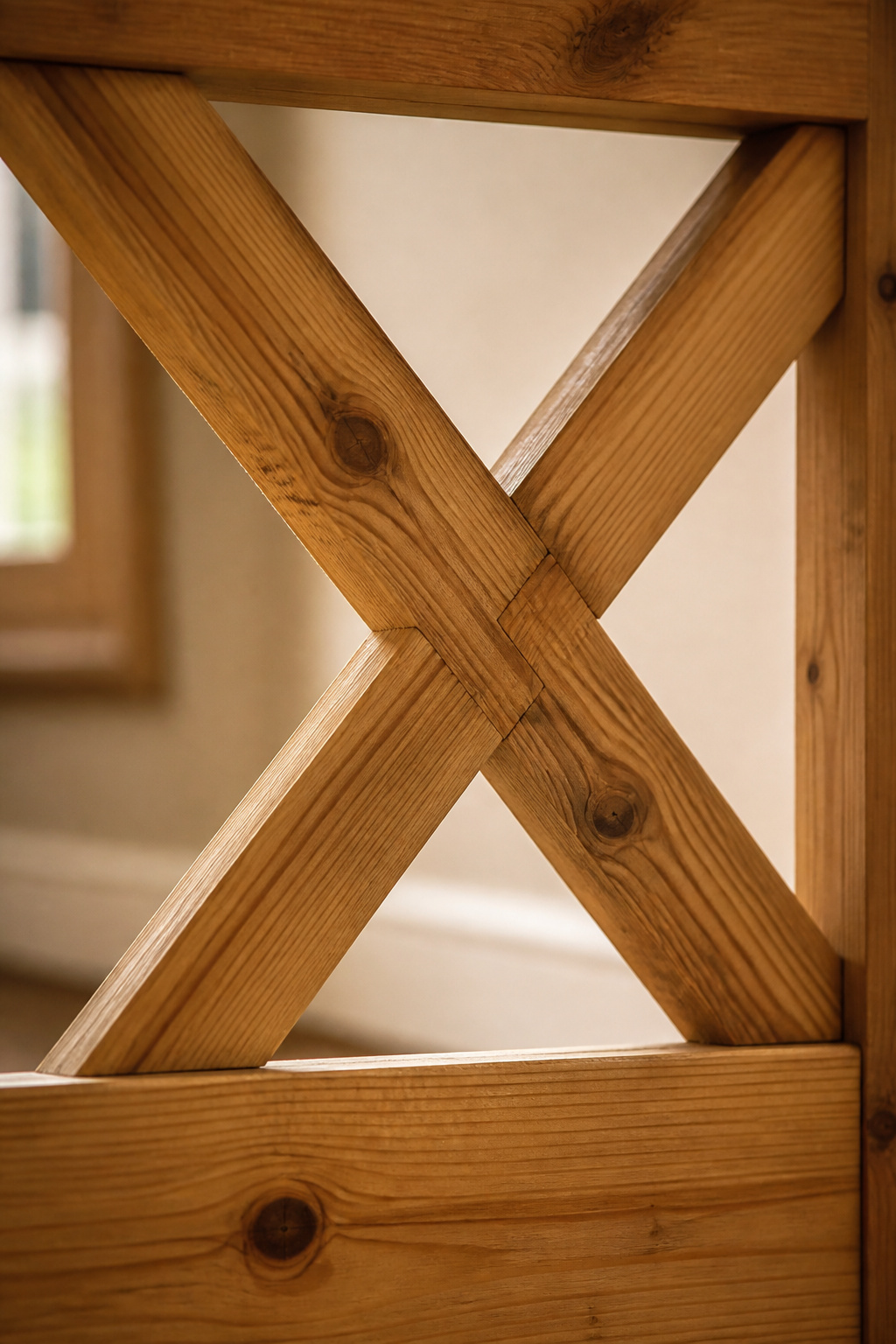
The X-brace isn’t decoration. It’s a triangulated brace — the same structural principle that holds up bridge trusswork and farm gates.
Why the X-brace works
A plain rectangular leg frame racks — it deforms into a parallelogram under sideways load. The X converts that rectangle into triangles, which can’t change shape without compressing or stretching a member. The Kreg DIY Rustic X Bench plan uses 2×2 brace pieces with 30-degree end cuts and 21-degree inner intersection angles, attached with 2-inch brad nails and glue. The glue does the structural work; the nails hold position while it cures. Benches built this way typically rate 300–450 lbs.
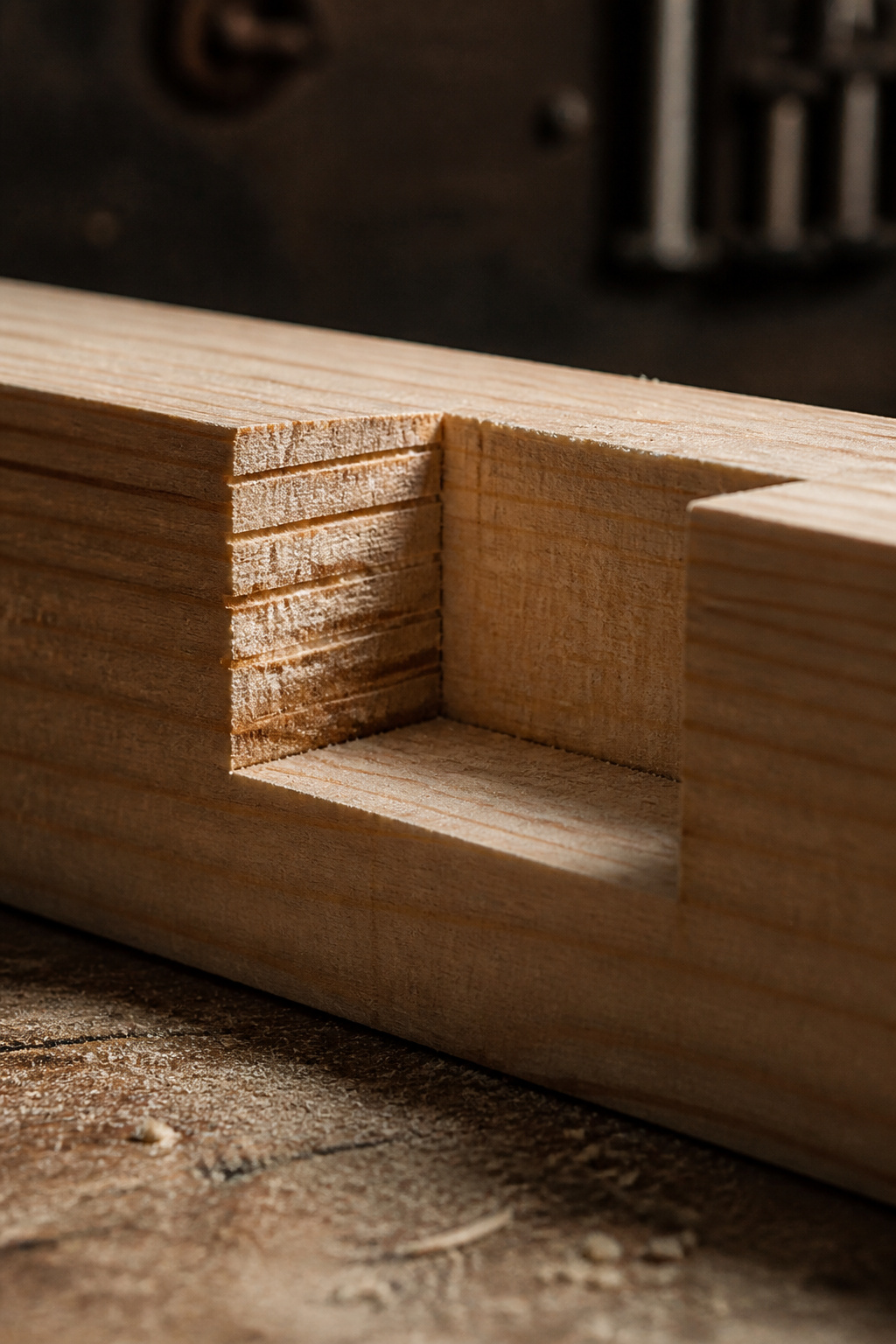
Cutting the half-lap joint
For the X members to sit flush where they cross, cut a half-lap — each board notched to half its depth so the two slot together level.
- Mark the crossing point. Lay both brace boards in position and pencil lines where the other overlaps.
- Set the saw to half depth. For 2×2 stock (actual 1-1/2 in), the notch is 3/4 in deep.
- Make parallel cuts between the marked lines to remove the waste, then clean flat with a chisel.
- Cut to actual width, not nominal — 1-1/2 in for a 2×2, never 2 in.
No half-lap tools? Butt the two boards and brad-nail them to the frame face one behind the other — looks identical head-on.
Sizing the brace
The Kreg plan’s 2×2 braces fill roughly 80% of the end-panel opening — the ratio that reads as correct. The Ana White Rustic X Bench (48 in wide, 16.5-in legs) uses heavier 2×4 boards for a bolder brace; narrower benches under 36 inches usually look right with 2×2. That’s my read from comparing the two plans, not a stated standard. As Kreg contributor DIY Huntress notes, lay your actual boards under the frame at the angle you want and pencil the cuts — the real frame beats a published angle. To build the bench yourself, the DIY guide covers every step.
Woven Baskets and What Goes Under a Farmhouse Bench
The shelf under a farmhouse bench is its second act — and one well-chosen basket beats five small ones every time.
Sizing the basket
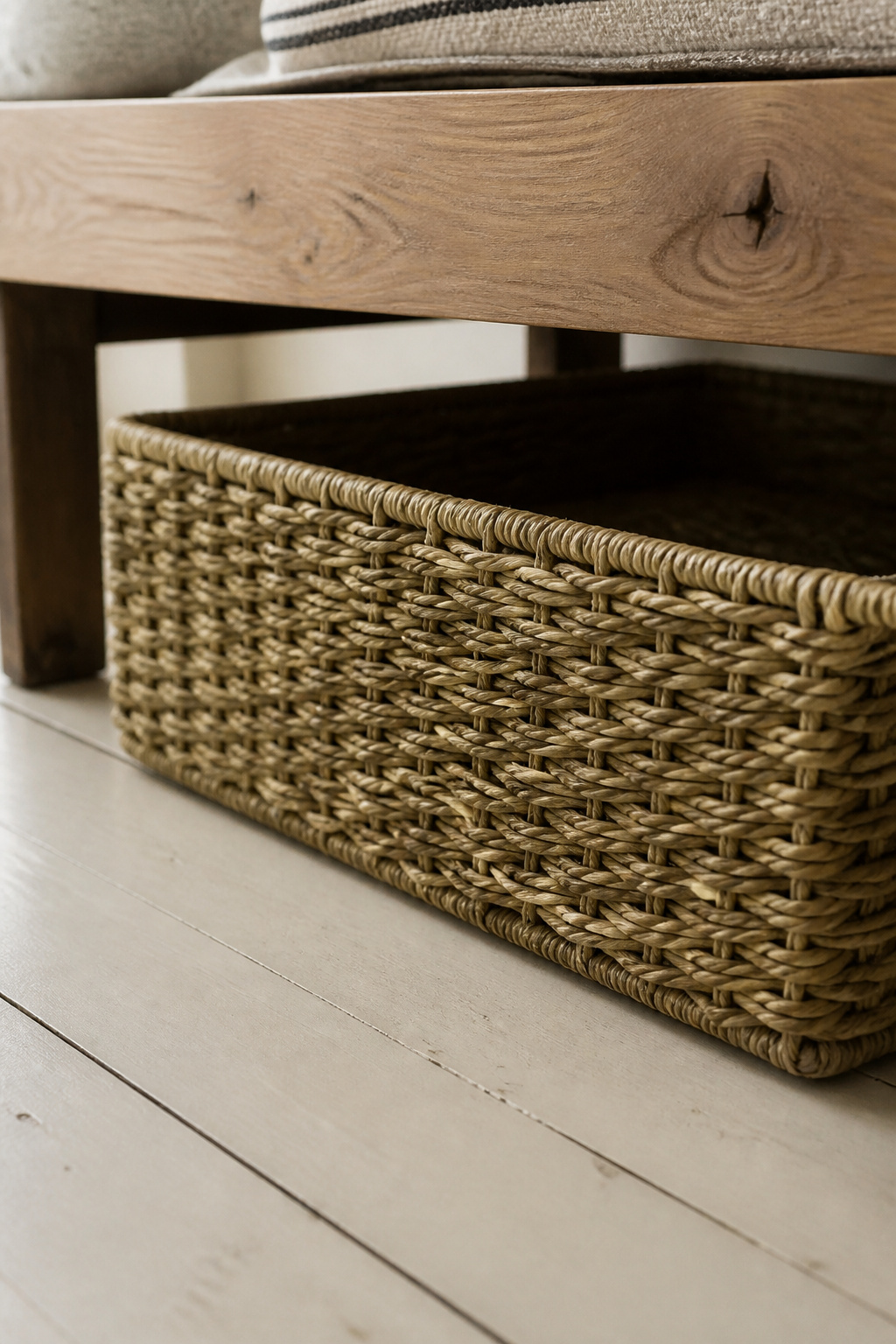
A typical bench shelf opening runs 8–12 inches of clear height and 10–14 inches deep. For a 48-inch bench, one rectangular seagrass basket around 18–21 in wide by 14 in deep by 9–12 in tall fills the span without crowding — my own guideline from bench dimensions and common basket sizes, not a published standard, so measure your opening first. Skip belly-round baskets; the round format competes with the bench’s horizontal lines.
Seagrass vs cotton rope vs rattan
Seagrass is the most consistent choice. It’s naturally stain-resistant — important under a bench that catches muddy shoes and damp umbrellas — and its warm golden-green tone pairs with honey-stained or milk-painted pine rather than fighting the grain. Rattan reads coastal or boho; its finer texture suits airier rooms more than a rustic pine bench. Cotton rope is more porous, so it absorbs damp from wet shoes and can develop mildew — reasoning from the fibre rather than a lab test, but keep cotton rope for dry items like hats and gloves, not footwear.
The one-basket rule
Farmhouse design keeps negative space on purpose. As Her Happy Habitat puts it, restraint means one or two objects with purpose, not a collection of everything natural. One large rectangular basket pushed slightly back from the apron creates a reveal that shows off the bench’s depth. A vintage wooden crate alongside keeps the material palette honest while standing up umbrellas or sports gear.
Buying a Farmhouse Bench: What to Check Before You Click
If you’re buying, the listing language is the problem — “solid wood construction” can mean solid planks or veneer over MDF. Four checks separate the bench that lasts from one that looks the part for a season.
- End grain in the photos. Solid wood shows continuous growth rings at any cut end; MDF shows a dense, grainless core. Ask for leg-bottom or shelf-edge photos if the listing doesn’t show them.
- Grain continuity at corners. In solid wood, the surface grain flows across the edge onto the end face. As Boston Mills Furniture puts it: if the grain makes sense from every angle, it’s solid wood. A visible seam means veneer.
- The weight number. A 48-inch bench under 20 lbs is almost certainly not solid pine, which would weigh 30–45 lbs at that size.
- The material words. “Kiln-dried pine,” “solid poplar,” or “solid fir” confirm solid wood. “Manufactured wood” or “wood composite” mean an engineered core.
Solid pine benches with pocket-hole or mortise-and-tenon joinery typically rate 250–450 lbs; engineered benches with staple-gun assembly often rate 200 lbs or less. The substrate matters more than joint type — a pocket-hole bench in solid pine outlasts a mortise-and-tenon bench in particle board. In a listing, “distressed finish” describes the surface only; a distressed veneer can’t be repaired when the finish chips because it’s too thin to sand. Solid pine touches up with the same paint, or strips and refinishes. The Pottery Barn Heritage Farmhouse bench states solid kiln-dried pine with poplar and MDF accents — honest listings name both. Once the bench is in place, style it with baskets and textiles to finish the farmhouse look.
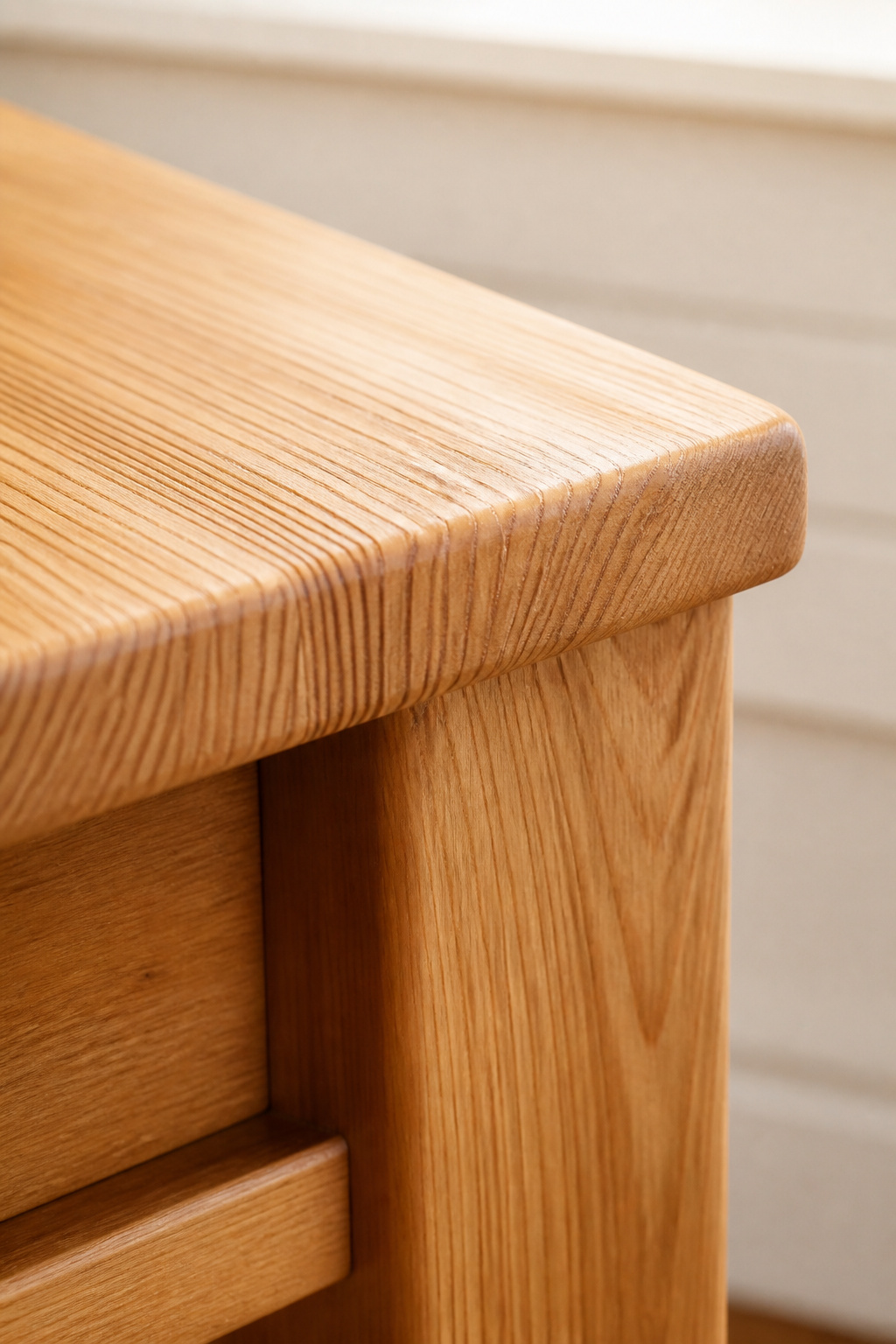
Build it or buy it, the test is the same: does the character live in the wood or sit on top of it? Get that right and the rest follows.
FAQ
What wood is best for a farmhouse entryway bench?
No. 2 knotty pine is the most authentic choice — the knots and grain variation are farmhouse character, not defects — and the most affordable at $8–$16 per 1×6×8 board. For a painted white or cream bench, poplar takes paint more evenly. Douglas fir gives wider, straight grain closer to reclaimed barn wood under a clear oil finish.
How do you make an entryway bench look farmhouse?
The clearest signals are X-brace end panels and a slatted or open lower shelf, both referencing working-farm construction. Finish in a warm honey stain, a matte milk paint, or natural wood with clear oil — all keep the grain visible. Add one large rectangular seagrass basket underneath and a simple jute or linen cushion on the seat.
Is a farmhouse bench with X-legs sturdy enough for daily use?
Yes. The X-brace converts a rectangular frame into a triangulated structure that resists racking far better than a plain frame — the same reason the form appears in bridge trusswork and farm gates. Solid-wood X-leg benches built this way typically rate 300–450 lbs. Glue at every joint is non-negotiable; brad nails only hold position while the glue cures.