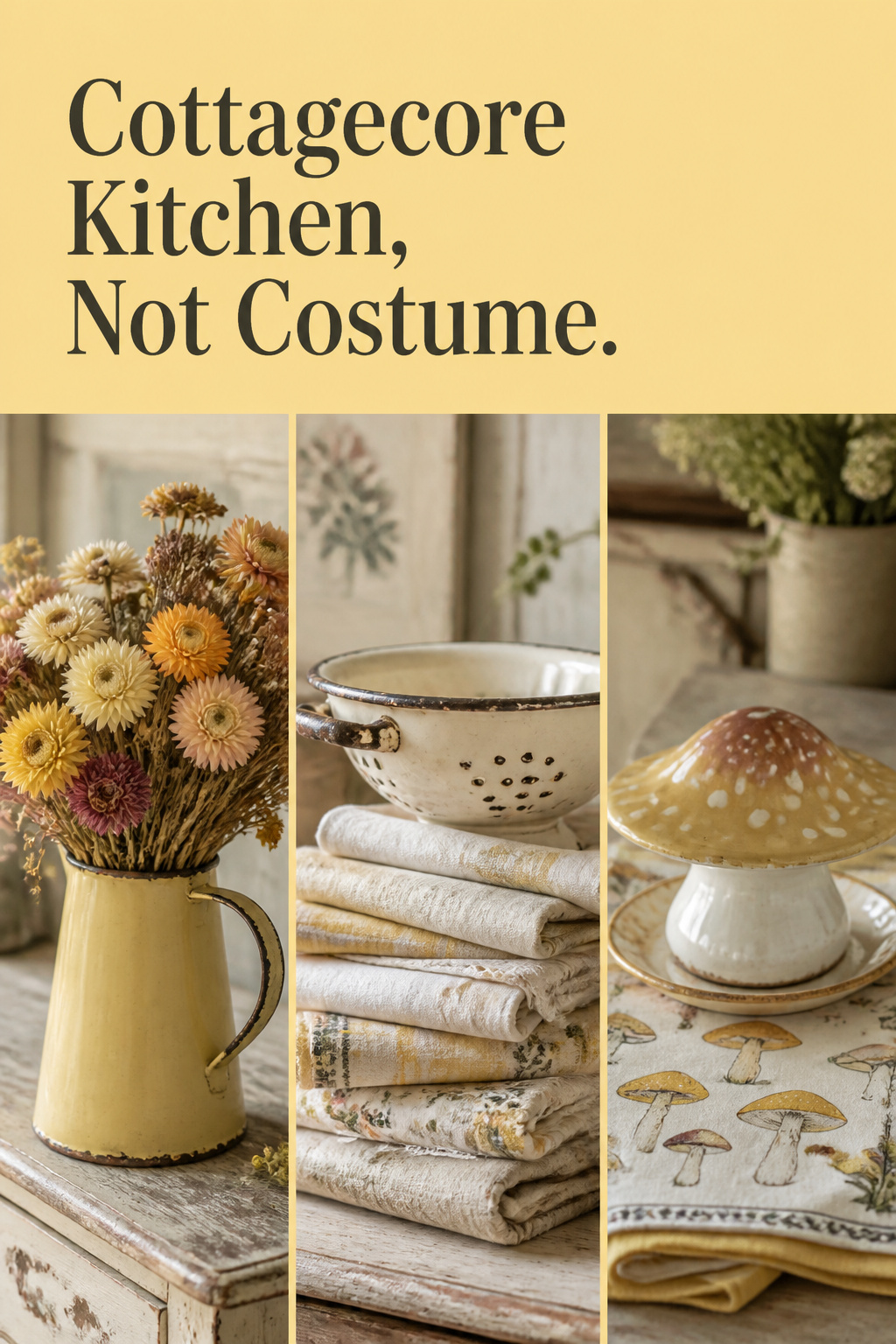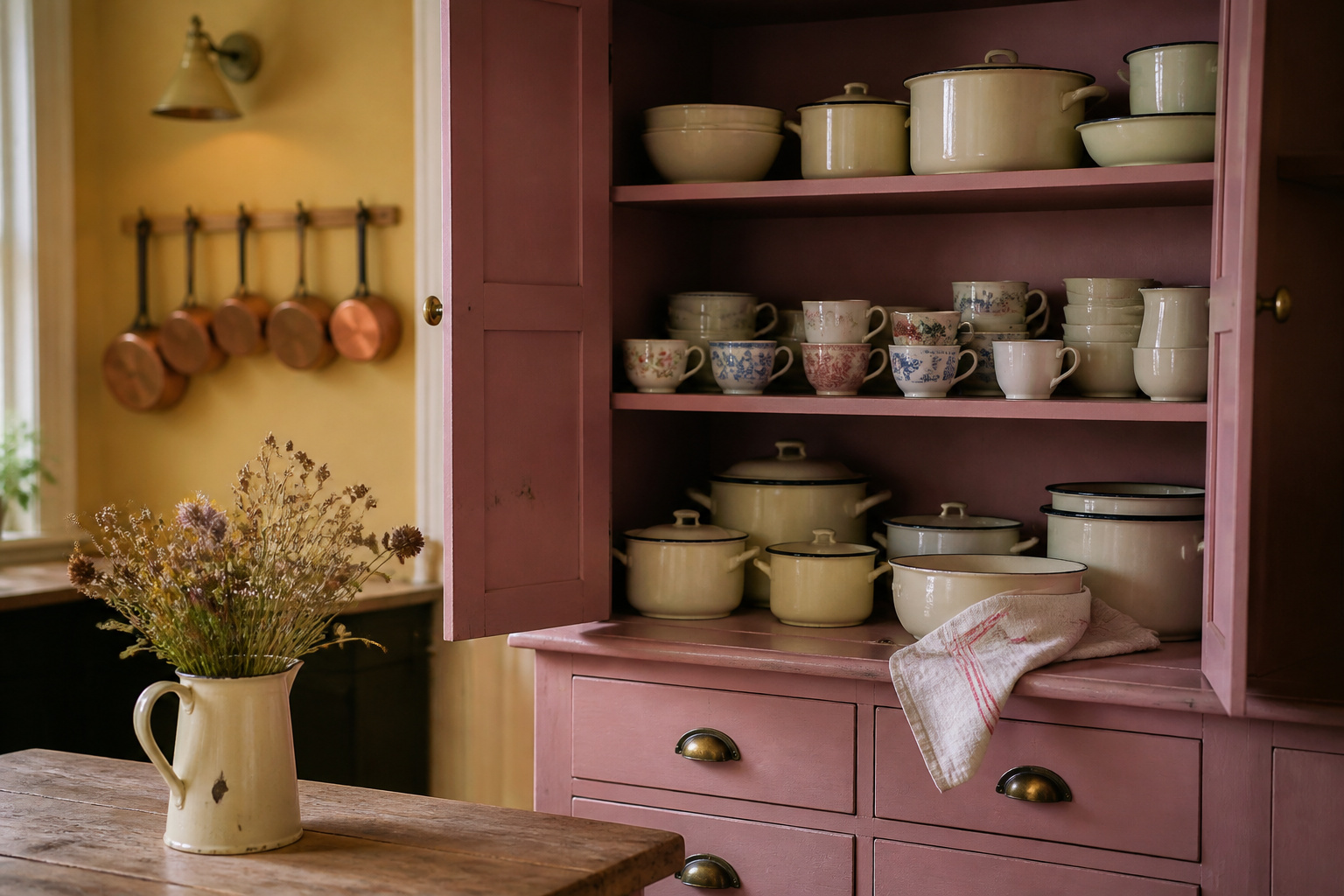

Cottagecore kitchen decor began as a rebellion against buying things — the first irony worth sitting with before you spend a penny on it. It swelled into a pastoral daydream of gathered flowers, worn enamel and slow mornings, then the marketplaces caught up: search the aesthetic now and you get printed mushrooms on everything and “gathered” florals molded in a factory. Follow that path and the room reads as costume, a set dressed to look lived-in, fooling no one who actually walks into it.
TL;DR
- Build the look from genuinely old, useful things — vintage linens, chipped enamelware, flowers you dried yourself — never a matched prop set: real wear is asymmetric and can’t be faked.
- Keep whimsy to a single dose: one mushroom-print textile and one small ceramic, and never on permanent fixtures like tile or cabinetry.
- A starter corner runs roughly $50–$150 from flea markets and secondhand sources, where condition swings prices five to ten times over in a wear-loving shopper’s favor.
What Cottagecore Kitchen Decor Actually Is (and Isn’t)
Before you style a shelf, know the values that separate the real thing from the merchandise.
Where the aesthetic movement came from online
Cottagecore is an internet movement first, a decorating style second. It was named on Tumblr in 2018, then exploded during lockdown — Tumblr saw a 150% jump in cottagecore posts between March and May 2020.
Why it borrows from real cottage tradition
The daydream underneath it is old — the fantasy of escaping to the countryside runs back roughly 2,300 years, to Hellenistic writers idealizing rural Arcadia for city audiences. The 19th-century Arts and Crafts movement embraced folk styles as a protest against industrial mass production, the same tension cottagecore sits inside today.
The costume trap: props versus real objects
That history is why mass-produced cottagecore merchandise sits badly with the movement’s own thrifted-first ethos. In a kitchen, decorating with props instead of things is the mistake that gives the whole look away.
Dried Flowers and Botanicals That Don’t Look Fake
Start with flowers, the fastest tell in either direction: they carry a room when right, and announce the props when they’re not.
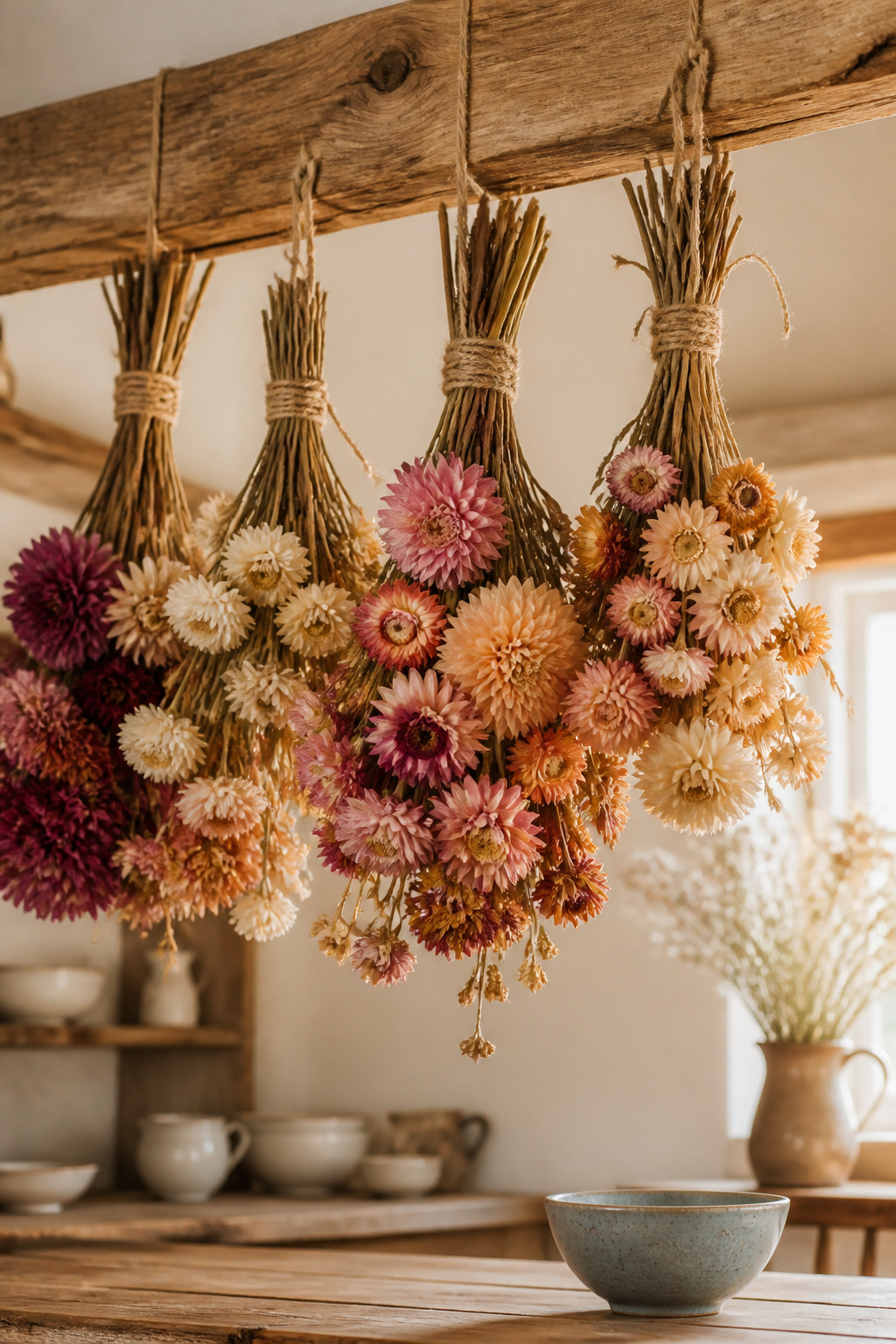
Air-drying your own versus buying arrangements
Drying your own is simple, and it looks it. Bunch about three stems for large blooms like dahlias, or ten to fifteen for small ones like spray roses, and hang from a paper clip in a dry room out of direct sun with good airflow. Strawflowers and globe amaranth dry especially well. Store-bought preserved arrangements are usually glycerin-treated or dyed for uniform color — precisely the machined look home-dried bunches avoid.
Placing them so they look gathered, not staged
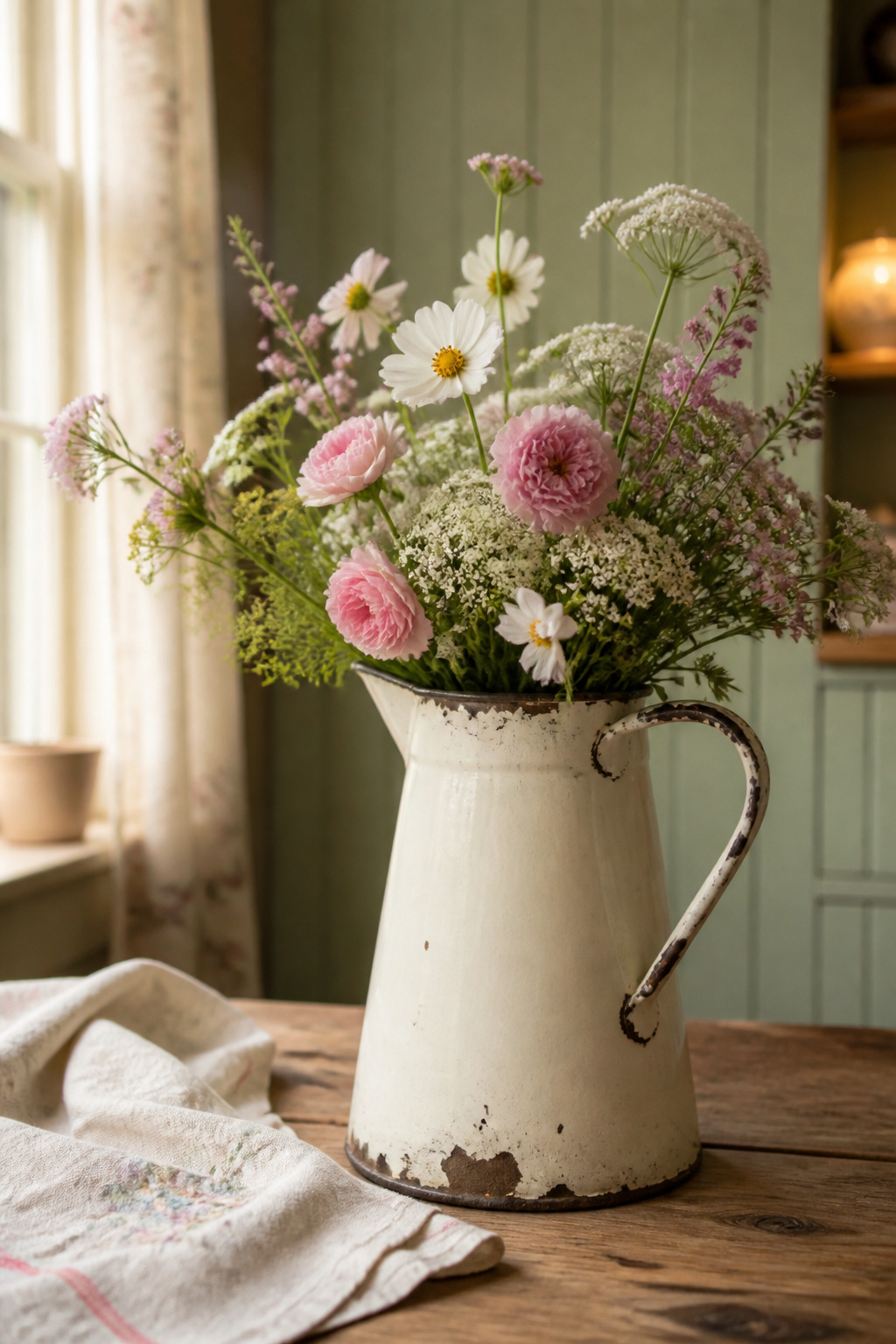
Placement is where most people give it away. Split irregular-height stems across a few mismatched vessels — an old crock, a chipped pitcher, a jam jar — and the flowers look carried in from the garden, not bought in one matched vase. Trailing greenery near a window and a potted herb on open shelving read as ongoing life, not a staged centerpiece.
Seasonal rotation instead of permanent displays
Keep it moving: rotate what dries and shows by season — garden flowers and herbs in summer, wheat or hydrangea in autumn — so the display registers as an ongoing practice, not a frozen prop shelf.
Vintage Linens and Enamelware With Real Wear
Pick up genuine old enamelware and you feel the difference before you see it — the weight alone dates it.
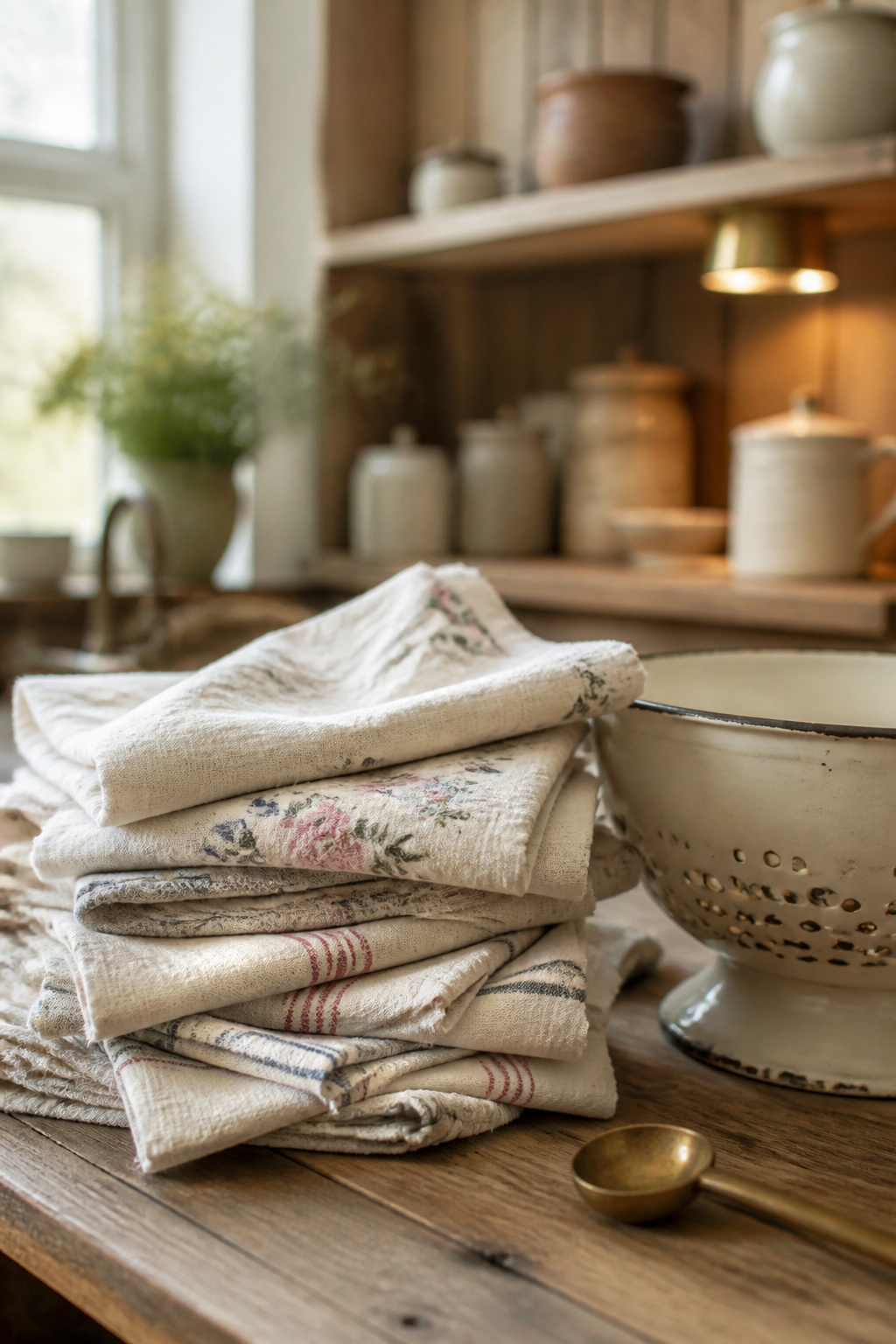
Finding genuine secondhand pieces
Enamelware’s golden age ran from the 1870s to the 1930s; after 1940, plastic, stainless and aluminum replaced it. A few physical tells separate the genuine article from a reproduction dressed to look old.
| Test | Authentic (1870s–1930s) | Reproduction |
|---|---|---|
| Weight | Heavy — thick metal base | Noticeably lighter |
| Tapped sound | Dull thud | Tinny ring (1970s or later) |
| Handles | Riveted, wood or heat-resistant grips | Molded, with plastic knobs |
| Enamel | Real chips, natural rust from use | Flawless finish |
On the textile side, hunt grain and feed sacks, European flax and hemp, ticking stripe and embroidered linens.
Why real wear beats faux-aged finishes
Real wear is asymmetric; applied “aging” is not. Genuine enamelware chips and rusts where a lid sat or a rim knocked the shelf, while faux-distressed finishes are made to a repeatable pattern, so they wear identically everywhere. Unlacquered brass makes the same case: by months four to twelve, handled spots warm to honey while the rest stays bright, a two-tone patina no factory finish reproduces. Sand-through-paint “aging” is a costume, and I will always say so.
In my workshop — a converted carriage house where most of my rescue pieces come back to life — a client once set two cream jugs on the bench and asked which was worth keeping. One had been factory-aged, its edges sanded and its speckling printed on. The other carried a real rim chip and rust blooming where a lid had rested for decades. The reproduction was oddly heavy from a thick modern coat; the real one rang dull and showed wear only where hands had touched it. She kept the real one. They always do.
Mixing eras without looking themed
Don’t chase a matched set — a real collection never was one. Pair a 1930s tea towel with a 1960s enamelware colander; the mismatch signals pieces gathered over years, not bought in one box. Mid-century linens are common and cheap online, so be selective about condition and let the era gaps show.
Mushroom Motifs and Whimsical Details, Used Sparingly
How much whimsy can one kitchen hold before it stops being charming? Less than the marketplace wants to sell you.
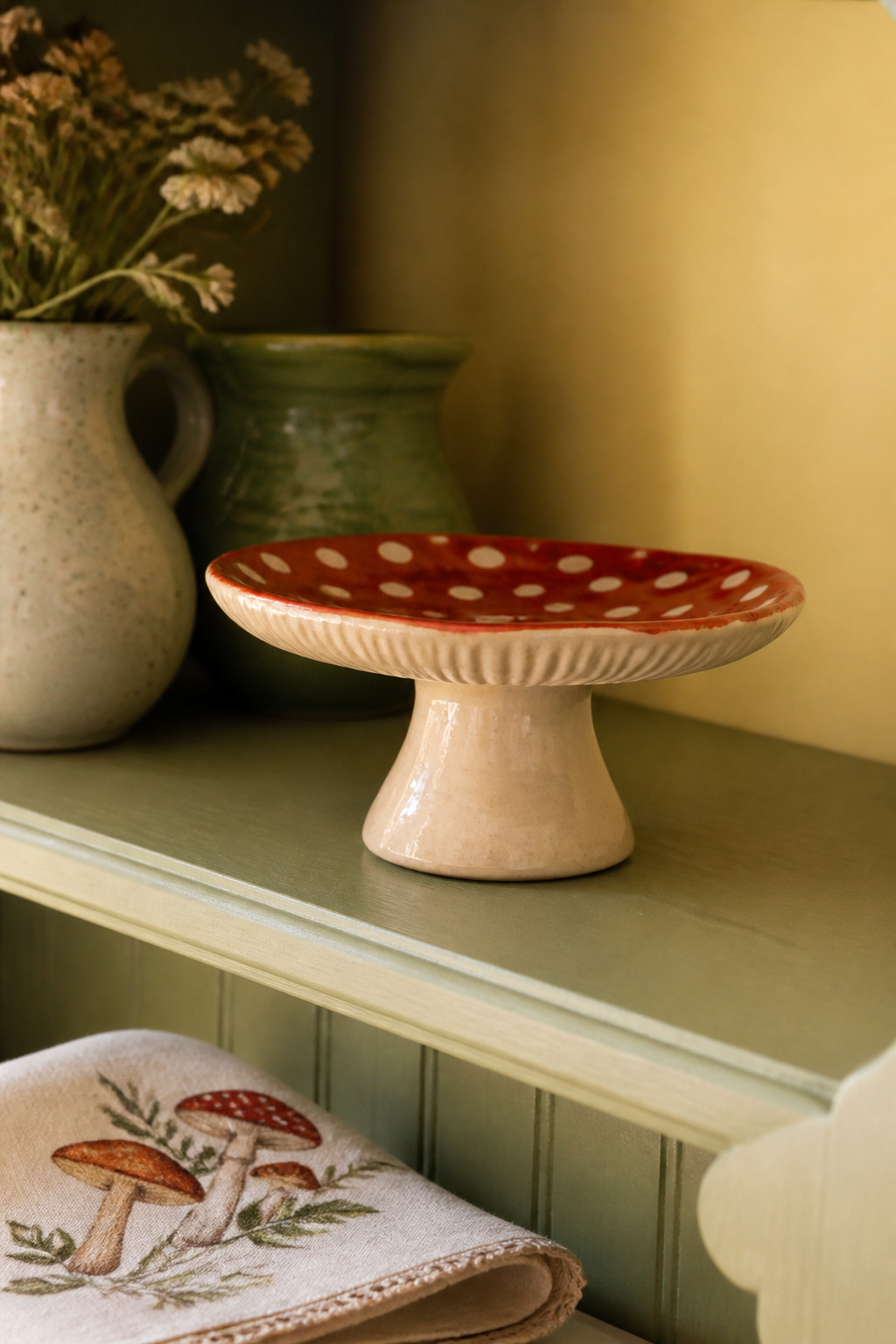
How much whimsy a room can carry before it tips into costume
The discipline is one motif, not a theme. As Sophia Pouget de St Victor of Homes & Gardens puts it, small accents can shift a room’s energy without overtaking it. One motif surface — vintage mushroom-print tea towels — plus one object like a ceramic toadstool dish lands as intentional; the same print on curtains, wallpaper and canisters tips into a themed room.
Where motifs work versus where they don’t
Put whimsy where you can change your mind: textiles, open-shelf ceramics and framed art are cheap and swappable, the right home for a motif you may tire of. Permanent fixtures — tile, cabinetry, grout, wallpaper — are costly and slow to undo. Layer a mushroom-hued cushion or a botanical sketch before you reach for the paint.
The 2026 turn toward “dark cottagecore”
The newest chapter proves the point. Pinterest logged a 915% surge in searches and saves for “dark cottagecore kitchen” in its Spring 2026 Trend Report, and Hunker corroborated the jump at over 900%. The variant trades pastel sage and blush for hunter green, indigo, burgundy and even wine-toned or black cabinets, with wrought iron and worn copper in place of stainless. The throughline from light to dark isn’t color; it’s the same commitment to real, textured materials over glossy surfaces. A butter-yellow kitchen can borrow the mood in small doses, a wrought-iron rail or a deeper floral print, with no repaint.
The English Roots Under the Aesthetic
Strip the filter off cottagecore and you find a working tradition it borrowed from, not invented.
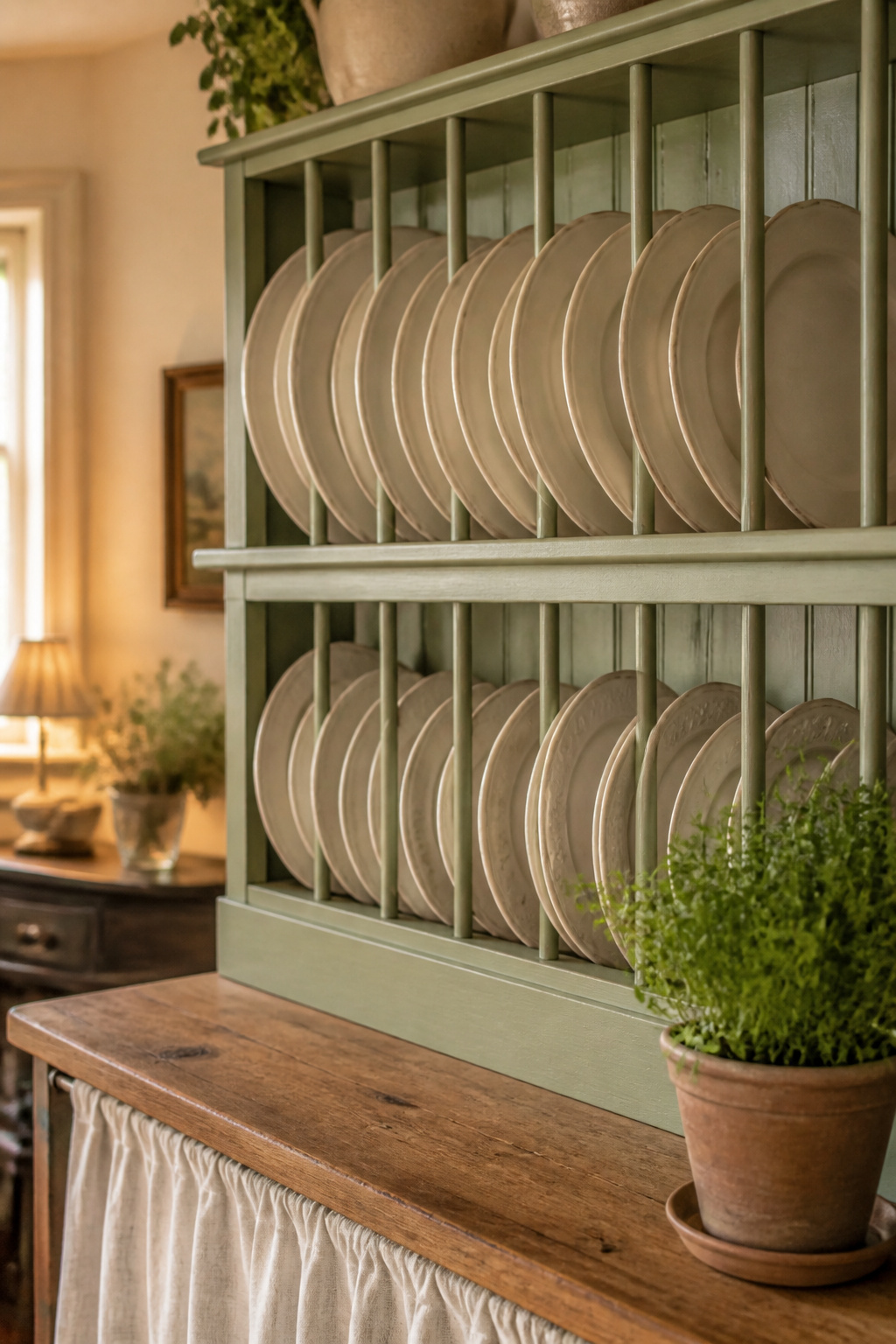
What cottagecore borrowed from real cottage kitchens
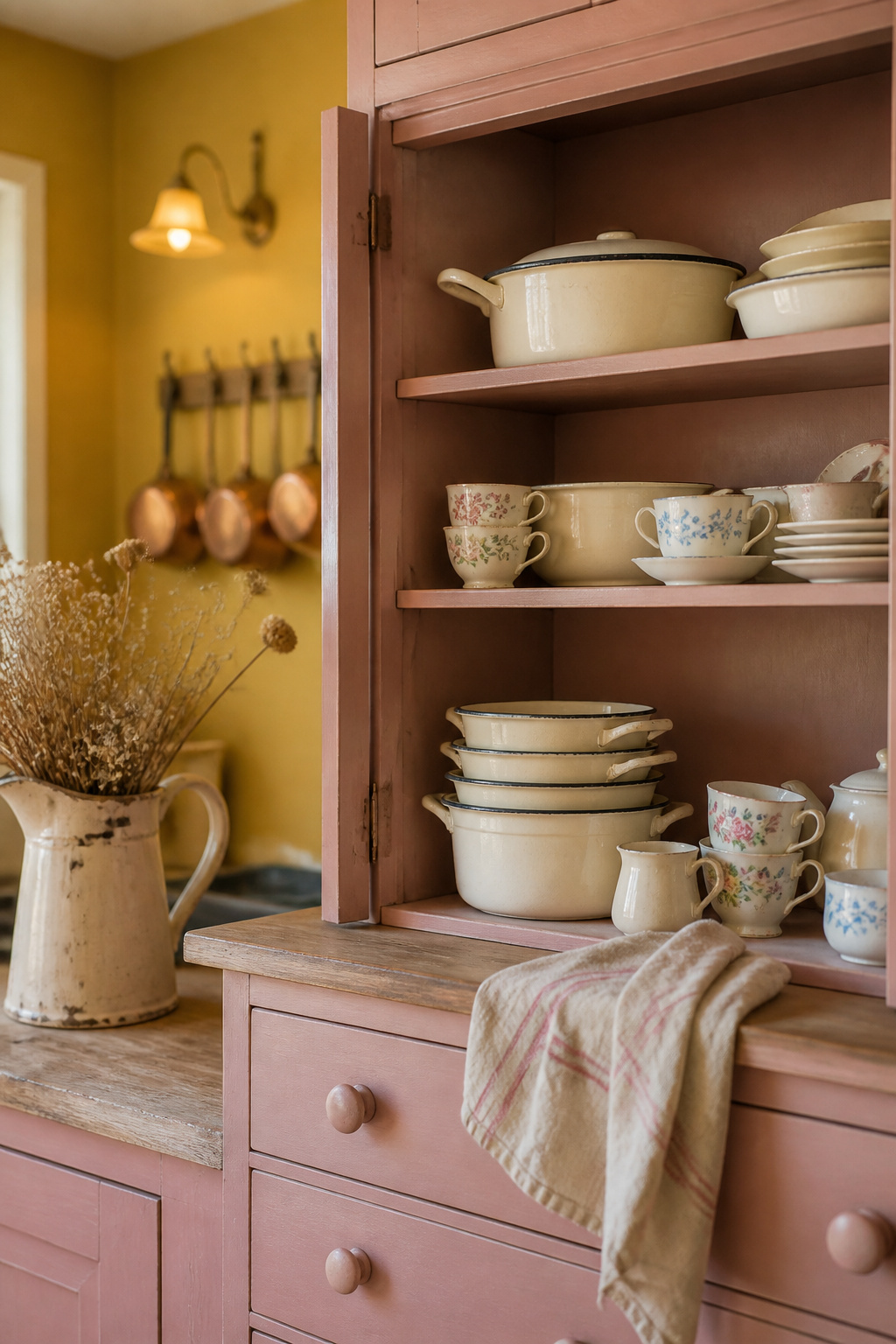
Much of the look descends from real English cottage practice and the Arts and Crafts folk revival. Beside farmhouse style, cottagecore leans worn and romantic where farmhouse stays clean and methodical, keeping wood grain and gold-toned hardware to gather its own patina. The warmth is inherited, not designed for a camera.
Going deeper than the trend
The original features were solutions, not styling: open dressers gave crockery airflow, plate racks let dishes drip-dry, herbs sat on the sill where the cook could reach them. Function came first; the charm was a by-product — the reverse of buying a prop for how it photographs.
Where to look for the authentic version
If you want the real thing, the deeper history is worth chasing: unfitted dressers, in-frame painted cabinetry and heritage colors get a fuller treatment in the English cottage kitchen tradition, the honest source this decorating style is quoting.
Building Cottagecore Decor Without Spending a Fortune
Because cottagecore wants pieces that already show wear, the secondhand market is tilted in your favor.
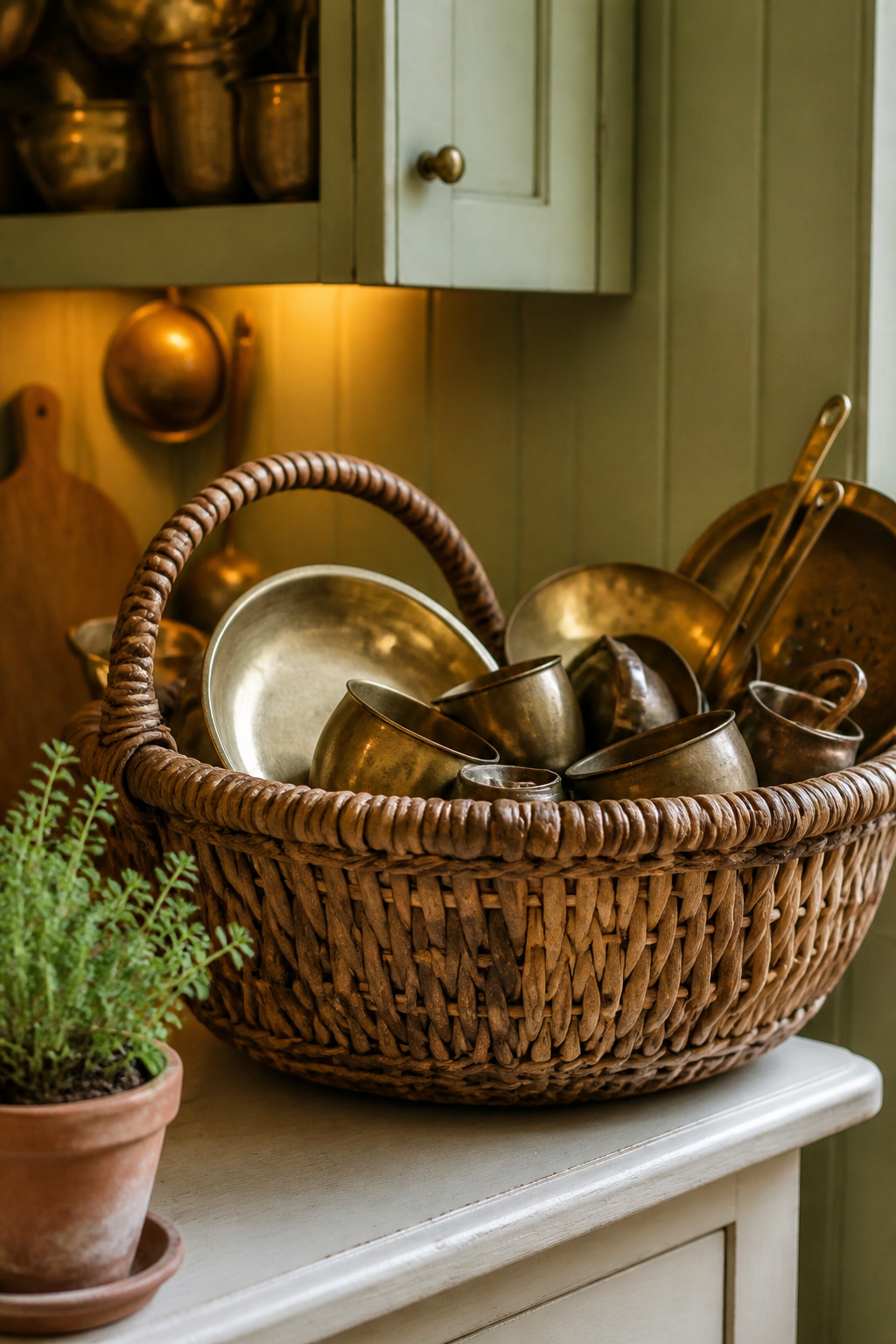
Flea markets, and thrift finds
Flea markets, thrift shops and estate sales are the real hunting grounds, where used pieces cost a fraction of their reproductions.
| Flea-market find | Typical unrestored price |
|---|---|
| Vintage stand mixer (KitchenAid, Sunbeam, Hamilton Beach) | $50–$100 |
| Vintage cookbook | Under $5 to $100+ |
| Hand-carved wood tool (spoon, rolling pin, bread board) | $10–$250+ |
Estate sales run a standard three-day markdown — full price day one, 25% off day two, 50% off the last — so shop day one for the rare piece, day three for everyday decor. Condition alone swings prices five to ten times over, a discount rather than a defect for a look that prizes honest wear. That dovetails with a full plan for thrifty cottage kitchen updates.
What’s worth buying new
Spend new money where safety, not looks, is the issue. Enamelware and ceramics made before roughly 1971 to 1980 — especially bright orange, yellow or red glazes — can carry hazardous lead: there were no federal lead limits on dinnerware before 1971, and chips or cracks harbor bacteria and expose bare metal. Treat any unverified vintage food piece as display or dry storage only, repurpose damaged ones as planters, and buy new for anything meeting hot or acidic food.
A realistic starting budget
Add up a first corner — two or three linens, one piece of enamelware, a dried bunch, one small ceramic accent — and you land somewhere around $50 to $150 as an estimate, not a fixed figure, depending on condition and source. You’re in good company: vintage and antique pieces made up about a third of everything interior designers sourced in 2025. Cosmetic moves — paint, swapped hardware — carry the rest, the logic behind the broader cottage kitchen ideas this fits into.
None of this asks you to furnish a film set. The honest version is easier than the costume version — it lets things you already half-own, a chipped jug, a hemmed linen, flowers past their vase life, do work a printed prop never could. Start with one corner: a shelf or windowsill, one real piece of enamelware, one bunch you dried yourself. Add the next thing when you find it. A kitchen built that way keeps its character, because every object in it is genuinely yours.
FAQ
Is cottagecore kitchen decor expensive?
Not necessarily. The look leans on cosmetic changes — paint, swapped hardware, thrifted styling — over renovation, and flea-market finds like vintage mixers, wood tools and cookbooks often run $5 to $100. A starter corner of a few linens, one enamelware piece, dried flowers and a small ceramic realistically lands around $50 to $150.
What’s the difference between cottagecore and farmhouse decor?
Farmhouse favors tight neutrals — white, cream, tan, gray — with streamlined, mixed-metal hardware and minimal ornament. Cottagecore embraces moodier hues, gold-toned hardware and visible natural patina, and it leans into florals, wild foliage and vintage keepsakes. Farmhouse feels clean and methodical; cottagecore feels worn, romantic and a little kitschy.
What is “dark cottagecore” and does it work in a kitchen?
Dark cottagecore swaps the pastel sage, blush and cream for moodier hunter green, indigo, cobalt or burgundy, often on wine-toned or black cabinetry paired with wrought iron and worn copper. It’s a real 2026 trend — Pinterest logged a 915% surge in searches. It works as an accent too: one wrought-iron rail borrows the mood without a repaint.