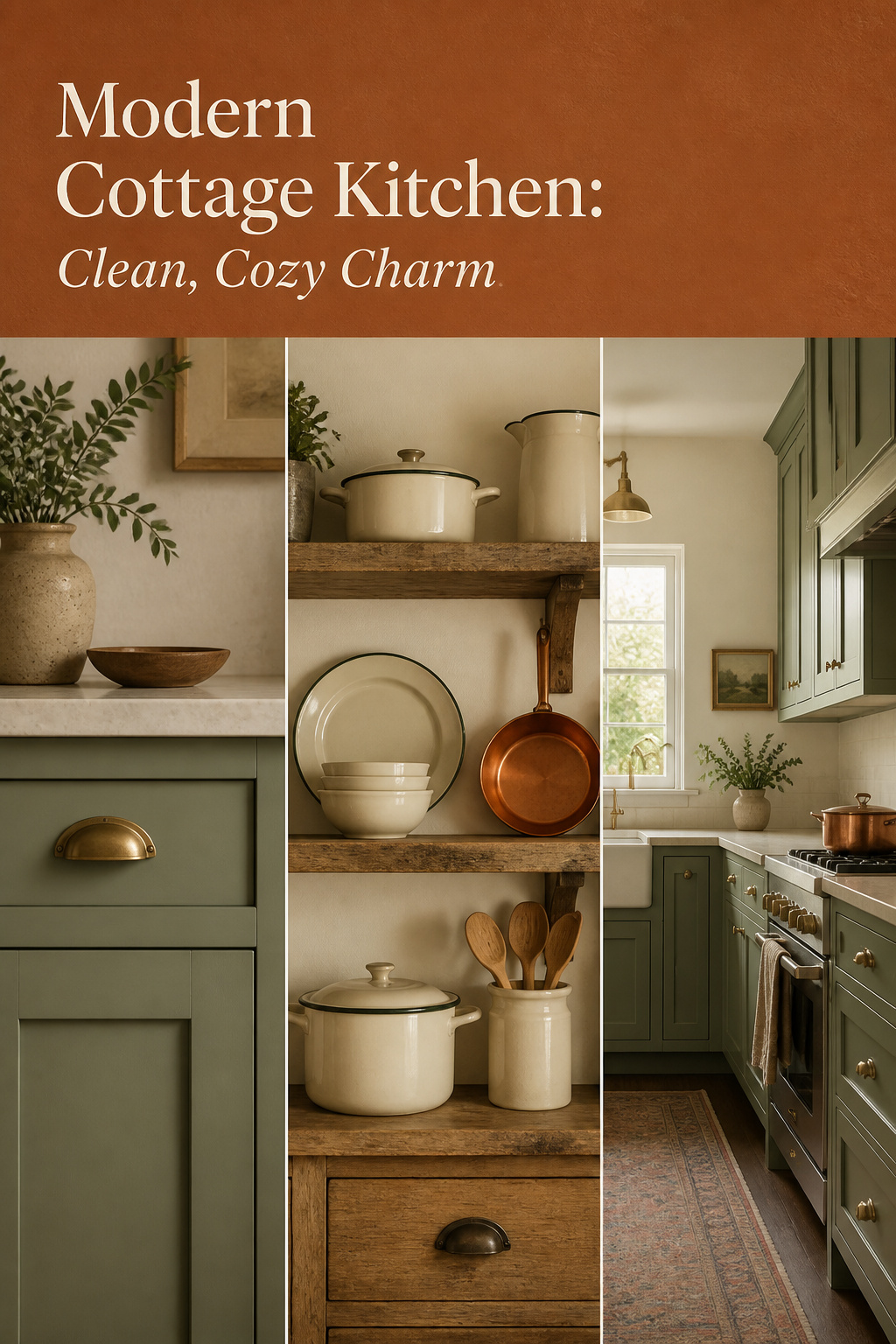
You like a cottage kitchen for its warmth, but the version on most inspiration boards comes loaded: florals on the tile, a collection on every shelf, nothing matching on purpose. You want the character without the visual noise, and somewhere you picked up the idea that the moment you calm it down, the room goes cold. A modern cottage kitchen is the proof it does not. It keeps the sage, the brass and the wood and drops the clutter, concentrating warmth into fewer, better things.
TL;DR
- Modern cottage keeps cottage’s warm materials — farmhouse sink, open wood shelving, natural wood, one kept detail like shallow-groove beadboard — and drops the collected clutter; start by simplifying to a flat or narrow-rail shaker front.
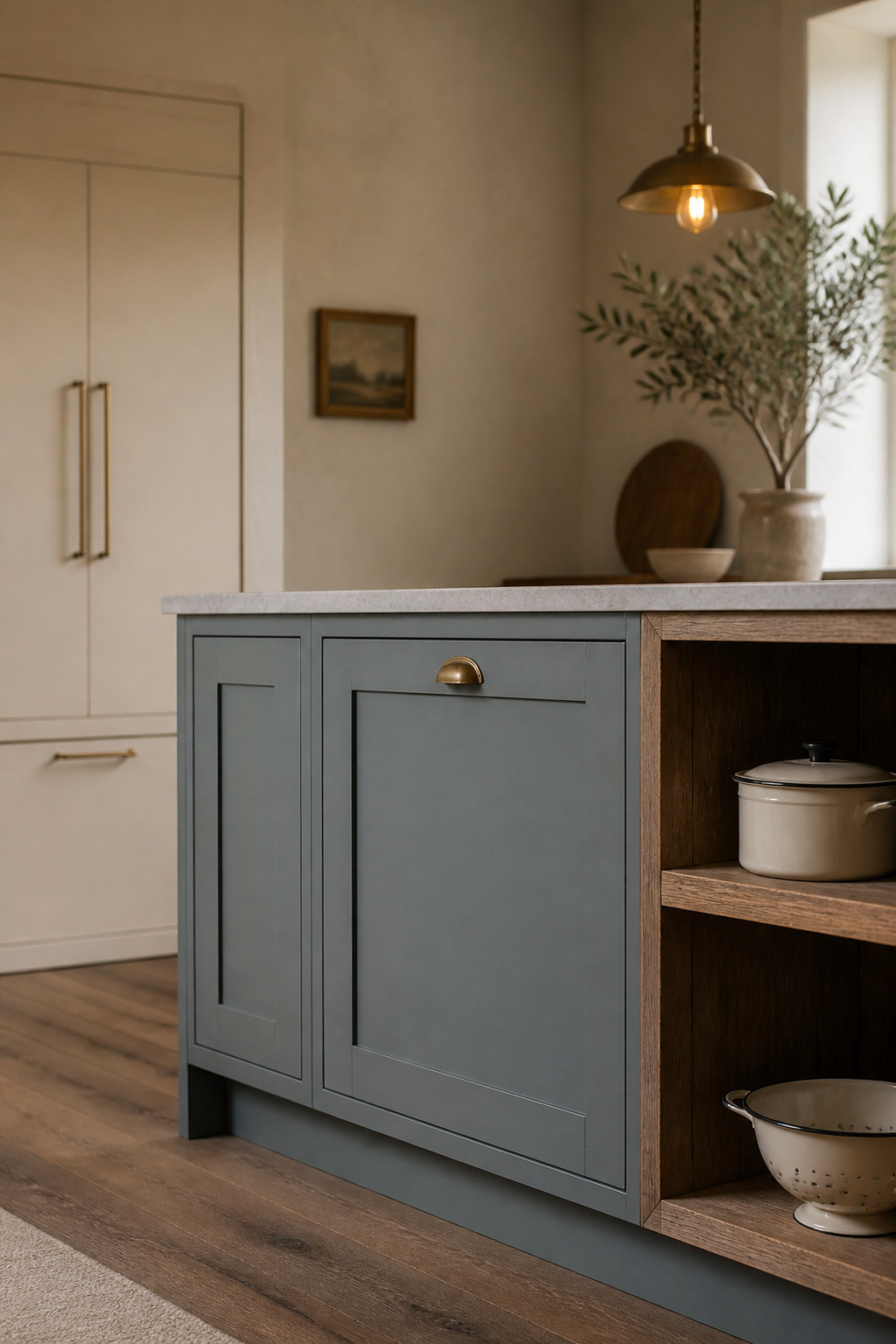
- Choose warm, low-glare hardware — champagne bronze, aged or unlacquered brass — over matte black, which pulls a painted shaker kitchen toward modern farmhouse; scale pulls to the drawer and match your existing 96mm or 128mm hole spacing.
- Spend on the cheap warmth first: paint and hardware return about 90% of cost, a major upscale remodel only 40-55%. Real wood tone, one honed stone and 2700-3000K bulbs keep minimal from going cold.
Cottage Warmth Without the Clutter
Modern cottage is not a stripped-down cottage. It is an edited one — the warmth stays, the volume comes down.
What modern cottage keeps from the tradition
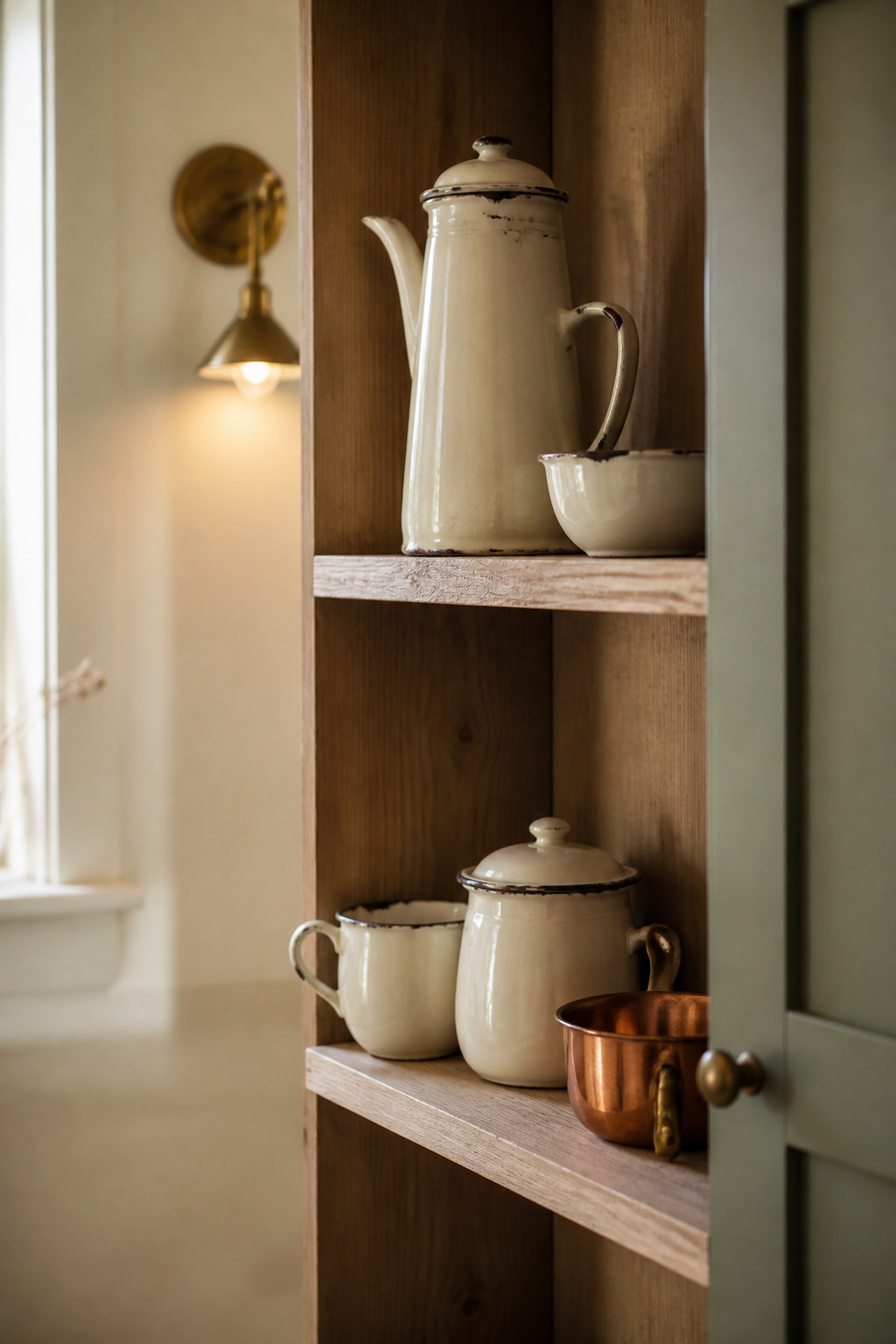
Keep the backbone you cannot fake: designer Benji Lewis advises retaining original character — ceiling beams, a fireplace, original wood or flagstone floors. Around it the warm vocabulary survives — a farmhouse sink, open wood shelving, natural timber, a few genuinely old pieces among the new, each doing daily work and warm while it does it.
What it deliberately leaves out
What goes is the noise: layered collections, busy antiques, pattern stacked on pattern until the eye has nowhere to rest. Montana Labelle marks the shift — “Gone are the days of dark wood cabins with dimly lit interiors” — and the palette narrows to soft whites and greys with one sage or dusty-blue accent, not a full scheme.
The false choice this style resolves
Most people think they must pick: cosy but cluttered, or clean but cold. It is a false choice. Warmth comes from material, tone and light, not the count of things on the counter — swap glossy white for wood, polished stone for honed, a cool-white bulb for a warm 2700K one, and a near-empty room still feels held.
Simplifying the Shaker Front
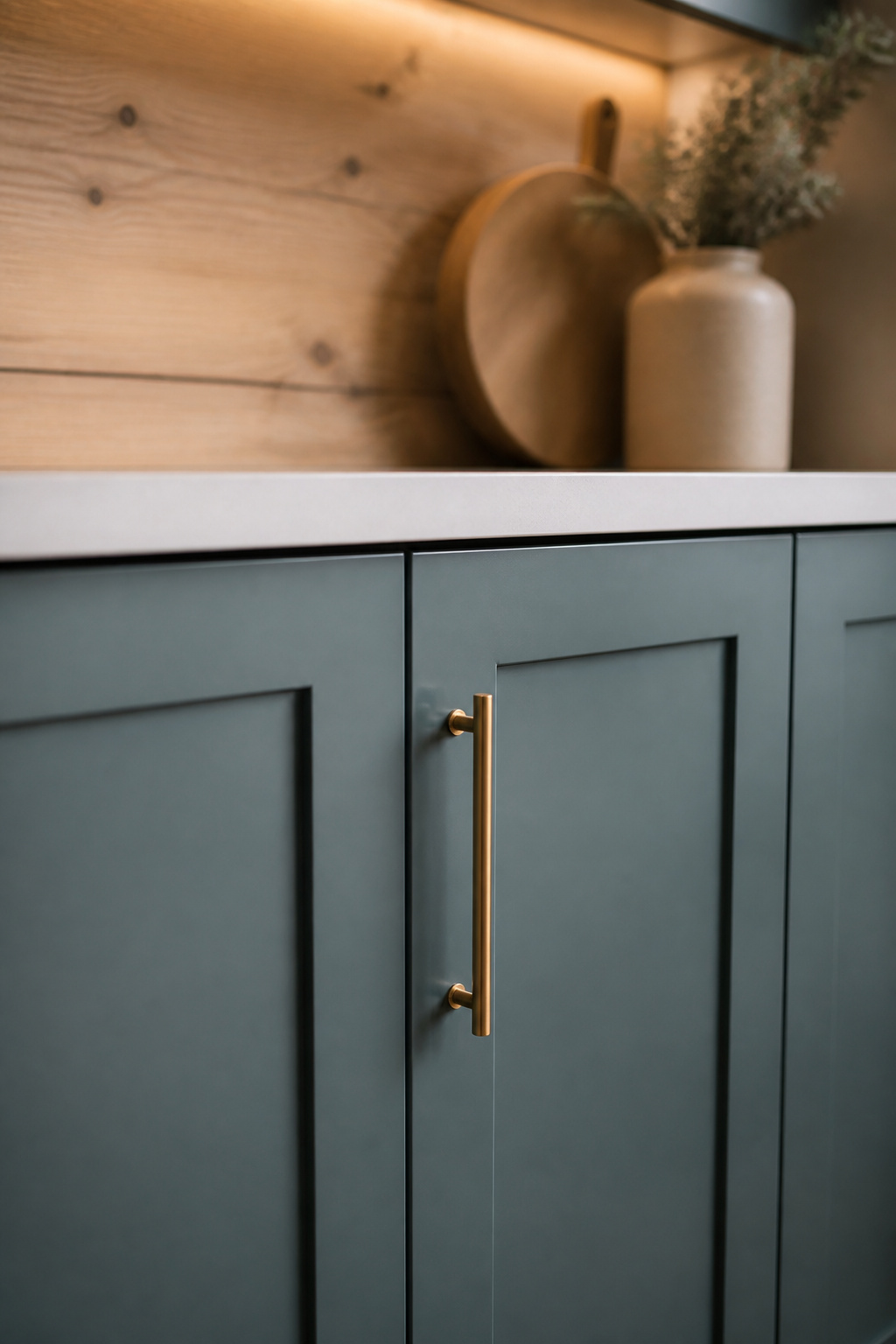
The shaker door sits mid-spectrum on cost — about 10-15% more than a flat slab, 10-20% less than a raised panel — exactly the register between plain and ornate that modern cottage wants.
Panel proportions that read as calmer
The move is subtraction. A raised panel is the formal register you are narrowing away from; a flat slab is the calmest surface there is. Run a shaker’s rails and stiles narrower and it approaches that calm slab while keeping the frame that still says cottage — a slimmer version of the door already there, not a new style.
Where a flat-front door still feels warm
A flat door need not feel hard, because warmth comes from finish, not profile. Choose light oak or walnut over glossy white and set honed rather than polished stone beside it, and the flat surface still reads as tactile — doing more for a calm kitchen than an ornate door straining to be noticed.
One detail worth keeping from the ornamented version
Keep one ornamented detail: beadboard. Phoebe Hollond calls its feel “almost soulful,” the soul a flat front gives up. Run it on a single island or tall cabinet, never wall to wall, in a shallow modern groove — easier to clean, and calmer up close. One kept detail, placed once, stops restraint from tipping into a showroom.
Choosing Quiet Hardware
The common hardware mistake is defaulting to matte black because everyone knows it; on a painted shaker front it pulls the room toward modern farmhouse, the wrong sibling.
Finishes that don’t compete with the wood
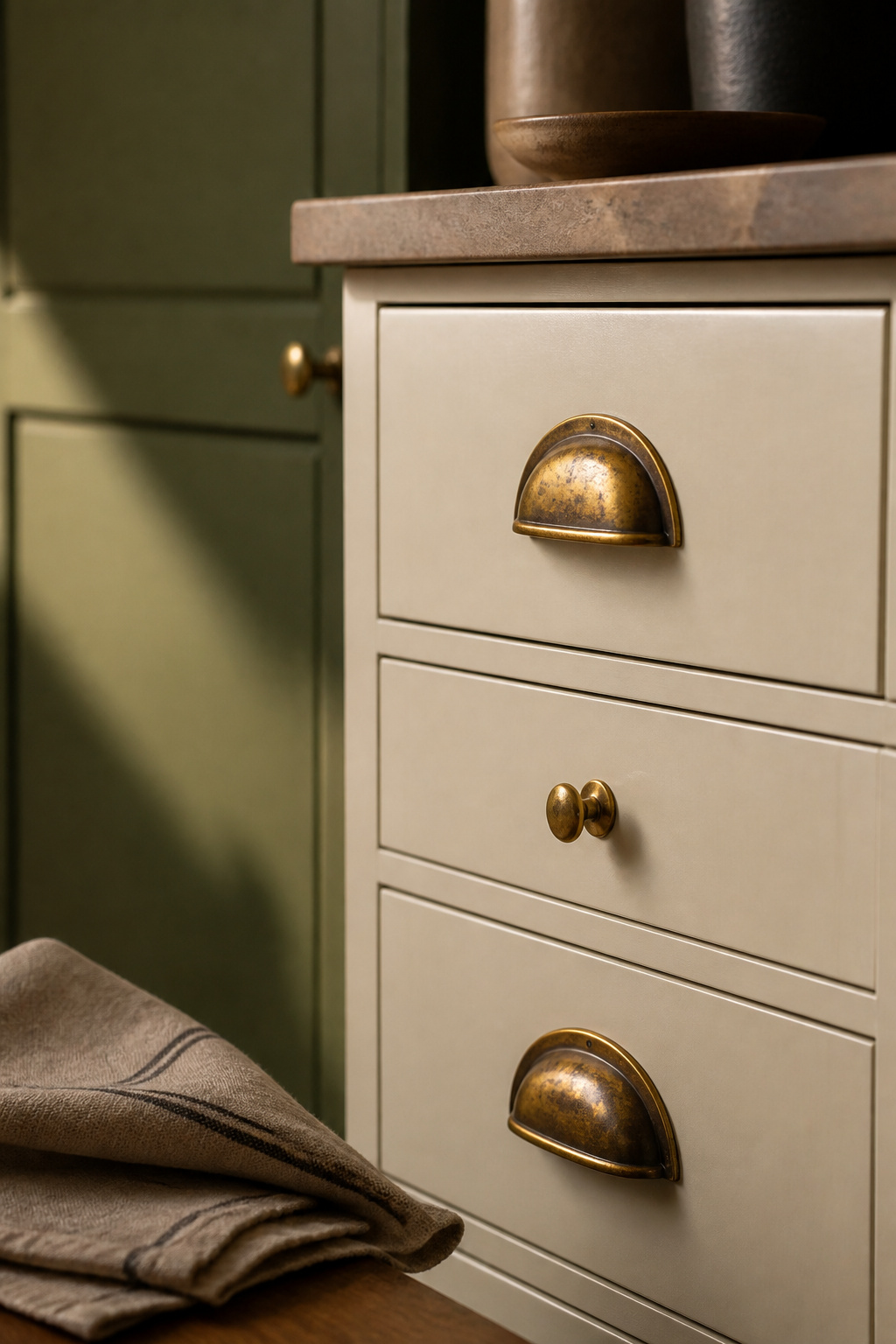
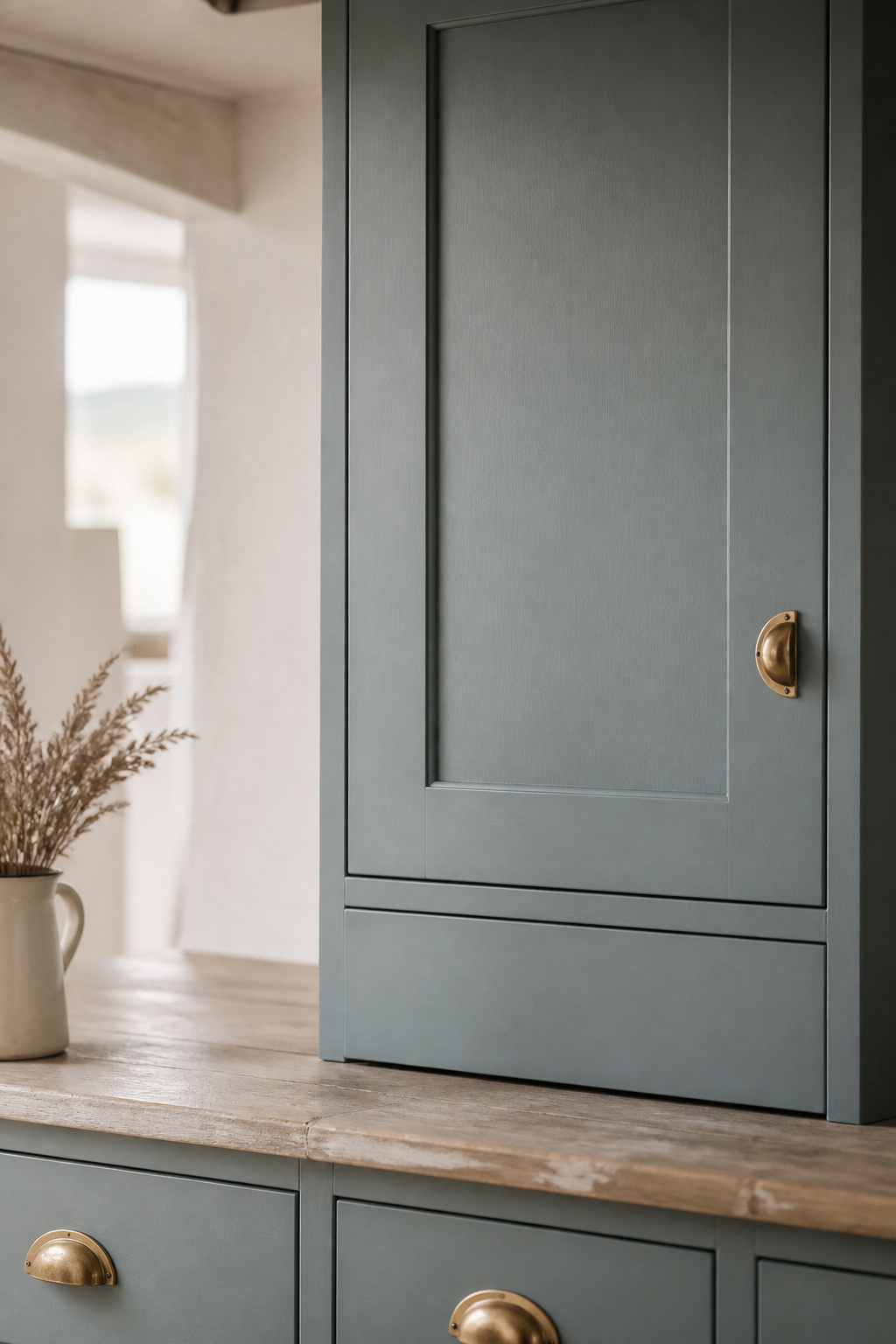
Reach for warm, low-glare metal instead. Andrew Saladino names champagne bronze, aged brass and unlacquered brass as the 2026 finishes that “add warmth without feeling too yellow or flashy.” Unlacquered brass improves with use, shifting from a two-tone contrast between handled and untouched spots at months four to twelve to an even golden-brown patina by year one to three.
Sizing hardware down without losing function
Scale hardware to the piece — long pulls on wide drawers and tall pantry doors, a knob or medium pull on a standard door. Check the holes first: existing pulls sit at 3-inch (76mm) or 3.75-inch (96mm) centres, and builder-grade clusters at 96mm and 128mm, so matching spacing saves you drilling and filling a run you never meant to touch.
Where to spend and where not to
Knobs run $1-25 and pulls $5-50, so spend the extra on finish and weight, not a novel shape. A heavy unlacquered pull feels solid in the hand daily; a clever silhouette stops being clever by the second week. For the depth mixed metals give, mix brass with a little unlacquered copper rather than adding black.
Where to Spend So Minimal Doesn’t Go Cold
My grandparents’ summer cottage on the Stockholm archipelago — unpainted pine walls, one open shelf of everyday crockery, oil lamps for the evenings — is the warmest room I know, and my reference whenever I decide what “enough” looks like. Swedish has a word for that amount: lagom, enough and no more. The warmth was in the pine and the daylight, never the quantity. A modern cottage kitchen works the same way: concentrate the spend, don’t spread it.
Open wood shelving beside integrated appliances
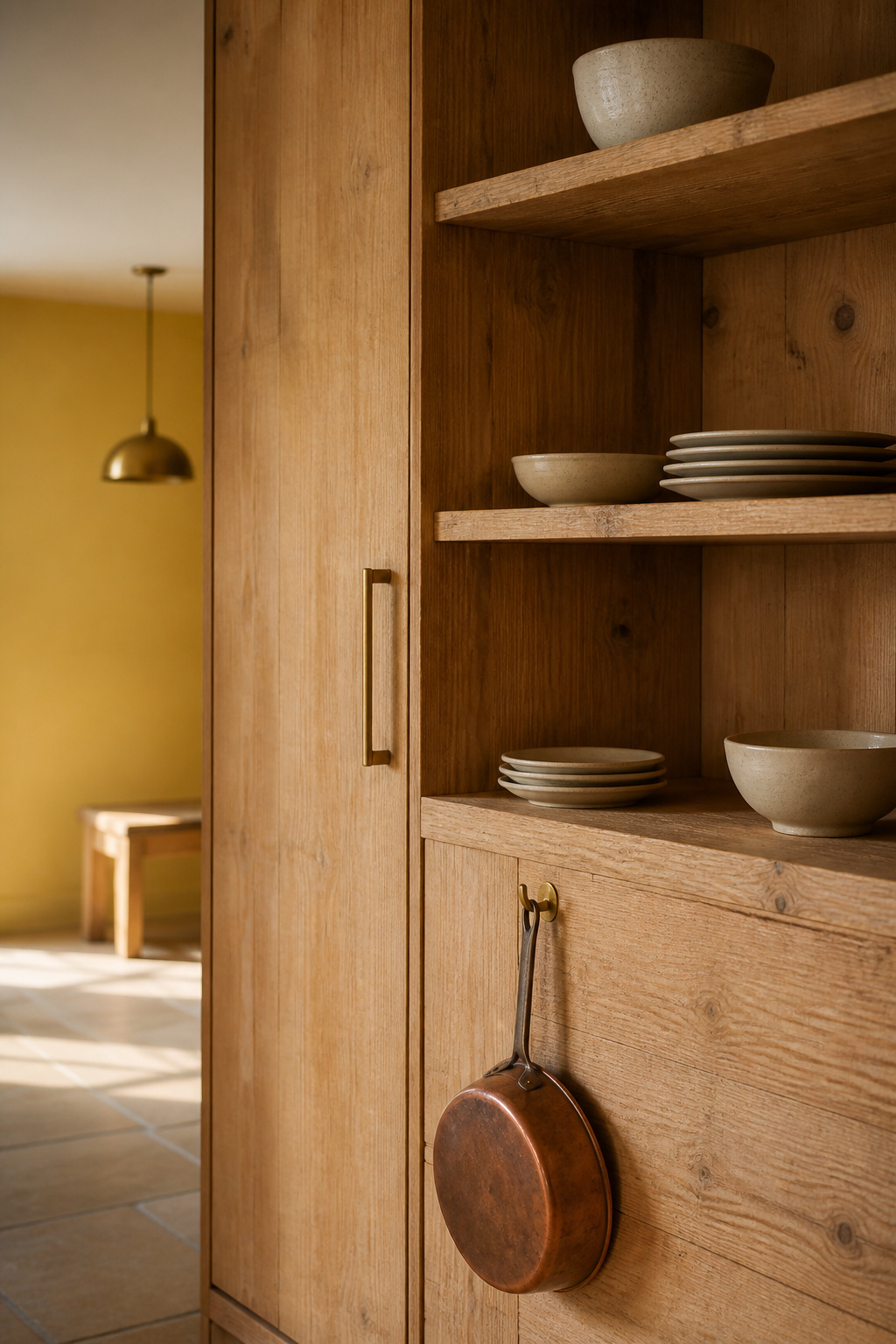
Start with one run of open wood shelving beside the integrated appliances. In one recent cottage renovation the owner pulled the upper cabinets for open shelving purely to reclaim light, then warmed the white-and-red room with unlacquered brass taps, pulls and a flush-mount fixture. The trick beside a flush fridge panel is to style the shelf as a few practical sculptures — handmade ceramics, a couple of boards — not the whole cupboard.
The one or two natural materials that carry the warmth
The highest-return move is real wood where a hand lands plus honed stone over polished — soapstone, travertine or matte quartz, which absorb light instead of throwing it back, and that is most of why they feel warm. Then let three or four shades of one warm neutral — bone, oatmeal, a soft white — do the work pattern used to do.
Diminishing returns: where extra spend stops helping
The numbers back the instinct. Reported cost-versus-value estimates:
| Upgrade tier | Reported cost-to-value return |
|---|---|
| Paint and hardware | ~90% |
| Cabinet refacing | ~80% |
| New countertops | ~70% |
| Minor remodel | 75-80% |
| Major upscale remodel | 40-55% |
The smaller the tier, the more of its cost comes back — spend at the top of this table before the bottom. Once a kitchen is modern and functional, marble over quartz or fully custom over semi-custom stops changing how it feels. Treat the figures as estimates, but the direction is not in doubt.
A Modern Cottage Kitchen in a Small Space
That same cottage renovation — a 13-by-9-foot galley in Door County, Wisconsin — fits a full-size stove, a dishwasher and a six-foot dining table, because the owner moved the refrigerator to an adjoining mudroom and let restraint do the rest.
Why restraint suits tight footprints
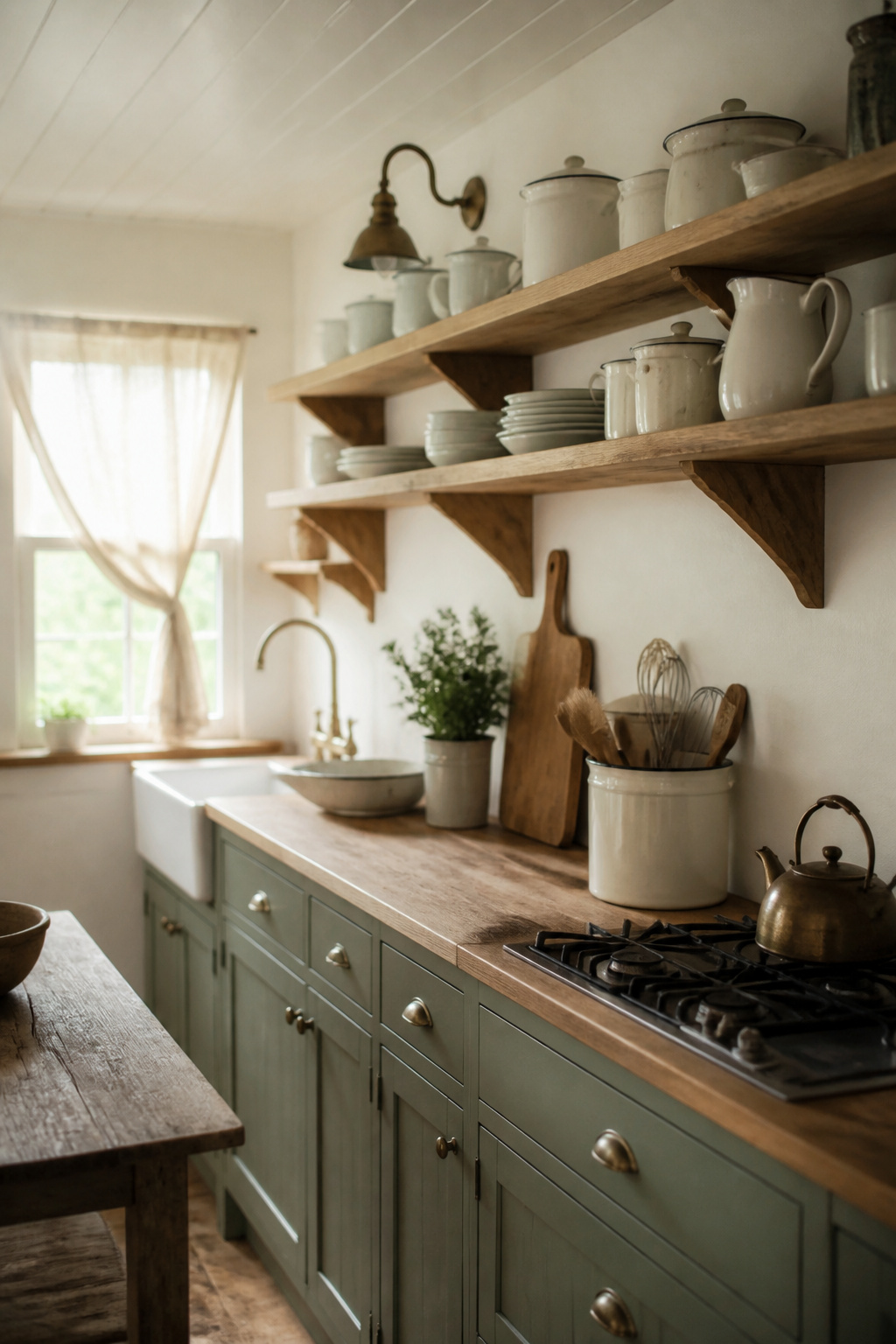
Restraint works hardest where space is tightest. Swapping upper cabinets for open shelving is what maximised the light there — the discipline that feels like calm in a large room feels like space in a small one. A small kitchen needs more restraint, not less, because there is less wall and counter to absorb a mistake.
Layout moves that carry over directly
Two moves carry over. Build storage into the seating — that owner turned one wall into a banquette with two drawer rows beneath for baking pans and rarely used things. And if you use beadboard, run it horizontally, so the lines lengthen the room. Neither is decorative; both buy back space you would otherwise lose.
What to skip in a small room
Skip the collected-antiques layer, which turns to clutter fastest where no spare surface can carry it. Skip the deep, ornate beadboard groove too, since it holds dust and shadow in a tight space. If a small footprint is your situation, start with these small cottage kitchen layouts and bring the same restraint to them.
Modern Cottage by the Coast
So how close is modern cottage to a coastal kitchen? Close enough to confuse, different enough to choose deliberately.
Where the two styles’ palettes overlap
The palettes almost rhyme: coastal builds on white cabinetry with a soft blue-grey or sea-foam accent, modern cottage on the same light-neutral-plus-one-accent structure with sage or dusty blue. Both favour light woods over heavy ornament, which makes coastal modern cottage’s climate-facing cousin — the same restraint, a different accent.
Materials that work for both restraint and salt air
The shared instinct is honest materials chosen for how they wear. Coastal leans on quartz over marble and on glass tile — durable, still light and uncluttered — the direction modern cottage already leans with its honed-quartz preference. How those choices hold up against actual salt air is its own subject, and the coastal cottage kitchens guide takes it on properly.
Choosing between them
If you live with humidity or salt air, that decides it — coastal’s materials exist to handle conditions an inland kitchen never meets. If climate isn’t in play, the choice comes down to accent and texture: dusty blue-green and reclaimed pine, or sea-foam and rattan. Either way the restraint is the same, and either way the first move is identical — simplify one door profile and pick one warm metal to carry the room. Do those two things and your modern cottage kitchen is already underway. For how every cottage-kitchen decision fits together, the full guide to cottage kitchen style is the place to start.
FAQ
How is modern cottage kitchen style different from modern farmhouse?
Both are pared-back, but palette and hardware separate them. Modern farmhouse leans on black-and-white contrast and barn touches like shiplap; modern cottage keeps a softer register — muted cool neutrals with a sage or dusty-blue accent, warm brass over matte black, and more collected vintage than stark contrast. It is farmhouse’s warmer, quieter evolution.
Can a modern cottage kitchen still feel cozy?
Yes — cosiness is half the point of the style, not a casualty of it. The warmth comes from technique rather than clutter: light wood tones instead of glossy white, honed rather than polished stone, and 2700-3000K bulbs. Those three moves are what keep a pared-back kitchen from ever feeling cold or empty.
What colors work best in a modern cottage kitchen?
Build on cool-toned neutrals — soft whites and muted greys — as the base, then add a single muted jewel accent rather than a full colour scheme. Sage green and a rich, dusty blue are the accents that keep the neutral base from going flat. Hold any black or darker note to a small hint.