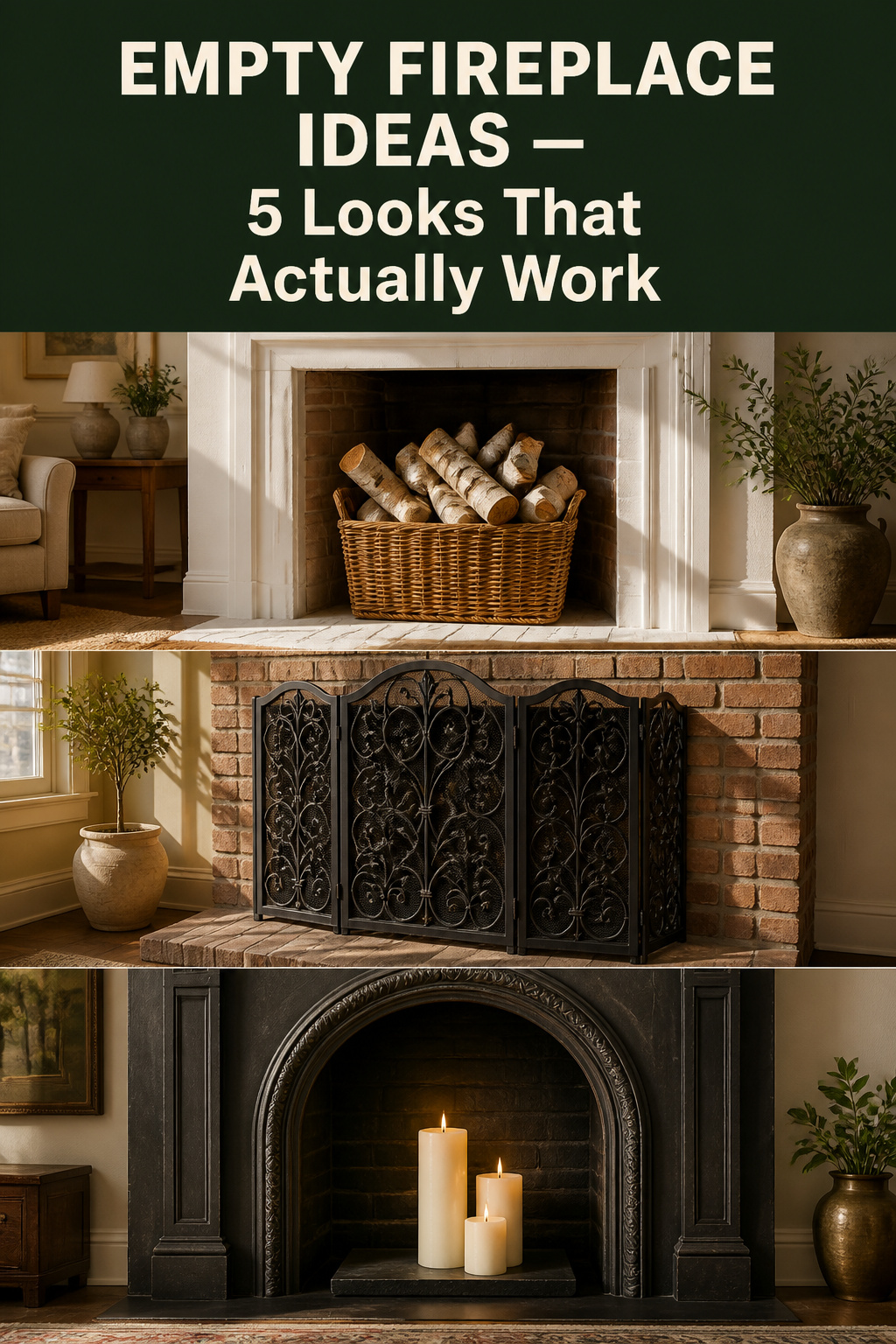
The cheapest empty fireplace ideas here cost about $20 and take ten minutes. The most involved — peel-and-stick tiles inside the firebox — runs $30 to $90 and a Saturday afternoon, including the bit where you re-warm the three tiles that lifted at the corners. That’s the honest range. Most “unused fireplace” lists skip the costs and the catch, so before the candles and the logs, two checks decide whether any of this is safe at all.
TL;DR
- A candle cluster is the cheapest start ($20–$80, no tools); a decorative screen is the biggest single-purchase change ($35–$150); a stacked-birch look runs $45–$70 real or $20–$45 faux.
- Sweep soot from the fireback first, and never seal the chimney at both ends — a retired flue should be capped or blocked at one end only, or trapped moisture causes damp and mould.
- Every option here is removable without tools, so it stays renter-safe; lean things rather than fixing them, and skip peel-and-stick tiles in any gas or electric firebox that gets hot.
Before You Style It: Check the Firebox Is Actually Safe to Decorate
Inspiration boards skip this part, and it’s the part that wrecks things later. Five minutes here saves you a damp wall or a scorched tray.
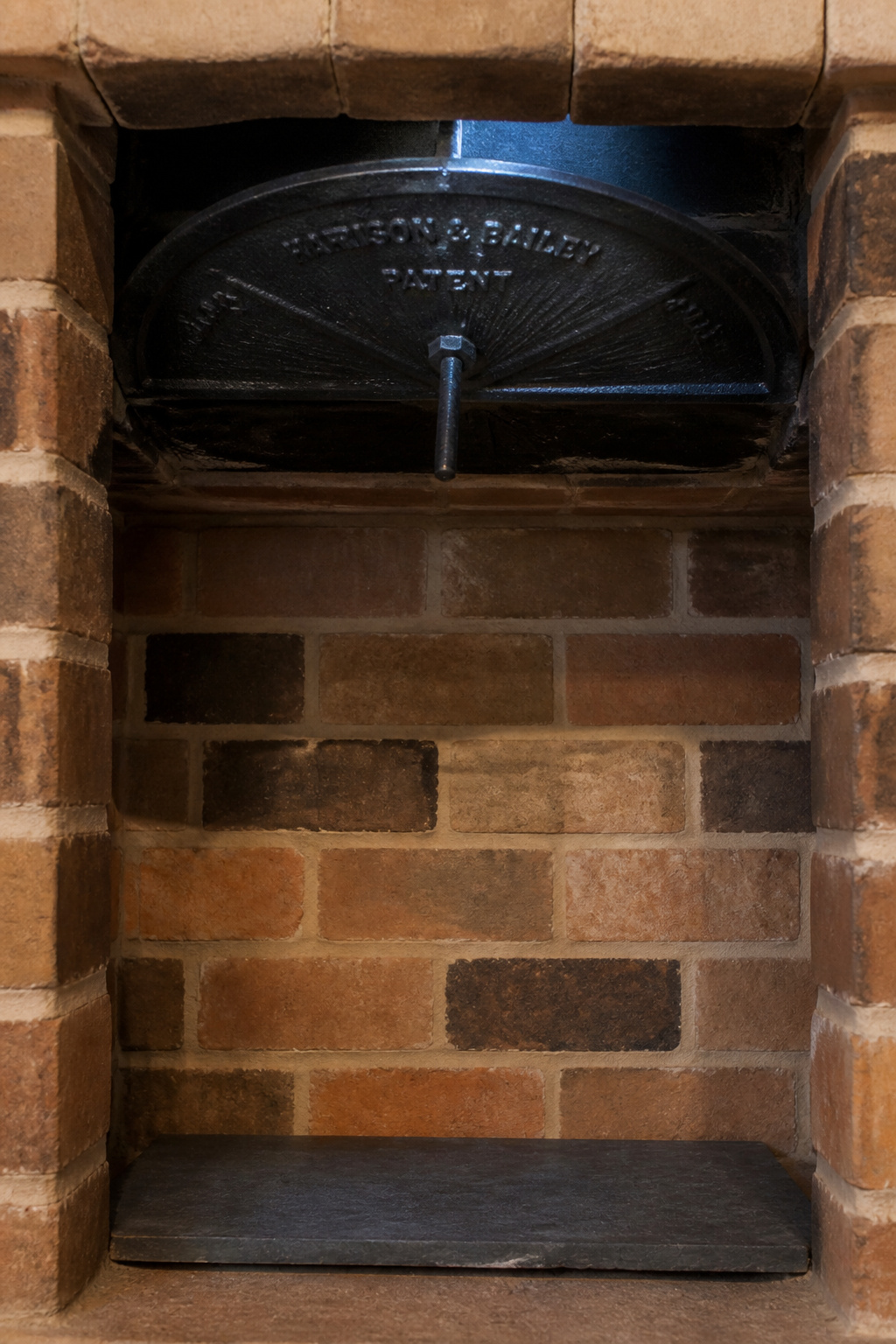
Flue open or closed? The one check that matters before anything goes in
Shine a torch up into the firebox. An open space up the flue means the damper is open; a solid metal plate blocking the view means it’s closed. Here’s the rule that catches people out: a retired chimney should be sealed at the top or the bottom, never both. Chimney Solutions, a certified chimney firm, put it plainly — most unused-chimney problems are moisture problems, and sealing both ends traps damp that rots brick and mortar and bleeds into your interior walls.
Soot, moisture, and drafts: quick fixes before you place a single candle
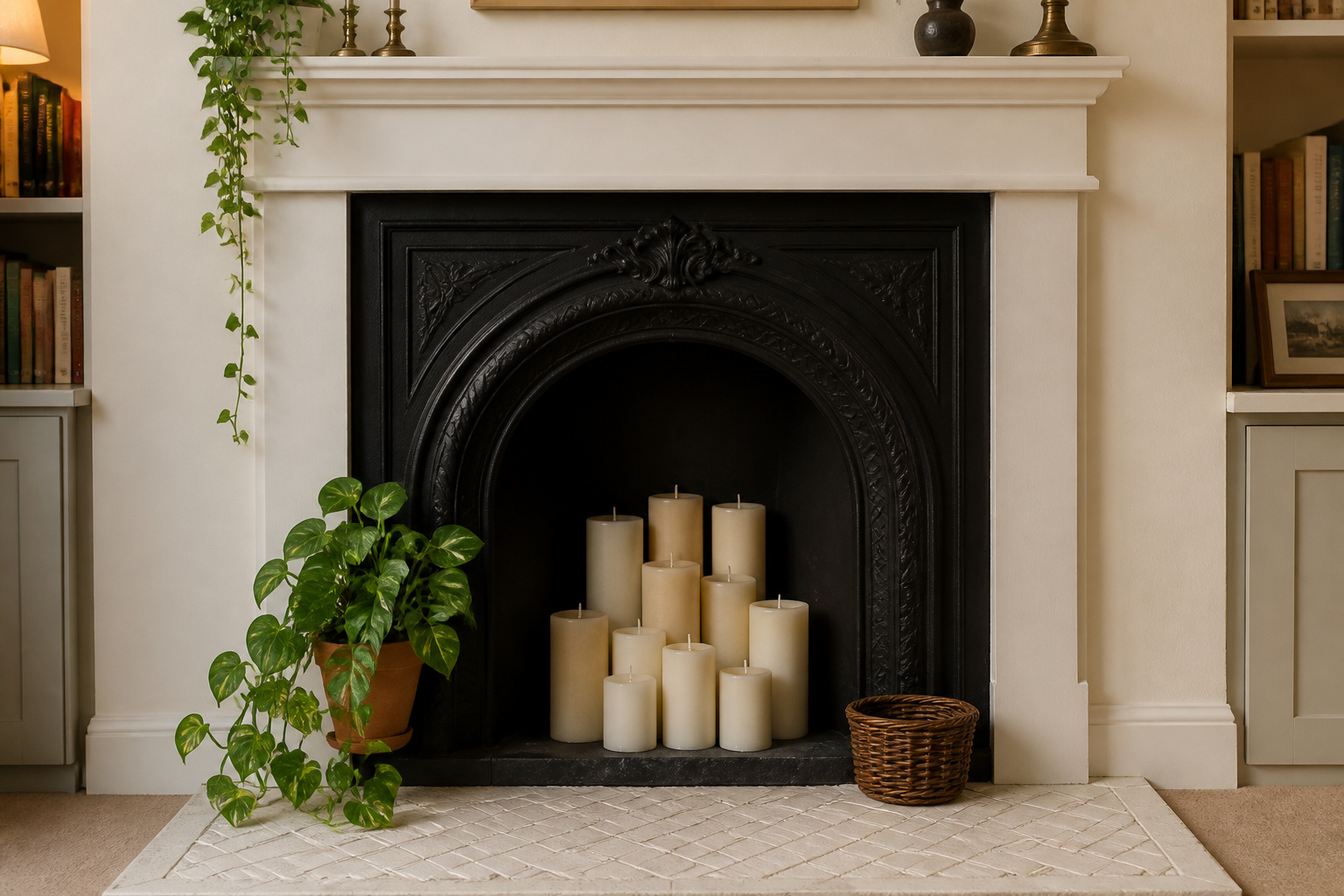
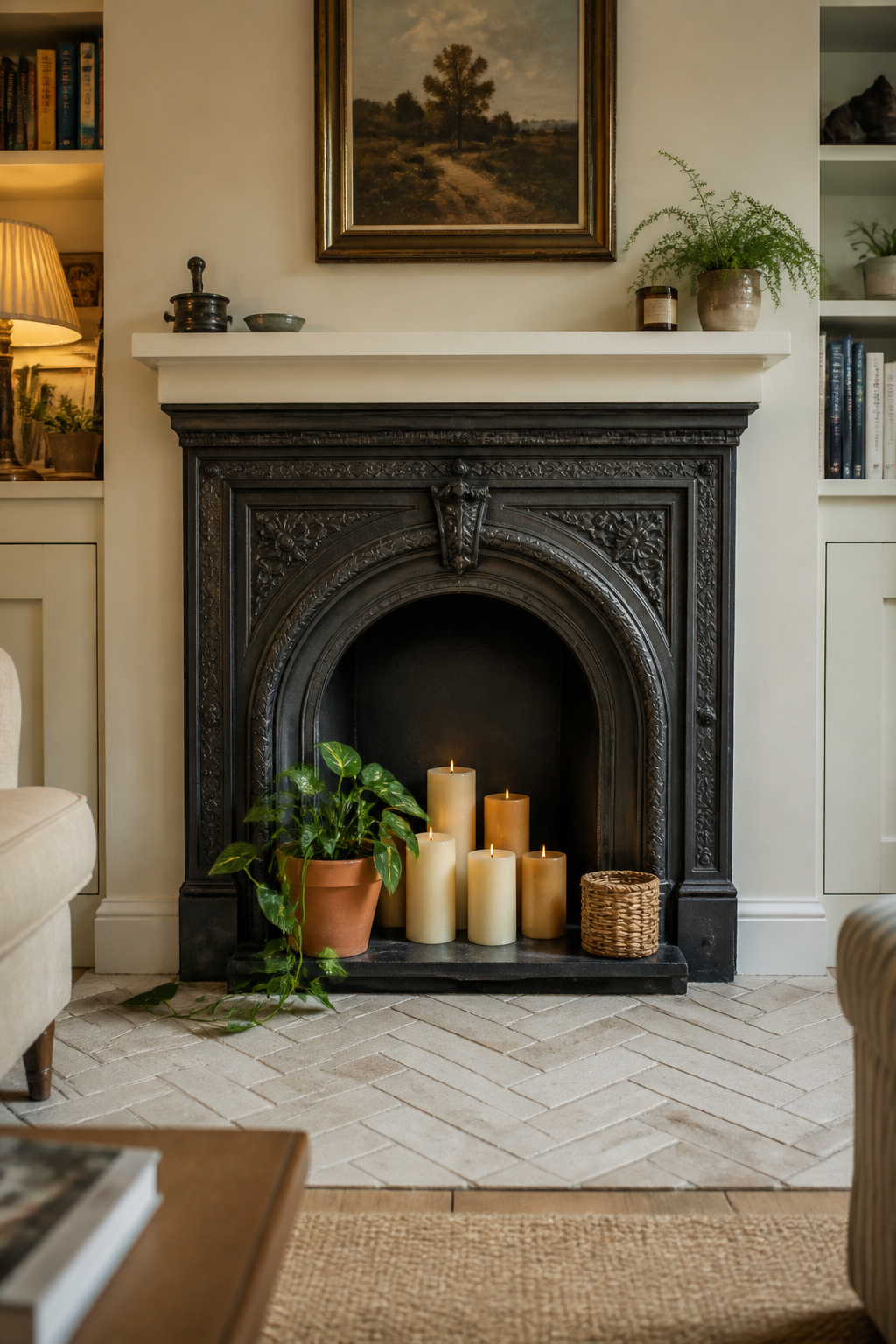
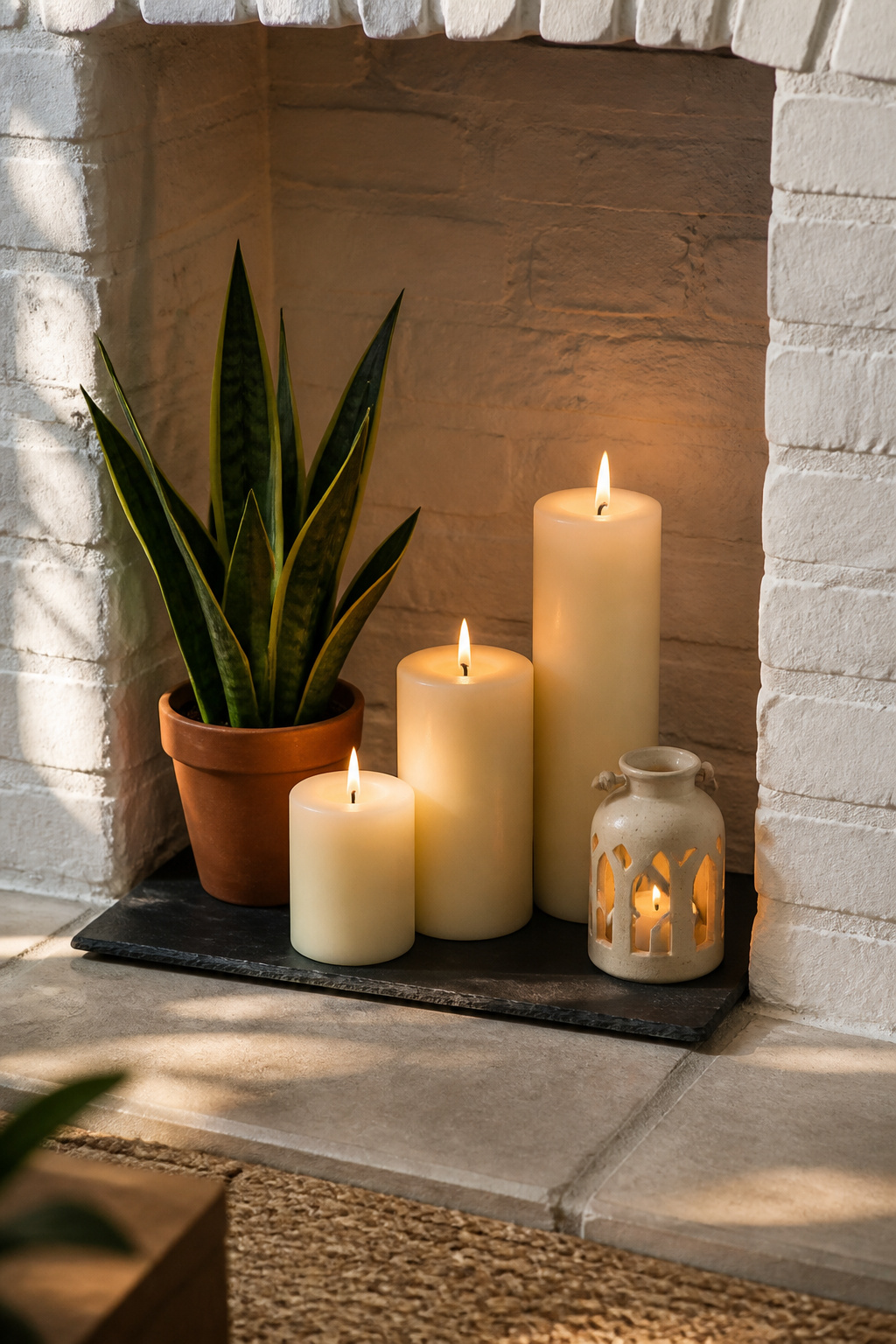
Old soot is flammable, and a candle flame doesn’t care that the fireplace is “non-working.” Sweep the fireback clear of soot and debris first, and look for moisture staining while you’re in there. If you’ll burn real candles, trim wicks to a quarter inch and set them on a slate tray. Where a strong draft pulls through an open flue, candles flare or blow out — switch to flameless LED ones instead.
Renter check: what you can and cannot do without losing your deposit
Most leases ban “permanent alterations,” and that’s the whole game here. Good news: every option in this article is removable without tools, so none count as a permanent change. Lean a screen, set a basket, group some candles — no wall fixings, no holes. HUD treats small pin holes as normal wear, but multiple screw holes read as damage, so freestanding wins for a deposit you want back.
No-Tools Options: Plants, Candles, and Baskets in an Empty Firebox
These three are the starting tier — no tools, low cost, nothing a landlord can object to. Rate them all “first build”: if you can set an object on a tray, you can do these.
| Option | Estimated cost | Skill level | Renter-safe? | Key watch-out |
|---|---|---|---|---|
| Candle cluster (5 pillars) | $20–$80 | First build | Yes | Soot-free fireback; trim wicks or go flameless |
| Floor lanterns (3) | $40–$120 | First build | Yes | Stable base; vary the sizes |
| Statement plant | $15–$60 | First build | Yes | Pick a low-light survivor, not a fern |
| Wicker/seagrass basket | $35–$120 | First build | Yes | Size 18–24 in wide for breathing room |
Statement plants in the firebox: which species survive the low light
A firebox is dark, often drafty, and unheated — conditions that kill most houseplants fast. Three survive it: the snake plant, the ZZ plant, and the cast iron plant. The snake plant uses CAM photosynthesis, which lets it tolerate humidity as low as 20%; the ZZ stores water in underground rhizomes and shrugs off two-week droughts. Skip the maidenhair fern — it’ll brown out within a fortnight.
Candle and lantern clusters: the layered-height approach, with real costs
The look that reads “styled” rather than “random” comes down to odd numbers and three distinct heights. My convention is a short candle (4–5 in), a medium (8–10 in) and a tall (12–16 in), grouped in threes or fives on a slate tray. Pillars run $5–$30 each, so a set of five lands at $20–$80 — the lowest cash outlay here. Mixing brass, ceramic and iron holders beats a matching set, and flameless pillars (about $30–$60 for three) are the no-flame option.
Baskets and log storage: firebox styling that actually gets used
A wicker or seagrass basket does two jobs — it fills the void and stores blankets or magazines. Size it 18–24 inches wide for a standard 24–36 inch opening, so it sits inside without jamming the walls. Budget wicker starts around $35–$50; hand-woven seagrass runs $60–$120. The mistake is filling the opening edge to edge — it reads stuffed, not styled. Lay two or three objects across the top to give it depth.
The Stacked Wood Look: Real Logs, Faux Logs, and the Honest Difference
Stacked wood is the most-wanted firebox look, and it’s where the real-versus-faux math matters. Here’s the honest comparison, because both have a catch.
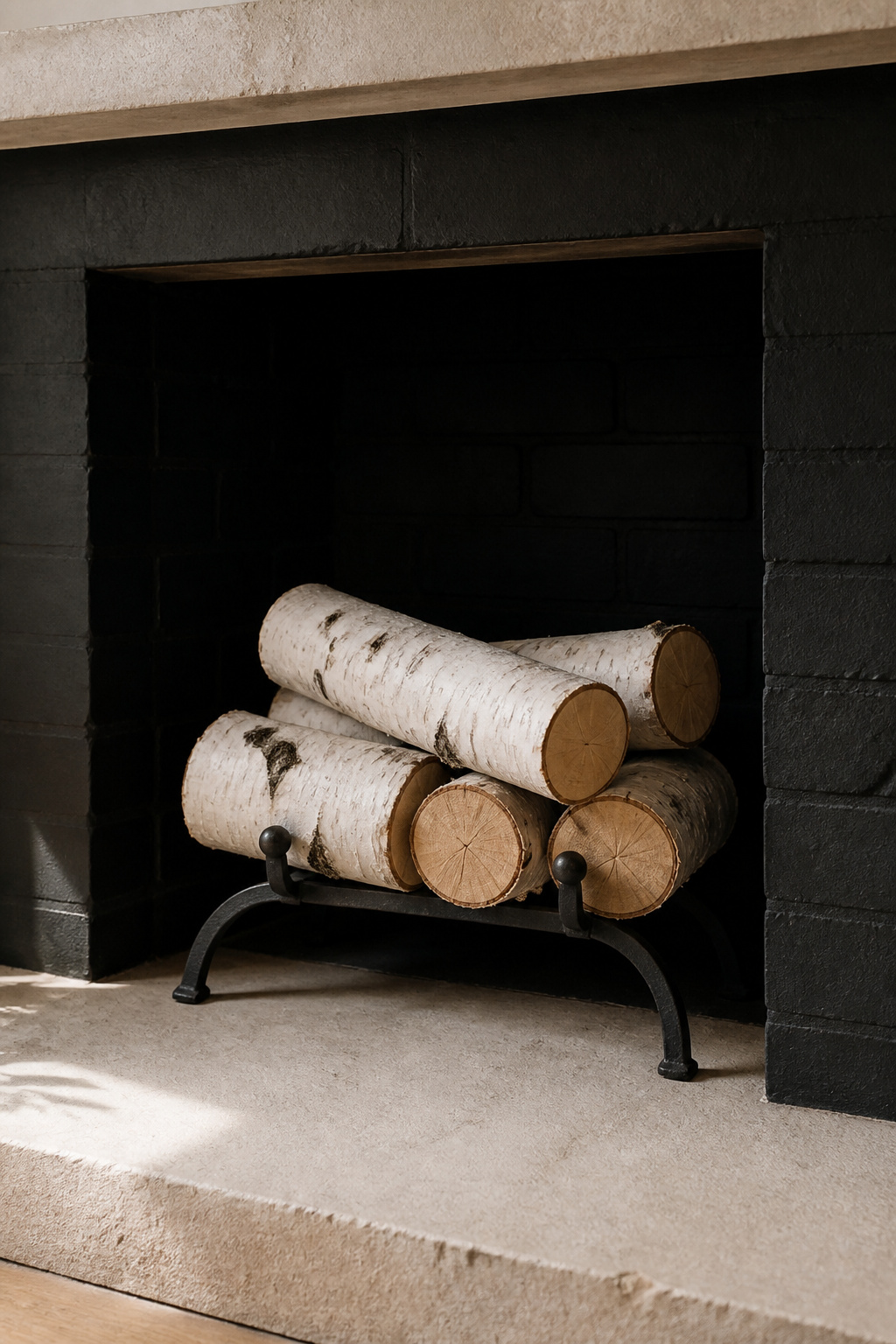
Real stacked wood: which species, how to stack, and the pest check
Birch is the species worth buying — the white bark with dark lenticel markings is dramatic, it’s usually kiln-dried, and it holds its bark cleanly for months indoors. A bundle of six to eight logs runs $45–$70. Stack it like a log-cabin corner — parallel one layer, perpendicular the next — or a parallel-only pile slides apart without the firebox walls to hold it. Now the part nobody mentions: even kiln-dried wood can carry beetle larvae. Check every log for small round exit holes (1–2mm) and powdery frass, and never bring in outdoor wood that hasn’t been commercially dried.
Faux log options: what they cost versus real
Faux decorative logs come in resin or foam for cold, decorative-only use — a set of nine to twelve costs $20–$45, cheaper than real birch. They weigh nothing, carry no pest risk, and need zero maintenance, which is the whole appeal for a renter who wants set-and-forget. The catch is visual: natural bark and size variation are hard to fake, and the flatness shows at room distance.
The mix approach: faux in back, real in front
So split the difference, which is what I’d actually do. Fill the back third with stacked faux logs as the bulk filler, then lay two or three real birch logs across the front where the eye lands. The real bark carries the look; the faux keeps the cost down. This Old House showed the same trick with a pre-assembled faux front that lifts out as one unit — handy for renters. Set the front row on a small cast iron or wicker cradle, too: that shadow gap is the difference between a stack that looks intentional and one that sits flat.
Decorative Screens and Panels: The One-Purchase Transformation
If you want the biggest change from a single buy, it’s a screen. It covers the opening completely, needs no styling, and reads as a design choice rather than a cover-up.
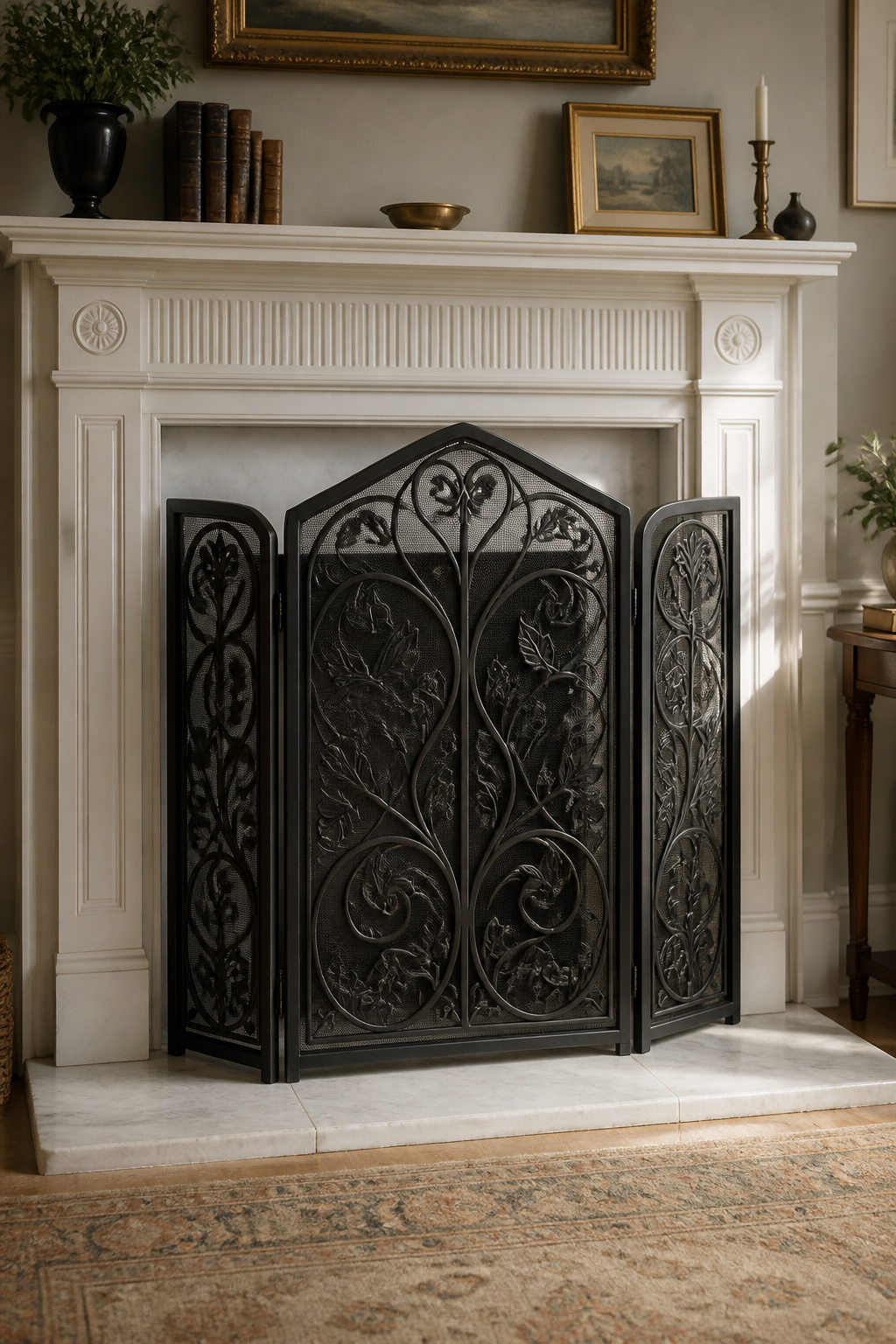
Fireplace screen types: spark guards, decorative panels, folding screens
Flat single-panel screens lean for a clean look; folding three-panel screens stand on their own and handle irregular openings; ornate panels are purely aesthetic. For a non-working firebox you have full freedom — as hearth specialist Northline Express notes, with no fire to contain, any screen that matches your decor works. Budget flat screens start at $35–$75; folding three-panel screens run $75–$150; ornate panels reach $150–$275.
What to look for: sizing the opening and finish longevity
- Size it. A single panel should overhang the opening by 1–3 inches each side, so a 30-inch opening calls for a 32–36 inch screen. A folding screen wants 5 inches of overhang per side — a 40-inch screen for that same opening. For decorative-only use you can also go slightly smaller for a recessed-panel look.
- Choose a finish that lasts. Matte black powder coat and wrought iron resist rust and never need polishing — the safe default. Brass and copper look warmer but tarnish in a cool, damp room unless you buff them.
DIY screen option: a simple frame build and what it costs
Prefer to build? A wood-frame-and-mesh screen costs $15–$30 and two to three hours — use 8-wire-per-inch steel mesh, or stainless if the firebox runs damp. The one rule: never build a wood-only frame with no metal mesh and set candles behind it. Wood is not a candle screen. Confident-builder territory, but a genuine money-saver for a custom size.
Art and Statement Pieces Inside the Firebox Opening
This is the higher-effort tier — art, a mirror, or a semi-permanent finish inside the opening. Most of it is “some builds,” with a couple edging into confident-builder. I’ll flag what’s reversible, because that protects your deposit.
Placing art in a firebox: depth, scale, and changing room light
Art works best leaning, not hanging: rest the canvas against the fireback, bottom edge on the hearth. That dodges any fixing inside the firebox, makes swaps easy, and gives a natural forward tilt. Interior designer Artem Kropovinsky recommends sizing the piece to fill roughly 60–80% of the opening width — so the surround frames it rather than the art competing with it. One honest catch — the firebox that pops in daylight turns into a black hole at night. Plan a small battery puck light at the top of the fireback, or the art disappears after dark. That last point is my read, not a rule; plenty of people are fine with the piece being a daytime feature.
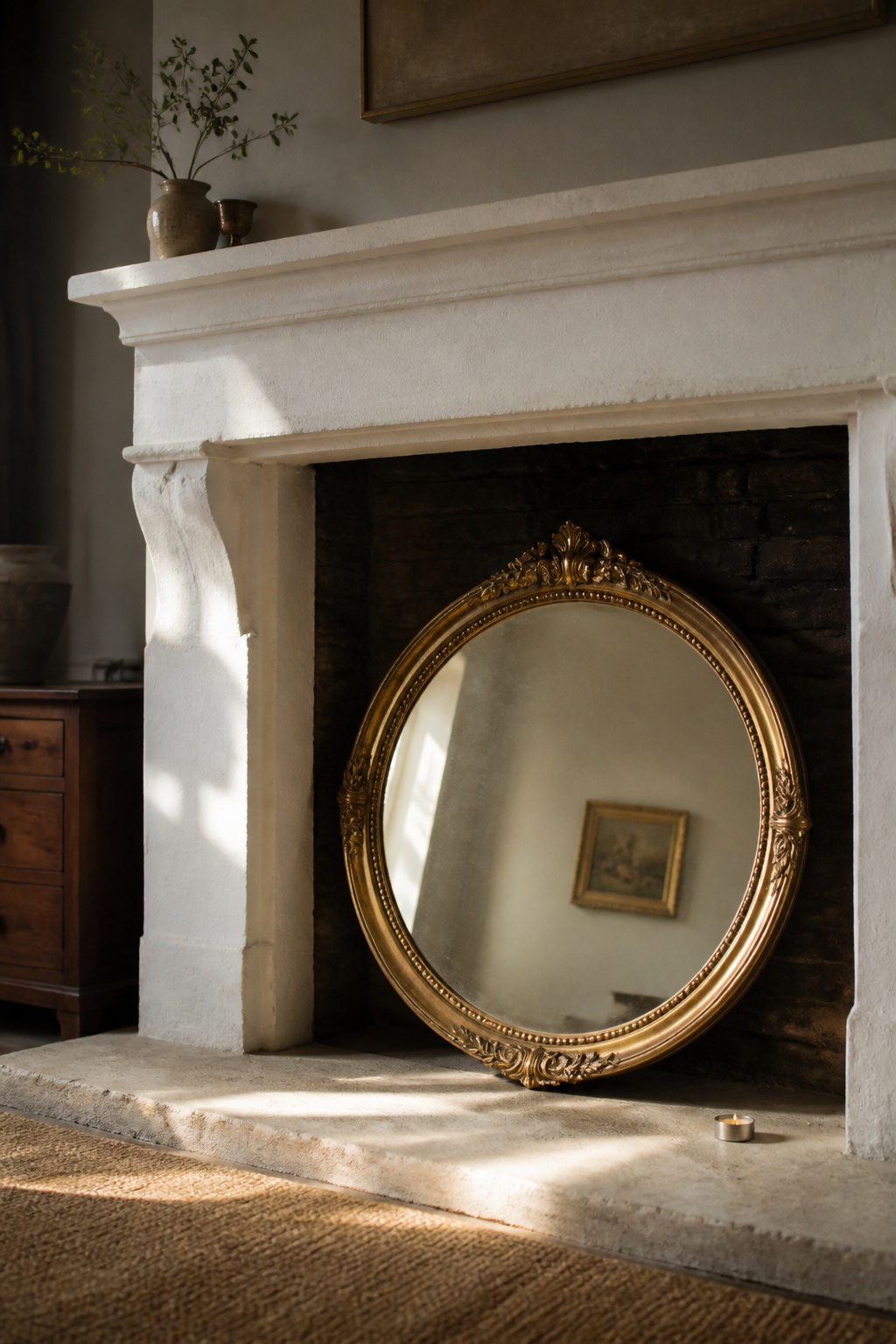
Mirrors inside the firebox: the light-amplification effect and its limits
A leaned mirror is the better bet for most rooms: it turns the dark opening into a light pocket and makes the fireplace feel alive. Size the frame at 60–75% of the opening width; edge-to-edge loses the framing effect. Watch the reflection angle, though — a chandelier straight in front bounces back as glare. To stop a big mirror slipping, loop a furniture anti-tip strap from frame to wall stud, the same kit used to babyproof tall furniture. Once the firebox is sorted, the wall above is the next call; see what to put above the fireplace for the sizing and hang-height rules.
Tiles, wallpaper, and painted murals: the semi-permanent options
For a semi-permanent finish, peel-and-stick tiles fake a tiled insert for $30–$90 and peel off later with a low heat gun and patience. The hard rule: never use them in a gas or electric firebox, where surface temperatures can exceed the adhesive’s rated threshold (typically 120–200°F depending on adhesive type) — they’re only safe in a cold opening. A chalk-paint fireback is cheaper and fully reversible at $15–$40, if you repaint to the original on move-out. Jennifer Ebert of Homes & Gardens offers a take worth hearing: if your firebox has a handsome old metal insert, sometimes the right move is to do nothing and let it speak. Small openings raise the same scale questions a shallow shelf does — the narrow mantel ideas translate straight across. For the full picture from shelf to wall, our full mantel decorating guide ties it together.
So pick the one that matches the weekend you’ve actually got. Short on time and money? Group three candles on a slate tray tonight — twenty minutes, under $30, done. Want the biggest change for one purchase? Order a $35 screen and lean it in when it arrives. Everything past that is a step up in effort, not necessity. Start cheap, live with it a week, and only build the fancier option if the firebox still bugs you.
FAQ
What can I put in a non working fireplace to make it look nice?
The five most popular options are a cluster of pillar candles at varied heights, a stack of decorative birch logs (real or faux), a decorative screen, a low-light plant like a snake or ZZ plant, or a leaning mirror or art. All are renter-safe and need no tools. Sweep the fireback and confirm the flue still ventilates before you start.
Is it safe to put candles in a fireplace that doesn’t work?
Yes, with two precautions. The fireback must be clear of old soot or debris that candle heat could ignite, and the candles must sit on a stable, heat-resistant tray. Trim wicks to a quarter inch before lighting, and never leave them burning unattended. If the flue has a strong draft, flameless candles are the safer choice.
How do you style a fireplace that is not in use?
The most impactful single purchase is a decorative screen sized 1–3 inches wider than the opening on each side; it covers the firebox completely and reads as intentional. Budget flat screens start at $35–$75. For a no-tools start, group three pillar candles at short, medium and tall heights on a slate tray — odd numbers and graduated heights do the work.