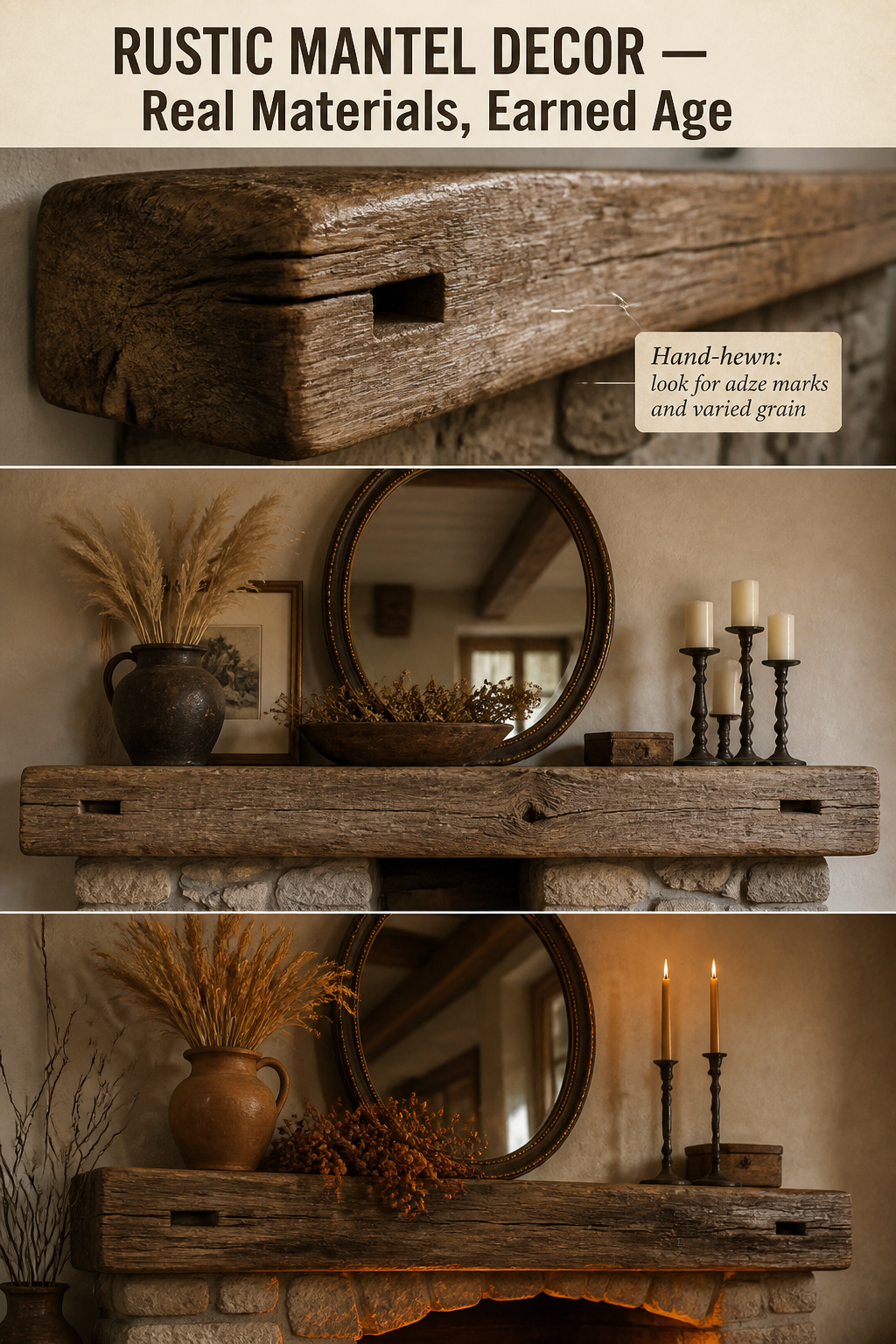
A genuinely rustic object carries a record of its own life. A hand-hewn barn beam shows the faceted bite of an adze, swung by someone shaping a felled tree more than a century ago. A salvaged frame holds nail holes at uneven intervals and a patina darker in the grain valleys than on the ridges, because light and damp aged it unevenly. That irregular history is the whole point — and exactly what a sanded-and-greywashed shelf cannot fake. The best rustic mantel decor ideas start from the same place: real materials before arrangement.
TL;DR
- Build on genuine materials — a reclaimed beam shows 15+ growth rings per inch, adze marks, and uneven patina; faux distressing shows uniform “aging” and pale new wood under the grey wash.
- Anchor with one large object at roughly two-thirds the mantel width, then add odd-numbered groups in iron, aged wood, woven fibre, rough ceramic, and dried botanicals — leaving beam between them.
- Keep it lived-in, not costume: no text signs, no matching sets, and one or two non-rustic pieces from a different era.
Real Rustic vs Faux-Distressed: Why the Difference Matters on a Mantel
Before any object goes on the shelf, learn to read the material — genuine age and applied distressing look similar from across a room and nothing alike close up.
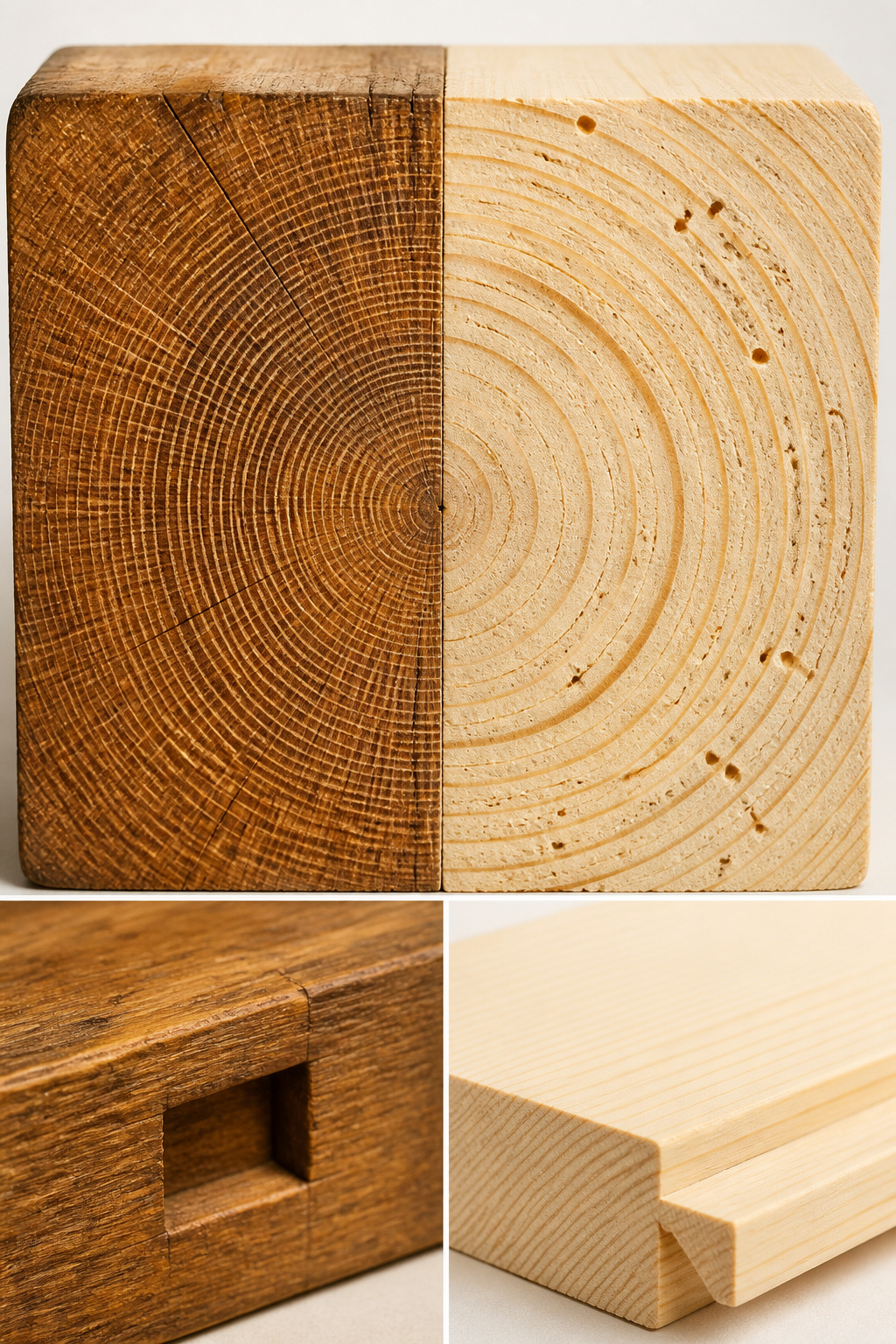
What makes an object genuinely rustic: grain figure, hand marks, and earned wear
Genuine wear is additive — grime and oxidisation build up over decades, and no two surfaces age alike. The clearest tell is end grain: old-growth timber shows 15 to 30+ growth rings per inch, plantation wood only 3 to 8. A count above 12 confirms old-growth. Look for a working past: checks from drying, irregular nail holes, and mortise pockets — structural history, not decoration.
The tells of faux distressing: sanded edges, uniform ‘aging’, artificial grey wash
Faux distressing is subtractive — material is sanded away to expose lighter wood, the opposite of how age accumulates. The grey wash gives it away: genuine silver-grey patina is uneven, darker in the grain valleys; a diluted stain reads the same flat depth in every pore. Drilled “woodworm” holes are another tell — uniform and bored straight, where real exit holes range from under 2 mm to nearly 10 mm and follow the grain off-vertical.
Where to find the real thing: estate sales, barn demolitions, architectural salvage
Estate sales, flea markets, and barn demolitions are the classic sources. Salvage retailers such as Olde Good Things offer antique mantels with provenance; specialist timber suppliers dimension beams from demolished buildings while preserving the original surface. Facebook Marketplace is a practical first stop, though provenance comes with no guarantee. Our fireplace mantel decor guide covers the underlying styling rules.
| Characteristic | Real rustic | Faux distressed | How to check |
|---|---|---|---|
| End-grain rings | 15+ per inch (old-growth) | 3–8 per inch (plantation) | Count rings on the cut end |
| Patina | Uneven; dark in valleys, pale on ridges | Flat, same depth everywhere | Tilt to the light; look in the grooves |
| Wear marks | Adze marks, checks, nail holes, mortise pockets | Sanded edges, drilled holes, routed profile | Check holes vary in size and angle |
The Reclaimed Wood Mantel Beam: Sourcing, Sizing, and Installing
The beam is the most characterful — and most expensive — element in a rustic scheme, so its decisions come before any styling.
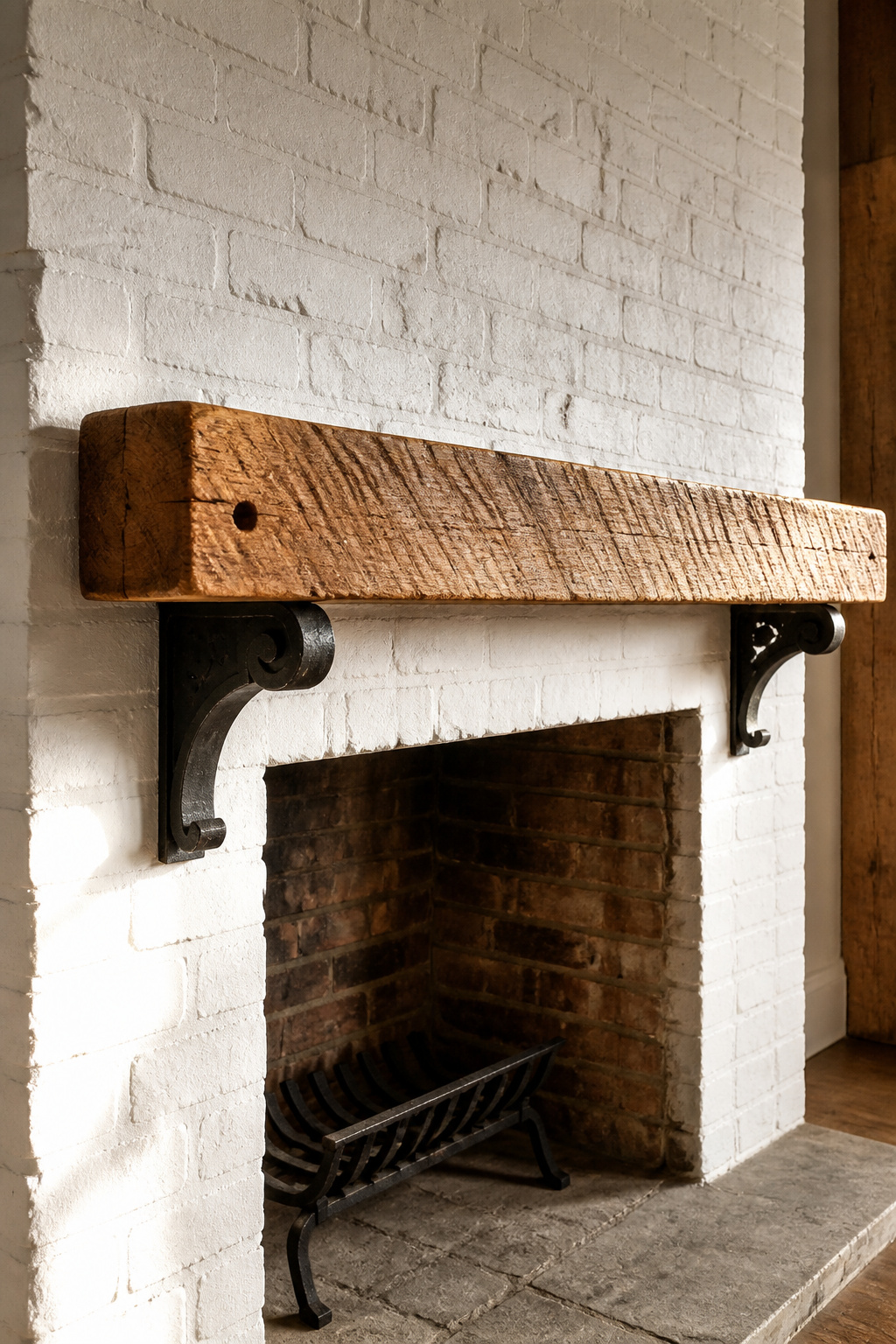
What to look for in a beam: species, age indicators, and whether it needs treatment
Reclaimed beams come in two surface types: hand-hewn (axe and adze, pre-1900, rugged and faceted) and rough-sawn (early sawmill blade marks, more refined). Worth seeking: antique heart pine (dense, amber-red, naturally resin-rich), white oak (stable), Douglas fir (warm honey tone), and black walnut (dark, oily) — the first two resist wood-boring organisms without borate treatment. Kiln-dry to 8–12% moisture before installation. Beams run roughly $6–$15 per linear foot for 6×6 stock up to $45–$60 for 10×10 old-growth — directional only.
Sizing a beam mantel: depth, projection, and height above the firebox opening
Per NFPA guidance, the mantel bottom must sit at least 12 inches above the firebox opening, plus one inch per inch of projection — so an 8-inch-deep beam needs at least 20 inches of clearance. Then proportion: 8–10 inches of face height for 9-foot ceilings, 4–6 inches for standard 8-foot. Run the beam about 12 inches longer than the firebox.
Installation options: bracket-mounted, corbel-supported, and when to call a joiner
Three routes:
- Hidden-bracket mounting — lag bolts or steel rebar anchor into studs or masonry; matching holes in the beam back let it float flush with no visible hardware.
- Corbel support — the beam rests on reclaimed-wood or aged-iron brackets spaced every two feet, period-appropriate and a visual feature.
- Box-beam mantels — real-wood hollow shells, for walls that cannot take solid stock weight.
Call a joiner when the mantel exceeds 80 lbs (a six-foot oak beam can reach 150+), when masonry offers no stud anchoring, or when installation cuts into the chimneybreast.
Layering Objects With Provenance: The Rustic Mantel Styling Method
Anchoring with a large object: vintage mirrors, old-growth frames, barn-door panels
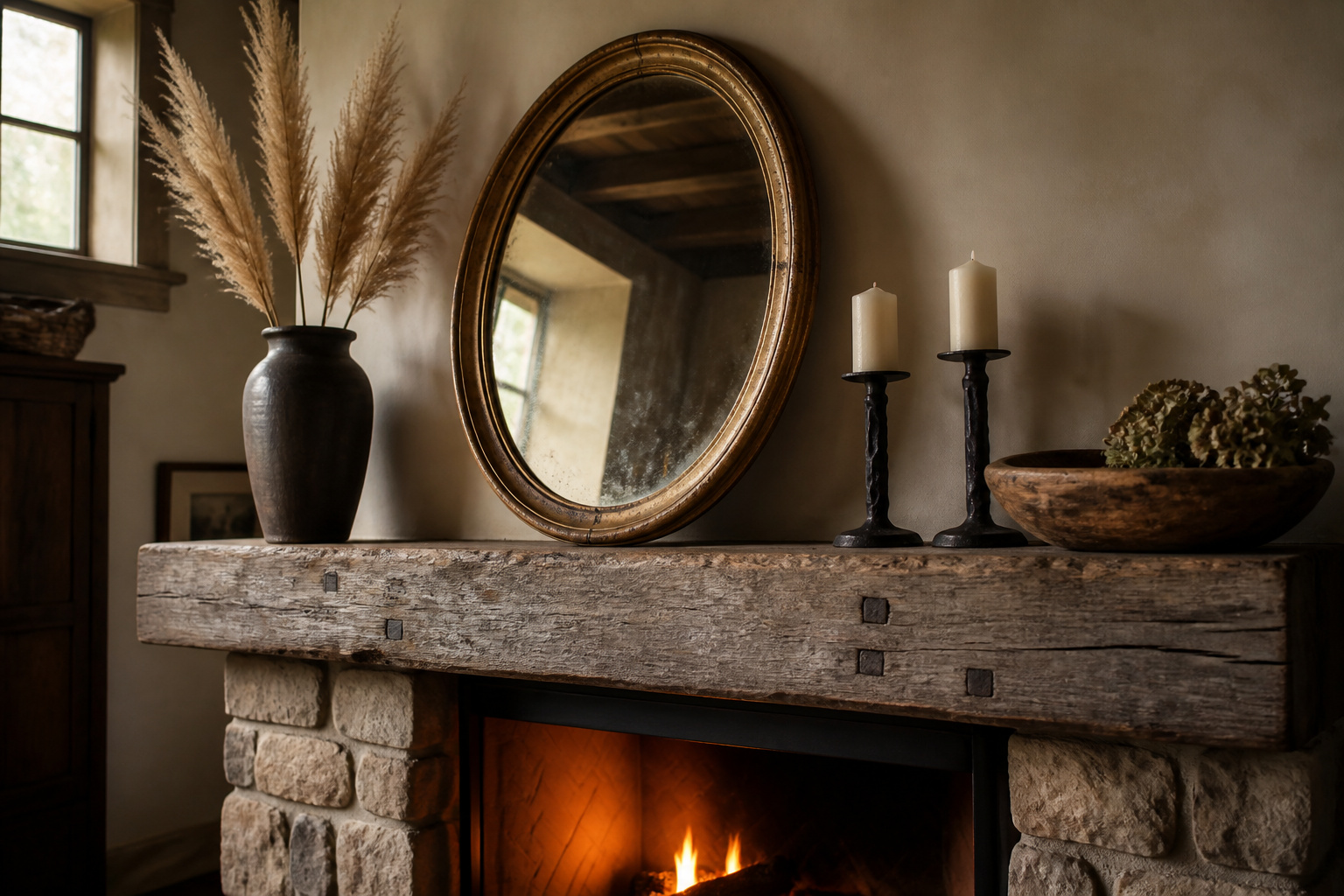
Start with one anchor at roughly two-thirds the mantel width — a large aged-frame mirror, a print in a heavy dark-wood frame, a reclaimed barn-door panel, or a vintage architectural clock. A mirror earns its place best: it carries no colour, adapts to any palette, and throws candlelight across the arrangement. Nothing smaller than a cantaloupe — smaller objects get lost against the beam.
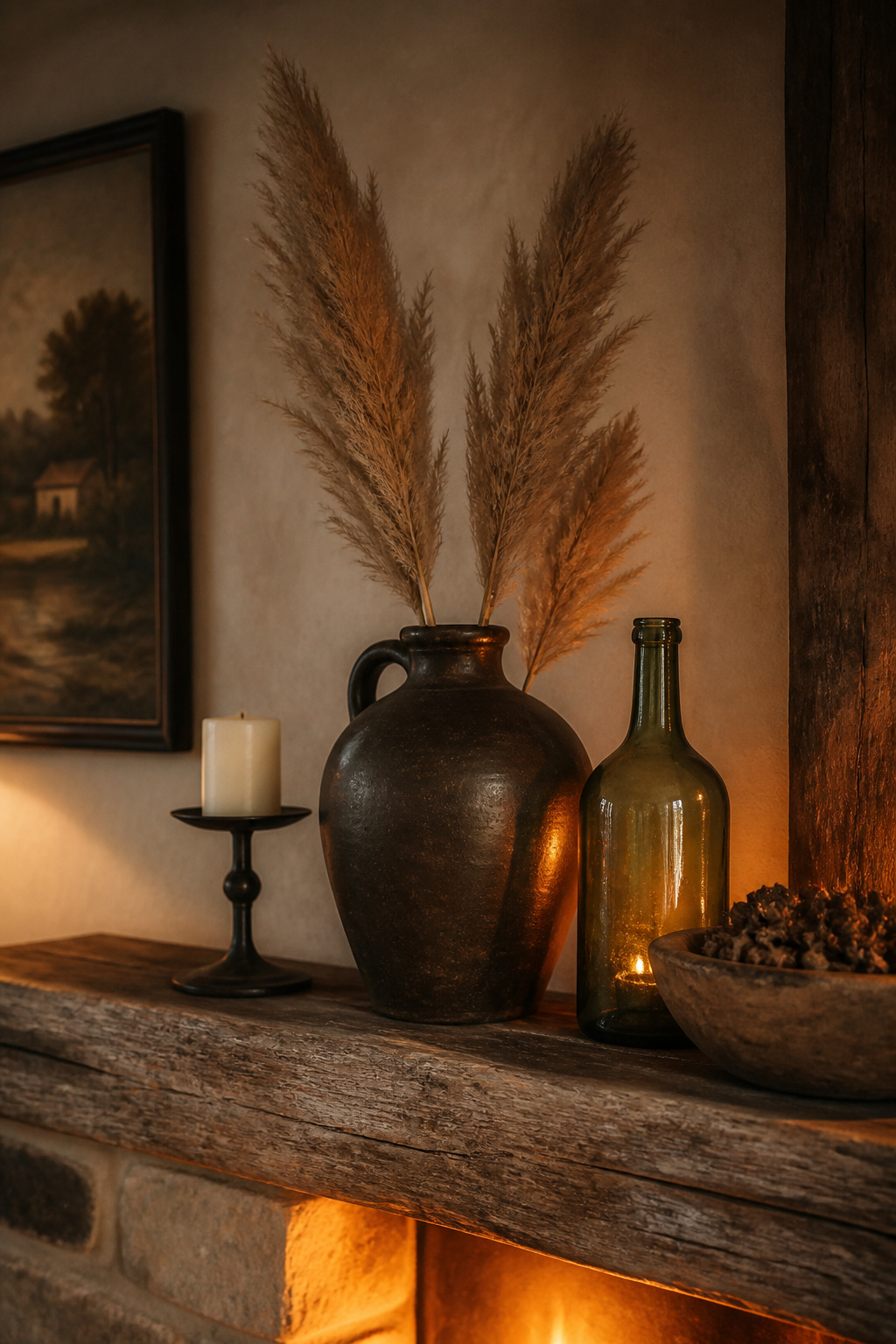
Building in layers: depth, height variation, and leaving the shelf to breathe
Build from back to front: anchor at the rear, medium pieces — a tall vase, aged books — at mid-depth, low accents at the shelf edge. Group in odd numbers (three minimum) and span at least three heights. Asymmetry suits a reclaimed beam better than formal symmetry — the beam’s own irregularities harmonise with an uneven arrangement.
The texture mix that reads rustic: iron, worn leather, aged wood, woven fibre, rough ceramic
Five material families reliably read rustic: wrought iron, worn leather, aged wood in a secondary tone, woven natural fibre, and rough or matte ceramic in earthy glazes. Mix at least three. The contrast that prevents monotony is rough against smooth — a matte stoneware jug beside a polished antique glass bottle. As Sarah of Grace In My Space notes, pairing a chunky rustic bowl with a glass vase balances the design; the vase need not be modern to lift the shelf.
Greenery, Botanicals, and the Rustic Palette
Botanicals make a rustic mantel feel alive — the trick is greenery that survives the heat and tones that stay inside the rustic register.
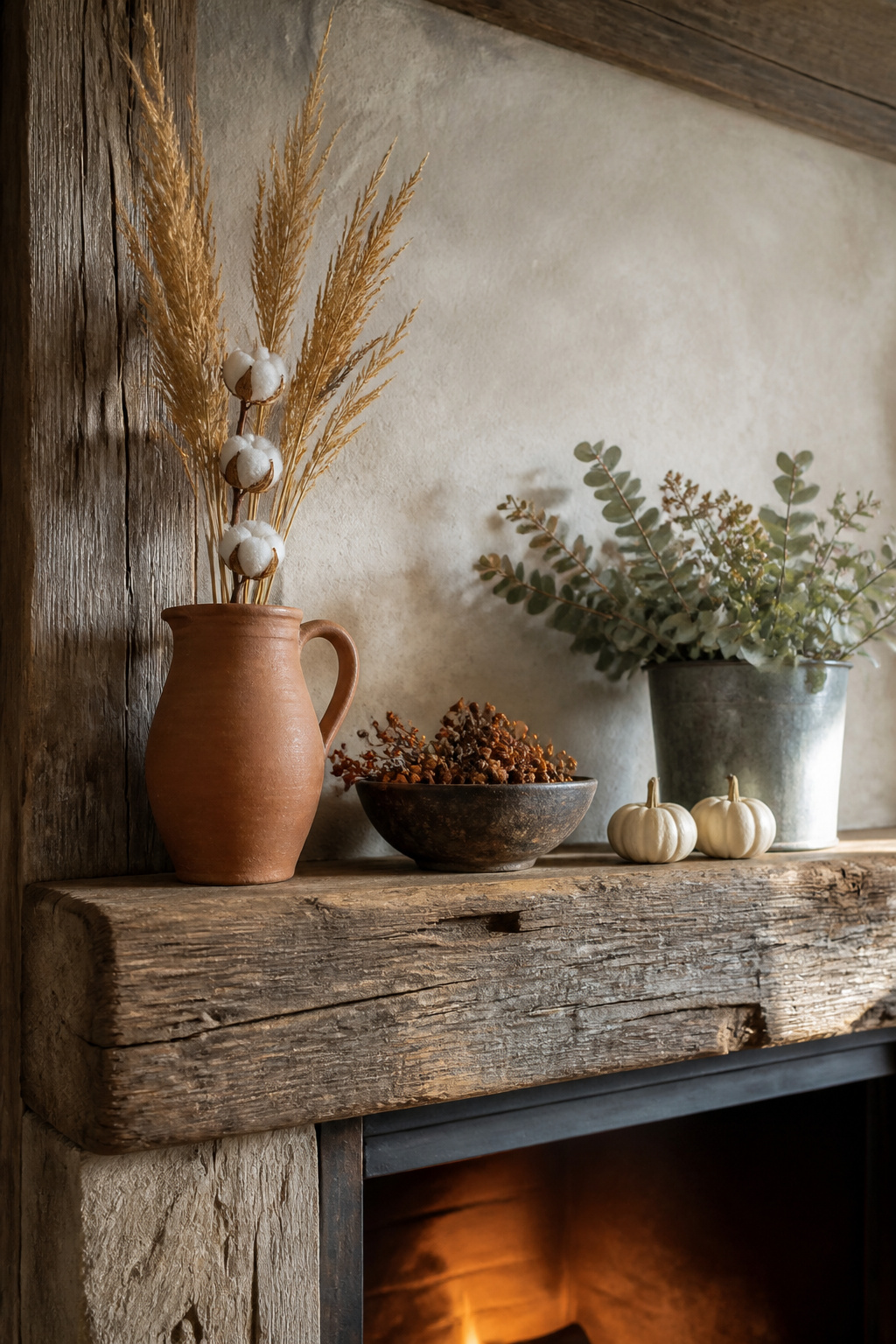
Dried botanicals vs living plants: which works better on a mantel and why
Above a working fireplace, dried botanicals win. Heat shortens a living plant’s life fast, while dried materials — silver-white pampas, gold wheat, cream cotton, grey-green eucalyptus — suit the rustic palette precisely and ask no maintenance. Dried pampas holds its plumes for one to three years indoors, reading as height without competing for colour. Container choice matters: dark-glazed ceramic, galvanised steel, or terracotta sit right; glossy white reads modern. Swap accents seasonally — wheat and berries for autumn, eucalyptus and beeswax tapers for winter — while pampas stays as a structural anchor.
The rustic colour palette: ochre, slate, brick red, and the neutrals that carry them
The rustic palette holds together built from three groups: warm ambers and ochres (aged wood, wheat, terracotta), earth reds and rusts (berries, antique brick, rust-patinated iron), and the relieving neutrals — silver-grey, cream, and charcoal. Let deep ochre appear in one or two objects or the mantel reads as generic harvest. Slate grey in a glazed ceramic ties the objects back to the beam’s natural grey — the continuity that separates a considered arrangement from a random one.
Rustic Mantels With a Brick or Stone Surround
A reclaimed beam over brick or stone is the most common rustic pairing — and the most likely to read as chaos, because two complex textures give the eye nowhere to rest.
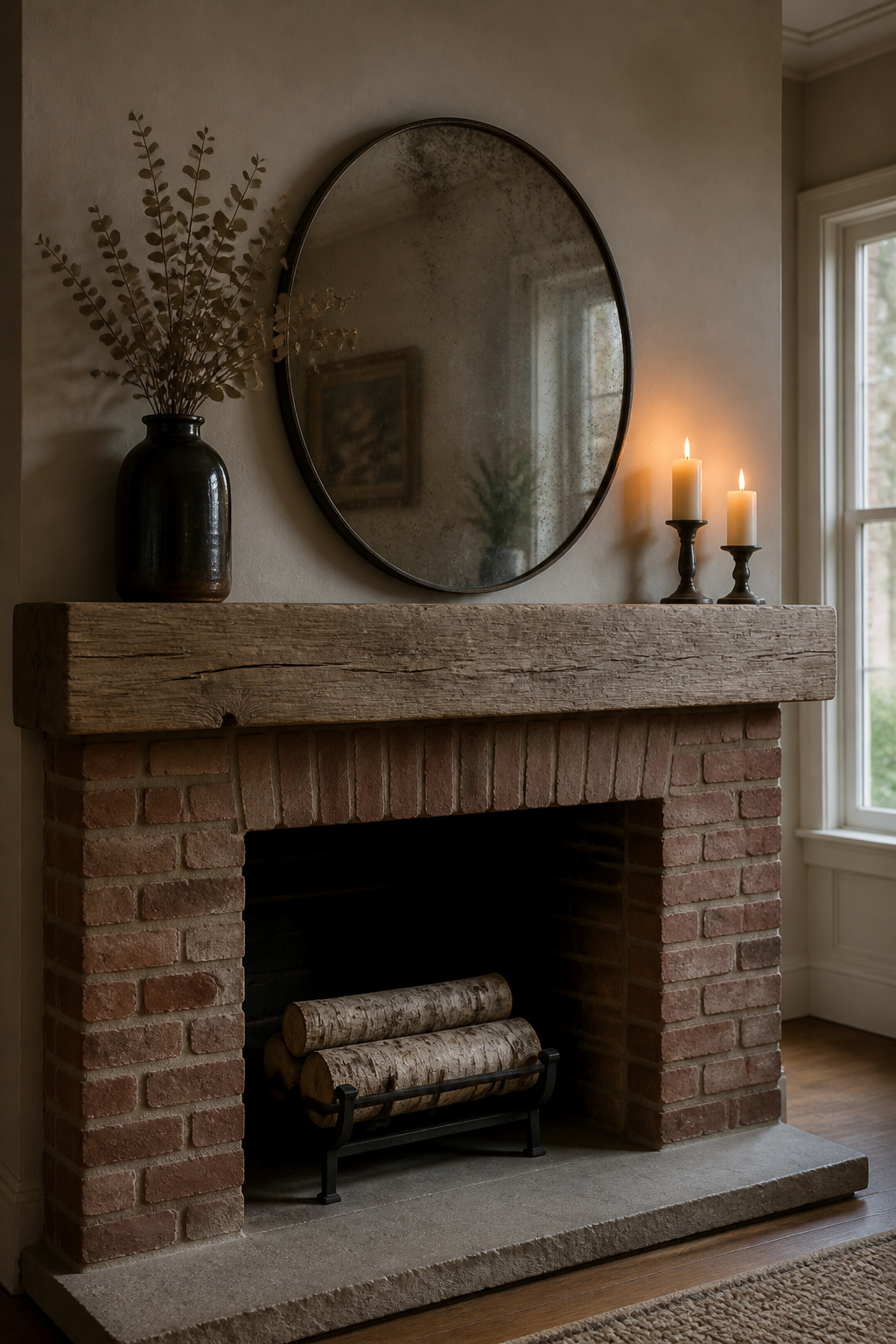
Keeping control: one calm anchor and small groups
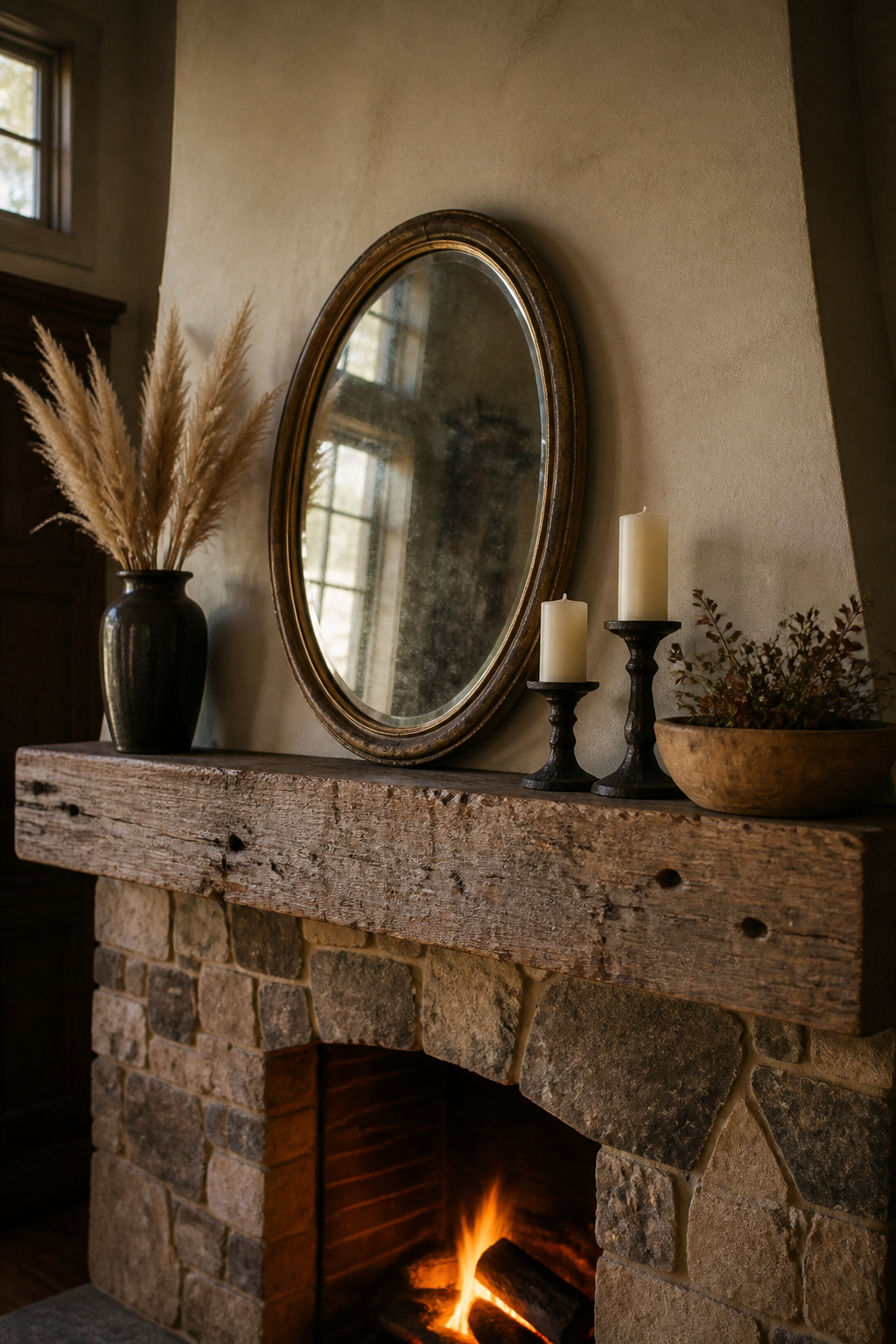
Brick and stone are already busy, so the fix is counterintuitive: fewer objects, each with more weight. Choose accessories that contrast rather than pile on — matte black iron, smooth ceramics, aged brass — and skip woven baskets. One large, tonally calm anchor flanked by no more than two small groups, with clear beam between each, is the reliable structure. The full case for working with the masonry lives in our guide to brick fireplace styling.
Styling the hearth below: stacked logs, cast-iron accessories, and the firebox floor
A styled mantel above a dark, empty firebox looks half-finished. Stacked firewood is the most effective rustic move here: visually heavy without adding wall texture, the most direct link between beam and firebox. Cast-iron andirons connect back to the iron candlesticks on the mantel, carrying one material from chimneybreast to floor. Birch logs read beautifully against dark brick in a non-working fireplace — our guide to styling the firebox below covers the full range of options.
Avoiding the Costume Look: The Edit That Makes Rustic Feel Lived-In
Rustic most often goes wrong here: too many matching farmhouse pieces, bought in one trip, all wearing the same deliberate “aged” finish — so the mantel reads as a stage set rather than a shelf that accumulated over time.
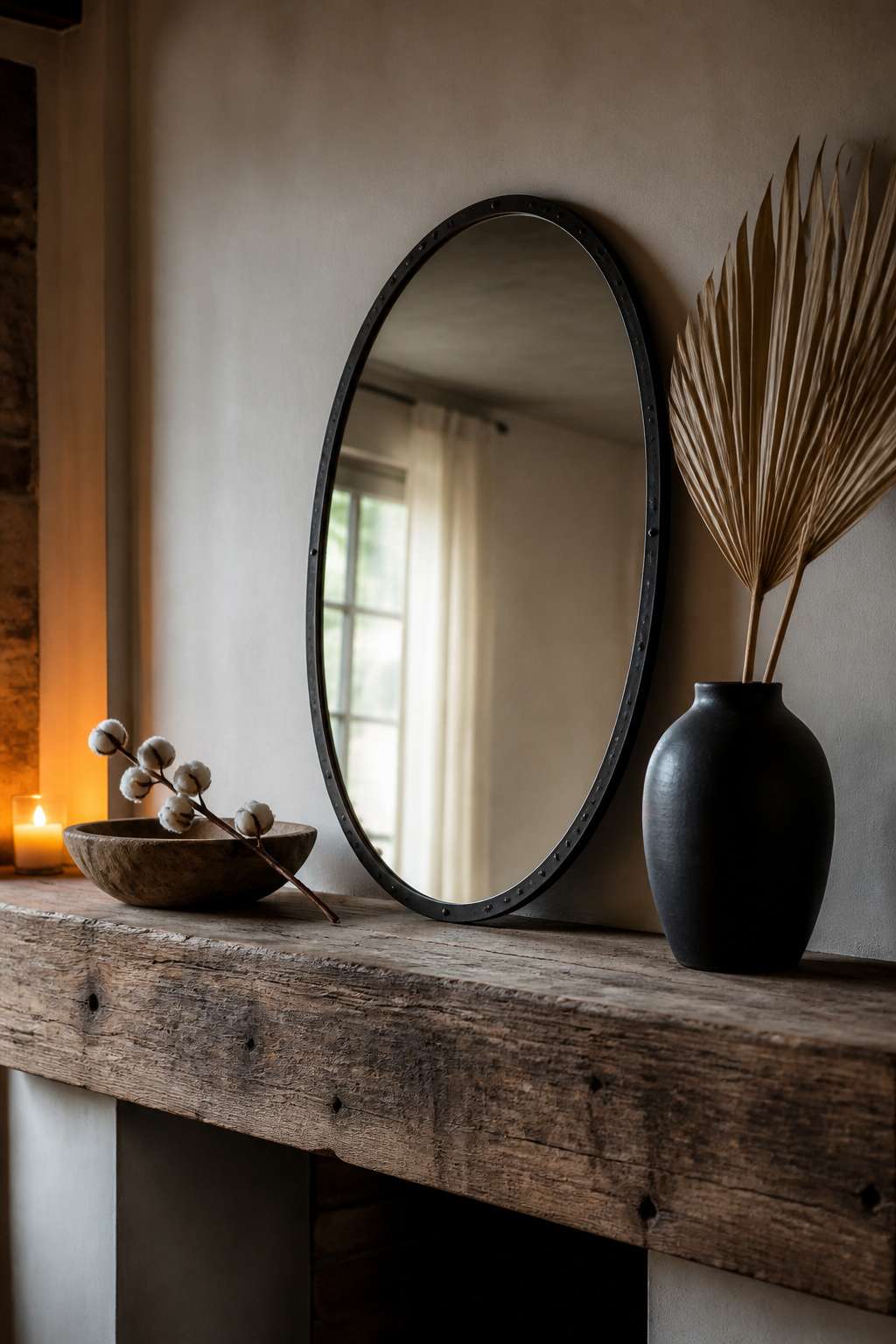
The over-themed rustic mantel: when farmhouse elements tip into stage set
The tells: every object from the same shop, every piece wearing identical manufactured aging, text-based decor — “Gather,” “Home” — announcing the theme rather than embodying it. A family clock beside a modern ceramic beside an estate-sale candlestick reads as real life; three matching galvanised buckets reads as a shop display. When a shelf feels over-themed, find the newest-looking “farmhouse” piece and take it off. If the arrangement improves, it stays off.
Mixing rustic with other periods: how one or two non-rustic objects save the whole composition
The piece that rescues a rustic mantel is usually the one that isn’t rustic. A clean-lined modern ceramic, a mid-century print, a hand-thrown studio vessel — one or two counterpoints signal a real person’s taste rather than a stylistic recreation. Pair the rough age of the beam with one object of high craft in a different tradition — the steward’s instinct is to let a shelf look collected, never catalogued — gathered over years rather than assembled in an afternoon.
FAQ
What goes on a rustic fireplace mantel?
Start with one large anchor at roughly two-thirds the mantel width — an antique mirror, an aged-frame artwork, or a reclaimed barn-door panel — then flanking groups of three objects in odd numbers. Mix at least three rustic material families: wrought iron, worn leather, aged wood, woven fibre, and matte earthy ceramic. Dried botanicals in dark or terracotta vessels complete the arrangement.
How do you style a farmhouse mantel?
Less is more. Choose a large anchor piece, add one grouping of three objects at varying heights on each side, and leave visible beam between groups. Group in odd numbers, vary heights across three levels, and use asymmetric placement over formal symmetry. Mix objects from different sources and eras — buying a matching set produces the staged result.
What kind of wood is used for a reclaimed mantel beam?
The most sought-after species are antique heart pine (dense, resin-rich, amber-red), white oak (strong, fine-grained), Douglas fir (warm honey tone), and black walnut (dark and naturally oily). Heart pine and Douglas fir resist wood-boring organisms without chemical treatment. The oldest beams are hand-hewn old-growth — 15-plus growth rings per inch, adze marks, and mortise pockets.