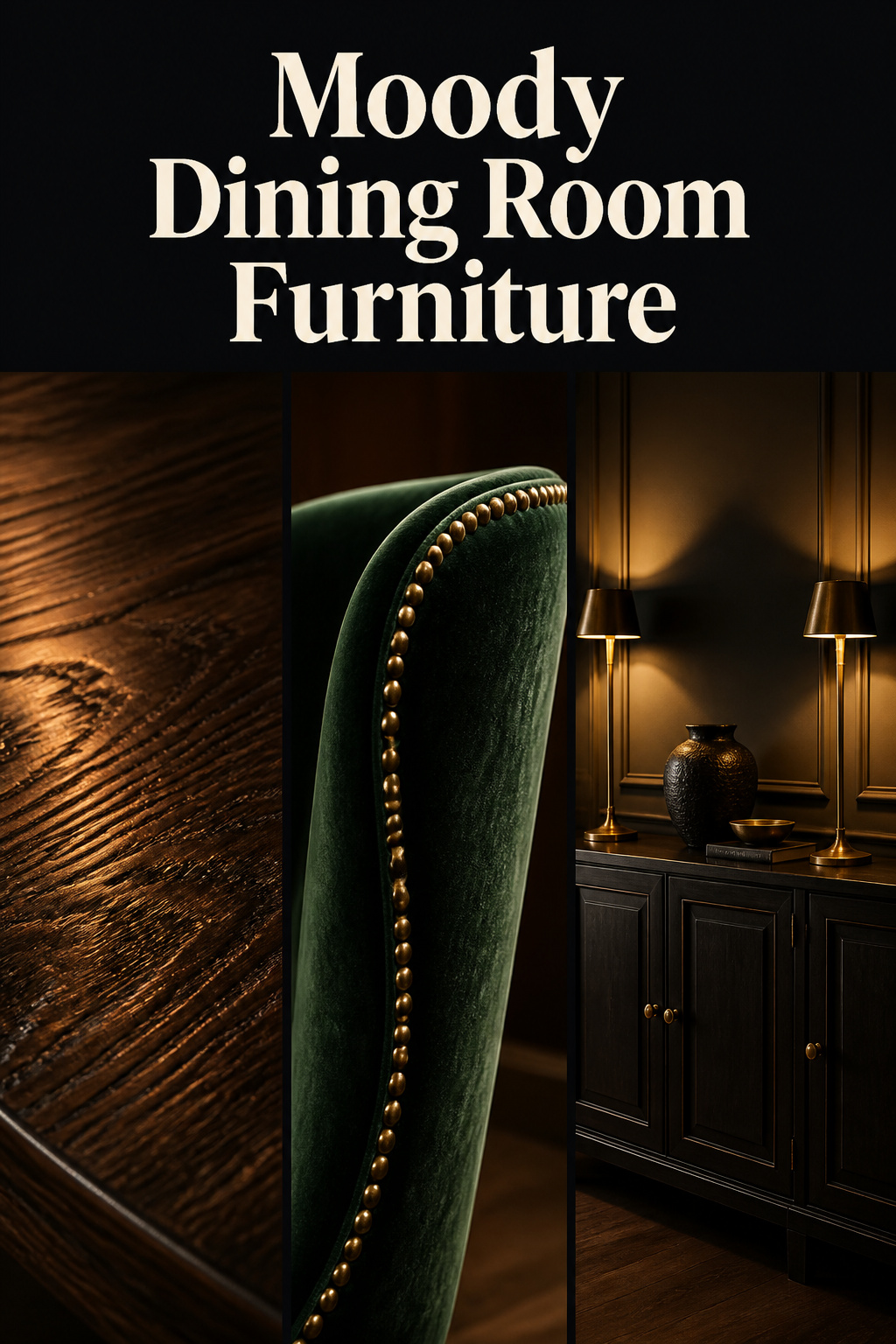
Picture yourself at the table after dark. Your hand rests on the wood and finds open grain, faintly warm, the surface catching the candle as a run of fine shadows. Behind you, a velvet chair back holds the light differently across its pile — emerald where it faces the flame, near-black where it turns away. The room is quiet on a rug underfoot, the windows closed off behind heavy folds of cloth. Nothing glares; every surface drinks the light and gives a little back. That is what good moody dining room furniture does — and unlike paint, you can read it with your fingertips.

TL;DR
- Choose surfaces that absorb light, not bounce it: naturally dark timber (walnut, mahogany), performance velvet rated 40,000–100,000 Martindale rubs, matte or satin finishes — high-gloss lacquer throws hot-spots in candlelight.
- The rug must extend at least 24 inches beyond every table edge so chairs stay fully on it when pulled out; a six-seat table needs an 8′ x 10′ rug minimum.
- Velvet reads warmer and more atmospheric; leather wipes clean and develops patina — pick by your household’s maintenance habits, not the look alone.
What Every Surface Does in a Dark Room: The Material Logic
Before any single piece, the rule that governs all of them: in low, warm light, a material either deepens the mood or fights it. Some surfaces absorb light and hold the shadow; others throw it back and flatten the room. The wider picture — how furniture sits alongside colour, walls and light — lives in the moody dining room ideas guide.
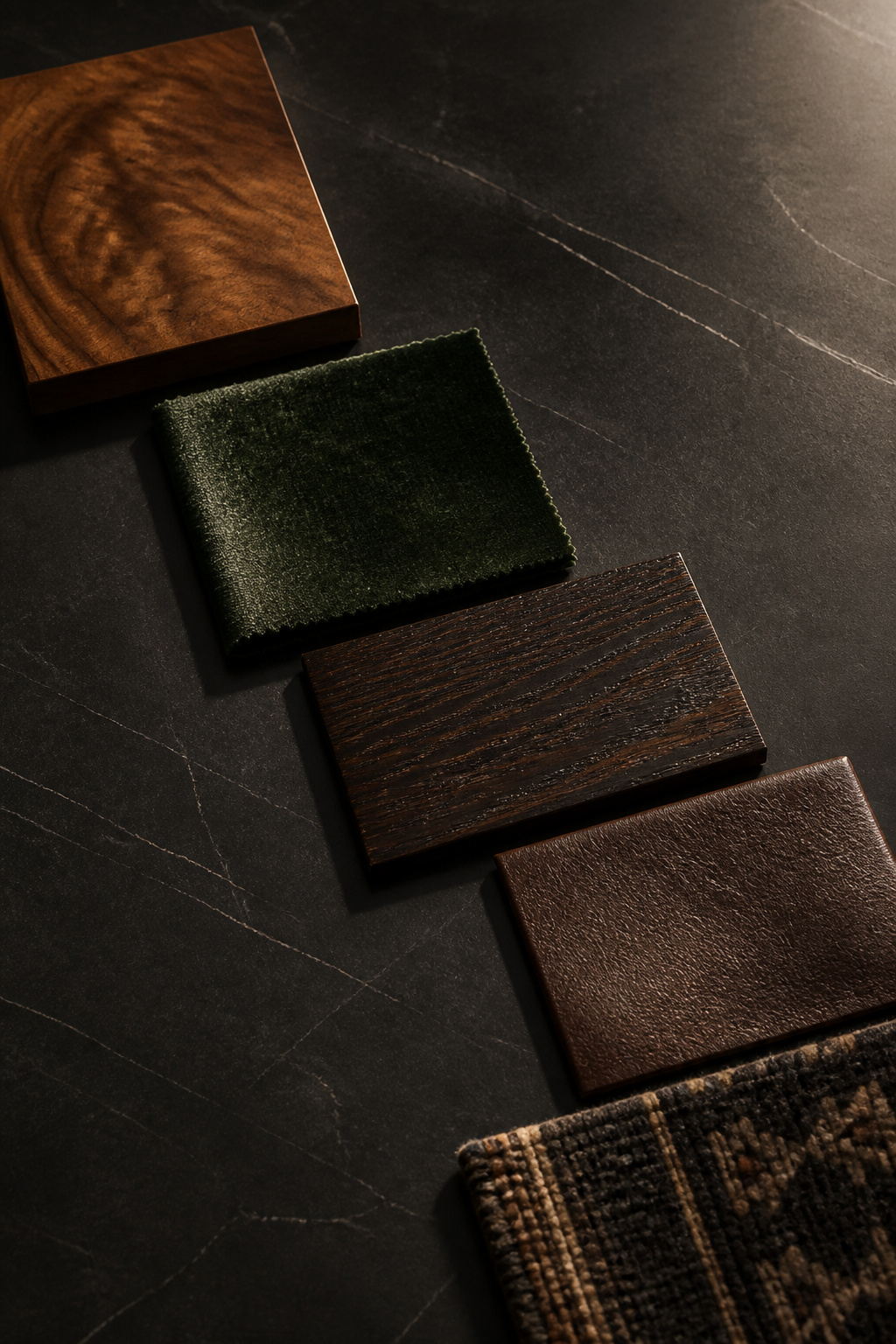
How low light changes the way wood grain, velvet pile and leather read
A dark room reverses the daylight reading of a surface. Walnut’s chocolate-to-espresso heartwood comes alive under warm tungsten and candle, the open grain catching light as a run of fine shadows. Velvet’s cut pile does the same at smaller scale — the shimmer that makes it look alive — and full-grain leather burnishes with use, so its patina reads as depth, not wear.
The absorb-vs-reflect question
High-gloss lacquer is the trap: a mirror-finished tabletop bounces lamplight straight back, the furniture equivalent of a glossy white wall. Matte and satin finishes absorb the light and keep the grain legible, and deep performance velvet holds colour-depth no flat-woven or wipe-clean surface can match.
The material hierarchy: what carries the most weight
Pieces earn light in order of how much of the room they occupy.
| Surface | Why it ranks where it does |
|---|---|
| Dining table | Largest plane, read from every seat; its grain anchors the room |
| Dining chairs | Tallest band of fabric at eye level — the most atmospheric choice after wall colour |
| Sideboard | The one full-height piece nobody sits at; backdrop and staging surface |
| Rug and curtains | The acoustic and visual ground plane and the room’s soft edges |
The Dining Table: Dark Wood, Rich Finishes and What They Really Mean
The species matters more than the stain. A table is read from every chair and every doorway, so it earns the highest material investment — and a naturally dark wood gives back far more than a stained pale one.
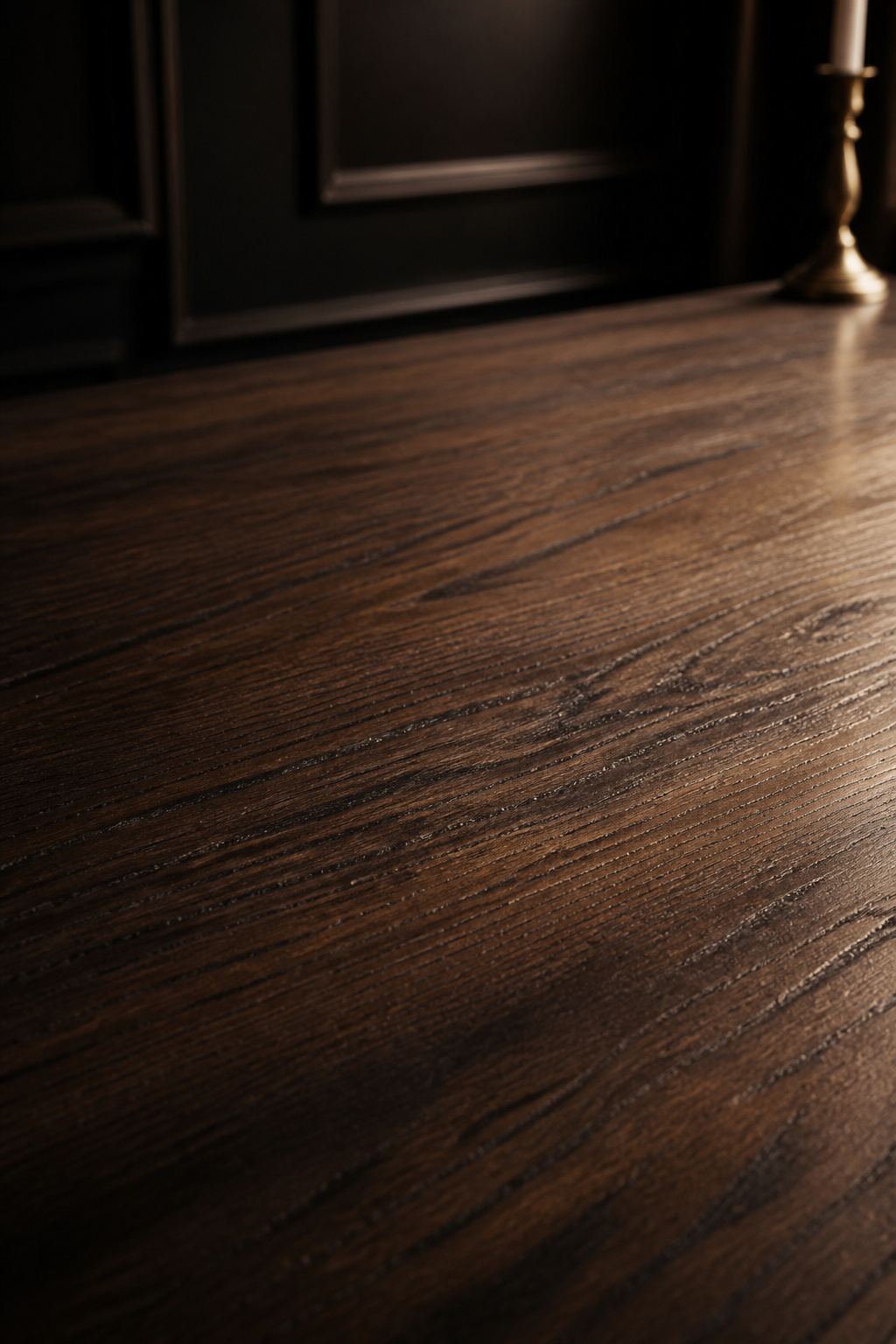
Walnut, oak and mahogany compared
Black walnut is the workhorse: a Janka hardness around 1,010 lbf handles daily use, and its heartwood runs from chocolate to espresso with streaks of caramel and grey that show only under warm light. The open grain reads in dim conditions where tight-grained maple goes flat. Mahogany is subtler and more formal, its gift the reddish-brown patina that can read almost claret by candlelight. As Dutch Craft Furniture notes, walnut is the contemporary choice and mahogany the heritage one.
Dark stain versus natural dark wood
A stain sits on the surface, but a dark species runs all the way through — what I see again and again on estate-sale pieces. As Loewen Design Studios puts it, espresso or ebony stain fills oak’s open vessels with pigment and reduces grain variance, a two-tone effect that reads as applied; a natural dark wood keeps its heartwood’s full tonal range. A solid table can also be refinished indefinitely, while a scratch through veneer exposes the MDF beneath for good.
The case for going bigger
A dark room compresses scale: the walls absorb light and pull the boundaries inward, so a table that suits a pale room can read as undersized in a dark one. Size up — a table that seats six where the family is four gives the dark walls something to frame rather than crowd. A rectangle suits the mood better than a round, its long axis parallel to the dominant wall.
Dining Chairs: Velvet, Leather and the Upholstery Decision
Chairs are the tallest band of fabric in the room, at eye level down the table — after the wall colour, the most atmospheric decision you make. The velvet-or-leather question is really about how your household lives.
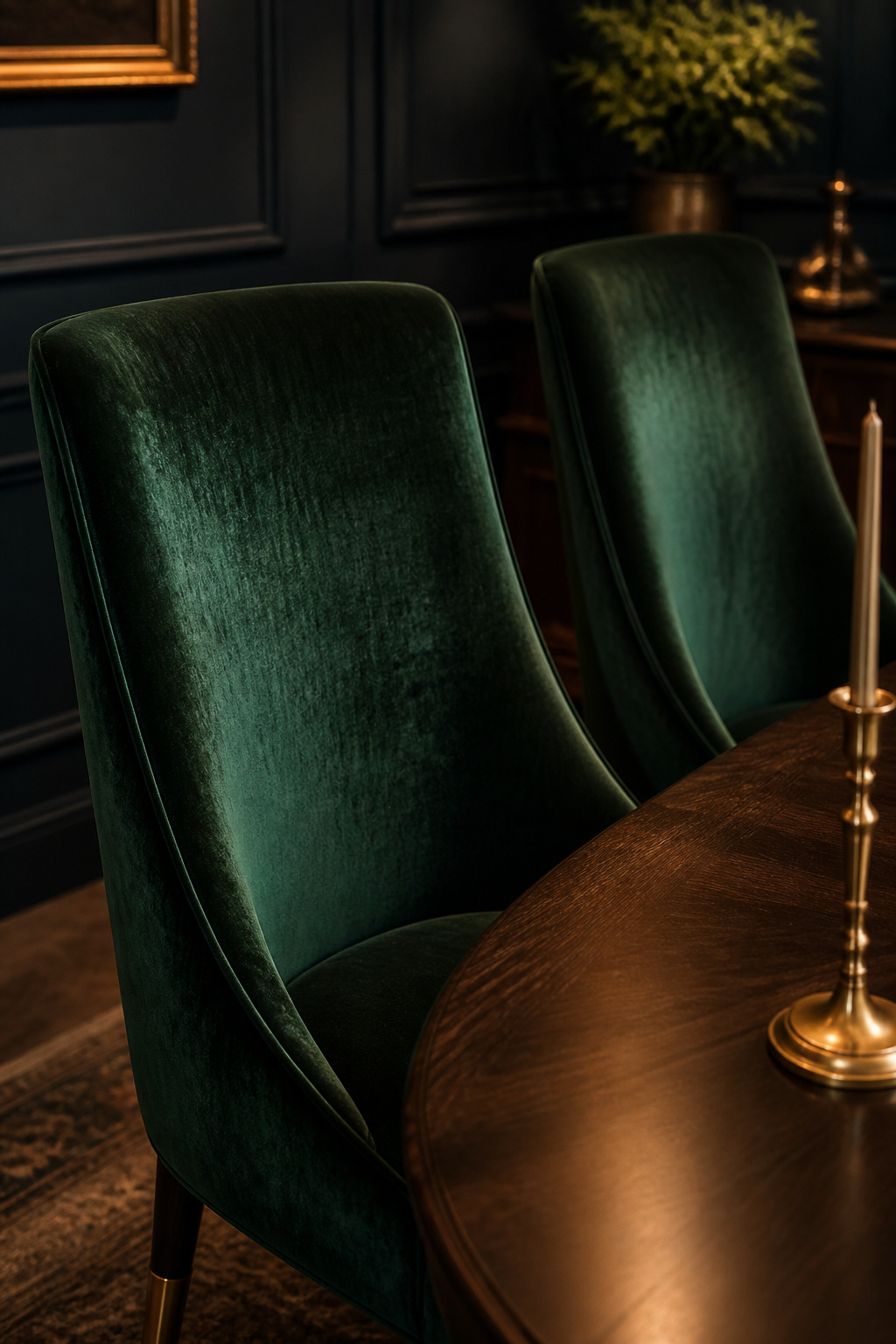
| Velvet (performance) | Leather (full-grain) | |
|---|---|---|
| Feel in low light | Soft, warm, atmospheric; pile shimmers | Crisp, formal; deepens with patina |
| Durability | 40,000–100,000 Martindale; lasts 10–15 years | Beads spills; lasts 15–20+ years |
| Care | Blot, never rub; brush pile when dry | Wipe clean; condition every 6–12 months |
Why velvet dominates, and the practicality myth
Velvet earns its place because the pile holds colour-depth no flat fabric can, and the durability objection no longer holds. Dining chairs want a minimum of 20,000 Martindale rubs, and performance polyester velvet routinely clears 40,000–100,000; cotton velvet rates only 15,000–30,000 and marks more readily. As Shannon Taylor of Lakeland Furniture observes, the velvet is almost never the failure point — the foam, frame or stitching gives out first, so buy a solid frame and high-grade pile in a dark colour that hides marks.
Leather, faux-leather and the patina argument
Leather makes the opposite case: full-grain hide deepens with use and wins outright on spills, since liquid beads and wipes away before it soaks in. Avoid bonded faux leather, which peels at the seams within a few years. As the Povison buying guide puts it, neither is universally better — the right choice follows your maintenance habits as much as your taste.
Frames: dark wood, black metal or brass
The frame signals the room’s register. Dark wood legs flow the table’s tone to the floor; black metal lightens the weight and pulls toward modern; brass or aged-bronze caps catch warm light and echo the chandelier. Whichever you pick, match it to the other metals — a brass chandelier above chrome legs reads as unfinished. The chair is also scaled to the lighting over the table above it, so choose the two together.
The Sideboard: Anchor Piece and Atmospheric Element
A sideboard does more work in a moody dining room than in any other style: it anchors a wall, stages the second tier of light, and bridges the table to the wall treatment behind it.
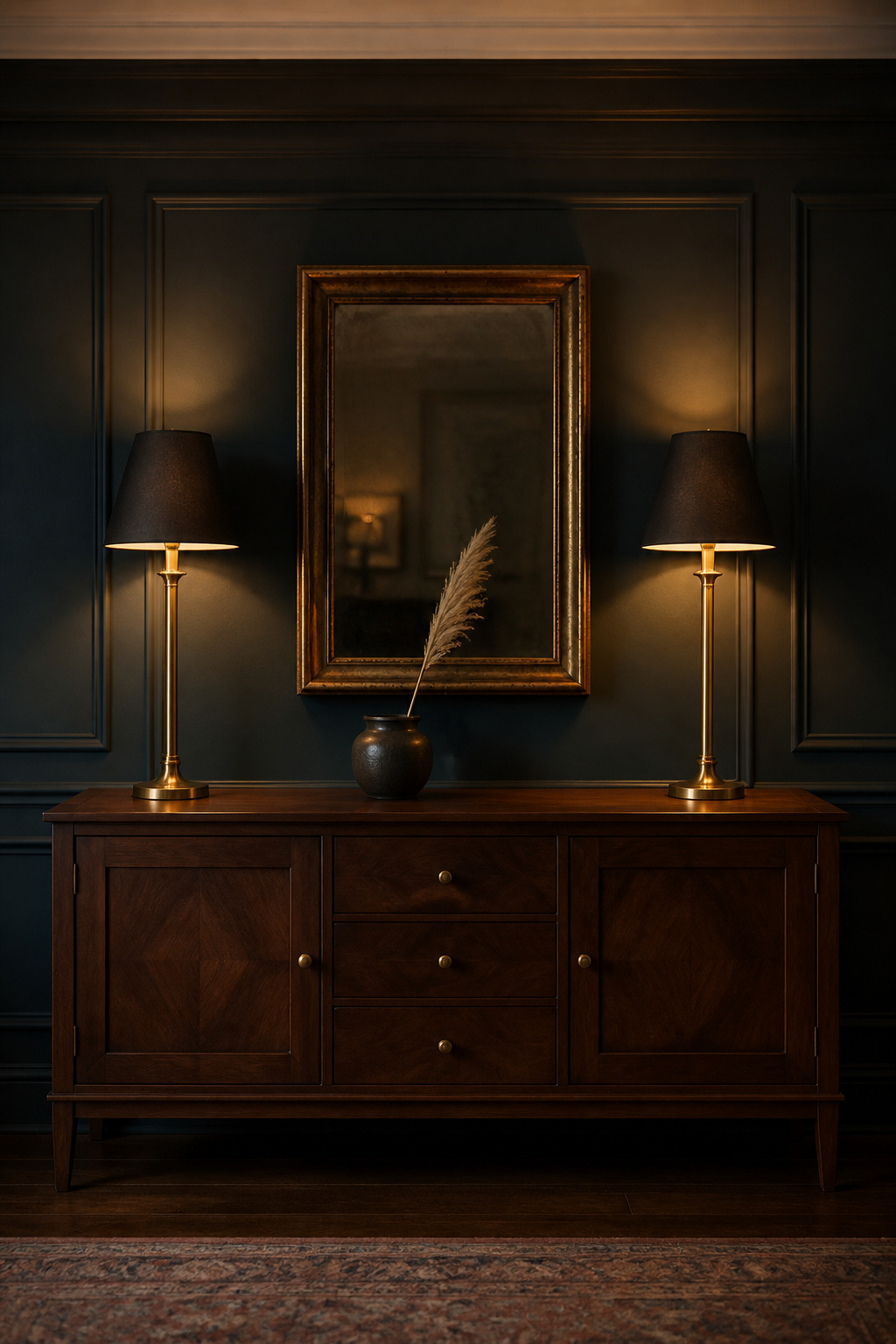
Why it earns its place
Standard sideboard height runs 30–36 inches, sitting at or just above the table’s 28–30 — a continuous dark band that carries a visual horizon around the room. Keep the length to 60–75% of the table length (a 72-inch table takes a 43–54-inch sideboard) and depth to 16–18 inches where the wall already carries panelling. Without a sideboard, a dark-walled room has nowhere to break the shadow.
Material and finish
The same truth as the table applies: solid oak, walnut or mahogany can be refinished and reads with real grain depth, while veneer over MDF gives itself away once damaged. Check the end grain and inside the drawers — solid pieces show continuous grain through the full thickness. Choose a satin finish over high-gloss lacquer, which turns to a mirror in candlelight.
Layering light and decor together
Two flanking buffet lamps at 30–40 inches tall sit just above seated eye level and throw warm light up the wall rather than into diners’ faces; charcoal or navy shades give a moodier pool than white. Two lamps flanking a mirror turn storage into a focal point. What goes on top — the art, the greenery — is its own craft, covered in styling the table and sideboard.
Rugs: Grounding the Room Without Competing With the Walls
A rug under a dining table is a specific challenge, not an afterthought — it has acoustic and visual work to do, and one sizing rule buyers get wrong more than any other.
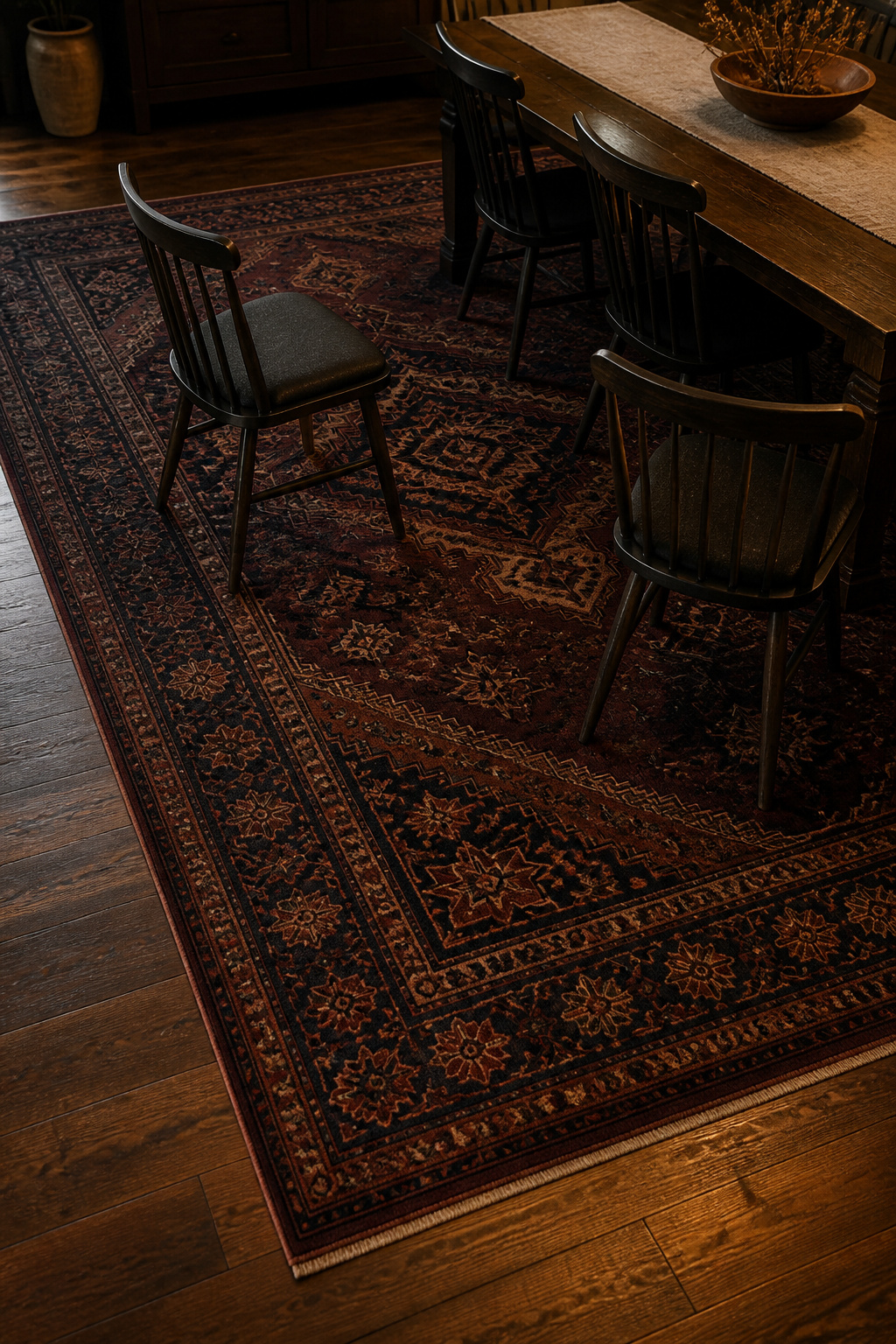
Why a rug is essential
Hard floors amplify a dining room: bare tile produces seven to twelve times more surface noise than carpet, so every scraped chair rings out. A rug absorbs that and grounds the furniture as a room within the room — without it, table and chairs float on an undifferentiated floor.
Material, pile and colour for a dark room
Where the walls already do the visual work, the rug plays support. Keep it dark and tonal — deep wine, charcoal, navy or forest in a Persian or geometric motif — so it grounds without competing and hides spills; a pale rug becomes the brightest object and works against the mood.
| Rug material | How it handles dining spills | Care note |
|---|---|---|
| Wool | Natural lanolin makes liquids bead before they absorb | Best all-round; low pile; long-lasting |
| Polypropylene | Excellent stain resistance, holds colour well | Easiest care, lowest cost — the practical pick |
| Jute / sisal | Highly absorbent; wine and food stain permanently | Avoid under a dining table |
Keep the pile under 0.5 inches whatever the material — high pile catches chair legs and compresses into permanent dents.
The 24-inch rule
This is the one to get right. A dining rug must extend at least 24 inches beyond every side of the table — roughly how far a chair travels when pulled out. As Rugs Direct puts it, the most common error is sizing the rug to the table footprint instead of the table-plus-chairs footprint. A six-seat table (around 36 x 72 inches) needs an 8′ x 10′ rug minimum; an eight-seat table needs 9′ x 12′. Every chair leg must stay on the rug even when pushed back. Where the room can’t give 24 inches on all four sides, protect the two long sides where the chairs sit.
Curtains and Window Treatments: Light Control as Design Material
Curtains are the element that closes the room in for dinner, turning a space with windows into a contained, cloth-lined chamber — the last surface to fall into place, and the one that makes the room feel finished after dark.
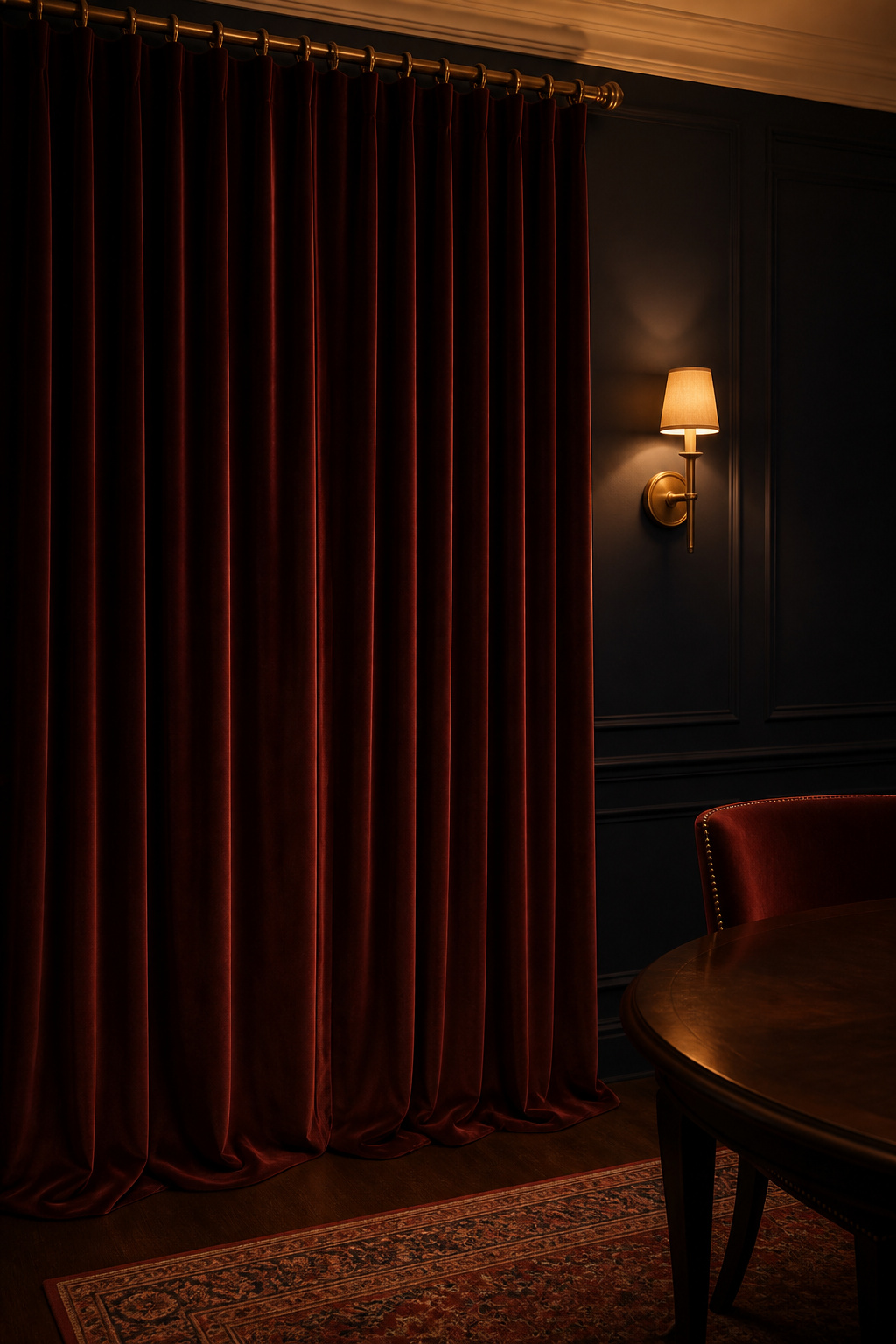
Floor-length, and how long is long enough
Hang the rod high — 4 to 6 inches below the ceiling or cornice, not just above the window — to draw the eye up and frame the whole wall. Then run the panels to the floor: a clean half-inch break reads contemporary, a 2-to-4-inch puddle reads formal and works best where the curtains stay closed. Sill-length panels are the wrong call — they expose the wall below and undo the enclosure the style depends on.
Fabric: velvet, linen and blackout-lined silk
Velvet is the atmospheric peak. Beyond the drape, it insulates against heat loss and absorbs sound; retailers cite figures around 60–90% daylight blocking, best read as an illustrative range rather than a tested standard. Being the heaviest option, it needs a steel or solid-wood rod on wall-anchored brackets — a tension rod will not hold it. In a warm climate, blackout-lined silk or linen gives the face colour with light control in the lining, at a lighter weight. Whatever the fabric, line it — unlined panels lose their drape and leak light.
Curtain colour
Match the curtain closely to the wall and the room becomes a single enveloping surface — the most immersive option. A tonal contrast — a shade or two off, or burgundy against forest-green walls — adds interest while staying in register, and suits most rooms. Reserve high-contrast cream or white for where there is a real reason, such as picking up white trim; an arbitrary pale panel just punches a hole in the dark.
Putting the Room Together: Material Cohesion
Cohesion comes not from matching furniture but from a consistent register — dark timber, warm metals, light-absorbing fabrics — pulled from one tonal family. A few principles hold it together:
- Keep the timber family tight. Walnut, mahogany or ebonised oak can coexist if one metal finish ties them; mismatched woods with nothing linking them read as accident.
- Let contrast reveal, not compete. A pale linen curtain reveals the window and a cream napkin reveals the dark tabletop — earned contrast directs the eye, while a glowing pale rug only steals it.
- Choose one warm metal and repeat it. Brass or aged bronze on legs, lamp bases and rod catches candlelight as gold; chrome reads cool and belongs to a modern register.
Furniture confirms a moody room; it cannot create one. The walls and the warm light set the register first. For the whole system, return to the moody dining room ideas guide.
FAQ
What color furniture works best in a moody dining room?
Dark natural timber works best for the big pieces — walnut, mahogany or ebonised oak, whose grain reacts to warm light better than stain on pale wood. For chairs, deep jewel-tone velvet (forest, burgundy, sapphire, charcoal) absorbs light and holds depth, while pale upholstery fights the mood. Add brass or aged-bronze accents to tie the metals together.
Is velvet a practical choice for dining chairs?
Yes, if you choose performance polyester velvet rated 40,000–100,000 Martindale rubs rather than cotton velvet at 15,000–30,000. It resists staining, recovers from pressure marks and suits daily use. Blot spills immediately with a dry microfibre cloth, never rub, then brush the pile in one direction. Dark colours hide marks far better than pale ones.
How do I choose a rug for a dark dining room?
Size first: apply the 24-inch rule so the rug extends at least 24 inches past every table edge, keeping chairs on it when pulled out — a six-seat table needs an 8′ x 10′ rug minimum. Choose wool or polypropylene, never absorbent jute or sisal. Pick a dark, tonal colour and keep the pile under half an inch.