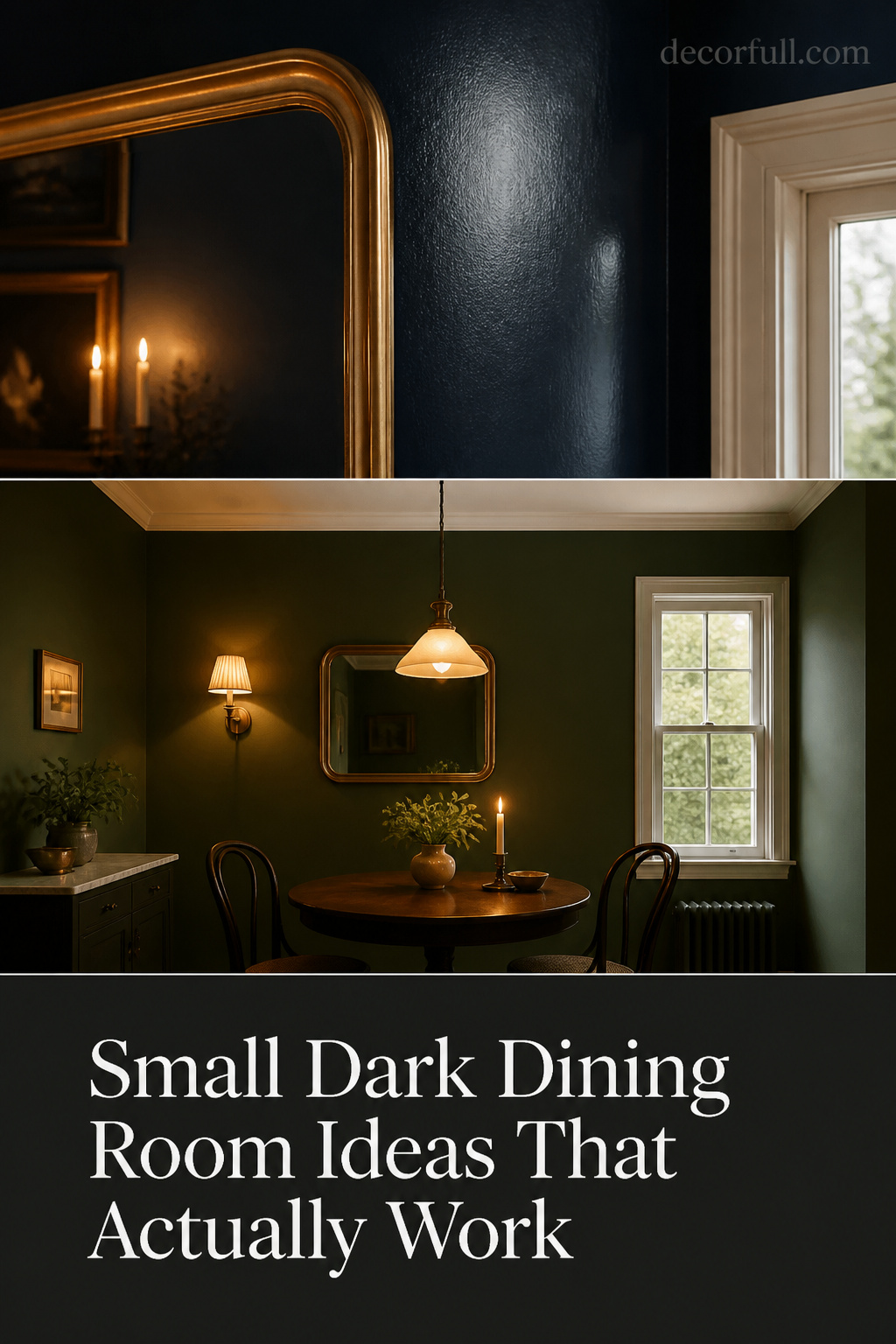
The cheapest version of this project is about $195 in materials and one weekend; the version that goes wrong costs you a second gallon of paint and a Sunday repainting. Both start with one belief I want to talk you out of: that dark paint shrinks a small room. It doesn’t. Square footage isn’t what makes a small dark dining room feel like a cave — finish, light and contrast are, and all three are cheap to fix.
TL;DR
- Dark paint doesn’t shrink a room; a flat finish, one overhead bulb and oversized furniture do. Fix those and a 9×10 ft room reads rich, not cramped.
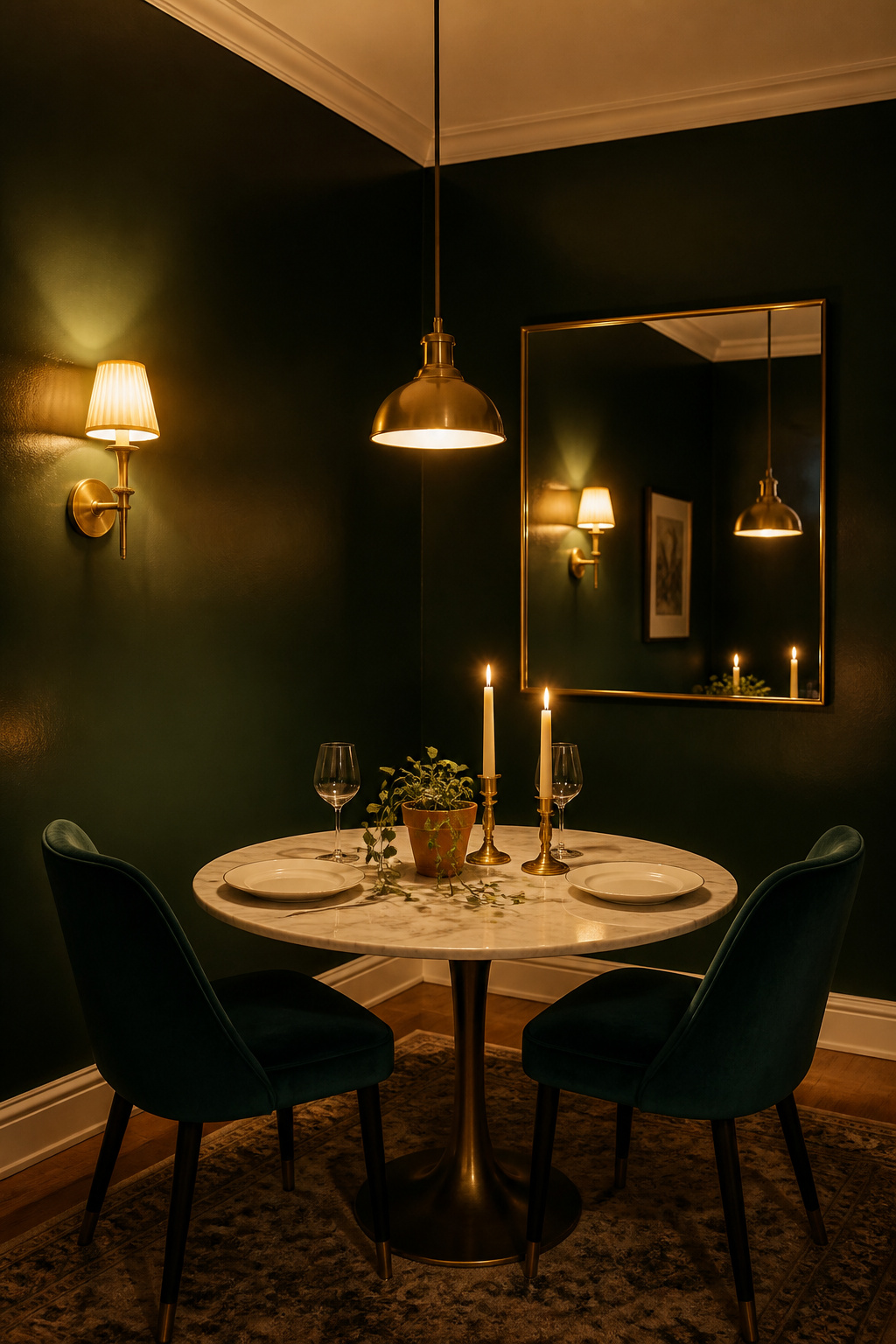
- Use a satin finish (25–35° gloss) on the walls, white semi-gloss on the trim, one large mirror, and three warm 2700K light sources at different heights.
- Total materials run roughly $195–$480 DIY over a weekend; sample one wall first, and renters can do most of it with peel-and-stick wallpaper and plug-in sconces.
The Myth: Dark Paint Shrinks Small Rooms
The “dark makes a room smaller” rule survives because people confuse the colour with the things that actually do the shrinking. For how all the moody-room levers fit together, work back to the pillar on designing a moody dining room.
What actually controls how large a room feels — and it’s not the paint colour
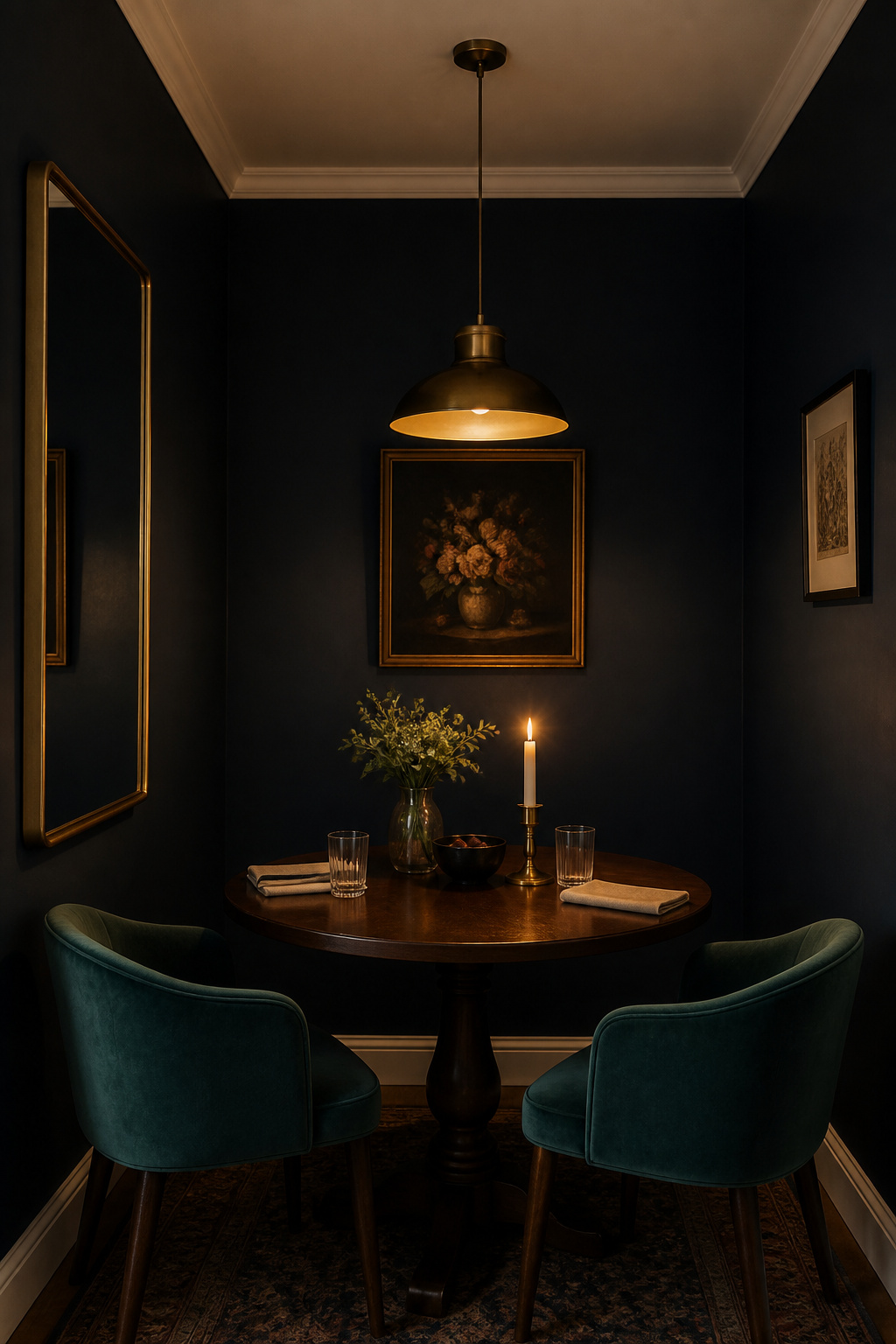
Perceived size is mostly about light level and contrast, not hue. Below roughly 200 lux, edge contrast drops and corners visually collapse for any colour — so enough layered light keeps dark from shrinking anything. Dark colours actually recede from your eye; designer Kathryn Findlay of Studio Findlay says a dark wall “can add contrast and dimension, while visually enlarging the space.” The usual culprit in a tight room is oversized furniture, which is why a round table is the standard small-dining pick.
The rooms that prove dark works
Interior designers Amanda Jacobs and Jaclyn Journey covered a 10×12 ft room in BEHR Cherry Cola, and it read “cohesive,” not closed-in. HGTV’s Orlando Soria is blunter: painting a dark room white “makes it look dingy and depressing. LEAN IN and paint it a sultry, saturated color.”
What the real culprits are when a small dark room fails
Three things stack up: a single overhead light that leaves walls unlit; a stark white ceiling whose contrast against warm dark walls pulls the planes closer; and deep matte on all four walls with no mirrors, metal or extra light. That combination makes a cave. The dark paint alone never does.
Finish First: Why Gloss and Semi-Gloss Change the Rules
Here’s the lever almost nobody starts with: in a small dark room, finish does structural work. The sheen decides how much light bounces back. Because finish pairs with the colour itself, read it alongside the spoke on paint colour and finish.
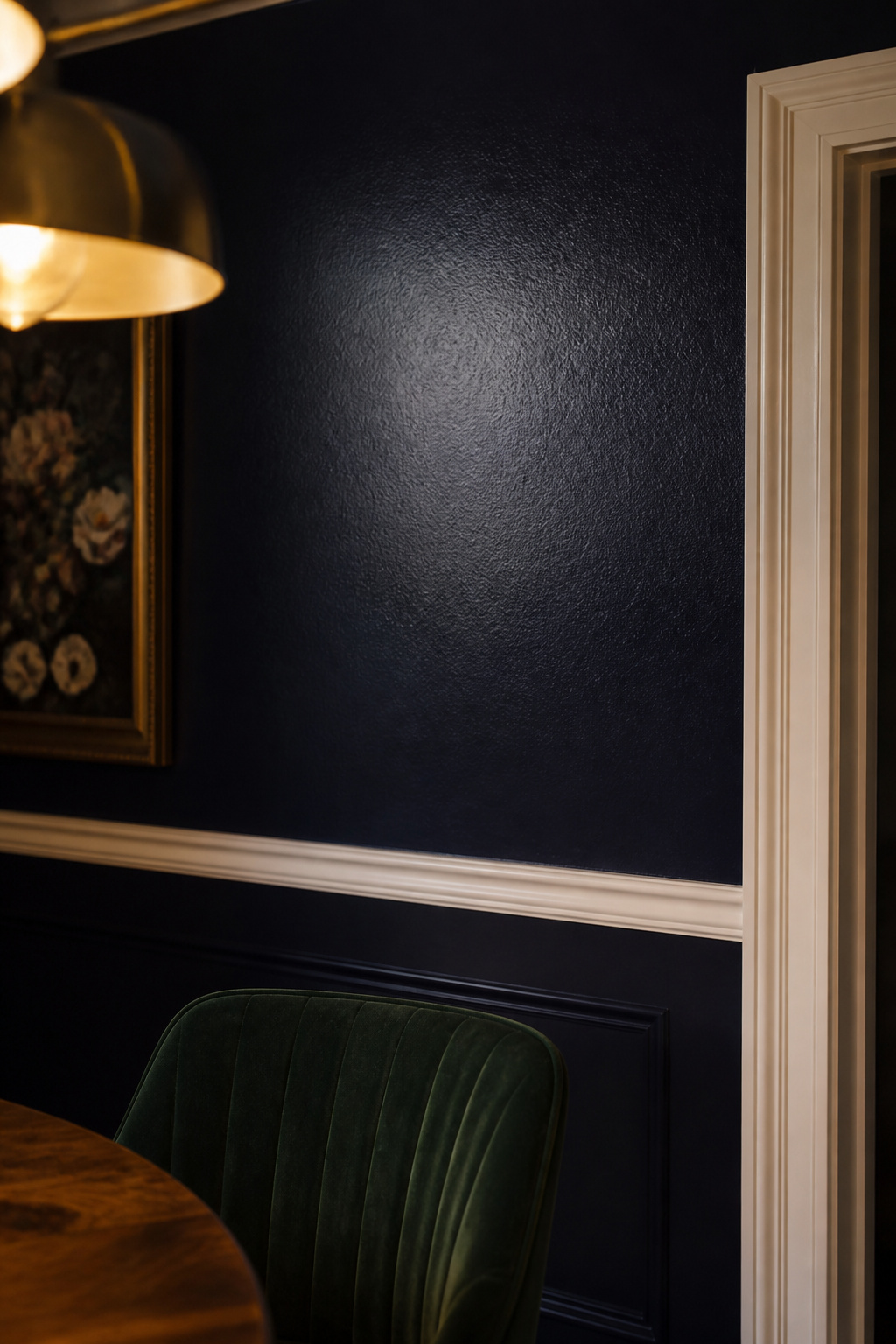
What gloss does to perceived depth in a small dark room
The sheen scale runs by gloss value: flat/matte 0–5°, eggshell 10–25°, satin 25–35°, semi-gloss 35–55°, high gloss 70° and up. Higher sheen bounces more light back, but semi-gloss on a dark wall amplifies every dent and brush stroke. Satin is the compromise: reflects gently without the glare. One caution — any sheen above satin needs a level-5 drywall finish (a full skim coat). Rental drywall almost never is, so sheen telegraphs every taped joint.
The finish spectrum for small rooms
| Finish | Gloss value | Where it earns its place |
|---|---|---|
| Flat / matte | 0–5° | Envelopment, only with mirrors and extra light |
| Eggshell | 10–25° | Rental walls that aren’t level-5; forgiving of flaws |
| Satin | 25–35° | The default for walls: bounces light, cleans well |
| Semi-gloss | 35–55° | Trim and ceilings, not standard walls |
| High gloss | 70°+ | Jewel-box walls in level-5 condition only |
Satin is the sweet spot for walls. Matte still works — Apartment Therapy’s 350 sq ft studio found the matte black walls helped because “the edges and boundaries of the small studio are disguised by the matte black finish.” That’s the envelopment route, and it only works if you add mirrors and light to do the lifting.
Combining matte walls with gloss trim
The standard combination: dark walls in satin or eggshell, white semi-gloss trim and ceiling. Semi-gloss trim (35–55°) turns baseboards and door frames into a light-bouncing border, and Sherwin-Williams recommends it because it’s “more durable and easier to clean.” Budget: Behr or Sherwin-Williams satin in a dark hue runs $40–$60 a gallon. Rate this one first build.
Mirrors and Reflective Metals: The Small Room’s Structural Tools
A mirror in a small dark dining room isn’t decoration — it multiplies your light and doubles your perceived depth. Hang one before painting anything.
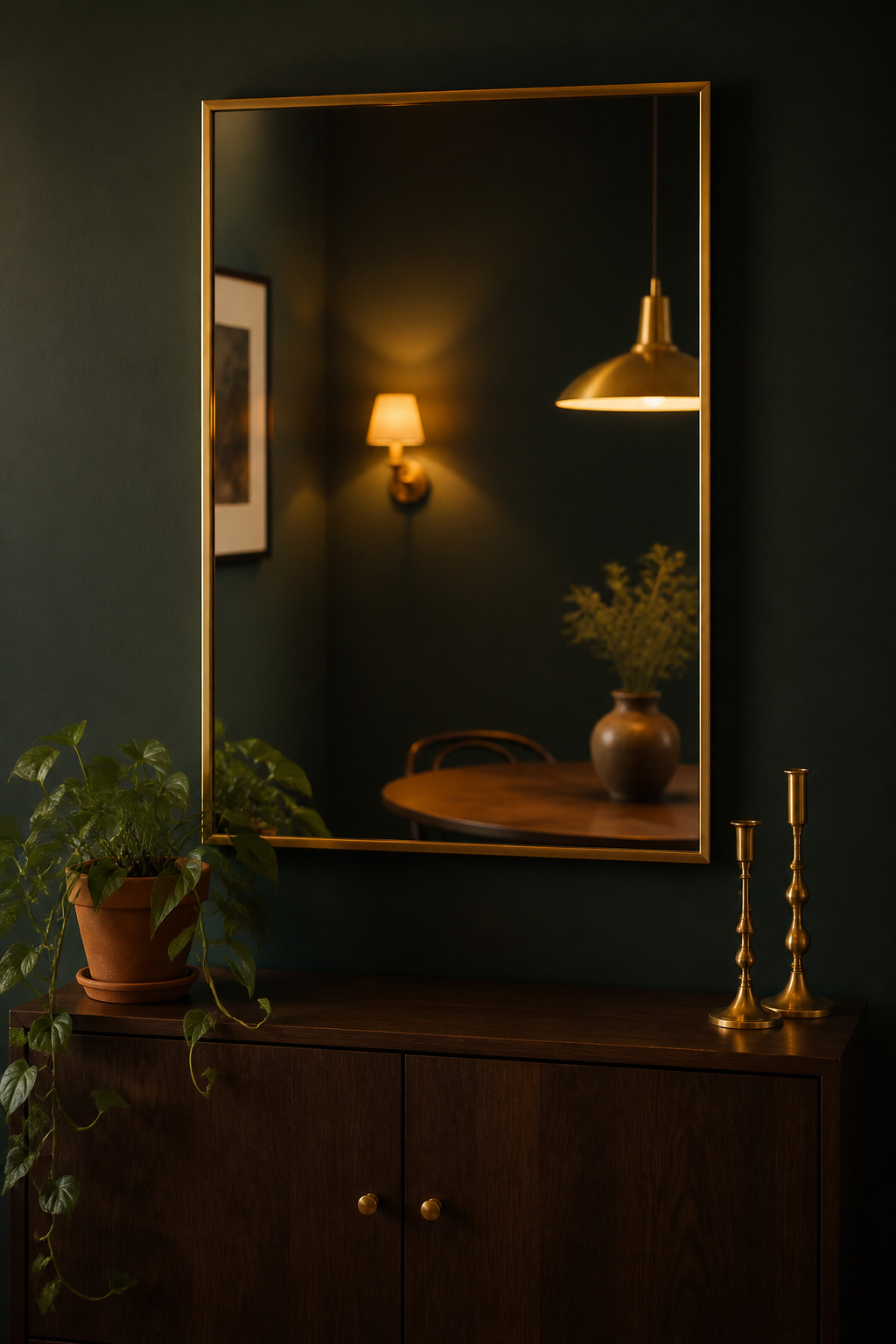
How a mirror doubles a small dark room’s perceived depth
A large mirror on a main wall reflects the room and erases the boundary where the wall ends. In a 9×10 ft room, a 48×36-inch mirror opposite the window or light source can deliver a reported 25–35% gain in perceived depth — a trade figure, not a lab result, so treat it as a ballpark. Hang it behind a sideboard and you push the room past the plane of the glass.
Where mirrors work (and don’t) in a tight dining room
- Put it opposite or next to your main light source so it bounces the most light.
- Hang it at eye level, around 57–65 inches to its vertical centre, so it catches the lit table, not clutter.
- Keep it off the wall directly facing the table; a side wall or above a sideboard avoids your reflection mid-meal.
- Go tall in a low-ceiling room: a vertical mirror fakes ceiling height as well as depth.
Reflective metals: the cheaper multiplier
Mirrors do the heavy lifting; metals do the same at a smaller scale. A brass pendant, a gold-framed mirror, brass cabinet pulls — each scatters another reflective spot. Match finishes so it reads intentional. Budget workaround: swap sideboard knobs for brass ones at $3–$15 each — four knobs for under $60, one screwdriver, twenty minutes, first build.
One Accent Wall: The Small-Room Version of the Full Commitment
One dark wall instead of four isn’t a compromise — it’s a deliberate strategy that often beats going fully dark in a tight room. For the depth on molding and wallpaper, see the full case for an accent wall.
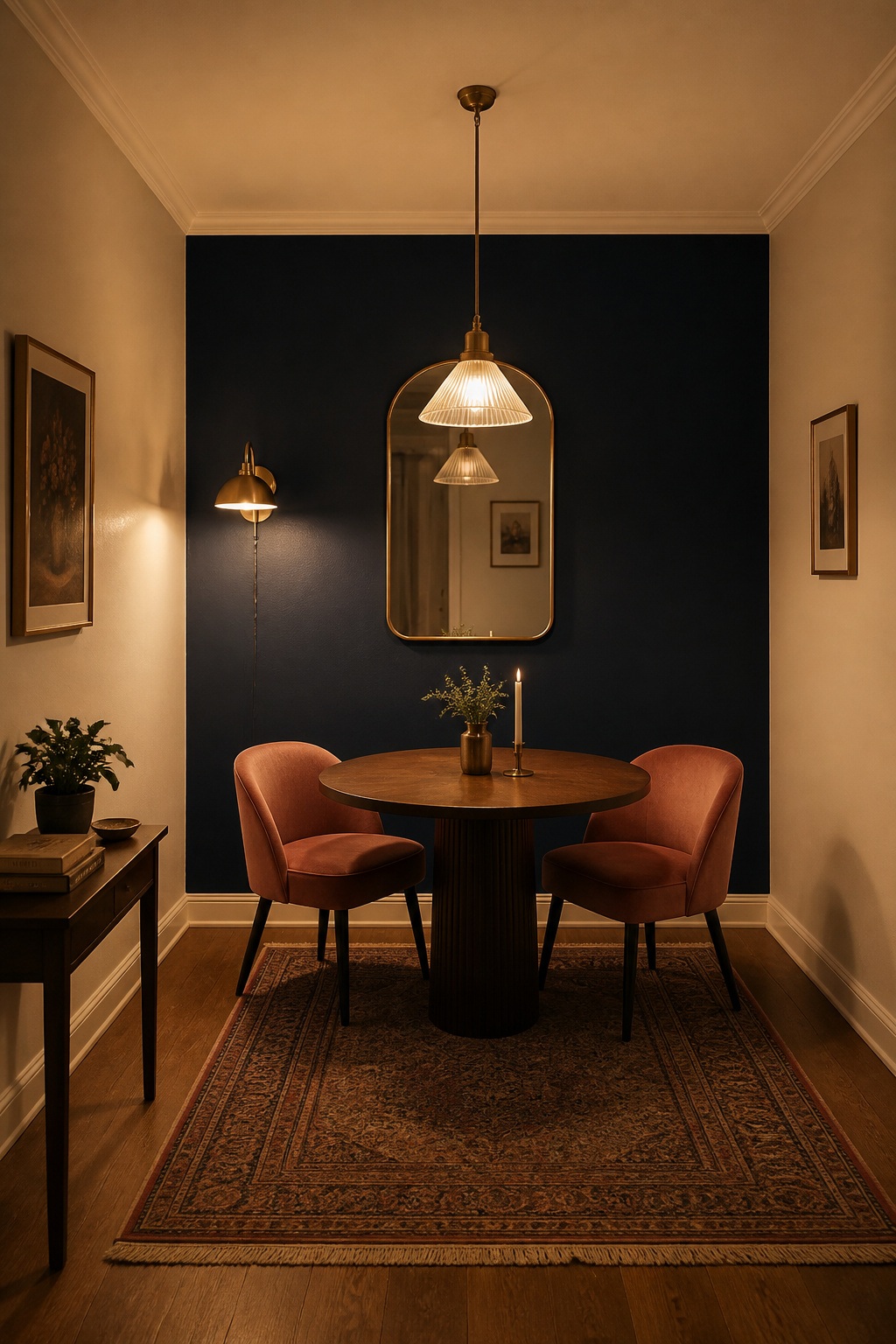
Which wall to choose and why
Pick the wall your eye lands on first — usually the one your chairs face, often behind a sideboard. Don’t make the window wall the dark one; keep it light so daylight bounces off pale surfaces. Ruth Mottershead of Little Greene explains the logic: a darker feature wall reads as receding, drawing the eye forward and elongating the room while the side walls stay open.
Going dark on one wall, keeping three lighter
A dark accent wall makes the three lighter walls read brighter, so they reflect more light. As Paola Zamudio of npz studio+ notes, an all-dark room under artificial light “can make a space feel confined.” Three lighter walls leave enough pale surface to throw sconce and pendant light back rather than swallow it.
Making the accent wall feel intentional
The difference between “design choice” and “abandoned project” is in the edges. Carry the dark paint onto the ceiling by 6–12 inches, or paint that wall’s trim dark too. Tash Bradley of Lick advises reflecting the dark with a complementary shade: cream with forest green, warm greige with charcoal. Renter version: peel-and-stick wallpaper, about 28 sq ft per roll at $25–$50, so a 72 sq ft accent wall needs three rolls ($108–$150). What goes wrong: it only grips smooth, clean, dry walls — on textured rental walls it lifts at the corners within weeks, so test one strip first. First build, but check your lease first: painting rights vary, so don’t take a universal rule from me or anyone else.
White Trim and Ceiling: The Contrast Move That Creates Height
White up top buys you height; white trim frames the walls and bounces light back.
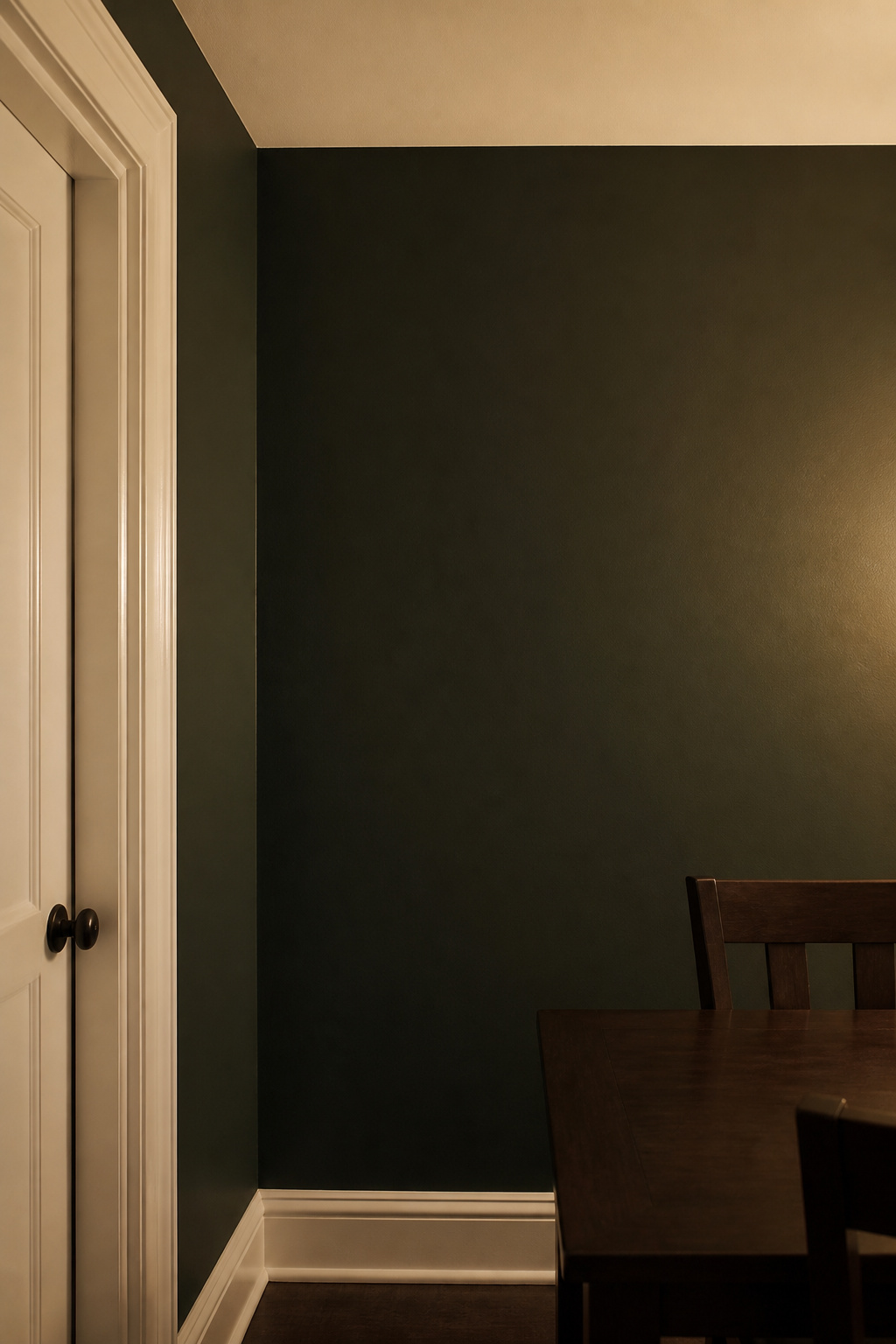
Why the ceiling is the last place to go dark
A dark ceiling in a low-light room drops the height. Kylie M Interiors puts it directly: “a darker ceiling can soak up any remaining light and make it feel closed-in.” Paint it some tone of white; even 10% lighter than the walls lifts the proportions. The exception is colour-drenching — walls, ceiling and trim all the same dark — which Apartment Therapy’s 350 sq ft study confirmed works by erasing the contrast boundaries that make edges feel close.
How white trim frames dark walls without fighting them
White semi-gloss trim acts as a bright border, and across baseboards, door frames and casings that’s meaningful reflective area. Shade matters: a warm white like Benjamin Moore White Dove OC-17 (LRV 83.16) sits better against warm-undertone darks than a cool bright white at LRV 90-plus, which reads almost jarring. Can’t repaint trim? Removable white trim tape inside existing profiles approximates the framing edge.
The painting sequence
- Prime first if going light-to-dark. A tinted primer cuts you to two finish coats.
- Paint the ceiling (white) so later wall drips don’t ruin finished work.
- Paint the walls (dark). Cut in with an angled brush, then roll; allow 2–4 hours between coats.
- Paint the trim last (white semi-gloss). Dry walls give sharp lines.
Two-day job: Saturday for primer and the first dark coat, Sunday for the second coat, trim and styling.
Light — Lots of It, and Warm
Light is the make-or-break lever. A small dark room needs more sources than a large bright one, not fewer — and they need to be warm.
Why you need more sources, not fewer
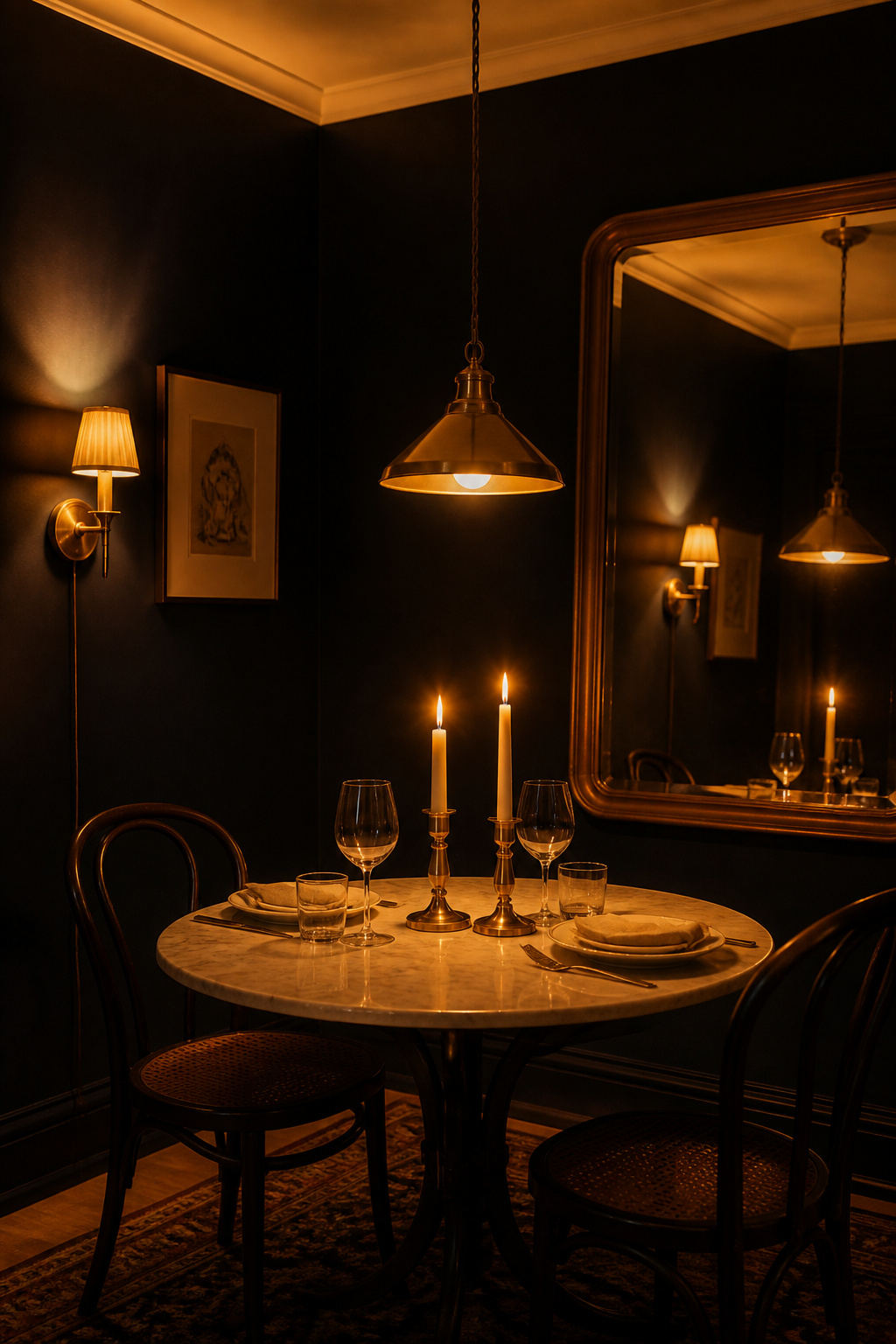
Layering beats wattage. Three warm sources at different heights light the wall planes a single overhead bulb leaves dark. Below the 200-lux floor corners visually vanish, so aim for a combined 300–500 lux at dinner. Set them all to 2700–3000K: warm LEDs amplify the undertones in green, navy and charcoal, while anything above 3500K greys the colour out.
The small-room lighting stack
A tight room carries three layers without crowding: a pendant above the table, one or two sconces flanking the mirror, and candles. Mount sconces around 60–66 inches from floor to fixture centre, so they throw flattering side and upward light rather than downward shadow.
Practical bulb choices on a budget
Plug-in sconces need only a wall hook and a cord run to the nearest outlet. Battery adhesive sconces like Poplight ($35–$60) stick up in about 20 seconds — NBC News Select called it “a big win for renters.” Cheapest of all: swap one cool-white bulb for a warm 2700K dimmable LED, $5–$12. It shifts the whole room’s mood for the price of lunch. First build, every one.
The Small Dark Dining Room: What to Do First
Cheapest and least committal first, most permanent last.
The sequenced starting point
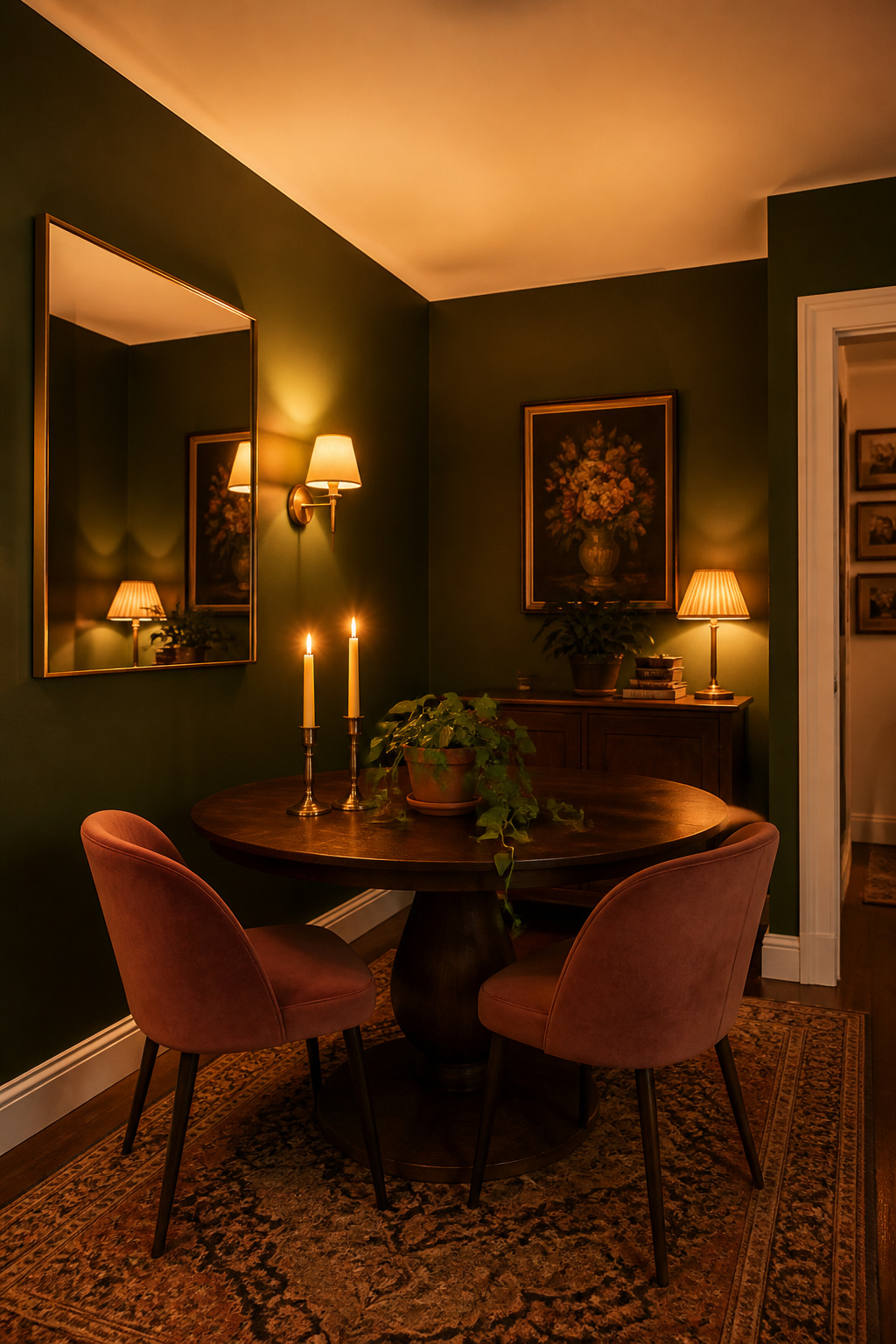
- Swap in warm 2700K bulbs. Immediate impact, no tools, $10–$20.
- Hang one large mirror on the main wall. Instant depth, one afternoon.
- Sample the paint. Brush a 4×4 ft satin patch and check it morning, midday and 7 PM with a candle lit.
- Paint the accent wall or full room only once it reads right at dinner.
Renters: start with peel-and-stick on the accent wall plus plug-in sconces and warm bulbs — removable paper previews the effect before you spend on paint you can’t reclaim.
Budget reality
| Item | Cost |
|---|---|
| Warm 2700K bulbs | $15–$25 |
| One large mirror (24×36 to 36×48 in) | $40–$200 |
| One gallon dark paint, satin | $45–$75 |
| One quart white trim paint | $20–$35 |
| Two plug-in sconces | $60–$120 |
| Painter’s tape and drop cloth | $15–$25 |
| Total materials | $195–$480 |
One gallon covers 350–400 sq ft per coat, so a 72 sq ft accent wall takes well under a gallon for two coats. DIY accent wall runs $15–$100; a pro charges $200–$500 for the same wall.
The mistake to avoid
The most expensive mistake in dark-room projects: buying four gallons and painting all four walls before testing how the colour reads in your specific light. Dark paint looks like a different colour under store fluorescents than under warm 2700K dinner light. A $5–$8 sample pot covers a 2×2 ft test patch — the professional minimum — checked morning, midday and evening. And the renter caveat: HUD treats nail and pin holes as normal wear, but painting without permission and not restoring the colour can count as damage. Check your lease; rules genuinely vary, so don’t take a universal one from me or anyone else.
FAQ
Can you use dark paint in a small dining room with no windows?
Yes, but the lighting does all the work. Without daylight, the room depends entirely on layered artificial light at 2700K — aim for three sources (pendant, wall sconce, candles) instead of one overhead. Choose warm darks with brown undertones over cool ones, and treat a large mirror as non-optional to multiply what light you have.
What finish should I use for dark paint in a small room?
Satin (25–35° gloss) is the sweet spot for small dark dining room walls: it reflects enough light to avoid the cave effect, cleans easily, and hides minor flaws better than semi-gloss. Reserve semi-gloss for trim and ceilings only. In rentals with textured or uneven walls, drop to eggshell instead — it’s more forgiving of imperfections.
How do I make a small dark dining room feel bigger?
Three moves matter most. First, hang a large mirror on the main wall — a 36×48-inch mirror reportedly adds 25–35% perceived depth. Second, keep the ceiling warm white to protect the vertical space. Third, use three layered light sources at different heights so every wall plane stays lit. A round table also removes the visual corners.