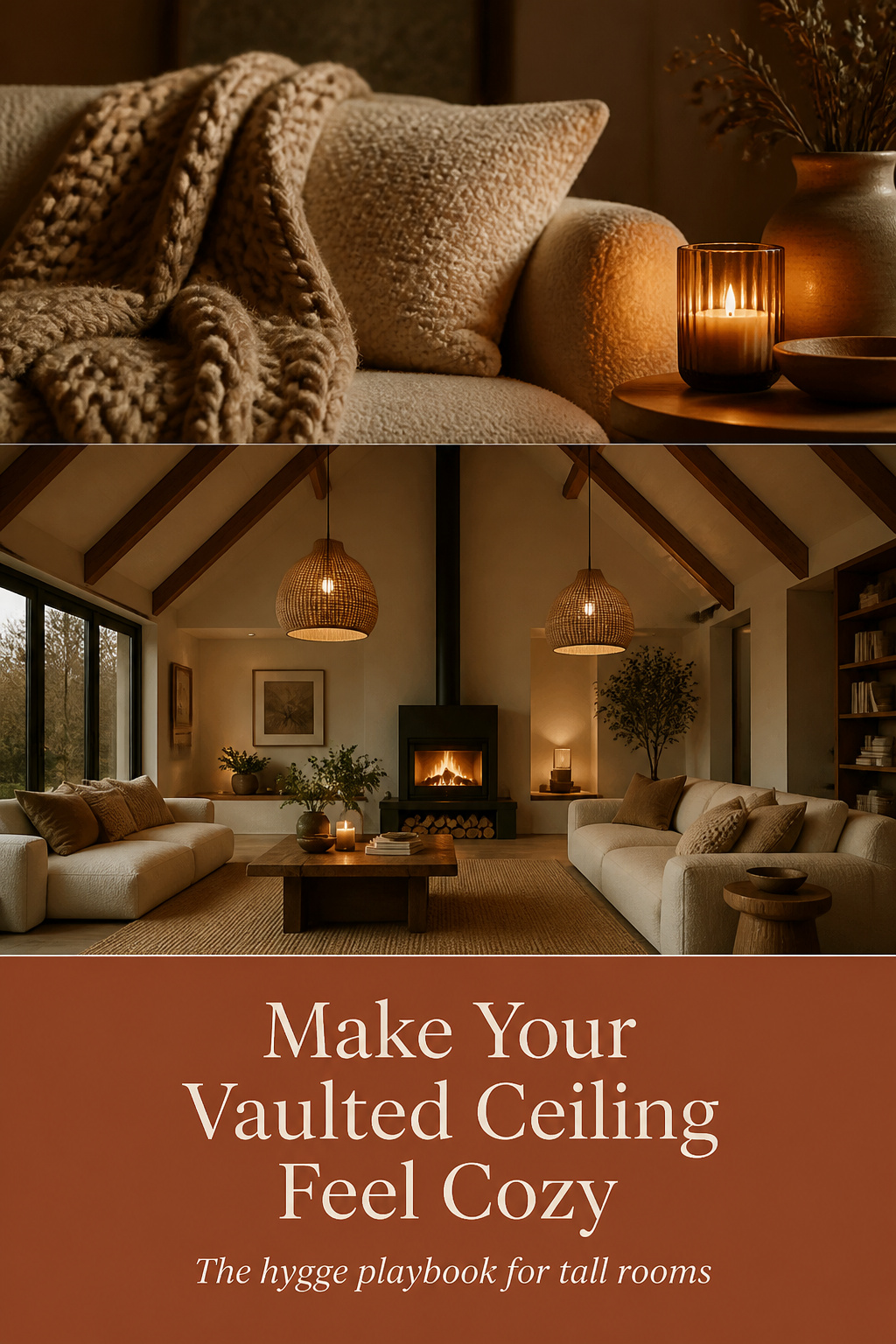
It is the same room at two times of day. In the afternoon the vault is a gift — light pours down the slope and the height feels generous. Then evening comes, you switch on the one ceiling light, and the warmth drains out of the floor. Voices echo a little. The top half glows; the half you sit in goes grey. To make a vaulted ceiling cozy, this is the hour you are solving for, not the showroom hour. And the work happens lower than you think — at the floor, the sofa, the seated eye line — never up at the peak.
TL;DR
- Build warmth from the floor up, not the ceiling down: a 9×12 ft rug, layered wool and boucle throws, and low lamps do more than anything at the apex.
- Drop the eye line below the midpoint of the wall — low furniture, pendants pulled to 6.5–7.5 ft, a horizontal element around 9 ft — and the height amplifies the room instead of swallowing it.
- The six levers in order: textiles, eye-line control, natural materials, paint with warm undertones, warm layered light, and a defined human-scale zone.
The Room That Changes After Dark: Starting From the Problem
The “cold and cavernous” complaint is the most common thing people say about a vaulted living room, and it is rarely about temperature. It is about scale, sound and where the light sits.
Why a vaulted room that looked bright in the showroom feels cold at home
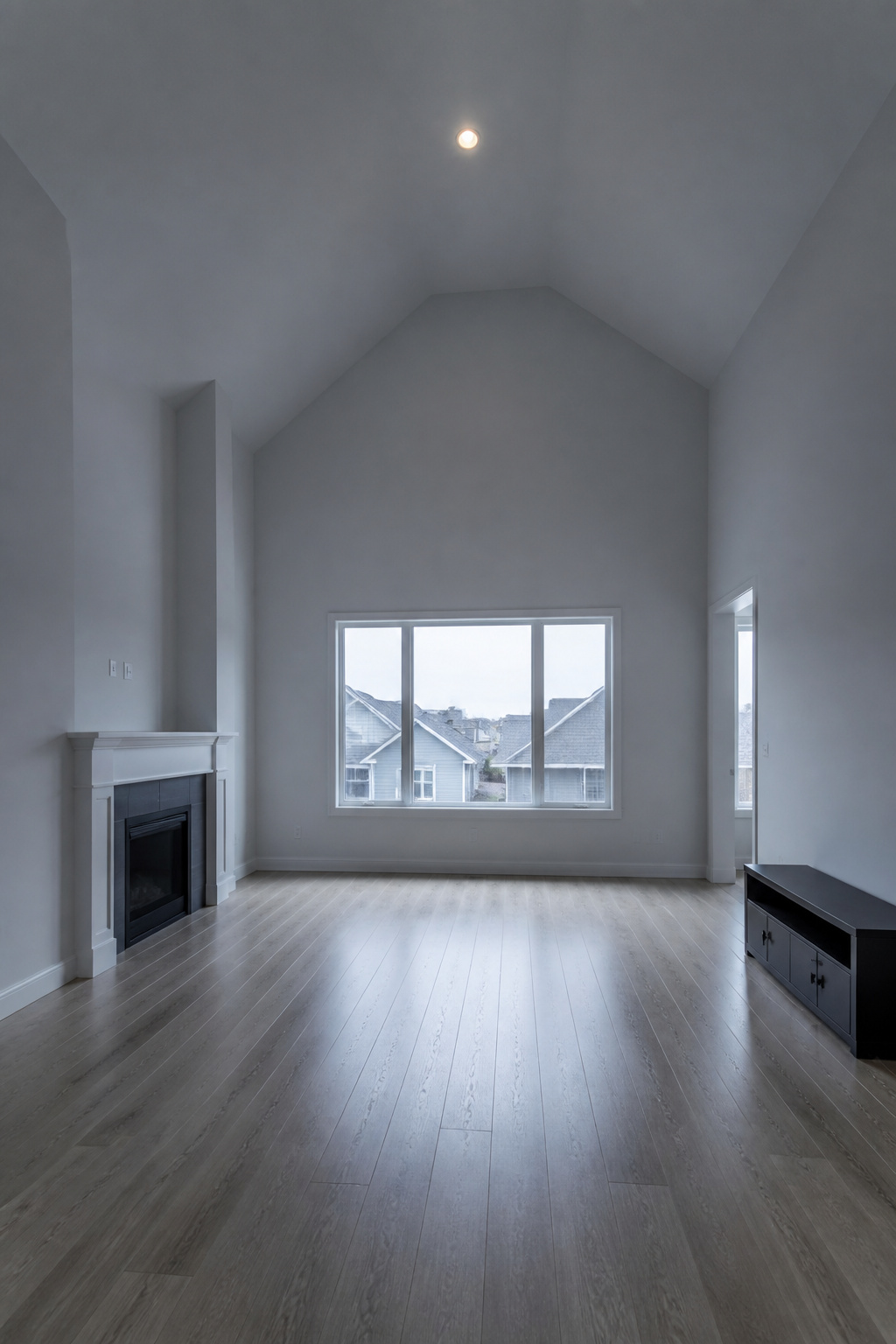
The showroom lied to you, but not on purpose. That display was lit with several warm sources and dressed with rugs and throws at human height. At home you have one pendant on a tall ceiling, which over-exposes the upper half and leaves the lower half in shadow. A single source at the apex distributes light badly across any room, and in a vaulted one the problem is compounded: the fixture sits six feet higher than usual and the warm half of the room — the half you sit in — goes dim. The paint compounds it: cool tones recede, so a blue-white ceiling reads colder and further off. Then there is sound — a tall empty volume echoes, and that hollowness makes the space feel unfurnished even when it is not.
The hygge principle applied to height: warmth is earned from the floor up
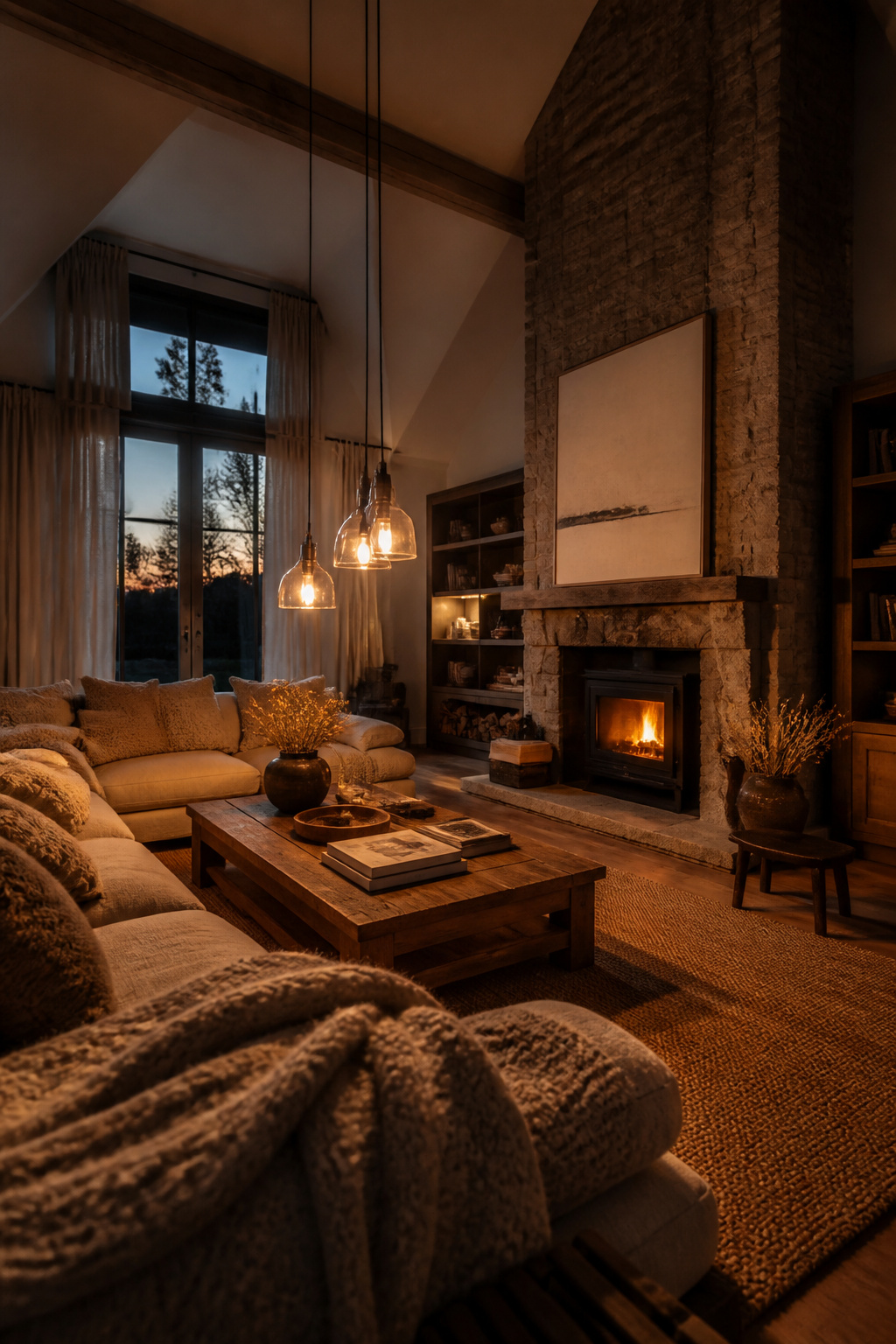
Here is the Nordic habit worth borrowing. In a cold country you learn that warmth is built where people live, not poured from above. So the sequence runs upward from the floor: rug and seating first, then low light, then colour — never starting with the ceiling as the problem to solve. The hygge expert Amber Brandt describes her aim as a home that meets all five senses, built by first quieting the room, then layering it. Several low, warm sources do more atmospheric work at seated eye level than any fixture at the peak. Bringing in nature — wood, stone, plant life — turns an empty volume into somewhere inhabited.
The six levers in the cozy-not-cavernous playbook
There are six levers, and they have an order of impact: layered textiles at the floor, furniture and eye-line control, warm natural materials, paint with warm undertones, warm layered light, and a defined human-scale zone. This guide walks them in that order. For the fixtures and the colour formulas, it hands you to the spokes that own those decisions rather than half-teaching them here. The wider room, where all of this connects, lives in the vaulted ceiling living room ideas guide.
Textiles and Texture: The Fastest Way to Add Warmth at Human Scale
If you do one thing this weekend, do this one. Textiles are the quickest, most reversible warmth you can add, and they work exactly where you sit.
Layering rugs, throws, and cushions without the result looking cluttered
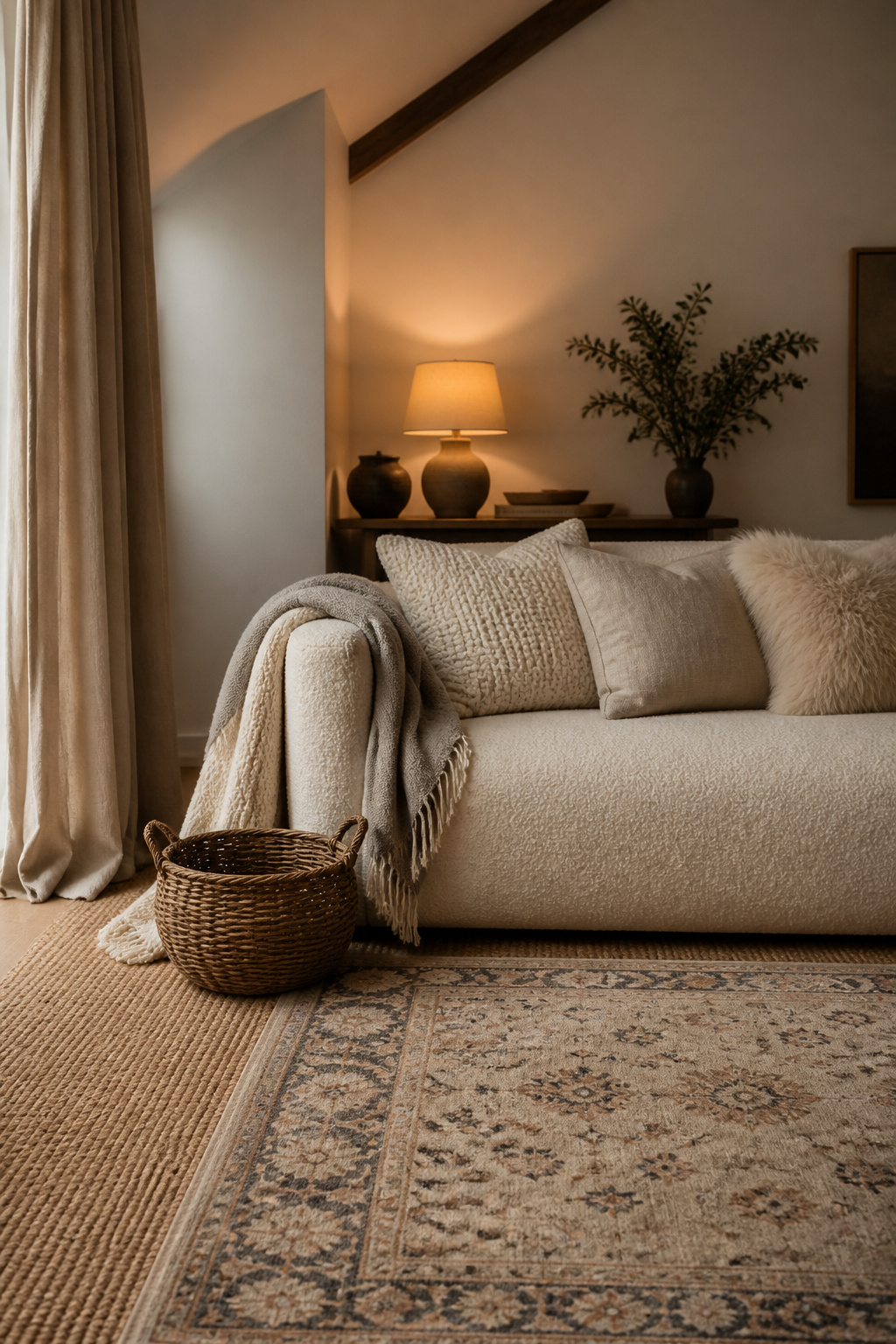
Start at the floor with a rug large enough to hold the seating. For a standard open-plan vaulted living room, 9×12 ft is the minimum — the front legs of every major piece should sit on it, with 8 to 18 inches of bare floor between the rug edge and the wall. A rug that is too small leaves the furniture floating and the height winning. It earns its place twice over: thick, plush textiles absorb sound and cut the echo, so conversation stops feeling hollow. The line between cozy and cluttered is real, so edit — as Amber Brandt puts it, a woven basket gives the spare throw a home and keeps the layering from tipping into mess.
Fabric types that add visual warmth: wool, boucle, linen, sheepskin
A few fabrics carry warmth better than the rest:
- Boucle — looped wool-blend, full of dimension; its texture softens hard architecture on a sofa or accent chair.
- Sheepskin — natural variation in tone and pile; draped over an arm, it lifts a room without shouting.
- Heavyweight wool — the most hygge-aligned throw; it feels richer and more intentional than thin acrylic.
- Tightly woven linen — tactile without visual noise, ideal for cushions and loose covers.
Pair boucle with a sheepskin and you get a softness neither manages alone. The point is layered texture, not one thick blanket doing all the work.
Curtains: floor-to-ceiling panels, even if the window is half that height
Curtains are the lever most people misjudge. Hang the rod 4 to 6 inches below the ceiling or crown moulding — not above the window frame — and run the fabric to the floor so it kisses or pools an inch. Width matters too: panels totalling two to two-and-a-half times the window width read as lush rather than thin. Lined twill or velvet adds the bonus of softening sound on that vast vertical plane. Stopping the curtain at window height is the most common curtain mistake in a vaulted room — it leaves the void above fully exposed.
Lowering the Eye Line: Furniture, Pendants, and the Rug Anchor
This is the counterintuitive heart of it. The number that decides how a tall room feels is not the ceiling height — it is where your eye comes to rest.
Why the eye line matters more than ceiling height
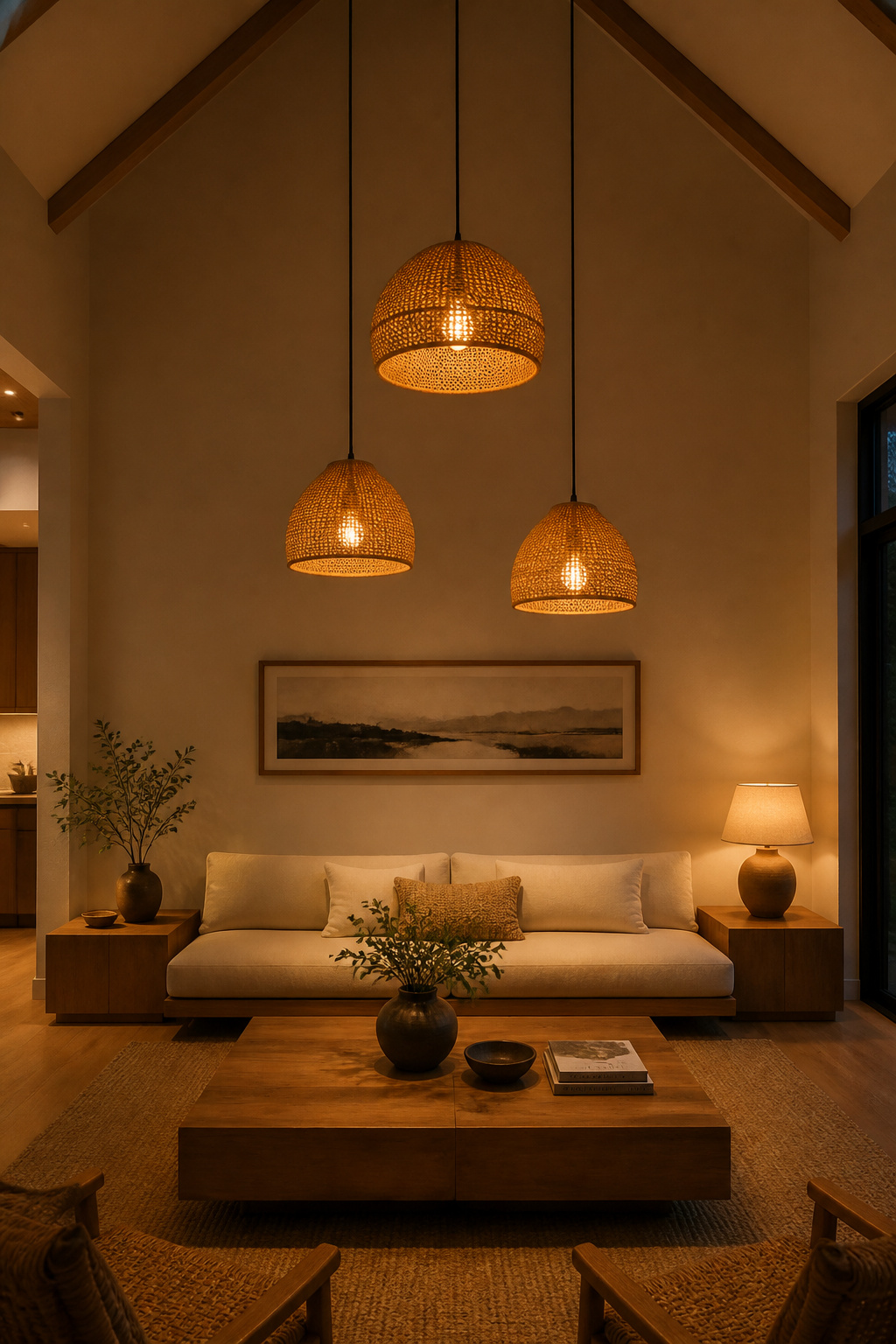
Keep the eye level below the midpoint of the wall and the ceiling stops being a boundary; it becomes part of the field, read as spaciousness rather than emptiness. The way you hold the gaze low is a horizontal line at human height — moulding, a board-and-batten rail, a beam, or a light fixture brought down. The paint consultant Kylie M, who solved an 18-foot vault in her own home, places a horizontal moulding at roughly 9 feet, tying into the stair trim, and it creates the illusion of shorter walls and a lower, cozier ceiling. A single beam through the centre of a cathedral ceiling does the same work.
Low-slung furniture and the proportion rule
Low furniture leaves more visual headroom above it, which reads as ease rather than competition with the height. A sofa around 16 to 17 inches of seat height gives that relaxed, grounded line, and sitting lower tends to soften how people move in the room. The most common mistake is pushing everything to the walls — it empties the centre and hands the room to the ceiling. Pull the furniture in and float it over the rug; the zone closes around the people in it.
The pendant-over-table trick: a light source at human scale
A pendant cluster dropped on long cords over the coffee table is the most effective eye-line tool there is. Two or three pendants brought to roughly 6.5 to 7.5 feet of clearance create a visual ceiling for the seating zone — a warm lid at human scale while the real vault carries on above. On a ceiling over 10 feet, use adjustable downrods to reach that height; a pendant left near the apex reads as a decorative object, not a light you live under. Keep the bulbs warm and dimmable. The colour and layering of the fixtures themselves belong to the lighting ideas that work spoke, where the real detail lives.
Warm Materials That Fight the Cold: Wood, Stone, and Natural Fibre
Paint can be warm, but it cannot do what a natural material does. Wood, stone and fibre absorb and hold warmth where a flat painted surface only reflects.
How natural materials warm a room in a way painted surfaces cannot
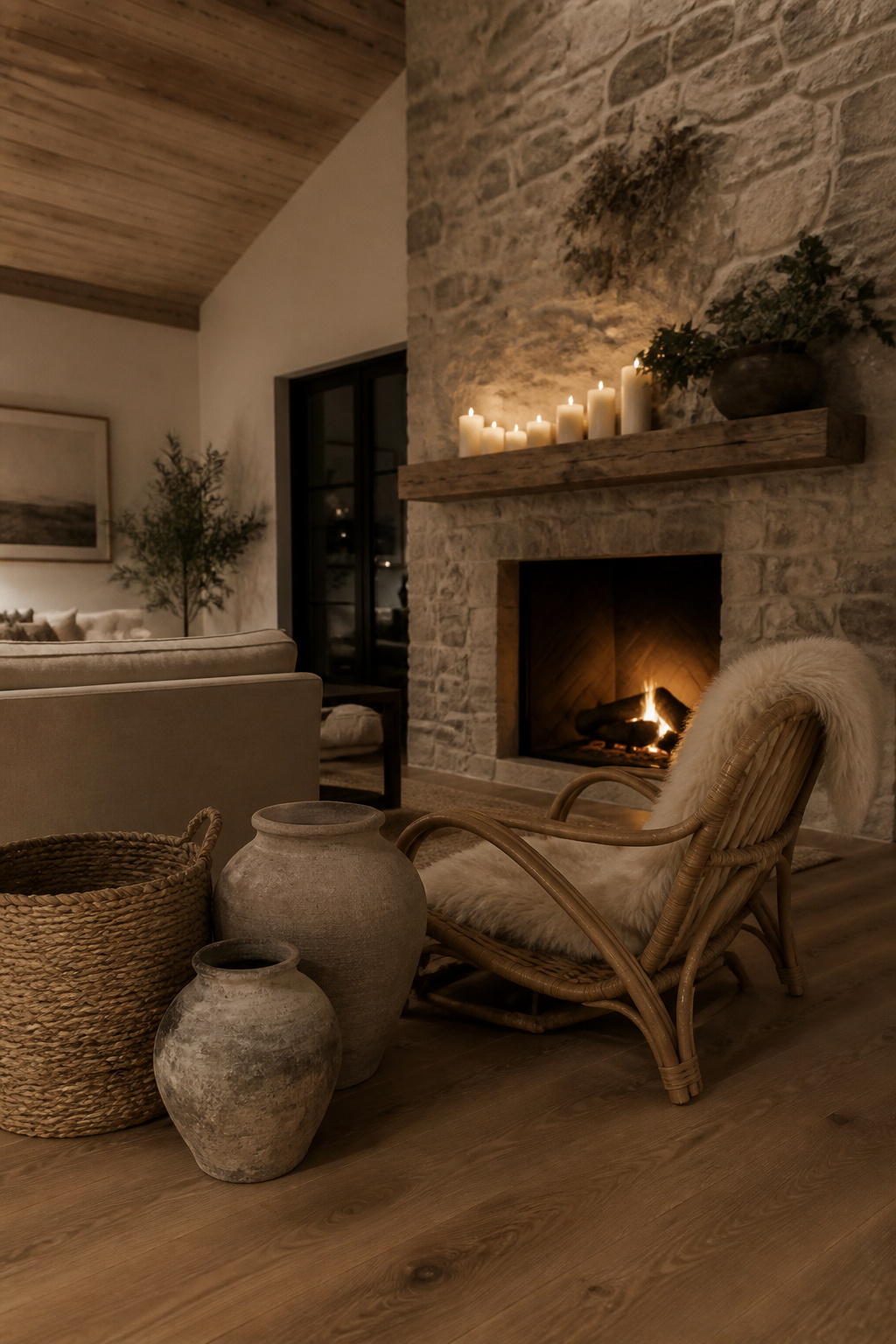
The difference is the tactile layer — grain, knot, the small variations of colour that no manufactured surface replicates, felt as much as seen. On a vaulted ceiling, wood does the most: tongue-and-groove or planking breaks up the big span and warms it. Keep the wood natural rather than painted white — paint removes the grain and colour variation that do the atmospheric work.
A wood-burning stove or fireplace as the room’s anchor
A fire is the most powerful single source of warmth a tall room has, literal and atmospheric at once. Its low position and the movement of the flame pull the eye down to floor level and give the room a hub people gather around. A freestanding stove set near the heart of the room, rather than flat against a wall, lets the flames read from several angles. A contained stone surround anchors without dominating — Kylie M’s own vaulted room caps the stone at 60 inches, so it grounds the space without drawing a tall line up into the vault. Layer rugs and throws around it and you have the conversation zone the rest of the room orbits.
Stone, rattan, jute, and raw clay — the tactile layer
Beneath and around the furniture sits the quieter material layer. Jute and sisal make honest base rugs, grounding the seating with texture underfoot. Rattan brings warmth through its open weave and organic colour, lighter and less costly than solid timber. Raw clay vessels and unglazed terracotta add a matte warmth that pushes back against the cold reflective surfaces — windows, polished floor — that make a vault feel hard. Even stacked firewood earns its keep; Brandt cites a wood nook as adding real character to a room.
Paint and Color as Atmosphere Tools
Paint is the one lever that touches every surface at once, so it works at the whole-room scale. In a vault the rule is short: warm undertones win every time.
The one rule: warm undertones win every time
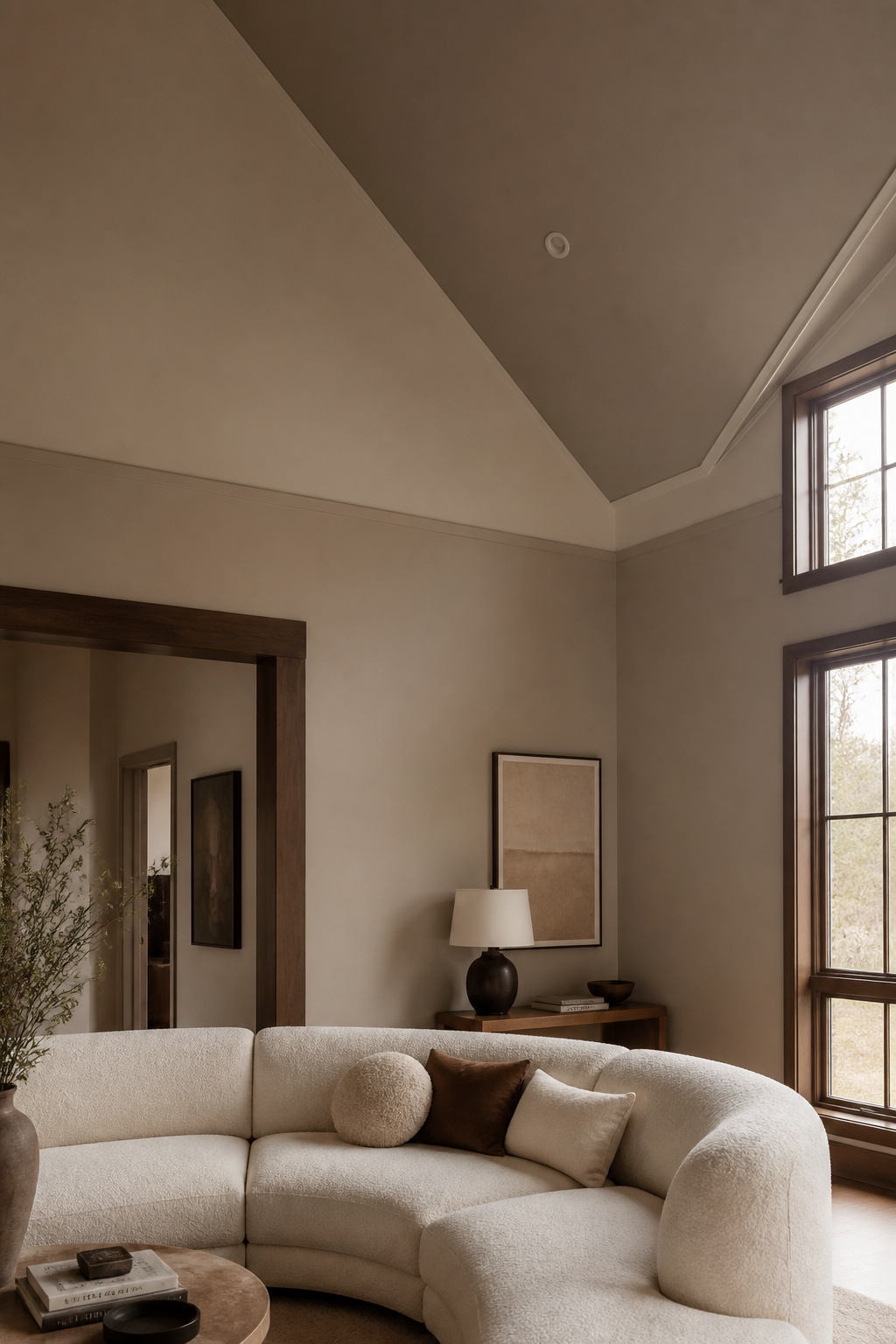
A cool pure white or a blue-leaning ceiling amplifies the coldness the volume already has — those tones feel clinical at scale and push surfaces away. A soft off-white with warm undertones does the opposite, advancing gently and reading as warmth. The ceiling should belong to the same envelope as the walls, not sit above them as a separate cold plane. For Nordic rooms with low natural light, warm whites in the LRV 80 to 90 range are the standard.
Two-tone and dark-ceiling choices for intimacy
To compress a too-tall ceiling, paint it two to three shades darker than the walls. The darker overhead plane reads lower than it sits while the room below stays open and bright. A deep charcoal or navy overhead works against pale walls, but only where there is enough daylight or layered light to carry it; without that, a dark ceiling tips into oppression rather than intimacy.
How paint interacts with the textiles already chosen
One principle here: paint and textiles are a single decision, not two. A warm taupe or soft sage makes boucle and linen read warmer, where the same fabrics against a blue-white wall look colder. So choose the wall colour after the main textile palette is set. The full colour work — the names, the LRV numbers, the two-tone break line — belongs to the warm paint color choices spoke.
How to Make a Vaulted Ceiling Cozy: Defining a Human-Scale Zone
All six levers serve one outcome — a human-scale zone. In a room where the ceiling is fifteen feet, the place you live needs its own internal scale, a warm pocket inside the larger volume.
What ‘human scale’ means when the ceiling is fifteen feet
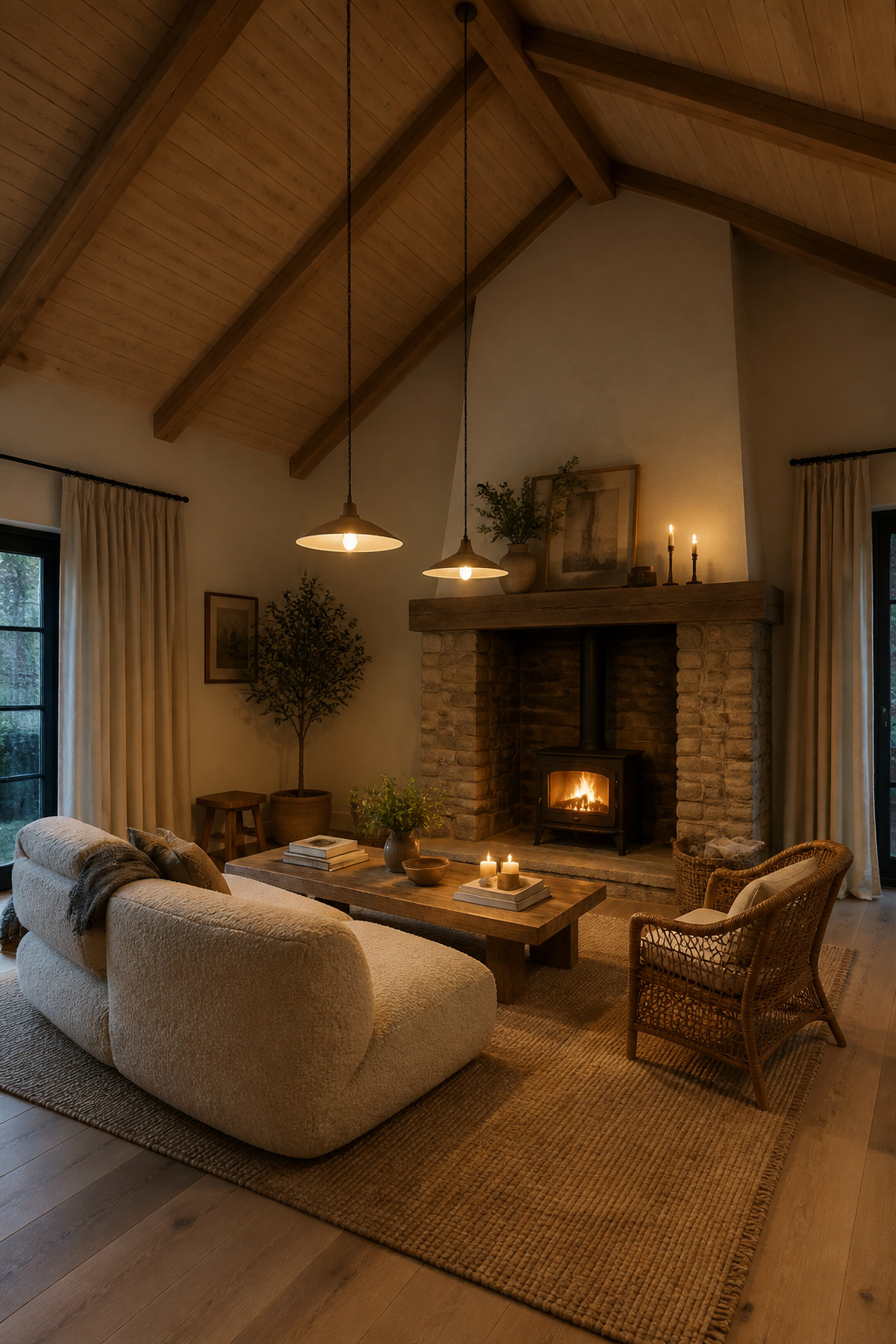
Human scale is the room sized to the body and what it does there. In a fifteen-foot living room, that zone runs from the floor to about seven or eight feet — the band where you see, speak and reach. Everything above is the room’s drama; everything inside it has to serve comfort. The practical handle is light: bring the main fixture down to that 7-to-8-foot range and you set a perceived ceiling for the zone, whatever the structure does above.
Creating a conversation zone the height amplifies rather than swallows
The zone is a small set of components working together: one substantial sofa or a facing pair, the 9×12 ft rug with all front legs on it, a low coffee table near 15 to 16 inches, and a pendant or floor lamp setting the lid at 7 to 8 feet. Pull it all off the walls and float it over the rug. Give the zone a focal anchor with gravity — a stove or fireplace rather than a wall-mounted screen — because the fire generates warmth, defines the view, and gives the conversation a direction.
The cozy-not-cavernous checklist: the six levers in order
Run the levers in this order, top to bottom by impact:
- Layered textiles at floor level — a 9×12 ft rug minimum, throws and cushions in wool, boucle and linen. Fastest, most reversible.
- Eye-line control — low furniture at 16–17 in seat height, a horizontal element around 9 ft, pendants dropped to 6.5–7.5 ft.
- Natural materials — wood overhead and underfoot, a stone fireplace surround, rattan and jute at the tactile layer.
- Warm layered light — 2700–3000K warm white throughout, dimmable and layered, never a single overhead source.
- Paint with warm undertones — warm off-white walls, ceiling two to three shades darker for intimacy.
- Human-scale zone definition — seating floated over the rug, fireplace as gravity, curtains run floor-to-ceiling.
Get those in place and the evening hour you started with changes character. The light pools warm and low, the rug holds the talk, the fire pulls the eye down, and the vault overhead stops swallowing the room and starts lifting it — the same volume, now working for you instead of against you.
FAQ
Why does my vaulted ceiling living room feel so cold and empty?
Tall volumes echo, and that hollowness makes a room feel unfurnished even when it is not. Cool paint undertones and a single overhead light compound it — cool tones push surfaces away, and one ceiling fixture leaves the lower half in shadow. Check three things first: a blue-white wall colour, a single overhead light, and a too-small or absent rug.
What is the quickest way to make a room with a high ceiling feel warmer?
Layer textiles first. Add a 9×12 ft rug to anchor the seating, two or three wool or boucle throws, and a handful of warm-toned cushions. Textiles are immediate, reversible, and do more warmth work at human scale than any structural change. Next, swap the single overhead light for two or three lamps at table and floor height in warm 2700K white.
Do dark colors make a vaulted room feel cozier or just smaller?
On the ceiling, a dark colour makes a room cozier without shrinking the walls — the darker overhead plane visually compresses the height while the walls stay open and bright. On the walls, dark tones can actually feel larger and more dramatic, but they need good light to avoid oppression. The rule: dark walls need daylight, a dark ceiling needs warm light.