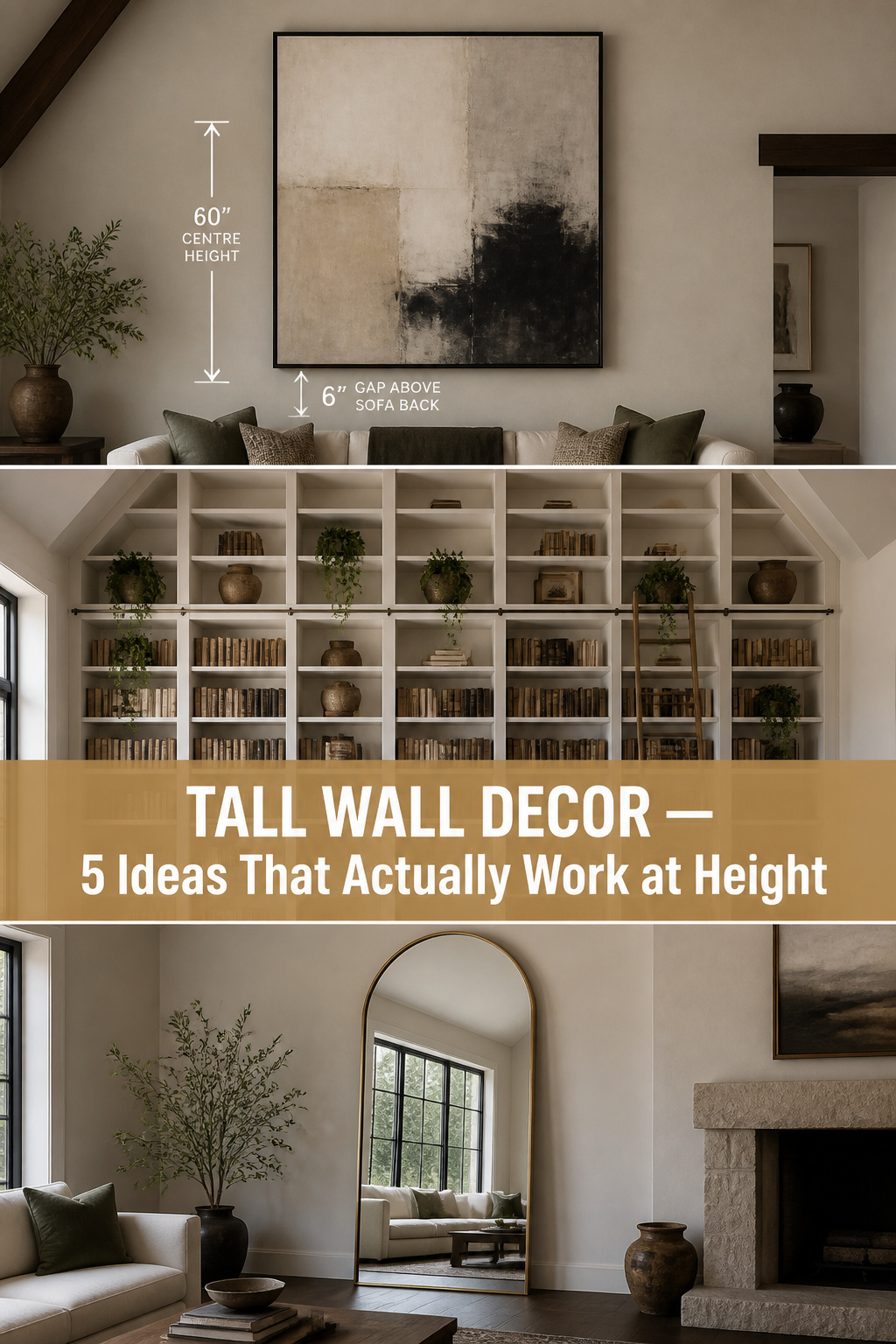

A reading-room precedent comes to mind whenever a client stands paralysed before a tall, empty wall: the great library reading rooms never left their high walls blank, but they never crowded them either. They ran shelving to the gallery line, set a few large objects above the reach of any hand, and let the upper register breathe. Most tall wall decor ideas fail because the reader applies rules built for an eight-foot room to a wall that runs to twelve — so before any single option, here is the standard I use to sort what belongs at height from what disappears.
TL;DR
- On a 12-foot vaulted wall, a single canvas needs to be 36×48 inches at minimum and 48×60 inches to read comfortably; a 24×36-inch piece adequate for a 9-foot room shrinks to a Post-it.
- Floor-to-ceiling shelving is the most reliable option because it uses the full height rather than accommodating it; hang art at 60-inch centre height anchored to the furniture, not pushed toward the ceiling.
- Work the wall in three zones — furniture and shelving below 5 feet, primary art or a mirror from 5 to 8 feet, and the top 18 to 24 inches left deliberately bare.
Tall Wall Decor Ideas: Why Standard Advice Fails at Height
The eye-level advice you have read is sound, but written for the wrong room — treat it as a starting line, not a law.
How “hang art at eye level” becomes the wrong rule when the wall runs to twelve feet
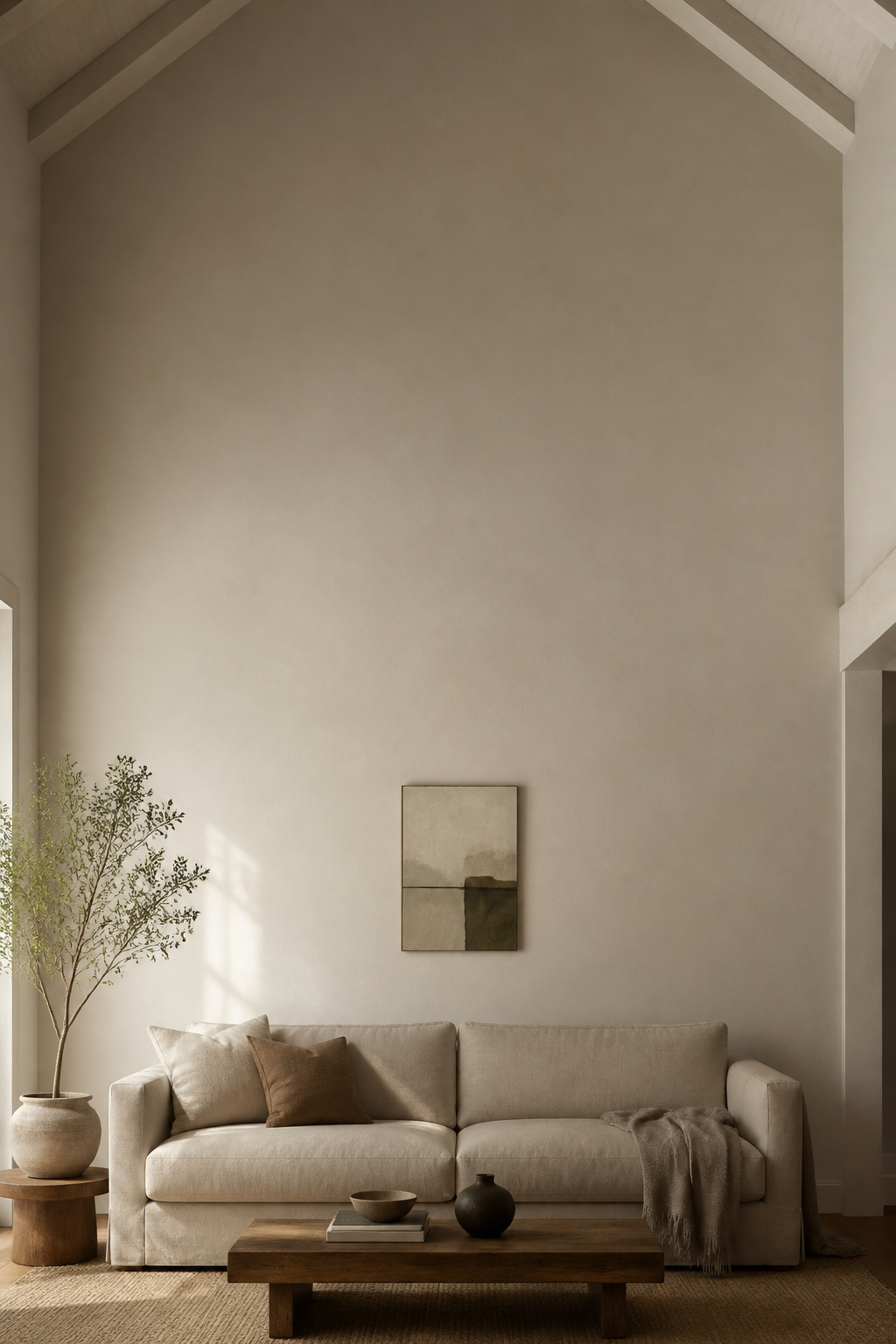
The 57-inch centre-height rule comes from museum practice built for 8-to-9-foot ceilings. On a 12-foot vaulted wall it strands the artwork: centre a piece at 57 inches and five or six feet of blank wall overhead advertises the height problem rather than solving it. As design writer Danko S Mayer puts it, the rule is a solid anchor but “not gospel.” For tall walls, nudge the main piece to 60 inches and let shelving or plants carry the composition upward.
The selection standard: what belongs on a tall wall vs what disappears
Here is the test I apply before recommending anything. An object should occupy 60 to 75 percent of the wall zone it sits in; below that, it reads as undersized and only emphasises the empty space around it. Tall walls also reward vertical objects — a narrow mirror, a floor-to-ceiling bookcase, a stacked gallery grouping — over horizontal ones that widen the wall without addressing its height.
Reading the wall before buying anything
Before you select a thing, read the wall with a tape measure. Mark the standard 57-inch hanging reference on the wall, keep the top 18 to 24 inches clear, and tape out the working band between them. Two variables govern the rest: where the light comes from, which decides whether a mirror earns its place, and where the furniture sets the floor of that band. For how this fits the wider room, see decorating a room with a vaulted ceiling.
Scaling Art Up: Gallery Arrangements and Oversized Single Pieces
Art is the first option most readers reach for, and the one most often sized wrong.
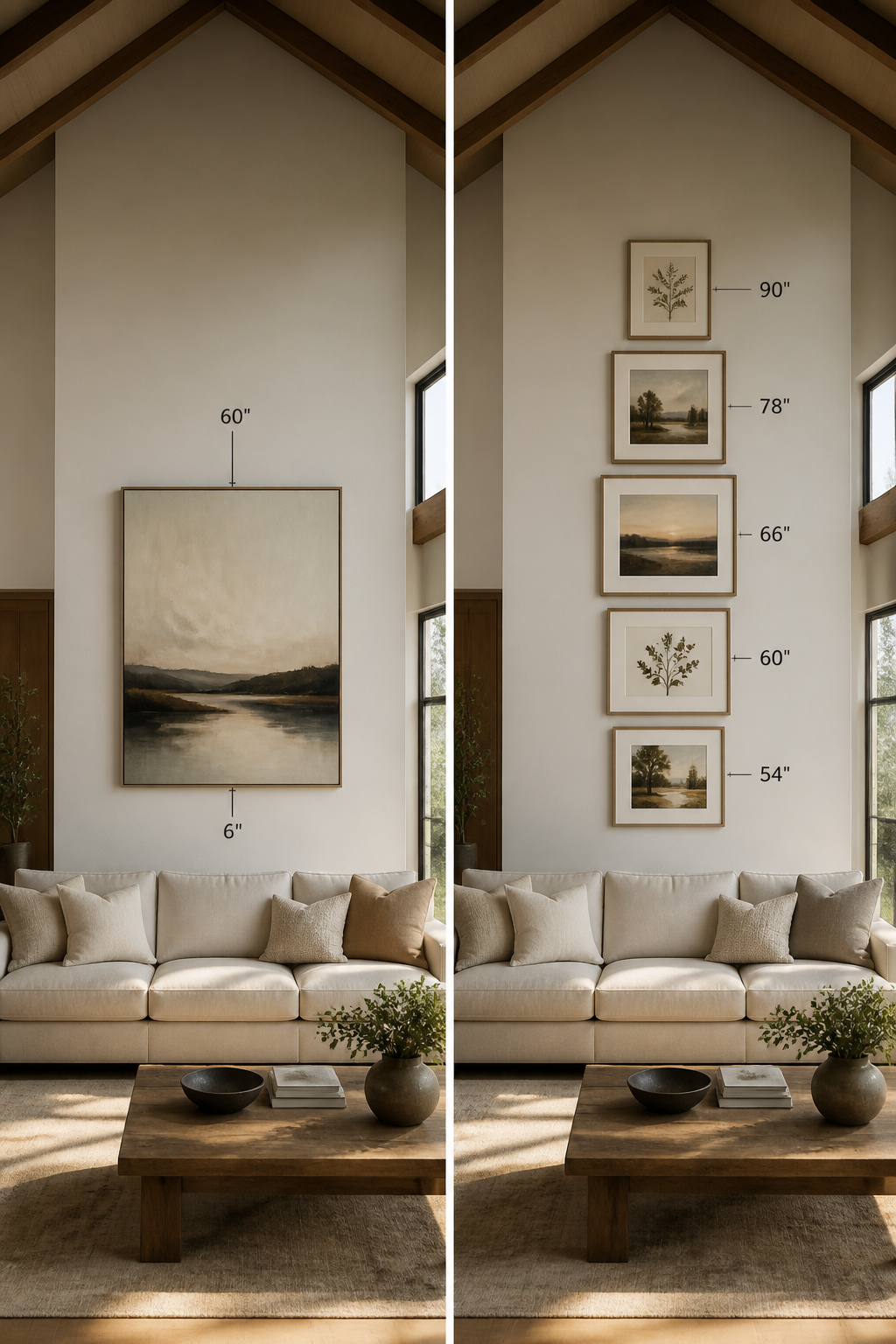
Minimum canvas size for a tall wall — and why 24×36 reads as a Post-it
A 40-inch canvas that commands an eight-foot room disappears in a loft with fourteen-foot ceilings; the problem is not where it hangs but how big it is. For a high-ceiling living room of 10 to 14 feet, a single piece should be 36×48 inches at minimum, with 48×60 inches the comfortable choice.
| Wall / ceiling height | Single-piece minimum | Comfortable choice | Gallery group footprint |
|---|---|---|---|
| 9 ft (standard) | 24×36 in | 30×40 in | 60–75% of furniture width |
| 12 ft (vaulted) | 36×48 in | 48×60 in | spans 5–7 ft of height as one shape |
| 14–16 ft | 48×60 in | 48–72 in tall, multi-panel | stacked vertically, 54–90 in |
Gallery arrangements on a tall wall: grouping logic and spacing
A gallery wall has to be planned as one large shape, not a scatter of frames. As the team at Art Academi advise, lay it out on the floor first and photograph it from above before transferring it to the wall. Centre the bounding box at 57 to 60 inches, keep 2 to 3 inches between frames, and stack it vertically — three to five pieces can address five to seven feet of height and read as one tall form.
What to frame and what not to: weight and anchoring at height
Medium matters more at height than people expect. A gallery-wrapped canvas at 48×60 inches weighs 8 to 12 pounds and throws no glass glare; the framed, glazed equivalent runs 20 to 35 pounds. Above seven feet, that weight goes into studs via a French cleat, never drywall anchors — a 20-pound frame on a drywall anchor at ten feet is a genuine hazard.
Floor-to-Ceiling Shelving: The Option That Earns Its Height
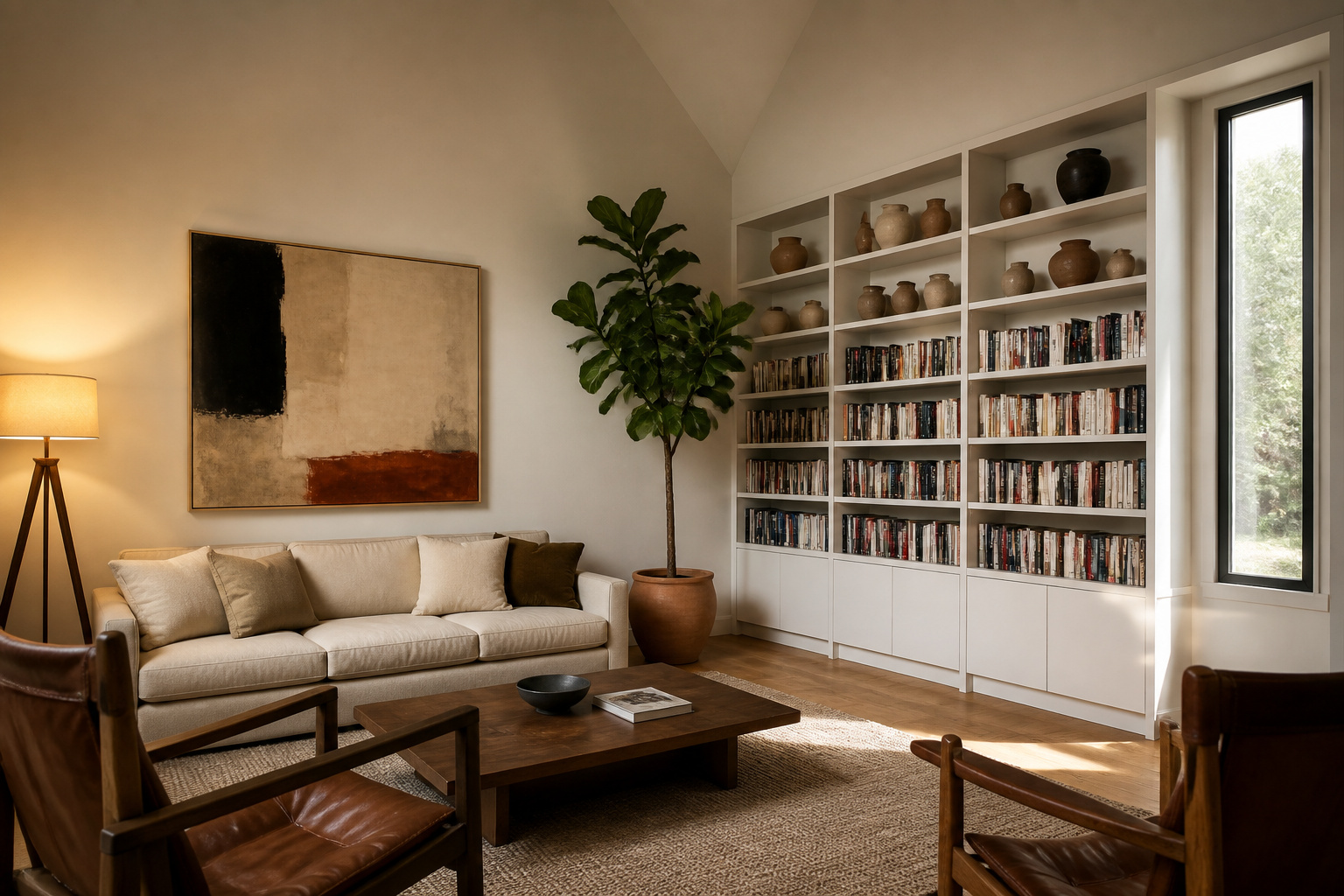
If one option is my natural recommendation, it is this — and not out of professional habit. Shelving is the only tall-wall solution that uses the full height rather than merely accommodating it.
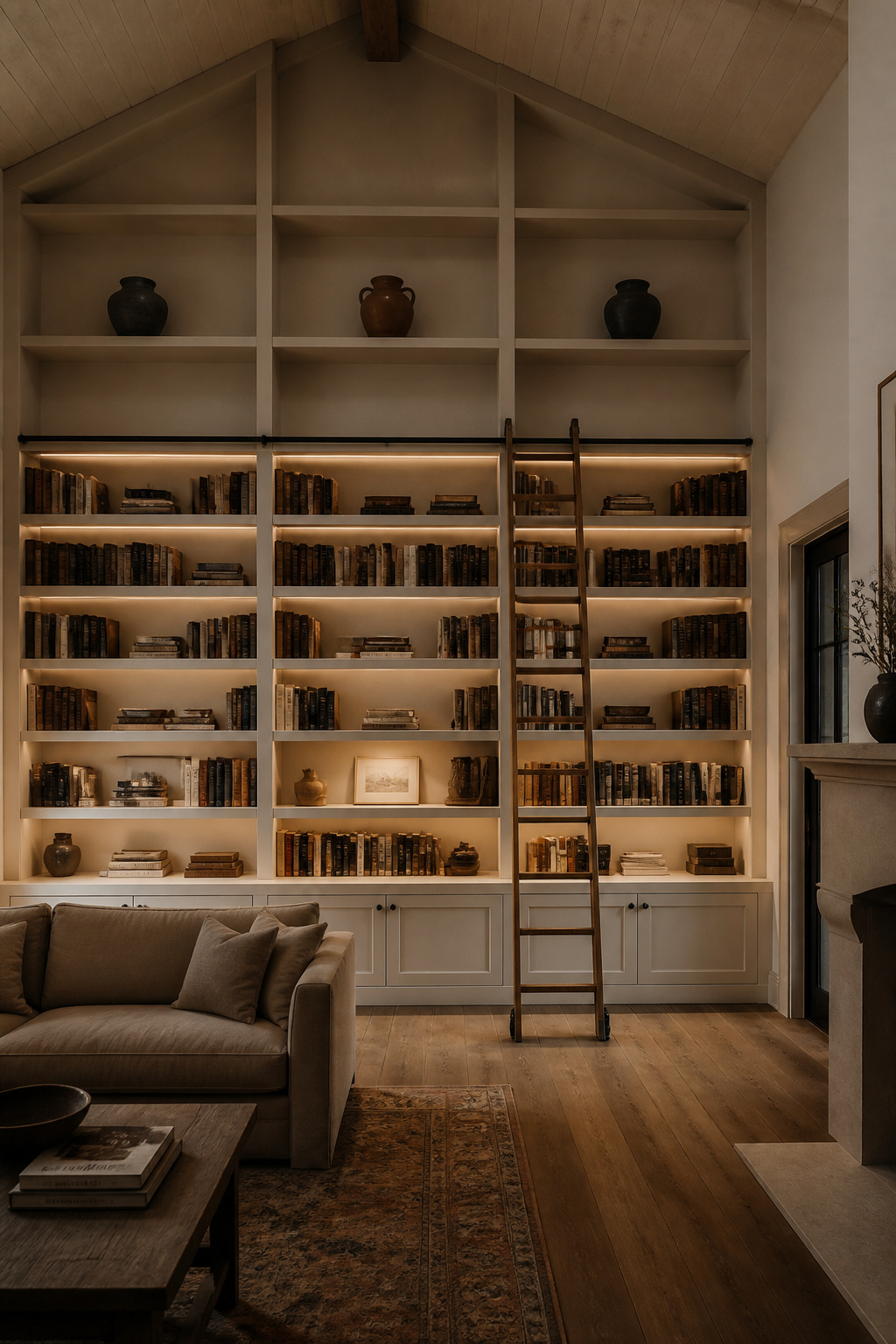
Why built-in or freestanding shelving reads better than any single object
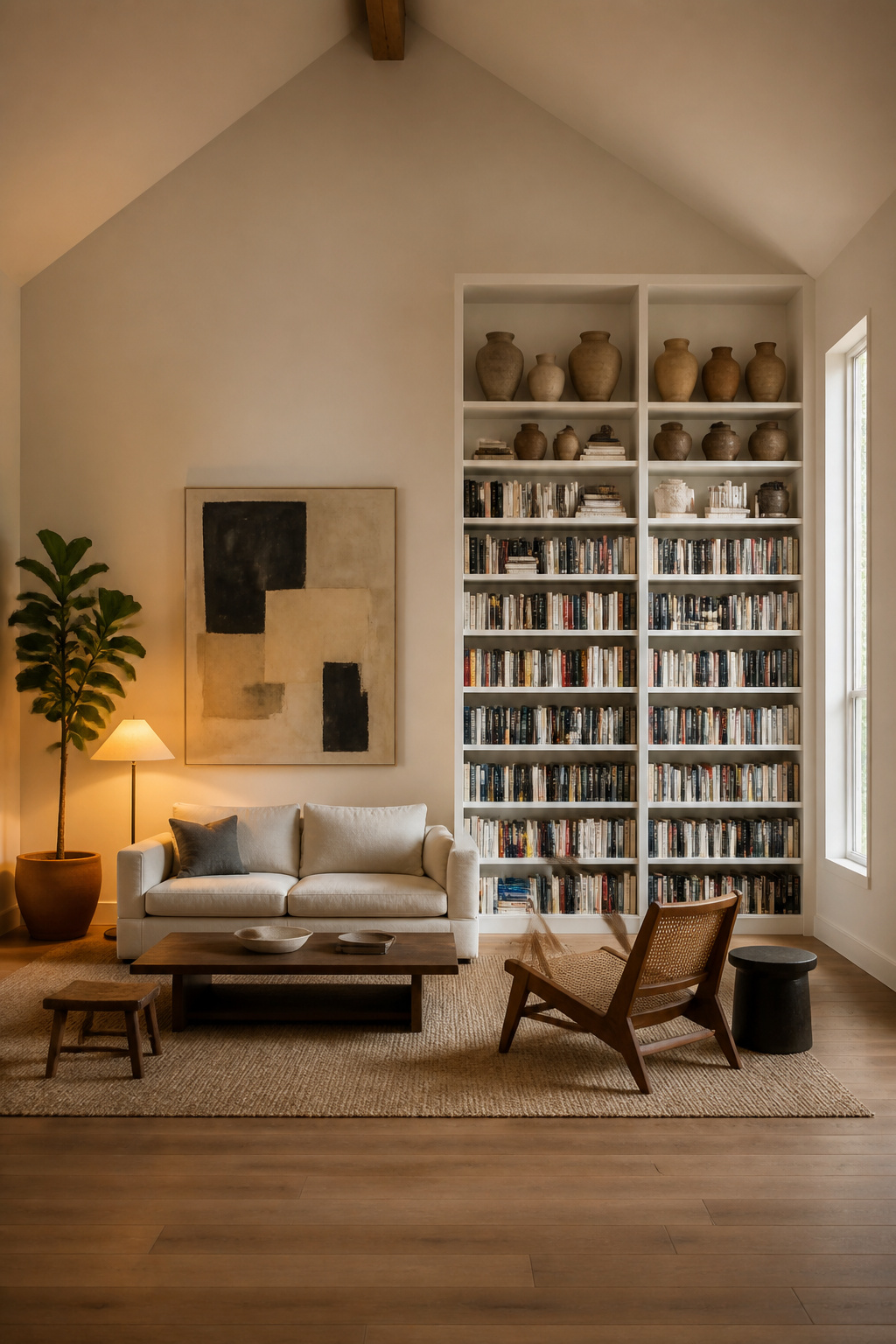
A floor-to-ceiling case gives the eye a continuous vertical path from baseboard to ceiling, making the room feel taller rather than emptier. Most stock bookshelves stop near nine feet, so a 12-foot vault wants a built-in run or a unit paired with a library ladder — and the ladder signals that the upper shelves are intentional, not abandoned. Built-ins earn their cost over years; quality freestanding units are the practical alternative. Either way, anchor it to studs: loaded at full height, an unanchored case is a tipping hazard, full stop.
Staggered vs uniform shelving height: the visual difference at scale
Across a full wall, uniform shelf spacing reads as architecture — clean, recessive, especially painted the wall colour. Staggered spacing feels more curated but risks looking jumbled across a tall run. My compromise borrows from how a real library shelves: uniform spacing from floor to head height, where books are retrieved, then deeper spacing above for display objects that need the room.
What to put on the upper shelves when you can’t reach them daily
Above seven or eight feet you are in display-only territory — books there cannot be pulled without a ladder, so reserve the zone for objects chosen for scale: stoneware vessels 12 to 18 inches tall, woven baskets, a trailing plant whose canopy gains presence as it falls. These read at height where spine text cannot. Leave 25 to 30 percent of the upper shelves empty, since every object looks smaller from below. This vertical thinking turns walls into storage in small high-ceiling rooms, where floor space is scarce.
Tall Mirrors: Light, Illusion, and Vertical Drama
A mirror does what no canvas can: instead of adding weight, it subtracts the wall’s opacity and gives back light and depth — but only if it faces the right thing.
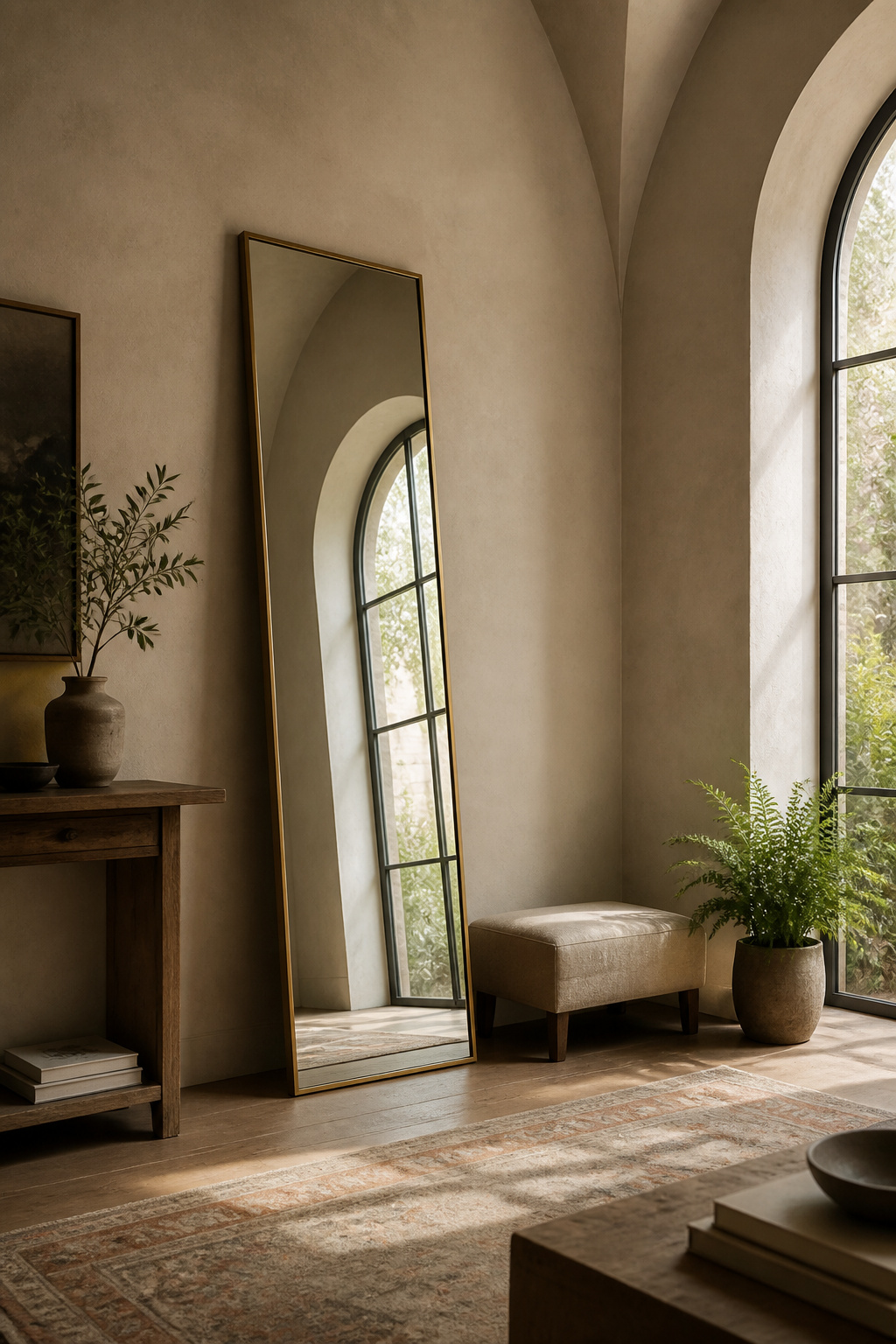
How a tall mirror changes the light dynamic in a vaulted room
The highest-value position in any room, vault included, is a mirror directly opposite a window — it reflects the view back and effectively doubles the daylight. In a vault, reach for the tall-and-narrow format (floor-to-ceiling, 18 to 24 inches wide); it reinforces the ceiling’s vertical axis, where a wide panoramic mirror would fight it.
Framing choices that add architecture rather than decoration
To my eye, the frame is where most tall mirrors go wrong. At six feet and above, an ornate frame starts to dominate the glass and compete with the reflection — so a slim brass or black metal frame, or a frameless design, lets the mirror read as part of the wall plane rather than an object propped against it. That is a design judgement rather than a measured rule, but it holds across the tall rooms I have worked in. Size it to two-thirds or three-quarters of the furniture below, the same proportion that governs art.
Placement: where a mirror earns its place and where it confuses the eye
A mirror reflects whatever it faces, so position decides everything:
- Opposite a window, flanking a doorway, or closing a long axis — it reflects something that adds light or depth.
- Aligned with another tall element nearby (a plant, a door, an artwork) rather than floating alone on an unbroken wall.
- Never on the same wall as the main window, and never facing a television or a cluttered corner — a mirror amplifies disorder as readily as order.
Hanging Sculpture, Oversized Plants, and Vertical Feature Objects
Flat art and mirrors do not exhaust the wall. Three-dimensional objects add physical depth — shadow, texture, weight that shifts as the day’s light moves.
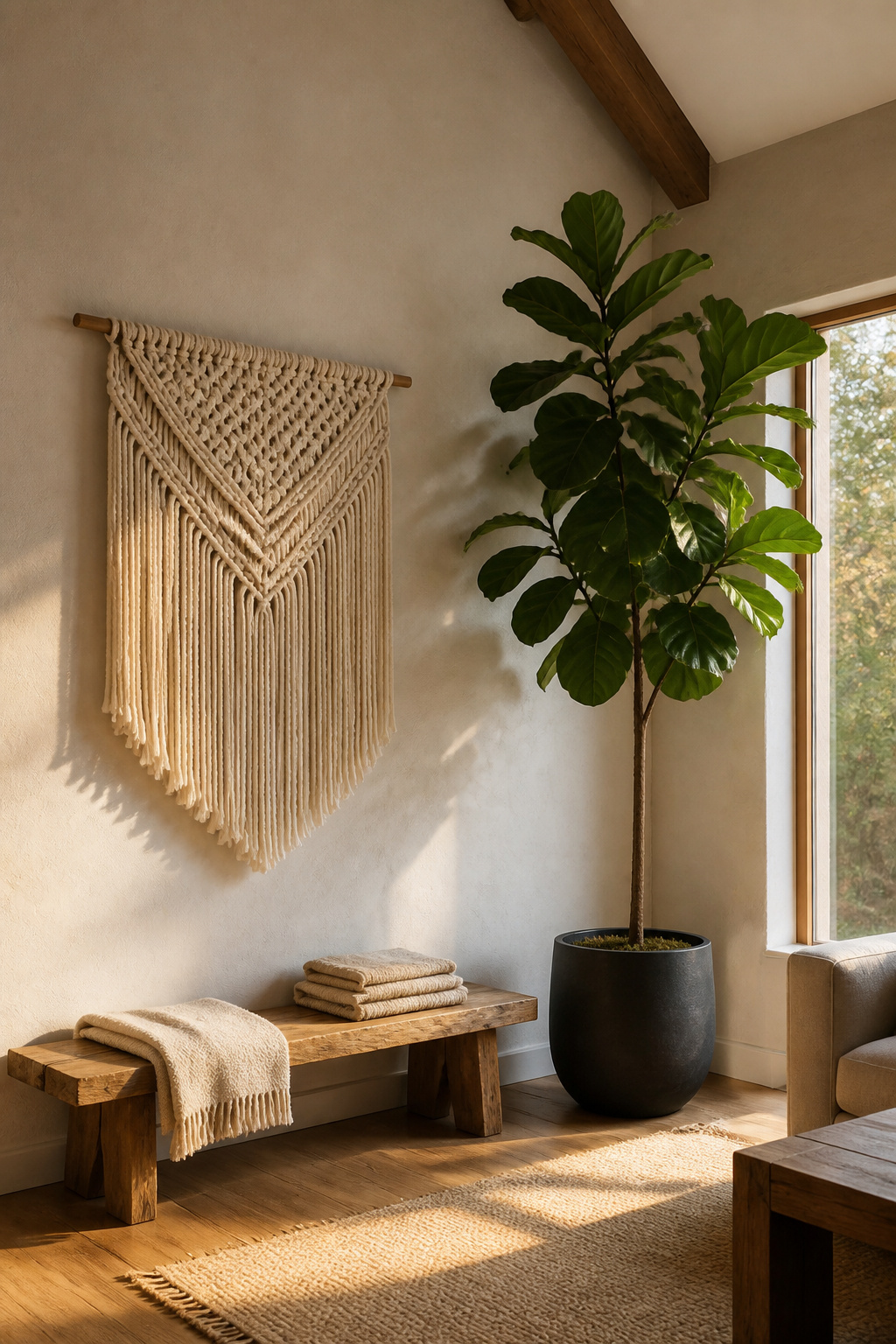
Hanging textile art, macramé, and woven pieces
A woven hanging has to be large to anchor a tall wall: on a 12-foot vault I would not go below 48 inches wide by 60 inches long. The suspension point matters more than the textile — the rod anchors into a stud or joist, never a drywall hook. A cotton or wool piece at 48×72 inches can run in the 8-to-15-pound range dry, and since textile-specific load ratings are thin, I would spec anchors rated for twice that. The bonus is acoustic: natural fibre softens the echo a hard tall room generates.
Tall indoor plants as vertical anchors
A 5-to-8-foot specimen acts as a living vertical anchor between furniture scale and ceiling scale. Match the species to the light honestly. Fiddle-leaf fig (6 to 10 feet) wants bright indirect light and will sulk in a north-facing room despite its popularity; snake plant and parlour palm tolerate lower light and hold their height where the fig would decline. One statement specimen near a sofa arm does the work — two, echoed across the room, build rhythm.
Sculptural wall objects: metal reliefs, ceramic collections, dimensional arrangements
Metal reliefs, reclaimed-wood panels, and clustered ceramic pieces catch light and cast shadow in a way flat art cannot, staying visually active at distance. Treat the specifics as directional rather than gospel, since the sources lean retail, but the scale logic holds: a single object wants to be 24 inches or larger, and a cluster needs a footprint around 36×48 inches with 3-to-5-inch spacing — wider, and it dissolves into scattered objects.
How High to Hang Things — and How the Furniture Layout Below Decides It
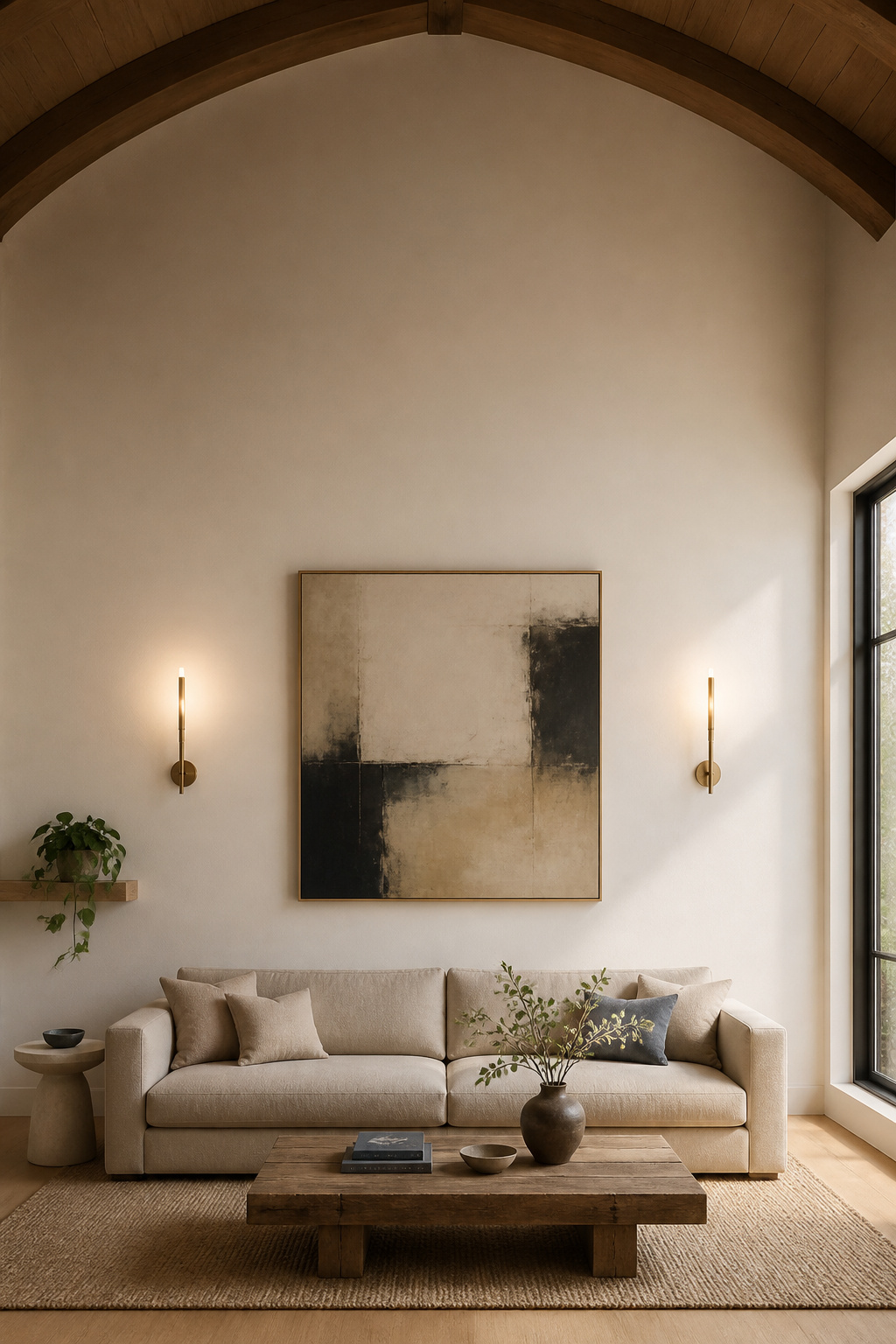
One principle resolves most height confusion: the ceiling sets the top of the wall, but the furniture sets the floor of the decor zone. Hang to the furniture, not the apex.
The relationship between the seating arrangement and the effective eye line
A seated viewer’s eye sits around 42 to 48 inches from the floor, pulling the optimal centre down to roughly 54 to 57 inches in a room built for lounging. Above furniture, a different rule supersedes both: keep the bottom of the lowest frame 6 to 10 inches above the furniture’s highest point. A sectional at 32 inches sets the baseline near 40 inches; everything above that is your working wall, and the relationship to the furniture matters more than the exact number.
Hanging above doors and windows without looking accidental
Above a door or window, leave at least a 6-inch gap between the frame top and the artwork; if the band between opening and ceiling is 24 inches or less, leave it bare, since filling a narrow strip reads as clutter. And do not align frame tops with the tops of doors or windows — that coincidence looks regimented rather than considered.
Layering decor across base, mid, and high zones
The framework I keep returning to divides the wall into three bands. The base zone, floor to five feet, holds furniture, shelving, and low art. The mid zone, five to eight feet, carries the primary art, a mirror, or sconces at human scale. The high zone, eight feet up, takes only plant canopies, the tops of bookcases, trim — or nothing, and that emptiness is a decision, not an oversight. Since wall scale follows the seating plan, read this alongside arranging the furniture below.
So the tall wall comes down to three questions: what is the largest single thing it can carry, where does the furniture set the baseline, and what is left deliberately empty at the top. Answer those before you buy anything, and the wall becomes the reason the room has presence.
FAQ
How high should you hang art on a wall with a vaulted ceiling?
Centre the art at 60 inches from the floor in rooms with ceilings of 10 feet or more, a step up from the standard 57-inch museum rule. Above furniture, the clearance rule supersedes it: keep the frame bottom 6 to 10 inches above the furniture top. Resist pushing art higher — scale the piece up instead.
What looks good on very tall walls in a living room?
Floor-to-ceiling shelving is the most reliably successful option, since it converts the full height into a feature and adds real storage. Oversized single canvases (36×48 inches minimum on a 12-foot wall), vertical gallery groupings treated as one shape, tall mirrors opposite windows, large natural-fibre textiles, and tall plants all hold their own at height.
How do you fill a large empty wall with a high ceiling without it looking cluttered?
Use one big thing rather than many small ones: an object or grouping covering 60 to 75 percent of the wall zone reads as intentional, while scattered pieces emphasise the gaps. Leave the upper 18 to 24 inches deliberately bare, and assign each band of the wall a job using the three-zone approach so neither clutter nor emptiness wins.