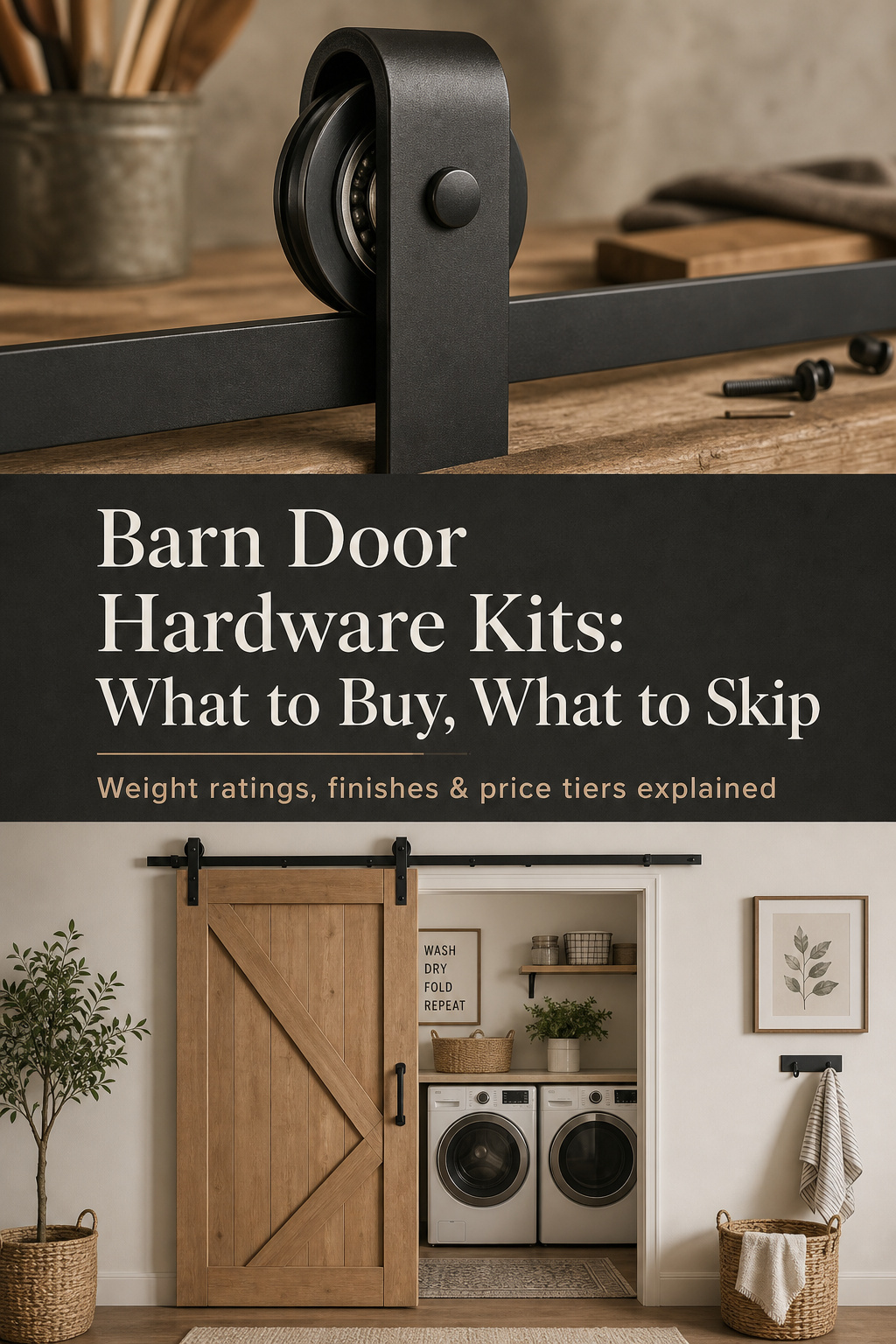
Here is the part nobody tells you at the checkout: your barn door hardware kit does not come with handles. Not one of them does. You hang the whole thing, step back, and realize you can’t open the door without buying more parts. Heading off gaps like that is what this guide is for.
TL;DR
- A standard single-slider kit (track, two hangers, stops, anti-jump discs, floor guide, mounting hardware) runs about $150 budget to $226 mid-range; handles are always sold separately.
- Match the weight rating to your real door weight: hollow-core is 25–35 lbs, solid pine 80–120 lbs, reclaimed wood 120–200+ lbs. A 200 lb J-strap kit covers most DIY wood doors.
- Soft-close is a $60–$98 retrofit, worth it for a daily-use laundry door on hard floors; in a humid laundry room, choose 304-grade stainless or powder coat over a galvanized base — plain steel will rust.
If you’re earlier in the process, the planning a laundry room barn door guide covers the whole decision; this page is the hardware chapter.
What a Barn Door Hardware Kit Actually Includes
Most of a kit ships in every box. One piece often doesn’t, and two never do.
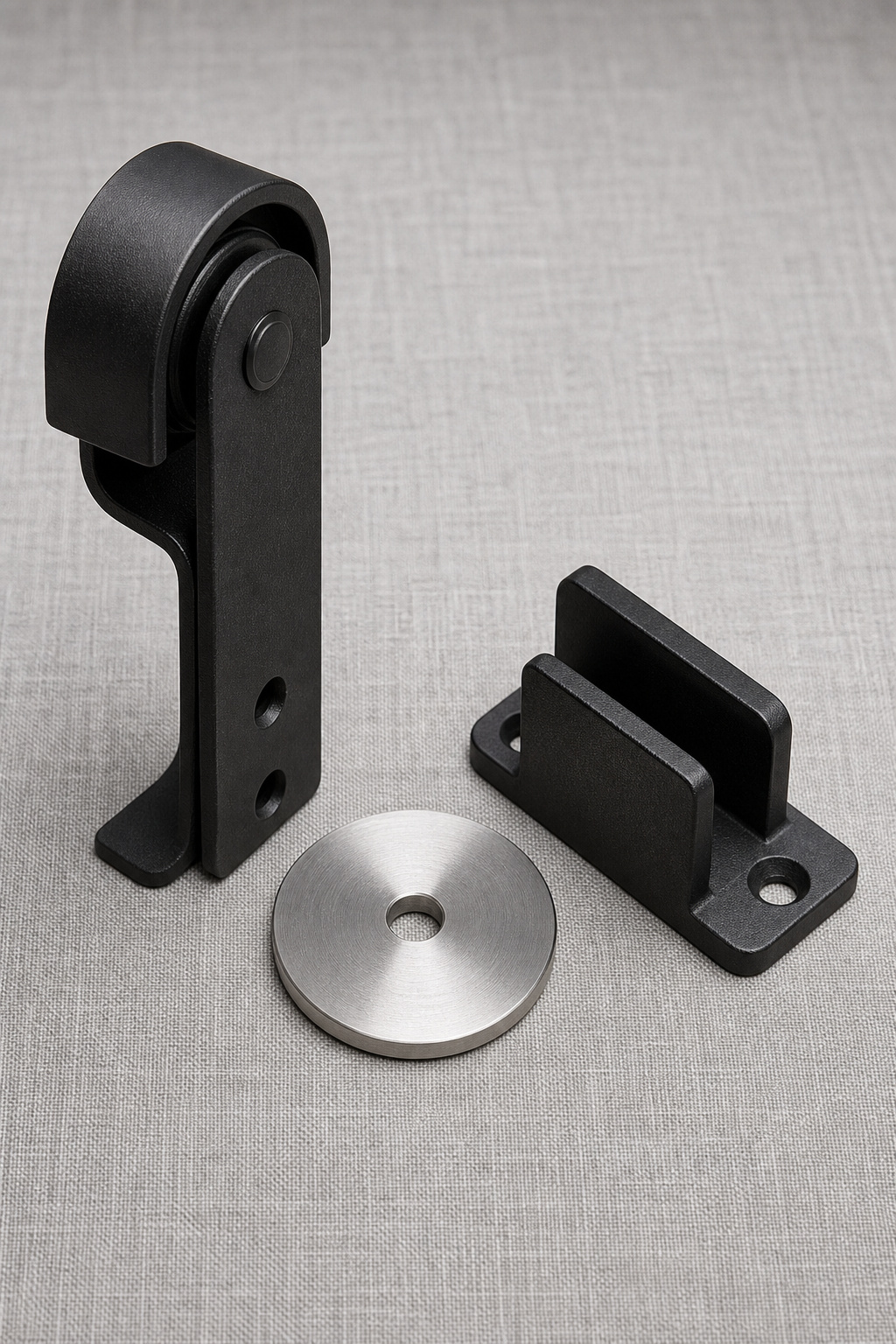
Track, rollers, hangers, stops: what each piece does
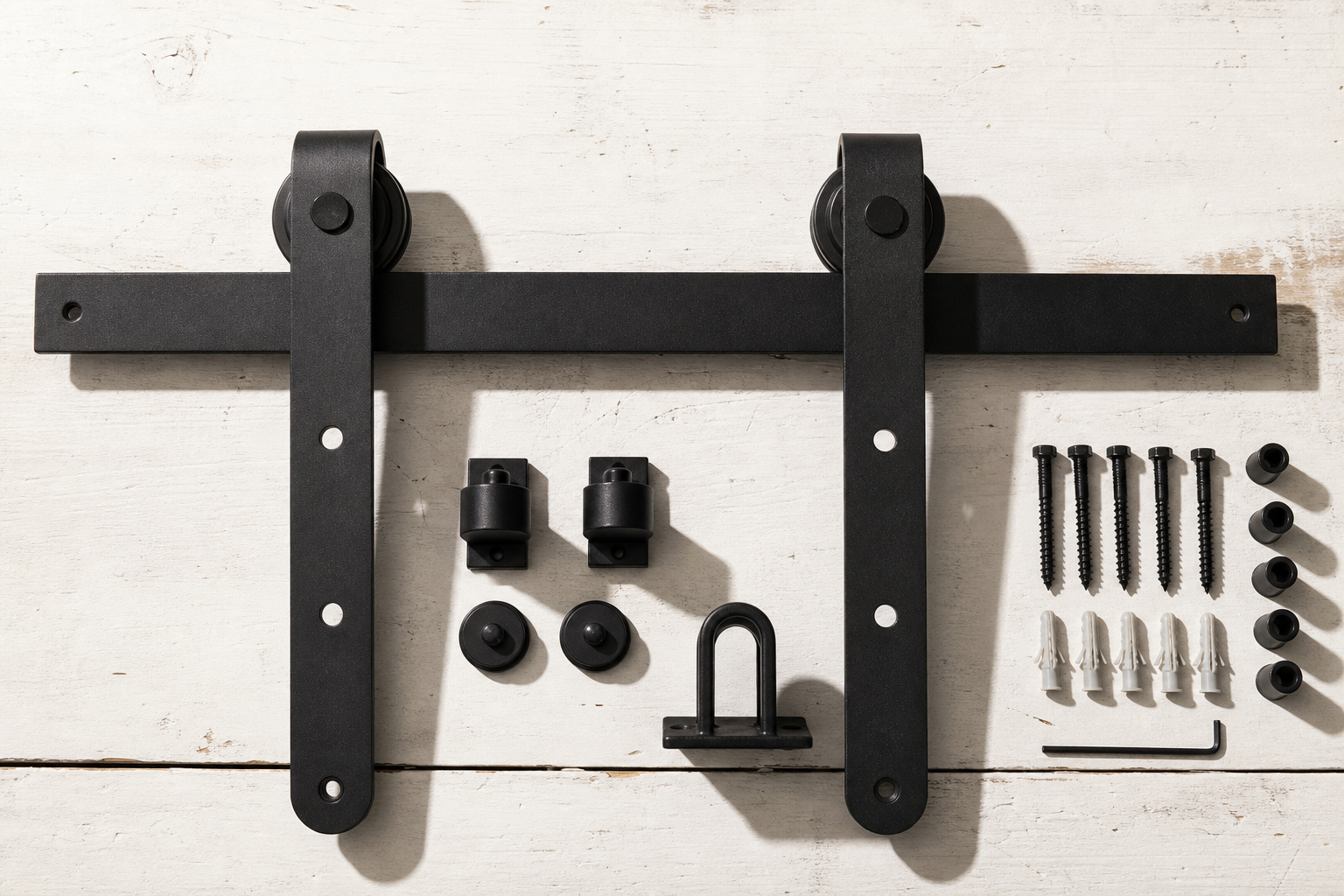
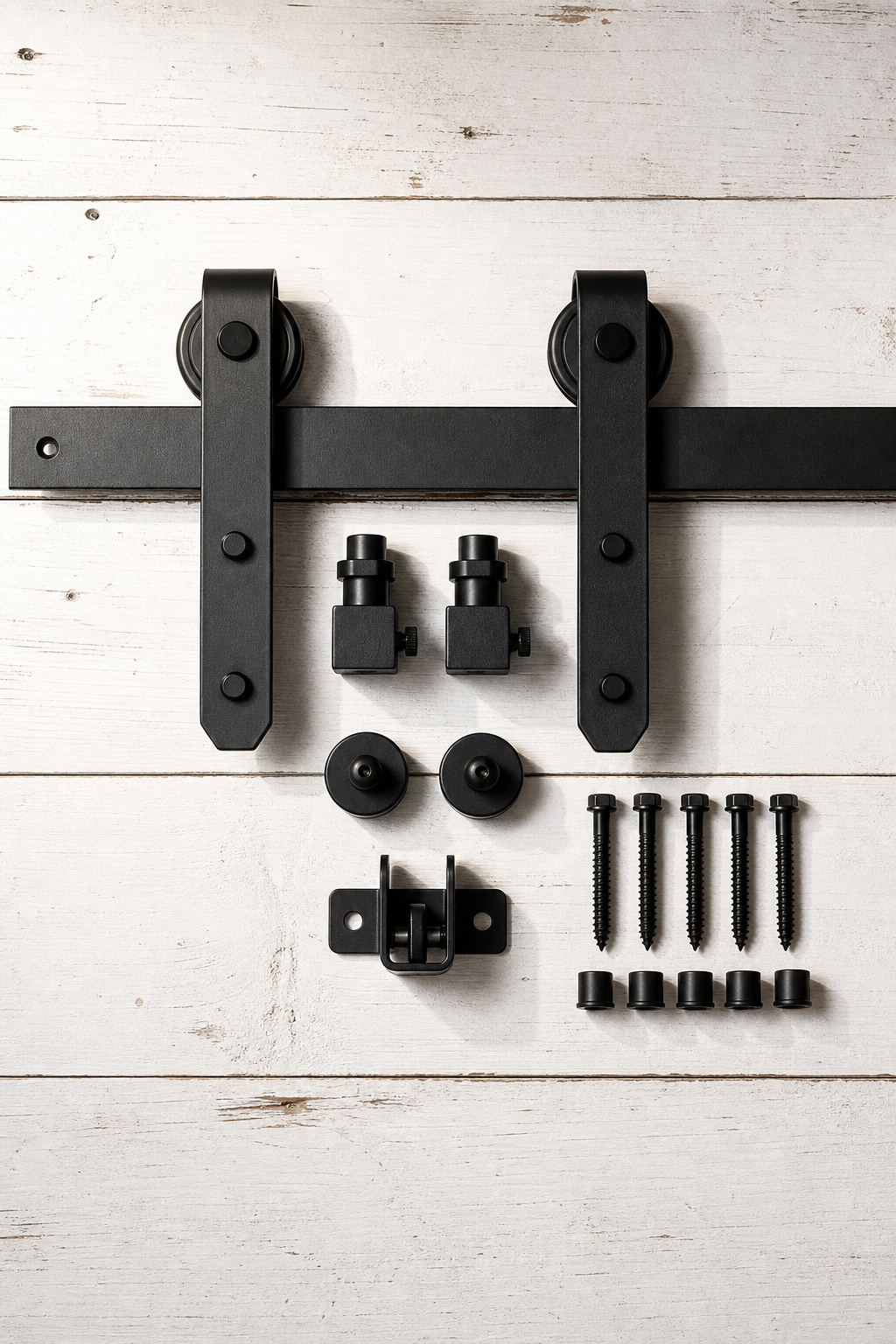
A standard single-slider kit includes:
- Track (rail) — the flat-top steel bar above the opening; pre-drilled holes spread the door’s weight along its length rather than off one bracket
- Hangers (rollers) — bolt to the door face and carry the wheel that rides the track; hanger style (J-strap, flat-top strap, spoke-wheel) is your main look decision
- Door stoppers — clamp to each end of the rail; loosen the set screws to nudge them after hanging
- Wall spacers — hold the track off the wall so hangers clear the surface as the door slides
- Anti-jump discs — screw into the top edge of the door and stop it bouncing off the track under a hard pull
- Floor guide — keeps the door’s bottom from swinging out from the wall; see below
Anti-jump discs and floor guides: why they matter, and what kits leave out
The standard floor guide is a fin-style that needs a routed channel in the door’s bottom edge and a screw into the floor. Over finished hardwood, tile, or LVP, you need a wall-mounted floor guide instead — sold separately. Evan Christensen of The Barn Door Hardware Store calls it the single most common accessory people order after their kit ships.
Handles are the other universal gap: a pull on the front face, a flush or edge pull on the back. Flush pulls need a routed recess — plan a router template. Budget for both up front. Soft-close is also sold separately from most kits.
Weight Ratings: The Number That Determines Whether Your Door Stays Up
Hanger style is a look; the weight rating is whether the door is still on the wall next year. Under-rate it and the failure is rarely dramatic — wheels deform, the track bows, bolt holes strip until the door wobbles sideways. As Evan Christensen of The Barn Door Hardware Store puts it: the most common mistake isn’t the wrong hanger shape, it’s buying hardware rated below the door’s actual weight.
How to estimate your door’s weight by material and size
At a standard 36×80 in size:
| Door material | Typical weight (36×80 in) | Recommended minimum rating |
|---|---|---|
| Hollow-core blank | 25–35 lbs | 75–100 lb |
| Solid-core (veneer over MDF) | 50–80 lbs | 100–125 lb |
| Solid pine or poplar | 80–120 lbs | 200 lb |
| Solid hardwood (oak, maple, walnut) | 100–150 lbs | 200 lb |
| Reclaimed / old-growth wood | 120–200+ lbs | 250 lb or heavy-duty |
Thickness matters: a 2 in solid pine door weighs roughly 45% more than the same door at 1-3/8 in. Anything reclaimed — put it on a bathroom scale before ordering.
Weight ratings in practice — and the cost of getting it wrong
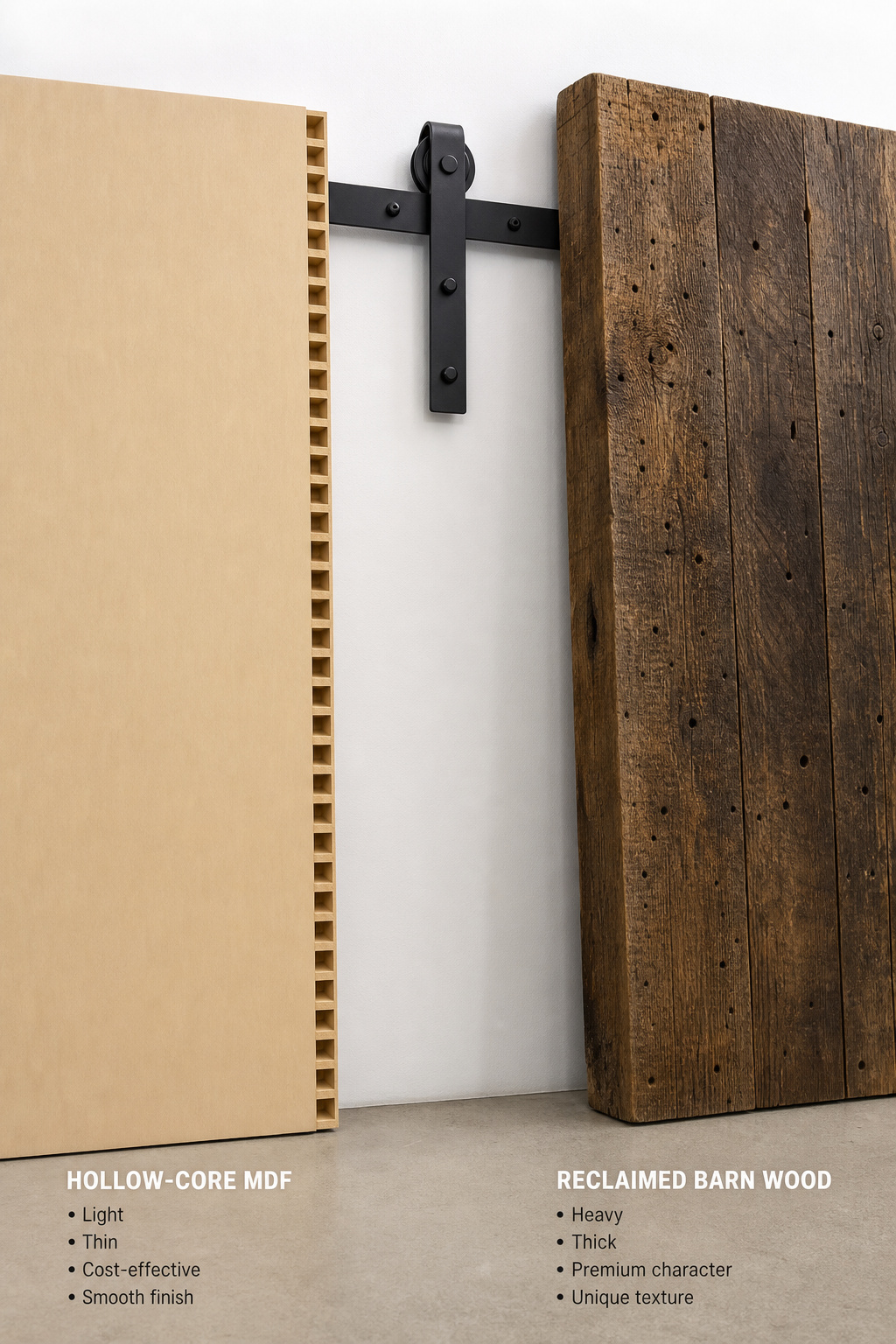
Standard-duty hardware climbs by hanger style: straight top-mount 75 lb, J top-mount 100 lb, straight strap 125 lb, J-strap 200 lb, horseshoe 250 lb. Heavy-duty extends to 400–600 lb. One rule overrides weight: standard-duty fits doors 1-3/8 to 1-3/4 in thick; anything thicker needs heavy-duty regardless of weight. For doors wider than 60 in, add hangers beyond the standard two.
The classic error: a budget 150 lb kit under a reclaimed door that actually weighs 180–200 lbs — fine on day one, failing by month six. A 36×84 in solid pine slab like the one you’d build your own door panel from typically lands at 80–120 lbs; a 200 lb J-strap kit covers it without going heavy-duty. Glass doors are the other trap: a frosted slider weighs far more than wood of the same size, which is where buyers under-rate most.
Single Slider Hardware: The Right Kit for a Standard Laundry Opening
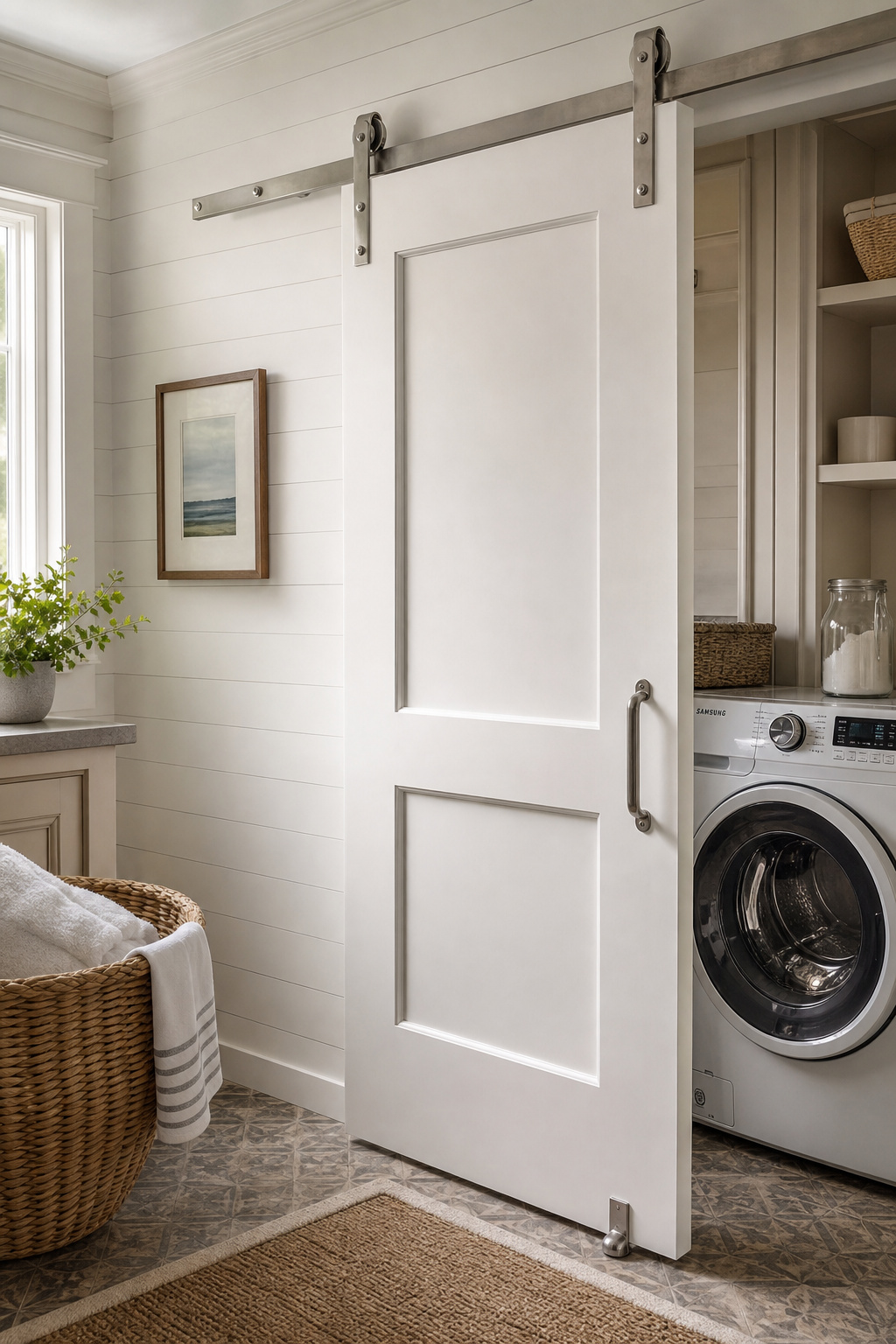
This is the kit most laundry rooms want — one door, one track, open wall on at least one side.
Track length and finish: the two decisions before you buy
The track must be at least twice the door width — a 36 in door needs a 72 in minimum. Match it to the opening instead and the door only slides halfway clear. For the full sizing math, measure before buying a track.
On finish: in a laundry room, corrosion matters more than color. Standard powder coat over plain steel will eventually rust. Look for powder coat over a galvanized base, or step up to 304-grade stainless — corrosion-resistant through the whole alloy. Brushed finishes hide fingerprints better than polished ones.
Budget, mid-range, and premium single-slider kits compared
| Tier | Example kit | Price | Rating |
|---|---|---|---|
| Budget | J-Strap Black Single Track (Quick Ship) | $149.99 | Standard |
| Mid-range | Goldberg Brothers Hidden Roller | $184.50 | Standard |
| Mid-range | Goldberg Brothers Classic J-Strap | $218.50 | Standard |
| Premium | J-Strap Heavy Duty | $297.00 | 400 lb |
Rustica’s entry single slider runs about $128 as a floor. Mid-range is where I’d point most laundry builds: tighter tolerances mean smoother operation and fewer adjustments — worth fifty dollars more than a value kit you’ll tweak for a week.
Bypass Hardware: When Two Doors Share One Wall
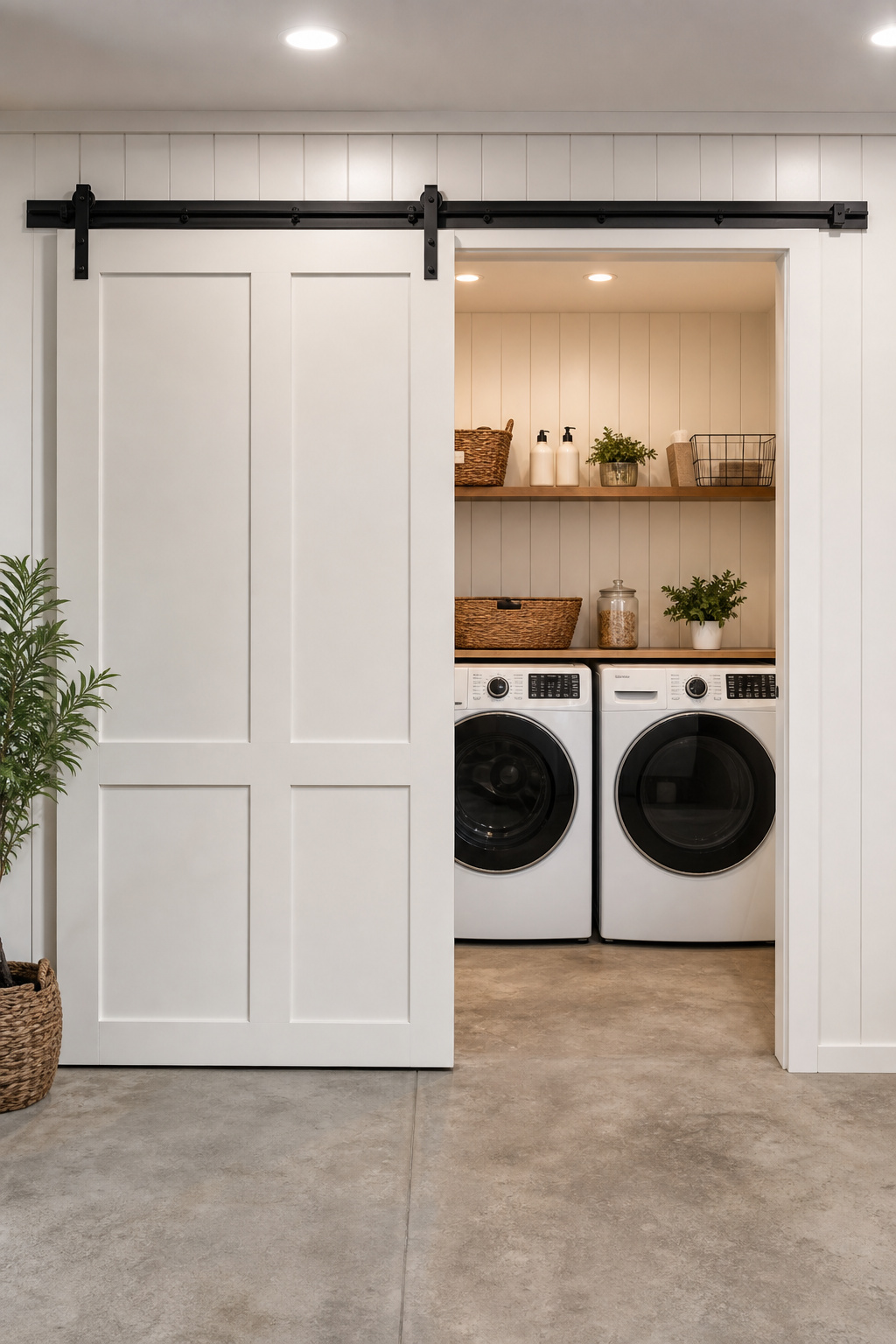
When there’s no side wall for a single door to slide onto, bypass is the answer — two doors that pass each other to cover one wide opening.
How bypass systems work and when to use one
Double-bypass runs two parallel tracks at different depths, each door on its own rail; single-bypass puts two doors on one shared track, overlapping at center when closed. The trade-off is clearance: bypass needs 7-5/16 to 12 in above the opening for its brackets, nearly double the 4-3/8 to 6 in a single track requires. Check that height first — it’s the most common bypass oversight.
Choose accordingly:
- Single slider — adequate side wall, one door, simplest and cheapest. The default when you have the room.
- Bypass — no side wall, opening 48 in or wider, both sides need access. Costlier, deeper, more overhead clearance required.
What bypass hardware costs
Bypass runs more than single-slider — roughly $319 at the entry end up to $420–$620 for double-track kits; pricing swings with track length and configuration, so check current listings for your width. A proper kit includes two tracks, bypass brackets, two sets of hangers, stops, spacers, and mounting hardware. Soft-close works on bypass but not on bifold — worth knowing if you’re weighing the two.
Soft-Close Add-Ons: Worth the Upgrade or Marketing Upsell?
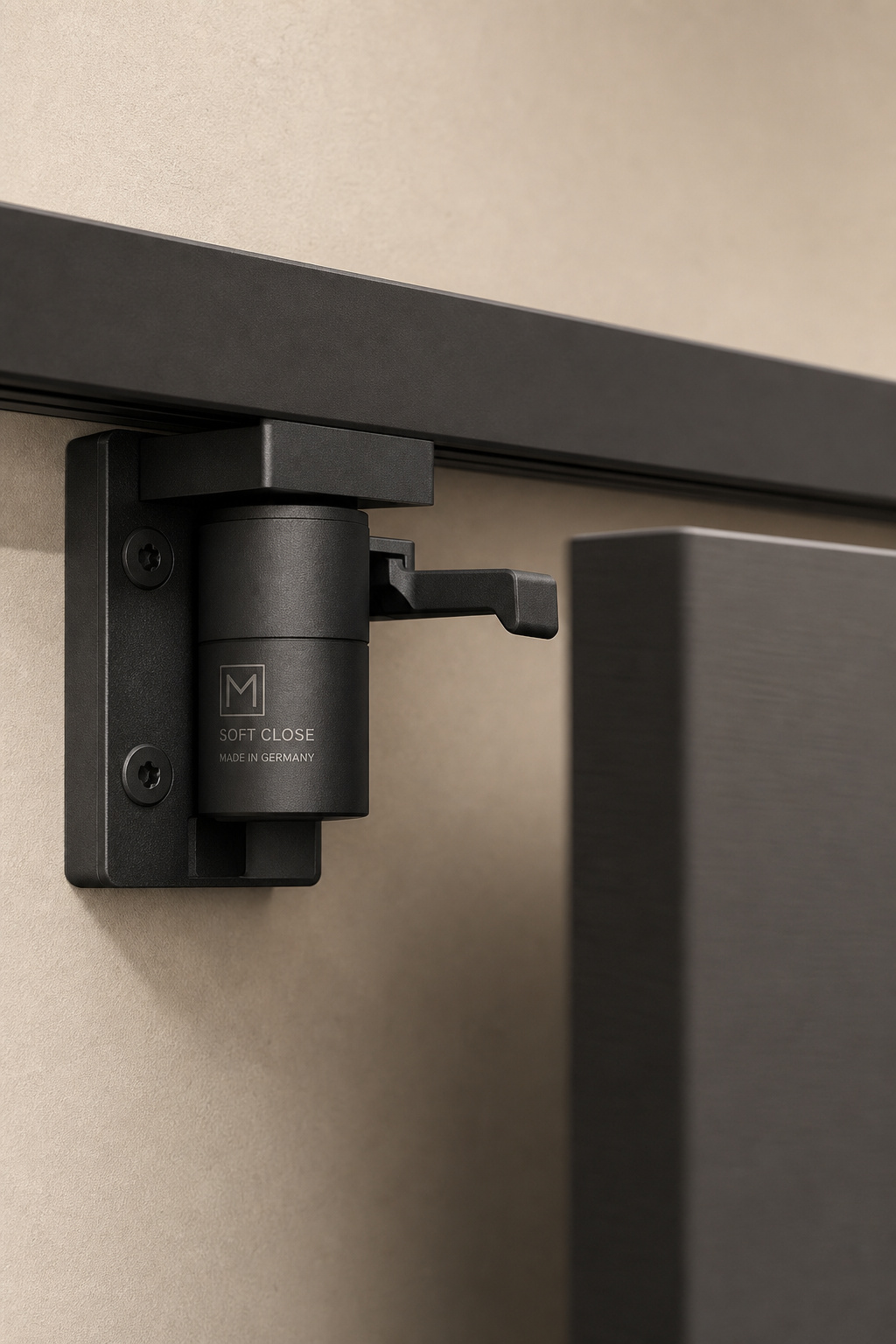
How they work and what they cost
The mechanism mounts at each end of the track and catches the door in its last 6–8 inches of travel, decelerating it on hydraulic resistance so it settles instead of slamming. The RealCraft Soft Stop runs $60 a pair (tested to 100,000 cycles, rated to 220 lb); Leatherneck units go for about $98 a pair. Both clip onto a flat track with no drilling and tune via a set screw. Most kits don’t include it — add at order time or retrofit later.
Is it worth it in a laundry room?
In a laundry room, more often than not. Hard surfaces amplify a slam that carpet would absorb, and a laundry door gets opened several times a day, piling wear on the stops and door face. The Barn Door Hardware Store puts it plainly: soft-close earns its keep on a frequently used door; on a closet opened twice a week, the benefit is noticeably less.
One hard limit: soft-close is incompatible with bifold hardware in every configuration. Roughly 40% of 2024 installs included it — common enough to ask about at order time, not so universal that every install needs it.
Installing the Track: What to Know Before You Drill
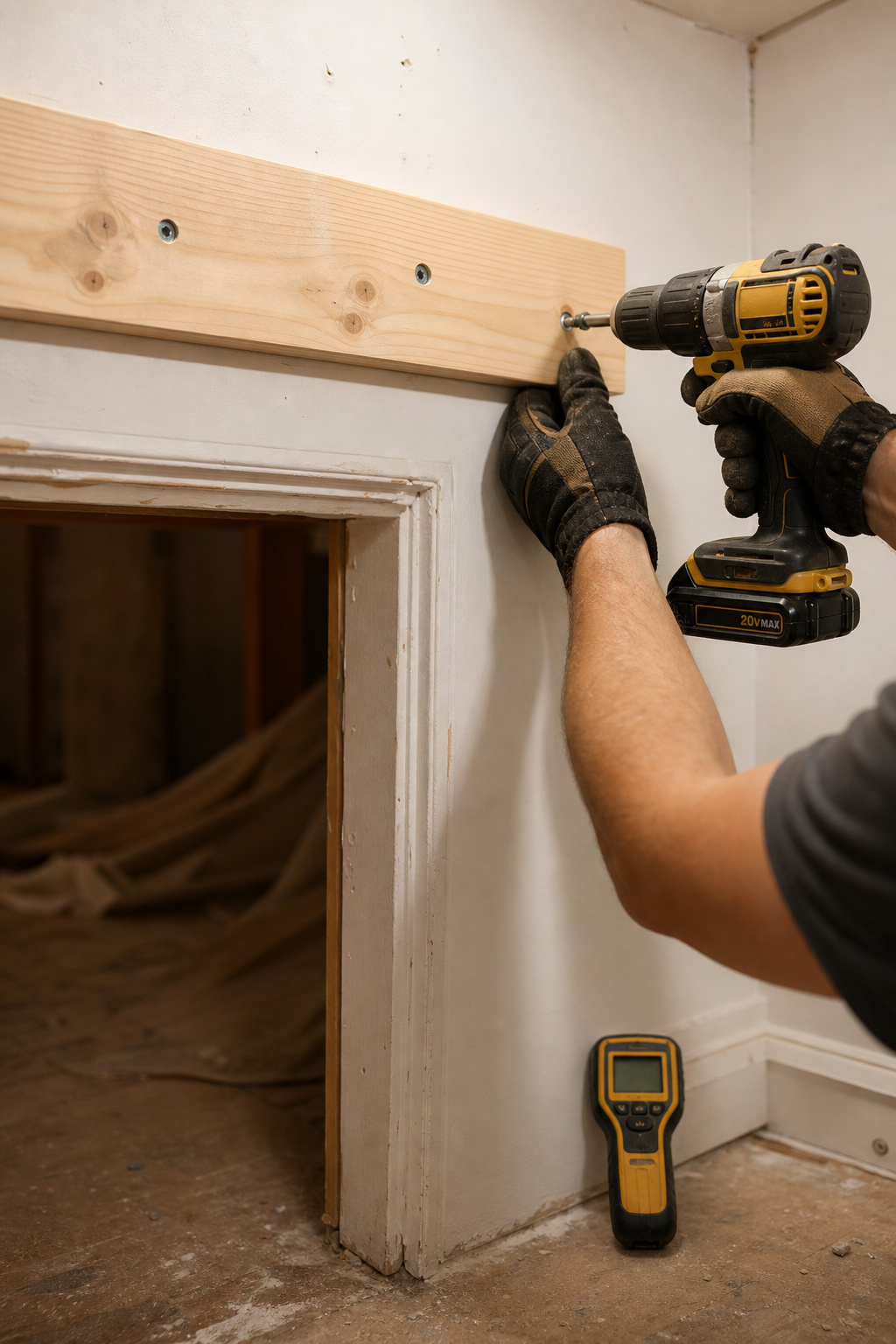
Backing and height clearance — the two things that matter
Every wall-mount track needs solid backing. A standard framed wall with a door header handles most installs. When pre-drilled track holes don’t land on studs, mount a 1×4 or 1×6 header board first: screw it to the studs, run it past the next stud beyond each end of the track, and bolt the track to the board. Minimum three stud connections — if only two fall within the span, extend the board to catch a third. RealCraft treats the header board as standard method wherever there’s no wood blocking, not a workaround. Masonry or tile wants a ceiling-mount kit into the joists instead.
Before the drill touches the wall, confirm total height clearance: track center equals door height plus the hanger drop (4-3/8 to 6 in on single-track) plus a 1/2 to 1 in gap under the door. For a standard 84 in door on J-strap hangers — about a 5 in drop — the track centerline lands roughly 89–90 in off the finished floor. Measure twice, then drill. If you built the slab yourself, measure the hanger bolt spacing before drilling the door — the pattern changes by hanger style.
Buy for the weight your door actually is. Size the track to double the door width. Pick a finish that survives steam, add handles to the cart from the start, and treat soft-close as the worth-it upgrade it usually is on a daily-use laundry door.
FAQ
How long should a barn door track be for a 36-inch opening?
A 36-inch opening needs a door of roughly 38–40 inches (2 inches of overlap per side) and a track of at least 76–80 inches — double the door width. For extra margin, add 4–6 inches of buffer: (door width × 2) + 4–6 in. Sizing the track to match the opening leaves a door that only slides halfway clear.
Can you add soft close to an existing barn door kit?
Yes. Most soft-close retrofit kits — the RealCraft Soft Stop at $60 or Leatherneck units around $98 a pair — clip onto the end of an installed flat track with no drilling, and the job takes under 30 minutes. Check compatibility first: the unit must match your track type, and soft-close is not retrofittable to bifold hardware in any configuration.
What barn door hardware works best in a laundry room with humidity?
304-grade stainless steel is the most humidity-resistant option, because it resists corrosion throughout the alloy rather than only at the surface, so it won’t pit or rust in laundry-room steam. A more affordable route is a powder-coated finish applied over a galvanized base metal; standard powder coat over plain steel will eventually corrode.