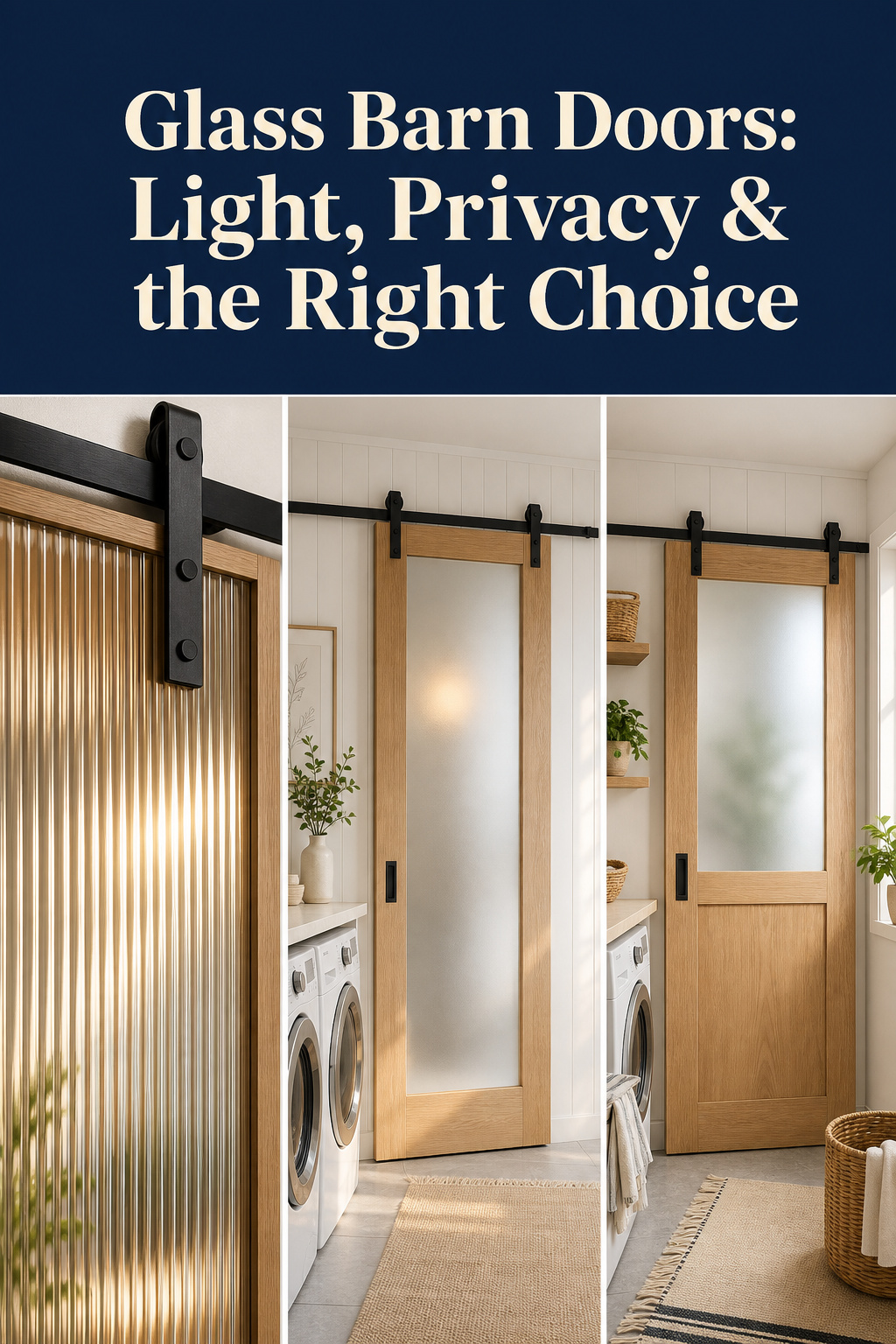
Ask what a laundry room is for and the honest answer is light — not the single ceiling bulb most of them get, but the borrowed daylight a room needs to feel like part of the home rather than a cupboard you shut the door on. A solid door blocks that light completely. A frosted glass sliding door does the opposite: daylight travels through, clutter stays hidden. In a windowless laundry space, that is not decoration — it is the difference between a room that works and one you avoid.
TL;DR
- A frosted glass sliding door transmits 60–75% of available light while obscuring everything behind it past 12 inches — bright enough to brighten a windowless laundry room, private enough to hide the pile.
- Reeded (fluted) glass is the best choice for most laundry rooms: nearly clear-glass brightness with soft, textured privacy; frosted is safer where the door faces a living area; clear hides nothing.
- Glass is heavy — a frameless panel runs 90–140 lbs against 25–35 lbs for a hollow wood slab — so it needs hardware rated well above the door’s weight, and a soft-close mechanism is genuinely worth the $40–$80.
The Laundry Room Light Problem (and Why Glass Solves It)
Most laundry rooms sit deep in the floor plan, with no exterior wall and no window. They rely on one ceiling fixture that cannot reach evenly into the corners, so shadows gather exactly where you sort clothes and check a stain. The only daylight such a room receives travels in from the corridor — and a solid door shuts that channel off completely.
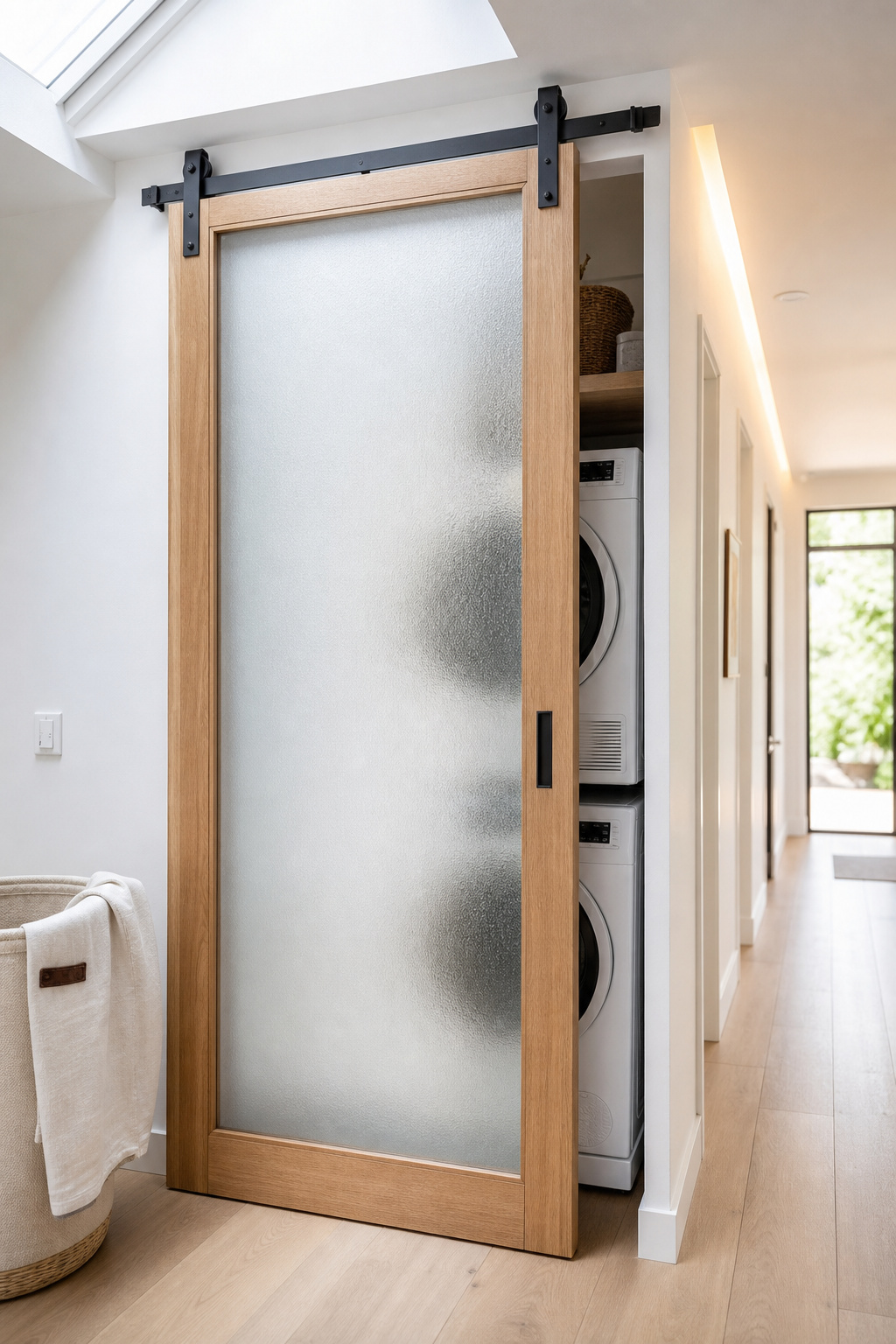
Swap the solid panel for glass and the doorway becomes a conduit. Diffused hallway light reaches the back wall without a single new fixture, and the closed room reads as an extension of the space beyond. Better Homes & Gardens, via BarnDoorz, notes that visual separation through glass makes a home feel calmer and more intentional — the boundary drawn without cutting off the light.
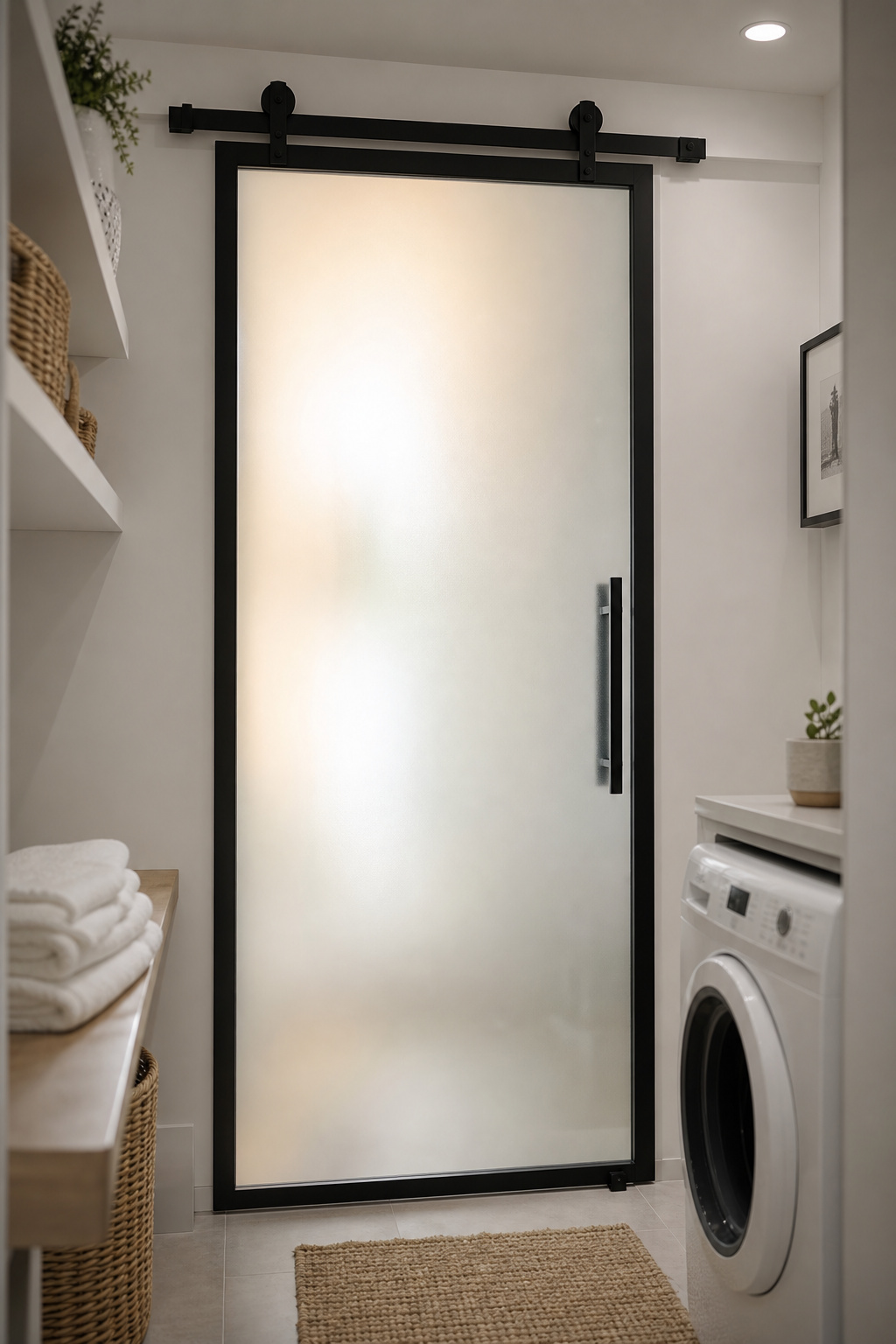
In Nordic countries, where winter daylight is brief, light is the first material of a room — pale walls, sheer fabrics and transparent surfaces exist to capture and pass along whatever there is. A laundry room deserves that same care. One caution: glass only borrows light that exists. If the adjoining hallway is dark, the door passes artificial light rather than daylight — still useful, less transformative. The main guide maps the full range of laundry room barn door styles and options.
Clear, Frosted, and Reeded: How to Choose Your Frosted Glass Sliding Door
The three common glass types sit on one spectrum, from most light to most privacy. Start with how much privacy you need, then choose the glass.
Clear tempered glass transmits 85–90% of available light at $10–$20 per square foot — the maximum brightness, zero privacy. In a laundry room it works only if the space stays genuinely tidy.
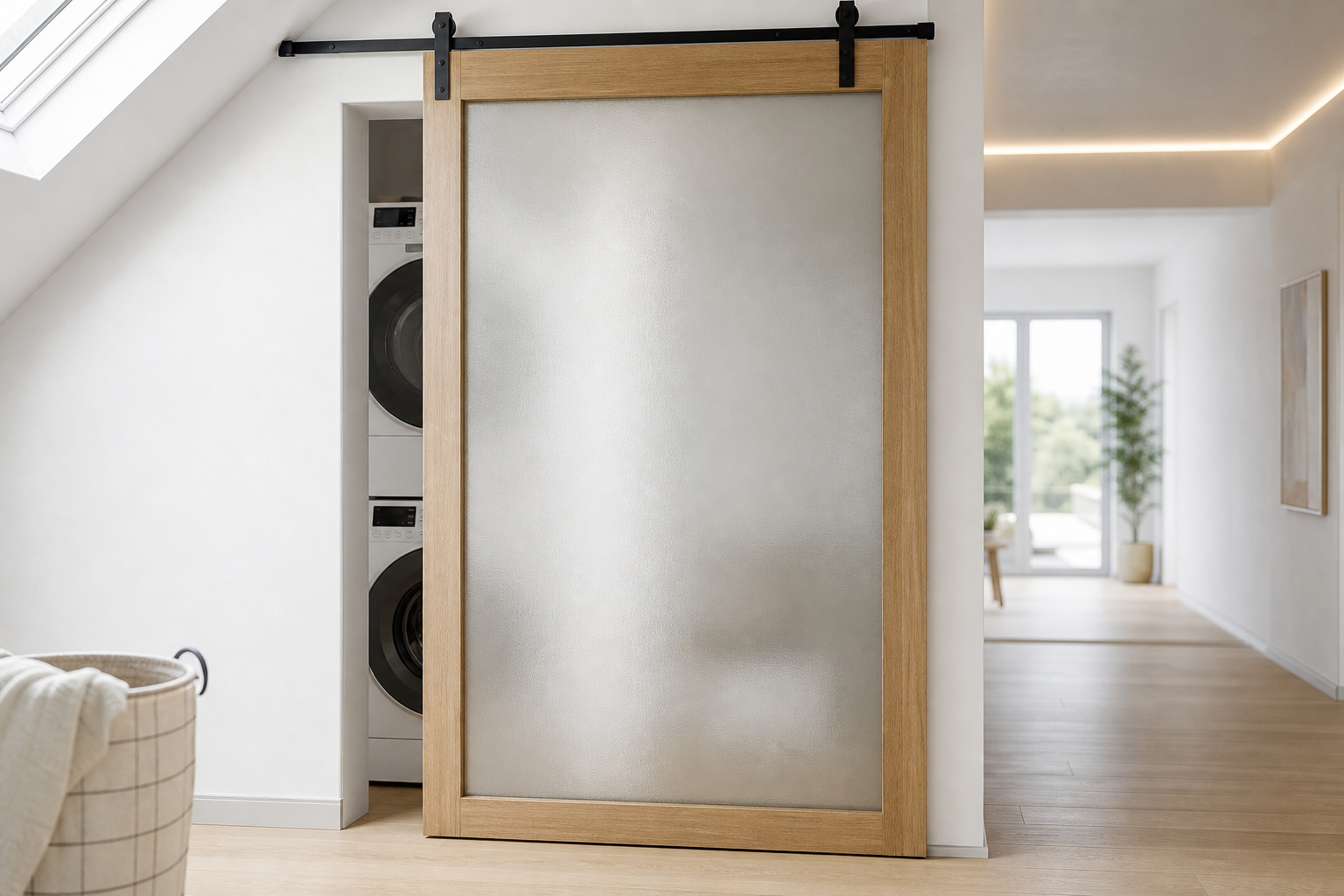
Frosted glass — acid-etched or sandblasted on one face — admits 60–75% of light while blurring anything past about 12 inches into a silhouette, at $15–$30 per square foot. The most complete privacy of any light-passing glass, and the default for laundry and bathroom doors.
Reeded glass — clear glass formed with shallow vertical grooves — is the one I reach for first in a laundry room. It scatters light forward almost as well as clear glass, yet the grooves soften appliances and sorting piles into texture rather than detail. As Royal Glass in Auckland puts it, reeded glass “scatters light forward so rooms stay bright while faces and objects soften into silhouettes.” Fine reeds at 6–10 mm give a gentle blur with high light; bolder reeds at 12–25 mm give more concealment. At $25–$45 per square foot, it has one honest weakness the table notes.
| Glass type | Light transmission | Privacy | Best for | Approx. cost |
|---|---|---|---|---|
| Clear | 85–90% | None at any distance | Tidy, open-look spaces | $10–$20/sq ft |
| Frosted | 60–75% | Complete past 12 in | Door facing a living area | $15–$30/sq ft |
| Reeded | Near clear | Strong head-on, less at an angle | Most laundry rooms (off a hallway) | $25–$45/sq ft |
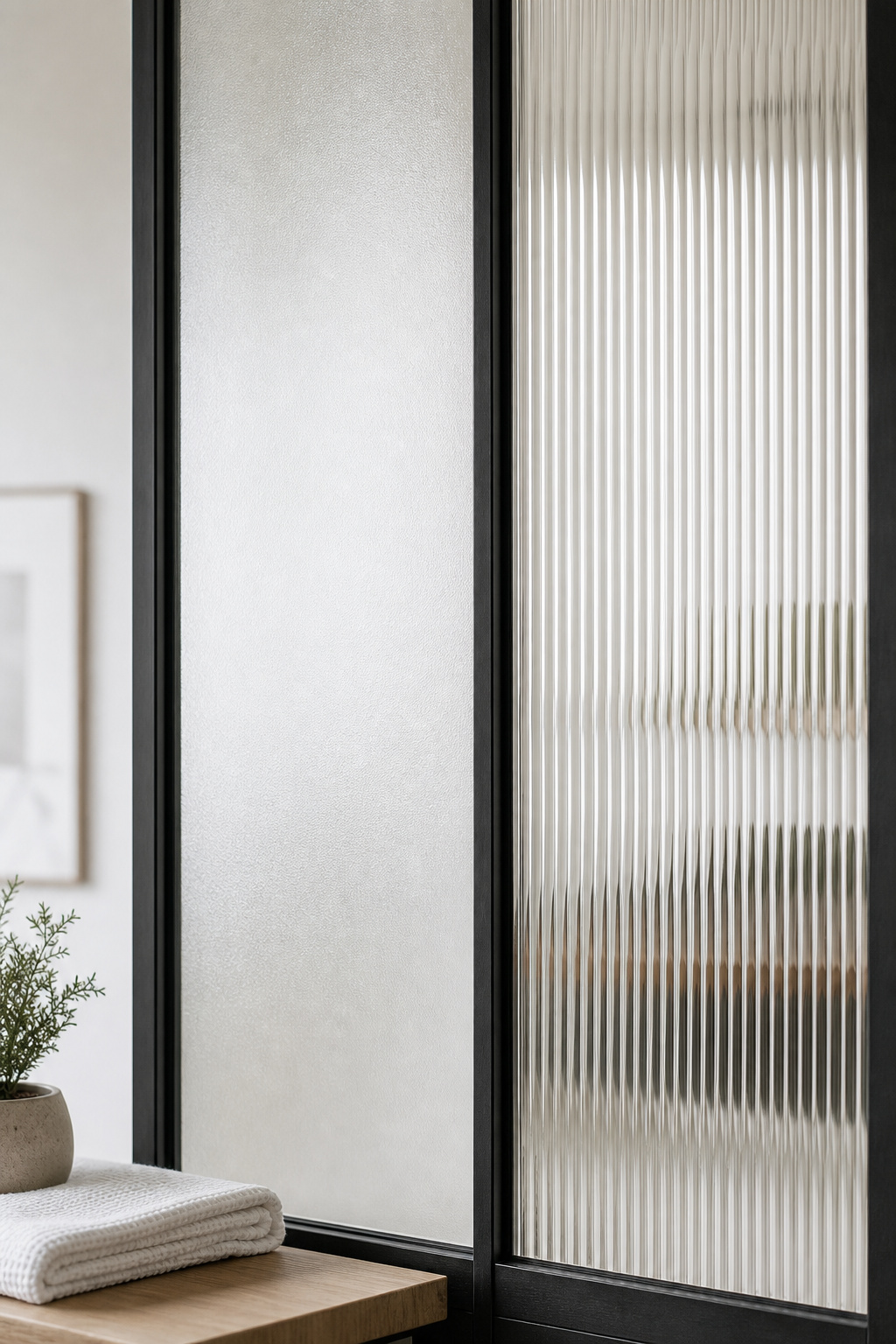
That weakness is worth taking seriously. John at Colfax Glass is direct: reeded glass gives strong privacy head-on but more transparency from a 45-degree angle, so someone approaching from the side sees more than a straight look suggests. For a door off a corridor that is fine; for one in a living-room sightline, choose frosted. A fitting tip: reeded glass has one smooth face — turn the ribbed side toward the laundry room and the smooth side toward the hall, so the easy-wipe surface faces the traffic.
Framing the Glass: How the Border Shapes the Look
The frame decides a glass door’s character more than the glass does. Three directions matter.
- Full-frame metal — matte-black steel or aluminium, often a factory-window grid. Contemporary, deliberately styled. Steel-and-glass systems cost $1,000–$2,200 installed and pair with brick and concrete. In a home of warm timber and textiles, that heavy frame can read as intrusive.
- Frameless or minimal — a single sheet of tempered glass, 3/8 or 1/2 inch, on glass-specific clamps. No frame means no visual boundary, the cleanest result, at $1,400–$2,500 installed — with zero warping risk in a humid room.
- Wood-framed glass — light oak, alder or pine around the panel. The one I recommend for a home laundry room.
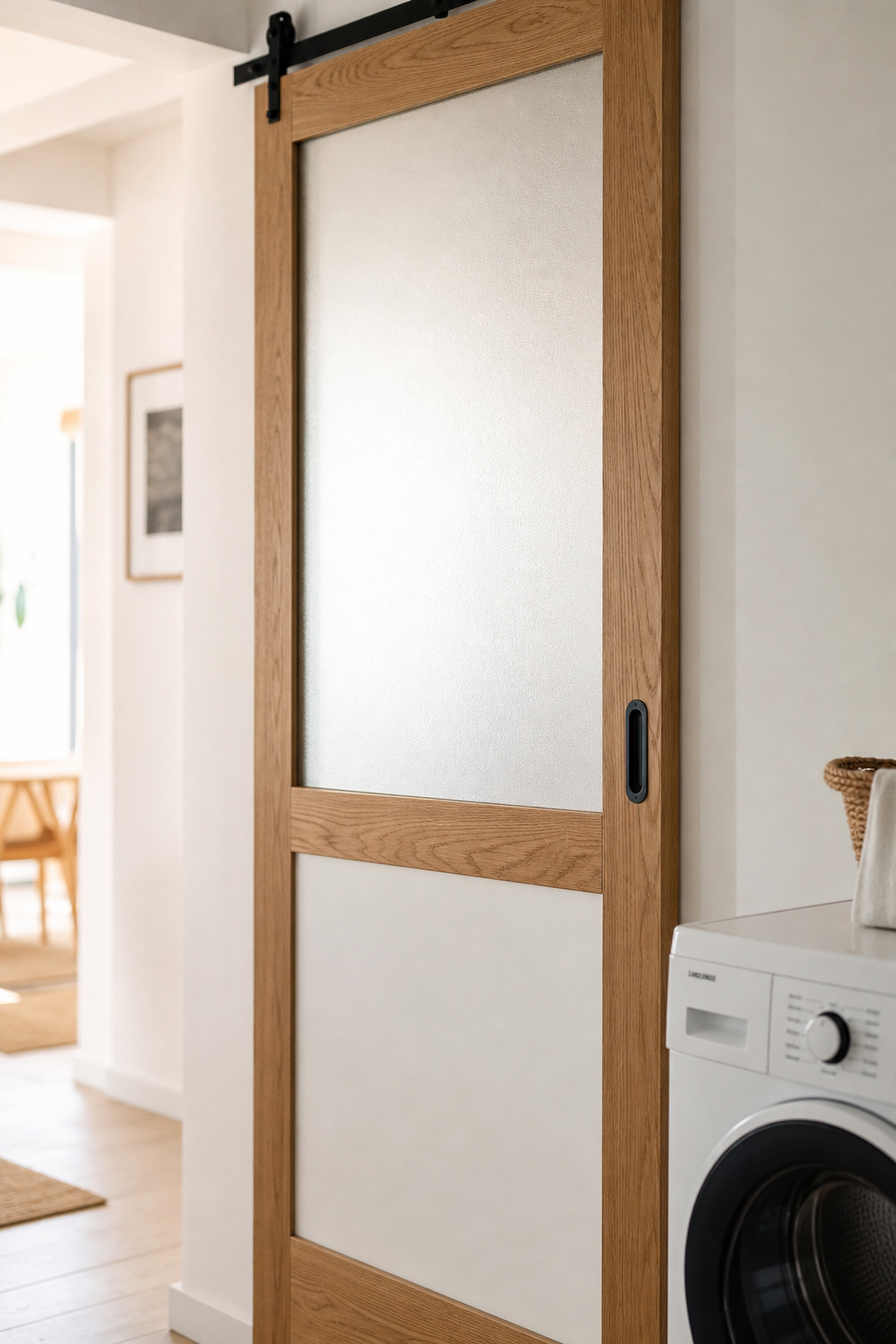
Wood softens the clinical quality of glass and connects it to the organic materials a Scandinavian interior is built from — timber, linen, unbleached cotton. As Sans Soucie notes, natural wood like alder or maple suits Scandinavian and mid-century rooms where black metal suits industrial ones. A pine-framed frosted door is the entry price: $270–$500 for the panel, $500–$900 installed. The one demand a wood frame makes in this room is a moisture-resistant finish; an ordinary interior finish can warp within three to five years near a dryer. The half-lite — frosted glass above a solid lower panel — is the most liveable version: light at eye level, solid below where clutter gathers.
Weight, Hardware, and the One Upgrade Worth Making
Glass is heavy, and the weight settles every hardware choice. A pine-framed frosted door at 36×84 inches runs 60–80 lbs; a frameless 3/8-inch panel, 90–110 lbs; a 1/2-inch panel, 120–140 lbs — against 25–35 lbs for a hollow-core wood slab. A steel-framed glass door can pass 200 lbs, at which point hardware is the most important safety decision in the install.
The number to check is the track rating: at least 1.5 times the door’s weight. A 100-lb panel wants hardware rated 200–250 lbs, not 100. The kit must be made for glass — frameless panels hang from top-mount clamps or standoff brackets through pre-drilled holes, never the bolt-through-face hangers wood doors use. And the glass must be tempered, which US code requires anyway; it breaks into blunt pebbles rather than shards. For the full hardware weight-tier breakdown, read the guide on hardware rated for heavier doors before buying a track.
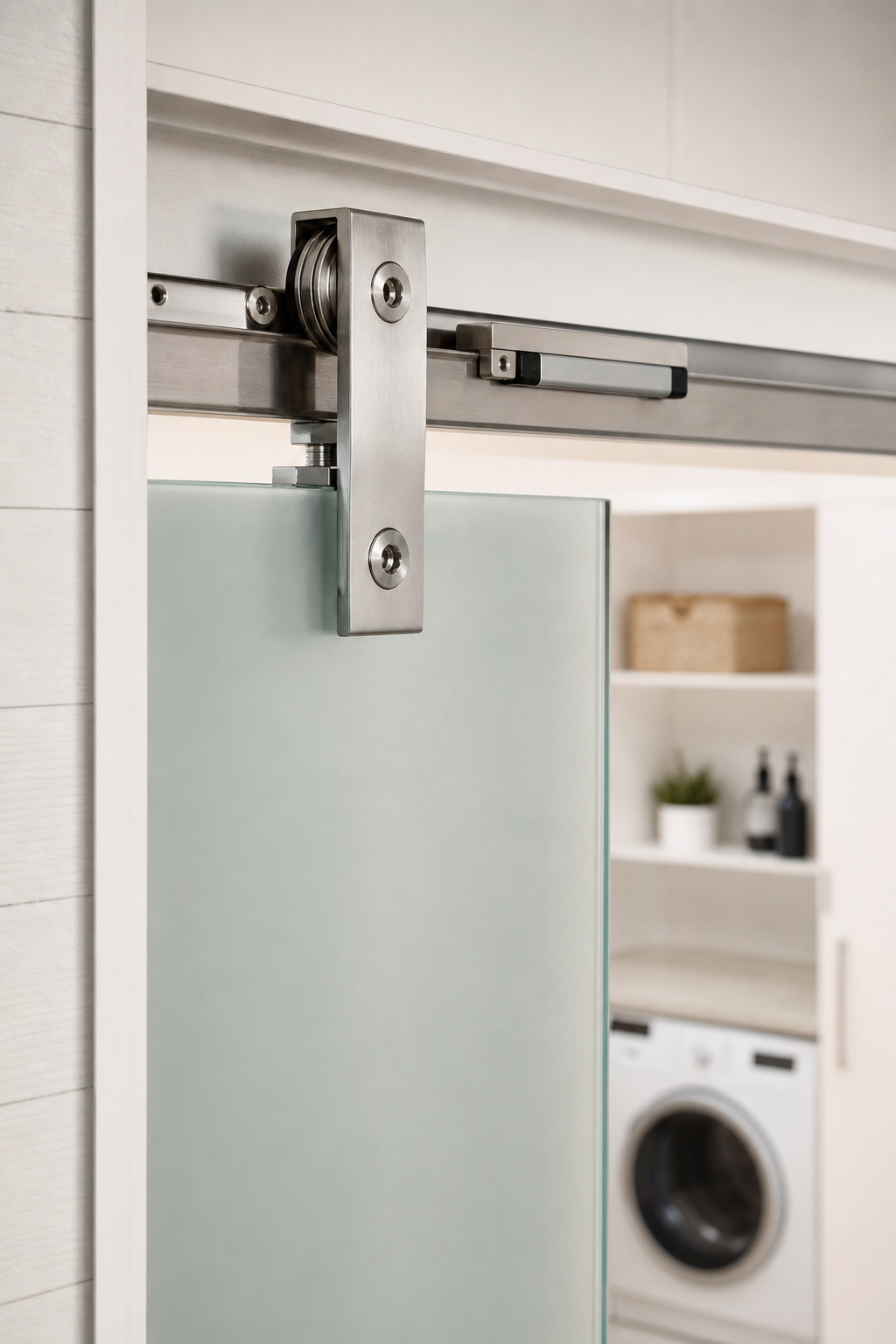
The one upgrade I would not skip is soft-close. Colfax Glass calls it a durability requirement — repeated slamming drives micro-cracks into the glass at the mounting points. It catches the panel three or four inches from closed and eases it the rest of the way, adds $40–$80, and works best on doors in the 77–176 lb range. There is a quieter reason too: a glass panel meeting a hard stop makes a sharper sound than wood, and a door that announces itself with a crack is the opposite of what the whole project is trying to create.
Care and Cleaning: Keeping the Glass Looking Right
Glass does not warp, swell or grow mould — the moisture concern is for wood frames, seals and hardware finishes, where powder-coated or stainless parts outlast chrome. The glass itself needs the right routine.
Two residues build up. Dryers raise humidity and moisture condenses on the cooler glass, leaving mineral rings at the edges; a wipe-dry after each session prevents most of it. The second is subtler: high-efficiency front-loaders likely throw a fine detergent aerosol that settles as a thin film — this is reasoned from how these machines work rather than documented for barn doors specifically, but it lifts easily with a degreasing wipe if you stay ahead of it.
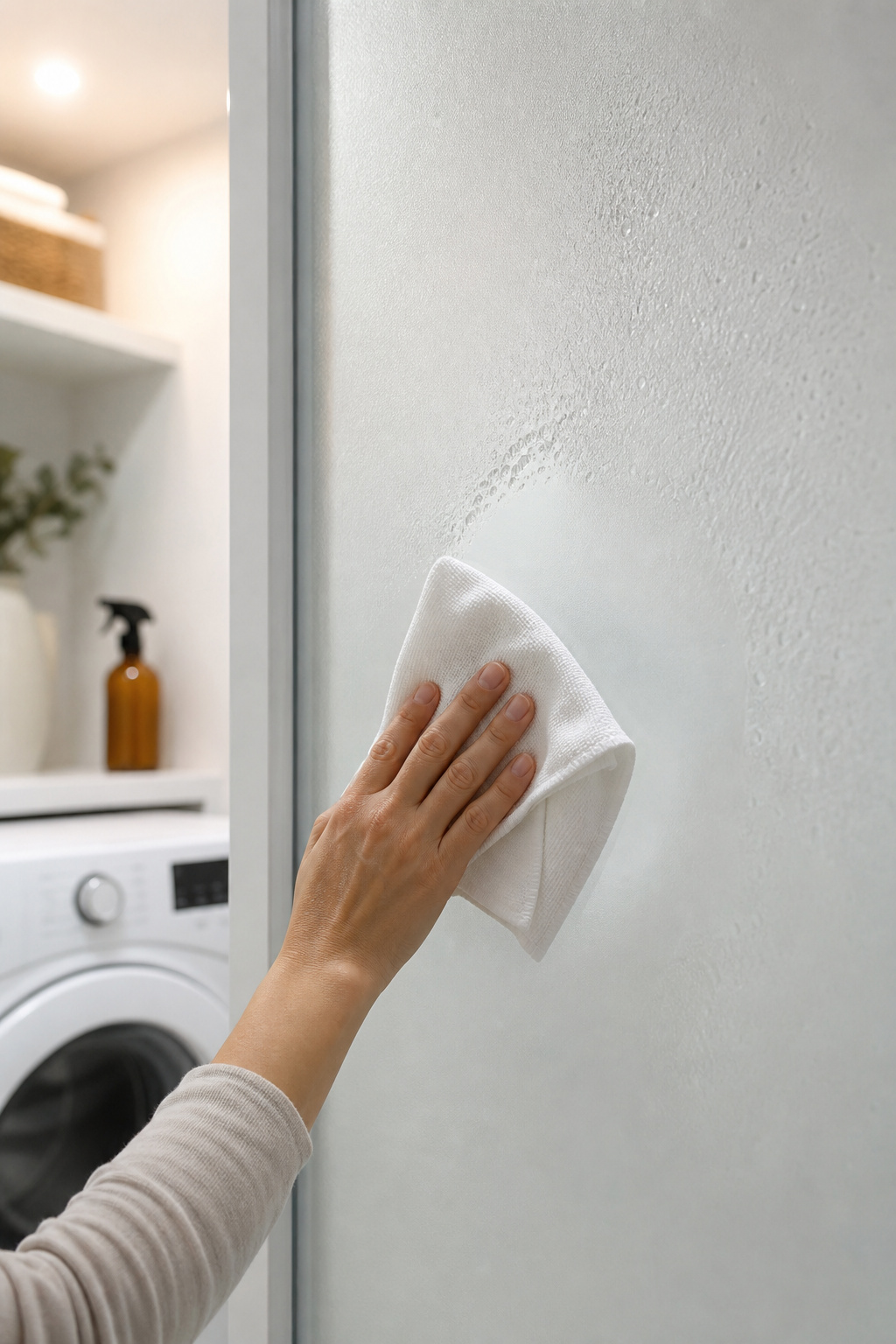
For frosted glass: equal-parts white vinegar and water, 30 seconds dwell, circular wipe, microfibre finish. Reeded glass needs two passes — mild cleaner on the smooth (hallway) face with microfibre, and a soft brush worked along the grooves on the ribbed (room) face, which trap residue a flat surface sheds.
- Do use diluted white vinegar or a neutral-pH cleaner and a microfibre finish — more soap means more streaky residue.
- Don’t use steel wool, scouring pads or pumice; they leave micro-scratches tempered glass cannot lose.
- Don’t use acidic cleaners — toilet-bowl cleaner, citrus sprays, undiluted descalers — which permanently alter the etched frosted surface and attack the panel sealant.
Glass vs Wood: Which Direction Your Laundry Room Needs
This is a light question, not a style one. If the laundry room has no window and the doorway is its only daylight, glass is the right answer — a solid door is a functional failure, sealing the room off from its one light source every time it shuts.
If the room already has a window, wood earns its place: more warmth, simpler maintenance, lower price, and better sound damping. That last point comes with a caveat — any barn door, glass or wood, reduces noise by only around 15–25%, because the real acoustic leak is the gap around the door, not the panel. (Single source; treat as approximate.) Glass is also wrong where the door sits in a living-area sightline and the room will not stay tidy; clear or reeded glass there turns the laundry into a display case.
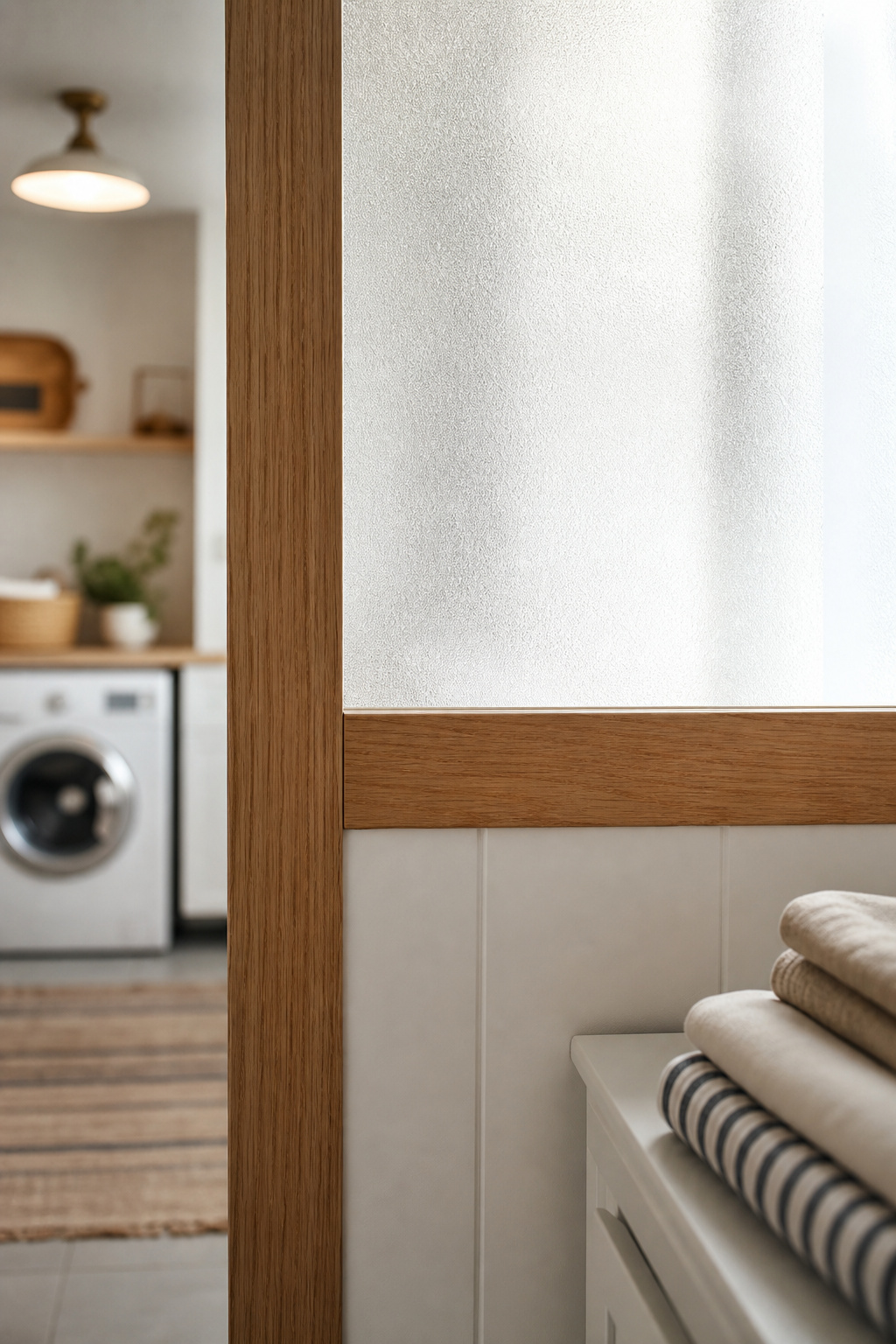
The half-lite — frosted glass over a solid wood lower panel, $500–$900 installed in pine — gives daylight from above and warmth from below. If your room has its light already and you are drawn to grain over brightness, the warmer farmhouse looks cover solid-wood styling in full. But for the dim, windowless laundry room most of us actually have, glass is what gives the room back its daylight — and a room with daylight in it is simply a better place to spend ten minutes folding towels.
FAQ
Does a frosted glass barn door provide enough privacy for a laundry room?
Yes. Standard acid-etched frosted glass obscures detail at any distance beyond 12 inches — people and objects behind it appear as blurred silhouettes, not recognisable forms, which is ample for a laundry room. Sound is separate: any barn door reduces noise by only approximately 15–25%, since the gap around the door is the real acoustic leak.
Can you get a barn door with just the top half in glass?
Yes — it is a standard configuration called a half-lite barn door, with frosted glass filling the upper section above a solid wood lower panel. It suits laundry rooms particularly well: the glass transfers daylight at eye level while the solid base hides floor-level clutter. Installed prices start around $500–$900 in pine framing.
How do you clean reeded glass on a sliding door without streaking it?
Clean the smooth face with a microfibre cloth and mild cleaner or diluted white vinegar, wiping in circles, then buff dry. For the ribbed face, work along the grooves with a soft detailing brush, rinse, and dry — a squeegee cannot reach into them. Avoid abrasive pads and acidic cleaners, which permanently dull the surface.