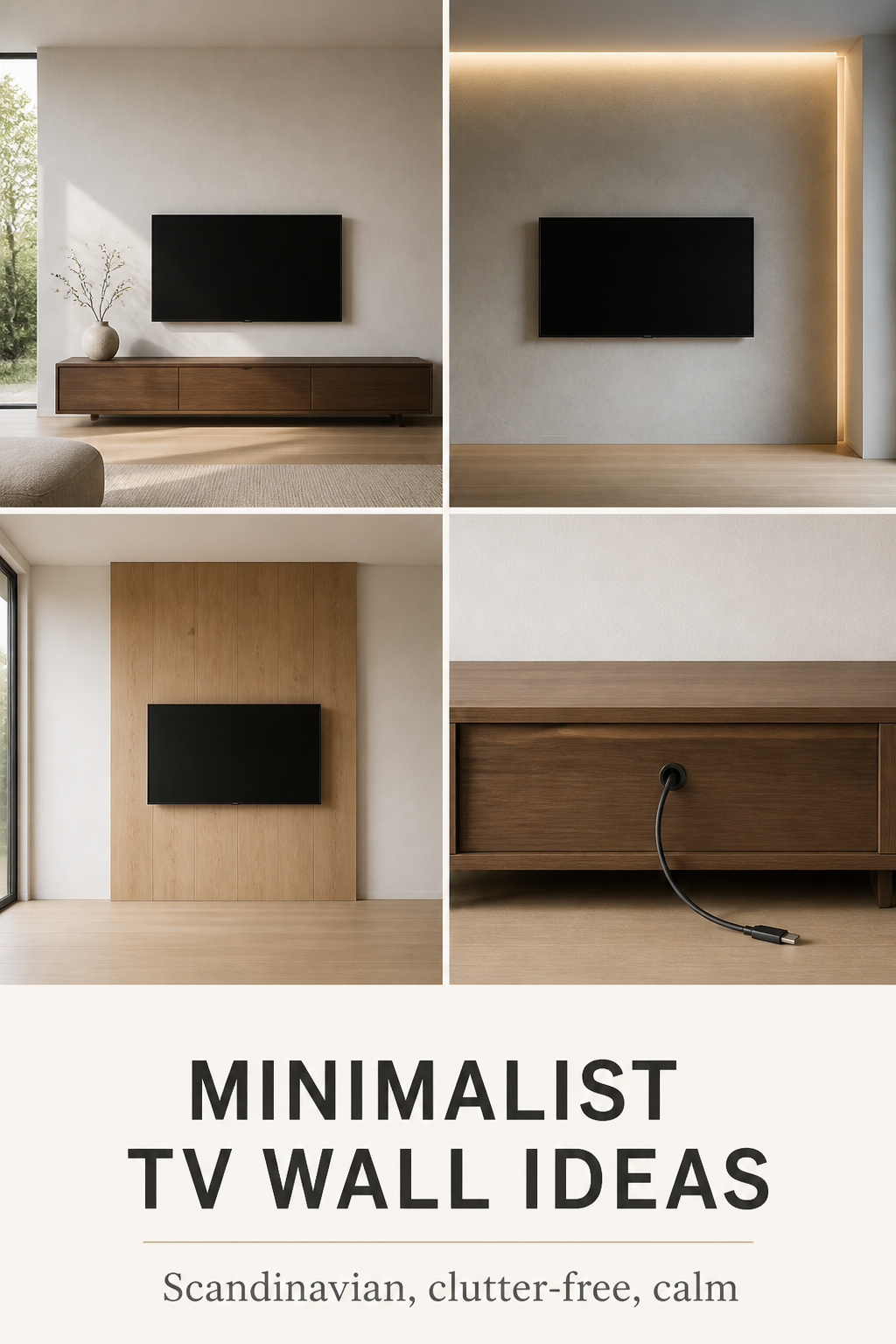
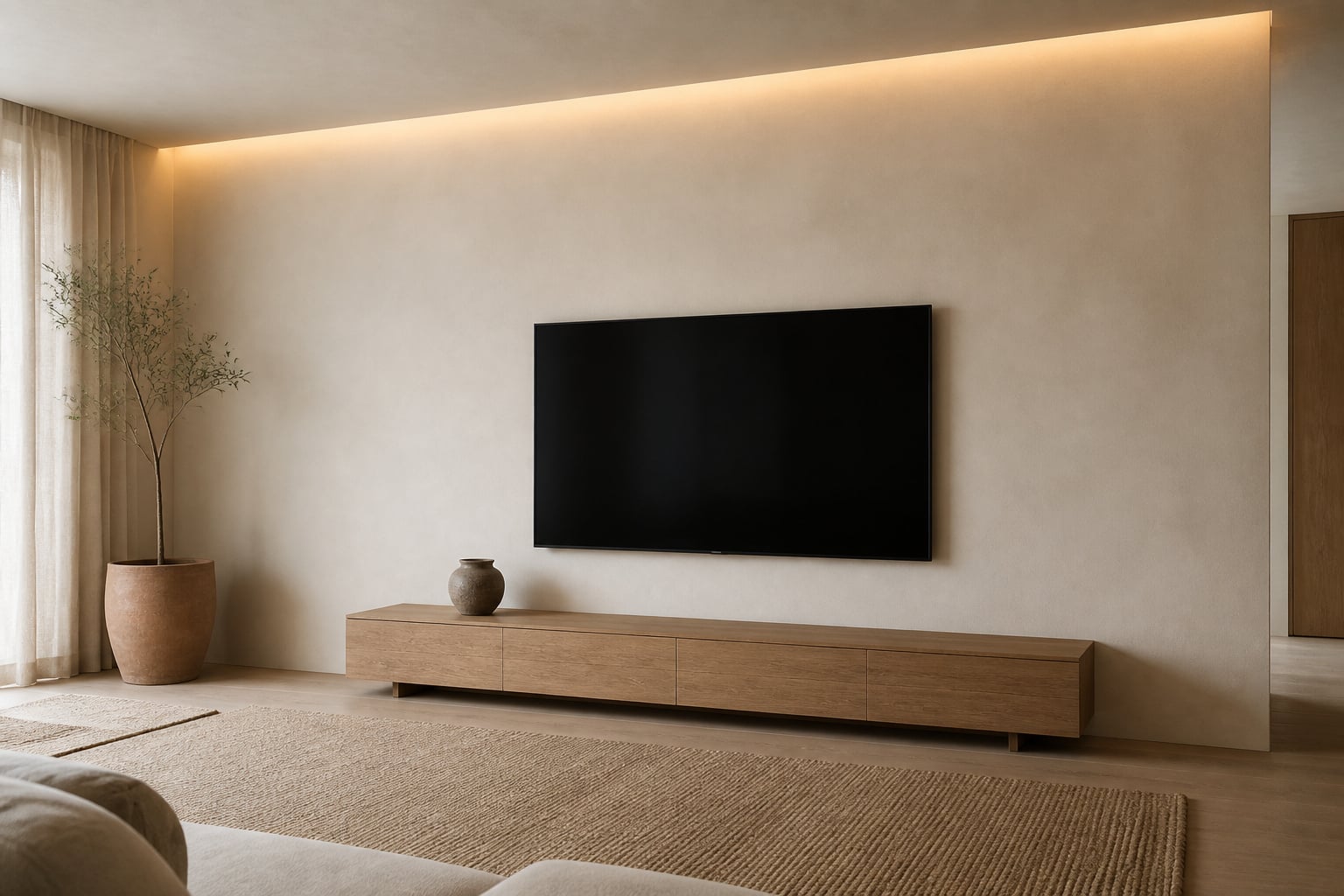

Before you choose anything for the wall the television lives on, ask what you want that part of the room to be. Most people skip it, start with a media unit, and end with a wall of shelves arranged to apologise for the screen. A minimalist TV wall works the other way: the screen sits against a quiet surface, grounded by one low piece of furniture, with space left empty on purpose around it. That is the Scandinavian position — a decision, not a shortage of ideas.
TL;DR
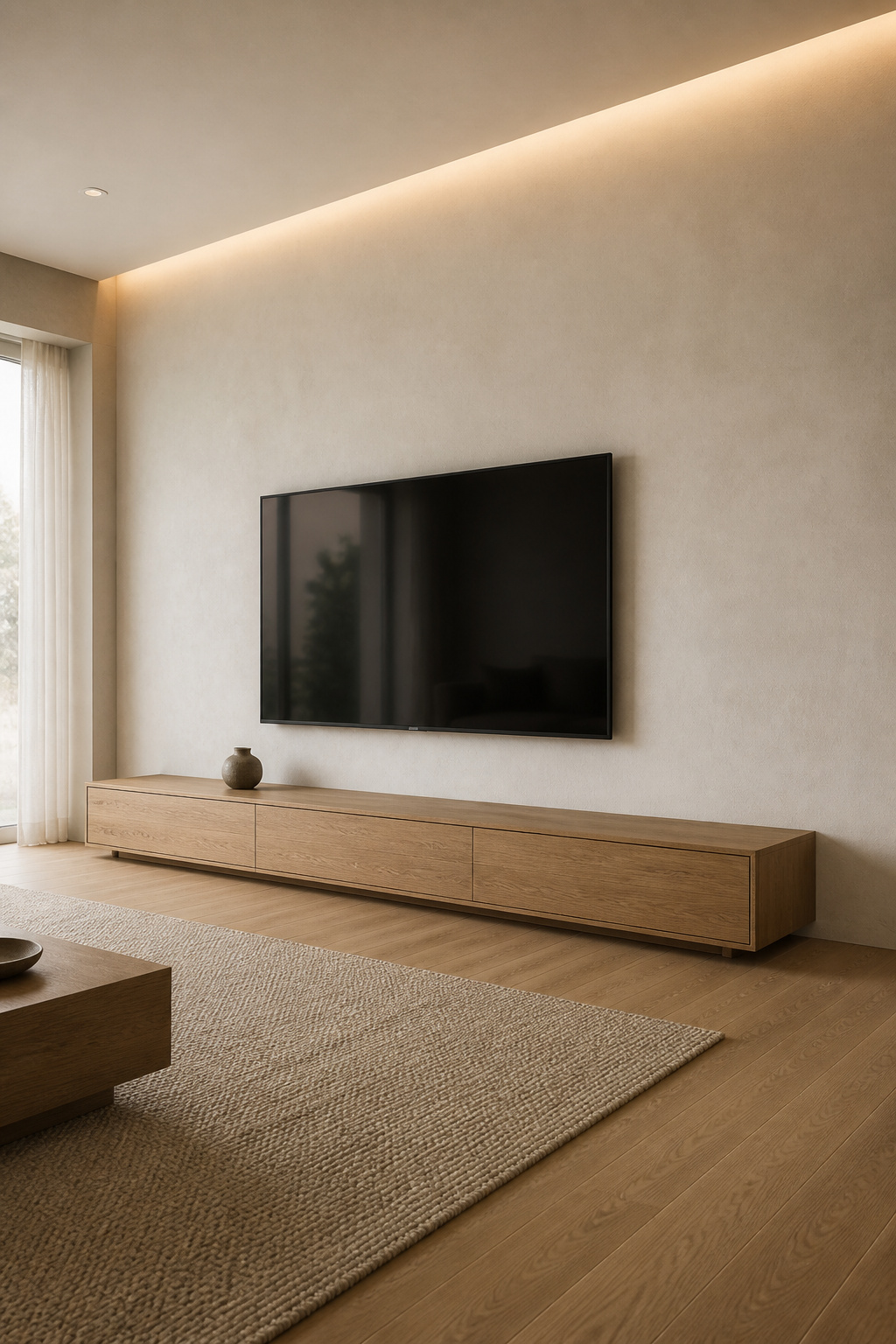
- A minimalist TV wall is a flat-screen mounted against a bare matte surface — warm white, limewash plaster, or soft warm grey — with one low solid-wood console (40–55 cm tall) below it and no objects on the wall itself.
- The screen and console together should occupy no more than about a third to a half of the wall’s width, leaving open space on both sides; cables run inside the wall, not across it.
- Restraint is the design, not a budget compromise. A monochrome, edited wall is harder to get right than a busy one, because texture, light, and proportion carry all the work.
The Question Behind the TV Wall
The usual media wall tries to disguise the television inside a composition of cabinets and ornaments — the assumption being that the screen is a problem to solve. The Nordic view is simpler: the screen is an object, and a good room lets it sit honestly.
What most TV walls hide, and what they reveal instead
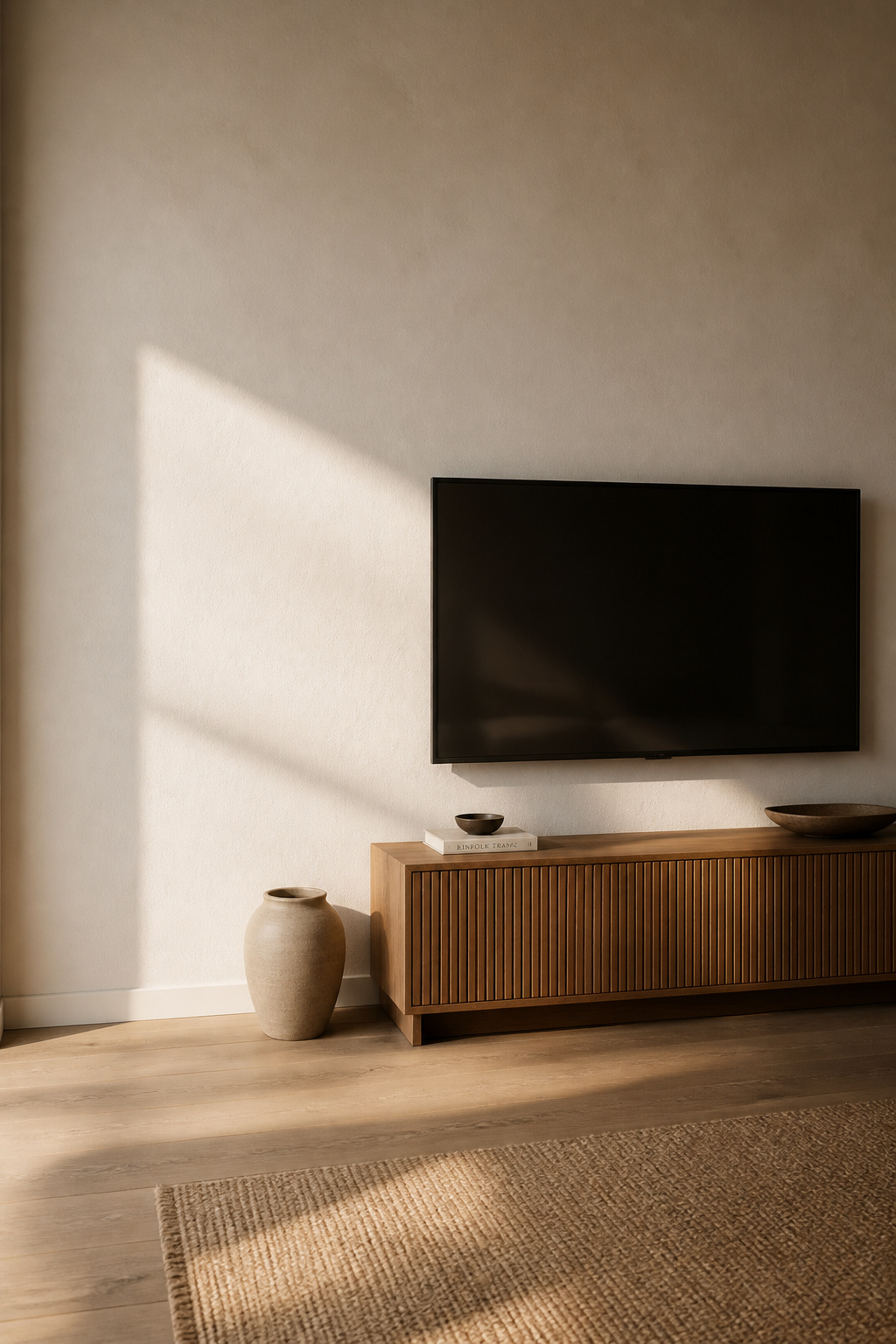
A wall built to hide the television usually announces it instead — the eye reads the effort. Lagom — not too much, not too little — leaves room to move and breathe; its companion hygge is comfort with restraint: soft light, one good piece, a room that feels finished rather than assembled. One focal point anchors it, and in a media room that point is the screen.
Let the screen sit honestly in the room
Every object in a Nordic room should help it feel useful and human, the television included. The Japandi approach — the 2026 blend of Japanese wabi-sabi with Scandinavian calm — sets the screen against a natural surface above a low console, so the hardware reads as architecture, not intrusion. A 2023 UK furniture report found 68% of consumers now prioritise clutter-free living spaces.
Restraint as a positive act
Minimalism is not absence. The Japanese term ma describes negative space that lets the eye rest — empty for a reason, not by neglect. A restrained room demands more editing than a busy one: every element that remains has to earn its place.
The Surface: What Goes Behind the Screen
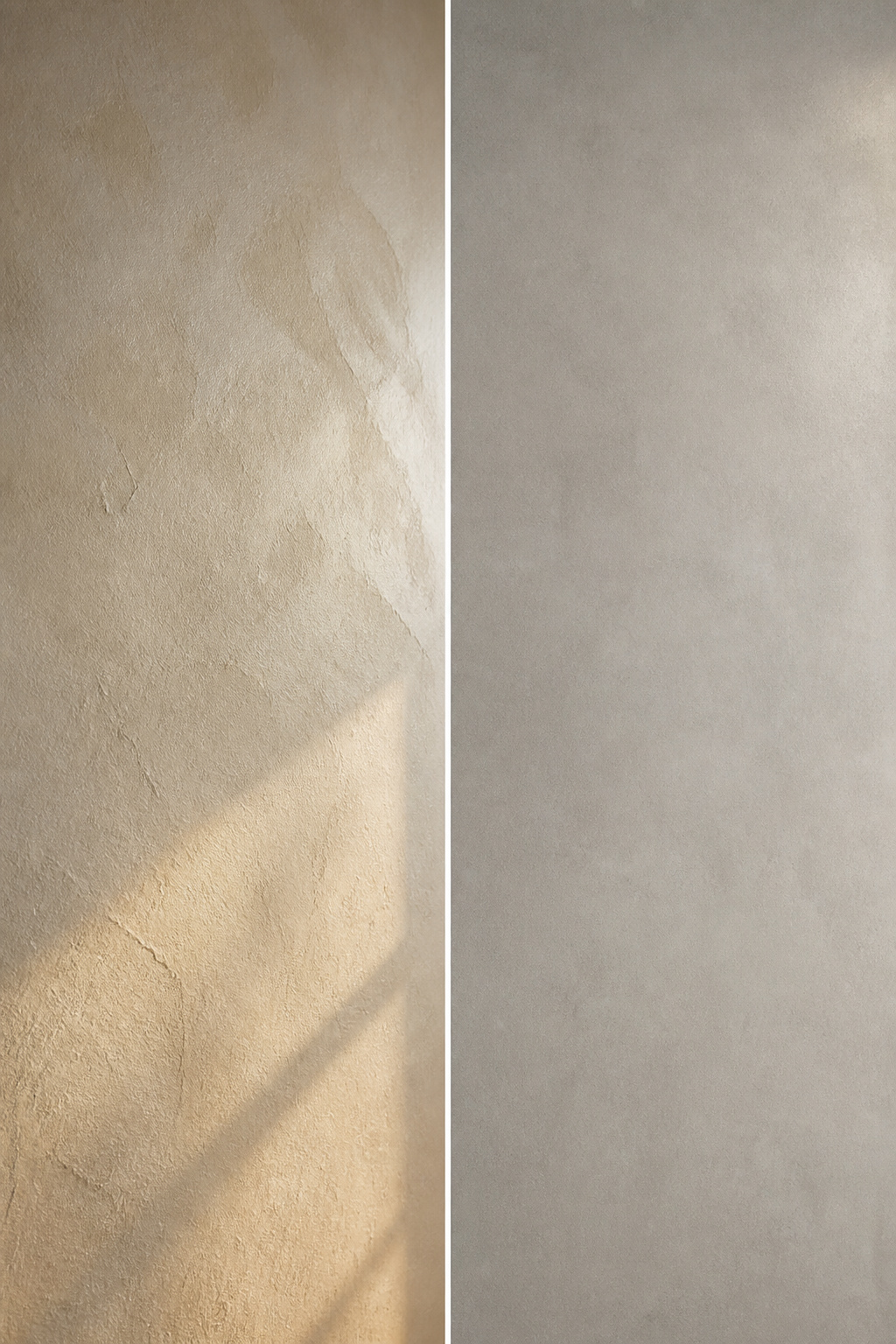
The wall surface is the first material decision, and for a Nordic setup it reduces to three honest options. One rule governs all three: matte, never gloss — gloss lifts the screen’s blacks toward grey.
Plaster, limewash, and microcement
Limewash gives a velvety, clouded finish with subtle tonal variation — the wall reads as a material, not a flat backdrop — and stays matte behind a screen, where glossy walls degrade black levels. Microcement does the opposite work: a seamless, joint-free plane with no grout lines to interrupt the eye. A neutral matte grey is ideal for accuracy, but the Japandi palette of warm white, soft grey, and chalk is far less disruptive than any bold tone.
| Surface | Maintenance | Visual weight | Best light |
|---|---|---|---|
| Limewash plaster | Occasional re-wash | Soft, organic | Window-facing, daytime |
| Microcement | Low, wipe-clean | Smooth, quiet | Even ambient |
| Bare matte paint | Lowest | Almost none | Light supplied by cove or bias |
If I had to commit to one, it would be limewash: its hand-finished texture lets the screen read as an object within the architecture, not a black rectangle on a flat wall.
A single wood panel
A solid-wood panel, or a run of closely spaced vertical boards behind the screen, brings warmth and grain without the complexity of a full built-in. For 2026, warm walnut and roasted oak are replacing the pale Scandinavian blondes; the richer mid-tones hold against warm walls rather than competing.
The case for leaving it bare
The most demanding choice is to add nothing. A flat limewashed wall gains its definition from what surrounds it — a cove of light above, a low console below — not from its face. The empty wall is often the finished wall.
The Console: Low, Single, and Doing One Job
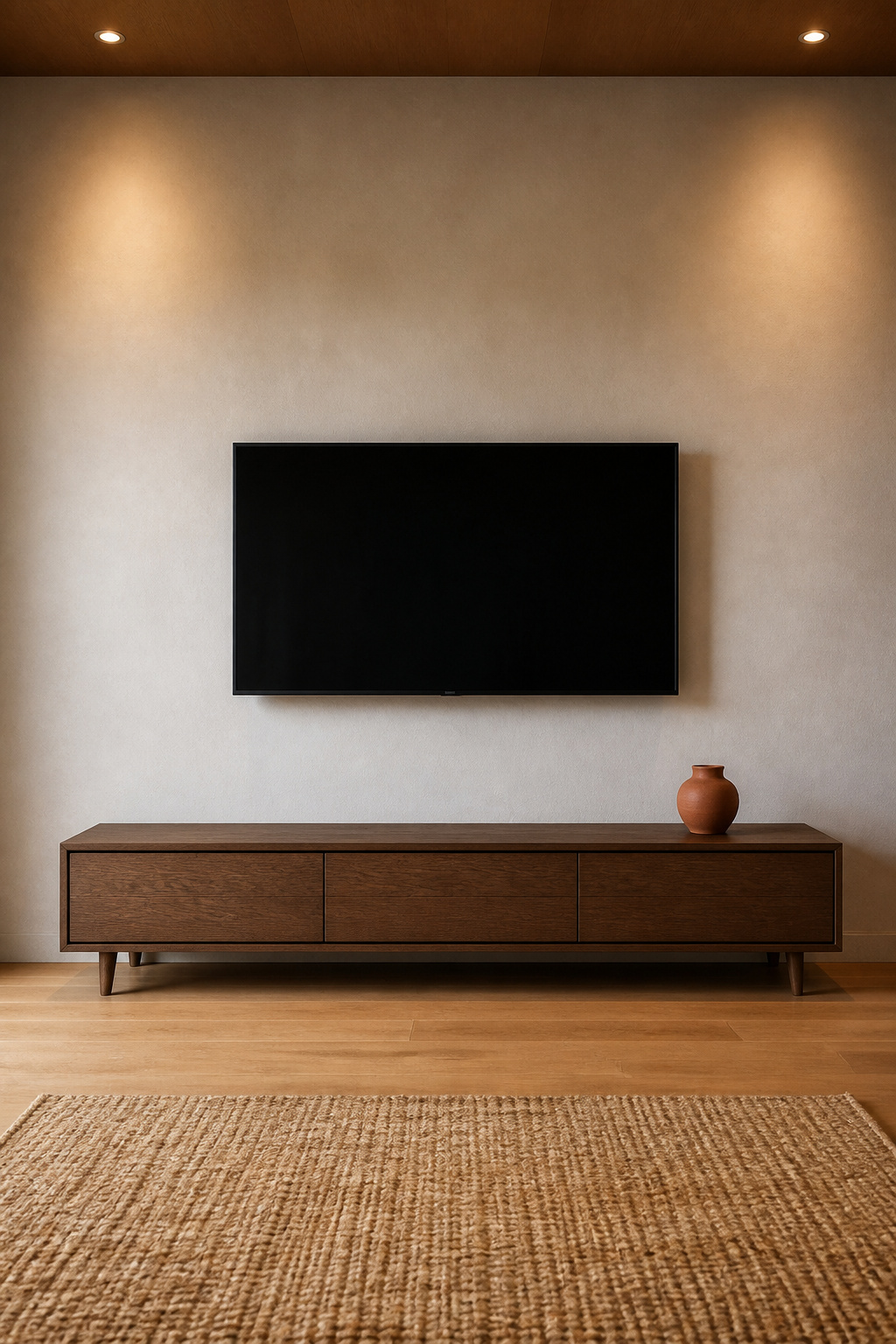
The console grounds the screen. In a Nordic room it is always low and always a single piece — never flanked by extra units that rebuild the clutter from the floor.
Height, depth, and proportion
An authentic Japandi or Scandinavian console stands 40–55 cm tall, roughly 16 to 22 inches — a low horizontal line that keeps sightlines open. The screen above it wants its centre at about 42–48 inches from the floor for neck-easy viewing, with a 4–6 inch gap to the screen bottom, more like 6–12 if a soundbar sits there. One proportion matters more than people expect: the console should run 10–15 cm wider than the television on each side. Narrower than the screen, it gives the unstable “perched television” look.
Solid wood, not lacquer
Buy solid oak, walnut, or ash, oil- or wax-finished so the grain stays visible and earns a patina over the years rather than chipping. Laminated particleboard with a wood-effect vinyl has no place here. A solid-oak console at the £600–800 tier outlasts three cheaper units over a decade: one good piece beats three veneer ones.
One rule for what lives on it
Place one or two chosen objects at most — a ceramic bowl, a single plant in an unglazed pot — and leave the rest empty. Before anything goes down, clear the surface and ask three questions of each item:
- Does it serve a daily function, or only sit there?
- Does it give real visual pleasure, or fill a gap out of habit?
- Can it be stored behind a door instead of displayed?
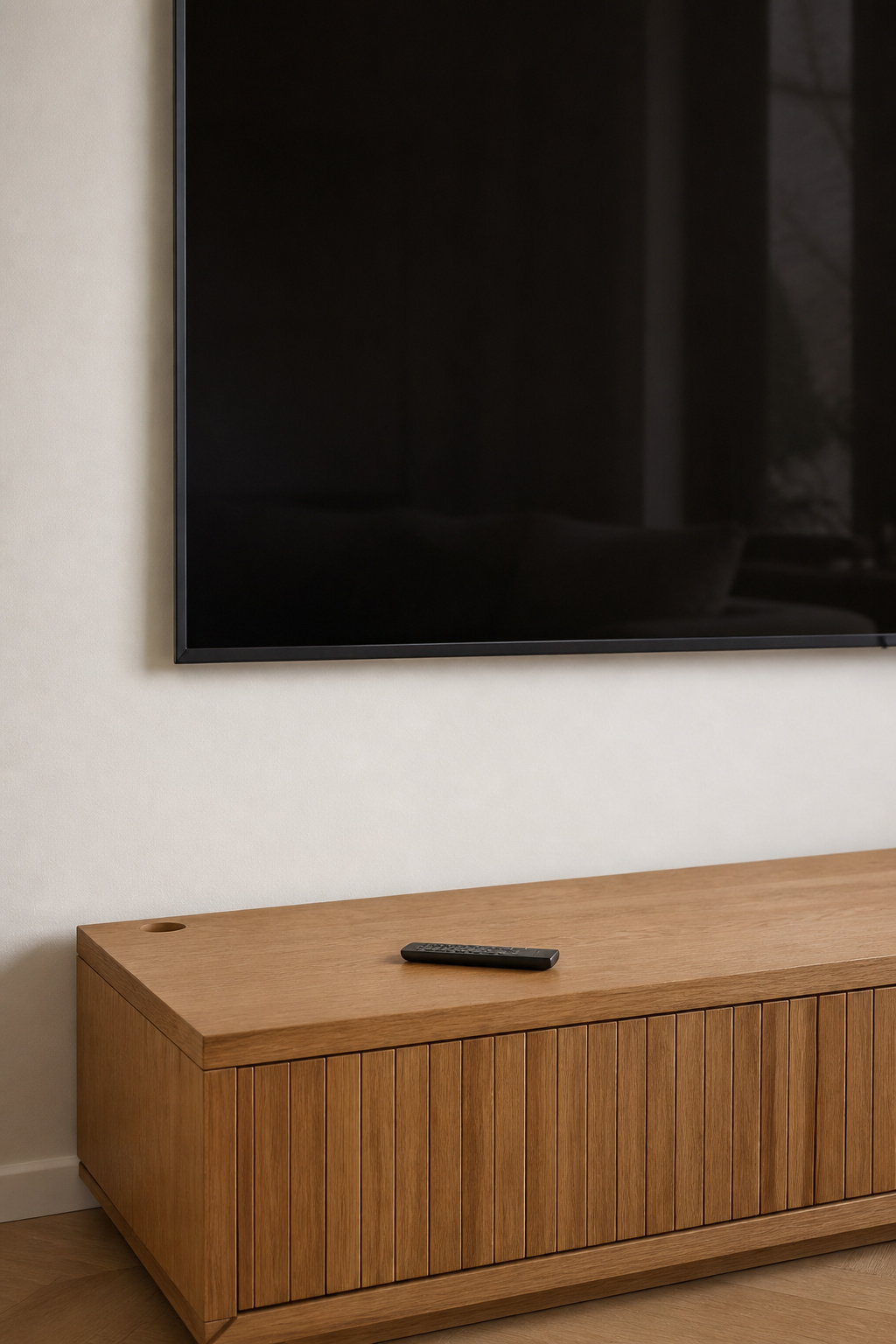
Remotes and a streaming box belong inside a closed cabinet, not on an open shelf. Three items is a generous ceiling; most walls are better at one.
Light: The First Material of a Minimalist TV Wall
In a winter country you learn that light comes before paint, wood, or fabric — the first material of any room. On a TV wall it does three jobs: it lifts the wall off the ceiling, sets the room’s warmth, and behind the screen earns its keep twice over.
Separating wall from ceiling
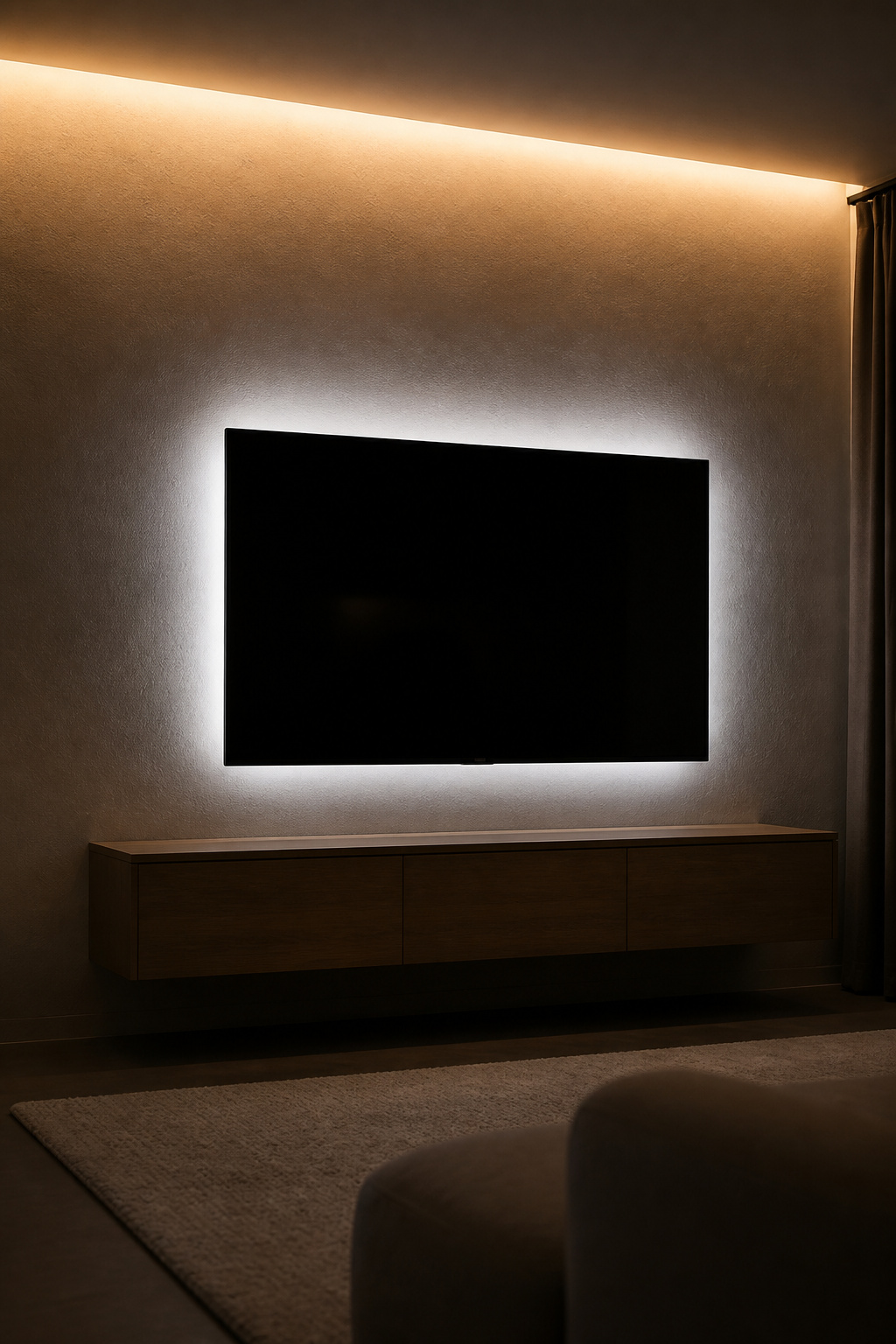
An LED cove at the ceiling-wall junction lifts the wall plane away from the ceiling and adds depth without putting a new object in the room. Make it dimmable: bright by day, near-dark in the evening, so the screen leads the room at night.
The warm-white rule
For a Scandinavian room, fit 2700–3000K warm white and stop there. It warms the earthy neutrals and keeps warm-grey walls from going muddy; anything cooler — 3500K and up — greys those tones out and turns the room clinical.
Bias lighting behind the screen
Bias lighting is function dressed as design. A strip on the back of the panel, aimed at the wall, softens the jump between a bright screen and the dark around it and makes on-screen blacks look deeper — invisible by day, a quiet halo at night, with no object or cable on the front of the wall. Two numbers make it work:
- Colour temperature: 6500K (D65) — the display standard, not warm white. A warm halo here would skew the screen’s colour.
- Brightness: about 5% of the screen’s output, well under the 10% ceiling the SMPTE practice sets.
Keep the cove warm and the bias strip neutral: they do different jobs.
Cables and Devices: The Hardest Problem
Cables are the enemy of the restrained wall. The minimalist answer is not a better way to hide them — it is to remove the devices first, then deal with what remains. A tidy tangle of nine cords from six devices is not minimal; it is clutter, organised. Clear devices, not cords:
- The cable box — replace it with a streaming device, or the TV’s own apps, and it disappears.
- Any player or media box unused in the past month.
- The second streaming stick doing the first one’s job.
What survives is usually two cables: one power, one signal to a single streaming device. Run those out of sight, not along the wall — in-wall routing leaves the surface between screen and console completely bare. The methods, from renter-safe raceways to recessed kits, belong to the guide to hide every wire; plan the route there before you mount. If you would rather the surface carry the calm, a quiet accent-wall color is the colour side of the same decision.
Putting It Together: The Minimalist Checklist
A minimalist TV wall is built by subtraction before addition: clear the wall first, return only what earns its place.
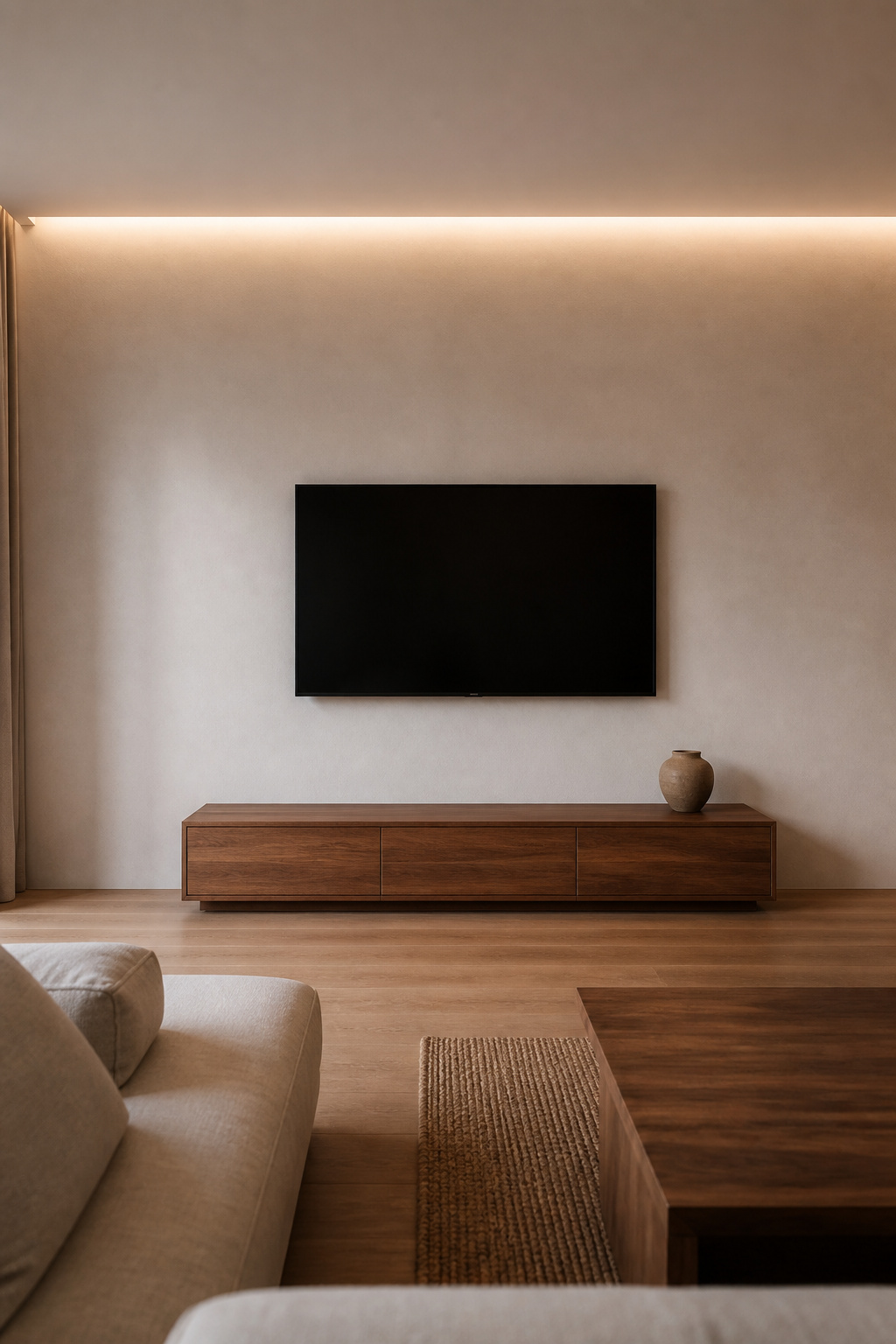
The subtraction sequence
Work in this order, and look before you add anything back:
- Remove the cable box, or swap it for a streaming device.
- Remove any player or console you have not used in a month.
- Clear every decorative object off the console top.
- Stand back and look at the bare wall for thirty seconds.
That pause is usually the design itself — the empty state is often the one you keep.
The one-number test
Here is the number I commit to: the screen and console together should leave roughly a third of the wall open on each side. Stand back and judge whether the arrangement has obvious air around it; if it looks cramped, the console is too wide or the screen too large. As a check, the screen alone should occupy no more than about a sixth of the wall’s width. Negative space here is not what is left over — it is the point.
Living with it
After a month, the wall teaches you something. Notice what has crept back onto the console — mail, a charging cable, a remote left out. Anything that returned without a decision is a storage gap to solve behind a door, not clutter to accept. A restrained room asks less of you day to day. If you are still placing this wall among the other approaches, start from planning your TV wall and return when you are ready to subtract.
FAQ
What does a minimalist TV wall look like?
It is a flat-screen mounted flush against a plain matte surface — warm white, limewash plaster, or pale warm grey — with one low console below, 40–55 cm tall, and no objects on the wall itself. The console holds one or two chosen pieces at most, with open space on both sides and no cables crossing the wall.
How do you make a TV wall look clean and uncluttered?
Begin with subtraction, not addition. Clear the wall and console, then return only what serves a daily function. Replace the cable box with a streaming device, remove unused players, and route the remaining cables in-wall using an NEC-compliant kit. Choose a console with closed-door storage, since open shelves gather clutter within months.
What color should a minimalist TV wall be?
Warm white, off-white, chalk, or soft warm grey suits a Scandinavian or Japandi wall best; a neutral matte grey is ideal for viewing accuracy. Keep the finish matte, never gloss, because shiny walls reflect light and lift the screen’s blacks. Under 2700K warm light these tones read true; under cooler light they go muddy.