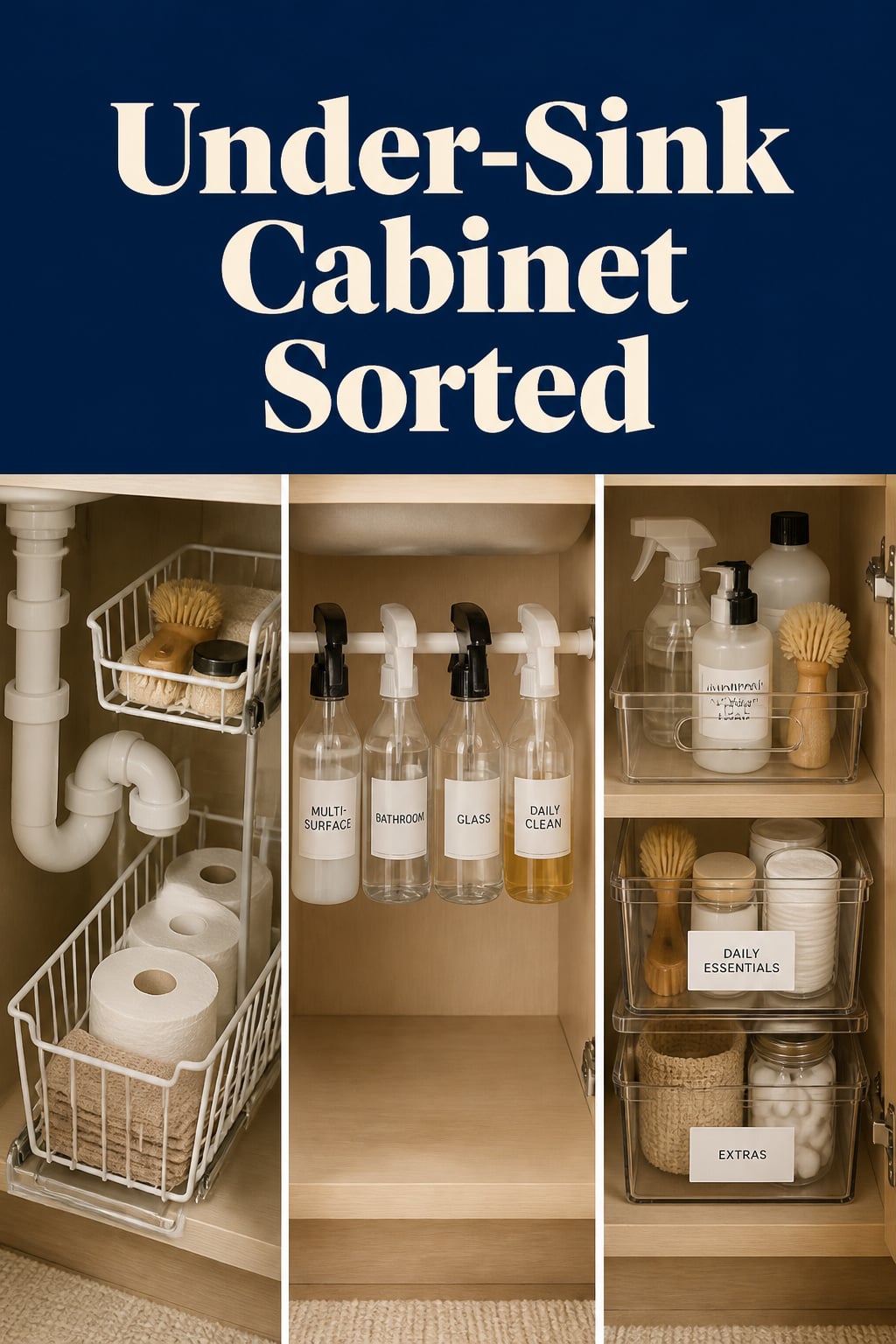
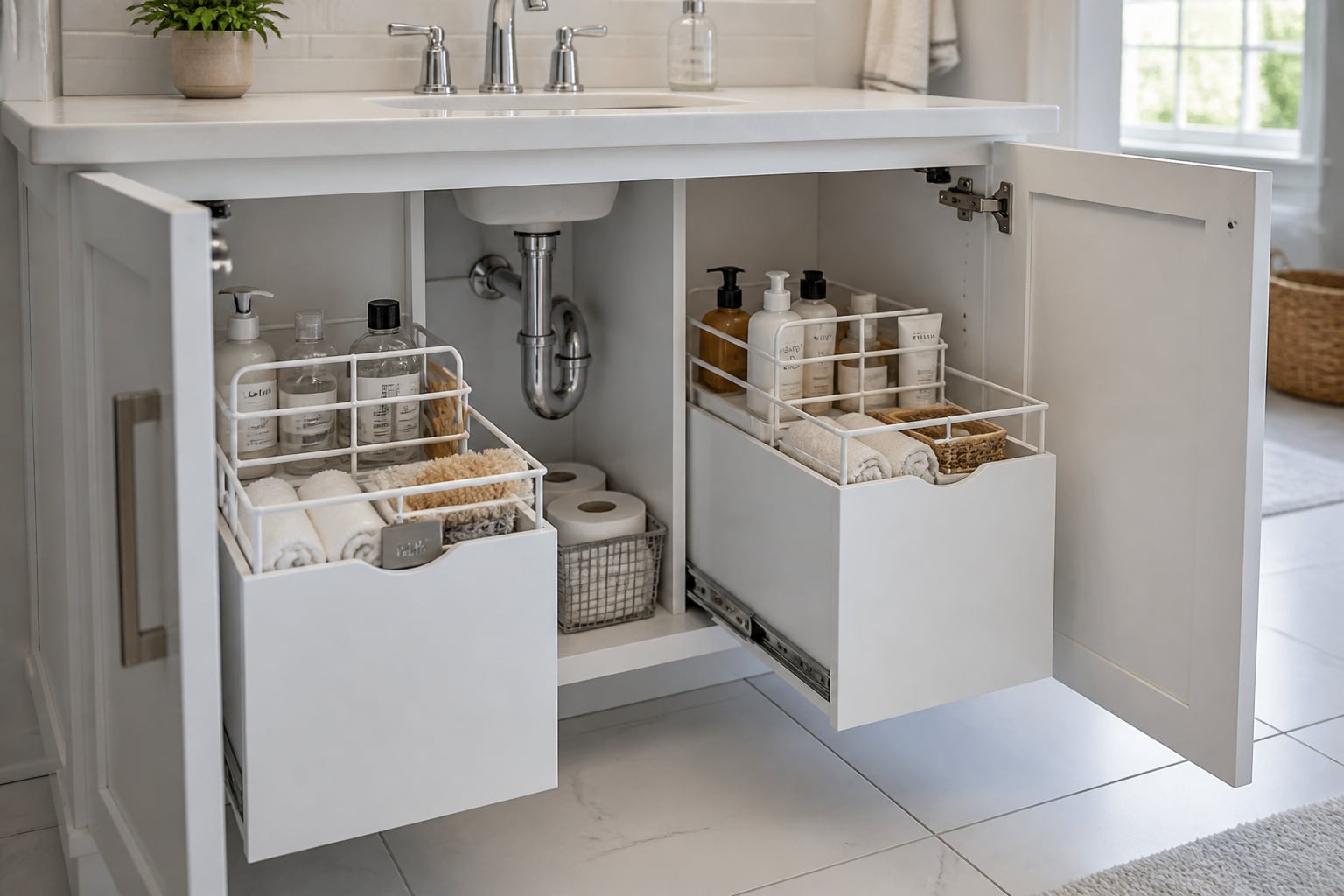

Most people write off the cabinet under the bathroom sink before they ever measure it. The P-trap sits there like a roadblock, so the whole thing becomes where extra toilet paper goes to die. Here’s the real number: under sink bathroom organization costs anywhere from $10 for a tension rod to under $30 for a pair of budget pull-out bins. The P-trap takes up far less room than you think. The pipe isn’t the problem. Not measuring before you buy is.
TL;DR
- A standard bathroom P-trap uses 1-1/4-inch pipe and sits 18–20 inches off the floor, leaving usable columns on each side of the drain in any 24-inch-or-wider vanity.
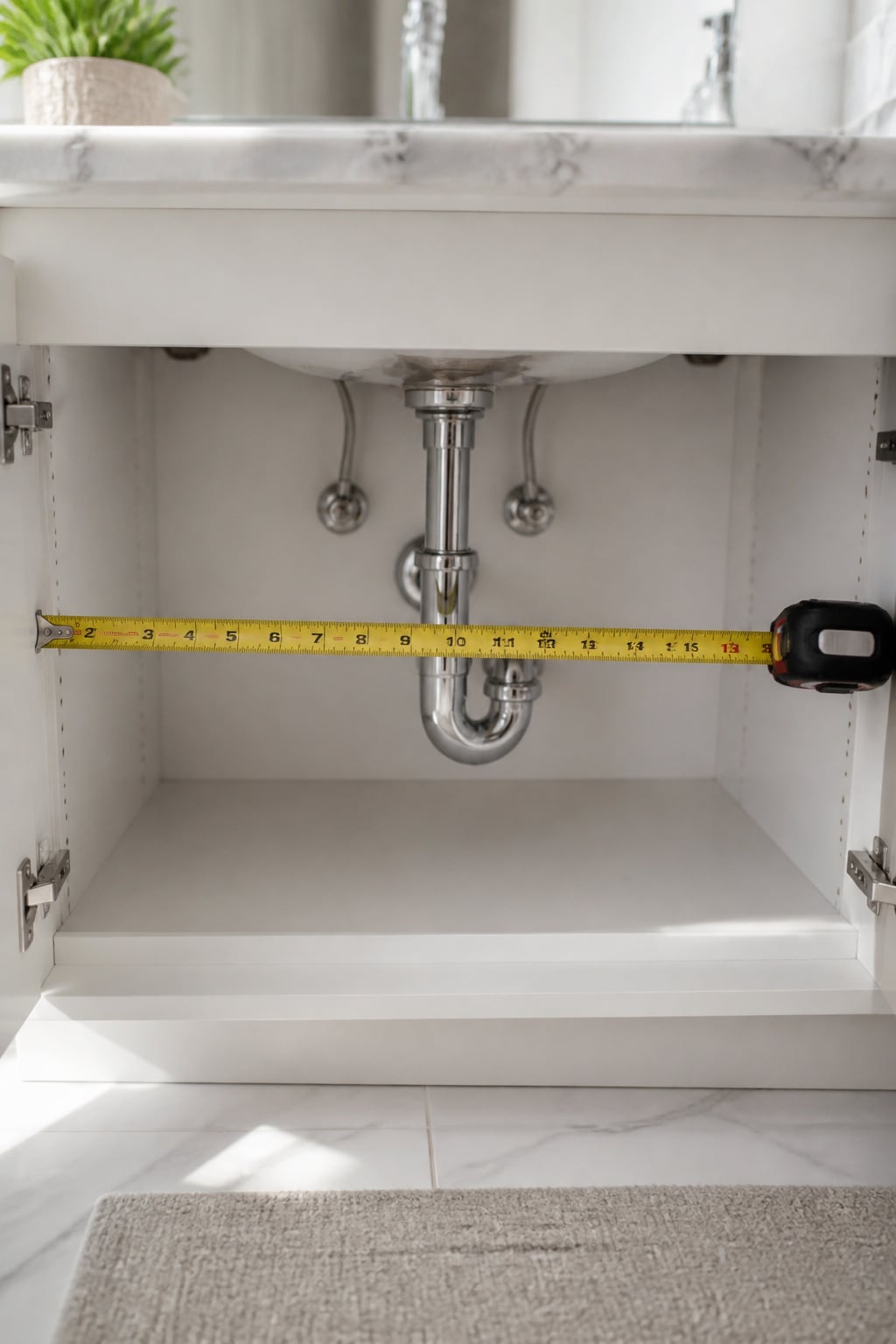
- The three numbers to measure first: interior width (wall to wall, not door to door), front-to-back depth (bathroom cabinets run shallow, about 18–20 inches), and the door opening — which is usually narrower than the cabinet inside.
- Biggest gain is a pull-out bin sized for bathroom depth (18–19 inches); the cheapest win is a sub-$10 tension rod that hangs your spray bottles and clears the floor below.
Why the P-Trap Is Not the Problem You Think It Is
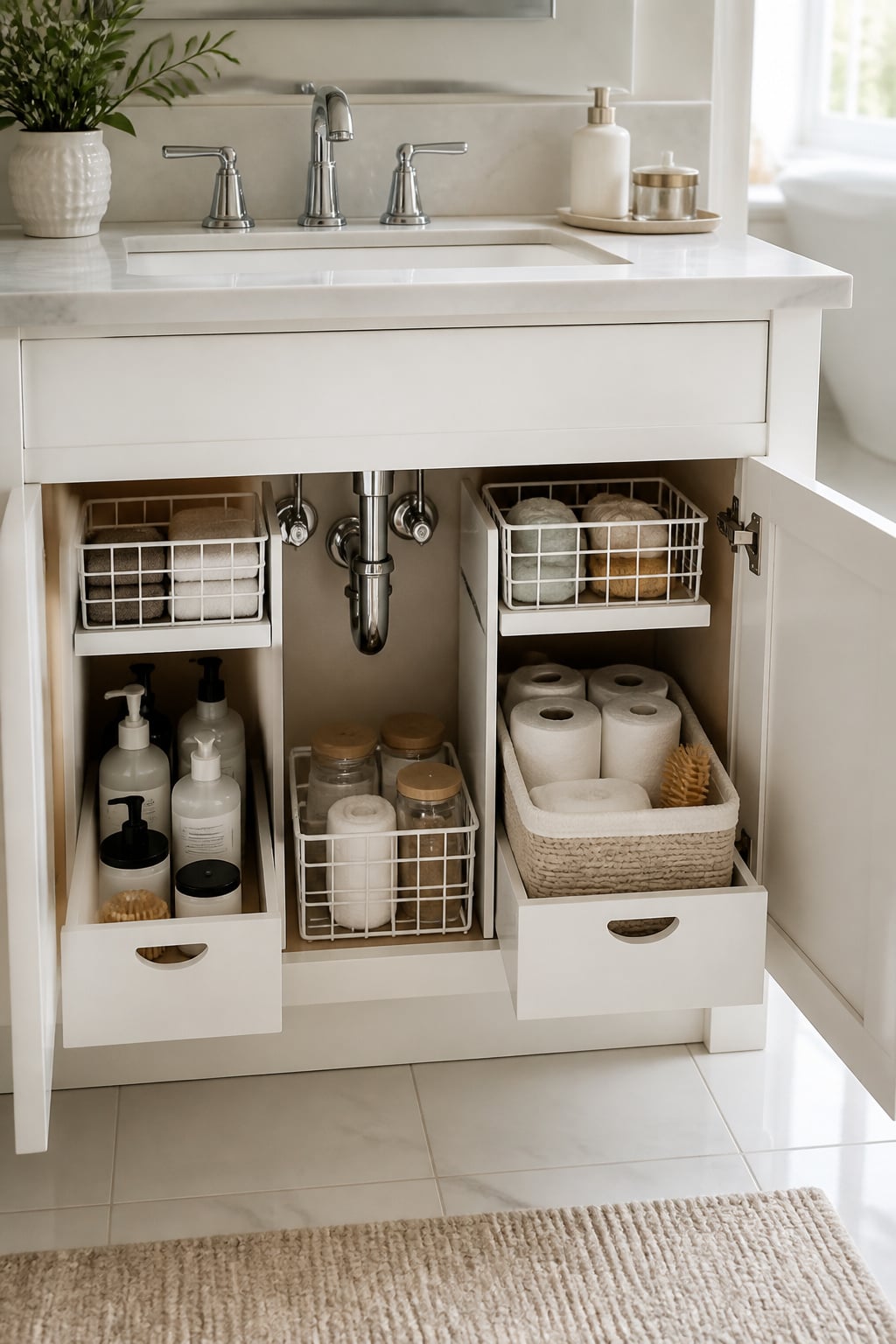
The P-trap looks like it eats the whole cabinet. It doesn’t. The myth that this cabinet is a lost cause comes from one place: people buy an organizer that doesn’t fit, give up, and call the space cursed. Measure first and it becomes the most useful drawer in the bathroom.
What the P-trap actually takes up — and the usable space it leaves on each side
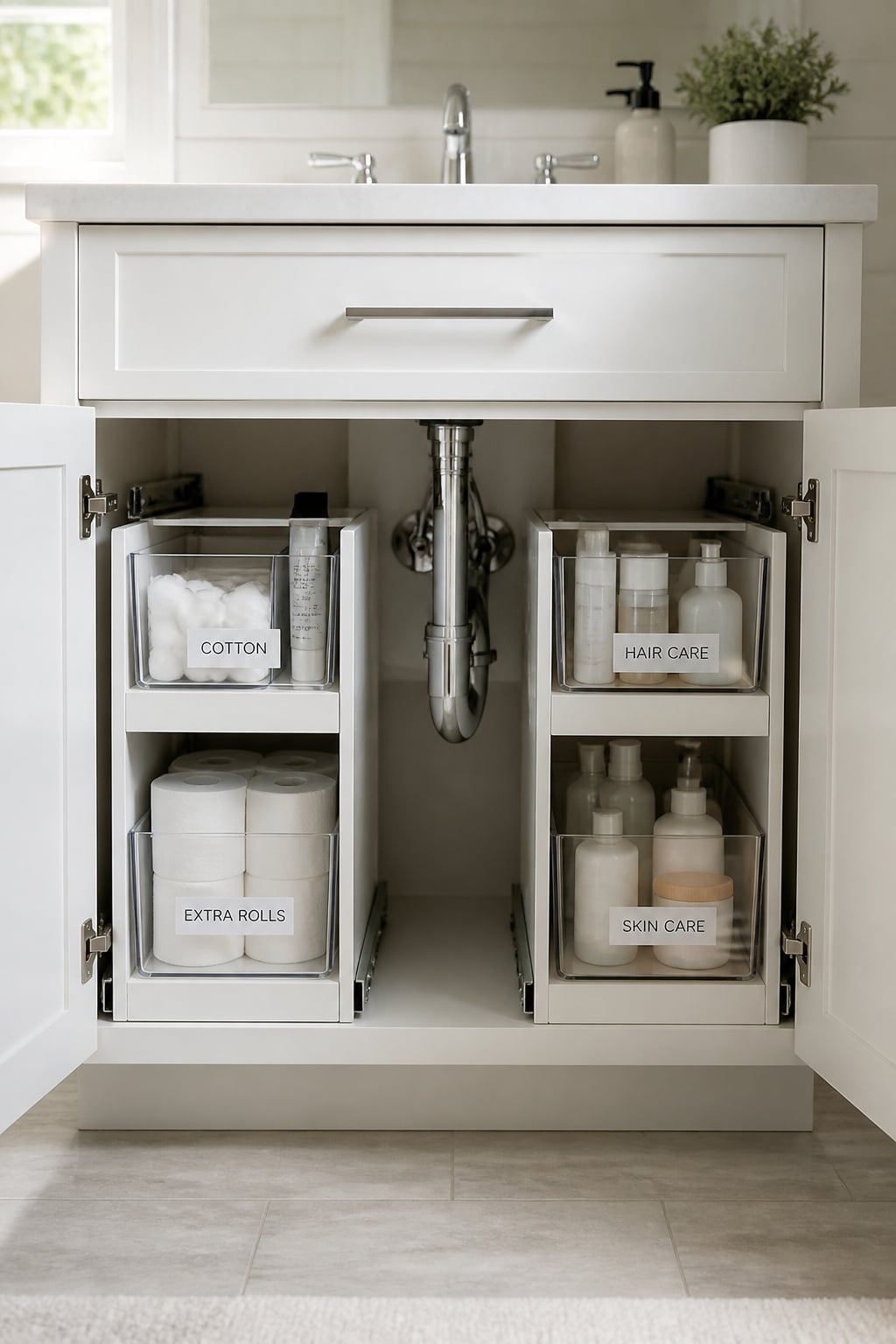
A bathroom sink P-trap runs on 1-1/4-inch pipe — the smaller size; kitchens use 1-1/2-inch. The trap and its drain arm take up roughly a 6-to-8-inch radius around the center of the drain. Drain rough-in height is usually 18–20 inches off the finished floor, so the pipe sits near the middle of a 30–32-inch cabinet. That leaves real space above it, below it, and on both sides.
Stop hunting for one organizer that spans the whole cabinet. Treat the two zones on either side of the trap as separate columns and fill each one independently. NEAT Method’s professional organizers put it plainly: those pipes aren’t going anywhere, so you work with them, not against them. The space most people waste isn’t around the pipe — it’s vertical. Most folks only use the floor.
Measuring your cabinet before buying anything: the three numbers that matter
Three measurements decide whether anything you order will fit. Take all three before you open a single shopping tab.
| What to measure | How to measure it | Why it matters |
|---|---|---|
| Interior width | Side wall to side wall inside the cabinet, noting any center stile | Sizing off the exterior is how you end up with a bin too wide for the opening |
| Front-to-back depth | Back wall to the front edge of the cabinet floor | Bathroom interiors run ~18–20 inches; kitchen-rated units assume 24 and hit the pipes |
| Door opening width | Across the open doorway, separately from the interior | The opening is often narrower than the cabinet — a bin can fit inside but not thread through |
That third row is the one that bites people. The Container Store flags it: the door opening is frequently narrower than the cabinet, so a bin can be the right width and still refuse to go in. Measure it separately.
The difference between a vanity with a centre drain and an off-centre drain
A centered drain splits the cabinet into two roughly even columns — ideal for a matched pair of pull-out bins. An off-centre drain gives you one wide column and one skinny one: put a wider pull-out or a stacking drawer unit in the big side, and a tension rod or a door rack in the narrow side.
There’s no standard number for how wide the large column will be — it varies by manufacturer. Pull the tape across each column on its own and buy to what you actually have.
Pull-Out Bins and Sliding Drawers: The Biggest Capacity Gain
If you do one thing in this cabinet, make it a pull-out. A bin on runners recovers the back half — the dead zone you can’t reach without lying on the floor. That’s the biggest capacity gain available.
Under-cabinet pull-out bins that wrap around the P-trap
For a 24-inch vanity, the Rev-A-Shelf 441-12VSBSC-1 measures 8.5 inches wide, 18.75 deep, 18.87 tall, and needs a 9.25-inch opening — it tucks into the column beside a centered drain. Step up to a 30-inch vanity and the 441-15 version widens to 11.66 inches with the same 18.75-inch depth. That depth is the whole point: it’s built for a bathroom cabinet’s ~20-inch interior, so it won’t slam into the back-wall plumbing the way a kitchen unit does.
Want one piece instead of two? Rev-A-Shelf’s 486 U-shaped pullout spans the full 27.56-inch width of a 30-inch cabinet and wraps around the P-trap through a center cutout. On a budget, a PXRACK adjustable metal pull-out runs under $30 for a two-pack and steps through five heights to clear your supply lines.
Sliding drawer inserts vs stacking bins: which gives you more reach
Pull-outs win on reach — they slide the whole load forward so nothing hides behind anything. Stacking bins don’t: to get the bottom one you lift off the top one. So here’s the rule, straight from NEAT Method: only stack things you don’t use daily, label every bin, and put the least-used stuff on the bottom.
Where a runner won’t fit — a narrow 8-to-10-inch column — a lazy Susan earns its keep. Spin it and the bottle at the back comes to you. A clear acrylic one lets you read labels without lifting anything.
Width and depth specs to check before you order
Measure the clear column width beside the P-trap, not the total cabinet width.
- Column width, not cabinet width. In a 24-inch vanity with a centered drain, each side is usually 8–10 inches. That fits the 8.5-inch Rev-A-Shelf 441-12, not the wider 30-inch series.
- Depth in the 18–19-inch range. Buy units labeled for bathrooms. HGTV’s roundup names the most common mistake outright: a kitchen-rated 24-inch unit hits the pipes and sits permanently crooked.
- Handle clearance. A bin with a front handle needs an extra inch or two of opening height to clear it on the way out. Measure floor to the bottom of the face frame before you commit.
Tension Rods and Hanging Baskets: The Budget Move That Works
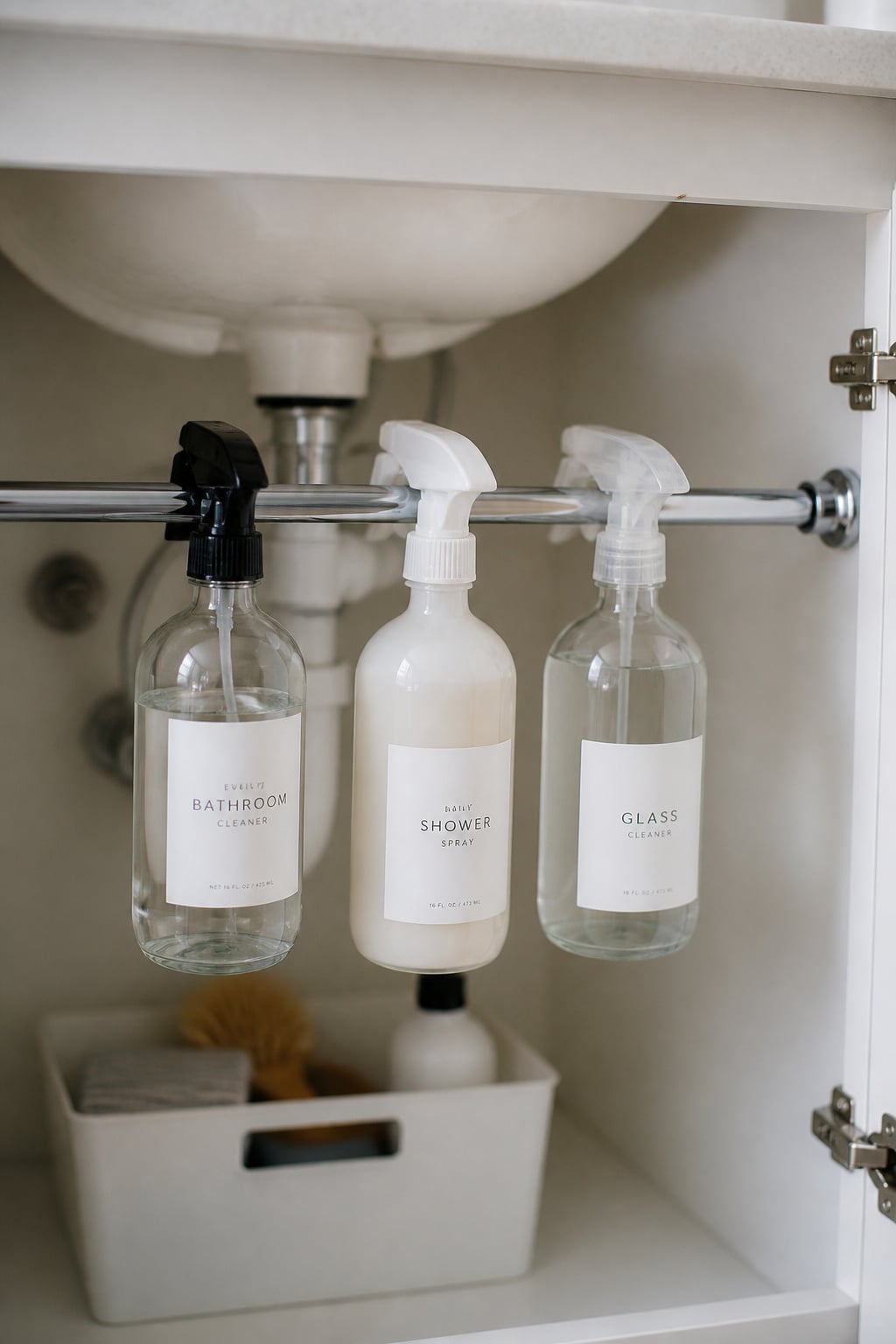
A spring tension rod set across the cabinet interior hangs spray bottles by their triggers, turning dead air into a shelf — for under $10, no tools, no drilling. The full damage-free playbook is in the renter-friendly, no-drill storage guide, but this trick belongs in every cabinet, owned or rented.
How to set a tension rod across the cabinet to hang spray bottles and pouches
Set it toward the front of the cabinet, high enough that the bottle bodies hang clear of the floor — you want the floor free for bins. A rod in the 18–26-inch range covers most cabinets. Press it firmly against both side walls and tighten until there’s zero give before you load anything. On painted walls, a rubber-tipped end-cap grips far better than bare metal; a rod that slips dumps everything on the cabinet floor.
What load a tension rod will hold and what to store on it vs beside it
Be honest about what these hold. They’re curtain rods doing a second job. Keep it to four or five standard spray bottles — more than that, especially in a wide cabinet where the rod is stretched near its limit, and it bows or slips. The Kitchn lands on the same practical ceiling.
Hang the light stuff and stand the heavy stuff below it:
- Hang it: spray bottles by the trigger, rubber gloves by the wrist loop, small pouches, a scrub brush on an S-hook.
- Don’t hang it: big jugs of bleach, concentrated cleaners, multi-packs of anything. Too heavy, too tippy.
The 6-to-10 inches of floor that opens up under the hanging bottles is now prime real estate for a cleaning tote or a pair of slim stacking drawers.
Pairing a tension rod with door-mounted storage to double the surface area
The inside of the cabinet door is a whole storage wall you’re not using. Hook-over organizers clip on with no drilling — renter-safe — and hold small flat stuff: cotton balls, medicine boxes, floss. The Umbra Hide-N-Sink caddy is sized for exactly this. Screw-mounted racks carry more, but keep door-mounted loads modest either way.
One catch: shut the door and measure the gap between its inside face and the nearest obstacle — usually the P-trap or a supply line. The organizer plus its contents must fit that gap or the door won’t close. Rod hanging bottles mid-air, door rack holding flat items, bins on the floor: three zones covered, nothing to unstack.
Zoning by Frequency: The Under-Sink Bathroom Organization Rule That Beats Any Container
You can buy every organizer on this page and still have a cabinet that fights you. The containers aren’t the hard part — deciding what goes where is. Zoning by use frequency is the free upgrade that makes everything else work.
Daily kit at front and centre: the one rule that makes every organiser work better
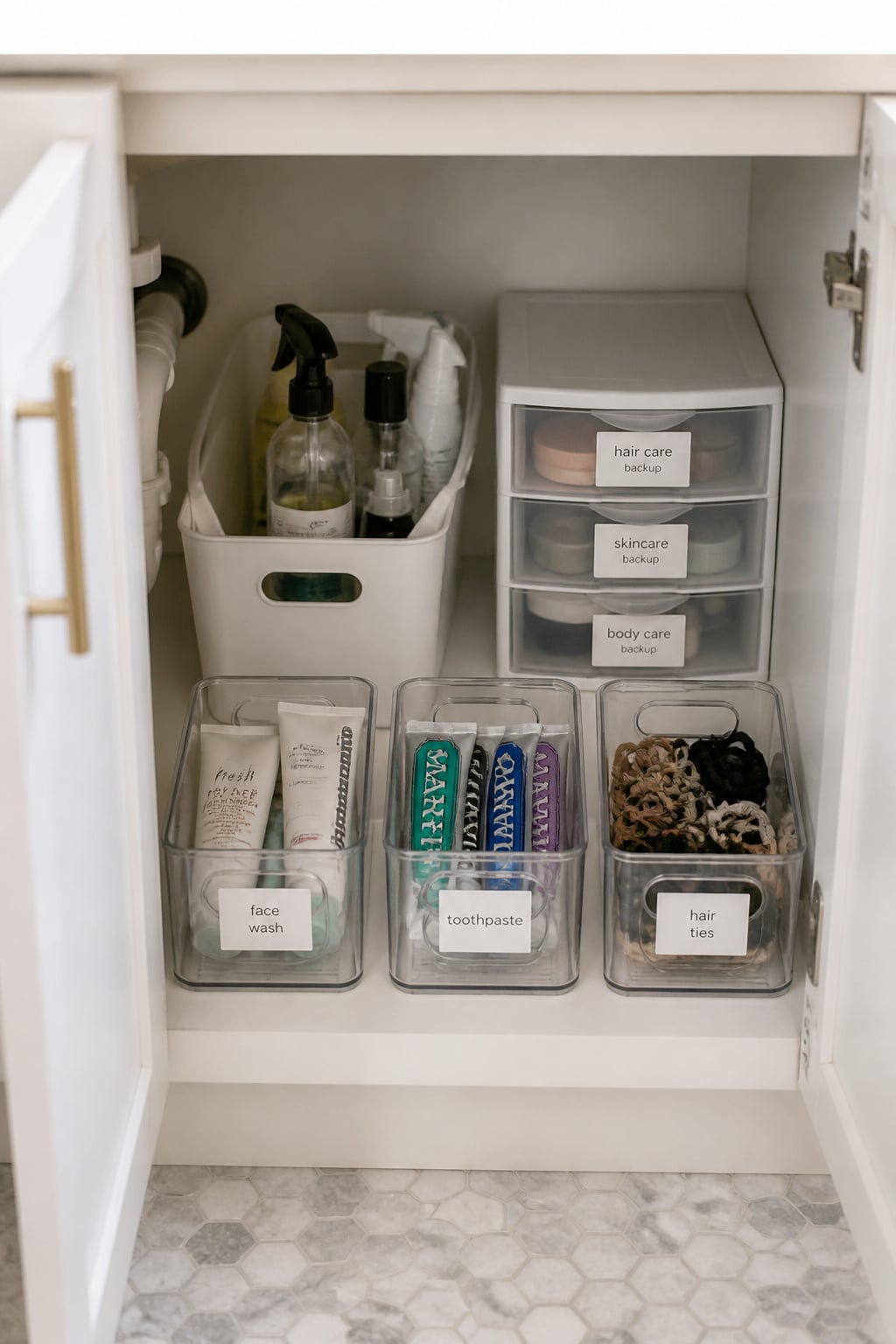
Anything you use every day sits at the front, in reach, with nothing in front of it — no lifting, no shifting, no opening a second container. Face wash, one cleaning spray, the hair tool you reach for at the sink. Put those in a clear or open-top basket and you’ll see them without a label. NEAT Method’s whole approach circles back to this: daily items earn the prime spot, everything else gives way.
Seasonal and backup items: where they go so they stay out of the way
Backups go behind the daily kit, not beside it. One spare of each product lives at the back or on top of a stack and rotates forward when the front one runs out. Seasonal things belong in their own pouch pushed to the back during the off months. True bulk — the four-pack, the buy-one-get-one — doesn’t belong here. The linen closet takes everything beyond one spare.
Cleaning products: containment, not just storage — why a tray beats loose bottles
Cleaning supplies should ride in one handled tote, not stand loose across the cabinet floor. Grab the tote, clean, slide it back. The raised sides earn their keep: if a bottle leaks, the spill stays contained instead of soaking the cabinet bottom. Park the tote to the side or back — never in front of the daily stuff. You clean weekly. You wash your face every morning. Store accordingly.
When the Cabinet Is Not Enough — or Is Not There at All
Sometimes the cabinet really is full, and sometimes there’s no cabinet in the first place. Both have a clear next move. Don’t throw more bins at either one.
Signs your under-sink cabinet is genuinely at capacity and what to do next
It’s genuinely full when daily items won’t fit without stacking, when stuff falls out as you open the door, and when pull-outs and a tension rod are already in and it’s still jammed. But before you call it: pull every backup item — anything past one spare — and move it to the linen closet. Most “full” cabinets are holding two or three months of backstock that was never supposed to live there. Purge that first.
If you have a pedestal sink instead: where to turn
If you came here with a pedestal sink, you don’t have an organizing problem — you have a no-cabinet problem, and none of the bins above apply. The pedestal is a decorative column. That’s a from-scratch storage build: sink skirts, baskets in the base nooks, wall shelves above and beside the sink. It’s a different job, and the pedestal sink storage solutions guide covers it end to end.
Overflow storage: what stays in the bathroom vs moves to a linen closet
Keep the line clean: the under-sink cabinet holds current-cycle products, one spare each, hair tools used at the sink, and the bathroom’s cleaning supplies. The linen closet takes bulk backstock, seasonal items, and towel overflow. Two things worth actively evicting: hair dryers used at the mirror (a door holder up there does the job), and surplus medications (a humid bathroom cabinet is the wrong place for them). For the whole picture, the complete guide to small bathroom storage ties every zone together.
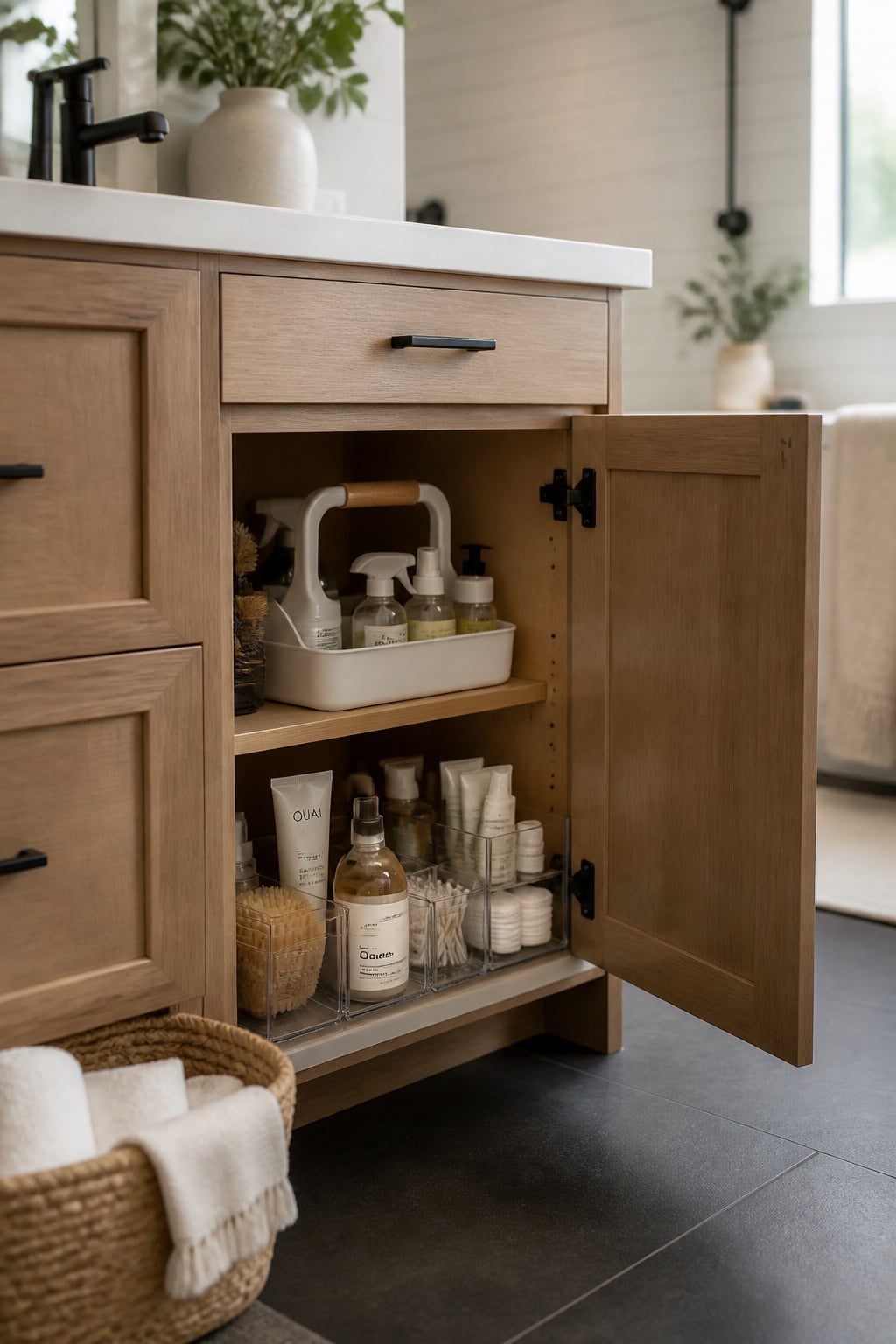
Pick the easiest win and do it this weekend. Pull everything out, run the tape across both columns, and order one pull-out bin sized for the side you measured — or just hang a tension rod and load your spray bottles tonight. You don’t need the whole system in one go. One bin, one rod, one cleared back wall, and the cabinet everyone told you was hopeless starts pulling its weight.
FAQ
How do you organize under the bathroom sink with a P-trap in the way?
Measure the clear column width on each side of the P-trap — not the total cabinet width — then buy bins sized for each column on its own. Rev-A-Shelf’s 441 series is built for bathroom depth at 18.75 inches. On a budget, a tension rod set high hangs spray bottles and frees the floor below for stacking bins.
What are the best organizers for under a small bathroom sink?
For a 24-inch vanity, two slim pull-out bins sized for bathroom depth (18–19 inches), one each side of the P-trap, plus a tension rod for sprays. Budget version: PXRACK adjustable pull-outs at under $30 for two, a tension rod, and a hook-over door organizer keep the whole project under $50. A lazy Susan suits narrow 8-to-10-inch columns.
How do you use the door inside a vanity cabinet for extra storage?
Hook-over organizers clip onto the door top with no drilling — renter-friendly — and hold small bottles, cotton wool and floss on the door’s inside face. Before buying, close the door and measure the gap to the nearest obstacle inside, usually the P-trap or a supply line. The organizer and its contents must fit that gap or the door won’t shut.