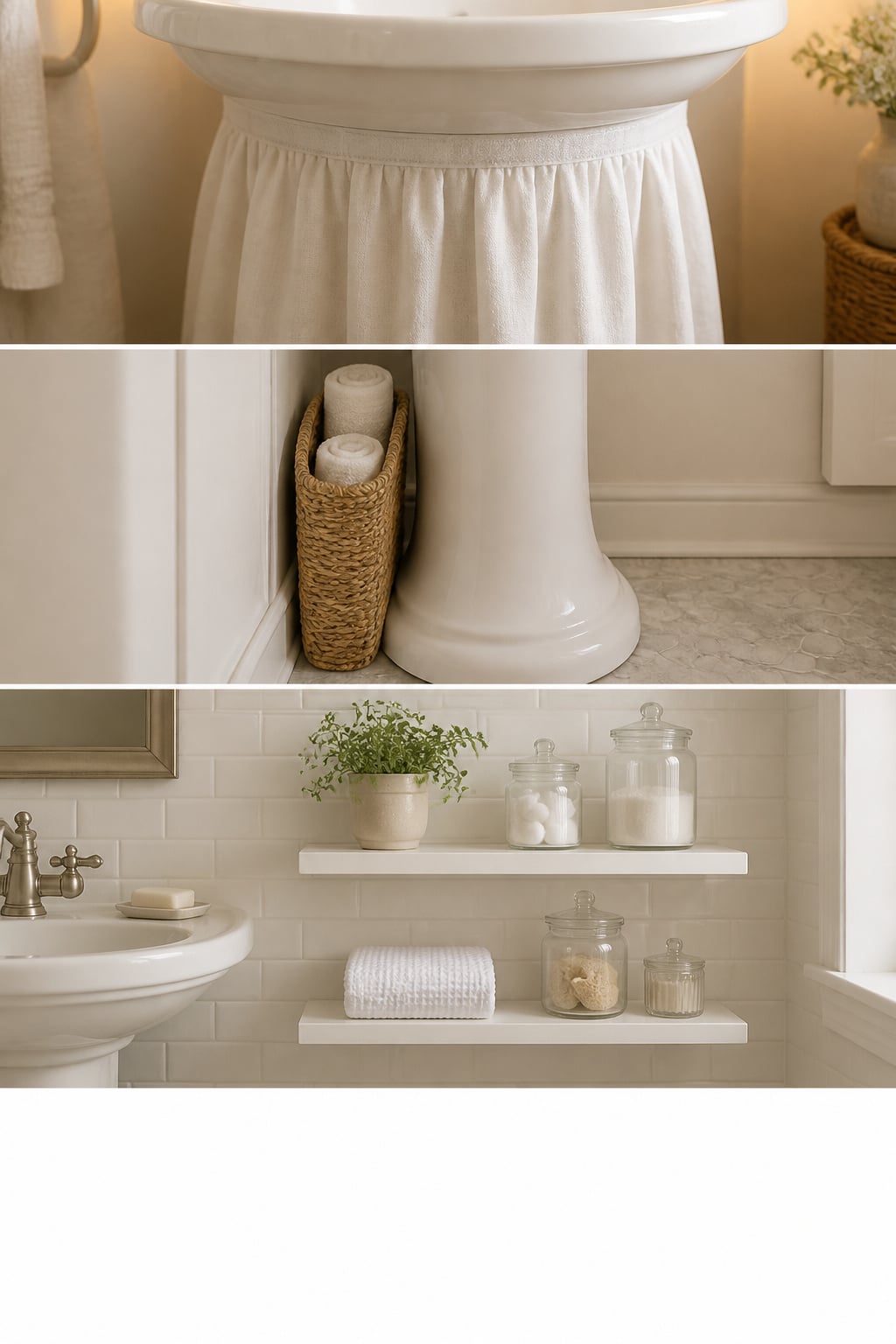
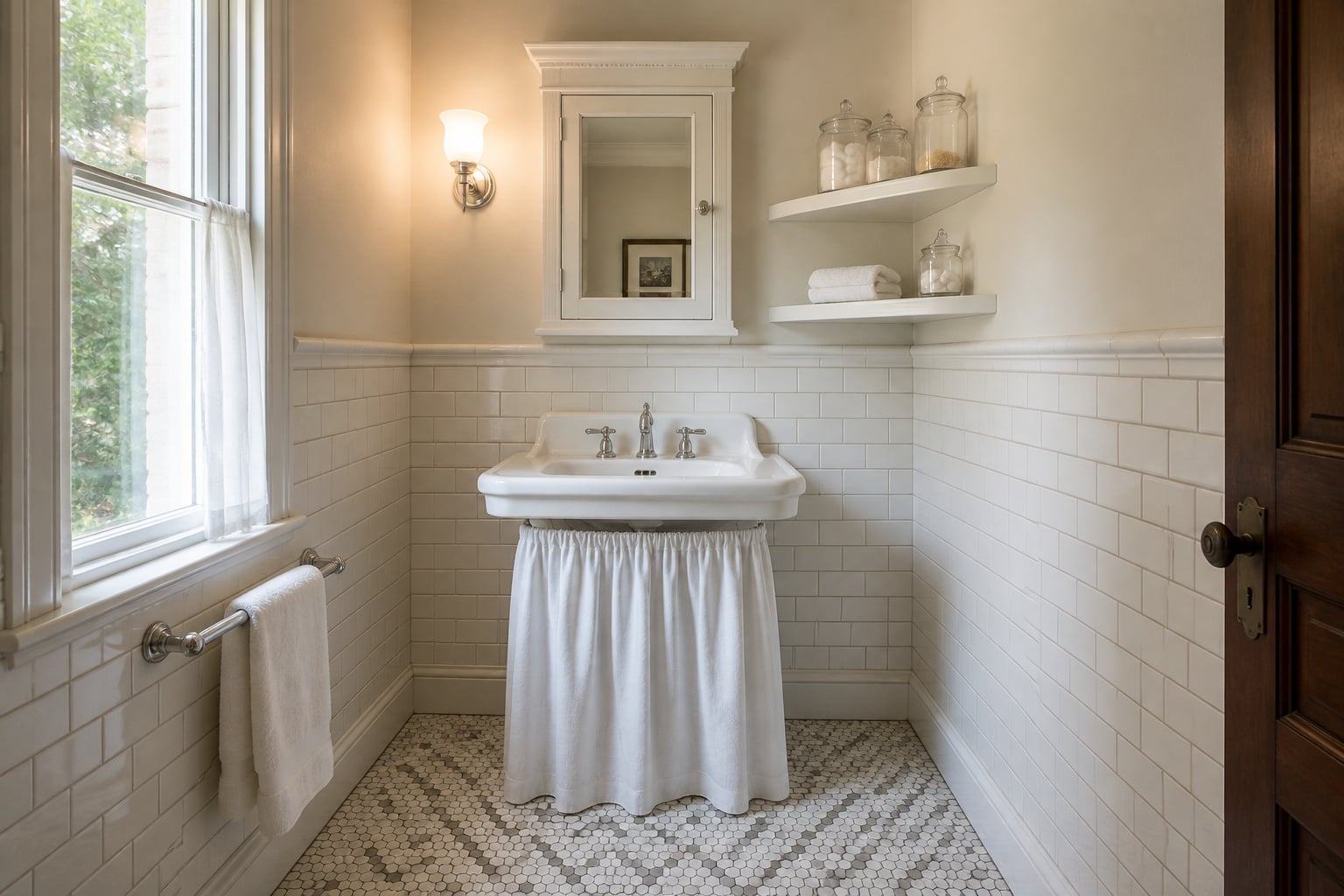

The pedestal sink in your bathroom is not a design failure. It is a survivor. When indoor plumbing spread through American cities from the 1880s, sanitation laws began demanding a fixed wash basin in every home, and the vitreous porcelain pedestal answered — its bare column read as hygienic in an age gripped by germ theory. So the search for pedestal sink storage solutions starts with a fact most owners miss: the fixture gave up its storage on purpose, and the best fixes honour that intent rather than fight it.
TL;DR
- Removing a vanity costs roughly 10–15 cubic feet of closed storage; a medicine cabinet plus two or three 8-inch wall shelves returns 8–12 cubic feet without touching the floor.
- A no-drill fabric sink skirt on industrial Velcro hides the column and creates concealed storage; slim baskets under 8 inches wide fit the floor gap beside it.
- Swapping the pedestal for a console sink on legs opens the full under-sink floor and runs $1,000–$1,700 all-in for a mid-range fixture, often without moving the plumbing.
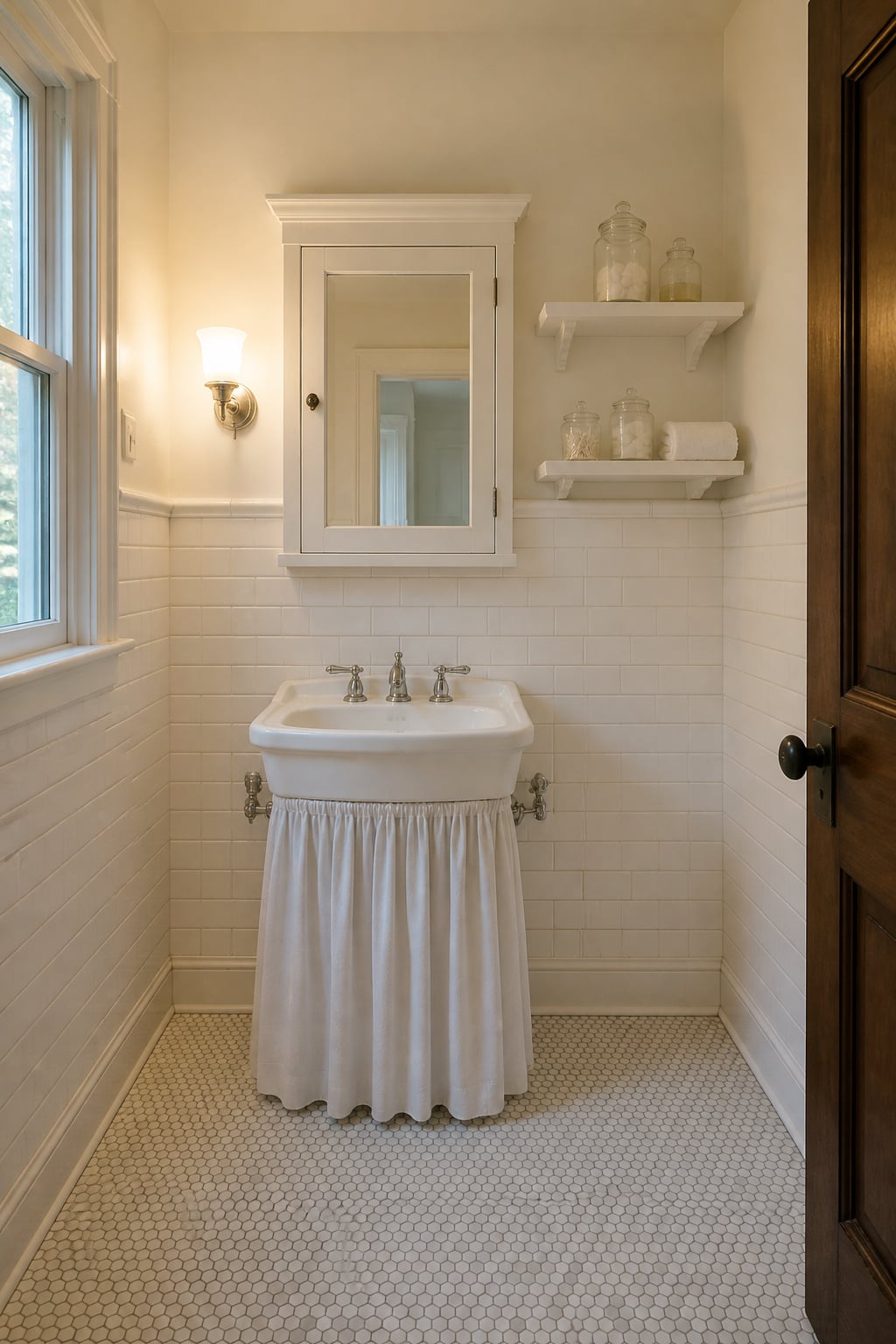
The Pedestal Sink Was Never Designed to Be a Storage Platform
The pedestal earned its place through a working past, and that past explains both what it takes from you and what it gives back.
Why pedestal sinks dominated bathrooms from the 1890s through the 1940s — and what changed
For half a century, the pedestal was the bathroom sink. Its smooth, non-porous surface was prized in an era newly converted to germ theory. Vanity-mounted sinks appeared in advertisements as early as the 1920s but did not become standard until the post-war housing boom of the 1950s — the driver was storage, plainly. Today the pedestal survives almost entirely in pre-1950 housing stock — Victorian, Edwardian, Arts and Crafts — where it is original or period-appropriate.
What the fixture takes away and what it gives back in a small room
A pedestal eliminates the under-sink cabinet outright, costing you roughly 10–15 cubic feet of closed storage. In exchange, it returns floor area: because the column is narrow — typically 4–8 inches across at the base — the sink makes a small room read 30–40% more open than a 24-inch vanity on the same wall. In a bathroom under 40 square feet, that openness is the fixture’s whole argument.
Reading your pedestal: console, classic column and semi-pedestal are different problems
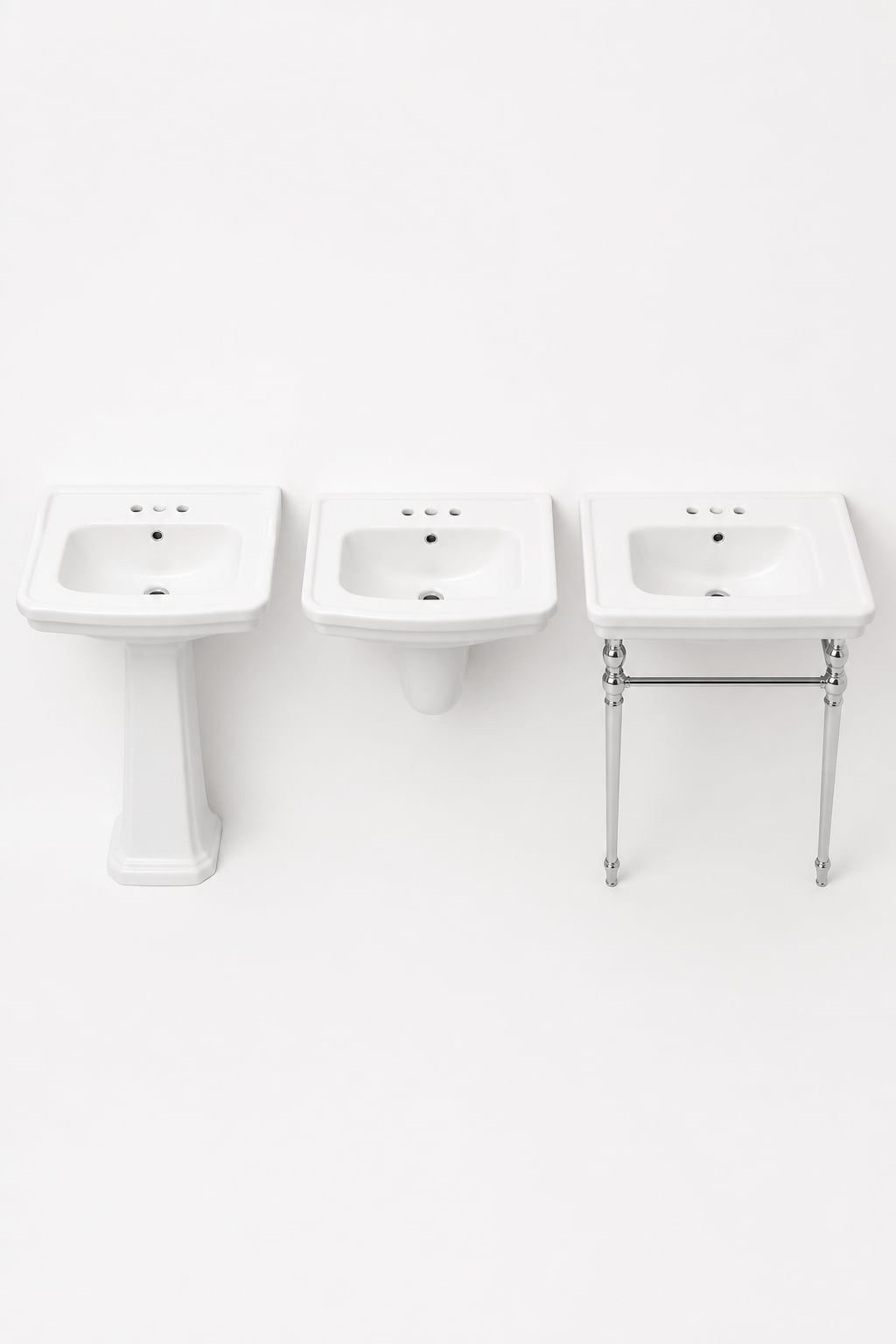
Name yours before you shop. A classic column has a solid base from floor to basin — no shelf, only a narrow gap each side. A console stands on slender legs with the basin wall-mounted, leaving the under-sink area open. A semi-pedestal is wall-hung with a partial shroud over the upper plumbing, the space beneath more reachable than a full column.
| Pedestal type | Typical era | Storage challenge | Space it leaves |
|---|---|---|---|
| Classic column | 1890s–1940s | No under-sink access; column is structural | Narrow floor gap each side (4–12 in) |
| Semi-pedestal | Mid-century onward | Lower drain exposed; partial access below | Reachable space beneath the basin |
| Console (on legs) | 1900s–1920s commercial | Open below — least restrictive | Full under-sink footprint, basket-ready |
A word of caution from the workshop: never treat the column as a shelf — it is load-bearing porcelain. And measure the gap at floor level before buying; a classic column is wider there than at mid-height.
Sink Skirts: Period-Appropriate Pedestal Sink Storage Solutions
Give the fixture back the soft cover it once wore, and you gain concealed storage without altering a thing.
The original function of the sink skirt and why it fell out of fashion
The sink skirt has provenance. In 18th and 19th century Europe, skirts were hung around fixed sinks to hide the unfinished pipework of early indoor plumbing while giving the space beneath a soft cover for storage. The tradition carried into the early American bathroom, then disappeared as post-war vanity cabinets left nothing to conceal. Interior designer Artem Kropovinsky of Arsight Studio describes the dual past: “It hid plumbing and gave extra storage a soft cover. Now, it’s more of a style moment, adding texture and charm…”
Fabric skirts today: how to hang them without drilling the porcelain
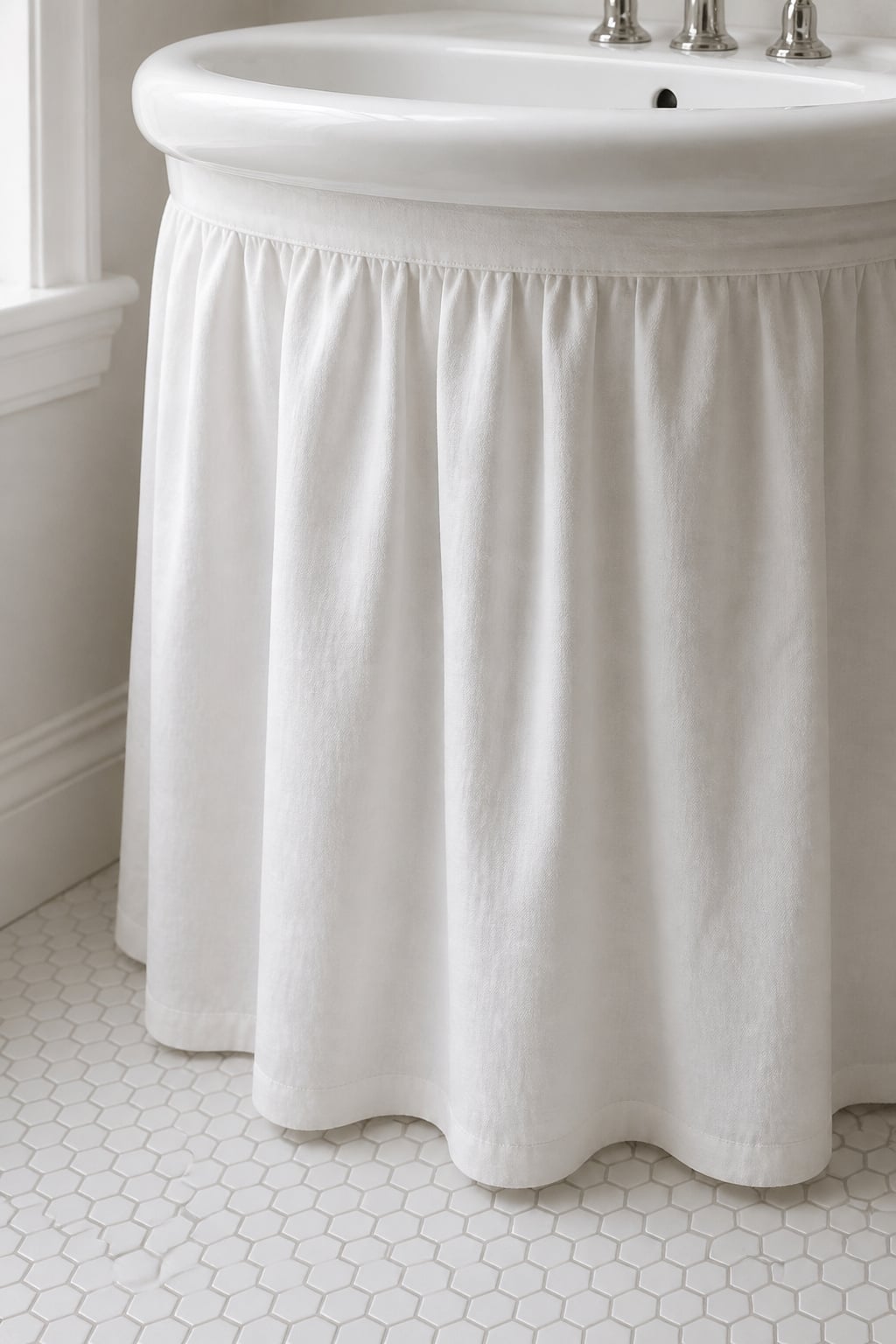
Porcelain should never be drilled. The preferred method is industrial-strength adhesive Velcro: one strip on the cleaned underside of the basin rim, the matching strip on the skirt’s hem — the skirt pulls away for washing and the next owner lifts it off without a trace. Standard Velcro can fail in humidity; use outdoor-rated tape backed with a thin bead of clear silicone. A no-sew skirt comes together with fusible webbing tape, cut to basin width plus 1.5–2× fullness for a gathered look.
What you can realistically store behind a skirt and what humidity rules out
The skirt conceals the space but does not seal it; whatever sits behind the fabric breathes the same humidity as the room. Store spare toilet paper, sealed cleaning bottles, and washcloths in a covered bin. Keep out anything moisture degrades — medications, loose paper, batteries. Fabric choice matters: polyester or a linen-polyester blend resists humidity better than pure cotton, which can develop a mildew odour in a poorly ventilated room.
Side Baskets, Console Shelves and the Nooks a Pedestal Creates
A pedestal carves out small spaces most owners walk past. Read the geometry and the fixture starts offering storage it never seemed to have.
The gap beside the column: slim baskets and freestanding towers that fit it
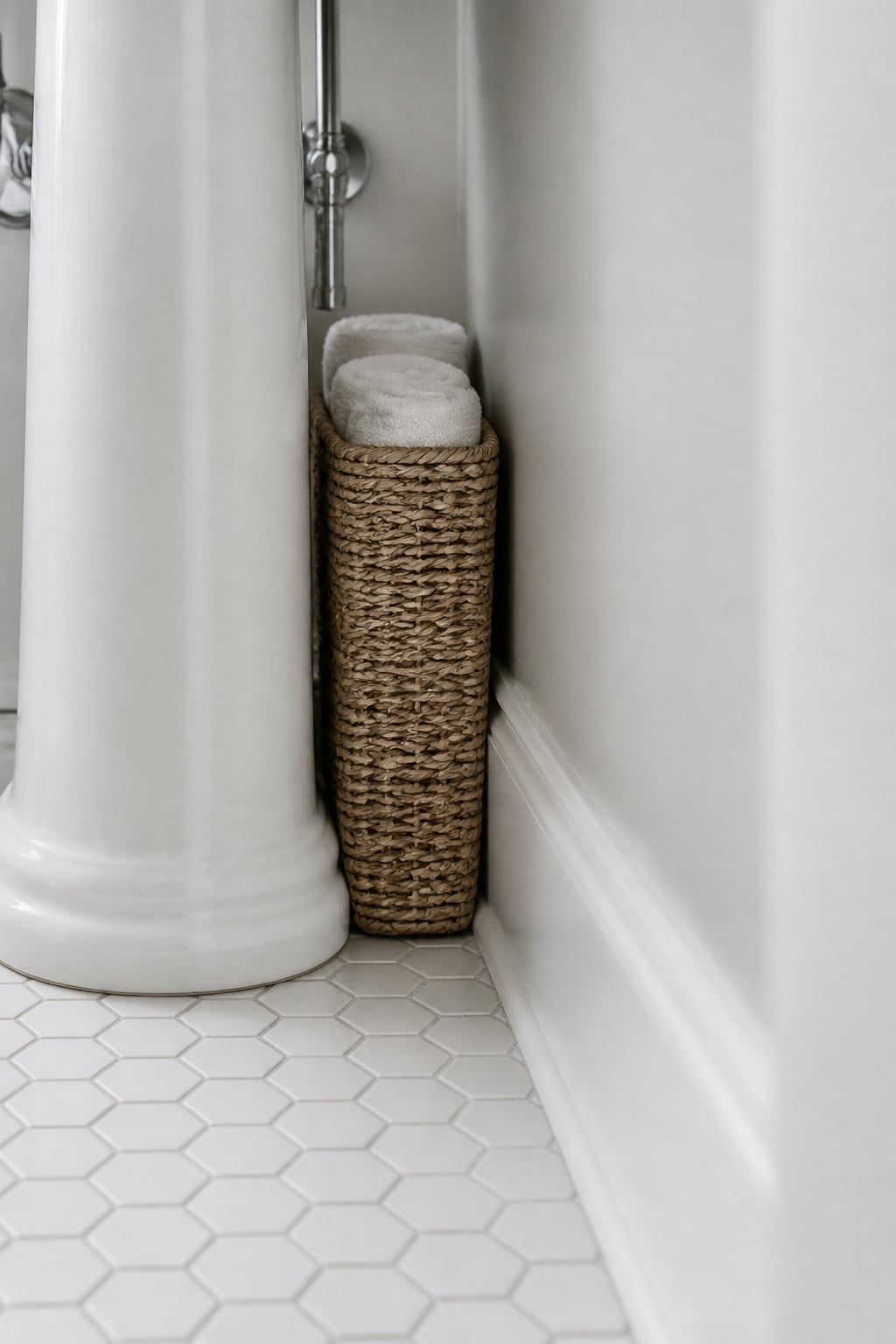
The floor gap beside a standard 22–24 inch column usually runs 4–12 inches — the most overlooked storage in the room. Slim rolling carts as narrow as 5.9 inches slide into it and pull out on casters. A woven seagrass basket in the 6–10 inch range holds rolled hand towels and reads as period-sympathetic without looking modern. Dedicated cabinets with a U-shaped cutout — about 23.5 inches wide — straddle the column; IKEA’s RAGRUND shelf wraps the plumbing outright. Measure the gap before you buy.
Console-style pedestals: the shelf space already built into the fixture
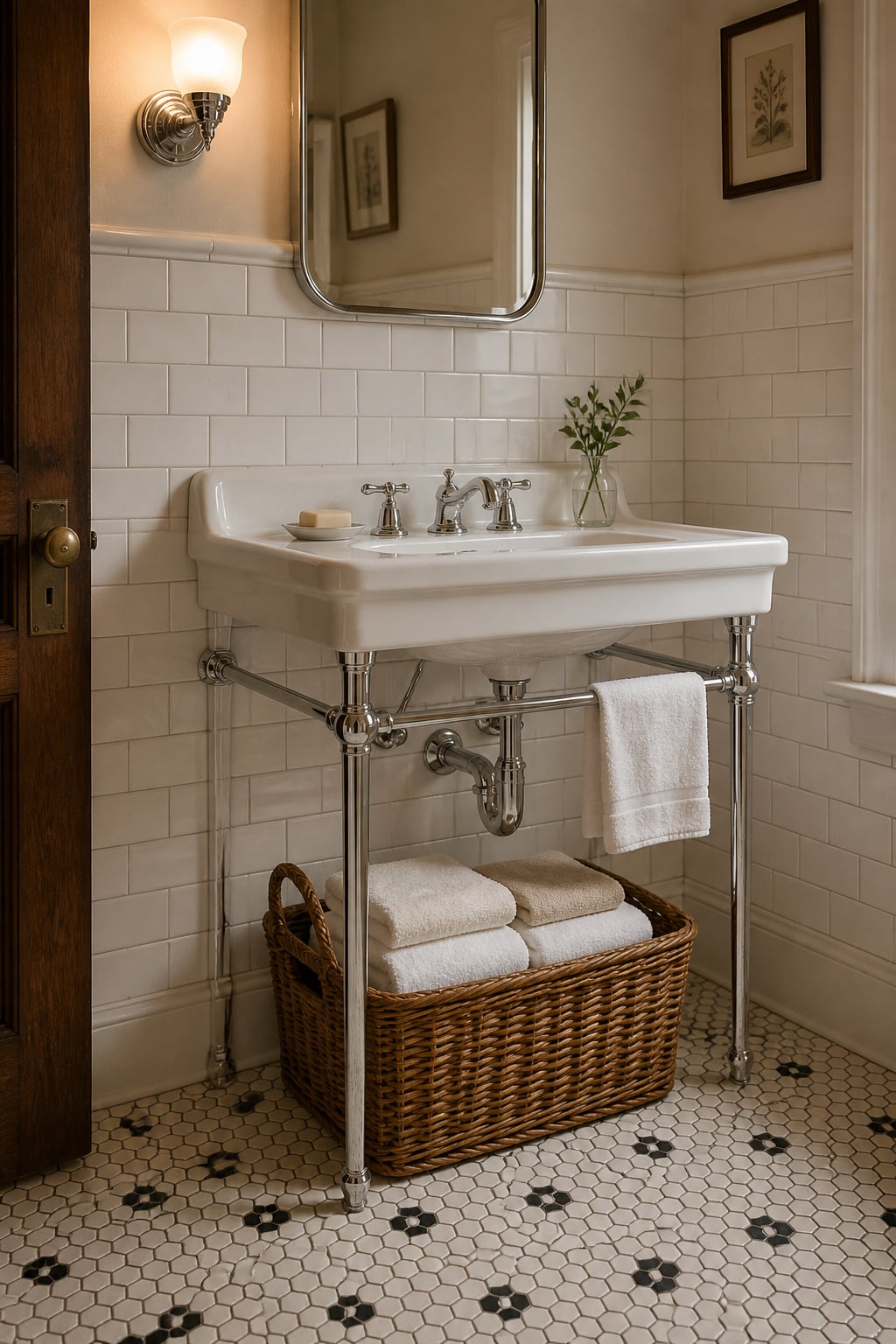
If your sink is a console, the storage is already there. Standing on legs, it leaves the full under-sink footprint open — basin width of 16–30 inches by 15–20 inches deep — enough for a wicker hamper, two stacked baskets, or a low shelf between the legs. Some models include an integrated lower shelf or towel rail (Signature Hardware and American Standard both offer them), and that built-in tier is the advantage a solid column can never match.
Freestanding tray tables and butler’s stands as period-sympathetic companions
For a listed property where nothing can be mounted, freestanding furniture is the purest answer. The butler’s tray on a folding stand was a standard piece of Victorian and Edwardian household furniture; beside a pedestal it offers a surface above and a tray below, then lifts away without a mark. Match each type to what fits:
- Classic column: a slim seagrass basket or narrow rolling cart in the floor gap; a butler’s stand alongside.
- Console on legs: baskets or a low shelf set between the legs, using the open footprint the fixture already gives.
- Semi-pedestal: a shallow basket tucked beneath the partial shroud, where the lower space stays reachable.
Wall Storage Above and Beside the Sink: The Primary Answer
When the floor is spoken for by the fixture and its clearances, the wall becomes the real storehouse.
Why the wall is where a pedestal-sink bathroom gets its storage back
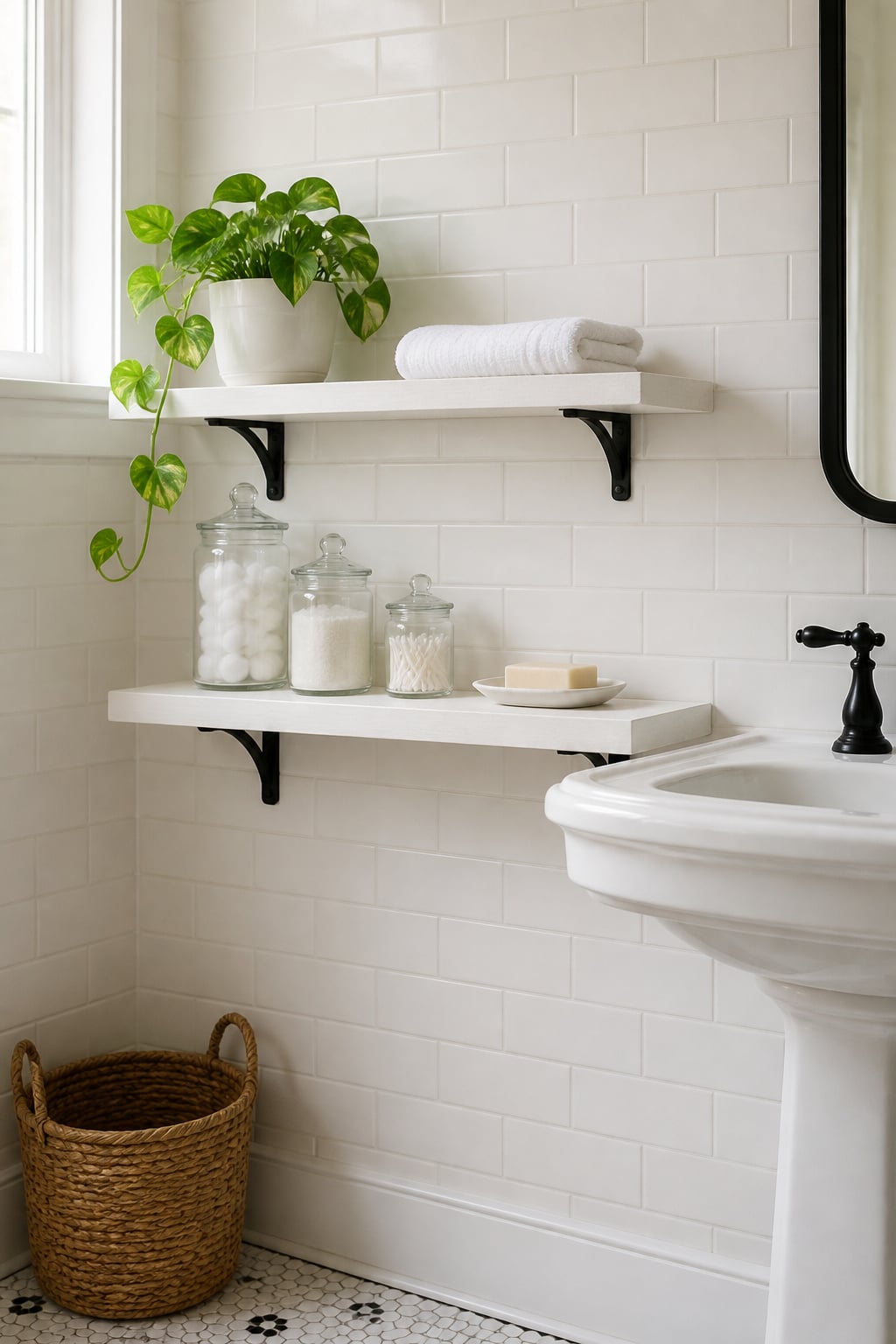
US building code requires 21 inches of clear floor in front of a lavatory; the NKBA recommends 30 — clearance the column and walkway already consume. The wall is the surface left. Combine a medicine cabinet with two or three floating shelves and you can realistically recover 8–12 cubic feet, comparable to a standard 24-inch vanity, without stealing an inch of walkway.
Medicine cabinet placement without clashing with the fixture’s proportions
Centre the cabinet at eye level — 60–66 inches from the floor — which sets the bottom around 48–54 inches up, well clear of a 29–34 inch basin. Hold it 4–6 inches above the faucet so splash never reaches the underside. Match the width to the basin: 10–25 inches suits a standard 22–24 inch pedestal. In a period home, choose surface-mount over recessed; recessing into plaster-and-lath is invasive and rarely reversible.
Floating shelves at arm reach: height, depth and load for daily-use items
Shelves earn their keep on three numbers. Eight inches is the professional depth for a tight bathroom — room for bottles while staying clear of anyone at the sink. Set daily-use items 48 to 60 inches from the floor, within arm reach without stretching overhead. Fix them honestly: locate studs or use toggle bolts rated to twice the load, since a 24-inch shelf of toiletries runs 10–20 lbs. For period character, painted wood on black iron or antique brass brackets suits a Victorian room; read the dedicated floating shelf ideas before you drill. Diamond Kitchen and Bath advises starting beside the sink rather than above it — and those side shelves are also the natural home for the towel storage ideas a pedestal bath otherwise lacks.
When to Consider a Console Sink Swap Instead
If the workarounds fall short, one intervention honours the period look while giving real storage — and it is the most reversible fixture change of all.
What a console sink is and how it differs from a pedestal
A console sink mounts to the wall at the basin — the same blocking a pedestal relies on — but stands on slender legs instead of a column. Swapping a pedestal for a console can usually reuse the existing supply and drain connections, unlike a swap to a vanity, which typically forces the drain rough-in to move. Its leg clearance of 27–29 inches also meets ADA knee-space guidance.
The storage gains a console swap delivers and what it costs — parts and labour
Here are honest 2026 figures. The fixture alone ranges from $200–$400 for builder-grade up to $1,725 for period styles with nickel, chrome, or brass legs. Licensed plumbing labour for a straightforward swap runs $330–$730. A mid-range fixture plus labour plus minor wall touch-up lands at $1,000–$1,700 all-in; a high-end reproduction pushes that to $2,200–$2,800. The table compares each solution.
| Solution | Storage gained | Period-appropriate | Cost range | Reversible |
|---|---|---|---|---|
| Fabric sink skirt | Concealed under-basin space | Yes — true to provenance | $20–$60 | Fully (Velcro, no drilling) |
| Side basket / rolling cart | Small floor-gap storage | Yes (natural fibre) | $20–$80 | Fully (freestanding) |
| Wall cabinet + shelves | 8–12 cu ft on the wall | Yes (period brackets) | $100–$400 | Mostly (surface-mount) |
| Console sink swap | Full under-sink floor | Yes (reproduction styles) | $1,000–$1,700 | Largely (reuses plumbing) |
Period-appropriate console options that don’t compromise the bathroom’s character
The leg material is where a swap succeeds or fails. Reproduction apothecary consoles with chrome or nickel tubular legs replicate early 20th century commercial fittings — accurate for Edwardian and 1920s homes. Belle Époque designs with stepped legs and an integrated lower shelf, from specialists such as Signature Hardware at $948–$1,572, are the most historically grounded choice for a Victorian restoration. Finish the exposed supply lines in matching chrome rather than raw PVC, and avoid chrome-over-plastic legs; in a period home they read as imitation.
The fixture has stood in fine homes for over a century because it gives a small room light and openness a cabinet never could. Capture the wall first — a well-proportioned cabinet and shelves return most of what you lost. Use the skirt and side nooks for the rest, and reach for the console swap only when the gain justifies a change you can still undo. The full set of small bathroom storage ideas covers the rest of the room.
FAQ
How do you add storage to a bathroom with only a pedestal sink?
The most effective combination is a surface-mount medicine cabinet at eye level — 60–66 inches from the floor — plus 8-inch-deep floating shelves on the side wall at 48–60 inches. A fabric skirt on industrial Velcro hides the column and stores spare rolls; a slim cart or basket under 8 inches wide fills the floor gap beside it.
Can you put a cabinet next to a pedestal sink?
Yes. A freestanding narrow cabinet of 12–18 inches can stand beside a pedestal, provided it keeps the clear floor in front of the lavatory above the NKBA’s recommended 30 inches (21 inches is the code minimum). Dedicated pedestal cabinets with a U-shaped cutout straddle the column at about 23.5 inches wide; a slim wall-mounted cabinet avoids the floor-clearance constraint entirely.
What is the difference between a pedestal sink and a console sink for storage?
A pedestal has a solid column base that blocks the entire area beneath the basin, so storage is only possible with a skirt, basket, or column-straddle cabinet. A console stands on two to four legs with the full under-sink floor open. Swapping a pedestal for a console costs $1,000–$1,700 all-in for a mid-range fixture and usually reuses existing plumbing.