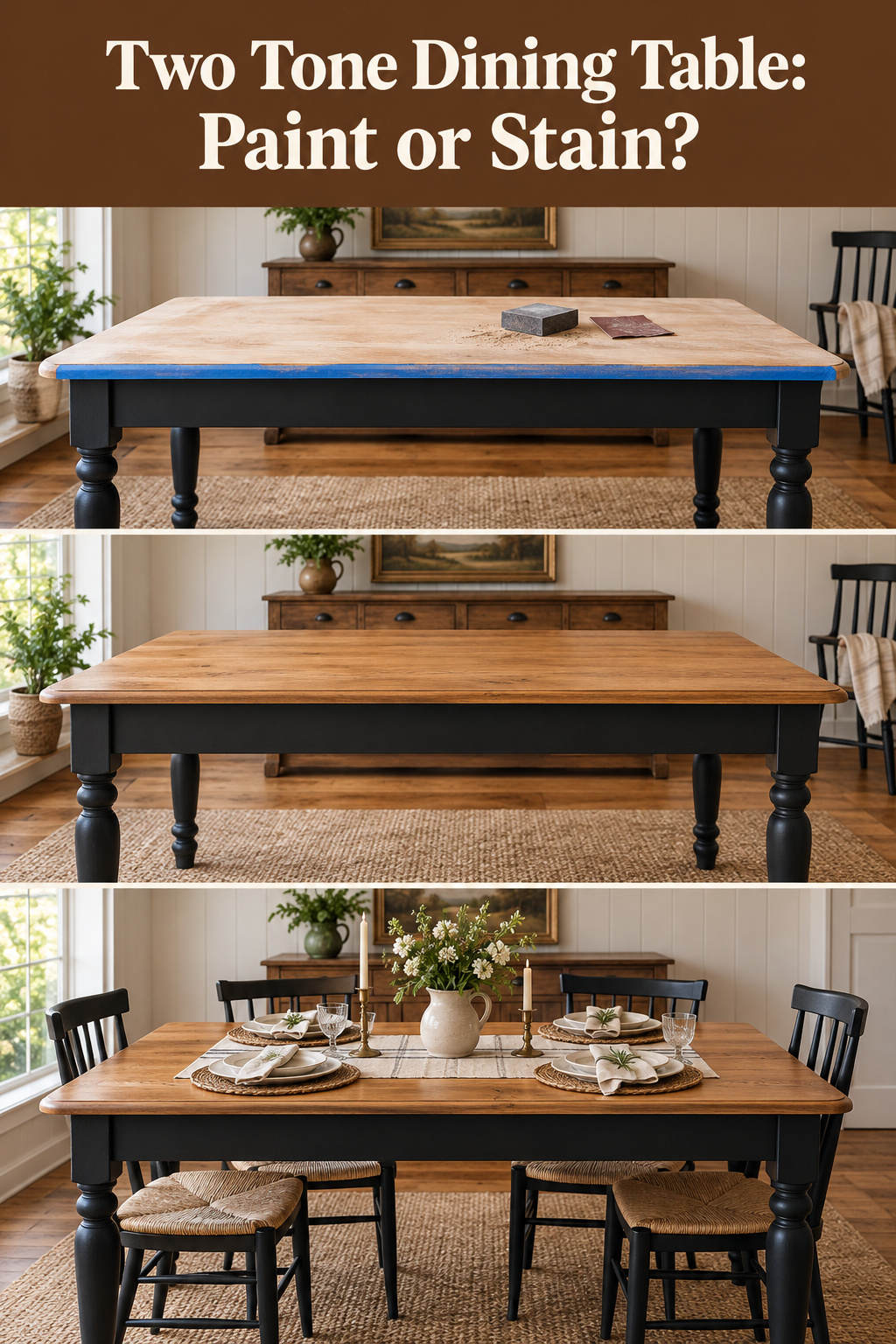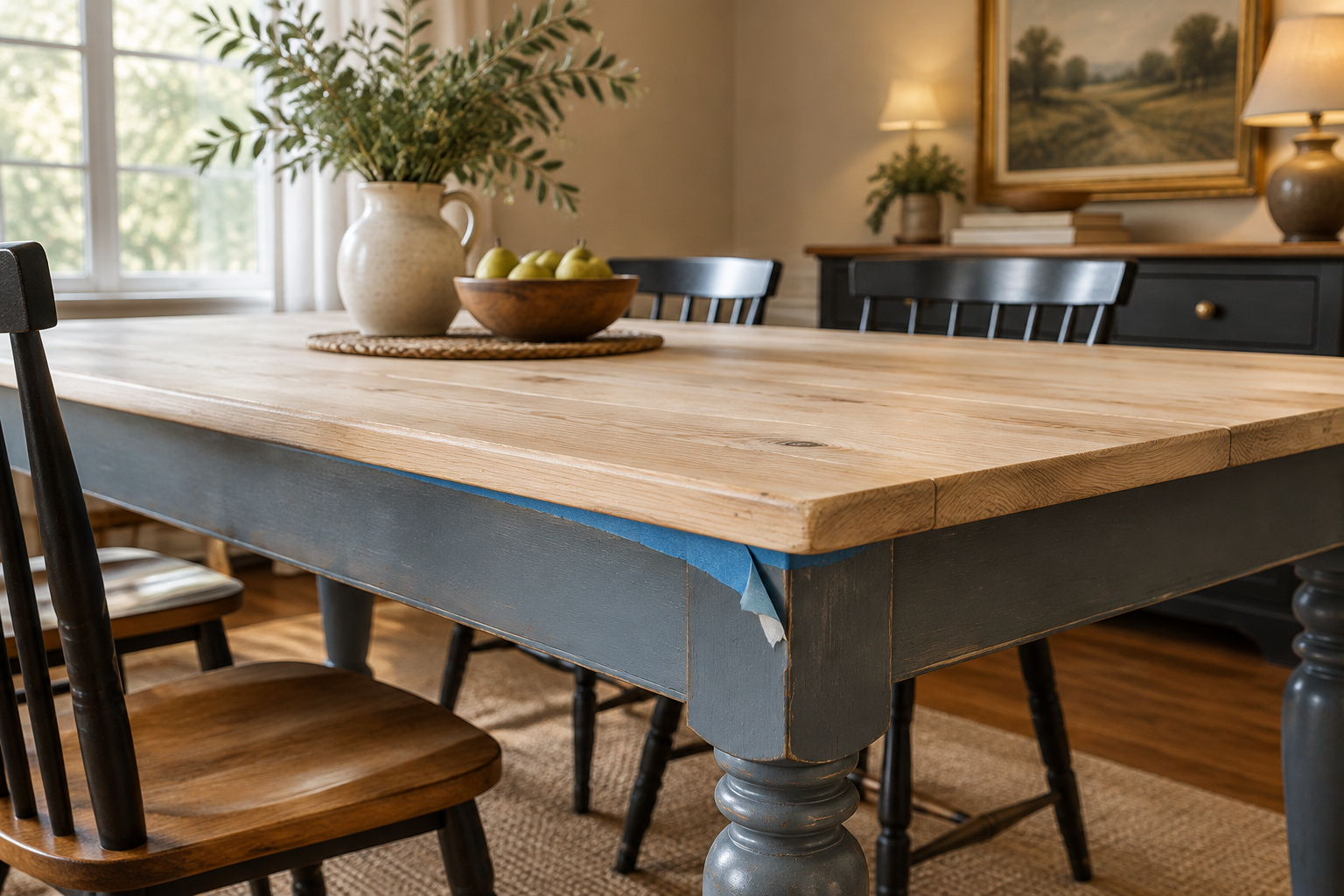
A pine table sits on my bench in the carriage house, upside down on its blanket, with two faces. The top has been scrubbed back to pale, soft grain that feels almost furred under a palm. The base still wears its old paint, a tired blue-gray rubbed through at the feet and stretchers, exactly where boots and chair rungs found it. Tape runs along the apron where the two halves meet. Nothing happens next until this two tone dining table settles one question: which half carries color, and which stays wood.
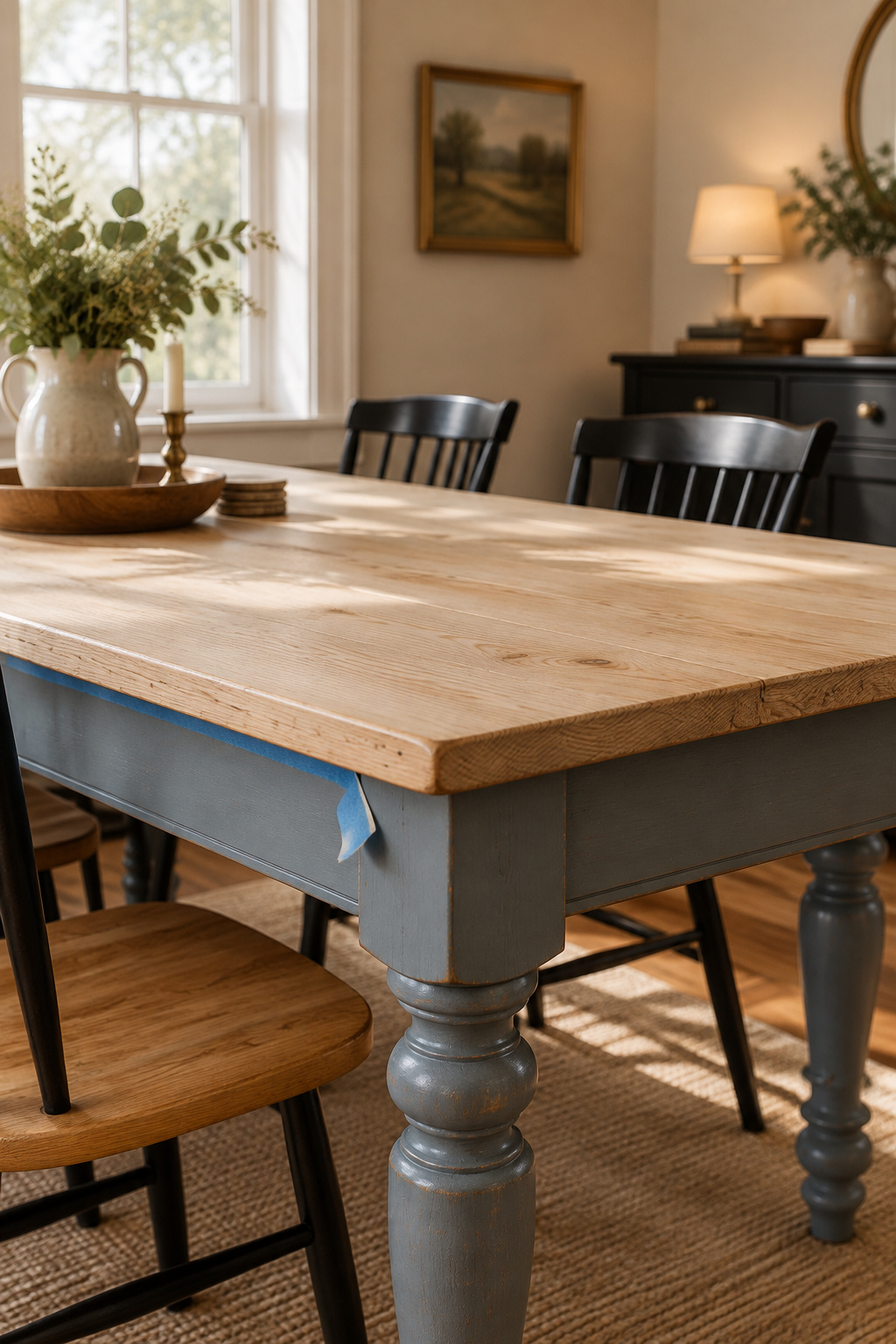
That question is far older than whatever style you are chasing right now. Two finished tables can look alike while hiding very different decisions: what the table is built from, what finish sits on the top, how the household wears it. A five-minute choice of chairs and a strip-to-bare-wood refinish can look identical once the work is done. By the end of this guide you should be able to say which half of your own table takes the color, what that commits you to, and which single next step fits your table and your time.
Why the Top Is Almost Always Wood and the Base Almost Always Isn’t
In the first half of the nineteenth century, someone in Virginia built a farm table of yellow pine. It survives in an auction catalog with the description a restorer hopes for: a three-board scrubbed top over a plain apron, the base retaining its early blue-painted surface. A painted pine farm table from Pendleton County, West Virginia, made around 1870, reached the same auction house with the same arrangement, a scrubbed top above and paint remnants below. No later owner chasing a look refinished either piece that way. The split was built in.
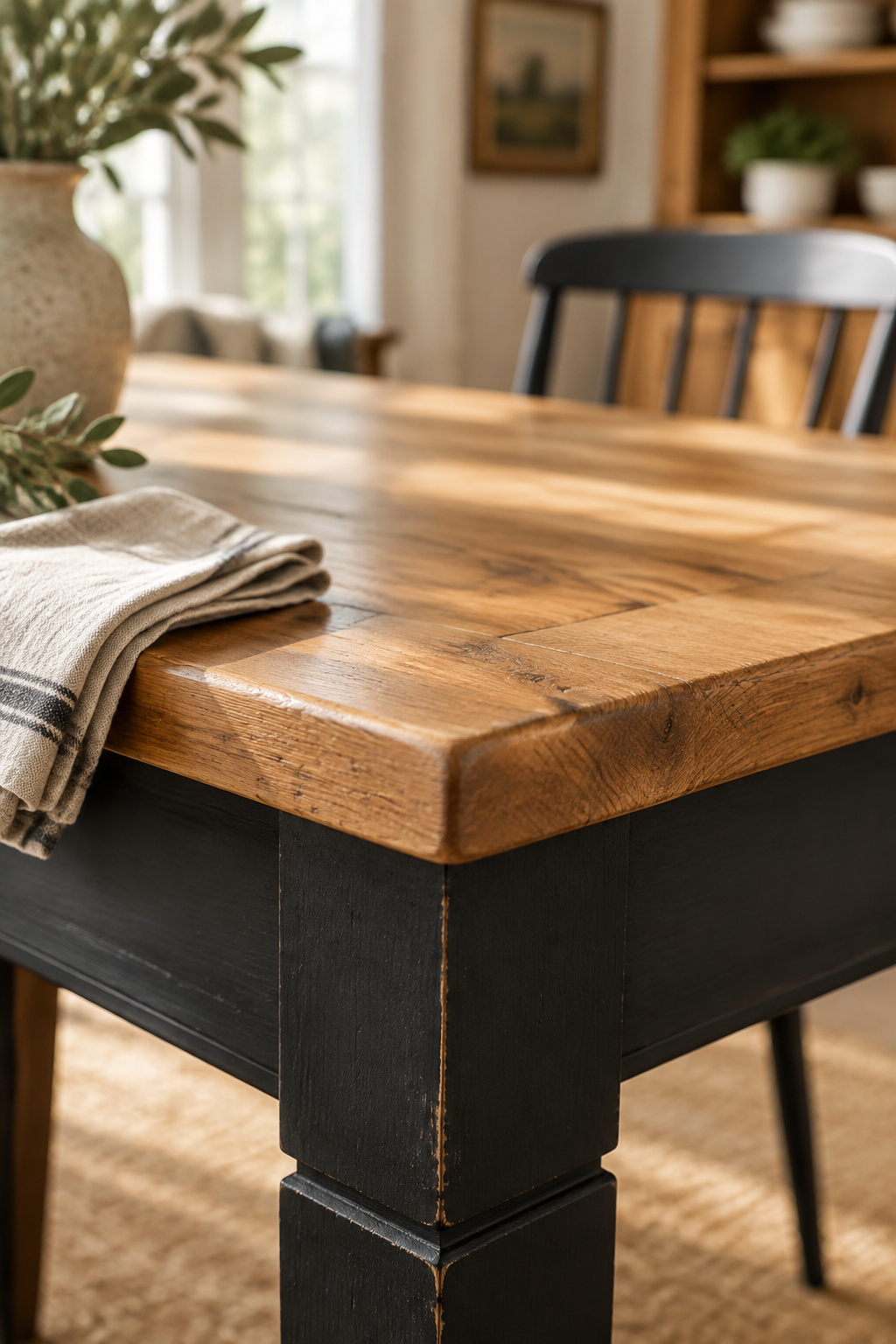
The British record points the same way. Charlotte Ambler, writing on the history of antique pine for the dealer Antique and Unique, describes the country house running two kinds of furniture, with mahogany and walnut in the rooms guests saw and sturdy scrubbed pine in the kitchen and service rooms that did the daily work. The National Trust still keeps the kitchen at Wallington furnished with scrubbed pine tables and a dresser.
I want to be precise about what that evidence is. It consists of auction-house condition reports and a dealer’s history, documented practice written down by people who handle the furniture, and it is not museum scholarship. It is dated and it agrees across two countries, which is enough to say this: the painted base and the bare top were a working arrangement long before they were a trend.
The reasons were practical. Paint disguised a plain, cheap softwood on the base and could be renewed whenever it scuffed. The top stayed bare so the household could scrub the eating surface with water and a brush every day, a routine no painted surface would have survived.
The Wear Pattern Behind the Convention
Here is how I read that history. It is my reasoning, not a rule anyone wrote down. A two-tone table divides the labor. The top works for your hands: plates, elbows, hot dishes, spilled water, the cloth that wipes it after every meal. The base works for your feet: shoes, chair legs dragged in and out, the vacuum head that knocks every leg on its way past.
These are two different kinds of wear, and they want two different kinds of surface. Hands and water need something you can clean and, one day, renew without starting over. Knocks and scuffs need a surface that hides them or can be touched up with a small brush. Wood under a clear finish does the first job, and paint does the second.
Makers still think this way. SHD Timber, a furniture-timber supplier, frames it as a split between the parts a person touches and studies, chosen for grain and feel, and the structural parts that take the abuse and decide how long a piece lasts. Coleman Furniture’s durability guidance adds that finish protection matters most where contact is heaviest, which on a dining table is the eating surface, not the legs.
If you remember one line from this guide, make it this one: color goes where the shoes are; wood goes where the hands are. Every other decision follows from it.
When an old base comes to me still wearing its first paint, I clean it and leave the paint alone. A later owner can always add a coat, but nobody can put original paint back.
Start With What You Have: Table, or Table-Shaped Question
Is there already a table in your dining room, or only the space where one will stand?
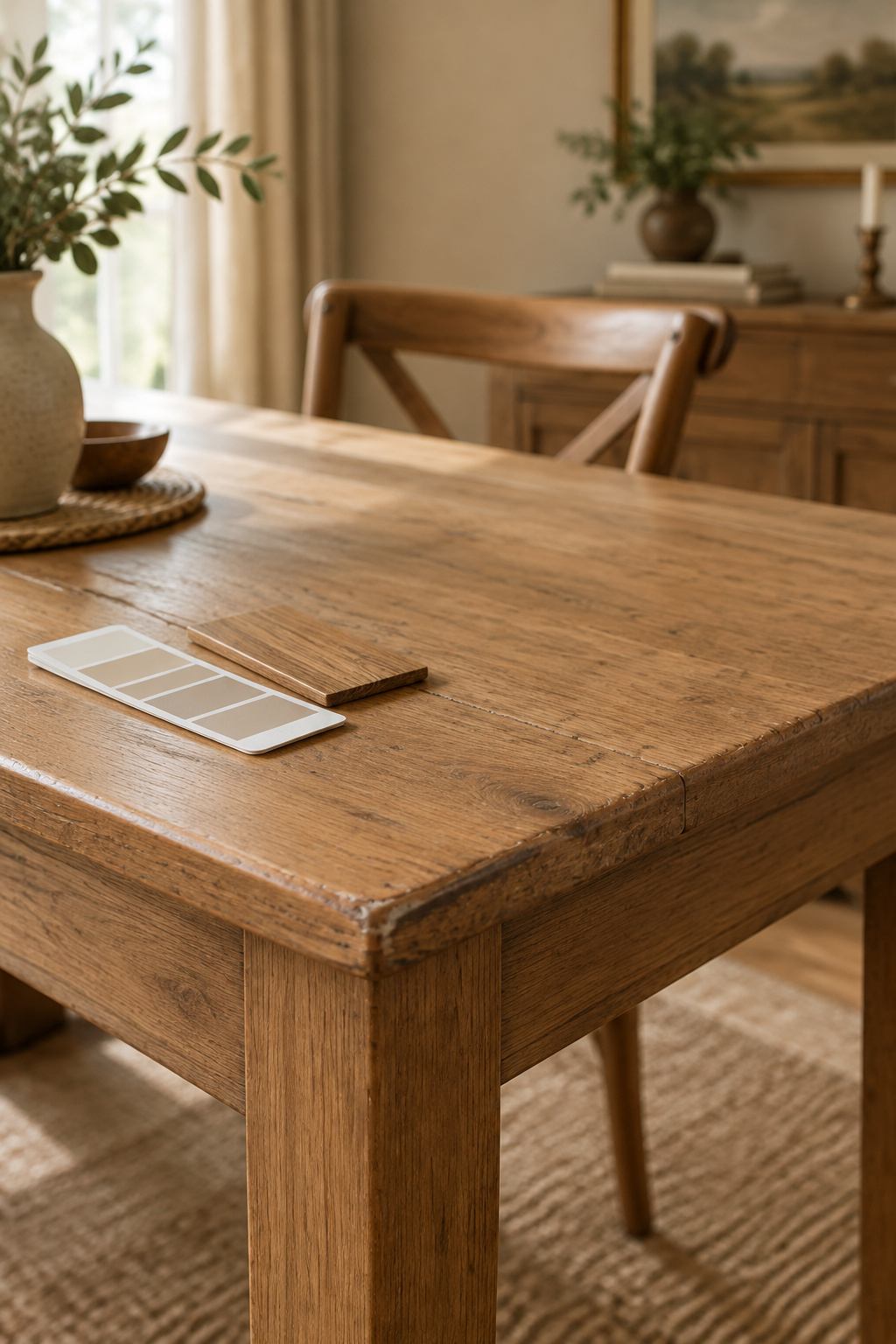
The answer splits this subject in two, and most of the confusion comes from mixing the paths. Many two-tone tables in circulation were never a project. They were made in a factory, finished on both halves, and bought exactly as pictured. Buying one done is a real, well-stocked category across a wide range of prices and build quality, not a fallback for people who can’t hold a brush.
If you already own the table, it knows things no showroom can tell you. Check how the top has worn: rings, a dull track where plates slide, a pale patch by the window. Then check the base. Do the feet and stretchers show the knocks of chair legs and a vacuum, and is it already painted or stained? A table that has lived with you for a few years has already shown you where your household does its damage.
Coleman Furniture’s buying guidance breaks durability into four things you can check on a table you own: how hard the material is, how well it is put together, what finish is on it now, and how well it fits the way your household actually uses it. Run through all four before you choose a color. They decide whether your next step is a styling choice, a refinish, or a replacement.
The sections that follow take the owned-table path first: choosing the colors, knowing what the table is made of, doing the work, and protecting it. The buying path gets a single paragraph at the end, because once you understand an owned table, buying one is the same set of questions asked in a shop.
Choosing the Two Colors for a Two Tone Dining Table
Undertone decides the pairing, whatever name is on the paint can.
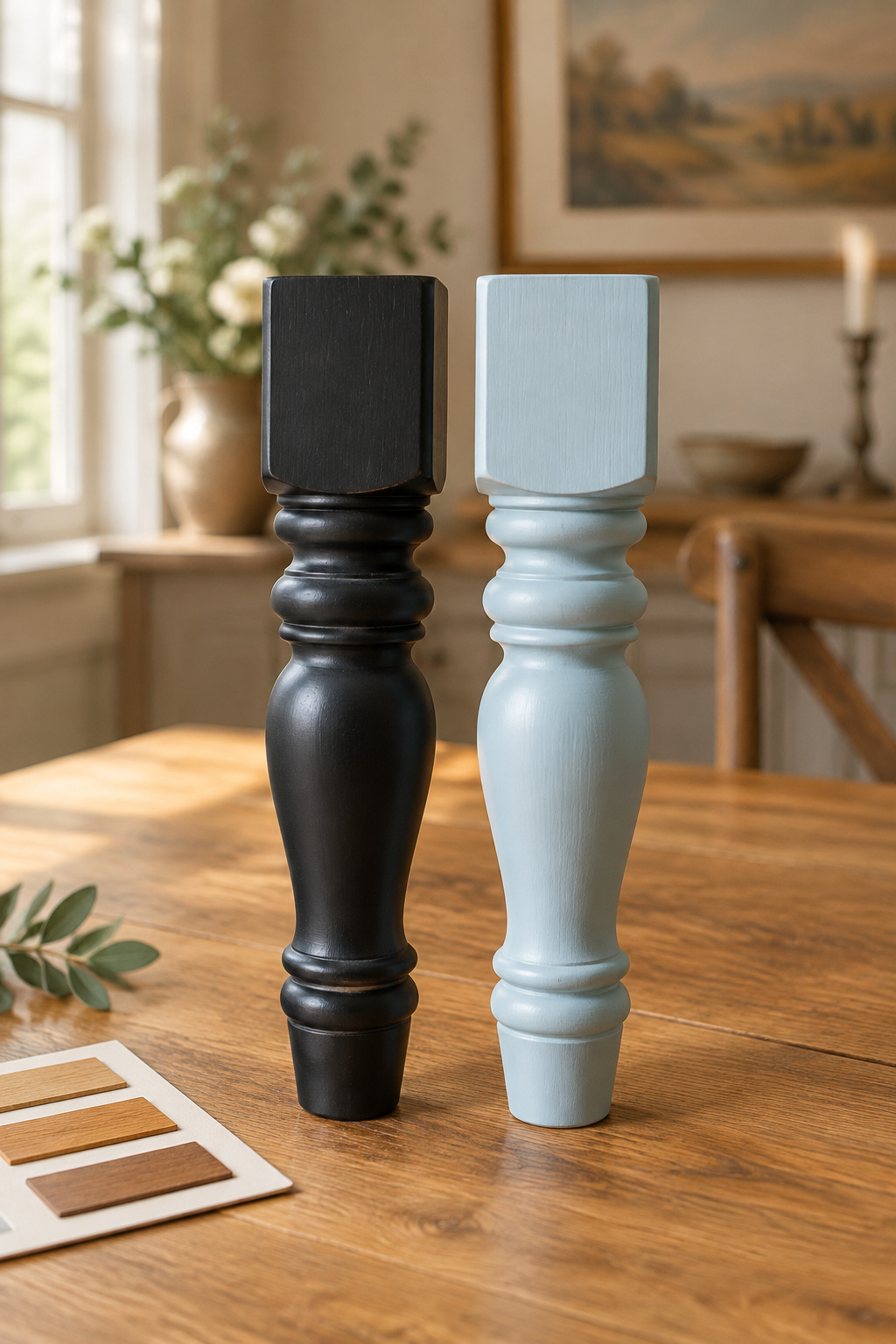
Warm woods such as cherry, mahogany, golden oak and pine sit most easily against paint with a warm undertone, and cooler-leaning woods such as ash, maple and white oak against a cool one. The check is simple but has to happen in your own room. Hold the paint chip against bare wood from your table in daylight, not under a shop’s lights. Working out which base color suits your wood properly, species by species and window by window, is a job for its own article, so I won’t repeat it here. I will make two calls about wear, because a finished look can’t show you wear.
Safe First Pairings
My first call: for a table used every day, I reach for a dark, low-sheen painted base under a wood top, black or near-black. Anna Hill, brand director and color consultant at Fenwick & Tilbrook, argues in Homes & Gardens that pale colors show scuffs and scratches far more than darker ones. The reason is physical. A dent casts a small shadow, and against a dark ground that shadow has almost nothing to contrast with.
The other half of the story usually gets left out. Lost & Found Decor, writing on the hardest colors to paint furniture, points out that very dark and black finishes show dust, fingerprints and pale crumbs more than any other color, because nothing competes with the mark. So dark hides damage and shows dust. Both are true at once, because they are different kinds of visibility.
That is why my call has a condition. Choose black or near-black, and near-black rather than true black if a bright window lands on the table, where raking light finds every fingerprint on a leg. A deep charcoal, an inky green or a dark blue will all do the job. In a room without that light, true black is the easiest dark to pair with almost any wood.
My second call: I would not put a pale or bright-white base, or a light pastel, on a table that works every day. The base is the half that gets kicked, and pale paint shows every kick. Keep white for the table that sees Sunday lunch, or put it somewhere shoes never reach.
| Base | What it hides | What it shows | My verdict for a daily table |
|---|---|---|---|
| Deep charcoal, dark green or dark blue, low sheen | Dents, scuffs from shoes and chair legs | Some dust, less than black | Reach for this first |
| True black, low sheen | Dents and scuffs best of all | Dust, fingerprints, pale crumbs most | Excellent, except in strong window light |
| Mid-tone color | Dust and crumbs better than dark | Scuffs more than dark | A fair compromise |
| Bright white or pale pastel | Very little | Every scuff and kick | Not on a table used daily |
Weathered and Gray Tops
The one real variation on the convention changes the top instead of the base: a pale, silvery, weathered-looking top over a painted base. Retailers already sell factory tables in distressed and weathered finish pairings as a named category, so this is a mainstream look, not a niche one.
It is also a finish technique with its own chemistry that behaves differently on different woods, which is why the weathered gray top gets a full article of its own. I will add one thing from my side of the trade. A gray top is a legitimate finish choice. Sanded-through paint and hammered “age” are another matter. Real wear beats applied distressing every time, and a finish should never pretend to a history it hasn’t had.
Know Your Table Before You Touch It
The most expensive mistake in this whole subject happens before any paint is opened: someone sands a top they have never identified.
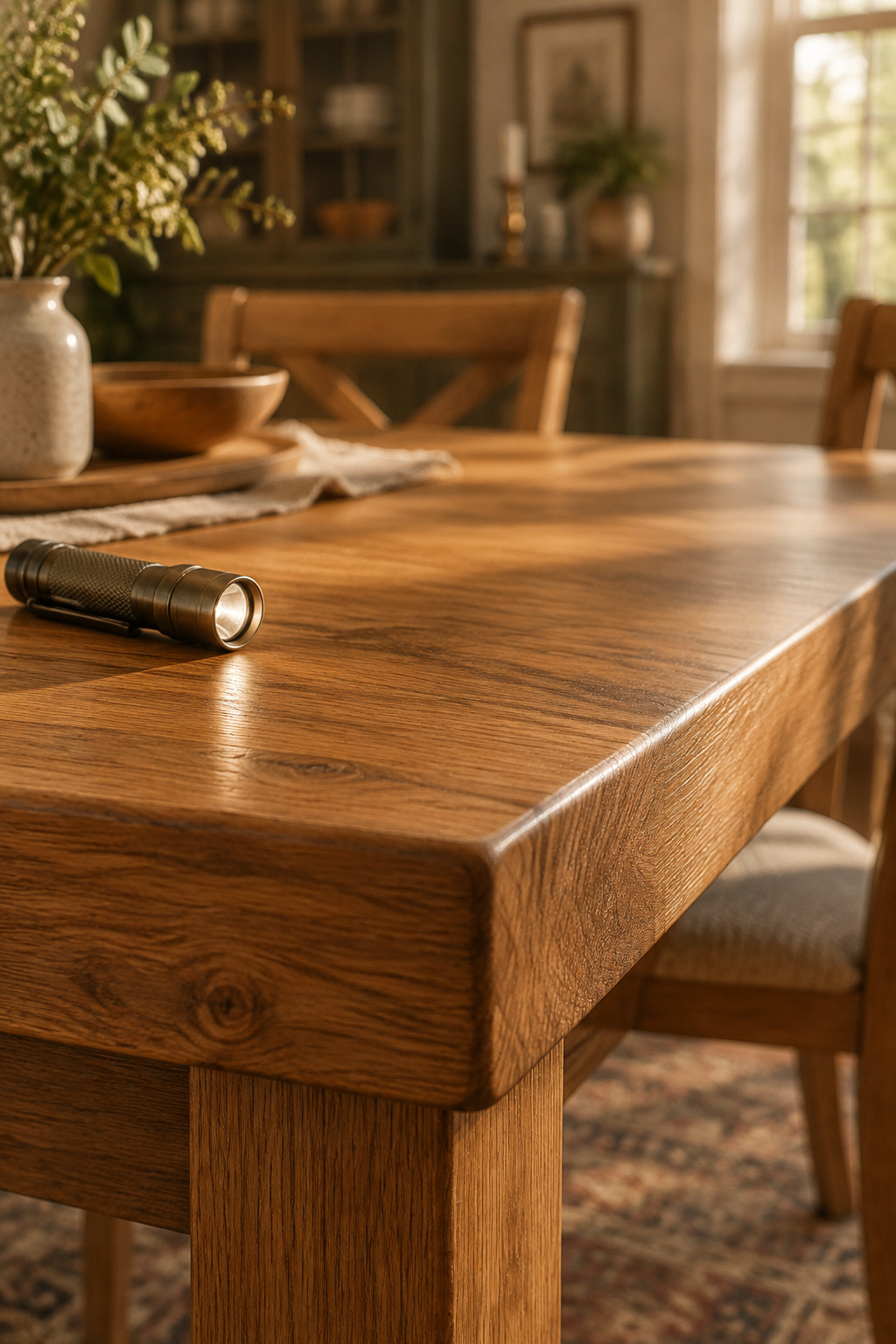
What a table is made of decides which paths are even open to you. Solid wood forgives a second refinish, and often a third. A veneered top is a skin of real wood over a core. It can be cleaned, recoated and recolored, but it will only tolerate so much sanding. A printed laminate has no wood under its surface at all. Paint, stain and a clear coat each mean something different on each of the three.
Solid Wood, Veneer, or Something Else
Several buying guides that agree with each other give the same quick checks. Start with an edge or corner. Grain that flows continuously around it suggests solid wood, while a visible seam where a thin surface layer stops suggests veneer. Then look underneath, where an underside whose grain matches the top is a good sign and smooth engineered board is not. Lift a corner too, but don’t trust the lift alone. A solid table is usually heavier, yet a hollow leg can fool you.
Joinery grades a table independently of its wood, so look there next. Where the leg meets the apron, a mortise-and-tenon joint, dowels or any wood-to-wood connection tells you the piece was built to last. Metal brackets, cam locks or staples doing the structural work tell you it was built to a price. On an older piece, the same test tells me roughly how it was made and how carefully.
None of this makes veneer the lesser choice. Veneer is more stable than solid wood through humidity swings, and it lets a maker lay rare or highly figured grain across a large top that solid timber could never economically cover. It only changes what you can do to the table later, which is why identification comes first. Whether you own the table or are standing in a showroom, telling solid wood from veneer before you buy is the one inspection worth learning properly.
Doing It Yourself: Painting the Base, Staining the Top
Picture the job the way it looks on a drop cloth: one table, and on it two separate finishing projects that happen to share a set of legs.
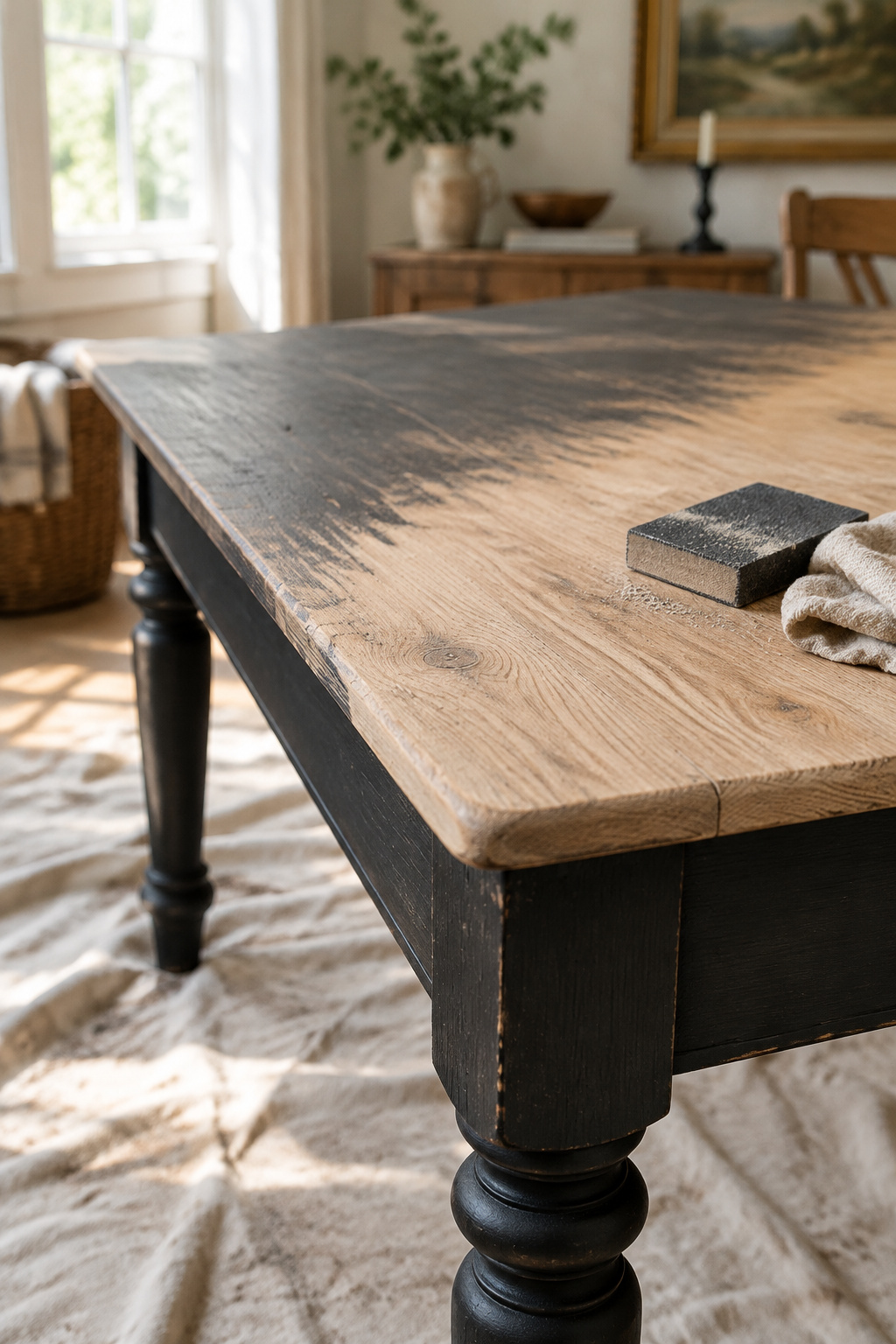
New England Table Company’s guidance on finishes draws the line clearly. The base takes a film-forming furniture paint suited to a surface that stays mostly dry and mostly looked at. The top, if it is being refinished and not simply cleaned, takes a stain-and-seal or a clean-and-reseal process built for food, water and daily wiping. That makes two products with two sets of preparation and two sets of waiting, meeting at one line along the apron.
The Work Fits a Weekend; the Wait Doesn’t
How much a weekend gets you depends almost entirely on the top, not the base. A top whose existing finish is sound, with no deep damage, may need nothing more than a thorough clean and a fresh clear coat, which is realistic in a weekend. A top stripped to bare wood and restained is a much bigger job once the drying between coats is counted, and people plan for it as if it were the small part.
The base is rarely what goes wrong. First attempts fail at the tape line, in the order the two halves are done, and in patience between coats, and all three are set out step by step in the guide to painting the base and staining the top yourself. Everything here assumes a table that already exists. Building one from lumber is a different project with its own guide here.
Can the Tabletop Itself Take Paint?
What if you want the color on top?
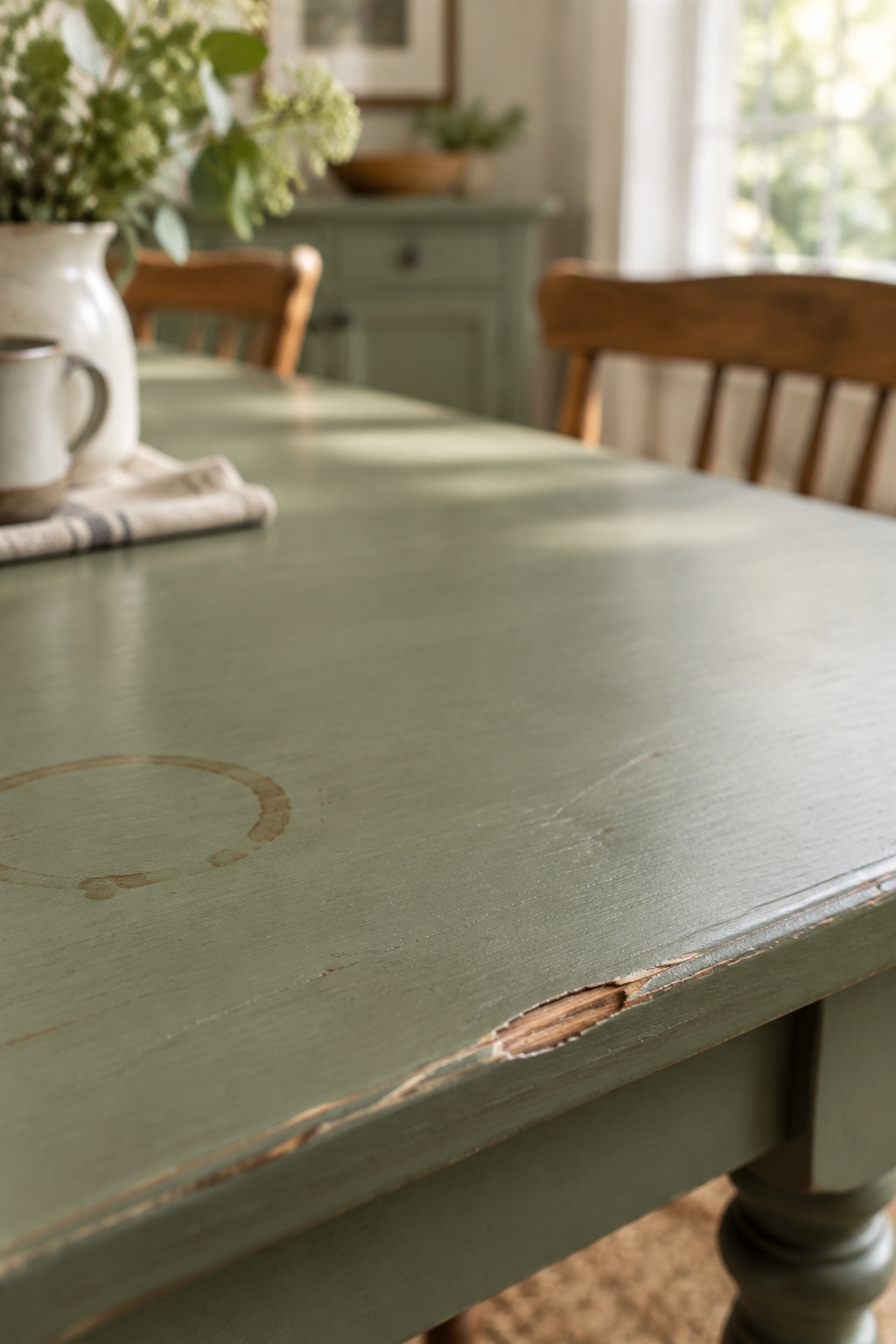
It is possible, and painted tops appear on plenty of tables finished this way. But a painted top has a harder job than any other surface on the table. It has to survive heat, water, acidic food and daily wiping, and paint alone isn’t built for that. Craftsncomforts, a furniture-painting blog, puts the risk bluntly: a matte chalk-style paint left without a hardwearing topcoat will be destroyed within months of daily meals. Painting a top means making two decisions, one for the paint and one for the tabletop-rated coat over it.
The convention has a second reason, and it concerns how damage looks. The furniture maker Artisan notes that a scratch or chip in paint exposes a contrasting material underneath and shows as an obvious flaw, while a scratch in stained or natural wood stays close to the wood’s own color. On the base, a chip gets touched up and forgotten. On the top, the same chip sits under every plate.
Painting the top is also the less reversible move on a solid table. Whoever owns it next can strip a painted base without much regret, but a solid top that has been painted asks more of them to bring back. The familiar rule against painting a top at all is weaker than its reputation, though, and the full case for whether a painted top can really last is made, with the evidence, in its own article.
Protecting the Wood Half and a Veneer Top’s Real Limits
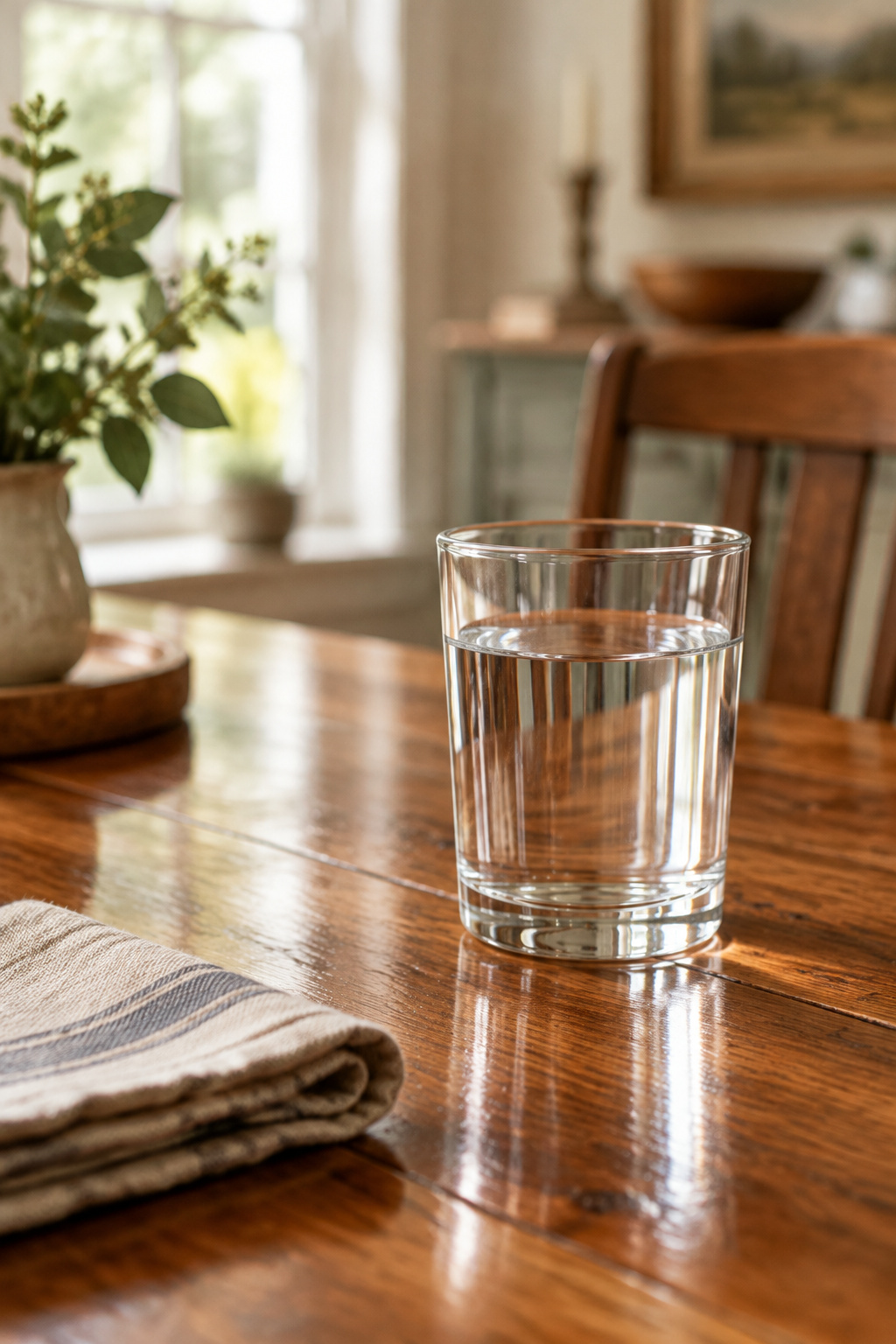
A wood top is only as good as the thin layer over it. The clear finish works as a barrier between the grain and every spilled glass, hot dish, acidic sauce and wet cloth the table will ever meet.
What a Clear Finish Has to Survive
Tyner Furniture’s guide to tabletop finishes sorts the choices into two families, and the difference between them is the whole decision. Film-forming finishes, polyurethane and lacquer among them, lay a continuous skin over the wood that resists liquid and abrasion well. Their weakness shows on the day something breaks through that skin. A deep scratch usually means sanding and refinishing a wider area so the repair blends, because a film doesn’t take a small, invisible patch. Penetrating finishes, oils and hardwax oils, sit in the wood instead of on it. By most accounts they protect less as a barrier, and they forgive far more when a single spot needs mending.
The choice comes down to protection against repairability, and which matters more depends on who sits at your table. The old scrubbed top belongs in this argument too, because it was chosen for being renewable in place. How the modern options compare on water, heat and curing, and how to test one against your own household, is the subject of the clear finish that protects the wood half.
What a Veneer Top Will and Won’t Let You Redo
If your checks said veneer, don’t write the table off. A veneer top can be cleaned, re-oiled or recoated with a compatible clear product without trouble, because none of that removes wood. The risk starts with sanding, which can cut through the decorative layer to the core beneath.
Once that happens, the exposed substrate, usually MDF, plywood or particleboard, is a structural problem as much as a cosmetic one. Woodrio’s guide notes that the core is typically less durable than the veneer over it and can invite further damage, warping among it, if left open. That is the one mistake a veneer top never forgives, and it is why painting the base and recoloring the top suits so many veneered tables. How far a particular top can go, and how its age changes the answer, is covered in what a veneer top will let you do.
Finishing the Room: Chairs and Buying It Already Done
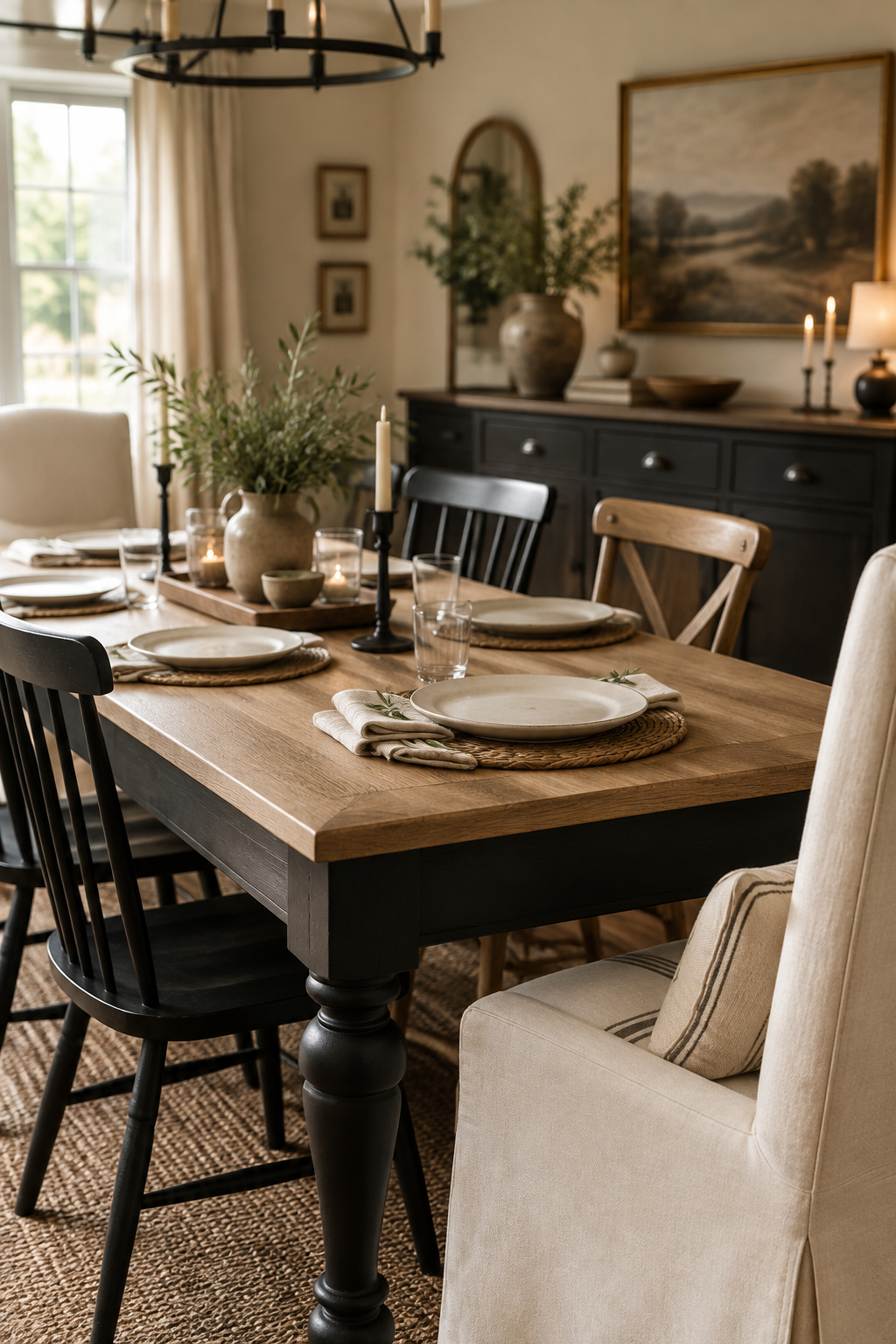
Set the table in its room with the chairs pulled in, and you can see that a two-tone table has put two colors in front of you before a single chair arrives.
Choosing Chairs That Complete the Two Colors
The chairs are the third note, and there are two sound ways to play it. Pop Maison’s guidance on matching chairs describes both. You can echo one half of the table, with chairs that repeat either the base color or the top’s wood tone. Or you can contrast with both on purpose, as long as that contrast turns up somewhere else in the room, in a lamp, a frame or the legs of a sideboard, so it looks chosen and not accidental.
Undertone discipline carries over from the table itself. James+James, the furniture maker, advises keeping a chair’s finish on the same side of the warm-or-cool line as the wood top it sits against, even when its color or value contrasts. Avoid the near-match, a chair almost but not quite the tone of the table, which looks like an error and not a decision. Where the chairs vary, solid upholstered chairs at the two ends give the eye somewhere to rest, which suits a table already carrying two tones. The fuller argument, from where the eye lands to whether the chairs join the base, the top, or neither, is in the guide to choosing chairs to sit against it.
If You’d Rather Buy One Finished
Factory two-tone tables run from budget pieces with a veneer top over an engineered core to solid hardwood tables made to order, and the price tag alone won’t tell you which you are looking at. Give it the same inspection you would give your own table: edge, underside, joinery. Then ask the seller one precise question: which parts are solid timber, which are veneered, and is there MDF or plywood anywhere? An itemized answer is a good sign, while “wood construction” or “real wood finish” is a warning at any price. The article on solid wood and veneer, linked above, walks you through the rest.
The whole subject comes down to a few principles. Color goes where the shoes are, wood where the hands are. Know what the table is made of before any tool touches it. Choose a base dark enough to hide a kick, but not so black it shows every crumb in your light. Protect the top with a finish you can live with repairing. And resist the two tempting shortcuts, a painted top without a serious coat over it and a sander taken to a top nobody has identified.
| Your situation | Your next step |
|---|---|
| You own the table and like its finish | Style it: a base color and chairs, no refinishing |
| You own a solid table with a tired top | Refinish: paint the base, clean or restain the top |
| You own a veneered table | Refinish gently: paint the base, recolor the top without sanding through |
| You want color on the eating surface | Read the case for a painted top before you buy paint |
| You have no table yet | Buy: inspect the construction, then ask the seller the one question |
Go back to your own dining room and find the half of your table your family actually touches. Put your hand flat on it. That half stays wood. The only decision left is the color of everything your hand isn’t touching.