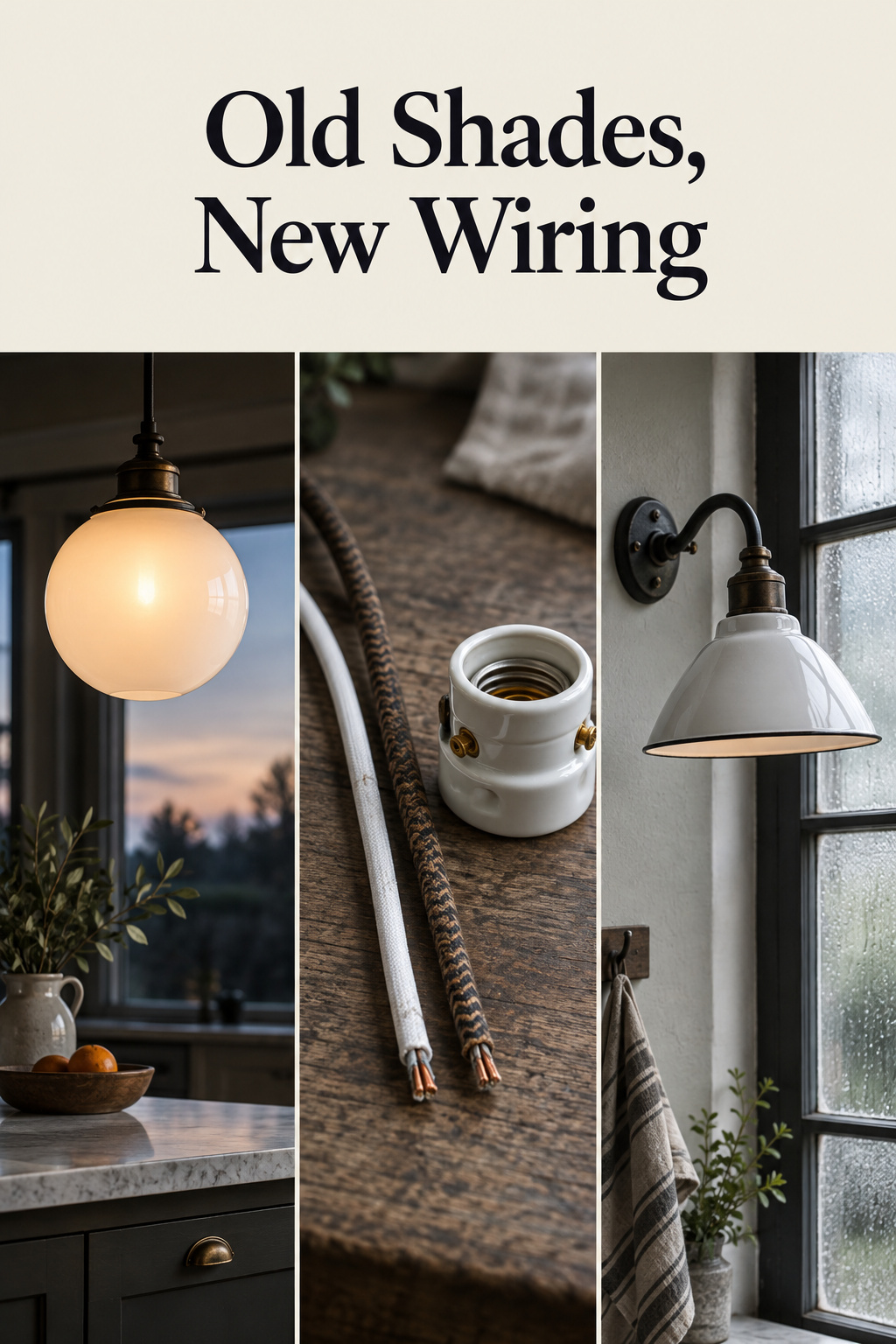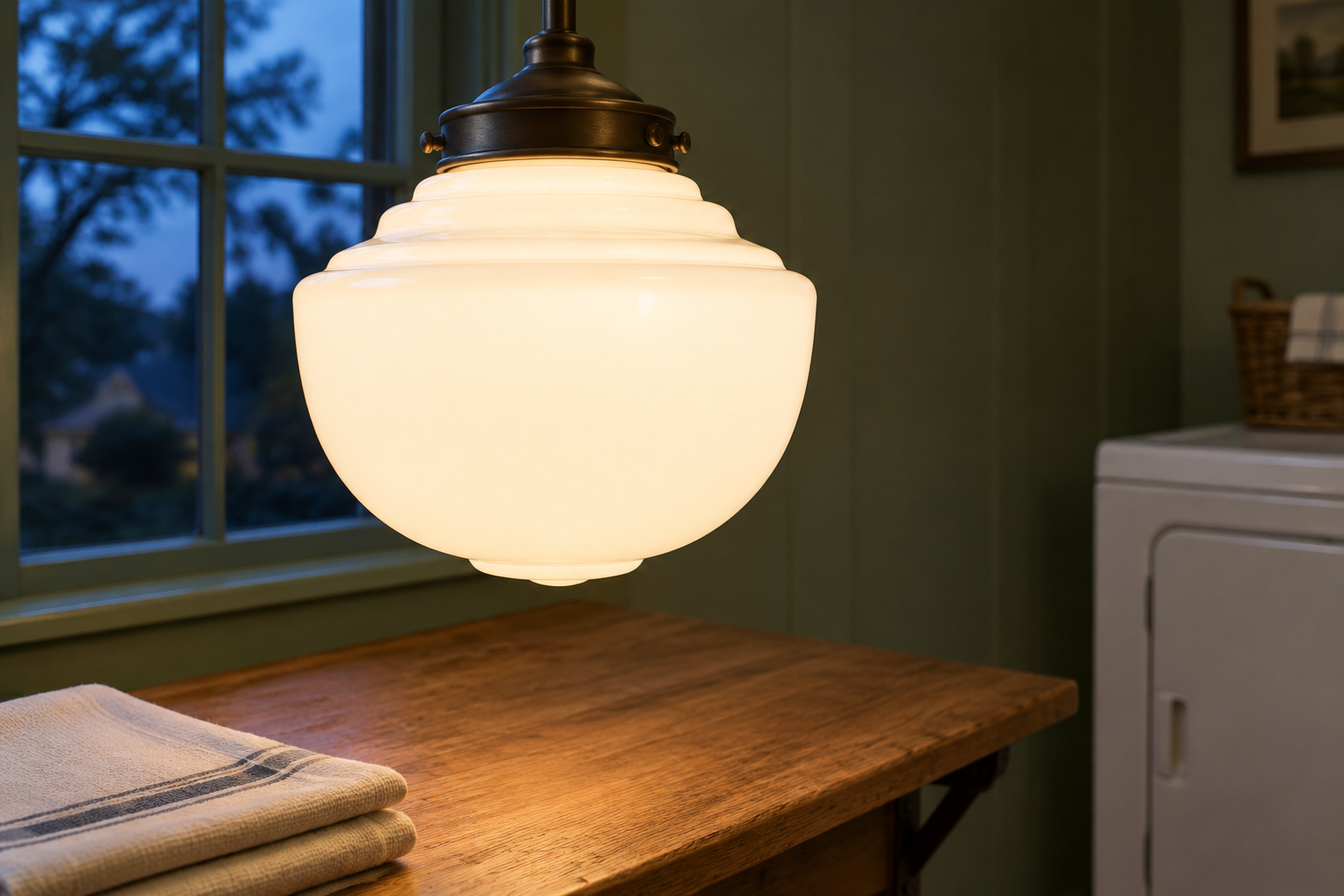

A milk-glass schoolhouse globe hangs on a short stem over the folding counter, and when the switch goes on the whole shade glows, evenly, the way opal glass was made to, with no bulb glaring through it. Towels are stacked under it.
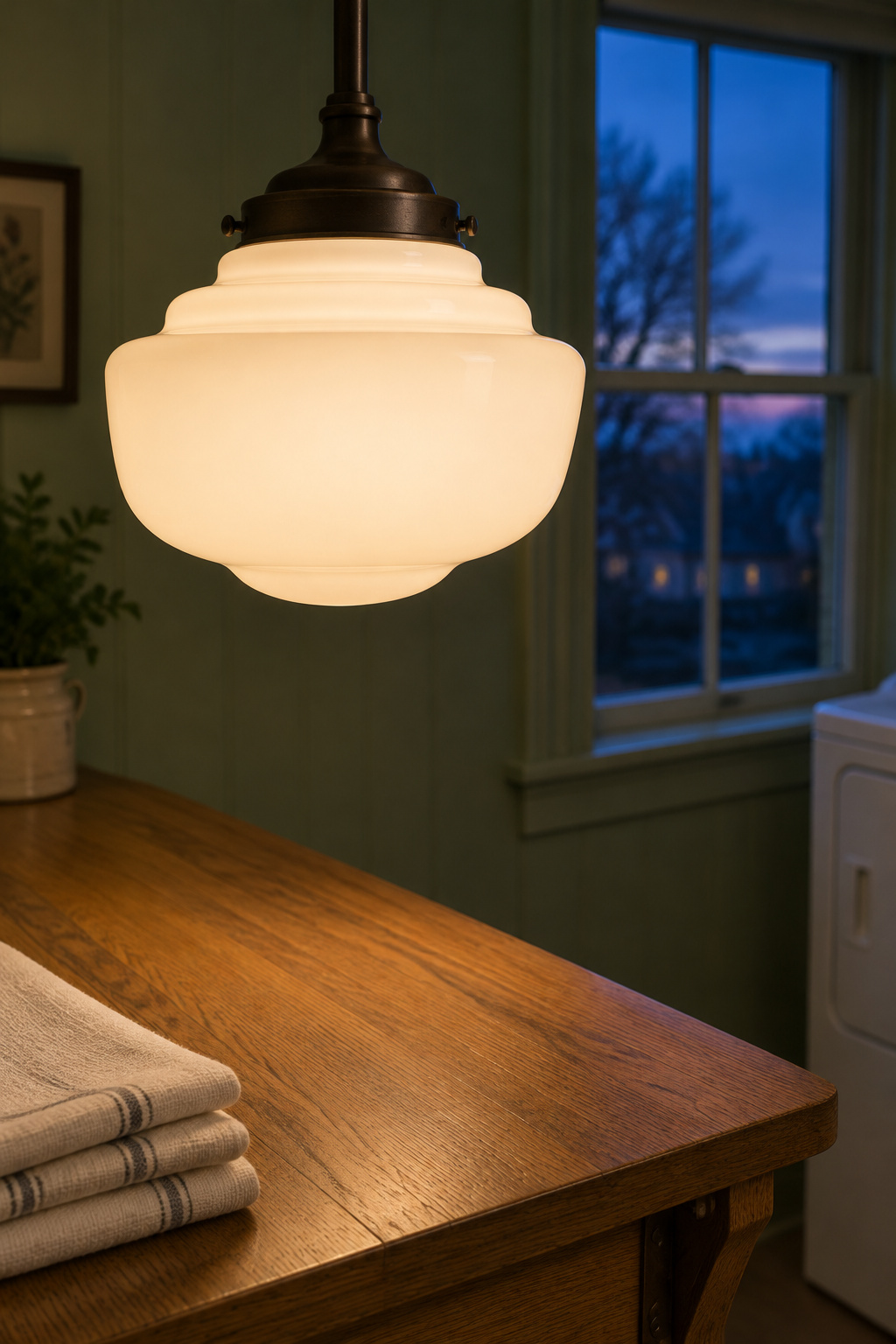
For vintage laundry room lighting, the photographs that sell the look and the people who restore old lights for a living disagree about one thing. The galleries show the shade switched on and leave it there. A lighting restorer at Fritz Fryer puts the other side plainly: “most antique lights will need to be rewired.” Both are right, about different parts of the same fixture. The glass is the heirloom. The socket, the cord and the wire behind it are consumables that happen to be old, and in a room full of steam they face a test their makers never set.
TL;DR
- Keep the shade, canopy and cage; replace the socket, cord and wire, because old insulation turns brittle and cracked sockets are a listed hazard, while glass and steel outlast them.
- No code text names a residential laundry room a damp location, so your inspector decides; a fixture marked “Suitable for Damp Locations” is the sensible precaution and can also go anywhere dry.
- A rewire runs from about $15–35 at a hardware-store counter to about $150 per arm or socket at a specialist, and a plug-in swag kit from a major retailer is listed for dry locations only.
Vintage Laundry Room Lighting at Its Best: One Shade, Switched On, Doing Its Job
That globe is doing two jobs at once. It lights a counter where shirts get folded, and it gives a plain room a single old object to look at. One good lamp beats a wall of recessed lights for reading, and I think the same holds over a laundry counter: a single shade placed over the work does more for the room than a grid of cans.
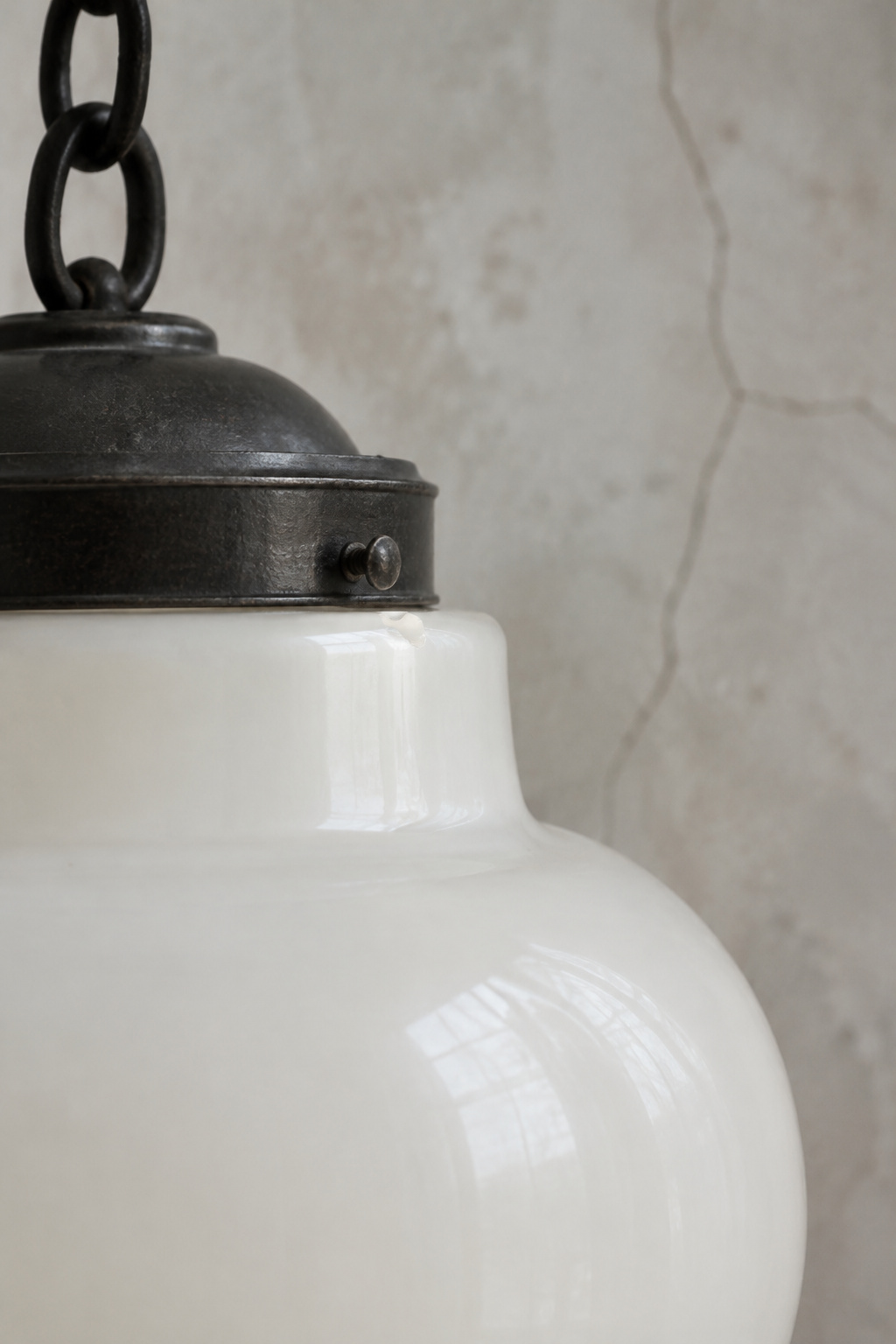
Three families of old shade suit this room: schoolhouse glass, the opal globe that 1920s and 1930s catalogs sold for schools and stores; enamel and porcelain barn shades, steel coated in glass, descended from early-1900s warehouse and farm lights; and the small fittings, the keyless porcelain socket and the jelly jar. Good reproductions copy the schoolhouse outline closely, so the shape tells you neither the date nor whether the fixture is safe.
My standard for all of them: the shade, canopy and cage are worth keeping; everything that carries current is replaced. The rest of a room built from old pieces is covered in our vintage laundry room decor ideas, and how much light a laundry needs for the work itself belongs to the modern laundry room lighting guide.
Keep the Shade, Canopy and Cage; Replace Socket, Cord and Wire
I keep a reading lamp with a brass arm that I bought at an estate sale, and I have had it rewired twice rather than replace it. The arm and the shade are the good part. The wire and the socket are what wear out, so those are what get renewed, and the lamp carries on. The same method works on a desk lamp or a barn shade.
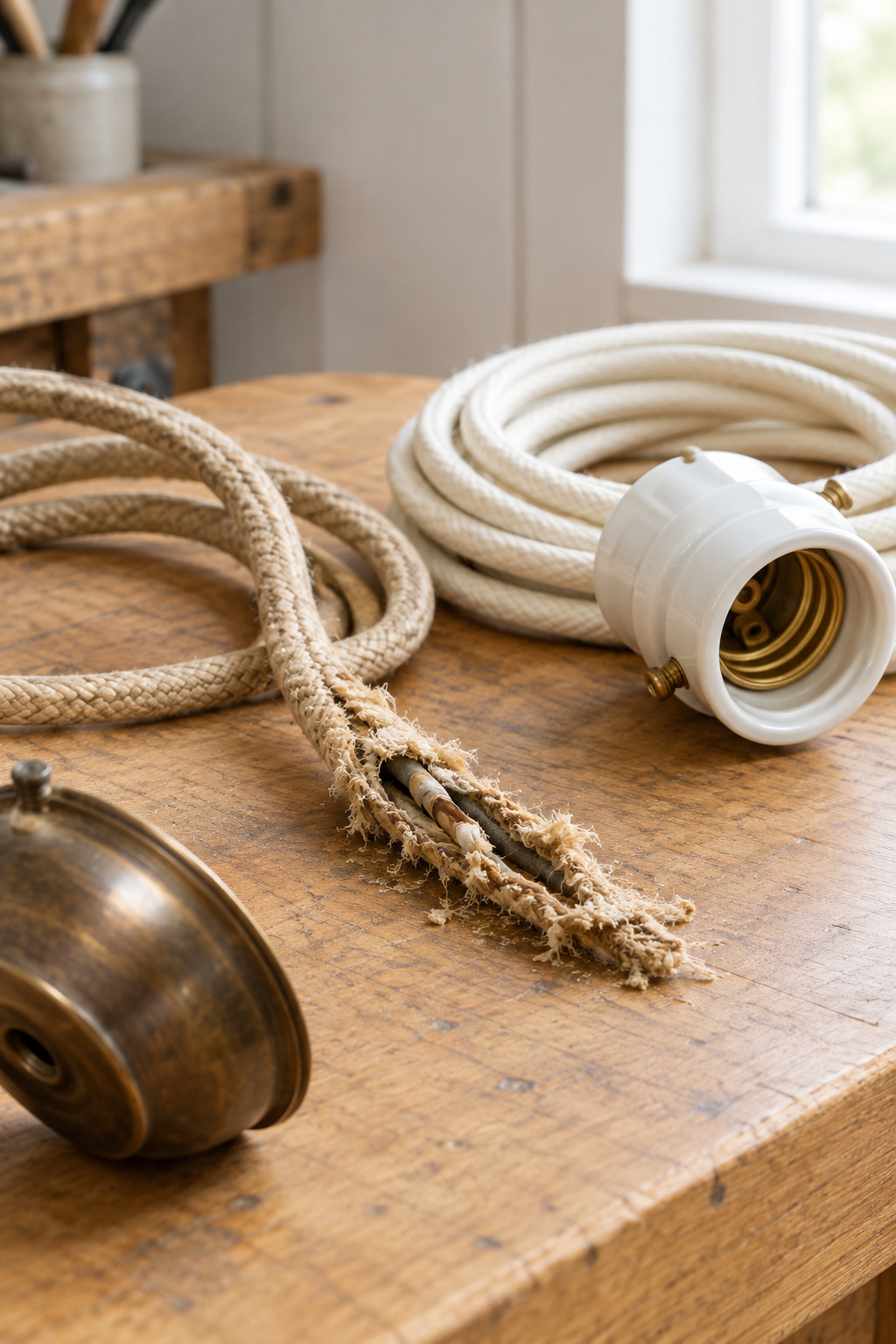
Restorers agree on where old fixtures fail. Insulation goes brittle: one restorer quoted in This Old House describes it “totally cracking up”, leaving a fixture uninstallable until it is rewired. Cracked or corroded sockets, frayed wiring and a missing ground complete the list. The list has no frequency ranking; any one is reason enough.
| Part | Keep or replace | Why | What to check |
|---|---|---|---|
| Glass or enamel shade | Keep | Glass and enamelled steel do not age like insulation | Cracks in glass; chips and rust in enamel |
| Canopy, housing, cage | Keep | Metal parts outlast the wiring | Corrosion; a sound mounting point |
| Socket | Replace | Cracked and corroded sockets are a listed hazard | Choose a listed socket with the same switch type |
| Cord or cloth-covered wire | Replace | Old insulation turns brittle | Insulation that cracks when flexed |
| Ground | Add if missing | Older fixtures may never have been earthed | A grounding screw on the new parts |
The code wants listed parts, so the new socket should carry a UL mark, and keeping the original switch type protects the fixture’s value.
The Damp Rating Is the Test Your Old Fixture Never Took
Indoors does not mean dry. A dryer vent run and a sink that splashes are moisture, and no code text names a residential laundry room a damp location either way. The codes define the categories, and UL 1598, the standard for luminaires, defines them most usefully for a homeowner:
| Location | What it means | Where a fixture marked for it may go |
|---|---|---|
| Dry | Not normally subject to dampness | Dry locations only |
| Damp | Normally or periodically subject to condensation in, on or next to the equipment | Damp or dry |
| Wet | Water or other liquid can drip, splash or flow on or against the equipment | Wet, damp or dry |
The right-hand column comes from NEC 410.10(A), which ties a fixture’s marking to its location and requires damp and wet fixtures to keep water out of the wiring and the lampholder. A steamy laundry plausibly meets that definition of periodic condensation; a fixture right over a splashing sink may be closer to wet.
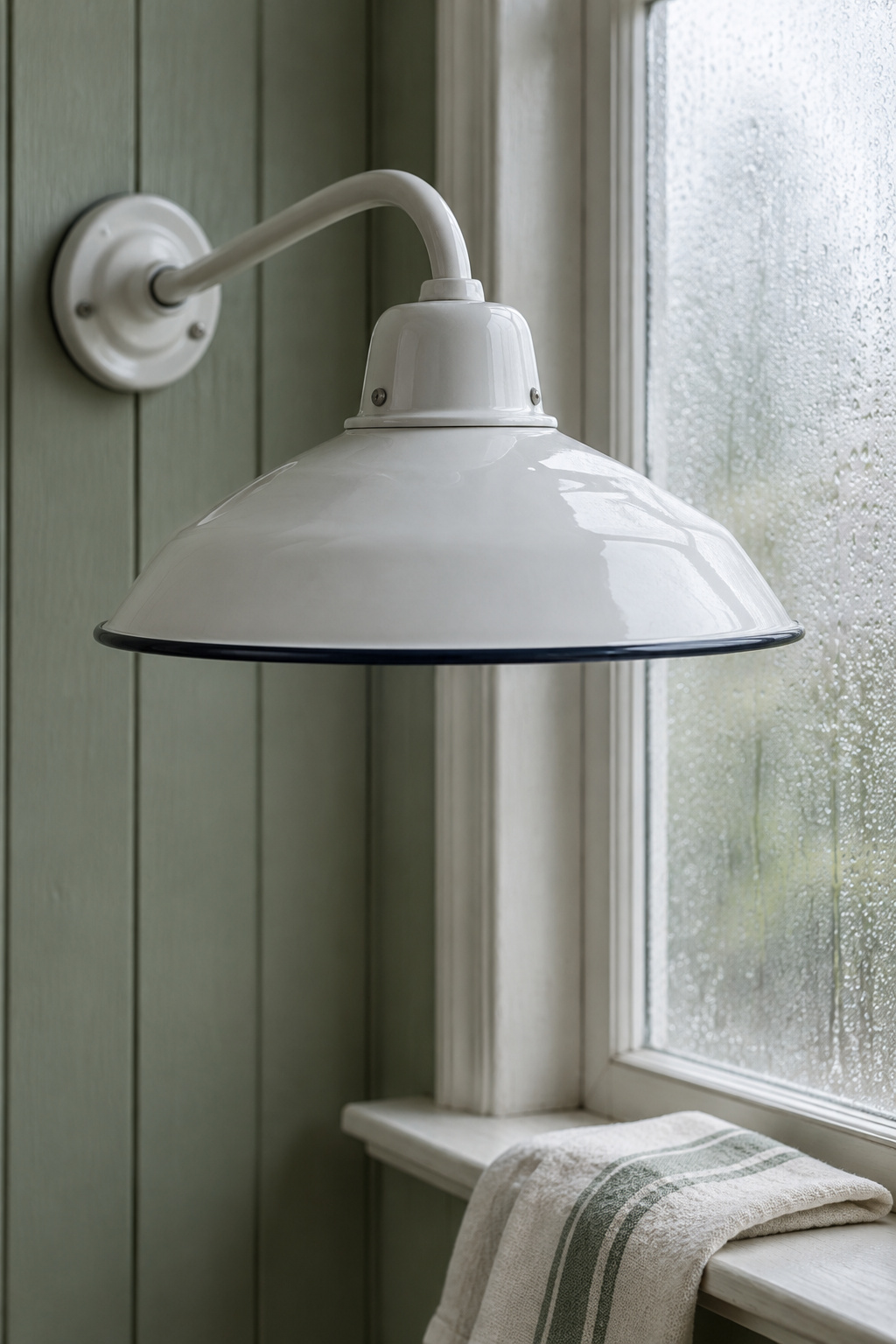
So the classification is your inspector’s call. Ask which marking they will accept. A fixture marked “Suitable for Damp Locations” is the sensible precaution, because it may also hang anywhere dry. An unrestored salvaged fixture carries no modern marking at all.
Pick by the Shade: Schoolhouse Glass, Enamel Barn or Jelly Jar
Schoolhouse glass over the counter
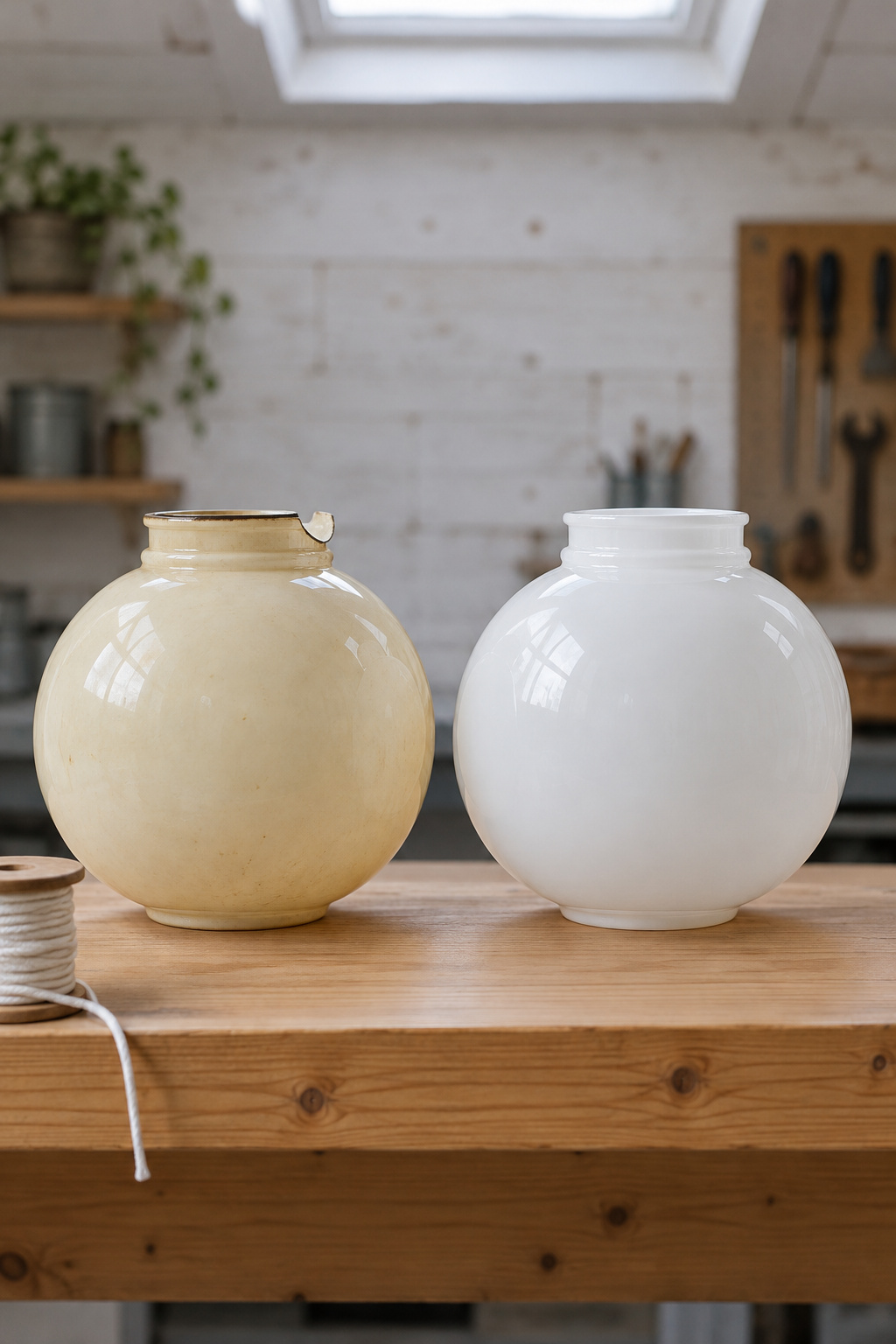
The opal globe is the gentlest light of the three, because the glass scatters it and hides the bulb. It belongs over a counter or a folding surface. Buying a replacement globe means matching the fitter, the ring the glass sits in: in one documented 1930s line, a 10-inch glass took a 4-inch fitter and the 12-, 14- and 16-inch glasses took 6-inch fitters, so measure yours before you shop.
Enamel and porcelain barn lights on the wall
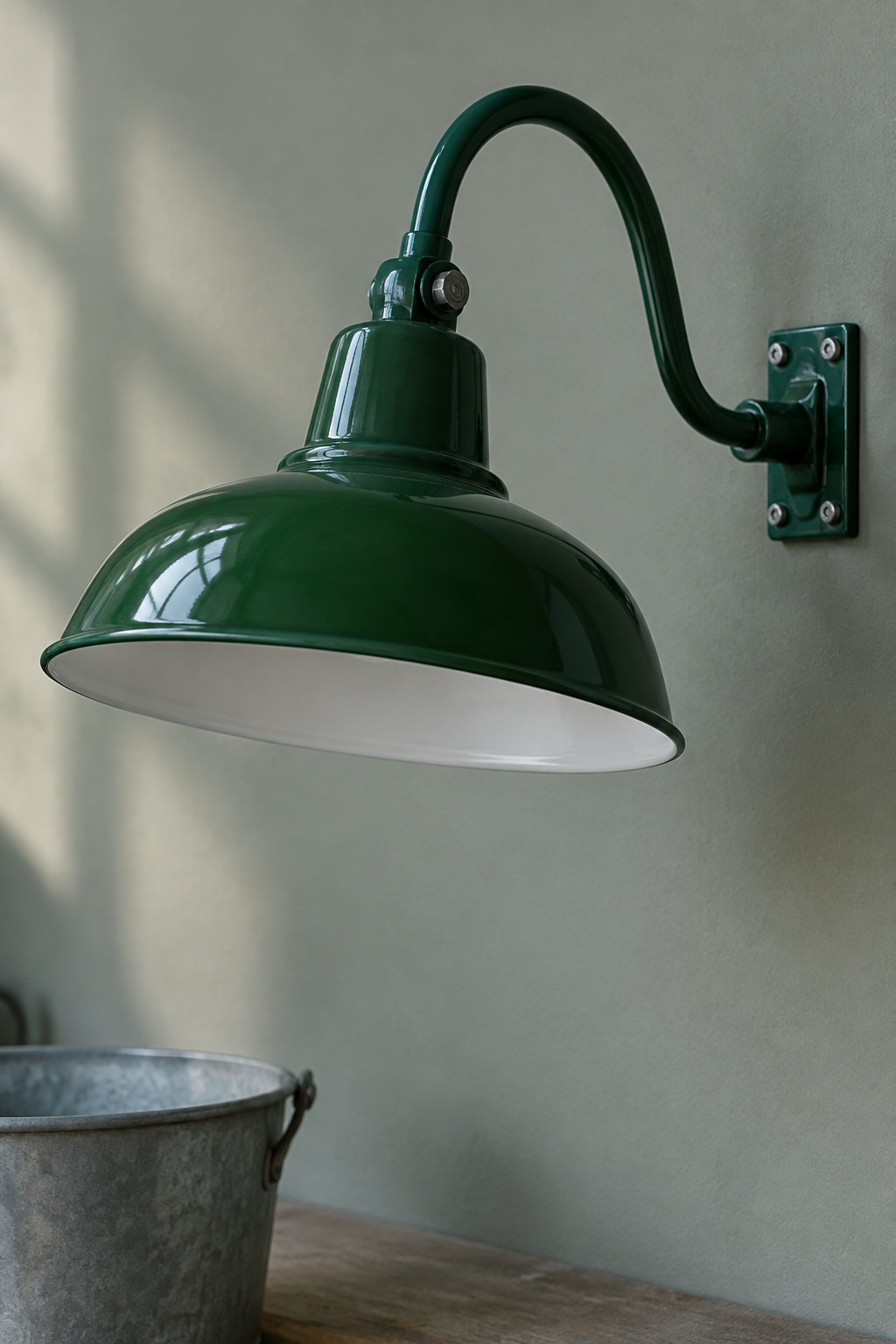
A barn shade on a gooseneck arm throws light down a wall rather than across a room, and light that rakes across a surface shows its texture. That makes it the natural partner for lighting a washboard on the wall, where the ridges and the worn frame are the whole point. Check the enamel for chips and rust before paying.
Jelly jars and keyless porcelain sockets
The jelly jar has no formal definition; it is a trade nickname for a jar-shaped glass shade, often with a wire guard. The keyless porcelain socket under it is older than most people guess. It was designed in 1910 for the Edison bulb and is still made by Leviton in New York, and a basic one costs about $1.50 to $1.92 (the cheapest heirloom in the house). Industrial cages ask the same questions of their wiring.
Salvaged or Honest Reproduction, and What a Rewire Really Costs
Salvage is worth the rewire when the shade is sound and the canopy whole. When the shade is cracked or parts cannot be matched, a reproduction listed to current standards is a sound choice.
Repair shops’ posted prices run from about $15 to $35 for a basic lamp repair at the low end, through $85 to $95 for a table or floor lamp at a specialist, up to about $150 per arm or socket on a hardwired fixture at the high end. A one-socket barn shade at the specialist rate is therefore about $150, and a three-arm fixture about $450. No shop publishes a flat price for taking down, rewiring and rehanging a ceiling schoolhouse fixture, so get a quote for the hanging separately.
Clark Vintage Lighting offers UL Listing on request for hardwired ceiling and wall fixtures that qualify under UL 1598, which is a route to a salvaged shade that also carries a marking. A plug-in swag kit is the popular shortcut for hanging an old shade without an electrician, and the listing decides whether it suits a laundry: a two-socket kit sold by Home Depot is listed for “indoor, dry location” only, and the 2023 electrical code wants a laundry area’s light on a wall switch at the entrance, which an in-line cord switch is not.
The fixtures I would walk away from:
- Insulation that crumbles when you flex it, on a fixture with nothing else to recommend it
- A cracked shade, since the shade is the only reason to pay for the rest
- Missing parts a restorer cannot match
- A rewire plus listing that costs more than a listed reproduction
Warm Bulbs for Old Glass, and Where the Glow Stops Being Enough
Where do you actually fold and iron? The answer decides how much you can ask of an old shade.
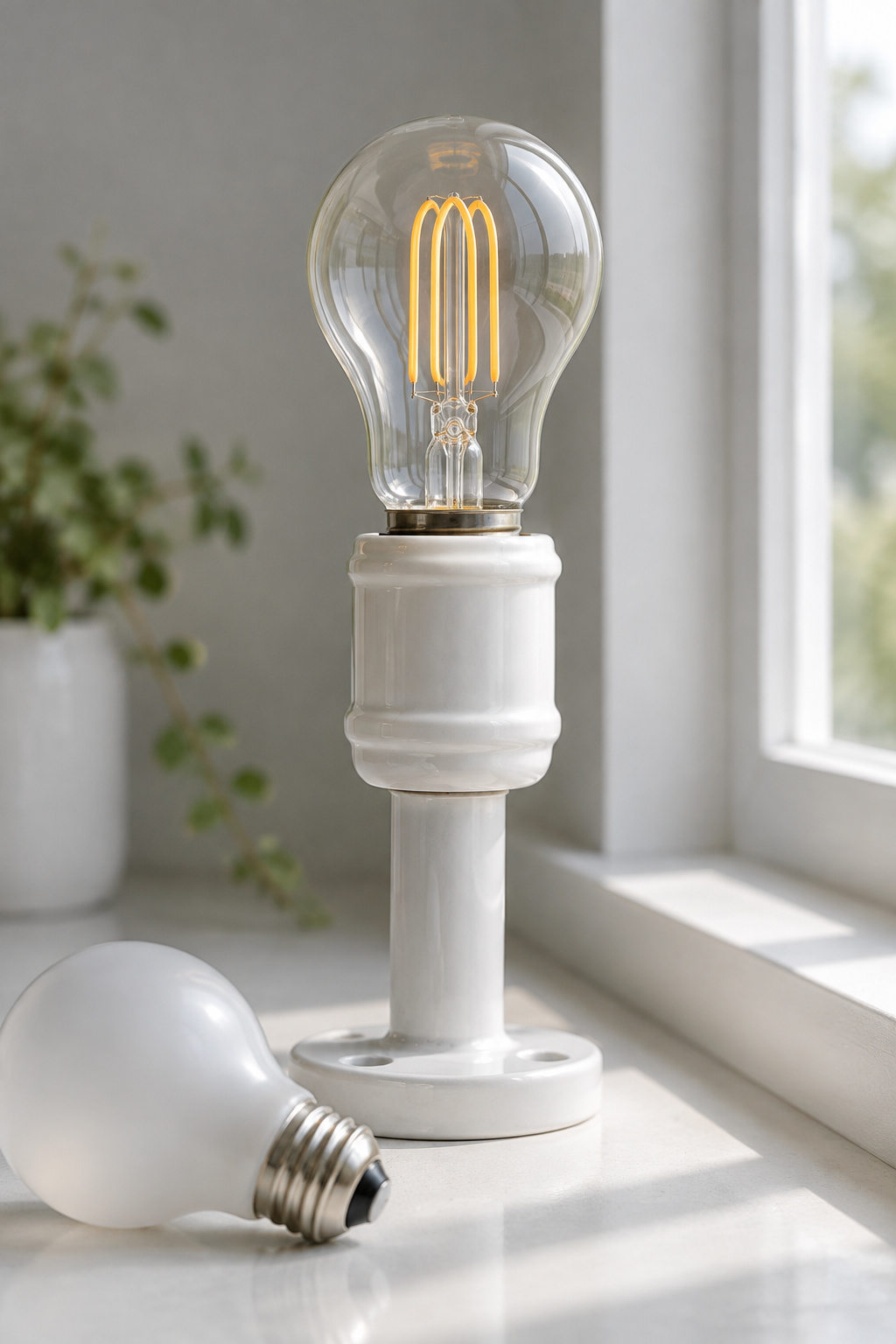
For the look, a warm filament-style LED around 2700K suits old glass. A 2200K bulb gives the amber of a visible filament, and I would use it only for that look: whites go cream under it, and it seems dimmer than its lumens suggest. The bulb carries its own markings, separate from the fixture’s. Signify’s Philips Classic filament LED is marked for wet locations, yet its datasheet answers “can it be used in closed luminaires” with a flat no, so it suits an open barn shade and not a closed globe. For a globe, choose a bulb marked for enclosed fixtures, and never exceed the fixture’s maximum wattage in actual watts; the “equivalent” figure on an LED box only compares brightness.
The glow is atmosphere. Working light comes from a separate task source, and the levels belong to the modern laundry lighting guide. If there is an ironing board in the room, give it its own light where the ironing happens and keep the old shade for the glow.
That leaves the globe lit over the counter, now with a listed socket, sound wire and a damp marking, and a bulb that suits the glass. I choose old lamps and look after them, and I am not an electrician. The rewire and the hanging of a hardwired fixture go to an electrician or a lamp-repair shop, and the question of which marking a laundry room needs goes to your inspector.
FAQ
How do you clean old milk glass or enamel lamp shades without damaging them?
Take the shade down, brush or vacuum it gently from the top down, then wash unpainted glass in warm soapy water, pat it dry and let it air-dry. Test painted or decorated areas with a cotton bud first. For enamel, test a hidden spot first and skip abrasives.
Can you convert an old fixture to plug-in instead of hardwiring it?
You can, with a plug-in swag kit, which is aimed at renters. The catch in a laundry room is the listing: a two-socket kit sold by Home Depot is rated for indoor, dry locations only, and the cord runs visibly down the wall. Ask your building department whether a plug-in fixture is acceptable in your laundry before buying one.
How high should a schoolhouse or barn light hang in a small laundry room?
Over a counter, start at 30 to 36 inches from the surface to the bottom of the shade, nearer 30 under a low ceiling. That range is kitchen-island guidance borrowed for the laundry. Over open floor where people walk, allow about 7 feet. Check the sightlines standing at the counter.