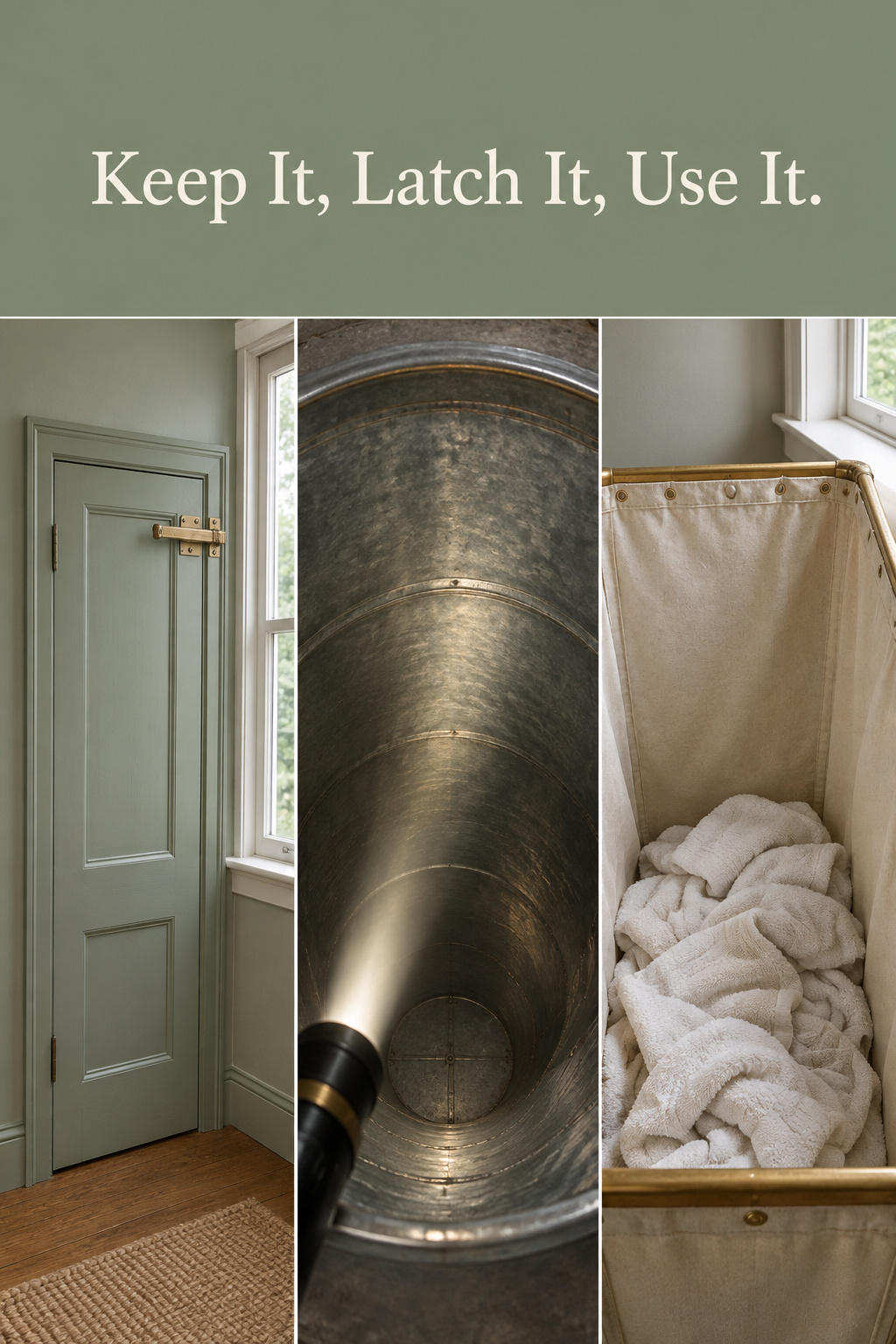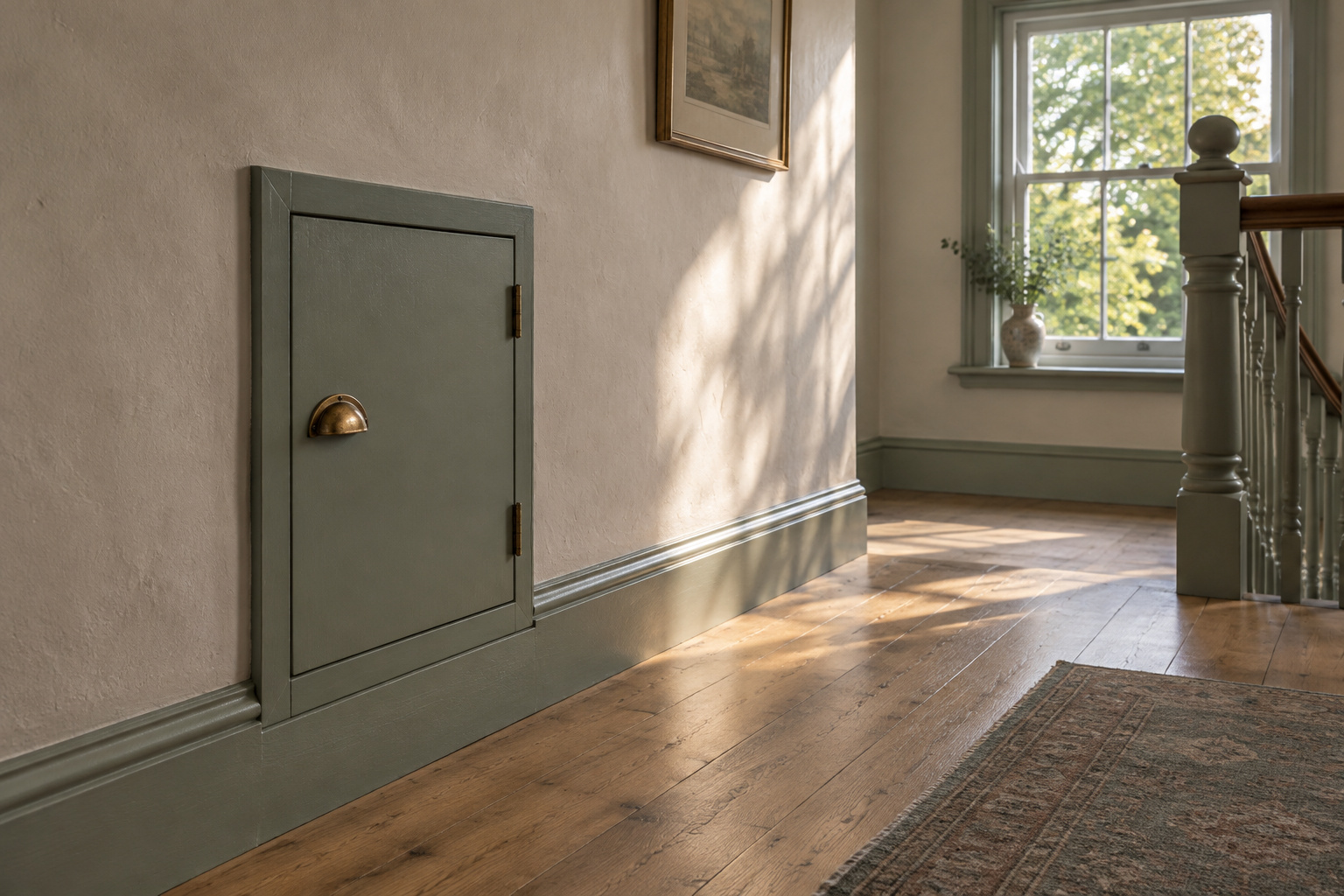

The best laundry helper in your house may be a small painted door at the top of the stairs. You open it, drop the towels, close it, and skip the trip to the basement. Laundry chute ideas usually start with someone who has carried one load too many and noticed that older houses solved this a century ago.
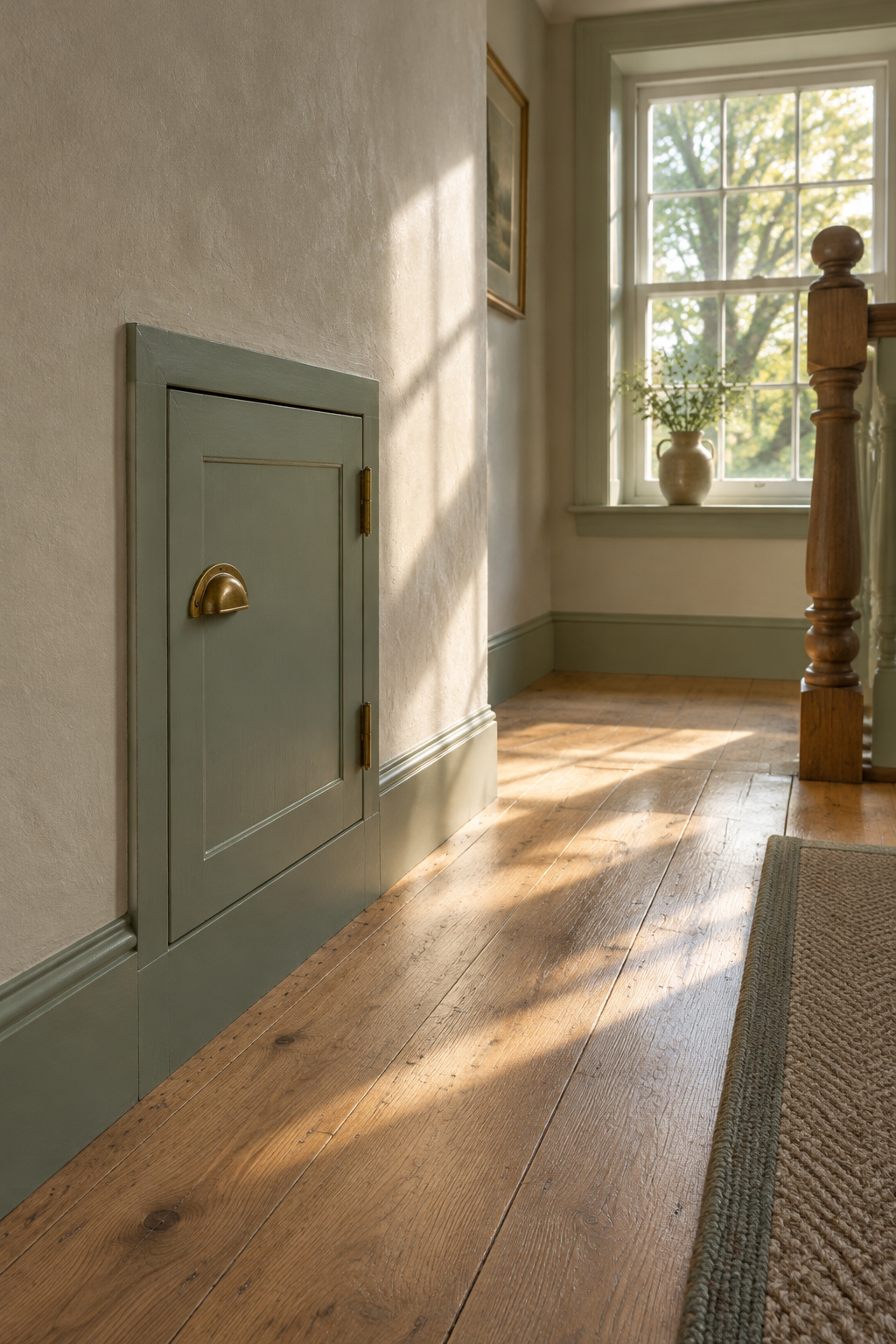
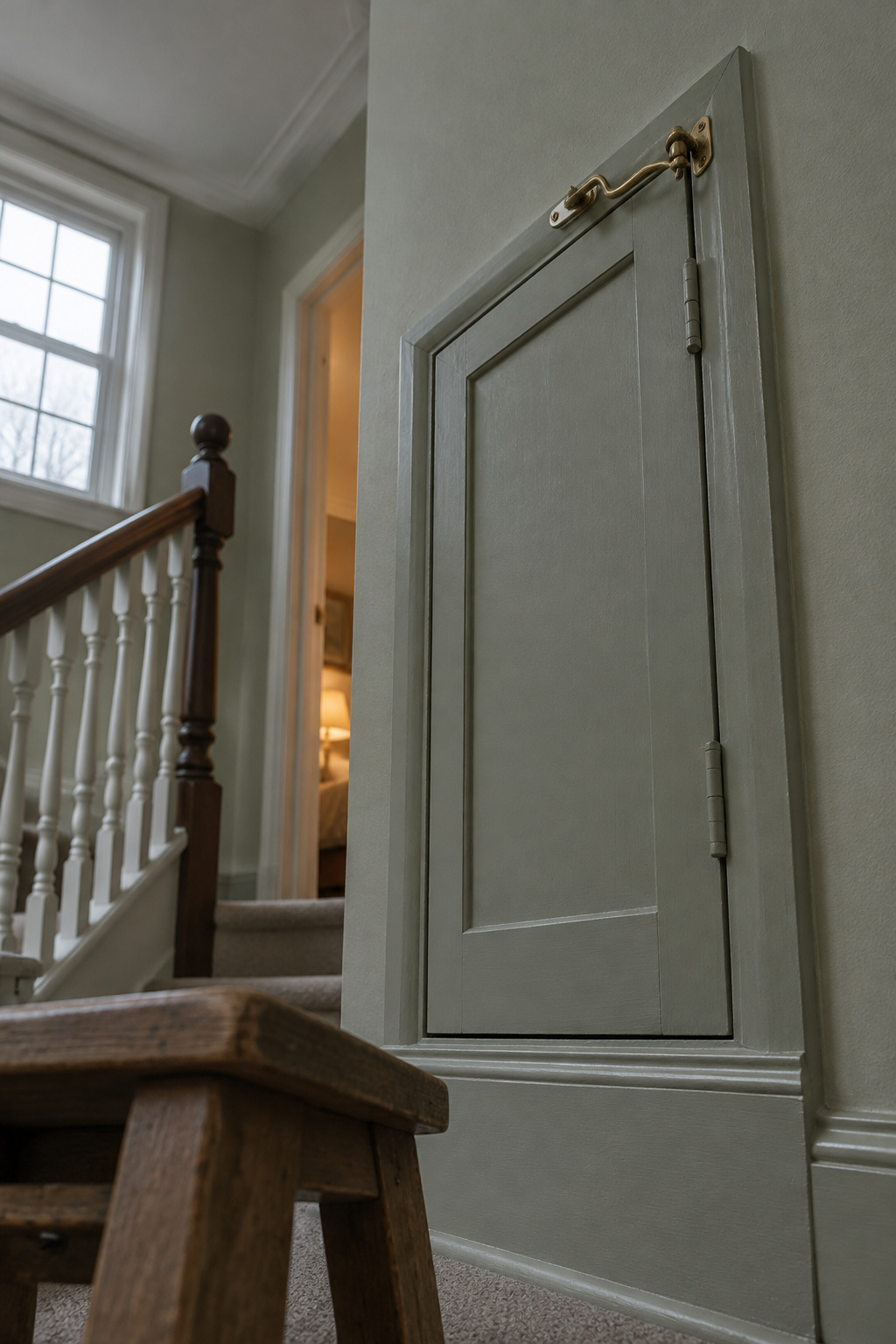
Handsome doors and build photos are easy to find, and so is the odd toddler news story told as a scare. A parent with a two-year-old needs something plainer. Keep the chute, or add one, for the trips it saves. Then make its door the one your children cannot open: latched above their reach and closing on its own. No opening is small enough to trust, so the door does the work.
TL;DR
- A chute saves a trip downstairs with a basket on every load, and waking an old one means cleaning the shaft, freeing the door, fitting a latch and putting a bin at the bottom.
- Adding one is real building work: one guide gives $1,050 to $4,300, another puts most projects from about $800, and a standard 3.5 in wall cavity is too shallow, so new framing is almost always needed.
- With small children, the latch goes above your youngest child’s reach while standing on a step stool, and the door should close by itself. A 2-year-old got into a chute only about 7 by 10 in, so size alone is not a safeguard.
Read the chute you have: the shaft, the door at the top and where it lands
An old chute is a simple machine. A small door in a hallway, bathroom or closet opens onto a shaft, usually a sheet-metal or wood box, that runs straight or with a gentle bend down to the laundry below. In a typical house that run is about 9 to 10 feet. Some covers were spring-hinged so they swung shut on their own.
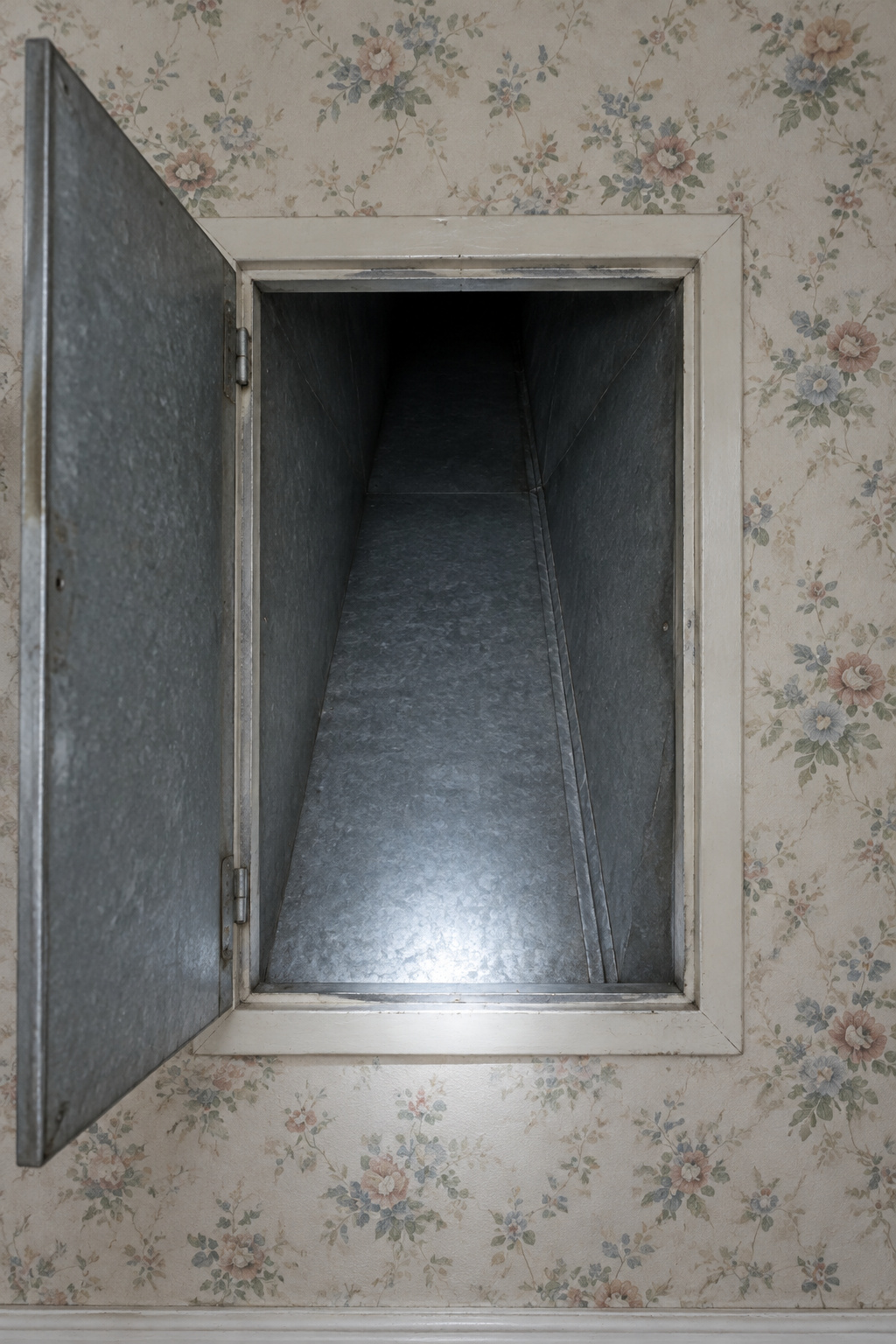
The idea likely came from industrial coal and rubbish chutes, and by around 1900 wealthy households used them to get dirty laundry out of sight. Chutes faded when newer houses put the laundry on the bedroom floor, though apartment buildings and hotels still have them.
If your house has one, open the door and look in before you decide anything. Old houses that hid a chute behind a small door sometimes hid other useful things the same way, like the fold-down ironing board in an old wall.
Laundry chute ideas for the top: hatch, cabinet door or flush panel
The door is the part you see every day, so it is tempting to choose it on looks. Choose it first on whether it latches and whether it closes by itself. Painted wood is the most common finish.
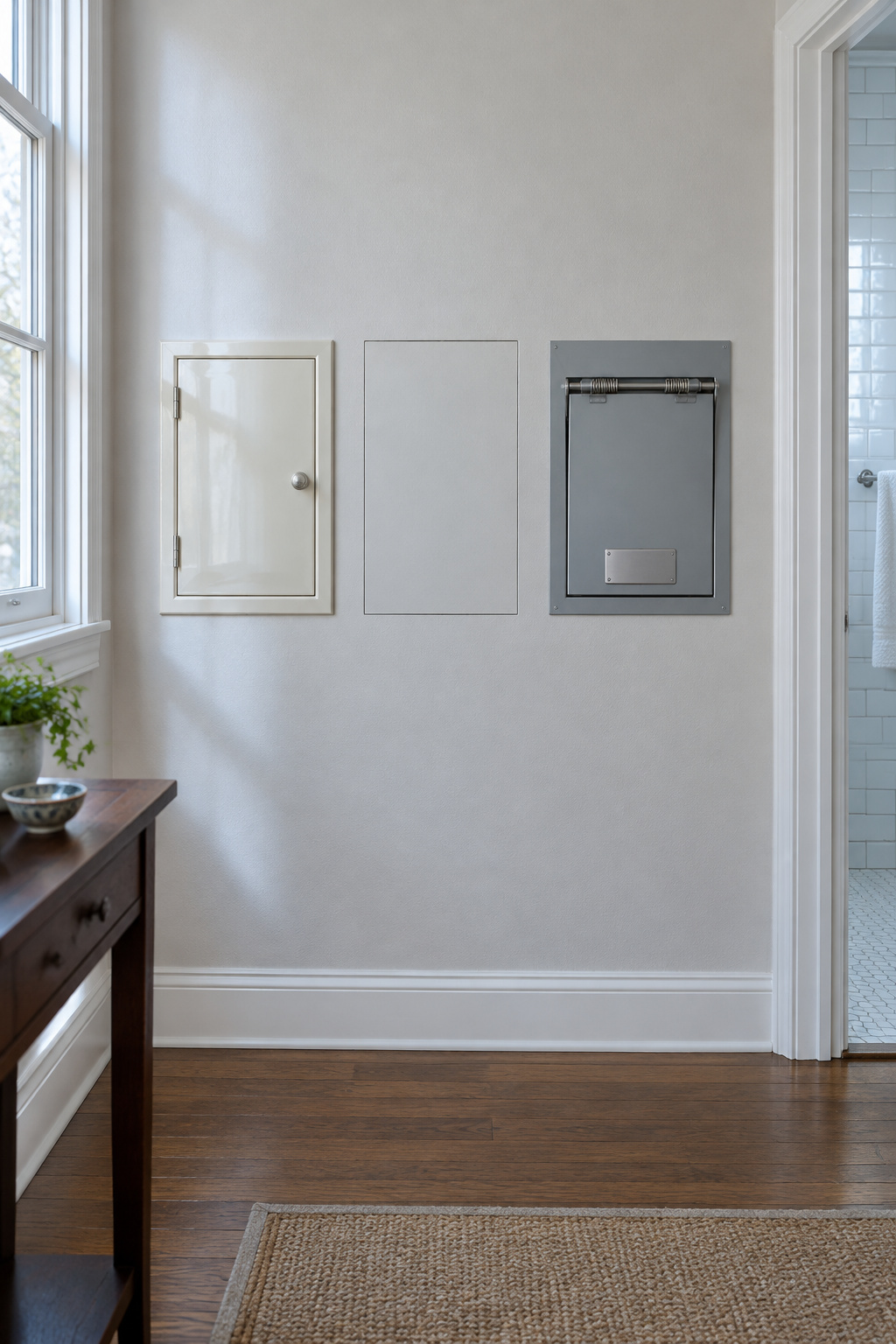
| Door style | How it opens | Closes by itself? | Latch | Notes |
|---|---|---|---|---|
| Hinged cabinet-style door | Swings out from a frame | Not unless a closer is fitted | Takes a cabinet latch or lock | Standard door alone $100 to $300; works well in closets |
| Flush panel | Swings out, level with the wall | Not unless a closer is fitted | Child locks fitted as standard on some | Nearly invisible when painted; needs careful installation |
| Pull-out drawer front | Pulls out like a drawer | No | Takes a drawer lock | Matches cabinetry; the most expensive; custom doors run $400 to $1,500+ |
| Spring push-in flap | Pushes in, springs back | Yes | Spring only | Old powder-coated steel ones came in 10 in or 12 in widths |
| Commercial steel intake door | Side-hinged, lever handle | Yes | Self-latching, keyed | 15 x 15 to 24 x 24 in, $401 to $694; built for apartment buildings |
Look twice at the push-in flap. One builder calls it the easiest to use, and it closes itself, but a door that swings shut is not a door that stays shut. Old flaps likely have no latch, so if you love one, add one. The commercial door is overkill for a house, but it shows the full set.
A landing that takes a drop: bin, shelf or basket
Throw a big towel down the chute and watch where it lands. Most of your laundry will land in the same spot, so that is where the bin goes. Skip any door at the bottom of the shaft, because light clothes hang up on it.
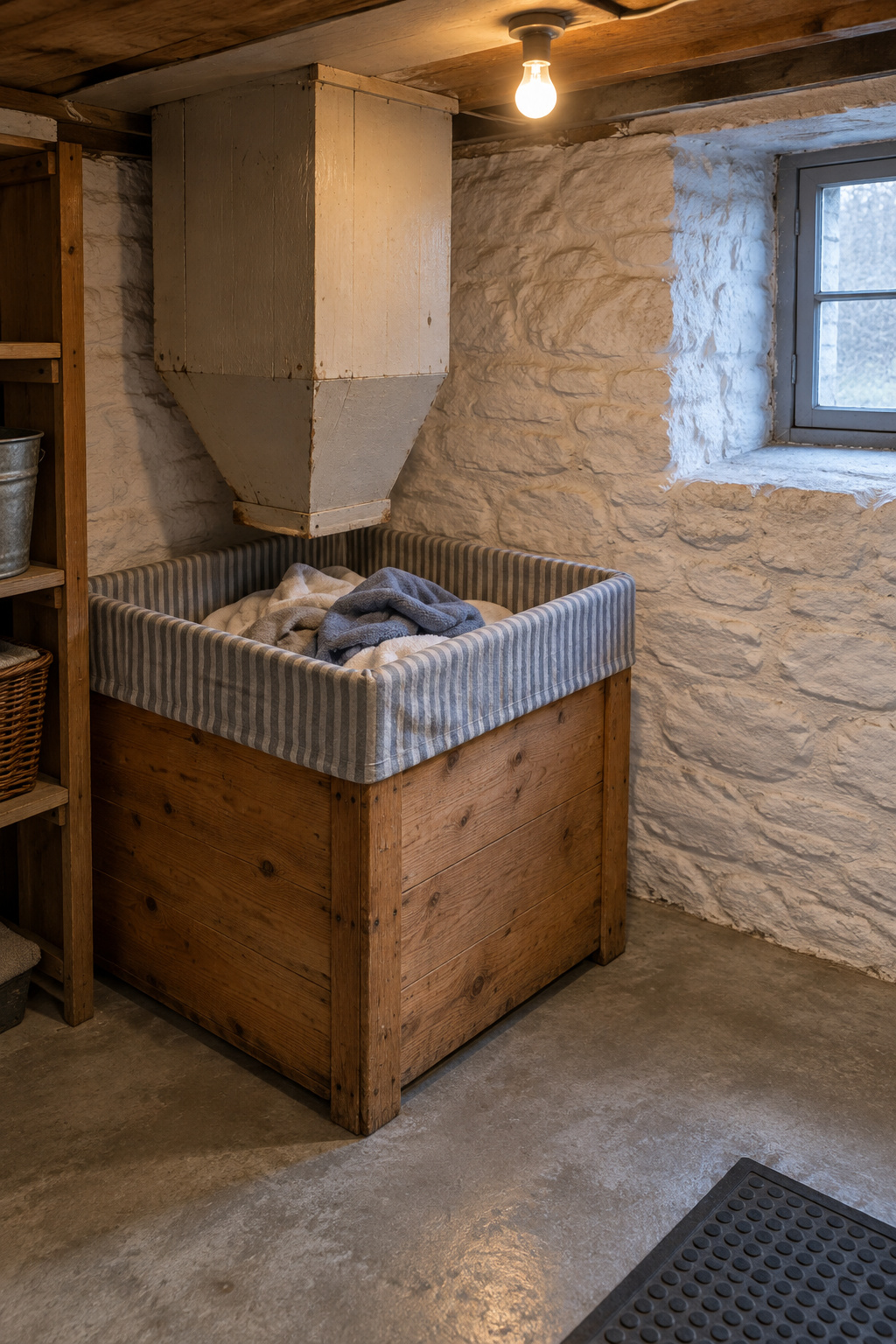
Either a basket sits directly under the outlet or a collection bin is built into the cabinetry below. A loose basket takes every drop, so choose a sturdy old basket for the landing.
A low hook does more for tidiness than any organizer, so put one beside the chute door upstairs for the towel that is not dirty yet. A tired six-year-old will actually use it.
What may go down the chute, and what may not
- Yes: towels, clothes and sheets, completely dry, so the shaft does not start to smell musty.
- No: wet loads, anything breakable, anything with a hard edge or a cord.
- Sort first: small children toss stuffed animals and shoes down chutes, so check the basket before it goes in the machine.
Pods and detergent are a separate question, covered in our childproof laundry room storage guide.
Restoring an old shaft: free the door, clean it, check it
Start a chute that has been shut for years with a light and a vacuum. What a long-closed shaft holds, from nests to damp, is anyone’s guess, so look before you reach in.
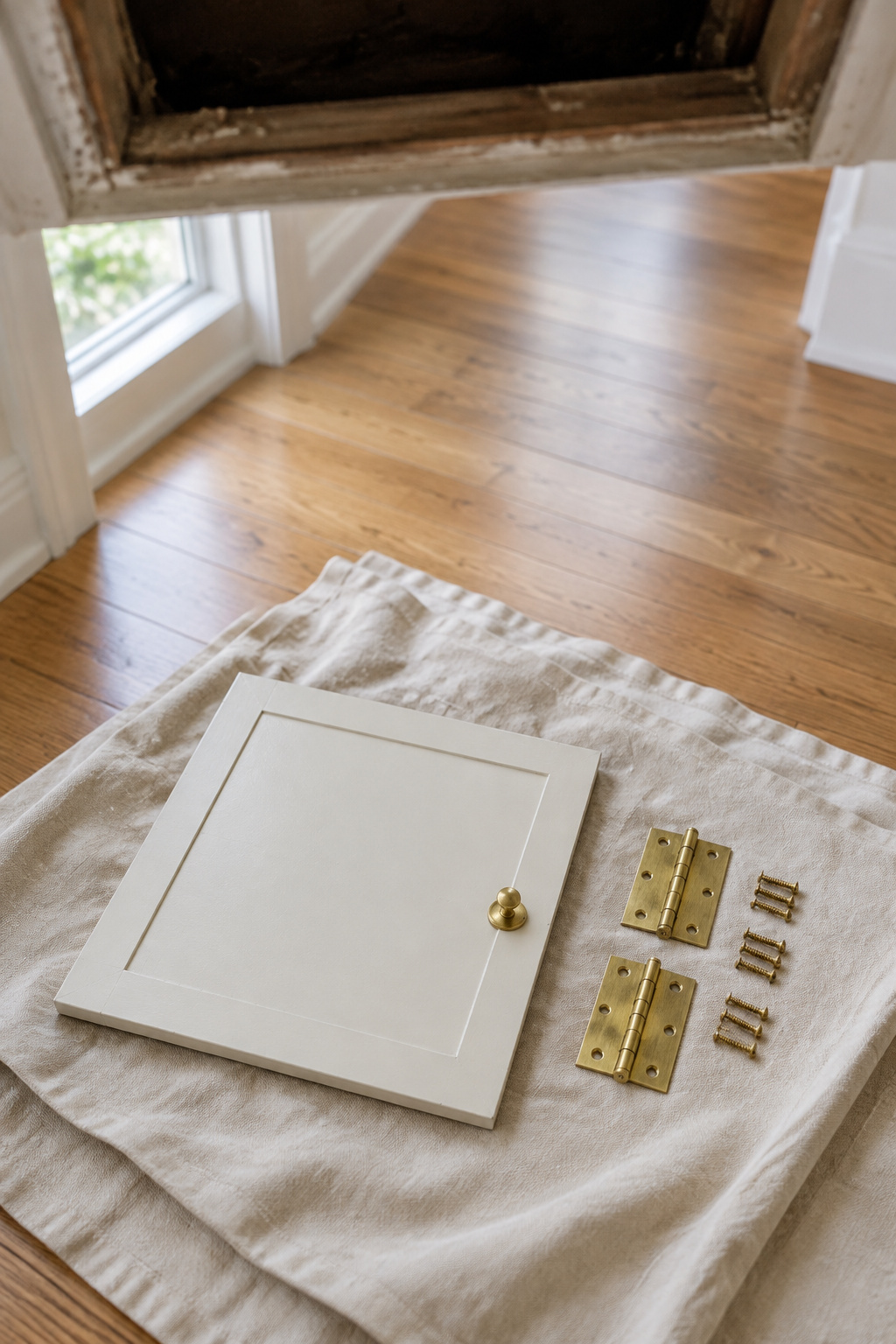
- Open and inspect. Take the door or cover off if you can and shine a torch down the shaft for blockages and build-up.
- Clear it. Vacuum lint and debris from the walls, or use a long flexible brush. For a stuck clog, a plumbing snake or flexible rod works; never a sharp tool, which can damage a thin metal shaft.
- Wipe and smooth. Wipe the inside with a damp cloth. Bare plywood snags synthetics, so a coat of high-gloss paint or paste wax helps clothes slide.
- Free and rehang the door. Clean the hinges and ease the door until it swings freely. Test old paint before you sand it.
- Refit a latch. If the original had none, add one now (more on height below).
- Add a smoke alarm at the top. A vertical shaft can act like a chimney, and the doors are part of what slows a fire.
If restoring means opening plaster walls in an older house, have the old insulation assessed for asbestos before anyone cuts. A working chute is one of the old-house laundry features worth keeping, but only once you know what is inside the wall around it.
Adding a chute: what it costs and where it can run
One Seattle architect allows a clear shaft of 10 by 10 inches, and one renovation guide sets 12 by 12 as the working minimum. Neither fits in an ordinary wall. A standard 2×4 cavity is only about 3.5 in deep, so a new chute almost always needs its own framed chase.
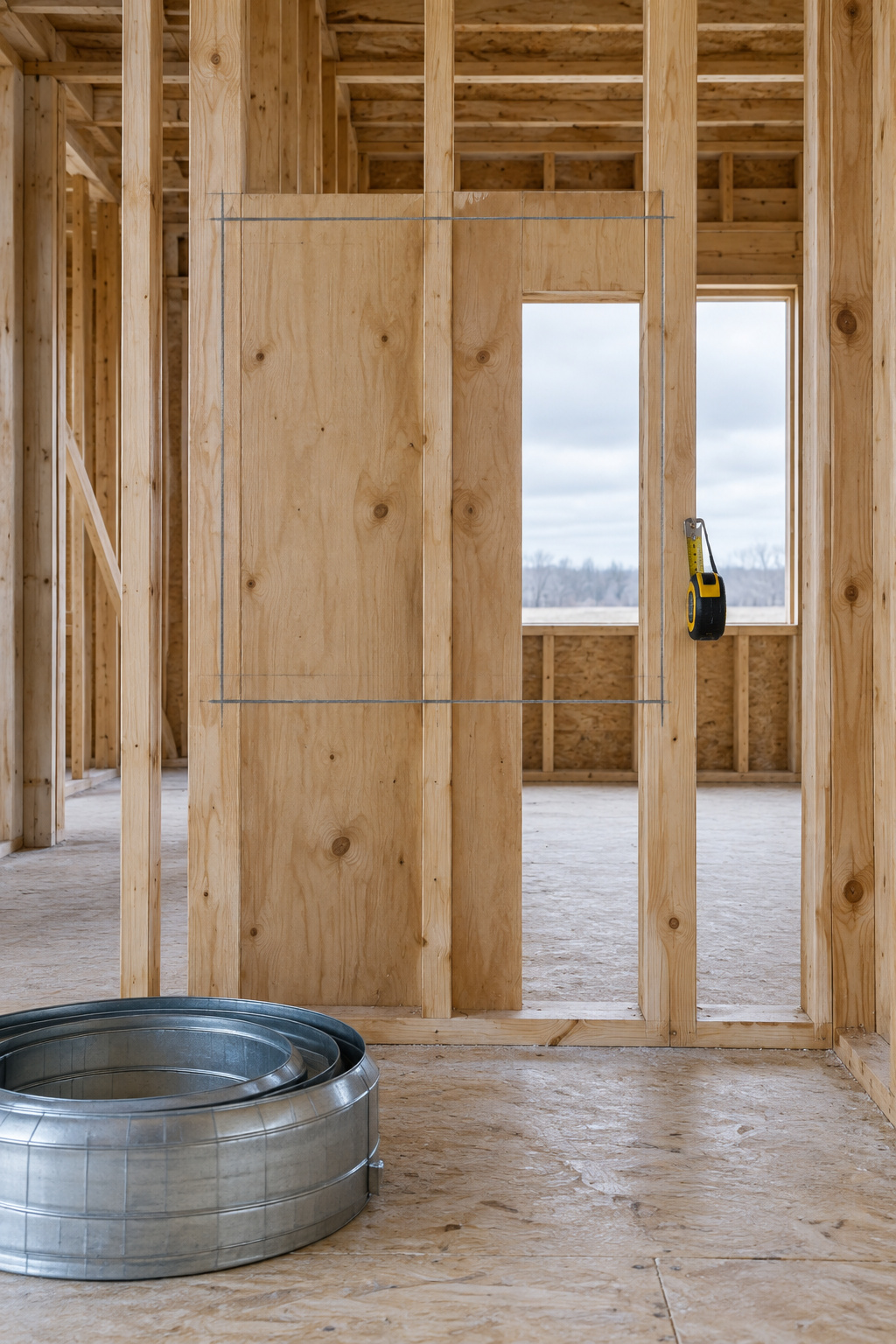
The cheapest route is a straight drop from an upstairs hallway, bathroom or closet into a laundry room directly below; every bend adds length. Expect company inside the wall: one carpenter found a thermostat wire, a water pipe, a drain and three outlet wires in his planned route.
Prices vary a lot. One guide gives $1,050 to $4,300 for a typical build, plus $200 to $600 or more in permit fees, and says building while walls are already open saves $500 to $1,500. Another puts the starting price for most professional installs at about $800, and a third says a chute unit for a two-story house costs around $1,000 before installation.
On code, the model building code’s chute rules carry an exception for chutes inside a single home (section 713.13), and no chute section appears in the residential code. Some local authorities still restrict or ban chutes, so call your building department before you cut a hole in a floor.
The child test: latch height, a door that closes itself, and why size is not enough
In 2012 in Manchester, New Hampshire, a 2-year-old opened an old second-floor chute and slid in. He ended up wedged about 20 feet down inside the wall. The chute was only about 7 by 10 inches, and his parents never imagined a child could squeeze in. He came out with minor injuries.
He is not the only one. A 17-month-old went head first down a 9-foot chute in Michigan in 2008 and landed on a pile of clothes. In Illinois in 2016, a 5-year-old fell in feet first while working out how to throw her shoes down, and was stuck for about half an hour in a chute that narrowed from 9 by 12 in to 6 by 10 in. In Indiana in 2021, an 8-year-old was wedged in a metal chute until firefighters cut through a floor joist. All of them survived, and I tell their stories to explain the test, not to frighten anyone. A toddler’s job is finding out where things go, and a door in the wall is an invitation. That curiosity is healthy, so the door has to be the one that says no.
Kneel at the opening: the three checks
Get down to their height and look at the door the way your child does. Then check:
- The latch is above reach. There is no safe height in inches, because children climb. I keep a step stool in every room with a high shelf, ever since my younger one climbed the pantry shelves. Kids will reach for things regardless, so make the reach safe. Stand your youngest child on a step stool, measure how high they reach, and put the latch above that. Re-measure as they grow.
- The door closes by itself and latches. A self-closing door adds protection, and one renovation guide says it is often required anyway.
- The opening is smaller, as a backup only. A smaller door helps, but a chute wide enough for a towel is wider than the one that admitted that 2-year-old, and an 8-year-old got stuck too, so age is no test either.
A cabinet-style opening about 30 in off the floor is within a toddler’s reach. If two children four years apart share a room, as mine did for years, measure the younger one.
If it fails: fix, shrink or close it
Fit a lock or child lock, move the door higher on the wall, or downsize the opening. If none of that works for your house, close it, as the New Hampshire family did.
The law is less settled. One renovation guide says the residential code demands a one-hour fire-rated shaft and a solid self-closing door that never opens into a bedroom. The code text itself exempts chutes inside a single home. Your building department will tell you which reading applies where you live. The latch is your decision.
FAQ
Can I seal up a laundry chute I do not want to use?
Yes, and families do. After a toddler got into their chute, one New Hampshire family fastened the door shut. That is the quick step. Closing an old shaft properly, including blocking it against fire and drafts, is a job for a contractor or your local building department, who can say what your house needs.
Do laundry chutes let noise, smells or drafts travel between floors?
Noise does. Sheet metal carries sound well, and an open chute with no door passes noise freely between floors, so a door at the top helps. For smells, send down only dry items and clean the shaft. A vertical shaft can also act like a chimney, which is another reason to keep the door closed.
Does a laundry chute still make sense if my washer is already on the bedroom floor?
For that floor, no. Newer houses put the laundry beside the bedrooms precisely so nobody has to carry baskets downstairs, and a chute saves trips only between floors. If you have a third floor above the machines, a chute from there could still spare you a staircase, and the latch rules apply all the same.