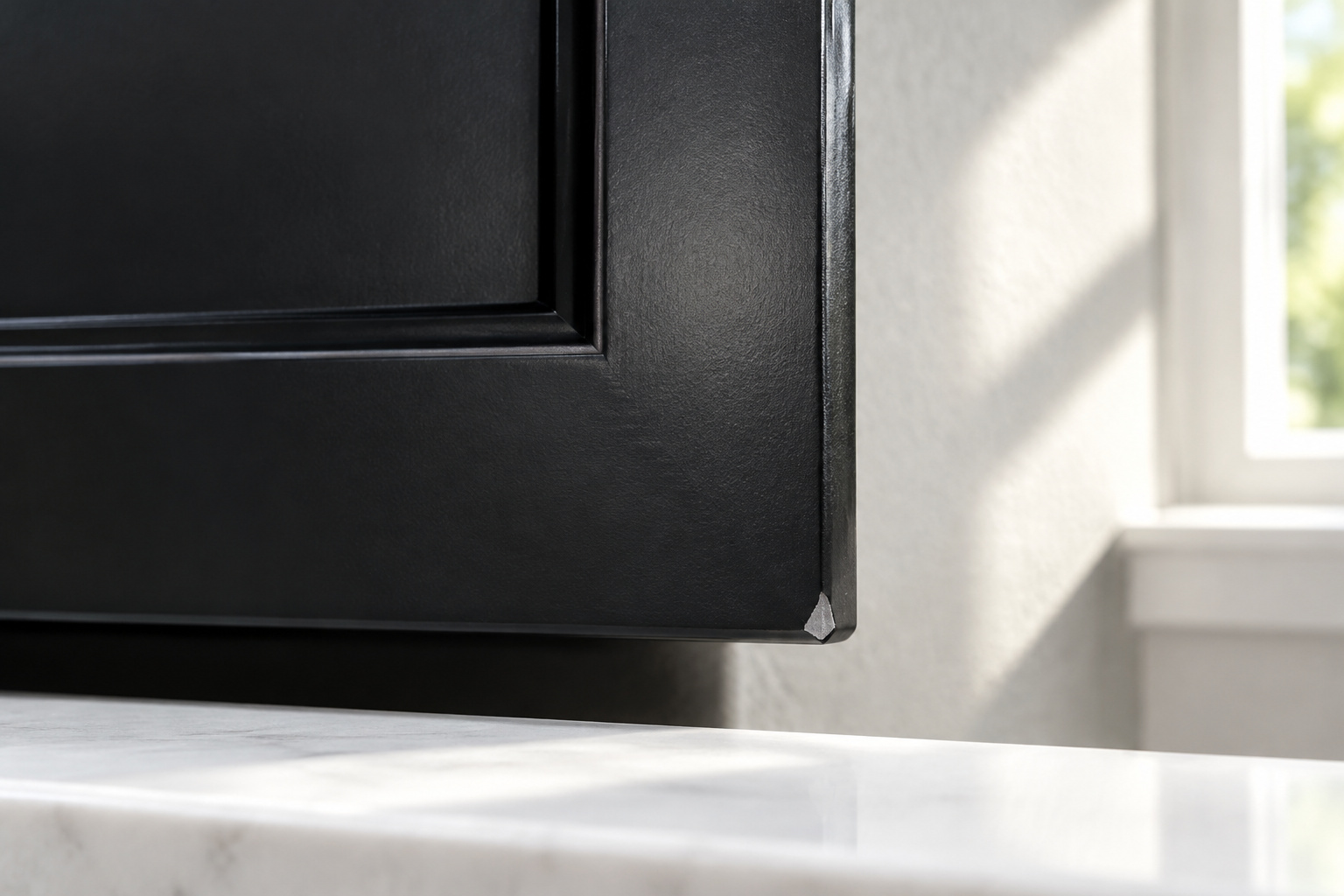

Where does a black bathroom vanity show its first chip? At the corner, and the pale coat underneath makes sure you see it from the doorway. So the choice is whether to buy a vanity finished in black at the factory or paint the one you already have. Painting takes a quart of enamel, a can of primer and about a month before the finish is fully hard. Buying skips the month. The box you have, and the steam your room makes, decide which one is right.
TL;DR
- Paint a sound solid-wood, plywood or MDF vanity, and an intact thermofoil one, but only after a scuff, a bonding primer and two thin coats of cabinet enamel; buy factory black when the thermofoil is peeling or heat-damaged, or the room steams too much to rest for a week.
- Benjamin Moore Advance satin recoats in 16 hours, takes heavy use after 5 to 7 days and needs up to 30 days to reach full hardness, so a vanity primed and painted in three days is fully hard around day 33.
- Pick satin over matte for a bathroom: pros split on it, but satin wipes clean without the shiny patches matte black picks up from hands and scrubbing.
Black bathroom vanity: check the box material before you shop or sand
Open a door and look at the back before you buy paint or a new vanity.
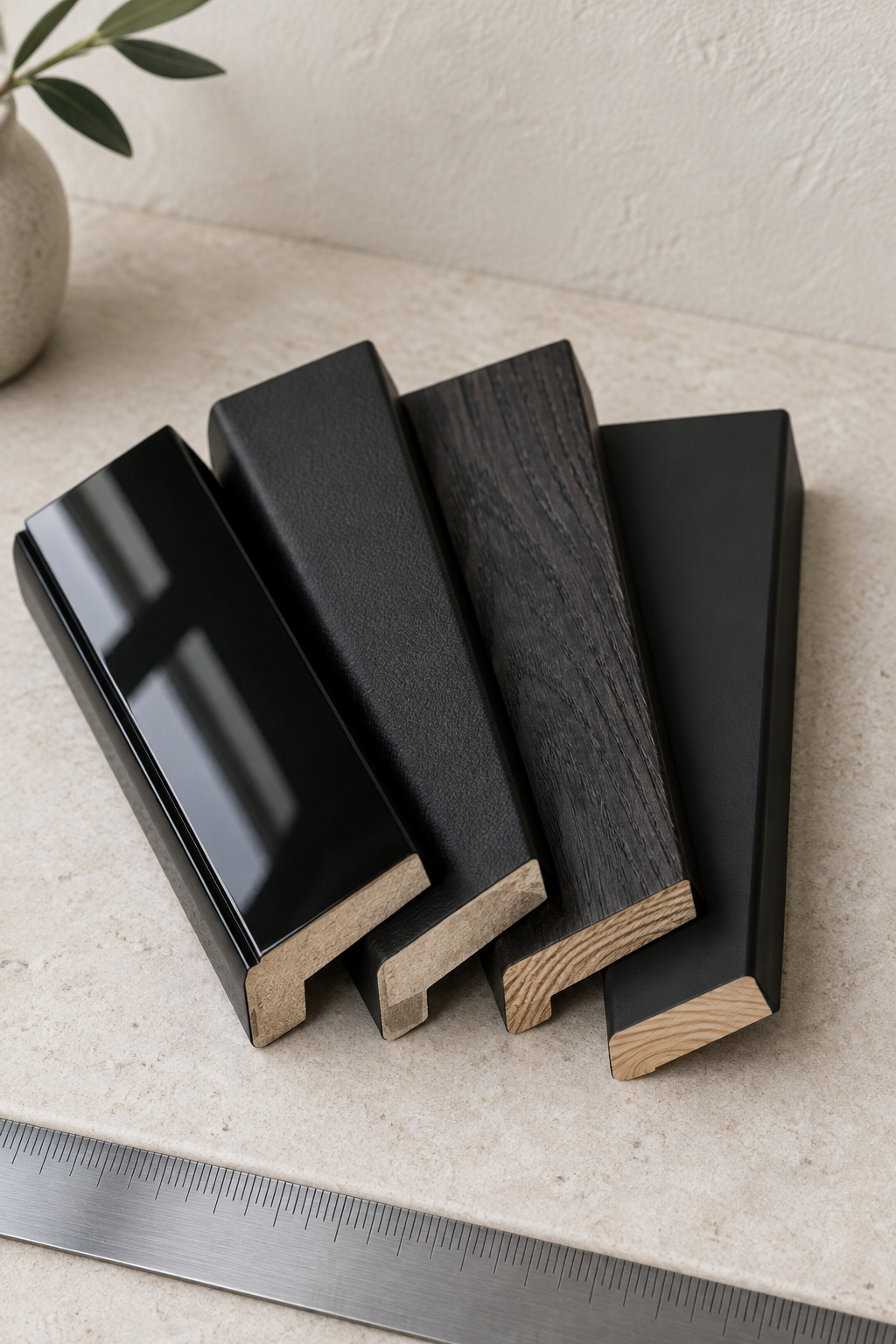
Factory black comes several ways. Retail and maker listings show UV-cured lacquer on MDF, polyurethane over plywood or hardwood, black veneer, and vinyl wraps sold as thermofoil or PVC. Thermofoil is a thin vinyl skin bonded with heat and pressure to MDF, usually on the door fronts and edges only. Open the door and the back is often plain melamine. That is your tell.
| What’s under the black | How it behaves | Paint it or buy? |
|---|---|---|
| Solid wood | Can be sanded and refinished | Paint |
| Plywood | Takes paint or veneer well | Paint |
| MDF, painted or lacquered | Smooth, takes paint nicely, repairs poorly once the edge swells | Paint, with the edges sealed |
| Thermofoil, film tight | Resists water while the vinyl holds | Paint, with a bonding primer |
| Thermofoil, peeling or blistered | Water reaches the MDF under it | Replace the door or buy |
Peeling film means a new door. A repair firm priced stripping and replacing the film at $199 a door in 2021, so count the lifting doors before you decide.
Paint-grade pine is the best first-build wood, and a plywood or MDF vanity paints well for the same reason: nobody is sorry to cover the grain.
If the box passes, the first job is a scuff sand to dull the shine.
Buying black: factory finishes, tops and hardware that suit them
Buying makes sense in two cases: your current vanity is failing, or your only bathroom can’t sit unused while paint cures. Don’t buy on the idea that factory black chips less than a good paint job; that isn’t established. What differs is the repair. A chipped thermofoil front is close to impossible to fix without replacing the door, while lacquer and paint can be refinished.
That matters more in a steamy room. Heat and steam can make thermofoil melt, peel or blister, so if your shower fogs the mirror every morning, buy lacquer or polyurethane and skip the wrap.
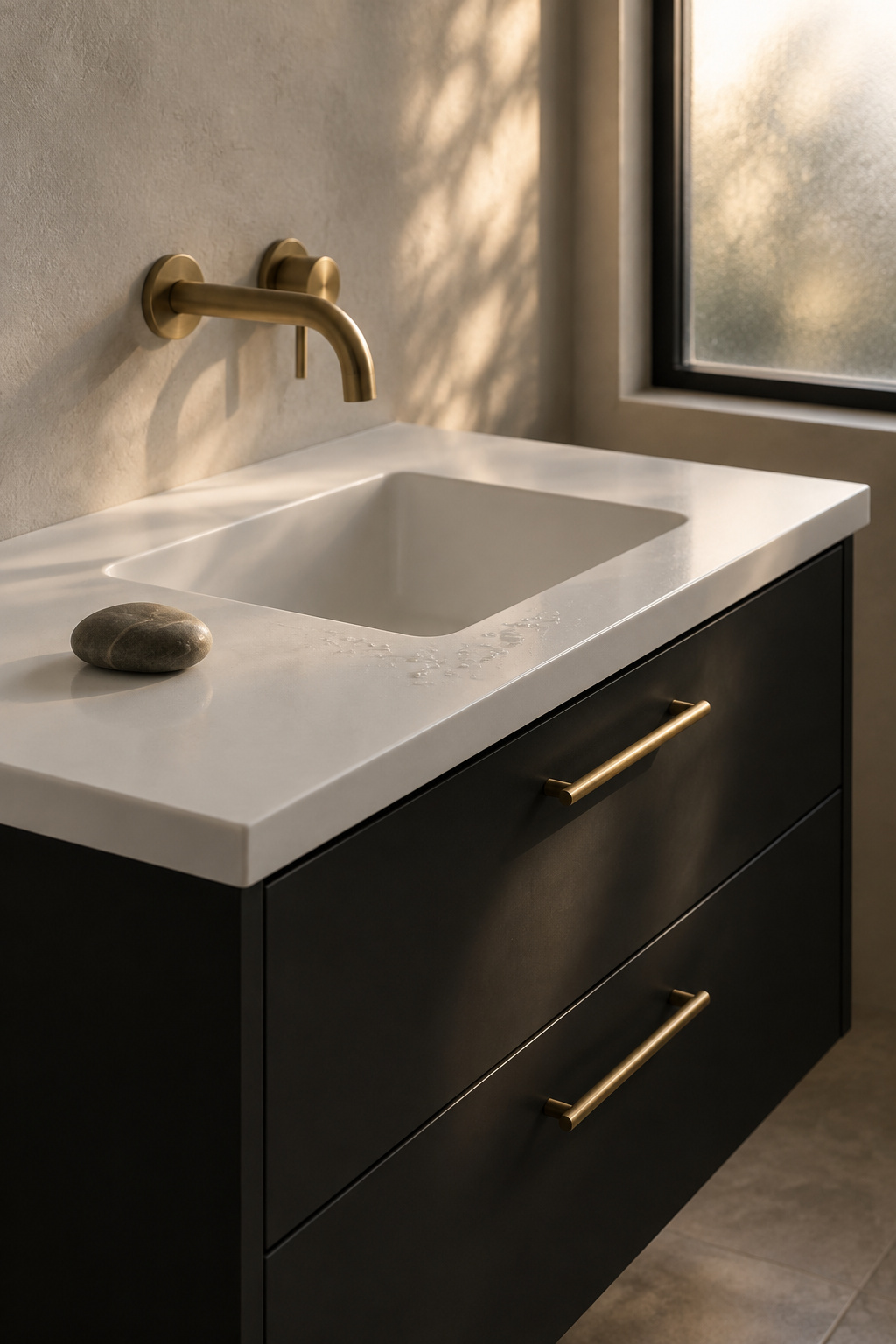
Glossy black shows water spots and dust more than lighter cabinets do. Split the mess on purpose: a white top takes the toothpaste and soap, and the black base shows the water spots.
For the top, quartz and granite both sit well on black, and if you’re weighing marble on a vanity top, read that guide first. For pulls, brushed brass, polished chrome or matte nickel add a bit of shine that lightens all that black. Matte black pulls on a matte black door disappear into it. The care of matte black metal has its own guide on bathroom fixture finishes, and if your new vanity hangs on the wall, the floating vanity ideas guide covers that part.
How to paint a bathroom vanity black so it stays black
Skill level: some builds. Active time is a few hours. The calendar is the long part.
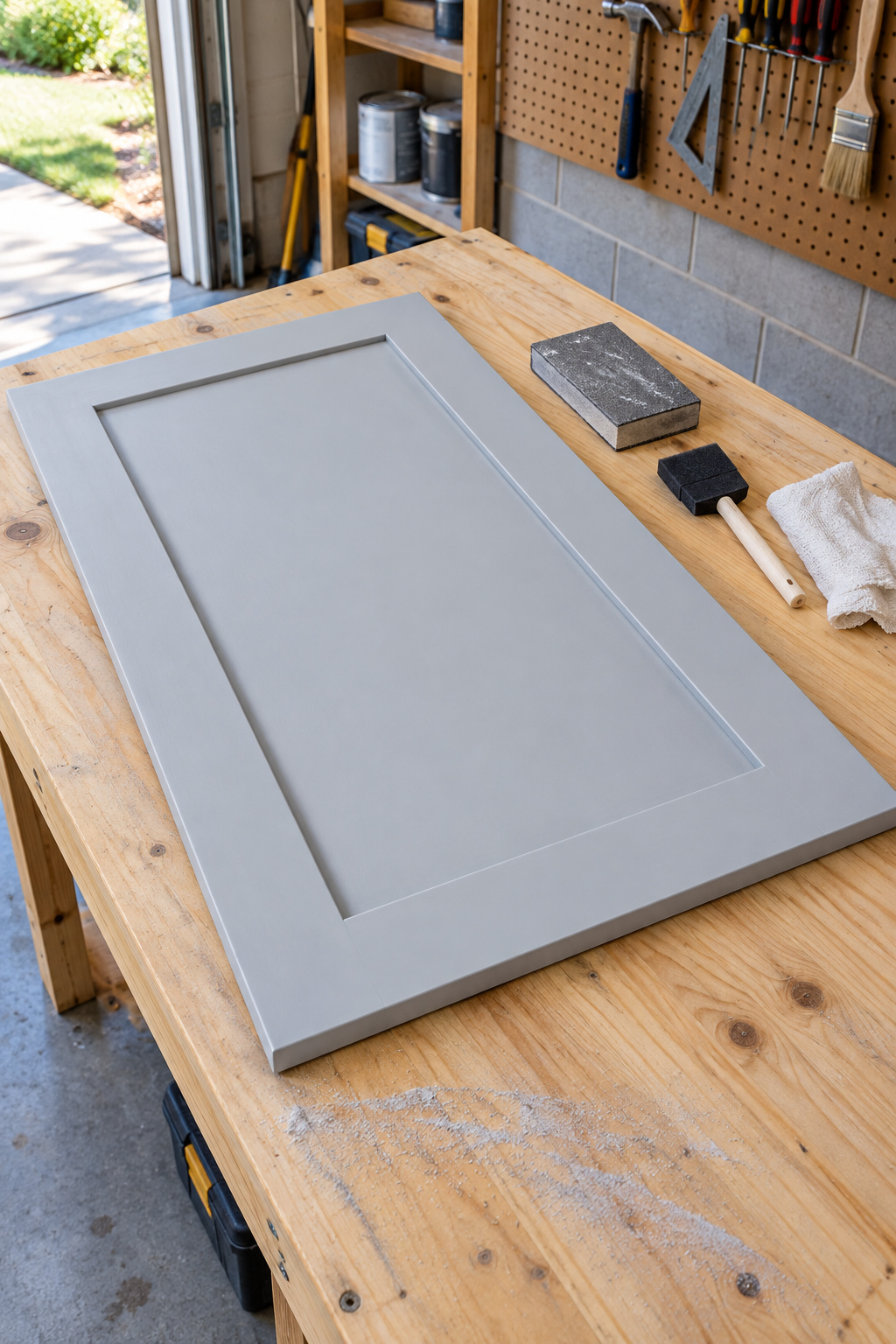
- Clean. Wash with one part ammonia to three parts water, wearing rubber gloves, with the window open. Don’t soak the edges where thermofoil meets melamine.
- Scuff. Sand with 220 grit on a sanding sponge or block, just enough to dull the shine. The primer can says it bonds without sanding. Scuff anyway.
- Prime. Use a bonding primer such as Zinsser Bulls-Eye 1-2-3, in gray if you can get it, because gray helps a dark topcoat cover. It recoats in an hour. Where film has been stripped to bare MDF, or on cut MDF edges, use a shellac primer like Zinsser BIN instead, since water-based primer next to bare MDF can swell the fibers.
- Paint. Brush or roll two thin coats of a cabinet enamel such as Benjamin Moore Advance in satin, at least 16 hours apart.
- Wait. Put nothing back on it, and keep showers cool and short for the first week.
On thermofoil, the primer does the most work. One contractor calls skipping it a leading reason paint fails on thermofoil, sometimes within months.
For quantity, call it 20 sq ft of painted face on a 36-inch vanity. Two coats is 40 sq ft, and Advance covers 400 to 500 sq ft a gallon, or 100 to 125 sq ft a quart. One quart does it.
Advance goes on between 50°F and 90°F surface temperature, and not at 85% humidity or above, which a bathroom can hit right after a shower. Paint with the shower off for the day and the fan running.
Cure time is the step that shortens most and shows soonest
Touch-dry is not done. Touch-dry is the paint being polite.
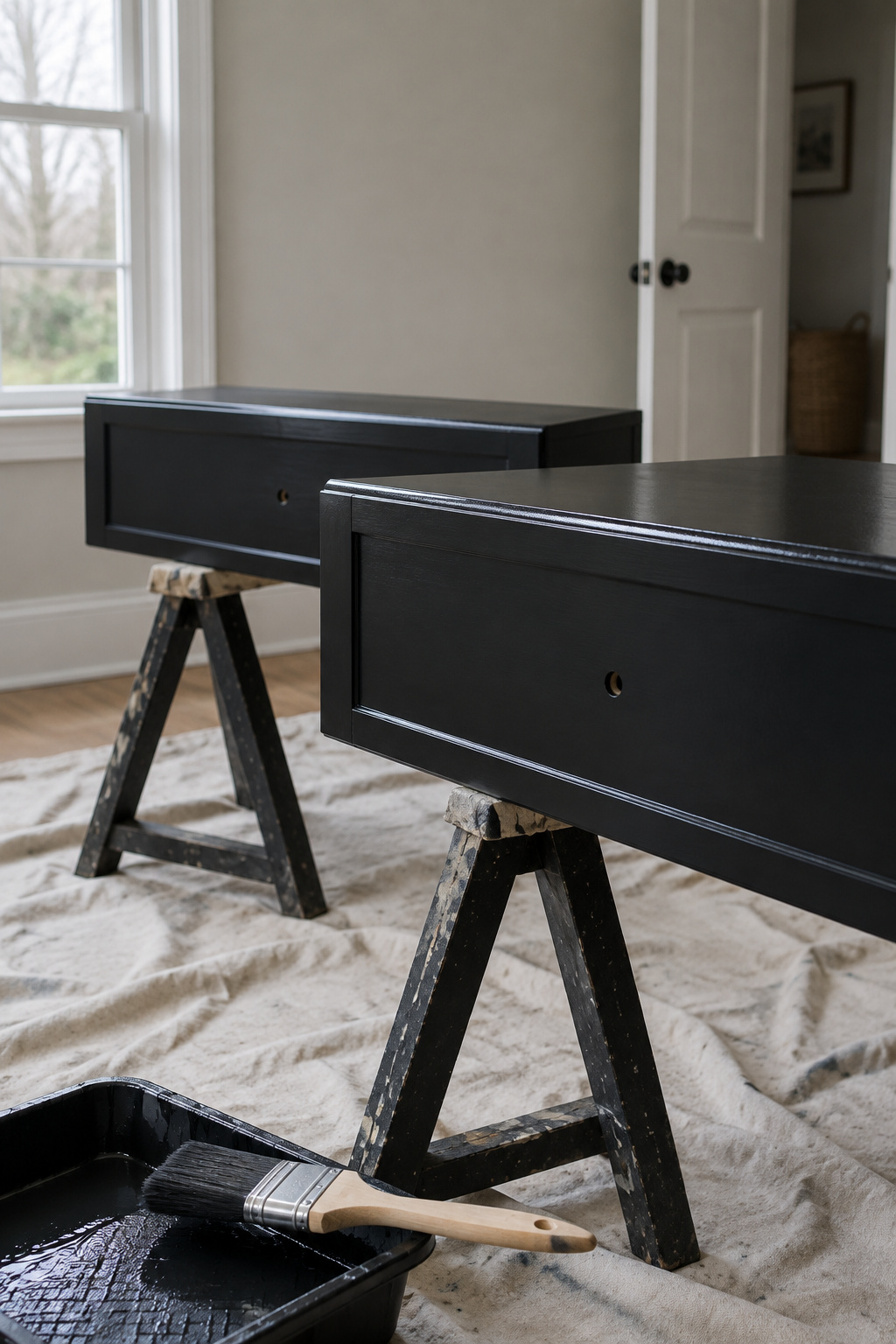
The Advance data sheet has three clocks. It’s dry to the touch in 4 to 6 hours and ready to recoat in 16. It shouldn’t see heavy use for 5 to 7 days. It takes up to 30 days to reach full hardness and its final sheen. Cool air and high humidity stretch all three, and a bathroom is often both. The primer has its own clock, too: 7 days to full adhesion and hardness.
Lay it on a calendar and a weekend job looks like this:
- Day 1: clean, scuff, prime.
- Day 2: first coat of enamel.
- Day 3: second coat, at least 16 hours after the first.
- Day 10: heavy use, day 3 plus 7, the long end of the sheet’s 5 to 7.
- Day 33: full hardness, day 3 plus 30.
The data sheet gives no wait before shower steam. My reading of those numbers is to keep the fan on and showers short through the first week, and treat day 10 as the earliest the vanity goes back to normal bathroom life. That’s the extra weekend every project takes.
I keep a box of spare screws, shims and a level behind the seat of the truck. None of it makes paint cure faster.
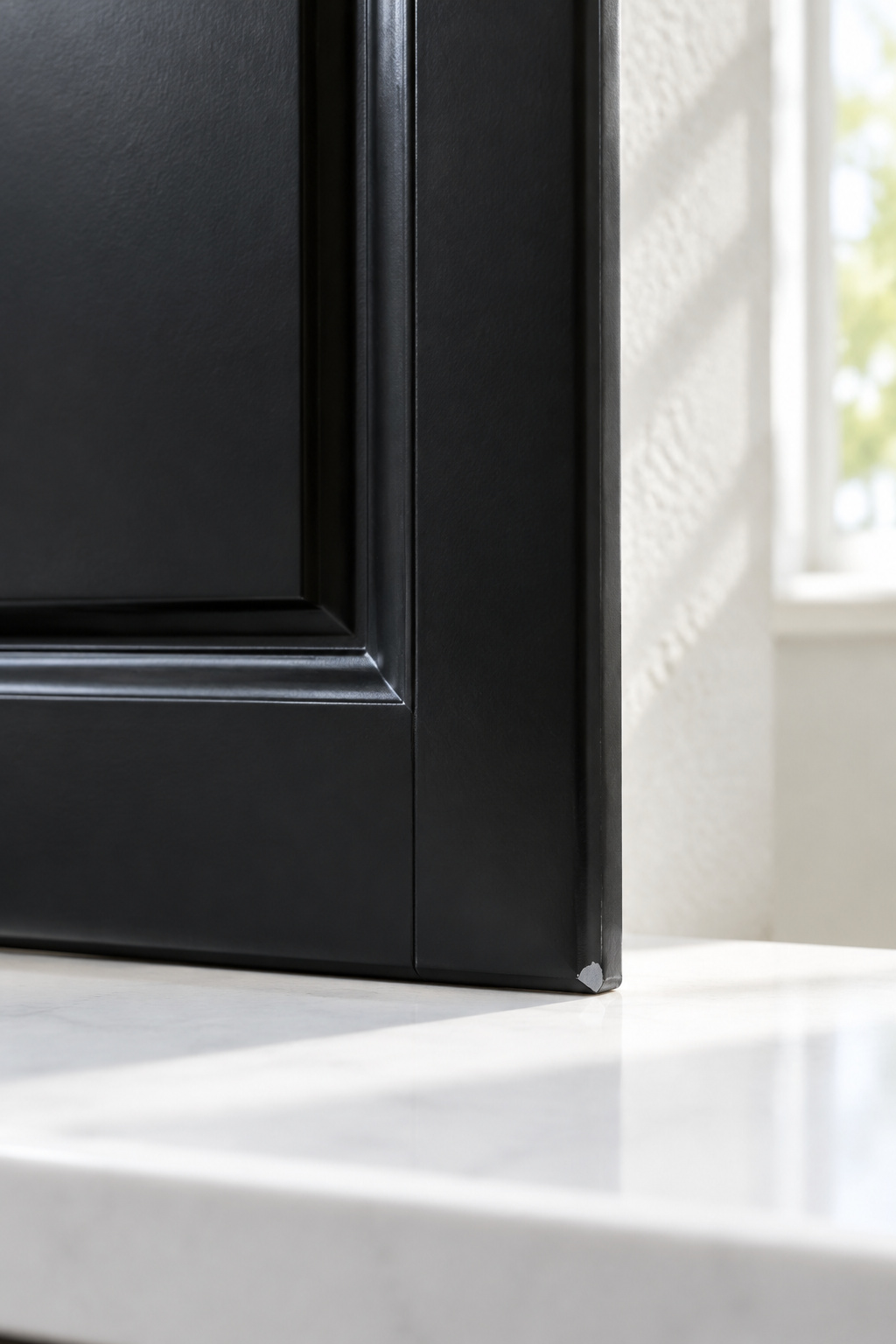
When a fresh finish fails, it fails at the corners and edges first, because that’s where knees, mop handles and the door that swings into the wall land. On MDF the edge is the most porous part of the panel, so a chip there also lets water in to swell the core. Black makes each of those chips obvious, because the primer under it is pale.
Satin, not matte: the sheen that wipes clean
Satin versus matte on black
Pros disagree here, so take this as my call. Captivating Cabinets favors matte on dark colors because it hides fingerprints better than gloss, though the same blog admits matte can burnish shiny where it gets rubbed, and dark colors show that most. Journeyman HQ goes the other way and recommends satin for bathroom vanities, since matte black soaks up skin oil and shows dark shiny spots.
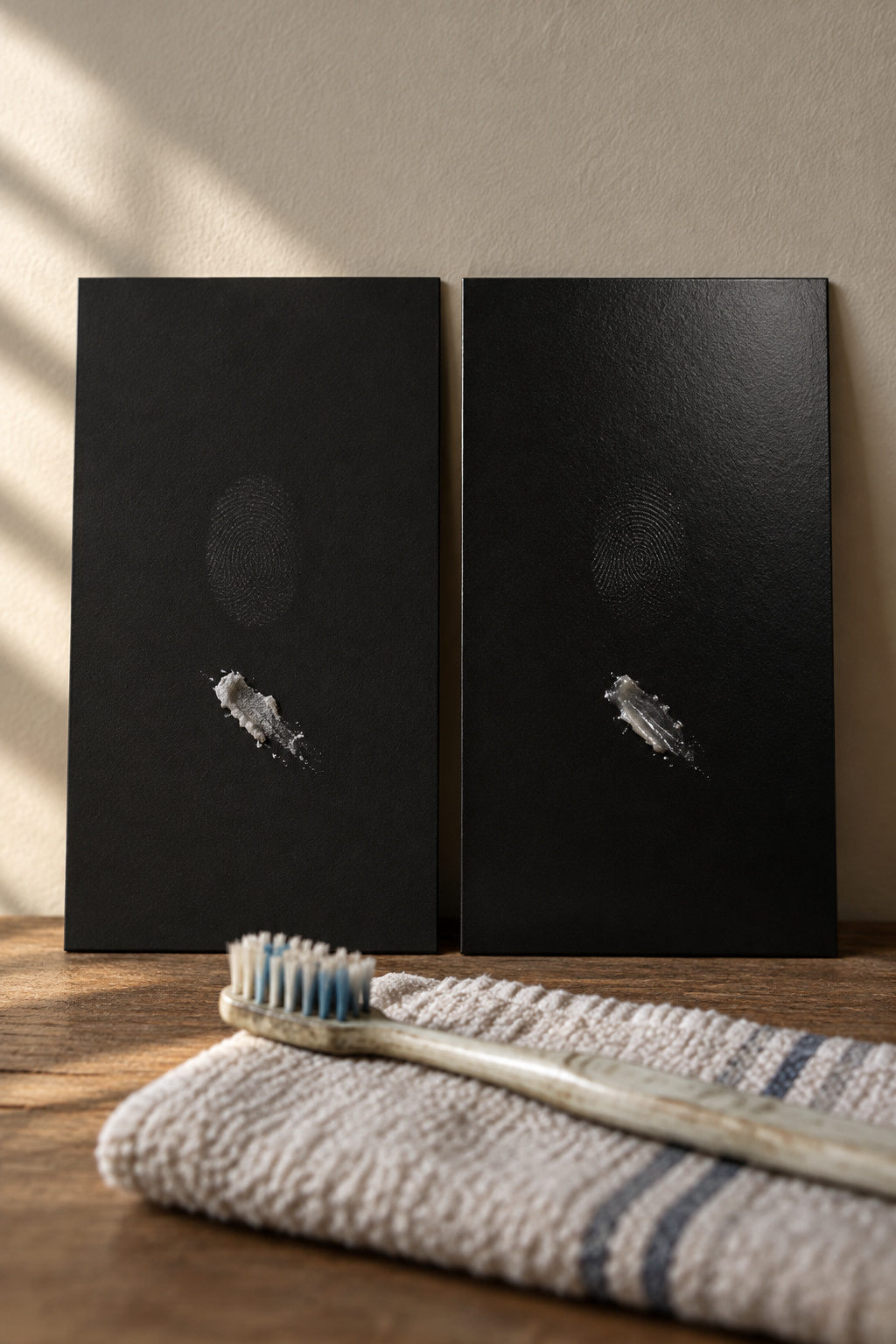
I pick satin. Advance satin sits at 25 to 35 gloss at 60 degrees, enough sheen to wipe toothpaste off without polishing a patch into the finish. A vanity gets scrubbed.
Touching up a chip
The advice on touch-ups contradicts itself, so test it on a scrap first. One side says a dab on satin blends and a repair on matte dries at a different gloss you can see at an angle. The other says matte is the easiest to touch up because there’s no sheen to match.
On MDF, fill the chip with wood filler or epoxy putty, sand flush, prime, then paint. If the corner has crumbled, cut back to solid material and seal the edge before you fill. Keep the leftover paint, and judge a touch-up after the finish has had its 30 days, since the sheen is still settling until then. A chipped thermofoil front is a new door.
If you’re thinking of a black sink on a black vanity, that guide covers the basin.
Pulling it together: your decision rule for a black vanity
Look at the corner of your own vanity, where the first chip lands.
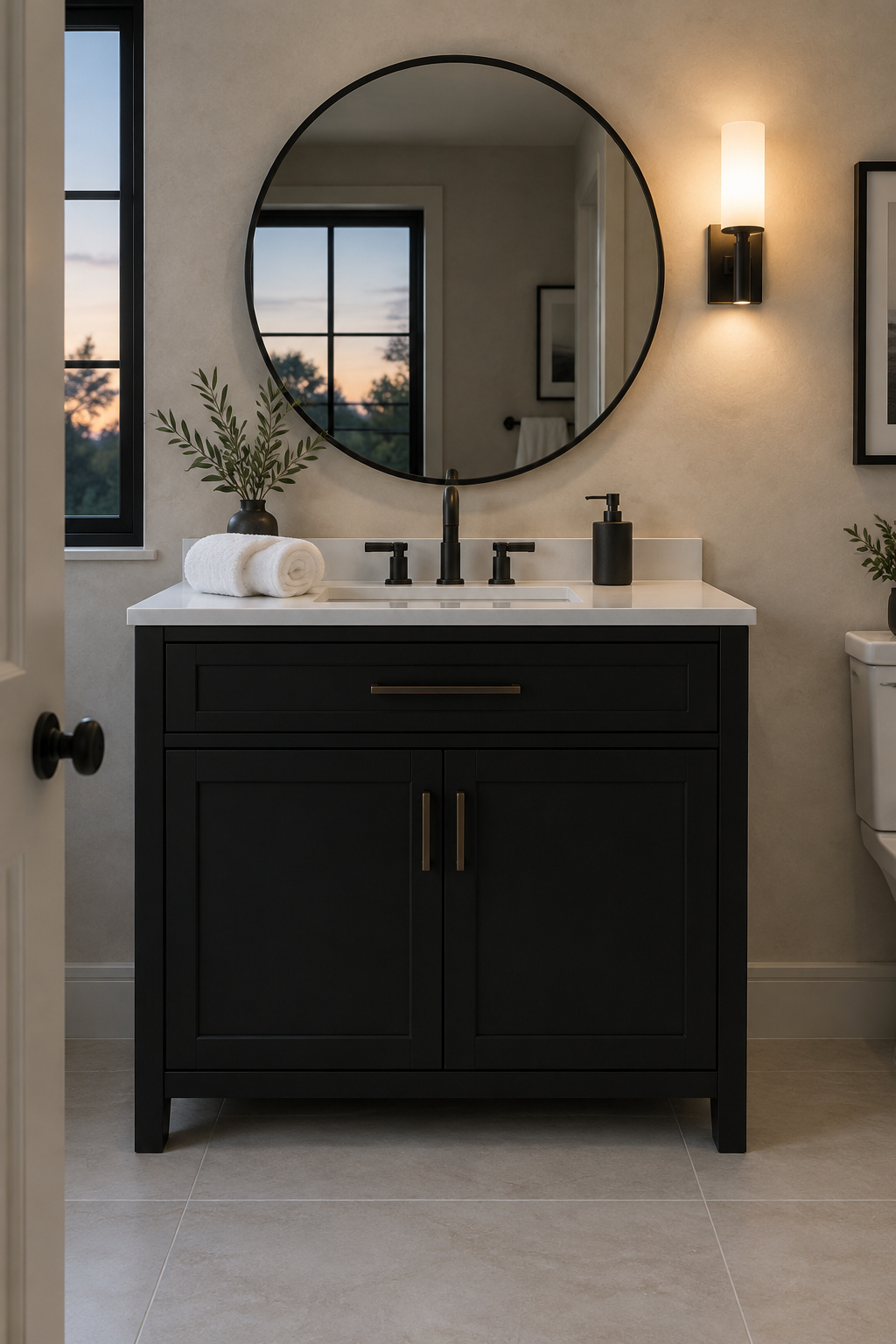
If the box is solid wood, plywood or MDF in good shape, or thermofoil with the film still tight, paint it. Scuff, prime with a bonding primer, seal any bare MDF with shellac, lay down two thin coats of satin enamel and wait. If the film is peeling or heat-damaged, the base is swollen, or the room steams every morning and can’t be rested for a week, buy factory black in lacquer or polyurethane and put the paint money toward a good top.
The counter and basin above the base are separate decisions, and black and white bathroom ideas puts them in the context of the whole room.
Paint it on a Saturday and plan for day 33. That’s the second coat going on day 3, plus the data sheet’s 30 days to full hardness, at 77°F and 50% humidity. A colder, wetter bathroom pushes it later.
FAQ
Do black bathroom vanities go out of style?
A black vanity against white walls is a classic high-contrast pairing, and one designer puts deep colors like charcoal against lighter walls or marble tops. If you worry about tiring of it, paint is the safer bet: a painted wood or plywood vanity can be scuffed, primed and repainted, while factory lacquer or thermofoil is harder to change.
Should a bathroom vanity be darker than the walls?
It’s the familiar arrangement. White walls keep the room bright while a black or navy vanity becomes the focal point, and a Benjamin Moore designer describes a deep vanity against light walls as drawing the eye in. In a small bathroom, keep the walls light and add a reflective finish or bright accents so the dark doesn’t feel confining.
Can you use black stain instead of black paint on a vanity?
Mostly on bare wood. Ordinary stain needs open pores, so it won’t change a finished surface, and it gives color without protection, so it needs a clear topcoat. Gel stain is the exception: it can go over an existing finish, though it’s made for raw wood. For MDF or thermofoil, use paint.