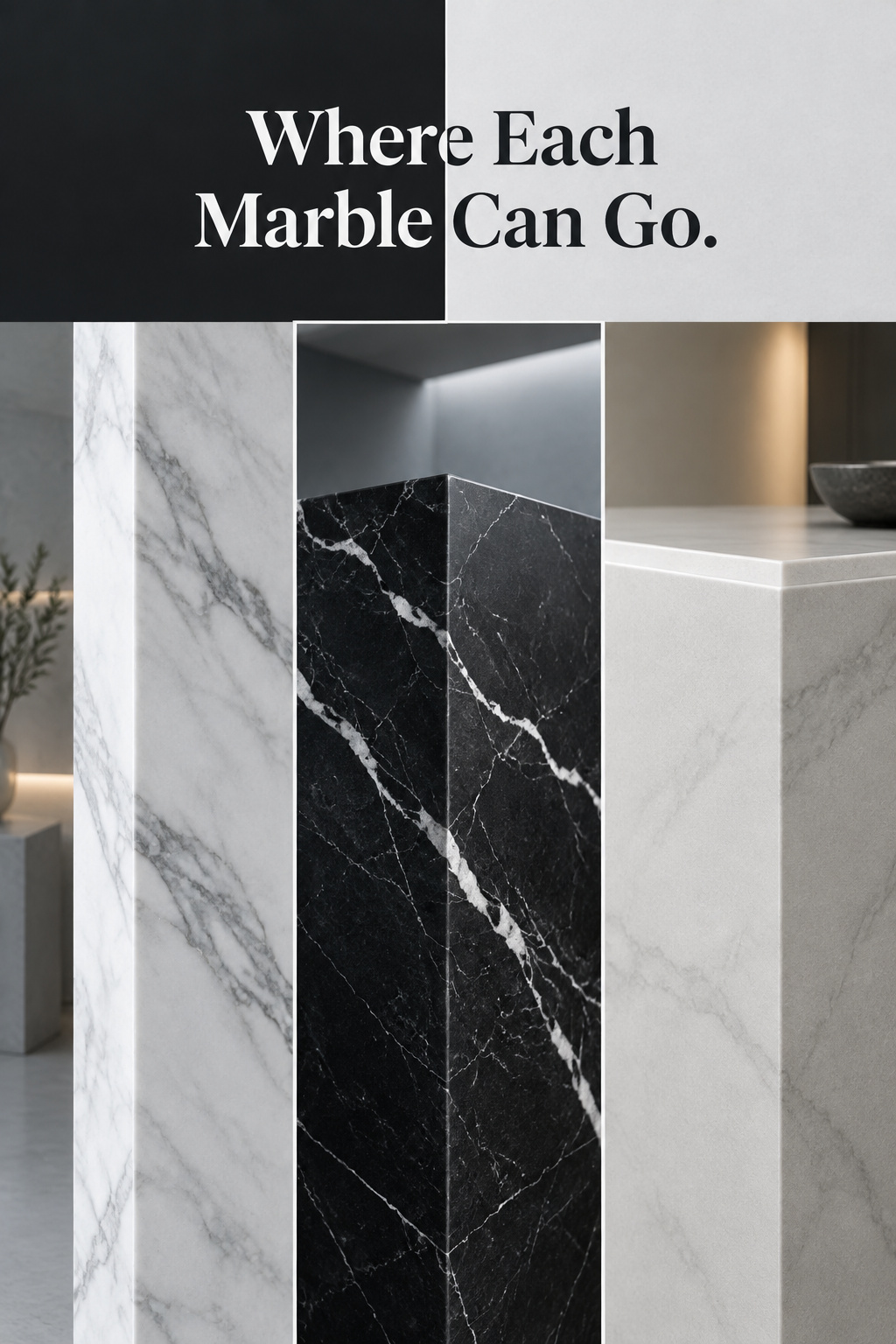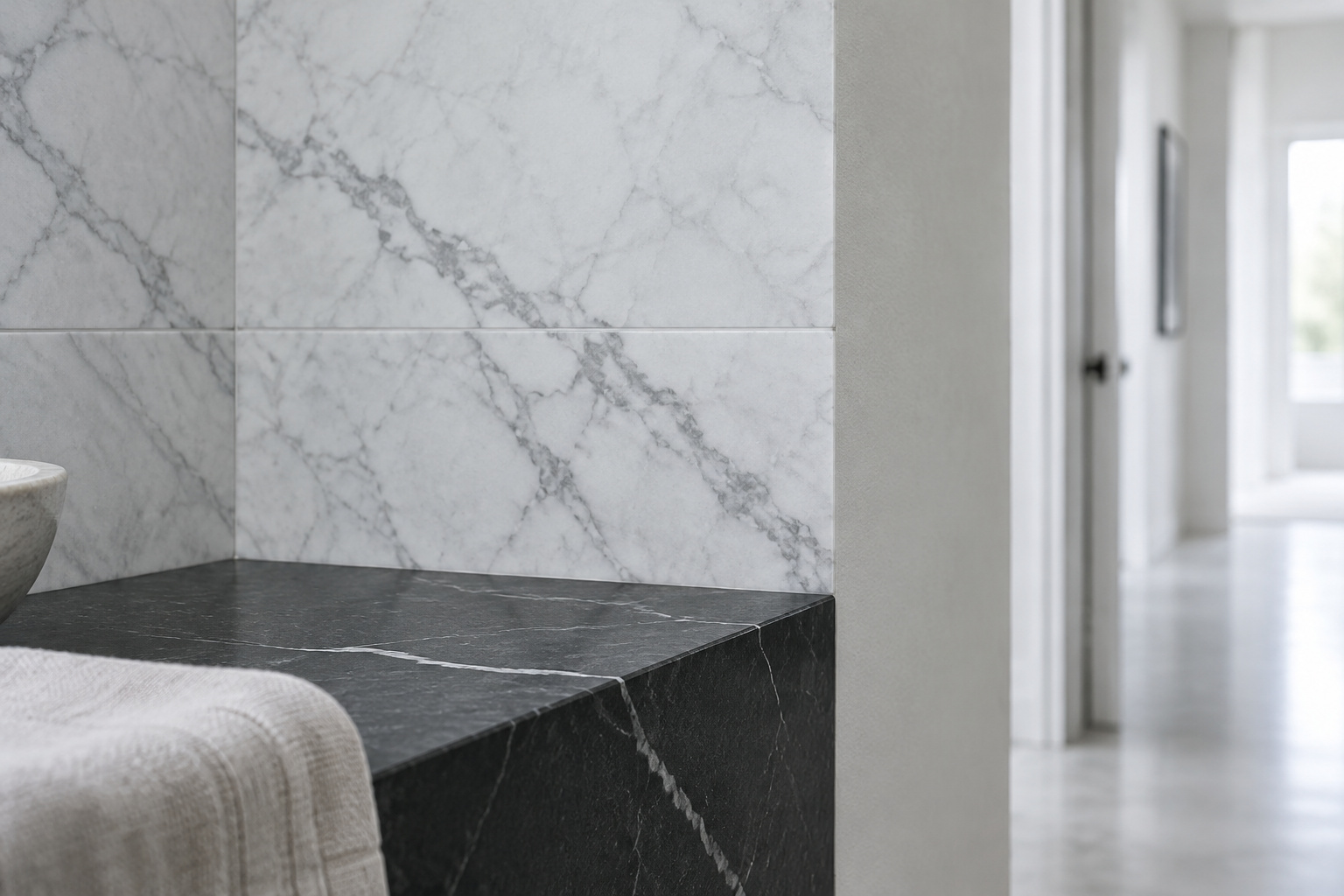

On my workbench sits an offcut of old marble threshold, white with soft gray veins, its top worn smooth. Near one end is a faint ring the size of a coffee cup, duller than the stone around it. It is the sample I reach for when someone asks me about a black and white marble bathroom, because it shows both what the stone is and what it becomes. The choices that hold up in these rooms come from one habit: put each stone where what lands on it can’t spoil it.
TL;DR
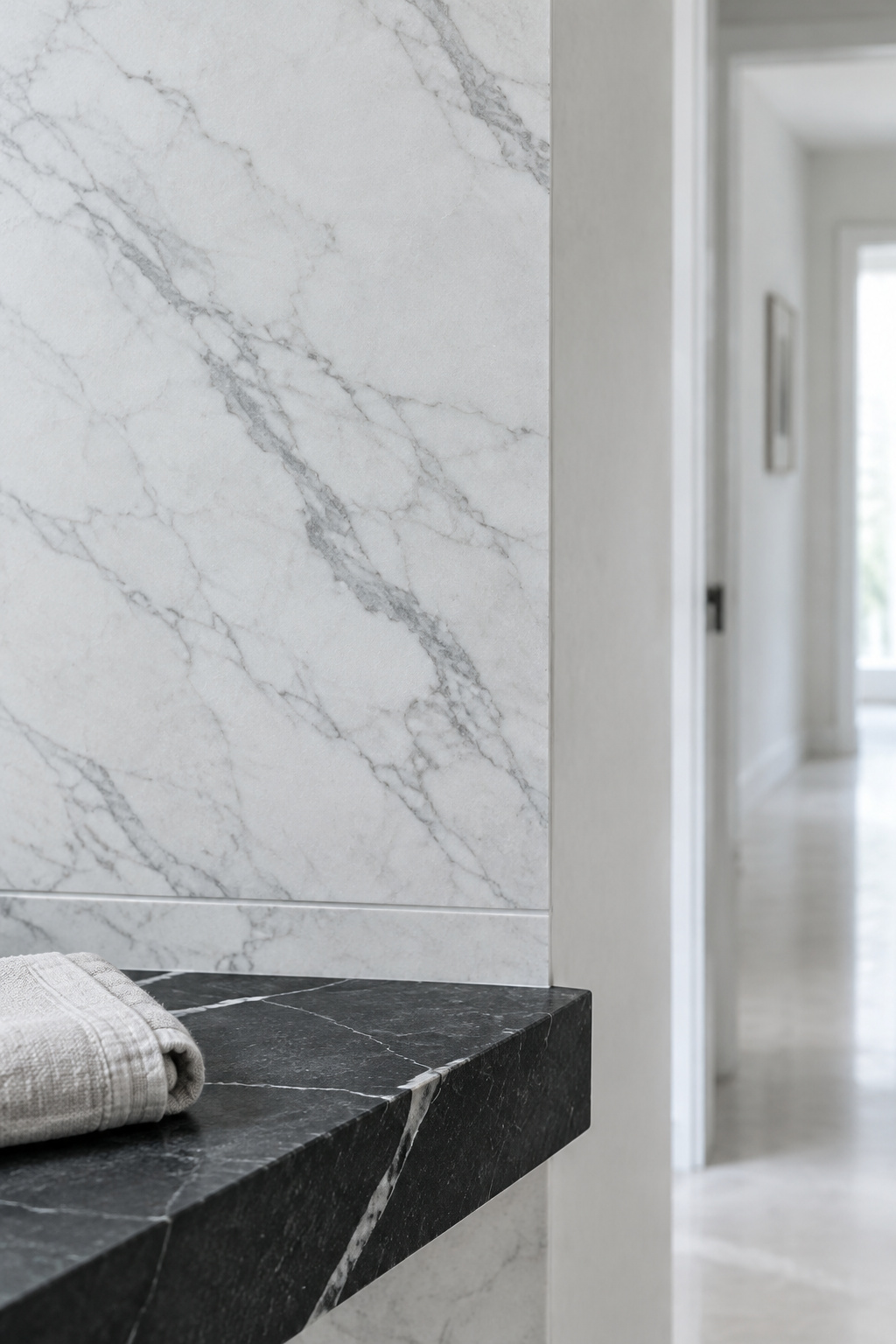
- Put honed white Carrara-type marble on the walls and a shower bench, where it can age; a honed finish hides the dull marks acids leave, though it doesn’t stop them.
- Keep polished black stone off the vanity top: black and white etch alike, but the pale scar tends to show most on polished black. Nero Marquina, the classic black, is sold as marble but is geologically a black limestone.
- Where a surface must stay spotless, buy marble-look porcelain, which absorbs 0.5% water or less under ANSI A137.1, and call it porcelain.
A Black and White Marble Bathroom Looks Best When Each Stone Has Its Place
The classic pairing is two stones from two corners of Europe. The white is Carrara-type marble from Italy’s Carrara region: a white to light gray ground with fine gray veining. The classic black is Nero Marquina, named for Markina in Spain’s Basque Country, a compact, fine-grained black rock laced with white veins in a loose, flowery pattern, with fossils visible in places.
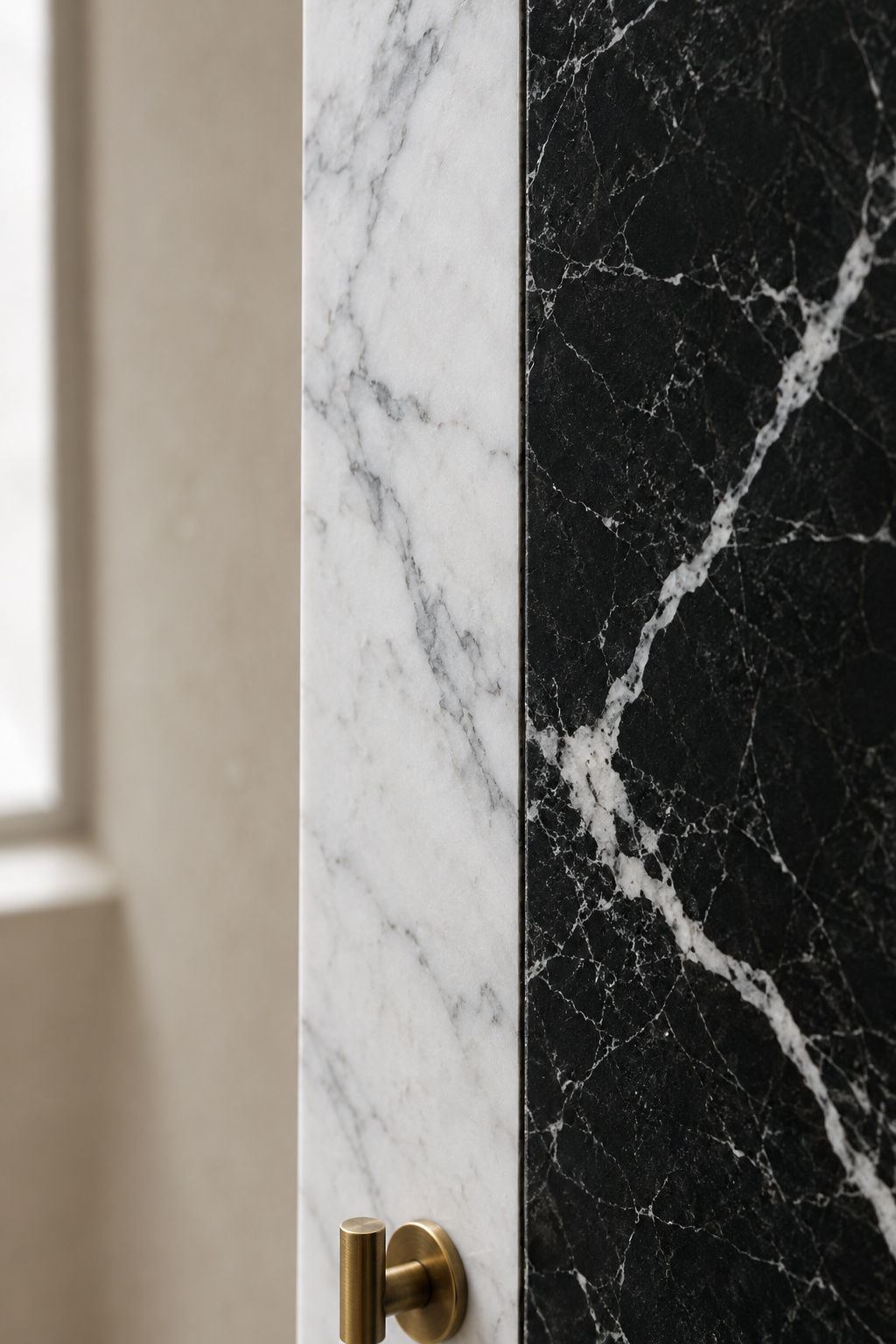
Its black comes from natural bitumen; the white veins are calcite, the same mineral as the white marble beside them, so one care routine covers both. The name doesn’t fix the quarry, though. Similar stone comes out of Morocco, Mexico and China under similar names, so ask where yours was cut.
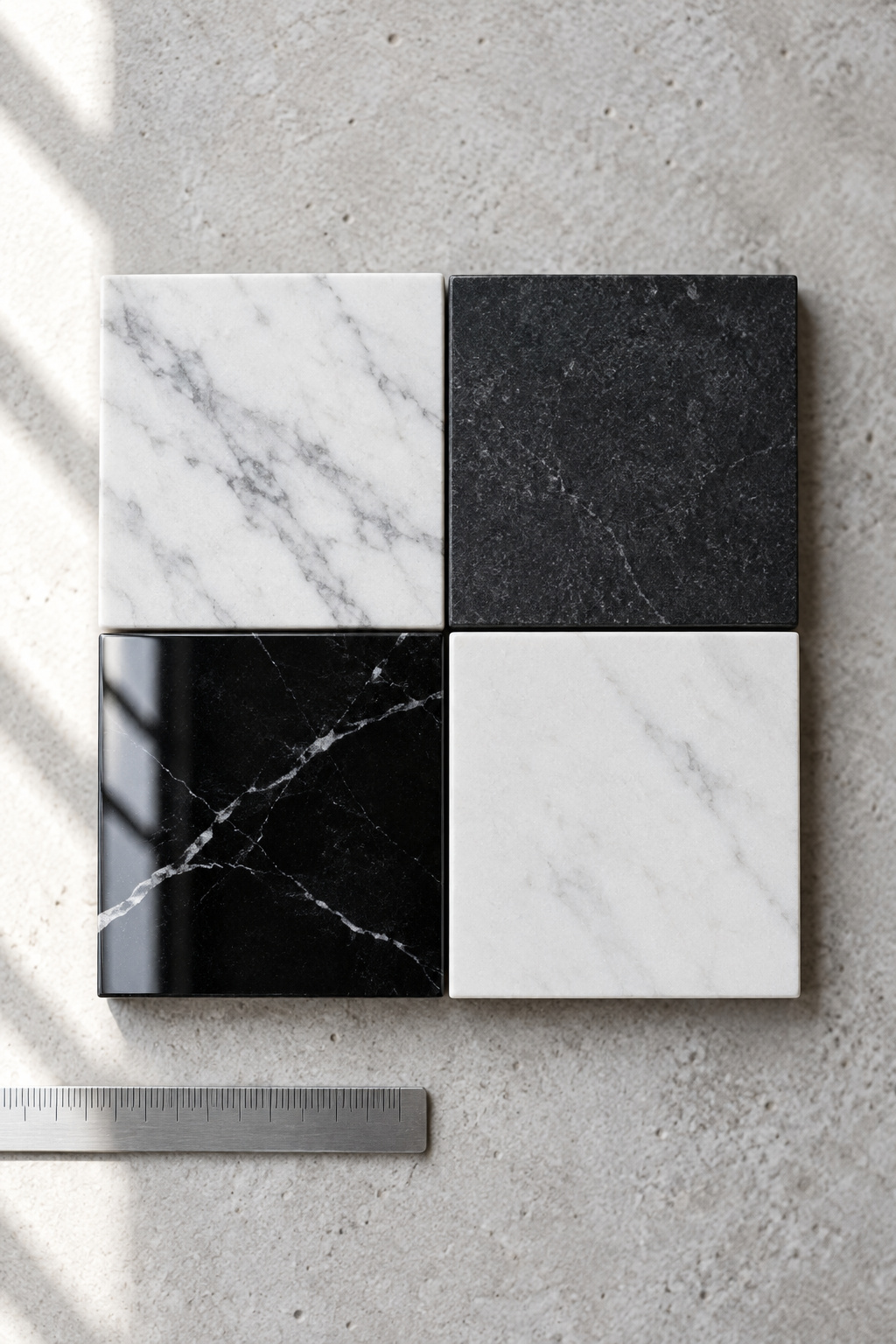
Finish changes the picture. Honing makes stone look lighter and softer, noticeably so on black, while polish deepens the color.
Given jobs, the pair works: white on the walls and the shower bench, black as an edge, a ledge or a floor accent. What each surface gets splashed with decides where each color goes in a black and white bathroom, and stone is no exception.
Marble Is Calcite, and Calcite Etches
Etch is not a stain
Marble is built from calcite, calcium carbonate, which sits at 3 on the Mohs scale; marble as a whole is usually quoted at 3 to 4, since the scale rates minerals rather than stones. Mild acids also dissolve calcite’s surface, and the Natural Stone Institute is plain that a marble buyer should accept the maintenance and patina to come.
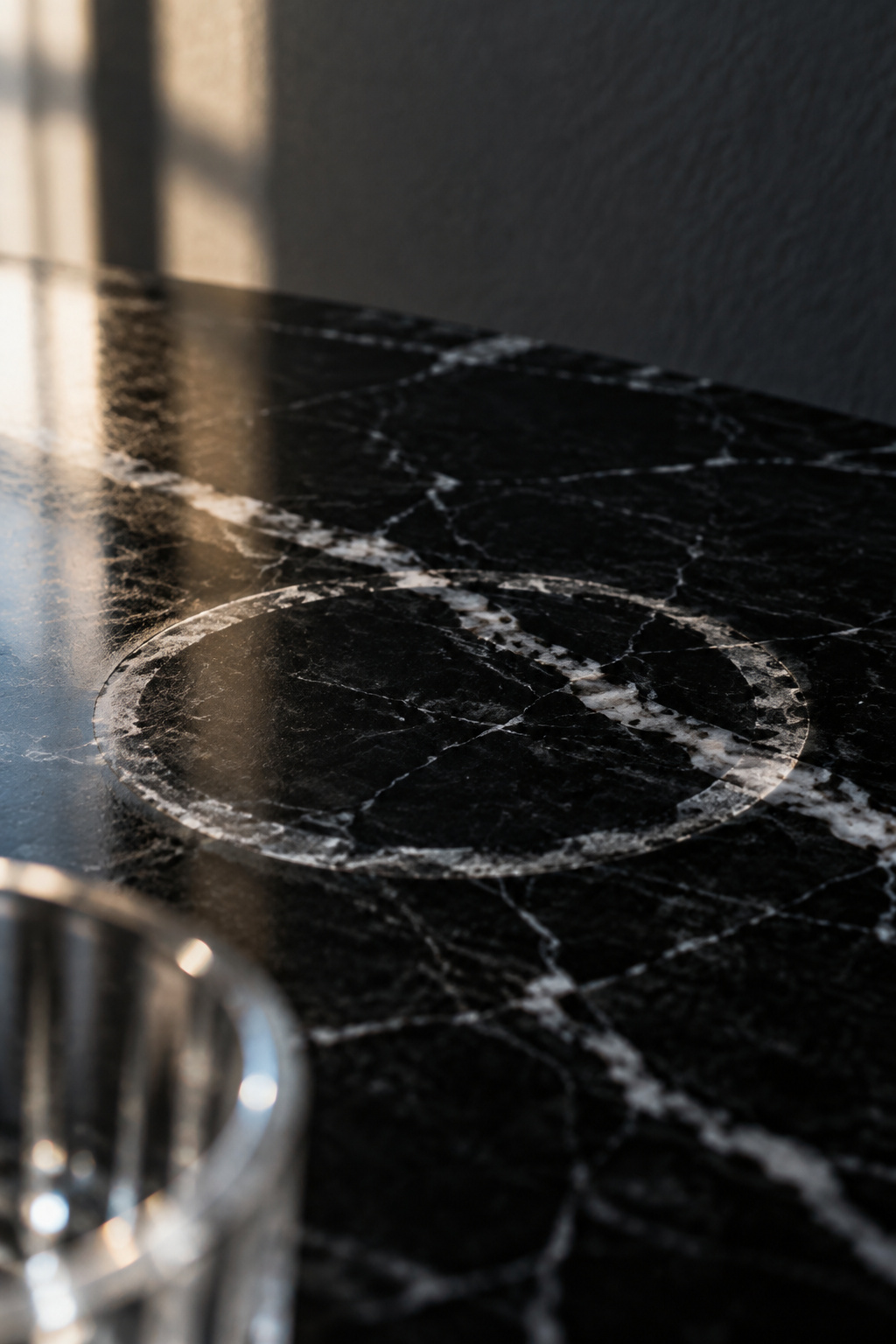
That dissolving is an etch: a dull, whitish mark where the surface has physically changed and now reflects light differently. A stain is color that has soaked into the stone. You can’t clean or reseal an etch away; a deep one has to be ground back to the depth of the damage and refinished. The ring on my offcut is that kind of mark.
Hard-water rings are usually mineral sitting on the surface, and they wipe off, but an acidic limescale remover can turn one into a real etch. In a bathroom the acids to watch, by the Natural Stone Institute’s list, are products with lemon or vinegar in them, and rust removers or toilet bowl cleaners with trace hydrofluoric acid, which attacks every stone. A stone-care maker warns that toothpaste that isn’t pH neutral can mark marble, and suggests a tray under the tube.
Why a pale scar shows on polished black
On polished marble an etch breaks the reflection, so it reads as a dull spot or ring. On honed marble the whole surface is already matte, and minor etches sink into it. Honing hides etching; it doesn’t stop it. Direct sunlight makes any etch easier to see.
Black stone is no quicker to etch than white; the chemistry is the same. What changes is contrast. One designer’s guide says dark marbles reveal etches more readily, because the pale patch sits against a dark mirror; a fabricator’s guide says the risk is identical on any color, both marks show, and which bothers you more depends on your eye. I’d rather not test that at a basin that takes acid every morning.
Check That Your Black Marble Is Marble
Old isn’t the same as original, and in stone, marble isn’t always marble. Nero Marquina is sold and specified as marble, and ASTM C119 allows that: recrystallized, compact limestone that takes a polish counts as commercial marble and may be sold as either. Spain’s geological survey describes it as a recrystallized reef limestone with white calcite veins. Calcite either way, so it etches exactly as a white marble does.
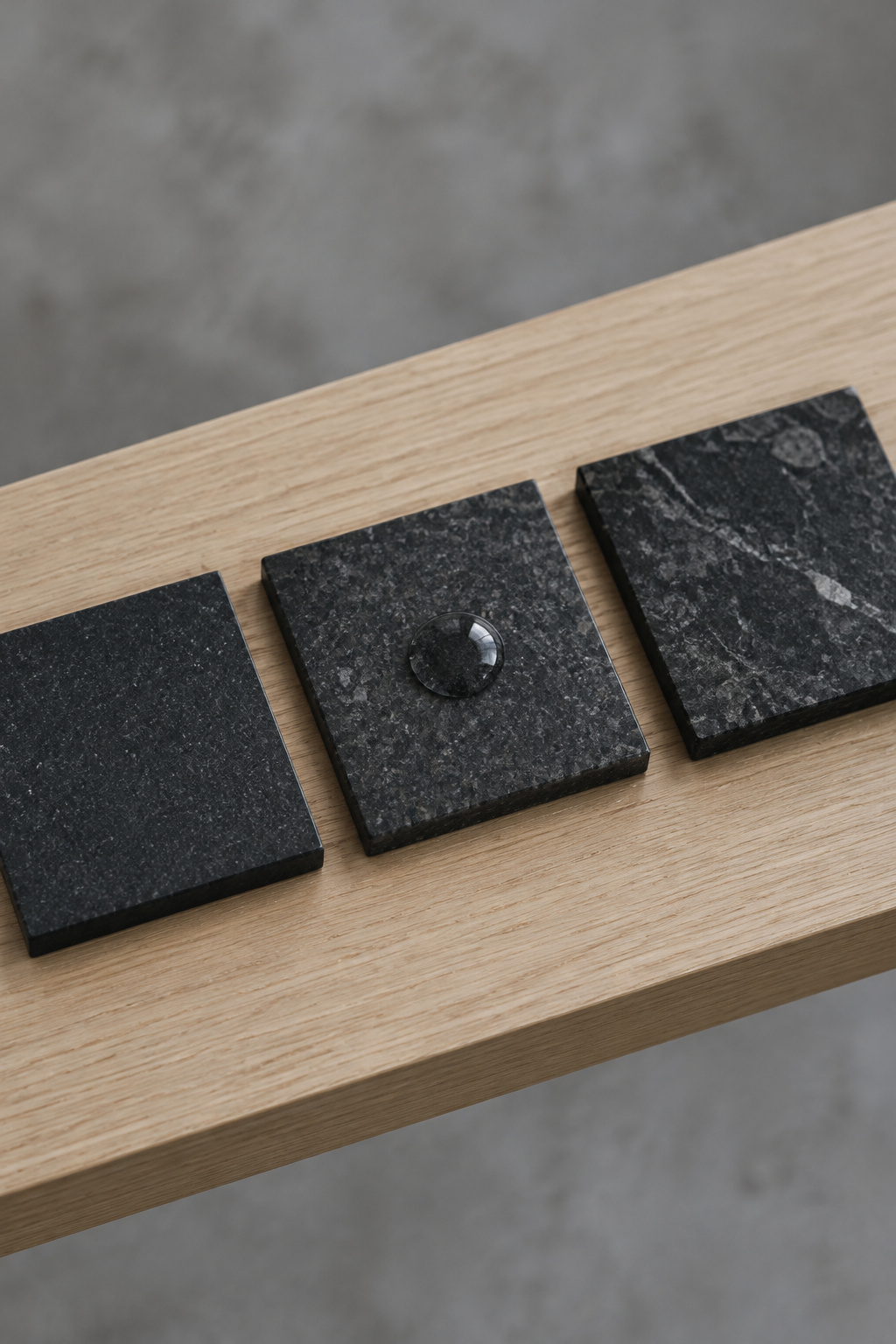
Serpentine, often mistaken for marble, is a magnesium silicate with more resistance to acid. Find out what yours is before it goes on a wall:
- Ask for the stone type and country of origin. A trade name alone is not enough; the same name gets used for different stones.
- Ask for the technical data sheet, with density, porosity and water absorption results (EN 1936 and EN 13755 are the tests to look for).
- Put several large drops of lemon juice or vinegar on a spare offcut for 5 to 10 minutes, wipe, and look at it from a low angle. A dulled patch means the stone etches, sealed or not.
- Leave water on the offcut for 15 minutes, wipe it, and look for a dark patch.
- Judge the sample in the finish you are buying.
Never run the acid test on installed stone. Marble-look porcelain is another matter: ASTM C119 excludes manmade materials that simulate stone.
Where Each Stone Can Go: Walls, a Shower Bench, a Floor, a Vanity Top
Nothing on this list is forbidden. The Natural Stone Institute lists marble for floors, wall cladding, wainscot and vanity tops, and calls many marbles well suited to showers and tub decks. It comes down to what lands on each surface, and how much the mark will show:
| Surface | Stone and finish | What lands on it | Verdict |
|---|---|---|---|
| Walls | Honed white | Steam and splashes | Let it age |
| Shower bench | Honed white, sealed | Soap, shampoo, standing water | Good, with a squeegee habit |
| Floor | Honed white or black | Traffic, grit, water | Honed; polish wears off underfoot |
| Vanity top | Polished black | Toothpaste, cosmetics, cleaners | Avoid; honed white or porcelain instead |
Honed stone is more porous than polished, so a honed bench or floor needs sealing more often. Honed black has its own trade-off: it reads lighter, and it shows fingerprints and water spots more than honed white, so budget a quick wipe. Floor slip ratings and the honed-versus-polished argument underfoot belong with slip and finish for a bathroom floor.
Behind any stone in a shower, Walker Zanger recommends a waterproof membrane. That is a maker’s guidance, not code, and I’d follow it anyway.
The vanity top is the one call I make on judgement rather than any rule. It takes the most acid in the room, every morning, under a bright light. On polished black, each of those mornings leaves a pale record.
Seal It, Then Accept the Patina
A stone sealer is an impregnator. It soaks a couple of millimeters below the surface and acts as a repellent; it does not form a seal, and it does nothing against acid. Sealing makes marble more stain resistant, not stain proof.
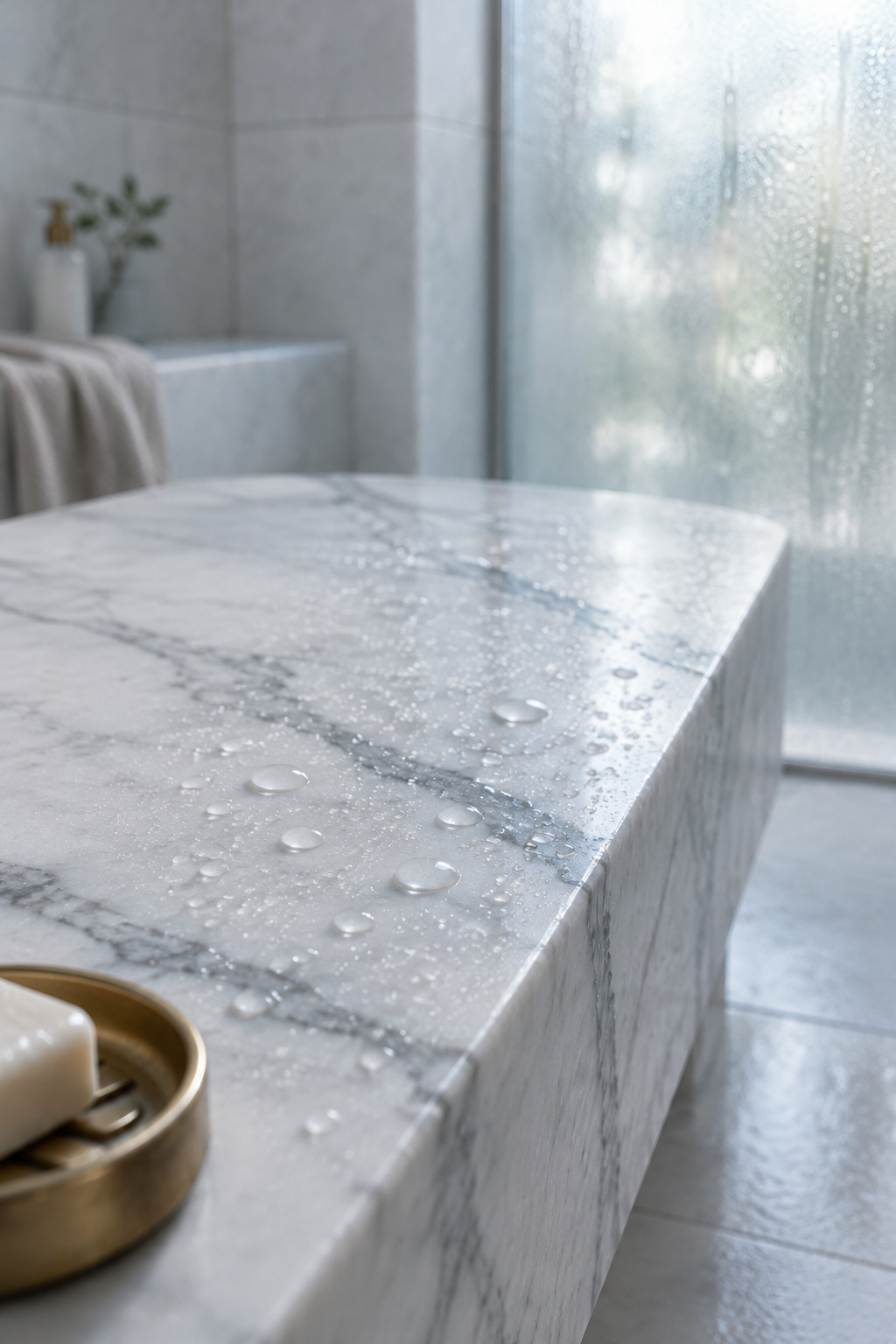
How often to reseal is less settled than the labels suggest. Intervals quoted for marble run from six months to a year and a half, and the Natural Stone Institute gives no figure at all, telling owners to ask their supplier. Let the water decide. While drops bead on the surface, the sealer is working; if a drop darkens the stone within 3 minutes, it has failed and it’s time.
Then live with it. A light etch can sometimes be lifted with marble polishing powder; a deep one is a job for a restorer. Real wear beats applied distressing every time. Stone tumbled to look old is wearing a costume, and a decade of honest dulling on a white shower wall looks better than anything a factory can fake.
The everyday habits:
- Wipe toothpaste and anything acidic off the stone at once, and keep a tray under the tube.
- Clean with a neutral stone cleaner, stone soap or a little mild dish detergent in warm water, then rinse and dry with a soft cloth.
- Keep lemon, vinegar, acidic descalers, scouring powders, rust removers and hydrofluoric toilet cleaners away from it.
- Buff a water ring with dry 0000 steel wool before reaching for anything stronger.
Porcelain Is the Honest Choice for a Vanity Top
My pickup usually has a salvaged door or two in the back, but new work should be honest about being new. A vanity top meets toothpaste and cleaners every day, and stone there gets fretted over when a different material would simply do the job.
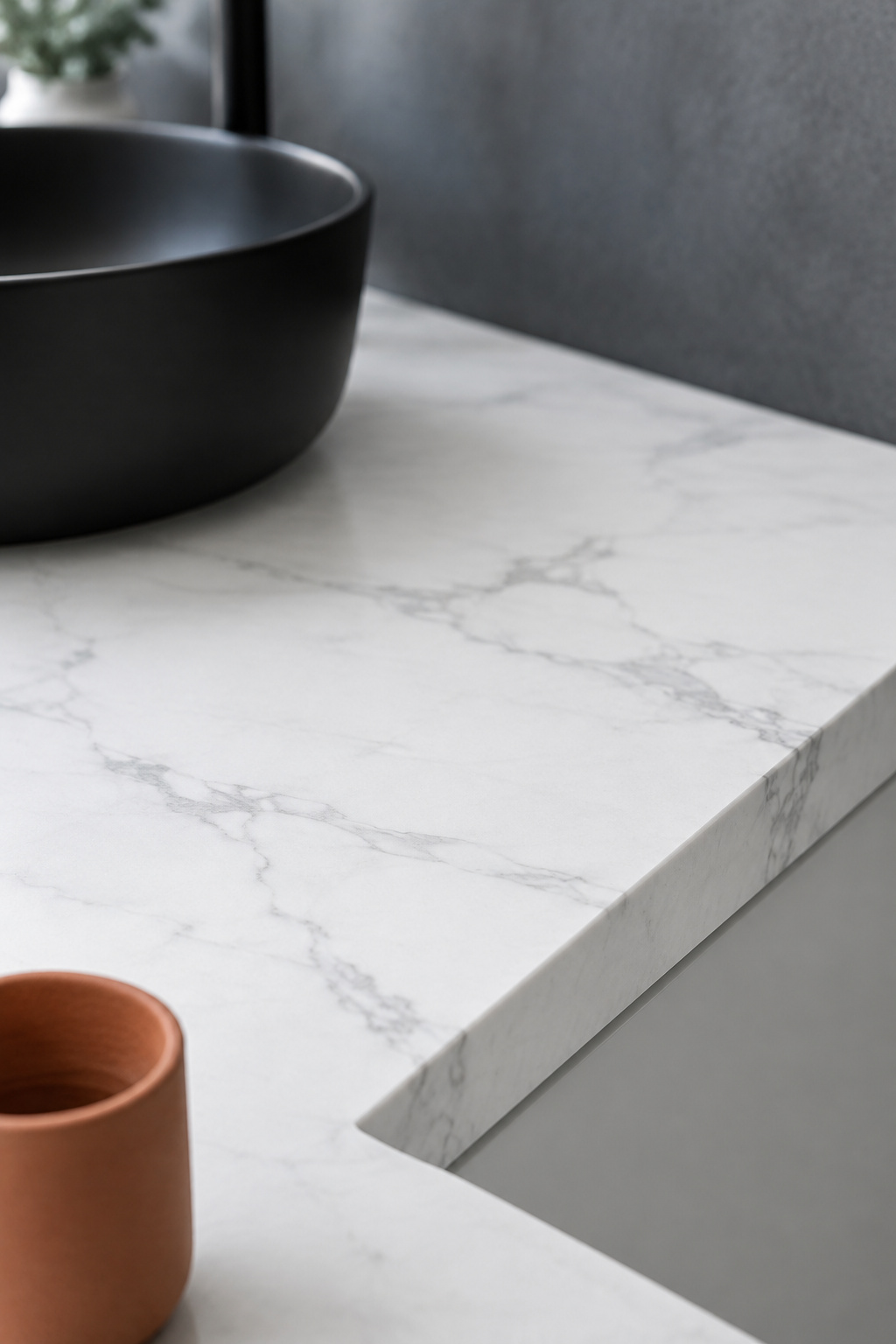
Marble-look porcelain is that material. Under ANSI A137.1, porcelain is a ceramic tile that absorbs 0.5% water or less. Look for that absorption figure, or a porcelain certification mark. Daltile’s Marble Attache line, for one, tests under 0.5% in matte, satin and polished finishes, but its sheet does not rate it as a countertop. Ask the maker whether a product is made for vanity tops, or buy a slab made for one. And call it porcelain. It is not marble and shouldn’t pretend to be.
I learned the cost of loyalty to old material on a crumbling plaster wall I once told a client to keep. Three weekends of patching later, I admitted new drywall would have been the honest choice.
The rules, then: honed white where the room may age, polished black off the vanity, porcelain where it must stay spotless, and an offcut test before you trust any invoice. If you love black at the basin, put it in the cabinet; the black vanity under a marble top carries the color without the etch. Etch a spare offcut of each stone and hold it up in your bathroom’s light before you decide.
FAQ
What is the difference between Carrara and Calacatta marble?
Carrara has a white or light gray base with delicate, fine gray veining, while Calacatta has a bolder white ground with larger veins in gray and gold. Both come from Italy’s Carrara region and both are calcite, so both etch the same way. Choose on looks; Carrara is the quieter partner for black.
Can you use marble tile inside a wet shower?
Yes, many marbles suit showers and tub decks, but put a waterproof membrane behind the stone, because stone and grout are not waterproofing. Moisture discoloration is a known risk with no established cause or cure, and it can appear even after a by-the-book install. Six-sided sealing reduces the chance. Squeegee after every shower.
Does black granite etch like black marble?
Mostly no. Granite is a siliceous stone that resists most household acids, though acidic cleaners still aren’t recommended. The exception is hydrofluoric acid, found in some rust removers and toilet bowl cleaners, which attacks silicates too. Some black stones sold as granite are really gabbro or diabase, and they take a near-mirror polish.