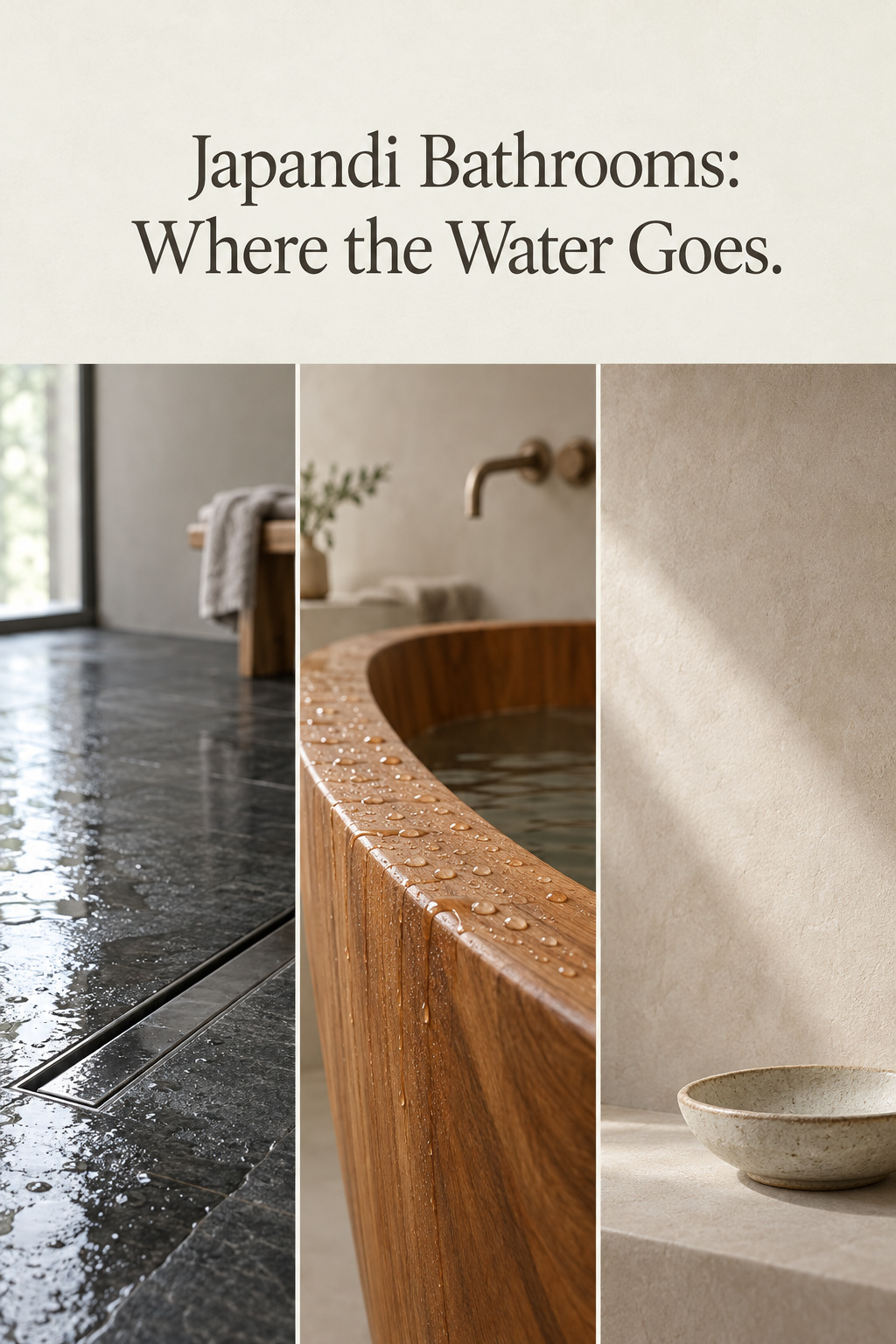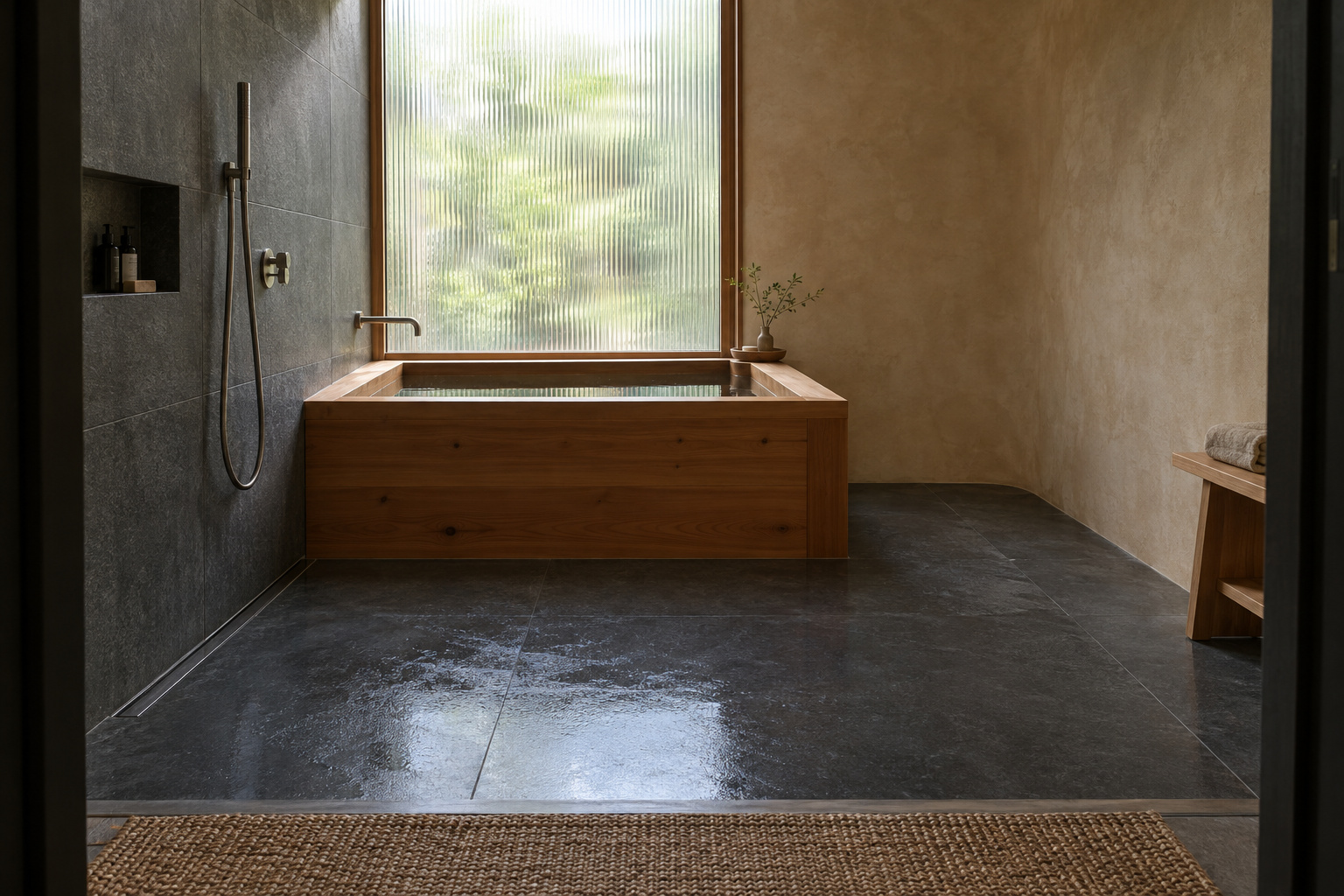

Water decides what lasts in a bathroom. Much Japandi bathroom design you see online is planned as if it didn’t. The same room turns up again and again: pale wood, a plaster wall, a stone basin, a branch in a vase, the whole room the color of oatmeal. Put that room in a house where everyone showers in a hurry every morning and parts of it will not last.
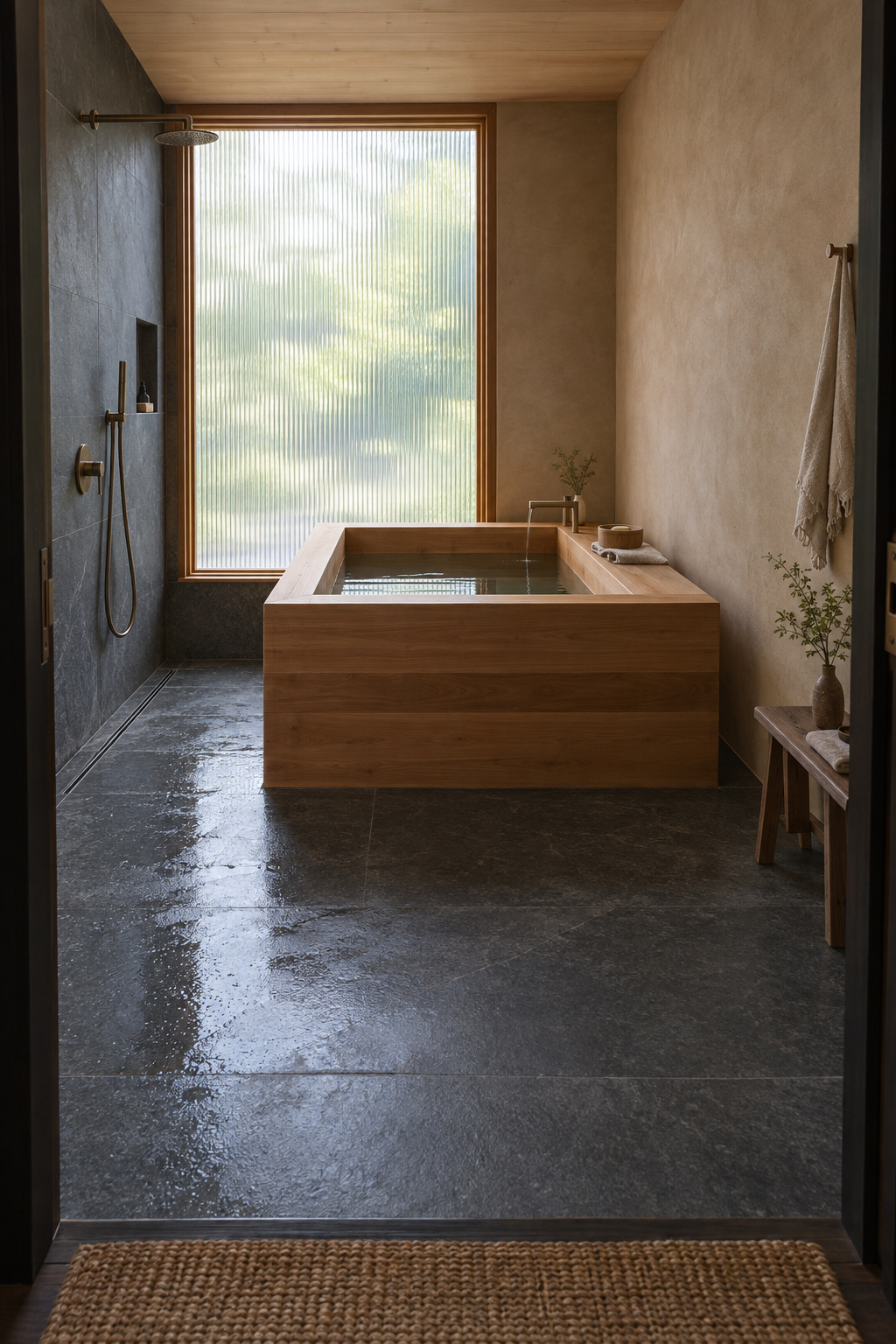
I sort a Japandi bathroom by where the water goes: stone where you wash, wood only where water visits and then dries, lime on the walls the spray never reaches, and few objects anywhere. It is my way of sorting the room, not a definition you will find in a design dictionary, and it starts with a question that comes before any product: how do I want to wash, and how do I want to rest?
Japandi Bathroom Design Starts With Where the Water Goes
The word is younger than it looks. Japandi first appeared in the mid-2010s, when furniture fairs in Europe began building whole themes around Japan: Stockholm in 2014, then the Formland fair in Denmark and Milan in 2016. Houzz UK was already calling the pairing “Japanordic” that April. No one is named as its coiner.
The conversation it names is much older. A Danish naval lieutenant, William Carstensen, visited Japan in 1863, and his book started a Danish taste for Japanese things that designers have drawn on ever since. Thomas Lykke of OEO Studio, who works in Copenhagen, Kyoto and Tokyo, calls the connection “part of our DNA rather than a trend”, and he dislikes the term “Japanordic”. I understand him. The label sells a look, and the older thing is a set of habits.
It is also not the same as warm minimalism, the smooth surfaces and wall-hung fixtures the modern bathroom design guide covers. Japandi parts company with it in three places: the Japanese order of bathing, natural materials that age in use, and light that arrives through a screen.
The order matters most. In a Japanese home you undress in a small dry room. In most accounts you then wash beside the tub, in a room built to get wet, and rinse off every trace of soap. Only then do you get into the tub, which is for soaking and nothing else. The family shares the water, so everyone gets in clean. Afterward you go back to the dry room to dry and dress. How much of the wash-then-soak layout of a Japanese bathroom fits an American room is a question with several good answers, smallest first.
Most winter mornings I ski to the end of our road and back. I come in cold, and the order makes sense to me without any explaining. The soak is what warms you. The warm, dry room afterward is what lets you stay warm.
The pictures also leave out that most modern Japanese homes do not bathe among cedar and plaster. Their bathrooms are tiled wet rooms or molded plastic units with a drain in the floor, and a wooden tub is a premium choice there too. What Japandi can take from a Japanese bathroom is the habit about water, not a catalog of materials. The habit is what tells you where each material can go.
| Place | How wet it gets | What I put there | What stays out |
|---|---|---|---|
| Wash area floor and the walls around it | Sprayed and running every day | Honed stone or floor-rated tile underfoot; handmade tile on the walls | Plaster, limewash, unsealed wood |
| Tub edge, vanity, a bench by the bath | Splashed, then left to dry | Durable heartwood | Wood that sits in a puddle |
| Walls the steam reaches but the spray does not | Damp air and condensation | Limewash or lime plaster | An acrylic sealer over limewash |
| Changing area, a window across the room | Dry most of the time | Paper, screened glass, linen | Paper anywhere near the spray |
None of that table works without moving air: every row assumes a fan that actually runs after a shower.
Stone and Handmade Matte Tile Where You Wash
The wash area is built to be wet. The question for its surfaces is how they look after years of it.
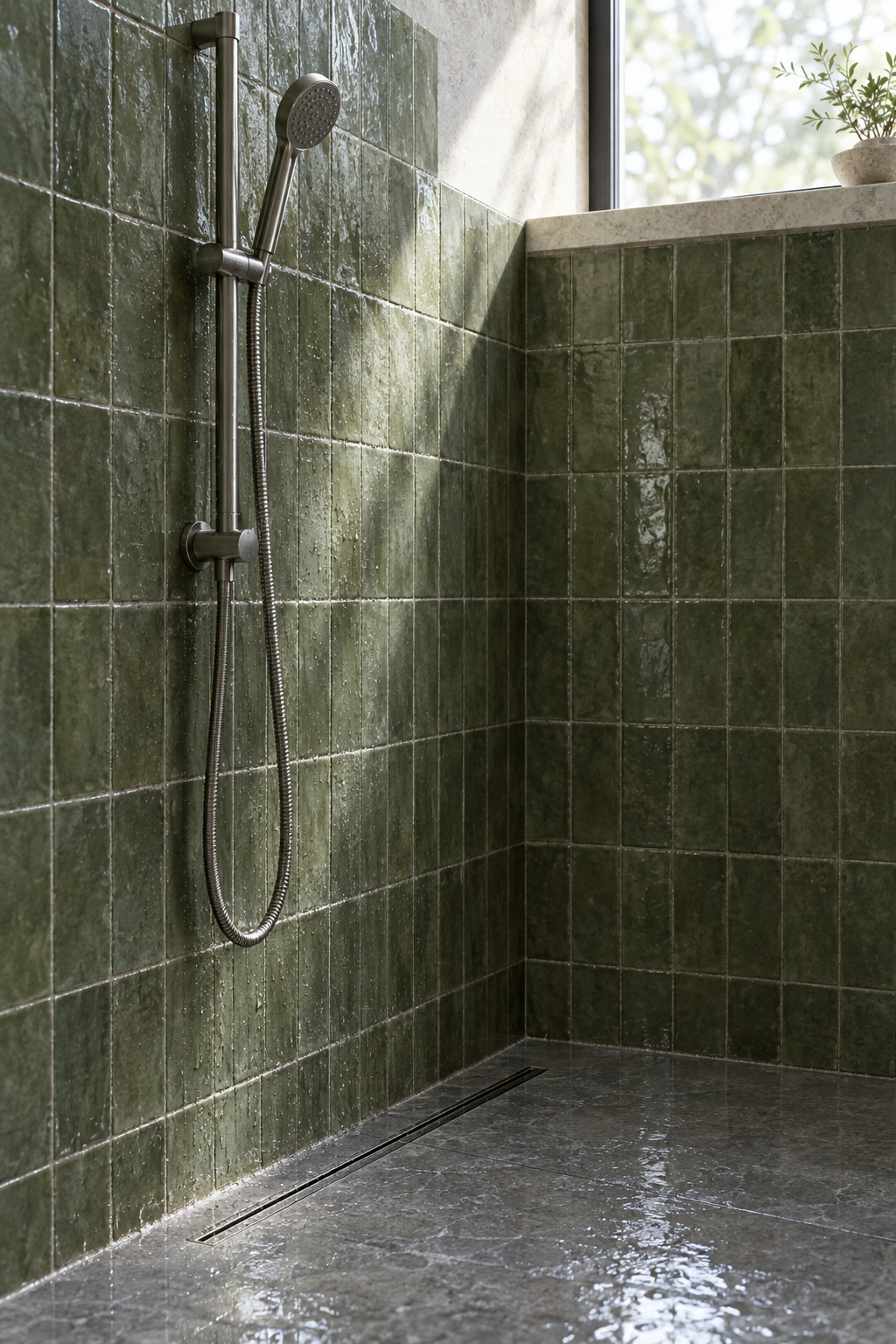
Stone answers well. Marble, limestone, quartzite and slate all work in wet areas, though stone is porous and needs planning with its supplier. The finish matters more than the stone. Polished stone resists moisture better, but it loses its grip when wet and soapy, and that is the wrong trade on a floor where you stand barefoot. Honed stone is more porous and far kinder underfoot. On a wash floor I choose honed or leathered stone and leave polished for the vanity top.
Stone is not a waterproof layer. Water works through it and through its grout, so it sits on a membrane, and that membrane belongs to whoever builds the wet corner. A fully waterproofed, curbless wet room is a construction project with its own planning, and a bigger decision than any style.
Handmade matte tile is where I would put the character, but on the walls. Authentic handmade zellige has uneven thickness and a glaze that chips under feet, so its home is the wall around the wash area. The floor wants stone or a tile its maker rates for floors. Matte is a look, not a grip. What tells you a tile is safe wet is its slip rating for wet interior floors, printed by the maker, so check it before the color wins you over. The small-room guide explains how to read it.
Stone keeps a record of the room. Lemon and vinegar dull or etch limestone and marble. The Natural Stone Institute says sealing makes stone more resistant to stains, not stain proof, and that many stones do not need sealing at all. I am at peace with that. A honed limestone floor that has gone a little soft in tone where people stand every morning shows you where the room is used.
Plaster and Limewash Belong on the Dry Wall, Not in the Spray
Three finishes get called plaster, and they behave differently.
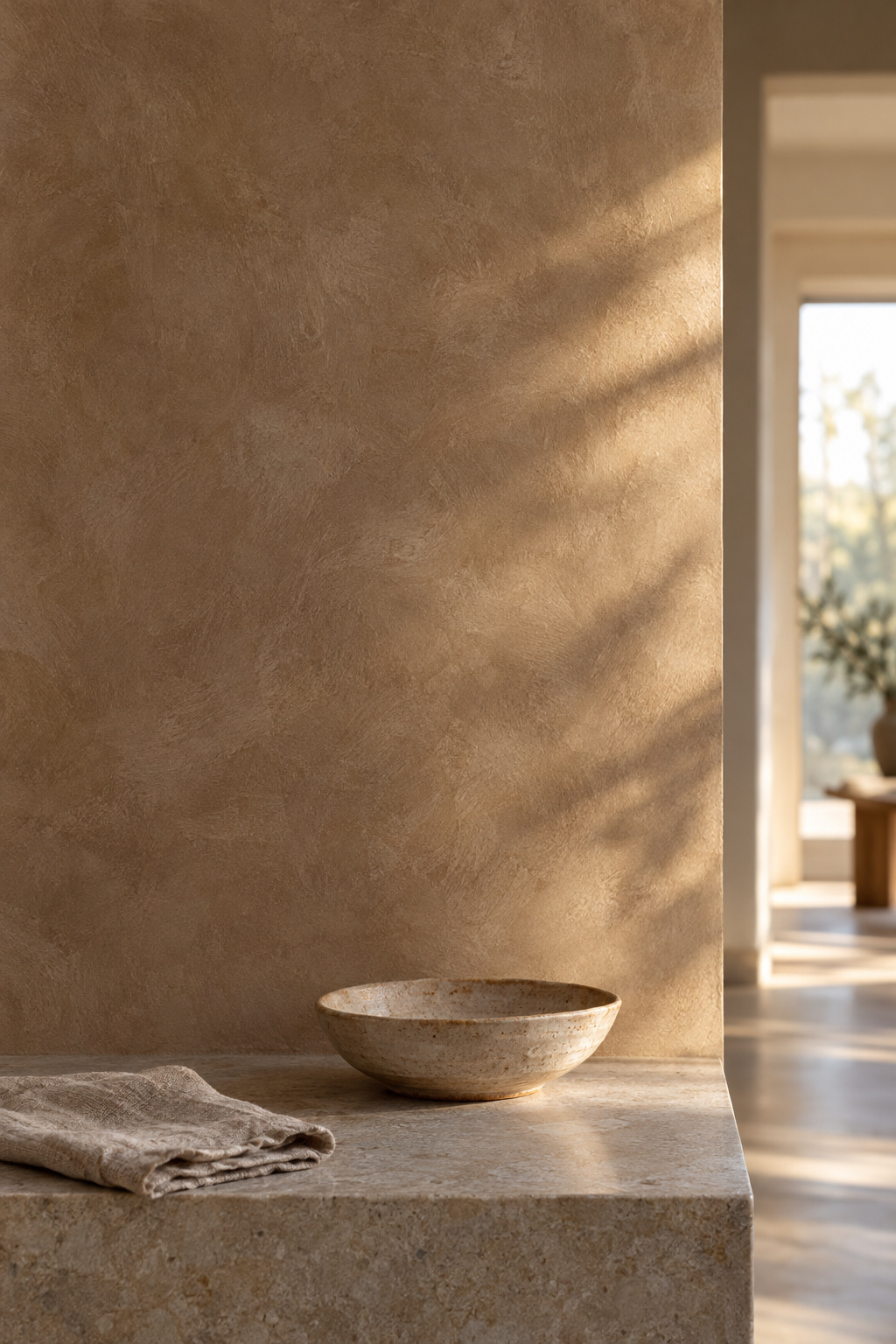
- Limewash: slaked lime, water and mineral pigment, brushed on in thin coats. Soft, chalky and breathable, and the cheapest of the three.
- Lime plaster, often sold as Venetian plaster: lime and marble dust, troweled in layers and burnished until it is stone-hard, with a wax that needs renewing.
- Tadelakt: lime burnished with black olive soap into a water-resistant skin.
Limewash makers are clear about the line. Bauwerk says its limewash suits every bathroom wall except the inside of a shower and the area right beside a bath. It is water-resistant, not waterproof. It is not a film, so it is not prone to blistering or peeling in a humid room, and the same maker says not to seal it, because a sealer undoes the breathing that makes it work. It does stain, which is why a splashback behind the basin is a good idea; toothpaste finds lime quickly. Limewash runs about $1.50 to $6 per square foot.
Old lime plaster has a useful habit in damp: it softens and swells when wet, usually without failing, and hardens again once it dries. That is a material for walls the steam reaches and the spray does not, in a room where the air keeps moving.
Tadelakt is where the makers disagree. Kreidezeit says it suits splash areas but does not recommend it for showers. Earthaus sells a complete tadelakt shower system. Both expect upkeep: soap every month or two in wet areas, beeswax at least yearly in a shower. Microcement is the other sealed route, and the modern bathroom design guide has an article weighing the two. I do not trowel plaster myself, so I take the makers at their word.
Lime goes on the walls the spray cannot reach, and stone or tile everywhere it can.
A palette that comes from the materials
The big paint brands do not publish a Japandi palette. The colors I use come from the materials themselves. Lime takes earth pigments, so it gives warm whites and clay. Stone gives charcoal and soft gray. I add one muted green, because it sits well beside wood.
White deserves a warning. White walls are not neutral in a north-facing room. They go gray and cold. Pick a warm white, or an off-white with some yellow in it. I used to recommend all-white kitchens to everyone, until a winter in Minnesota showed me how cold they look in north light. The lesson counts double in a bathroom with one small window. Paint a sample board, hang it on the wall, and try it in February.
Wood Where Water Visits and Dries, Never Where It Stands
Wood does not rot because it gets wet. It rots because it stays wet.
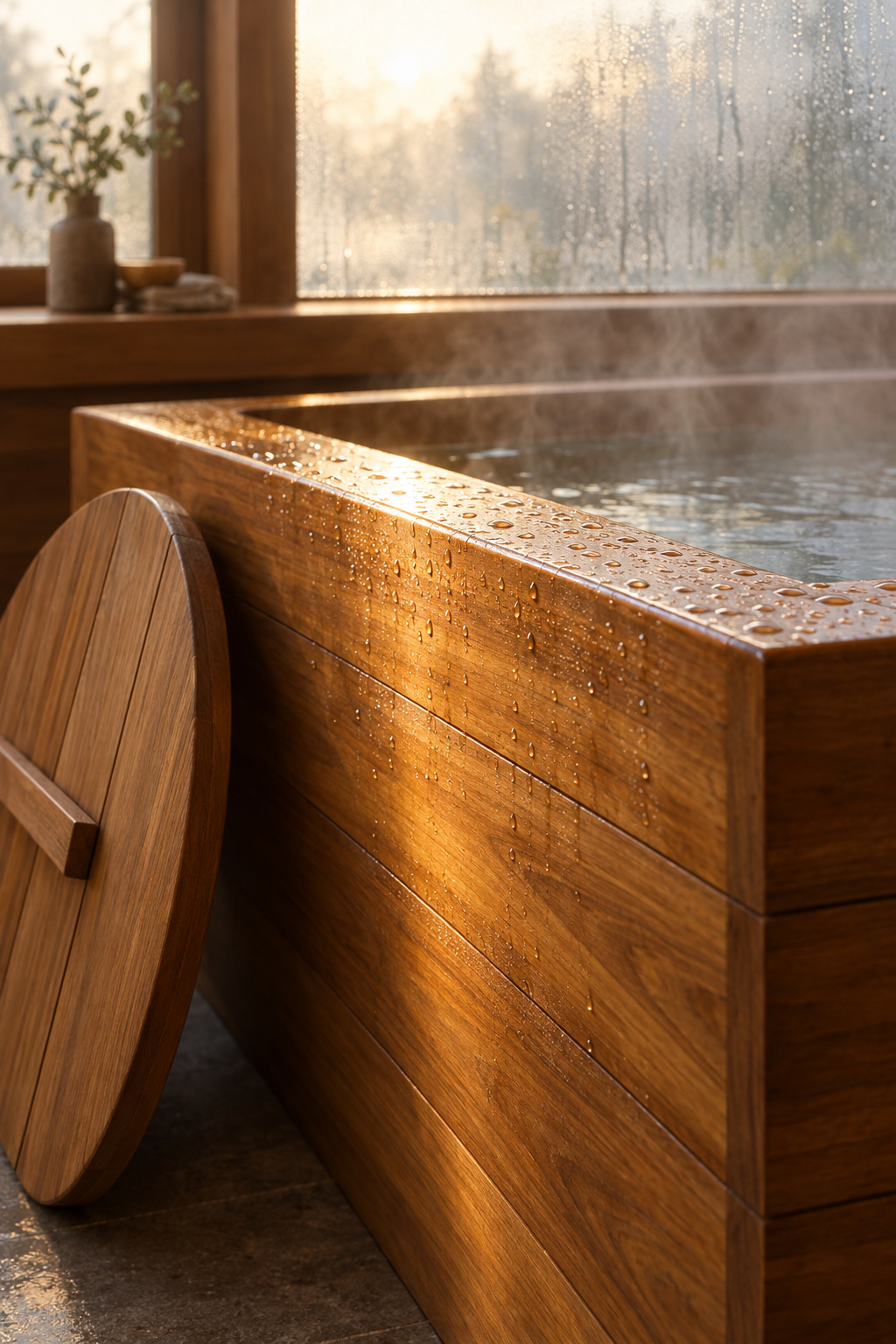
Decay fungi need the wood itself to hold moisture above roughly 20 to 30 percent, and to hold it for a long time. The USDA Forest Products Laboratory puts the reassuring half in one line: untreated wood will not decay if it is wetted for short periods and then dries. That figure is the moisture inside the wood, not the humidity in the room. So I do not sort wood by splash or steam. I sort it by how quickly it dries.
The Japanese wooden tub is the clearest model. One Japanese maker of hinoki tubs tells you to drain it after every bath and ventilate the room so the wood dries naturally.
Wood that can take getting wet
Some heartwoods buy you margin. Where each one can go:
- Teak, the most durable in the European ranking: a tub surround, a bench, a bath mat.
- Western red cedar heartwood, also durable: slats, a surround, a shelf near the bath.
- White oak, between durable and moderately durable: a vanity, a shelf beside the basin.
- Ash and beech, which are not durable: the dry side only, a stool by the door or a towel rail.
These rankings come from stakes buried in soil, so read them as margin, not a bathroom rating.
Where wood should not go
Keep wood off the wash floor and out of the shower. Keep it from under a mat that stays wet, and off any flat surface that holds a puddle. There is no code or standard safe distance between a shower and a piece of wood, so watch where your own water lands and keep wood out of the places that are still wet after the rest of the room has dried. A slat wall asks the same question across a whole wall, and where a wood slat wall can go in a bathroom is the guide to read before you buy boards.
The best argument I know for wood that shows its use is in our kitchen in Duluth. The small oak table we eat breakfast at was my desk, my dining table and my workbench for six years in my apartment in Malmö. It has knife marks I refuse to sand out. It followed us between homes because it was good, and the marks are part of why I still like it. Good wood in a bathroom can take the same kind of wear, as long as the wear comes from hands and not from standing water.
Paper, Screened Glass and Daylight for the Dry Side
Light is the first material of any room. In winter countries you learn that or live badly.
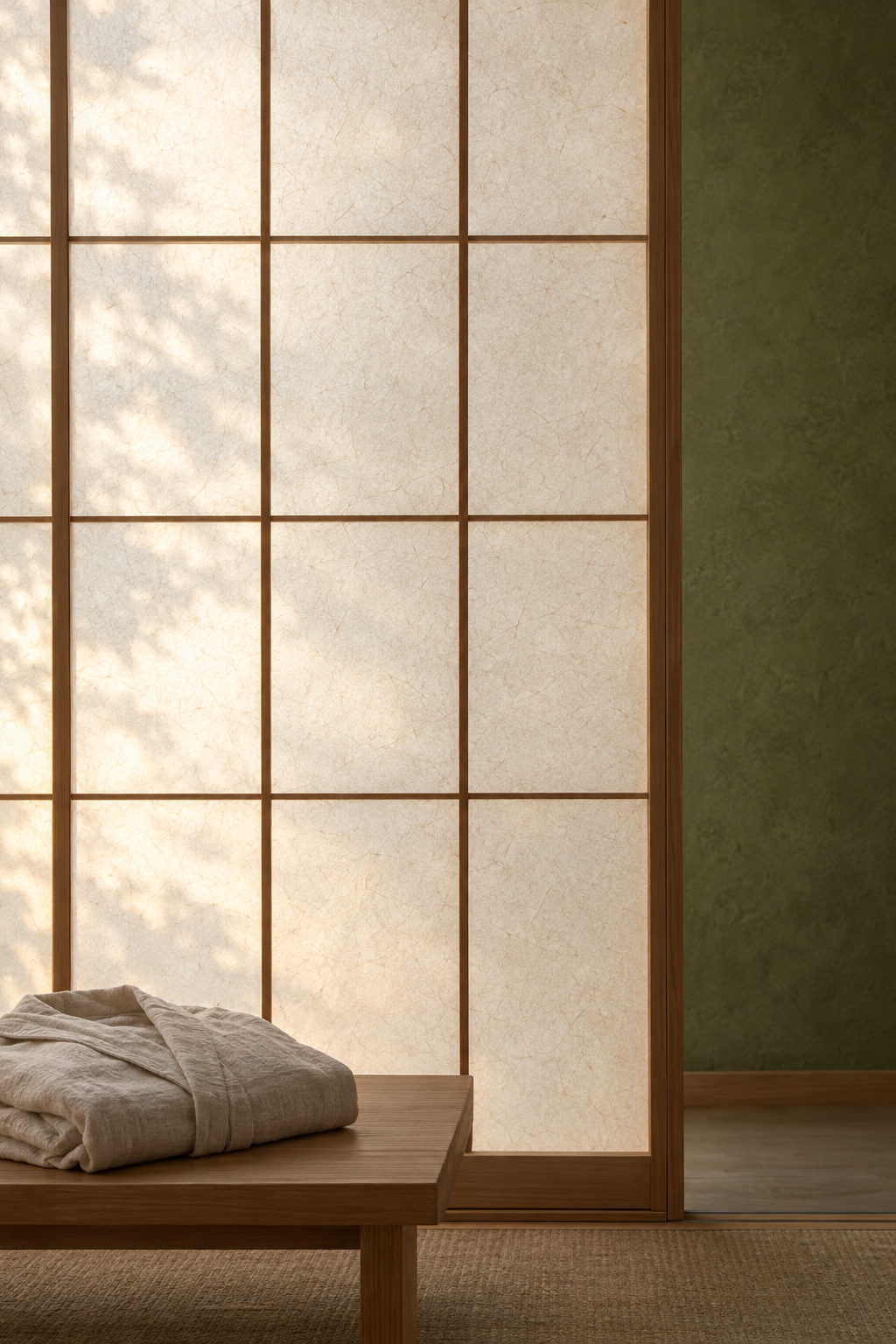
The Japanese answer is the shoji: tough, translucent paper on a wooden lattice that softly spreads light through a house. Traditionally the screens were often taken out in summer, because of the humidity. That detail tells you where paper belongs. It is a dry-room material, and in a bathroom I keep it on the dry side, in the changing area or on a window across the room from the bath.
Tanizaki, in his 1933 essay In Praise of Shadows, described light drawn into a tea-house alcove that “forms dim shadows within emptiness”. A bathroom wants a little of that: light that has passed through something before it reaches you, so the room glows rather than glares. Reeded glass does it on a window that gets wet. For a window nearer the water, bathroom window privacy that keeps the daylight sorts out the films, glass and panels that can take steam.
A paper lantern over the bath is the other temptation. Light fittings are rated for damp locations, where condensation forms, or for wet ones, where water can drip or splash onto them. I know of no rating that covers a paper shade in steam. Hanging and rating bathroom lights after dark is the bathroom lighting guide’s subject, and I would read it before a paper globe goes anywhere near the tub.
Wabi Sabi Bathroom Without the Costume: Few Objects, Each With a Job
“In the small room, it is desirable for every utensil to be less than adequate.” The tea master Sen no Rikyū is recorded saying it in the Nampōroku of 1690. The wabi idea behind it is moderation, not hardship: a few modest things, used often, with their small flaws left alone.
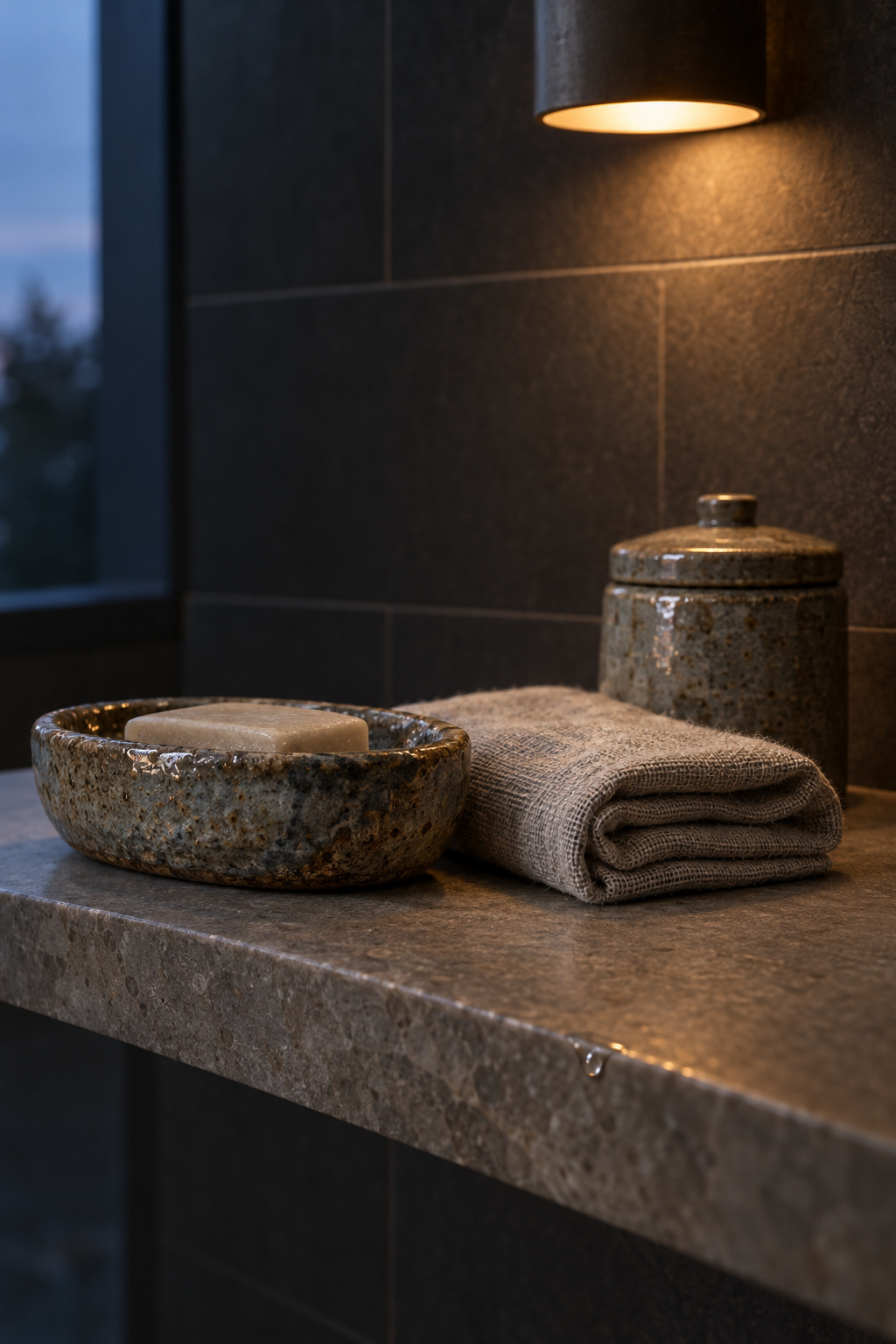
The historian Paul Atkins points out that wabi and sabi are “yoked together far more often outside Japan than in it”. So “wabi sabi bathroom” is mostly our phrase, not theirs, and I hold it loosely. The part I keep is wear. Tadelakt shows traces where it is rubbed. Limestone etches. Limewash goes on changing as it ages. Each of those is a finish.
A leak is not a finish. Neither is rot, or black mold in the corner of a wooden mat. Nothing in the idea excuses neglect, and the tea tradition mended its broken bowls. Wear comes from use. Damage comes from water you left where it should not be.
Costume is the other trap: things bought to look calm or spiritual that do no work in the room. My test is a job. A stool you sit on to wash, a mat you step onto, one tray for the bottles you use each morning. Everything else needs a very good reason. There is no right number of objects. Enough is a good word. An empty stretch of ledge is the part of the room that lets the rest be seen. My wife calls this my monk phase.
Choosing the few objects worth keeping out, and what each should be made of, is a short list of its own.
Which Parts Are Worth the Money: Deep Tub, Real Wood Vanity, Small Room
A Japandi bathroom has no price of its own. What it does is show you where money changes how the room works, and where it only changes how the room photographs. This is how I would rank the spending, first to last.
| Part | What it changes | Effort | Where I rank it |
|---|---|---|---|
| A place to wash: a stool and a handheld shower | The order of the bath | Light | First |
| Screened daylight at the window | The light all day | Low, if the window is already there | Second |
| A real-wood vanity | What your hands touch every morning | Mostly checking how it is built | Third, where water only splashes |
| A deep soaking tub | The soak itself | Heavy: the floor, the water heater, the way in | Last, and only with a place to wash |
The wash station comes first because it is the cheapest part of the order and the one everything else depends on.
A deep tub
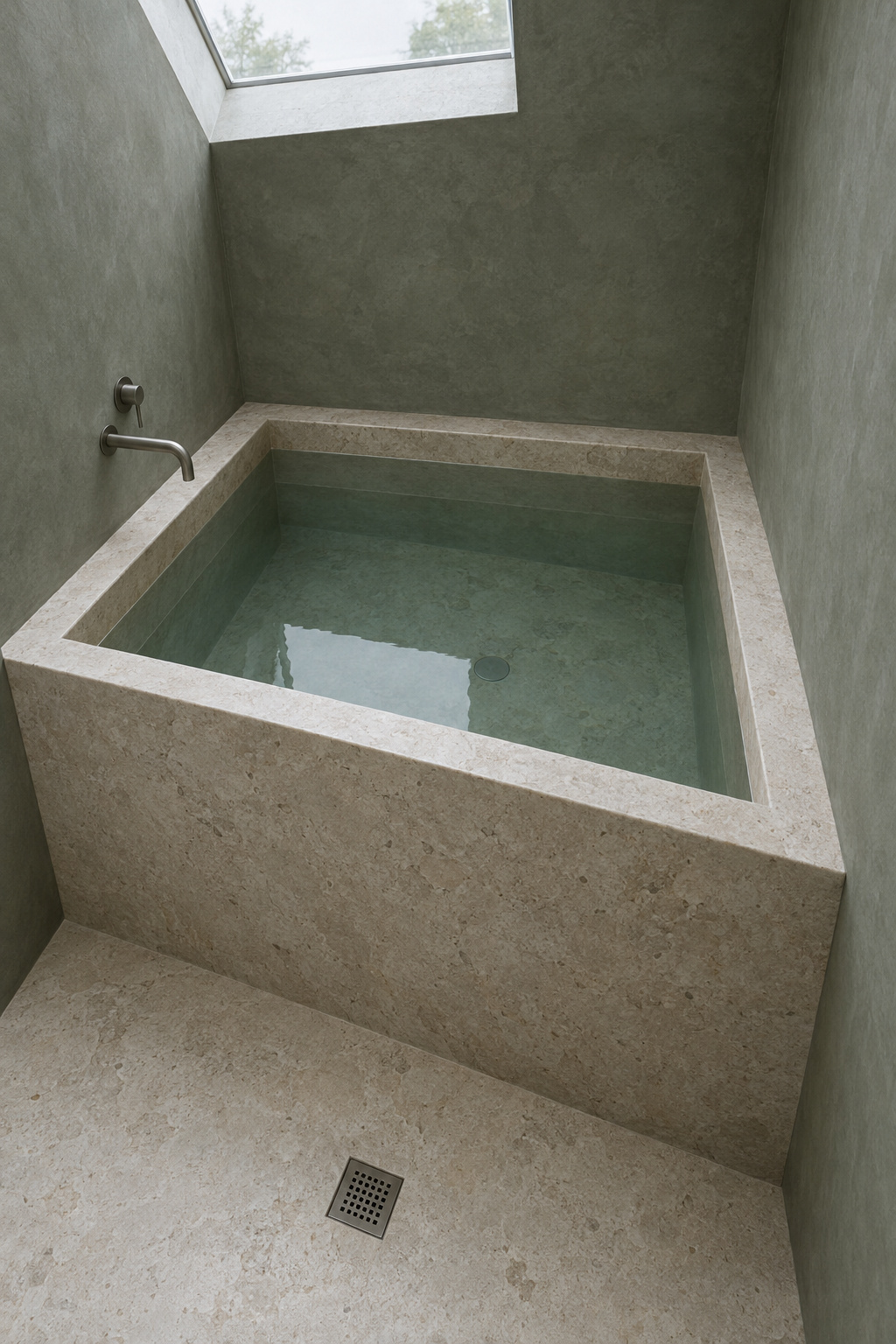
The Japanese tub is for soaking only. Washing happens outside it. A deep tub without a place to wash beside it gives you the soak but not the order, and you end up scrubbing in water you meant to rest in. It is also a structural question. A full deep tub is heavy, it asks a lot of a water heater, and it has to get through your house to reach the bathroom. Read what to check before buying a Japanese soaking tub before you fall for one in a showroom.
A real-wood vanity
If I spend on one piece of wood in a bathroom, it is the vanity, because it is the wood your hands touch every day. A glossy listing will not tell you which you are buying. Telling a real-wood Japandi vanity from veneer comes down to the edges and the material line, and you can check both before you pay.
A small room
In a small bathroom the zones overlap. The wash area is the tub. The dry side might be one hook by the door. The wet-to-dry map still works, but it tells you what to leave out rather than what to add. A small room shared by a whole household has its own logic of who can reach what, and fitting Japandi into a small bathroom by subtraction works through it shelf by shelf.
Walk Your Own Bathroom Wet to Dry
Stand where you wash. After the next shower, before you wipe anything, look at the room. Where is the floor still wet? Which walls have fogged, and which have stayed dry? How far did the spray reach, and where does the steam stop? Your own bathroom will give you a better map than any room you have seen online.
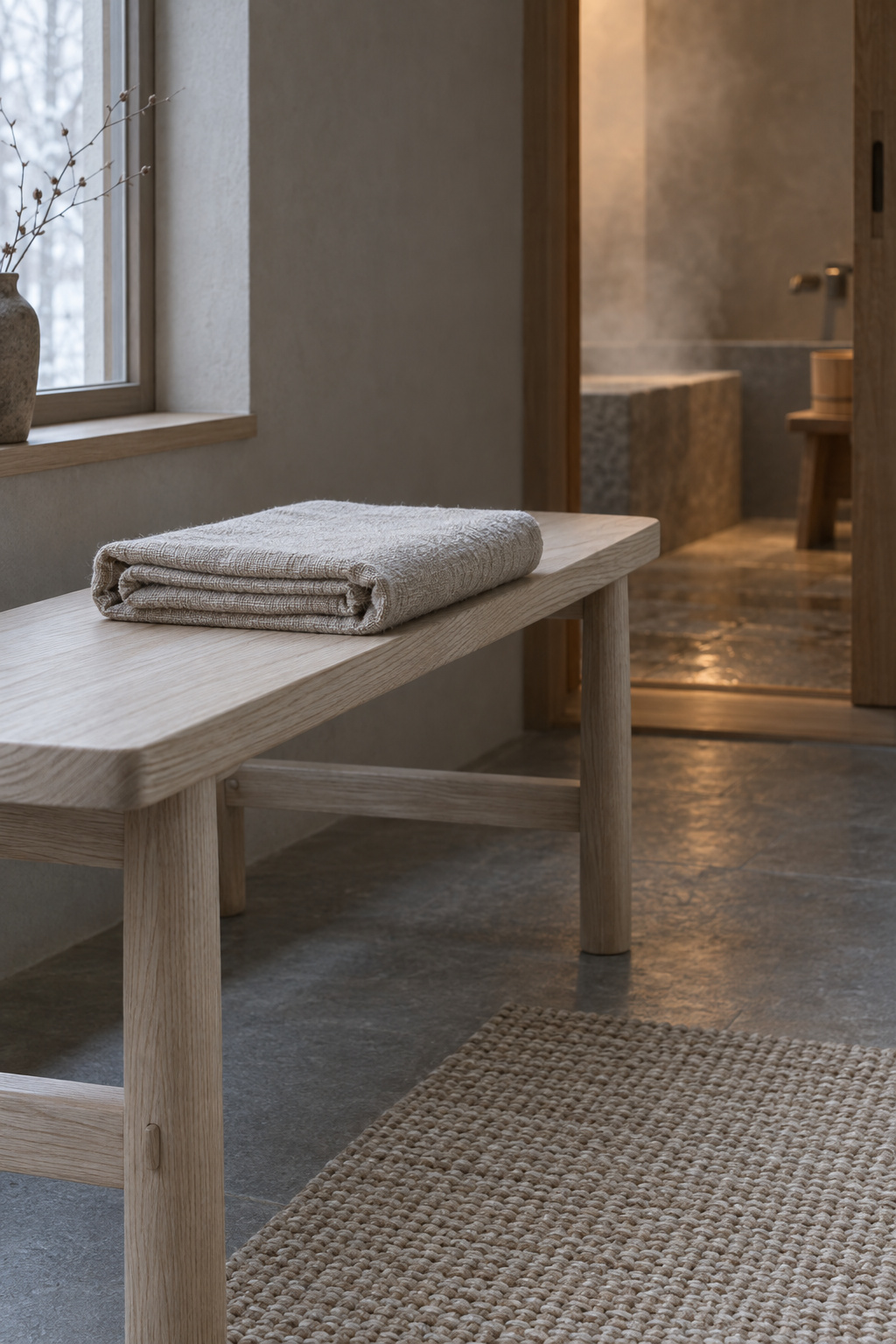
Mark it in your head: the floor and walls that run with water, the edges that splash and then dry, the walls the steam only touches, the dry corner by the door. Then put the materials where they belong: stone where the water runs, wood where it visits and leaves, lime where it only drifts as damp air, and paper and linen where it never arrives.
Air ties all of it together. Lime finishes help even out humidity, and conservation guidance on lime is firm that the room still needs proper ventilation. A breathing wall is no excuse for a fan that never runs.
Houzz UK names the Finnish sauna habit and Japanese ritual bathing as a natural meeting point, so the question of how you want to wash and how you want to rest belongs to both traditions.
Start with the wall in your bathroom the spray never reaches. Decide what it will be made of. That wall is where the room’s warmth goes, the lime or the wood or the softened light, and once it is settled every wetter surface knows what it has to be.