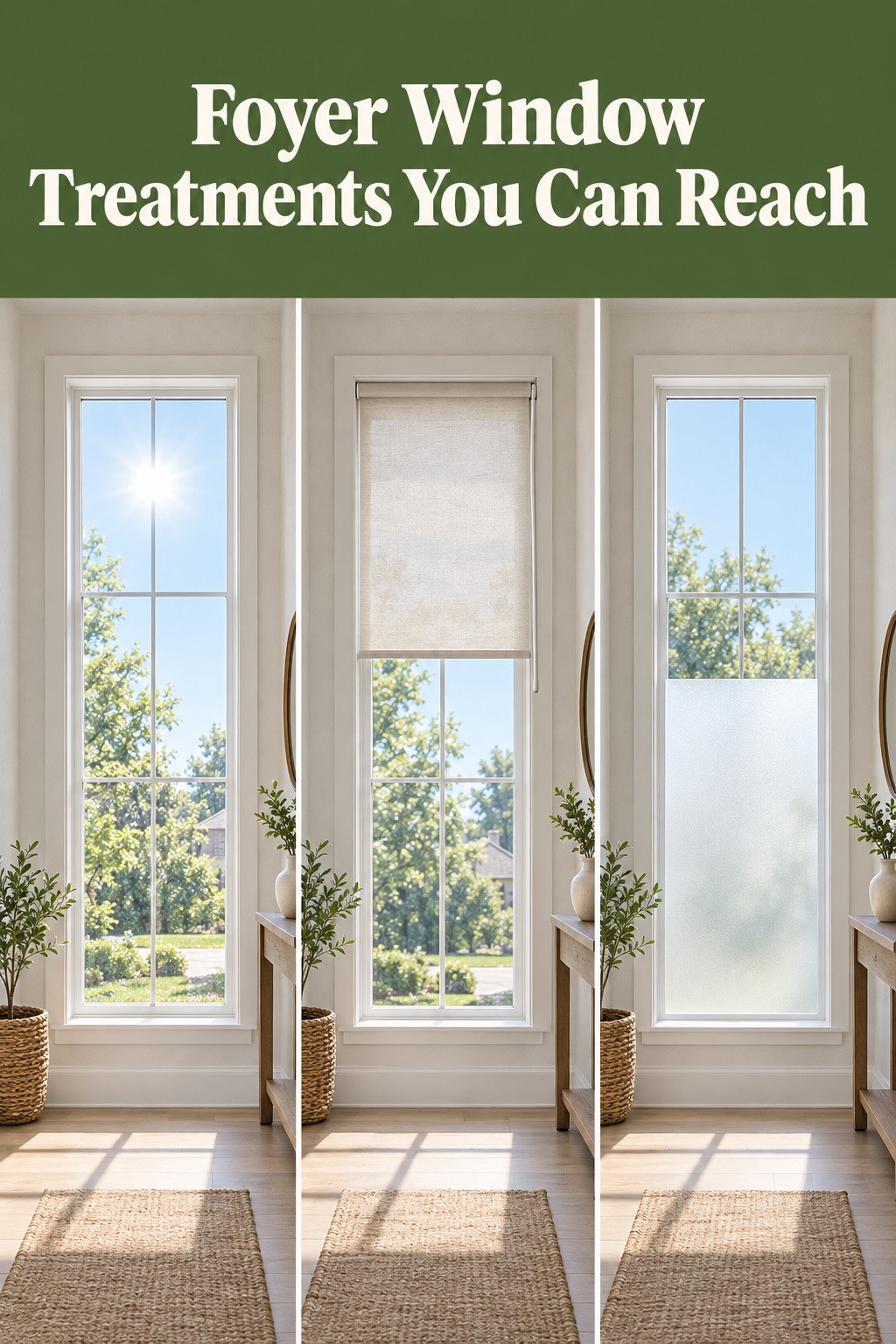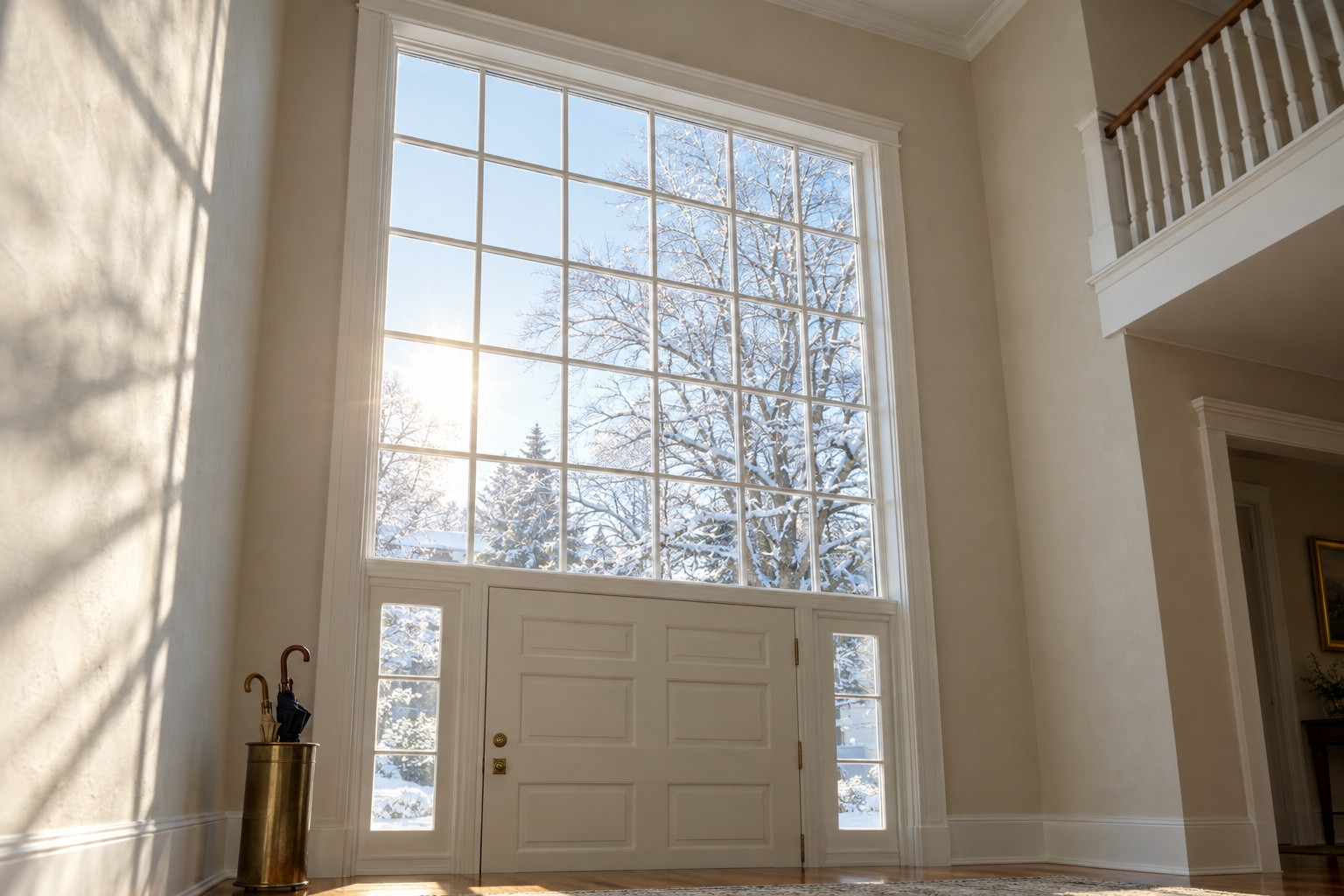

“Does the big window over my front door need anything on it?” It’s the question I hear about tall entries. My answer is usually no.
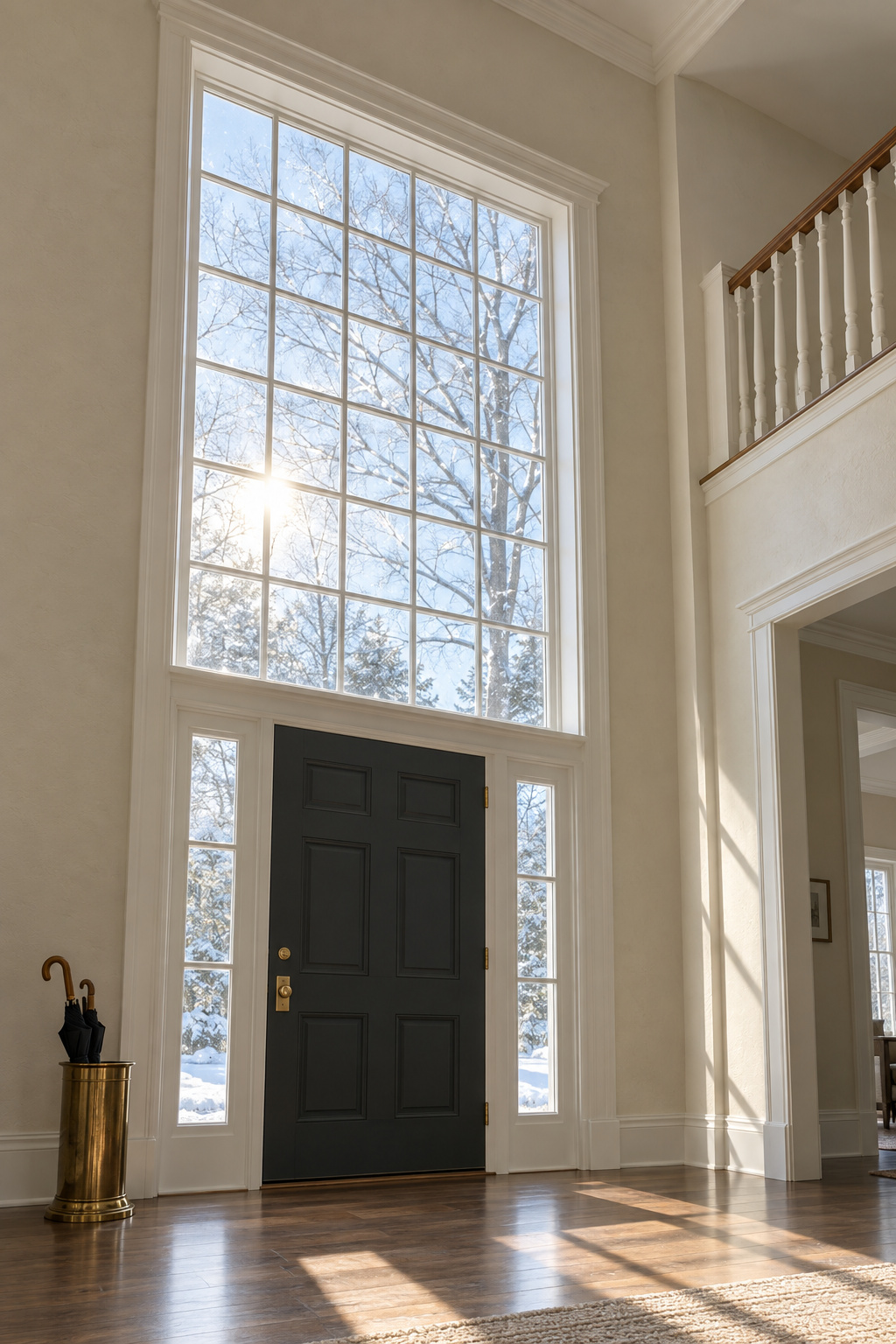
The follow-up matters more: if it does need something, can you work it from the floor? Two story foyer window treatments fail in one predictable way: a shade you can’t reach stays wherever it was left, half-down and collecting dust, for years. So name the problem first, whether that is night privacy, fading or heat. Then pick the simplest fix you can operate and clean standing on your own floor.
TL;DR
- Leave the glass bare unless it causes a problem you can name, and match the fix to that one problem: light and film for night privacy, the glass itself for fading, a cellular shade you will actually lower for heat.
- Ground tools stop working well around 14 to 16 feet up, so above that the practical choices are film, a fixed shape or a motorized shade, which runs $500 to $1,200 and up installed for a 72 x 84 in window.
- Low-E glass already reflects up to 74% of UV, but UV causes only 40 to 60% of fading, so find out what your glass blocks before paying for a fade fix.
Two Story Foyer Window Treatments You Can Work From the Floor, and What They Cost
Reach is the filter. Past roughly 14 to 16 feet a pole loses its angle and pressure, and you get streaks, missed corners and a wand you can’t hook. Take a tape from the floor to the top rail of the window before you look at a single fabric.
Leave the glass bare unless it causes a problem you can name, the same test I put to glass in my bathroom window privacy article.
My test for anything fixed to an old window is whether the next owner can undo it. Film touches only the glass; a bracket or cornice leaves screw holes in the casing. Here are the real options for high glass, from least to most machinery:
| Option | How you work it from the floor | Rough cost for a large window | Problem it fits |
|---|---|---|---|
| Decorative or privacy film | Nothing to work; it stays put | $5 to $15 per sq ft installed; no published price for DIY at this size | Night privacy, some glare |
| Wand-operated roller | Wand or pole, within its length | No published price | Glare, privacy |
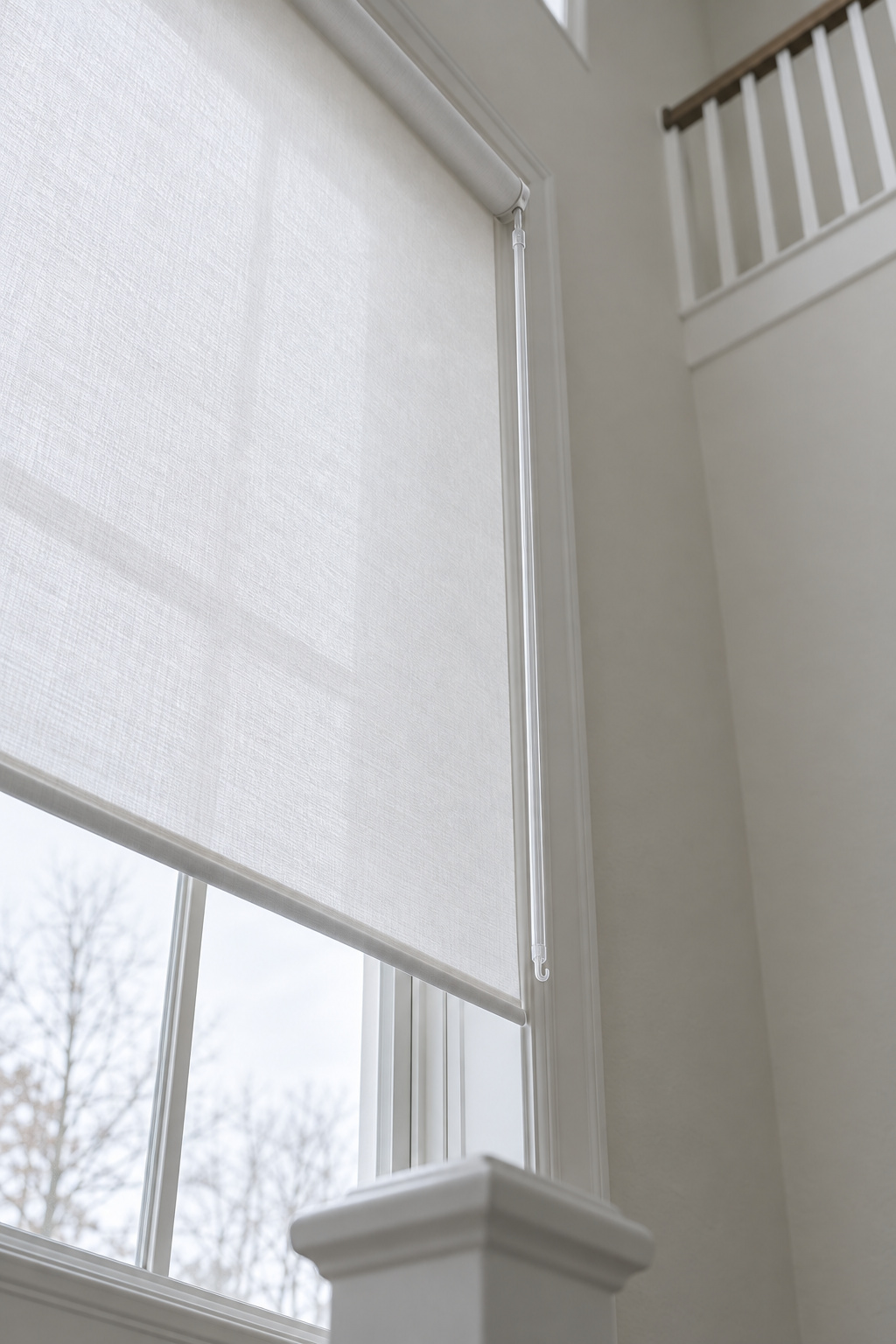
| Cordless or wand cellular | Extension pole, sold in 6 ft and 9.5 ft lengths | $35 to $200 manual at standard sizes (2019); no published price at this size | Heat, privacy |
| Drapery panels on a cornice | Traverse wand or cord | No published price | Privacy, softening a hard entry |
| Motorized roller or cellular | Remote, app or wall switch | $500 to $1,200+ installed for 72 x 84 in | Any, once the glass is out of reach |
Once the top rail sits beyond your pole, power is the first real decision.
Motorized Shades on a Window This Tall: Battery, Solar or Wired
Furniture listings that say “island height” without giving a number annoy me. Shade listings that say “for tall windows” without giving a width do the same thing. One battery roller line stops at 72.8 inches wide, so a wide two-story window is already outside it.
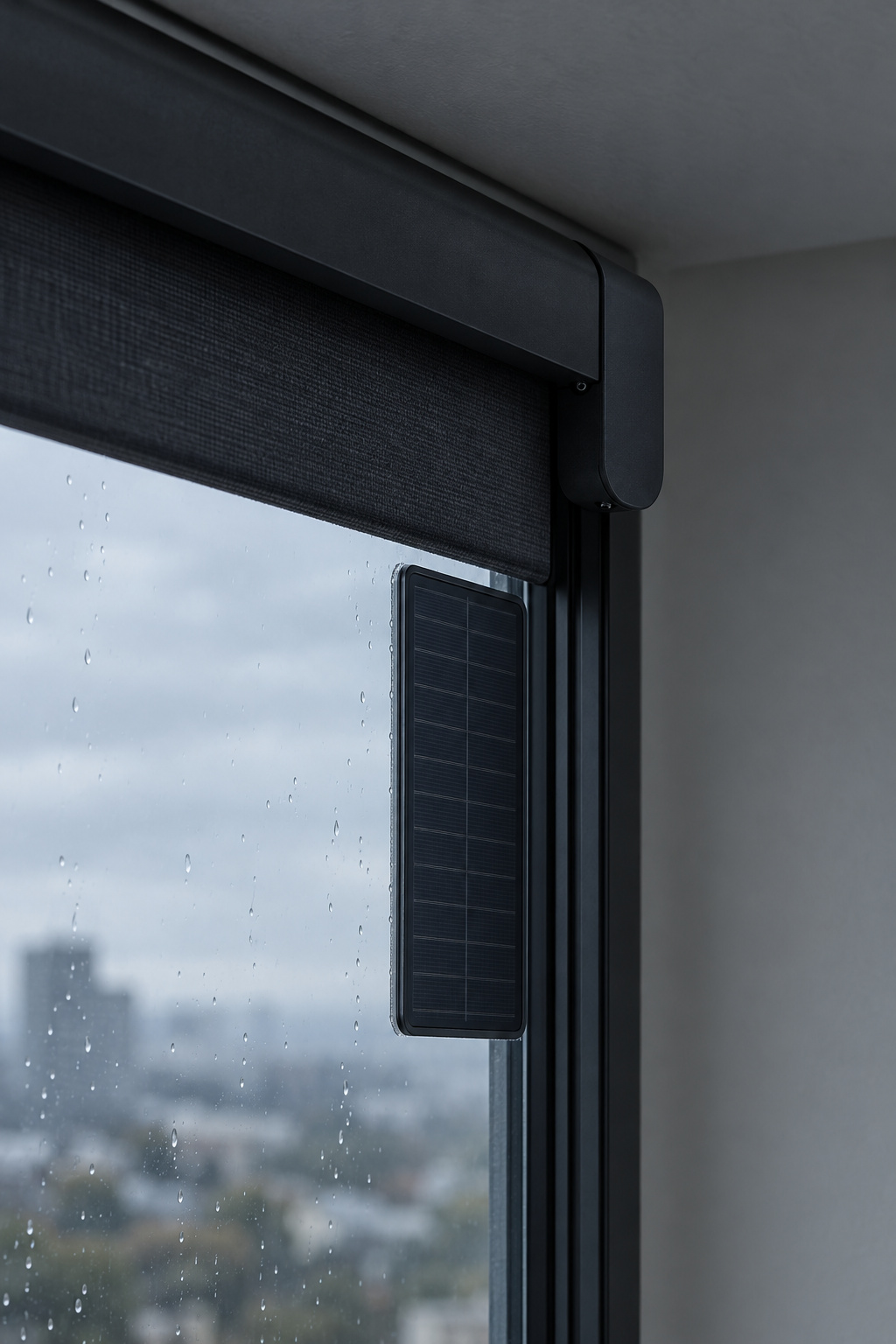
The installed price in the table above covers windows up to 72 x 84 in; anything wider needs a quote. The motor alone adds about $200 to $300 over the same shade worked by hand, and professional installation is $50 to $250 a window. Then choose the power:
| Power | How it charges | What it asks of you | Relative cost |
|---|---|---|---|
| Battery | Rechargeable, often by USB cable in place | A recharge two to three times a year at moderate use; makers and testers quote 3 to 8 months between charges | Lowest |
| Solar-assisted | Small panel on the glass, about $30 | Adds roughly a month per charge; still needs charging | Middle |
| Hardwired | Low-voltage wire run to the window | An electrician in a finished house; stops in a power cut | Highest |
The battery is the hidden climb: changing it means going up there. Ask whether the shade can be charged in place with a long cable or a power bank. If the answer is no, you have bought a ladder trip a few times a year.
A dealer once told me a table was rock solid while he held it still with his hip. Brochures that sell a motor for every high window and never mention charging stand the same way. If the top rail sits inside pole reach, a wand roller or cordless cellular shade on a long pole does the same work for less, with no battery to fetch. Past that reach, the motor is what keeps the shade in use.
Night Privacy Is the Problem Most Foyers Actually Have
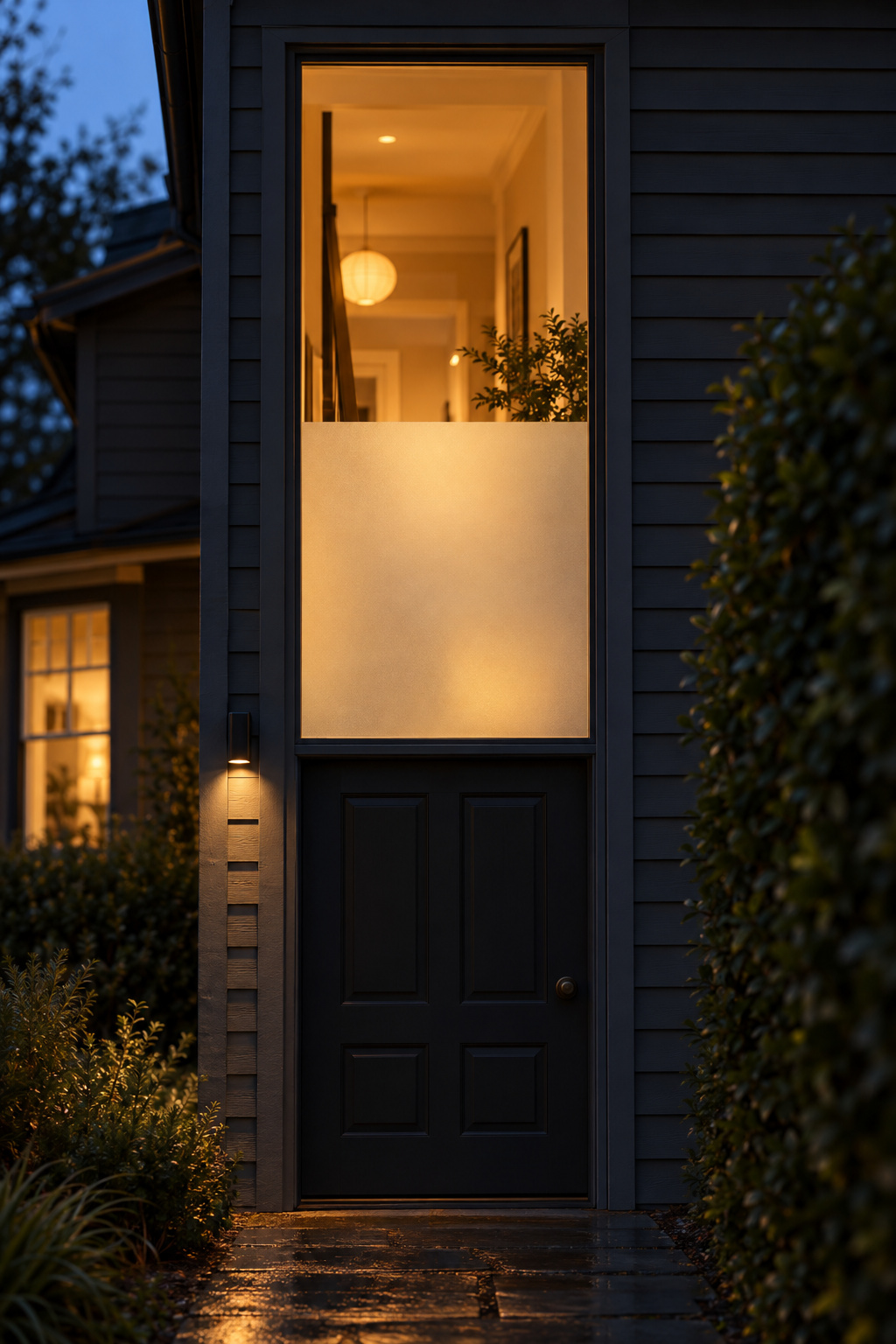
Go out to the street after dark with the hall lights on and look back at the house. A lit foyer is a stage, and from the sidewalk you can sometimes see straight through to the upstairs hall. One homeowner wrote that it “makes me feel really weird.”
In shops the answer to any wobble is “It’s been like that for a hundred years.” My reply is that nobody leaned on it to knead bread for a hundred years. I apply the same logic to glass: a window can have been bare since the house was built and still not suit the way you use the hall at eleven at night.
Change the light first. Sizing the chandelier for the landing view covers where that light belongs, and a lower lamp in the evening may settle the matter. Next comes a sheer or privacy shade you can lower from the floor. Then film, which also handles sidelights and door glass.
Film is where people go wrong. Frosted and dusted lines pass roughly 55 to 87% of visible light, against 90% for clear glass, but denser privacy films drop to 6 to 21%. A small sample looks fine at noon; a whole window of it dims the foyer every day. Have someone stand in the street while you hold a sheet against the glass; the cover usually needs to reach less high than you expect. One caution for newer houses: a UK film maker warns that its frosted solar film is not compatible with low-E double glazing unless the pane is toughened, so check the film maker’s chart and your window warranty first.
Afternoon Glare, Fading and Heat: What Cellular Shades and Film Really Do
What low-E glass already blocks
Find out what the glass is before you buy anything for fading. According to the National Fenestration Rating Council, low-E coated glass reflects up to 74% of the sun’s UV, against about 25% for clear single-pane glass. UV causes only 40 to 60% of fading, though; visible light, heat and humidity do the rest. So low-E slows fading without stopping it.
If the window is old, I would repair and weatherstrip the sash before covering anything. A draft around a sash is a maintenance job, not a design problem.
Honeycomb shades and winter heat loss
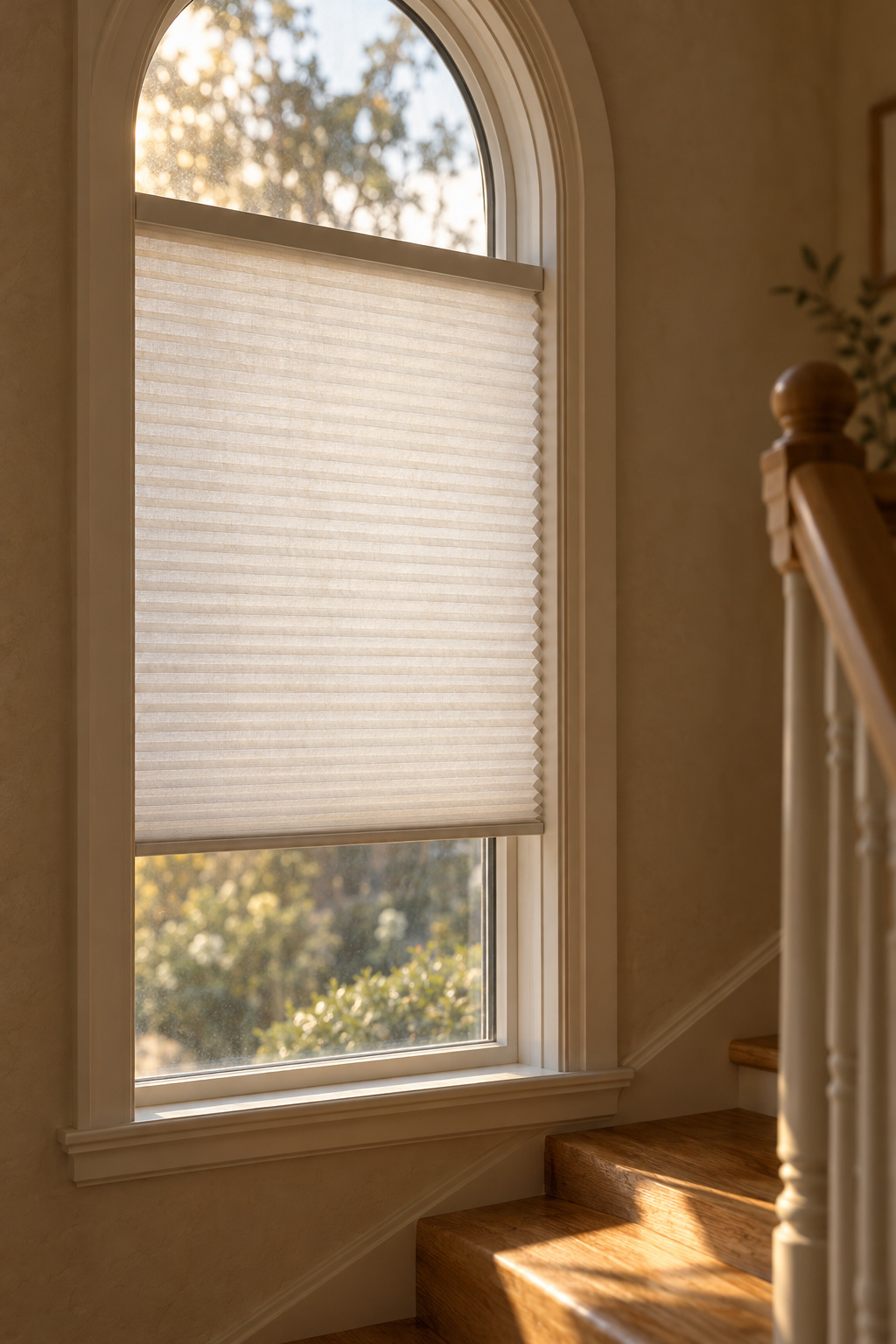
Cellular shades have measured winter results. Oak Ridge National Laboratory tested them in second-floor rooms of a two-story house and found up to 24% heating energy savings over venetian blinds, and the Department of Energy puts the saving at up to 20% against no shades at all. The 40% heat-loss figure is a maker’s claim, and it measures heat through the glass, not heating energy.
The catch is operation, which brings us back to reach. In federal lab-house tests, cellular shades lowered at typical use saved 2.0% of heating energy over venetian blinds, against 9.3% with every shade down. A shade nobody lowers saves almost nothing. For summer heat, a dense solar film cuts heat and daylight together.
- Fading: ask the window maker what your glass already blocks before buying a shade.
- Glare: a light-filtering shade you can lower, or a lighter film.
- Heat: a cellular shade you can reach and will actually use.
Drapery Panels, a Cornice and the Trim Around a Window Over the Door
Window casing had a job before it had a look: it closed the gap between frame and wall to keep out air and damp, and decoration came second. Sometimes the best treatment is to dress the trim and leave the glass alone.
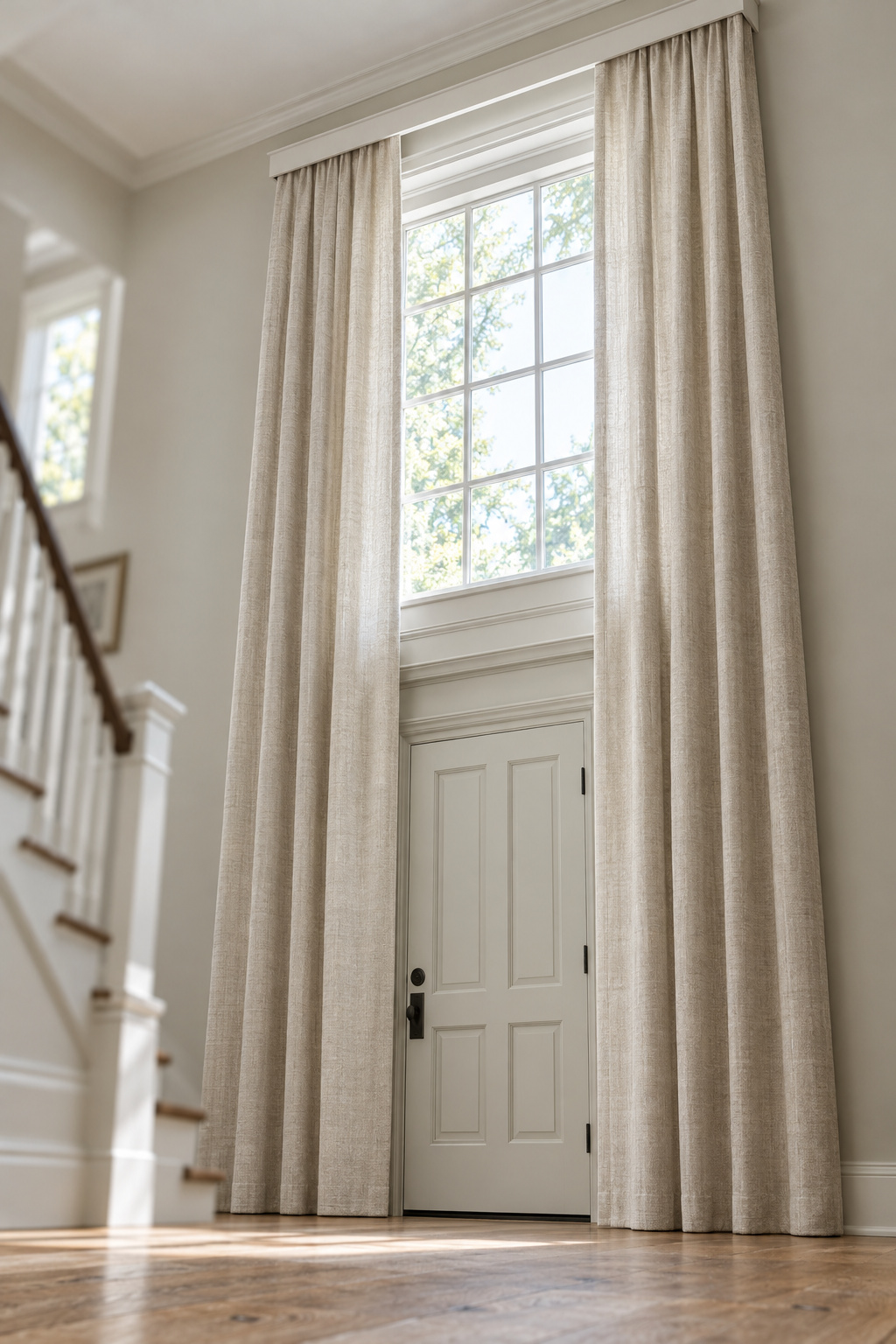
Panels need fullness of two to two and a half times the window width to hang well, and wide spans need reinforced hardware with an extra support bracket. A traverse wand or cord lets you draw them from the floor only if the rod sits inside your reach. Panels also count among the soft surfaces that quiet a tall entry, which is a fair reason to choose fabric over film.
I once told a client to keep a crumbling plaster wall and spent three weekends patching it before admitting that new drywall would have been the honest choice. A plain new cornice does the job and fools nobody.
Clearance from a swinging door
No rule sets how far a cornice must sit from a door. It is geometry: the door’s top edge sweeps a quarter circle whose radius equals the door’s width, so a 36 in door sweeps a 36 in radius. Check it with a tape in hand:
- Measure the door’s width. That is the swing radius.
- Measure how far the cornice or rod projects from the wall, and how high it sits over the door’s top edge.
- Tape the hardware in place, open the door fully, and check it clears the hinge side and any sidelight glass before you drill.
What the Shade Companies Don’t Say: Your Floor-Reach Checklist
Almost no shade company leads with whether the window needs covering at all, and what they offer is mostly a motor or a fixed fit. I would rather you did neither until you had to. The rule I hand anyone standing under that window:
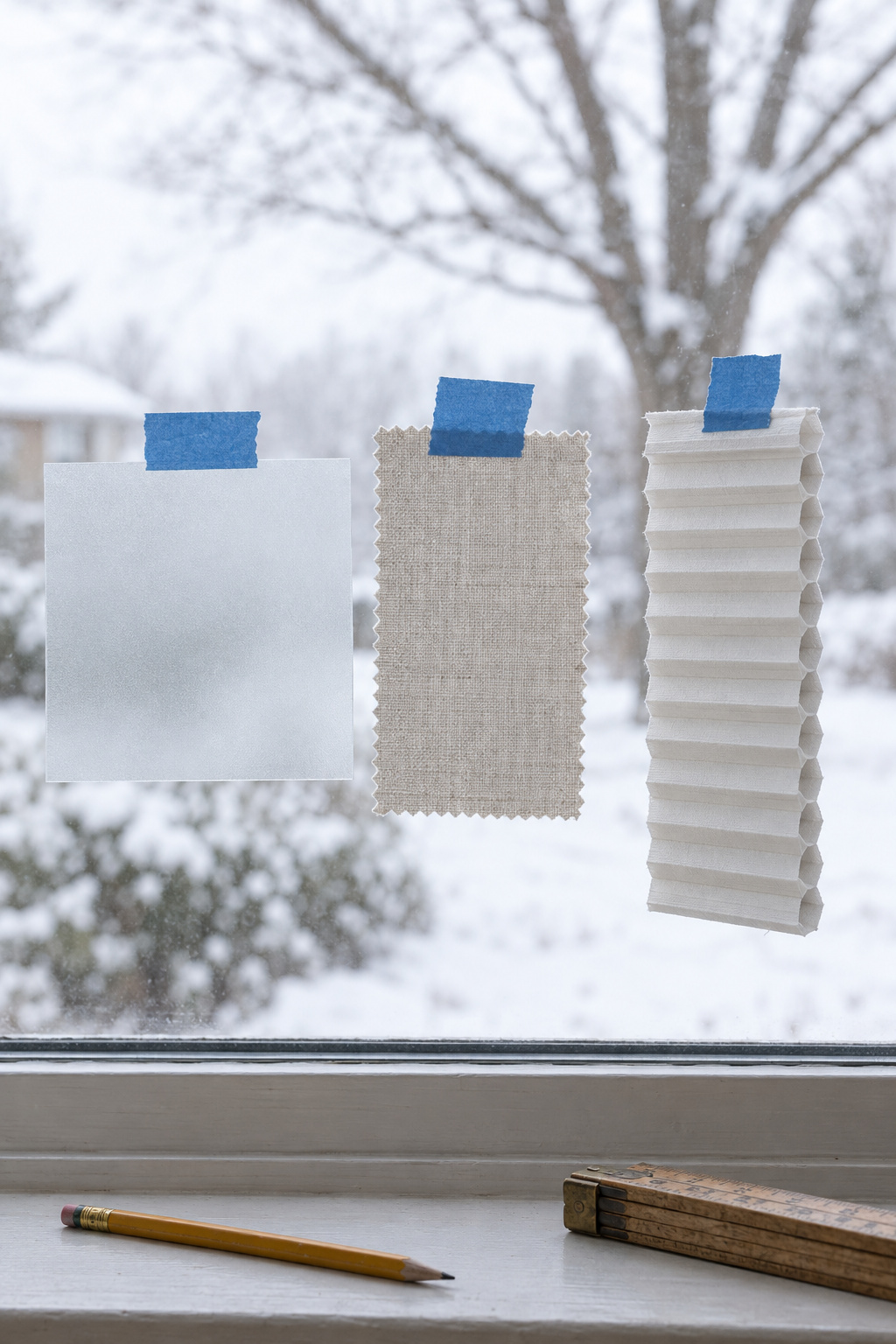
- Name the problem: night privacy, glare or fade, or heat. No problem, no treatment.
- Pick the simplest fix: change the light, then film or a shade you can lower, then power.
- Check how you will work it and clean it from the floor, and test one sample on the glass before ordering the whole window.
Whatever goes up, leave a note for the next one: tape the shade’s model and charging instructions inside a closet door. Once the window is settled, the wall, the light and the line between the lower room and the upper wall come next, in the ideas for the whole double-height entry.
FAQ
How do you clean a two story foyer window you can’t reach?
Clean the outside from the ground with a telescoping pole kit and squeegee; kits that reach a second floor start around $100, and hose-fed water systems about $140. Inside, use an interior pole from a stable floor spot. Beyond pole reach, hire a professional, typically $10 to $18 per accessible high window.
Can you put a shade on an arched or Palladian window above a front door?
Yes, but most arched shades are fixed in place, usually as an arch insert above operable shades on the rectangular sections. Fixed shaped arches run about $250 to $700 and custom operable ones $500 to $1,300. Film follows any shape and needs no operating at all.
Is a bare foyer window a security risk when nobody is home?
Police guidance doesn’t single it out. Ground-floor windows are the most vulnerable, and upper windows matter only when someone can reach them from a stairway, tree, fence, ladder or balcony. The real concern is what a burglar can see, so keep valuables out of view. No published figure ties bare high windows to break-ins.