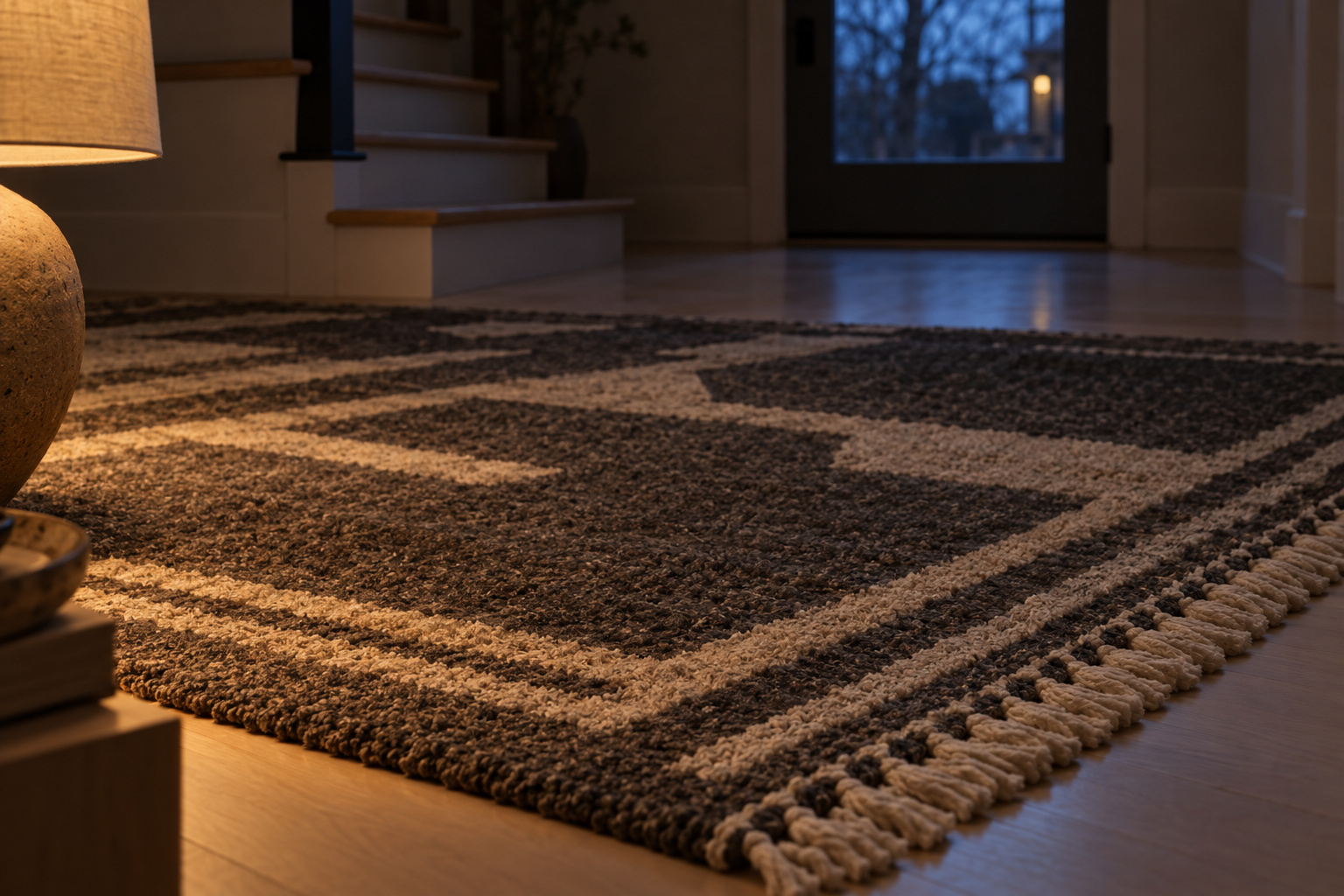

The tape measure snaps back into its case. The click runs up the stairwell and comes back down a beat later. I write the floor size in my notebook before I look at anything on the walls.
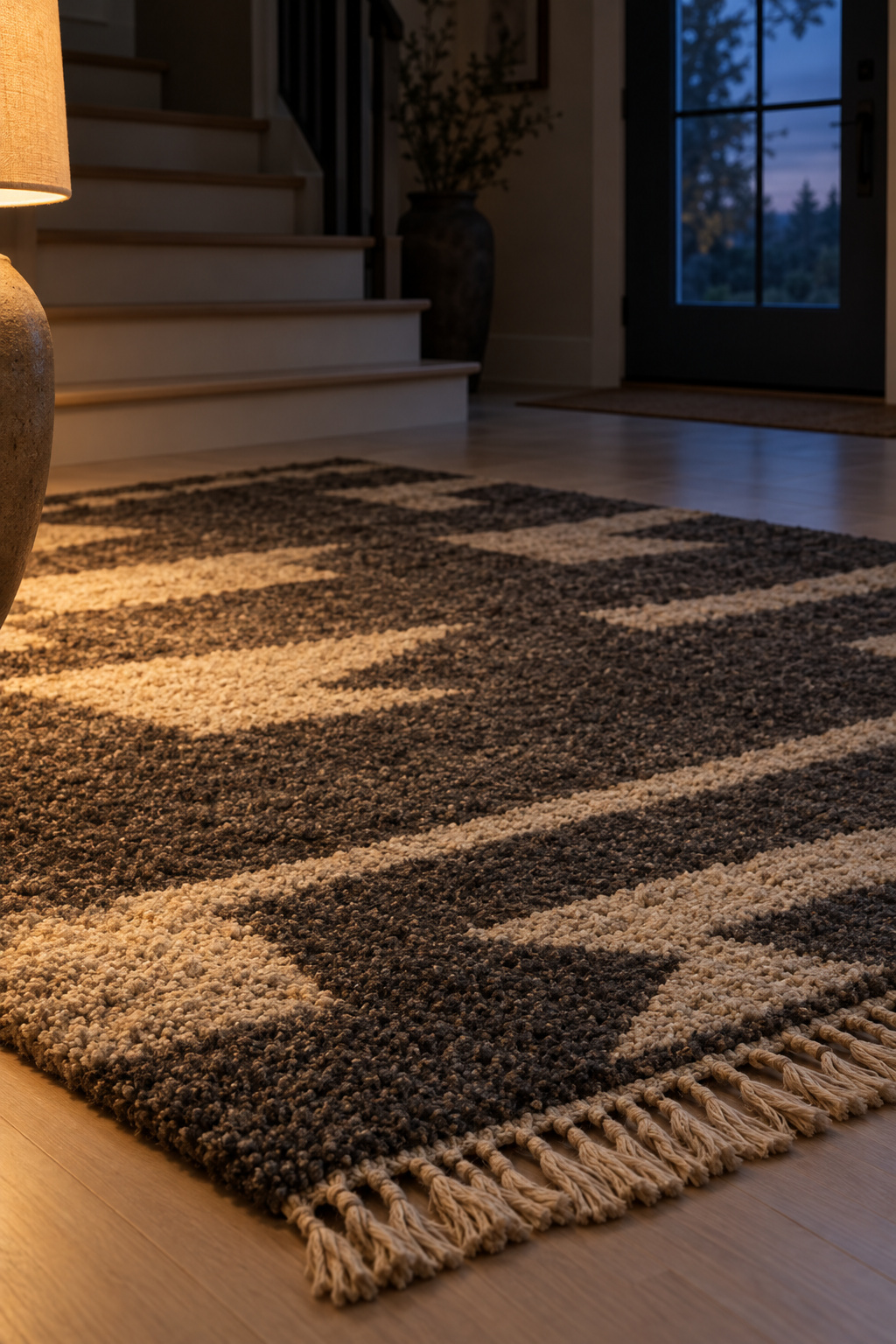
You have probably decorated already: a bench, a big piece over the stairs, a fixture you liked. The entry still feels cold. If you want to make a two story foyer cozy, start with what you hear, because a tall room with nothing soft in it rings, and a ringing room never feels warm. The fix runs in order: a padded rug sized for the floor, one soft thing on the wall, curtains, low warm light, then the draft.
TL;DR
- A two story foyer feels cold mostly because it echoes: painted drywall and glass absorb almost nothing, and in a hard test room at Penn State, laying carpet cut the ring from 3.3 to 1.6 seconds at 1000 Hz.
- Start with a rug on a pad sized to the floor people walk on, 4×4 to 7×7 ft in an open square foyer or 5×8 to 8×8 ft at a double door, then add one soft thing on the wall and heavy gathered curtains.
- Put the warm light at lamp height with 2700K to 3000K bulbs, and if the foyer has a ceiling fan, run it clockwise on low in winter to push warm air back down.
Why a two story foyer sounds cold before it looks cold
Look at what a foyer is made of: a wood or stone floor, painted drywall, a tall window, and a staircase open to the floor above. On the noise reduction coefficient (NRC) scale, where 0 absorbs nothing and 1 absorbs everything, painted drywall sits at 0.05 and glass at 0.05 to 0.10. Almost every sound that hits them comes straight back.
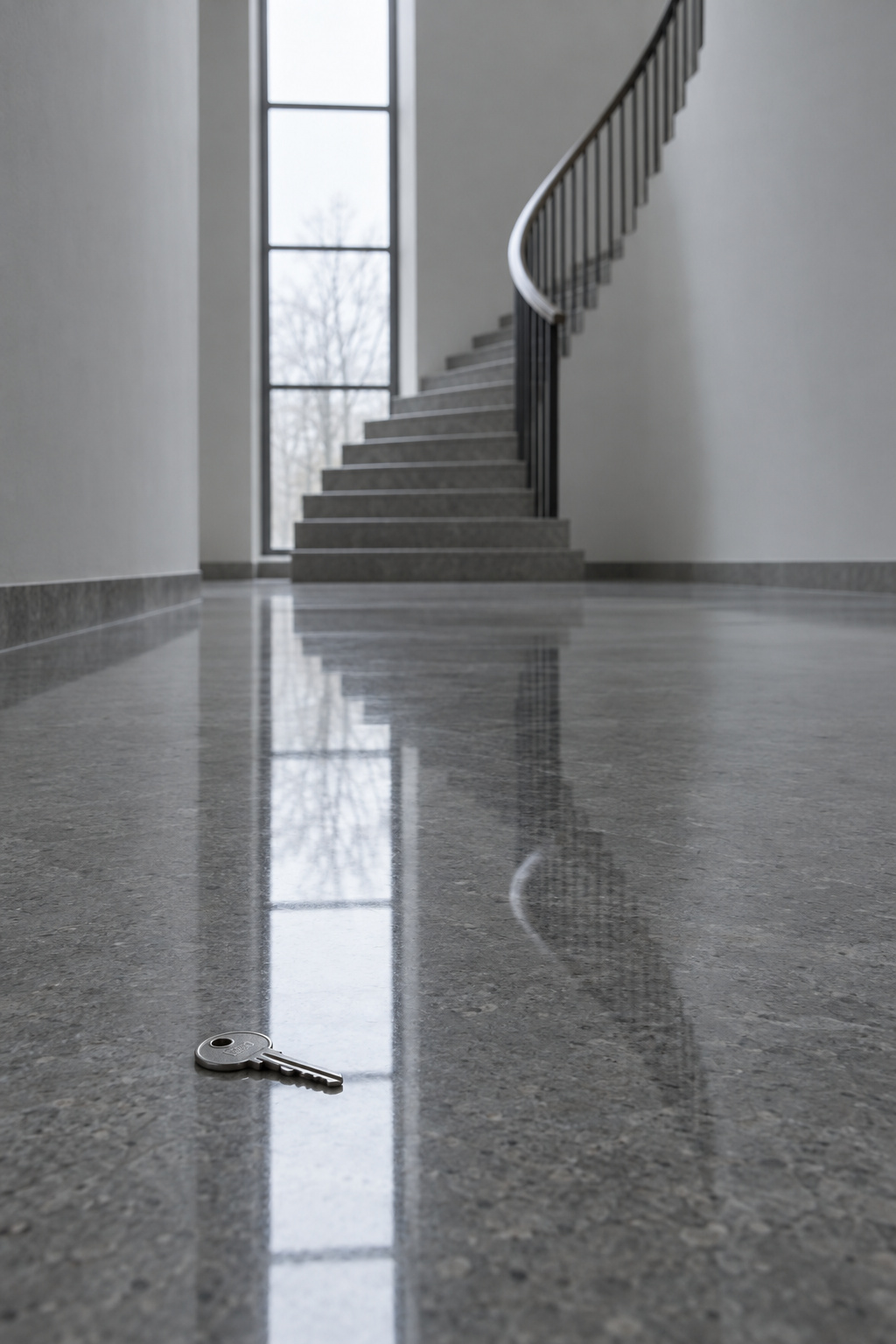
Wallace Sabine worked out the rule at Harvard, testing seat cushions and Oriental rugs in a lecture hall: the more air a room holds and the less soft material in it, the longer a sound hangs on. A tall entry is the bad case on both counts. The good news runs the other way. Double the soft absorption and you roughly halve the ring.
My own family room taught me the order. It had hard floors and bare walls, and it echoed. A rug, a bookshelf and curtains did more for it than any speaker upgrade would have. Soft surfaces first, gear second. The room is the speaker. A foyer has no bookshelf to lean on, though, so everything soft has to be something an entry can actually hold.
This is my view, not a lab result: a quiet room feels warm, and a ringing one feels like a lobby. I can tell which neighbor has a new subwoofer, and on which night: deep sound goes wherever it likes, and soft surfaces only take the sharp ring.
If you want a number for your before-and-after, the clap test in the reduce echo in living room article works the same way in an entry.
Make a two story foyer cozy from the floor up: a padded rug sized for sound
The floor is the biggest hard surface you can cover, so it goes first. Absorption is a material’s coefficient times its area, which means twice the rug does twice the work. Size the rug for sound, not for the photo.
These are the usual sizes for an entry:
| Entry layout | Rug size |
|---|---|
| Landing just inside the door | 2×3 or 3×5 ft |
| Small foyer | 3×5, 4×6 or 5×7 ft |
| Narrow hallway entry | Runner 2 to 3 ft wide |
| Open square foyer | 4×4 to 7×7 ft |
| Double-door entry | 5×8 to 8×8 ft |
Pick from the top of your row and cover the floor people walk on; that extra soft area is the whole point.
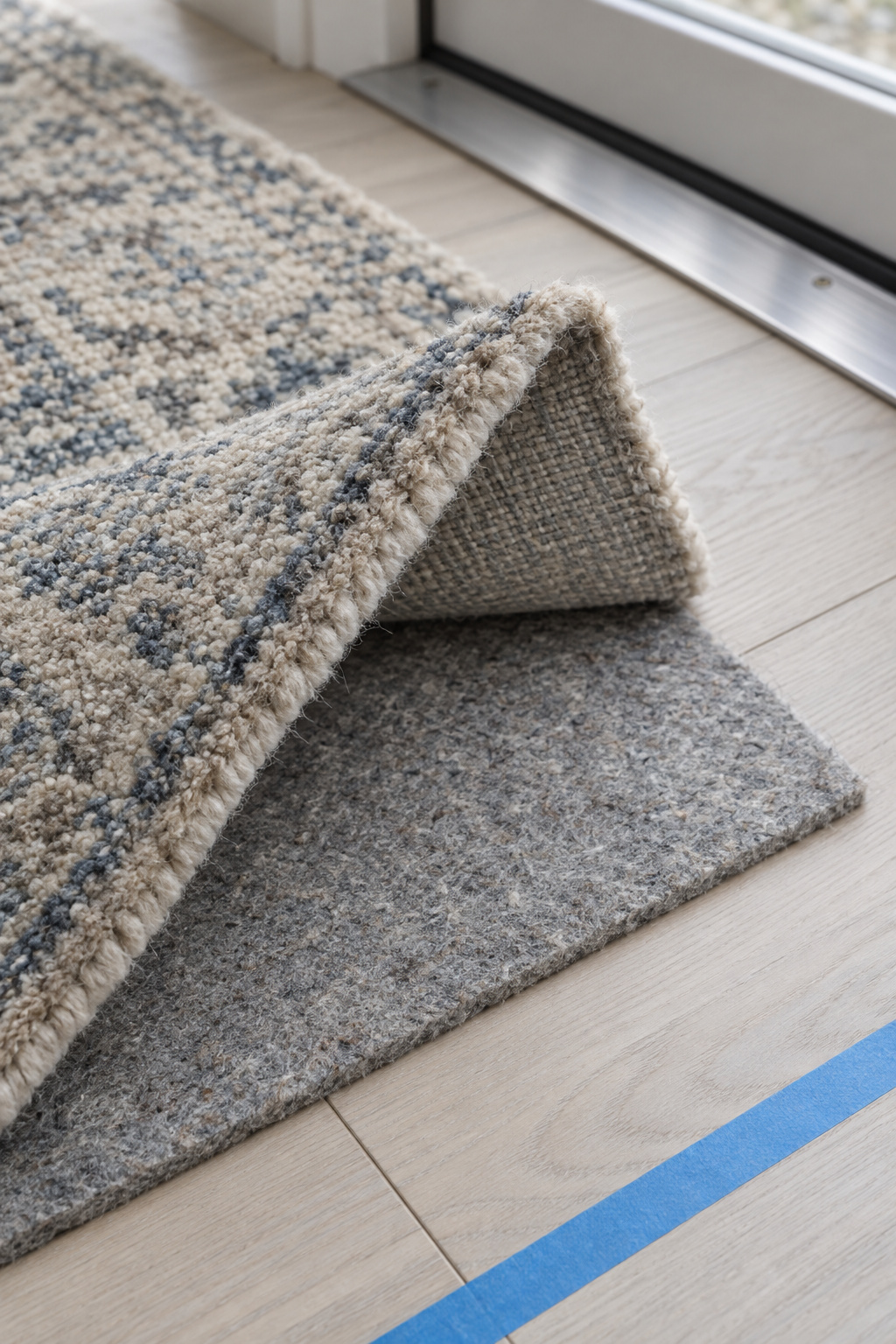
The pad matters. In the Carpet and Rug Institute’s lab, cut-pile carpet over a hair cushion tested at 0.50 to 0.70, and the cushion added 0.10 to 0.20 on its own; the cushion makers quote a bigger lift. The lab data is all wall-to-wall carpet, so treat it as the nearest case for a loose rug. Keep rug plus pad under 1 in thick at the edge so the door clears, and over hardwood choose felt-and-rubber, since rubber-only pads can bond to the finish.
In a store I ask them to turn the demo down, then stand where the couch would be. Do the rug version: stand where you take your shoes off. And buy the rug and pad before the new fixture or bigger art you’ve been eyeing. A budget machine-made 5×7 or 5×8 runs $39 to $99.
- Clap once by the door and note how long the ring lasts.
- Tape the rug’s outline on the floor and live with it for a day.
- Lay the pad, about an inch smaller than the rug on every side, then the rug.
- Clap again from the same spot.
Materials belong to the entryway rug ideas article, and a stair runner, one more soft strip, to the stair runner ideas article.
Soft things, ranked by effect: a wall hanging, curtains, panels, a bench and plants
Once the floor is quiet, the walls and window are left. Here is how the soft things an entry can hold compare:
| Soft item | Effect on echo (NRC) | What an entry can hold |
|---|---|---|
| Fabric-wrapped panel, 2 in | 1.03 to 1.25 | One or two, hung like art |
| Fabric-wrapped panel, 1 in | 0.83 to 0.90 | One or two, hung like art |
| Heavy velour curtains, gathered (18 oz) | 0.55 to 0.60 | Only where there is a window |
| Light curtain hung flat | 0.15 | Any window |
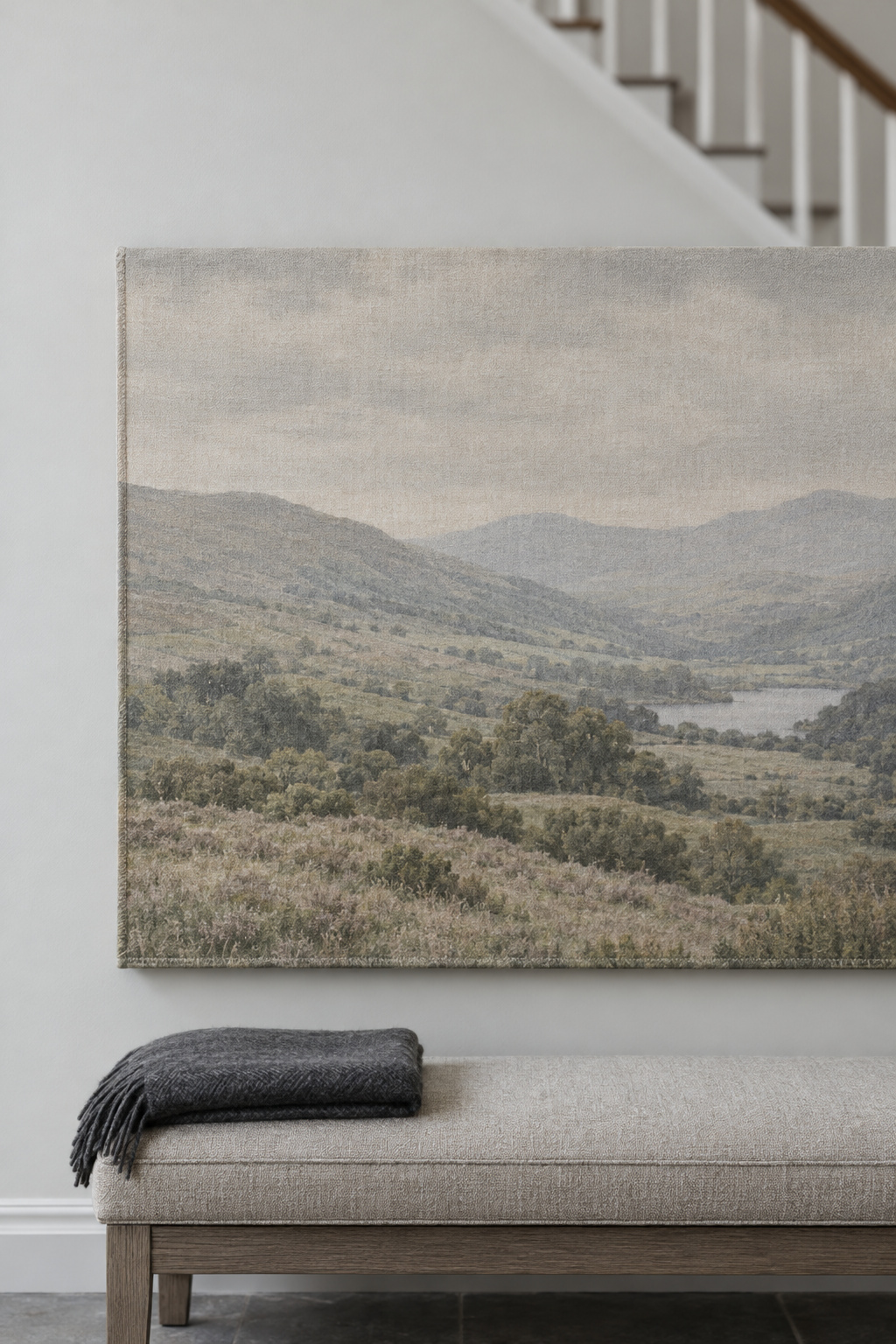
| Large wall hanging or quilt | Not measured | One big piece on the tall wall |
| Upholstered bench | More than a bare seat | One bench |
| Plants | Weak and inconsistent | A pot or two |
Panels are strongest, and the thicker one reaches lower pitches a thin one misses. If you buy a panel printed with art, ask the maker for its ASTM C423 test report, because a print or glass in front can change what it does. Curtains come next, and fullness is what counts: the same fabric absorbs more the more it is gathered, while a light curtain hung flat barely registers.
A big textile for the tall wall works as art and as soft surface at once. A fabric bench beats a wooden one, but it is one seat. Plants are mostly soil doing the absorbing, so buy them because you like them.
Before buying anything for the wall, run my cheapest test. I’ve hung a moving blanket on a client’s wall with painter’s tape just to make the point. Tape one where the textile would go, clap, and listen for one evening.
Warm light low, not bright light high: lamps do the cozy work
My wife reads in the chair with the worst sound in our family room because it’s nearest her lamp. I’ve stopped arguing. She’s right about the part that matters here: people settle where the warm light is.
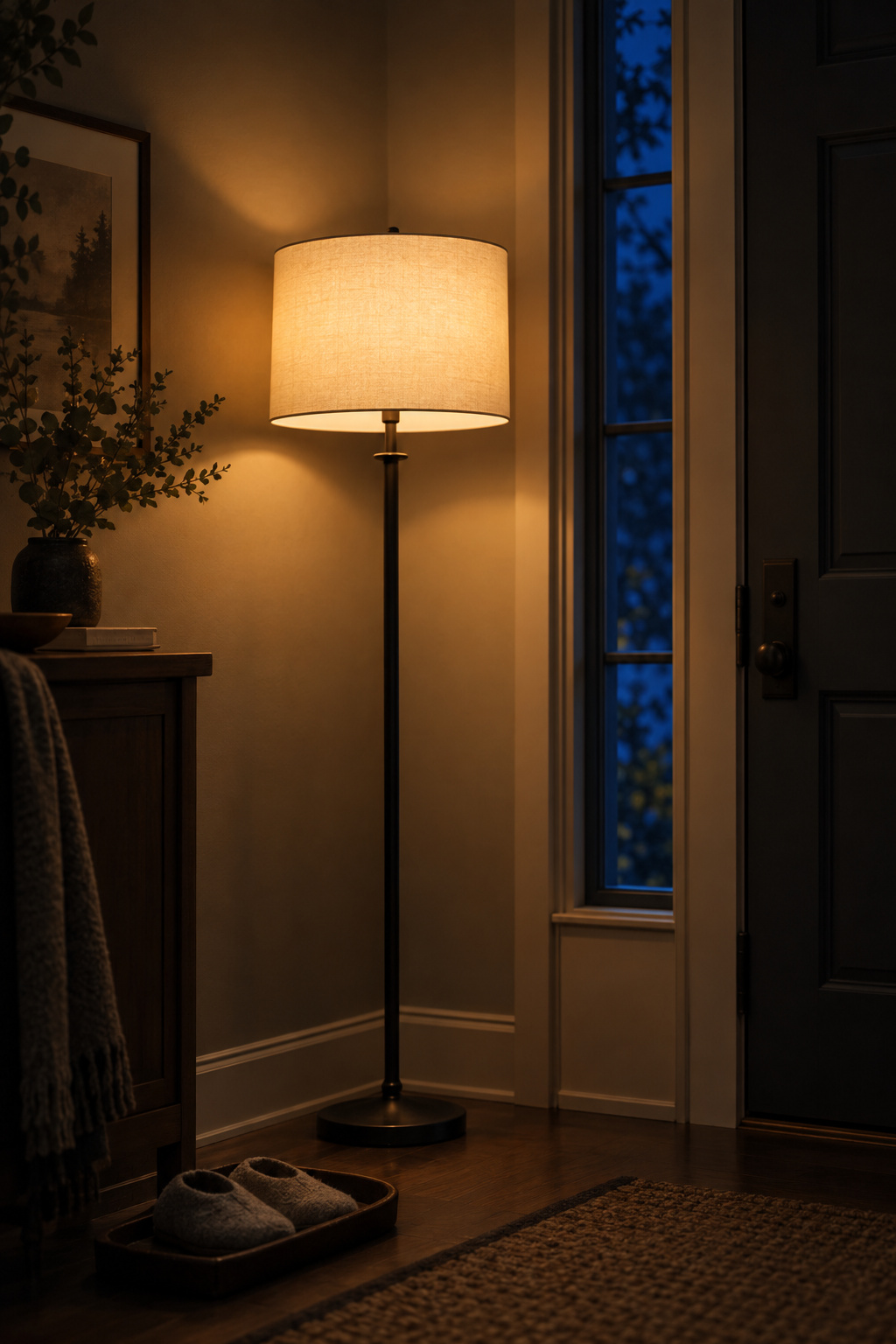
A fixture hanging in a tall void is far over everyone’s head. Let it be something to look up at, and put the light you feel at lamp height, on a chest or console near the door. Choosing and hanging the fixture itself is covered in the two story foyer chandelier article. Wall sconces can do the same low job; where they go is a topic of its own.
Bulbs decide whether the light feels warm. ENERGY STAR labels 2700K warm white and 3000K soft white, and calls that range ideal for most indoor applications. Use one color temperature for every bulb in the foyer.
I think of that lamplight as a ceiling at about nine feet. Below it sits a small warm room, and above it the height turns into a view.
Heat pools at the top: heavy curtains, a reversed fan and a sealed door
Warm air rises, and a two story foyer gives it somewhere to go. Cooler air slides in at the bottom to replace it, right where you stand.
If your foyer has a ceiling fan, reverse it and run it clockwise on low through the winter. ENERGY STAR says the gentle updraft pushes the warm air near the ceiling back down into the room. The fan won’t change the room’s temperature; it helps keep you warm. Many two story foyers have a chandelier, not a fan, and then skip this step. Fan blades need at least 7 ft of clearance, measured from wherever people stand, the landing included.
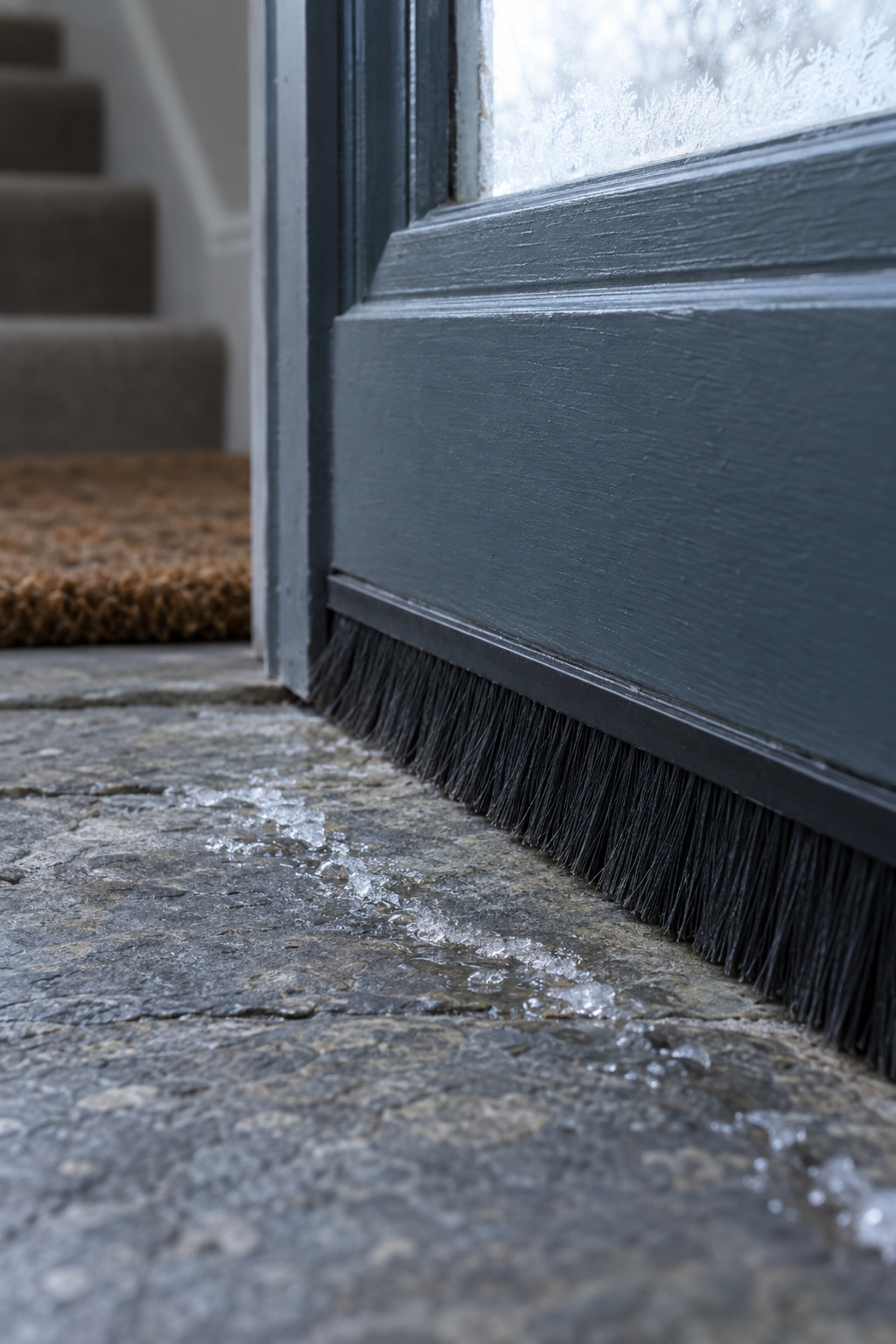
Then find the leak at the door: at night, switch the porch light on and the foyer lights off, and look for light around the edges. Or close the door on a dollar bill and see whether it slides out easily. Tighten loose hinges and the strike plate before you weatherstrip, then add a door sweep that clears the new rug.
Lined curtains at the glass do two jobs, cutting the chill and adding soft surface. For ones you can work from the floor, see curtains for a high foyer window.
The bottom nine feet become their own room, and the height becomes the view
Come in on a winter evening once the work is done. Your keys land on the console and the clink dies away almost at once. The lamp is on, the curtains are drawn, and the stairwell above is tall and quiet, something to look up at on the way in.
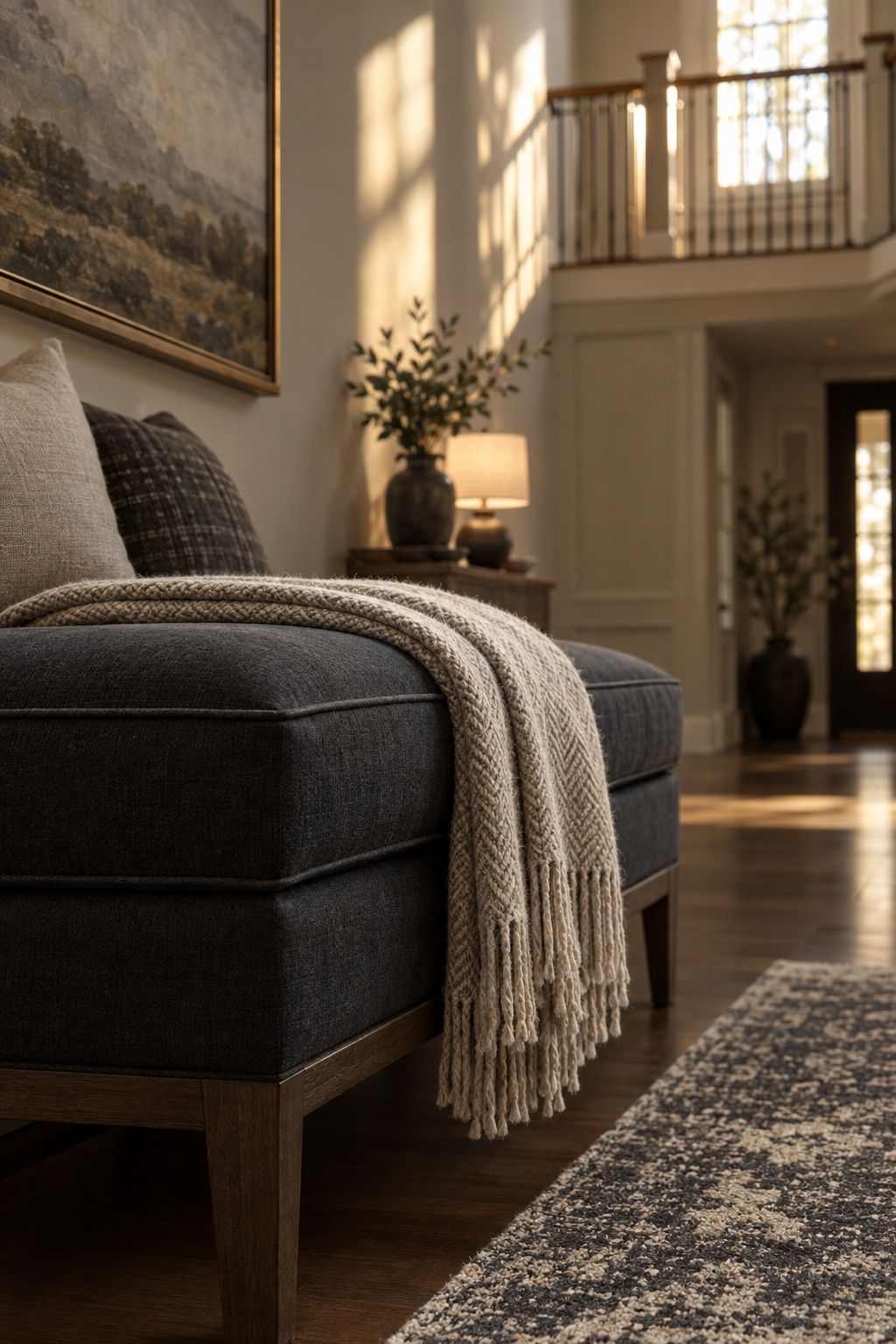
The path is short: clap, rug, one hanging, curtains, lamps, draft. If you do nothing else this week, clap, size the rug, and clap again. For the fixture, the tall wall and the line between the floors, start with how to decorate a tall foyer.
My part ends at what you hear and how the bottom of the room feels. Wiring a fan into a high ceiling is an electrician’s job, and a draft weatherstripping won’t fix needs a contractor, not me.
FAQ
Does a stair runner help with foyer echo?
A little. A runner is carpet on the treads, and padded carpet absorbs well, but it covers a narrow strip in a room full of hard drywall and glass. Treat it as one more soft surface after the rug. Carpet also does little for low, booming sound; it mostly takes the sharp ring.
How do I keep foyer noise from carrying upstairs and into the kitchen?
You can make it quieter, but you can’t stop it. Soft surfaces shorten how long sound rings in the foyer, so less builds up and travels on, but they don’t block the stairs. Even lab-tested acoustic curtains rate STC 13 to 17, far below the STC 40 that counts as real soundproofing.
Why does my entryway still echo after I added a rug?
Because a rug only changes the floor. The walls and glass still bounce nearly everything back, and a thin flat-weave rug absorbs little anyway. Even wall-to-wall carpet in a hard test room only about halved the ring, so add one soft thing on the wall or curtains at the window next.