The first thing I changed in our house outside Duluth was where the wet boots go. Before that, they stood wherever they came off. Now they have one tray by the door, and the floor stays dry.
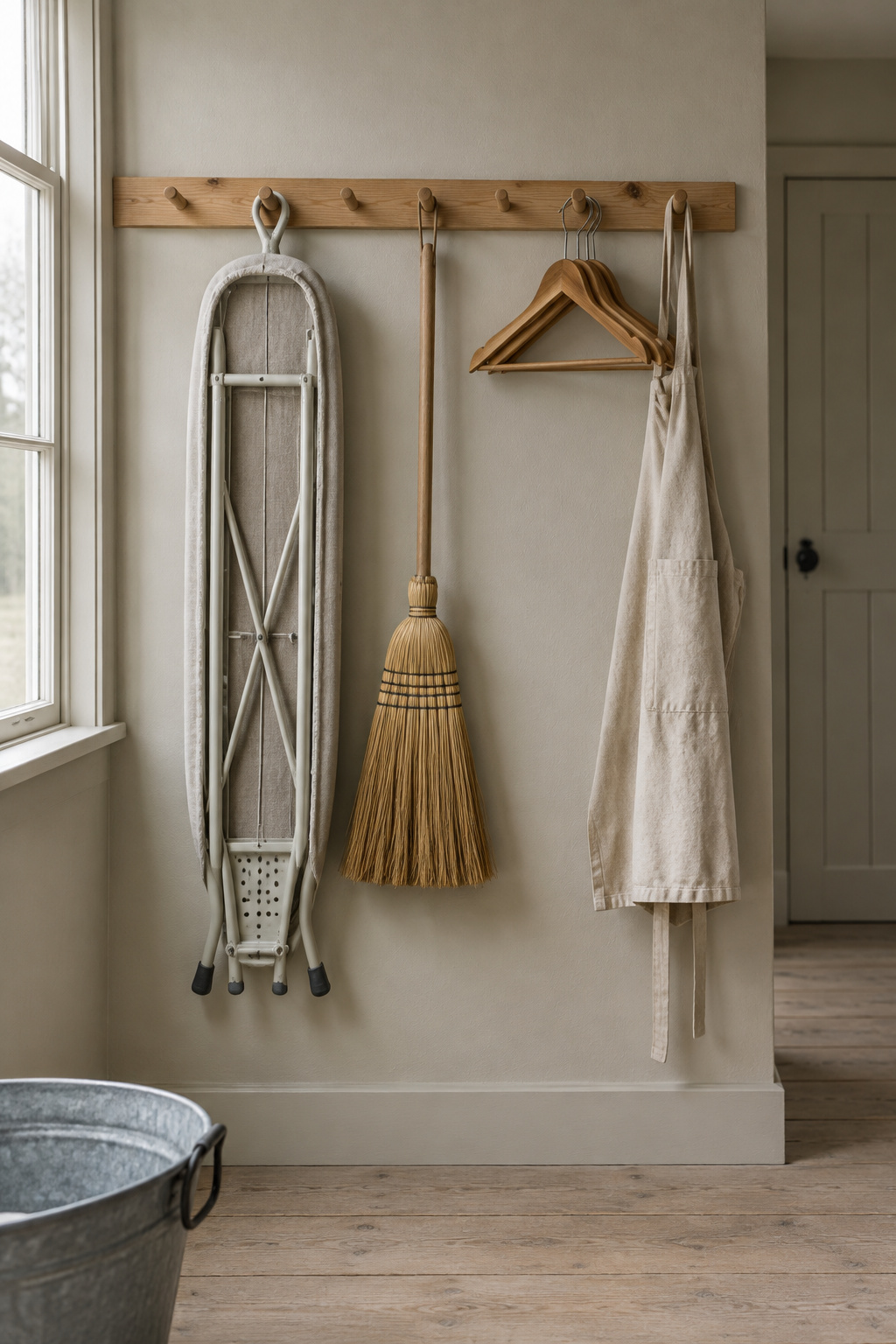
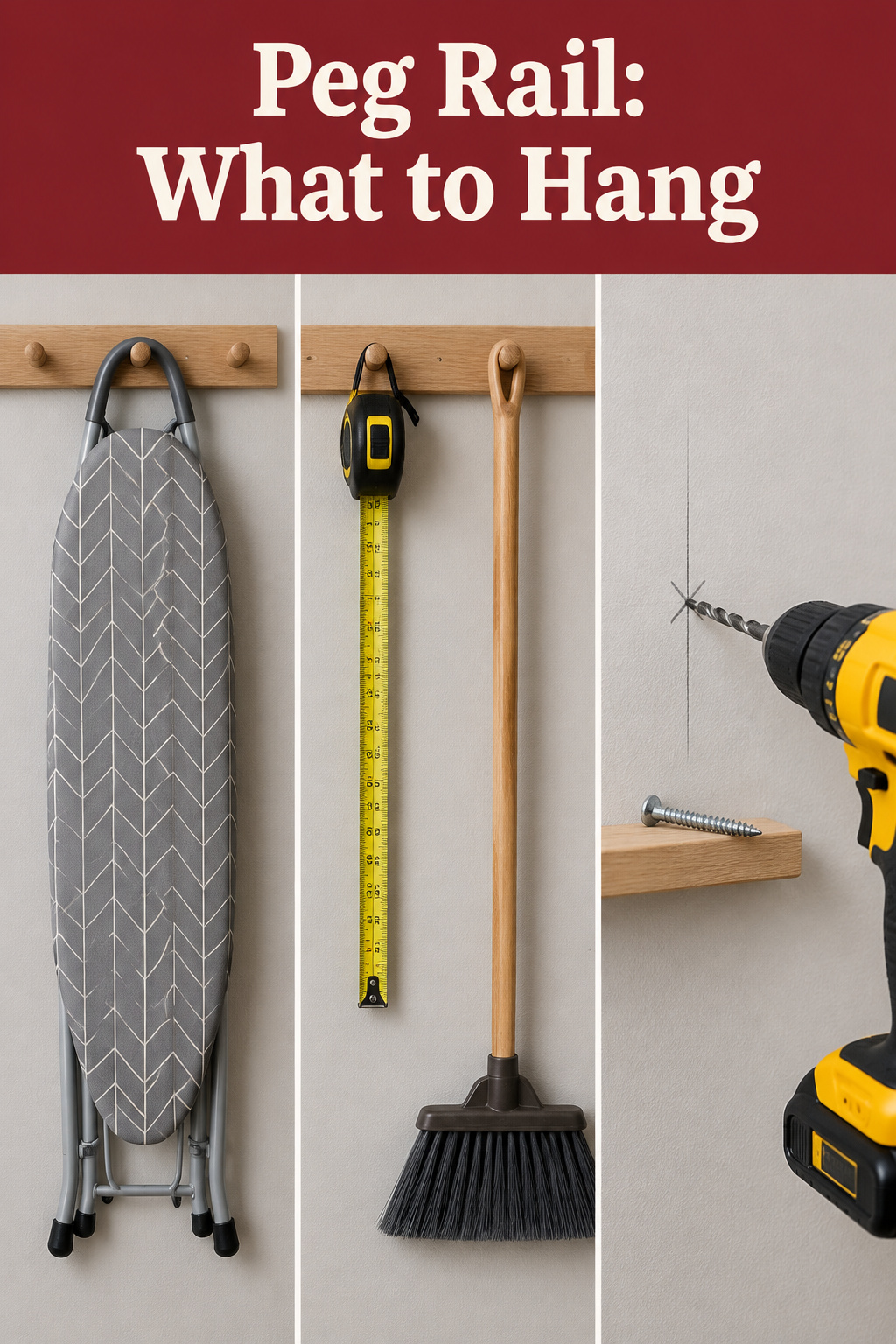
A laundry room peg rail does that job for a different room. It gives each thing that lives there one place off the floor. The longest, heaviest of those things sets how low the rail can hang, and in most laundry rooms that is the ironing board. Hung by its hook, the board needs a peg high enough that its foot clears the floor. Your reach sets the top. Shaker spacing and the few lighter things you hang set the rest.
TL;DR
- Hang the folded ironing board first: full-size boards fold to 54–59 in, so from a peg at 72 in the board’s foot sits about 13–18 in off the floor, less the hook.
- Space the pegs 6 in apart, the Shaker interval, and make the rail long enough to cross two studs.
- Use 3 in screws: through a ¾ in rail and ½ in drywall they reach 1¾ in into the stud, past the 1½ in Woodcraft asks for.
Why a laundry room peg rail starts with the ironing board
The Shakers ran a wooden rail around nearly every room and hung chairs, brooms and clothes from its rounded pegs. The point was the floor: lift everything up, sweep, put it back. It was a hanging system long before anyone called it a style.
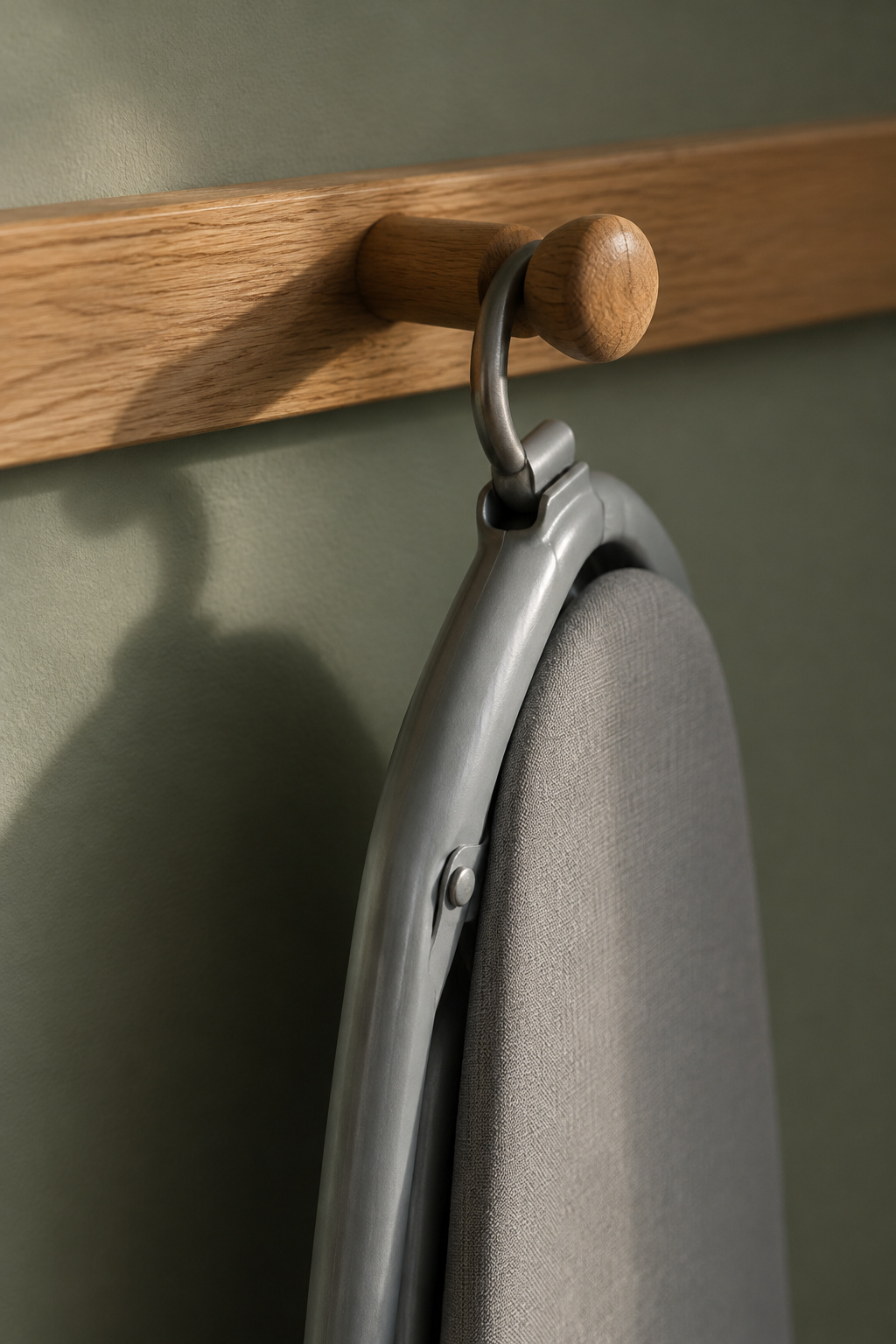
There is no record of the Shakers hanging an ironing board on one, so planning around the board is my rule, not theirs. The board is the longest, heaviest and most awkward thing a laundry room stores. Solve where it goes and the rest fits around it.
I would rather own one good wool blanket than six decorative cushions, and I feel the same about one plain rail against a wall of single hooks. Six hooks are six fixings. One rail is one decision. My wife calls this my monk phase, which is fair.
The rail is one of the farmhouse laundry room ideas that start with the work the room does. A built-in ironing board cabinet is a restoration job, covered in our vintage laundry room decor article; this rail is for a modern folding board.
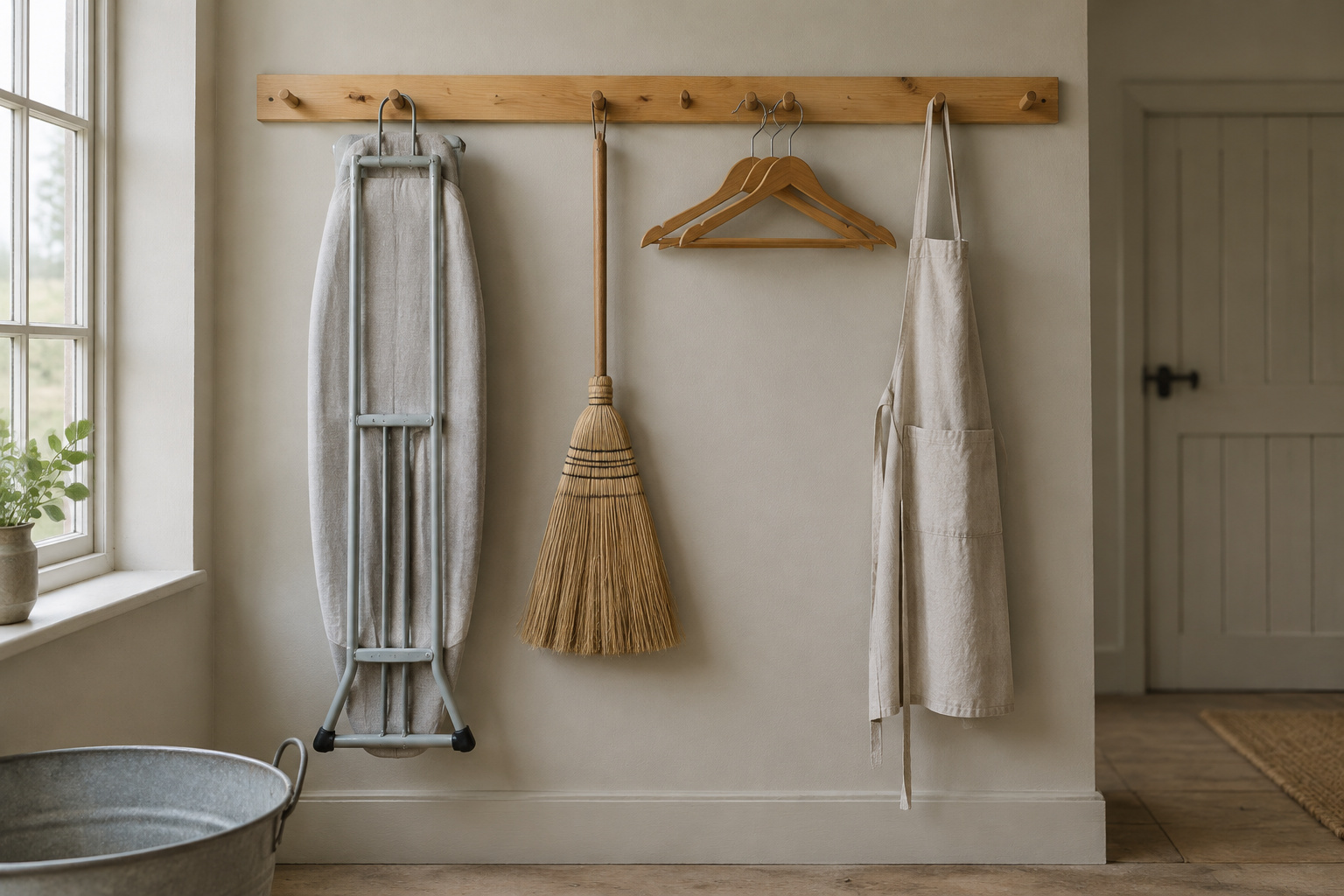
What earns a peg: the ironing board, the broom and three more
I read furniture catalogs from the back, where the dimensions and materials are, and ironing board listings reward the habit. The back tells you the folded length, the weight, and that most full-size boards have a hook built into the frame. That hook is what meets the peg.
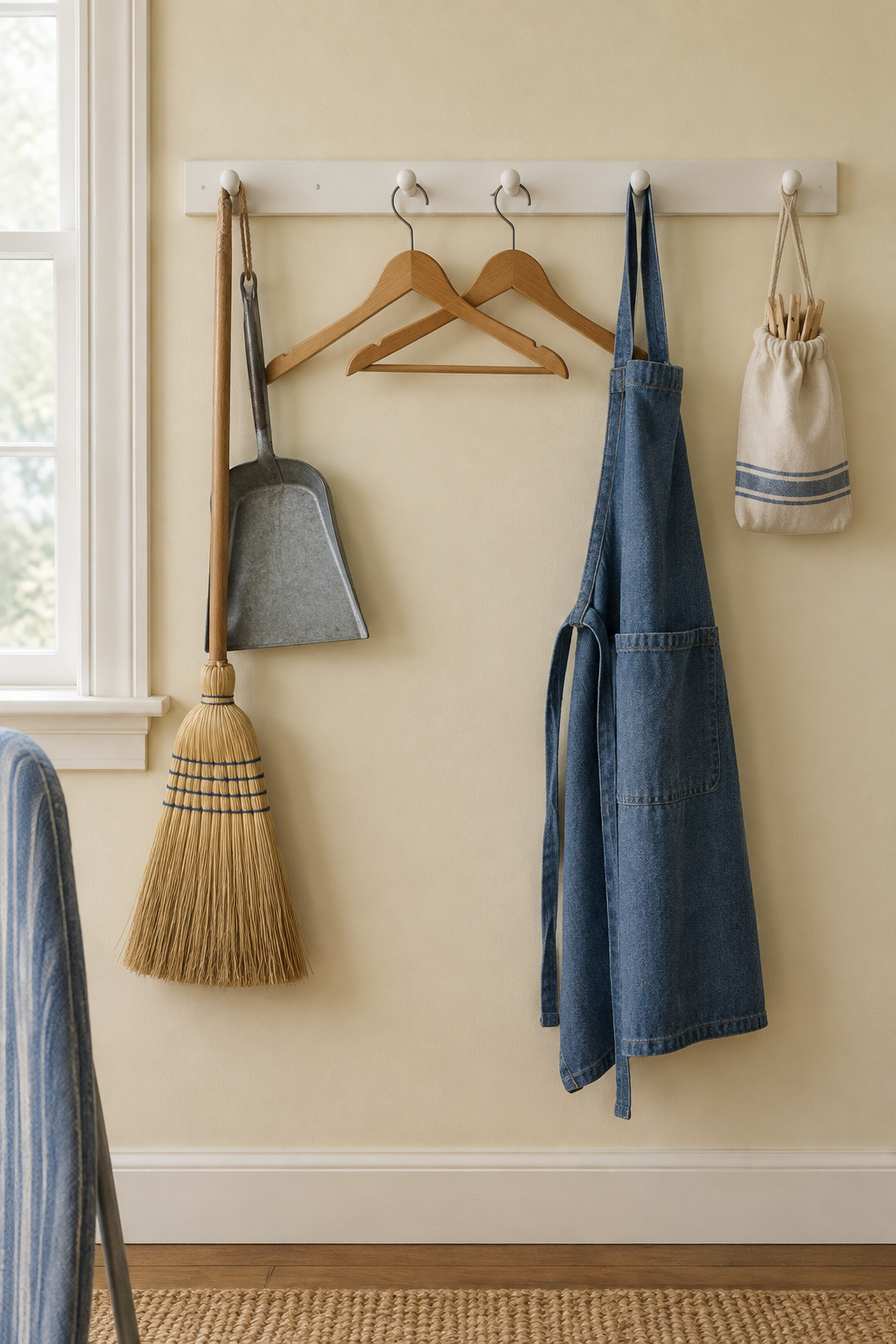
Five things in a laundry room deserve a peg, and the board is the only heavy one.
| Item | How it hangs | Pegs it takes | Size and weight |
|---|---|---|---|
| Folded ironing board | Hook built into the frame | 1, with the pegs either side left clear | 54–59 in long, 2.7–3 in thick, 9.7–15 lb |
| Broom and dustpan | By the handle | 1 | Light |
| Drying hangers | Bunched on one peg | 1 | Light |
| Peg bag for clothespins | By its own loop | 1 | Light |
| Apron or laundry bag | By a loop | 1 | Light |
Plan the board’s row and the others take care of themselves, because everything else is shorter and lighter.
Anything that only looks right when someone keeps it tidy does not earn a peg, and coats and school bags belong at the front door. The hangers and the peg bag travel with the basket whenever the weather allows drying outside on a line, so give them the pegs nearest the door.
Rail height from the ironing board, peg spacing from the pegs
Height comes from the person, not the catalog
The Shaker record gives two answers. Mea Hoffmann, a curator of the Vitra Design Museum’s Shaker exhibition, says rails usually hung at about six feet. A Shaker Village of Pleasant Hill source puts pegs at roughly head or shoulder height, lower for most adults. Neither is a rule for your wall.
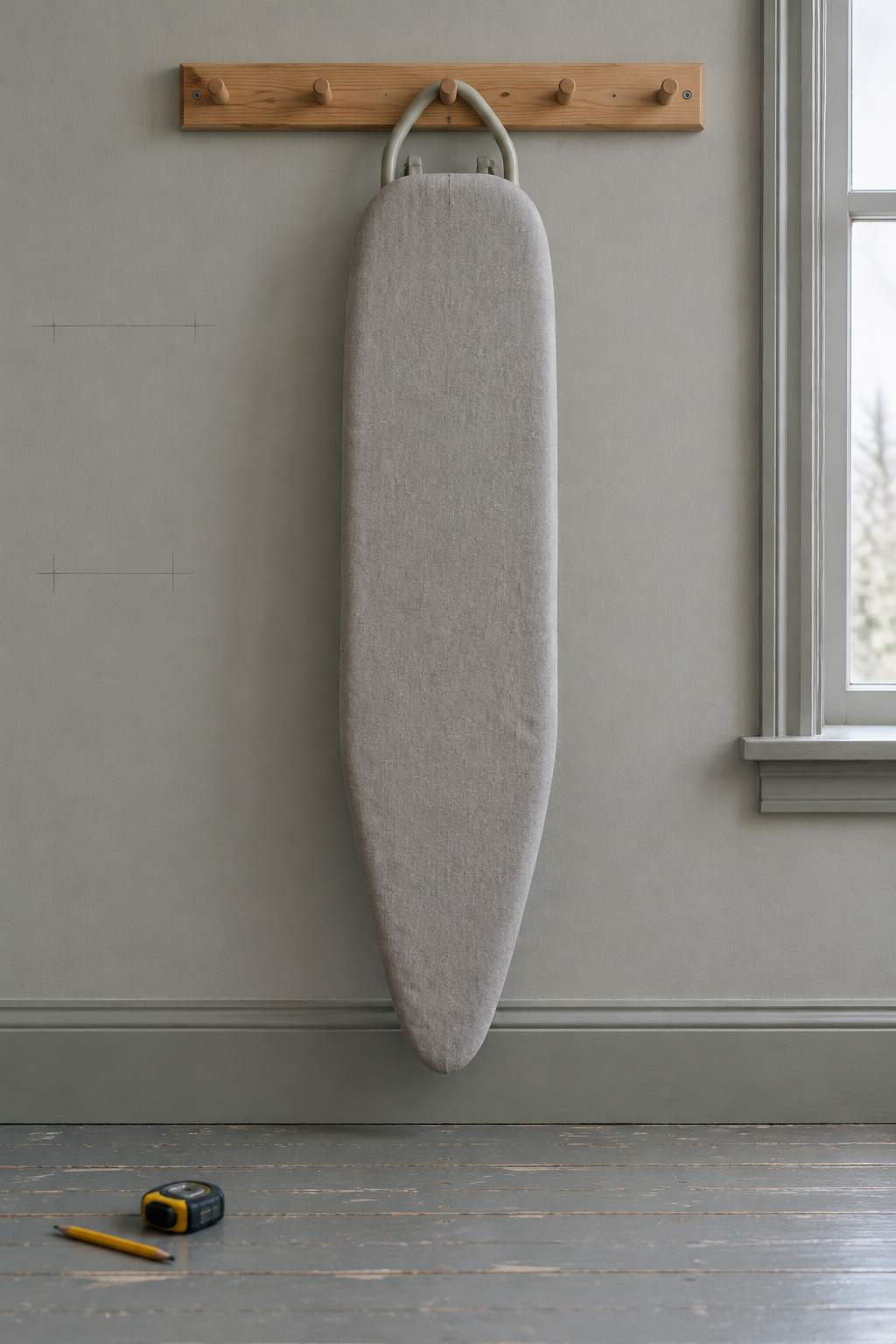
The board sets the lowest the rail can go. Hung by its hook, a folded board drops roughly its own length below the peg. From a peg at 72 in, a 54–59 in board ends about 13–18 in off the floor; from a peg at five feet, only 1–6 in, less the hook’s offset, which you can measure on your own board. Much lower and a full-size board will not hang.
You set the top. Hold the folded board by its hook against the wall at the height you can lift it to without stretching, and mark it. If the foot clears the floor, that mark is your rail. A rail you need a stool for is furniture for a photograph.
Spacing comes from the items
The board does not set the spacing. The Shakers set pegs 6 in apart, and 4–6 in is the range for large pegs. Take 6: the board, the broom and the hangers hang side by side without knocking. A Shaker peg stands 3 in off its rail and a folded board is thinner than that, so the board hangs within the peg’s length.
Length follows from the count. Six pegs at 6 in centers, with half a space at each end, is 6 × 6 = 36 in, enough to cross two studs at the usual 16 in centers. Bought rails run from 23.6 in to about 90 in.
A second, lower row is a separate decision; pegs set at a child’s reach belong to that plan, not this one.
Fixing a rail that carries an ironing board to the studs
I open a cabinet door and look at the hinge before the front. On a peg rail, the screws are the hinge.
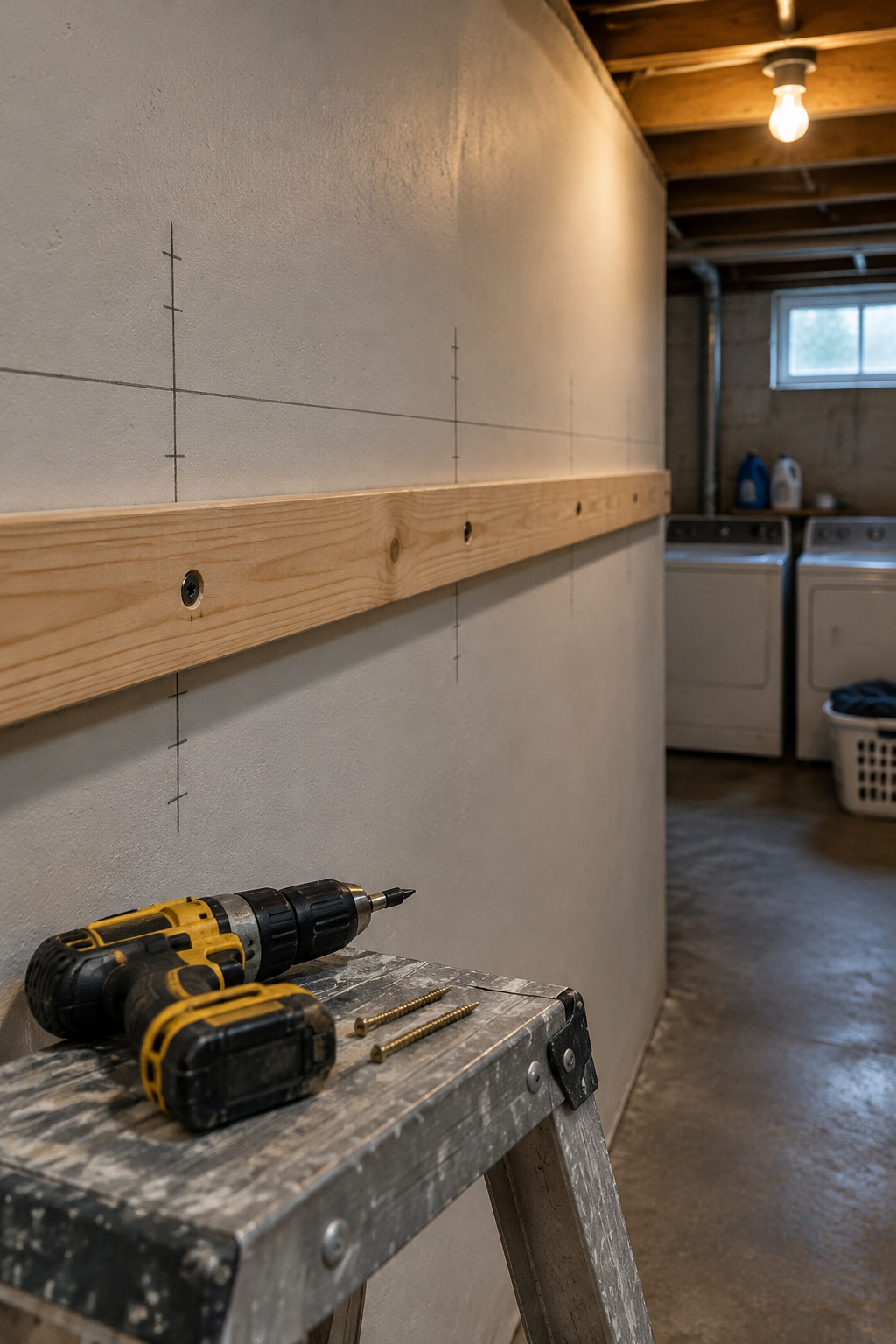
- Draw a level line at the height you marked, then find the studs along it with a stud finder.
- Transfer the stud positions to the rail and drill a pilot hole at each, smaller than the screw.
- Put a screw near each end, and on a rail of six feet or more, one near the center as well.
- Fix one end, check the level, then fix the other.
- Hang the board last and pull down on it once, firmly.
Makers often say a 2½ in screw. On standard ½ in drywall, 2½ − ¾ − ½ leaves 1¼ in in the stud, short of the 1½ in Woodcraft asks for. A 3 in screw leaves 1¾ in. Buy the better hinge, which here means the longer screw.
No maker rates a peg rail for an ironing board. The nearest figure is a hook rail sold at Home Depot, rated 35 lb in studs; one rail is rated as low as 5 kg (about 11 lb), less than the heaviest boards weigh, so check yours.
Old lath and plaster is the place to stop and call a carpenter. Shelves above the machines are a different load, covered in our laundry room open shelving guide.
Buy a rail or make one: solid wood and a finish for a damp room
In a showroom I pull a drawer all the way out and turn it over, because the underside tells you what the front will not. Turn a peg rail over too. You want solid wood with pegs set into drilled holes, not veneer on board. One solid rail outlasts three thin ones.
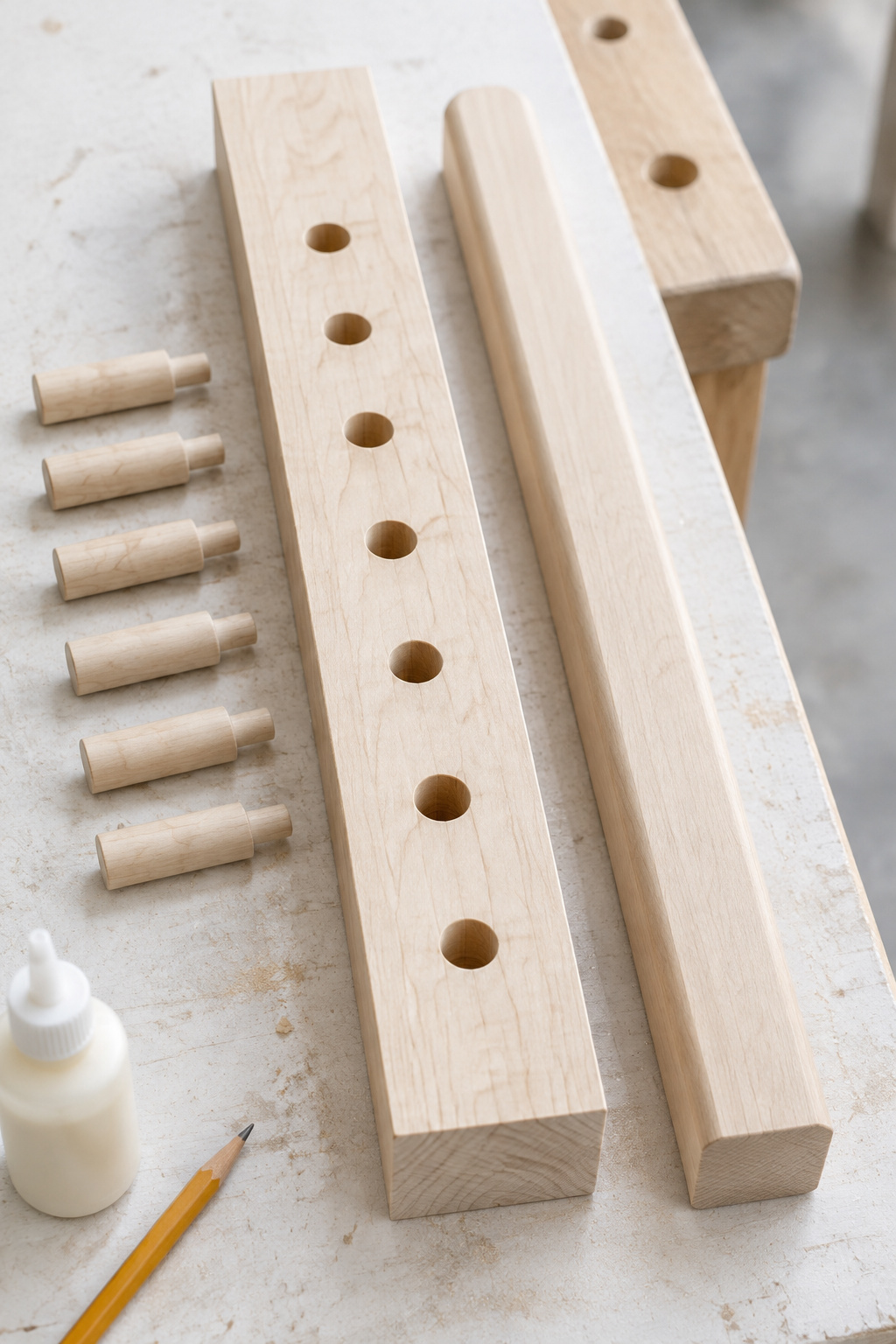
Buying is quick: small workshops sell handmade rails and cut custom lengths. Making one takes a 1×4 board cut to your stud layout, a Forstner bit, glue, and maple pegs at about $3 for four.
Make it. Pine with maple pegs is the traditional pairing, the Met’s Shaker peg board is white pine and maple, and you cut the length to your studs. Woodworkers disagree about hard maple in humid rooms: one maker favors white oak instead, while a builder’s guide rates both well. I would not lose sleep over it.
Finish every face and edge before the pegs go in, keeping finish off the tenons and holes so the glue grips. I oil our breakfast table on the first warm weekend of spring, with the windows open, and enjoy it. Re-oiling a rail by the dryer is a chore I would rather not own, so the rail gets a film finish.
Where a peg rail does not belong
Some walls are wrong for a rail. In my judgment there are four:
- Over the sink, where the splash lands on raw wood.
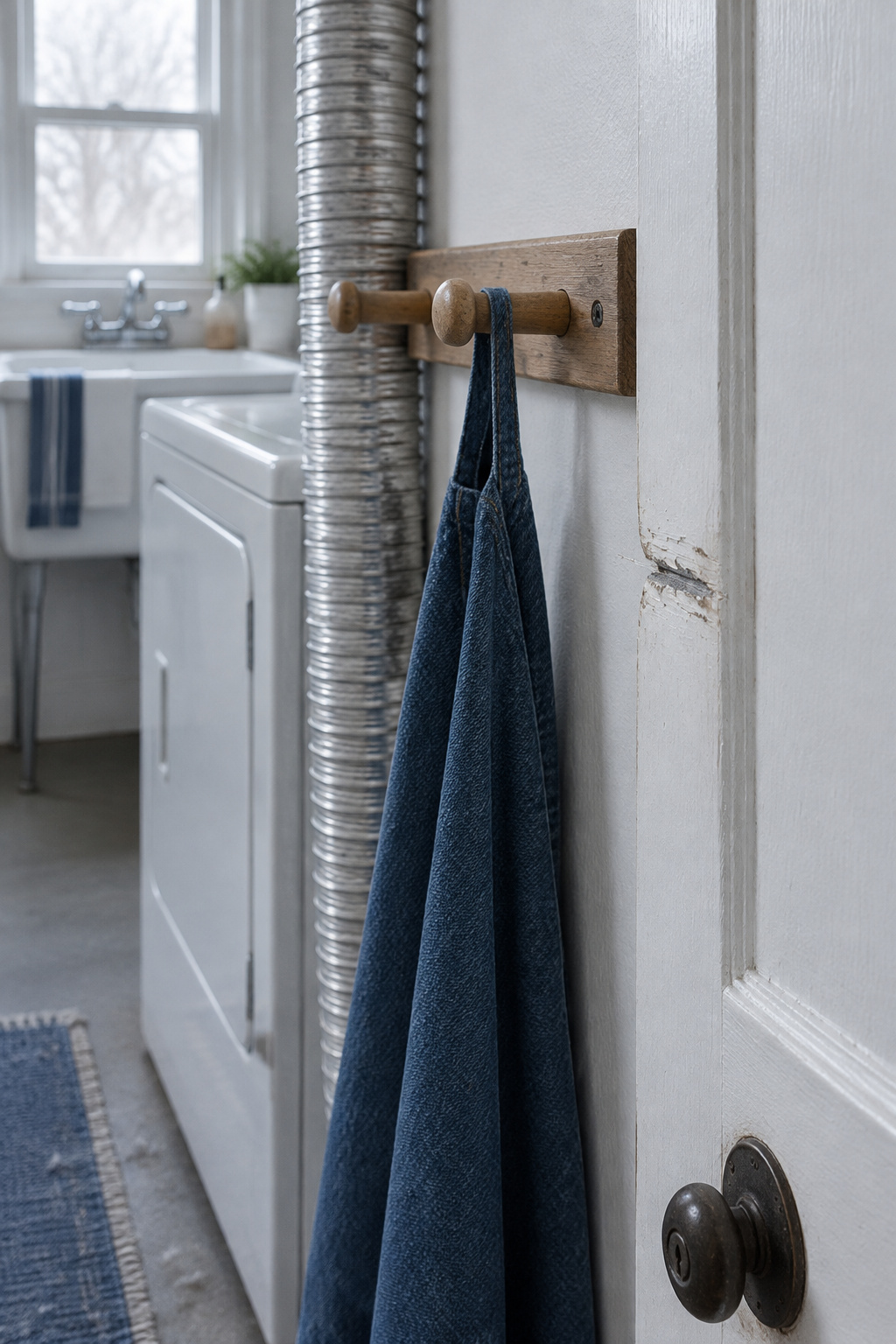
- In the swing of a door, because pegs stand 3¾ in off the wall and will catch a door or a hip.
- In the path of the dryer vent.
- Higher than the person who uses it can reach without a stool.
The rail holds the laundry room’s own things and stops there; a low row for children belongs with the rest of a child’s laundry steps. Hang the board first, at a height you can reach, with its foot clear of the floor, and the other pegs fall into place beside it.
FAQ
Can you mount a peg rail on plaster, tile or a rented wall without studs?
For light things, yes; for an ironing board, no. Without a stud, plasterboard plugs suit only light things such as hats or a peg bag. Over tile, drill with a tile bit and fix to the stud behind. On old plaster, or a rented wall you cannot drill freely, ask a carpenter or the landlord first.
What is the difference between a Shaker peg rail and a row of coat hooks?
A Shaker peg is rounded and stands 3 in off its rail, so a chair, broom or folded board hangs on it with room to spare. A single metal hook projects about 2½ in from the wall, less than a peg. Pegs are evenly spaced, traditionally 6 in apart, along one continuous board, which the Shakers ran around whole rooms.
How do you stop a hung ironing board from swinging into the wall and scuffing the paint?
Leave the pegs either side of the board empty, so it hangs between them and cannot slide sideways. A folded board is thinner than a peg is long, so it hangs within the peg’s reach. Paint the wall behind it in satin or semi-gloss, which wipes clean, and lift the board on and off with both hands rather than swinging it.