Your wall has already chosen your mirror. Lay a level across the vanity top and watch the bubble, then look at where the light boxes sit and how tall the faucet stands. Those three facts narrow the field of bathroom mirror shapes before you open a catalog. The round mirror in the photo looked perfect because that wall had sconces in the right place and a counter that ran true. Yours might not.
TL;DR
- Mark the light boxes, the top of the faucet and a level line before you shop; those three marks decide which shapes can work on your wall.
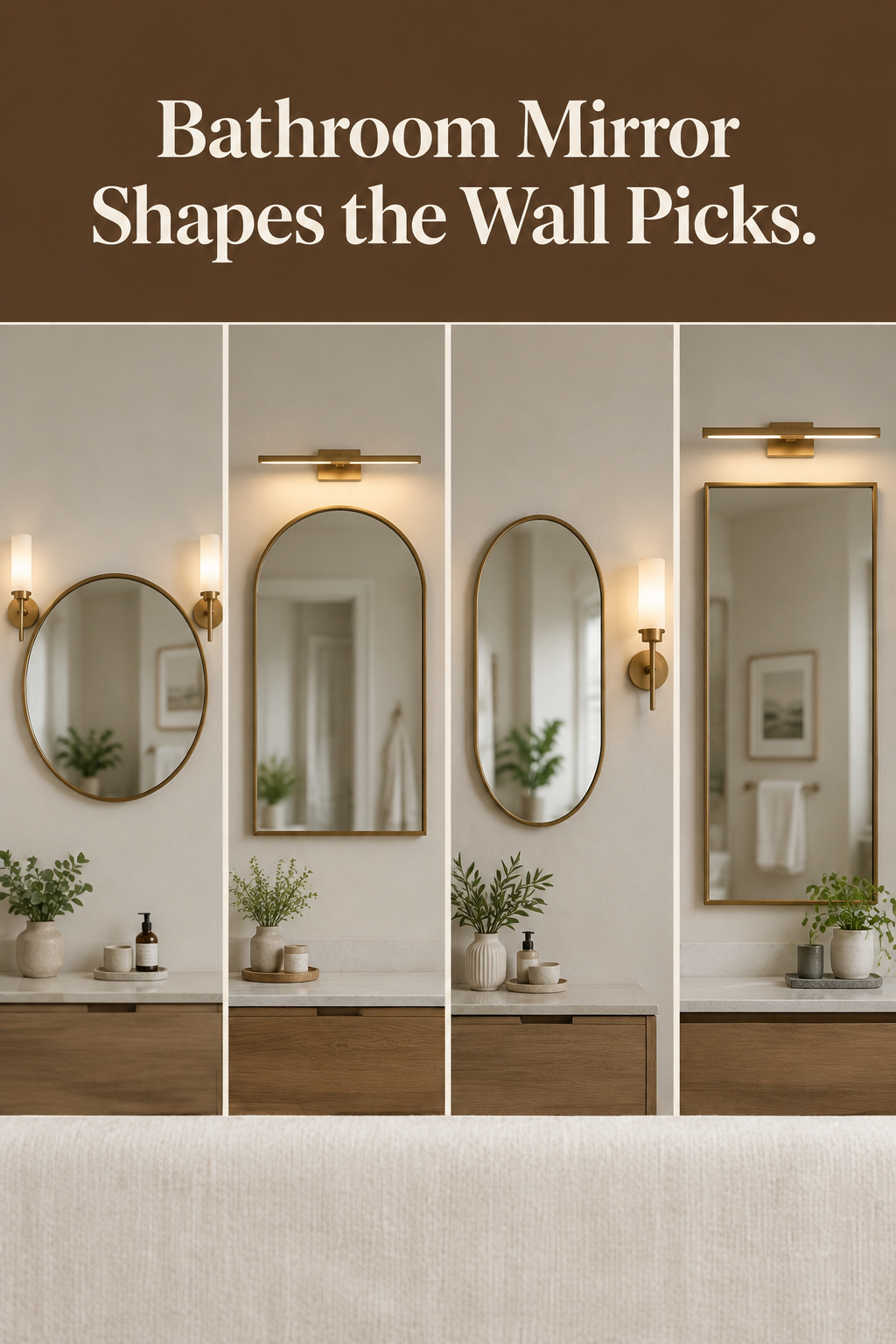
- Round mirrors pair with a sconce on each side, taller rectangles with a bar light above, and a bar light should never be wider than the mirror beneath it.
- A rectangle’s straight edges line up with tile, counter and cabinet lines, so it has to match them; a round or oval mirror has no straight edge to match.
Bathroom Mirror Shapes Start With What the Wall Already Fixed
Most shape advice starts with style. The designers Homes & Gardens quotes say to let the room’s architecture and the vanity guide you, repeating the tile’s strong lines or softening them with a curve. That works for the second half of the decision and skips the first half.
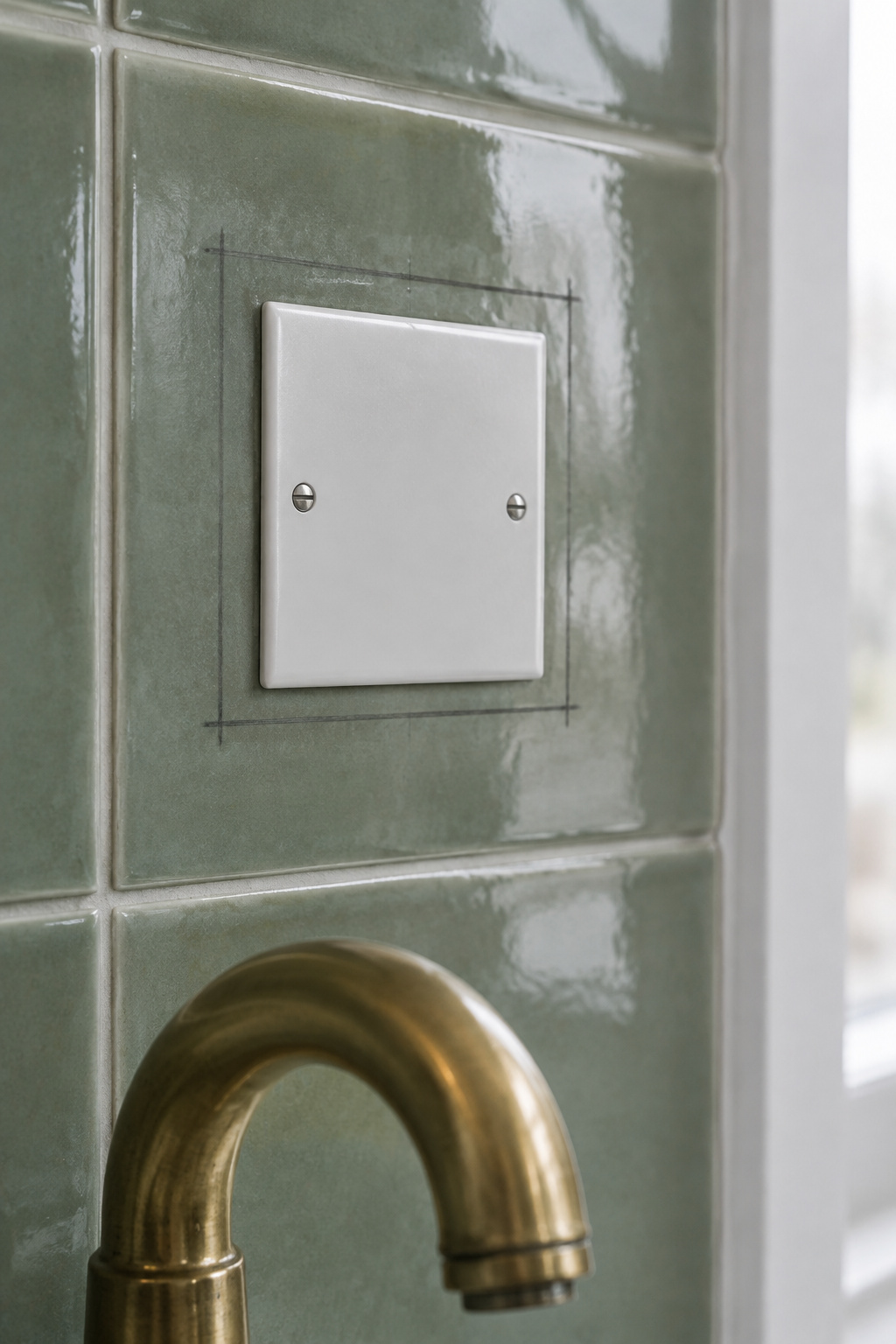
The first half is three things you can’t change on a Saturday afternoon. The electrical boxes are where the electrician put them, and moving one means calling one back. The faucet rises to a fixed height, and the mirror has to clear it. And the wall itself is less true than it looks. Drywall over framing is rarely flat, and old plaster can be worse. Walls lie, even in my 1970s ranch house outside Knoxville.
Choose by photo and you meet the wall afterwards: a bar light wider than the glass, no room for sconces, a spout poking into the bottom of a circle, a long straight edge sitting a little crooked against the tile.
Three Pencil Marks to Make Before You Shop for a Shape
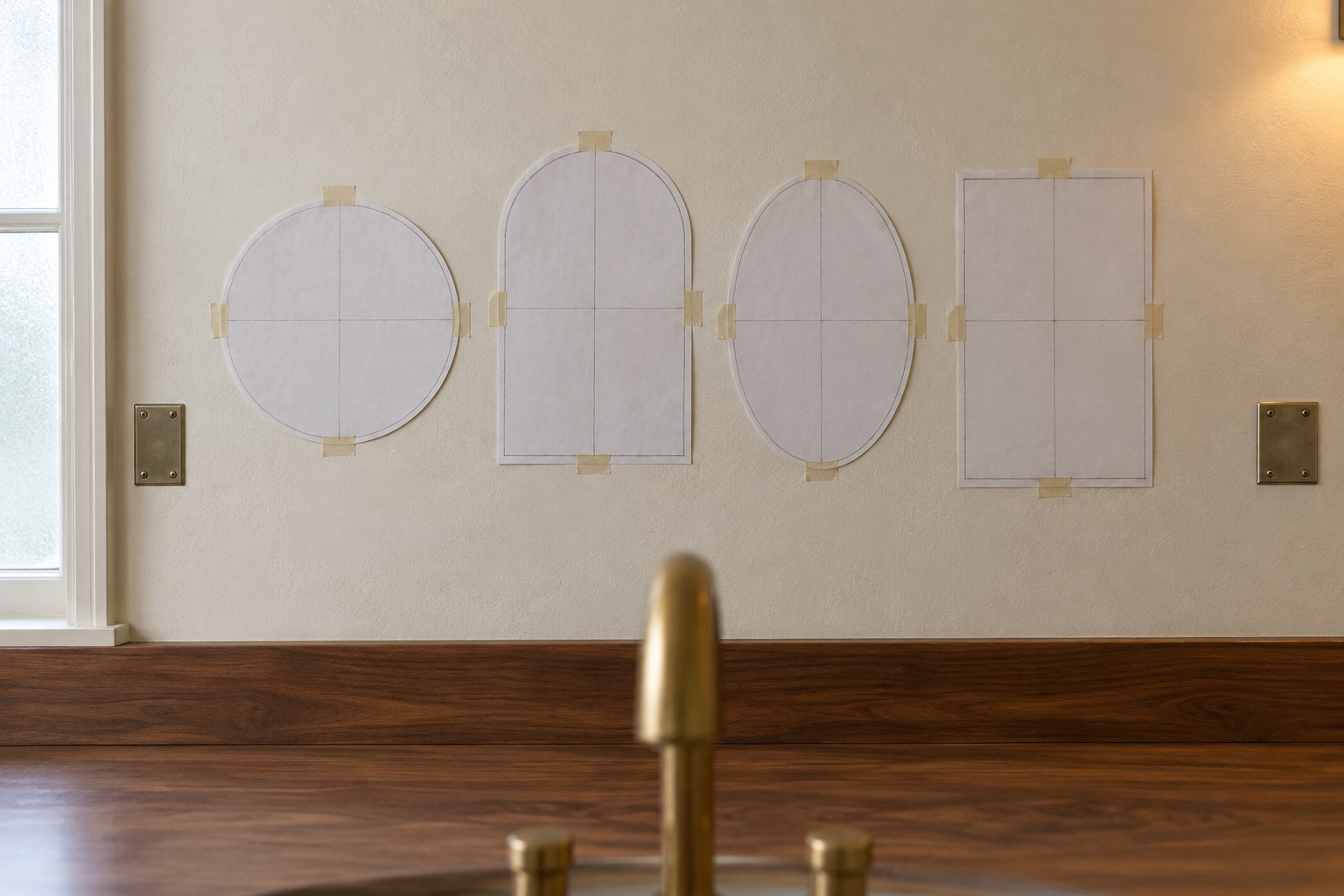
You need a pencil, painter’s tape and a level. A 4-foot level bridges high and low spots; a shorter one held on a straight board does the same job. Don’t buy a laser level for this.
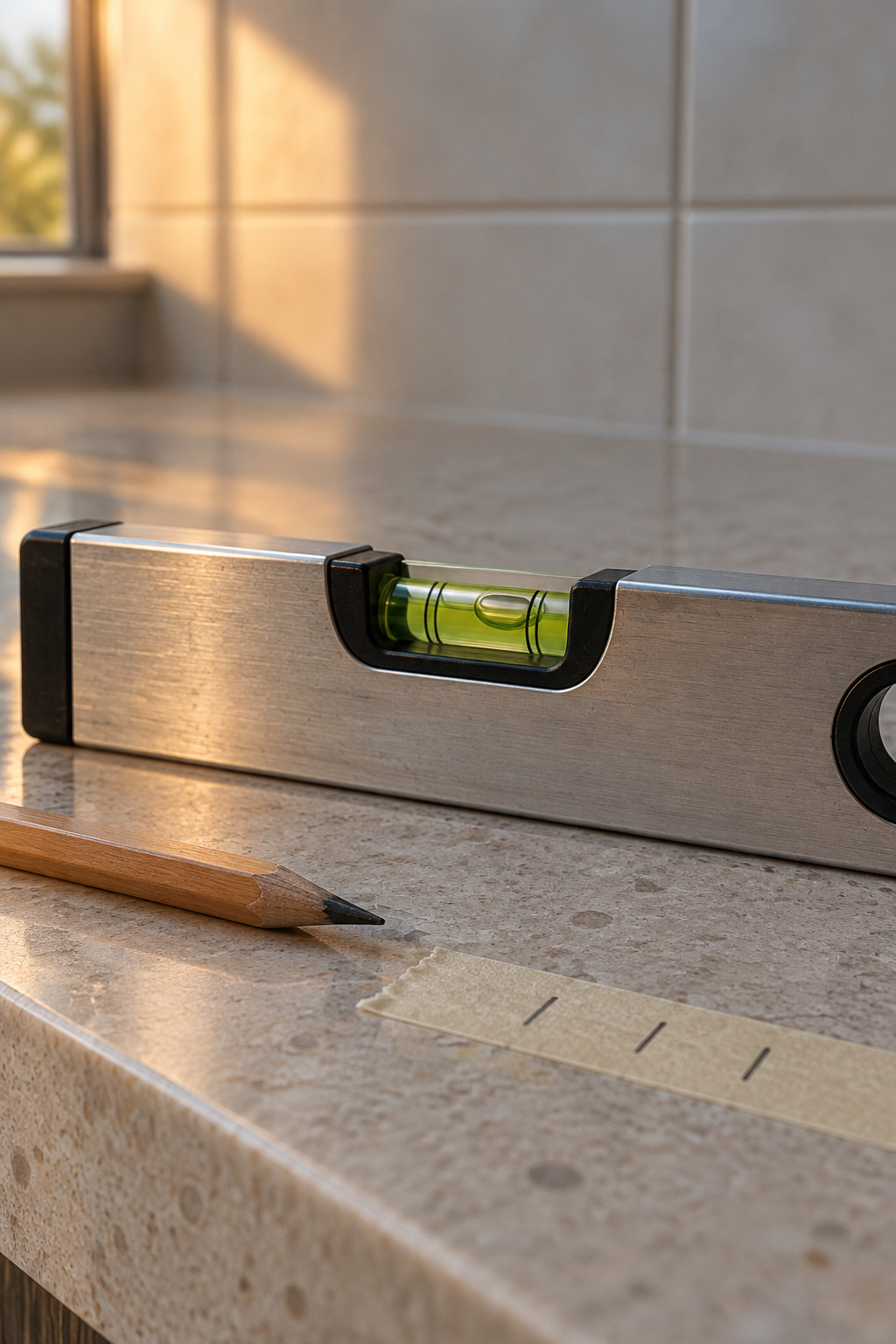
- Mark the light. Find every electrical box or existing fixture on the mirror wall and mark its center on tape. Sconces need bare wall on each side of the mirror. A bar needs a mirror at least as wide as the bar.
- Mark the faucet. Measure to the highest point of the faucet, not the sink rim. Tall and wall-mounted faucets push the mirror higher than you expect. If you’re leaning toward a round or oval mirror, the point that matters is the lowest part of the curve, because that’s what sits closest to the spout.
- Mark the level. Run tape across the wall above the counter so the pencil never touches grout, then draw a level line on it. Hold the level on the counter and on the nearest tile course too. Note which way each one drifts and roughly how far.
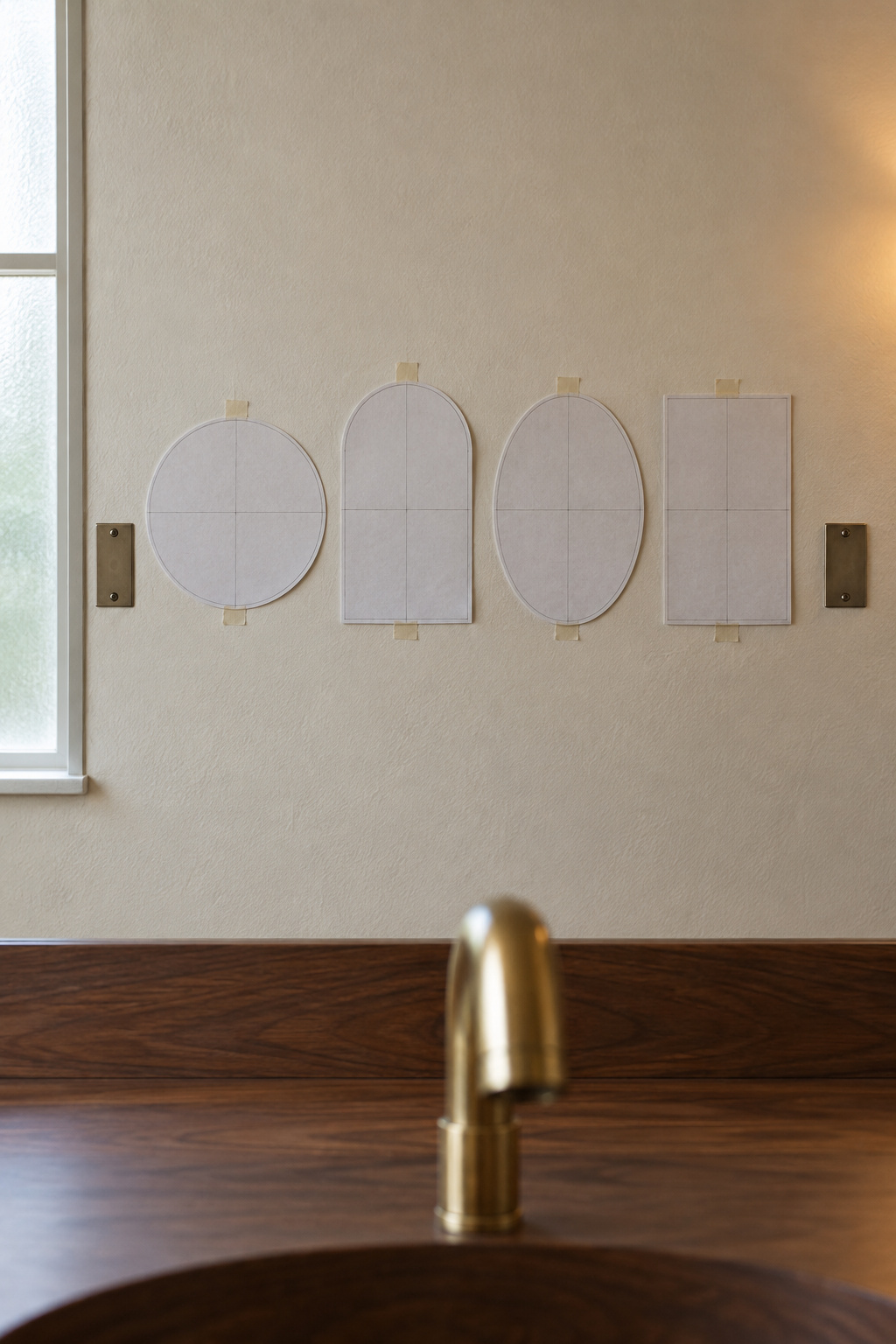
Then tape the outline of the mirror you like onto the wall and look at it from the doorway and the sink.
Buying first goes wrong the other way: hold the mirror up and find the sconce box sits right where the glass wants to go. The fix at that point is a different mirror or an electrician.
What a Bar Light or Flanking Sconces Allow
Light is the biggest limit, because it’s wired into the wall. No standards body names a mirror shape for any fixture, but lighting and mirror sellers give consistent advice.
Under a bar light
A bar sits above the mirror with open wall between them, and it should never be wider than the mirror below it. That points you toward glass that is wide at the top: a rectangle, especially a taller one, or a wide oval. Our guide to vanity lighting has the mounting heights and proportions.
Adam Wollerton of BK Eleven warns that an arch looks forced when its top crowds a ceiling, a shelf or a light fitting.
Between two sconces
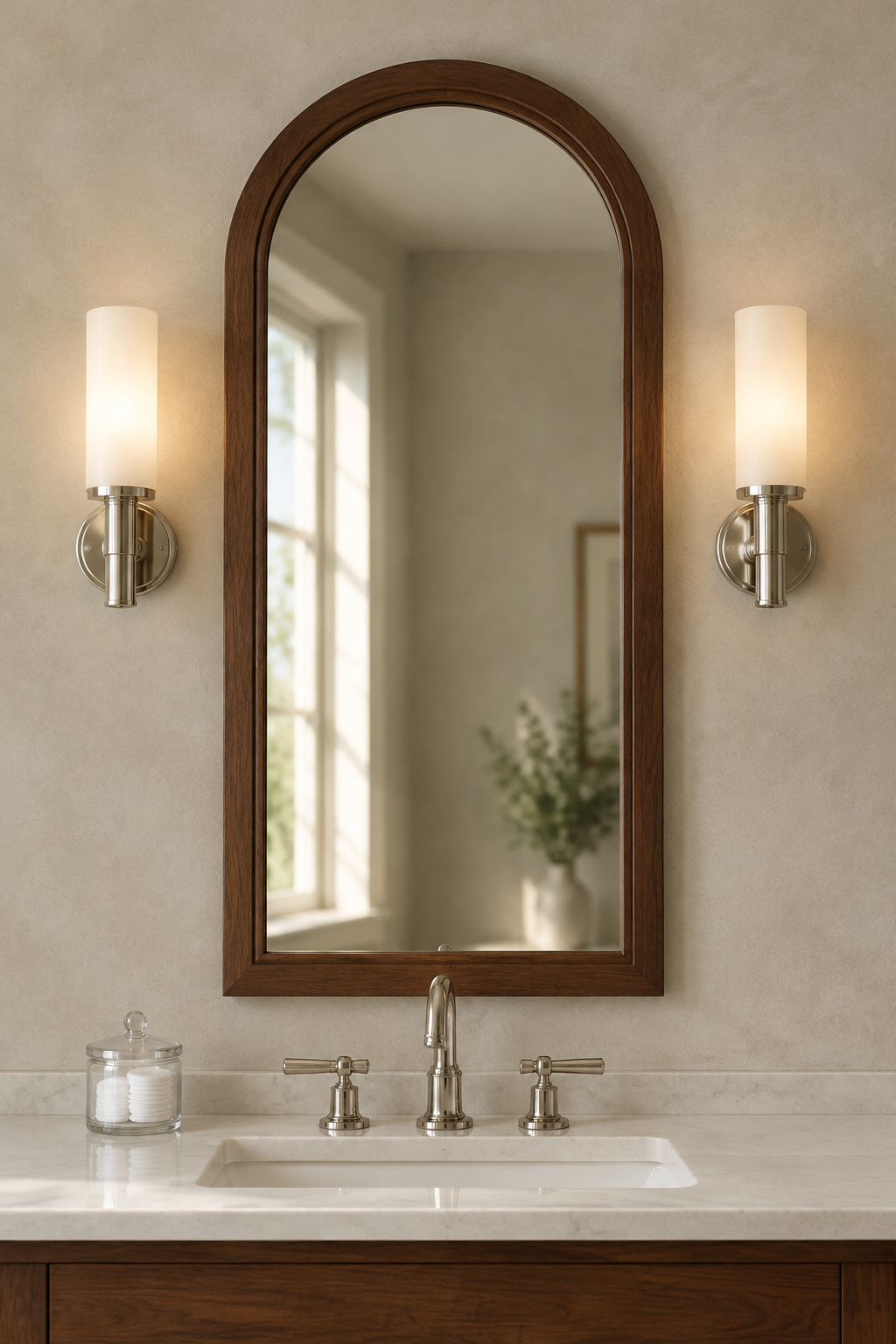
Round mirrors pair naturally with a sconce on each side; the lights frame the curve and put even light on your face. Arched, oval and pill mirrors can leave bare wall at the sides too. With an arch, keep the shades clear of the point where the curve springs from the straight sides.
On a narrow wall, or where the mirror runs nearly the full width of the vanity, sconces get hard to fit and a bar becomes the answer. If the mirror itself will be the light source, the choice changes again; round and rectangular LED mirrors carry their own light.
Curves, Straight Edges and the Lines Already on Your Wall
Check each shape against the three marks.
| Shape | With a bar light | With sconces | Against tile and counter lines | At the faucet |
|---|---|---|---|---|
| Rectangle | Best fit, especially tall ones | Fits if wall is left at the sides | Has to line up with them | Flat bottom edge, simple clearance |
| Round | Weak; less glass at the top | Classic pairing | No straight edge to compare | Measure to the lowest point of the curve |
| Oval | Wide ovals can work | Good, more height than round | Curved, no edge to compare | Lowest point of the curve |
| Arch | Only with height above it | Good; shades clear of the curve | Flat base meets the counter line | Flat base, simple clearance |
| Pill | Possible if the bar stays narrower | Leaves room at the sides | Two straight sides, rounded ends | Flat across the middle |
| Irregular | Check the widest point | Depends on the outline | Depends on the outline | Check the lowest point |
Irregular and organic shapes come with no designer guidance at all, so judge one by the boxes and the faucet alone.
Rectangles align with tile, cabinets and countertops, which is why they look tidy in a gridded room. Edward Martin adds that rectangles are easier to level, while a slight tilt on a circle can feel off. That’s about hanging, though, not about a wall that was never level. This part is only my observation: a wide straight edge is the shape most likely to make a sloping top obvious.
A retired teacher in my Saturday class built a bookcase that came out a quarter inch out of square. I told her to keep it. She uses it every day. Standing alone, a quarter inch doesn’t matter. Put it right next to a tile course or a countertop and your eye has something to measure it against.
The faucet under a curve
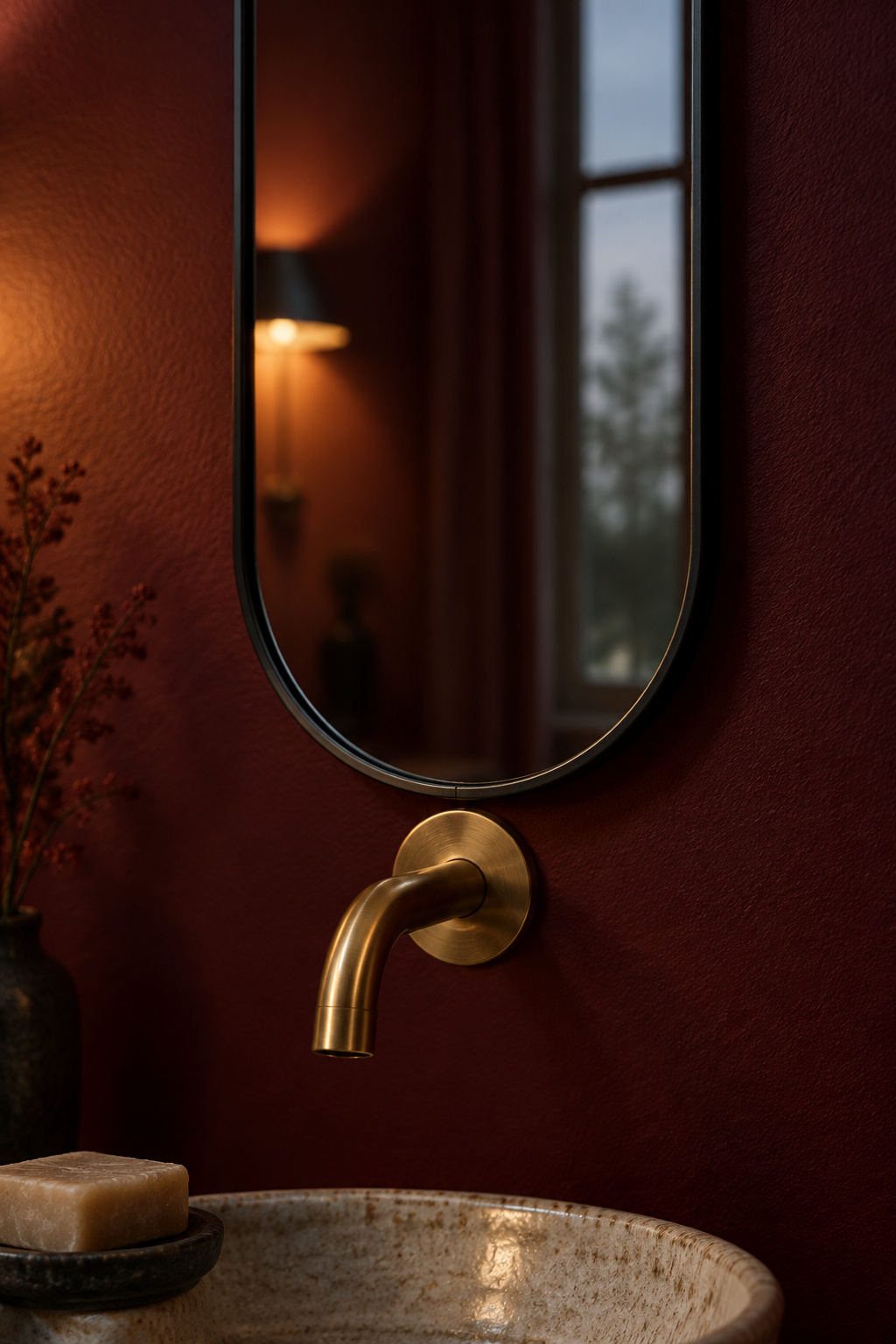
A round or oval mirror narrows toward the bottom, so the spout sits under the slimmest part of the glass. Work from the circle’s center and radius, not the bottom of the frame, since the usable glass starts several inches above that edge, and expect to lift it a little higher than a rectangle the same size. If the spout reaches forward, check the gap from the side too. The clearance numbers live in our main guide to sizing and choosing a bathroom mirror, along with how wide the glass should be.
When Tile Lines and a Sloping Top Overrule the Shape You Love
A crooked shelf is usually a crooked wall, not a crooked shelf. Mirrors can go the same way: if a hung rectangle looks wrong, check the tile course before blaming the glass. When your marks disagree, you have three choices.
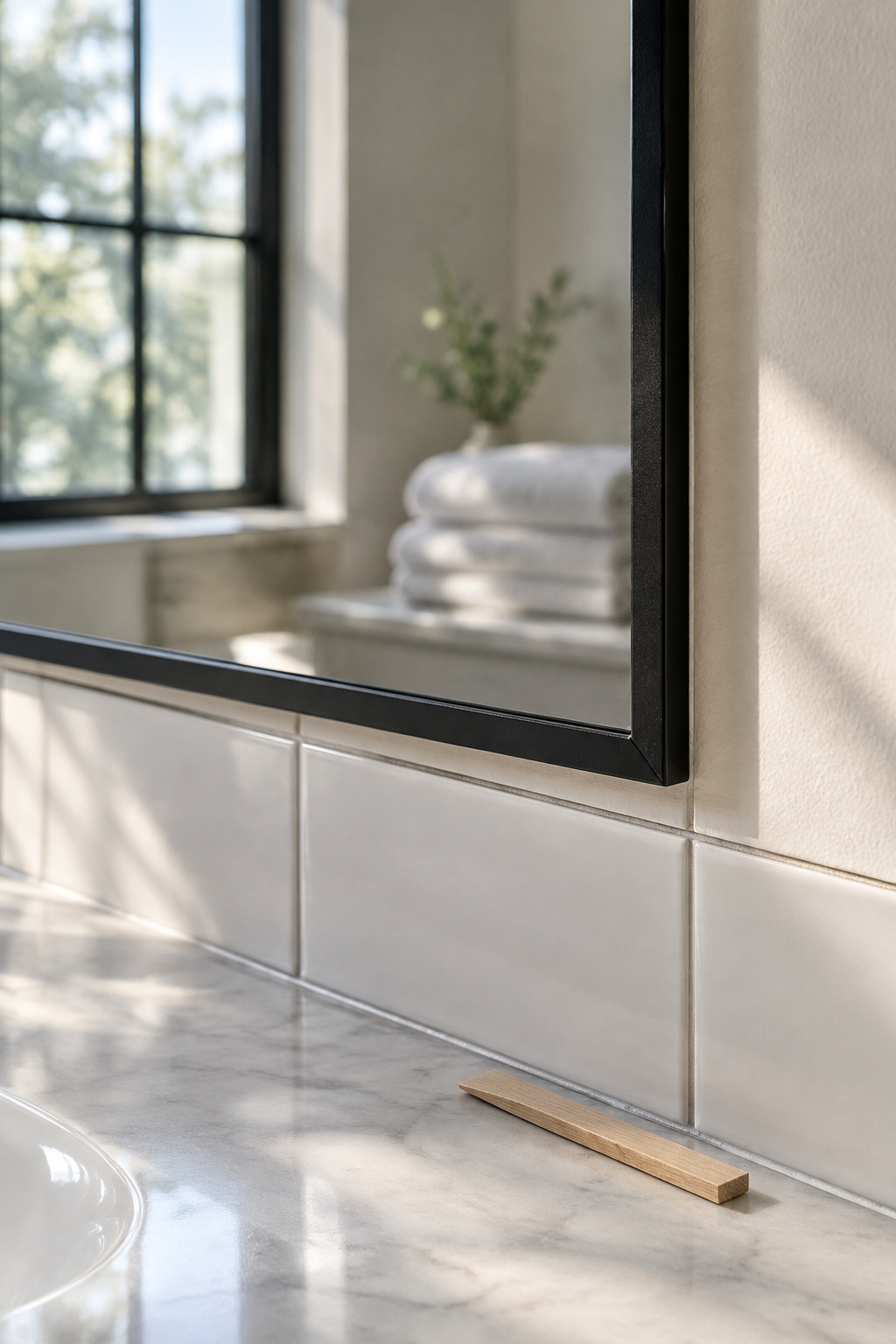
Follow the line you see most. If the tile course drifts right beside the mirror, a rectangle hung dead level will look crooked against it. I hang to the line the eye reads, then check it twice from the doorway. One installer guide measures up from the countertop, so the counter becomes the reference instead of the room.
Shim or correct the wall. A shimmed cleat gives a straight line on an uneven wall, and a wall that bows badly may need a flat backer panel first. The hanging guide has the cleat method.
Change the shape. If the wall won’t cooperate, a round or oval mirror takes the long straight edge out of the argument.
Moving a box, or adding sconces where only one box sits above the mirror, is electrician work.
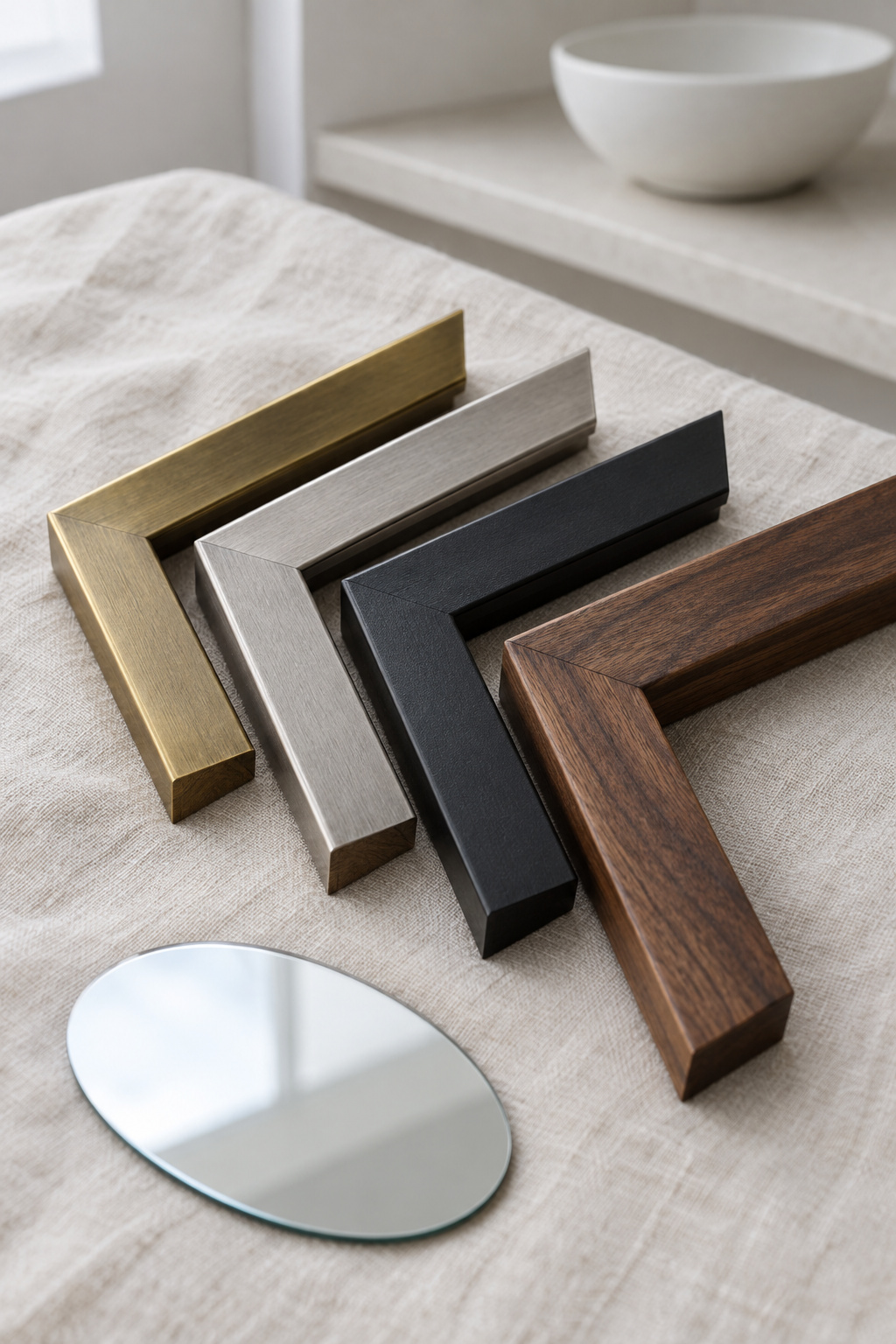
Once the wall has narrowed the field, the frame is the fun part. Slim brass warms things up and matte black gives quiet contrast; aged brass sconces suit a painted vanity, a thin black frame a floating cabinet. Oval and arched shapes suit vintage details. Our guide to arched and oval antique mirrors explains what old silvering needs in a steamy room.
The Verdict: Let the Wall Pick, Then Pick the Frame
Light boxes first, faucet second, level third, frame last. That order holds for every shape on the list.
The boxes decide between a bar and sconces. The faucet sets how low the glass can go. The level tells you whether a long straight edge will sit happily against your tile or argue with it.
Avoid shopping by photo, a wide straight edge on a wall nobody has checked, and a curve that dips down to the spout. If you’re torn, an oval or a rectangle with rounded corners sits between the camps. Distrust catalog shots taken in bathrooms bigger than yours.
Go back to the level on the vanity top. If the bubble sits dead center and the boxes are where you want them, pick the shape you love, as long as it clears the faucet. If it drifts, you already know what a long straight edge will be up against.
FAQ
Is an arched or a round bathroom mirror better for a small bathroom?
Round suits a small bathroom well, because it has no corners competing for attention and sits comfortably on a narrow wall. An arch keeps the softness with more height, but it needs enough wall height or it looks squeezed. Round does give less glass than a rectangle the same width.
Can you mix mirror shapes with the light fixtures in one bathroom?
Yes, and some pairings work better than others. Round mirrors sit well between two sconces, while a longer rectangle suits a bar light above. Keep the bar narrower than the mirror, leave bare wall beside the glass for sconces, and keep shades clear of an arch’s curve. Matching the fixture’s shape is taste, not a rule.
Does a pill-shaped mirror work with a wall-mounted faucet?
Yes. A pill has two straight sides and rounded ends, so its bottom edge is flat across the middle and clears the spout like a rectangle would. Wall-mounted faucets push the mirror higher than you expect, so measure from the faucet’s highest point and keep the mirror in the same vertical line as the faucet.