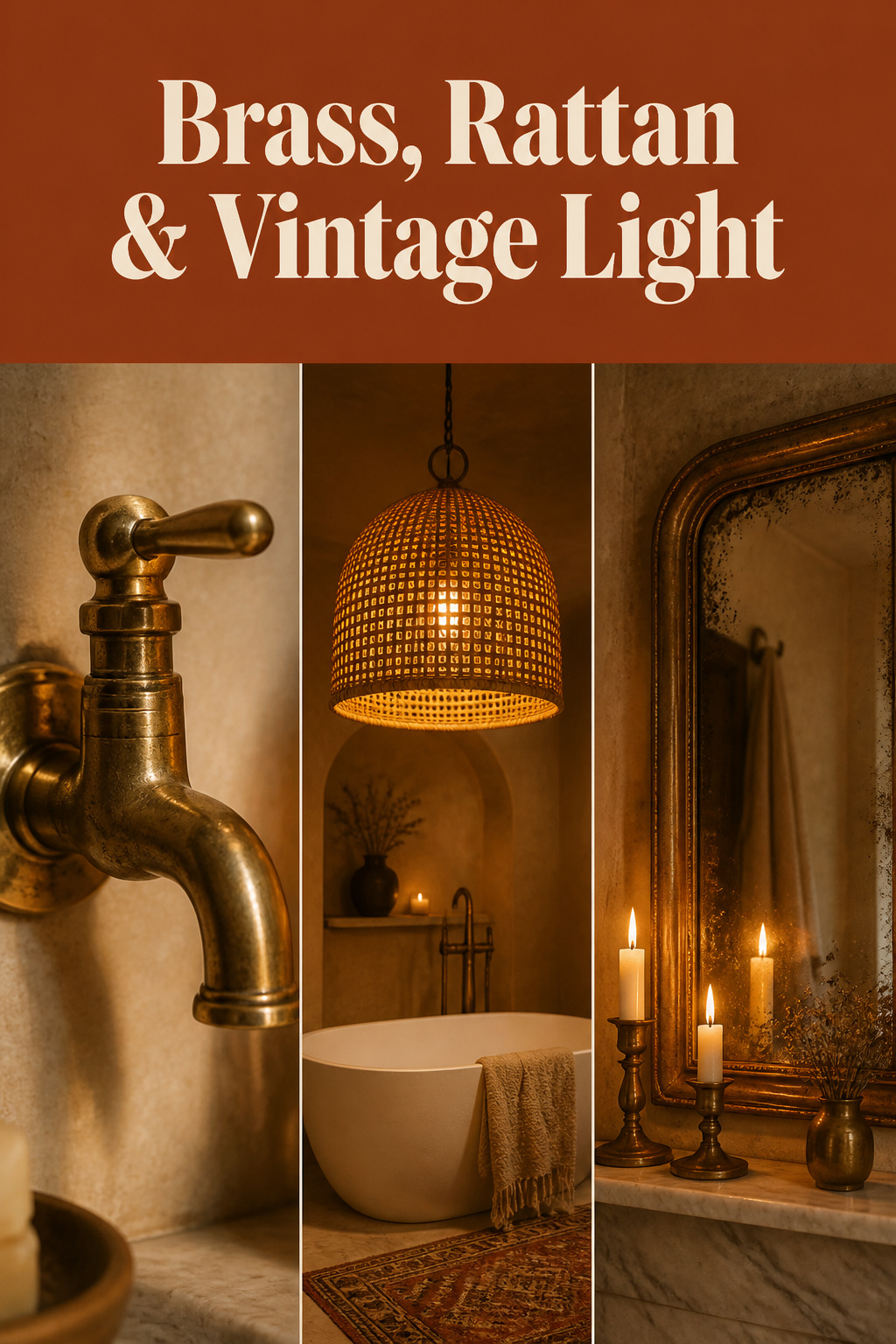
There is a moment when the tile is set and the only things left to choose are the tap, the pendant and the mirror. Many treat that as the easy part and reach for the chrome the showroom pushed — but an eye that has already chosen terracotta and handmade tile has outgrown chrome, and the move to warm brass, rattan and aged glass is what separates a bathroom that looks bohemian from one that merely holds boho objects. Boho bathroom lighting and fixtures are the last decision and the first thing a visitor notices.
TL;DR
- Unlacquered brass is the boho signature: a two-tone honey patina over months 4–12, an even golden-brown by years 1–3, faster in a humid bathroom. Brushed or lacquered brass stays bright for lower maintenance.
- Most decorative rattan pendants are IP20 and not legal above a bath: Zone 1 and Zone 2 require an IP44 fitting under BS 7671, so use synthetic rattan with a proper fitting and a qualified electrician for wet-zone circuits.
- Layer three warm sources at 2700–3000K, repeat each metal at least once, and keep no more than three metals — two warm, one matte-black accent.
Why the Right Fixtures Change Everything in a Boho Bathroom
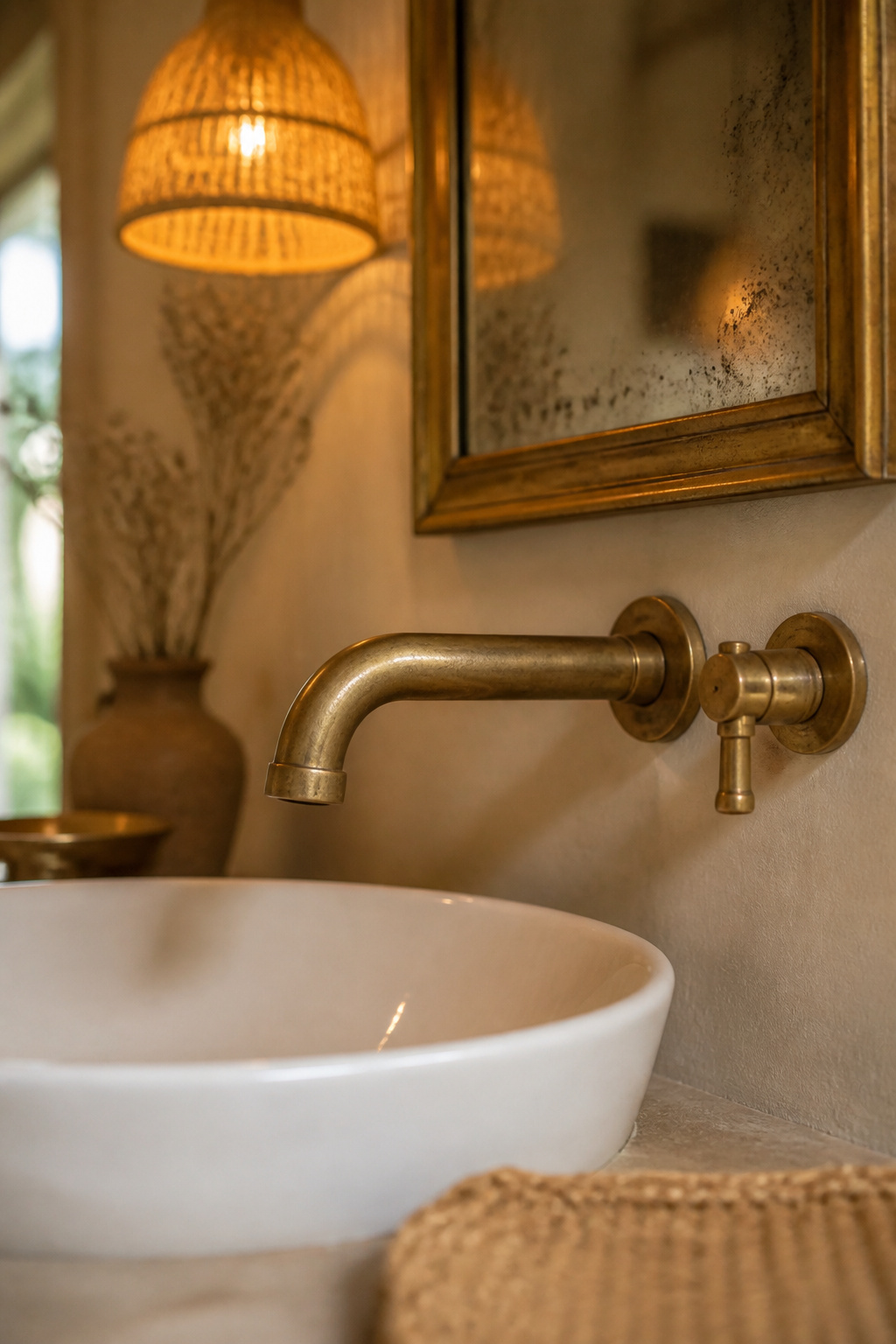
Fixtures are the jewellery of a bathroom: the metal at the basin and the light overhead tell a visitor whether the room was decorated or composed.
Fixtures as the room’s jewellery — the last detail and the first thing noticed
A tap is one of the few objects you touch many times a day, one of the most intimate decisions in the room — and in a space already soft with textiles and the handmade boho bathroom ideas that set the scene, an aged-brass tap or matte-black pull adds contrast without competing.
The journey from chrome to brass: what that change signals
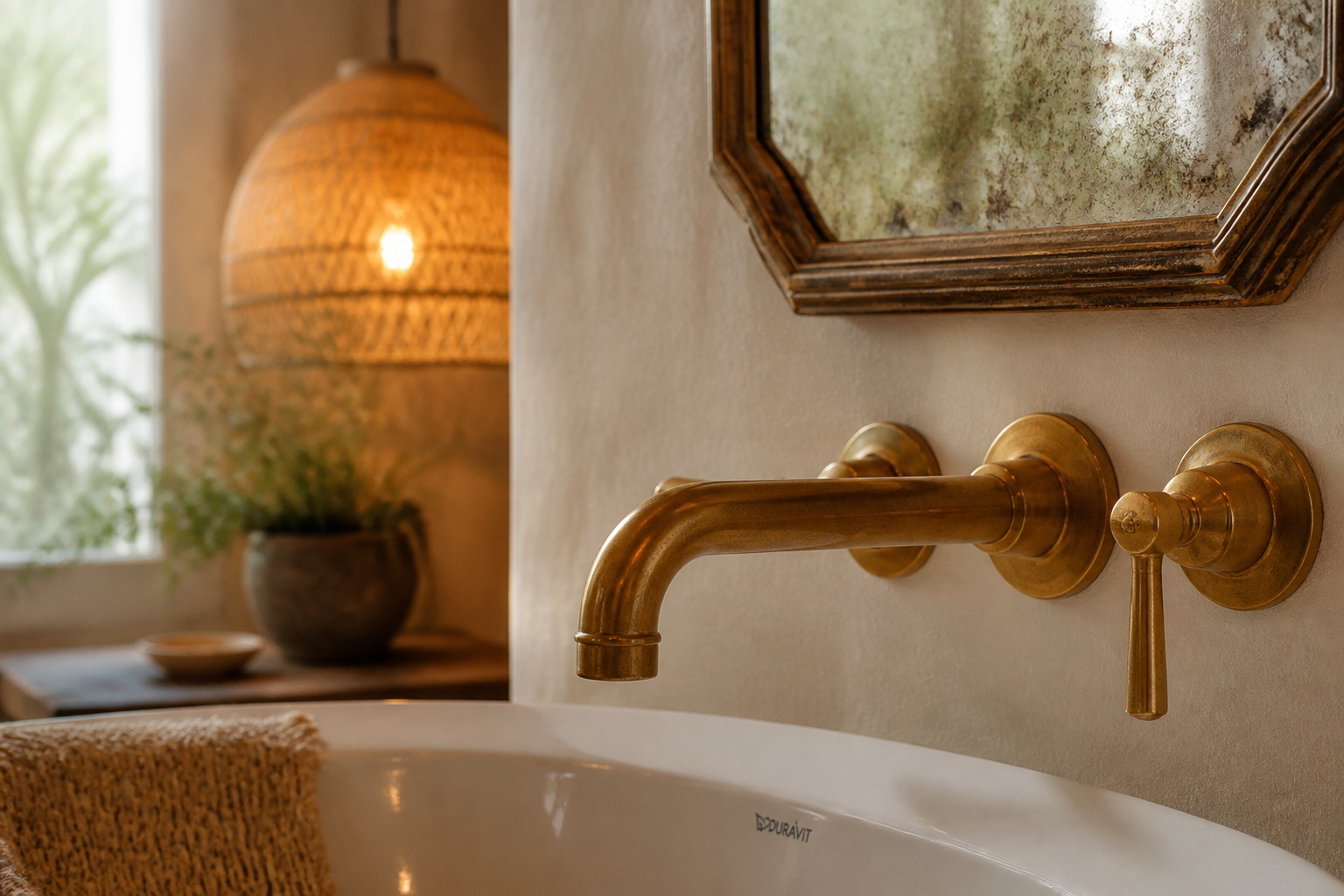
Brass is an alloy of copper and zinc whose golden hue reads warmer than any silver-toned metal, harmonising with the terracottas and creams of the boho palette. The return of raw, unlacquered brass is a shift away from showroom shine — metal allowed to age rather than sealed against time.
Patina and character versus showroom shine
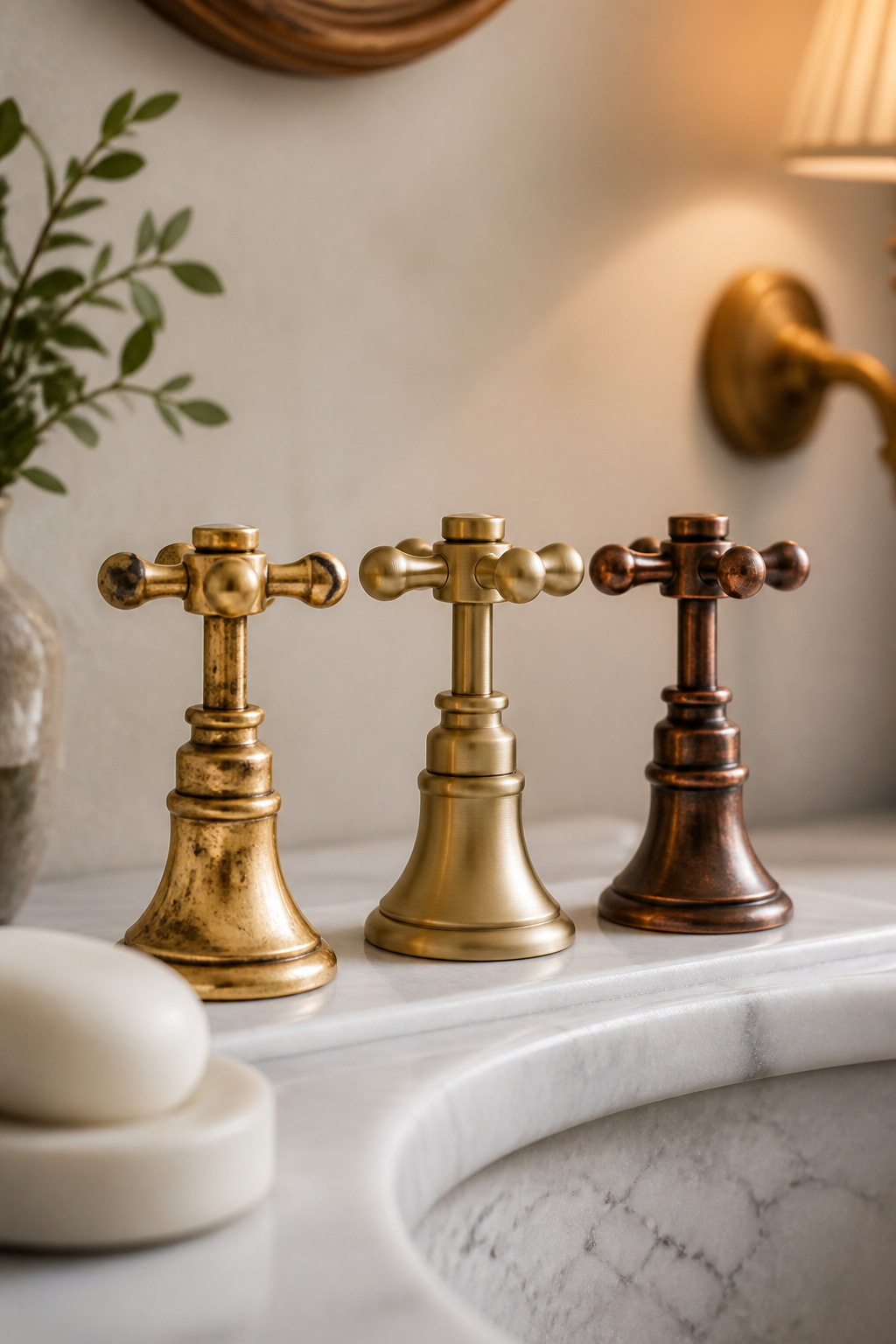
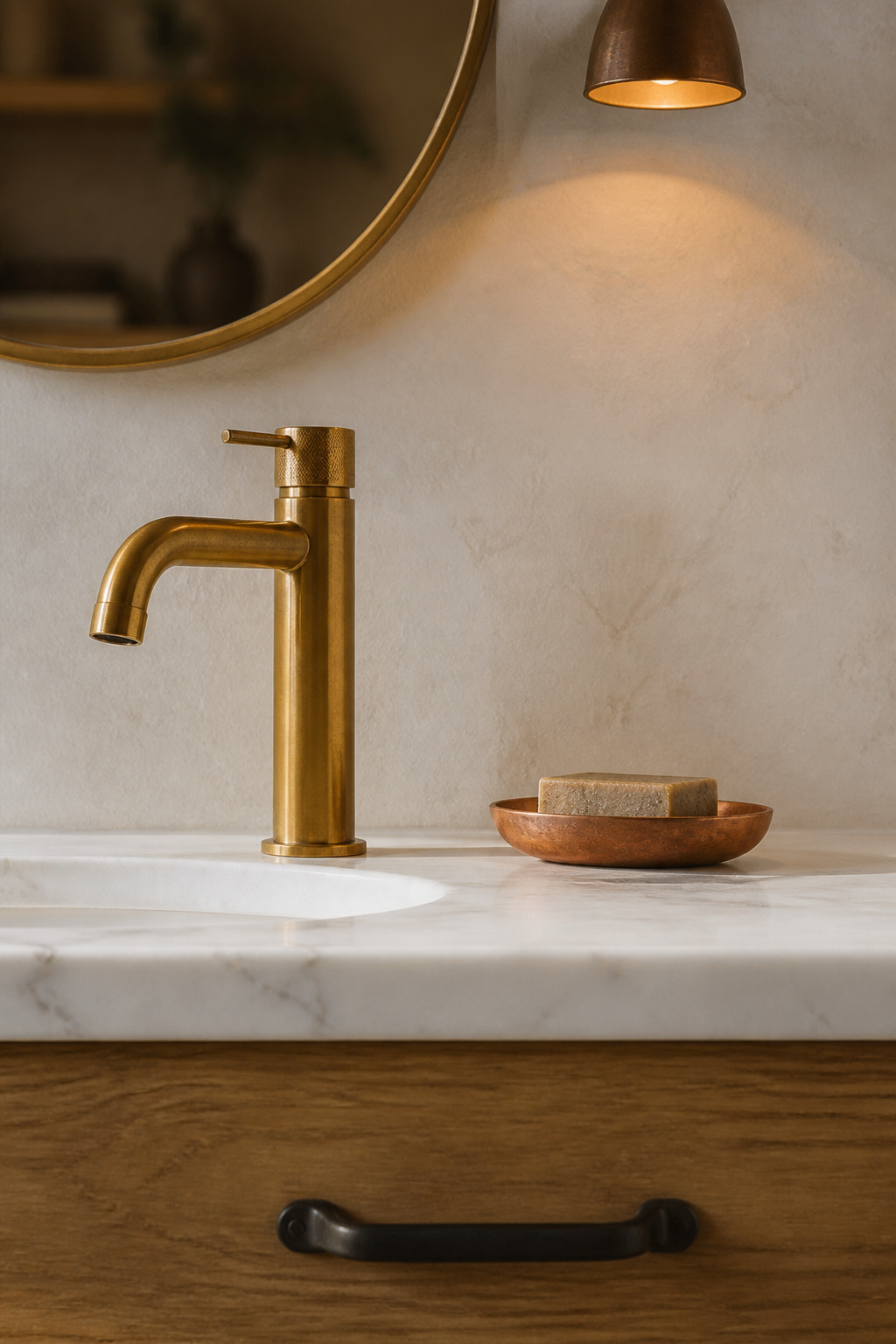
Unlacquered brass develops in two phases: months four to twelve give a two-tone read, handled areas warming to honey while sheltered surfaces stay bright; years one to three deepen the whole piece to an even golden-brown, faster in humidity than in a dry hallway.
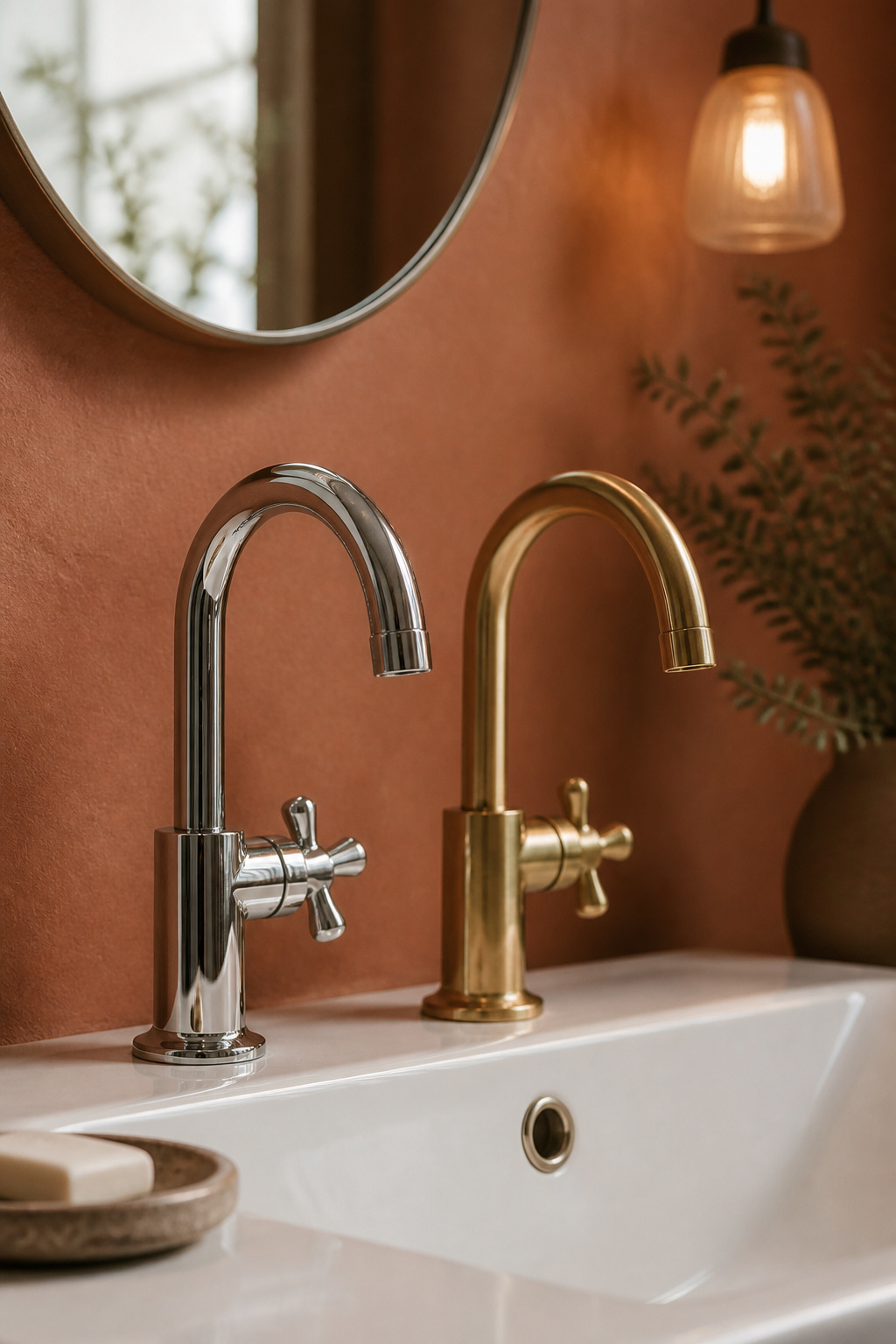
Brass and Copper Taps and Hardware: Choosing the Right Finish
Each finish ages by a different mechanism. One rule before you buy: choose solid brass, not plated zinc, which wears through in a wet room within one to three years and cannot patina gracefully beneath.
| Finish | Look | Patina behaviour in a wet room | Maintenance | Best use |
|---|---|---|---|---|
| Unlacquered brass | Warm gold, deepening to honey then golden-brown | Patinas fully; humidity accelerates it; uneven if cleaned in patches | High for a bright tone, none if patina is the goal | The boho signature — fittings meant to age |
| Lacquered brass | Bright factory gold, held | None until the coat chips, then localised tarnish, hard to spot-fix | Low until the lacquer breaches, then full strip | A stable bright finish with no patina |
| Brushed brass | Matte, linear-textured gold | Minimal; PVD coat resists moisture and chemicals | Low; hides fingerprints and water spots | Busy bathrooms wanting warmth, low upkeep |
| Antique copper | Dark reddish-brown, factory-aged | Factory finish wears to reveal base metal; ages inconsistently | Moderate; cannot age like real copper | Decorative accents, not lasting plumbing |
Unlacquered brass: the living finish that earns its look
Unlacquered brass is raw alloy exposed to the air, which is exactly why it patinas. Care is gentle — warm water, mild soap, a soft cloth and a few drops of mineral oil after cleaning, never abrasives or full-strength vinegar. Expect $80–$300+ for taps.
Lacquered and brushed brass for lower maintenance
Lacquered brass holds its factory brightness until the coat chips, when tarnish forms at the breach and, as Kingston Brass notes, cannot be spot-treated without stripping the piece. Brushed brass is more forgiving: its matte, PVD-coated surface hides fingerprints and outlasts conventional lacquer.
Copper and antique copper: richer and warmer
Pure copper is an elemental metal, redder and warmer than brass and naturally antimicrobial. Untreated in a wet room it can travel from bright red toward greenish verdigris — a real direction, though not on a fixed timetable — so it demands a committed maintenance relationship, and pairs richly with the tile these fixtures sit against in any boho scheme.
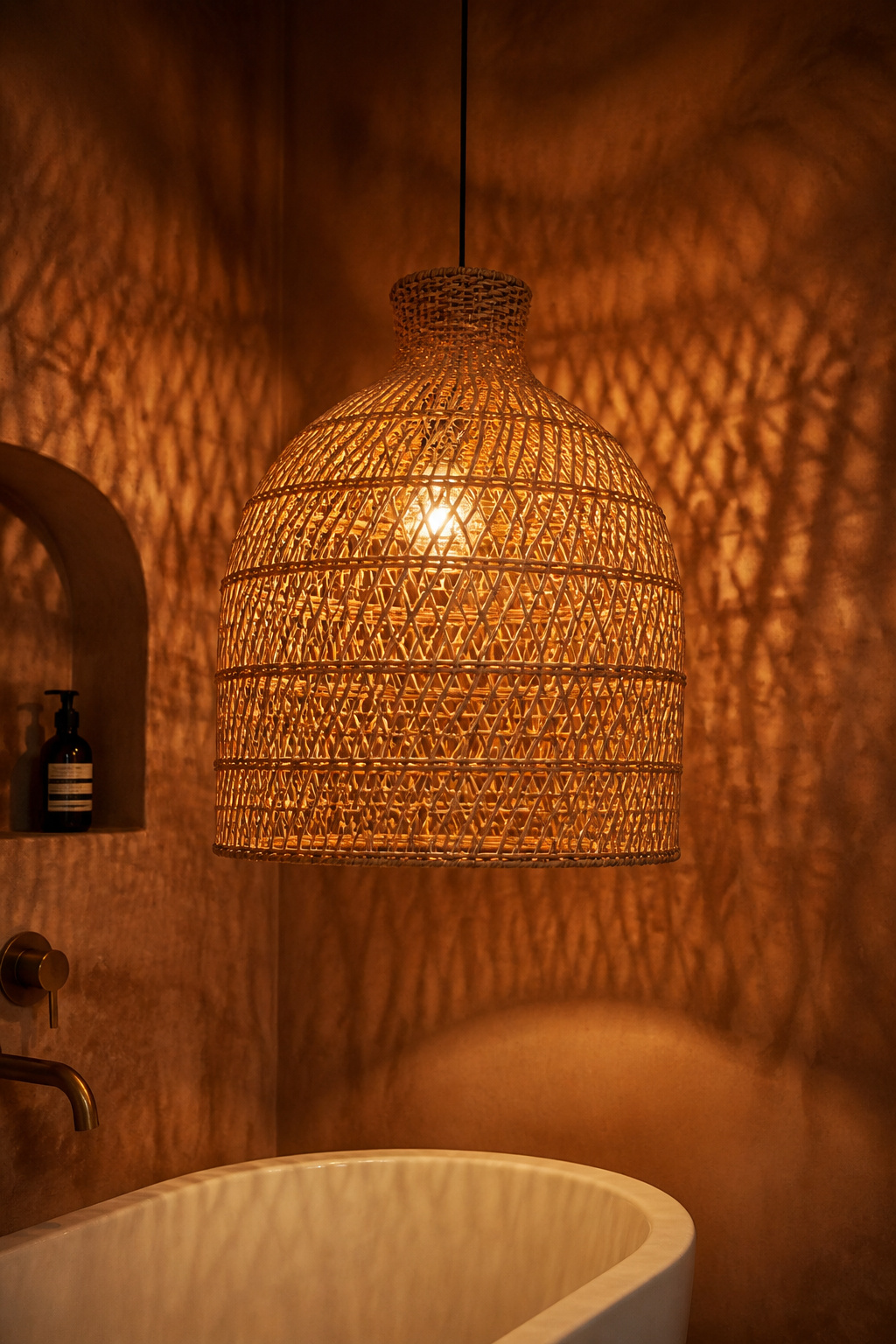
Rattan Pendants and Woven Light Shades
Why woven pendants are a definitive boho lighting choice
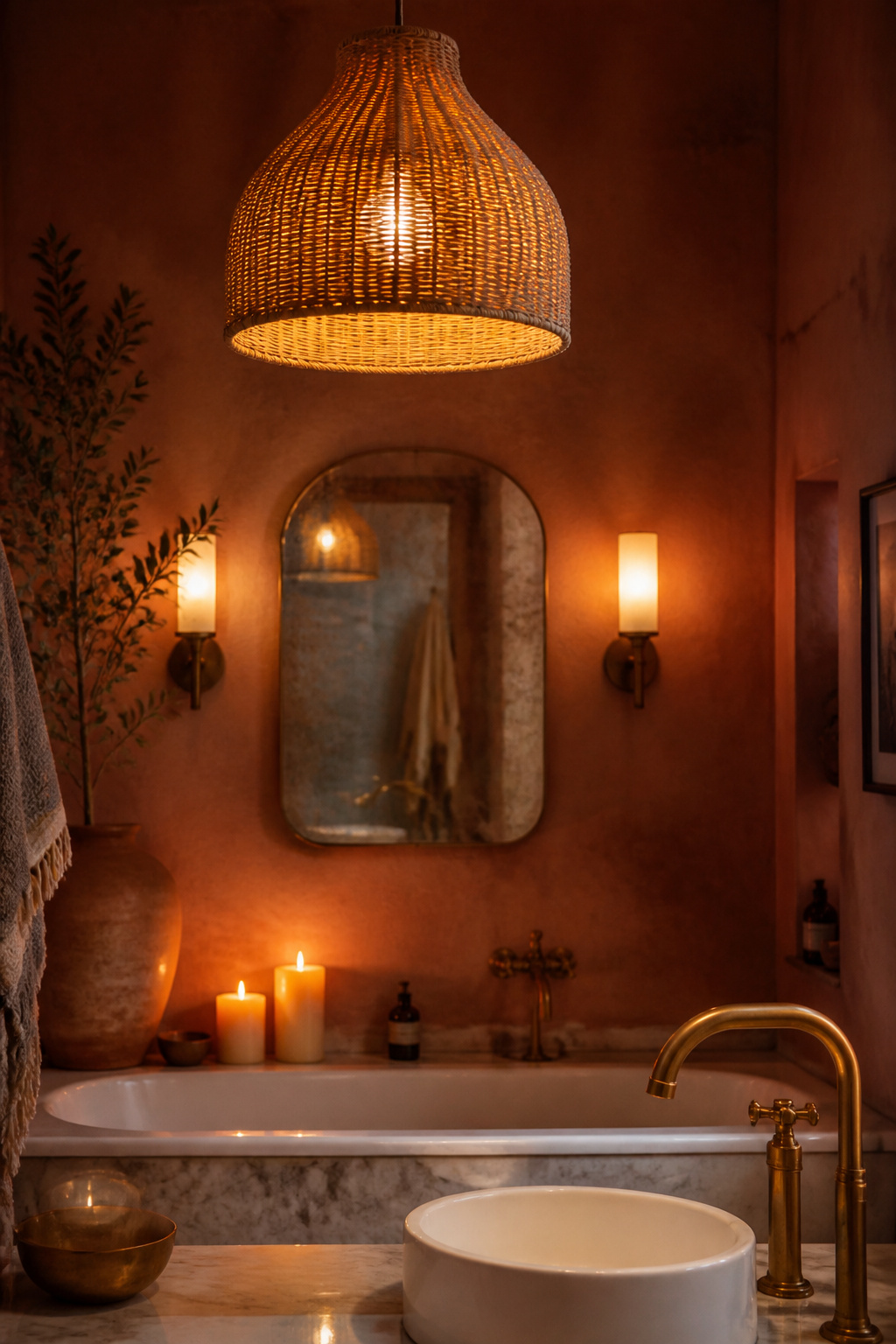
A rattan pendant is the most-wanted boho light for the latticed glow no glass or metal shade reproduces, and a bell shape suits the curved forms that recur through the style. Hung at 170–180 cm from floor to shade base over a freestanding bath, it creates a canopy of warm light — and it is the fixture where the prettiest guides go quietest about safety.
IP ratings and bathroom safety requirements for pendants
This is the part most design articles skip. UK bathroom zones under BS 7671 (the 18th Edition Wiring Regulations) require a minimum IP44 fitting in Zone 1 — directly above the bath or shower to 2.25 m — and in Zone 2, which extends 0.6 m beyond it. Most decorative rattan pendants sold in homeware shops are IP20: dust protection only, no water protection, not compliant in either zone. The shade material is irrelevant; the IP rating refers to the lampholder and fittings, never the rattan, which carries no rating at all. Synthetic resin rattan is the better wet-room choice — it will not absorb moisture, support mould or warp through the steam cycles. UK Part P also requires a new bathroom circuit to be installed by a registered competent person with 30 mA RCD protection, so a pendant over a wet area is a job for a qualified electrician, not a weekend swap.
Positioning and height for a warm, layered glow
Hanging at ceiling height loses the effect; the warmth comes from the shade sitting within view as you lie in the bath. Where the bath sits in a wet zone, a safer move is a pair of smaller rattan pendants flanking the vanity mirror at the NKBA sconce height of 60–66 inches, well clear of the zone constraints.
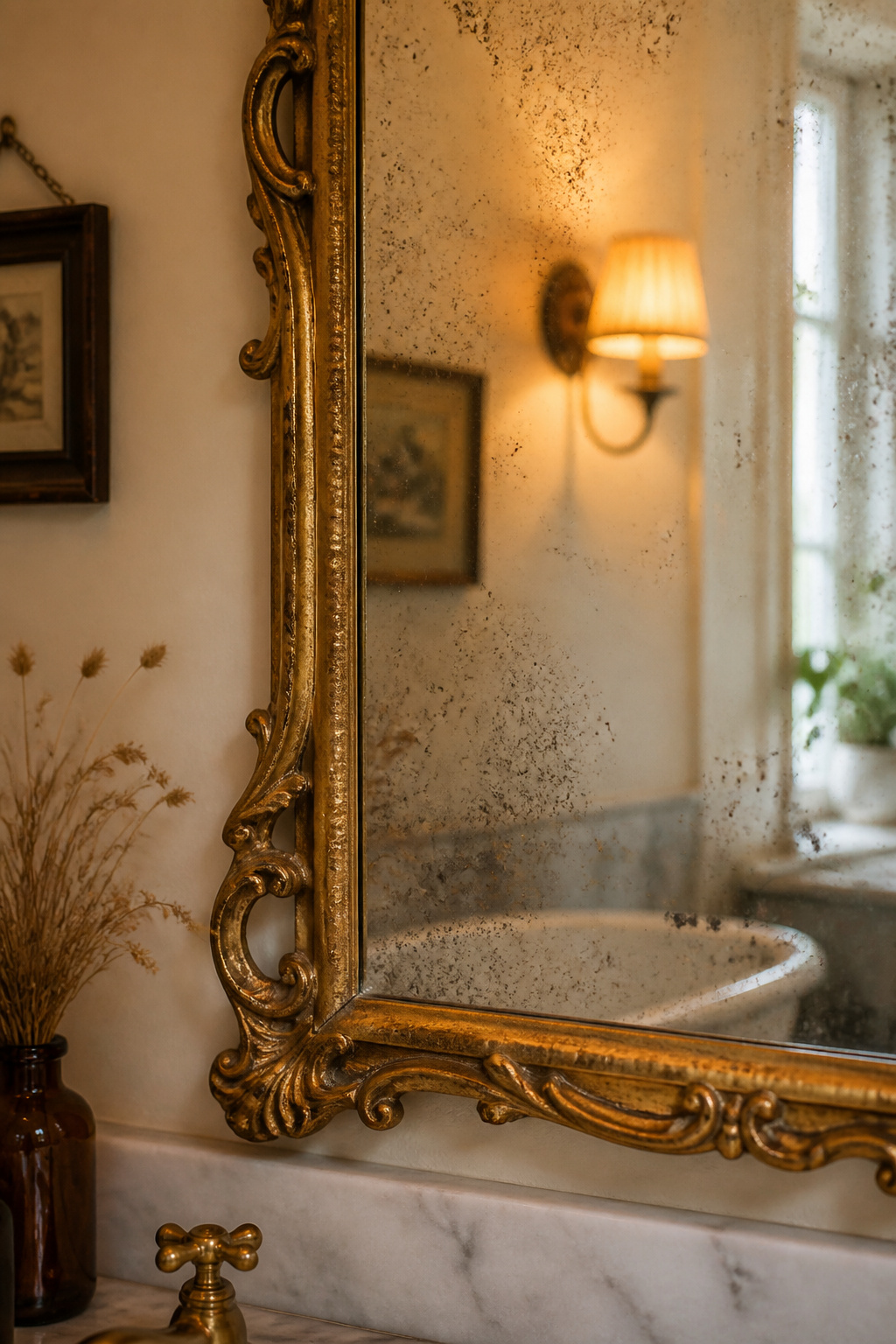
Vintage and Antique Mirrors: Character Over Size
What makes a mirror read as vintage versus mass-produced
The value almost always lives in the frame — hand-carved wood, real gold or silver leaf, joinery in walnut, mahogany or cherry. Foxing, the dark patches on old glass, is water vapour oxidising the silver backing; edge darkening with spot foxing is the primary tell, and the glass should never be replaced unless the reflection is truly lost. The quickest in-hand test is weight: gilded wood is noticeably heavier than cast resin.
Sourcing: estate sales, architectural salvage, and what to look for
Genuine pieces come from architectural salvage yards, estate sales in older neighbourhoods, and marketplaces such as Chairish and 1stDibs (the latter skewing investment-grade at $500–$5,000+). My inspection routine: tap the frame, where solid wood and brass ring dull and hollow resin rings light; check the glass for edge foxing; and look at the backing, where card over wood signals age and staple-gun MDF signals recent production.
Hanging a heavy vintage mirror safely
Framed vintage mirrors of 24×36 to 36×60 inches weigh 25–80 lb, and anything above 50 lb should anchor into a wall stud — a single stud holds well over 100 lb with a 2.5-inch screw set two inches deep. Where studs fall wrong, use toggle bolts rated around 45 kg, never the plastic plugs from picture hooks. Seal the frame with marine-grade polyurethane first and leave a 10–15 mm gap behind so moisture cannot trap against the wall.
Layered Boho Bathroom Lighting: Ambient, Task and Accent
A single ceiling light at full brightness is the commonest reason a bathroom reads as clinical; the spa-like warmth comes from at least three independently switched sources:
- Ambient pendant overhead — a ceiling rattan or flush fitting at 2700K, the base level that stops the room going dark.
- Vanity sconces flanking the mirror — at 60–70 inches from the floor (the NKBA position), throwing shadow-free light across the face.
- Warm LED mirror or 3000K task bulb — slightly cleaner than 2700K for accurate colour when grooming.
- Under-shelf warm LED strip — 2700K, CRI 90+, on a damp-rated driver, lighting counter surfaces without glare.
- A dimmer on the ambient circuit — dropping the main source to 20–40% with the other layers active, at no fixture cost.
- Candles or flame-effect LEDs — on sills and ledges where no wired light reaches; 1800K flame-effect LEDs suit rentals or homes with children.
A warm-lit room flatters plants as much as metal, so it is worth matching plants to your light once the layers are set.
Ambient and task light: what each one does
Ambient light fills the room evenly; task light at the vanity kills the shadows an overhead-only scheme casts across the face. The key is switching the layers independently rather than flooding the room from one source — that single change is what separates a functional bathroom from a retreat.
Warm bulb temperature and why 2700K is the boho number
2700K reads as candlelight-adjacent and warms terracotta and brass into their fullest colour; 3000K is the practical exception at the vanity mirror. The hard line is 4000K and above: daylight-toned bulbs desaturate the palette so brass reads grey and terracotta reads beige. LED filament bulbs at 2700K give the amber glow of incandescent at around 90% less energy.
Candles and flame-effect as the third layer
Candles occupy the low and mid heights where no wired light reaches, and their flicker animates brass and glass as no LED quite does. Open flame under a wired shade can affect the shade and raises CO in a small enclosed room, so flame-effect LEDs are the sensible substitute where ventilation is limited.
Mixing Metals and Avoiding the Clash
The two-metal rule and when it is actually a rule
The one steadfast rule of mixing metals is to repeat each metal at least once: brass tap plus brass towel ring is a considered choice, where one brass tap among chrome, gold and rose gold reads as confusion. Keep to no more than three metals — two dominant warm metals plus one accent neutral — with the primary metal carrying roughly two-thirds of the fixtures and the secondary the remaining third.
Warm metals together: brass, copper and bronze
Brass, copper and bronze all sit in the warm half of the spectrum and mix without contradiction: unlacquered brass for the plumbing, raw or antique copper for accessories, bronze for cabinet hardware. Shiny and matte within one family also mix happily, because the underlying tone stays coherent.
When matte black earns its place among the warm tones
Matte black works as a neutral that grounds a warm scheme without chilling it — keep it to one element, a single mirror frame or pull. The clash to avoid is cool-with-warm: chrome, nickel or polished stainless against brass and copper sit on opposite sides of the temperature spectrum and visually fight.
Choose fixtures the way you would choose any piece meant to last: by material truth, not showroom shine. Unlacquered brass that patinas, copper that ages, a foxed mirror in a real frame, warm light at 2700K — these share a register that chrome and 4000K bulbs break. Specify them together, and the room will not date so much as deepen.
FAQ
Is brass or matte black better for a boho bathroom?
Brass — especially unlacquered or antique — suits the earthier, maximalist boho register, its honey-to-amber tone harmonising with terracotta and natural materials, while matte black fits a cleaner, modern-boho look. They coexist when brass carries two-thirds of the fixtures and black appears only as a trace accent.
Can you use rattan light shades in a bathroom safely?
Yes, with the right fitting — the rattan is irrelevant to safety; what matters is the IP rating of the electrical fitting. Zone 1 and Zone 2 positions require an IP44-rated fitting under BS 7671, and standard homeware rattan pendants are usually IP20, barred from both zones. Synthetic rattan resists the moisture and warping that defeat natural rattan.
How do you stop unlacquered brass taps from tarnishing too quickly?
Wipe the tap dry after each use — in a bathroom this single habit matters more than any product, because standing moisture accelerates oxidation. Clean weekly with warm water and mild dish soap, never vinegar or abrasives, then apply a few drops of mineral oil. A micro-thin wax coat every few months slows the patina further.