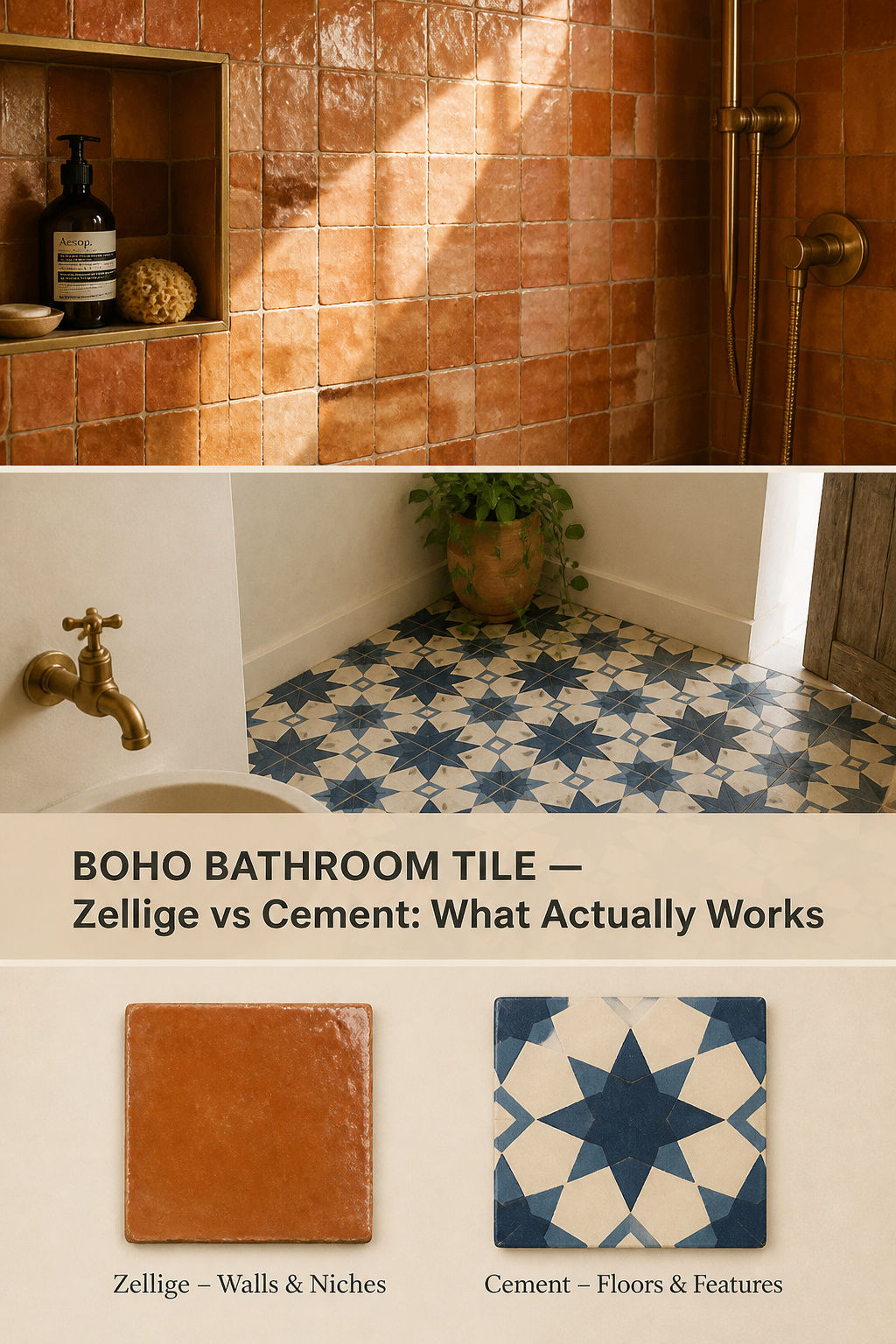
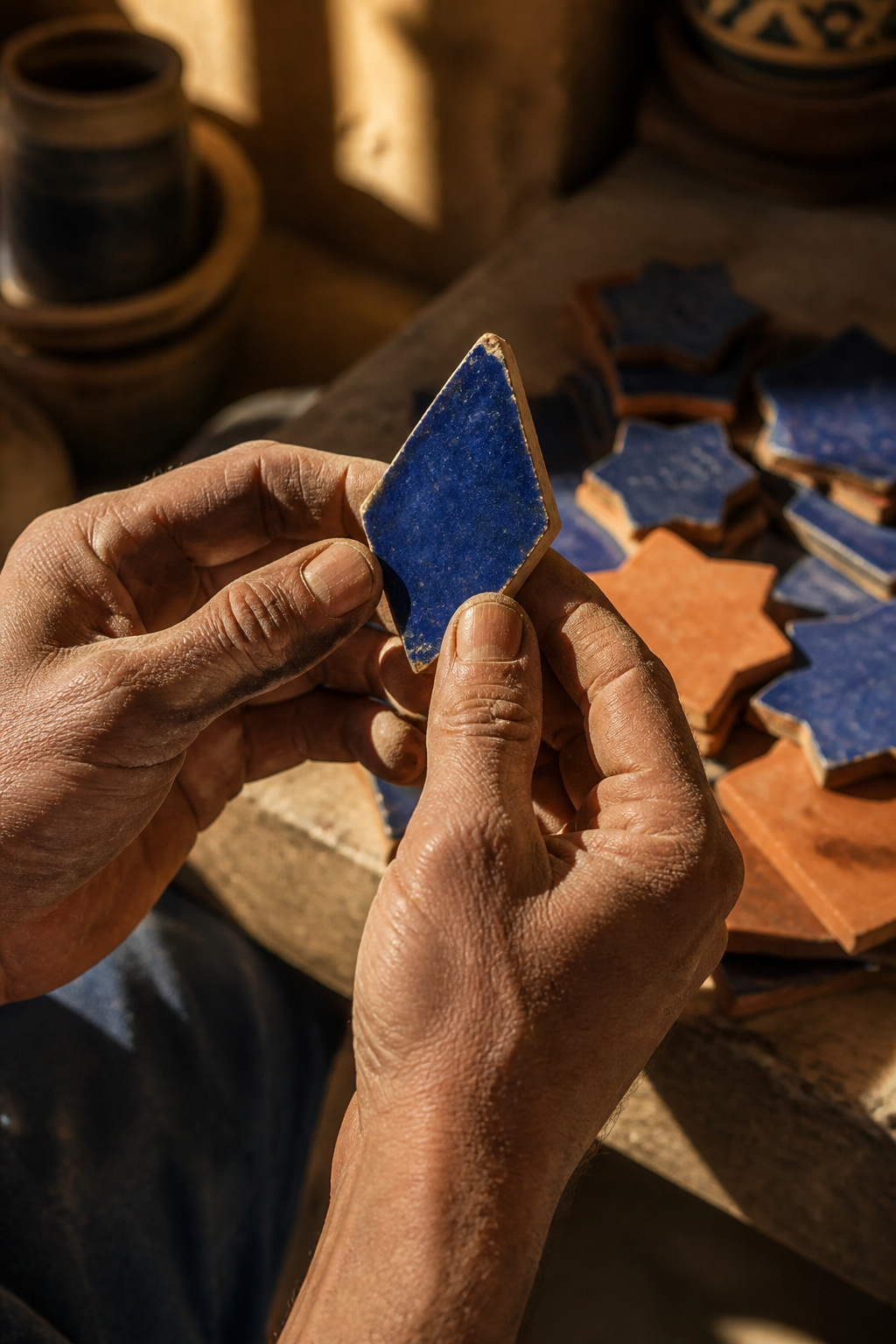
Authentic zellige has been made in Fez by a process barely changed since the 10th century: clay soaked a week, kneaded by hand, sun-dried, hand-glazed, fired in an earthen kiln where uneven heat gives each tile its own colour, then chiselled to shape. When people call boho bathroom tile “characterful,” this craft history is the character they mean.
TL;DR
- Zellige goes on walls and niches, not shower floors: its wet DCOF of about 0.16 is well below the 0.42 floor-safety minimum. Matte, porous cement tile suits floors in small formats, but must be sealed before and after grouting.
- Authentic zellige runs roughly $15–$60 per square foot, patterned cement $10–$30, machine-made lookalikes $7–$10 — but the lookalike loses the light-play and the provenance.
- Let pattern breathe: keep 50–60% of tiled surfaces plain, match grout to zellige for a continuous surface, and seal all grout lines because the tile is never the waterproof layer.
Why Handmade Boho Bathroom Tile Reads as Craft, Not Trend
Handmade tile carries evidence of the hand in the surface itself — palette and textiles complete how a boho bathroom comes together, but the concern here is the surfaces.
Zellige’s Moroccan origins and why irregularity is the point
The expulsion of artisans from Spain in the 15th century widened the zellige palette from terracotta into cobalt, emerald, ochre and ruby. The chips, pits and micro-cracks in a genuine box are not defects — they are, as the Zia Tile team puts it, what makes each tile “a work of art unto itself, beautifully imperfect and unique.”
Patterned cement tile’s Spanish and North African lineage
Cement tile is not fired and carries no glaze; colour and pattern are pressed into the body, so the pigment is permanent but the surface stays porous. Its spread through Spanish and French workshops gives it broad cross-cultural reach — a Moroccan star-and-cross and a Catalan geometric repeat are cousins.
What a handmade surface does that factory tile cannot
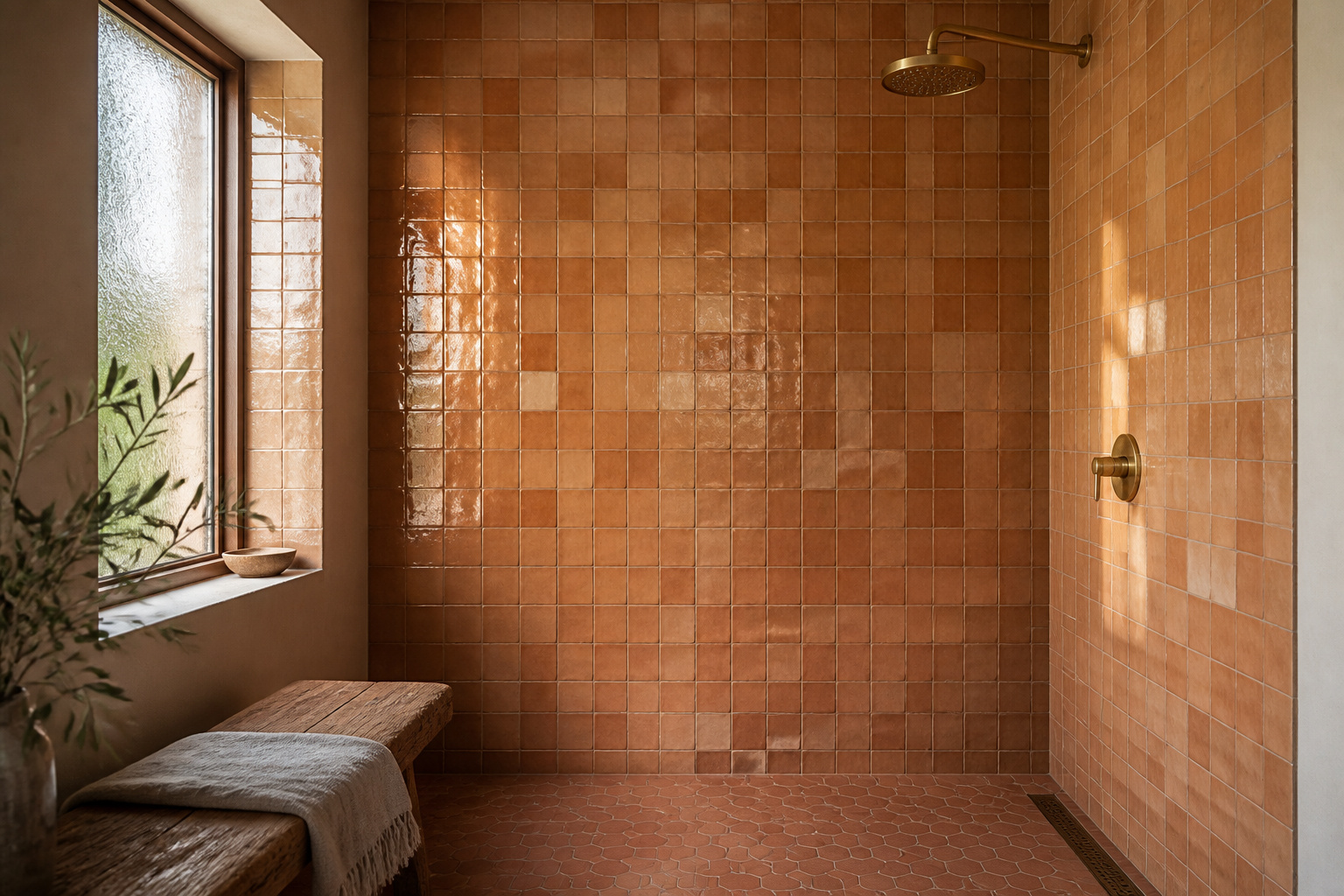
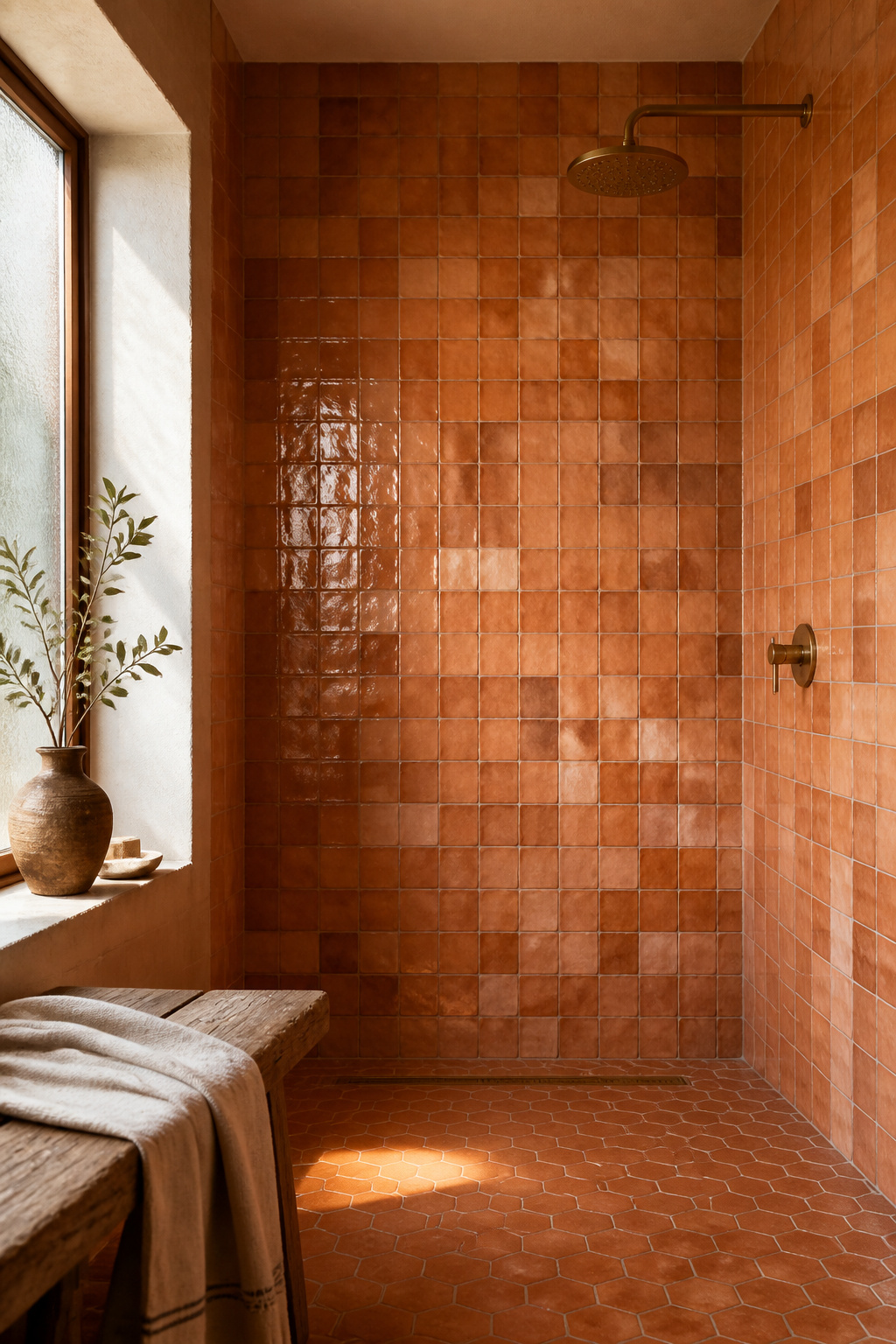
Because zellige is uneven, light strikes each piece at a different angle and the wall shifts through the day. That shimmer is invisible in a catalogue — it is the difference between a surface with provenance and one that imitates the idea of it.
Zellige vs Patterned Cement Tile: Which Is Right for Your Bathroom
The choice is rarely about which is prettier; it is about where each earns its place in a wet room. The table sets the two primary types beside the machine-made alternative, on the seven specifications that decide the job.
| Tile type | Origin / craft method | Slip resistance (wet DCOF) | Water absorption | Sealing required | Cost range (material) | Best application |
|---|---|---|---|---|---|---|
| Zellige (handmade Moroccan) | 10th-c. Fez; hand-glazed clay, kiln-fired, hand-chiselled | ~0.16 — below the 0.42 wet-floor minimum | Non-porous glazed face; porous grout lines | Tile face no; grout lines yes (unsanded polymer-modified) | $15–$60/sqft (typical $18–$28) | Shower walls, niches, splashbacks — not shower floors |
| Patterned cement (encaustic/hydraulic) | 1850s Catalonia; pigmented layer hydraulically pressed, unglazed | Higher (matte surface); viable in small formats | Porous throughout | Yes — penetrating sealer before and after grouting | $10–$30/sqft (8×8 typically $10–$18) | Floors (small format), feature walls, niches |
| Machine-made porcelain lookalike | Factory-pressed porcelain, consistent glaze | Factory-rated for floor use | Non-porous, glazed | No | $7–$10/sqft | Floors and walls where budget leads |
Zellige: the handmade Moroccan glazed clay tile
The price reflects the labour in every piece, and installation adds more because the size variation must be worked tile by tile. Its glaze is its own water resistance, so the face needs no sealer — but the grout lines do, in unsanded polymer-modified grout that fills the narrow joints without scratching the glaze.
Patterned cement tile: encaustic and hydraulic
Cement tile is matte, giving it the slip advantage zellige lacks, and in formats of 8×8 or below with a proper fall to the drain it is a common shower-floor material. Two cautions: an 8-inch tile weighs around three pounds, so substrate load and thinset matter; and with no glaze, acid cleaners etch it permanently.
Machine-made lookalikes: the honest trade-off
The lookalike has real virtues: consistent sizing, a factory DCOF rating fit for floors, a glaze that needs no sealing. What it cannot give is the light-play or the lineage — for a boho room rooted in material truth, a copy of an idea rather than the idea itself.
Using Bold Pattern Versus Restraint in a Boho Bathroom
The Moroccan tradition offers one clear lesson: the zellij mosaic was always set within plain-plastered walls, and the silence around it gave it force. Filling every surface with texture dissolves that focal power.
Full-floor pattern: when to commit and when not to
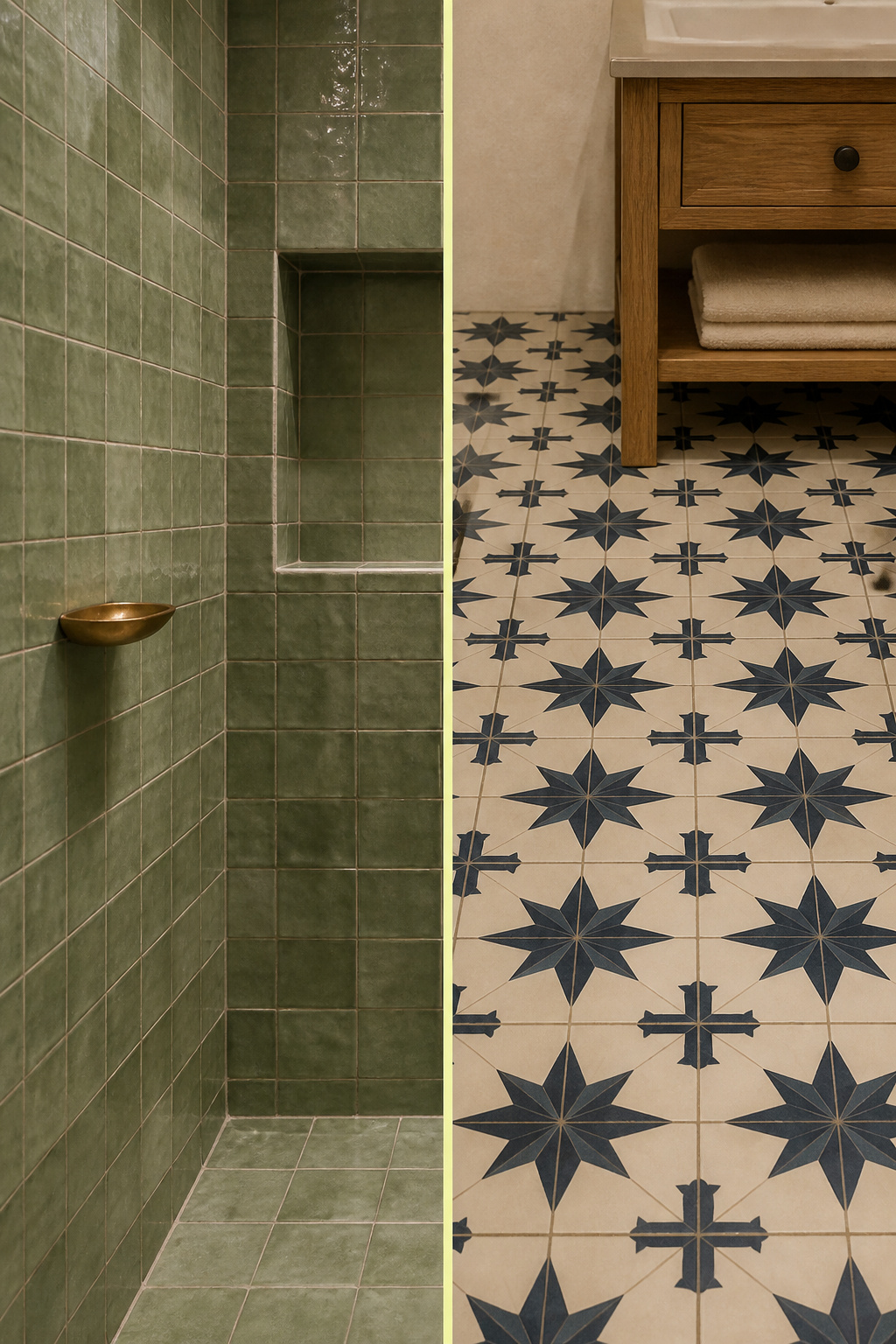
A bold patterned floor works when vertical surfaces stay quiet: plain plaster, white or cream tile, a single-colour zellige. In a small bathroom, pattern underfoot draws the eye down and out, which often beats a patterned wall. It goes wrong only when bold floor, bold wall and busy textiles compete at once.
Feature wall or niche: the restraint approach
One tiled wall behind the vanity, or a tiled niche, gives the focal point without the maintenance of an all-over installation. Studio Cement Tile calls a tiled niche a “high impact, low square footage” feature — the economy that suits an expensive material and makes sense for a rental or mid-budget room.
Mixing patterned tile with plain — the breathing room principle
Keep at least 50 to 60 percent of tiled surfaces plain when the patterned tile carries a complex repeat — editorial consensus, not a codified rule. Crisp white or cream walls with a patterned cement floor is the most common restrained-boho result. Echo a tone from the patterned tile in the plain tile’s grout rather than a decorative border, which reads as fussy.
Grout Colour Choices: The Decision Most People Get Wrong
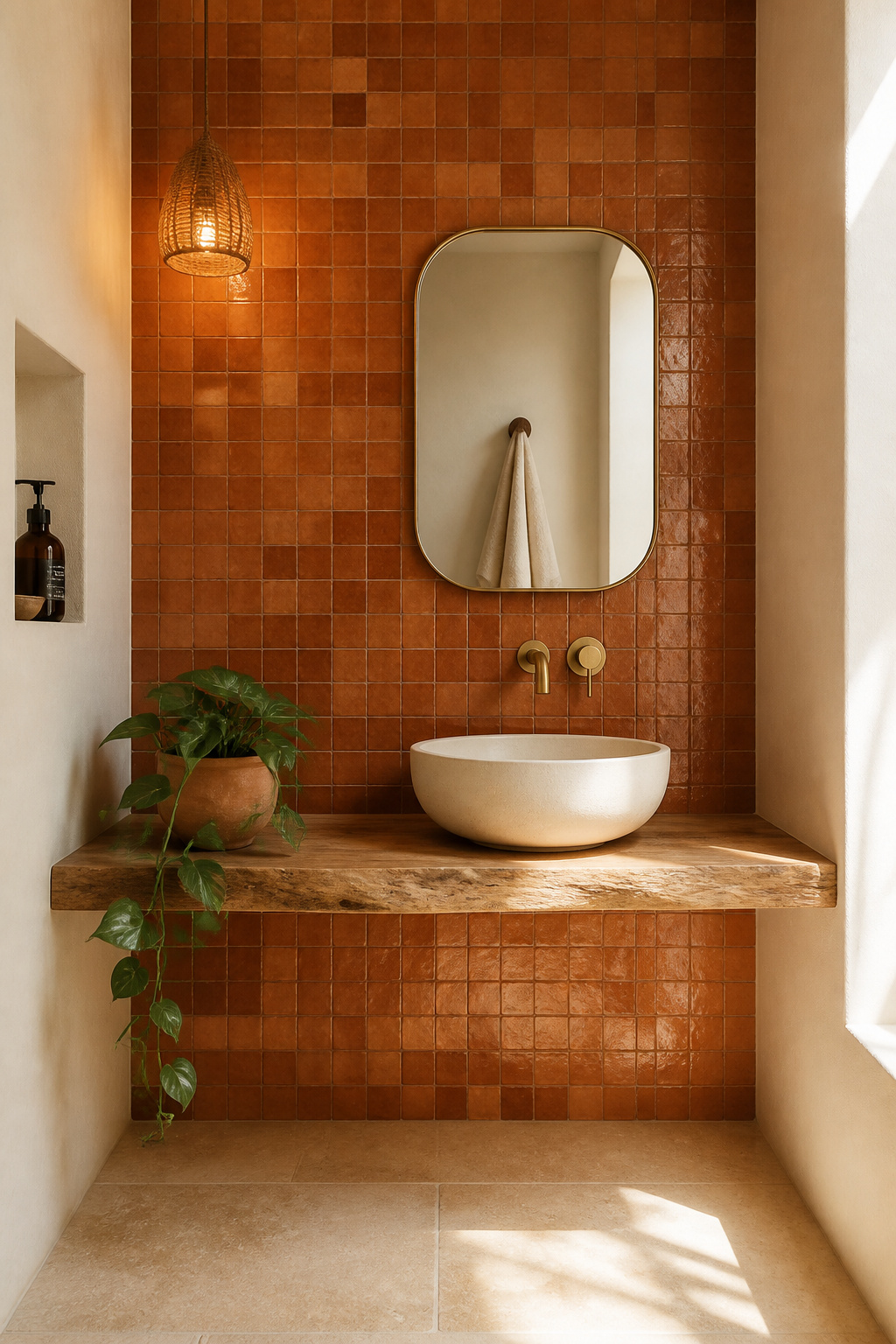
Grout is the decision made late, when attention is elsewhere, and it alters the scale and palette of the whole surface more than almost anything — “the decision most designers wish they’d spent more time on,” as Pfeiffer Design put it. The principles worth slowing down for:
- Match for continuity, contrast for grid. Matching grout makes a zellige wall read as one continuous surface; contrast — white against navy cement tile — emphasises the grid and brings the geometry forward.
- Coloured grout on zellige pulls toward drama. A charcoal or espresso grout sets each warm tile like a jewel in a dark frame, suited to a room that carries dark textiles and brass.
- White grout on cement tile maximises pattern. Full clarity and an airy feel — at the cost of showing mineral staining first in hard-water areas.
- Sand grout or unsanded, by joint width. Sanded grout suits joints over 1/8 inch; zellige’s 1/16-to-1/8-inch joints need unsanded polymer-modified grout, because sanded grout will not compact in a narrow joint and its grit scratches the glaze.
- Seal coloured grout, test on a real sample. A penetrating sealer after curing and annually holds off staining — and never trust a catalogue chip, because even a slight hue gap reads as contrast on the wall.
A mid-tone sand or greige grout is the most forgiving in daily wet-room use, and kinder to hard water than either extreme. The grout decision sits inside the room’s wider colour scheme, so it is worth matching tile to your palette before the trowel comes out.
Sealing, Durability and Wet-Room Realities
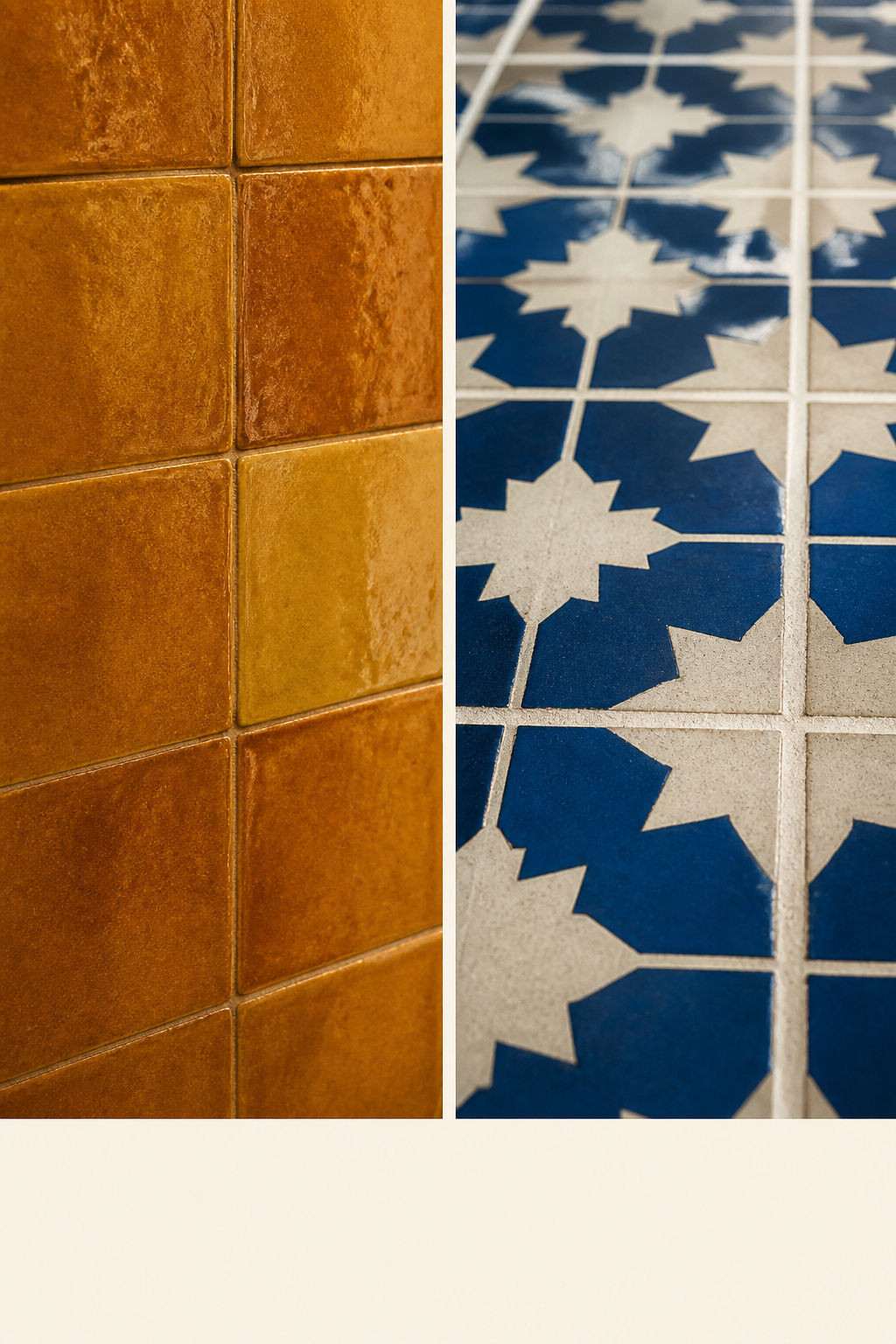
The golden rule, from Studio Cement Tile: “tile and grout are not the waterproof layer. Your shower must be waterproofed behind the tile with a complete system. This is where most shower failures happen — and why people unfairly blame the tile.” A liquid-applied or sheet membrane goes on the whole substrate before any tile.
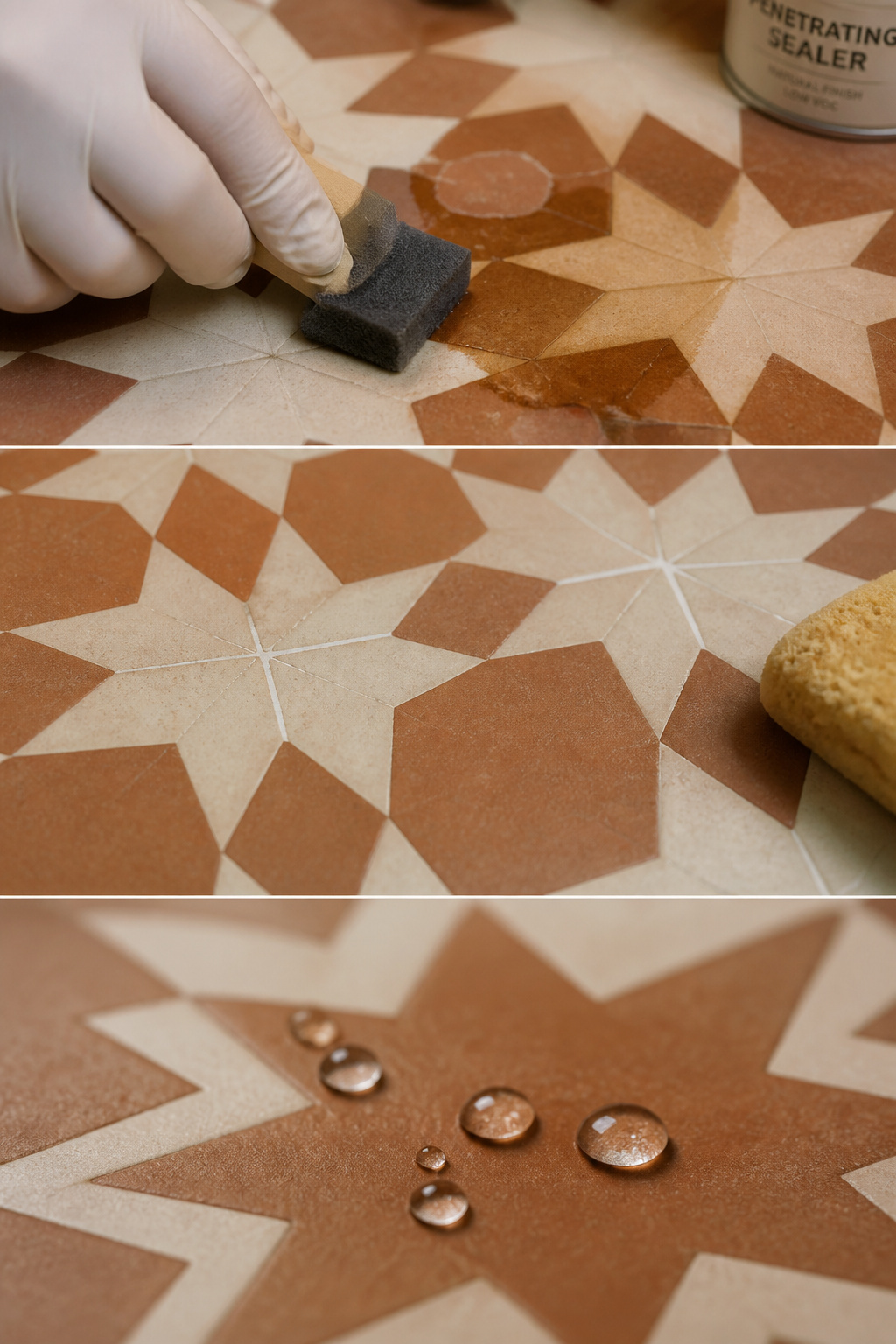
Why cement tile must be sealed before and after grouting
Cement tile is porous, so the sealing sequence is not optional — and the pre-grout seal is the most-skipped step, the one that permanently stains the tile face. Work it in order:
- Prepare the surface. Clean off all dust, grit and oil and let the tile dry fully — contamination in the pores seals in permanently.
- Apply the first seal. Brush penetrating impregnating sealer on before grouting to stop pigment staining the tile face; wait 24 hours.
- Grout the tile. Dampen the surface lightly, work grout into the joints with a float, and wipe excess immediately — porosity sets haze fast.
- Let the grout cure. Hold off 48–72 hours (the standard is 72), with no water on the surface.
- Apply the second seal. Coat the whole surface, grout included; let it absorb 5–15 minutes, then wipe all excess before it dries to a haze.
- Hold off traffic. Keep traffic off at least 24 hours, 48 for wet areas; full cure takes up to 72.
- Reseal on schedule. Every 6–12 months for an active shower, 1–2 years for a guest bathroom — if poured water absorbs rather than beads, reseal.
Always use a penetrating impregnating sealer, never a topical film-forming one, which peels in wet areas.
Zellige’s glaze and where it is and isn’t water-resistant
Zellige’s fired glaze makes the tile face water-resistant with no sealing — its real advantage over cement — but the porous grout lines must still be sealed. The glaze that protects a wall is the same glaze that creates a floor hazard: at a wet DCOF of about 0.16, zellige falls well below the 0.42 minimum required for wet interior floors. Keep zellige to walls, niches and dry bathroom floors only — not shower floors, where the slip risk is genuine and not resolved by format change alone.
Ongoing maintenance: what these tiles ask of their owner
Zellige asks little — mild soap, soft cloth, no abrasives or bleach. Cement tile asks more: pH-neutral cleaners only, because vinegar and citrus etch it permanently. Both reward the committed owner with decades of improving character — caring for a material so it outlasts the current owner is part of what makes it boho rather than merely fashionable.
Fixtures That Finish the Surfaces
Once the tile is specified, the metal either completes the material story or argues with it.
Metal tones that work with zellige and cement (brass, copper, matte black)
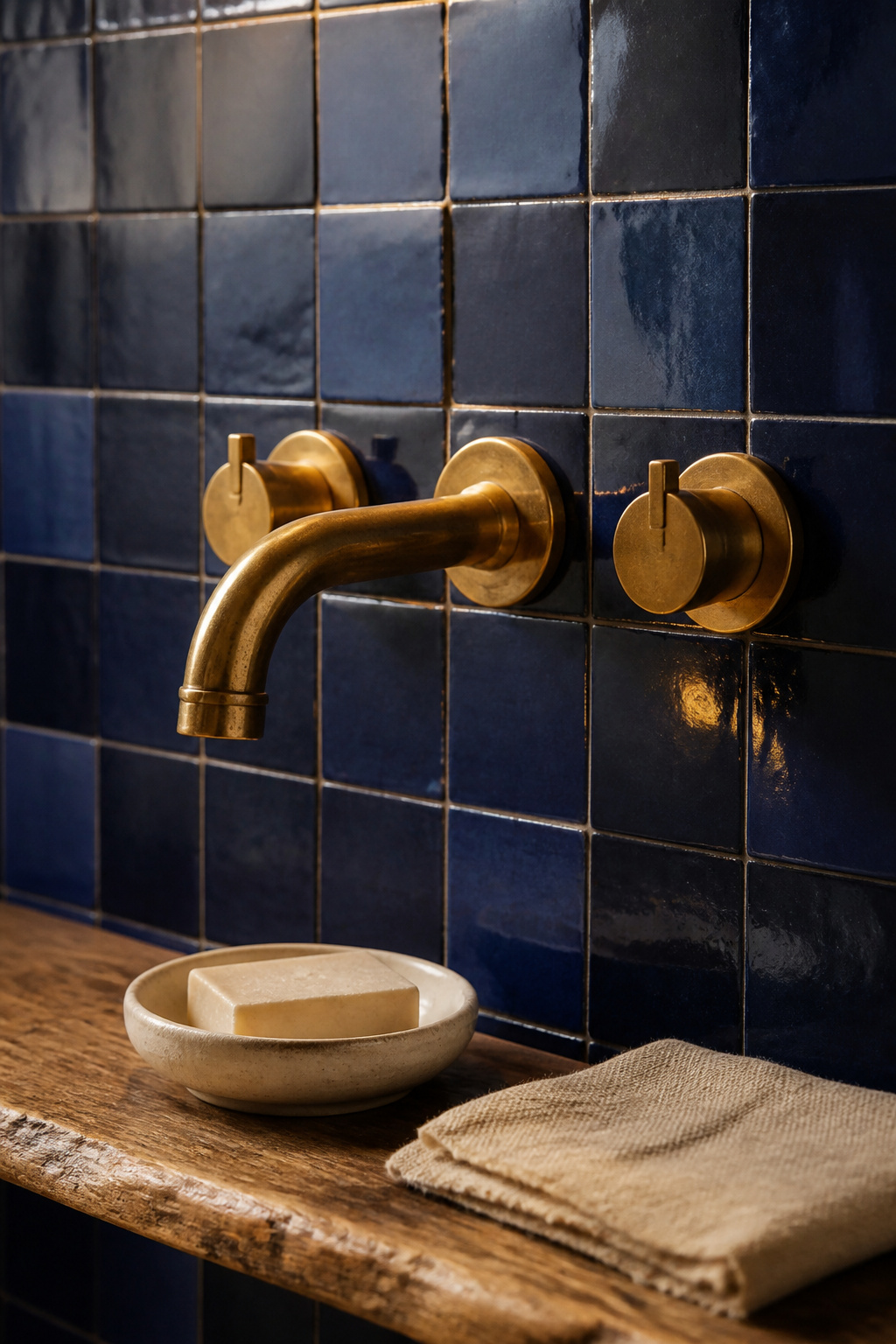
Brass is the most consistently recommended companion for zellige — its warm gold echoes the ochre and amber of the glaze, and its patina mirrors the tile’s habit of changing over time. Copper goes warmer still, at home with terracotta tones; matte black anchors either without competing. Chrome and brushed nickel are consistently absent from professional pairings — their cool undertone reads against warm mineral glazes.
Why the fixture choice either completes or fights the tile
A warm zellige wall with chrome taps sends two messages — the tile says craft, the fixture says industrial — and reads as a mistake rather than eclectic. The canonical boho completers are unfinished wood, linen, brass or matte black.
Rachel’s material-harmony principle
Pair provenance with provenance. Unlacquered brass that will patina, copper that will age — these share the tile’s register, where chrome breaks it, so choose tile and fixtures in one sitting. The same logic carries into the metals, mirrors and warm lighting that finish the room — the fixtures that finish the surfaces deserve the same provenance-first eye.
Two principles hold. Match material to place — zellige on walls and niches, patterned cement on floors, because zellige is a wall tile, not a shower floor. And the tile is never the waterproof layer: membrane, grout and sealer are one specification. Get those right and a handmade-tile bathroom does not date; it improves, which is the most boho thing a surface can do.
FAQ
Is zellige tile good for bathrooms?
Yes — zellige’s kiln-fired glass glaze makes the tile face water-resistant without sealing, and shower walls are among its most popular applications, where wet surfaces amplify its gloss and colour variation. The limitation is floors: at a wet DCOF near 0.16, well below the 0.42 minimum for wet floor areas, zellige is a wall and niche tile. Keep it off shower floors; patterned cement tile in a small format is the right choice underfoot.
How do you clean patterned cement tile in a bathroom?
Use only pH-neutral cleaners — mild dish soap, warm water and a soft cloth. Never use vinegar, citrus, bleach or any acid product, which permanently etch the unglazed surface. In showers, squeegee the walls and wipe soap and oil from niches quickly. When the tile begins absorbing water rather than beading it, reseal — every 6–12 months in an active shower.
Does zellige tile need to be sealed in a shower?
The glazed tile face does not — its kiln-fired enamel is non-porous — but the porous cement grout lines must be sealed with a penetrating impregnating sealer after installation. The more critical step is waterproofing the substrate behind the tile beforehand with a membrane, including corners and penetrations, because tile alone does not keep water out of a wall.