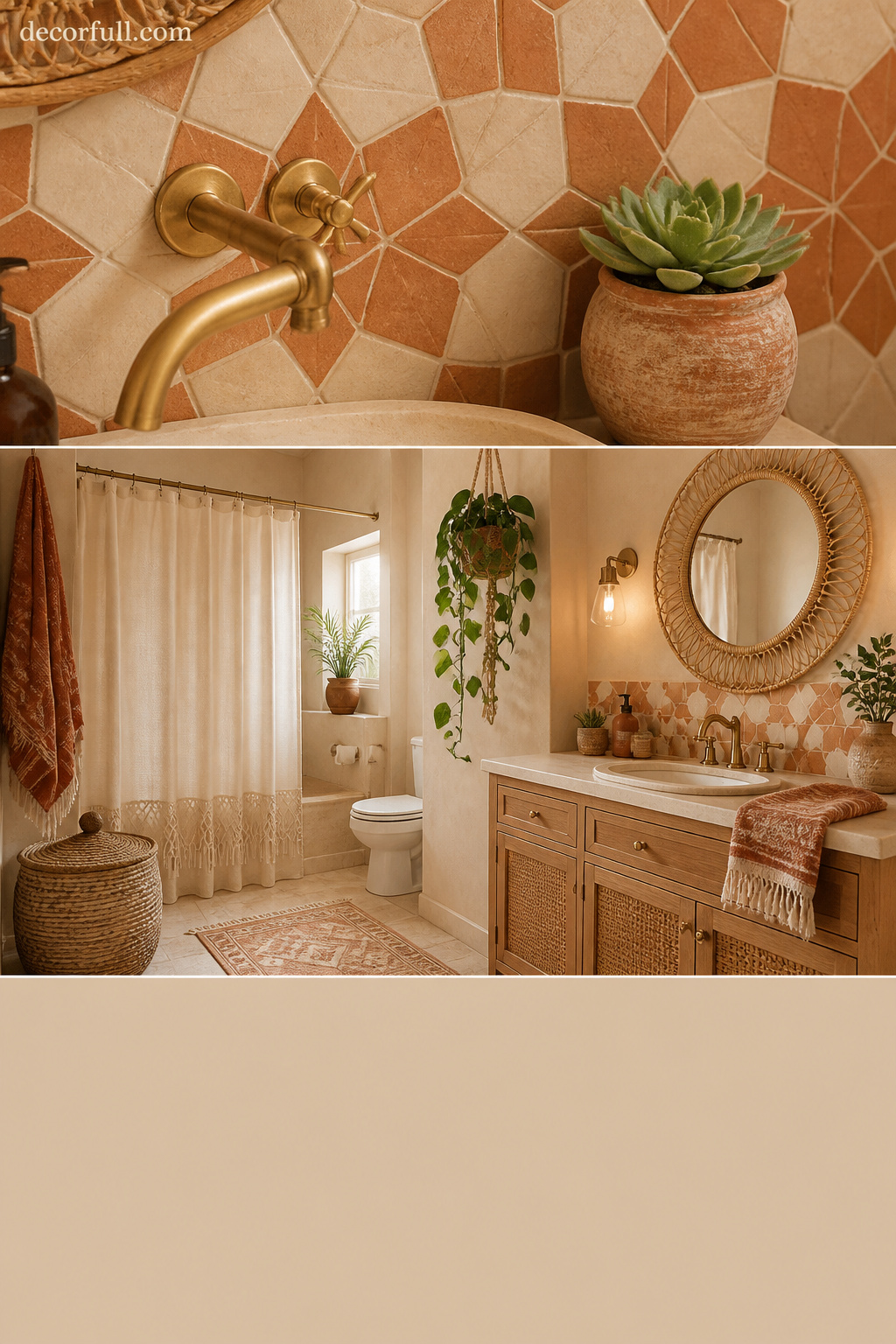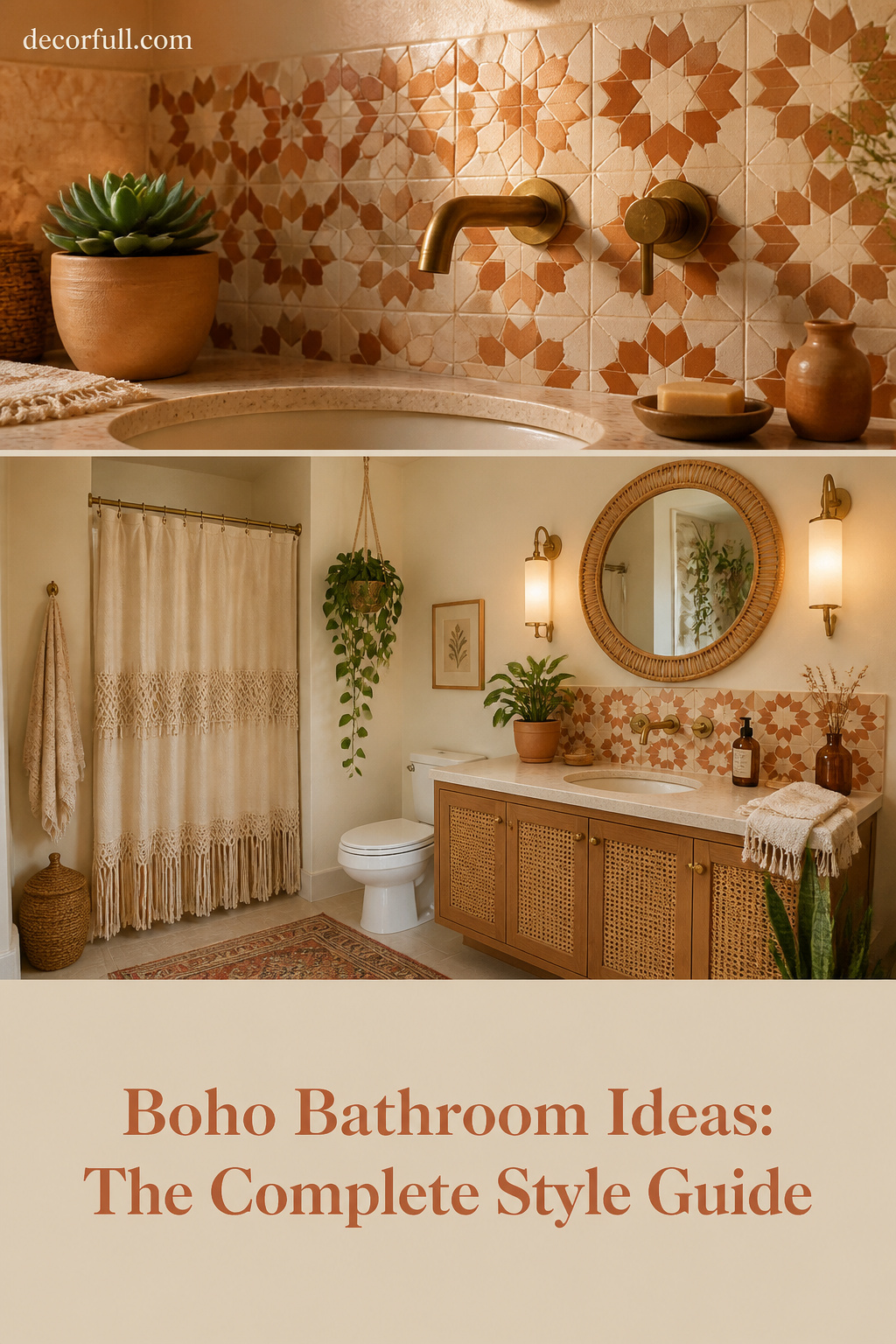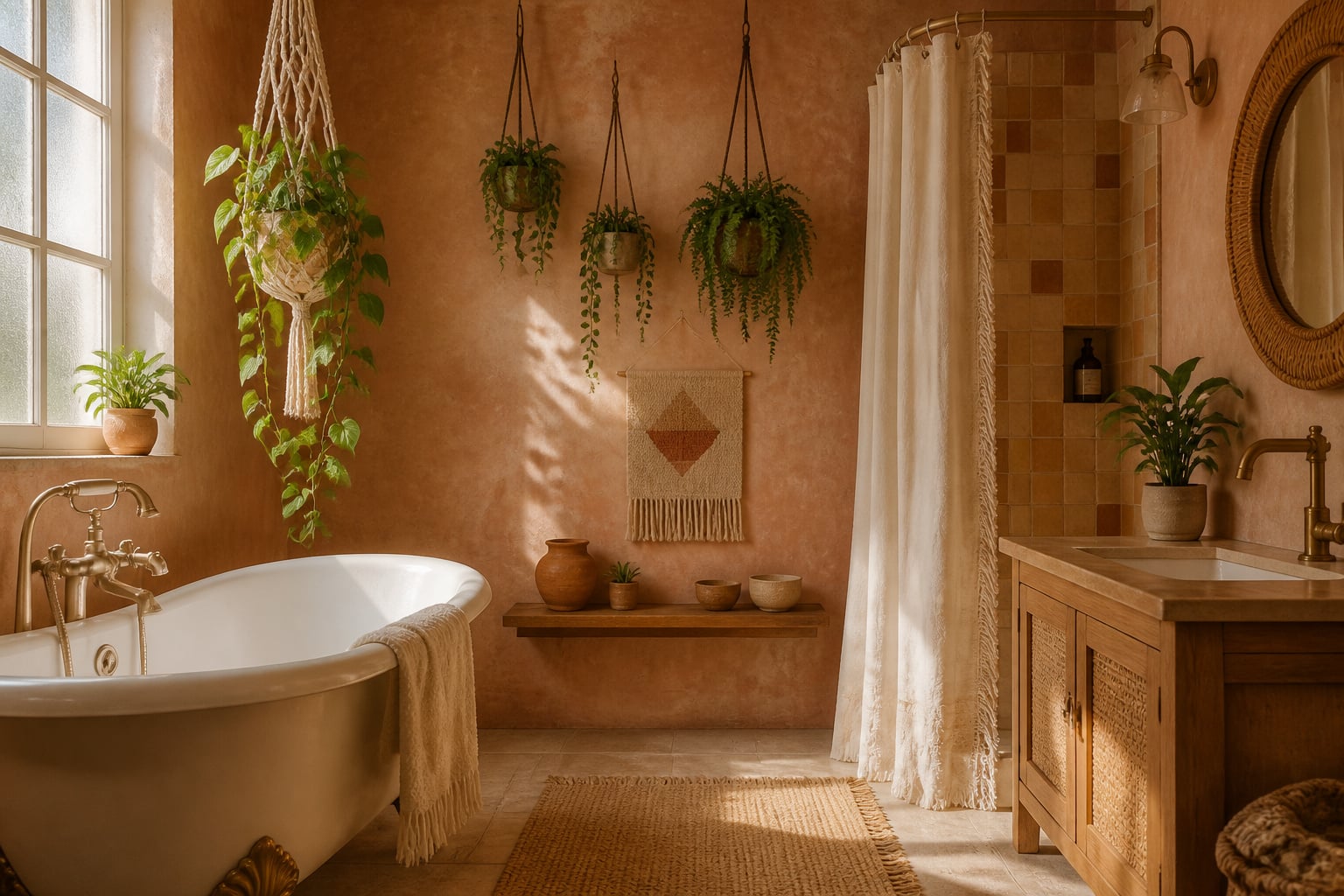
Late morning, the light comes in soft through the frosted glass and lands warm on clay-coloured walls. Underfoot there is a woven rug instead of cold tile. A pothos trails from the corner, and the brass tap has gone the soft gold of something that has been touched for years. The air holds a little of the plant and a little of the steam from the last shower. Nothing in the room is shouting. Everything in it is breathing.
That is the feeling a boho bathroom is really after — not a look you assemble for a photo, but a room that lowers your shoulders the moment you step in. These boho bathroom ideas all serve that single experience, and once you understand the experience you stop chasing objects and start building a place. This guide walks the whole room: the earthy palette that anchors it, the plants that bring it alive, the tile and textiles that layer it, the warm light that finishes it, and how to do all of it small, on a budget, or by hand. Each lever gets its survey here and its full treatment in its own guide, so you can read the room as a whole first, then go deep where you need to.
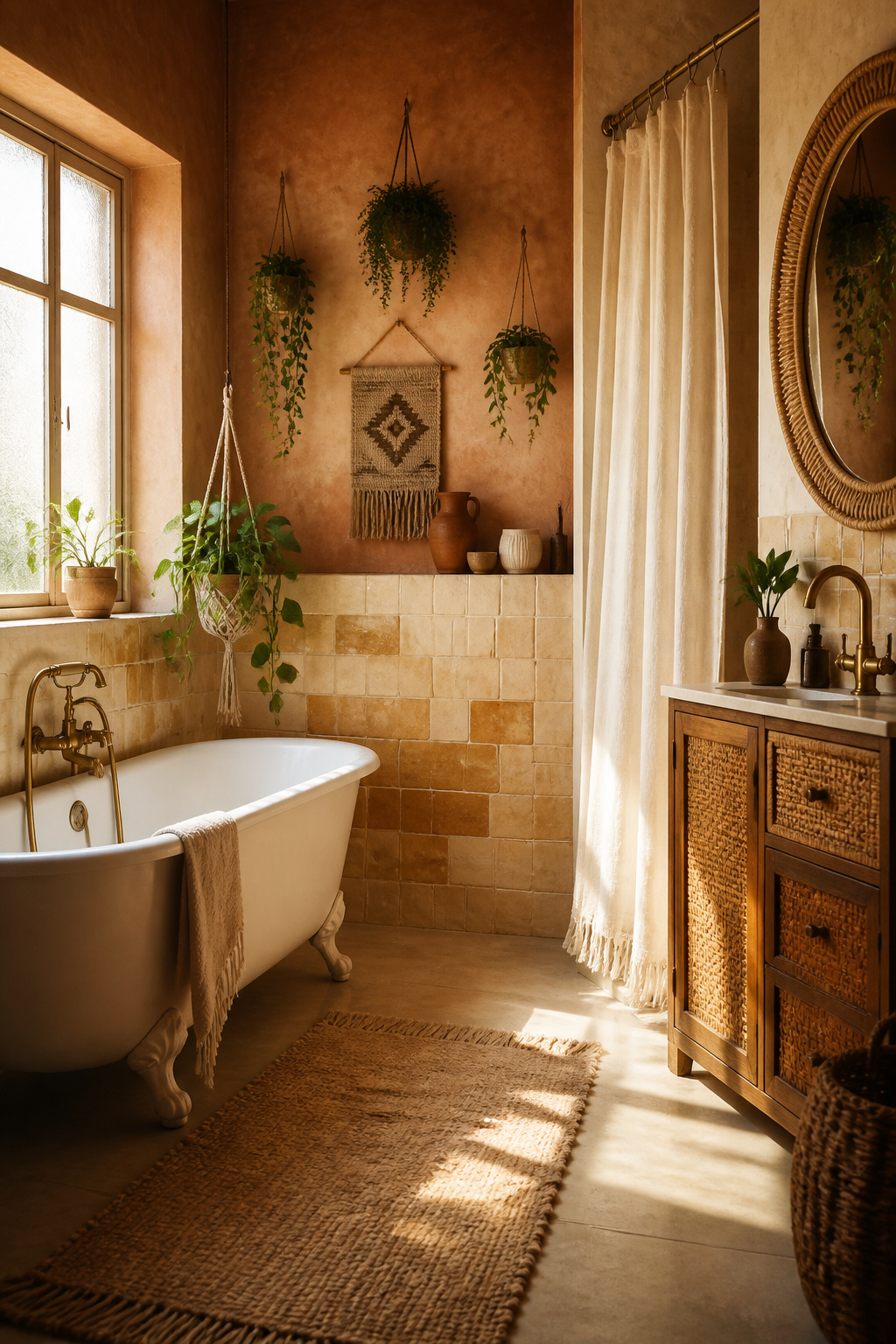
What Makes a Bathroom Truly Boho
Bohemianism did not begin as a decorating style. It began in early nineteenth-century Paris, in the Latin Quarter, where artists and writers chose creativity and self-expression over the comforts of convention. The boho room inherits that root: it values the personal and the made-by-hand over the manufactured and the matching. A boho bathroom is not eclectic for its own sake. It is a room that has been allowed to feel like it belongs to someone.
The feeling a boho bathroom is really after
Start with the feeling, not the shopping list. The promise of the style is a relaxed, spa-like retreat — calm, layered, natural, unmistakably yours. Benjamin Moore describes the boho aesthetic as “easygoing, casual and effortlessly cool,” driven by an explorer’s spirit. Hold that as the test every later decision has to pass: does this make the room calmer and more alive, or just more full? The design choices that follow — colour, texture, greenery, light — are all inputs to a nervous system, not entries in a catalogue. A room reads as boho when it feels collected over time, even if you assembled it last weekend.
The five levers that create the look
Design authorities keep returning to the same five structural levers, and it helps to name them before you touch anything. First, an earthy, nature-inspired palette. Second, natural and handmade materials — wood, rattan, jute, clay, zellige tile. Third, plants, treated as part of the room’s structure rather than its garnish. Fourth, layered textiles: rugs, fringed curtains, textured towels. Fifth, warm artisanal fixtures and light, usually in brass or copper. Each lever reinforces the others — the earthy palette tells the textiles which colours belong, the warm light animates the brass and the clay, the plants soften the hard tile. None of them carries the room alone, which is exactly why a single beautiful purchase so rarely makes a bathroom feel boho.
What boho is not: clearing up the maximalist myth
The most common misconception is that boho means more — that the goal is abundance. It is not. A boho bathroom drifts toward chaos almost on its own: add macramé, a vintage rug, patterned tile, brass objects, framed prints, and the room tips from layered into overwhelmed. The style is built on a foundation of restraint, on one or two statement pieces supported by calmer elements. The current direction in the look, through 2025 and 2026, is quality over quantity — real rattan, real handmade pottery, actual living plants over mass-produced boho props. The discipline is subtractive: before you add the next thing, look at what is already there and ask whether the room needs it. If you are unsure, leave it out and let the room tell you what it is missing.
The Boho Bathroom Color Palette: Earthy Tones That Anchor the Room
Colour is where the room is decided, because it tells everything else what it is allowed to be. The boho palette is a layering system, not a single hue: warm earthy tones grounded by neutrals and lifted with cream so the room stays airy. Buildable Home’s designers describe three working categories — base neutrals (beige, ivory, sand, off-white), warm accents (terracotta, mustard, burnt orange, cinnamon), and natural greens and earthy tones (sage, olive, clay). The skill is in the proportions, not in any one colour.
Terracotta, clay and warm greige as the base
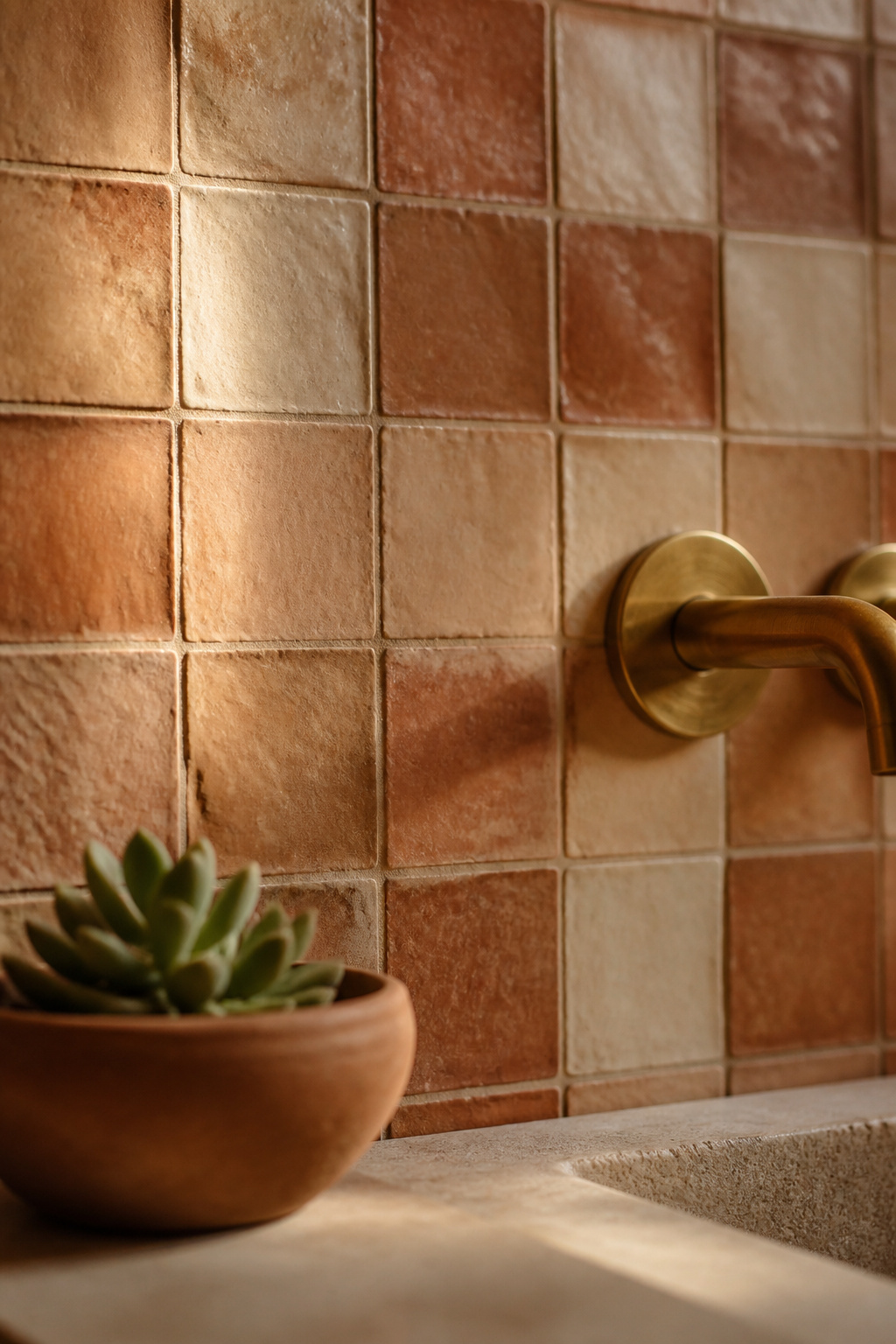
Terracotta and cream is the most cited boho combination for a reason: the clay-like warmth grounds the room while the cream keeps it from going heavy, and together they carry a Mediterranean, desert-adobe feeling that matches the style’s roots. Sherwin-Williams Cavern Clay (SW 7701), their 2019 Colour of the Year, is the benchmark terracotta — a muted red-orange clay with an LRV of 20, best kept to a single feature wall. Where a windowless room would swallow that depth, Redend Point (SW 7695) is a lighter, more relaxed clay (LRV 30) that suits full walls. Warm greige then does the quiet work between them, holding the whole palette together so nothing feels marooned.
Olive and cream: keeping the palette airy
The cooler counterpart to the terracotta-cream base is olive and camel — a deeply organic pairing that reads like a sun-warmed farmhouse rather than a trend. Sherwin-Williams Dried Thyme (SW 6186), a muted gray-green olive, is the grounded, sophisticated note for a vanity or wainscot; Olive Grove (SW 6148) carries more yellow where you want the warmth instead of the cool. Cream and warm white are the breath in the palette — the ceiling, the bulk of the tile field, the walls left quiet so a single coloured wall can speak. Without them the earthy tones close in. With them the room stays open.
Where to put colour and where to stay neutral
The framework is simple once the colours are chosen: base neutrals cover most of the surface, one warm accent tone lands on a single feature wall or in the tile, and the natural greens enter through textiles, plants and small ceramics rather than paint. Grout is part of this decision, not separate from it — a warm greige grout on cream zellige lets the tile read as one textured plane, where a high-contrast grout would fragment it into a grid. The table below sets out where each tone earns its place; treat it as a starting map rather than a rule, since the right balance depends on your light. For the full logic of warm-versus-airy and the proportions that keep a palette from going muddy, work through building your boho bathroom color palette.
| Tone | Where to use it | Paint / finish example |
|---|---|---|
| Terracotta / clay | Single accent wall (behind vanity or bath); floor tile; ceramic accessories | Sherwin-Williams Cavern Clay SW 7701 (LRV 20) or Redend Point SW 7695 (LRV 30) |
| Warm greige | Main walls; plaster finish; grout on cream zellige | Sherwin-Williams Accessible Beige SW 7036 |
| Olive / sage | Vanity cabinet; accent wall; wainscoting; carried into towels and plants | Sherwin-Williams Dried Thyme SW 6186 or Olive Grove SW 6148 |
| Cream / warm white | Ceiling; majority of the tile field; main walls when terracotta is on the accent wall | Benjamin Moore Chantilly Lace OC-65 (matte Aura Bath & Spa for humid rooms) |
| Camel / mustard | Textiles, ceramics and rattan accents; used sparingly as the warmth note | Benjamin Moore Dorset Gold HC-8 (feature wall or cabinetry only) |
In a humid room, the finish matters as much as the colour: Benjamin Moore recommends its Aura Bath & Spa formula, a humidity-rated matte that resists mildew while staying anti-shiny, which is precisely the boho instinct.
Plants That Complete the Boho Bathroom Feel
Greenery is not the accessory you add at the end. It is one of the five structural levers, and it does something no object can — it moves, it grows, it introduces a randomness no purchased piece can fake. Plants soften hard tile and ceramic, draw the eye up and across, and quietly manage the room’s own humidity, which in turn reduces how often you need to water them. A bathroom is one of the few rooms in a house that actively wants plants.
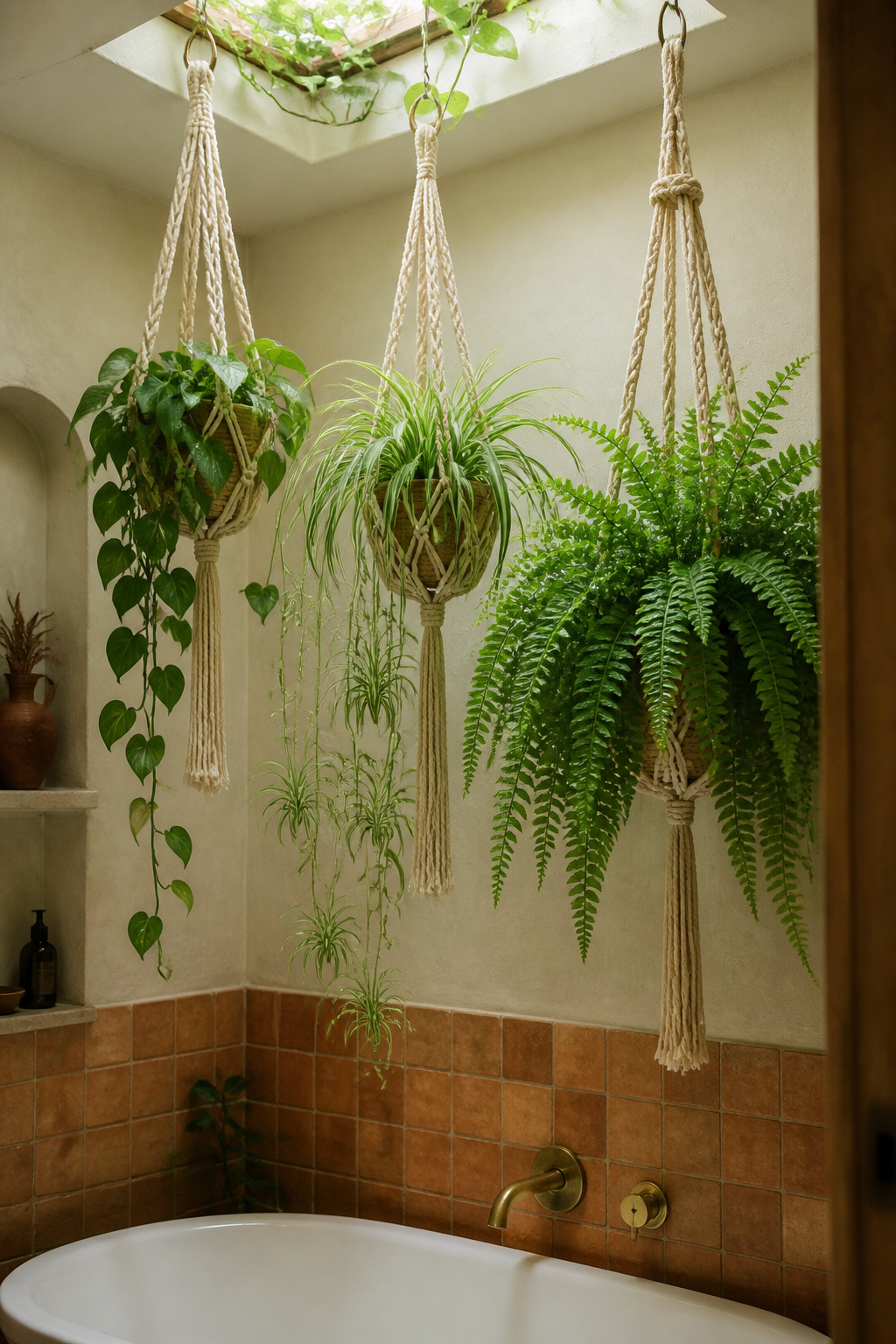
The challenge is matching the plant to the conditions — steam, often low light, irregular watering — rather than to a photograph. A short, reliable shortlist for a steamy, low-light room:
- Pothos — extremely forgiving of low light and missed waterings, and the classic trailer for a macramé hanger or a high shelf.
- Peace lily — thrives in high humidity, tolerates low light and cooler temperatures, and offers glossy leaves with white blooms.
- Boston fern — loves bright indirect light and high humidity, giving a full burst of lush green where it can get both.
- Spider plant — bathroom moisture is near-ideal for it, and its arching, cascading offsets read beautifully from a hanger.
- Golden pothos (devil’s ivy) — heart-shaped variegated leaves that trail with the slightly wild look the boho display is after.
How you show them is half the work. Three macramé hangers at graduated heights create the layered vertical interest that reads as deliberately boho rather than simply “plants in a bathroom” — and macramé itself counts twice, as both a hanging system and a woven textile element. A cluster of three at varying heights, a tall floor plant, a mid-shelf plant and a trailing hanger, makes a green corner that looks intentional. One caution worth carrying through the room: keep genuine natural fibres away from splash areas. A jute pot cover or rug that gets splashed will absorb moisture and grow mould — the safe move is unglazed ceramic or a sealed terracotta pot, a rule that returns when we reach textiles. For species-by-species care, light fixes for a windowless room and the styling in detail, see the best boho bathroom plants for humidity.
Textiles That Layer the Look: Rugs, Towels and Curtains
Textiles are the layer that most immediately signals boho, and the most accessible — nothing here needs installing, which makes it the renter’s and the budget decorator’s easiest entry. The thing to understand is that it is the layering of different textures, not any single piece, that reads as the style. A woven rug, a fringed shower curtain and textured towels in the palette colours do together what none of them does alone.
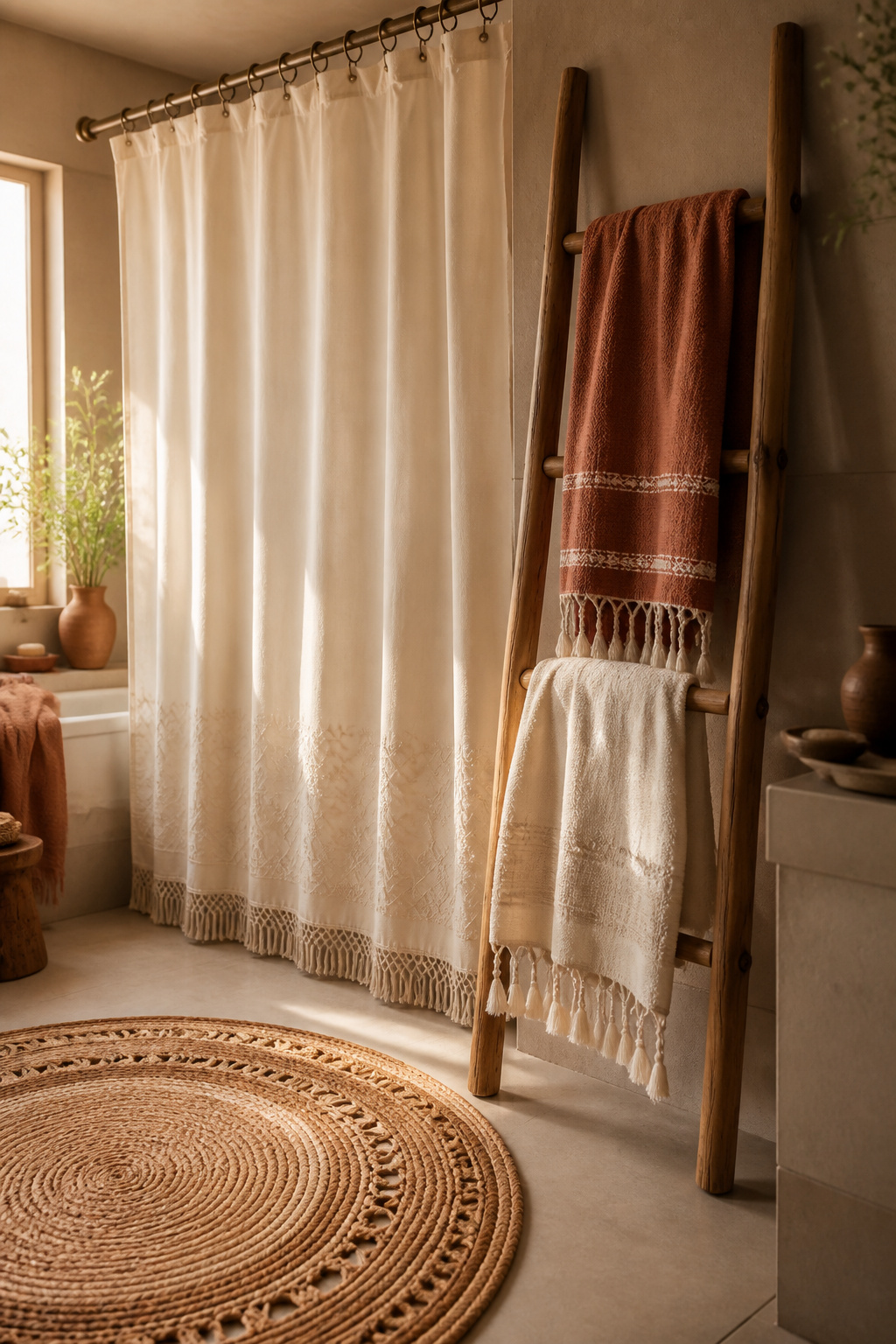
Underfoot, a round woven rug introduces movement into a room of hard rectangles. But choose the fibre with care: genuine jute looks the part and then fails fast, absorbing moisture from the air alone and warping or growing mould within weeks. A natural-look rug woven from polypropylene reads identically to the eye and survives the room — the look without the regret. The shower curtain is the largest textile and the first thing seen from the doorway, so treat it as a focal point rather than a background, in cotton or linen with fringe, tassels or macramé detail, with a separate liner behind to do the waterproofing. Towels then hold the palette: terracotta, mustard, olive, cream and greige rather than stark white, in textures like fringed Turkish cotton that dry fast in a humid room and drape softly over a ladder. The full selection logic — which fibres survive, how to layer two rugs, how the curtain and towels stack into something collected — is in layering boho bathroom textiles.
Tile, Pattern and Hard Surfaces: Where the Boho Character Lives
If textiles are the easiest layer, hard surfaces are the most permanent — the investment layer where the room’s character is set for years. Zellige and patterned cement tile define the boho surface because their irregularity is the point. Zellige is made from unrefined clay by traditional Moroccan hand methods, and each tile varies in tone, flatness, thickness and shine; that variation is what gives a wall its living quality, the way each tile catches light a little differently. It cannot be factory-replicated perfectly, and the imperfection is the beauty.
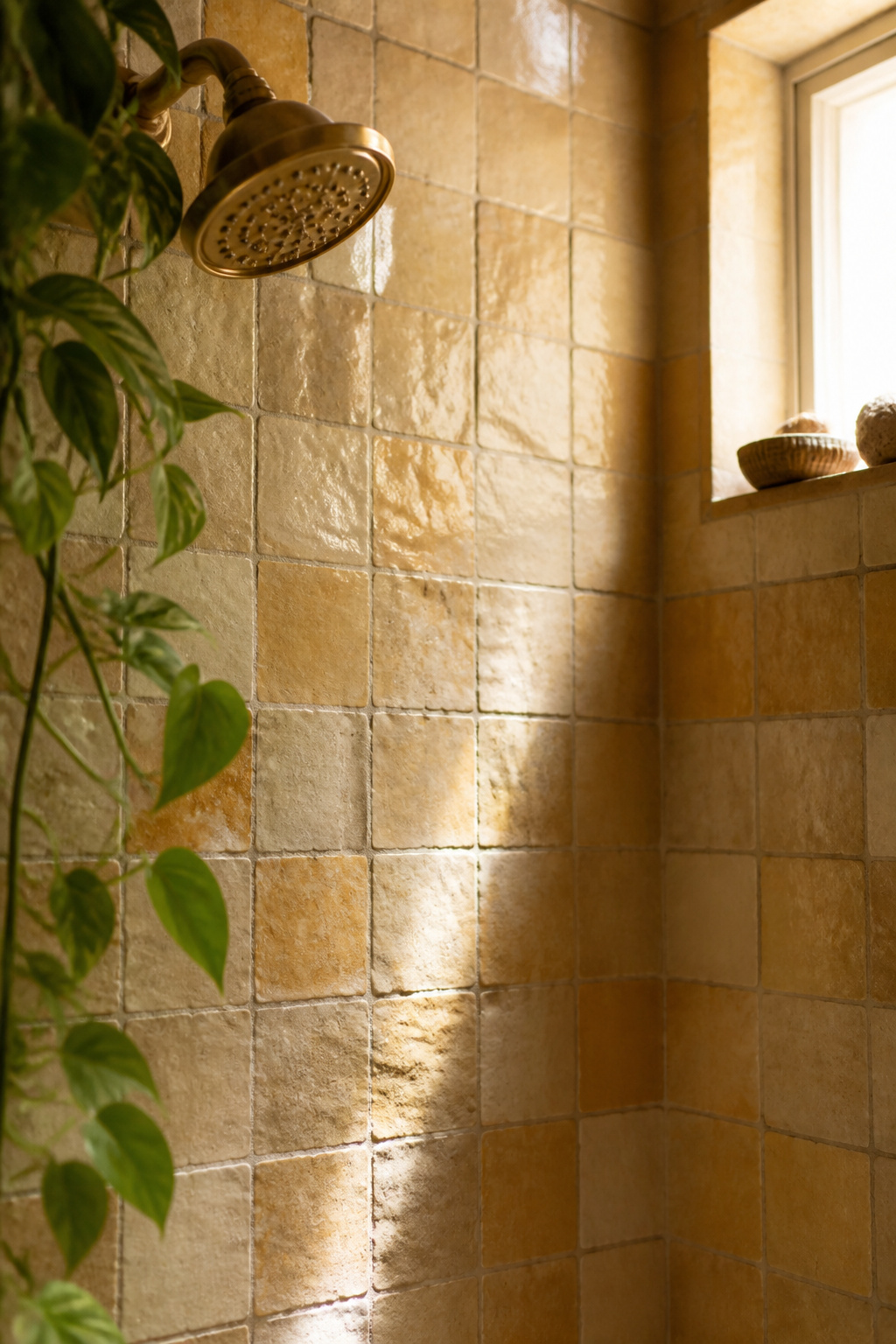
The strategy for using it is restraint: one bold surface, plain or tonal tile everywhere else. Run pattern across all four walls and the room competes with itself; confine it to a shower wall or the wall behind the vanity and the pattern reads clearly against a quiet backdrop. Grout finishes the decision — matched or one shade lighter than the tile so the surface stays one cohesive plane, never a high-contrast grid that fragments handmade tile into noise. Material, pattern restraint and grout are choices best made together, and they carry real installation and durability consequences worth understanding before you commit. The depth on zellige versus cement, where each performs and the practicalities of setting irregular handmade tile in a wet room are covered in zellige and patterned boho bathroom tile — including which tiles belong on a wall rather than a shower floor.
Fixtures and Lighting: Brass, Rattan and Warm Glow
This is the layer that delivers the warmth signature, and it works at a different scale to tile and textiles — a single well-chosen mirror or pendant can pull the whole room’s story together. The defining metal is warm: brass or copper over chrome, and unlacquered brass that develops a patina over time over polished showroom shine. Chrome’s cool reflective surface cuts against an earthy palette; brass belongs to it. Taps, a vanity sconce, a mirror frame in aged brass all add the worldly, vintage quality the style is after.
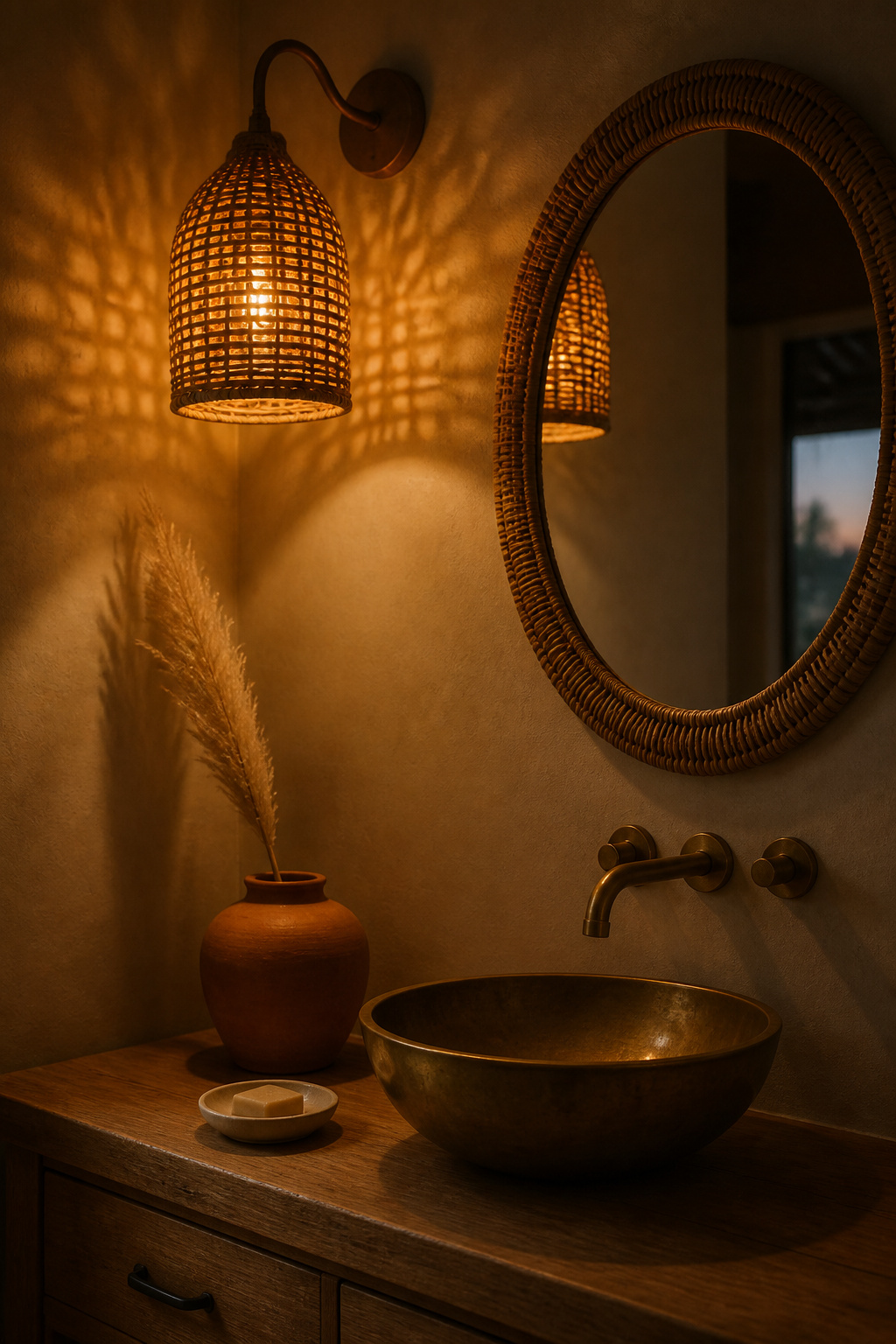
Light is the other half. Rattan and woven shades diffuse a lamp into a soft, dappled glow rather than a hard directional beam — the quality of light a spa-like room depends on — and the natural material bridges the hard tile and the soft textiles. Two things make or break it: warmth and layers. Keep the colour temperature to 2700–3000K warm white; above 3500K, cool daylight bulbs grey out the very materials the room is built on, draining terracotta tile, honey rattan and aged brass of their appeal. And use at least two independent sources — an ambient pendant plus task light at the vanity, ideally on a dimmer — rather than a single overhead that flattens every shadow. Rattan and woven shades carry their own placement rules near water, so for fixture selection, the vintage-mirror approach and the full layered-light setup, see brass, rattan and vintage fixtures and lighting.
Getting the Boho Look in a Small Bathroom
A small bathroom is a real test for a style built on layered abundance — the risk is tipping from cosy into cramped. The answer is not less style; it is more discipline. The constraint does the editing the look has always quietly needed, and a handful of scale-aware moves let a tight room carry full boho character. The tactics that do the most work in a compact space:
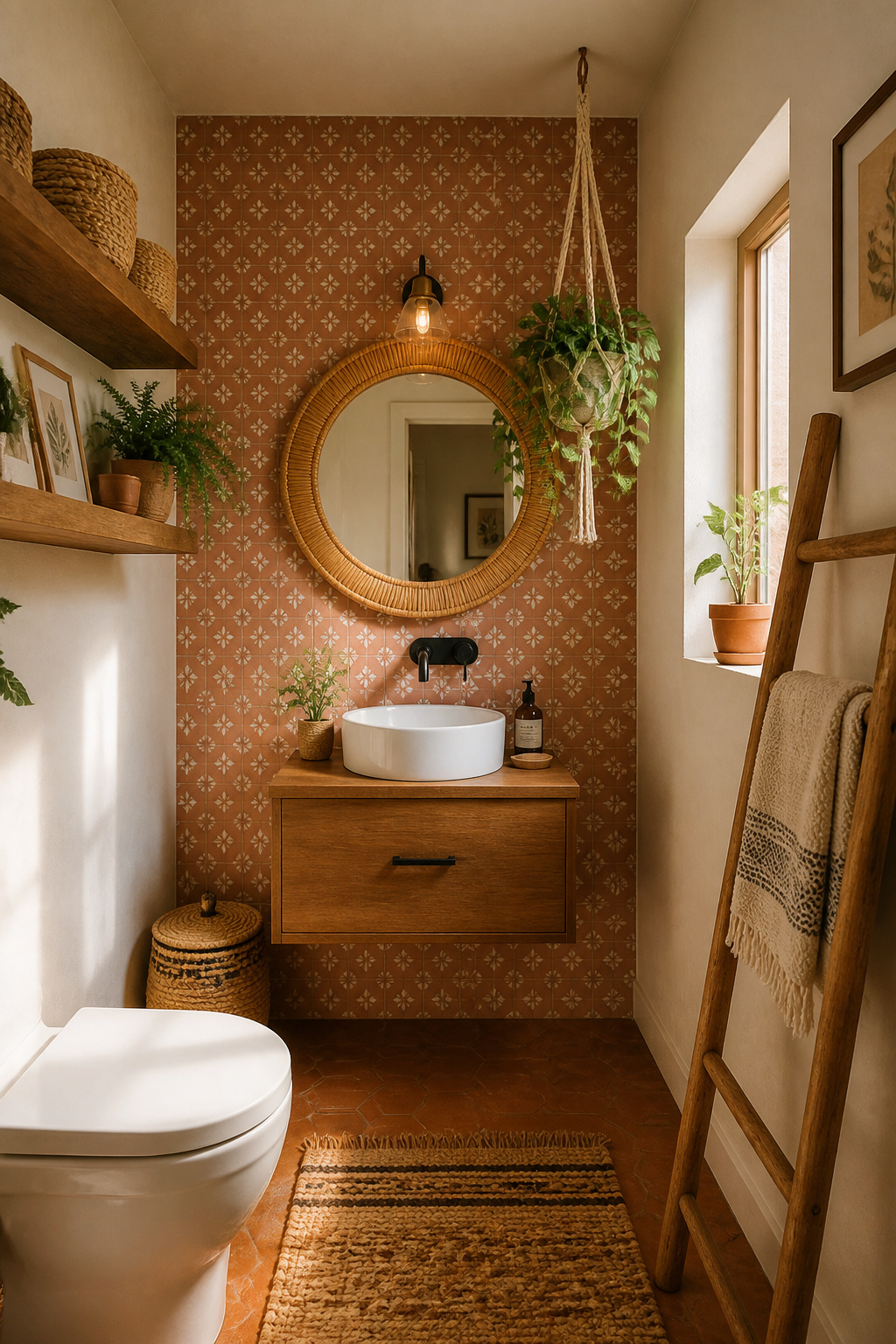
- Limit bold pattern to one surface — a single feature wall behind the vanity or bath, never all four, so the pattern reads instead of shrinking the room.
- Draw the eye upward with vertical stripes, tall narrow tile or a ceiling-hung trailing plant to make a standard ceiling feel taller.
- Use a large round or arched mirror opposite the light to reflect it and add the illusion of depth, doing two jobs at once.
- Choose a wall-mounted vanity so the floor stays visible beneath it and the room feels larger than its footprint.
- Repeat three textures rather than diversify ten — rattan, one woven textile, terracotta, a trailing plant — so the room reads as intentional cohesion.
In a small room, texture does more spatial work than colour, and natural materials make a space feel larger and more inviting on their own. Build upward, not outward: floating shelves and a leaning ladder use vertical space that floor furniture would eat. The full layout-and-scale playbook — including windowless rooms and rental-friendly tactics — is in getting the look in a small boho bathroom.
Boho on a Budget and by Hand
Boho is one of the most forgiving styles for a tight budget, because the look lives in accessory layering rather than renovation. A full transformation — a patterned shower curtain, a rug or two, a rattan mirror, a couple of plants, a macramé hanger, some ceramics — is realistic for under $275 buying new, and can come in under $150 with thrift sourcing and propagated cuttings. The principle that keeps a budget room from looking cheap is the same one that governs everything else: a few genuine or handmade pieces beat a pile of mass-produced props.
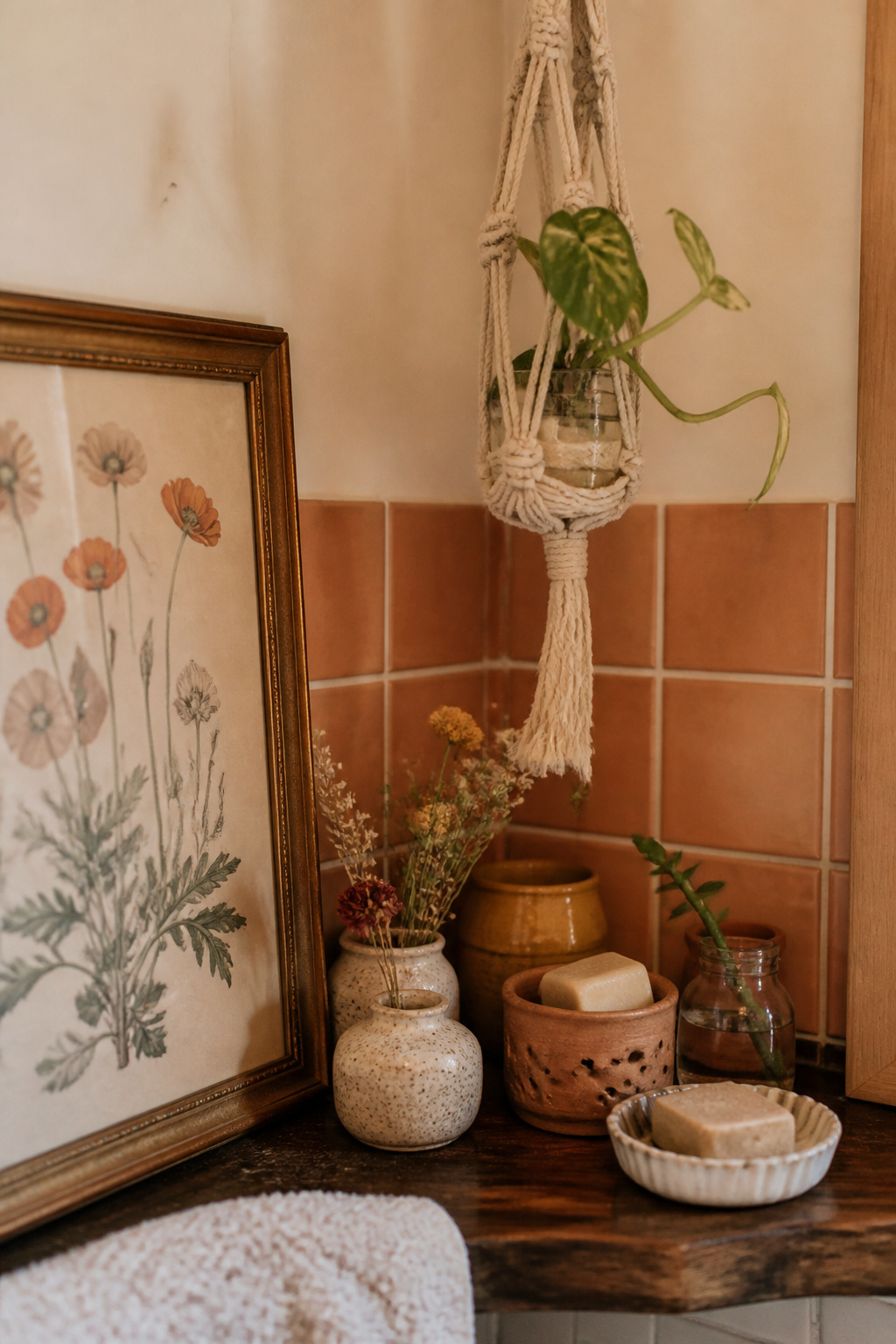
Renting changes nothing essential. Rattan mirrors hang from existing nails or removable hooks, macramé hangers use ceiling hooks, and peel-and-stick tile panels in terracotta patterns remove cleanly — the mirror, plant and pattern layers all achievable without a mark on the wall. Thrift stores quietly supply the soul of the look: glass jars for decanting, woven baskets, earthy ceramics, old frames for botanical prints. And some of the most boho pieces are the ones you make, because handmade provenance is the whole point — a macramé plant hanger is a beginner’s afternoon and adds a textile layer, a plant display and a story at once. For where the money should and shouldn’t go and the rental-friendly specifics, see creating a boho bathroom on a budget; for the projects themselves, step by step, see DIY boho bathroom decor projects.
Putting It All Together: How Boho Bathroom Ideas Come Together
The five levers are easier to use when you know the order to apply them. Start with the palette — settle the terracotta, greige, olive and cream that will govern every later choice — because shopping for accessories before the colours are decided is how you end up with a roomful of individually appealing boho things that don’t add up to a boho room. Then the hard surfaces, chosen with both the palette and the eventual textiles in mind, since cream zellige looks very different beside ivory linen than beside dark towels. Then the soft layers, which need no installation. Then the greenery, which can begin with a single hanger. Last, the light: change the bulbs to warm white, add a rattan pendant or a brass sconce, and let the room come up to temperature.
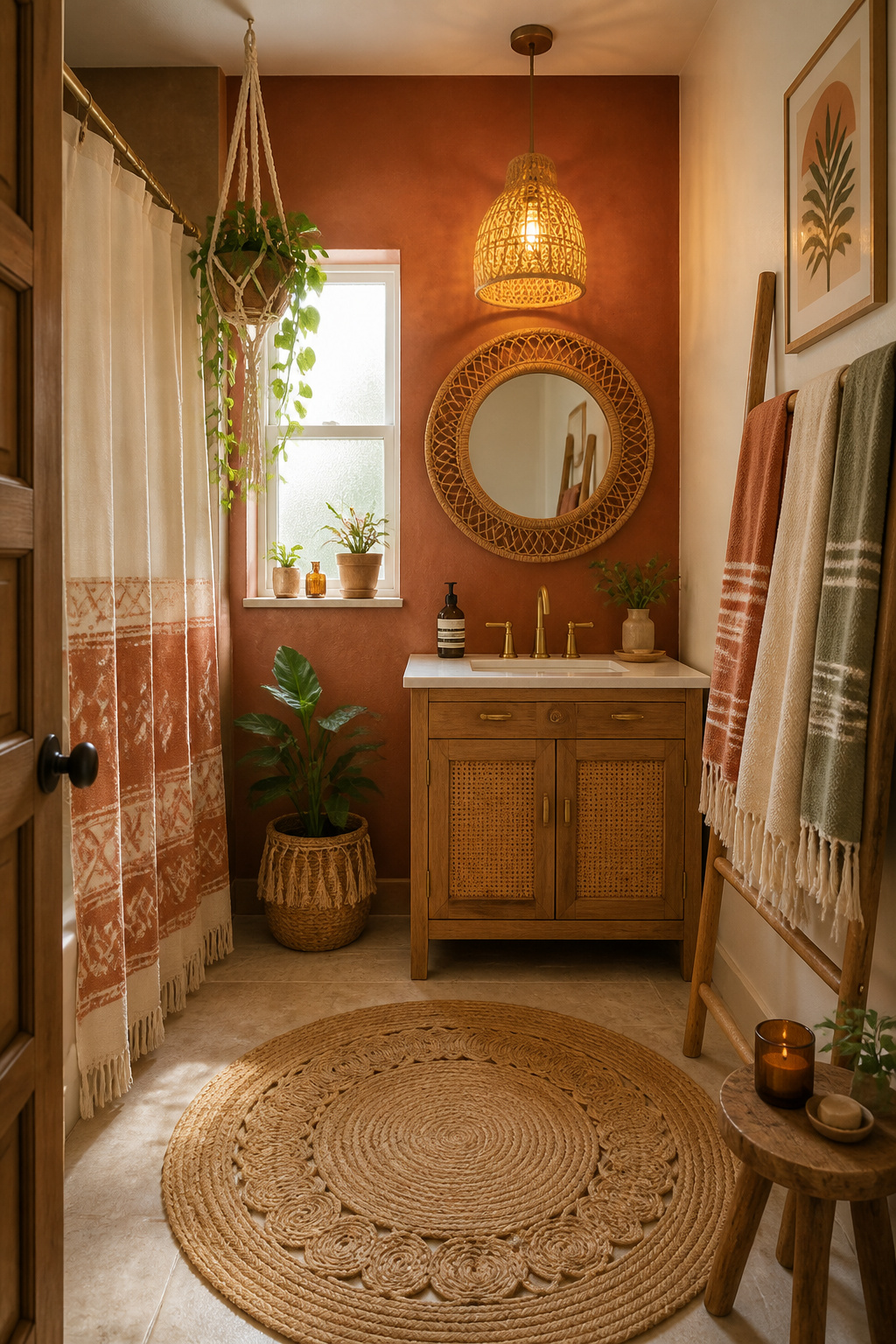
If all you have is an afternoon, do one thing well rather than five things halfway. The patterned shower curtain is the single fastest change — the largest textile, visible from the doorway, no installation, modest cost. A woven rug is the next, breaking up a flat tile floor. A single hanging plant in a macramé hanger shifts the whole atmosphere toward the retreat, especially if the room already has some earthy colour to build on. Any one of these moves the room; you do not need all of them at once.
And then the question every layered room eventually raises: when is it finished? The honest test is sensory. A boho bathroom is finished when stepping inside produces a small shift in the body — the warm light, the organic texture, the green and the earth of the palette lowering your shoulders before you have decided to relax. If you want a more concrete check, try removing three objects. If the room still reads as boho, it is finished, and those three were extra. If it suddenly feels sparse, one of them was structural — put it back. The room you are after is not the fullest version of itself. It is the one where everything that remains is there because it earns the calm.