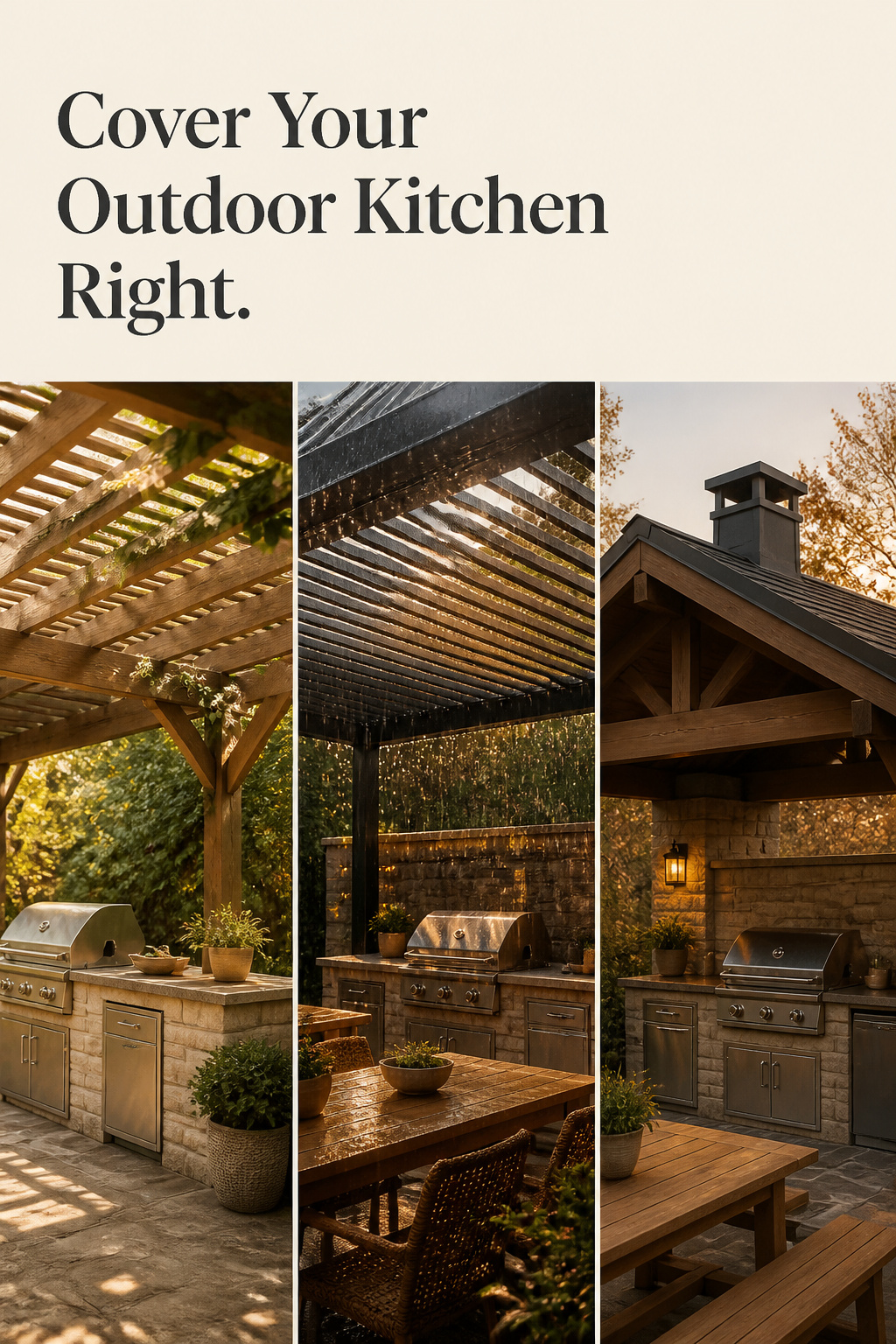
My own backyard kitchen is a modest thing: a grill, a salvaged prep table, and a string of lights under a pergola I built over three weekends. Those slatted boards taught me one lesson early. A cover is not decoration — it is the difference between a kitchen you use four nights a week and one that sits dark whenever the forecast turns. The trouble is that a covered outdoor kitchen looks like a single decision when it is really four: pergola, louvered roof, solid roof, polycarbonate — four options that photograph almost identically while behaving nothing alike in July rain.
TL;DR
- An open pergola gives selectable 50/75/90% shade but no rain protection; a louvered roof ($45–$175 per sq ft) opens for smoke and closes for rain; a solid roof gives full weather protection but traps smoke; polycarbonate on an aluminum frame ($20–$50 per sq ft) sheds rain cheaply but yellows in 3–7 years uncoated.
- Under any roof, ventilation is safety-critical: aim for an 8-foot (96-inch) minimum ceiling, a vent hood 4–6 inches wider than the grill on each side, mounted 30–42 inches up and rated at least 1,200 CFM — 1,500–2,000 under a solid roof.
- Many grill makers (Wolf among them) prohibit any combustible material above the grill at any height, so verify every figure here against your grill’s manual and your local building department before you build.
What a Covered Outdoor Kitchen Actually Buys You
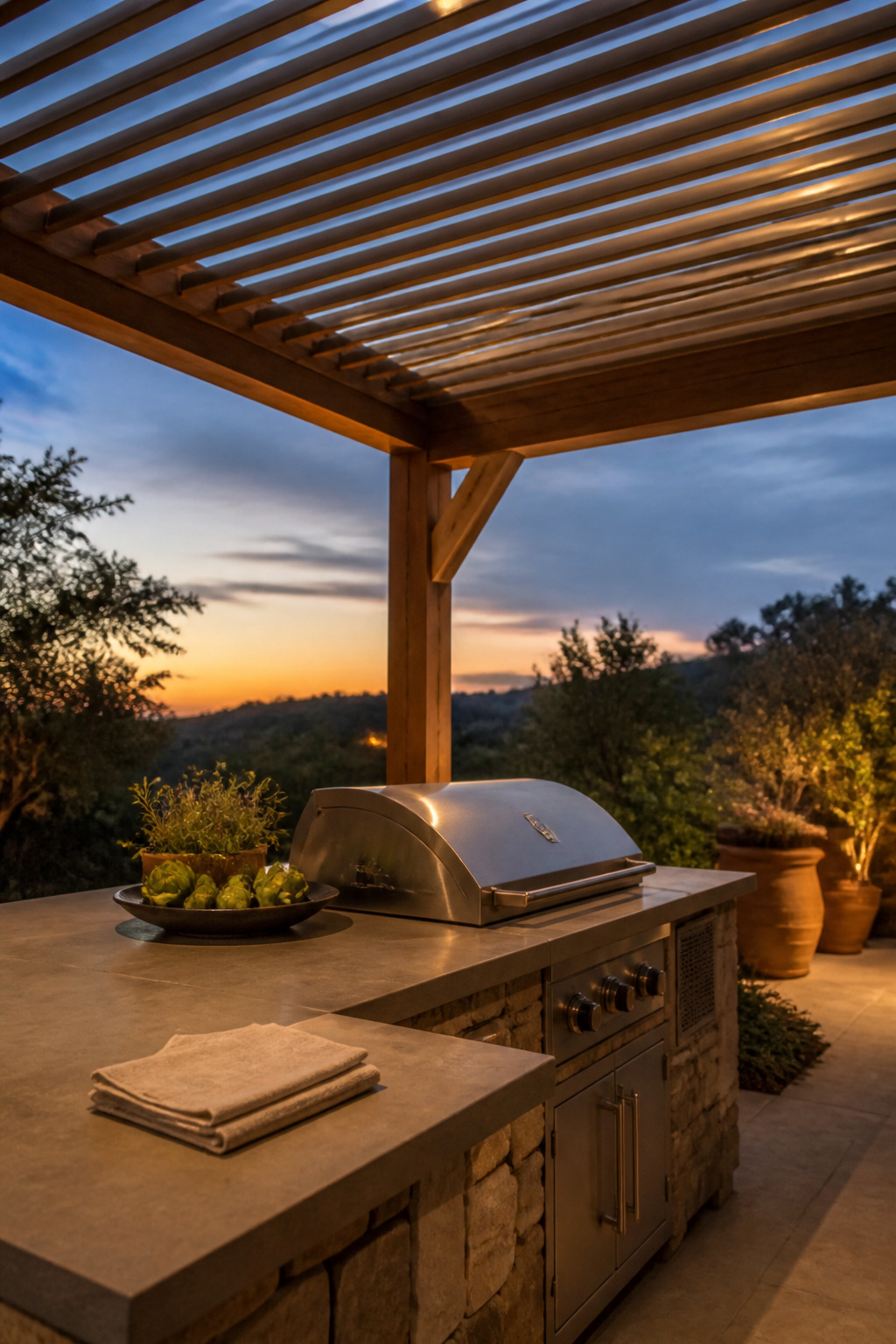
Ask what a cover is for and most people answer “shade” — the smallest part of it. The real payoff is usable hours: the drizzly evenings you cook out anyway because the surfaces stayed dry.
Usable hours, not just shade on a hot day
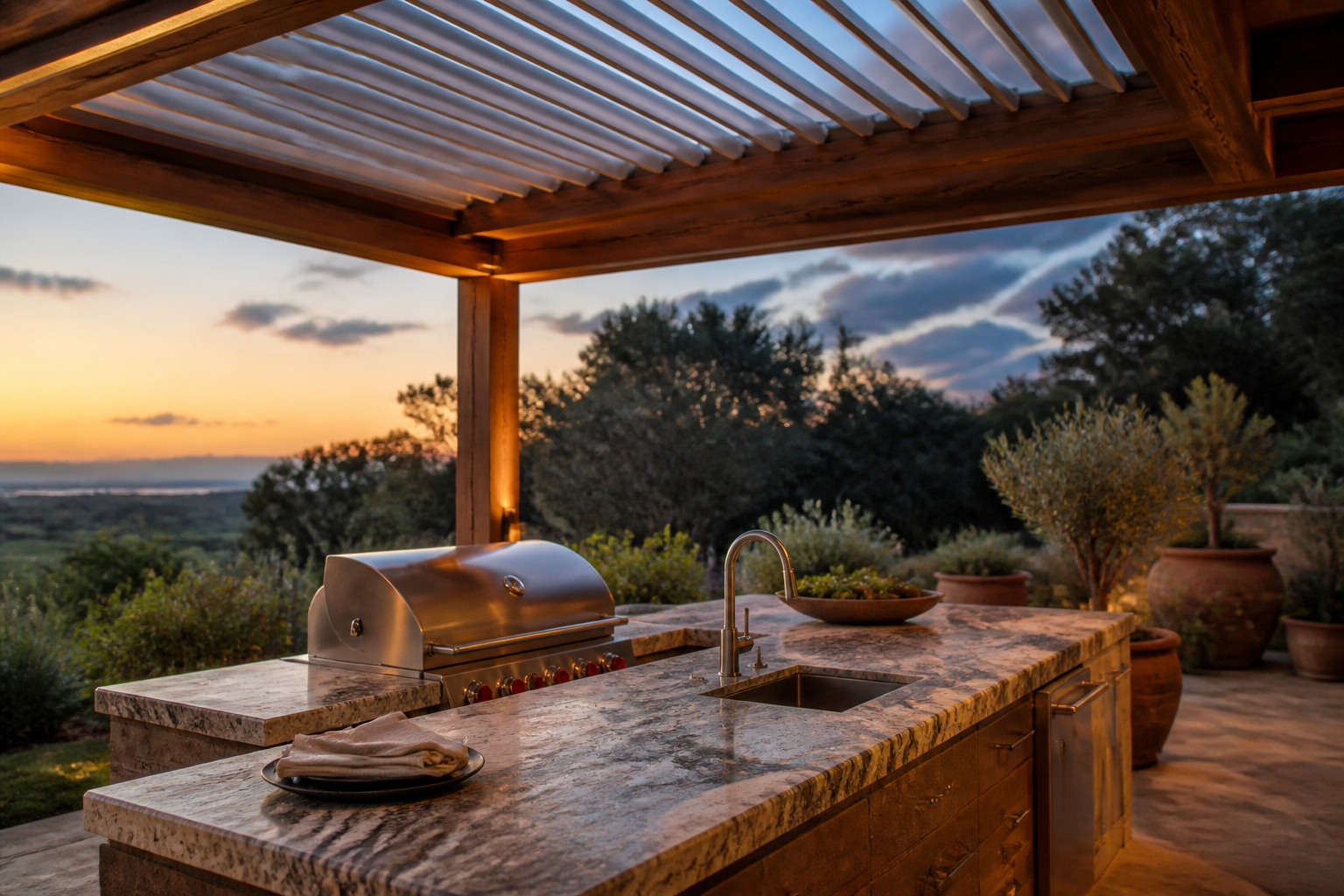
Shade and rain are different problems. A slatted pergola gives real, selectable shade but won’t keep rain off your grill; a solid or polycarbonate roof keeps the space dry but darkens it. The one structure that does both on demand is a waterproof aluminum louvered roof.
Protecting appliances the way the warranty assumes
Every hour a grill sits under open sky, its finish and electronics age faster than the warranty expects. But covering it adds an obligation: a cover decision is really a ventilation decision — one I’ll come back to hard below.
The standard this article judges them by
I judge all four on the criteria you’d use to compare quotes — shade, rain protection, appliance protection and installed cost:
| Cover type | Shade | Rain protection | Installed cost |
|---|---|---|---|
| Open pergola | Selectable 50 / 75 / 90% | None | Lowest of the four |
| Louvered roof | Full when closed, open on demand | Full when closed | $45–$175 / sq ft |
| Solid roof | Full, constant | Full | Wood $60–$120; vinyl $25–$80; aluminum $20–$50 / sq ft |
| Polycarbonate panels | Diffused, constant | Full | $20–$50 / sq ft (aluminum frame) |
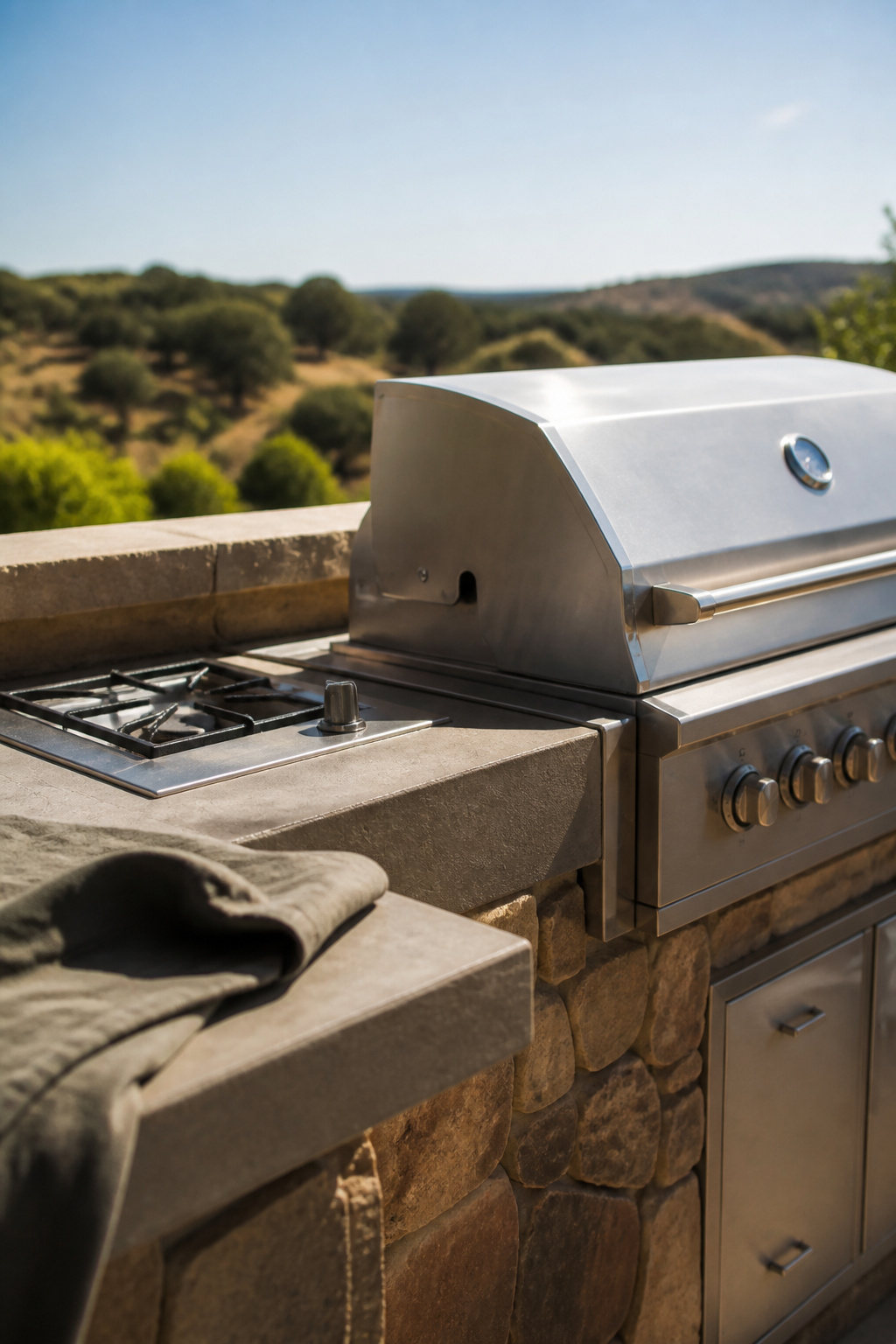
Open Pergolas: Partial Shade With Character
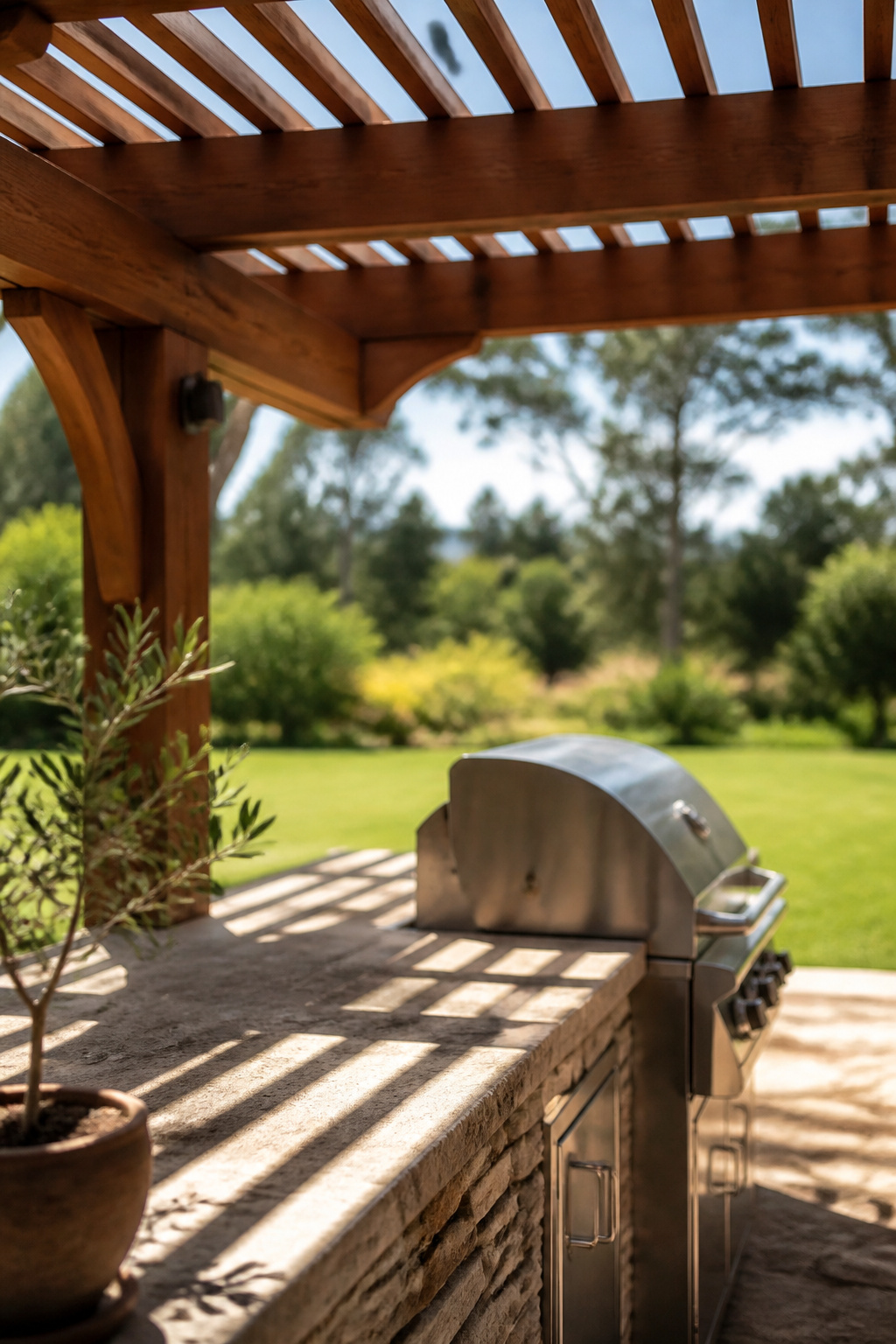
An open pergola is where I started in my own yard, and where I’d start most people. It builds a permanent, architectural outdoor room — but won’t keep your grill dry.
How much sun protection you really get
Slatted pergolas come in three tiers, set by slat spacing: 50% (maximum openness, best for gardens), 75% (the tier most owners land on — enough for dining while the space still reads bright), and 90% (maximum shade while still reading open, best for a poolside or high-sun patio). One caution: shade percentage isn’t UV-protection percentage — a 90% shade pergola cuts direct sun noticeably, but don’t read it as blocking 90% of your UV exposure.
Adding a canopy or vines for more coverage
For more weather coverage, add a retractable canopy insert or upgrade to a solid-roof version of the same frame — don’t hope the slats will do what slats can’t.
Cost, and what it won’t protect against
An aluminum-frame pergola with a slatted roof is the least expensive of the four covers here; pricing climbs toward louvered territory only once you add a solid or motorized upgrade. And since no slatted pergola shades identically all day, plan the grill’s position around where the sun actually lands at six, not where the catalog photo suggests.
Louvered Roofs: Adjustable Shade on Demand
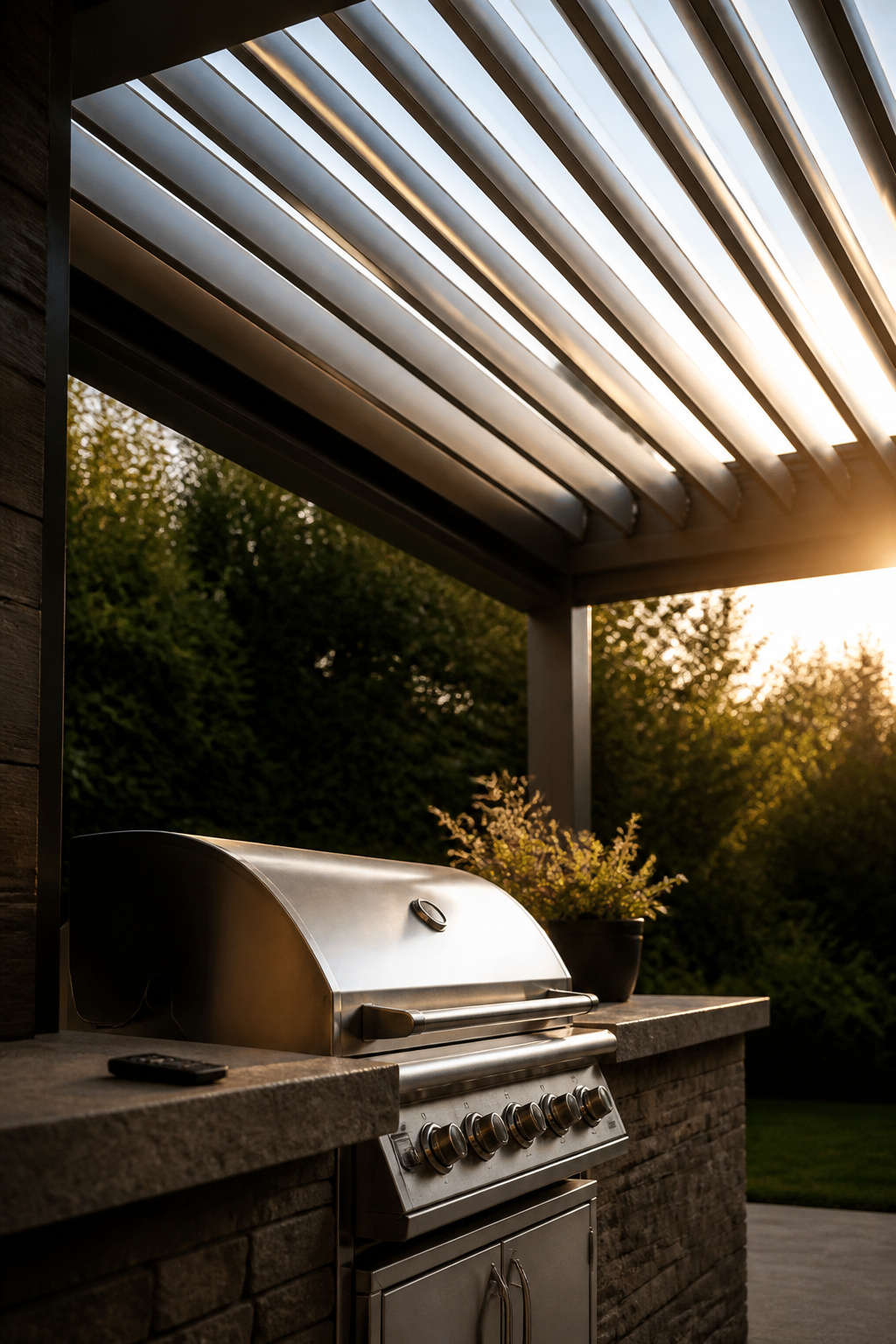
If the pergola’s weakness is rain and the solid roof’s weakness is trapped smoke, the louvered roof refuses to pick a side: a pergola and a solid roof in one structure, switchable in seconds.
How motorized or manual louvers work
Most systems rotate between 0 degrees (fully closed) and 130–135 degrees (fully open), with precise control at any angle between. Manual or motorized; smart systems add rain and wind sensors that close the roof for you. Keep them partly open while the grill runs hot, then close them the moment rain starts.
Why it’s the closest thing to four-season
Close the louvers completely and the roof shields the space from rain, snow or harsh sun year-round — a real advantage over a fixed pergola in an unpredictable climate. Aluminum or powder-coated frames also stay low-maintenance next to a wood pergola.
The cost premium
The range is wide — $45–$110 per square foot for a manual system, climbing to $75–$175 for sensor-equipped smart setups. My warning: if your household won’t reliably close manual louvers before a storm, pay for motorized — an open roof over a wet grill is worse than no roof at all.
Solid Roofs: Full Weather Protection
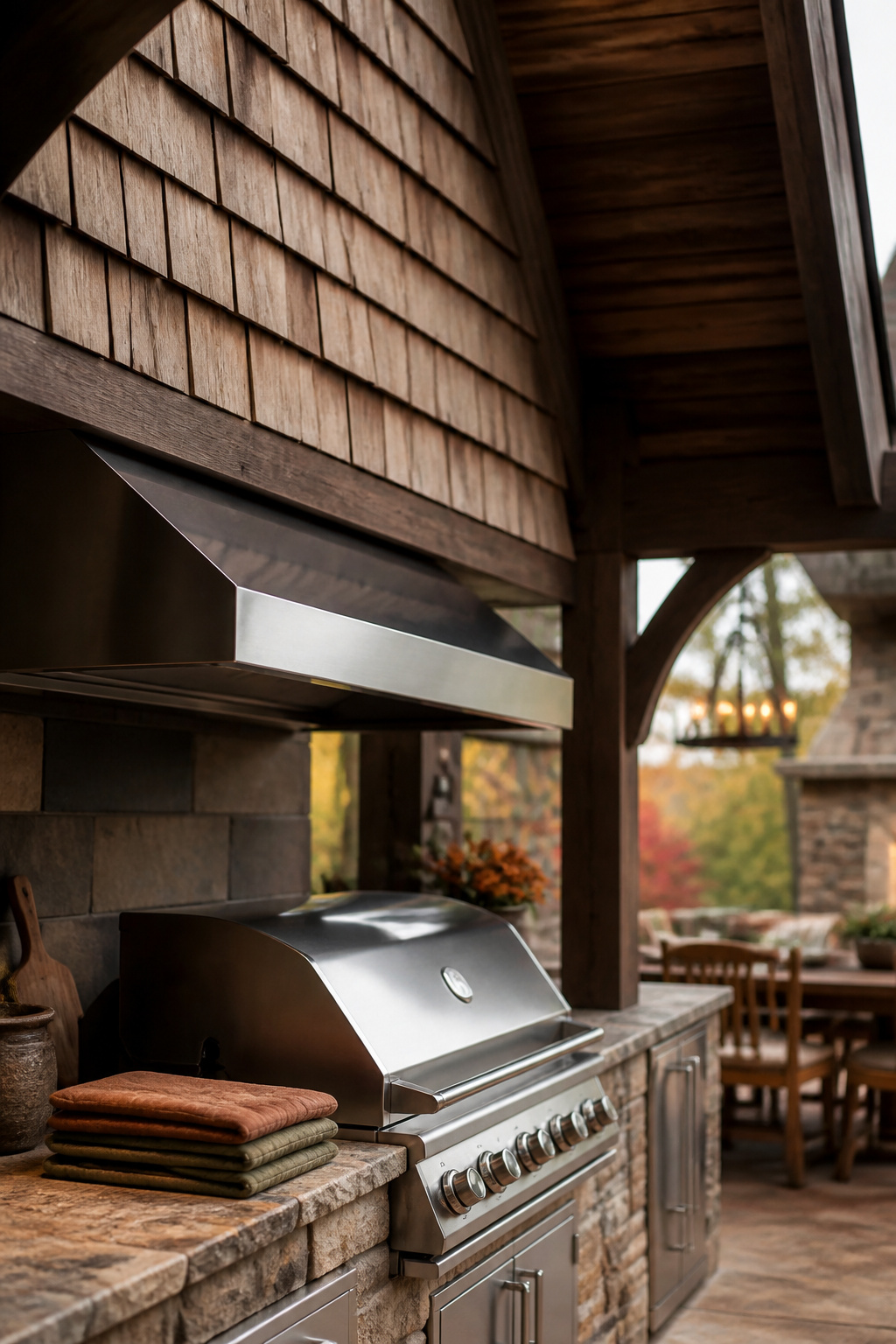
A solid roof is the most consistent shade and the most complete rain protection of the four. It also traps heat, smoke and light — which makes ventilation the central design problem, not an afterthought.
Matching material and pitch to the house
Match the roof to the building it sits near, in material and pitch, or it will look bolted on. Cost tracks the material — wood is the premium option, aluminum the cheapest (see the table above). A custom wooden roof attached to the home typically needs an architect or engineer, since attachment and load trigger permitting.
Ventilation once smoke and heat are trapped
Here I get emphatic, because the stakes are real. Wolf (Sub-Zero Group) states outright that its Outdoor Grill, Side Burner and Burner Module products cannot be installed in any enclosed or covered area with a roof or overhang — including the eave overhang. No combustible material may sit above the grill at any height, over any distance. Under a solid combustible roof, a dedicated compatible vent hood is the manufacturer’s required path, not an upgrade. The sizing numbers are below; these are manufacturer and trade figures, so confirm them against your grill’s manual and your local building department before you cut a rafter.
Cost and permitting realities
Attached, roofed or large patio covers generally require a permit; some jurisdictions exempt covers under 300 square feet of projected roof area on single-family or duplex homes. Either way, an outdoor kitchen almost always needs its own permit, since the gas, plumbing or electrical work triggers code review — and skipping a required one risks fines and a forced teardown.
Polycarbonate Panels: The Budget-Friendly Middle Ground
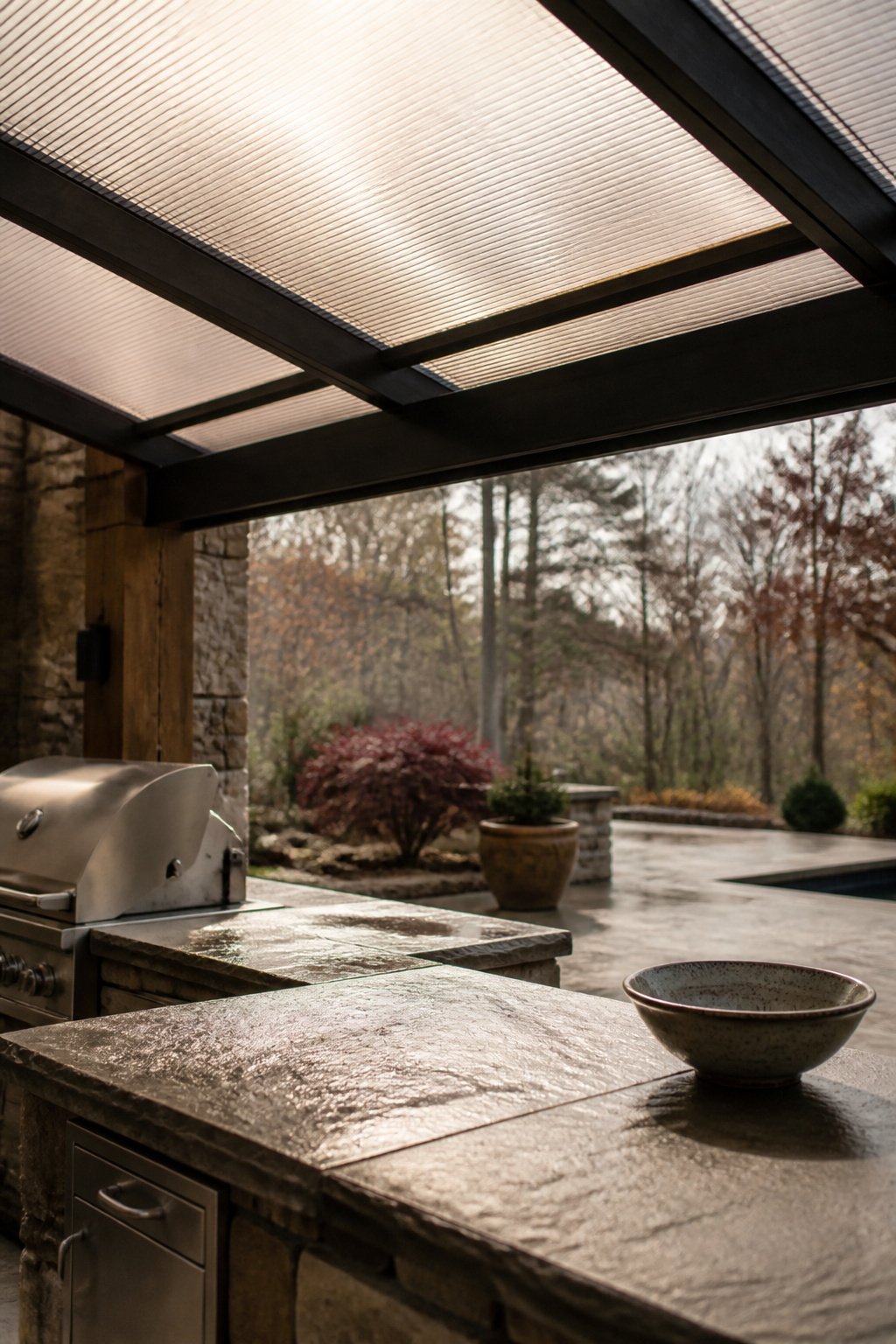
Polycarbonate sits between the open pergola and the full solid roof: it sheds rain like a solid roof at a fraction of the framing cost. I point budget-minded clients toward it when dry space matters more than a shingled silhouette — but the catch shows up years later.
Light, heat and impact
Twinwall polycarbonate transmits roughly 80% of available light while blocking up to 98% of UV. Clear panels let more heat and glare through; tinted or opal panels cut light further for less heat build-up, which matters for a south-facing cook zone. It’s also up to 250 times more impact-resistant than tempered glass — which is why it beats glass overhead, where hail or falling debris is a real risk.
Lifespan and yellowing
The tradeoff: an uncoated panel keeps its clear look for roughly 5–7 years before visible yellowing, and can turn brittle within 3–5 with no UV protection at all. Panels with a co-extruded UV layer last 10–20 years; premium multiwall panels reach 15–25. That’s why orientation isn’t optional — the UV-coated face must face the sun, or the panel ages fast from its unprotected side.
Where it beats a full roof on cost
On a solid aluminum frame, polycarbonate runs well under the cost of a solid-wood roof (see the table) — lighter, cheaper to frame, and shedding rain just as well. That’s what makes it the budget path to full rain protection.
Ventilation and Clearance Rules for Grilling Under Cover
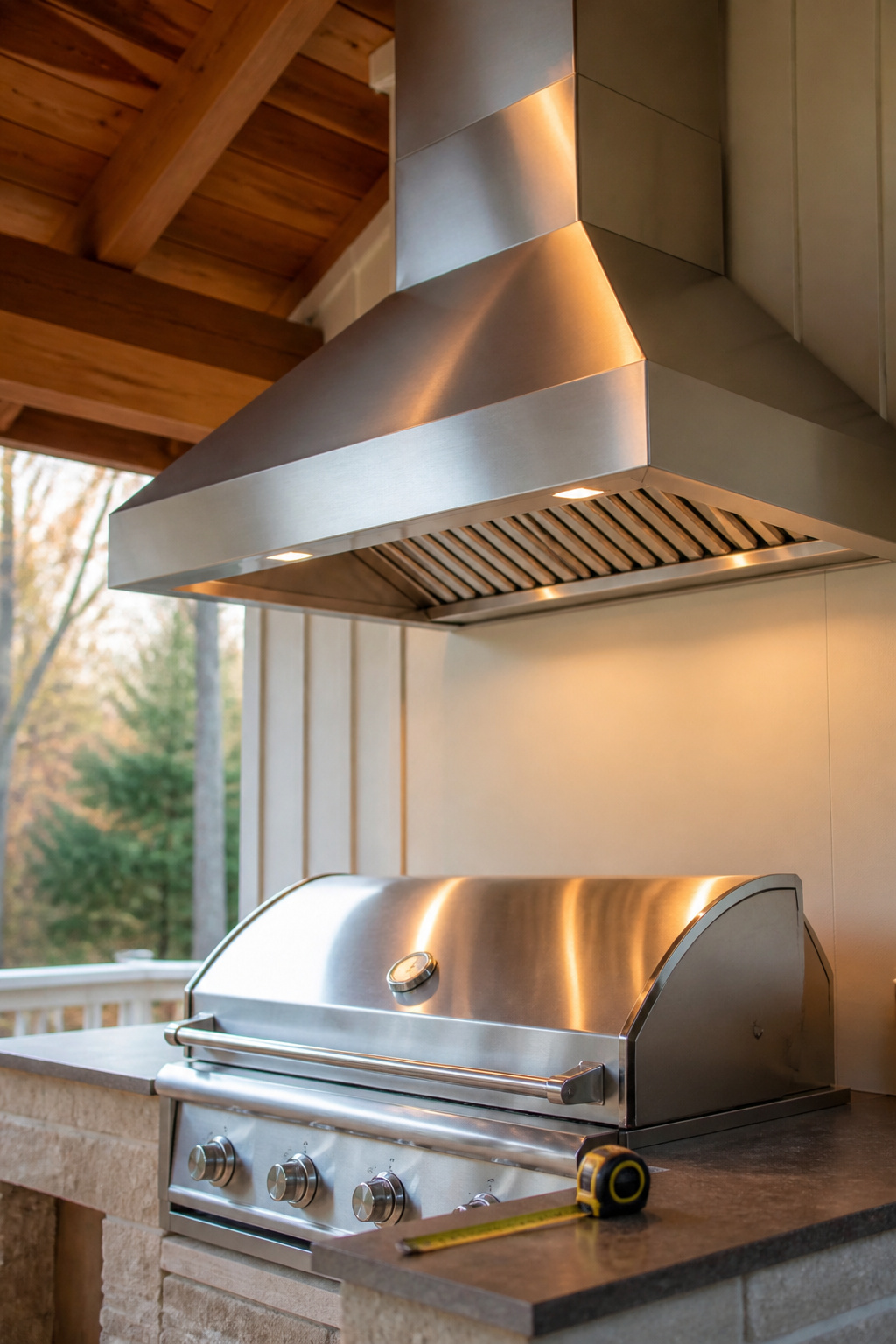
Every option above shares one non-optional dependency, and getting it wrong is how a nice cover becomes a fire risk. Read this part twice, and verify it against your grill’s documentation and your local building department — the figures below are manufacturer and trade guidance, not a single unified code.
Minimum overhead clearance for open-flame grills
Start with the numbers, then the rule that overrides them:
- Ceiling height: a widely accepted minimum for a grill under cover is 8 feet (96 inches). Some sources cite 7 feet as an absolute floor; 8–10 feet is the safer range.
- Charcoal and smokers: these produce far more smoke than gas and are named as needing 9 feet or more, plus stronger ventilation than a gas setup under the same roof.
- Overhead combustibles (wood overhangs, cedar-clad ceilings): many manufacturers and codes call for 36–42 inches of clearance to the underside of the structure as a baseline.
- The rule that overrides all of the above: Wolf specifies combustible material cannot sit above its grill products at any height whatsoever. No overhead distance makes combustible material safe — a stricter standard than any ceiling-height number, and the fact this whole section hinges on.
Venting smoke and heat so a roof doesn’t trap them
A hood is what makes a covered grill legal, not the clearance alone. Size an outdoor vent hood 4–6 inches wider than the grill each side, mount it 30–42 inches above the surface (30–36 inches is the sweet spot — enough to open the lid, low enough the fan still draws), and rate it at a minimum 1,200 CFM using the rule grill BTUs ÷ 100 = minimum CFM. Under a roof, push past that floor to 1,500–2,000 CFM. A semi-enclosed pavilion may also need dedicated makeup air, or negative pressure will fight the hood’s draw and pull smoke back inside — all of it belongs in the same plan as your kitchen’s layout and clearances, not bolted on after.
When an open pergola is the safer default
For a first outdoor kitchen, the lowest-risk cover is often the simplest: a fully open-air pergola with no roof and no walls needs no vent hood by code in most jurisdictions, since smoke dissipates naturally. Once a cover closes off two or more sides, or adds a solid or louvered-closed roof, ventilation planning stops being optional. If you’re not ready to engineer a hood, an open pergola lets you cook safely now and add coverage later.
Matching a Cover to Your Kitchen’s Layout and Style
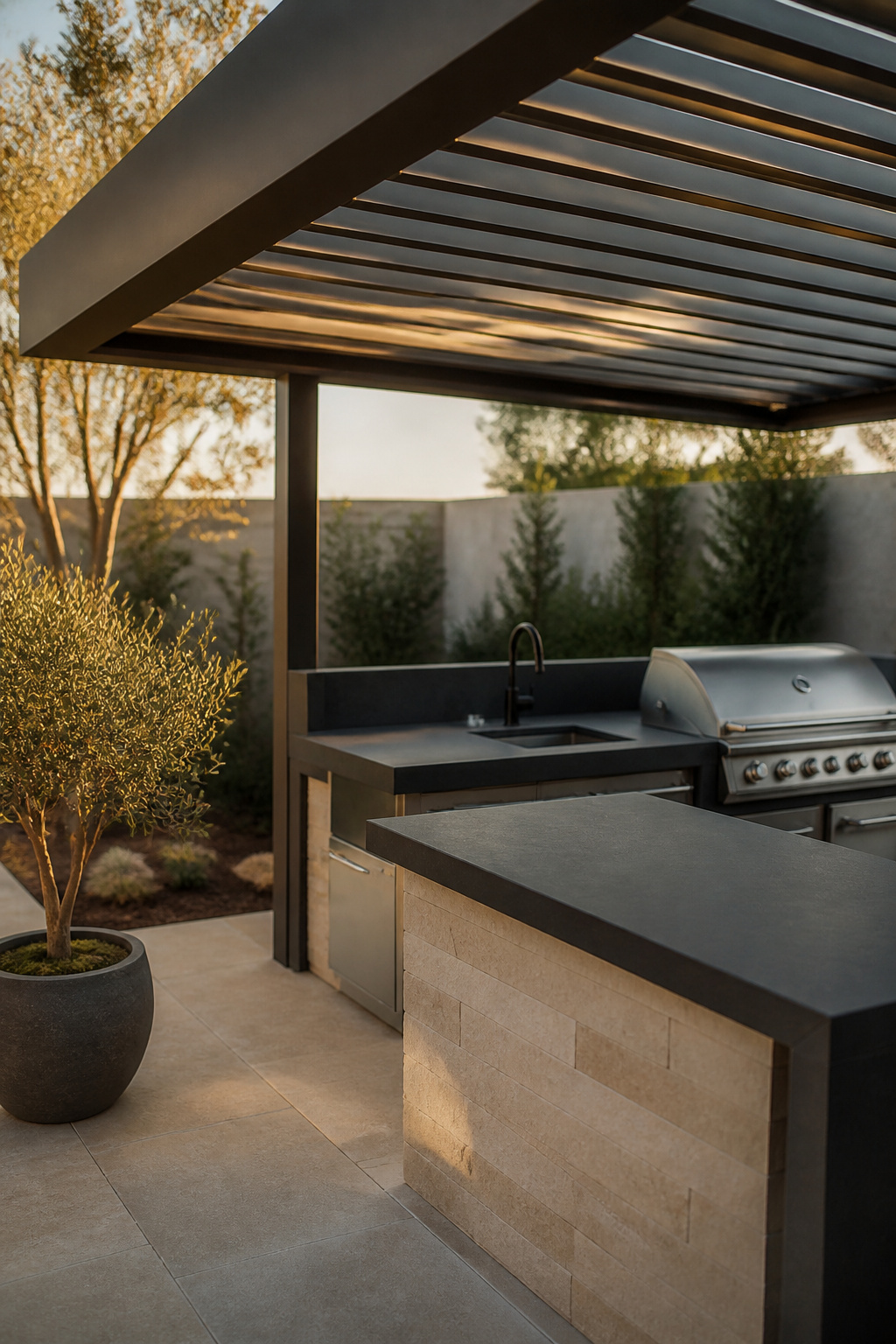
By now the four look-alike options should have thinned into a real choice. The last step is fitting it to the kitchen you actually have.
The cover fits the footprint, not the reverse
Settle the layout first: the grill’s position, the rear lid swing, the aisle width — all of it decided before the cover, not after. A roof that doesn’t clear the lid, or boxes in a grill the manufacturer won’t allow under cover, is a redo waiting to happen.
Louvered roofs and clean lines in a modern build
If your yard is styled clean and contemporary, the cover should follow. Louvered systems read modern in a way a rustic wood pergola never will — which is why a louvered or flat roof so often completes the silhouette of the sleek modern outdoor kitchens people pin and reverse-engineer.
Making the final call: climate first, look second
My verdict after a decade of building these: choose by climate exposure and budget first, aesthetics second. A reader in a wet climate gains nothing from a beautiful open pergola that leaves the grill exposed all season. Name your rain exposure, sun intensity and budget, settle the ventilation, and the cover picks itself. For the bigger picture, see the full range of outdoor kitchen ideas and options.
FAQ
Do you need a permit to build a roof over an outdoor kitchen?
Most attached, roofed or large patio-cover structures require a building permit, though some jurisdictions exempt small detached lattice covers or patio covers under 300 square feet of projected roof area on single-family or duplex homes. Separately, an outdoor kitchen itself almost always needs a permit, because its gas, plumbing or electrical work triggers code review. Building without a required permit risks fines and a forced teardown.
How much shade does a pergola actually provide?
Modern slatted pergolas offer three selectable tiers set by slat spacing: 50%, 75% or 90%. Seventy-five percent is the most common choice for dining and entertaining, while 90% is reserved for poolside or high-sun patios. Remember that shade percentage isn’t the same as UV-protection percentage, and shade performance shifts with time of day, season and roof orientation.
Can a covered outdoor kitchen be used in winter?
Yes, with the right heat and ventilation. Electric infrared heaters are the safest option for covered spaces, since they produce no carbon monoxide and direct heat outward rather than up into the roof, needing only about 12–24 inches of clearance from the ceiling. Propane heaters demand the same clearance and ventilation scrutiny as a grill — a hazardous winter kitchen is almost always a ventilation-planning failure, not a heater problem.