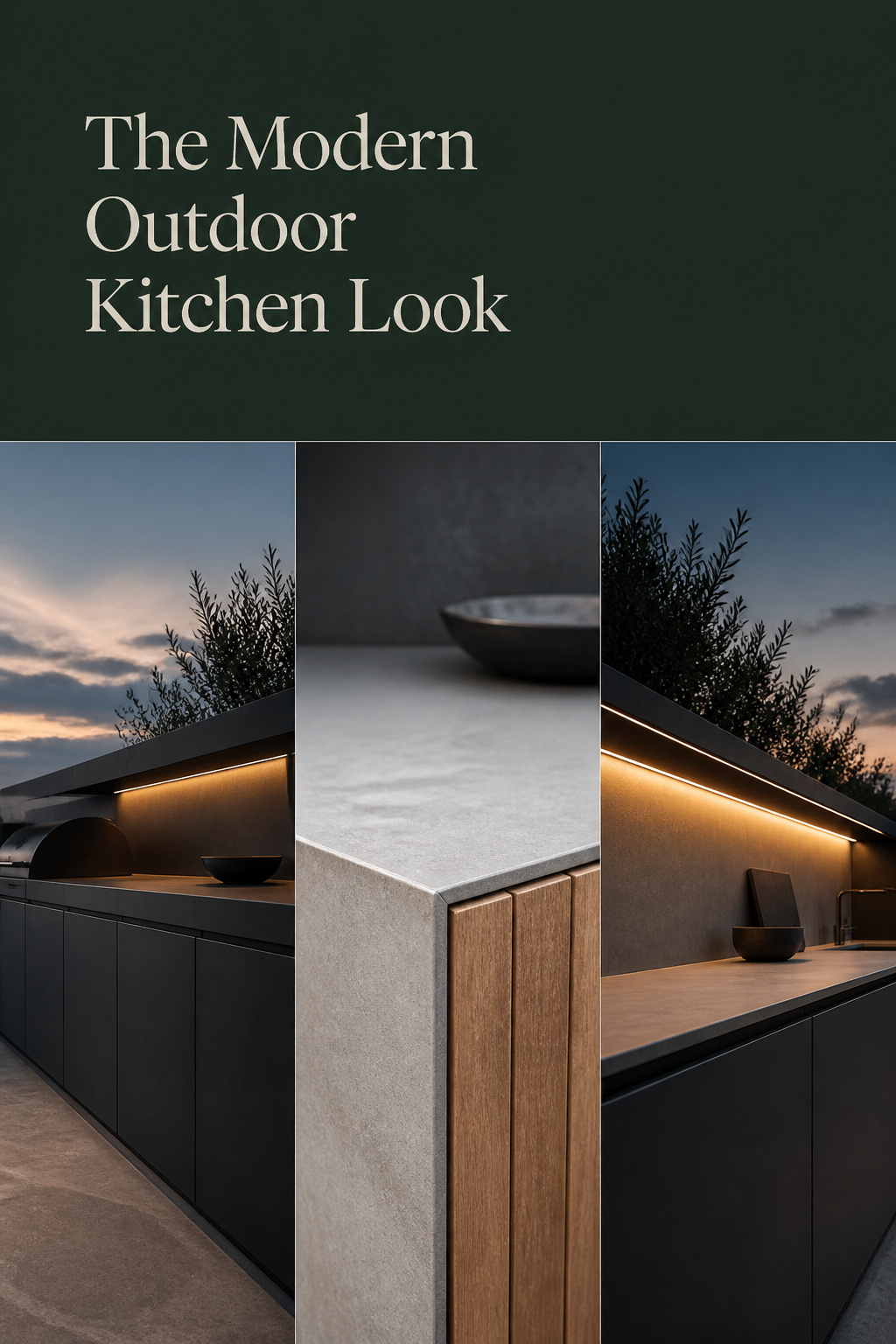
Most people copy a modern outdoor kitchen the way you’d copy a haircut from a photo: dark cabinets, black fixtures, done. The finished thing then looks busy, not calm, and they can’t say why. A modern outdoor kitchen is not a colour scheme — it is a discipline, fewer things chosen well, and the sleek look is what that discipline produces, not what you buy to fake it.
TL;DR
- Modern looks modern because of material restraint, not dark colour: the rule of three caps a space at roughly three finishes sharing one undertone (all cool, or all warm).
- The core outdoor palette is pale concrete, powder-coated blackened steel, pale stone and one warm wood — and that powder coat, not paint, is what keeps the charcoal look from fading under UV.
- Concealed storage (push-to-open, J-pull, Gola-rail fronts), flush-integrated appliances and one low line of linear LED do the work ornament does in a traditional build.
What ‘Modern’ Actually Means Outdoors
Modern kitchen design grew out of the mid-century modern movement, and it has one governing idea: function and material over ornament. A traditional kitchen builds from wood, natural stone and detail — crown moulding, raised panels, warm browns and creams; a modern one strips back to a monochromatic palette with, at most, one focal accent, letting man-made materials talk: steel, concrete, glass. Outdoors the logic holds: fewer materials, chosen for weather and calm, separate a modern build from a traditional one painted dark.
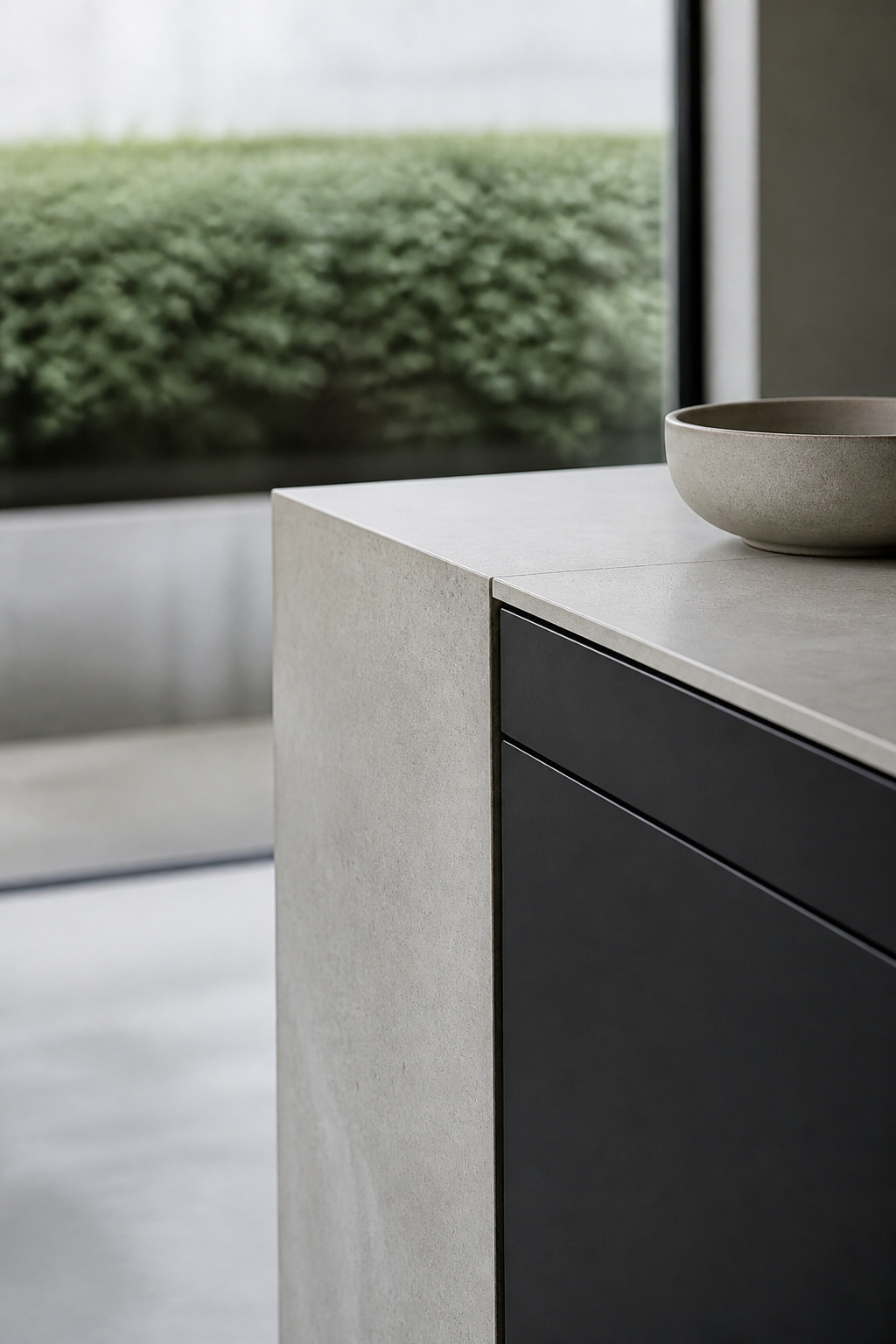
The quality-over-quantity logic behind the look
Here is the part the photos hide: a monochrome kitchen draws the eye to material and craftsmanship precisely because colour isn’t competing for attention. You don’t add to make a room feel considered; you subtract until the good things stand alone.
Why restraint is a discipline, not just a palette
I keep a picture in my head of my grandparents’ summer cottage on the Stockholm archipelago — unpainted pine, one open shelf of crockery, oil lamps at dusk. Nothing in it was expensive; everything in it was enough. That is the standard a modern kitchen chases, harder than buying black cabinets. The rule of three names the mechanism: cap a space at about three material tones, all sharing one undertone — more fragments the room, fewer feels monotonous.
What this article unpacks
The restraint shows up in four places: material, storage, appliances, and light — all answering one question, what can I leave out and still cook well?
A Restrained Material Palette
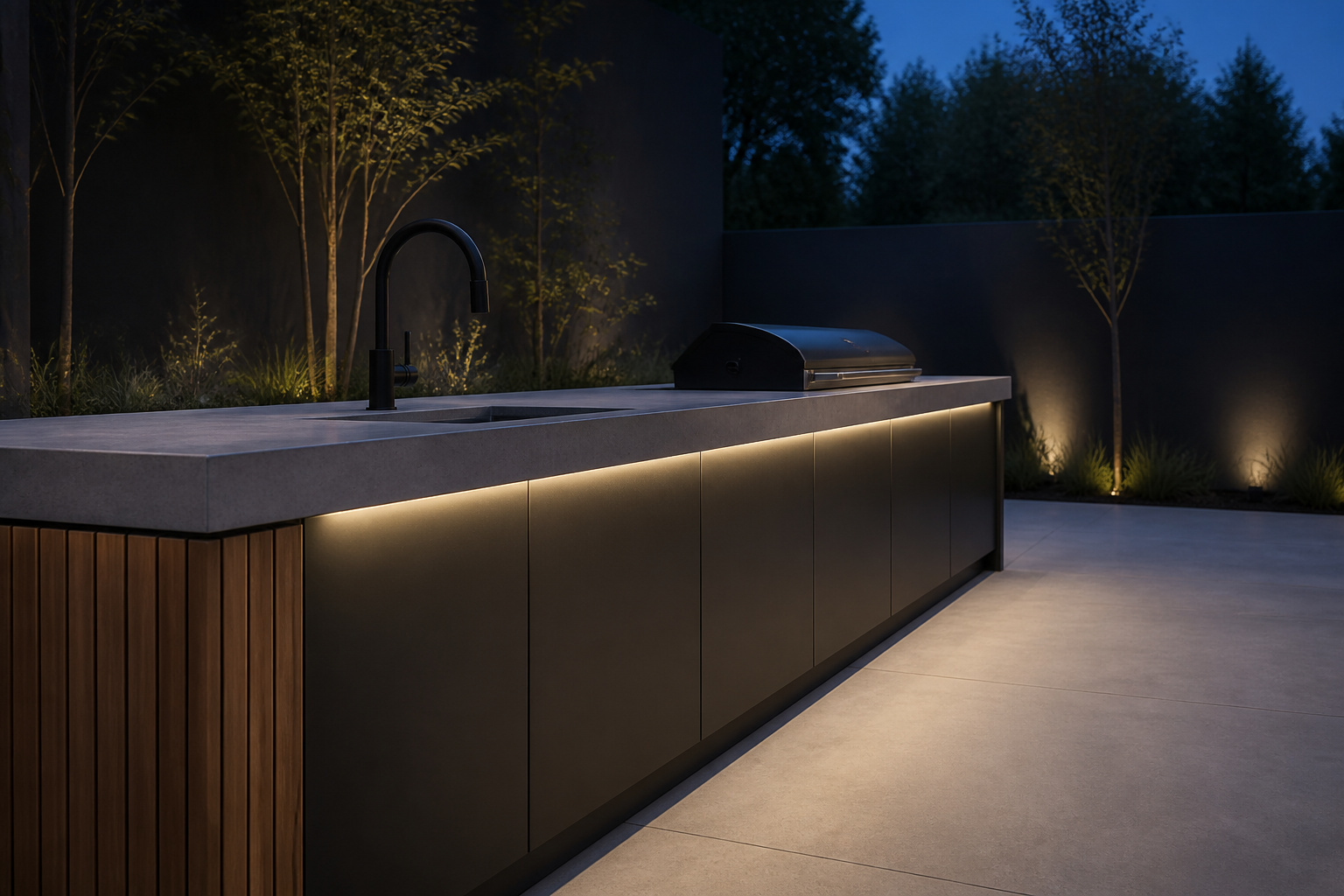
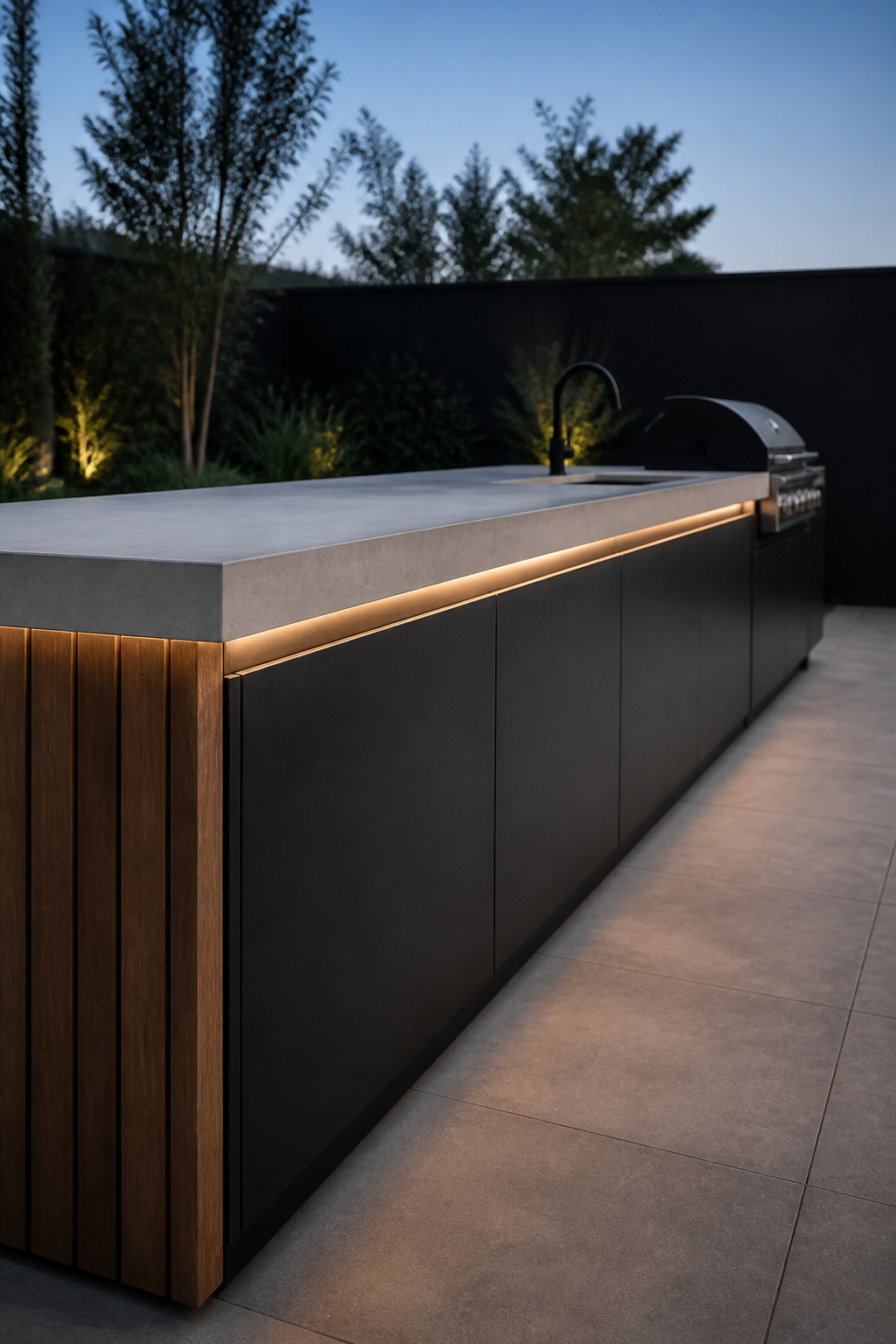
The modern palette rests on four materials that look contemporary because they’re made or processed, not left rustic: pale poured concrete, blackened powder-coated steel, pale stone, and one warm wood.
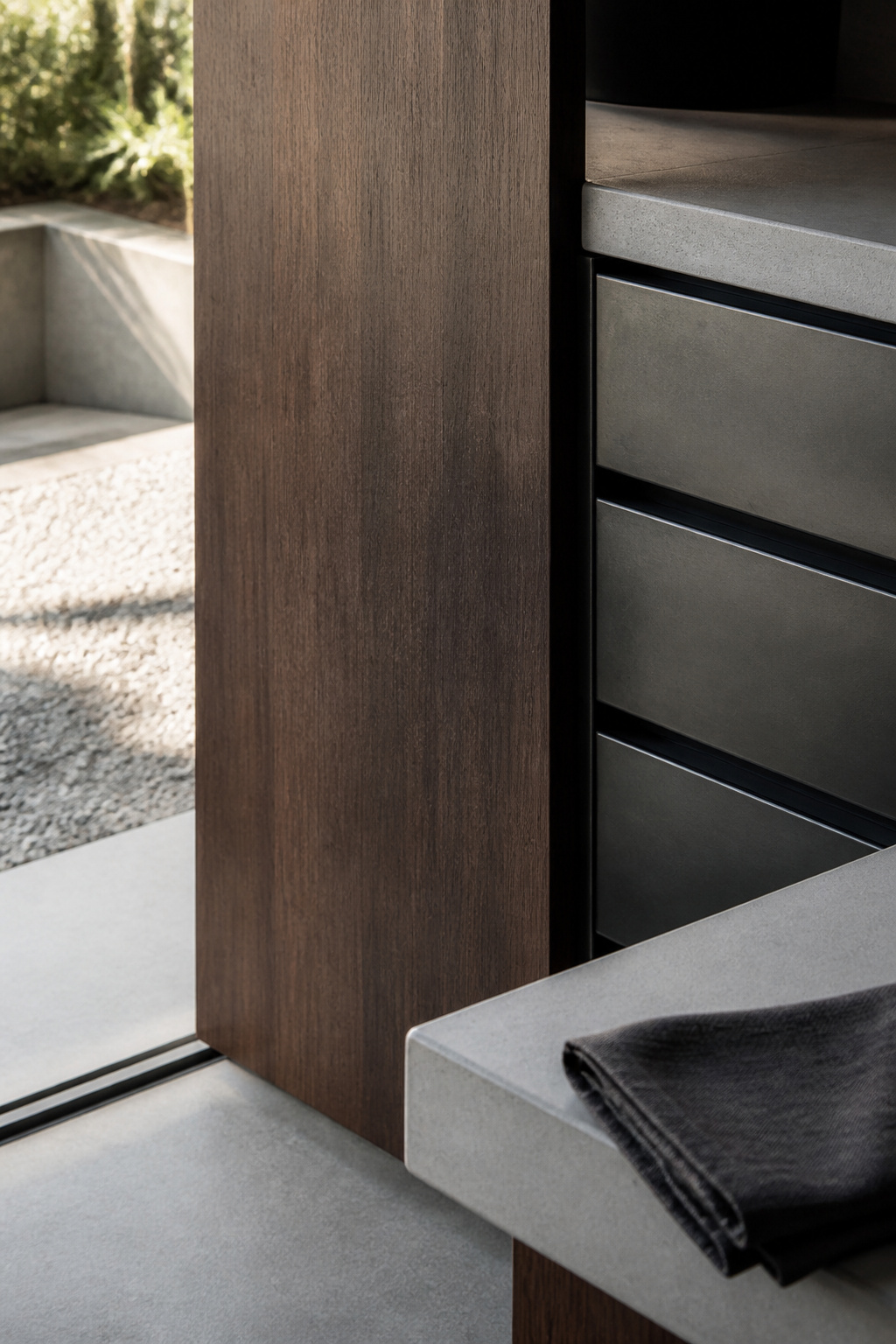
Concrete, steel, stone and one warm wood
A pale, dove-grey concrete or stone introduces a lightness that visually expands the space — one reason the modern lean runs pale where traditional stone runs deep and warm.
Concrete counters are heat-resistant, durable against weather and everyday wear, and suit an outdoor kitchen without special treatment. For cabinetry, the finish is where the look lives or dies: powder-coated stainless steel — rated against UV, humidity and corrosion through Super Durable Polyester coatings, in deep charcoal and matte-black tones — holds that blackened look outdoors. As Brown Jordan Outdoor Kitchens notes, the coating delivers the charcoal look with longevity; unprotected dark paint fades and chalks under sun. Buy the finish, not the paint.
The one warm material is where builders overthink it: cedar carries a reddish, traditional warmth and needs regular re-staining, while ipe is denser, cooler-toned, near maintenance-free and far harder.
| Warm-wood accent | Janka hardness | Maintenance | Best for |
|---|---|---|---|
| Ipe | 3,680 lbf | Little to none; 75+ yr documented lifespan | A cool, modern palette |
| Cedar | 1,560 lbf | Regular re-stain and seal to hold colour | A warmer, softer look |
Choose ipe for a cool modern build — real wood without cedar’s recurring stain-and-seal cycle. For the full weatherproofing verdict across every surface, the right countertop material goes deeper.
The one-material-too-many mistake
The rule of three has a failure mode, and it’s the most common one I see: a build gets its concrete, steel and ipe — three materials, one cool undertone, exactly right — then someone adds a patterned tile backsplash or a second wood species for “warmth.” That fourth material fragments the palette; even when each piece is contemporary alone, the eye has nowhere to rest, and the whole thing reads as busy rather than curated. Add warmth with light and texture, not another finish.
Concealed Storage and Clean Lines
Visible clutter and hardware break a modern look fastest. Remove the handles and the cabinet run becomes one unbroken surface.
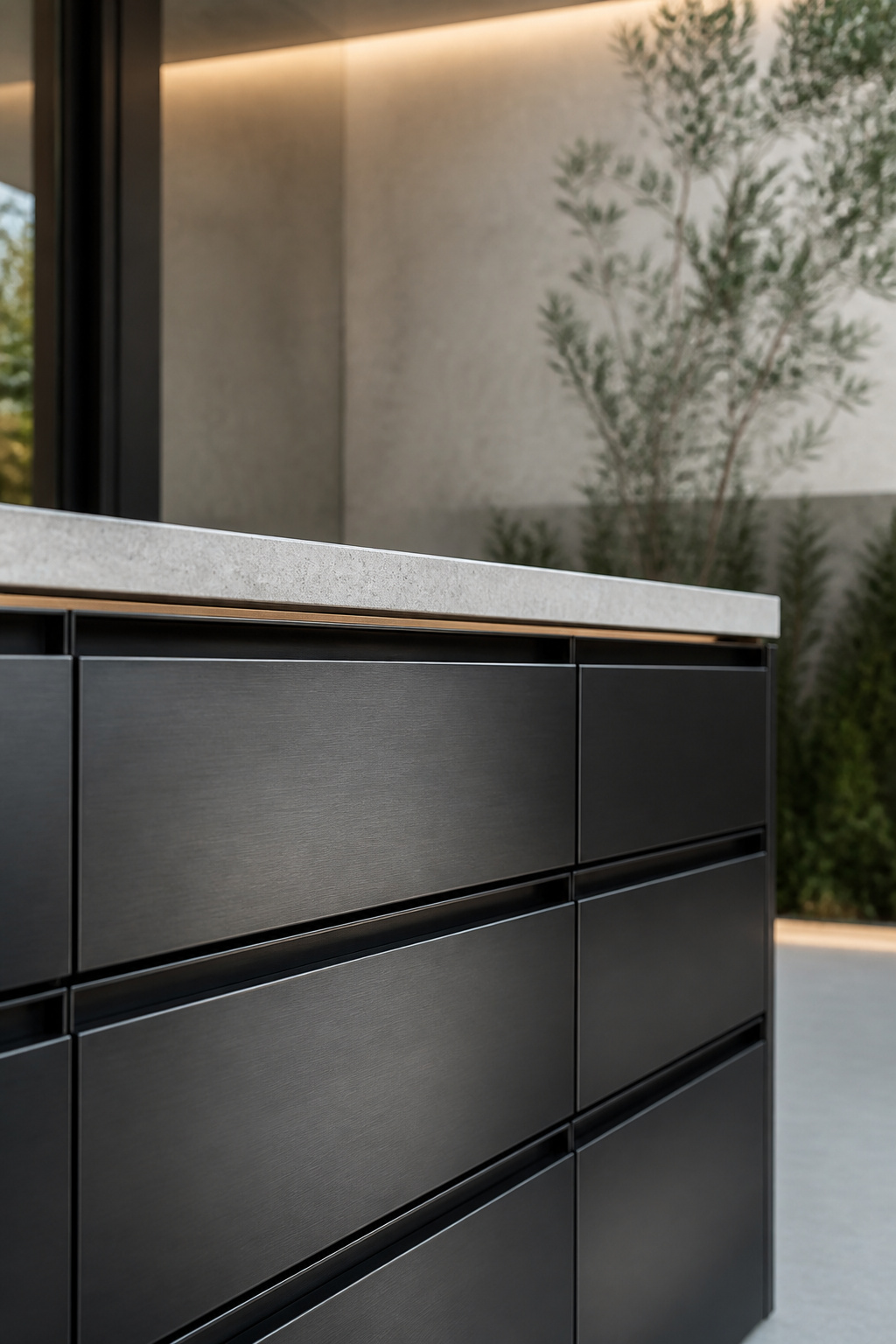
Flush fronts and hidden hardware
Four honest options enumerate cleanly:
- Push-to-open — a gentle push releases the door or drawer, no handle at all, and it opens hands-full.
- J-pull — a recessed J-shaped grip along the top or side edge, an integrated finger-hold with nothing protruding.
- Gola profile — a metal rail set between fronts; fingers grip the door edge, and the rail itself becomes a deliberate horizontal line.
- Pocket doors — the door slides back into the cabinet body, useful for concealing a bar station or appliance garage.
Any of these keeps the front flat. Mixing them is where people slip: choose one mechanism and hold it.
Why visible clutter breaks the look, and how storage stays clean without effort
Without handles, surfaces wipe clean and the visual rhythm stays uninterrupted — why the handleless front dates more slowly than trend hardware. Storage that only looks tidy when you constantly tidy it has failed; the system should be easier than the mess. An appliance garage — a dedicated compartment in the cabinet run — swallows the tool caddy and bar kit, and frameless construction closes the gaps between doors and drawers tighter than framed boxes.
Integrated Appliances That Disappear Into the Design
A crowded lineup of standalone units breaks a material run the way a fourth material does. Integration fixes it two ways: appliances built flush behind matching fronts, and finish coherence, so the appliance’s steel matches the cabinet’s.
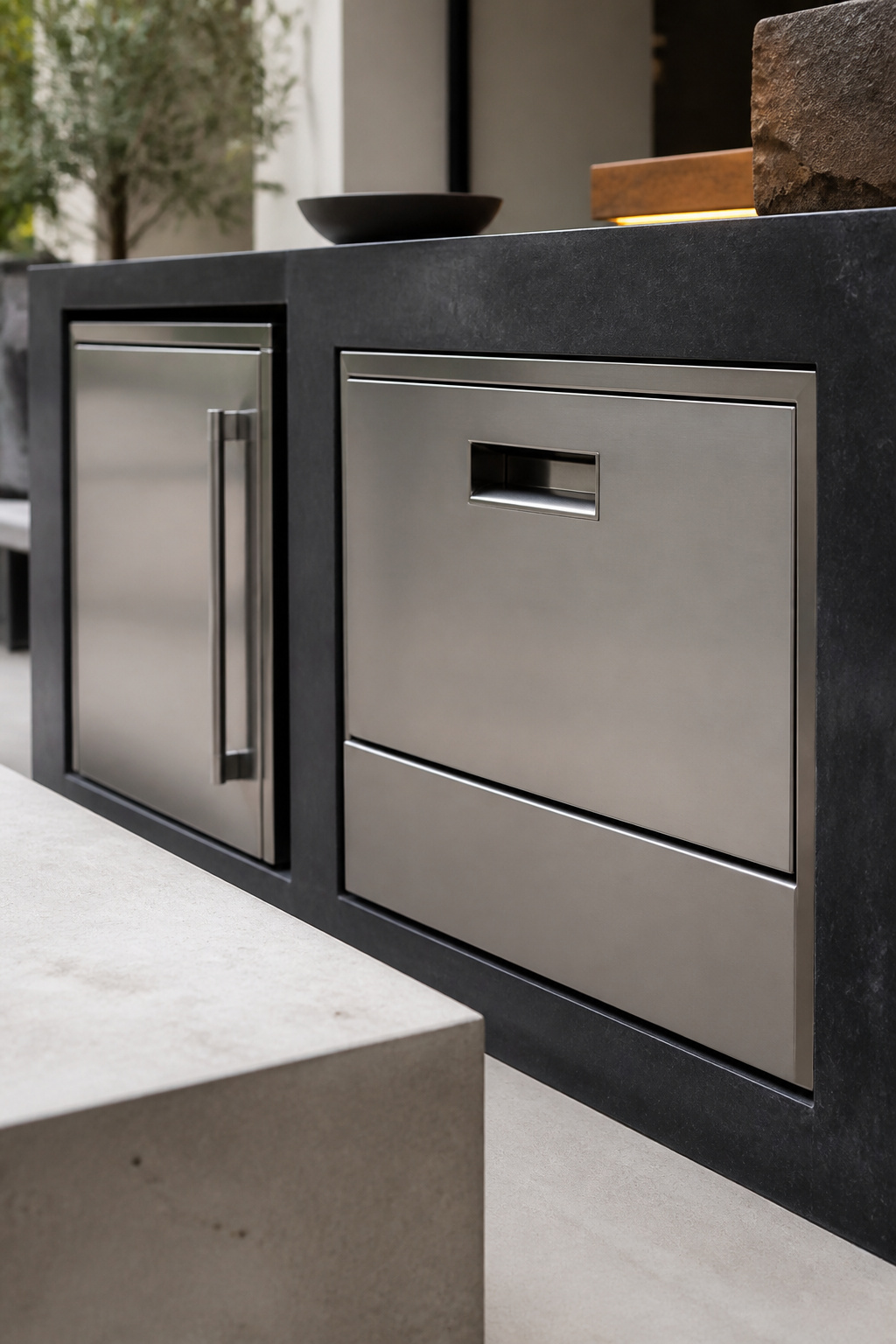
Flush grills and drawer fridges
Modern built-in grills are made for precise flush installation into the island wall, with recessed handles and a stainless body — commonly 304 marine-grade — so they sit as part of the cabinetry, not a unit dropped into a hole. Drawer-style refrigerators do the same for cold storage: they slide out at counter height, split across the run (produce by the prep zone, beverages under the island), and now come rated for outdoors.
What’s worth integrating, what can stay simple
The goal is capability per unit of visual clutter, not appliance count. Integration is a sequencing choice, not an all-or-nothing rule — a grill and a fridge earn flush integration because you use them every session, while an occasional-use item like a smoker or pizza oven can stay a distinct, simpler unit, since integrating it just adds cost. Where a grill offers LED-lit knobs or halogen work light, let it feed the lighting — the next facet.
Lighting That Completes the Look
A traditional kitchen decorates with its light: sconces, lanterns, an announcing pendant. A modern one does the opposite — the fixture’s job is illumination, and the signature is low, linear LED, nearly invisible by day, doing the whole job after dark.
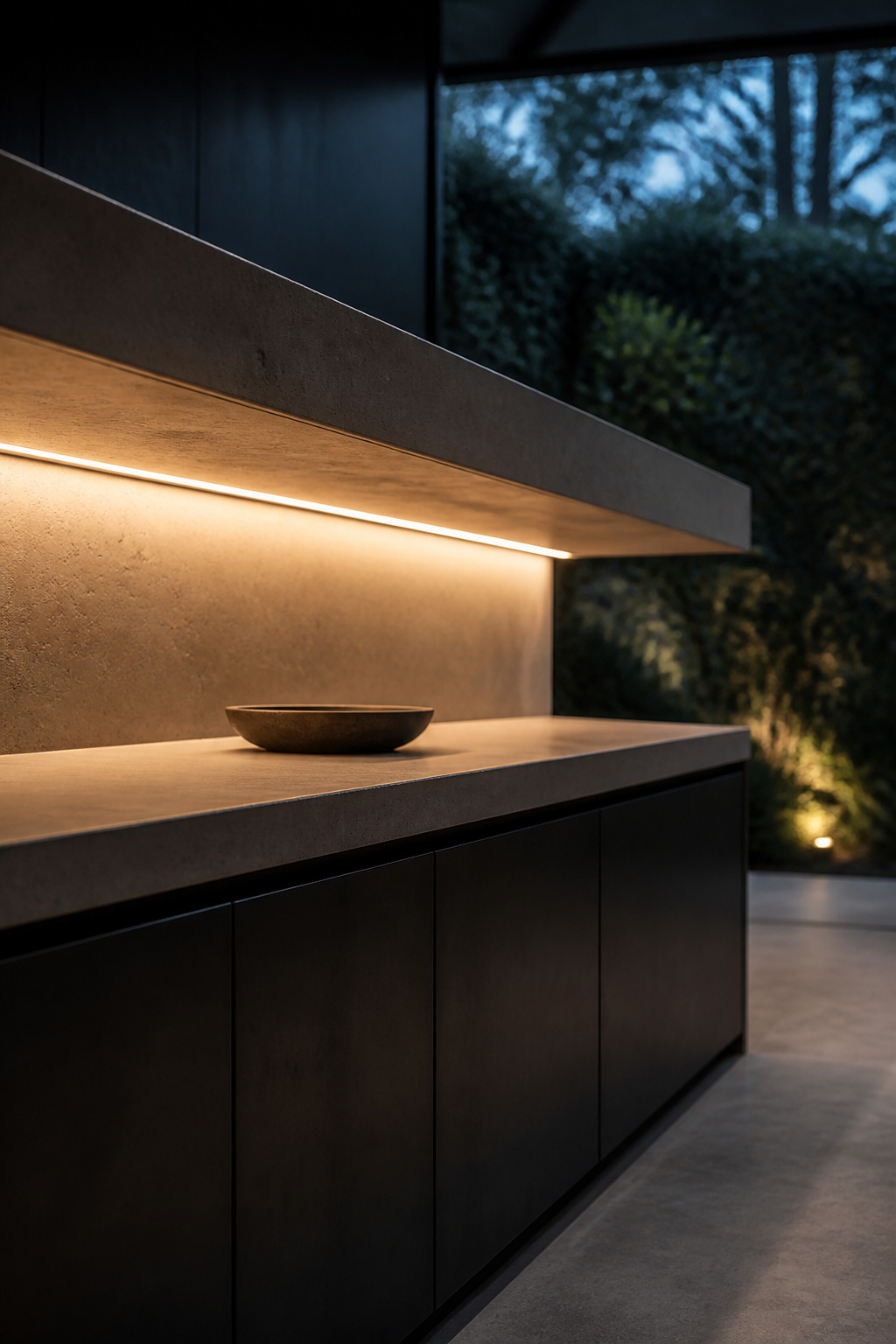
Low, linear light instead of ornamental fixtures
Linear LED bars throw slim, uniform light across a work surface, and their low profile makes the install nearly invisible. For outdoors, 12VDC low-voltage versions are built for wet-location use — the spec that lets the light line run safely under a counter overhang. One warm line beneath the counter replaces five decorative fixtures overhead.
Why light quality outranks fixture style, and how the kitchen reads after dark
Because the fixture disappears, its quality is all that’s left to judge. Premium LED strip aims for a high Colour Rendering Index so food colours read true, and strips at the same Kelvin rating can vary by up to 200K between makers — a high-density strip (60+ LEDs per metre) in an aluminium diffusion channel is the professional spec for a dot-free line. This is also where a monochrome palette earns or loses its warmth: matte cabinet and pale concrete have no warmth of their own, so a layered, warm-toned scheme — ambient, task, one feature light — keeps them soft rather than clinical at night.
A Cover That Completes the Contemporary Silhouette
The roof is the last facet, and the one people forget is a material decision at all. A cover finishes the silhouette, or undoes everything below it — it should extend the palette, not introduce a new one.
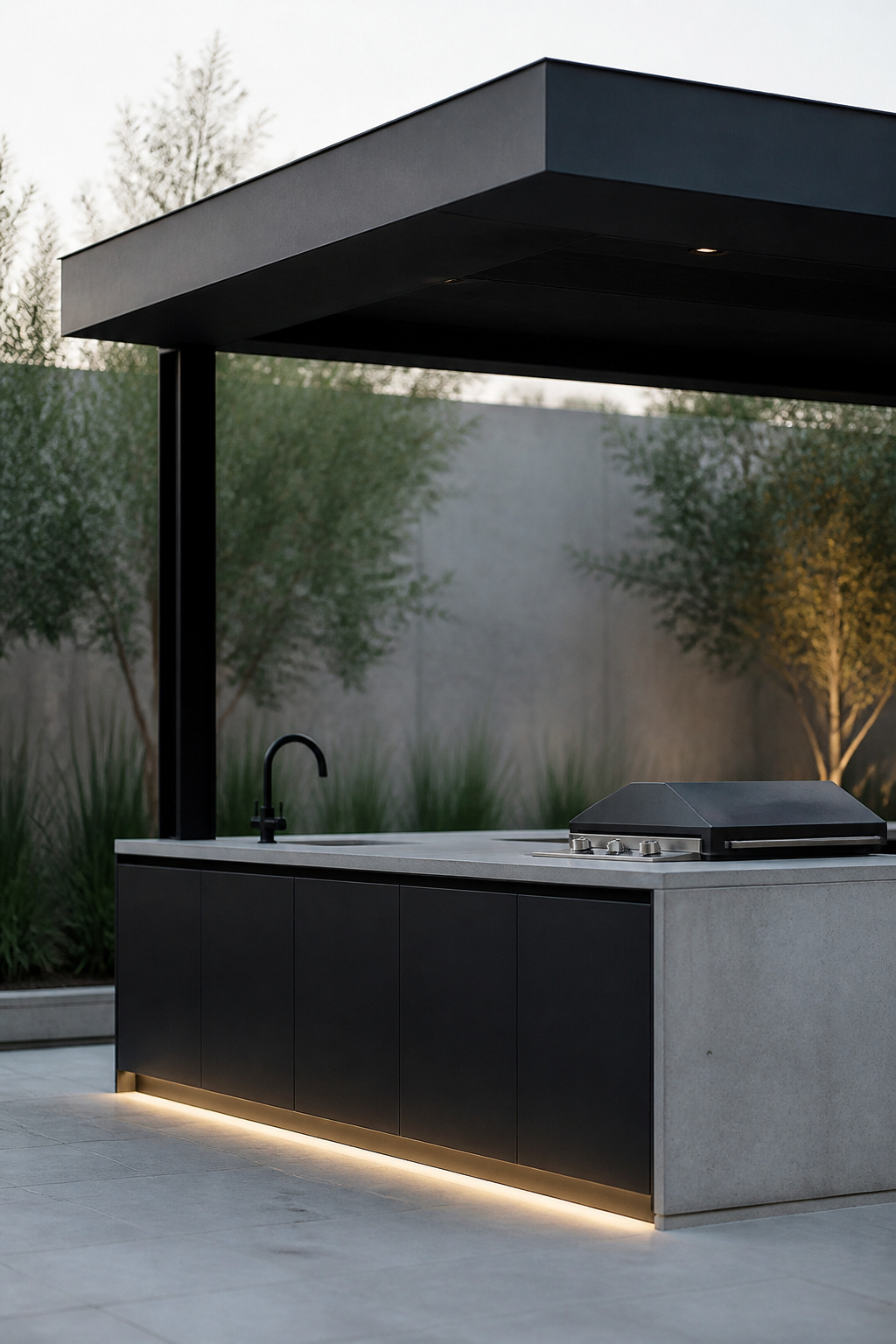
Louvered and flat roofs as the natural pairing
Louvered and flat-roof systems are built from aluminium or powder-coated steel — the same material family already in your cabinetry, associated with clean-lined contemporary structures rather than the rustic look of a natural-wood pergola. In a build that has otherwise chosen low-care materials — powder-coated steel, ipe, concrete — a wood pergola is the one high-maintenance, mismatched-tone outlier.
Why a fussy roofline undoes a clean build, and how to match structure to palette
An ornamented gable, decorative trim, a shingle pattern, a contrasting wood tone — each reintroduces the architectural detailing modern design strips away, and counts as another material against the rule of three. A flat or minimally pitched roof in the same blackened-steel or aluminium finish as the cabinetry avoids that, reading as one continuous system from countertop to roofline. The cover also carries real ventilation and clearance consequences; for the full comparison of pergolas, louvered and solid roofs, modern shade structures goes deep where this stays at style depth. And for how the modern look fits the wider decision, the complete guide to outdoor kitchen ideas is the place to start.
A modern outdoor kitchen is what restraint looks like when it’s done on purpose. Cap yourself at roughly three materials sharing one undertone, powder-coat the steel, hide the handles, integrate the daily appliances, run one low line of good light, and let the roof finish the sentence the counter started. Do that, and the sleek look arrives on its own — because you built the logic underneath it, not the colour on top.
FAQ
What colors are best for a modern outdoor kitchen?
Modern kitchens favour monochromatic or neutral palettes — whites, blacks, charcoals and cool greys — with at most one vibrant focal element, versus the warm browns and creams of a traditional palette. The real discipline isn’t picking one trendy colour, though; it’s keeping consistent undertones (all cool, or all warm) across every material so the restraint reads as considered.
Is a modern outdoor kitchen more expensive than a traditional one?
Not inherently. Outdoor kitchen costs span a wide range regardless of style — basic builds run roughly $5,000 to $12,000, a full average project about $13,000 to $17,000, and high-end or luxury kitchens $45,000 and up — driven by appliance count, utilities and labor, not the look. Powder-coated steel and integrated appliances carry a premium, but a restrained material count offsets it by skipping ornamental millwork.
How do you keep a modern outdoor kitchen from looking cold?
Ground the cooler steel and stone with one warm wood tone (ipe or cedar) and creamy neutrals, so texture replaces decoration as the source of warmth. Then layer the lighting — ambient, task and one feature light, all warm-toned — because matte, monochrome finishes have no warmth of their own after dark, and light is what makes them soft.