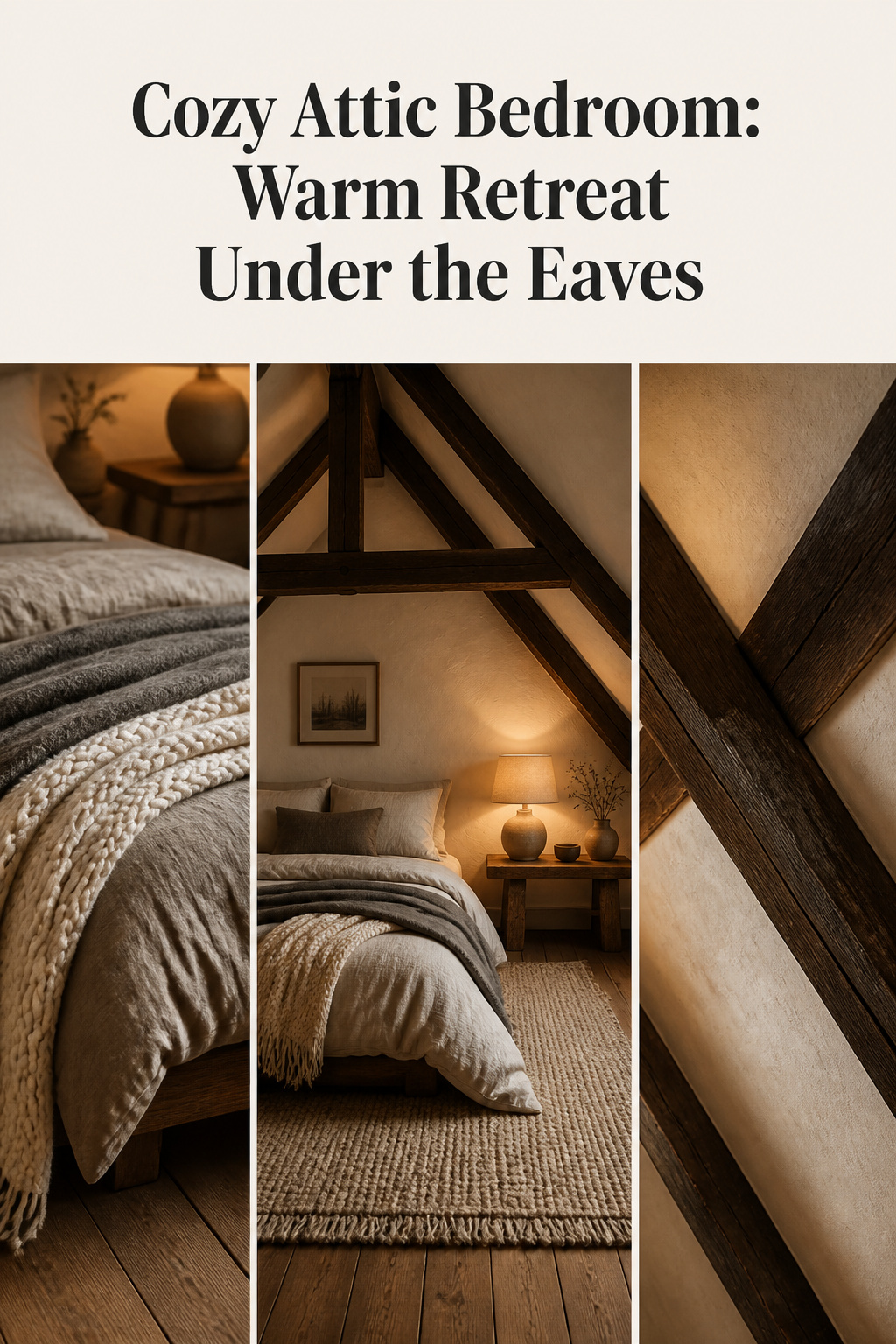
Step into a cozy attic bedroom on a wet evening and it meets you at three senses at once. The ceiling slopes down close overhead, so the air feels held rather than open. A wool throw drags rough and warm under your hand. One lamp throws an amber pool across a linen duvet, and the rain on the slates above is the only sound. That feeling has a name — hygge — and the low attic is the room most ready to deliver it.
TL;DR
- Layer textiles first: a linen base, a wool mid-layer, and one chunky knit throw — the highest-impact, lowest-commitment way to warm a cozy attic bedroom.
- Treat the slope as shelter, not a fault. Dark beams on warm plaster and warm whites at LRV 80–90 wrap the room around the bed instead of expanding away from it.
- Keep all light warm — 2700K, ideally pooled at bedside level rather than overhead. One lamp doing the work beats a cool overhead fixture that flattens every soft material below it.
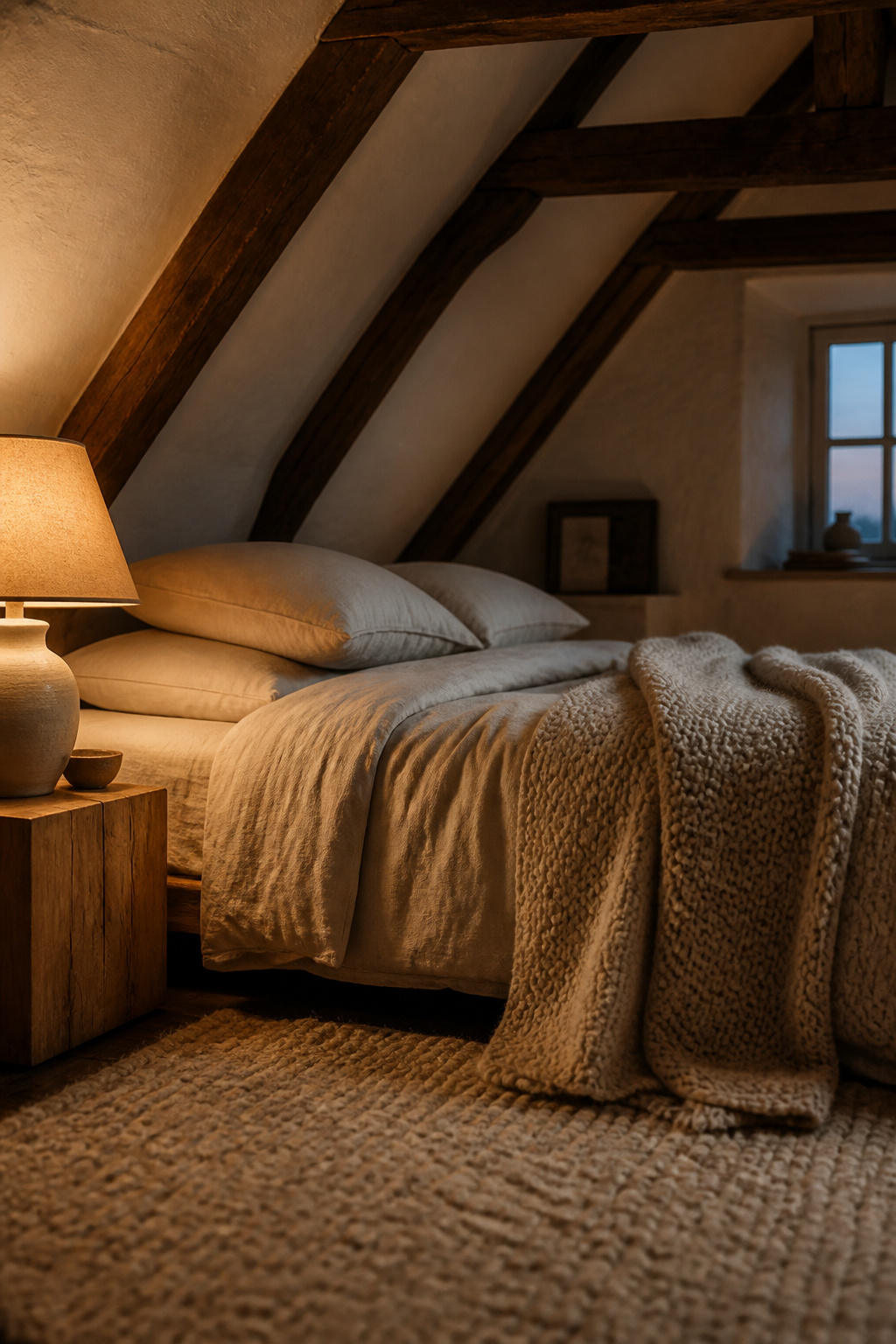
What a Hygge Attic Bedroom Actually Feels Like
The room you are building here has one purpose: to shelter you. Not to impress visitors, not to photograph well in morning light — to shelter the person in it after dark. Hold that, and every later decision becomes simpler.
The sensory experience: warmth, enclosure, and the smell of wool
Hygge is the Danish art of crafting a space that feels warm, inviting, and deeply relaxing — somewhere you unwind and recharge. It is built mostly from things you touch and smell, not things you see. Linen against skin, the lanolin warmth of wool, timber underfoot, a sheepskin so your morning foot never lands on cold plaster. Synthetic versions cannot stand in for these. The attic delivers the rest for free: its enclosed volume is the physical counterpart of the feeling.
Why the attic’s constraints make it the ideal hygge room
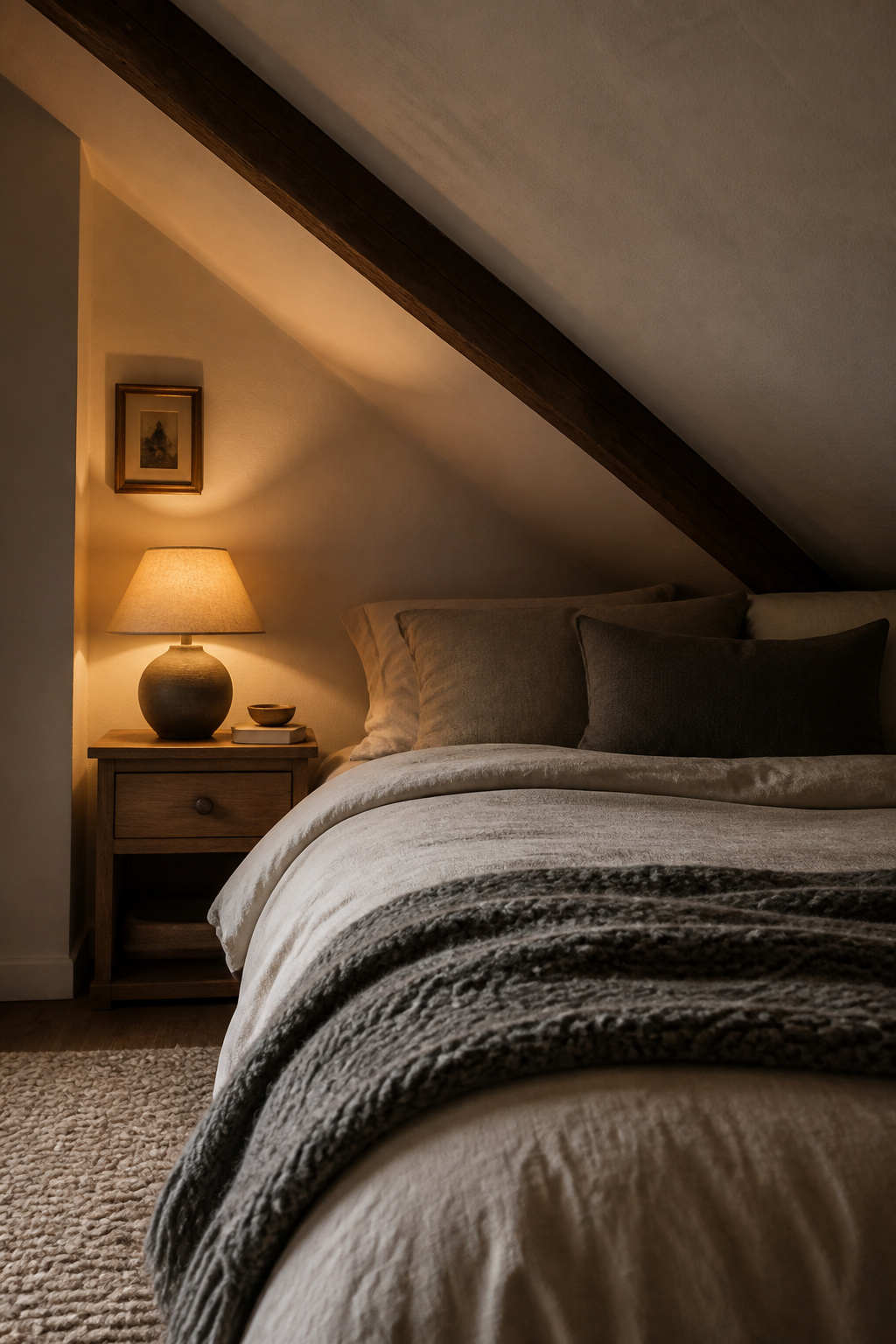
A low attic is not a compromised bedroom. Its separation from the rest of the house gives a privacy that ground-floor rooms cannot match. More than that, the sense of envelopment is the cornerstone of hygge — a room whose volume wraps around you rather than expanding away. Stop fighting the low ceiling, and the enclosure becomes the room’s most atmospheric quality.
The single decision that determines whether the room feels cozy or cramped
Every source agrees: the difference between cozy and cramped is whether you work with the slope or ignore it. The slope is not neutral — it either shelters the room’s occupant or compresses them, and the outcome depends entirely on whether the geometry is settled before the styling begins. A bed jammed under the eave without measuring the headroom, a dresser too tall for the space it claims — these are the moves that turn enclosure into suffocation. Work with it first. That decision is geometry as much as mood, and it starts with working with the sloped ceiling before any textile goes down. For the full room, see our guide to designing an attic bedroom.
Layered Textiles: The Quickest Way to Make an Attic Feel Warm
If the palette is the room’s mood, textiles are its temperature. They are also the fastest, most reversible warmth you can add — no commitment, no tools.
The textile stack: linen base, wool mid, and the throw that actually gets used
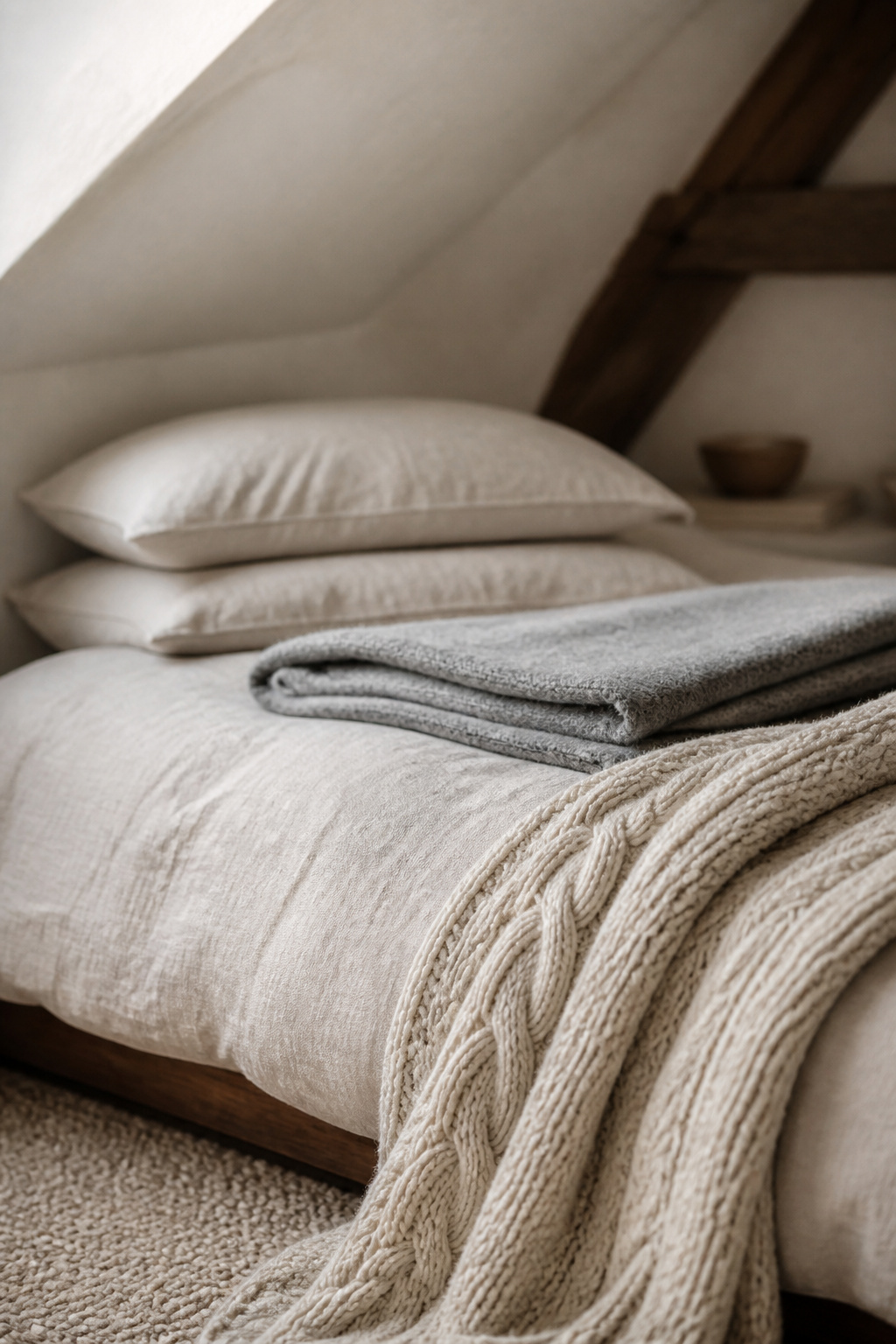
The stack runs lightest to heaviest. A linen duvet cover and pillowcases form the breathable base, since flax linen regulates temperature across seasons. A flat wool blanket goes over it as the insulating mid-layer. Then one chunky-knit wool throw at the foot of the bed — the layer your hand actually reaches for. Over 68% of Scandinavian consumers choose natural fibres like linen and wool for exactly this durability and feel.
Rug placement under a slope — where the boundaries work
The standard rule: a bedroom rug should extend 18 to 24 inches past the sides of the bed where your feet land. Under a slope I add one boundary — keep the rug inside the full-height zone and stop it where the ceiling drops. Run it under the low eave and it vanishes from standing height, grounding nothing. A dense wool rug earns its place twice over: a half-inch pile absorbs 25 to 35% of incident sound, so the room sounds calmer, not just warmer.
Weight and texture over pattern: the Nordic prioritisation
In a low attic, the architecture is already the visual event. A busy pattern competes with the beams; texture reinforces them. The Nordic instinct is to layer surface qualities — rough-woven linen against soft knitted wool against smooth ceramic. Variation you feel, not variation you decode. When you reach colour, choose the right cocoon palette to sit under these layers.
Exposed Beams: When to Celebrate Them and When to Paint Them Out
Beams are the structural luxury an attic gives you that a square box bedroom never will. How you treat them sets the room’s whole character, and there are only really two honest answers.
Dark beams on a light ceiling: the contrast logic
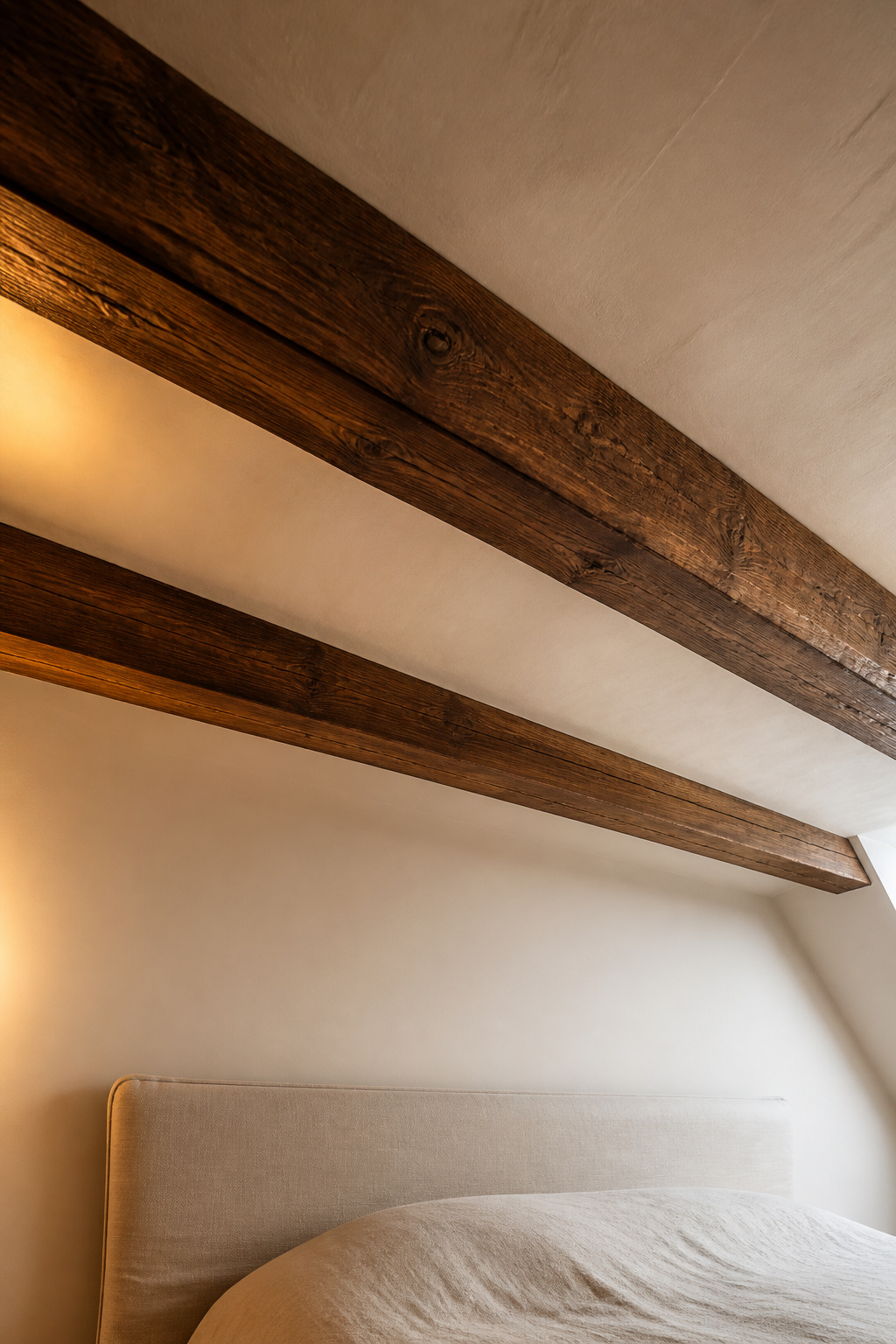
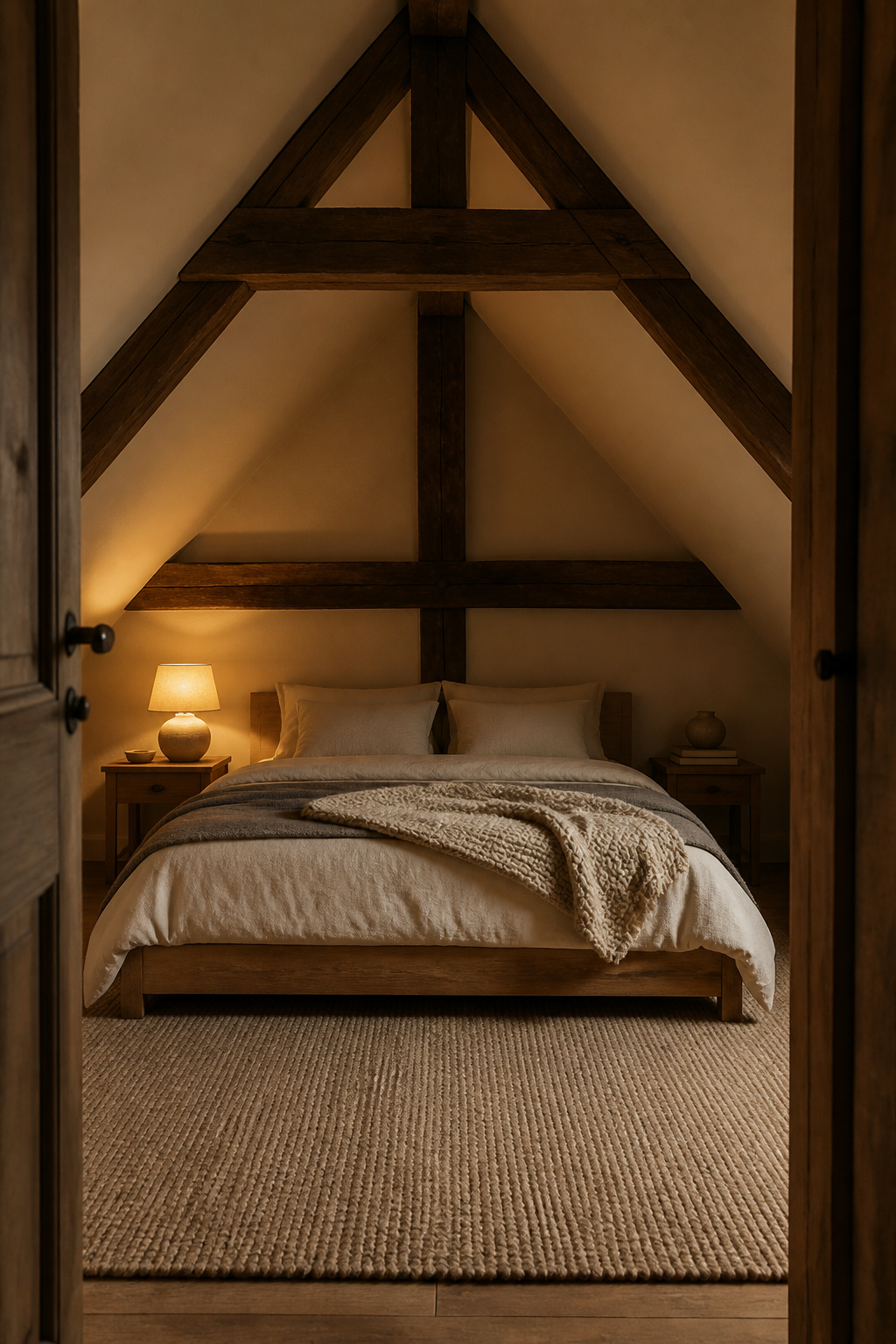
The classic warm choice is dark-stained beams against warm white or pale plaster. The contrast draws the eye upward; the warm wood tone makes the room read as inviting rather than stark. The beams also do organisational work: a dark beam grid gives the ceiling structure, letting the walls and textiles stay soft and recessive. For a hygge register, medium-to-dark stained timber is the right note — black and charcoal read industrial, a colder register than this room wants.
Painted-out beams: when the room asks for seamlessness
The other answer is to make the beams disappear. Paint them the ceiling colour and the plane reads as continuous — the move designer Hannah at The Otto House recommends for very low ceilings, where leaving every beam in raw timber makes the room feel smaller. It is the right call when the beams are later additions rather than original timber, or when the room already carries an overload of wood from an oak floor and pine furniture. Use a breathable paint where you can, so old timber can still move.
Lighting the beam: how a well-placed spotlight changes everything
Here I’m offering a taste, not a wiring plan. A single warm spotlight aimed along dark timber rakes the grain and casts a soft shadow that visually thickens the beam — adding depth to the ceiling without a scrap of new material. In my experience it reads close to firelight on wood. Which fixture type delivers it — and at what wattage — is a fixture question, not a styling one. The beam choice is yours; the bulb is a separate decision.
A Cocoon Palette: Choosing Colors That Work With Low Ceilings
Colour is where a room decides whether it shelters you or merely surrounds you. This is about the mood the palette creates — not where to cut in or how many coats, which lives in its own spoke.
Warm neutrals vs cool neutrals: how the choice shifts under the slope
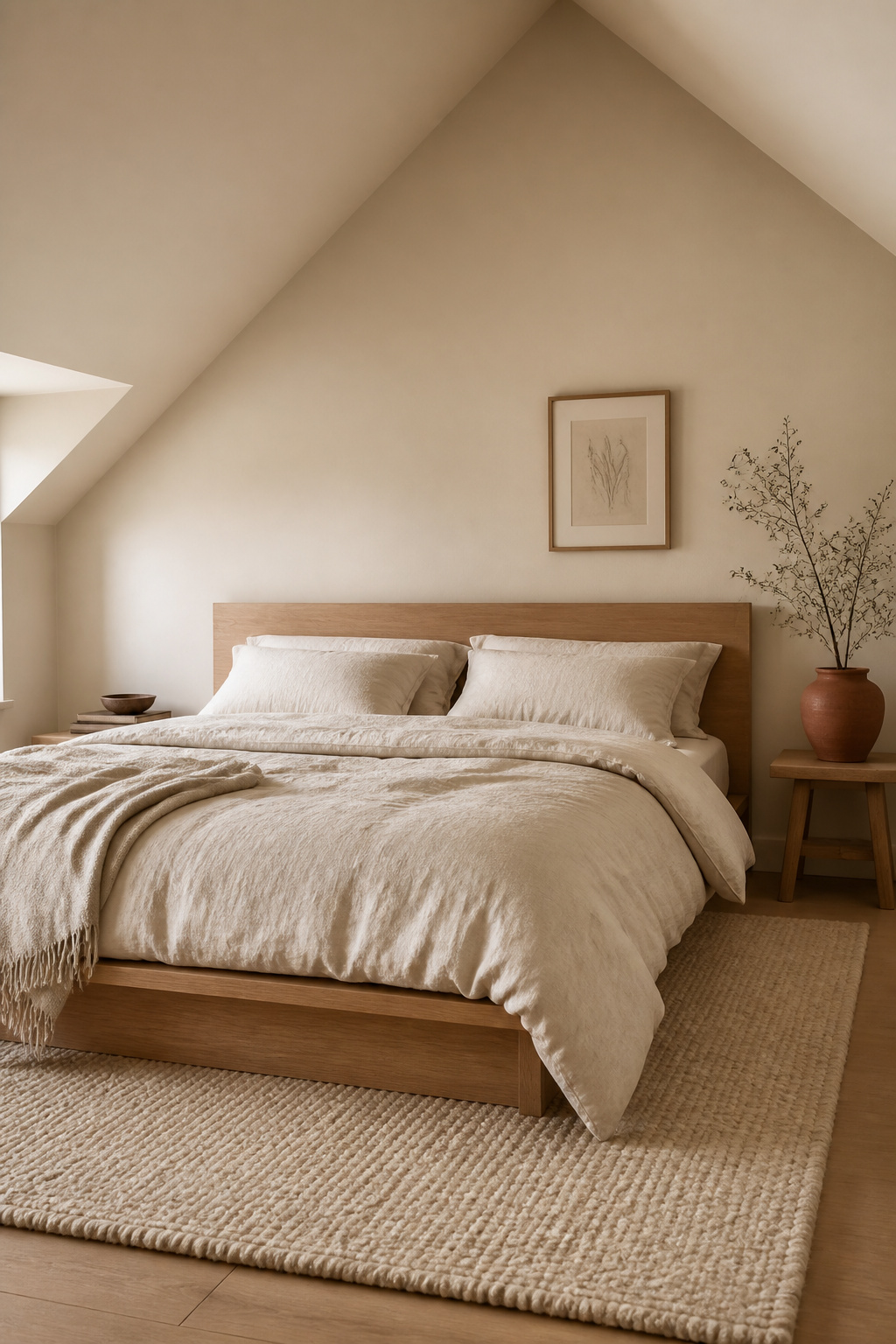
Under a low slope, a neutral is never neutral. Cool whites and greys bounce blue-toned daylight back at you and the room reads clinical. Warm whites and greiges absorb and re-emit warm tones, so the enclosure feels intended. For low-light Nordic rooms the professional standard sits at LRV 80–90 for ceilings and main walls — light enough to lift a dim attic, warm enough to hold it. Drop a warm earthy tone below LRV 60 in a room with no afternoon sun and it turns heavy and absorptive.
The case for dark walls in a small attic room — when it works
Going dark in a small attic is not the mistake it sounds. As Benjamin Moore’s Hannah Yeo notes, dark colours in a poorly lit room “maximise its cocooning effect” — the complex undertone evokes intimacy rather than gloom. The mechanism is boundary-blurring: the walls recede into a contained, jewel-box dark. Two conditions make it work: choose hues with warm green or blue undertones, never energising reds, and add lighter accents — off-white bedding, an oatmeal wool rug — so the room reads cocoon, not cave.
Accent colours that add warmth without breaking the mood
The accent is the last colour decision, not the first. Earthy tones carry warmth — terracotta’s sun-baked quality triggers an almost primal sense of groundedness — but in a bedroom they must drop in saturation. Clay pink, dusty rose, muted sage are the right picks for rest. Full-strength terracotta or ochre belongs in a throw pillow, a single clay pot, a woven basket — never on all four low walls, where the saturation turns oppressive at that height.
Soft Light and Natural Materials: The Two Finishers
Textiles, beams, and palette set the room. Two finishers complete it: warm light kept low, and natural materials you can touch.
The candle-level baseline: how low to go with ambient light for a retreat mood
Hygge light is warm, dim, and comes from several small sources, not one bright overhead. The Danes lean on candles for exactly this — warm pools that bring calm to a room. The most hygge light sits at 1800–2200K, the deep amber of candlelight; 2700K LEDs are the practical standard, and above 3000K warm materials grey out. This matters beyond mood: warm light slows the heart and prompts melatonin, while blue-white light above 4000K suppresses it. The attic’s naturally low light isn’t a deficiency — it’s aligned with the room’s purpose.
Wood, stone, and woven materials that earn their place
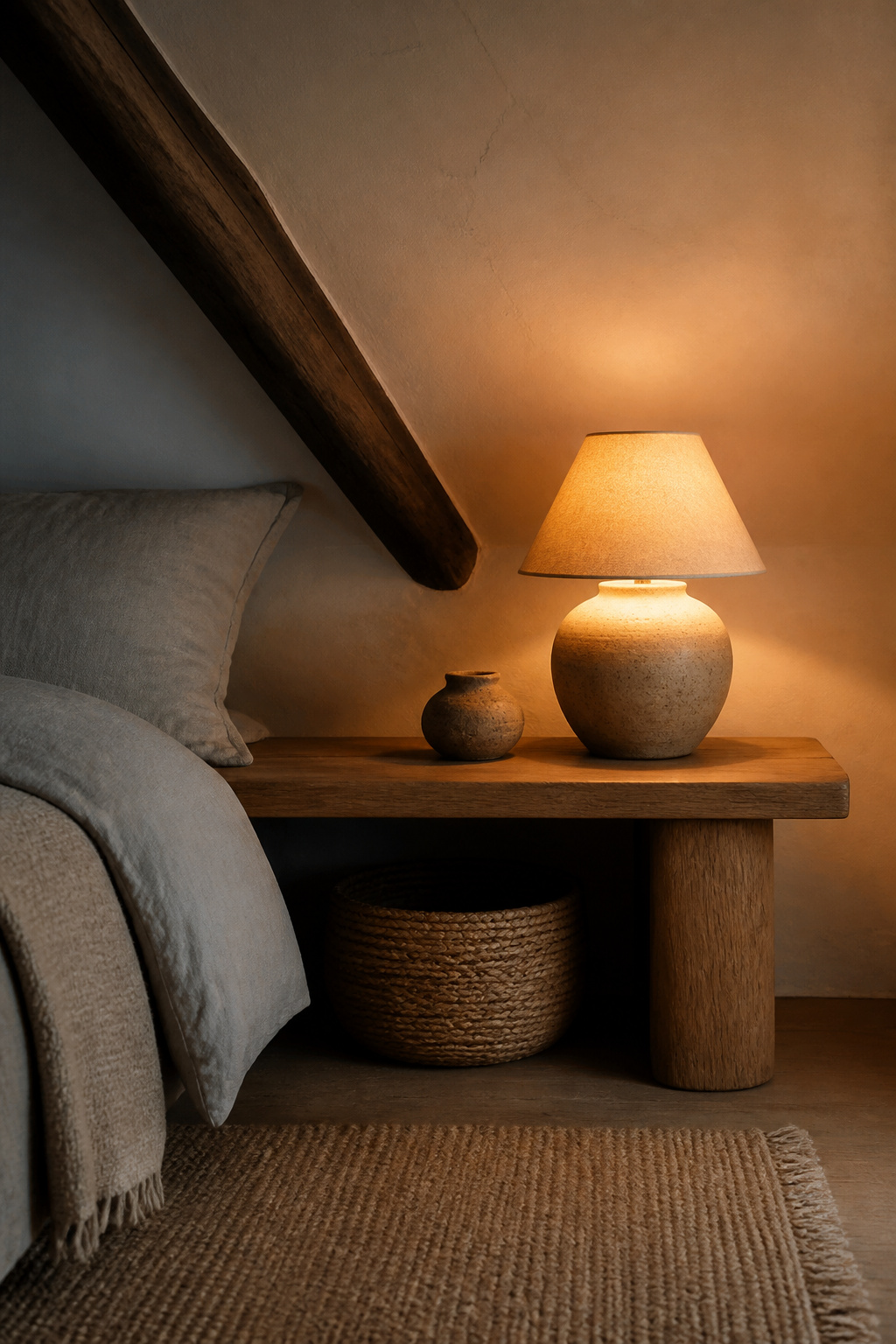
Natural materials add a warmth synthetic ones cannot fake, because here they are touched as much as seen. A solid-oak nightstand, grain and knots left visible, grounds the textile layers with something hard and honest. Woven seagrass or rattan baskets tuck under the table, adding texture while keeping the floor clear. A little stone or ceramic — a clay dish, a hand-thrown vase — sets weight and coolness against the soft linen and wool. Laminate that mimics timber fails the test: in a hygge room the surface has to reward the hand, not just the eye.
The one element to add last — and what it reveals about the whole room
I build a room like this from the structure inward: palette and beams first because they’re permanent, then textiles because they adjust, then the considered accessories. The last thing I place is one warm lamp at bedside level — a ceramic or rattan base lighting only its own small zone. That lamp is also the test. Turn everything else off, switch it on, and if the room reads warm and complete with that single pool of light, every earlier decision was right. If it still feels cold, the work isn’t finished, however many throws are on the bed.
Your Cozy Attic Bedroom: The Version That’s Actually Within Reach
The retreat from the opening — held air, warm wool, one amber lamp against the rain — is not a styled set you need a budget to reach. It’s a short, ordered sequence of plain decisions.
The low-investment order: textiles first, paint second, materials third
Start with textiles, because they buy the most warmth per pound and commit you to nothing. A linen duvet and a wool throw change a room’s character for the cost of an afternoon, and they hand the palette a reference point — you choose the paint to sit under tones you can already see. Paint is the second commit, once that direction is set. A solid-wood lamp and a ceramic piece or two come last, completing the material story without a day of renovation.
What to resist — the cozy traps that add clutter without warmth
A cozy room is less about buying cozy things and more about reducing visual noise — and in a low attic, every surface the eye reaches must be chosen, not accumulated. The traps to resist:
- Throw pillows piled until they compress the bed you have to clear every night.
- Five candles grouped where one does the same work.
- All-white surfaces and a recessed cool LED — fresh in a photo, cold in the room.
- Books and objects stacked as styling props rather than because you use them.
The finished room and the feeling it gives back
What the finished room gives back is specific: the reduced friction between your environment and your nervous system that lets you settle. A hygge bedroom is documented to support deeper, more restful sleep — the real return on the linen and the warm light. The attic was never the obstacle. Its low, enclosing volume is the one thing a grander bedroom can’t buy, and once the textiles, the beams, and the single warm lamp are in place, the room does what you walked into it wanting.
FAQ
How do you make a small attic bedroom feel cozy?
Start with layered natural textiles: a linen duvet as the breathable base, a wool mid-layer for insulation, and a chunky knit throw at the foot of the bed. Then switch every light to warm 2700K and pool it at bedside level rather than overhead. Finally, resist adding more — coziness comes from reducing visual noise, not accumulating accessories.
What colors make a low-ceiling attic bedroom feel warm?
Warm whites and greiges in the LRV 80–90 range are the professional standard for low-light Nordic rooms — they read warm rather than cold and reinforce the sheltered feeling without darkening the space. Add earthy accents like terracotta, ochre, or dusty sage through textiles and small ceramics, kept muted, never as a full-strength wall treatment.
Should you use dark or light colors in an attic bedroom?
Both work through different mechanisms. Warm whites and greiges reinforce available light and make the slope feel clean and deliberate. Dark colours — deep greens, navies, charcoals with warm undertones — blur the room’s boundaries into a jewel-box intimacy that suits the enclosed volume. If you go dark, add lighter accents like linen bedding to prevent a cave-like result.