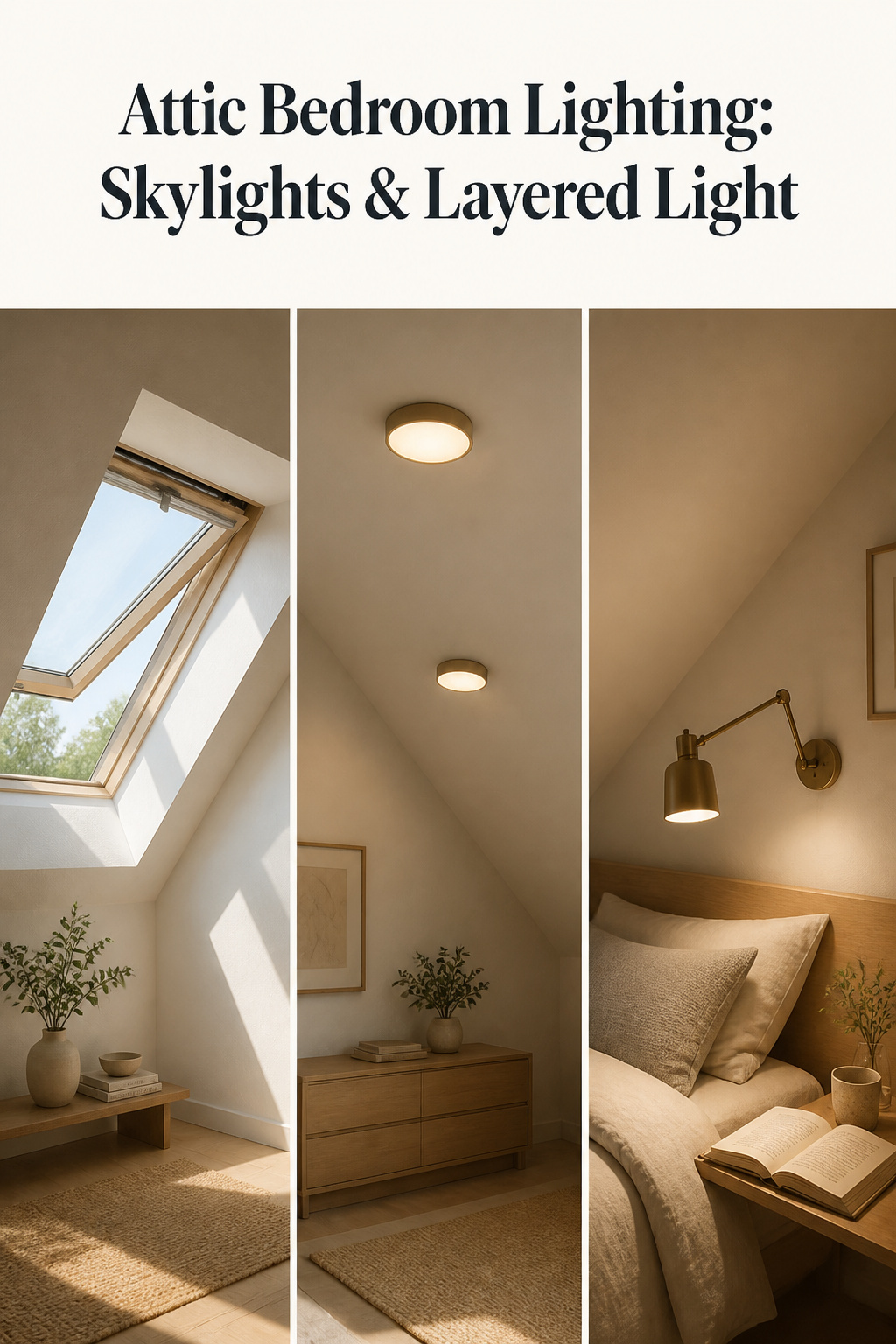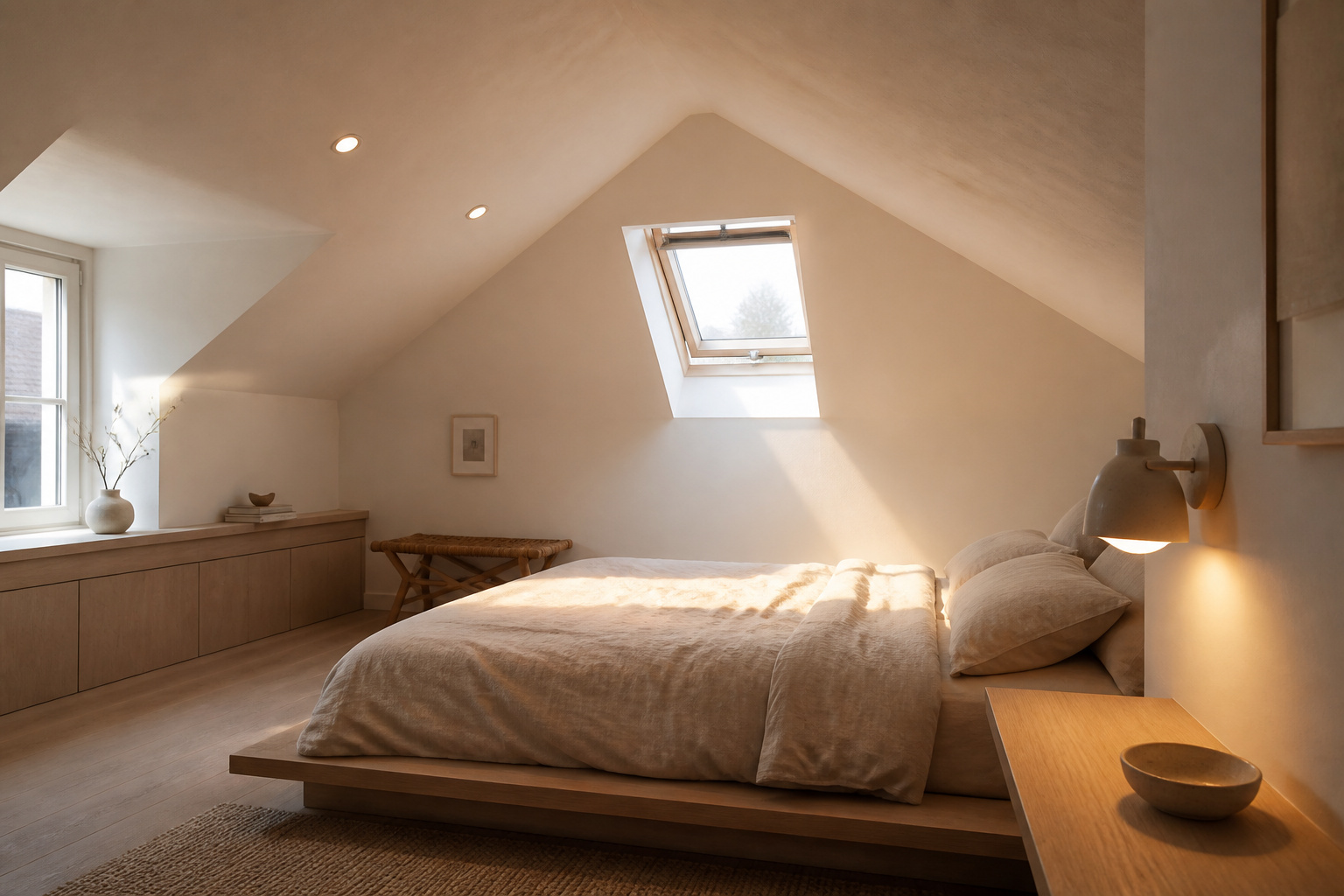
Here is the thing almost nobody gets right about a dark attic: the fix is never another fixture. Add a brighter bulb, then a second downlight, then a third, and the room only feels lower and busier with each one. The counterintuitive truth behind good attic bedroom lighting ideas is that fixture count is the wrong variable. A low, sloped room does not need more light. It needs light arranged in layers, kept warm, and placed so the slope works for you rather than against you.
TL;DR
- The mistake is adding fixtures; the fix is layering. Aim for 3–5 sources — one ambient, one or two task, one or two accent — all held at 2700K, each on its own dimmer.
- An operable skylight is the highest-value natural-light move, typically $1,200–$5,000+ installed; an east-facing position gives morning light, and the opening vents the hot air that gathers under the slope.
- True flush mounts work under 7 feet, gimbal trims fix recessed glare on a slope, and a bedside swing-arm sconce at 60–65 inches keeps reading light off the ceiling entirely.
The Attic Lighting Mistake Almost Everyone Makes
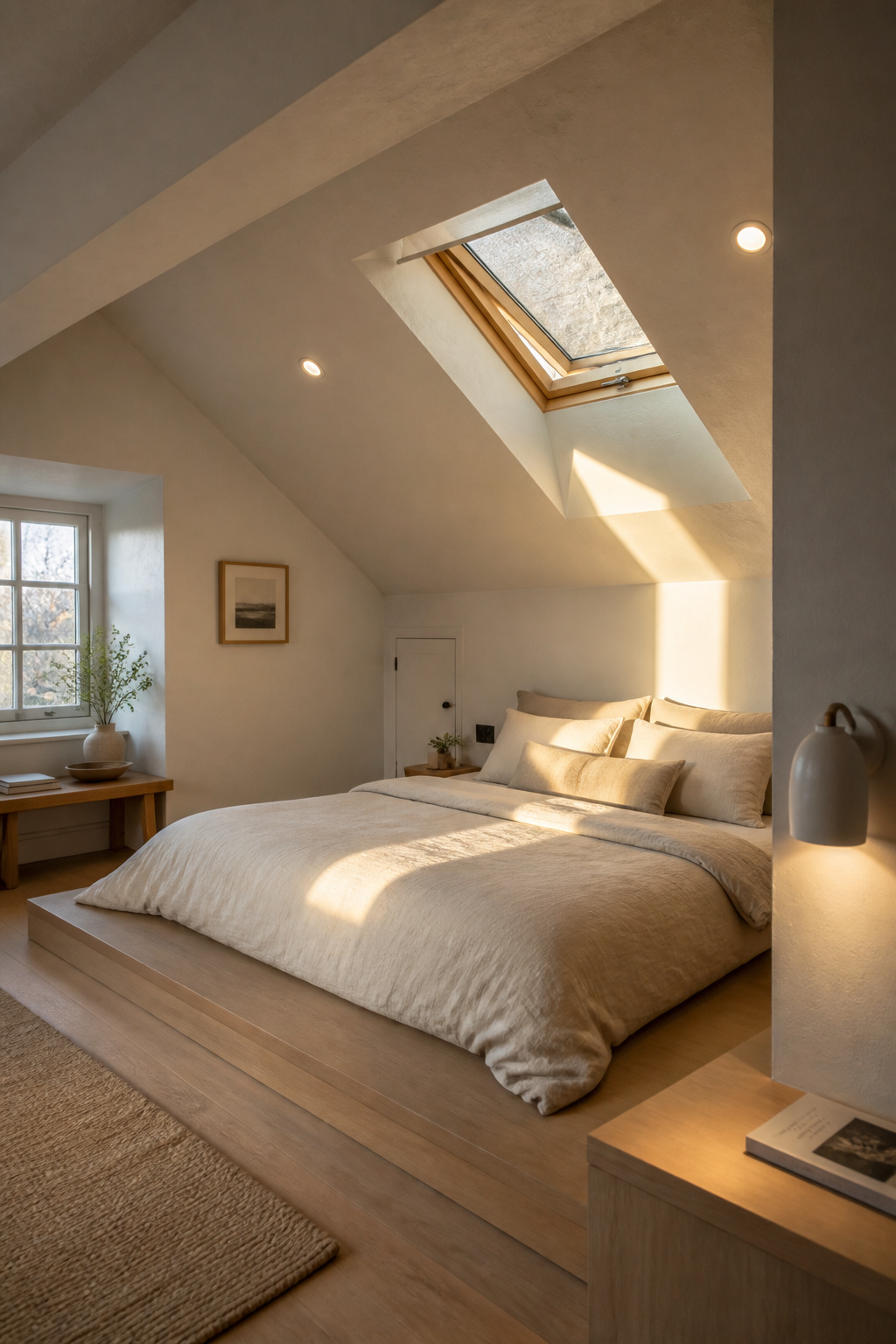
Before any fixture, ask what you want the room to be after dark. An attic bedroom should feel calm and held, not like a cellar lit by a single bare bulb. That answer rules out the most common approach before you spend a krona.
Why adding more fixtures makes a low ceiling feel lower
One central fixture leaves dark corners and harsh shadows. The instinct is to add more, but oversized or overcrowded fixtures crowd the ceiling line you already cannot raise. The fix is not quantity. It is coverage from several modest sources, plus light directed up the slope — indirect light bounced upward makes ceilings read higher and fills the middle height a single overhead source always misses.
What Scandinavian winters teach you about light as material
In Sweden, Denmark, and Norway, natural light is genuinely scarce for months. That scarcity made light the central axis of Nordic design, not a decorative afterthought. Light is the first material of a room, and you learn that in a winter country or you live badly. So the Scandinavian scheme is never harsh overhead brightness. Instead it layers sources that mimic daylight’s soft transitions — general light overhead, gentle diffusion from the walls, warmth low down for intimacy.
The layered-light principle that changes every decision after it
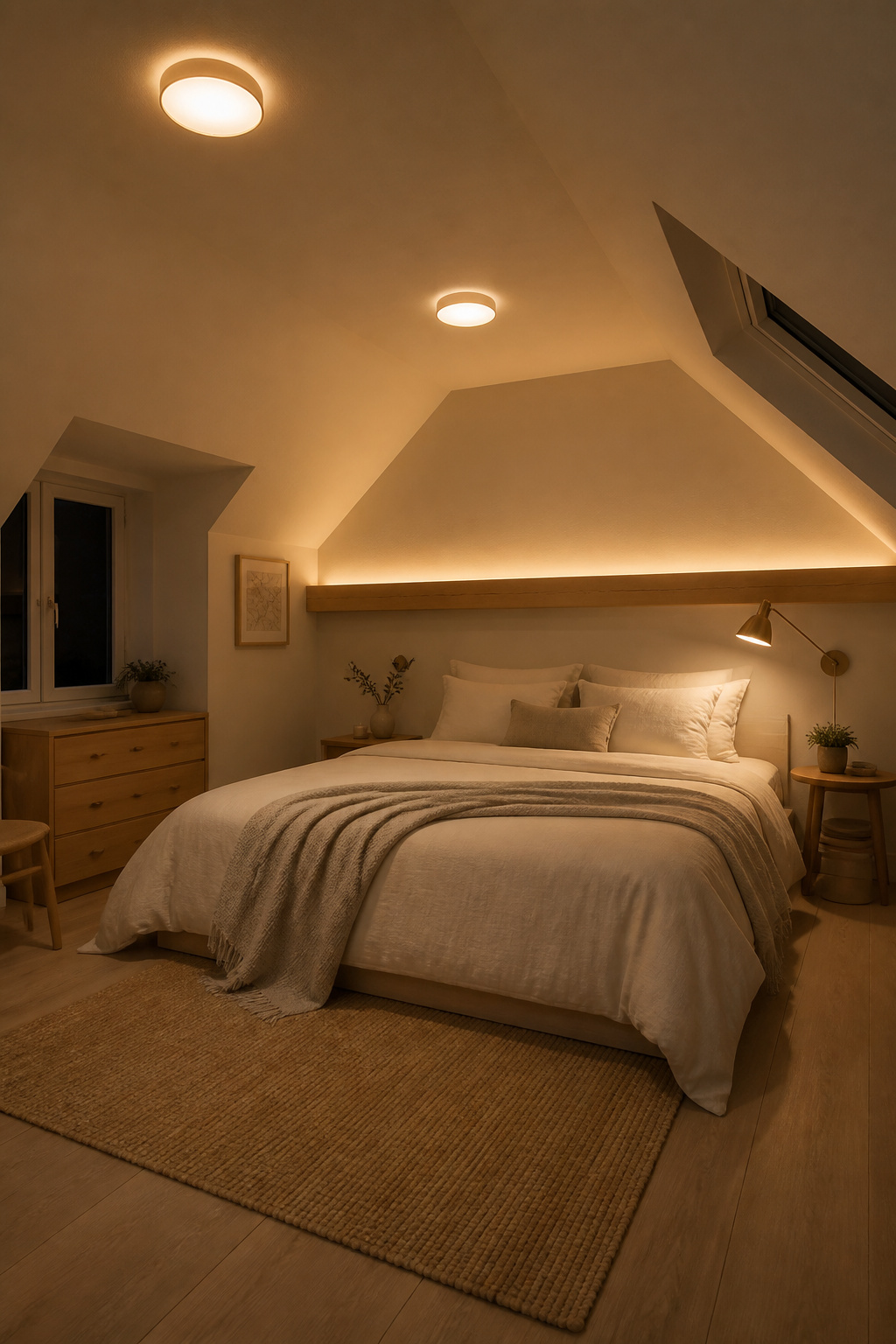
Professional designers split bedroom lighting into three types: ambient, the soft and even foundation; task, directed at reading or dressing; and accent, the finishing layer on architecture. The order matters — ambient first, task second, accent last. The optimum mix is 3–5 sources: one ambient, one or two task, one or two accent, all held in the 2700–3000K range with each on its own dimmer. In an attic this does double duty: wall sconces and a strip light carry some of the load, so the ceiling needs fewer fixtures, and the crowding problem solves itself. Light is one piece of the larger puzzle — the slope, the storage, the palette — covered in our full guide to attic bedroom ideas.
Skylights in an Attic Bedroom: Where They Earn Their Cost
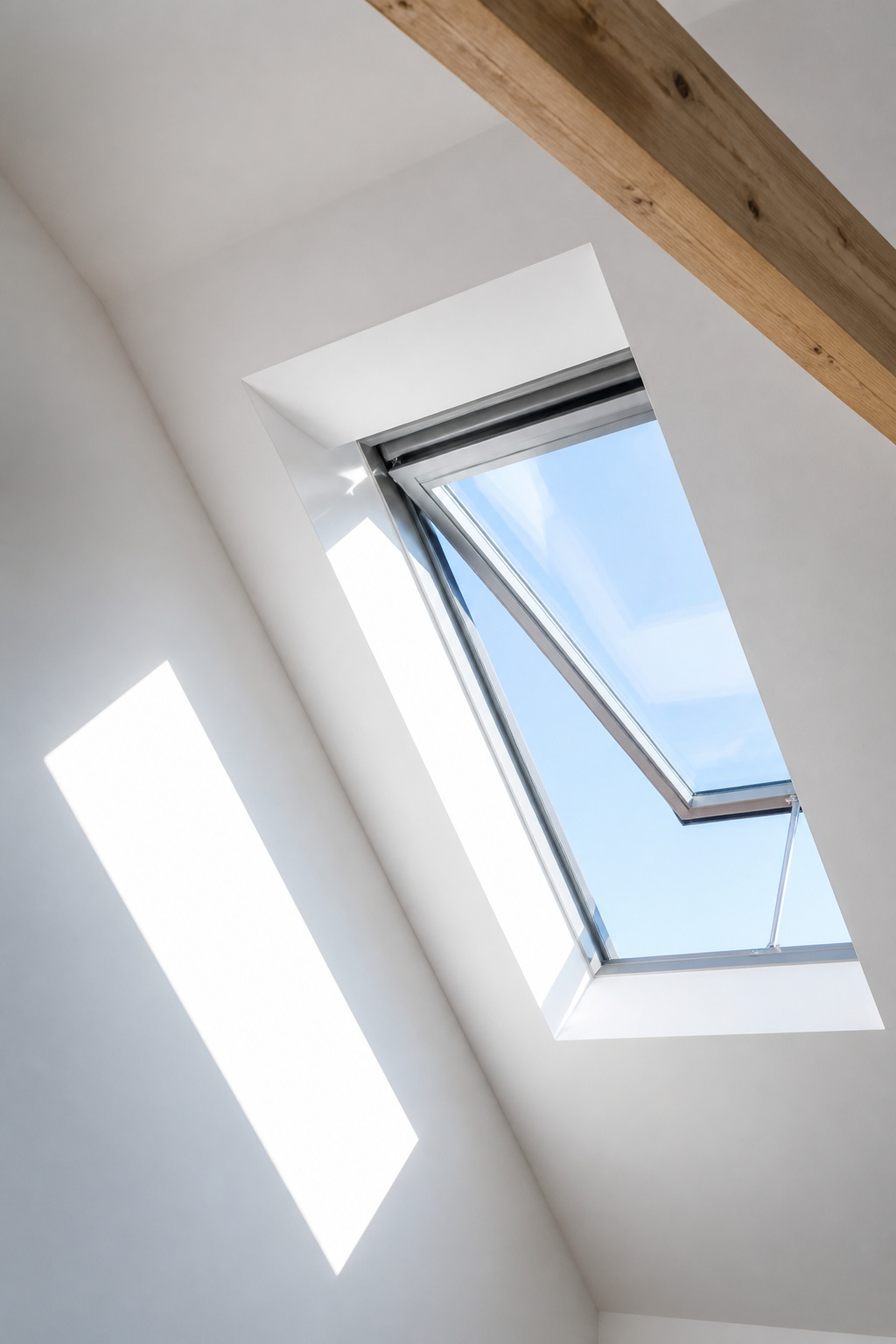
A skylight is the most transformational natural-light move in an attic. The decisions are which type, where on the roof, and what it truly costs once the structural work is counted.
Operable vs fixed: the ventilation argument for an attic room
A fixed skylight is the entry option, but an operable one earns its premium in an attic specifically. Heat rises and gathers under the slope with nowhere to go; an operable skylight releases it through the chimney effect, drawing cooler air in through lower windows. Solar-powered VELUX models include a moisture sensor that shuts the unit when it rains — useful above a sleeping head. For an attic bedroom, the ventilation case alone justifies operable over fixed.
The table below compares the natural-light options on the terms that matter under a sloped ceiling.
| Option | Light gain | Ventilation | Cost range (installed) | Best position |
|---|---|---|---|---|
| Fixed skylight | High, directional | None | $1,200–$2,000 | East or north slope |
| Operable skylight | High, directional | Yes — vents rising heat | $2,500–$5,000+ | East for morning light |
| Sun tunnel (14 in) | ~250 lux / ~3,000 lumens midday | None | Lower; smaller penetration | Any sunny slope |
| Dormer window | Vertical, all-day | Yes if operable | $6,000–$25,000 | Wall facing daylight |
Positioning and cost: what you actually pay
Orientation changes the light more than the unit does. East-facing skylights give maximum light and warmth in the morning — the US Department of Energy names them ideal for bedrooms, since early daylight matches when you wake. North-facing gives constant, cool illumination with low heat gain. South-facing offers the most solar heat but allows unwanted summer gain, so it suits an attic only with low-E glazing or a shade. One rule keeps you out of trouble: in a room with few windows, the skylight should not exceed 15% of floor area. Oversizing is the most common error in attic conversions, bringing glare and thermal swings rather than comfort.
A professional skylight install in 2025 averages around $4,000, with most homeowners paying $1,100–$3,500 for a fixed unit. The unit is the small part. Installation means cutting the roof, adding structural headers, flashing, and waterproofing — and in a finished attic, the shaft also needs drywall, insulation, and trim. Permits are mandatory in almost all US jurisdictions; skipping them risks fines, stop-work orders, and denied insurance claims. The DOE is plain on the rest: leaks are the most common failure of a badly installed skylight, and a leak over plaster and insulation is exactly the damage you do not want above a bed. This is professional work. Once the light is in, the warm fill and styling that make the space a cozy attic retreat are a separate, gentler project.
Dormer Windows: Adding Light Without a Full Skylight Install
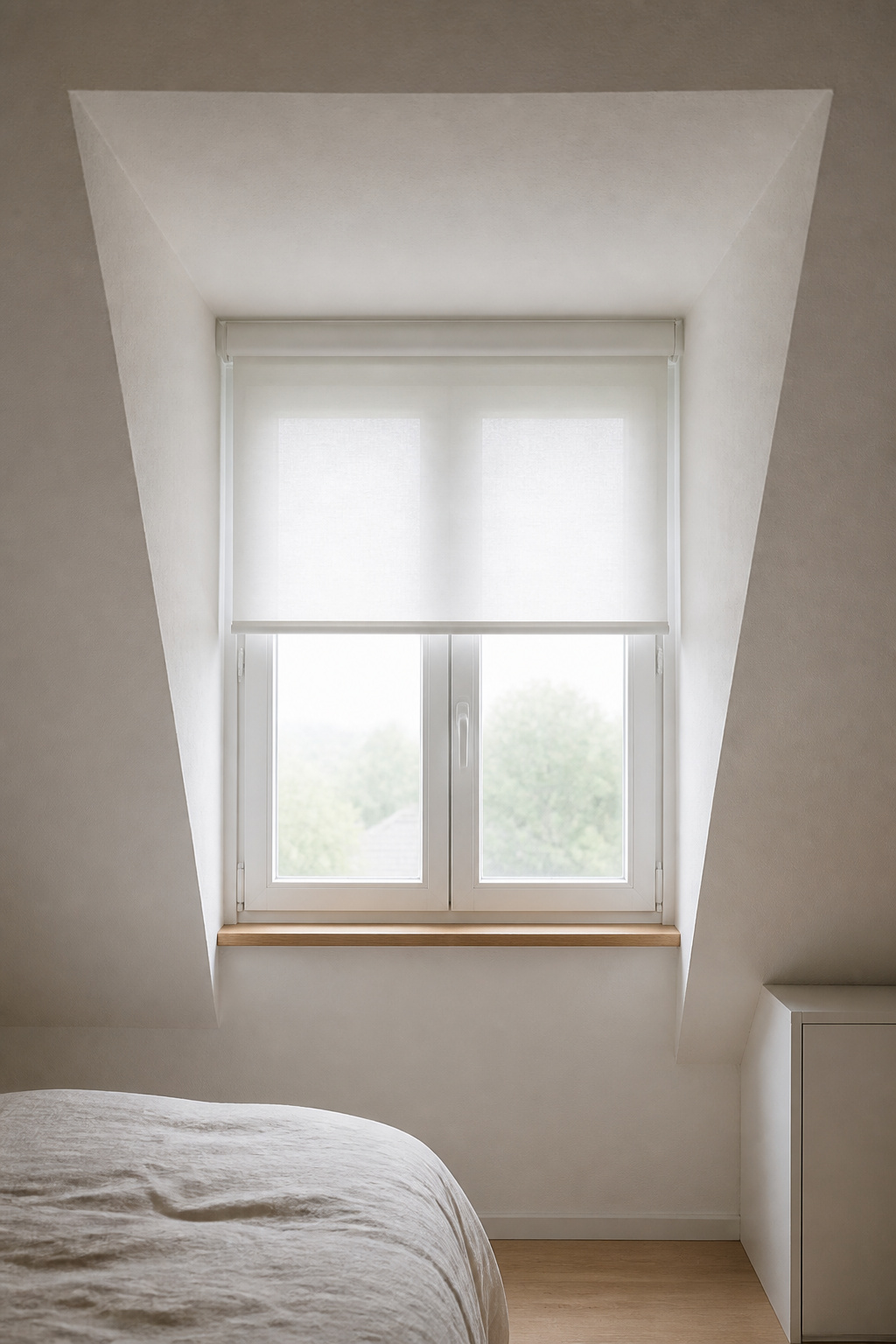
A dormer is a different intervention from a skylight, not a more expensive version of one. It projects vertically from the roof, bringing a conventional upright window and, with it, the headroom and floor space the slope had stolen.
How a dormer changes both light and usable floor area
A skylight solves light. A dormer solves light, headroom, and square footage at once — it turns the triangular dead space under the eaves into room you can stand in. That is why a dormer is often essential where the attic lacks the headroom to be livable, while a skylight only lights a space you still cannot use. Many of the best conversions combine the two: a shed dormer along one wall, skylights on the opposite slope for extra light.
Dormer window treatments: keeping light while managing heat and glare
A dormer’s quiet advantage is that it takes ordinary blinds. It is physically akin to a standard window, so roman and roller blinds fit straight off the shelf — no specialist ceiling-tracking system, as a skylight demands. For a bedroom, blackout is the right call, because the lining doubles as a thermal barrier: the acrylic coating that blocks light also slows heat, which matters because attics run warm as heat rises. A thermally lined blind keeps summer afternoon heat down and winter draught out, while still letting you flood the room with daylight by day. How that daylight reads on the walls depends on the paint colors for the slope, a decision worth making alongside the windows rather than after them.
When a dormer is the better investment over a skylight
The cost gap is real and large. A basic skylight runs $1,500–$5,000 installed; a professionally built dormer runs $6,000–$25,000, with most projects near $15,000. But the dormer adds floor space and headroom that count toward the room’s official square footage, so it lifts the property’s value in a way a skylight usually does not. The decision rule is clean. Choose a skylight when the attic already has standing headroom — 7 feet or more at the peak — and needs only light. Choose a dormer when the room is too tight to stand in and needs both light and livable floor.
Low-Profile Ambient Fixtures for a Sloped Ceiling
Natural light handles the day; the ambient layer carries the room at night. On a low ceiling the fixture choice is constrained before it is stylistic. Two families work under attic clearances, and a third needs a specific trim to behave.
Flush and semi-flush mounts that work under 7 feet
A true flush mount sits against the ceiling with zero drop, which makes it the safe choice at a 7-foot clearance. A semi-flush drops a few inches and suits 9–10 foot ceilings, so on a low attic ceiling keep any drop small enough to hold 7 feet of clearance. There is one reason to accept a small drop: a semi-flush with an uplight component bounces light off the ceiling and makes it appear to glow and lift — worth its few inches in an attic, provided the clearance still holds.
Recessed lighting on a sloped ceiling: the tilt-trim that makes it work
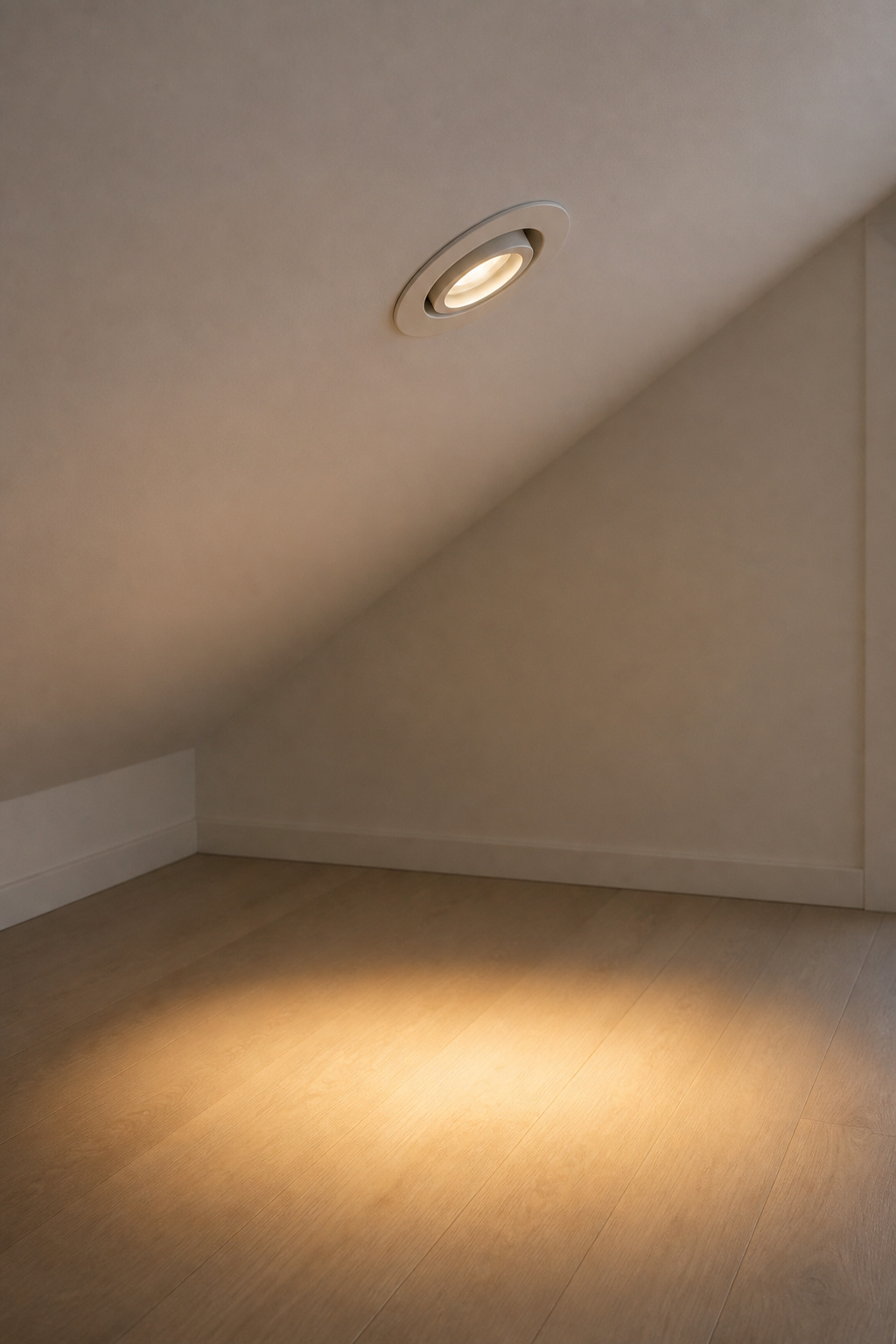
A standard recessed downlight does not work on a slope. The beam follows the ceiling pitch and points at your eyes — lighting contractor Andrew Schmitz describes it as feeling like the sun is shining in your face. The fix is a gimbal, or eyeball, trim that rotates the beam to point straight down regardless of pitch; gimbals tilt 15–25 degrees for moderate slopes, with high-tilt versions reaching 35–45 degrees for steep pitches. In an insulated attic ceiling the housing must be IC-rated under NEC code — a fire-safety requirement, not an upgrade. Aim for at least 600 lumens per fixture, since the slope lengthens the throw to the floor.
The short table below sets the ambient options against the constraints that decide them.
| Fixture type | Min clearance | Color temp | Dimmer-compatible |
|---|---|---|---|
| True flush mount | Works under 7 ft | 2700K warm | Yes, with trailing-edge dimmer |
| Semi-flush (uplight) | Hold 7 ft floor clearance | 2700–3000K | Yes |
| Gimbal recessed | Needs IC housing in insulation | 2700K, 600+ lumens | Yes |
LED panels vs incandescent warmth: the color-temperature decision
The old reason to keep incandescent was warmth. That reason is gone: high-CRI 2700K LEDs match incandescent colour rendering while using 75–85% less energy. So the real decision is temperature, and for a bedroom it is 2700K soft-white. The warm tone minimises blue light, which supports melatonin and sleep, and it animates the warm plaster and timber an attic is usually made of. Push above 3500K and you grey out those same materials — the room looks flat and institutional. Commit to 2700K across every fixture and let the dimmer handle brightness.
Task and Accent Lighting: The Layers That Make the Room Feel Finished
Ambient light makes the room usable; task and accent light make it feel finished. Both can be added without touching the ceiling, which is precisely why they suit an attic.
Bedside reading light under a low ceiling: wall-mounted vs clamp
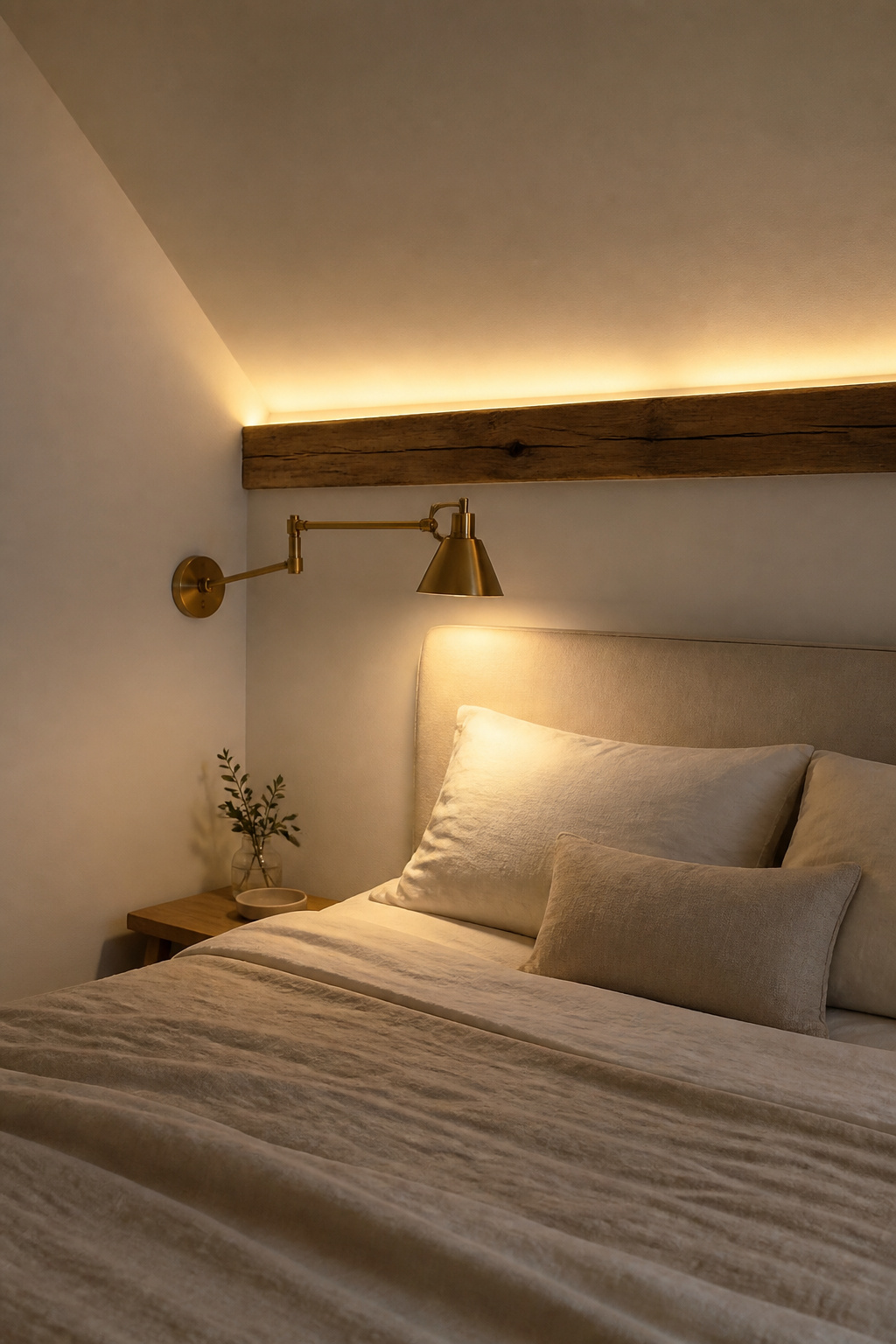
A bedside table lamp is wrong for a low attic bedroom. From a lying position, the shade sits at eye height and glares. A wall-mounted swing-arm sconce solves it: it brings adjustable light to the page, frees the small nightstand surface, and reaches over the pillow at the right angle. Mount it beside the bed at headboard height, 60–65 inches above the floor to the centre of the backplate, with an arm reach of 12–24 inches — high enough that the swing-arm clears the pillow without putting the bulb in your sightline.
Accent lighting for exposed beams and the slope itself
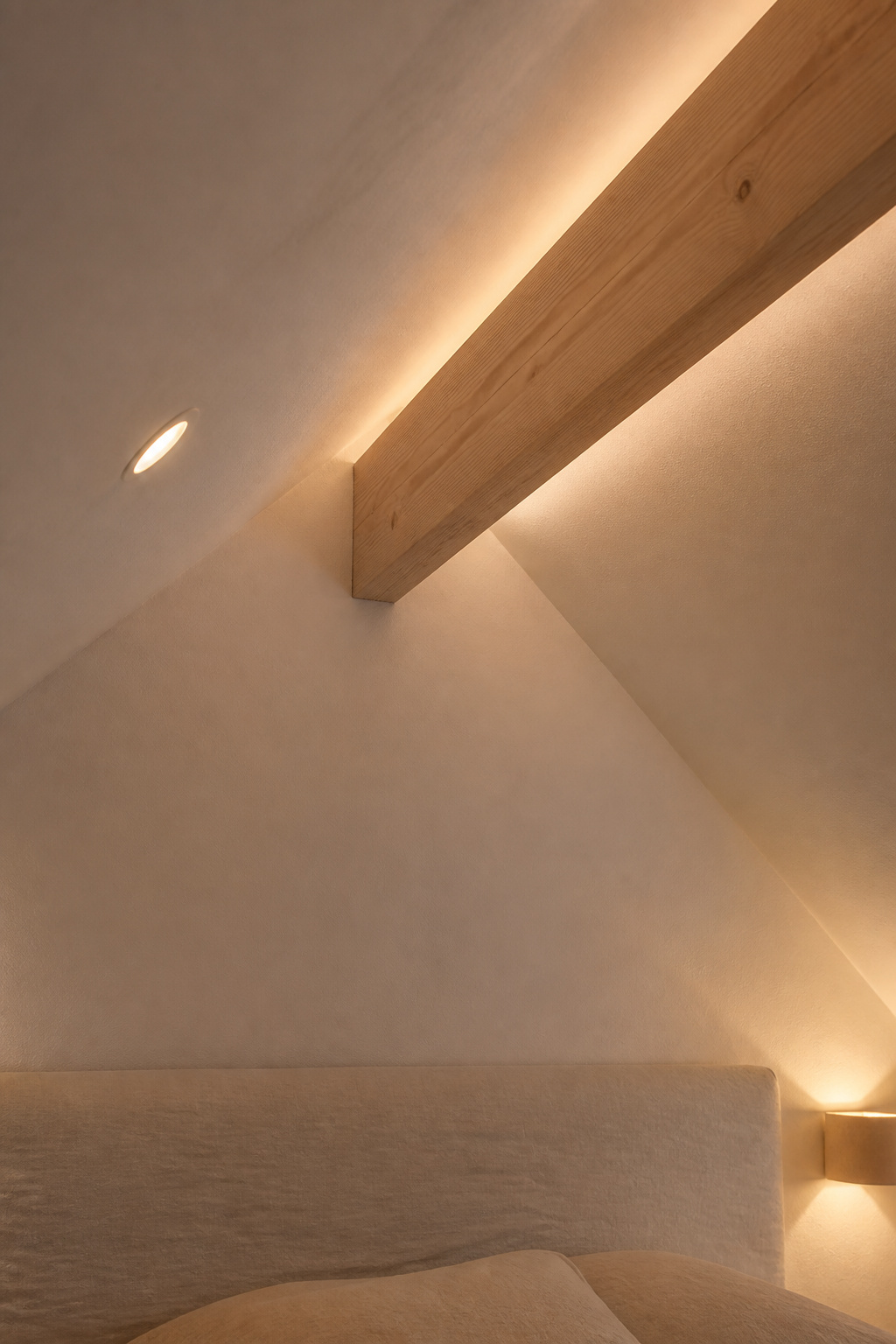
This is where the slope stops being a problem and becomes a canvas. An LED strip concealed along the top of a beam casts a warm wash upward, so only the glow shows, not the source. Seus Lighting describes what that wash does: it softens the ceiling line, reduces the cavernous feel, and adds the middle-height illumination ceiling fixtures miss. Keep the strip at 2700–3000K to match everything else; a fixed warm strip is more reliable than an RGB one, which only invites the wrong colour.
Dimmer switches: the single cheapest upgrade in an attic bedroom
If you change one thing, change this. A single-pole LED-compatible dimmer costs $10–$30, and it lets one circuit be both a bright work light and a near-candlelit evening source. Modern LEDs need a trailing-edge dimmer, not the older leading-edge type, which buzzes and flickers on low-wattage LED loads. Put each layer on its own dimmer: ambient, task, and accent, each controlled alone. That is what lets the room shift from full working brightness to a soft reading glow without switching a single fixture off.
A Layered Light Plan for Your Attic Bedroom: Putting It All Together
Everything above resolves into one method: build the room’s light in three layers, in order, and you get a space that holds its warmth at any hour and in any season. Follow this sequence:
- Install ambient first. Flush mounts or gimbal recessed on the slope set the base illumination for the room.
- Add task second. Mount the bedside sconces after the bed is in place, so the height and reach are right for where you actually read.
- Add accent last. Fit the beam strip and any directional spots last, tuned below the ambient level — accent that outshines ambient makes a room theatrical, not restful.
Hold all of it at 2700–3000K and give each layer its own dimmer. That is the whole framework.
You can specify a complete three-layer plan for roughly under $500 in fixtures — two flush mounts, two swing-arm sconces, two dimmers, and a 5-metre LED strip — with labour on top and excluding any skylight or dormer work. Treat that as a rough guide rather than a quote, since it sums component costs and your own choices and local labour will move it. For reference, flush mounts run $65–$180, swing-arm sconces $50–$300, and dimmers $10–$30. Spend first on the dimmers and the sconces; they buy the most atmosphere per krona.
I photograph rooms at 7am in February. If a room holds its warmth in the worst light of the year, it works; if it only comes alive on a bright summer afternoon, the plan is incomplete. A good Nordic plan treats the artificial layers not as a supplement to daylight but as a parallel system that can carry the room alone through the dark months. So switch the daylight off in your mind and ask whether the three layers still make the room feel held. When the answer is yes on a grey February morning, you have lit the room properly.
FAQ
Can you add a skylight to an attic bedroom yourself?
It is technically possible but strongly discouraged. Permits are mandatory in almost all US jurisdictions, structural headers are required, and poor waterproofing causes leaks and even insurance denials. Professional installation runs $1,200–$5,000+. Tubular sun tunnels are the one type experienced DIYers manage, thanks to a smaller penetration and a pre-engineered flashing kit.
What type of lighting is best for a low ceiling bedroom?
True flush-mount ceiling fixtures are the standard choice under 8 feet — they sit flat against the ceiling and add no drop or visual weight. Pair them with wall-mounted swing-arm sconces at the bedside, which take reading light off the ceiling entirely. Keep every source at 2700K warm white to support sleep and flatter warm materials. Vintage bedroom lighting also work well in attics.
How do you light an attic bedroom without ceiling space for recessed lights?
Shift the work to the walls and beams. Two bedside sconces replace both recessed task lights and a table lamp, while LED strips concealed behind exposed beams or along the top of knee walls add accent and ambient wash with no ceiling penetration. For overhead fill, slim surface-mounted LED panels under 2 inches deep need only a junction box.