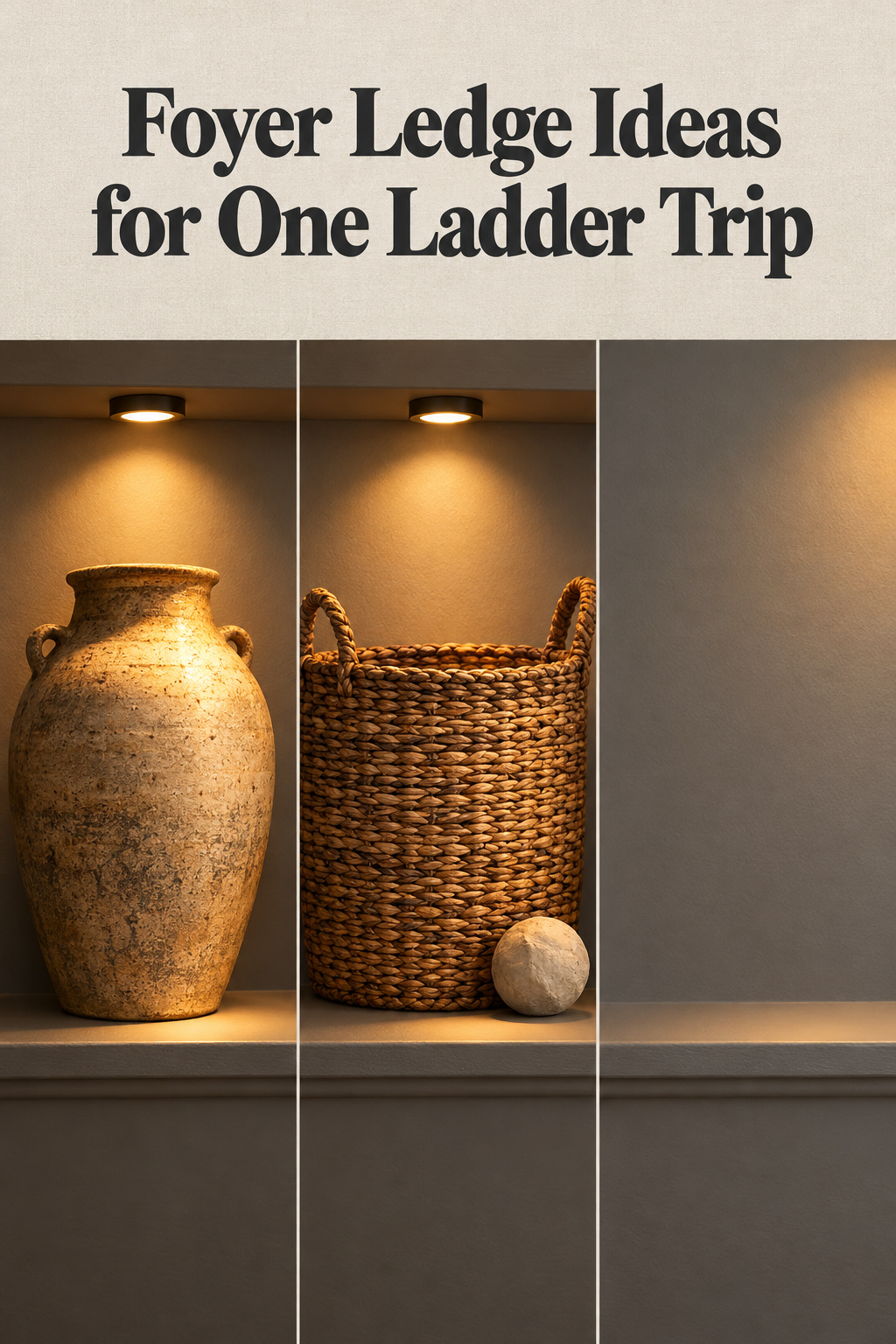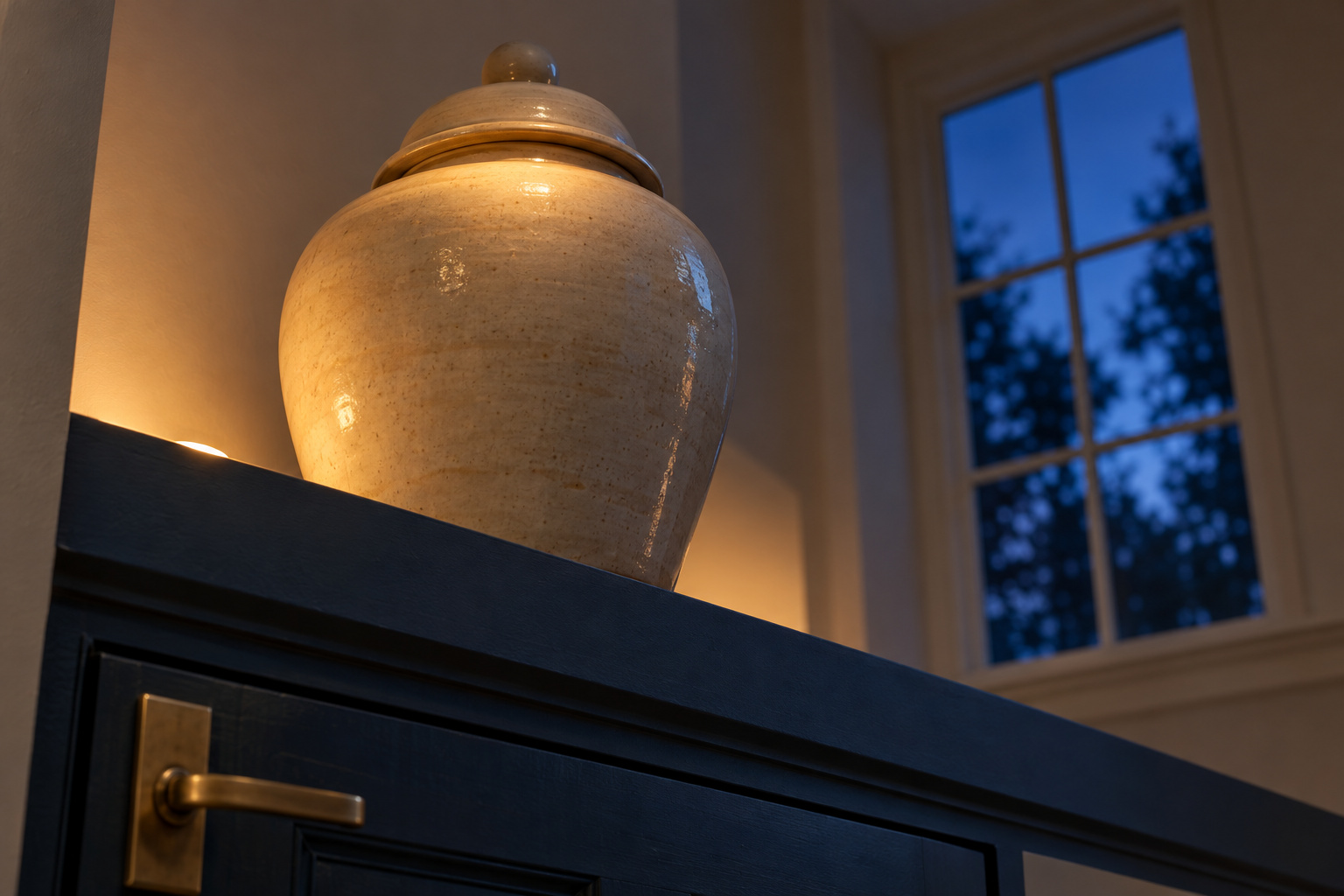

Under a high foyer ledge I knock along the wall with my knuckles before I get a single tool out. A hollow note means drywall over air. A dull thud means wood behind it. That sound tells me where a screw will hold.
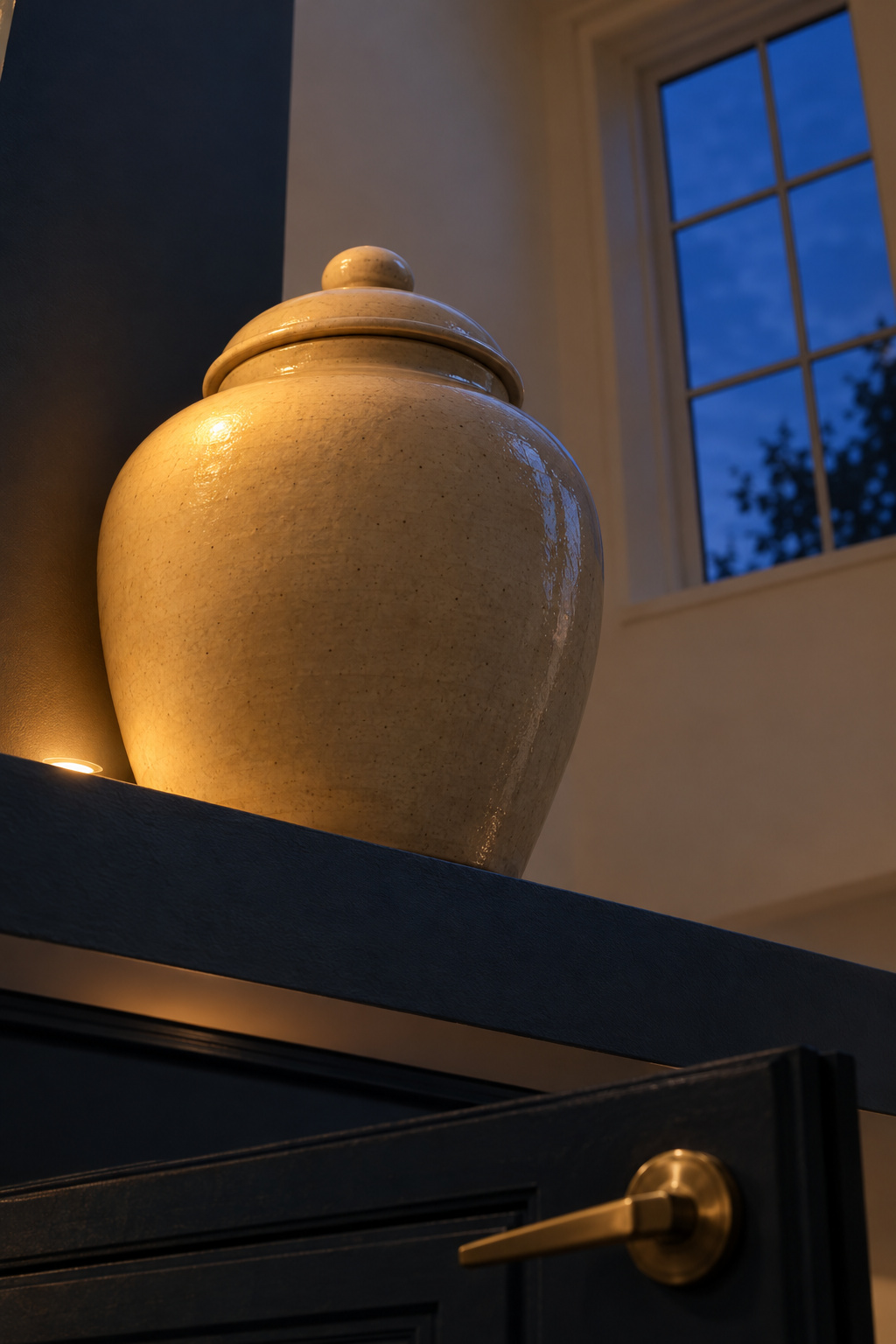
A high ledge over a front door should get only one visit. Foyer ledge decorating ideas built on trailing ivy or a fresh display every season each mean another climb. Budget one afternoon, one trip up and the cost of a few good pieces. Put up a few large things that never need watering or swapping, hold them with museum wax or a hidden screw instead of putty you would have to redo, and come down for good. Or leave the ledge empty, which is a real answer too.
TL;DR
- Go big and few: by my rule of thumb, an object seen from 16 ft away needs to be about four times the size it would be at 4 ft, so aim for 18 to 36 in across.
- Fix pieces down with museum wax or a screw into framing; the putty maker says putty is meant to be reapplied every 3 to 6 months, and the gel is meant for glass.
- Battery puck lights run 27 to 100-plus hours by the makers’ figures, which is under a week to 25 nights at 4 hours a night, so use a plug-in light or plan a second climb.
Foyer Ledge Decorating Ideas That Read From the Floor: Five Objects and Their Sizes
Nobody sees a ledge from arm’s length. They see it from the front door, looking up, and distance shrinks everything. A row of small bottles turns into a line of specks.
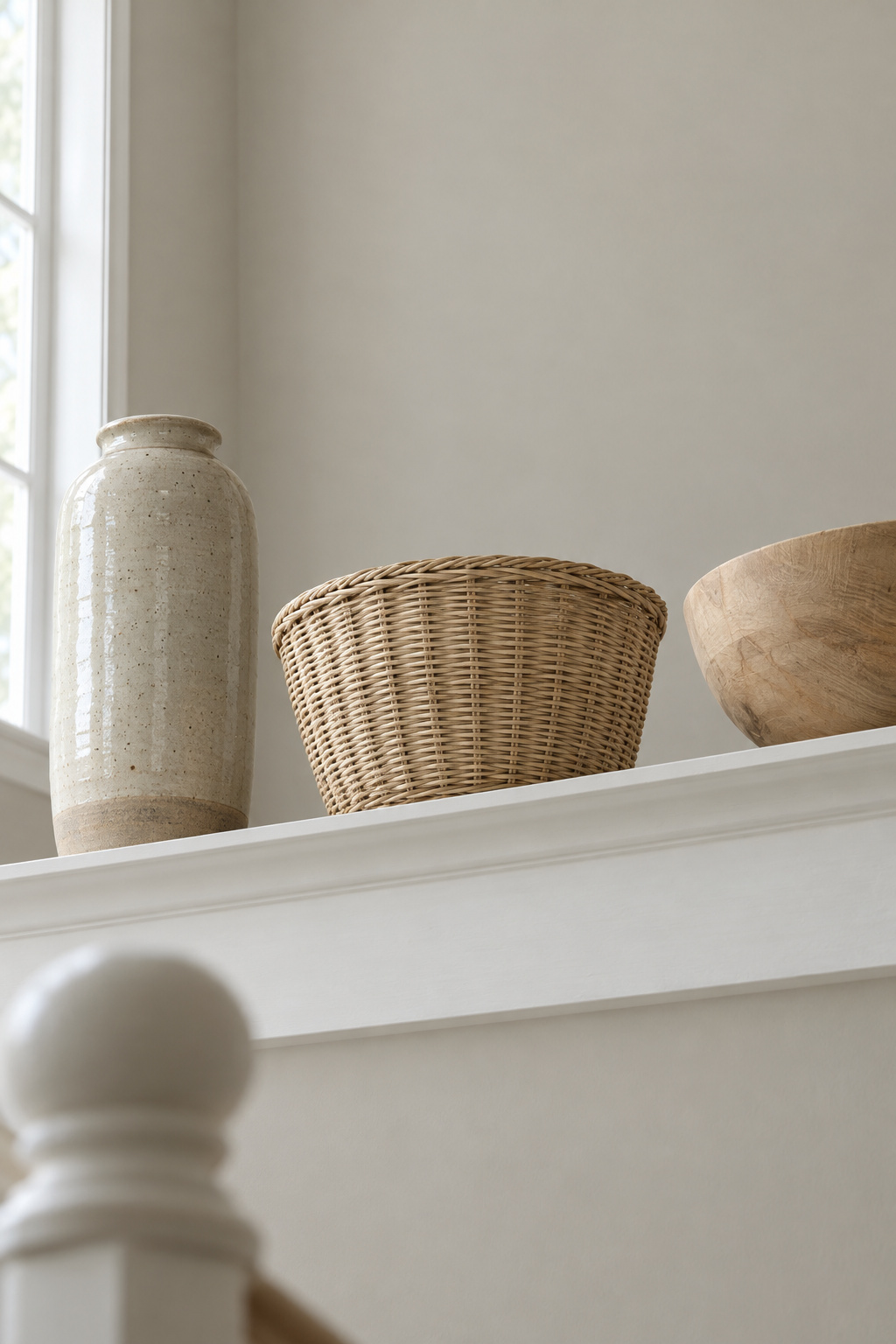
So size comes first. My rule of thumb: something that reads as a 6 in piece on a console from 4 ft away needs to be four times bigger, about 24 in, seen from 16 ft. Measure your own line of sight from the front door to the ledge and scale the same way. Ledges have no standard depth either, so measure that too before you buy anything.
Here are five object types that read from the front door, with sizes from that rule:
| Object | Size that reads from below | Upkeep | How it’s fixed |
|---|---|---|---|
| Lidded stoneware jar or urn | 24 to 36 in tall | Dust only | Wax under the base, or a screw |
| Group of three tall ceramic vases, one corner | Varying heights, 18 to 36 in | Dust only | Wax under each base |
| Large basket or trug | 18 to 24 in wide | Dust only | Screw through the base |
| Pair of big metal lanterns | 18 to 24 in tall each | Dust; battery candles mean a climb | Wax, or a screw through the base |
| Two or three large wooden bowls | 14 to 18 in across | Dust only | Wax |
Framed art doesn’t belong on the list. Kristi Linauer of Addicted 2 Decorating says not to put pictures up there at all, because they’re too high to enjoy, and I agree with her. If you want a big picture, hang one large piece for the tall wall where people can actually look at it.
Faux greenery is the other trap. Daylight fades dyed plastic, and that damage builds up and doesn’t come back. No maker gives a fade rate for faux greenery, but stoneware, wood and metal don’t care about the sun.
Before anything goes up the ladder, I put it together once on the floor with nothing holding it and walk away for the length of a coffee. Do that here. Set the pieces out at the ledge’s width, look them over from the front door, then change what bugs you. Write the spacing down in pencil. I keep one behind my ear in the shop and still lose one a week, so put a spare in your bucket.
Fix It Down Once: Wax, Gel and a Hidden Screw for the Day the Door Slams
My neighbors call me when something falls off a wall, so I have strong feelings about what stays up. I fix things for the slam I expect. The makers of museum putty sell it against bumps, vibration, cabinet doors, pets and kids, and a front door is a very large cabinet door. Fix everything down.
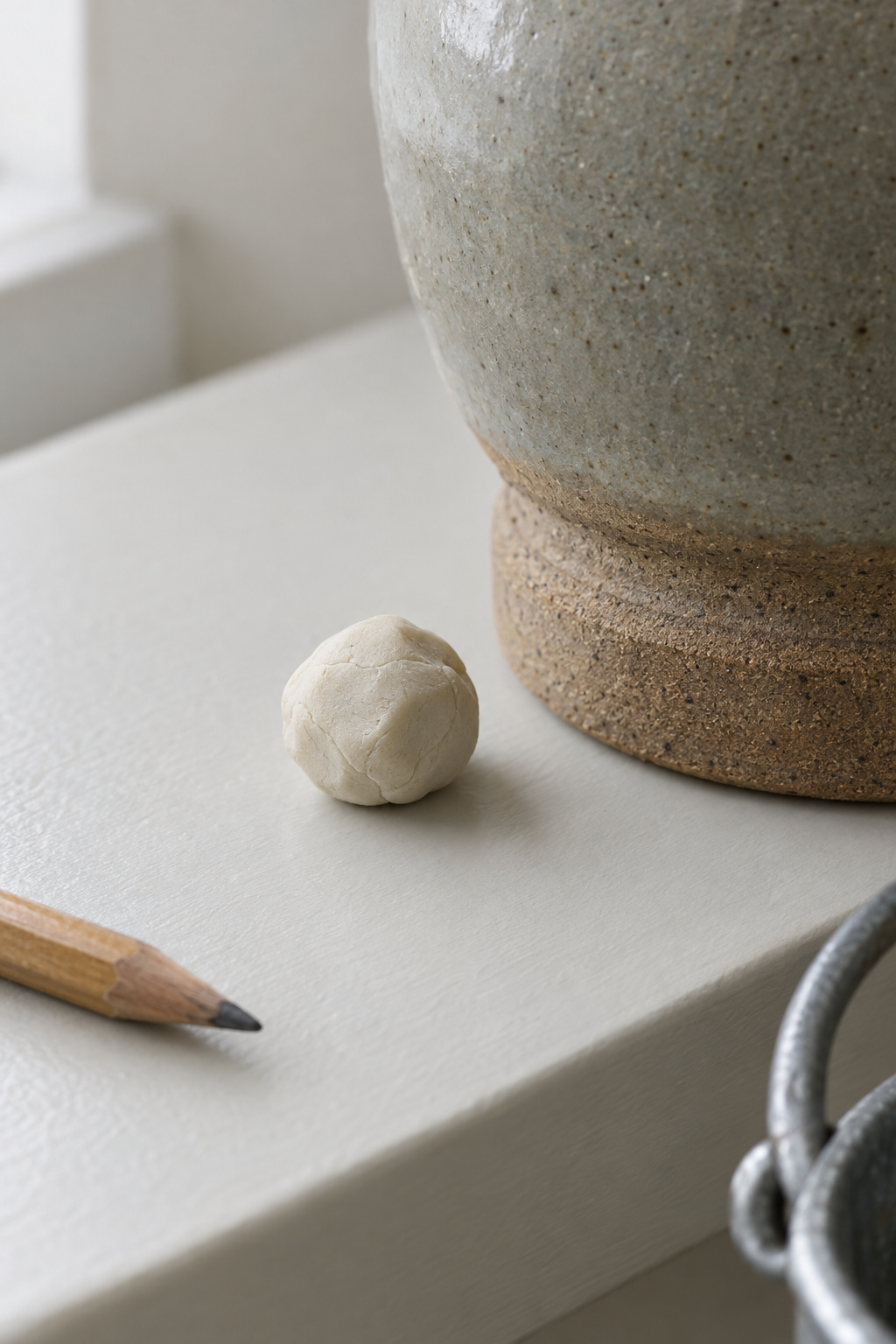
Skill level: wax and a jar is a first build. The hidden screw needs some builds behind you.
What museum wax, putty and gel will and won’t hold
- Putty: The putty maker’s own answer is that putty is meant to be reapplied every 3 to 6 months. That’s two or more climbs a year, which defeats the point. The maker also can’t guarantee it won’t mark flat paint.
- Wax: The same maker says wax can be left for long periods, though heat loosens it. It’s the hardest of the three to clean off.
- Gel: It’s made for anchoring glass to glass shelves, on waterproof surfaces only, and it sets in about an hour. Wrong product for a painted ledge and a stoneware jar.
Ignore any weight printed on the pack. The conservators behind CAMEO, the Museum of Fine Arts Boston’s materials database, say museum putty is not for heavy objects or freshly painted surfaces. In a shake test by Consumer NZ, wax held a 2.7 kg (5.95 lb), 29 cm (11.4 in) vase, gel came close and putty held less. A 30 in urn is likely heavier than that vase, so it is outside anything tested.
To wax a piece down:
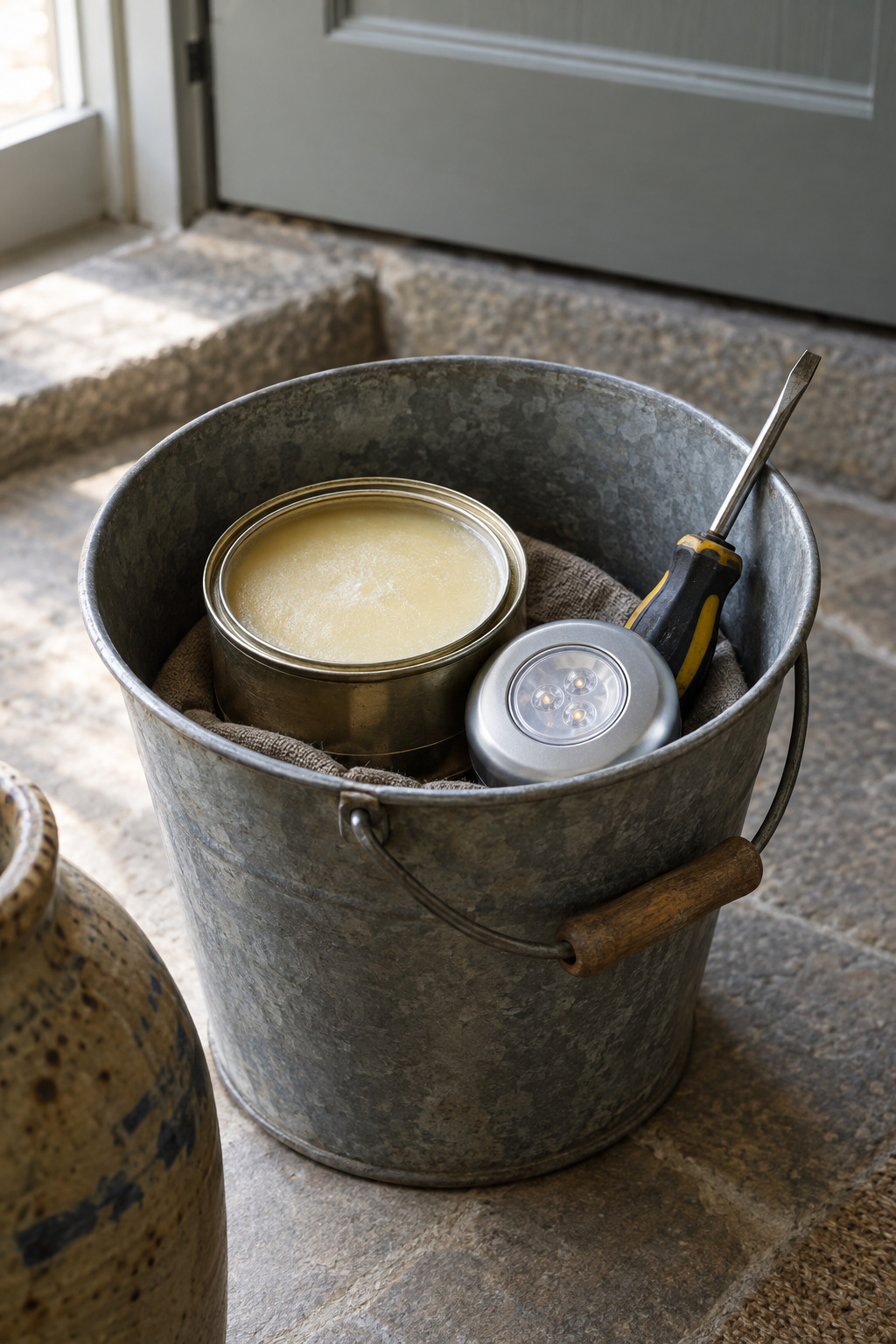
- Load one bucket on the ground with the wax, a dry rag, the drill, screws and a pencil.
- Wipe the ledge and the base of each piece clean and let them dry.
- Test the wax on a hidden corner of the paint first.
- Roll small balls of wax and press them under the base at a few points.
- Set the piece, press down and give it a slight twist to seat it.
- Move to the hidden screw for anything tall or heavy.
Plan the climb itself with how to reach the top of a two-story wall. The point here is that everything goes up in that one bucket.
The mistake comes later, on the day you want the jar down. People lift a waxed piece straight up. The bond lets go all at once, and in Consumer NZ’s test the freed vase hit the shelf above and cracked. Twist slowly with one hand while the other holds the piece. If it’s already stuck to flat paint and leaves a mark, you’re touching up paint at the top of a ladder, which is why the test spot matters.
The hidden screw
For anything tall, heavy or valuable, I want a screw, not friction. Drive it through the object’s base, or through a small bracket behind it, into solid framing. Never a drywall anchor. Ledges are built every which way, drywall wrapped over framing, plywood, trim, so find out what yours is.
Stud finders lie. Check with a thin nail or a magnet before you commit to a hole, and if the nail finds nothing, move over and probe again.
Light It With a Battery Puck and You Need Less on It
One lit jar does more than five dark ones. A small LED puck behind or beside a single piece pulls the eye up from the door, and it means you can put less on the ledge.
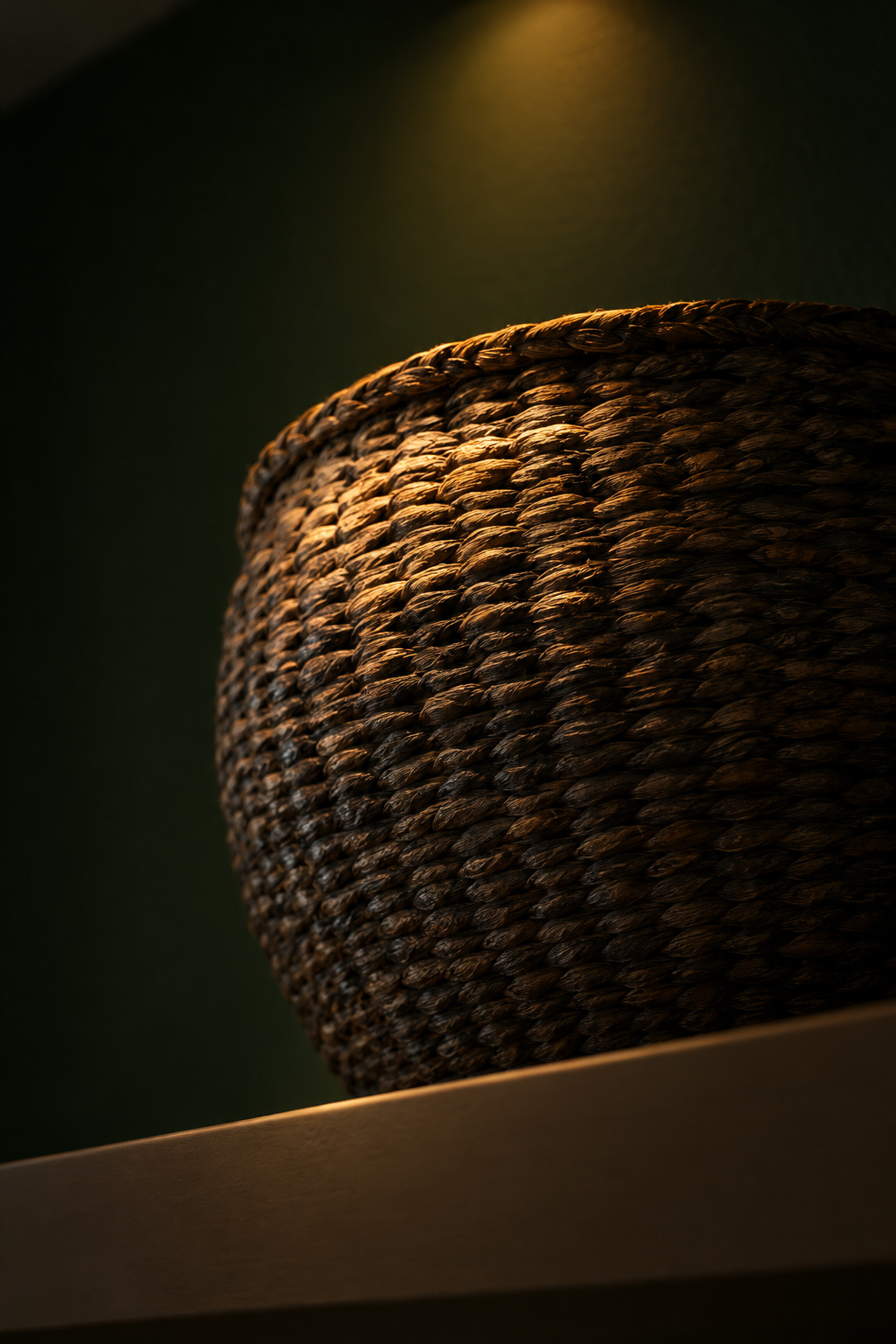
The catch is the battery. Brilliant Evolution rates its 55 lumen puck at over 100 hours on 3 AA batteries. Good Earth Lighting rates its puck at 27 hours until the output drops to 10 lumens. At 4 hours a night, that’s about 25 nights from the first, and under a week from the second before it dims to 10 lumens and somebody climbs up with batteries. I’d rather use a plug-in light where there’s power, or pick a long-life puck and accept the climb.
Effort is low: these pucks mount with a screw or adhesive tape. A puck around 50 lumens lights one object, not a whole ledge. Lit surfaces also show dust, so the light will tell on you. White LEDs give off next to no UV, so the puck won’t fade what it lights the way a sunny window will.
The Empty Ledge Is an Option, and So Is Painting It Out
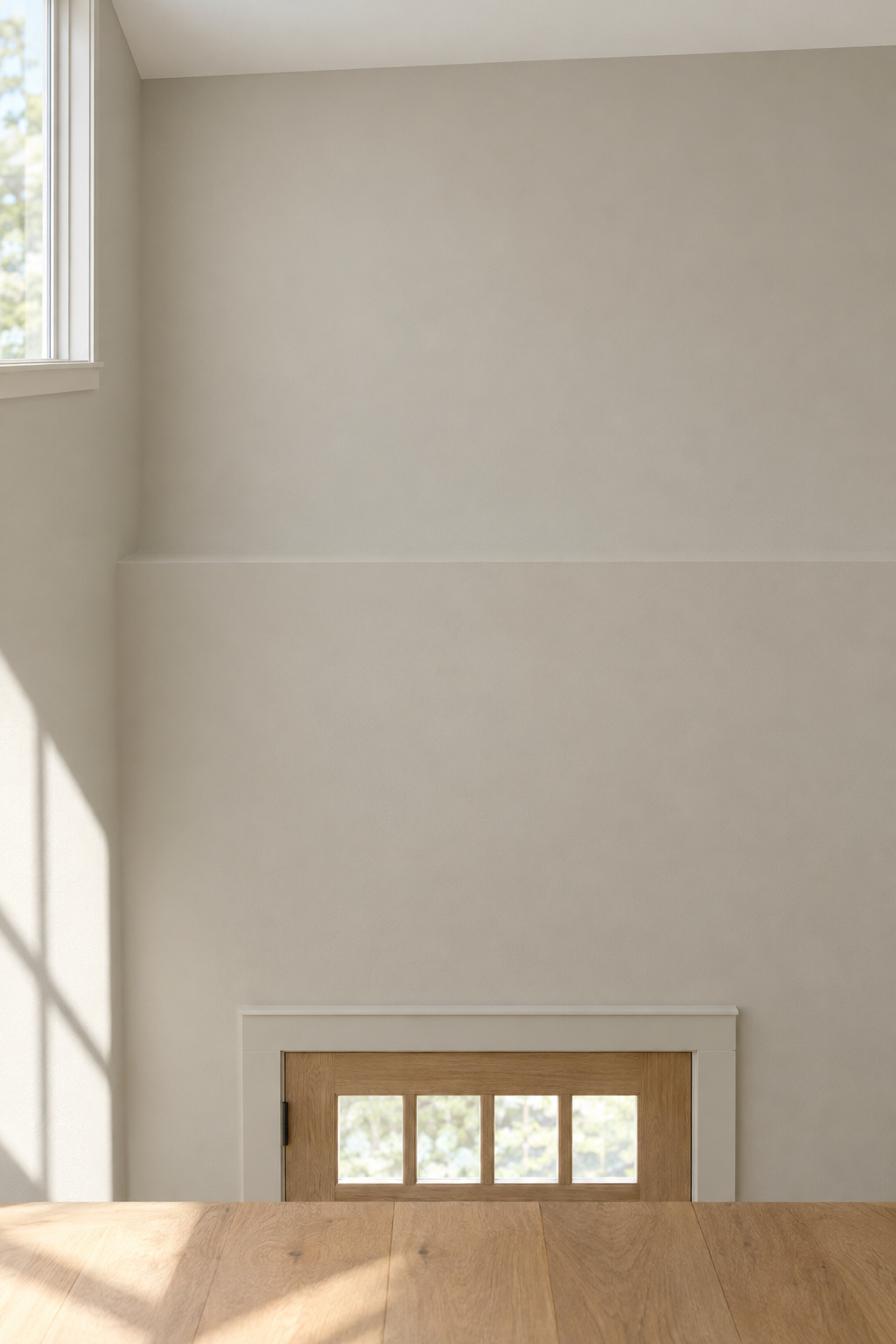
Leaving it empty costs nothing and needs nothing. Kristi Linauer’s first suggestion for this exact ledge is to ignore it, and she points out that guests coming in don’t see it until they turn to leave. If the ledge is painted a contrasting color, paint it the wall color and it mostly disappears.
Every screw I take out of a wall goes into a coffee can until the job is finished. On a ledge that matters more, because a loose screw rolls off the edge onto the entry floor.
Who should skip decorating it? Anyone who knows they won’t climb up there again.
Pick Your Ledge: A Decision Rule and What to Avoid
Find your situation and go with the row:
| Your situation | What to put up | What to skip |
|---|---|---|
| A door that slams, or a cat | Large pieces on wax or a hidden screw | Putty alone |
| A sunny window on the ledge | Stoneware, wood, metal | Dyed faux greenery |
| You want a glow at night | One lit object, plug-in or long-life puck | A row of battery pucks |
| You’ll never climb up again | Nothing; paint it the wall color | Anything that needs dusting or swapping |
The order I’d decide in is size, then fixing, then light, then restraint. Get the size wrong and nothing else saves it.
What to avoid: a line of small pieces from one end to the other, faux ivy or grapevine run across the full width, seasonal swaps, and anything you can’t reach to dust.
For the rest of the entry below the ledge, there are more two-story foyer ideas on fixtures, walls and trim.
Carla Aston would frame a ledge in to the ceiling and be rid of it, which is a molding job of its own, and Linauer would ignore it. My view is that one big jar, waxed and screwed down, is fine if you climb up once and never think about it again. We don’t agree, and the ledge doesn’t care.
FAQ
How deep is a typical plant shelf above a front door?
There isn’t a typical depth, because builders set their own. Homeowners report everything from a ledge about 18 in deep across an 8 ft wide foyer window to one about 5 ft deep over a two-story entry door. Measure the depth and width of yours before you buy anything for it.
How do you dust a high ledge you can’t reach?
Use an extendable duster with a locking telescopic pole and a microfiber head, working from the highest point down. Check that the pole really reaches your ledge before you rely on it. Balsam Hill suggests dusting faux plants weekly or biweekly, which no high ledge will get, so fewer, larger, smooth pieces are easier to live with.
Do faux plants fade on a ledge near a sunny window?
Yes. Daylight carries significant UV, and both UV and visible light fade dyes, with damage that builds up and can’t be reversed. Retailers sell UV-protected stems as fade-resistant, but no maker gives a fade rate. On a sunny ledge, choose stoneware, wood or metal instead of dyed greenery.