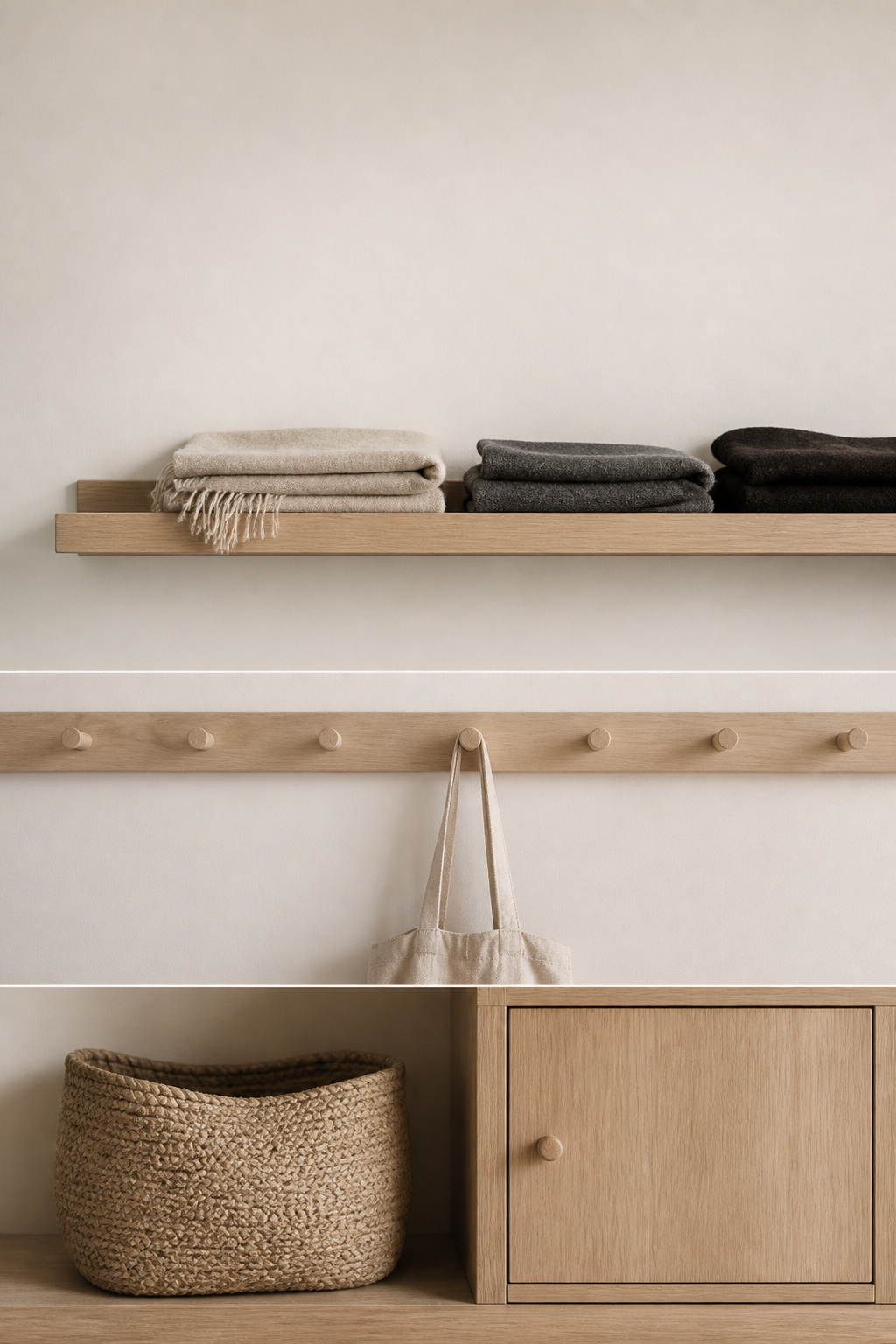
Here is the part almost nobody is told: the reason your coats end up on the floor is rarely the hooks. It’s the height they hang at and the space between them. Most people answer a messy entry by buying a nicer hook rail, when the rail they had was mounted wrong, not chosen wrong. Good drop zone shelving and hooks are a placement decision first, a shopping decision last — get the numbers right and cheap hardware holds a family’s winter gear.
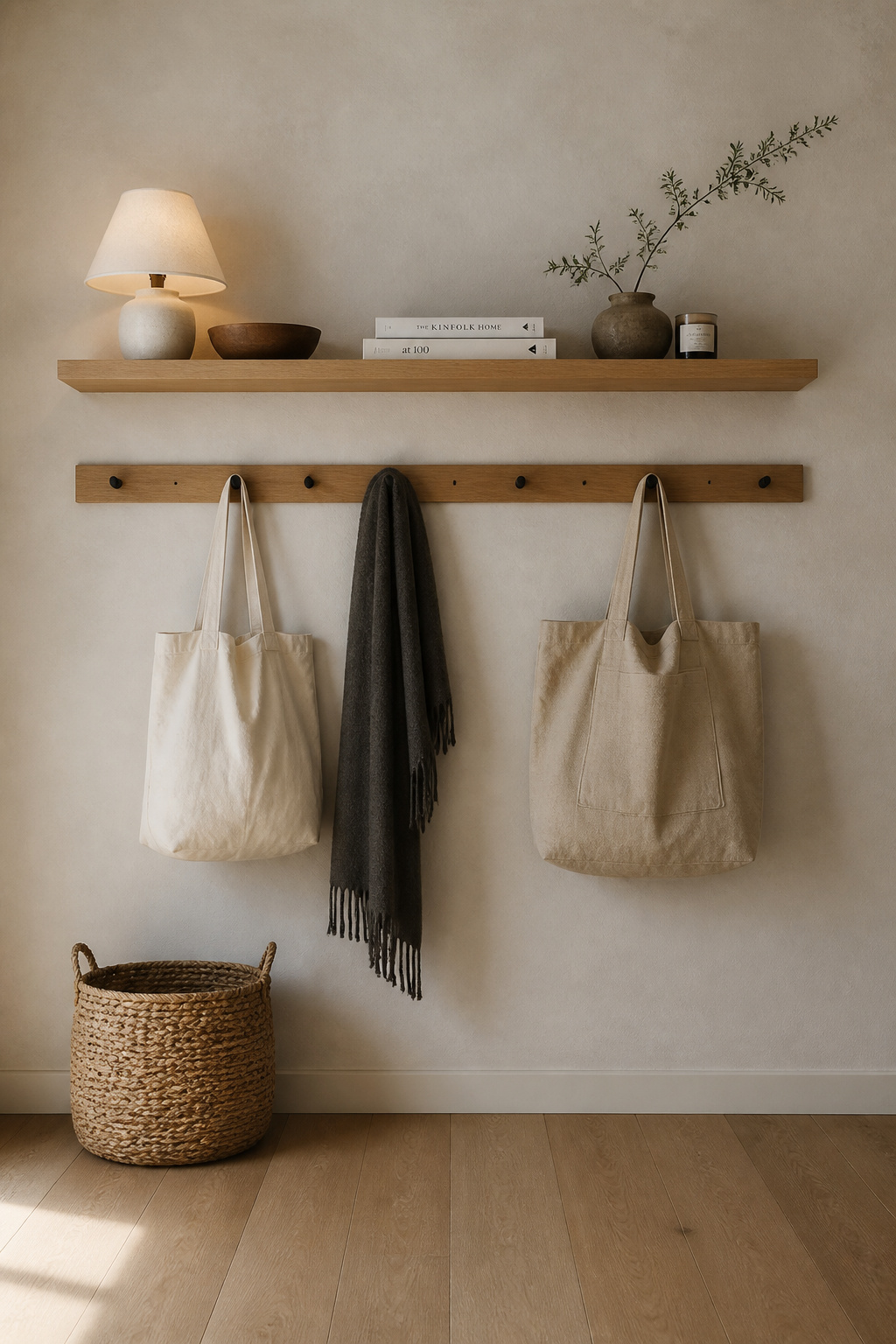
TL;DR
- Placement beats hardware: mount adult hooks 60-66 inches from the floor, child hooks 36-42, and space winter-coat hooks 10-12 inches apart so garments stop overlapping and sliding off.
- Choose storage by household discipline, not looks: open shelving needs a daily reset to stay calm; closed cubbies (12-24 inches wide per person) forgive a skipped day.
- Anchor for the real load: a solid-wood shelf into two studs holds 90-100 lbs, but drywall-only fixing drops any shelf to 20-25 lbs, and adhesive hooks (3-7.5 lbs) cannot carry a loaded backpack.
It’s Not the Hooks, It’s the Height
The most common entryway mistake is treating a placement problem as a product problem.
Why an attractive hook rail still ends up with coats on the floor
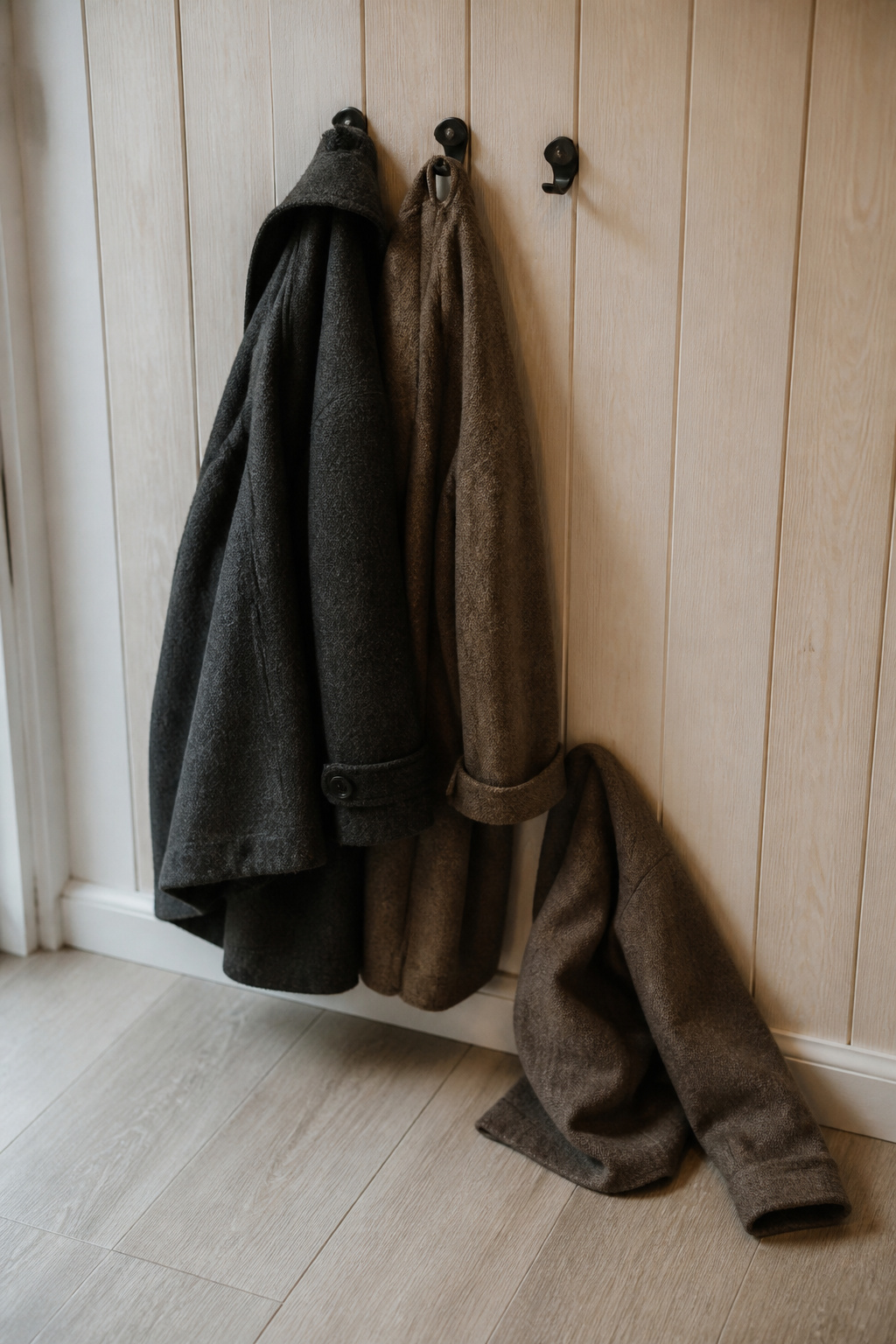
A typical winter coat has an elliptical hang radius of 7 to 9 inches, so hooks spaced tighter than a 10-inch minimum overlap, and the outer one slides to the floor. A prettier rail changes none of that physics. The other half is height: the builder-default hook sits at 66 inches, 24 to 30 inches above a child’s reach, so the child’s coat lands where the child can drop it.
The placement principle most entryway hardware ignores
Ergonomic reach is not one number; it is a range across a household. RethinkAccess accessibility guidance puts adult hooks at 60 to 66 inches, children roughly 4 to 10 at 36 to 42, and younger children lower still. Treating that curve as a single builder height is the deepest reason entries fail. The fix is two rows — an adult row and a child row, each at a reach someone actually has.
What this article will help you get right instead
So here is the frame for everything below: match hook height to who reaches for it, shelf depth to what it holds, and open versus closed storage to the household’s real daily discipline. Hardware style comes last — that’s the difference between a wall that stays tidy and one you keep re-buying.
Open Shelving vs. Closed Cubbies
The first real choice is not wood versus metal — it is visible versus hidden.
What open shelving asks of a household’s discipline
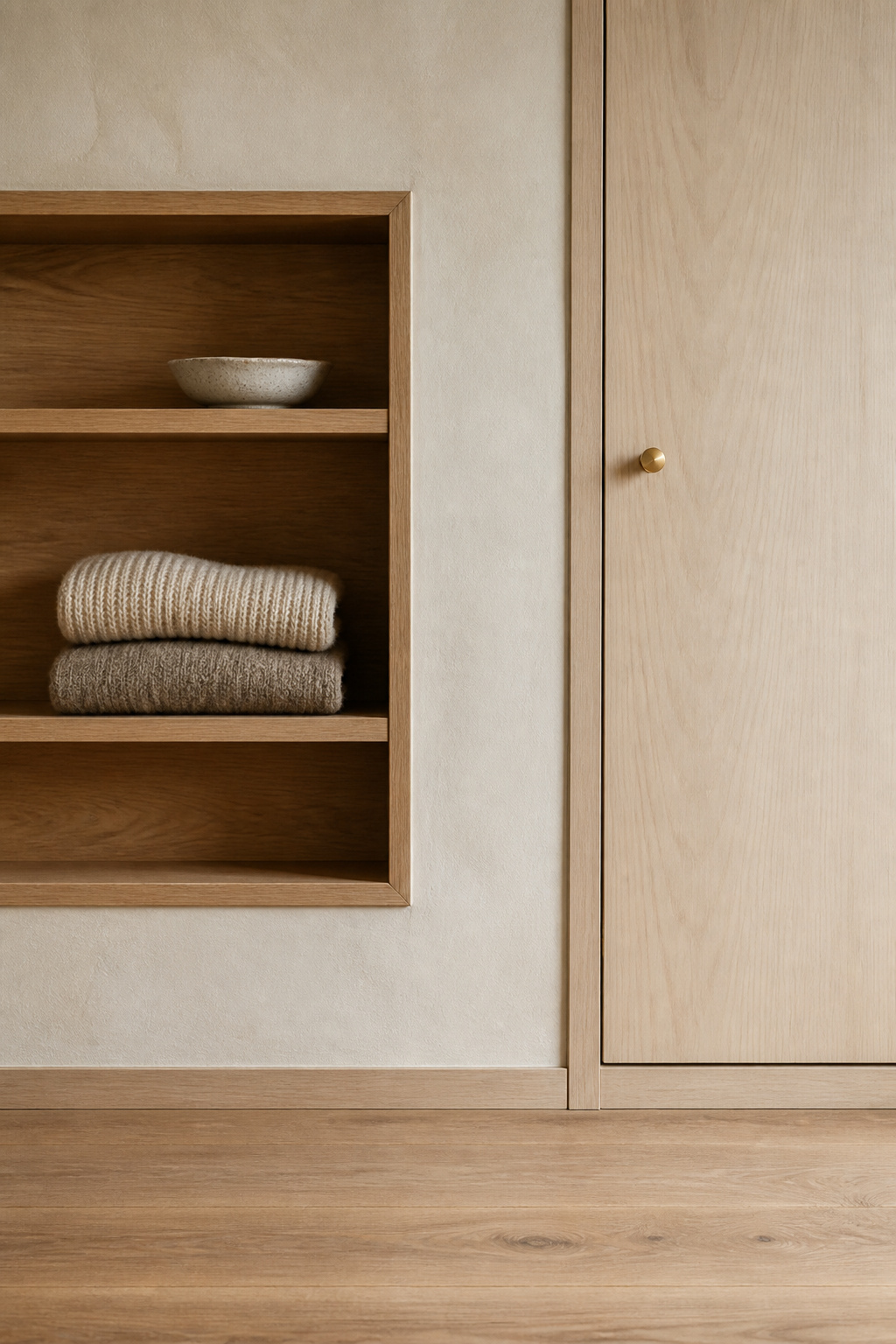
Open shelving is cheaper and keeps an entry feeling airy — but everything on it is visible, always. I hold a firm view here: storage that only works when you keep it perfect is failed design. The system has to be easier than the mess, so open shelving suits only the household that resets daily.
When closed cubbies are the more honest choice
For everyone else, a closed cubby is the more honest answer. A door gives mail and daily clutter a landing spot without broadcasting the mess. Size it to the person: 12 to 15 inches wide for shoes only, 15 to 18 for a backpack and coat, 18 to 24 for a full zone.
Material trade-offs: solid wood, veneer, wire
I will always take one solid piece over three that look the part. A solid-wood floating shelf into two studs safely carries roughly 90 to 100 lbs; hollow-core veneer looks identical but doesn’t match it under load. Wire systems win on raw capacity, some rated to 200 lbs, suited to a heavy-gear wall over a front-hall shelf. One warning outranks the rest: fix any shelf into drywall only, no stud, and its safe capacity collapses to 20 to 25 lbs regardless of rating — the anchor sets the limit.
Hooks: Type, Spacing and Weight
Hook type matters far less than spacing and weight rating, which decide whether the wall works.
Single hooks vs. hook rails vs. Shaker pegs
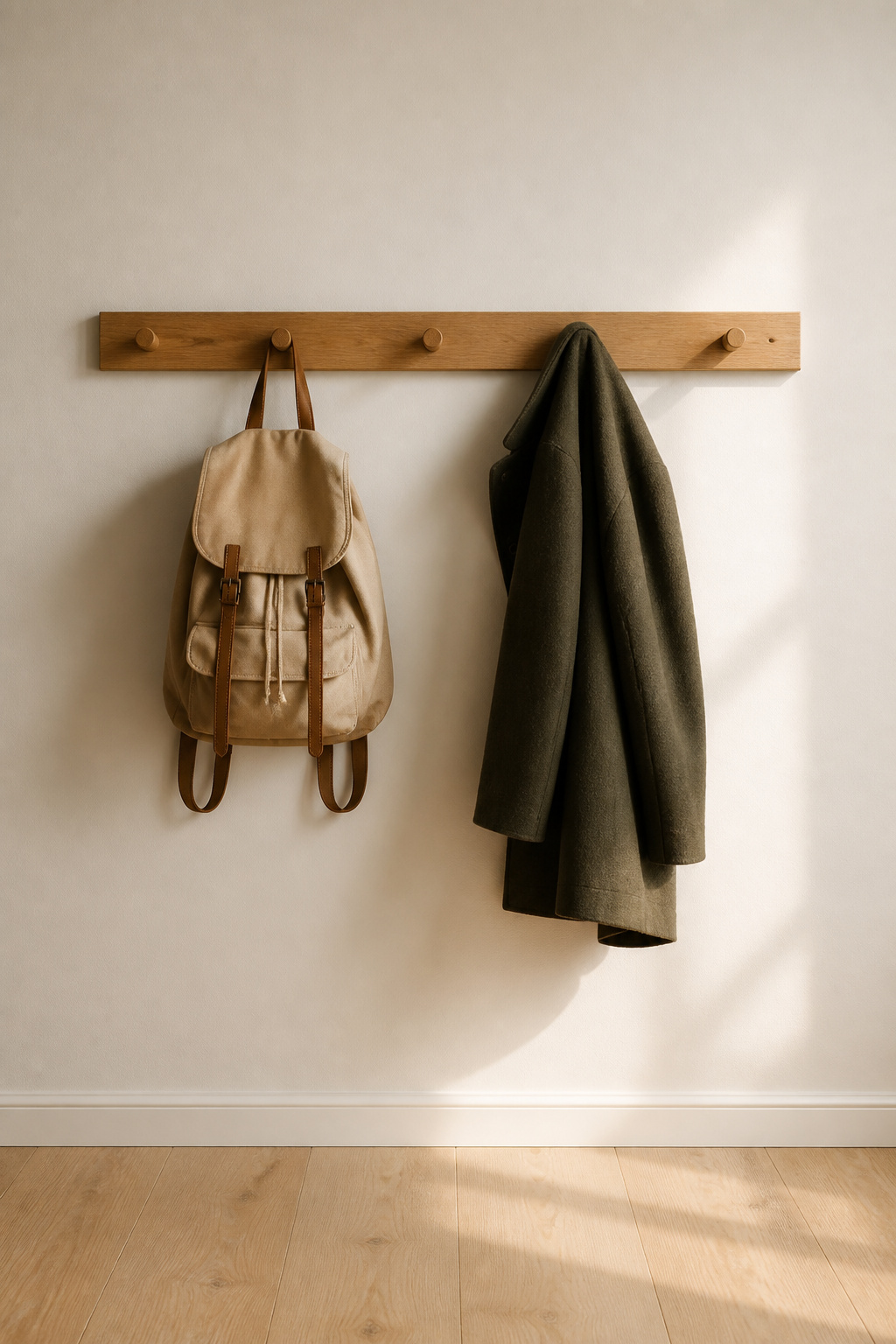
A hook rail spreads its load across the whole board’s stud attachment rather than a single point, which is why rails outperform scattered single hooks for heavy winter coats. Stock 2, 4 and 6-foot lengths size one to the exact wall run. Single hooks give more placement freedom, but each needs its own anchor — for a family entry, I recommend a stud-mounted rail.
Spacing that prevents coats from crowding each other
The standard for winter coats is 10 to 12 inches centre-to-centre, rising to 15 for heavy parkas and dropping to 6 only for light accessories like scarves. Here a common instinct backfires: traditional Shaker peg spacing runs 6 to 8 inches, tighter because pegs were sized for lighter historic garments. Fit real winter outerwear onto a rail at that spacing, and you’ve rebuilt the overlap problem by hand.
Weight ratings that matter for winter coats and bags
A winter parka weighs 3 to 5 lbs; a loaded backpack, 8 to 15 lbs. That’s your floor. 3M Command adhesive jumbo hooks top out at 7.5 lbs — no school backpack. Pegboard hooks scale with gauge, not size: a small heavy-gauge hook beats a larger thin one. Anything below roughly 15 lbs per point is undersized for a family entry.
Baskets and Bins for the Small Stuff
Shelves and hooks handle what hangs and stacks; baskets handle everything that does neither.
What belongs in a basket vs. on a shelf vs. in a drawer
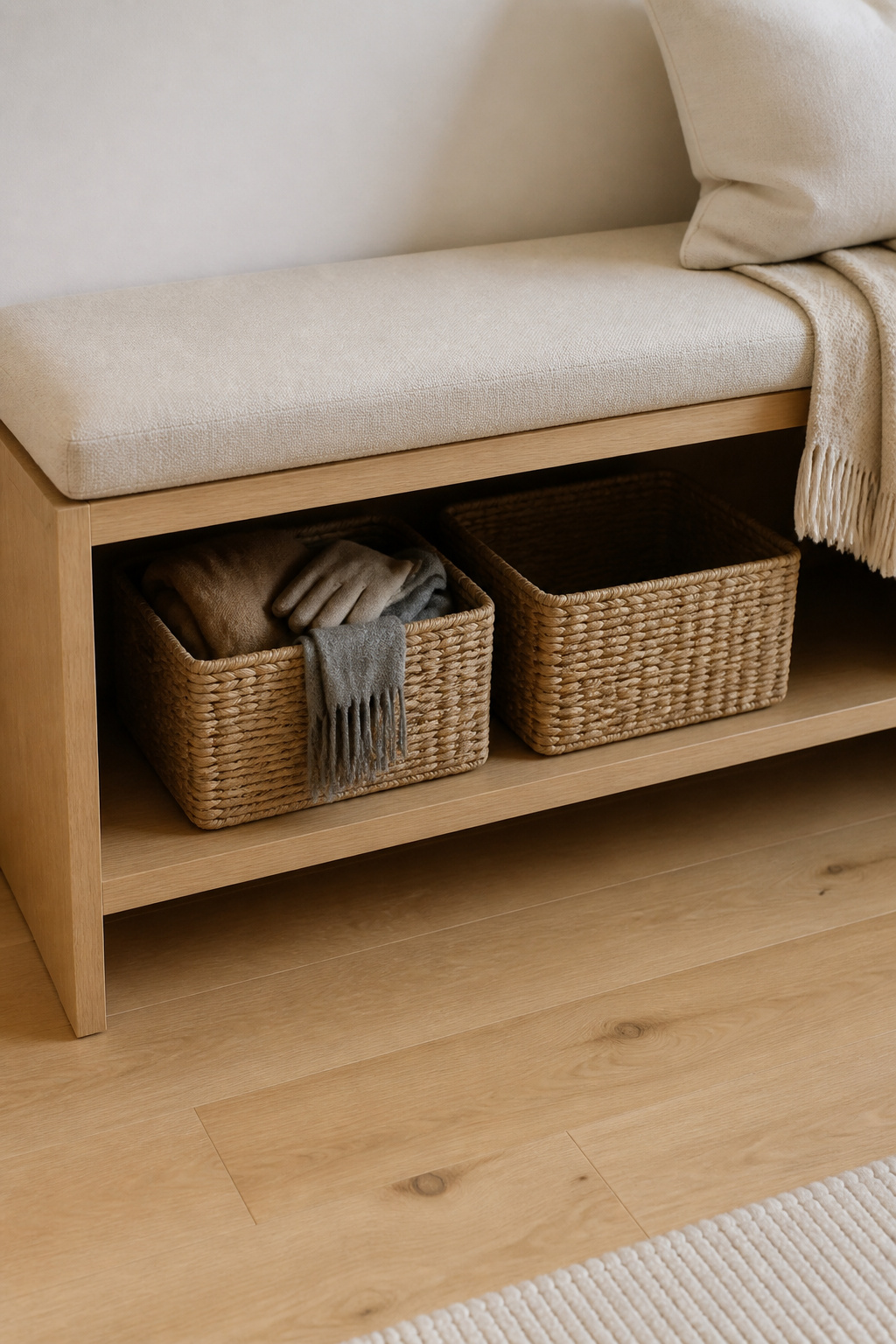
Baskets suit loose, irregular items that won’t sit flat on a shelf: gloves, sunglasses, a dog leash, outgoing mail. Tall narrow containers take umbrellas and long sports gear. One limit keeps the system from creeping: two baskets per person, one for accessories and one for shoes.
Sizing bins to what they’ll actually hold
Measure the contents before you buy the container, not the reverse — a basket too shallow for boots, or too large to fill, reads as clutter itself. For a 48-inch bench with an open lower shelf, one seagrass basket around 18 to 21 inches wide, 14 deep, 9 to 12 tall fills the opening well: roughly one per 18 inches of bench width.
Labeling without turning the entry into a supply closet
Resist the label maker. One basket type per category — accessories, shoes — keeps the system usable for a young child, who sorts by shape and material before reading a tag.
Placing Drop Zone Shelving and Hooks: Height and Sightlines
Standard adult hook height vs. what your household actually needs
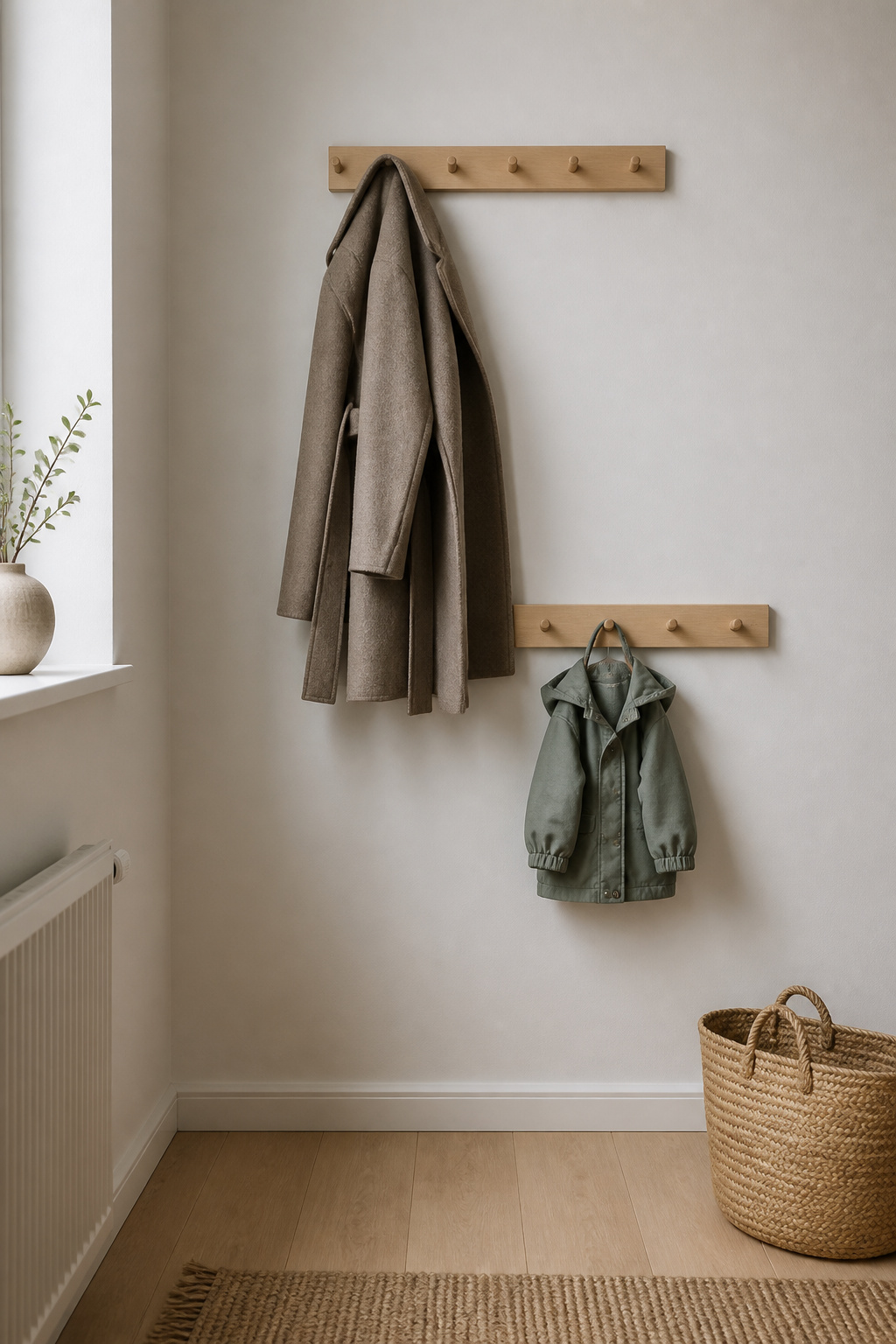
The adult standard is 60 to 66 inches above the finished floor, with 66 the builder default and 60 better above a 17 to 19-inch bench seat. Child-accessible height is 36 to 42 inches, right for roughly ages 4 to 10. A wide-age-range household does best with three tiers, adding a middle-school row between the two — the table below has all three. Each tier serves a real reach; the single compromise height serves none.
Sightline placement: what’s visible from the door matters
A sightline is the uninterrupted path from your eye to what sits in front of you — the first thing you see past the door. As House of Life and Love’s guidance puts it, doorways are transition points where visual order matters most. I photograph rooms at 7am in February, because that cold, low winter light exposes the wall you actually face walking in. So here is my own reasoning, not a measured rule: put the busiest hardware, the daily coat hooks, slightly off that direct line. The numbers stay the same; only the first impression does.
Hardware type against ideal height and reach
Everything above, as measurements you can mark on a wall:
| Hardware | Ideal height / spacing |
|---|---|
| Adult coat hooks | 60-66 in from floor (60 in above a bench seat) |
| Child coat hooks (ages ~4-10) | 36-42 in from floor |
| Middle-school hook row | 48-54 in from floor |
| Entryway floating shelf | 66-72 in from floor, 6-8 in deep (8 in standard) |
| Hook horizontal spacing | 10-12 in for winter coats; 15 in for heavy parkas; 6 in for accessories |
| Cubby width per person | 12-15 in (shoes only) to 18-24 in (full zone) |
If you change one number today, make it hook spacing: 10 inches minimum. It’s the single fix that stops coats sliding, and it costs nothing but the re-drilling.
Applying This to a Small Entryway
In a tight footprint the scarce resource stops being wall space and becomes depth.
Which hardware wastes the least depth
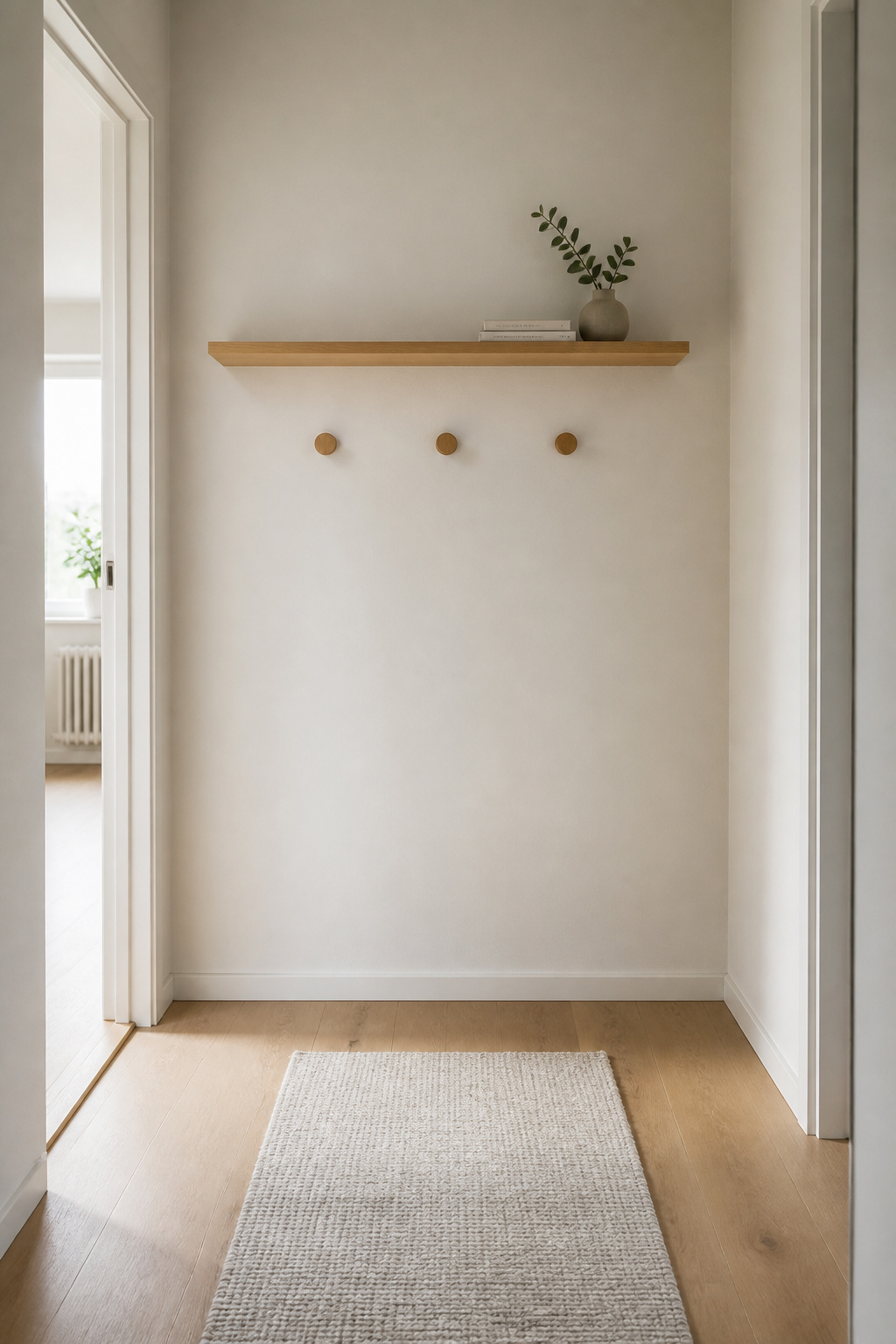
Wall hooks and a thin floating shelf are the shallowest storage available, against a console table’s 10 to 15 inches and a cabinet’s far more. A 6 to 10-inch shelf with a small lip, hooks 12 inches below, keeps the system inside roughly a foot of depth.
What to skip entirely in a tight footprint
Full-depth cubby benches are the first thing to cut in a narrow entry; a hook-and-shelf wall delivers most of the daily function in a fraction of the depth. For the full set of small-footprint trade-offs, see the guide on applying this to a small entryway.
Using This Hardware in a Command Center Build
The same logic scales down to a command center, where everything sits lower and processing separates from storage.
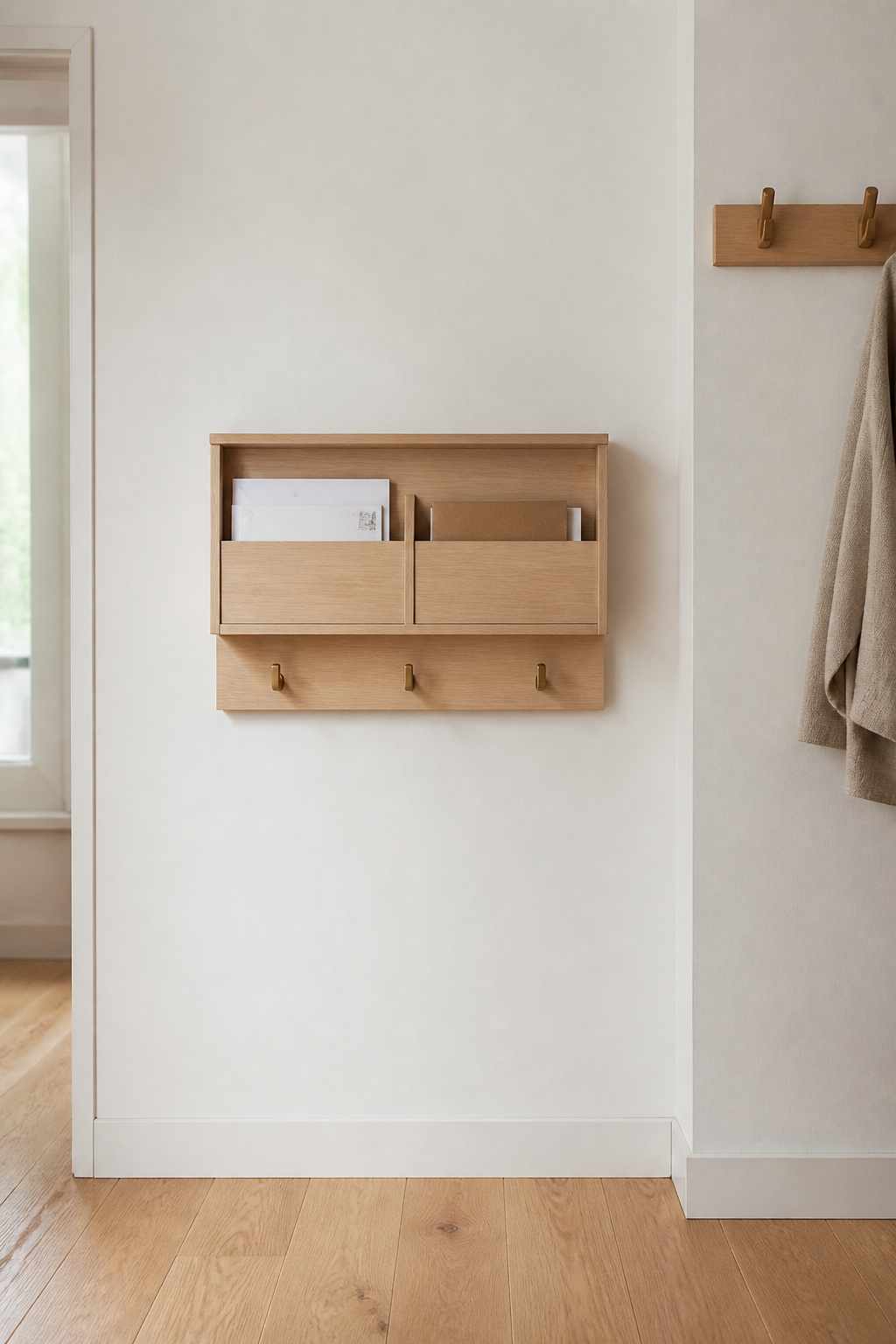
How the same hook logic scales down to a command center’s key hooks
Keys are grabbed at hand height, so command-center key hooks commonly sit near the base of the unit — around 9 to 17 inches tall, well below the 60 to 66-inch coat standard. Treat those retail figures as directional, not an ergonomic standard; the principle holds either way — reach follows the item. A handful of keys sits inside even a 3-lb adhesive hook, so a hook that would fail a coat is fine here.
What changes when mail and keys share the wall with coats
Mail and coats want to stay physically apart. Mail organizers typically build in slots by household member plus a small key-hook cluster at the bottom — small enough to mount beside or below a coat row. For the full layout, see the guide to using this hardware in a command center build.
So the shift is small but complete: stop shopping for hooks and start measuring for them. Decide open or closed storage by the reset your household will honestly do, set each hook at a reachable height, space coat hooks at least 10 inches apart, and anchor into studs. Do that, and hardware style becomes the last, easy choice. For how this wall fits the rest of the entry, see the complete guide to drop zone ideas.
FAQ
How high should entryway hooks be mounted?
Mount adult coat hooks 60 to 66 inches above the finished floor, or 60 inches above a 17 to 19-inch bench seat. Child hooks belong at 36 to 42 inches for roughly ages 4 to 10. In a mixed-age household, add a middle tier at 48 to 54 inches so every person has a reachable row.
What’s the best material for entryway hooks in a humid climate?
Solid grade-304 stainless steel resists rust and corrosion best in humid or coastal climates and handles repeated contact with wet coats and boots. Solid brass is a strong second choice, since it develops a protective patina instead of rusting. Confirm it is solid brass, though, not brass-plated steel, which corrodes once the coating wears through.
How many hooks does a family of four actually need?
A common professional guideline is two hooks per person, one for outerwear and one for a bag or accessory, putting a family of four at a minimum of eight hooks. An alternate rule gives one per person plus two spares for guests, reaching a similar minimum. Add more for seasonal overflow gear rather than sizing to the bare count.