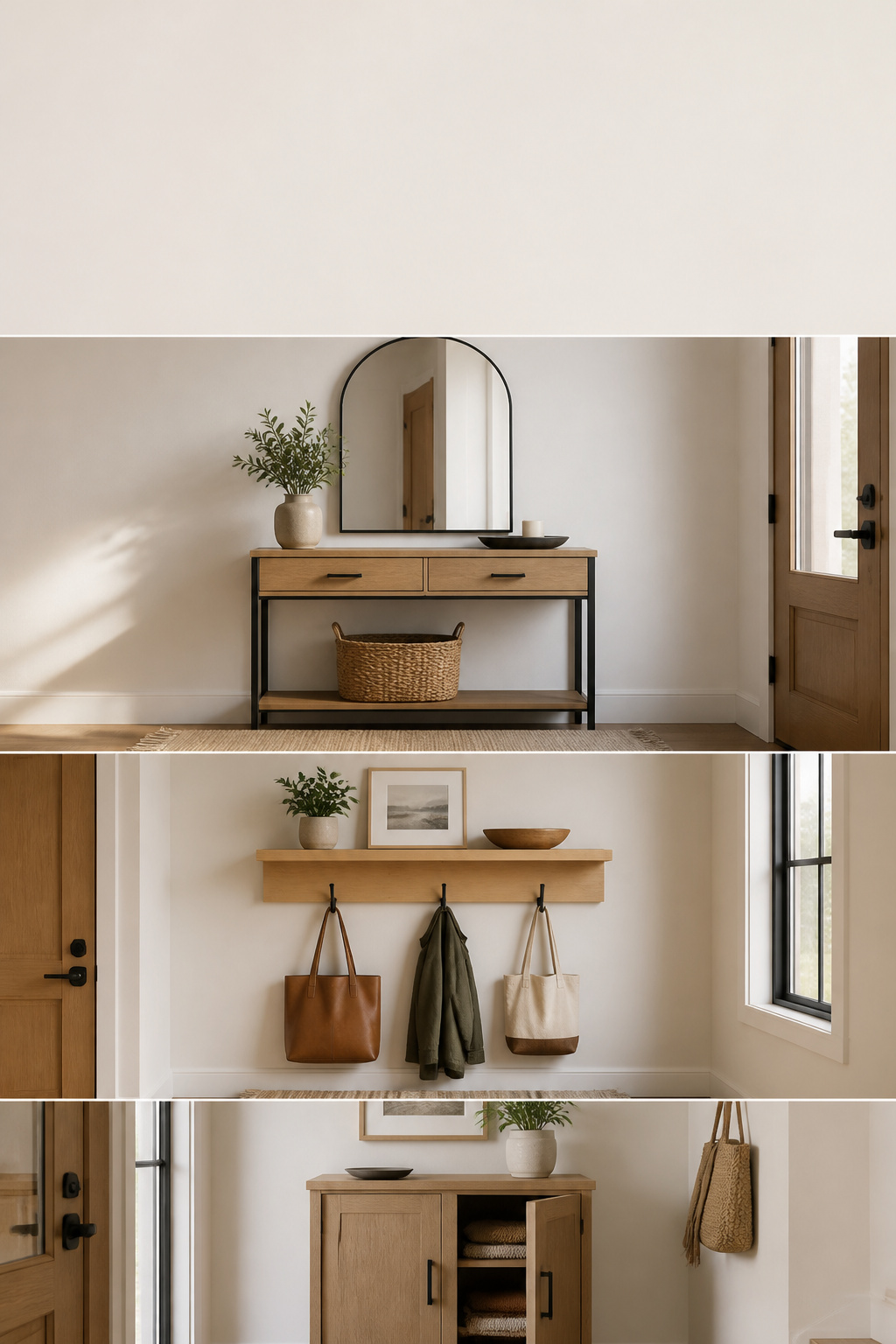
Most homes do not have a mudroom — just a door, a wall, and a growing pile of shoes and bags that lands wherever there is a flat surface. The market answers with dozens of near-identical pieces — the console table, the floating shelf, the slim armoire — each photographed in a wide, sunlit hall you do not own. I have sifted through them so you do not have to. A working small entryway drop zone is not about which piece looks best; it is about which one still fits once you measure the walking space you actually have.
TL;DR
- Measure the clear walking path first: building code sets a 36-inch minimum, so any floor piece in a hall under 48 inches wide caps at 12 inches deep.
- Three options, one footprint decision — wall-mounted shelf and hooks (6-8 in deep, roughly $30-$150), a solid-wood console table (12-16 in, $100-$550), or a closed armoire (22-28 in plus 24-30 in of door swing).
- For a narrow hall under 48 inches, only wall-mounted hooks fit; for a wider nook, a 14-16 inch console with two or three hooks covers keys, mail and coats without the armoire’s door-swing tax.
What Do You Want This Corner to Be?
Before you shop, decide what this corner is for — skipping that question is why so many entries fail, and a piece bought for its look rarely holds a real household’s gear.
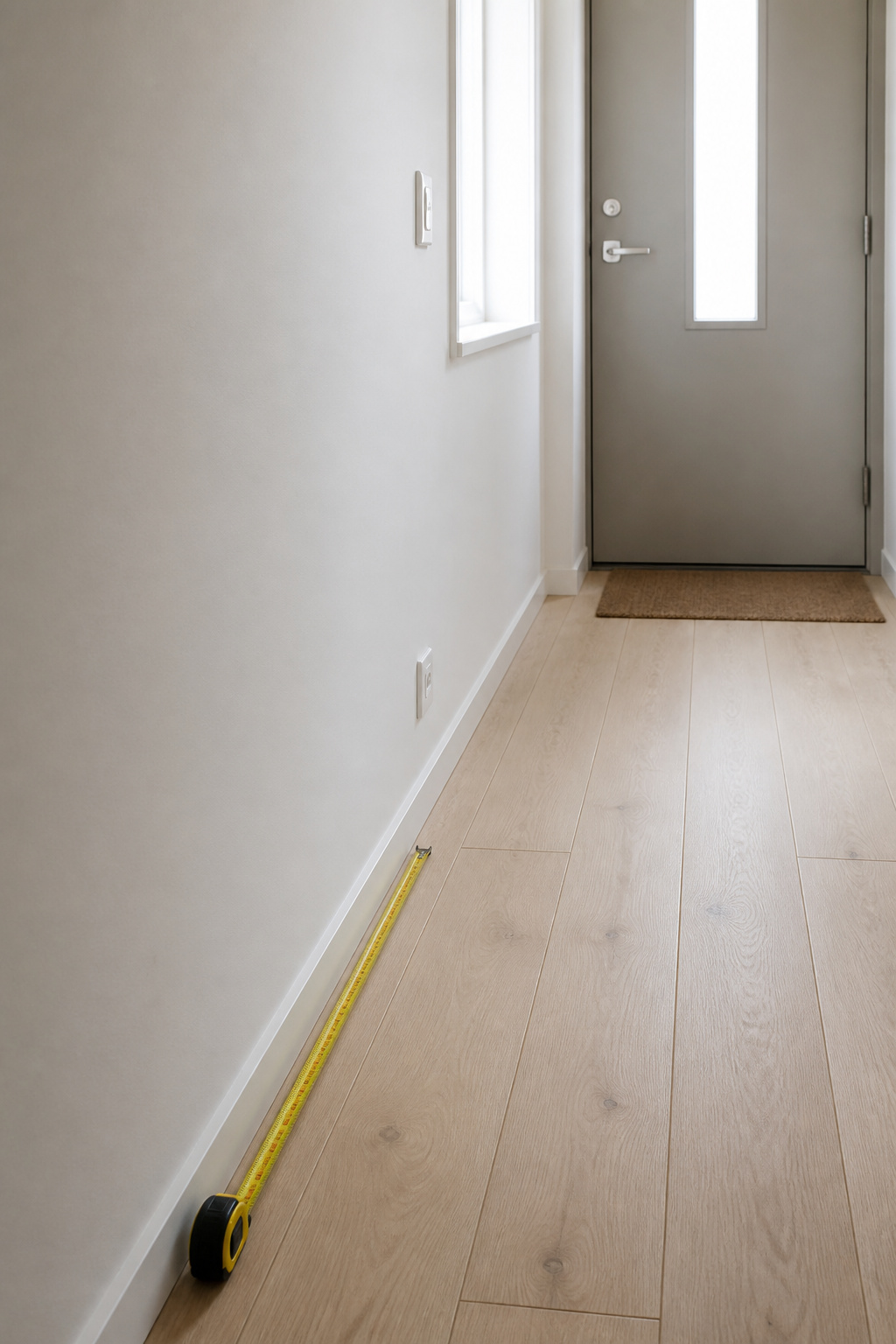
The question to ask before buying anything
Start with what has to land here, not with a piece of furniture: keys and mail, flat and small; bags and backpacks, which hang; shoes, on the floor or a shelf; coats, which need the most vertical clearance. As one entryway feature puts it, the key to avoiding a mess is a designated place for everything — a place for keys, a place for the bag, a place for the hat. Size the piece against the tallest, bulkiest category first, and you will not underbuild it.
Why most homes without a mudroom default to a pile by the door
Without an assigned landing spot, everything gathers on the nearest flat surface or floor — the default the drop zone exists to correct. The fix does not need to be elaborate: even a small shelf with a few hooks meaningfully reduces the pile, because the point is that each thing has somewhere to go, not that the somewhere is impressive.
Sizing the real footprint you have to work with
Here is the number that decides everything: residential code (IRC R311.6) sets 36 inches as the minimum clear hallway width. Most modern halls run 42 to 48 inches; older homes and apartments can be as narrow as 30 to 34. Measure the clear walking path, not just the wall — a piece can fit the wall perfectly and still block passage.
Console Tables as a Landing Surface
The console table is the most common answer to a no-mudroom entry, and for a wider hall it is a good one. But it has firm depth limits, and the material you choose decides whether it survives daily traffic.
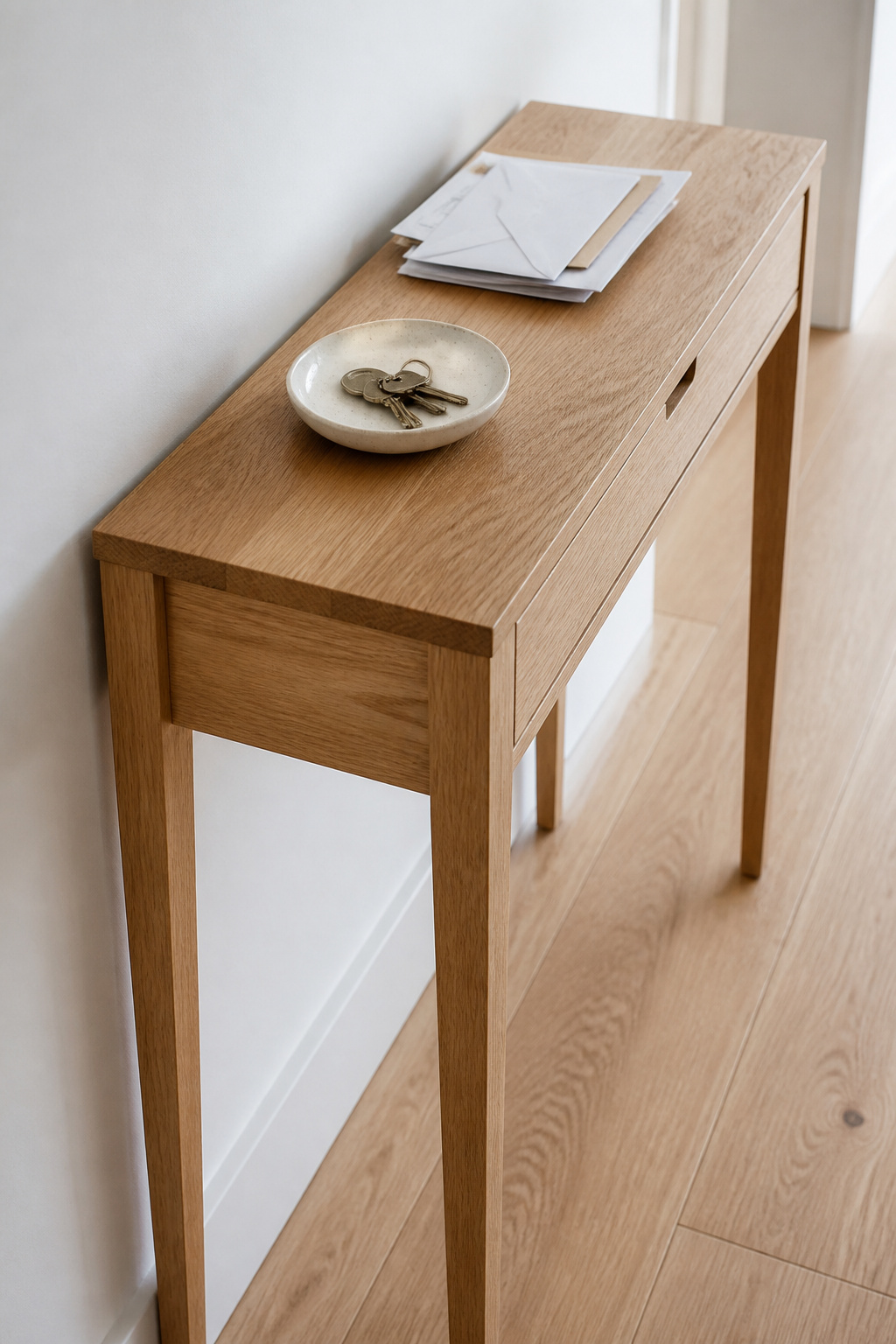
Depth and width that fit a narrow hallway
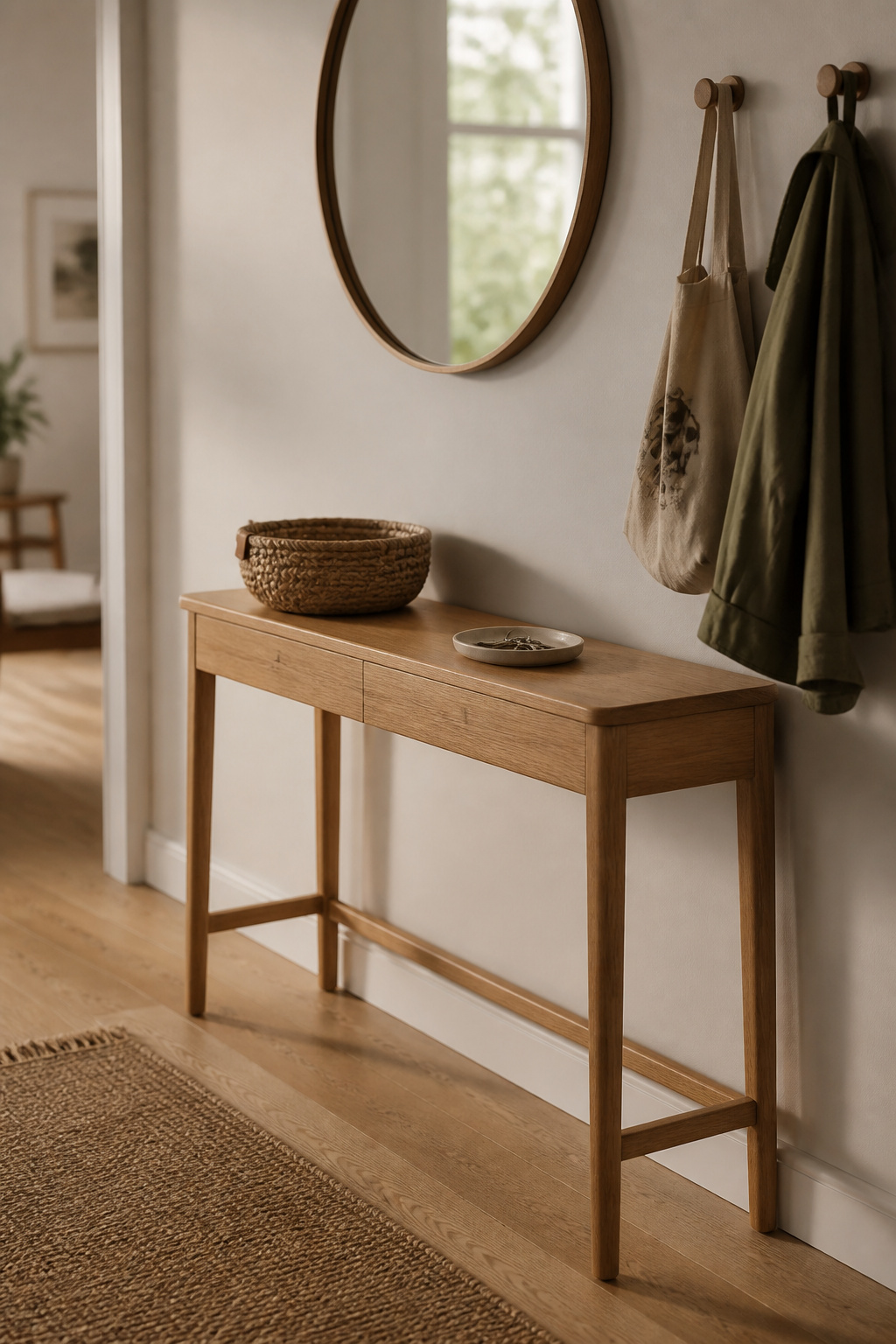
An entryway console should run 12 to 16 inches deep. Twelve is the ceiling for a hall under 48 inches wide, where anything deeper drops you below the 36-inch walking minimum; a hall of 50 to 60 inches can take 14 to 16. Height runs 30 to 36 inches, 30 to 32 best under an eight-foot ceiling. Let the table span roughly two-thirds of its wall — 60 to 75 percent; shorter reads as an afterthought, longer crowds the corners.
Choosing solid wood over veneer for a piece that earns its place
This is where I will commit: for a piece that takes daily impact from keys, bags and bumped hips, buy solid wood. As the Living Spaces buying guide notes, it withstands high-traffic wear and can be sanded and refinished many times; veneer can chip, peel or bubble, and once damaged generally cannot be repaired. Veneer is lighter, cheaper, and resists humidity swings better — a fair trade-off, but one solid piece that lasts beats three you replace. Budget veneer runs under $100 to $150; solid wood commonly runs $300 to $550 or more.
What a console table alone can’t solve
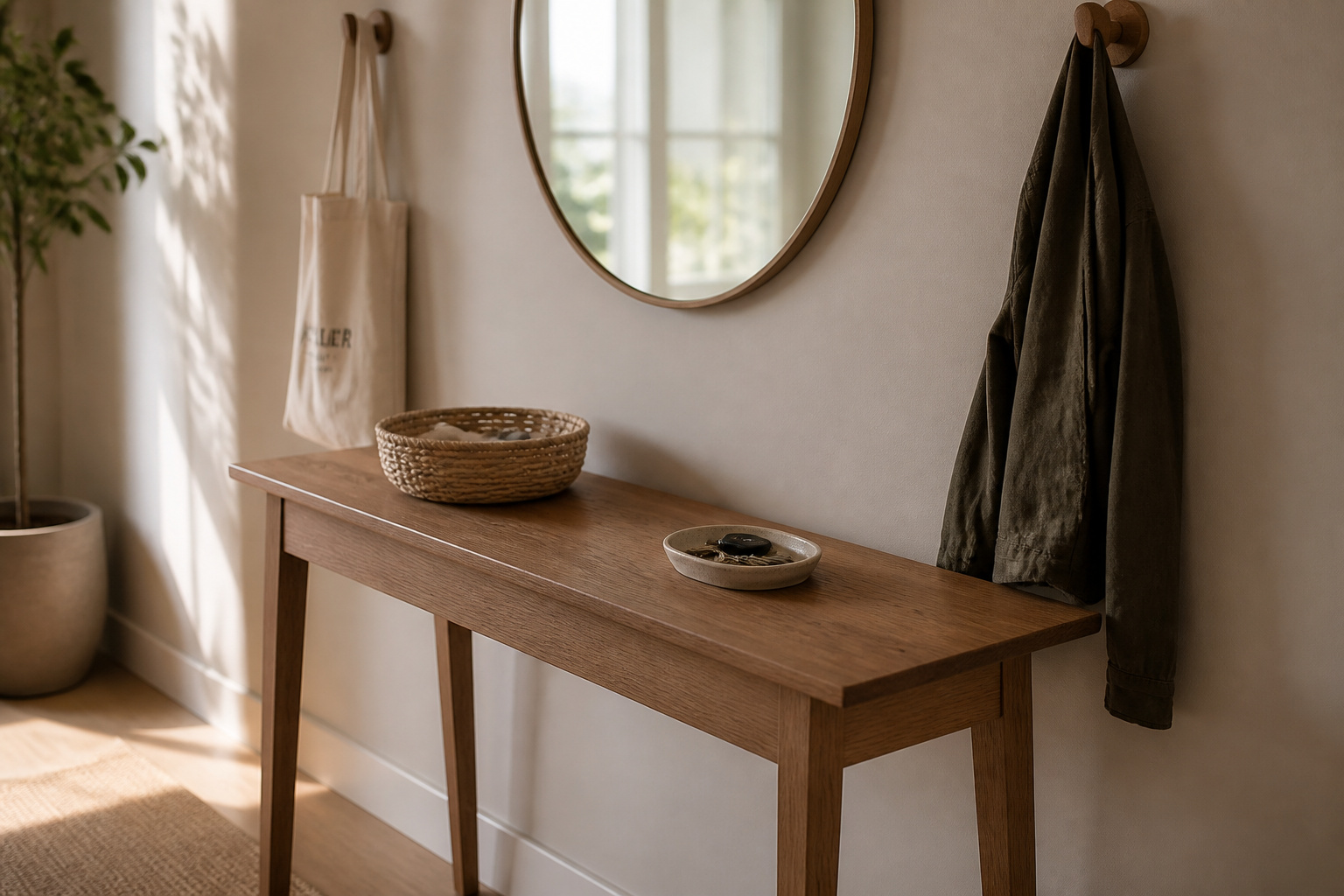
A console handles the flat, small things — keys, mail, a catch-all dish, perhaps a drawer. It has no place for hung coats or floor shoes. Pair it with a few wall hooks above and a basket underneath, and it becomes a complete drop zone.
Wall-Mounted Shelves and Hook Rails
When the floor is too tight for any furniture, the wall is your only surface. A shelf-and-hook system claims almost no floor depth.
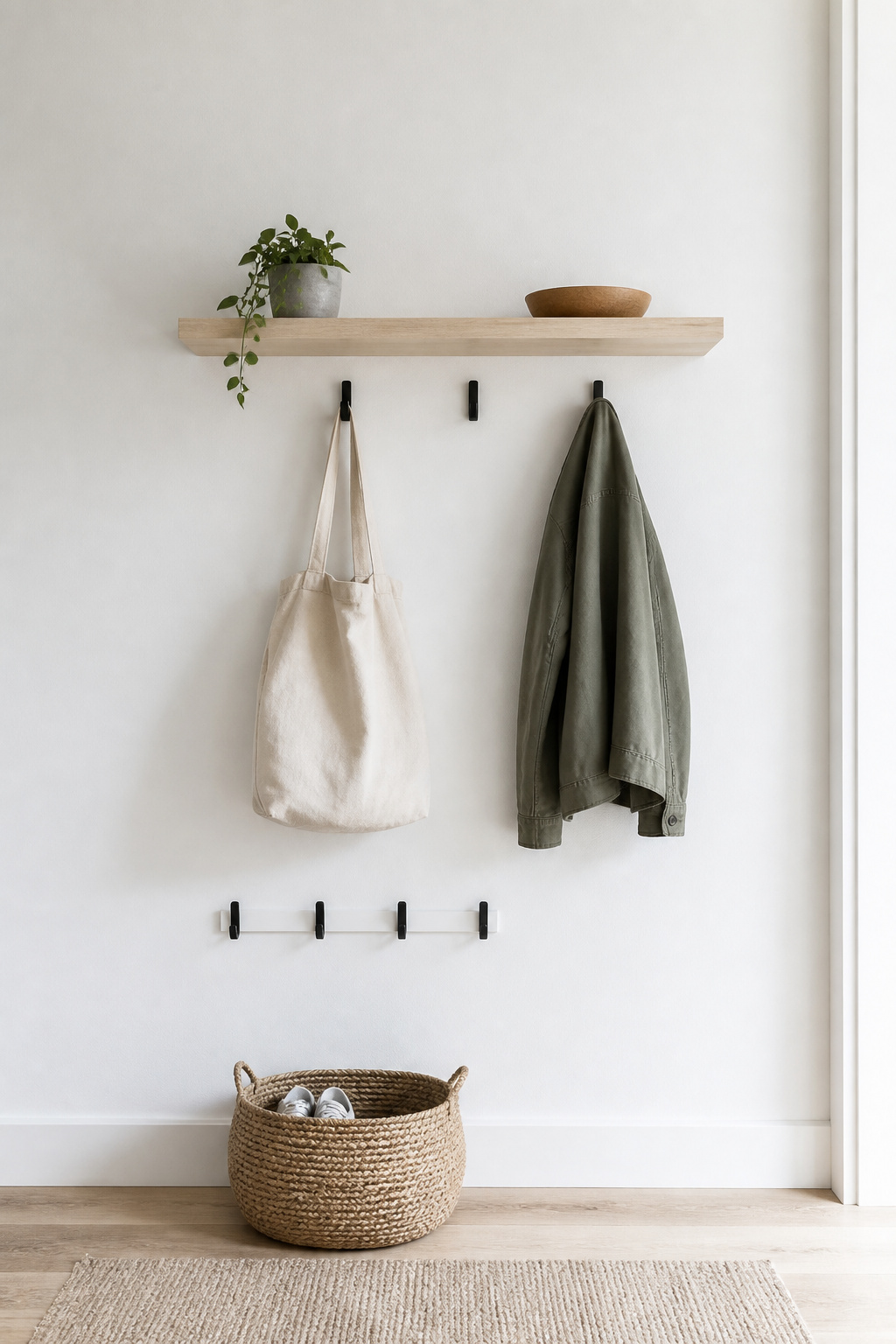
Floating shelf depth for shoes and bags
A display or catch-all floating shelf should run 6 to 8 inches deep, mounted 66 to 72 inches from the floor. Load matters more than the shelf itself: fixed into studs, a bracket holds 45 to 50 pounds per stud, so a three-foot shelf across two studs carries roughly 90 to 100 pounds; drywall-only fixings drop that to 20 to 25. A shoe shelf needs more depth — 12 to 15 inches regular, 16 to 18 for boots — and angling them nose-up uses less depth than laying them flat.
Hook rail height and spacing for a household
Set adult coat hooks 60 to 66 inches above the floor; 66 is the builder default. Space them 10 to 12 inches apart for coats, widening to 15 for bulky parkas, tightening to 6 for scarves. For a mixed household, run two rows: 60 to 66 inches for adults, 36 to 42 for children — as the Ashdeco design guide observes, that lower row lets children hang their own coats and backpacks, keeping them off the floor.
Why wall-mounted beats floor furniture in a tight space
The math is simple: a wall system needs 6 to 8 inches of depth, a console needs 12 to 16. In a hall too narrow for any floor piece, the wall is the only place left — and a clear floor reads as more open, with nothing to navigate around at ankle height. To go deeper on the hardware itself, see the shelving and hooks that fit small spaces.
Armoires and Closed Storage for Full Concealment
Some households would rather see none of it — for them, a closed cabinet is worth considering, with the caveat that “armoire as an entryway piece” is thinner ground than the two options above, so treat these figures as a starting point, not gospel.
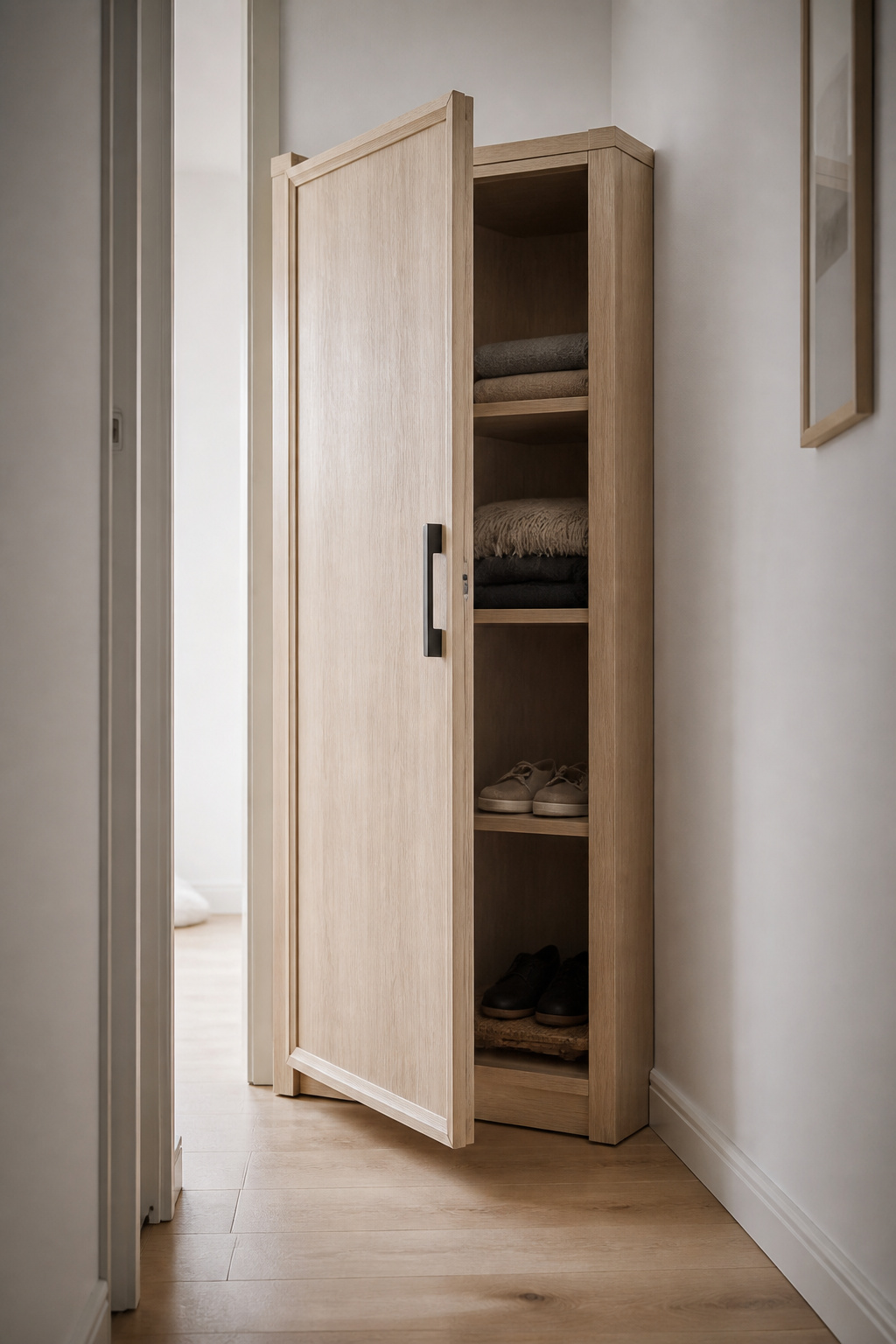
When an open system won’t work for the household
Open hooks only stay tidy if people use them tidily. Where a household reliably turns open storage into visible clutter, a cabinet with doors hides the inconsistency — a repurposed hutch or armoire fitted with hooks is one documented way to get gear fully out of sight.
Depth and door-swing considerations in a small entry
Here is the constraint the console and shelf do not have: a freestanding wardrobe or armoire typically runs 22 to 24 inches deep, around 28 for bulky coats, and a hinged door needs roughly its own width in clear floor in front — commonly 24 to 30 inches, on top of the cabinet’s depth. Sliding doors avoid swing clearance entirely.
The trade-off: concealment vs. daily friction
Add it up and a hinged armoire can claim 50-plus inches of footprint — more than double a console — and full concealment usually costs the narrowest halls their walking clearance outright. There is a quieter cost too: opening a door, then a bin inside it, adds steps to a two-second task, and that kind of friction tends to get abandoned within weeks.
Matching the Option to Your Footprint
Laid side by side, the three options separate cleanly: hallway width and your feelings about visible gear decide the winner, not what photographs best.
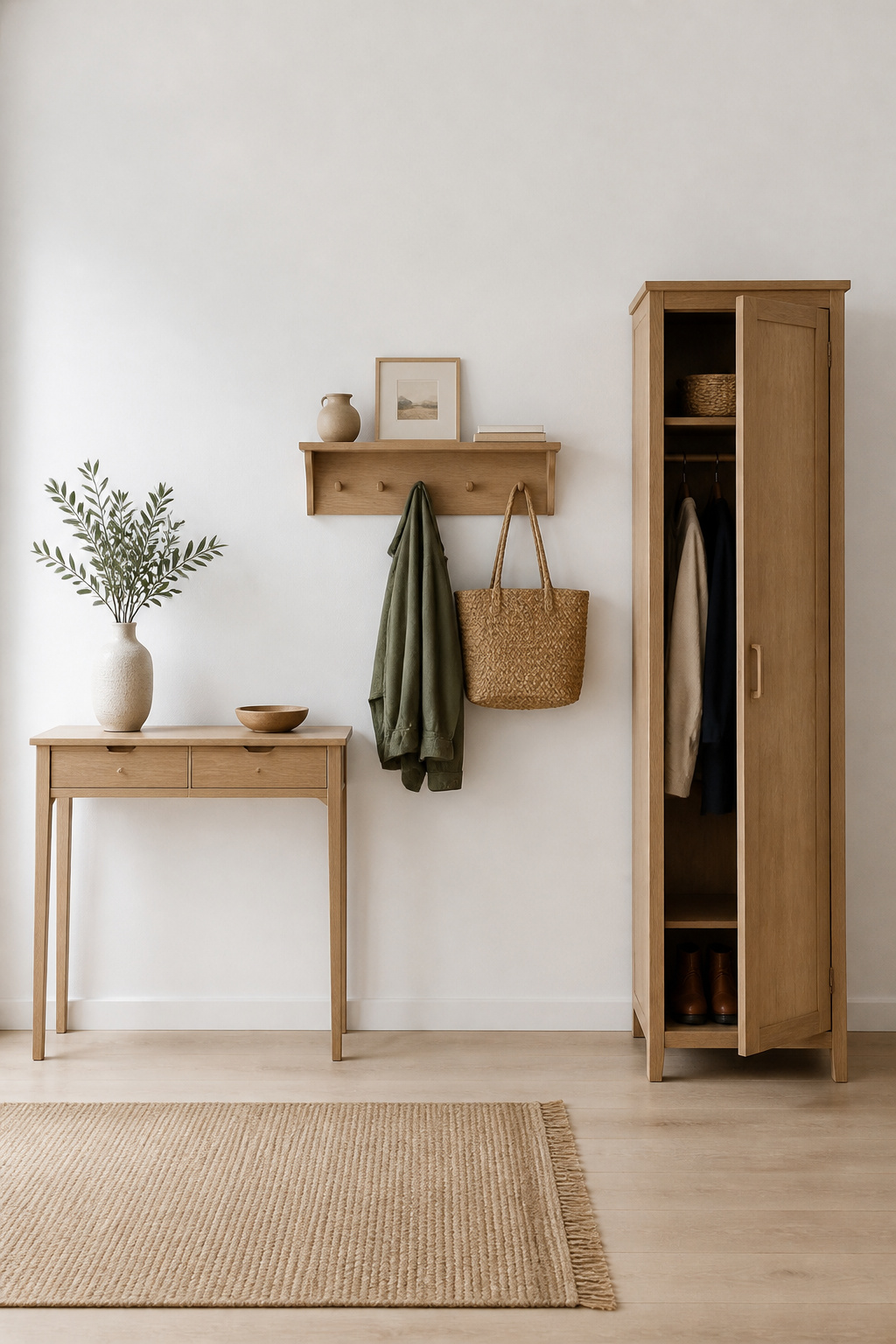
A simple comparison of depth, cost and capacity
Read the depth column first — it says yes or no in a small entry:
| Option | Depth | Rough cost | Holds | Trade-off |
|---|---|---|---|---|
| Wall shelf + hooks | 6-8 in (12-18 in for shoes) | $30-$150 | Shoes, bags, coats | Everything stays visible |
| Solid-wood console | 12-16 in | $100-$550 | Keys, mail, catch-all | Needs added hooks for coats |
| Armoire / cabinet | 22-28 in + 24-30 in swing | $200-$800+ | All of it, hidden | Adds a step to daily use |
One recommendation for a narrow hallway, one for a wider nook
For a hall under 48 inches wide, the wall-mounted shelf and hook rail is the only option that keeps the 36-inch clearance code requires — a console or armoire does not fit that math. For a wider nook of 50 to 60 inches or more, a 14 to 16 inch solid-wood console paired with two or three hooks covers keys, mail and coats in one footprint, without the armoire’s door-swing tax.
Fitting a Kid-Friendly System Into a Small Entry
Adding children changes the numbers, not the system — the same wall or console still works; you are only adjusting hook height and shelf depth to a smaller user.
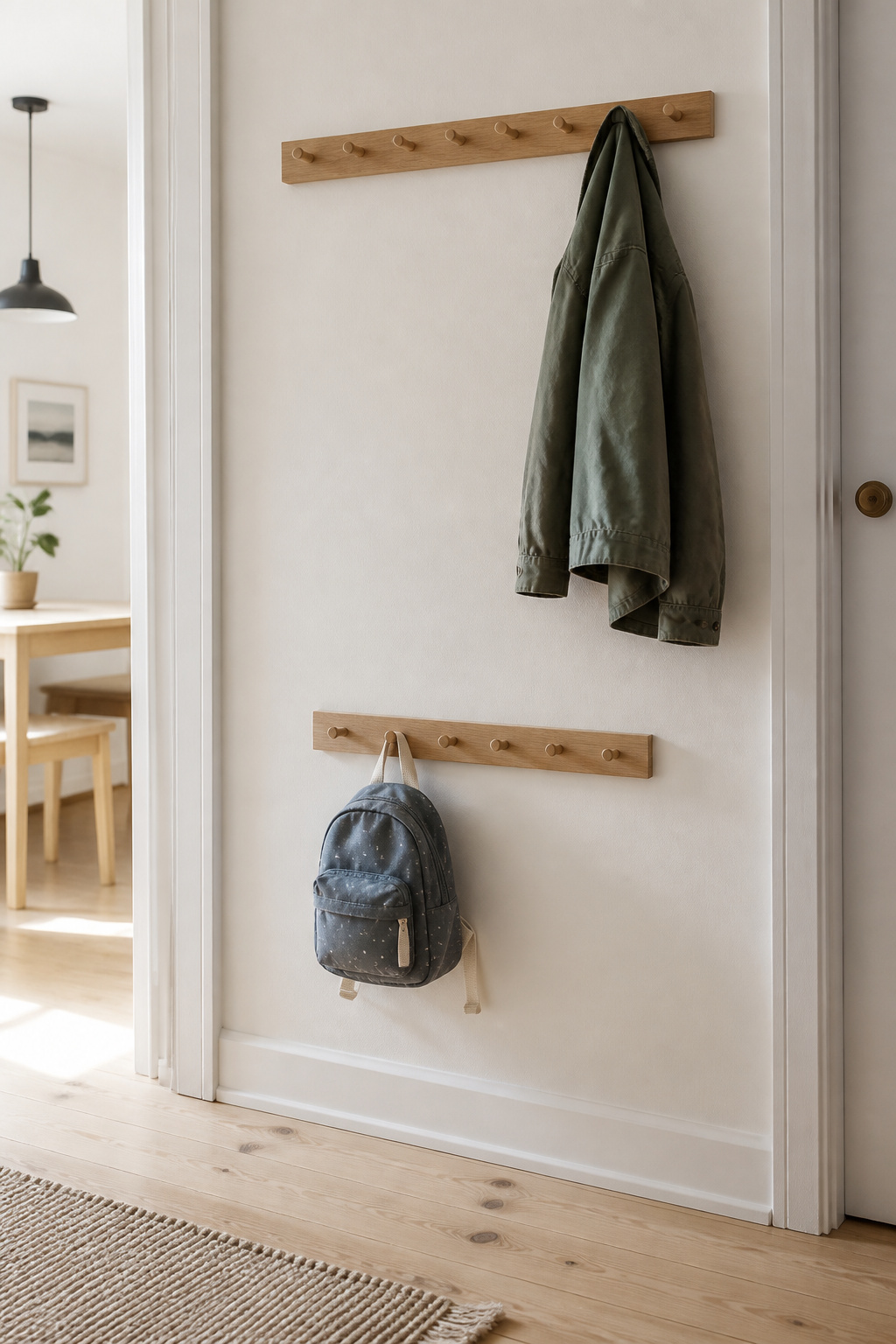
What changes when backpacks and small shoes join the footprint
Children reach lower, so a hook they can use sits lower: ADA anthropometric data puts a 5-to-8-year-old’s high reach at about 41 inches, a 9-to-12-year-old’s at 44. A loaded backpack wants the same 10-to-12-inch spacing as a coat but hangs lower and wider, crowding a narrow rail faster.
Where low hooks fit into a space this tight
In a hall too narrow for three separate rows, one child-height row at 36 to 42 inches below a single adult row at 60 to 66 covers most families without a third strip of hardware. Getting the stage-adaptive depth right as children grow is its own subject — for that, see fitting a kid-friendly system into a small entry.
Measure the walkway, not the wall, and the choice makes itself: hooks for the tight hall, a solid console for the wider nook, an armoire only where the door swing has room. I learned this the slow way, in a 38-square-metre flat in Malmö where every object had to earn its place — one shelf, three hooks and a basket, and it held six years of coming and going without complaint. A small entry is not a compromised mudroom; measured honestly, it is simply enough. For how this fits the wider system, see the drop zone design principles.
FAQ
What’s the minimum space needed for an entryway drop zone?
There is no fixed square-footage minimum; a drop zone scales down to a single wall section or corner by the door. The real limit is walking clearance — code requires a 36-inch clear hallway, capping floor furniture at 12 inches deep in halls under 48 inches wide. Wall-mounted shelves and hooks need no extra floor space at all.
Can a drop zone work in an apartment with no entry hall at all?
Yes. A complete drop zone can be built from a single wall beside the door, even with no hall — a basket on a small table, or a shelf with a few key hooks, is enough to function as a full system.
Is a bench necessary in a small entryway drop zone?
No. A bench helps for seated shoe-changing but is not required; a console or wall-mounted system works alone. Where you want seating, compact benches under 36 inches fit best — or pair a console with baskets underneath as an alternative that spares the extra floor depth.