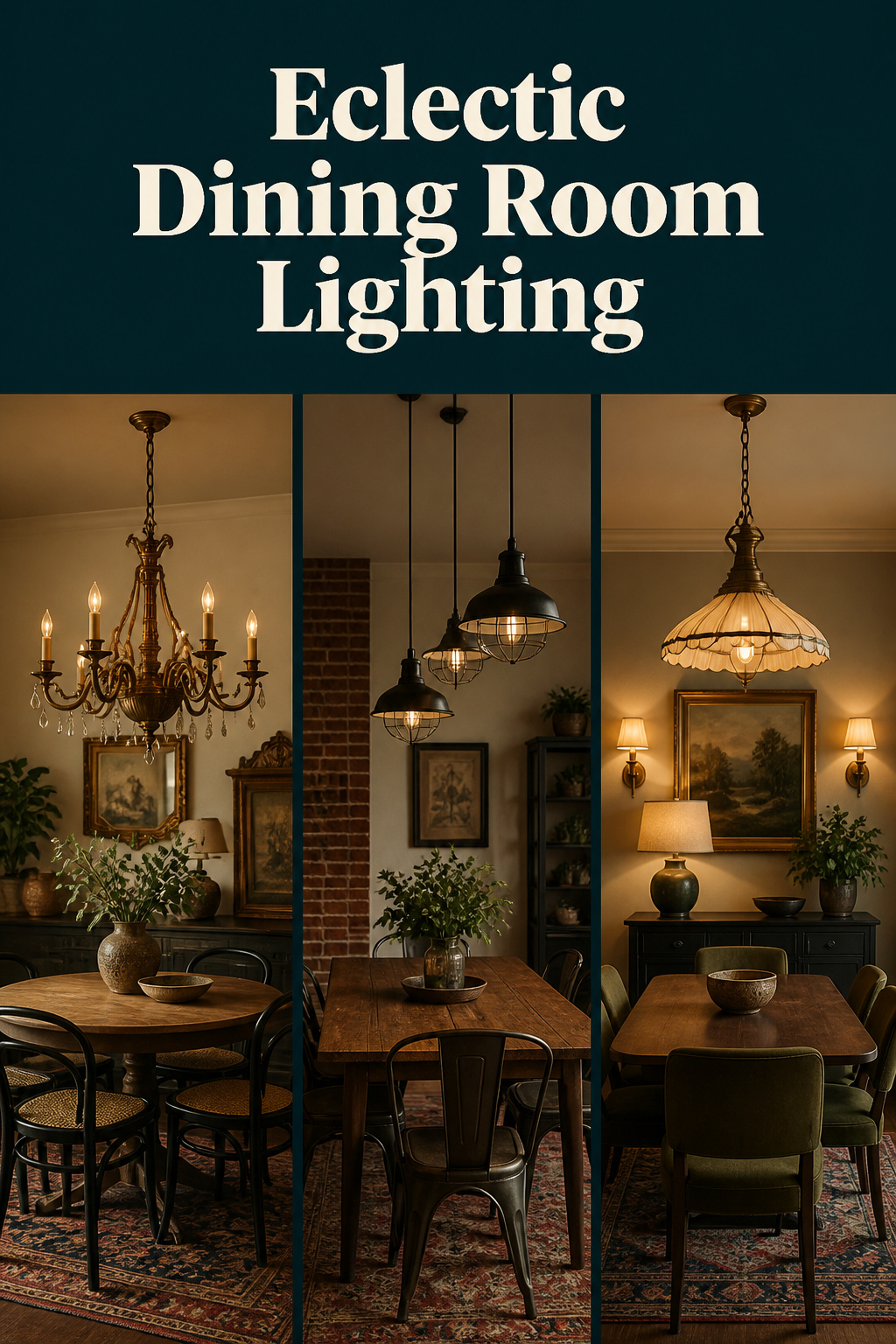
You have reached the point where matched no longer satisfies you. The dining set arrived together, the rug agrees with the curtains, and the room is correct in the way a showroom is correct. What you have started noticing in the homes you admire is a different quality: the fixture overhead that clearly did not come in the box, the one object in the room with a past of its own. Eclectic dining room lighting is the move that gets you there, and designers most often hand it to people exactly at your stage, because the dining room forgives a bold choice in a way no other room does.
TL;DR
- Hang the lowest point of a dining chandelier 30–36 inches above the table on a standard 8-foot ceiling, adding 3 inches per extra foot of ceiling height, and keep the fixture half to two-thirds the table’s width.
- Mix eras freely — a Victorian chandelier with Art Deco sconces works — as long as every bulb runs warm (2200–2700K) and you hold the room to two or three finishes, with aged brass as the bridge metal.
- Layer the light: one overhead alone interrogates faces, so add wall sconces at 60–66 inches beside a buffet and a lamp on the sideboard for the candlelight effect.
Why the Dining Room Is Where You Take the Lighting Risk
A dining room earns its keep a few evenings a week, not all day. That occasional use is exactly what gives it license. A kitchen overhead has to be sane at seven in the morning; a bedroom fixture has to read calm at midnight. The dining room only has to be wonderful when people are gathered. George Crew of Chicago Construction Crew puts it plainly: the dining room is no longer just where meals happen but where families gather and events are celebrated, which is why the lighting carries so much of the mood. The shift in 2026 is toward spaces designed for lingering — and a lingering room rewards a brave light.
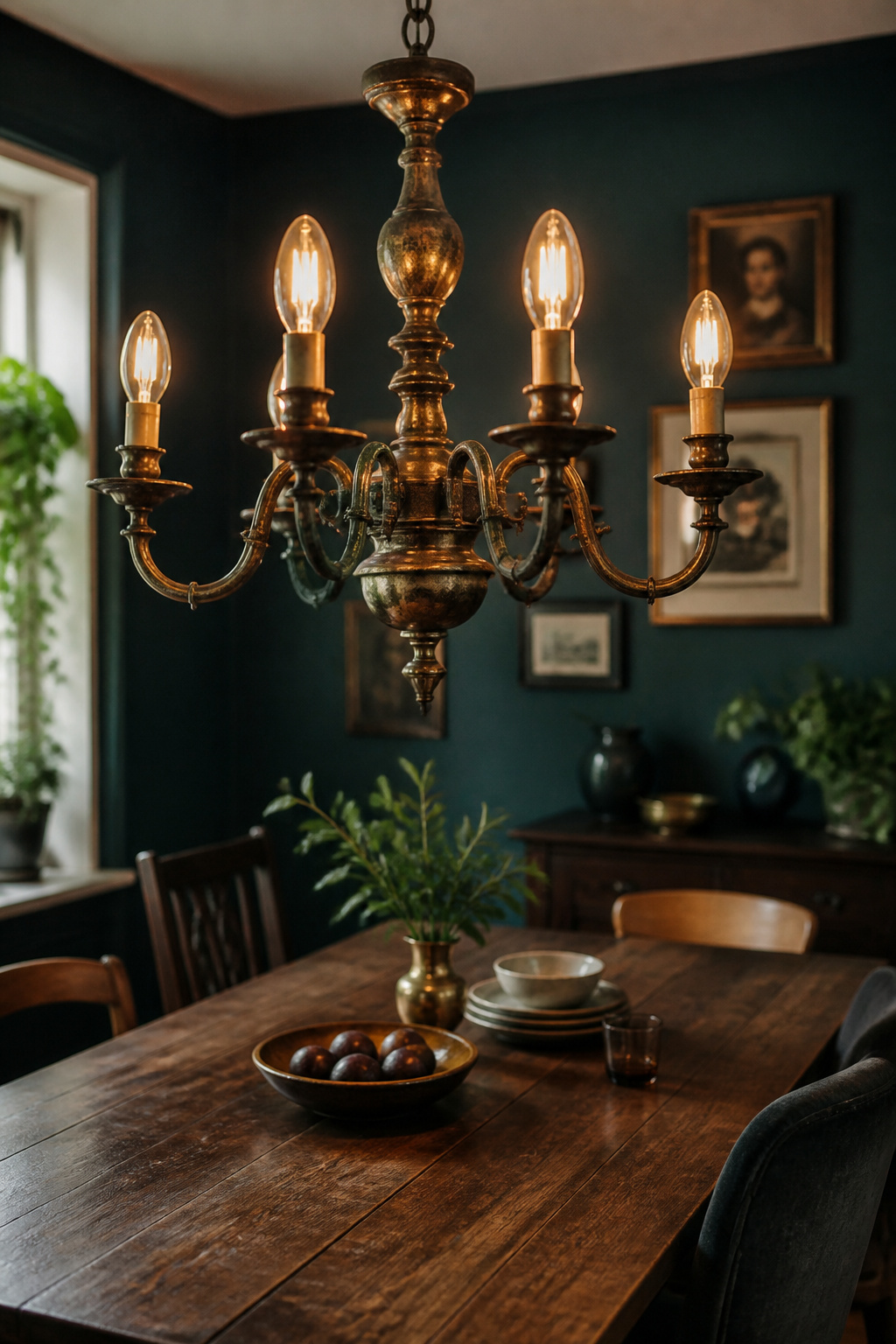
That bravery does real structural work. A chandelier draws the eye upward and defines the centre of the room, giving the surrounding mix of furniture and textures a point to orbit. In an eclectic scheme, where pieces deliberately disagree, a bold central fixture keeps the disagreement from reading as accident. This is the principle that runs through all the eclectic dining room design ideas on this site: one confident anchor makes a dozen smaller risks legible. The one mistake to avoid is choosing a fixture that matches the room’s existing style too closely. The dining room is the single place where deliberate mismatch pays.
Choosing a Statement or Vintage Fixture as Your Anchor
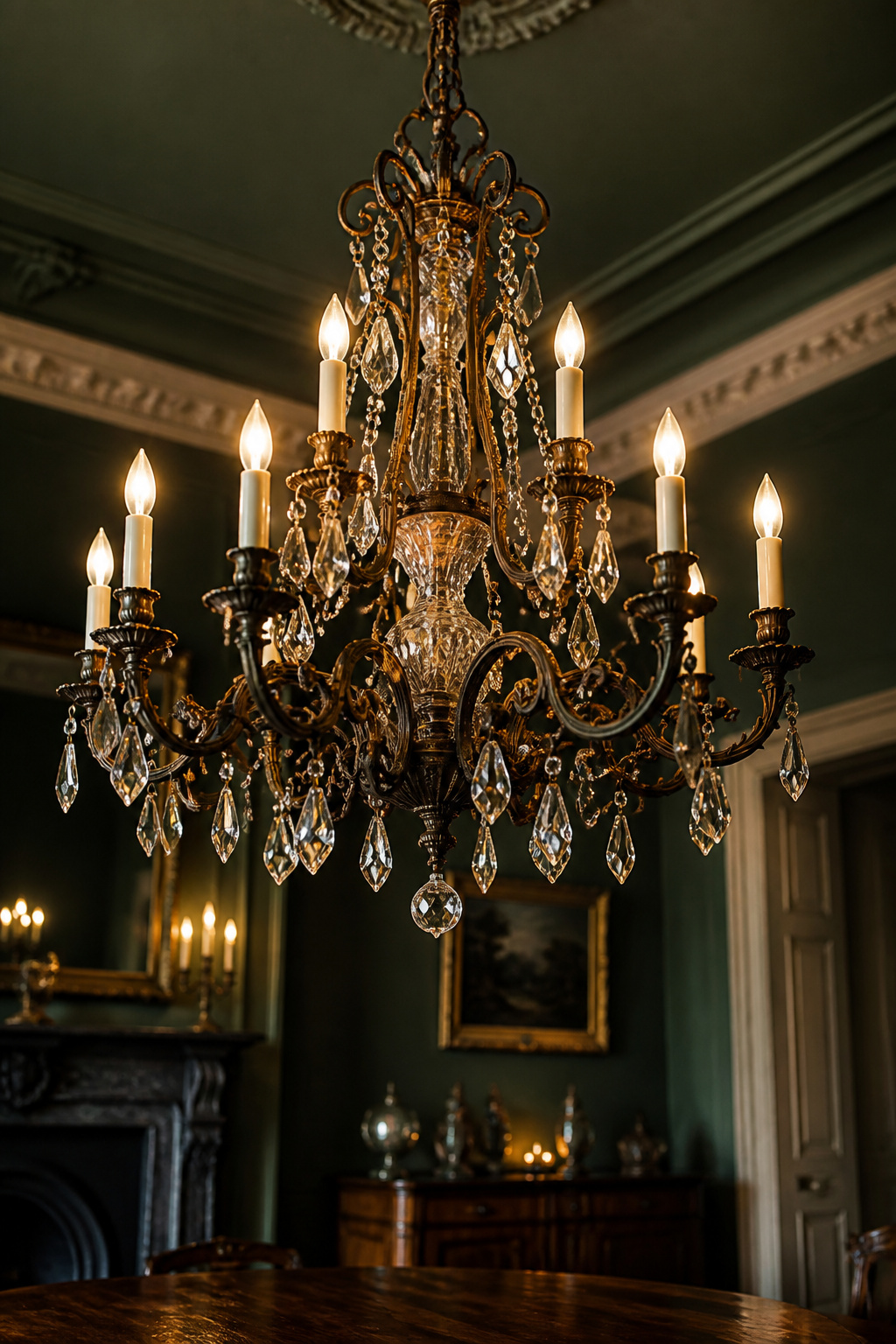
Before a vintage chandelier earns a place over your table, it should tell you where it has been. To carry the word antique a piece must be at least 100 years old; vintage covers the 20-to-99-year range. The materials date it as reliably as any label: brass — copper and zinc — reads bright gold when new and warms into patina; bronze — copper and tin — starts darker and reddish-brown. Authentic vintage crystal carries a faint grey tint from its high lead content, with drops faceted on both sides, where modern reproductions leave one side smooth. Era markers: Art Nouveau (1890–1910) uses organic curves and nature motifs in bronze; Art Deco (1920–1940) turns geometric in brass and chrome. Cloth-covered wire and dated sockets are a clear signal that the fixture needs rewiring before it goes live.
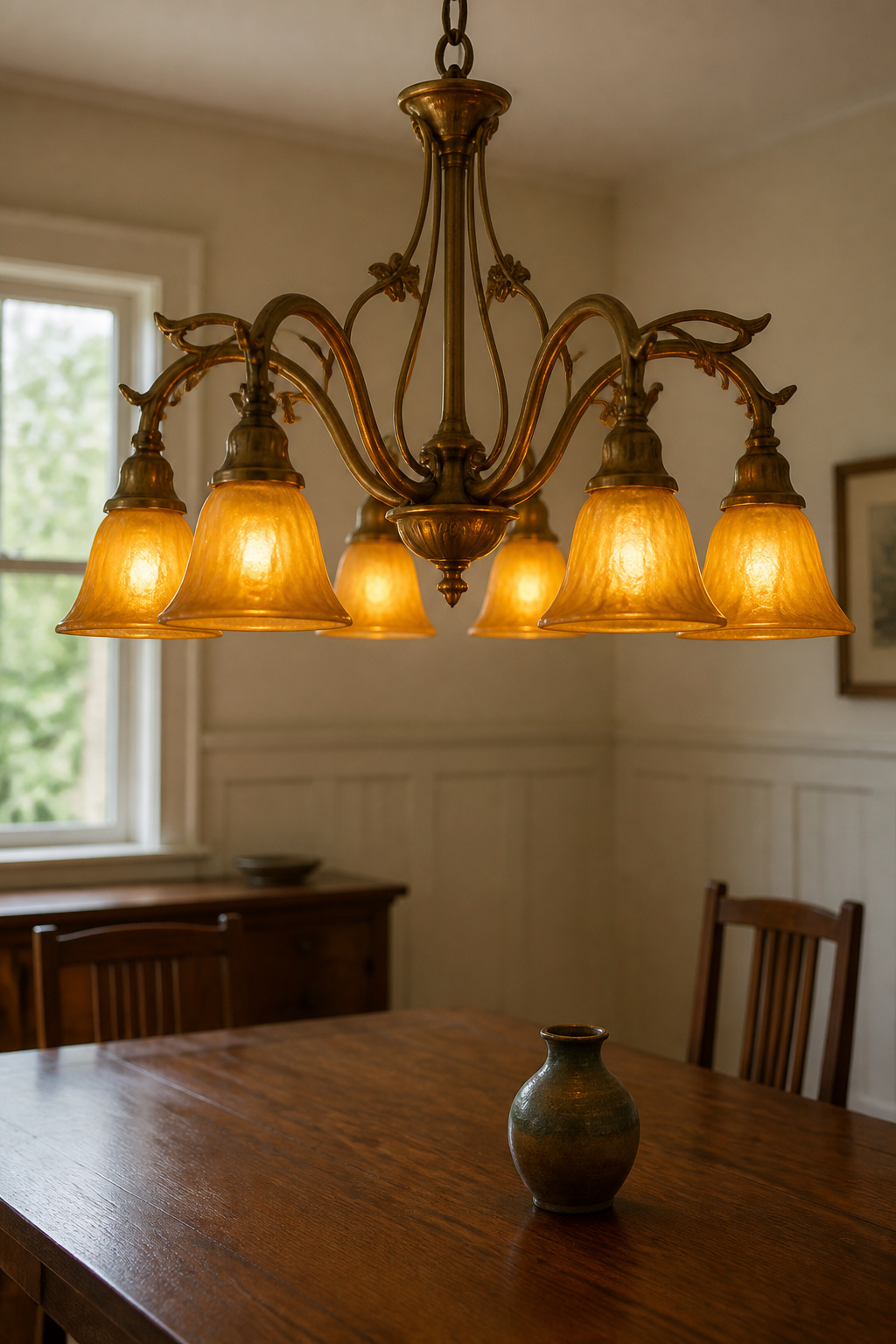
Sizing is where instinct fails most people. A single pendant runs one-third to one-half the table’s width; a full chandelier half to two-thirds, never exceeding the table. A room-dimension shortcut: add length and width in feet to get chandelier diameter in inches — a 12-by-14-foot room calls for roughly a 26-inch fixture. Hang the lowest point 30–36 inches above the table on a standard 8-foot ceiling, adding 3 inches per extra foot of ceiling, and keep a 7-foot floor clearance minimum in any passage. The table below is the one I keep in my head at estate sales.
| Table width / ceiling | Recommended fixture diameter | Hang height (table to fixture) |
|---|---|---|
| 36 in table, 8 ft ceiling | 18–24 in chandelier | 30–36 in |
| 48 in table, 9 ft ceiling | 24–32 in chandelier | 33–39 in |
| 60 in table, 10 ft ceiling | 30–40 in chandelier | 36–42 in |
When should you break the rule? An oversized fixture, up to about 80% of the table’s width, reads as a deliberate eclectic flourish — provided the ceiling height can carry the scale. An undersized vintage piece earns its place only when it has exceptional presence: dense crystal, a strong silhouette, or deep colour.
Mixing Pendant Styles and Heights: The Multi-Fixture Approach
For a long rectangular table, three pendants often beat one chandelier. A single centred fixture leaves the table ends in shadow; a row of three distributes warm light across the full length and introduces rhythm rather than emphasis. Spacing is the whole game. Keep 24 inches minimum and 36 inches maximum between fixtures — over a 96-inch table, three pendants land neatly at about 32 inches apart. Below 24 they crowd; above 36 the rhythm breaks and they stop reading as a set.
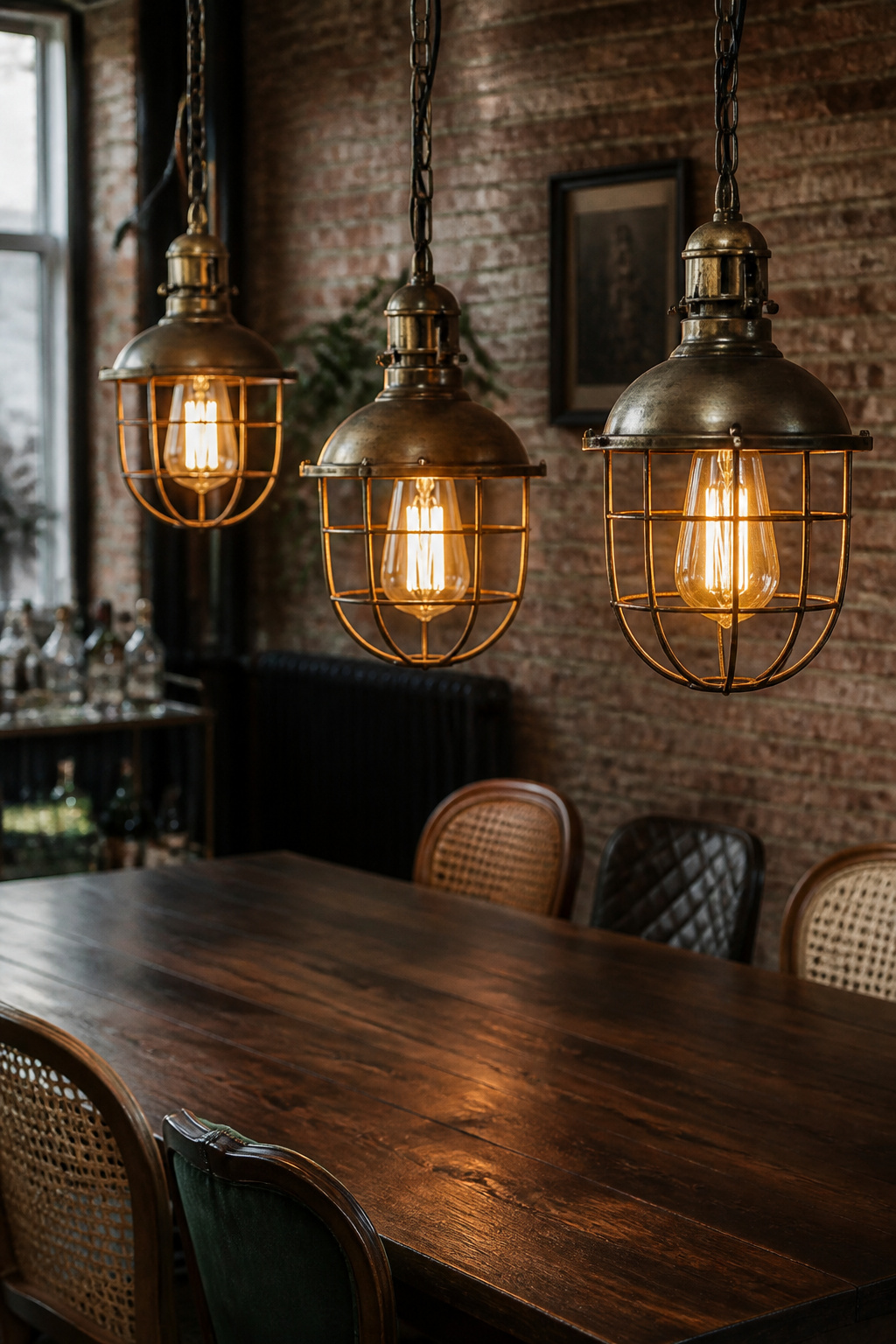
Height is where I depart from the spec sheets and give you my own working method. If you stagger pendant heights at all, do it in small increments — three to five inches, never the dramatic differences that look like an installation went wrong. My recommendation is to let the stagger decrease toward the room’s centre and increase toward the table ends, so the cluster cradles the table rather than tilting at random. Treat that as my judgment rather than a rule from trade literature. The safest route to a deliberate-looking stagger is using pendants from the same family — identical form, different chain lengths — because the shared silhouette signals intention even when the heights differ by six or eight inches.
Mixing eras across pendants is not only allowed but encouraged: a rugged industrial pendant beside a vintage globe is precisely the kind of contrast that makes a scheme feel curated. What lets them agree is rarely shape and almost always warmth. Keep every bulb in the 2200–2700K range and repeat at least one material — aged brass on the industrial cage echoed by aged brass arms on the globe — and two very different fixtures will read as a pair. Get the colour temperature wrong and no amount of matching metal will save you.
Layering Dining Room Light: Chandelier, Wall Sconces, and Table Lamps
One overhead fixture, however beautiful, lights a dining room the way a dentist’s office is lit. Direct downlight casts shadows under brows and noses, and nobody wants to look interrogated over dinner. The fix is layering. Designer Victoria Holly frames dining light as a balance between functional light for meals and softer, moodier light for ambiance, and the key, she says, is layering. Tom Simon of Juniper Design puts the mechanic plainly: placing light sources at eye level — table and floor lamps supplementing the overhead — produces a flattering horizontal glow instead of the unflattering shadows direct overhead casts. Hold every layer to a warm 2700–3000K; anything above 3500K greys out warm woods and undoes the intimacy entirely.
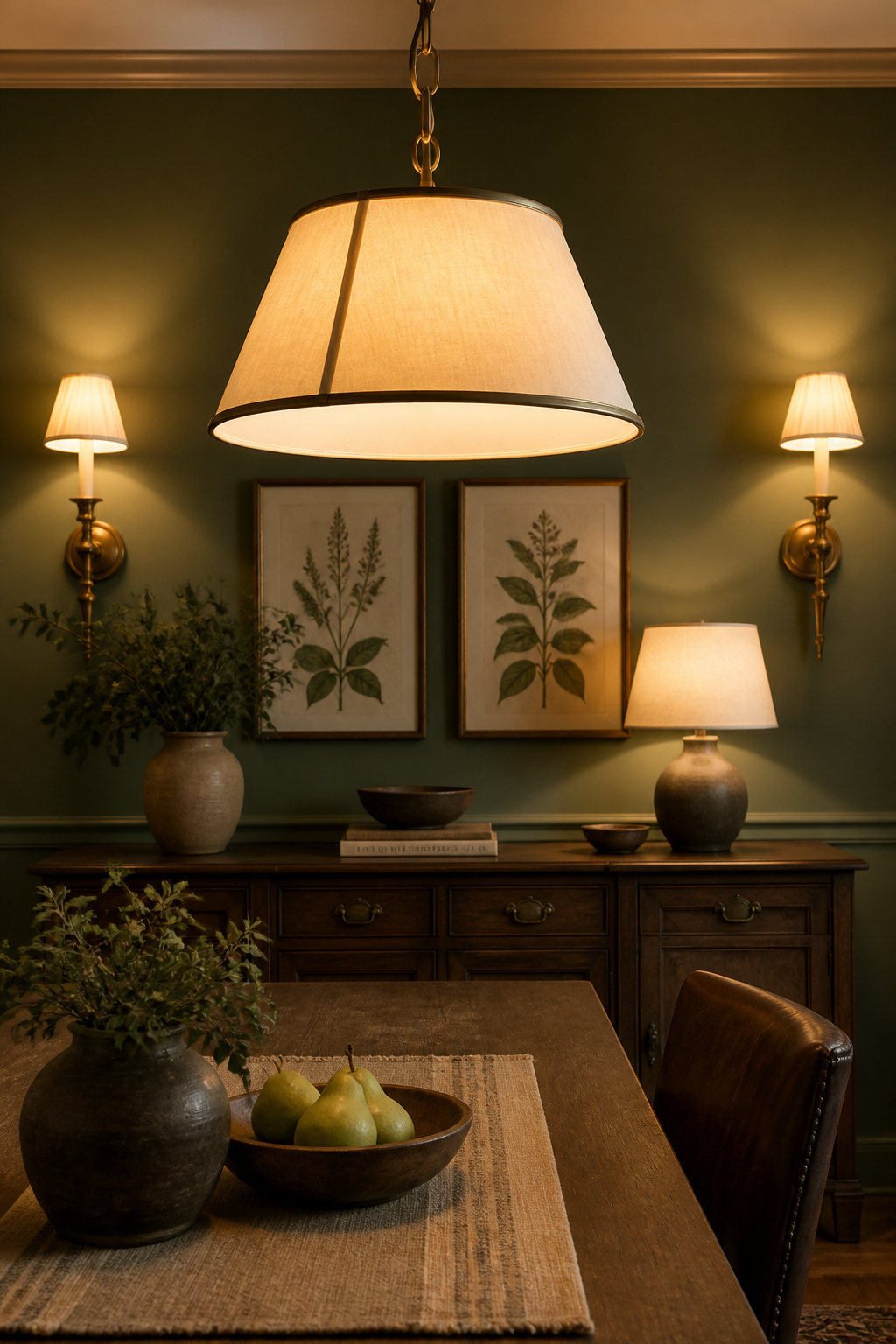
The second layer lives on the walls. Mount sconces with their centres 60–66 inches from the floor — eye level for a standing adult, above the sightline of a seated one. Flanking a buffet, china cabinet, or a mirror above a sideboard, they highlight the serving zone and lay down a perimeter glow the central fixture cannot reach.
The third layer is the one people forget: a lamp on the sideboard. A pair of small table lamps at roughly 30–42 inches of sideboard height adds ambient light between floor and ceiling, and a lamp set near a mirror doubles itself in reflection — candlelight-scale pools that keep the room feeling alive even when the chandelier is dimmed low. Cordless rechargeable lamps make this trivial now, with no cable to hide, and they carry to the table itself for a dinner party. The sconces and the sideboard lamp are the supporting cast; together with the chandelier they build the three-course meal of light a dining room actually needs.
Using Patina and Aged Brass as a Unifying Thread
If one finish deserves to run through an eclectic dining room, it is aged brass — because it is, almost literally, the bridge metal. Its green-gold tone sits between the cool metals (nickel, chrome, stainless) and warm timber, so it reads happily against both modern pale stone and dark vintage wood. The oxidised surface says collected over time rather than coordinated, which is exactly the message an eclectic room wants to send. That softened patina is what lets aged brass on a chandelier arm answer to aged brass pulls on a sideboard 40 years its junior and have the two read as one collected universe. This is how the lighting ties back to your mix of vintage and modern furniture: the patina does the work a matched set cannot.
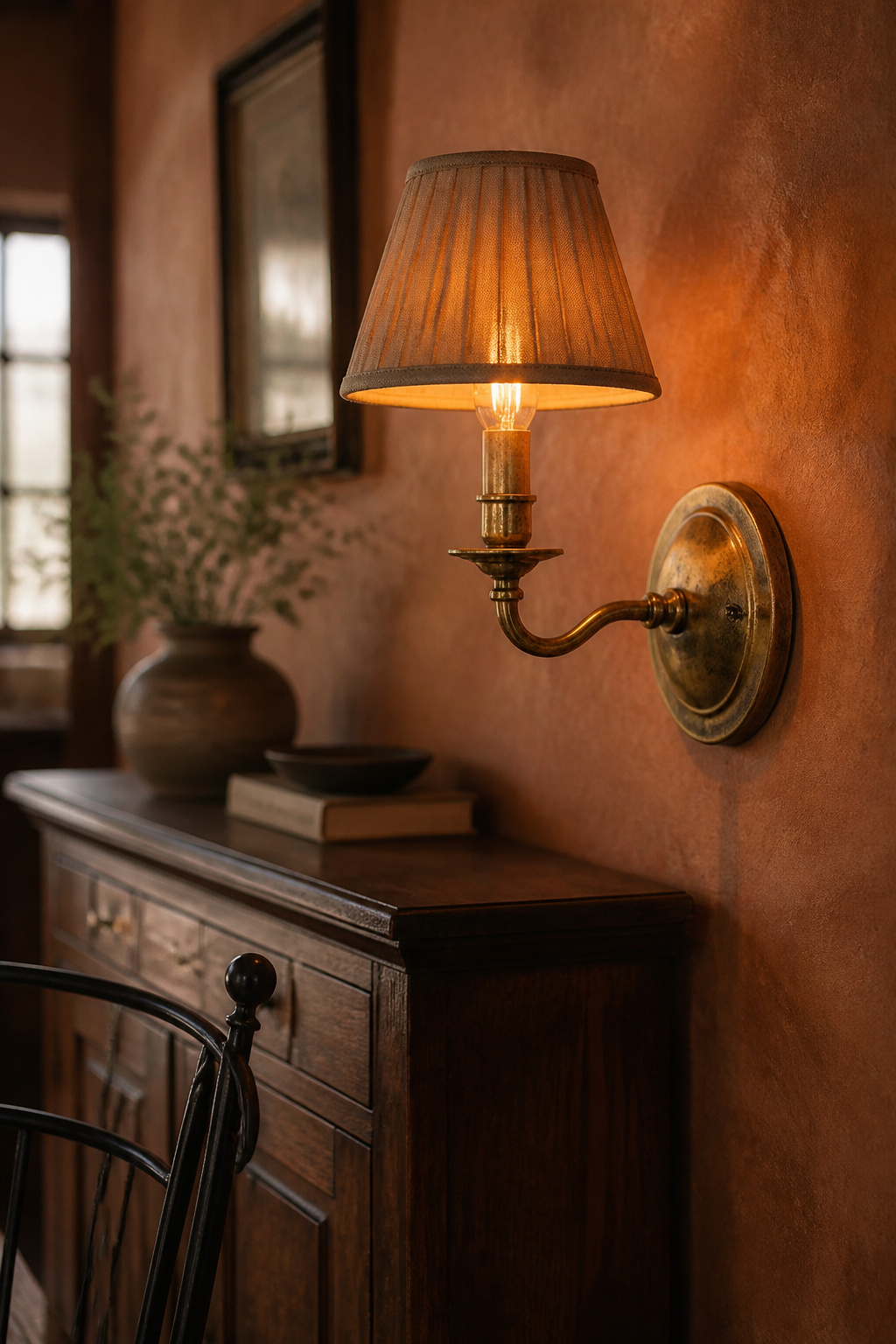
Brass alone can tip golden, so I pair it with matte black for a warm-cool balance. Run one finish as the dominant — usually aged brass at 60–70%, on the chandelier body and main pendant — and the other as accent: matte black on switch plates, sconce arms, or lamp bases. Two or three finishes is the ceiling for any one room; a third accent metal tips intentional into noisy. Repeat each metal at least once: a matte black chandelier arm echoed by matte black chair legs reads as a deliberate echo; a single isolated note looks like an oversight. Read those finishes against the room’s color palette before committing, because brass and black behave differently over a deep teal wall than a pale plaster one.
A word from the workbench: do not set brand-new brass-finish fixtures beside genuine aged ones. The colour mismatch is immediately obvious — choose one register or have the new piece patinated to match.
Sourcing Eclectic Dining Room Lighting: New, Vintage, and Rewired
Vintage fixtures divide into two worlds. Online, 1stDibs, Chairish, and Etsy list chandeliers with condition reports and rewiring notes — you can cost the project before you fall for the shade. In person, estate sales and antique dealers are the best source for architectural lighting with verifiable provenance, because you can test the socket and read the wiring with your own hands.
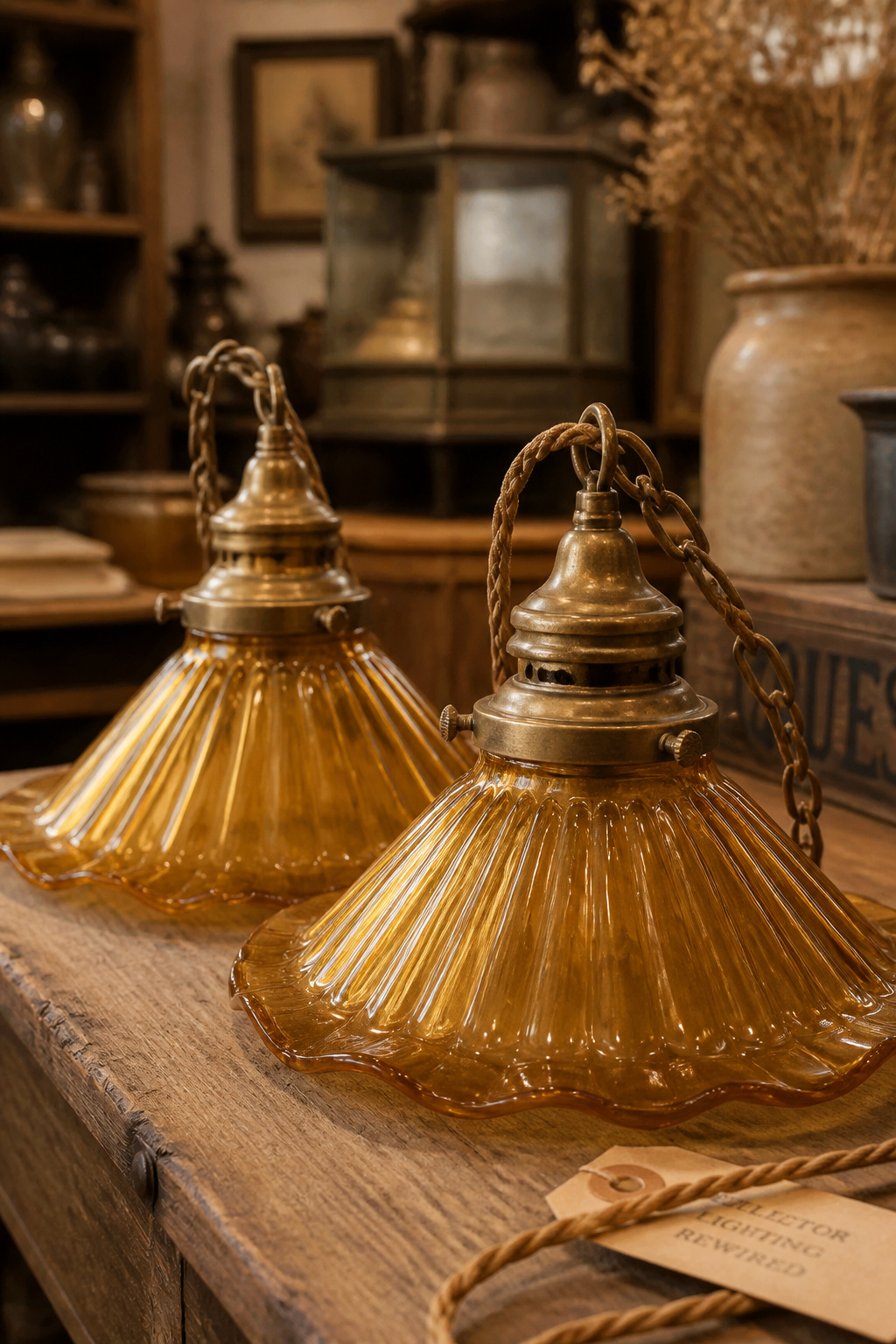
When you can hold the fixture, work through it in order:
- Plug it in. If it will not light, treat it as a restoration project and negotiate accordingly.
- Run the cord through your fingers. Cracked or brittle insulation means a rewire; treat any cloth-covered cord over 30 years old as needing replacement regardless of how it looks.
- Inspect the canopy. A mismatched or era-wrong canopy signals a careless restoration; verify the mounting is secure and flush.
- Test the chain or rod for corrosion and loose joints. A top-heavy fixture on a weak mount is a ceiling hazard, not a bargain.
Professional rewiring runs $30–$75 at most lamp shops and gives you a UL-rated cord, a grounded plug, and an updated socket — build that figure into any offer. New reproduction fixtures arrive with factory wiring and better LED compatibility than a vintage socket built for incandescents.
The reproductions are where my eye does its quiet work. Genuine age leaves irregularities: hand-craftsmanship shows in slightly uneven arm spacing and solder joints, while modern manufacture gives you machine-uniform threads and perfectly equal arms. Applied patina can convince at a glance, but real aged brass darkens unevenly — deeper at joints, recessed details, and the spots hands have touched for decades — while applied finish lies uniformly muted across the whole surface. When mixing old and new, focus on silhouette: a strong, considered shape creates cohesion across eras.
Get three things right and the rest follows: size and hang it by the numbers, keep every bulb warm and the finishes to two or three with brass as the thread, and layer the light so no one is interrogated at the table. Buy the piece with the past, check its wiring before you check its looks, and let it be the object in the room that clearly chose to be there.
FAQ
How low should a chandelier hang over a dining table?
Hang the lowest point of a dining chandelier 30–36 inches above the table surface on a standard 8-foot ceiling, adding 3 inches for every additional foot of ceiling height. Keep a minimum 7-foot floor clearance in any passage. Above 40 inches you lose intimacy; below 28 inches it becomes intrusive.
Can you mix different light fixtures in a dining room?
Yes — mixing era styles, such as a Victorian chandelier with Art Deco sconces or industrial pendants with a vintage globe, is actively encouraged in eclectic design. Limit the room to two or three finishes like aged brass and matte black, keep every bulb warm white at 2200–2700K, and repeat each finish at least once so it reads deliberate.
What size pendant light do I need for my dining table?
A single pendant should measure about one-third to one-half the table’s width — roughly 12–18 inches for a standard 36-inch table. A full chandelier runs half to two-thirds the table width and never exceeds it. For three pendants over a long table, space them 24–36 inches apart and size each at 10–15 inches.