Here’s what the listings won’t tell you: cubby count is a sales number, not a storage number. A bench sold as “10 cubbies!” can hold fewer real shoes than a plain open shelf, because most of those slots are only 5 to 5.5 inches high — room for a flat or a women’s sneaker lying down, nothing more. So before you buy an entryway shoe storage bench by counting holes, count what fits in them. That’s what decides whether your shoes end up inside the bench or piled in front of it.
TL;DR
- Buy by cubby dimensions, not cubby count: a 5.5-inch-high slot holds one flat pair, so a “10-cubby” bench can hold fewer real shoes than its number suggests.
- A standard 36–48-inch open-cubby bench holds roughly 6–12 pairs; open cubbies and basket shelves beat closed drawers and lift-tops for wet boots because air can dry the sole.
- Match the bench to your household — occupants × 3 = the daily pairs to keep at the door — and route a family of five to a mudroom setup, not one bench.
There are four real options — open cubbies, basket shelves, drawers, and lift-top seats — each suiting a different mess tolerance and shoe mix. I’ll cover what each holds, what survives a wet entry, and how to size it.
Entryway Shoe Storage Bench Types: Which Holds More Than It Looks
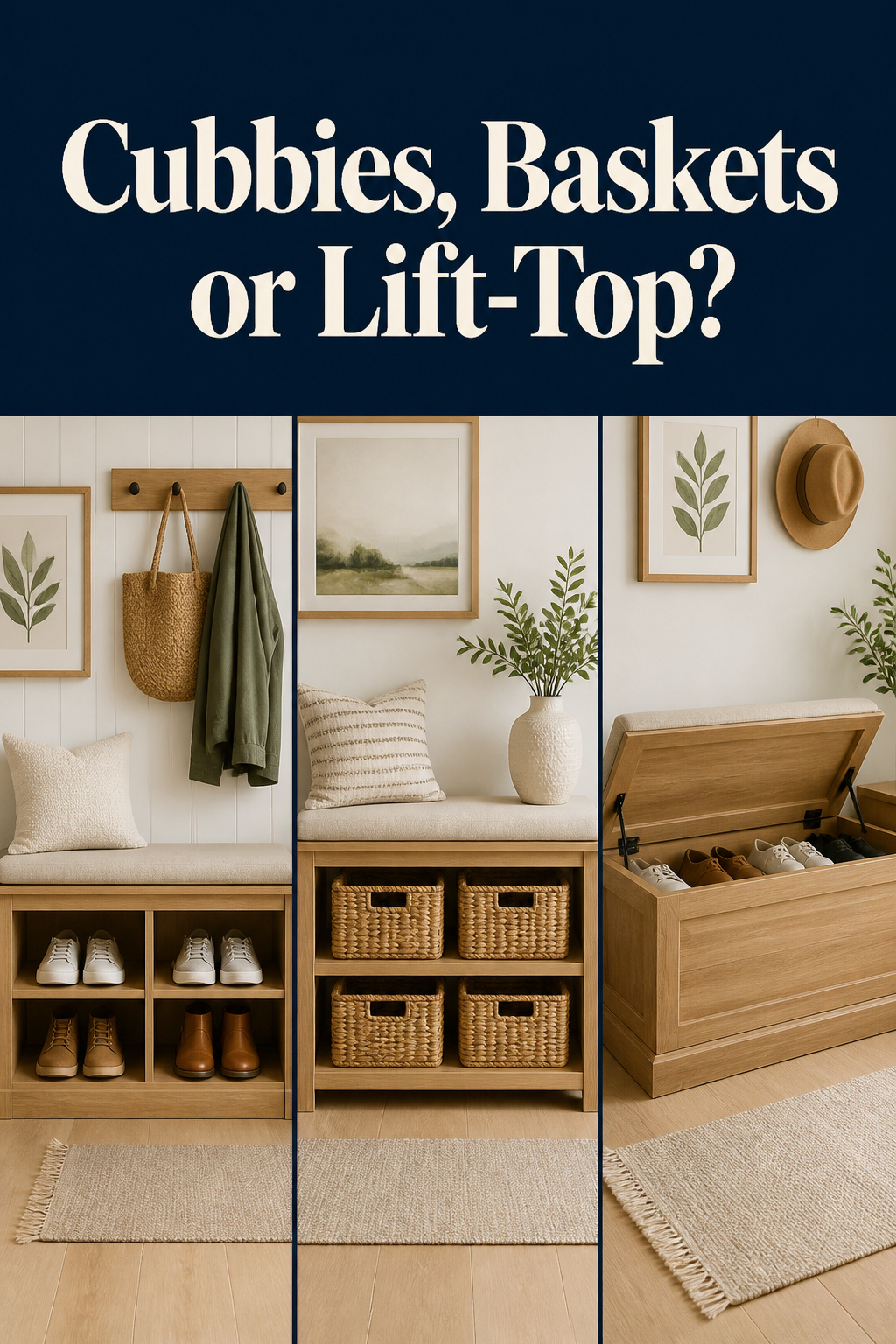
Volume beats compartment count. A lift-top chest swallows the same cubic space as a 10-cubby bench, but charges you a stand-up-and-lift ritual every morning. Open cubbies hold less raw volume but give grab-and-go access. The right call depends on how you live with it — so here’s the honest comparison first.
| Storage type | Pairs held | Wet boots | Flat/heeled shoes | Tidying | Price range |
|---|---|---|---|---|---|
| Open cubbies | 6–12 | Good (airflow) | Good | Easy, but visible | Budget–mid |
| Basket shelves | 8–16 | OK (swap to plastic) | Good | Easy, hides mess | Budget–mid |
| Drawers | 1 per slot | Poor | Flats only | Tidy facade | Mid |
| Lift-top | 4–8+ | Poor | Good, if under 14″ | Cleanest look | Mid–higher |
Price ranges overlap heavily — open cubbies and lift-tops both start at mass-market budget tiers — so treat these as loose bands, not quotes. For the wider decision on sizing, style and buy-versus-build, the complete guide to entryway benches covers the survey; this spoke stays on shoes.
Pairs-per-cubic-foot: why cubby count misleads buyers
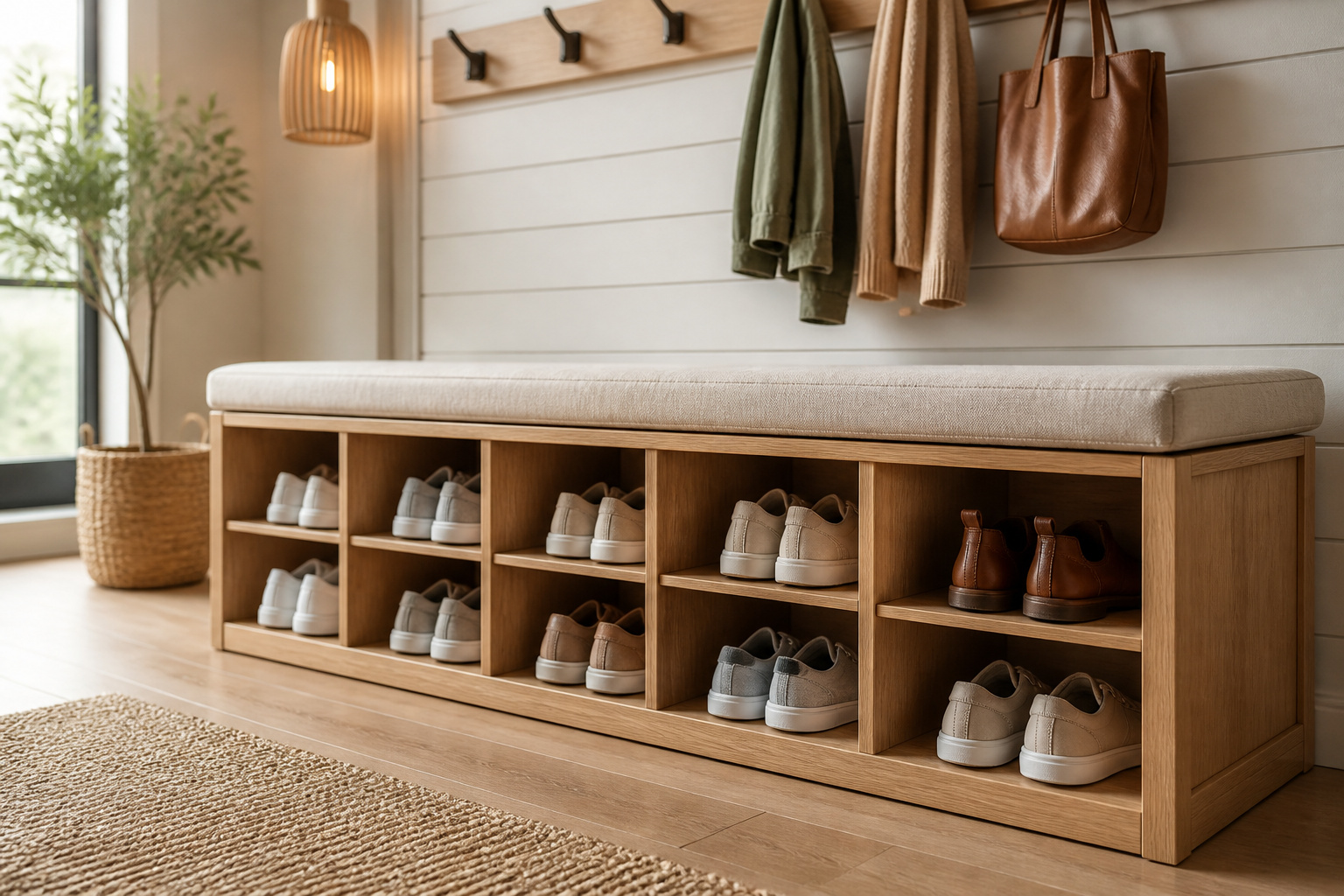
A standard cubby runs about 12 inches wide, 5–5.5 inches high, and 12–14 inches deep. At that height, one adult pair fits lying flat — full stop. The listing counts the holes; it won’t tell you they’re short. A taller 8-inch compartment fits more variety but cuts total cubby count on the same frame, so a “10-cubby” and an “8-cubby” bench often hold the same real shoes.
Storage type comparison table: cubbies vs baskets vs drawers vs lift-top
The split that matters: open cubbies and basket shelves let air circulate; drawers and lift-tops trap it. As FUFU&GAGA’s Yuvien Royer puts it, a flip-top bench is “too cumbersome to ask guests or family members to stand up, clear off the pillows, and lift a heavy lid just to retrieve sneakers.” Front access wins for daily use — cubbies for kids, tipper drawers for a cleaner facade.
How household size changes the calculation
The formula: occupants × 3 daily-rotation pairs = the minimum you keep at the door. A two-person home needs six; a family of four needs twelve to twenty. A 36–48-inch ten-cubby bench covers a family of four if off-season and formal shoes live elsewhere. Solo or couple? A 24–30-inch bench won’t swamp a narrow entry.
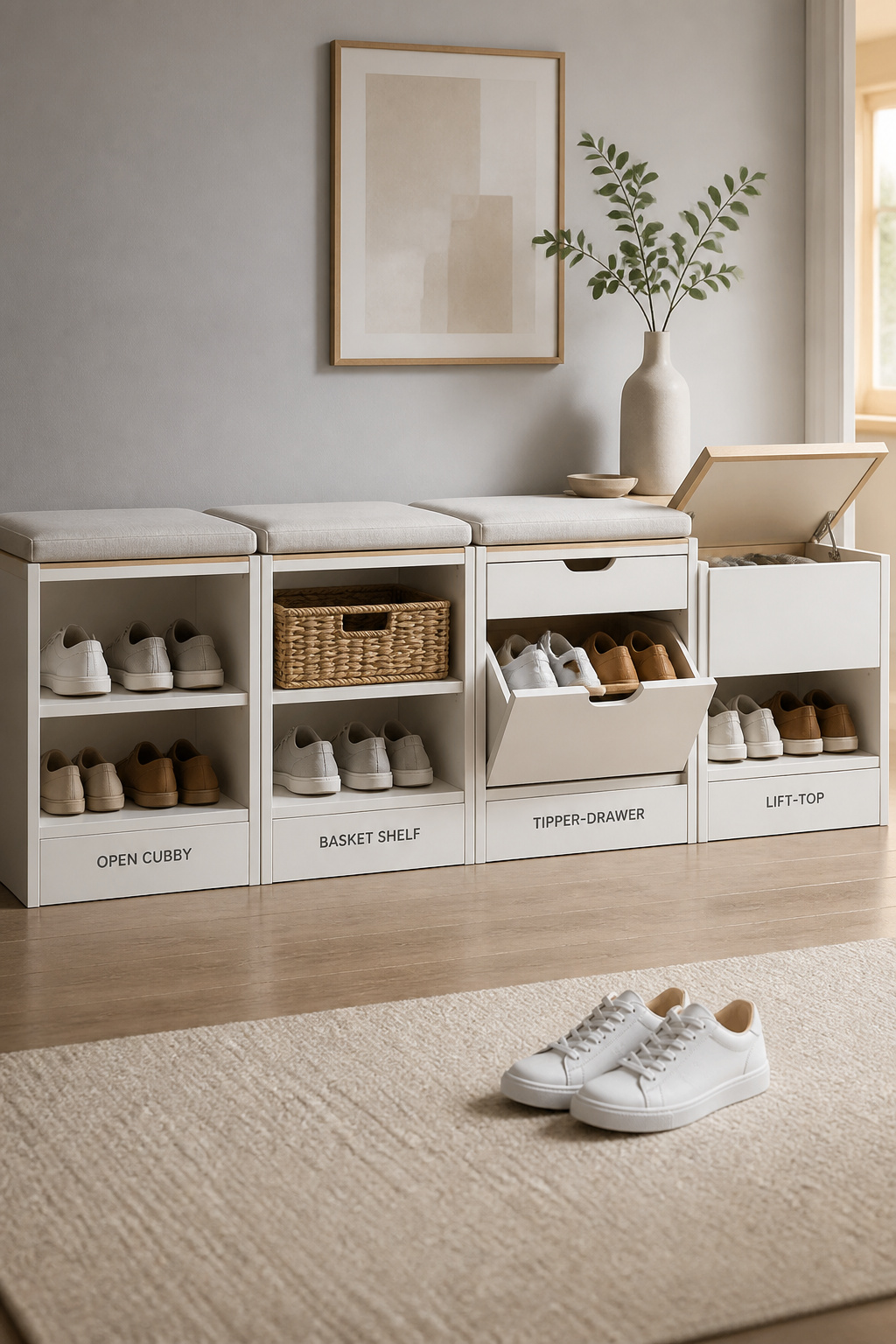
Open Cubbies: Fast Access, Zero Discipline Required
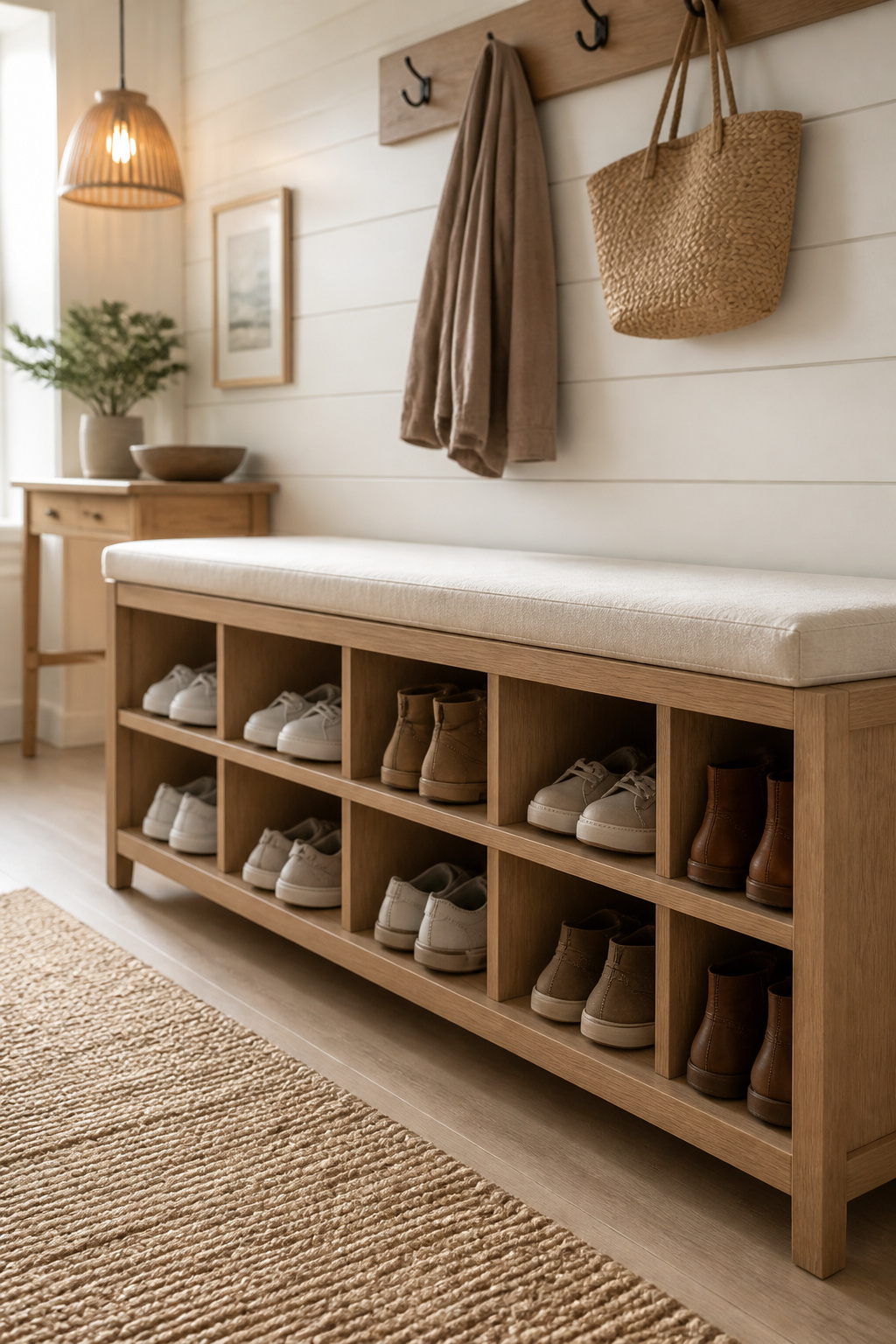
Open cubbies are the best-seller because they require no behaviour change. You drop the shoes in and grab them on the way out — no lid, no drawer, no system to maintain, so no system to abandon. For families, that’s the whole game. The trade-off: everything’s visible, so a messy slot stays messy.
How many pairs a standard 12x12in cubby actually holds
Let me be straight, because the listings aren’t. I’ve seen the claim that a 12×12-inch cubby holds two pairs, and no manufacturer spec I checked backs it up. At the common 12-inch width and 5–5.5-inch height, you get one pair lying flat. A taller 12-inch opening could take two thin pairs stacked heel-to-toe, but that’s a shelf measurement, not a standard cubby one. Plan on one pair per slot.
The wet-boot problem and what to put inside each cubby
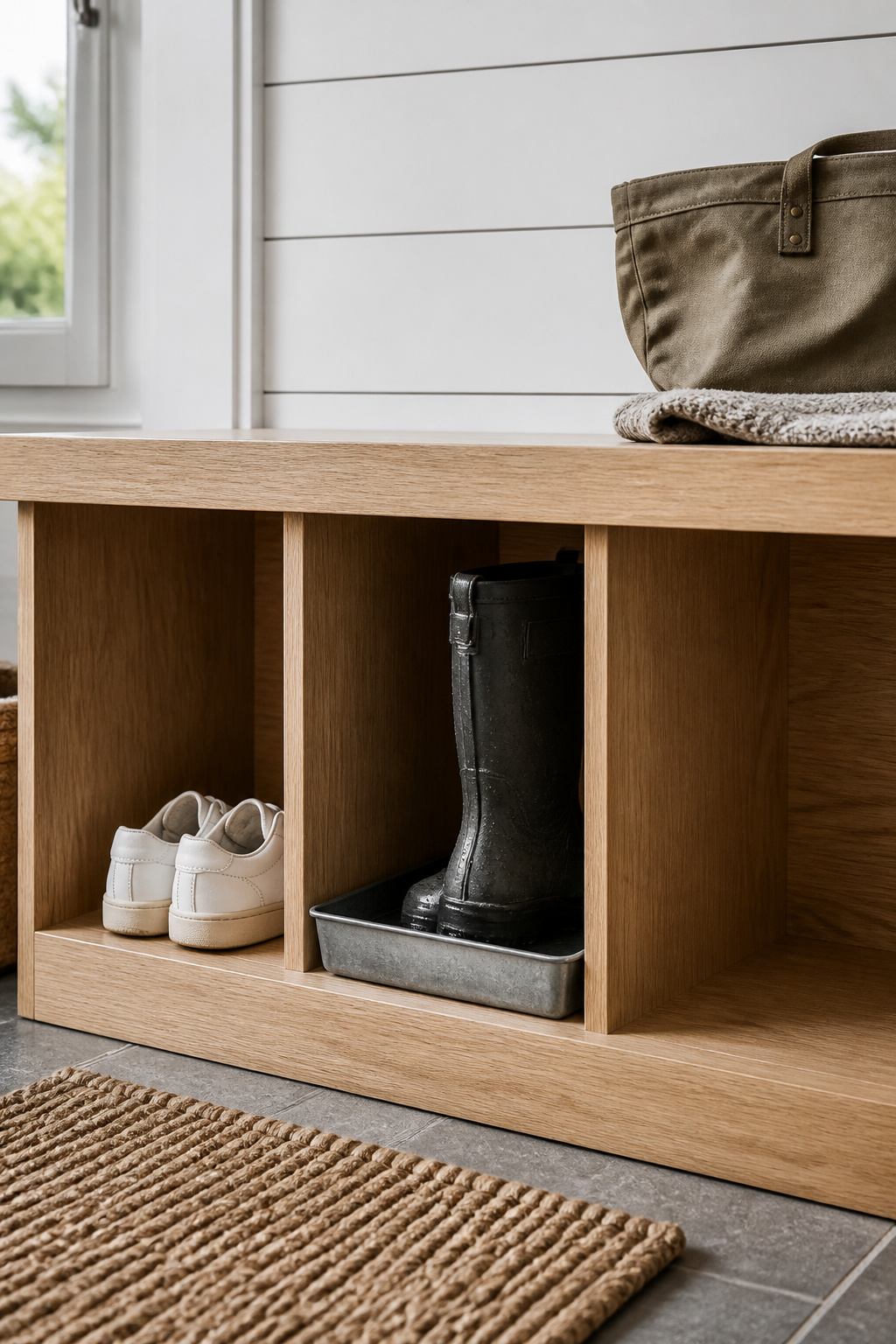
Airflow is the cubby’s superpower: air dries the whole shoe, sole included, which prevents the mould and odour closed storage breeds. For wet boots, drop a metal or plastic drip tray into the slot — they come in small (10×20-inch) and larger under-bench sizes. Metal beats fabric here: pull it out, pour the melt water, wipe, replace. No soaked MDF.
Best cubby depths for sneakers vs ankle boots
Depth is where benches quietly fail. A 12–15-inch cubby handles sneakers, flats, and sandals up to about men’s size 12. Ankle boots want 16–18 inches to lie flat, or a taller slot to stand upright. The STURDIS design solves this with a removable middle divider that turns two short slots into one boot slot around 11–12 inches clear. If anyone wears size 9 or up, don’t go under 14 inches deep.
Basket Shelves: The Flexible Option for Mixed Footwear
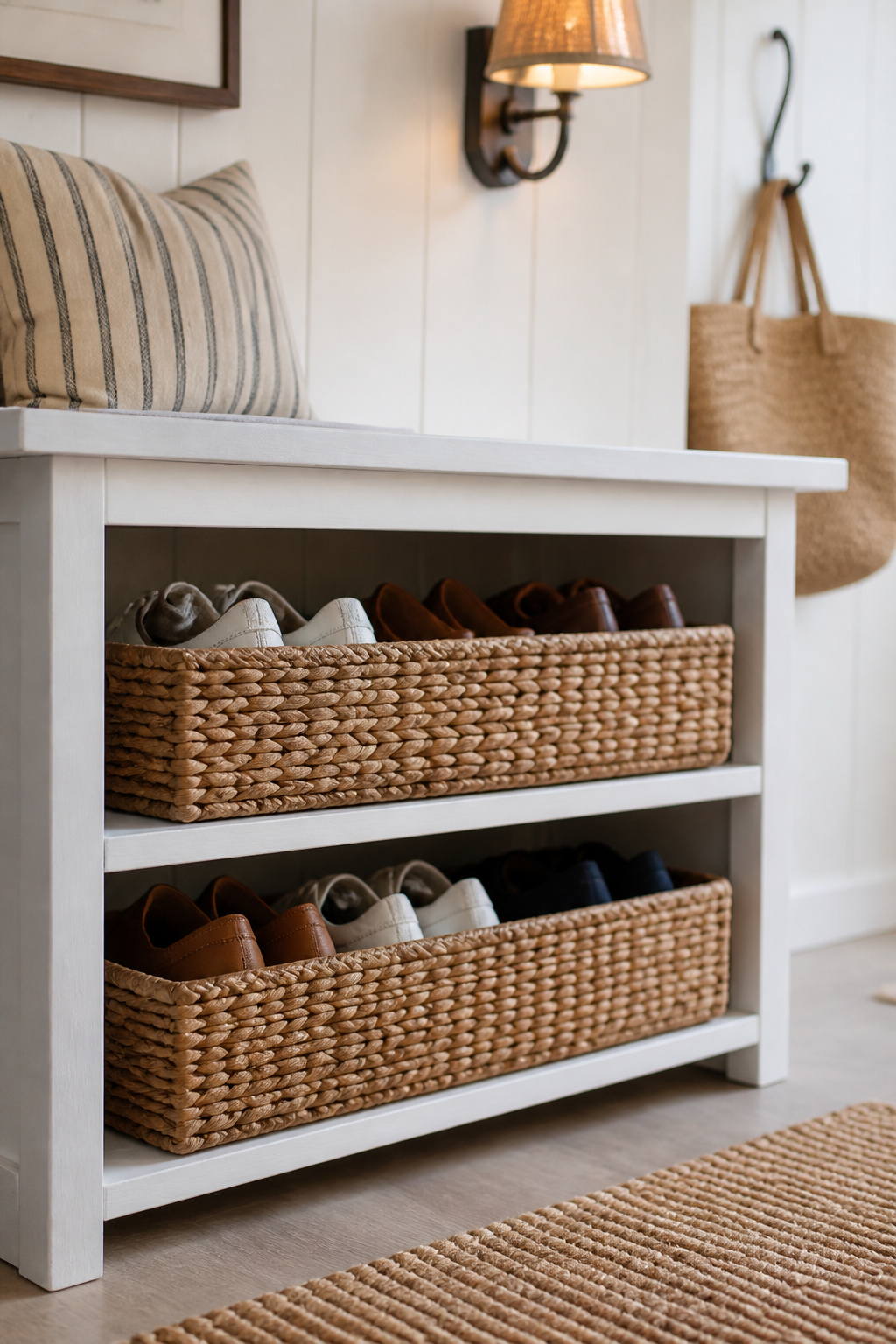
Basket shelves are the answer when footwear breaks the grid. Fixed cubbies are decided at the factory; baskets you swap, resize, and reassign as the seasons and the pile change. You keep open-storage airflow but gain a container you can lift out and tip into the wash. The catch is material — and that’s where most people get it wrong.
Basket sizing for a standard bench shelf
Measure the shelf opening before you order. Most bench shelves run 12–15 inches deep, so a basket over 13 inches deep protrudes or sits crooked — a trip hazard at ankle height. Baskets in the 10–12-inch wide by 11–14-inch deep range fit most benches and hold two to four pairs each. Assign one per person and you sidestep the communal-pile problem that defeats shared cubbies inside a week.
Woven vs plastic vs canvas: what survives wet entries
The honest version: seagrass and water hyacinth baskets look lovely and can handle light moisture, but they’re not waterproof — a wet entry moulds and degrades them by month two. For real slush and mud, plastic bins or coated polypropylene-fabric baskets win: waterproof, wipe-clean, less pretty. Machine-washable canvas with a reinforced base is the practical middle ground for young families.
When basket shelves beat fixed cubbies
Choose baskets when the footwear mix moves. Summer sandals and winter boots want different sizing, and cubbies can’t flex. Wide-fit shoes, riding boots, roller skates — anything irregular breaks a fixed grid but stands happily in a basket. Baskets also suit renters: a freestanding basket-shelf bench leaves no drill holes and lifts out on moving day.
Drawers and Lift-Top Seats: Hiding the Shoe Pile Completely
Closed storage buys a clean look and charges you in access and airflow. If zero visible shoes is the goal — a formal entry, a guest-facing hallway — this is your category. Just go in knowing the daily friction, because that’s what decides whether the system survives.
Drawer bench: pairs per drawer and the depth problem
Drawer benches are tidier than they are roomy. A typical horizontal drawer measures roughly 11.8 inches square by 3.2 inches high inside — one pair of flats or sandals, nothing with a real sole. Tipper drawers tilt forward so a slightly bigger shoe fits, but effective depth still tops out around 12–14 inches. They earn their keep storing one daily pair, or accessories like gloves and mail — not bulk shoes.
Lift-top bench: capacity reality vs marketing claims
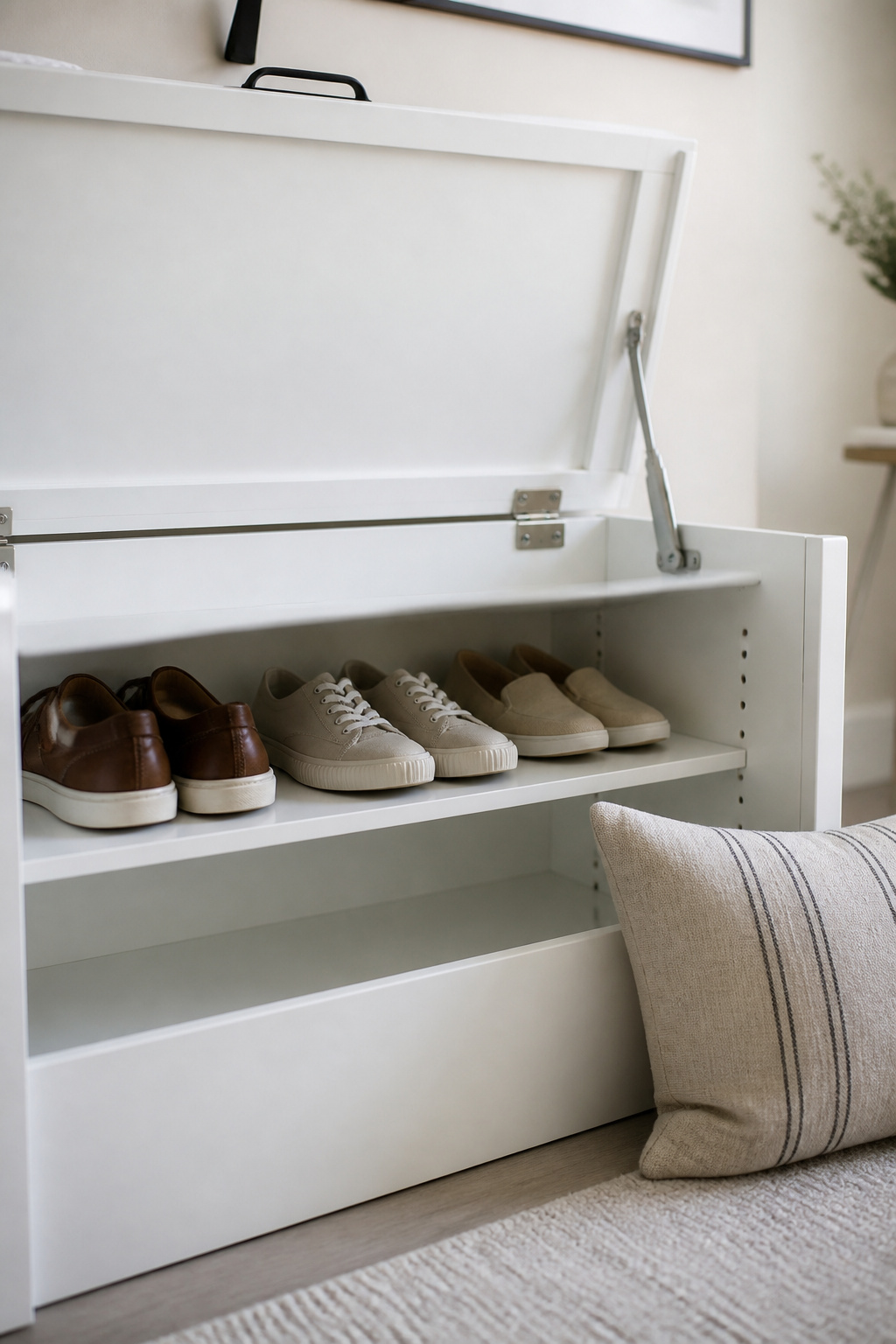
Marketed and real capacity diverge here. A 30-inch lift-top holds about four adult pairs; only shoes under 14 inches clear the closing lid. A 41-inch model with an interior shelf gets you six, a 55-inch one eight-plus. But every retrieval means standing, clearing the cushion, propping the lid. With kids in the house, check for dual safety hinges — cheap single-hinge lids pinch fingers.
Who these work for (and who they frustrate)
Singles and couples with a predictable two-to-four pairs do fine; the lid friction is tolerable when tidiness is the priority. Families with young kids abandon lift-tops inside a month — guaranteed. And never put wet boots in a closed bench without a drip tray: trapped moisture warps the MDF base and breeds mould within weeks.
Wet Boots, Muddy Shoes and Family Traffic: Choosing for Real Life
The wet-boot problem sinks more entryway benches than anything else — and it’s almost always a ventilation and material failure, not a storage-type failure. Solve airflow and drainage, size the bench to the household, and the rest is detail.
Ventilation: why closed storage fails wet boots without airflow
Open, slatted, or wire surfaces let air move around the whole shoe, sole included — that’s what dries footwear and stops the mould. Closed benches need the lid up or drawer out for two to four hours after a wet boot, and let’s be honest: nobody does that by mid-winter. Want a closed look anyway? Drill a few 1-inch vent holes in the back panel, or buy a model with slatted sides.
Drip trays and boot racks under a standard bench shelf
A drip tray is the cheapest fix in this article. Sizes run small (10×20), medium (24×16), large (30×15), and extra-large (40×20), most with a 1–1.5-inch raised edge to hold the mud. A 14–16-inch-deep bench fits a 10×20 tray on the lower shelf without it sticking out. Keep the wet zone separate: muddy boots drain on the tray, then move to the bench dry.
Scaling the bench for one person vs a family of five
Sizing is arithmetic, not guesswork. ADA-comfortable seat height is 17–19 inches off the floor, where adults can tie laces without straining. One or two people: a 24–30-inch bench. A family of four: 36–48 inches with ten-plus cubbies. A family of five needs 15-plus accessible pairs — one bench won’t cover it. Pair it with a shoe cabinet, or scale it up for a mudroom. Leave 36 inches of clearance in front so a seated lace-tier doesn’t block the hall. To nail the right size, you can always build a bench with cubbies to fit the exact space.
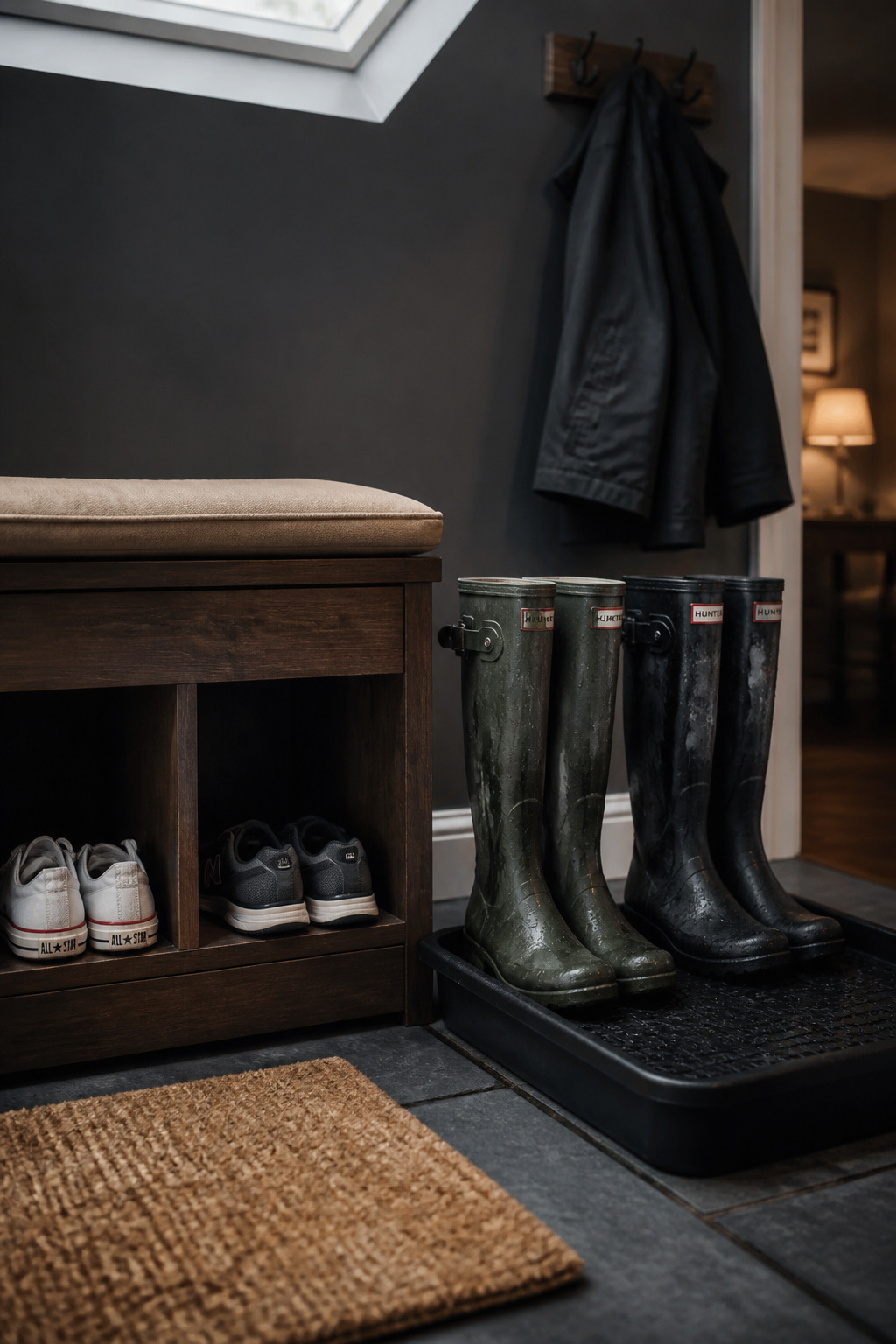
The decision comes down to three honest questions. How many pairs land at your door daily — occupants times three? Do wet boots come through, meaning you need airflow and a drip tray over a sealed lid? And will your household actually do the lift-or-open ritual, or will shoes pile up in front of a beautiful closed bench? Answer those and the storage type picks itself. The most common mistake isn’t the wrong style — it’s buying by cubby count, getting ten short slots, and watching the boots stack on the floor anyway. Count what fits, not what’s advertised.
FAQ
How many pairs of shoes does an entryway bench with cubbies hold?
A standard 36–48-inch cubby bench holds 6–12 pairs, depending on cubby height. Most slots are 5–8 inches high: at 5.5 inches, only flats or women’s sneakers fit, one pair per slot; at 8 inches or taller, most adult footwear fits. Heel-to-toe stacking can add roughly 50% capacity in slots over 10 inches high.
What is the best shoe storage bench for wet boots?
Open cubby and basket-shelf benches are best for wet boots because they let air circulate around the boot, including the sole, which speeds drying and prevents mould. Add a removable drip tray with 1-inch raised edges inside or beside the bench. Avoid drawers and lift-tops without a tray — trapped moisture warps MDF and smells within weeks.
Are shoe storage benches worth it for small entryways?
Yes, if sized correctly. For entryways under 48 inches wide, keep bench depth under 14–15 inches and leave at least 36 inches of clearance in front for passage. If a bench won’t fit with that clearance, a slim 6-inch wall-mounted shoe cabinet takes zero floor space. A bench you have to squeeze past gets abandoned.