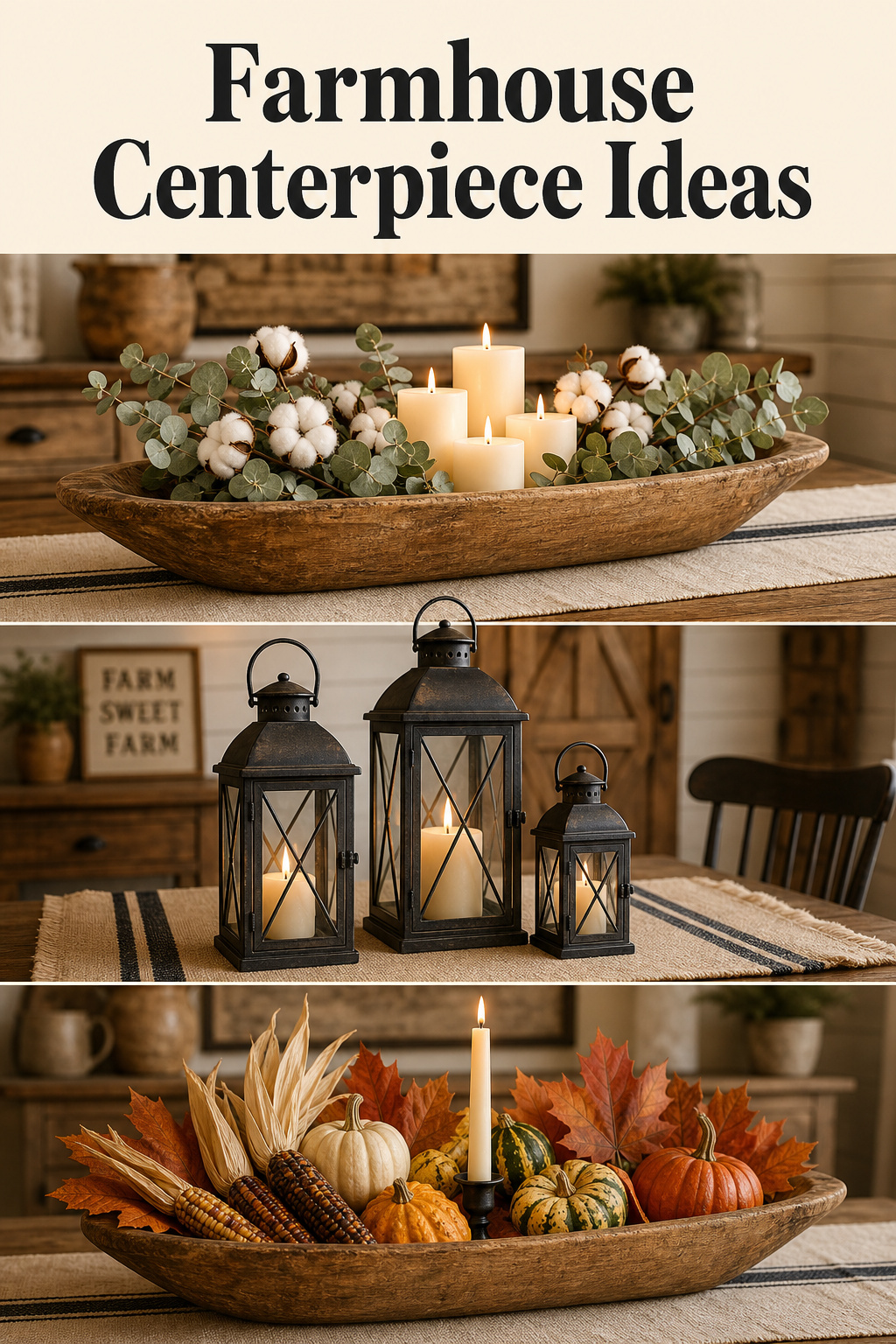
There are a thousand ways to dress a farmhouse table, and most go wrong the same way: too much, all at once, fighting for the same six inches of wood. A good farmhouse dining table centerpiece is not the sum of everything you own. It’s one anchor, a few accents that answer to it, and the discipline to stop. Get that ratio right and the table reads composed at any length, in any season.
TL;DR
- One low, wide anchor (dough bowl, stoneware pitcher, or trio of lanterns) plus odd-numbered accents at varying heights with one repeating texture.
- Keep the arrangement at 12 inches or lower — or deliberately above 22 inches — because anything in the 13–21 inch range sits in a seated guest’s sightline and kills conversation.
- Scale the spread to two-thirds of the table’s length, leave 18 inches to each place setting, and swap only seasonal accents on a permanent runner-bowl-lantern base.
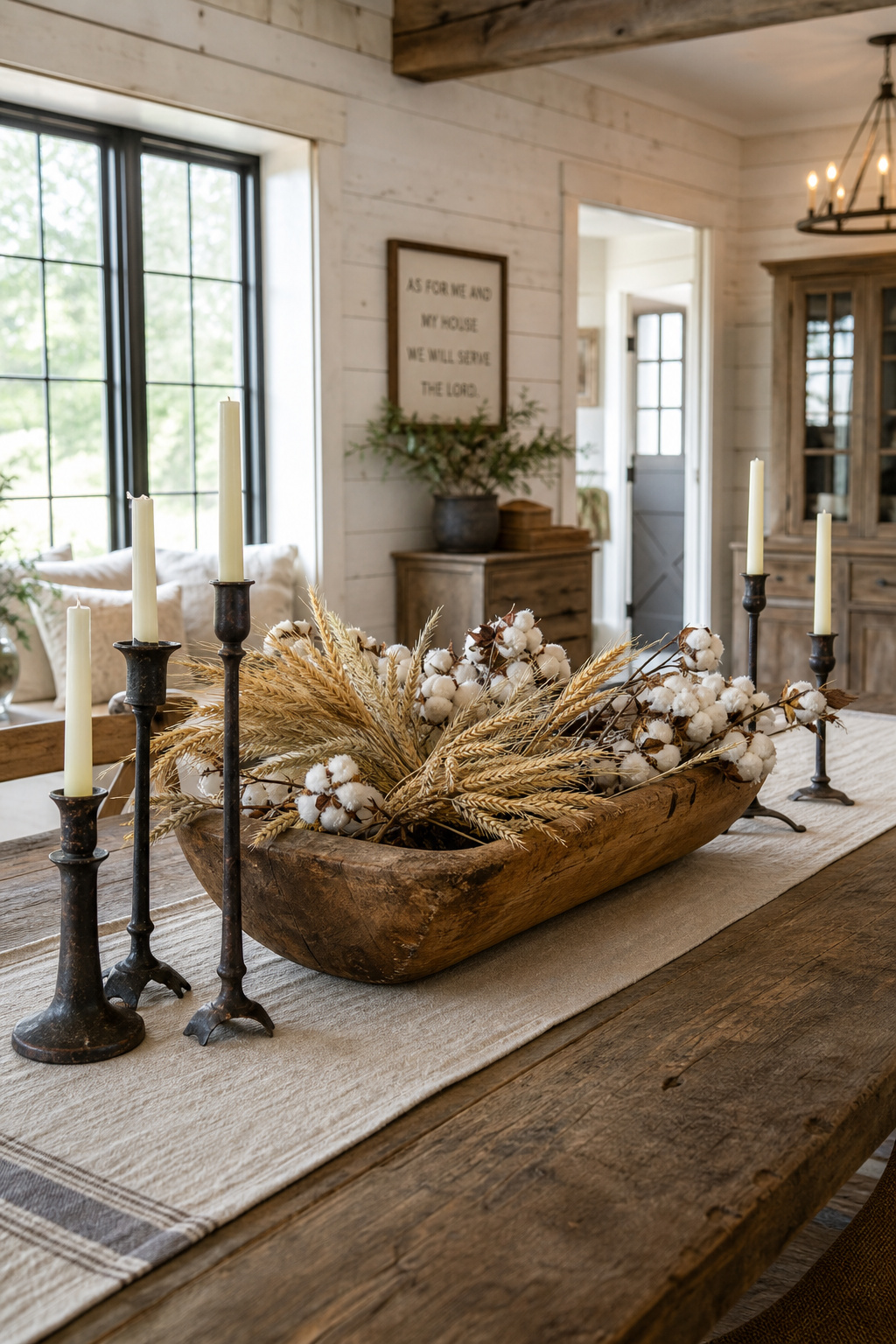
The Anchor-Plus-Accents Formula Behind Every Farmhouse Dining Table Centerpiece
One dominant anchor, a handful of accents that respond to it, scaled to the table. For where this styling sits within the wider farmhouse dining room styles and options, the pillar covers the room; this article stays on the tabletop.
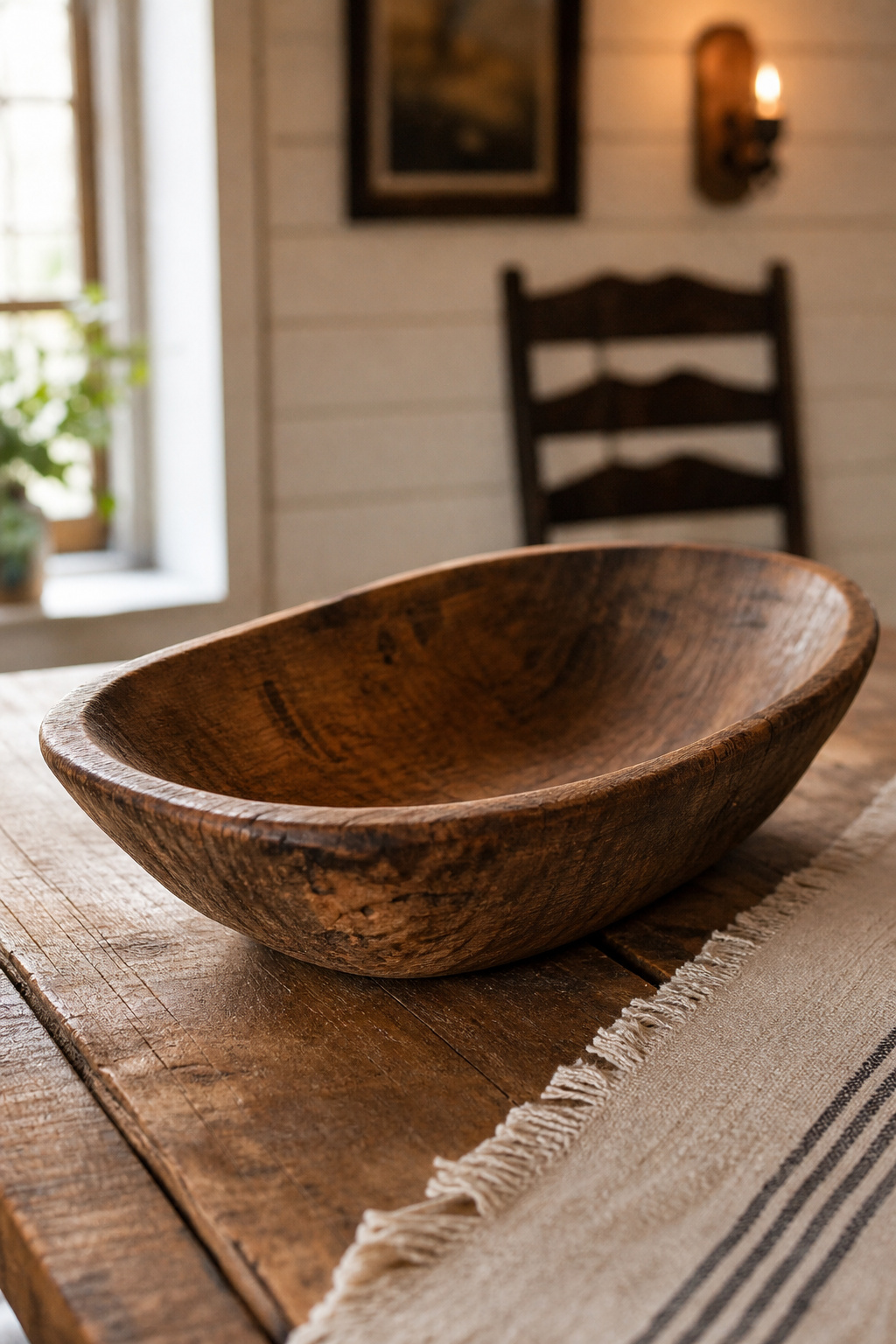
What an anchor piece does: height, mass, and visual grounding
The anchor sets the centerpiece’s visual weight; every accent reads as a response to it. A wide dough bowl, a stoneware pitcher, or three grouped lanterns all work depending on table length. Shea McGee of Studio McGee describes her no-fail method as pairing groupings — “one taller thing and a shorter thing.” Run the anchor about one-third the table’s length and keep the full arrangement under two-thirds, so place settings have room.
The accent rule: odd numbers, varying heights, one texture that repeats
Odd-numbered groupings read as intentional — threes and fives feel complete where pairs feel static. A group of three (anchor, mid-height, low) is the most natural configuration. Repeat a single texture across the arrangement — rough linen in both the runner and napkin rings — for cohesion without matching pieces. Two or three colours maximum; farmhouse neutrals let wood, iron, and linen carry the interest.
Scaling the whole arrangement to table length
Standard farmhouse tables run 72 to 96 inches. A centerpiece should sit at 12 inches or below, or deliberately above 22 inches — never in the 13-to-21-inch dead zone that lands in a seated adult’s sightline. KariAnne Wood of Thistlewood Farm tests it the only way that matters: sit in the chairs and check whether you can see the guest opposite.
| Table length | Anchor footprint | Accent pieces | Runner length |
|---|---|---|---|
| 72 in | 12–14 in | 3 | 84–96 in |
| 84 in | 15–17 in | 3–5 | 96–108 in |
| 96 in | 18–20 in | 5 | 108–120 in |
Leave at least 18 inches between the outer edge of the arrangement and each place setting, so serving dishes still pass.
Farmhouse Table Runners: Fabric, Length, and Layering
The runner is the literal base layer, and in farmhouse styling the fabric carries more character than in almost any other look, because each cloth has a working past.
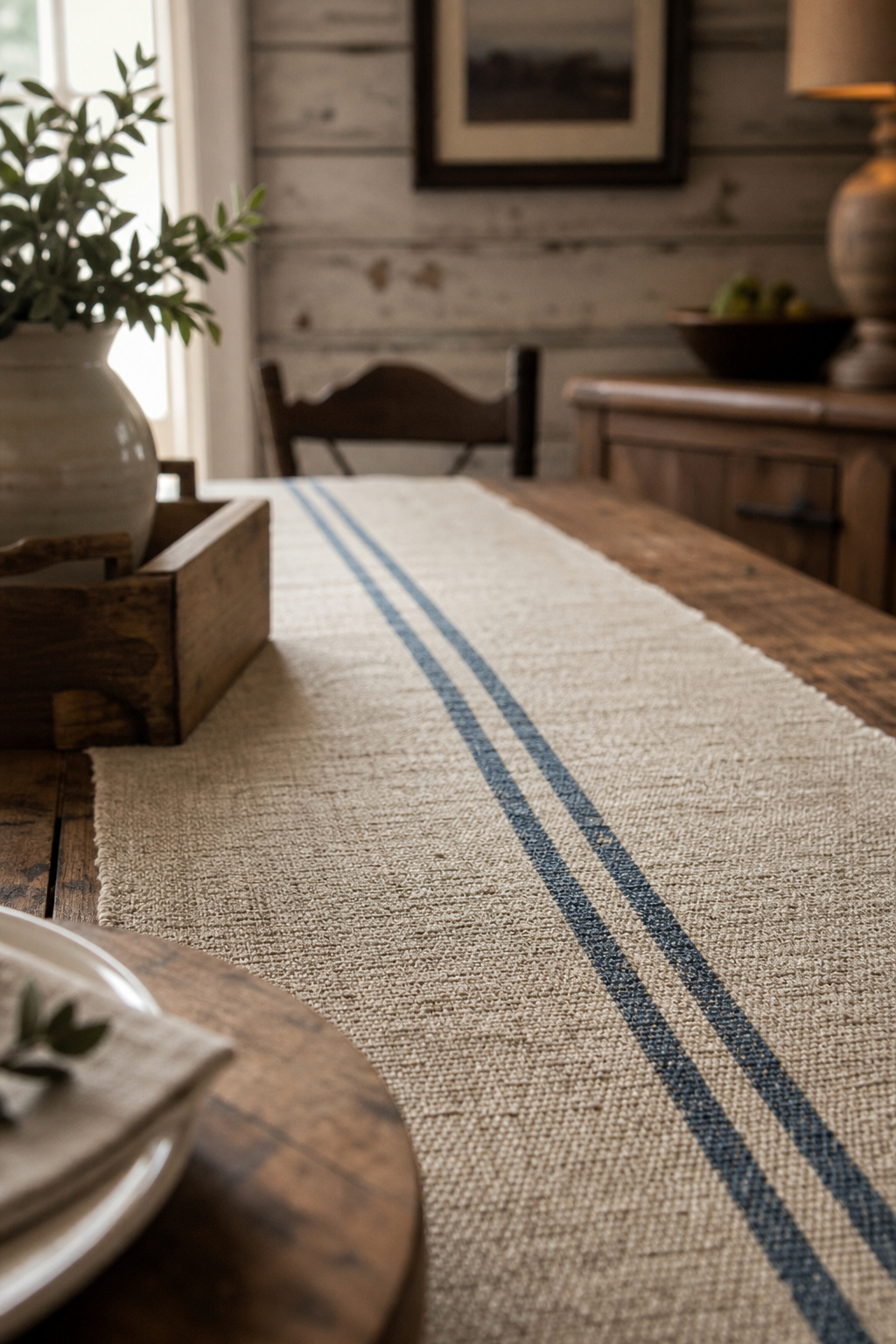
Runner fabrics: linen, grain sack, burlap, and washed cotton
Grain-sack stripe has the deepest provenance: 17th-century Central and Eastern European farms, where each family wove its own linen sacks and the stripe was their mark at the mill (Textile Trunk). For everyday use, choose washed linen — it lies flat, machine-washes, and improves as it ages. Washed cotton behaves the same at a lower price. Burlap sheds fibres and is spot-clean only; save it for occasions.
Runner length rules: over-the-edge vs contained
The standard overhang is 6 to 12 inches per end; add at least 12 inches to your table length to clear a 6-inch drop on each side.
- Everyday: a contained runner, flush with the table ends, keeps the textile off chair backs.
- Casual entertaining: a 6-inch drop per end reads curated without catching on chairs.
- Formal dinner: extend the drop to 8, 10, or 12 inches, but check it clears chair arms.
For width, divide the table’s width by three; 12 to 18 inches is standard.
Layering two runners at right angles
Running a second, narrower runner across the width builds a cross pattern that reads more layered — useful on square or round tables. Use different weights so each layer stays readable: a wide grain-sack runner lengthwise, a narrower burlap one across.
Candles, Lanterns, and Iron Candlesticks: The Farmhouse Light Layer
The candle layer makes a table feel considered. Two formats dominate: tapers in iron or aged-brass holders, and lanterns housing pillar candles.
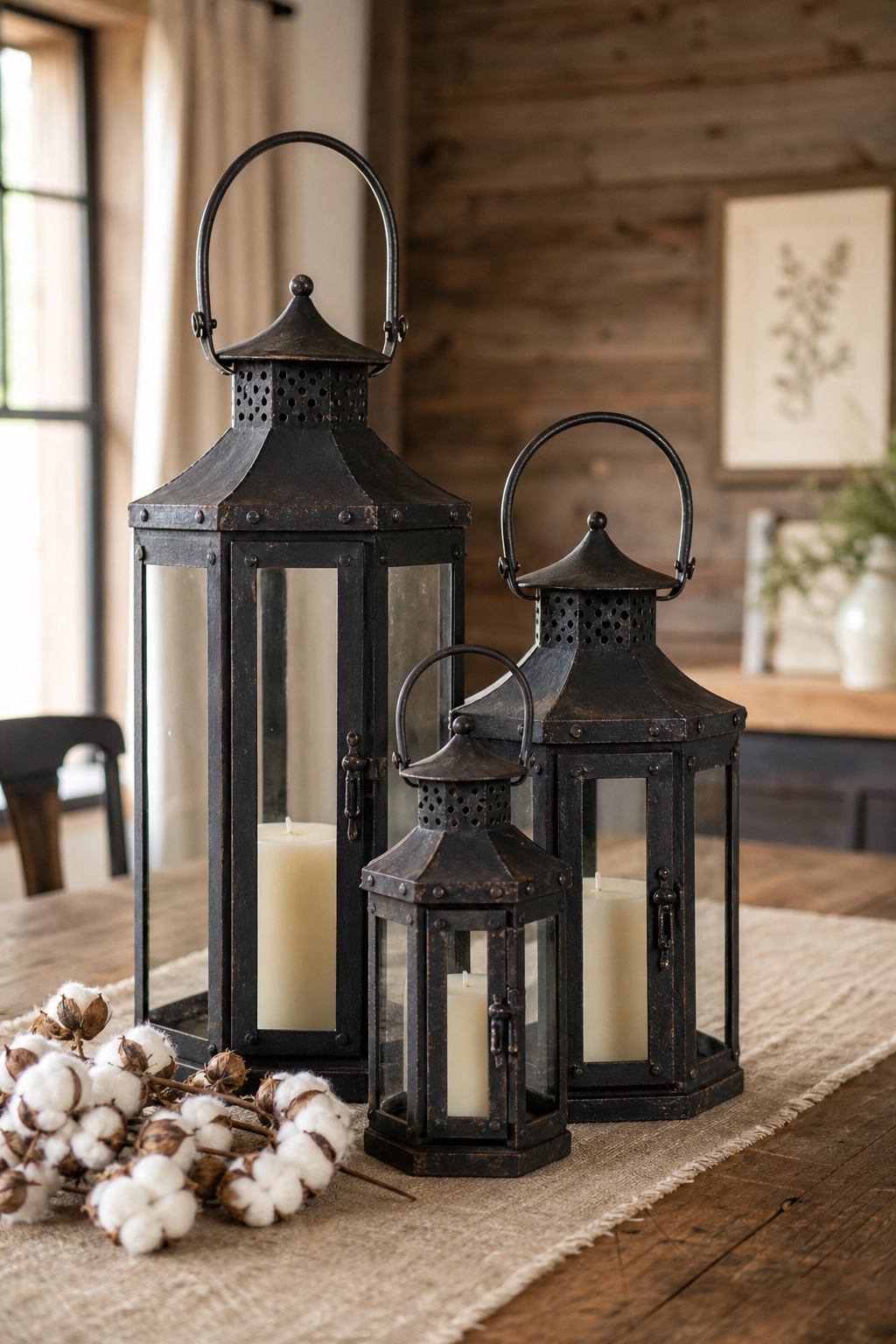
Pillar candles vs taper candles: which reads more farmhouse
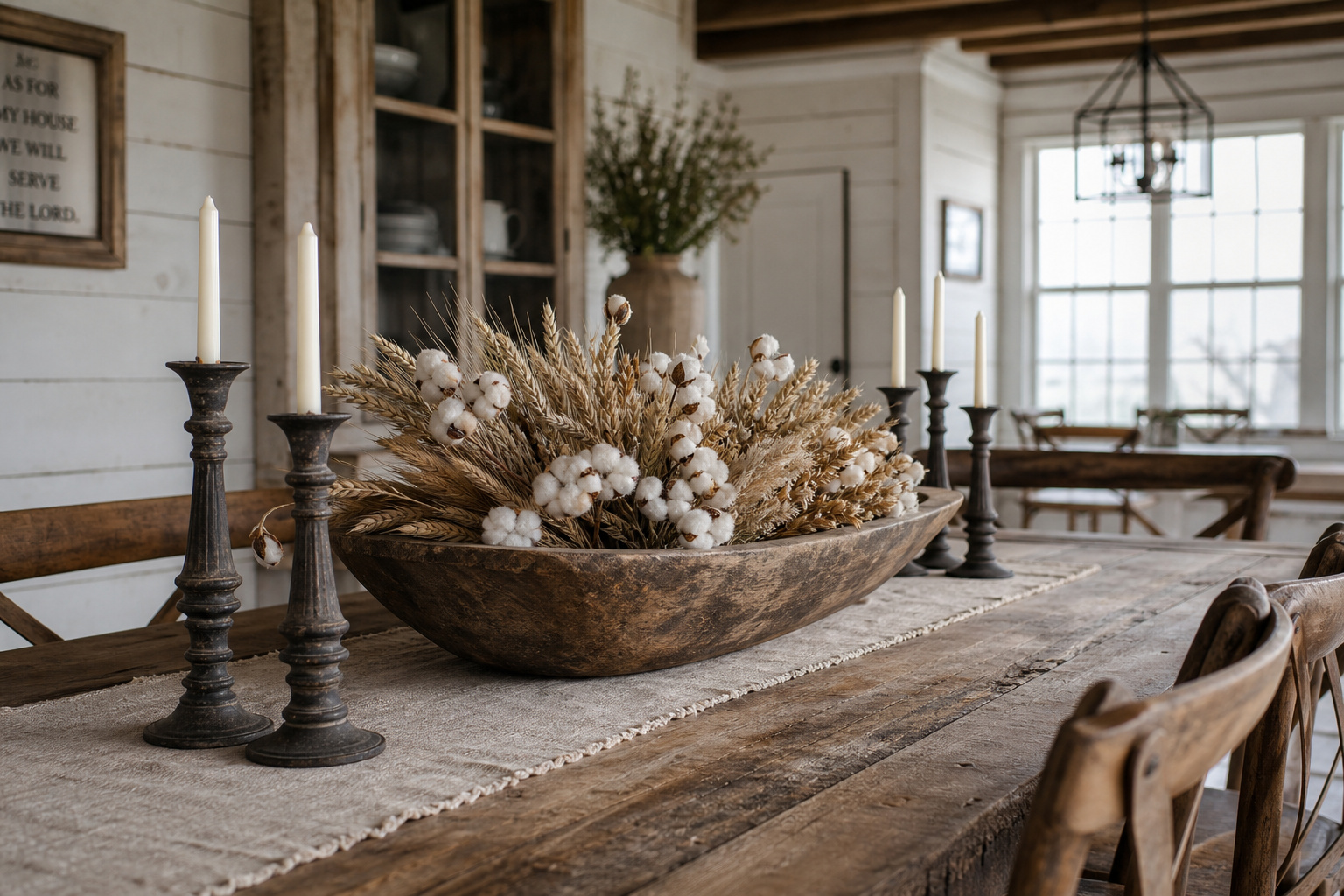
Taper candles in iron candlesticks are the most traditional format; their vertical line echoes the barn post and reads slightly more formal. Wide pillar candles (3 or 4 inches across) sit heavier and more rustic — grouped inside a lantern, they work at anchor level. Combine the two for height contrast. Keep candles unscented: beeswax tapers burn cleanly for up to 10 hours and leave the food aromas to dominate.
Lanterns as anchor pieces — sizing and grouping
A trio of lanterns at graduating heights is the most-used format. On a 72-inch table, heights of roughly 18, 14, and 10 inches read intentional — but 18 inches sits inside the sightline zone, so treat this as a stepped group that reads low overall, not a solo tall piece. One material family (all iron, all aged wood) keeps it cohesive.
Safe heights: when candlesticks obstruct sightlines
Standard iron candlesticks range from 6 to 14 inches. A pair of 10-inch holders stays within safe territory; a lone 14-inch candlestick lands in the 13-to-21-inch obstruction zone. Test it simply: seat someone and have them look across. If the flame floats in their field of vision, it’s too tall.
Vessels, Wooden Bowls, and Farmhouse Crockery as Centrepiece Anchors
Dough bowls, stoneware pitchers, and galvanised buckets came off working farms before they became interior features, and that history is why they read as authentic.
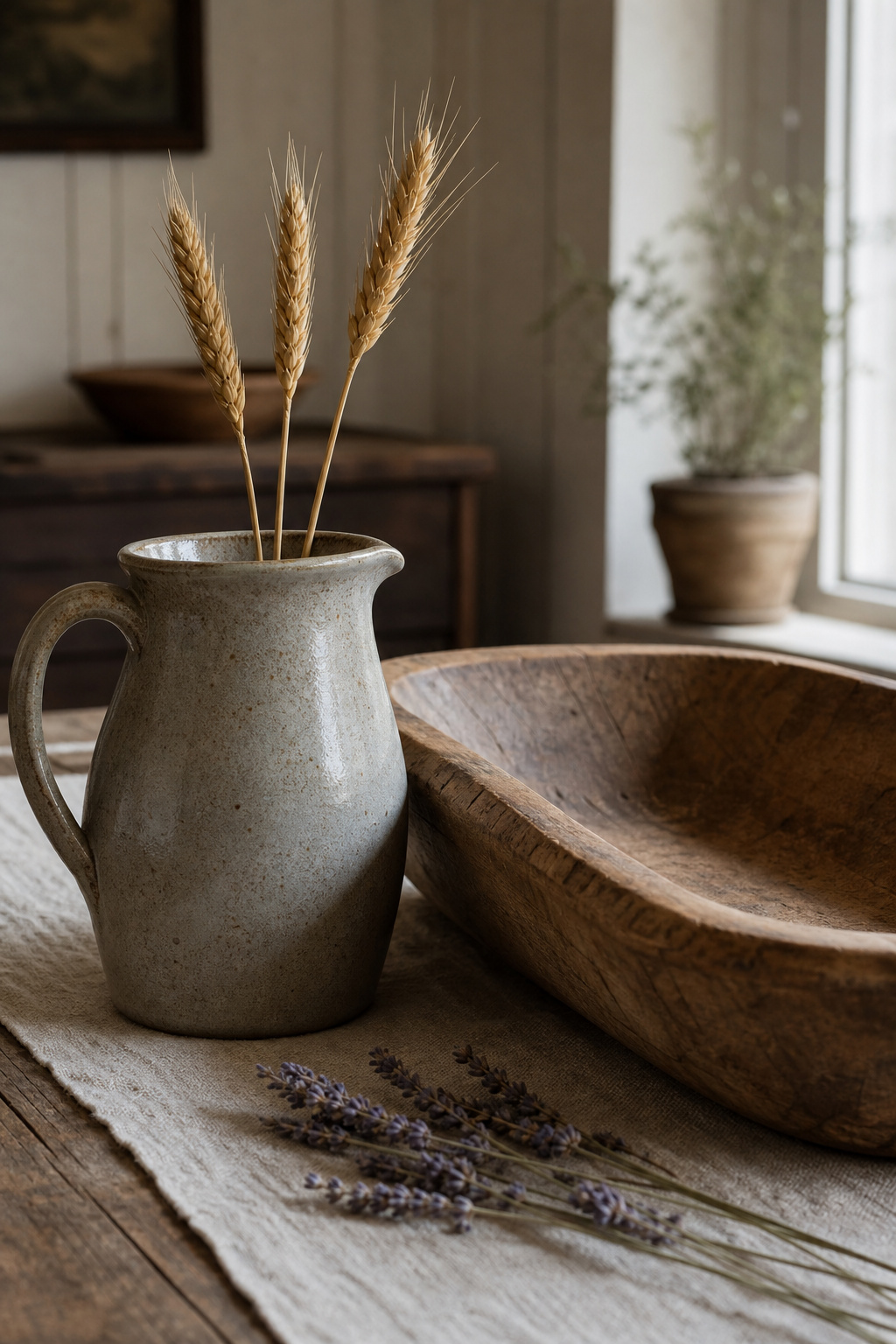
Stoneware pitchers and ceramic jugs: proportion guidelines
A salt-glaze or slip-glaze pitcher, common in American pottery from the 1820s into the early 1900s, reads instantly farmhouse. The narrow neck keeps you to a few tall stems rather than an overstuffed bouquet — that restraint is the point. A 9.5-inch pitcher suits a 60-to-72-inch table; 11-to-12-inch pieces work on 84-inch tables or longer.
Wooden dough bowls as low, wide anchor pieces
The dough bowl carries an honest working past — these proofed bread in 18th- and 19th-century farmhouse kitchens. Typically 4 to 6 inches tall and 12 to 24 inches wide, it sits well below the sightline zone. Fill it with botanicals, seasonal fruit, or pillar candles and it becomes the whole centerpiece. Designer Lory Bernstein pairs a vintage European bowl with formal florals on a bare table, letting the contrast carry the look.
Galvanised buckets and enamel pails for a working-farm reference
Galvanised metal entered American farm use in the late 19th century for water and milk pails. A genuine bucket filled with sunflowers, hydrangeas, or dried wheat is one of the most recognisable farmhouse formats; enamelware pails, white with a blue or black rim, read slightly more refined. Skip the reproduction with a shiny lacquer finish — the appeal is the honest object. These props are also central to the rustic farmhouse look across the whole room.
Greenery and Natural Elements: Fresh, Dried, and Foraged
The botanical layer separates a farmhouse centerpiece from a generic rustic pile. Choose plants that belong to a working landscape and hold up without fussing.
Fresh greenery: eucalyptus, olive branch, and herbs
Eucalyptus, olive branches, and magnolia leaves last longest on a dining table. Cut stems at an angle, stand them in clean water with a little sugar and white vinegar, and top up daily. Seeded eucalyptus lasts one to two weeks and dries in place, shifting from silver-green to dusty sage. For zero cost, rosemary, sage, and thyme tied with jute twine and propped in a jug introduces scent that suits the table.
Dried and preserved: wheat, cotton, lavender, and pampas
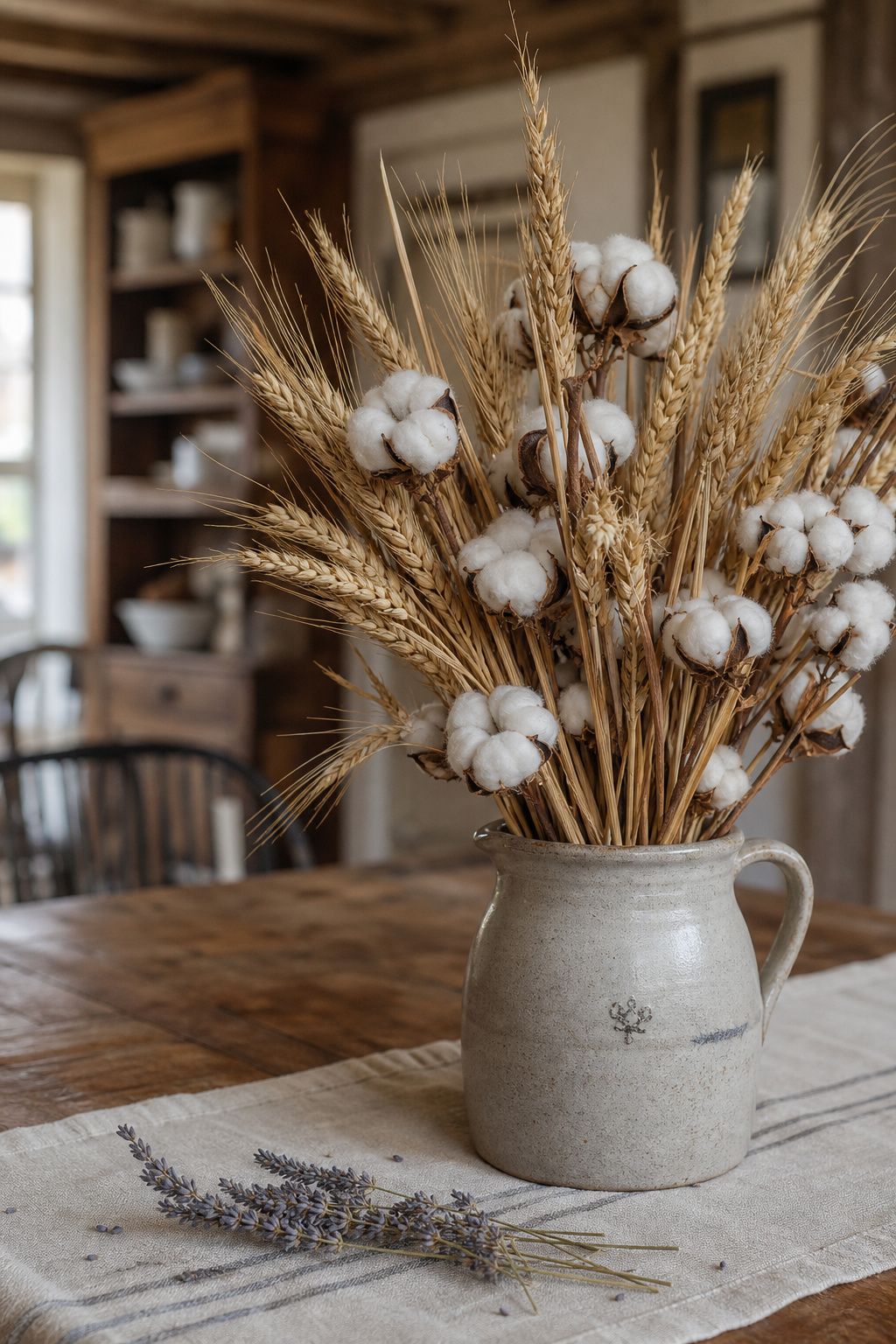
Dried elements are the low-maintenance backbone. Wheat stalks hold their golden colour indefinitely when kept dry; cotton stems last years. Mix the two for height — wheat at 16 to 20 inches, cotton at 12 to 14 — for structure and softness in one vessel. Pampas grass overwhelms fast; use a single stem as an accent, not a full vase.
Foraged elements: pine cones, seed pods, and branches
Foraged naturals cost nothing and last indefinitely. Freeze pine cones 48 to 72 hours first to kill any insects, then dry them fully. Vermont Public Radio’s gardening team builds a foraged arrangement from the largest elements down: evergreen boughs as a base, then pine cones, acorns, and holly or dogwood berries, keeping the profile low. Seed pods — honesty, lotus, and teasel — add architectural texture central to the look.
Seasonal Farmhouse Centrepieces: How to Swap Without Rebuilding
The most practical tablescape runs on a permanent base with seasonal accents that cost little or nothing.
The permanent base that stays year-round
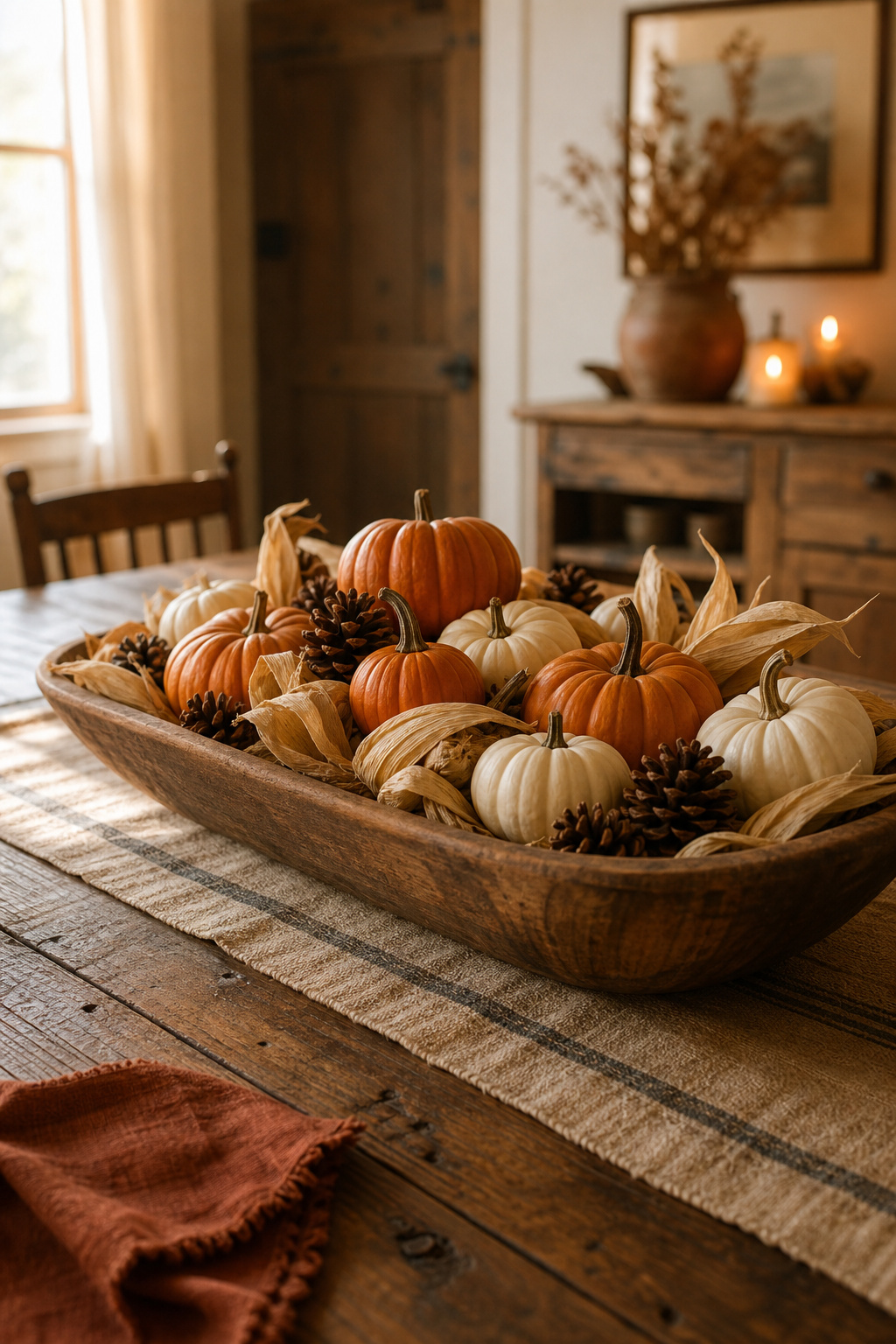
Three elements form the skeleton: a runner (washed linen for everyday, grain-sack for entertaining), one low wide anchor like a dough bowl, and two or three iron lanterns. Hunker’s editors call a shallow bowl the foundational year-round object because it holds seasonal inserts while keeping sightlines clear. The lanterns never change; their iron finish reads equally well with spring florals and winter pine.
Seasonal accent swaps by quarter
- Spring: fresh tulips or daffodils in the jug, a handful of moss in the bowl, pale green and cream accents.
- Summer: sunflowers or loose herbs, a small lemon cluster in the bowl, a lighter washed-cotton runner.
- Autumn: dried corn husks, mini gourds and pumpkins in the bowl, a rust taper in the lanterns.
- Winter: evergreen boughs of pine or cedar, winterberry in the jug, white or cream pillars in the lanterns.
Budget swaps: what costs nothing and what to buy once
Most of the rotation is free: foraged pine cones, kitchen-garden herbs, fallen autumn leaves, a mason jar standing in for a stoneware jug. Spend deliberately on two things: a large dough bowl (usually $40 to $80) that anchors all four seasons, and a set of three graduating iron lanterns (roughly $60 to $120) that need no maintenance. Buy those once, forage the rest. The same swap logic applies to styling the sideboard, so the two surfaces can change together.
The principles that matter are few: one anchor, accents that answer to it, height under 12 inches or over 22, and a permanent base you rotate rather than rebuild. Do that, and the table looks composed every day of the year.
FAQ
How tall should a farmhouse dining table centrepiece be?
Keep it at 12 inches or lower so guests can see across the table, or go deliberately above 22 inches for height drama. Anything between 13 and 21 inches lands directly in a seated adult’s sightline and blocks conversation. For tables seating six to twelve, an anchor 10 to 12 inches tall and 12 to 20 inches wide is ideal.
What do you put in the middle of a farmhouse table for everyday use?
A low wooden dough bowl is the most practical everyday centrepiece. Fill it with whatever is seasonal — lemons, pine cones, a few dried wheat stems — and it needs no maintenance between refreshes. Keep a washed-linen runner as the permanent base, add two or three iron lanterns, and slide the bowl aside when serving.
How do you make a simple farmhouse tablescape for a dinner party?
Start with a grain-sack or linen runner, allowing 6 to 12 inches of overhang each end. Centre the anchor — a dough bowl or stoneware jug — then flank it with a pair or trio of iron candlesticks at varying heights. Add seasonal botanicals, then light unscented beeswax tapers last; they burn up to 10 hours without competing with the food aromas.