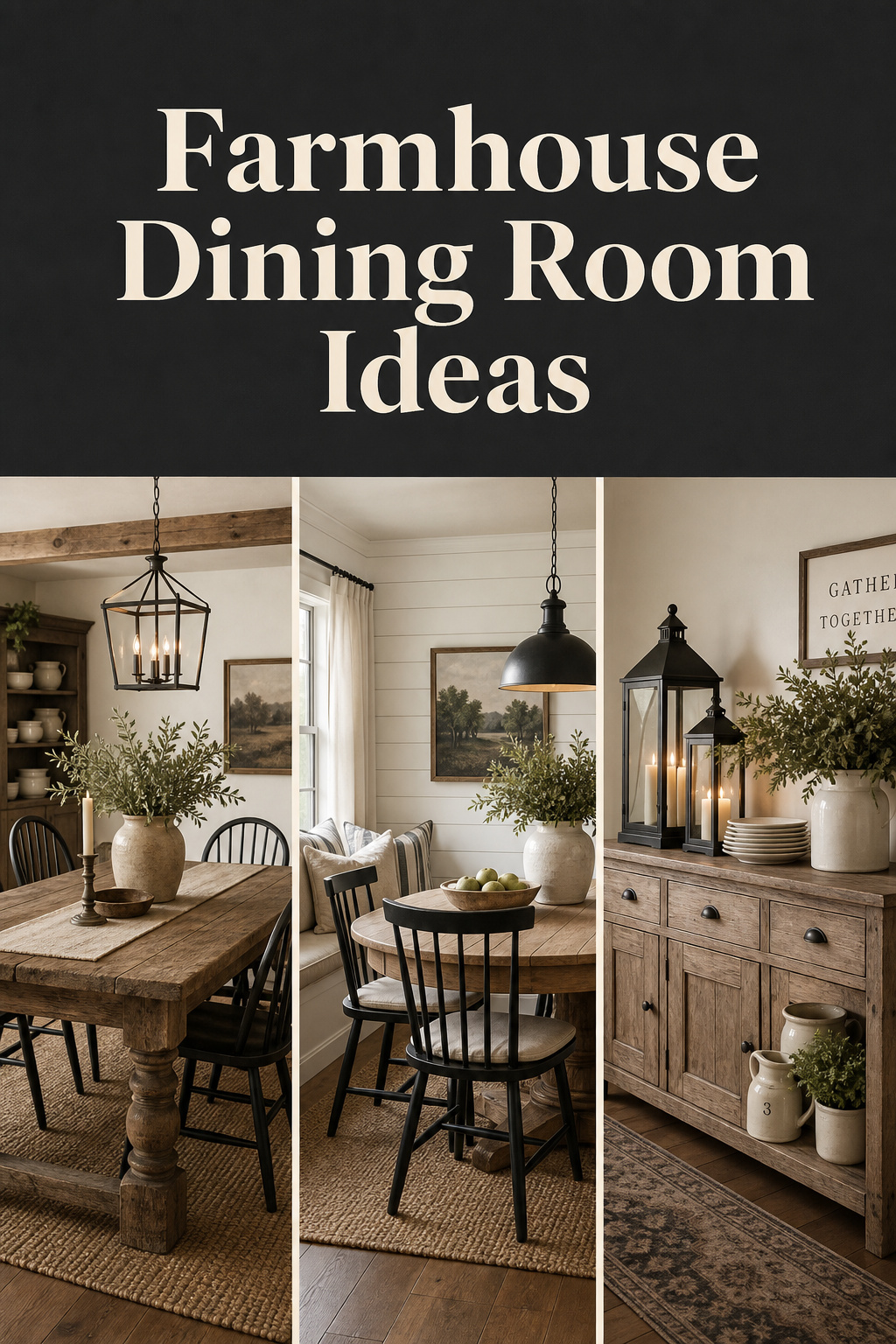
The farmhouse dining room did not begin as a style. It began as the busiest room in a working house. In 19th-century rural America, the long communal table sat at the centre of domestic life, built for utility from whatever timber the land clearing produced — usually solid pine or oak. The room doubled as a food-preparation space, flanked by a pantry and a root cellar, which gave it a plainer, more hard-wearing character than the parlour of the same era. That working past is the whole point. The best farmhouse dining room ideas still trace back to it, because the look is really a set of honest materials doing honest jobs.
Understand that lineage and the rest follows. You stop chasing a Pinterest aesthetic and start assembling a room with reasons behind every choice — why reclaimed wood reads differently from new lumber, why a trestle base matters, why one accent wall outperforms four. This guide surveys the whole style: its materials, the modern-versus-rustic split, the furniture, palette, lighting, walls, sideboard, and small-space adaptations. Each section goes deep enough to support a confident decision, then hands off to a dedicated guide where a subtopic deserves more room than a survey can give.`
What Genuinely Farmhouse Dining Room Ideas Have in Common
Before any table or paint chip enters the conversation, it helps to know what you are building toward. Farmhouse is not a colour or a single object. It is a material vocabulary with two recognised dialects, and the rooms that read as authentic speak it fluently.
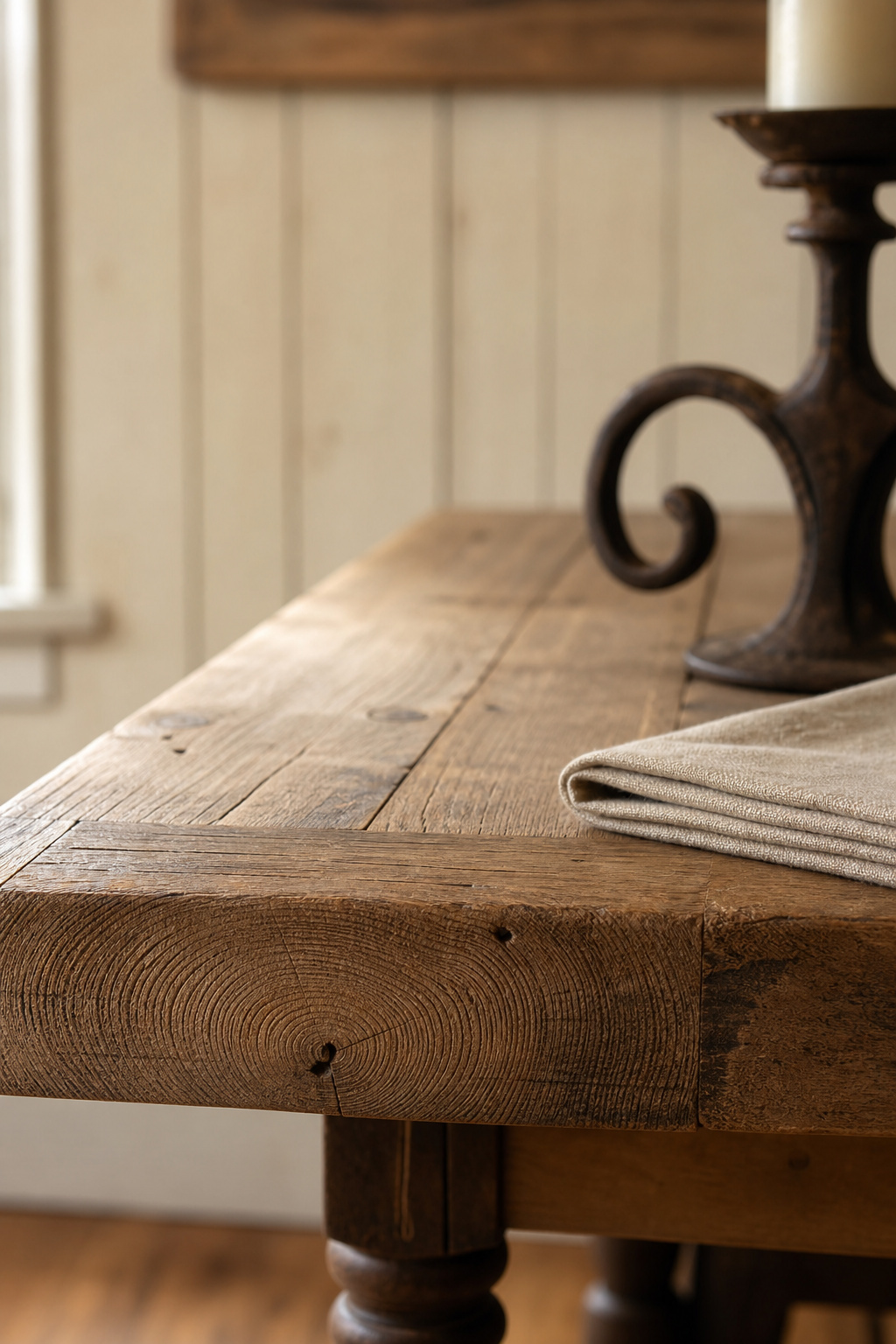
The agrarian roots: American working-farm interiors of the 1800s
Westward expansion shaped the room more than any designer did. Settlers built compact homes with steep roofs and small windows, and the open kitchen-dining space became the command centre of a self-contained operation. By the mid-1800s, railroad expansion made decorative trim affordable, so a little ornament crept in — turned legs, beadboard wainscoting, simple spindle-back chairs — without displacing the utilitarian ethic underneath. Regional character followed the climate: New England rooms ran compact and timber-heavy against the cold; Southern farmhouses opened to porches with lighter finishes; the Midwest blended both. That history is not trivia. It tells you which details are genuine and which are merely themed.
The five defining materials: reclaimed wood, cast iron, linen, stone, and aged metal
Strip the style to its essentials and five materials remain. Reclaimed wood is the most visible signature: old-growth boards carry 15 to 30-plus growth rings per inch, against 3 to 8 in plantation timber, which gives them a density and surface depth new lumber cannot fake. Cast and wrought iron handle the hardware, lighting, and serving pieces, their durability matching the originals. Linen and cotton form the textile backbone — runners, napkins, woven jute placemats — softening hard surfaces with natural texture. Stone appears as flagstone underfoot or, more often now, through ceramics and ironstone. The thread tying them together is patina. Each of these materials improves with age, developing wear and depth that manufactured surfaces only imitate. That single quality is what separates an authentic farmhouse dining room from a farmhouse-themed one.
Modern vs rustic: the two branches of the style spectrum
The style split in two during the late 20th century, and nearly every decision below sits somewhere on that axis. Rustic farmhouse keeps distressed materials, warm earthy tones, and vintage pieces for a cosy, traditional feel. Modern farmhouse takes the same roots but cleans the lines, neutralises the palette, and eases off the distressing. The branches share the material vocabulary; they differ in finish and restraint. The trend is also moving. Designer Mindy Laven notes that using colour instead of painting everything white “feels more authentic,” which is why navy, forest green, and charcoal now appear as farmhouse accents — and why the modern branch increasingly leans toward an organic, biophilic direction with plants and recycled-metal accents.
| Attribute | Modern farmhouse | Rustic farmhouse |
|---|---|---|
| Palette | True white, greige, warm grey | Warm cream, aged ivory, sage, barn red |
| Materials | Restrained distressing, solid colour | Salvage, weathered wood, visible wear |
| Furniture finish | Clean, matte black hardware | Turned legs, spindle backs, patina |
| Wall treatment | Smooth white shiplap, paint | Planked wood, brick, dark shiplap |
Most successful rooms are not purist. They borrow one element from each column, which is why treating the split as a hard binary is a common mistake. If you want the polished interpretation in full, the modern farmhouse dining room look is its own discipline; for the weathered, salvage-driven end, a rustic farmhouse dining room goes deep on sourcing and reading real age.
Farmhouse Dining Room Furniture: Table, Chairs, and Bench
The table is the irreducible starting point. Get its species, length, base, and finish right, and the room’s palette, scale, and style-position are already half-decided. Everything that follows responds to it.
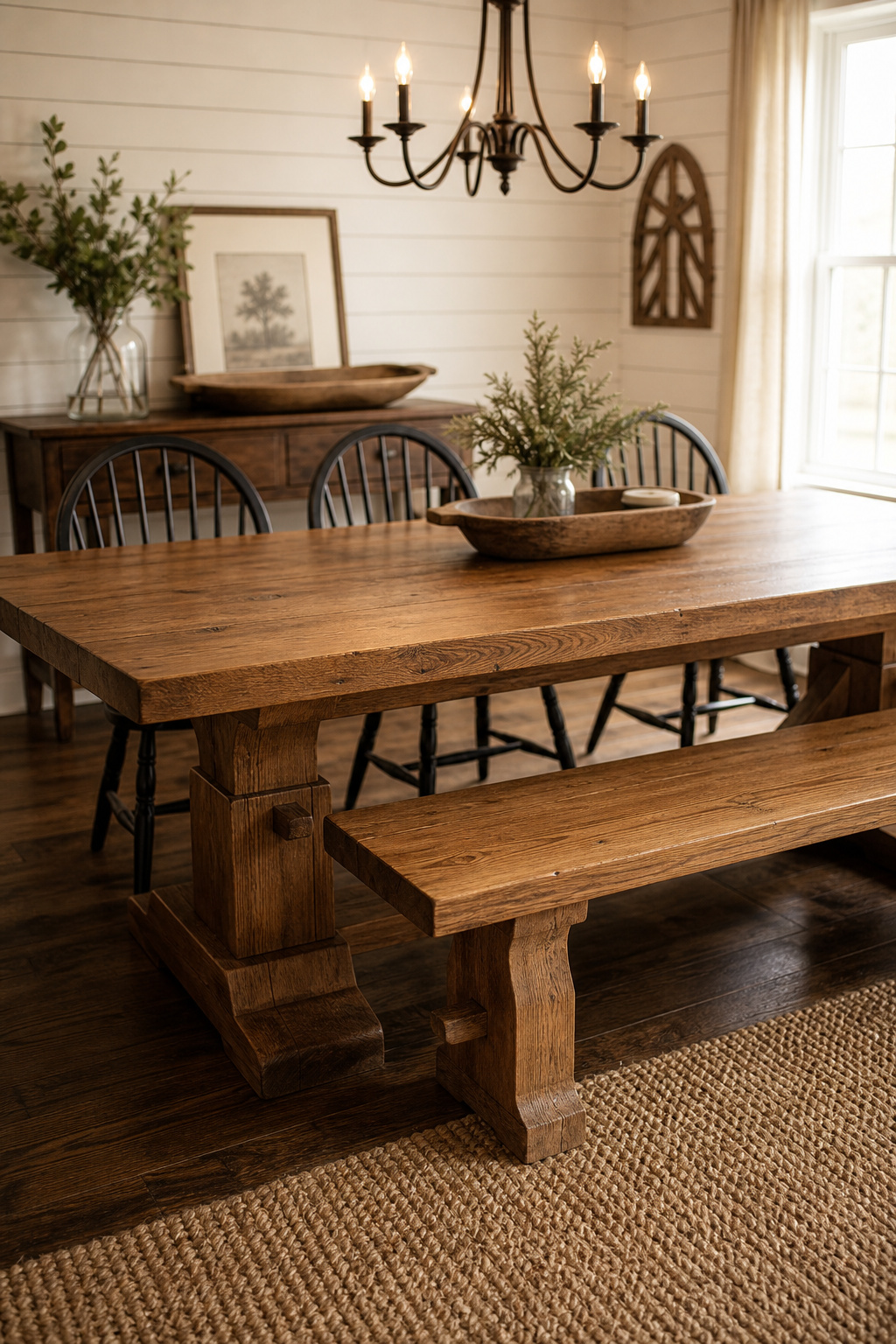
Proportions that read farmhouse: length-to-width ratios and leg profiles
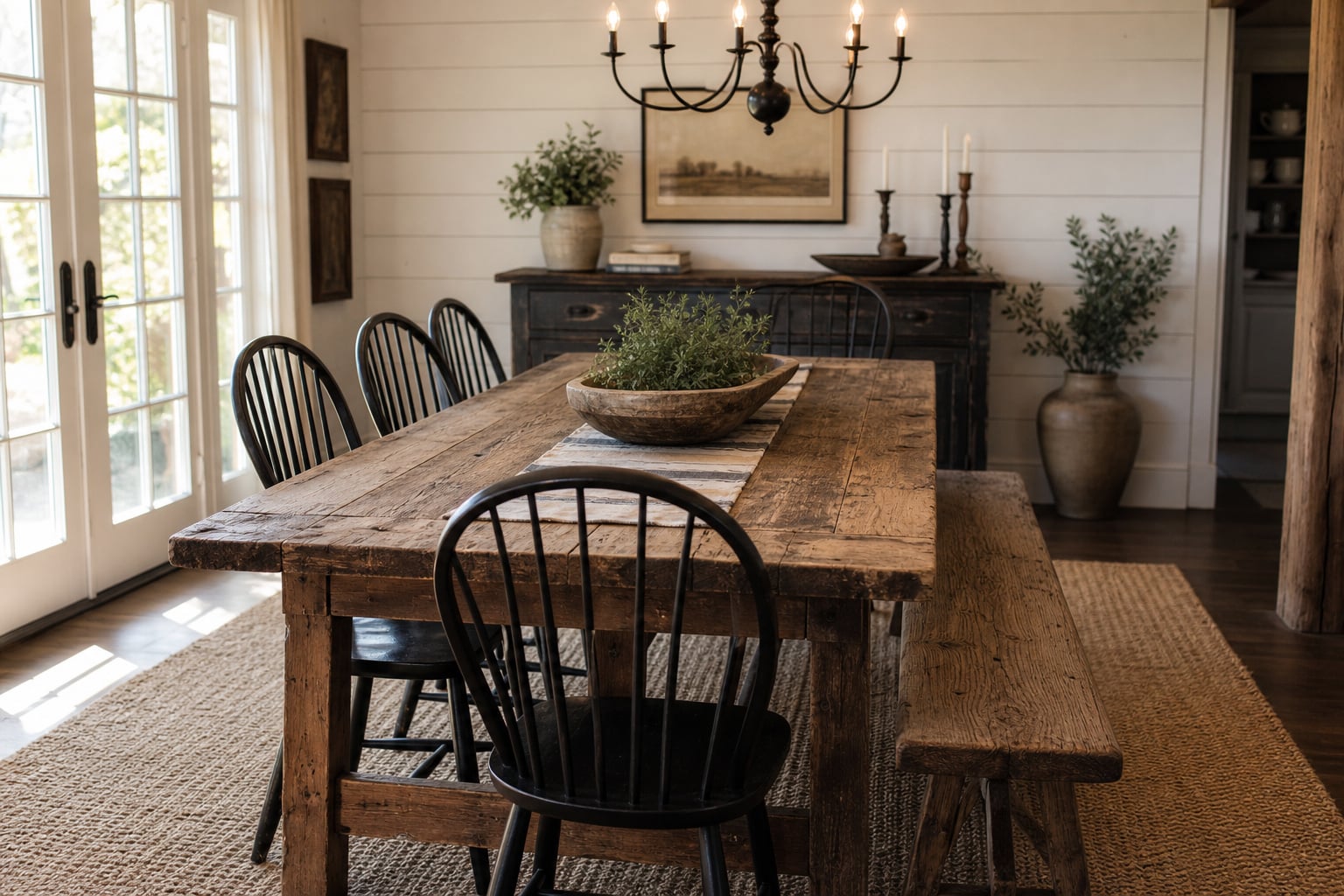
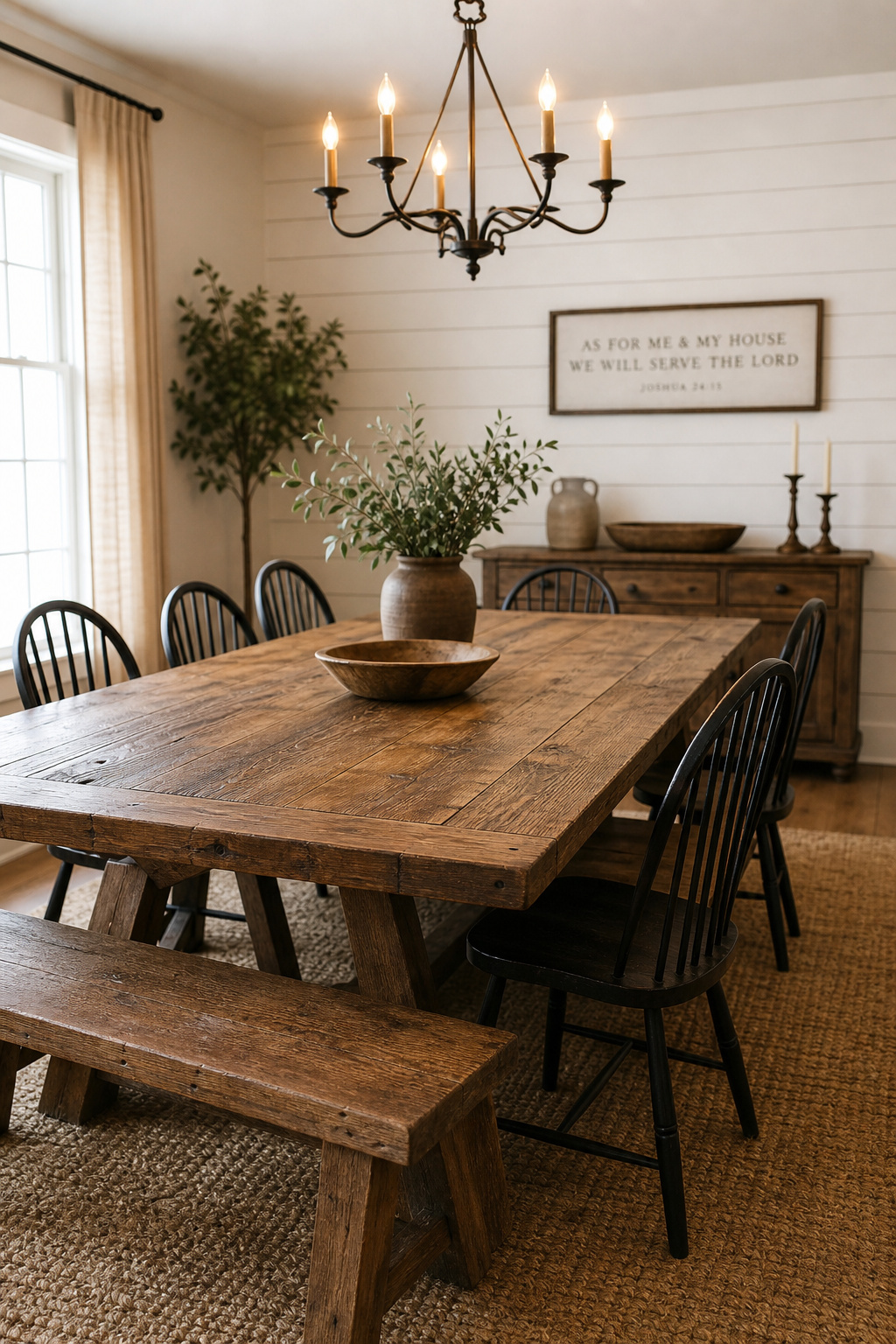
A farmhouse table reads correctly at 36 to 42 inches wide. Go narrower and it loses the communal generosity that defines the style. Lengths run from 4 feet for four seats up to 12 feet for large families, with 6 and 8 feet the common middle. The base matters as much as the top. A trestle base — two paired uprights joined by a stretcher — is the historically correct choice for long rectangular tables. It clears the corners so a bench can slide in and delivers the grounded, utilitarian atmosphere the style depends on. Leg profile signals the dialect: lathe-turned legs read warm and traditional, while square-tapered legs lean modern. One workshop formula keeps proportions honest: custom makers set the distance between the legs at the table length minus 15 inches and the width minus 10, which holds the seating comfortable at any size. For clearance, allow 36 inches around the perimeter for chairs and passage, dropping to 27 only where space is genuinely tight.
Wood species and finish: pine, oak, walnut — what each brings
Species is where authenticity and daily life negotiate. The table below shows the trade-off, measured in Janka hardness — the standard test for how well a wood resists denting.
| Wood species | Character | Durability (Janka) | Relative cost |
|---|---|---|---|
| Yellow pine | Soft, dents readily, develops patina fast | ~870 lbf | Lowest |
| Black walnut | Deep chocolate tone, refined grain | 1,010 lbf | Highest |
| White oak | Open grain, ray fleck, takes dark stain | 1,360 lbf | Mid |
Pine is the most historically authentic and the most forgiving of character marks, but it needs protective finishing for family use. White oak is the durable everyday choice — the one I steer parents of young children toward, because it resists denting far better than pine. Walnut bridges rustic and modern, a heritage American timber that still reads contemporary, and costs the most of the three. Finish counts as much as species. An oil or wax finish keeps the wood’s natural touch and spot-repairs easily, but it wants annual upkeep. A hard-wax oil or conversion varnish protects better for daily meals, though it can feel too slick on a heavily distressed top.
Mixing seating: when a bench replaces chairs and when it shouldn’t
A bench on one long side, chairs opposite, and chairs at the heads is the classic farmhouse arrangement. It seats roughly 25% more people per linear foot than chairs and anchors the rustic look, especially against a wall. The trestle base is what makes it work, since corner legs on a pedestal or apron table block the bench entry. Keep host chairs at the ends, though — they give the back support a bench cannot, and replacing all seating with benches reads as too casual outside a genuine nook. When you mix chair styles, hold one constant. A consistent wood tone or metal finish across Windsor spindle-backs and upholstered parsons chairs reads as collected; varying both material and style at once reads as accidental. Building rather than buying is a real option: a stock-lumber build runs $140 to $250 against $800 to $2,500-plus for a comparable bought set, so it is worth learning to build your own farmhouse dining table if the budget is tight and the weekends are free.
Farmhouse Dining Room Decor: Palette, Textiles, and Accents
With the furniture settled, decor is the layer that turns a table into a room. Three systems do the work: a disciplined colour range, textiles that add texture, and accent objects chosen to last.
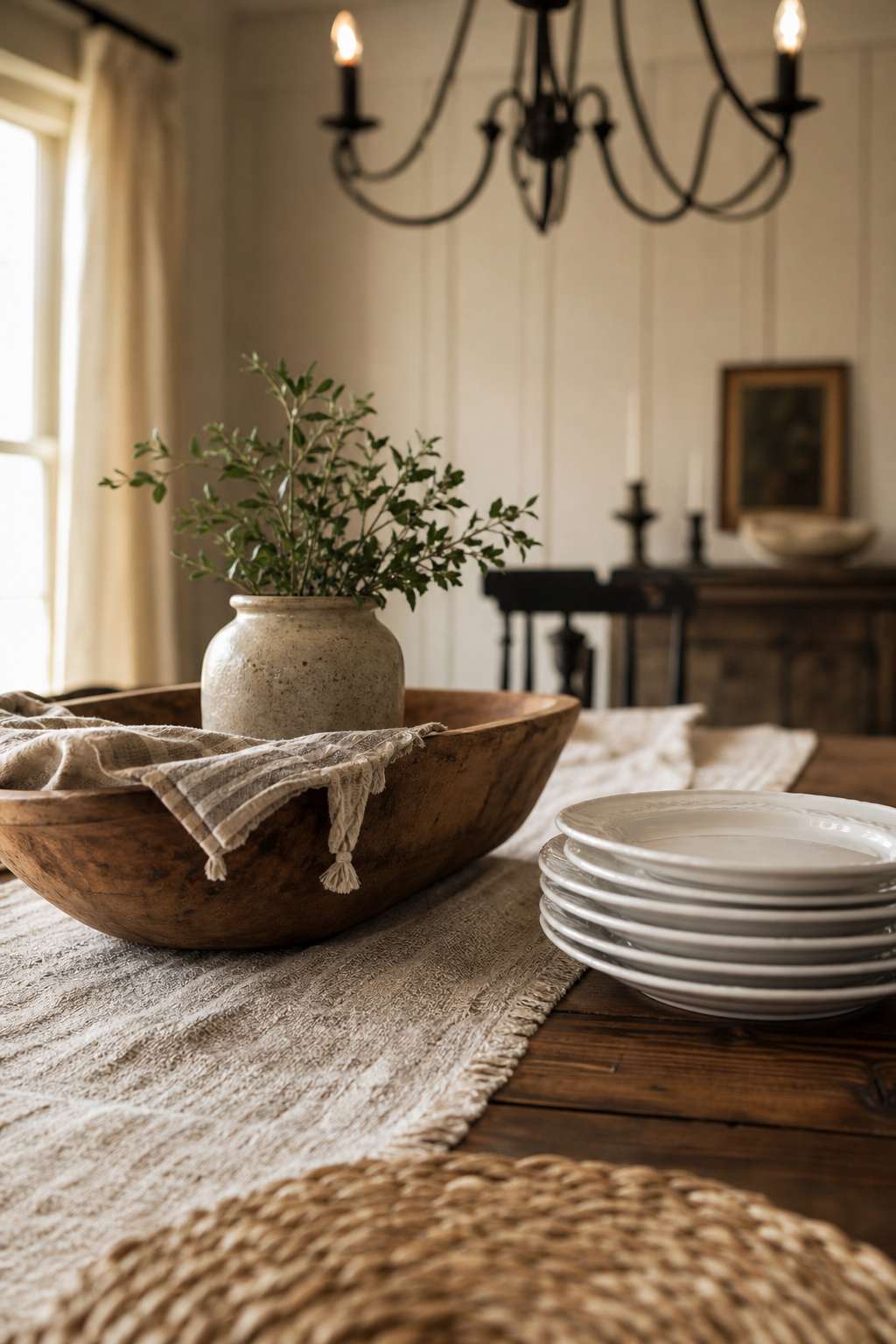
Neutral palette basics: whites, creams, warm greys, and when to add earthy tones
Farmhouse colour stays inside a tight neutral band so the materials can carry the interest. Benjamin Moore Simply White OC-117 is a dependable wall white — warm enough not to clash with wood, bright enough for low-light rooms — while White Dove OC-17 reads softer and creamier for north-facing spaces. A warm grey or greige, such as Classic Grey, works as a middle tone: welcoming, and happy to step back behind the wood. Earthy depth comes from the same axis introduced above. A deep navy like Hale Navy, or charcoal on an accent wall or lower wainscoting, grounds the room against crisp white trim and natural wood. Used wholesale, though, it costs the farmhouse lightness, so contain it to one surface. Modern rooms lean to true whites and barely-there greige; rustic rooms allow warmer creams and soft sage that nod to the original agrarian palette.
Textiles that carry weight: linen runners, cotton napkins, jute placemats
Textiles are where the farmhouse layering actually happens. A natural linen runner in cream, sage, or soft grey is the single most effective layer on the table — it protects the surface and adds the woven, lived-in quality the style depends on. Layer a jute or rattan placemat alongside it and the contrast of flatweave against coarse weave reads as depth rather than clutter. Cotton napkins in natural, cream, or buffalo check add a third layer — a functional one, since farmhouse prizes real use over display. On the floor, a jute or sisal rug extending 24 to 30 inches beyond every side of the table grounds the seating zone and keeps chairs on the rug when pulled out. Change the textiles seasonally within one tonal family — cream linen in spring, warm plaid in autumn — and keep the rug and curtains constant so the room shifts without being rebuilt.
Accent pieces that age well: ironwork, pottery, wooden bowls
The accent layer is where authenticity is won or lost. White ironstone — creamy ceramic that develops a fine crazing over years — is the most quintessentially farmhouse material for a dining room, equally at home in a hutch or on open shelves. Wrought-iron pieces carry the agricultural heritage without tipping into industrial: candleholders, a crock of serving utensils, iron trivets. Turned wooden bowls anchor the table and swap their contents by season — pinecones in autumn, lemons in summer. As designer Natalie Meyer of CNC Home & Design puts it, layering “classic, distressed wood furniture pieces” gives a lived-in look “that doesn’t feel like a theme park recreation of the style.” The fastest way to undo all of it is mass-retail word signs; genuine objects with a working past say “farmhouse” without spelling it out. The tabletop deserves its own treatment — for the full anchor-and-accents formula, see farmhouse dining table centerpiece ideas.
Farmhouse Dining Room Lighting: Fixtures That Set the Mood
Lighting is the fastest mood lever in the room, and the chandelier above the table is its signature piece. The rules below are enough to choose and hang a fixture with confidence.
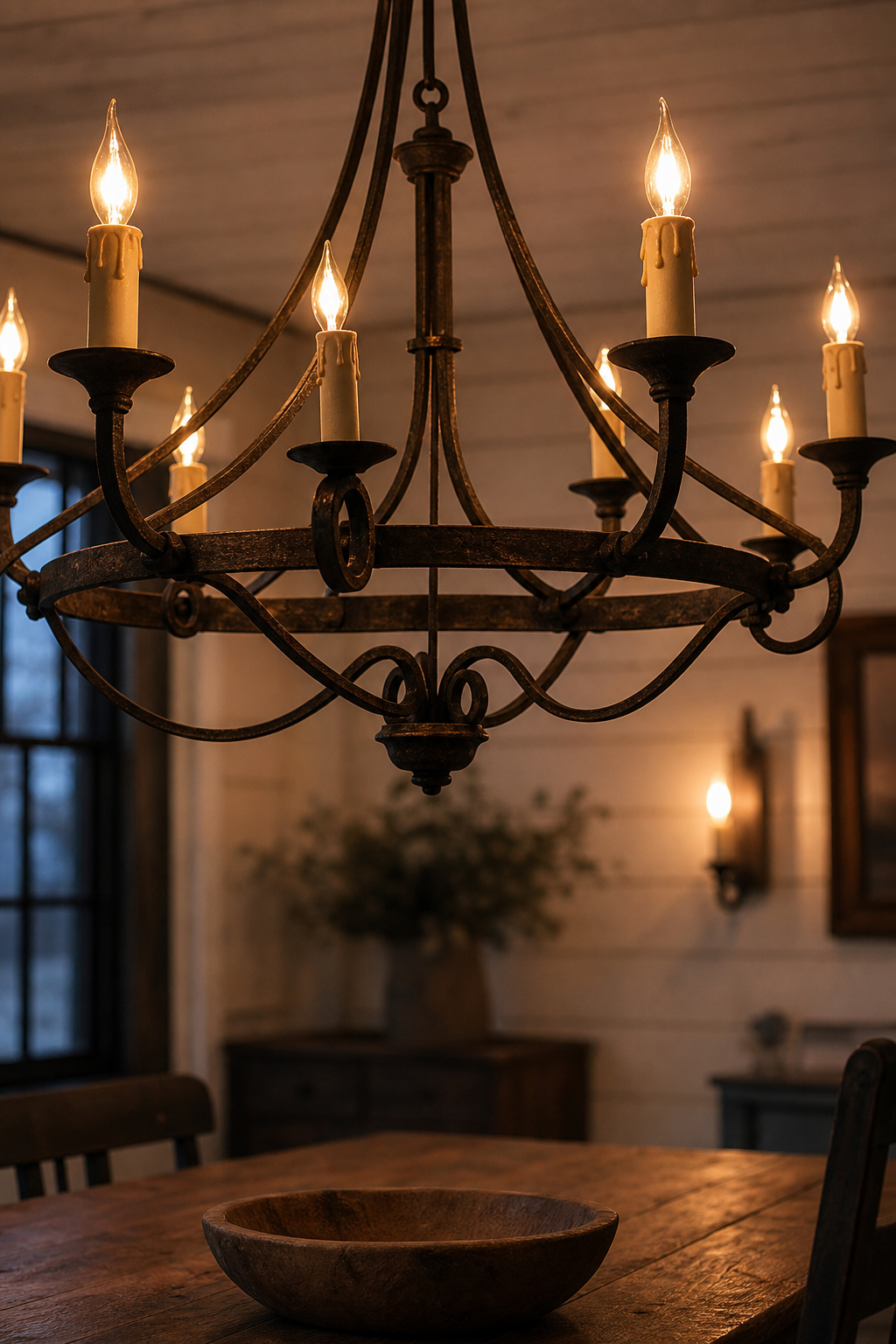
Candle-style chandeliers: sizing by table length
The candle-style chandelier — arms radiating from a central column, each holding a flame-tip bulb — is the most historically authentic farmhouse fixture. Three numbers govern how it hangs:
- Hang height: the lowest point sits 30 to 36 inches above the table on a standard 8-foot ceiling. Add 3 inches per extra foot of ceiling height (33 to 39 inches at 9 feet; 36 to 42 at 10 feet).
- Diameter: size it to one-half to two-thirds of the table’s width, and never wider than the table itself.
- Floor clearance: in any passage area, keep the lowest point at least 7 feet off the finished floor.
Bulb colour finishes the job. Warm LEDs at 2,700 to 3,000K animate wood grain and iron and create dinner-table warmth that cooler temperatures simply cannot. Hang it too high — past 36 inches on an 8-foot ceiling — and it disconnects from the table and dumps its light where nobody is sitting.
Pendant clusters and wagon-wheel fixtures: when each works
Not every farmhouse fixture suits every farmhouse room. A wagon-wheel chandelier — a wrought-iron or wood ring with evenly spaced candle sockets — is the signature rustic choice, but it can read as costume in a clean modern scheme, so treat it as a style commitment rather than a neutral pick. The 2025–2026 modern direction favours branched iron silhouettes, lighter wood tones, and warm brass, which feel contemporary while staying firmly farmhouse. Pendant clusters solve a different problem. Two or three pendants on a single canopy suit lower 8-foot ceilings where one large chandelier would loom; spacing them at equal thirds of the table length gives the most balanced line.
Layering ambient, task, and accent light
A single fixture is never the whole scheme. The complete farmhouse setup runs three layers: the chandelier for ambient mood, wall sconces flanking a mirror or the sideboard for accent depth, and a low lamp on the sideboard for an intimate pool of light. Place sconces with their centres 60 to 66 inches off the floor, where they frame the piece beside them. The non-negotiable across all three is dimmers. The same room has to deliver bright, functional light for a family weeknight and a soft, candlelit register for a dinner party; one fixed brightness compromises one of those jobs. As the Urban Ambiance design team notes, layering sconces with the chandelier softens the hard shadows a single fixture throws — the most impactful upgrade after the fixture itself.
Farmhouse Walls: Paint, Shiplap, and What Goes on Them
Walls work in three compounding layers: the paint colour underneath, an optional cladding treatment, and whatever you hang on top. Each decision changes how the next one reads, so think of them together.
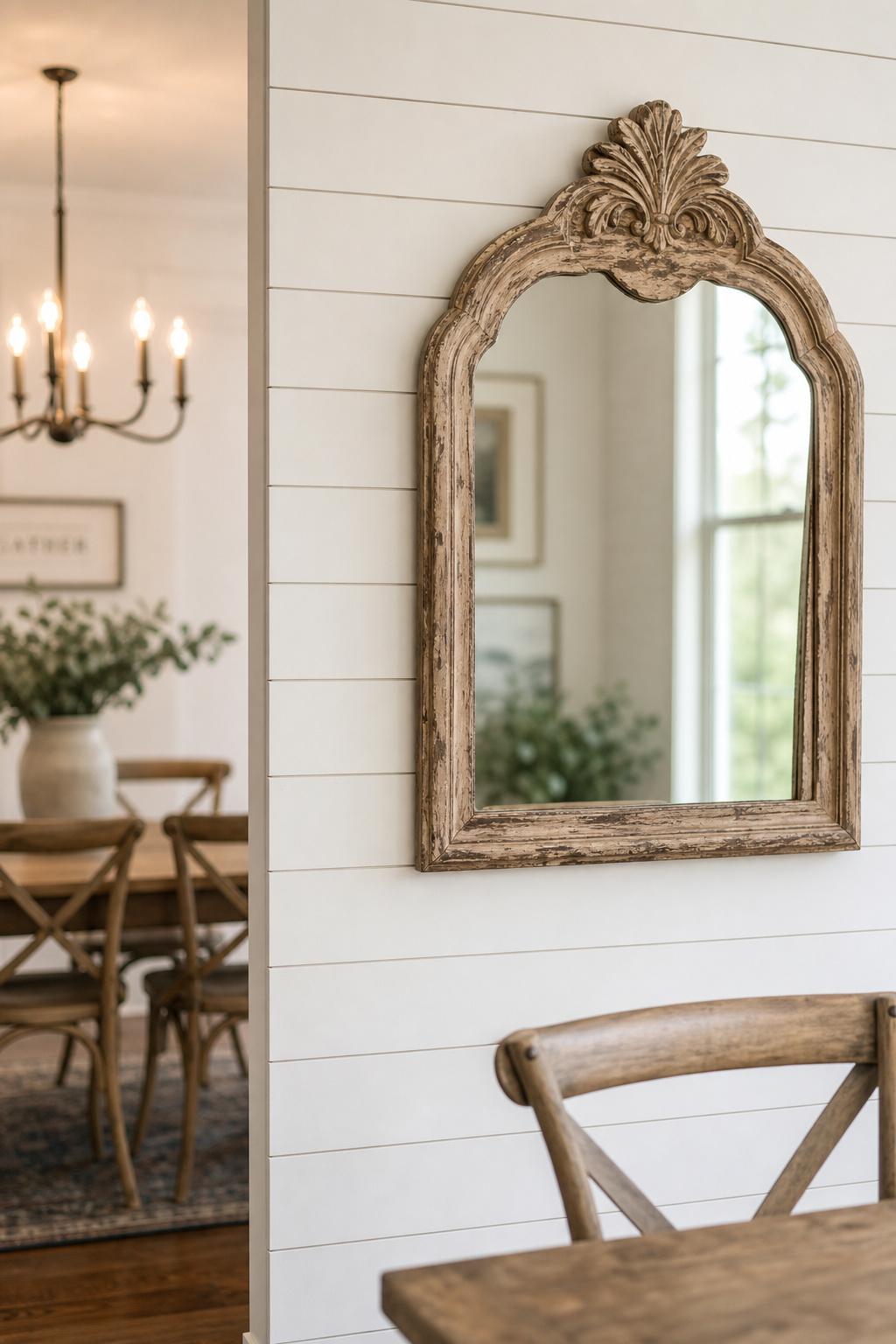
Paint colours that hold the farmhouse mood across seasons
Crisp whites do the most work for the least money. Chantilly Lace, Simply White OC-117, and Behr Polar Bear all reflect light, expand the room, and hand the chromatic job to the wood and textiles. Shiplap is the exception that needs care: its shadow lines amplify warmth, so a low-yellow white like White Dove OC-17 or Sherwin-Williams Alabaster works better than a warm cream, which will yellow under artificial light. Choosing a cladding colour warmer than the wall colour is a classic error, because the board reveals push it warmer still. For depth, a charcoal, slate-blue, or navy accent wall opposite the windows lifts the evening atmosphere without abandoning the look. As a budget marker, a shiplap accent wall runs $3 to $11 per square foot installed — roughly $240 to $880 for a typical 80-square-foot wall.
Shiplap, board-and-batten, and planked walls: which surface and where
Each cladding type carries a different formality. Horizontal shiplap is the most recognisable farmhouse treatment — boards with a slight reveal gap throwing shadow lines — and it suits an accent wall behind a sideboard or banquette. Board-and-batten reads more architectural and formal; use it at wainscoting height, 36 to 42 inches, under paint, or full-wall where horizontal shiplap feels too rustic. Vertical shiplap splits the difference, elongating a low ceiling and reading slightly more contemporary. Wherever you land, keep it to one or two walls. Cladding all four overwhelms the room and erases the contrast that gives the treatment its impact — position it behind the main seating side or the sideboard to frame that wall as the focal point. For material choice, orientation, and DIY installation, see a farmhouse dining room accent wall.
What to hang: mirrors, clocks, botanical prints, and open shelving
Once the surface is set, what goes on it ties the room together. An oversized clock, 24 to 36 inches across with a distressed or iron frame, anchors a wall and reads clear from across the room. A mirror in a wooden or aged-metal frame does double duty — hung opposite a window, it borrows the daylight and effectively doubles it. Botanical art suits the agrarian heritage and softens the hardness of wood and iron: pressed botanicals in dark frames, pastoral watercolours, vintage seed-catalogue prints. Open shelving — 6 to 10-inch floating shelves holding ironstone, pottery, or books — gives the layered look of a hutch without the floor footprint. Joanna Gaines’s design philosophy consistently returns to simple white shiplap as a wall treatment that gives texture and scale without competing with the table or the textiles.
The Sideboard and Buffet: Farmhouse Storage That Earns Its Place
Opposite the table, the sideboard is usually the room’s second visual anchor — a serving surface, a storage piece, and a display stage in one. Proportion and restraint decide whether it strengthens the room or fights it.
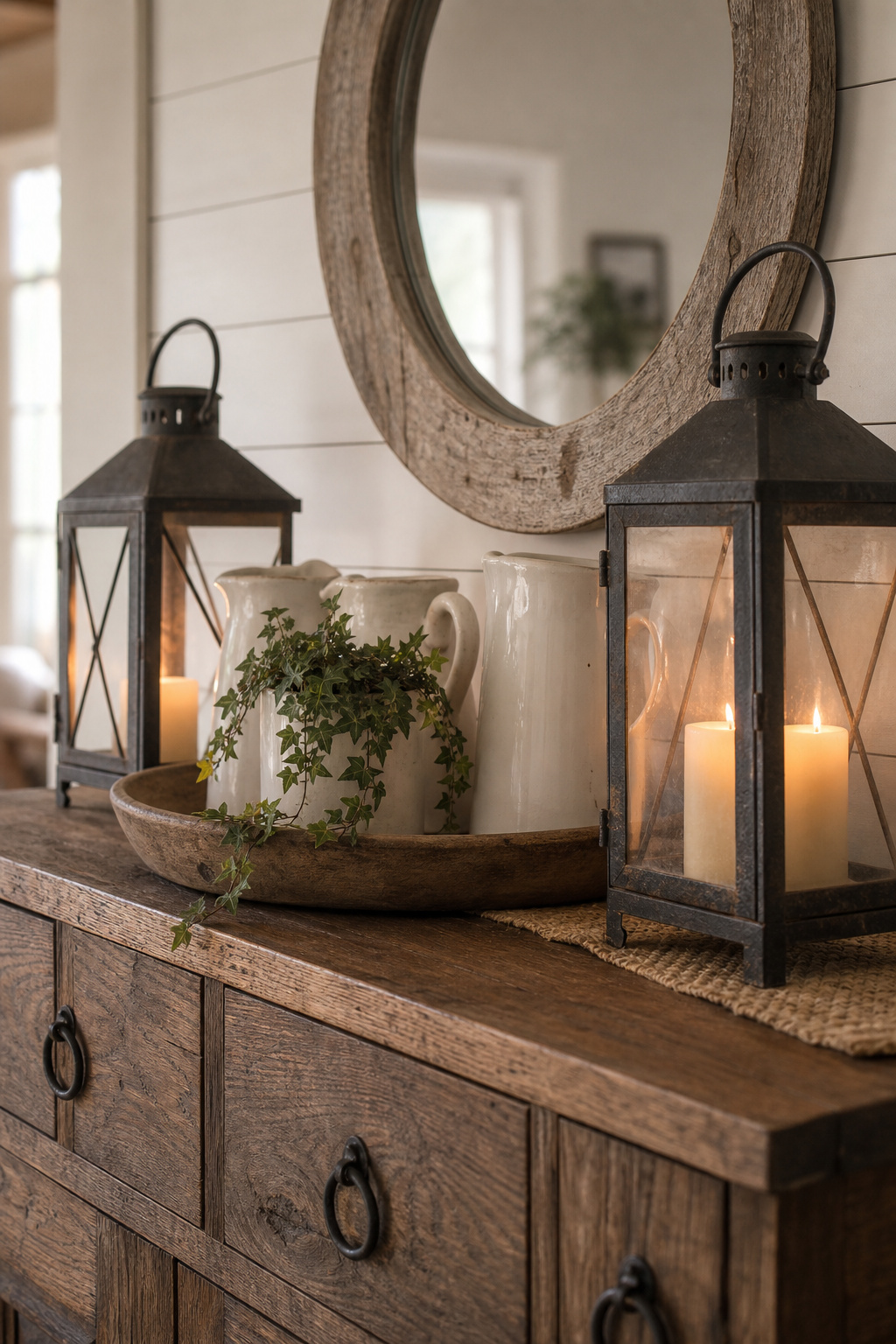
Choosing the right sideboard: wood, size, and proportion to the table
A sideboard reads right when it measures two-thirds to three-quarters of the table’s length — a 72-inch table pairs with a 48 to 54-inch piece — large enough to balance the table without challenging it for focus. Height runs 30 to 36 inches, which lets you serve from the top comfortably and sets the display at eye-catching height from a seated guest; above 40 inches it becomes a cabinet and changes its whole role. Leave at least 24 inches between its front and the pulled-out chair backs, 30 if you serve from it often. For coordination, match the wood’s undertone rather than its exact stain. A warm walnut beside a warm cherry harmonises naturally, where an exact match reads as a bought set rather than a collected room. Farmhouse sideboards favour simple, sturdy construction with visible iron or aged-brass bin pulls over painted or lacquered finishes.
What to put on it: layering trays, crockery, greenery, and lanterns
The surface is a small composition with a reliable formula. Start with a 16 to 20-inch serving tray as the base — it contains the arrangement and lifts away when you need to serve. Vary the heights with small risers, a stack of books, or a second tray, since a flat row of same-height objects reads as storage rather than display. Greenery is the most effective finishing touch: a potted herb, a trailing ivy, an evergreen clipping in a jug introduces organic movement against the neutral ceramics. Iron or glass lanterns flanking the centrepiece add vertical height and a warm glow during service. Restraint is the whole game — more than five to seven objects, or pieces stacked without a clear hierarchy, tips the surface from display into pile.
Practical storage vs display: balancing the two
A sideboard works best when its two jobs stay separate. Use the drawers and cabinet below for genuine dining needs — linens, candles, serving utensils — and reserve the top for display; each does its job better that way. Open lower shelving is a farmhouse-appropriate alternative to closed doors: legs and an open shelf keep the piece feeling lighter and let woven baskets or stacked ironstone show. As Carrocel’s design consultants point out, a chunky farmhouse table needs a sideboard with matching visual weight; a spindly console against the wall reads as the wrong furniture family and undercuts the room. The full surface system — the triangle layering, what earns a spot, how to keep a serving zone clear — belongs in its own guide, so see styling a farmhouse sideboard for the deep version.
Small Spaces and Nooks: Making Farmhouse Work in Any Footprint
Most readers do not have a barn-sized room, and the style adapts well to tight ones. Three moves carry the load: a smarter table shape, built-in seating, and a lighter hand with colour.
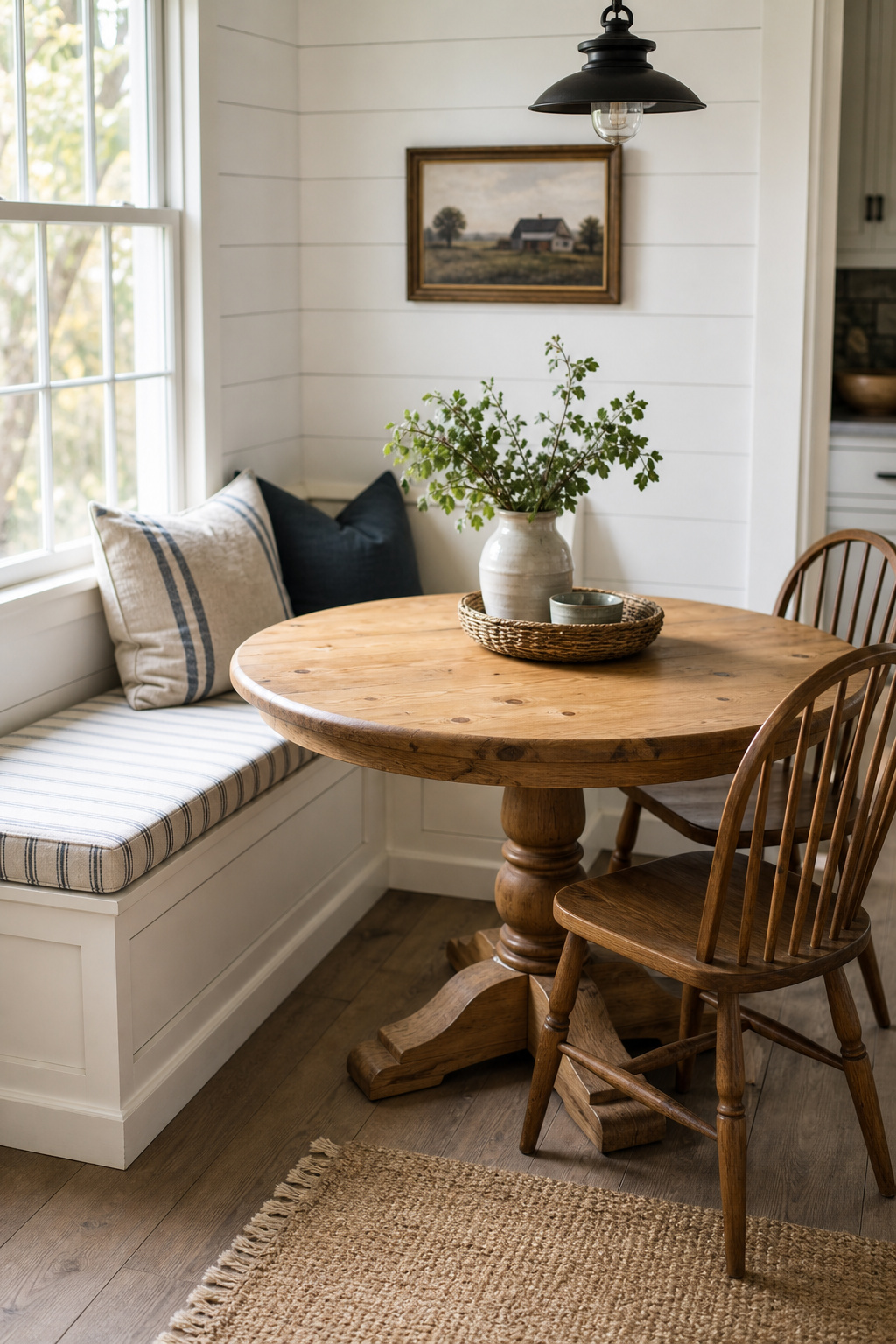
Table choices for tight rooms: round, drop-leaf, and extending options
Shape solves most small-room problems. A round pedestal table, 36 to 42 inches across, seats four in a tight footprint and loses the corner legs that snag entry, while the single base lets you pull up an extra chair in a pinch. A drop-leaf table is the most space-efficient option — gateleg and butterfly designs collapse to as little as 18 inches for daily use and open to 48 to 60 inches for a meal, ideal under 100 square feet. An extending table with a self-storing leaf does the same job in a more substantial piece: it lives at its smaller day-to-day size and grows only when company comes. The clearance rule relaxes in a nook: 36 inches stays the target, but 27 works where one side sits against a wall and only one side needs pull-out room.
Built-in banquettes as a space-saving farmhouse move
A built-in banquette is arguably the most efficient farmhouse seating there is. An L-shaped or straight bench tucks flush to the wall with no chair-leg overhang, seats more people per linear foot than chairs, and hides storage under the seat. Built traditionally in pine or poplar with shiplap-panelled sides and a simple cushion in ticking stripe, buffalo check, or plain linen, it reinforces the palette the rest of the room already uses. Match the seat height to your dining chairs at 17 to 19 inches; back height typically runs 36 to 42 inches against a wall, taller only where the banquette also divides the room.
Light and colour to expand a small farmhouse dining area
A light, airy palette matters more in a small room than a large one. Crisp white walls, light-toned wood, and pale linen keep a nook feeling open, where dark wood and a warm-cream wall together can close it in. The highest-value low-cost trick is a mirror hung opposite the nook’s main light source — a window or a pendant — which doubles the perceived depth for the price of the frame. Scale the fixture down, too: a single 12 to 18-inch pendant over a round 36-inch table gives the same overhead anchor a chandelier would, without the arm spread that dominates a compact space. For layout maths and compact-furniture strategy, see small farmhouse dining nook ideas.
Farmhouse Dining Room Design: Pulling the Look Together
Everything above is a part. This section is how the parts become a room — the order to build in, the mistakes that undo good materials, and where to begin if the room is currently empty.
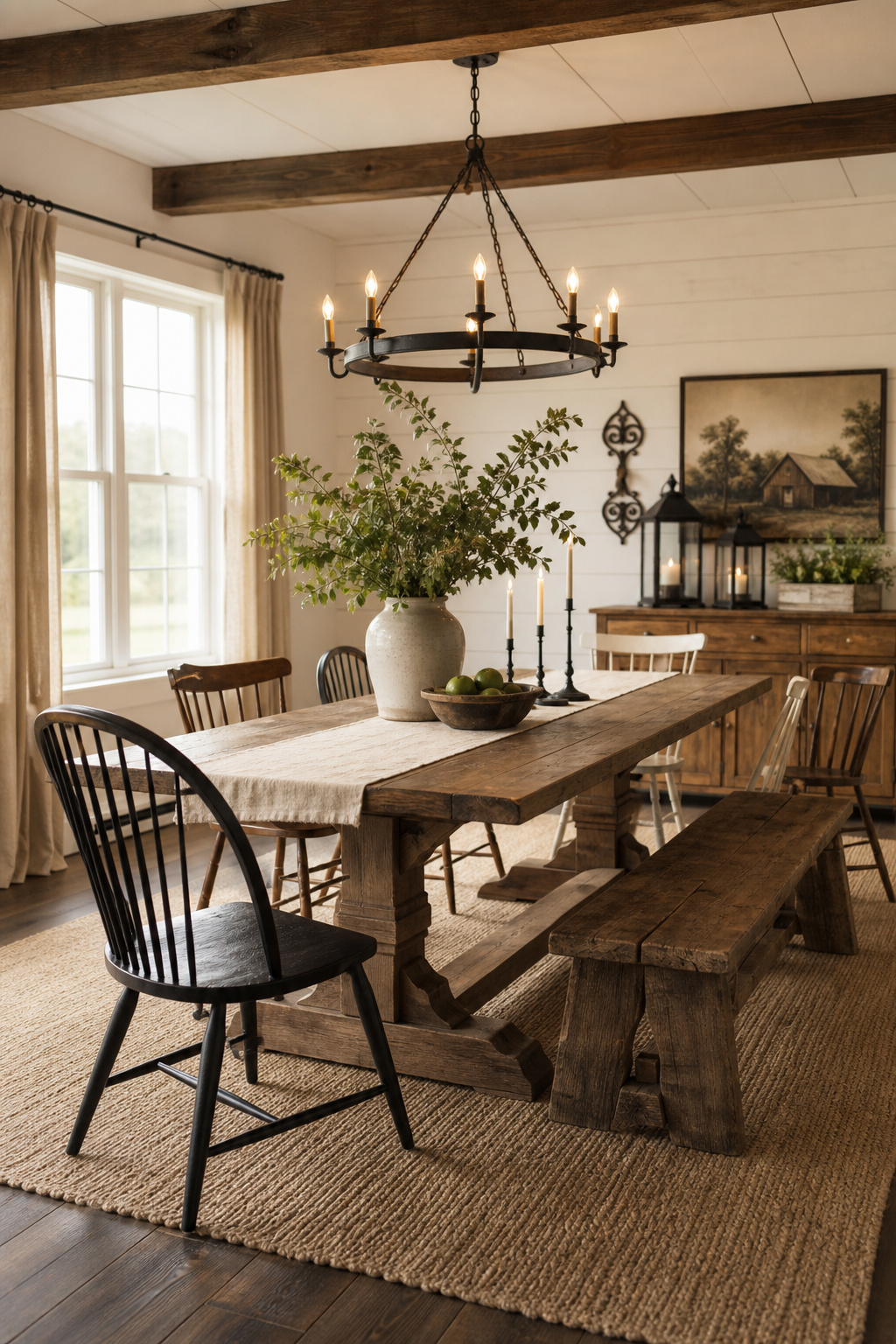
The layering order: floor, wall, furniture, textiles, accents
Farmhouse dining rooms come together in a deliberate sequence. Skipping ahead is how people end up solving for the wrong scale. Confirm each layer before specifying the next:
- Floor — the wood or stone the house already gives you sets the baseline.
- Walls — colour first, then any cladding, framing the focal wall.
- Furniture — the table first, then chairs and bench, then the sideboard.
- Textiles — rug, runner, napkins, curtains, in that order of footprint.
- Accents and lighting — the last layer, chosen to respond to everything below.
The table leads because its species, length, base, and finish set the palette, scale, and style-position the rest must answer to. One rule keeps the room from feeling crowded once the pieces arrive: the 60/40 floor guideline. Furniture and rugs should fill roughly 60% of the floor and leave 40% as clear walkway — which matters more here than in a light-furniture room, because solid-wood farmhouse pieces carry real visual weight.
Common mistakes — and the authentic alternatives
A handful of errors account for most rooms that miss. Buying a full matching set — table, chairs, and sideboard in one finish from one retailer — is the most common; authentic rooms look collected over time, so start with the table and source the rest separately. Leaning on word signs as shorthand produces a themed look where genuine objects with history would have spoken for themselves. Prioritising looks over function betrays the premise entirely — a glass-topped “farmhouse” table you cannot use for daily meals contradicts a style that was built to work first. And harsh, dimmer-less lighting at 4,000K-plus undoes the evening mood more decisively than any single decision, which is why warm bulbs and dimmable circuits are non-negotiable. As Rachel Ashwell of Shabby Chic frames the underlying principle, the authentic look is “the beauty of decay — things that once had a useful life acquiring patina and character through use, not through artificial distressing at a factory.”
How to start if you’re beginning from scratch
Begin with the table and let the room grow outward. A 6-foot reclaimed-oak trestle table in a white-walled room is already a farmhouse dining room; every later layer improves it, but none is required to establish the identity. From there, the most cost-effective sequence is reliable: paint the walls a warm white ($50 to $150), add a jute or sisal rug under the table ($80 to $250), swap the fixture for a candle-arm chandelier ($150 to $600), add a linen runner and cloth napkins ($30 to $80), then style one wall with shelves or shiplap. My own habit, learned from years of barn demolitions and estate sales across three counties, is to find one genuinely old piece first — a table, a clock, an ironstone collection — and build the room to meet its standard. That single authentic object sets the bar everything else has to clear, and it keeps the room honest as it fills in over the seasons rather than in a single afternoon.