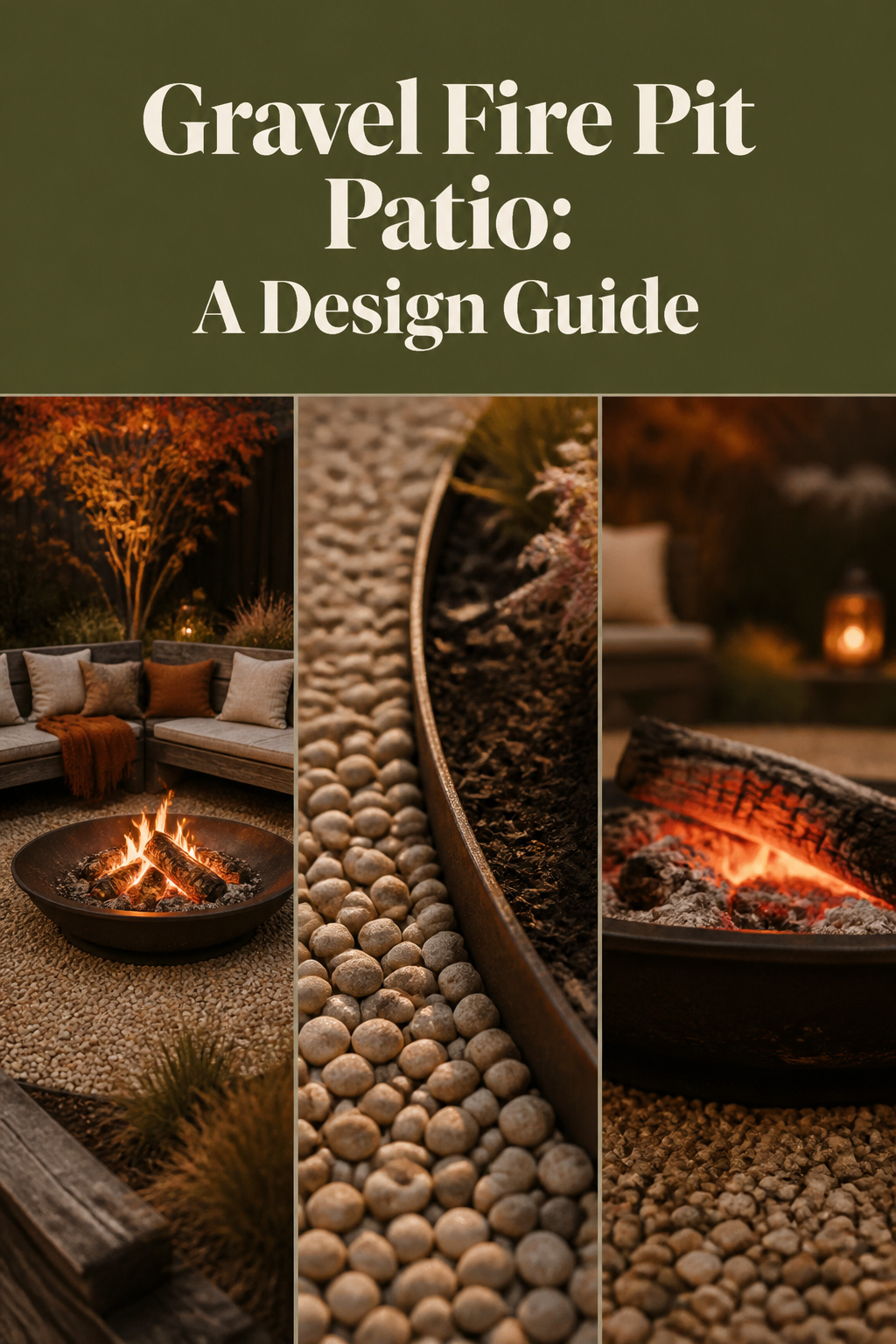

It’s the first cold evening of October. The grill has been quiet for weeks, but there’s a low orange glow at the far corner of the yard, and that’s where everyone has drifted — knees toward the heat, a wool throw going around, the crunch of gravel underfoot every time someone gets up for another log. That corner is the whole reason to build a gravel fire pit patio: not the photo, the evening. And the gap between the two is almost never style — it’s layout and safety, decided before the first stone goes down.
TL;DR
- Keep seating 3 feet from a wood fire’s edge, 2 feet from gas, and 7 feet from either on a windy night; a 36-inch pit seats 4 to 6 guests.
- Two separate safety distances matter: the pit stays 25 feet from the house for an open wood fire (36 inches for certified gas), and a non-combustible pad — concrete, steel or masonry, never grass — goes directly under it.
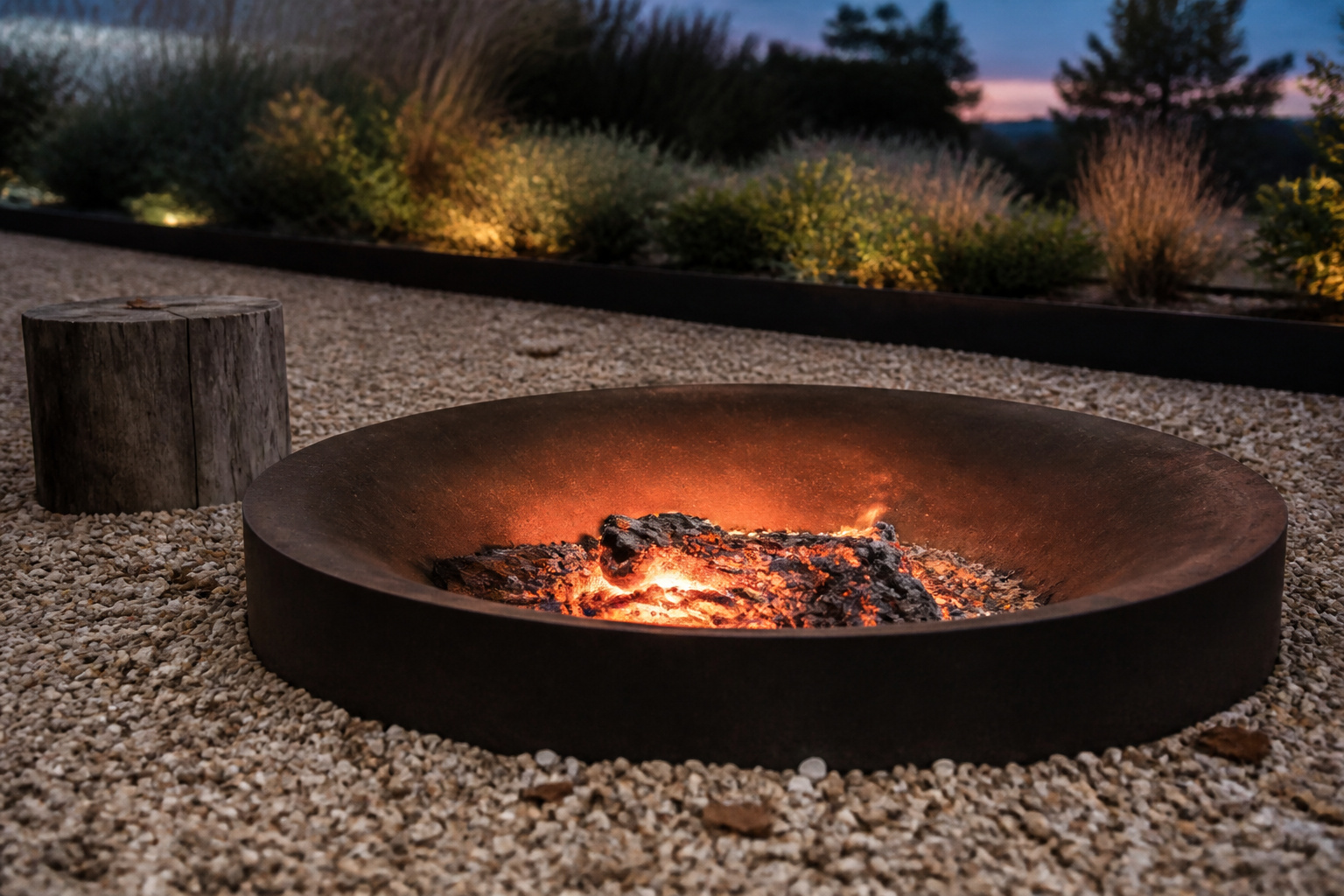
- Pea gravel works as the surround starting about 3 feet out, but never inside the basin; use fire-rated sand, fire glass or lava rock in the fire itself.
The Evening a Gravel Fire Pit Patio Is Built For
What makes a fire corner actually get used
Three things decide it, and none is the fire pit you buy: good sight lines to the flame and to other faces, a conversation distance inside about 8 feet seat-to-seat — wider than that and people stop talking and just watch the fire alone — and a clear way in and out. A circle wrapped evenly around the pit delivers all three at once, since every seat lands the same distance from the heat, which a straight line or an L-shape never manages.
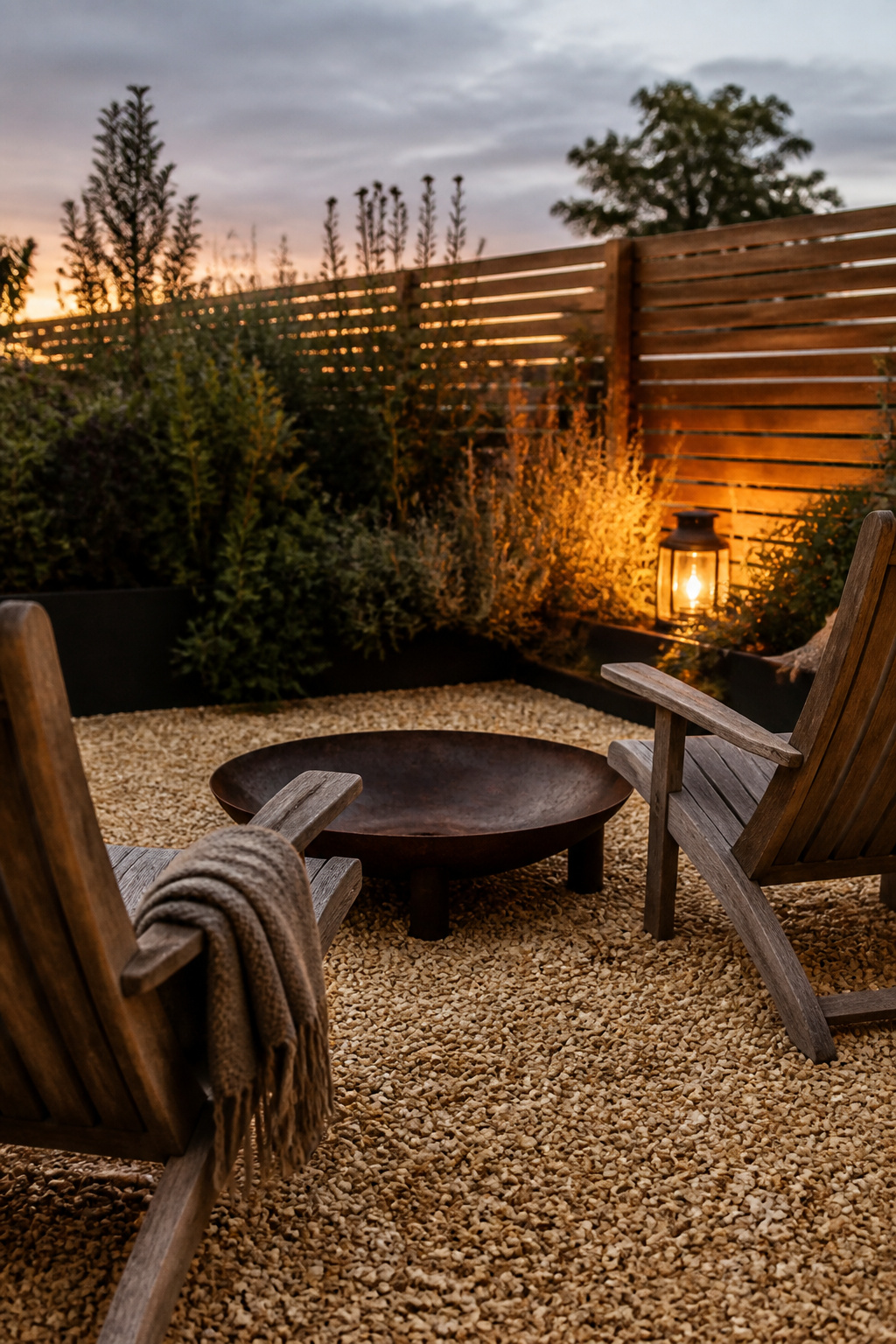
The gap between the photo and an empty patch of gravel
The wider work of designing a gravel patio — edging, drainage, the planting — belongs to the whole space. The fire corner has two decisions of its own: size the seating for who actually shows up, and get the safety clearances right the first time. Miss either and it gets built, then goes unused — the fix lives in the plan, not the furniture.
Layout and Seating Clearances Around the Pit
Fuel type settles the layout before taste gets a say, so decide it before you place a single chair.
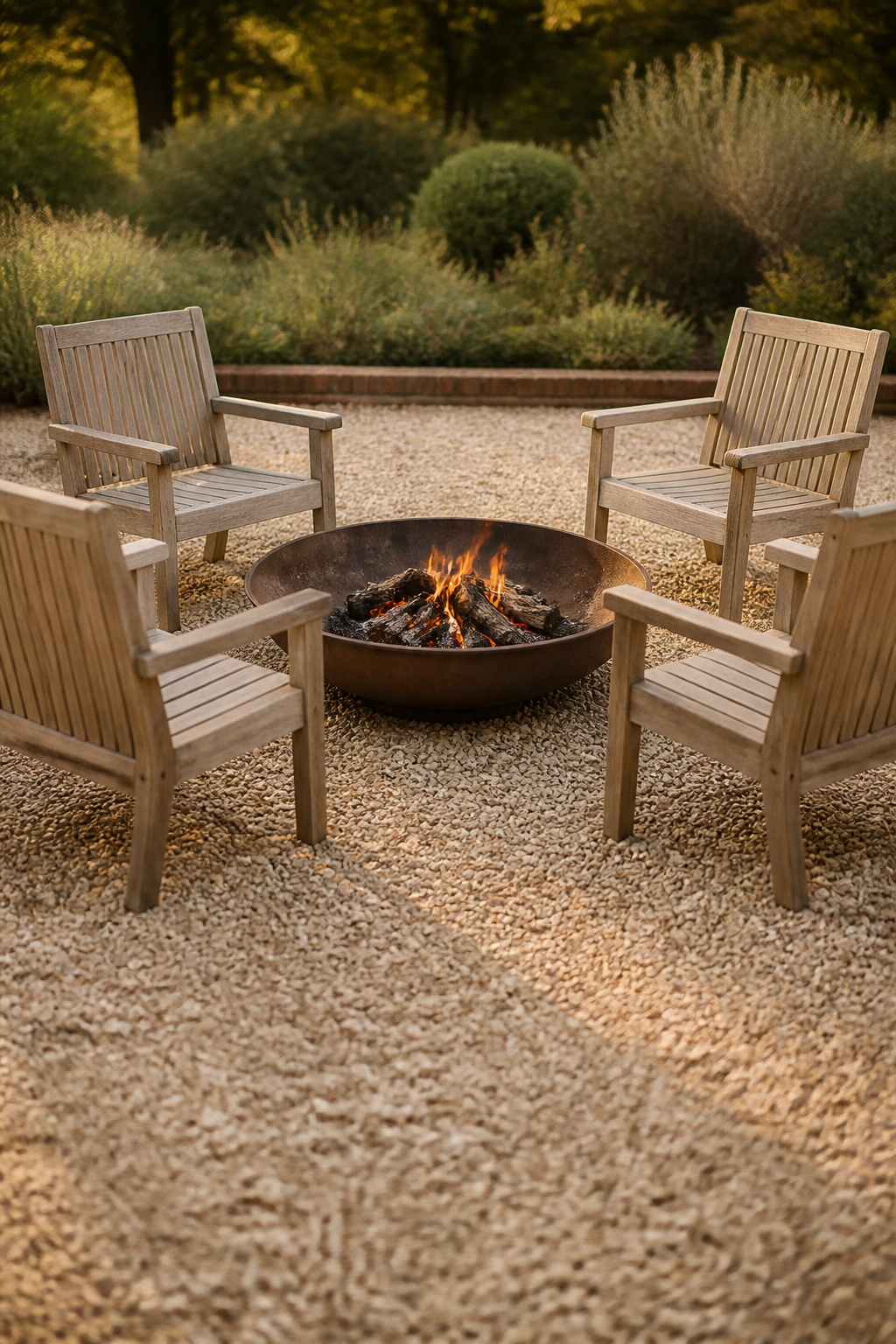
How far seating sits from the flame
Wood and gas ask for different distances. Wood-burning pits need at least 3 feet of clearance between the pit’s edge and any seat; gas, with no sparks or embers, allows seating as close as 2 feet — sometimes 15 to 24 inches. On a gusty evening, push every seat back to at least 7 feet regardless of fuel, since wind throws embers further than you expect. Wood pits also sit lower, around 12 to 14 inches against gas’s 16 to 25, keeping the flame under a seated sightline and sparks away from faces.
Sizing the circle for how many people you actually host
Match the pit to a normal evening, not the once-a-year crowd, and allow roughly 24 inches of seat frontage per person.
| Fire pit diameter | Seats comfortably | Seating-circle diameter |
|---|---|---|
| 36 in | 4–6 | ~14–15 ft (4 chairs) |
| 44–60 in | 6–8 | 16–18 ft (6) to 20–22 ft (8) |
An oversized circle for a typical group of four reads empty and kills the closeness a fire corner is built for.
Keeping a clear path in and out
Leave a deliberate gap in the circle as a walkway so nobody climbs over chair legs. Run paths 36 to 48 inches wide, with 24 inches clear behind each chair, and 6 feet of open room between the pit and the patio’s outer edge for the seats, gaps and side tables.
Safety Distances and the Non-Combustible Pad
Two distance questions get muddled constantly, so pull them apart before you build.
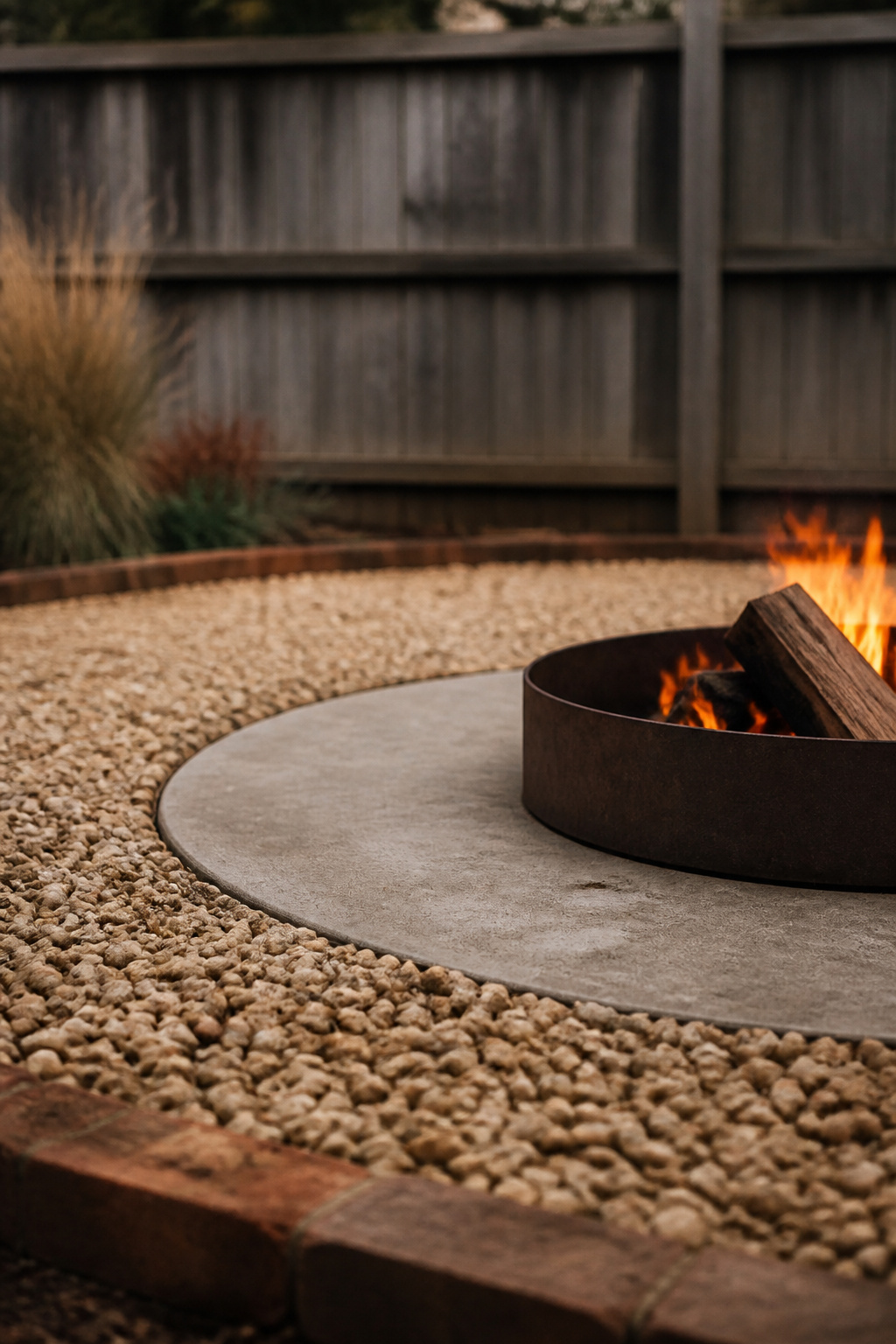
Minimum distances from structures and plantings
The first is how far the whole pit sits from anything that can burn. An open wood fire — a fuel area no bigger than 3 feet across and 2 feet high — needs 25 feet from any structure or combustible material under NFPA 1 and the 2021 International Fire Code. A gas unit certified to ANSI Z21.97 is a contained, tested appliance, so that drops to 36 inches.
| Clearance | Open wood fire | Certified gas unit |
|---|---|---|
| From house or combustible structure | 25 ft (NFPA 1 / 2021 IFC) | 36 in (ANSI Z21.97) |
| Overhead to combustibles | 10–15 ft (21 ft under tree branches) | 84 in / 7 ft (≤200,000 BTU) |
Travelers Insurance sets a practical floor of at least 10 feet from the house — no fire pit under string lights, power lines or a covered patio, which my own yard obeys too. Keep plants back 8 to 10 feet, and treat the first 4 feet around the ring as gravel or paving only.
What the pad under the pit needs to be made of
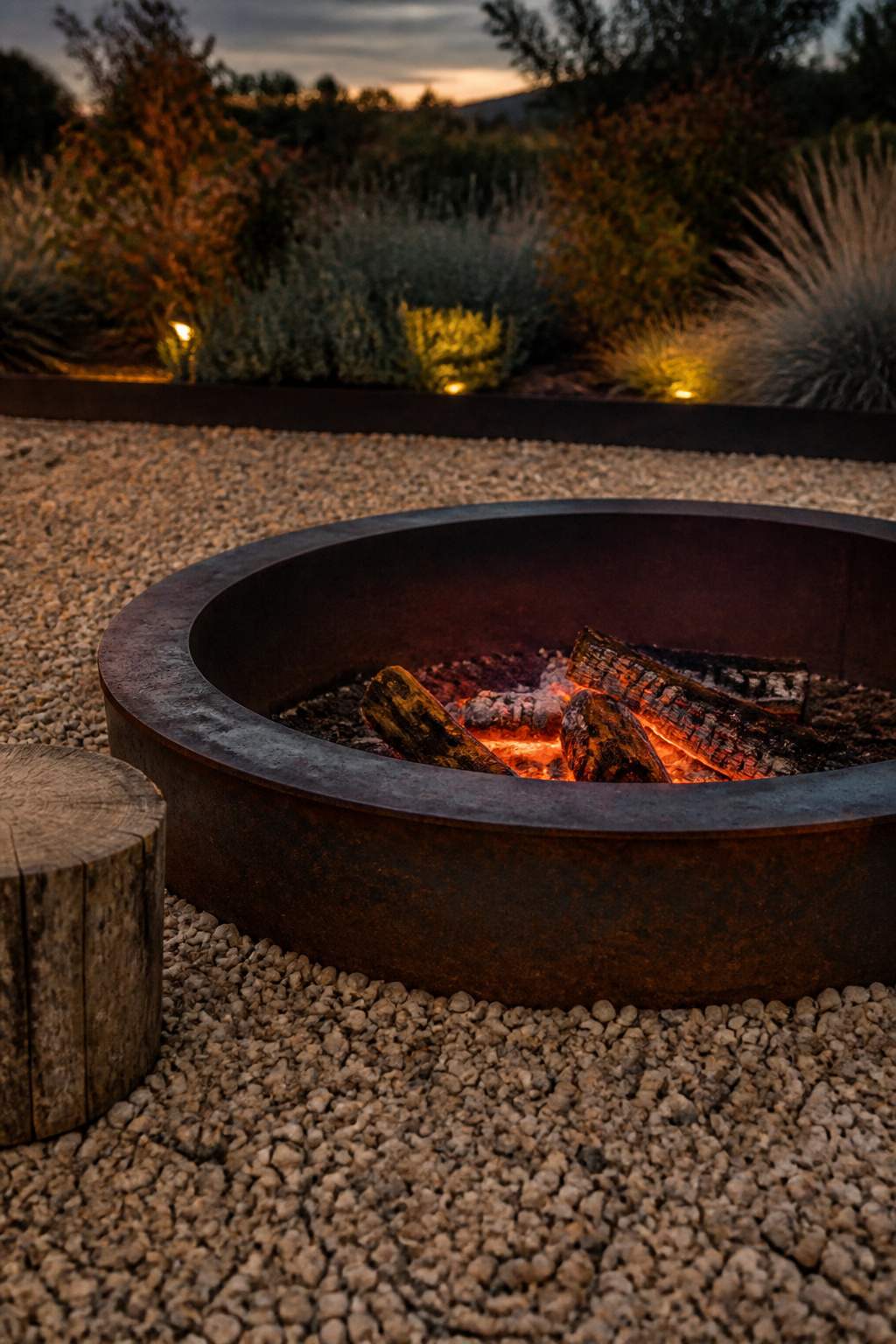
The second distance is really no distance at all: it’s what sits directly beneath the pit, and it has to be non-combustible, never bare grass:
- concrete
- steel
- masonry
- mineral wool insulation
These are often combined. A portable pit just needs an 18-to-24-inch concrete or flagstone pad set flush with the gravel, separate from the surrounding stone. A built ring wants more: 6 to 7 inches of compacted crushed stone plus a leveling inch of sand, and 8 to 10 inches in USDA Zone 5 and colder to clear frost depth.
Local rules worth checking before you build
Most places don’t require a permit for a portable wood pit, but permanent builds and gas installations usually do, and local clearance and burn-day rules apply either way — often stricter than the national baseline. Check the town or HOA rule before laying the pad, not after, to avoid relocating a finished corner.
The Right Gravel Around a Fire Pit
Does gravel explode near a fire? Here the sources genuinely disagree, but only on the mechanism — and it’s the practice they agree on that you actually build to.
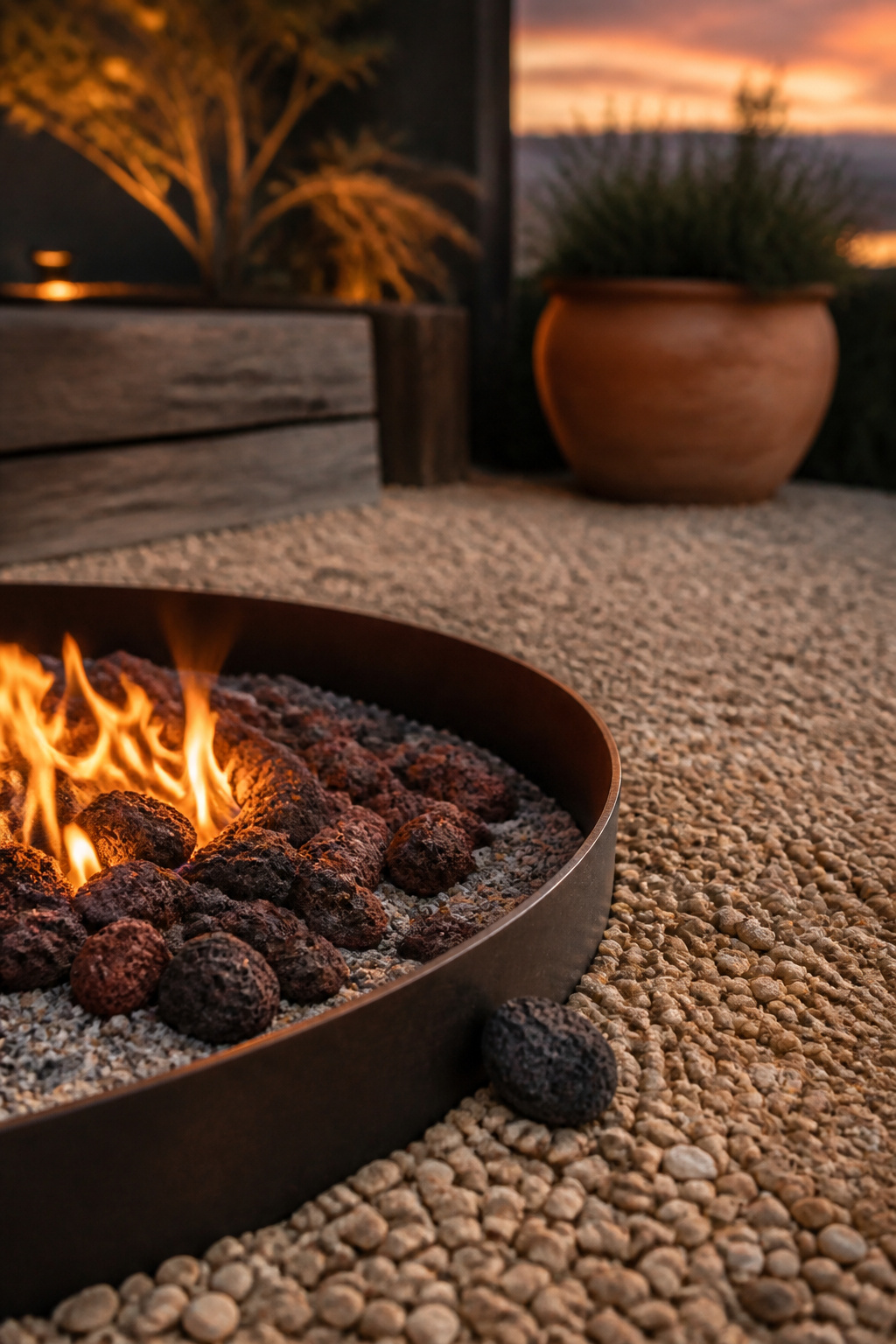
Why stone type and depth matter more near heat
Some guides call pea gravel dense and low-porosity, safe near heat; others call it porous and warn it off entirely — but none dispute what porous stone does under heat. River rock, sandstone and limestone soak up groundwater; heat one past roughly 300°C and the trapped water flashes to steam, expanding about 1,600 times its liquid volume and shattering the stone outward. The working rule holds either way: keep pea gravel out of the direct flame and ember zone, and never use it as fill inside the basin. Inside the fire itself, use fire-rated silica sand, fire glass or lava rock — its open structure lets steam vent rather than build pressure. For the surround, hold a clearance radius of about 3 feet of fire-resistant base around the pit, then let 2 to 3 inches of pea gravel over a 3-to-4-inch base carry out to the seats.
What happens to the wrong stone over a season of fires
Get this wrong and it isn’t cosmetic — it’s a projectile. A rock with moisture in it can crack and pop hot fragments in every direction, and even normally safe stone turns dangerous once it’s sat wet from rain or irrigation — let it dry before it goes near heat. Which stone to run across the rest of the patio is a separate call, and the right gravel around a fire pit covers it in full.
Fitting It Into a Small Yard
A fire pit and its safe zone should take up no more than about a third of the patio.
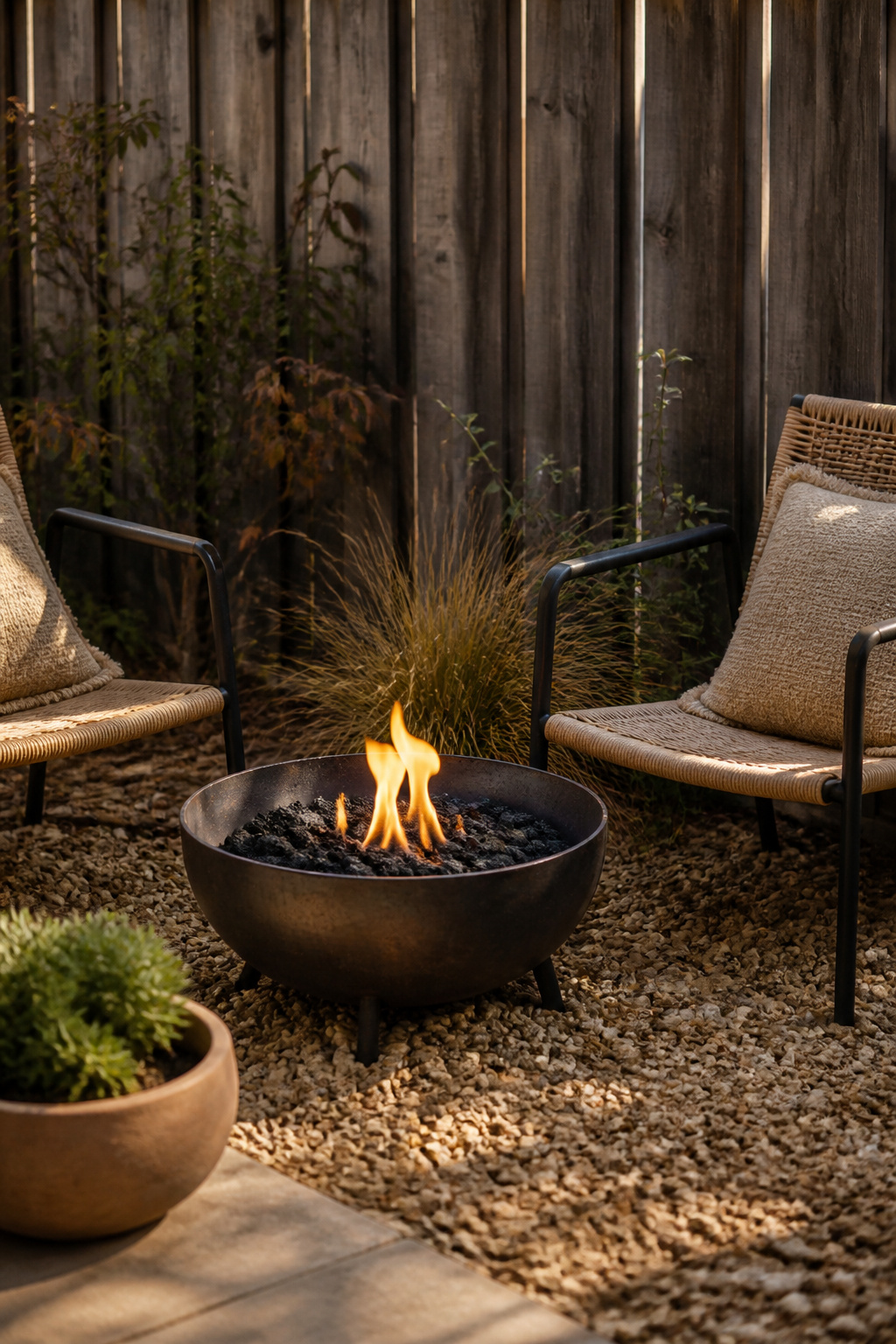
Scaling the circle down without losing comfort
On a 12-by-12-foot space — 144 square feet — that third caps the pit at roughly 36 to 44 inches. Shrink the pit, not the seating: pair a 36-inch pit with gas’s tighter 15-to-24-inch clearance instead of wood’s 3-foot minimum, and you reclaim floor space without cutting a seat.
Where a compact fire corner works best
Tuck it into a corner against two boundaries — a fence and a side wall, say — so the seating circle isn’t stranded in the middle of the lawn. The full small-space playbook — proportion, tricks that make a tight yard feel larger, and keeping furniture from sinking into loose gravel — is its own problem, and fitting it into a small yard takes it on properly.
Furniture and Materials That Handle Heat and Weather
Seating that won’t melt, warp or blow away
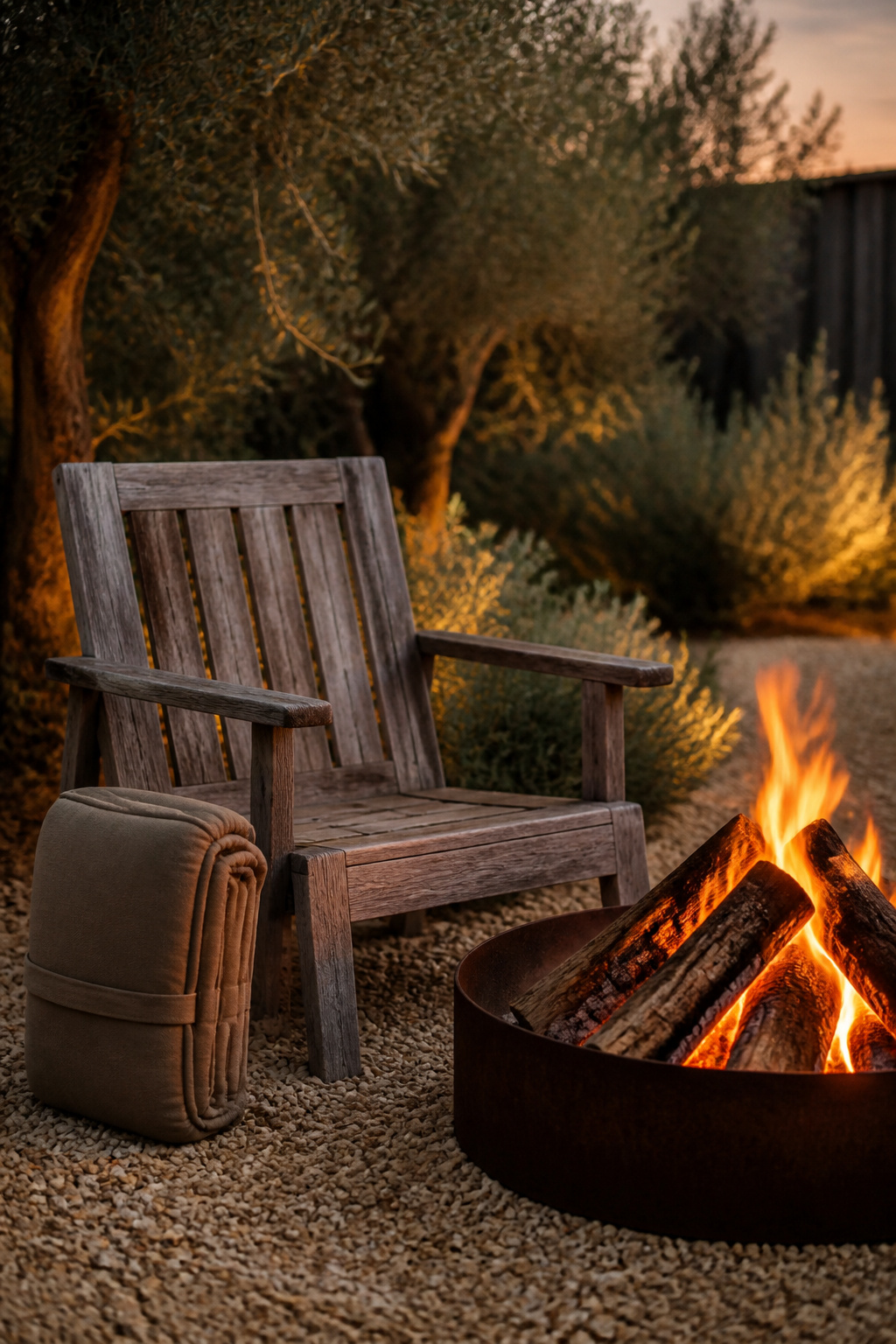
A plastic chair in the seating ring won’t survive a season of radiant heat — synthetics ignite easily, burning hard and giving off toxic smoke. Grade-A teak is the opposite: a high ignition point, self-extinguishing, and dimensionally stable, holding its shape where plastic warps. Metal won’t burn but conducts and radiates heat, getting genuinely hot up close — a comfort problem rather than a fire one. HDPE poly is a durable middle road, lasting 25-plus years on soap and water alone, though it still wants standard ember distance.
What a season of use does to fabric near a fire pit
Fabric shows the damage first. Standard outdoor cushions scorch from radiant heat and can catch outright from a stray ember, even with a fine frame underneath. Stand them upright or stash them when the fire is lit, rather than leaving them flat where embers land. On loose gravel, chairs without a wide foot also sink and rock over a season, right where the heat is worst.
Living With It Through the Seasons
What changes from first fire to first frost
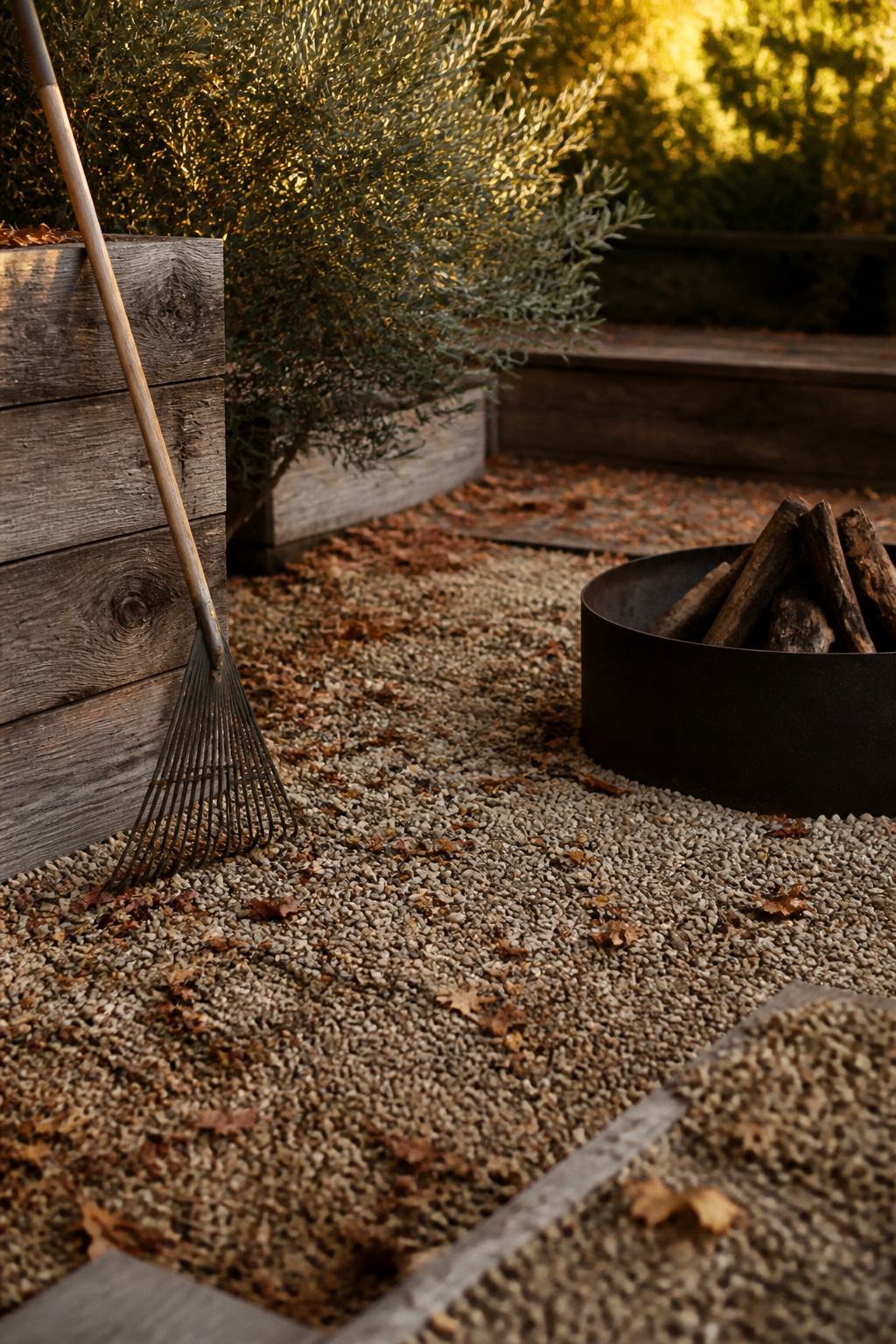
A gravel corner asks little across the year, but not nothing. Chairs get dragged and repositioned, so the surface goes uneven — an occasional rake levels it, and a top-up now and then holds the depth the safety spec calls for. Gravel’s real seasonal gift shows in the cold: it drains, so it doesn’t heave or pool through freeze-thaw the way a poured surface does, right where fire, frost and damp meet. Lay a weed barrier under the gravel at build time — retrofitting one under an established corner is miserable.
The maintenance truth that keeps it worth using
The honest part: the clearances and the pad are fixed once they’re in — you never revisit them. What’s left is raking, topping up, and a glance at the furniture each spring: the whole tab a well-planned corner asks for. A corner kept level and full stays inviting; one left to thin and scatter starts to feel neglected long before anything breaks — and that feeling is what stops people lighting the fire at all.
Which brings it back to that October evening. My own fire corner sits a few steps off the June kitchen — the grill, the salvaged prep table, the string of lights I hung under a pergola I threw up over three weekends — set deliberately out from under those lights, where code and common sense both want it. Keeping it going has never cost more than a rake and a bag of gravel each autumn. Settle the seating, the distances, the pad and the gravel, and you’ve got exactly what that evening promised: not a photo, but a corner you’ll actually use when the weather turns.
FAQ
How far should a fire pit be from a house when it sits on gravel?
An open wood fire should sit at least 25 feet from the house and any combustible, under NFPA 1 and the 2021 International Fire Code; a gas pit certified to ANSI Z21.97 needs only 36 inches. Travelers Insurance sets a 10-foot practical floor. The gravel underfoot doesn’t change these — they’re measured to the pit.
Does gravel crack or scorch from heat near a fire pit?
Pea gravel kept a few feet clear of direct flame and embers generally holds up, since it’s dense and low-porosity next to river rock or sandstone, which trap moisture that flashes to steam and can shatter the stone. The real risk is any rock placed inside the basin or against embers — keep it out and use fire-rated media there instead.
What gravel size is safest to use directly around a fire pit?
Pea gravel of about 3/8 inch, laid 2 to 3 inches deep over a 3-to-4-inch compacted base, is the standard for the surround. “Directly around” still means outside a roughly 3-foot clearance radius of fire-resistant base beside the pit — pea gravel is for the surround, never fill against the structure itself.