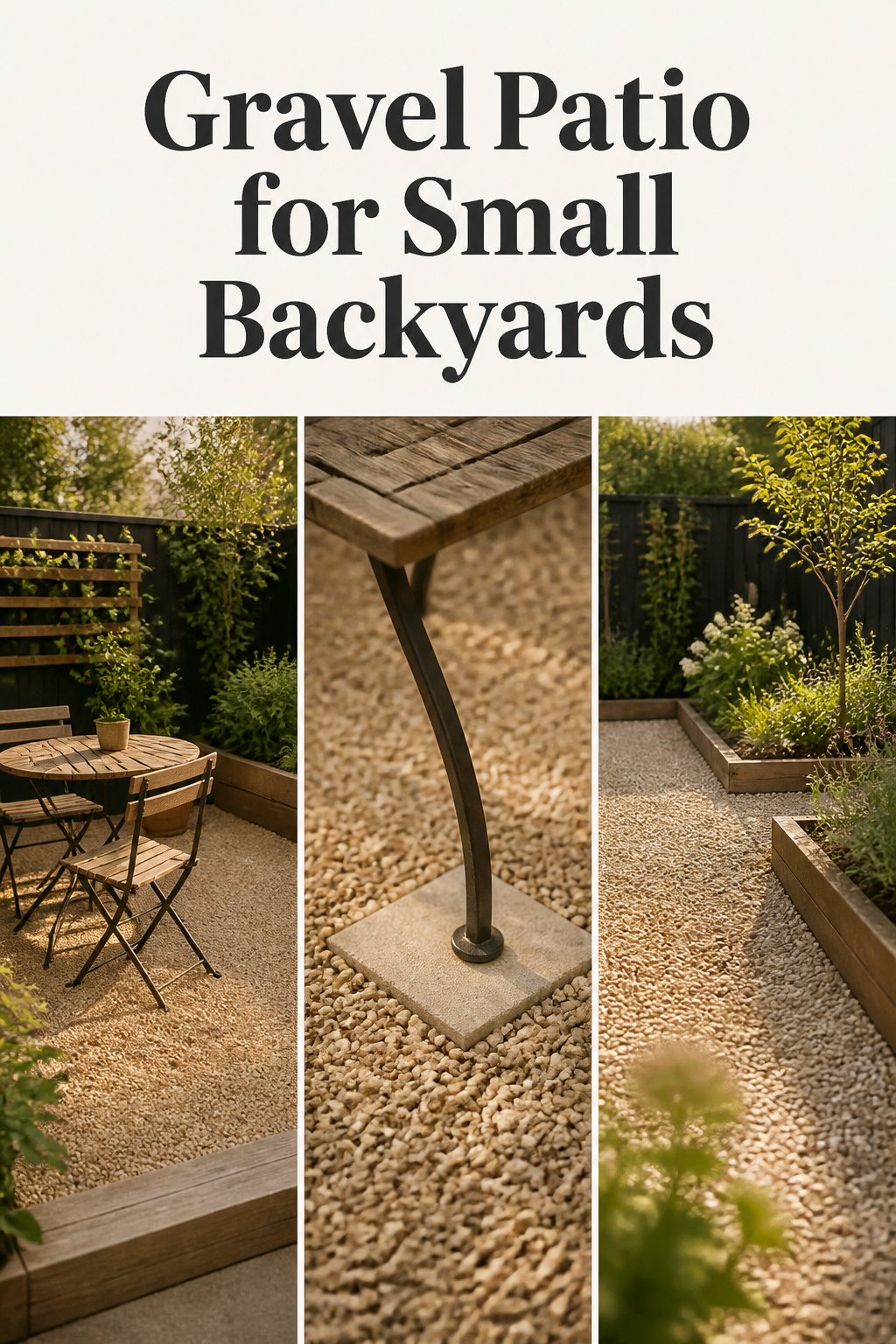
Picture the corner every small yard has: a strip of tired lawn behind the fence where the mower and the bins end up. You walk past it, never into it. A gravel patio for small backyards is the fix — not a shrunk copy of a big patio, but a seating spot built for the footprint you’ve got. The assumption holding most people back is that a small or awkward yard can’t hold a real outdoor room. It can. Here’s how to size it, stretch it, and get it used.
TL;DR
- A two-seat bistro setup works in as little as 48 to 80 square feet — about 6 by 8 feet on the tight end; below about 150 square feet, skip a fixed dining set for a bistro table and foldable chairs.
- To feel bigger, turn the layout 45 degrees off the fence, keep furniture to 40–55% of the floor, and limit the space to two functions — sightline and restraint beat square footage.
- To keep it working, set each leg on a roughly 12-by-12-inch paver pad instead of deeper gravel, and pitch the base about 1 inch per 8 feet toward a shallow edge trench so a confined corner drains.
The Cramped Yard, Before
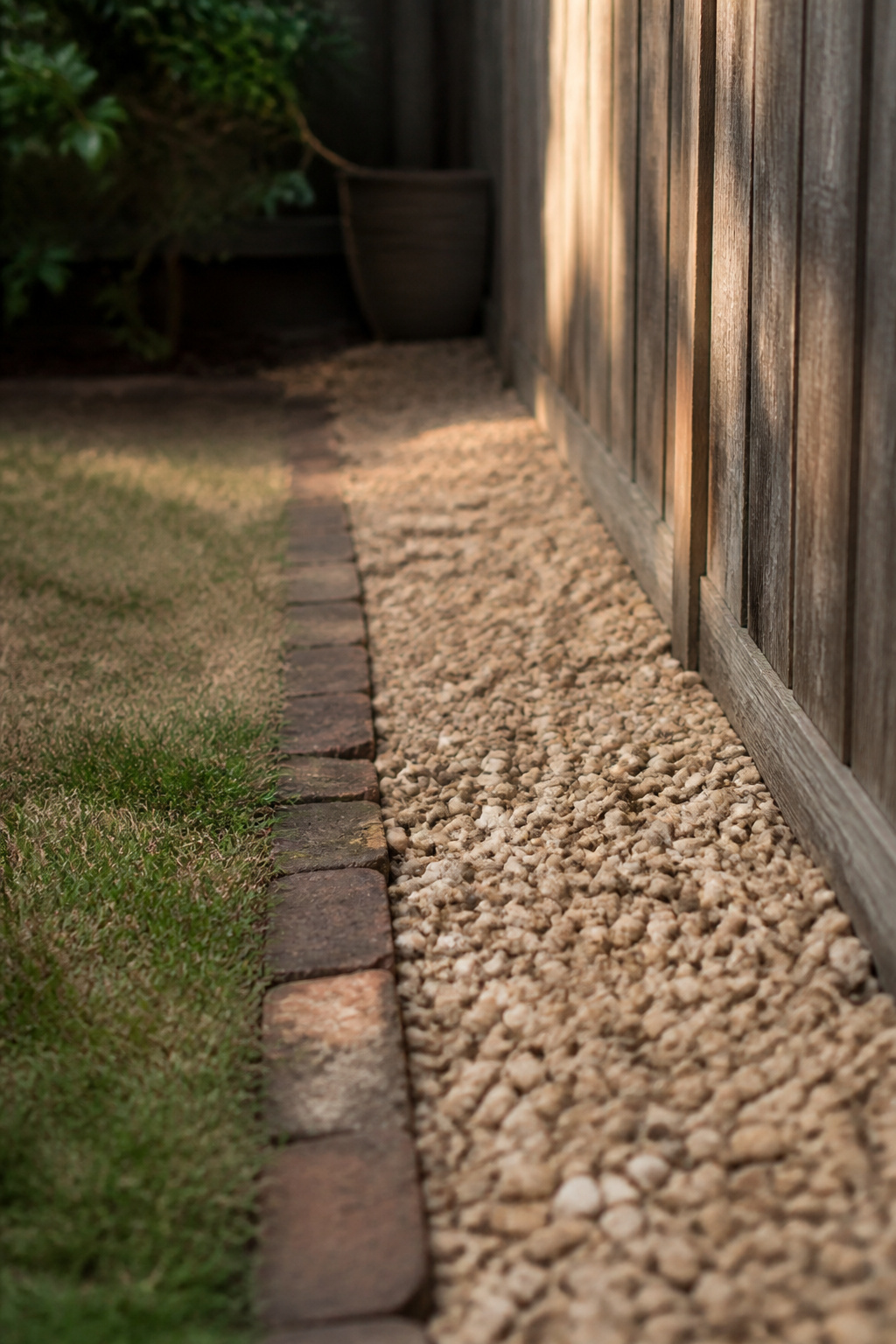
Small yards get written off before anyone measures them. The mental image of a “real” backyard is generous, but the average misleads: the national figure sits near 23,301 square feet, skewed by big-lot states, while the three tightest — Maryland at 7,599, California at 7,811 and New Jersey at 8,953 — describe the yard most of us actually live with.
Why small yards get written off as unusable
Subtract the house, the setbacks and the fixed obstacles — an AC condenser, downspouts, a hose bib — and what’s left feels like nothing. The reflex is to write it off, so it stays struggling lawn or storage for the bins. It gets skipped because nobody sized it honestly — not because it’s too small. See the full guide to gravel patios for the wider picture.
What actually changes when gravel replaces a patch of struggling lawn
Swap that lawn for gravel and two things change. It drains within minutes where turf would turn to mud, because gravel sheds water turf holds. And because it’s loose-laid, not poured, it shapes tight against the fence and the utility box, instead of the oversized rectangle a slab would demand.
Sizing a Gravel Patio for a Small Backyard
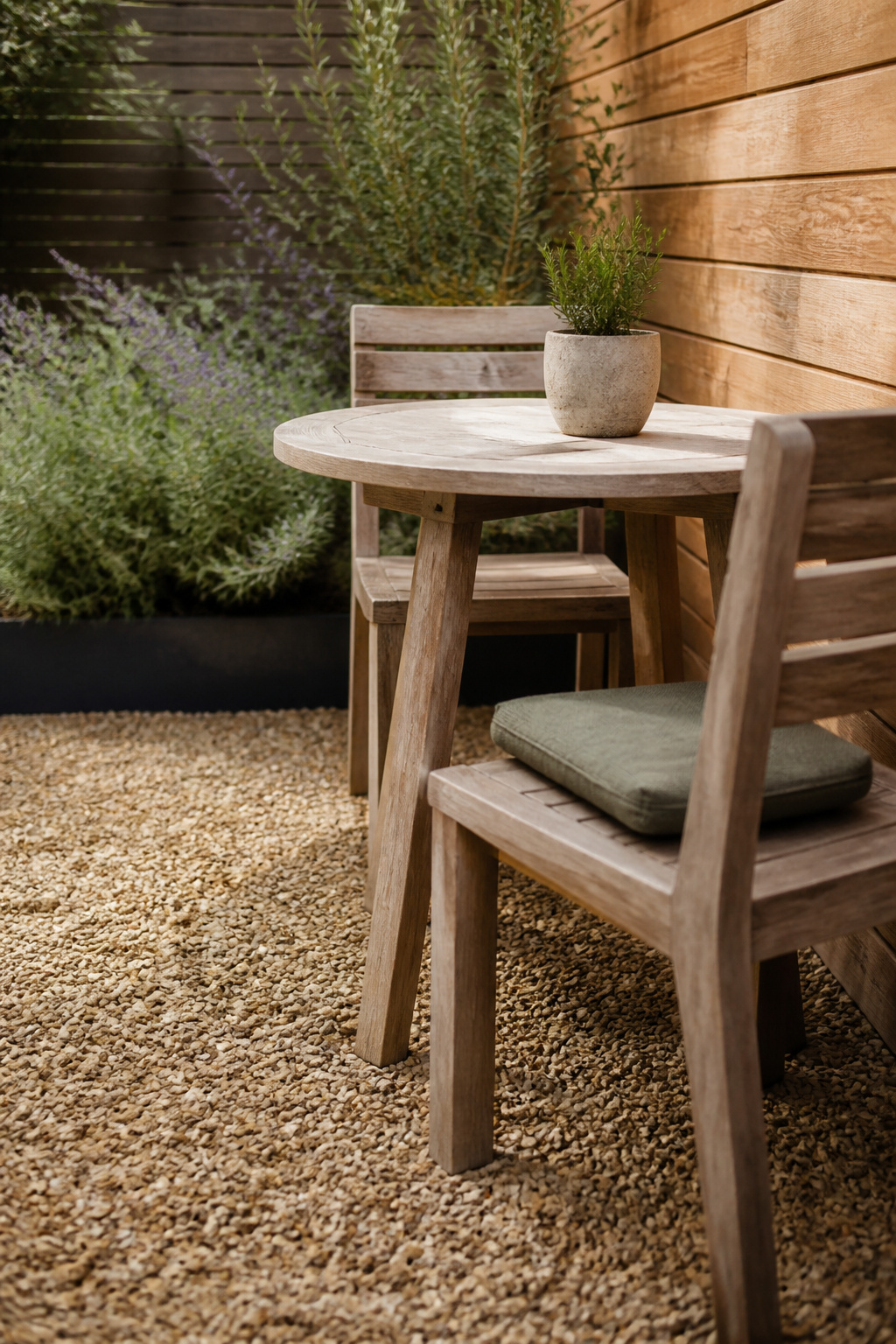
Start with the number that surprises people: a two-seat bistro set works in as little as 48 to 80 square feet — about 6 by 8 feet on the tight end. A café top is just 24 to 30 inches across; budget 3 by 3 feet of floor per chair instead, and size to that.
The minimum footprint for a real seating group
That chair math is why furniture, not the table, sets the footprint:
| Setup | Tight footprint | Comfortable footprint | Fits when |
|---|---|---|---|
| Two-seat bistro | 5×6 ft | 6×8 ft (≈48 sq ft) | no chair backs into a wall |
| 4-seat round dining | 8×8 ft | 9×9–10×10 ft | you’ve cleared 150+ sq ft |
| 4-seat rectangular dining | 8×10 ft | 9×10–10×11 ft | length runs along the long wall |
The tight column is a real option — it works as long as nothing crowds the chair swing.
Working around fences, beds and awkward angles
In a tight yard, measure the fixed boundaries first. Keep 36 inches of clear walkway from any door to furniture, and about 30 inches from the table edge to a fence, wall or bed so chairs pull out and people pass. Behind a seated guest, 18 to 24 inches is the floor, 36 where someone must walk past; a strip under 8 feet wide takes a single row only.
When to go smaller than you think you need
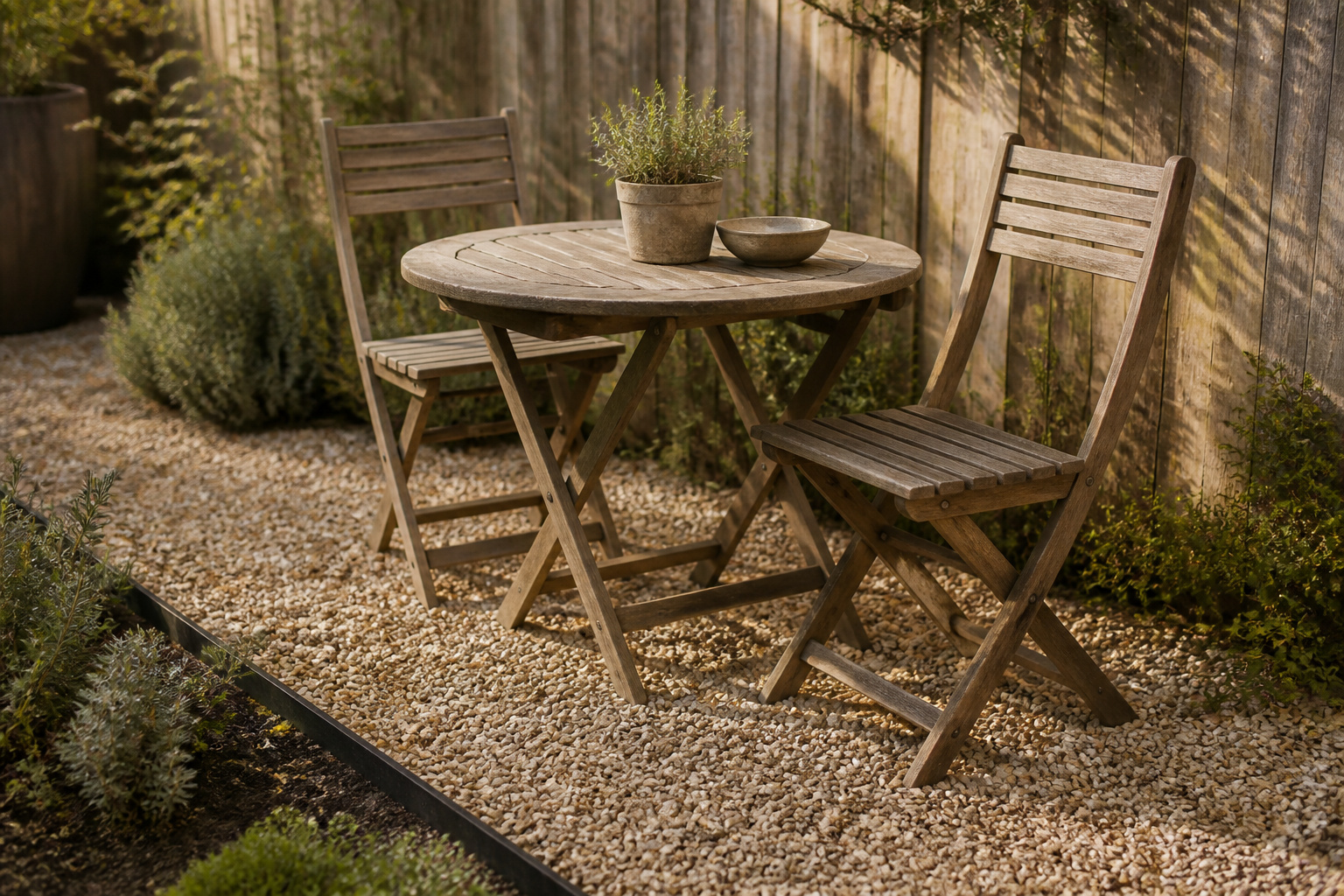
Going smaller isn’t a compromise; it’s often the right call. Below 150 square feet, drop the full dining set — stackable or foldable bistro chairs beat a fixed four-top that never has room to breathe. In an 8-by-8-foot corner, a round table and two light chairs turned off square dodges the boxed-in feeling. Keep furniture to 40 to 55 percent of the floor; past that, it feels crowded no matter what you choose.
Tricks That Make a Tight Space Feel Larger
Years back, clients of mine spent a fortune on a patio — heaters, a pergola roof, good furniture — and never used it. The seating faced the wrong way. We moved it fifteen feet to catch the evening sun, spent nothing, and they finally sat out there. Placement beats budget, and a small yard, with no fifteen feet to spare, needs that lesson most.
Sightlines and where the eye lands first
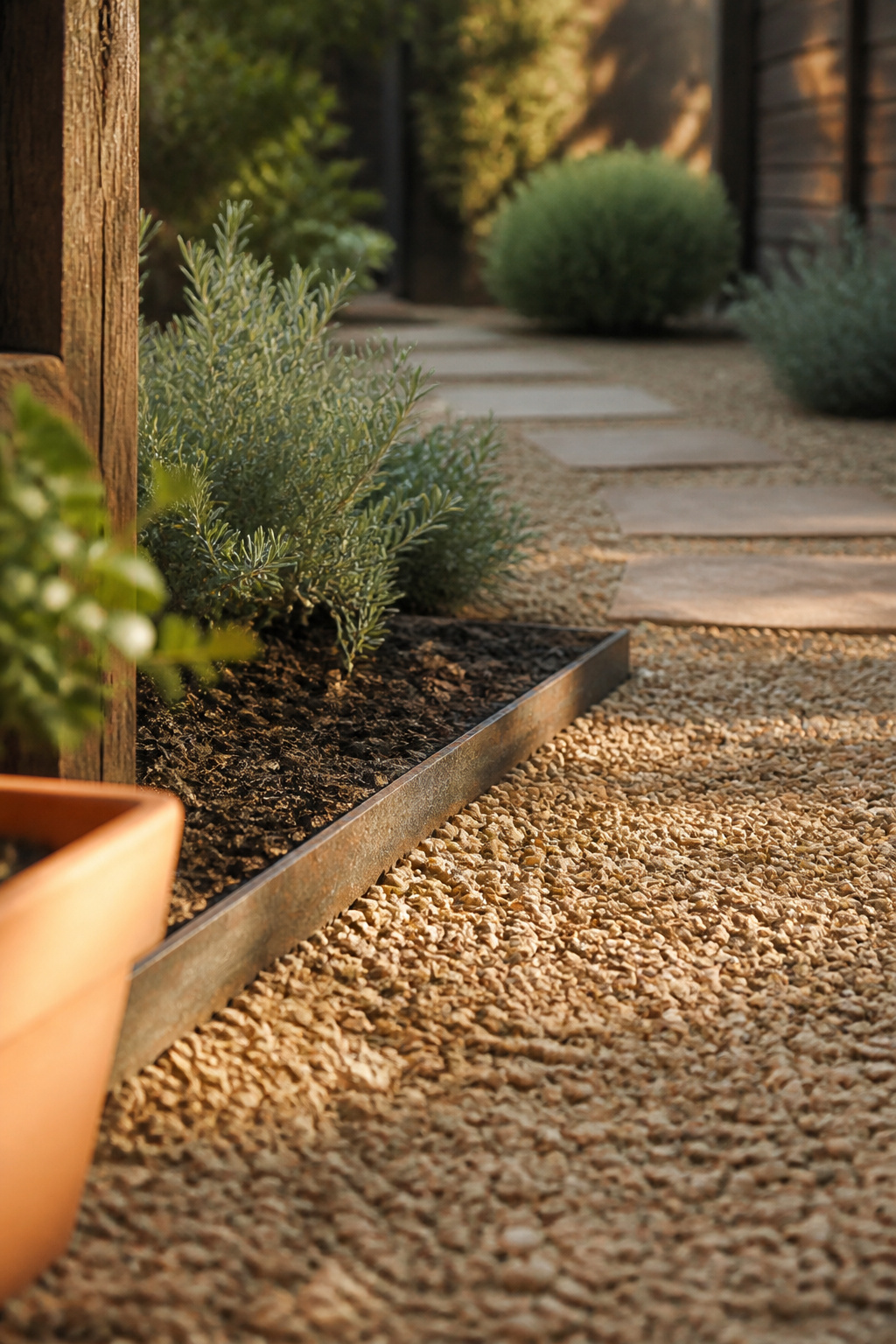
The eye reads depth from what it can travel toward. An L-shaped layout with an open center feels deeper than a solid rectangle of the same footage — it gives the gaze somewhere to go. A stepping-stone path to a back plant extends the perceived length, and a pale, reflective surface on the fence can double a tight corner’s depth. None of this adds a square foot.
Diagonal layouts versus square ones
The cheapest move: turn the layout 45 degrees off the fence line. Running the gravel, edging or furniture on the diagonal opens a longer sightline across the same footprint, and works best on square, boxy patios that feel like a pen. In an 8-by-8-foot space, rotating the seating a few degrees off the wall breaks that boxed-in look.
Using the edge line to visually stretch the space
Two edge tricks earn their keep. Zone the patio into two functions at most — a sitting spot and one lounge chair, say — rather than cramming dining, lounging and cooking into one shape. Work the boundary vertically too: a trellis, a taller plant or an uplit feature at night pulls the eye up and out. Even pulling seating 6 to 12 inches off the fence reads as a deliberate buffer, not a squeeze.
Keeping Furniture From Sinking in a Small Footprint
Why furniture sinking matters more when space is tight
Why does a sinking leg matter more in a small yard? Because nothing stays put: there’s no spare floor to leave chairs in place, so they move several times an evening, and a leg that digs a fresh rut each time becomes a daily irritation. The instinct fix — more gravel — backfires: overfill it and moving a chair feels like dragging its legs through sand.
Base pads under table and chair legs
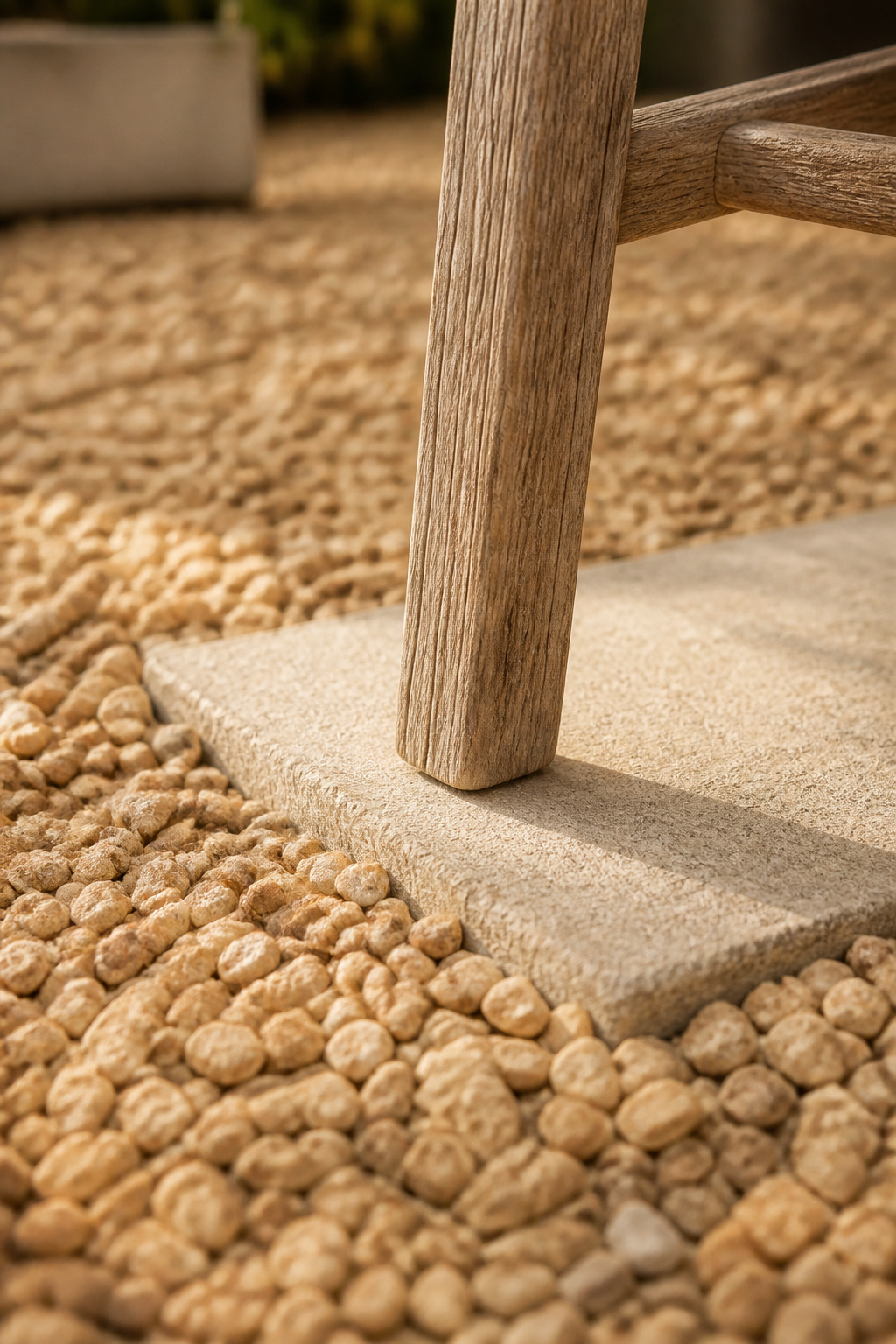
The answer is a firmer base, not a deeper one. Set a small paver under each leg and brush gravel up around it — a common off-the-shelf size is a 12-by-12-inch concrete step stone, about 1.5 inches thick, a practical guide rather than a spec handed down from on high. A honeycomb gravel grid under the finish layer holds the stone so legs don’t need extra depth, and finish gravel should stay shallow — about twice the stone’s own size, roughly 3/4 inch for 3/8-inch pea gravel.
Furniture styles that handle gravel best
Some furniture sits better on stone. What to look for, cheapest fix first:
- Wide, flat feet over thin spikes — they spread weight across more gravel and resist sinking.
- Rubber caps or screw-in plastic feet on legs you already own — a low-cost retrofit that widens the contact patch.
- Heavier teak or weathered oak over lightweight aluminium or resin — heft settles predictably instead of tipping a leg into a soft spot.
A thin-legged bistro set can still earn its spot with a pad or a wider foot under each leg.
Drainage in a Confined Area
A small yard pools water faster than a big one, for a simple reason: geometry. It has proportionally more hard edges — fences, walls, a foundation — and less open ground for runoff, so rain a large lawn would absorb instead collects against a boundary.
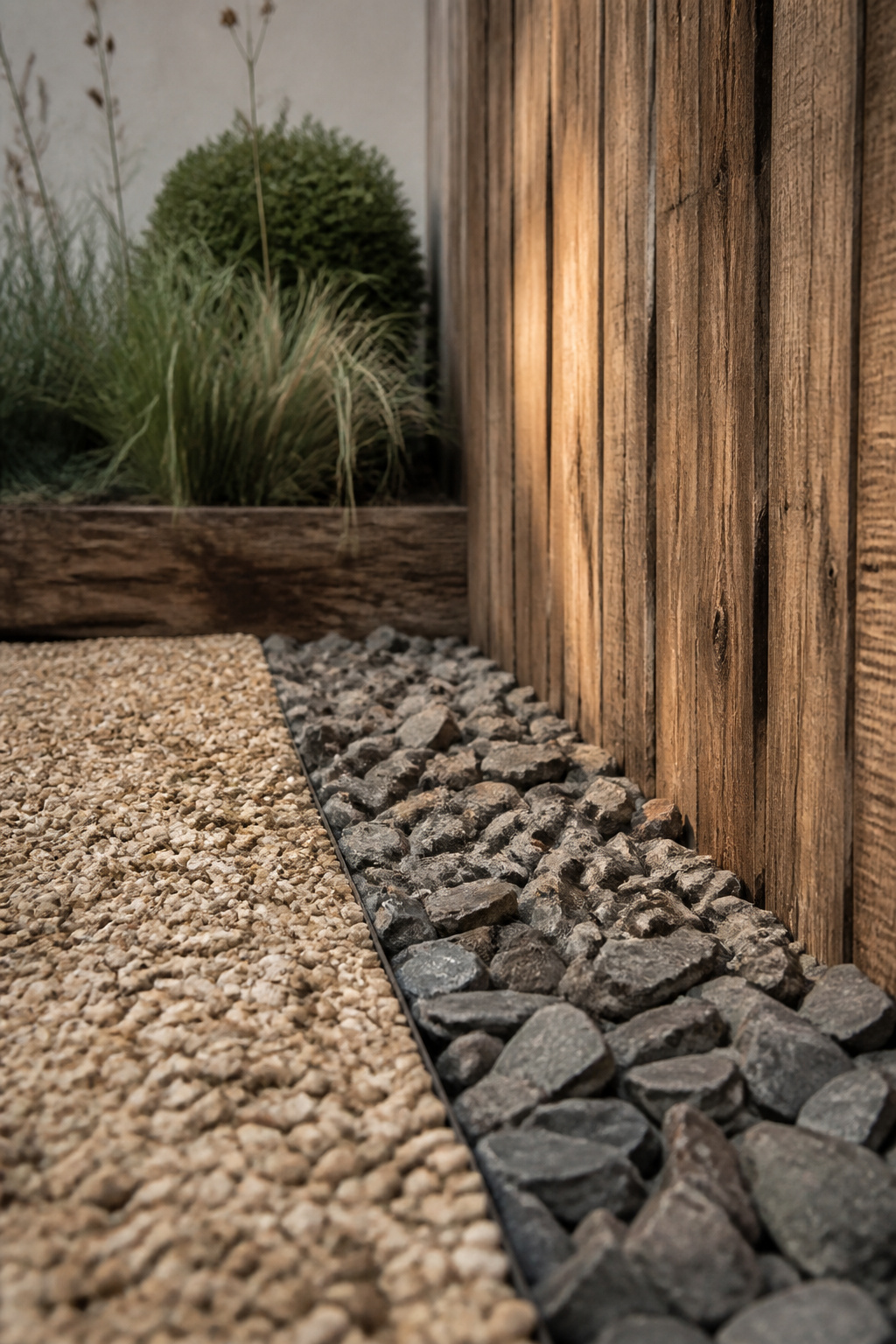
Why small yards pool water faster
Same rainfall, less ground — left flat, water finds the low point against the fence and sits. A 4-to-6-inch base under the gravel buys drainage capacity and a moisture buffer, but capacity alone won’t move water uphill.
Slope and outlet options when there’s nowhere for water to spread
Give it somewhere deliberate: a good working target — from landscaping practice, not a stamped code — is about 1 inch of drop per 8 feet of run, pitched toward a single outlet, usually a shallow perimeter trench about 6 inches deep along the edge where water gathers. A wetter site can take a French drain instead — a fabric-lined trench 6 to 12 inches wide and 18 to 24 inches deep over a perforated pipe, at the same slope. Fill either with angular crushed stone, not pea gravel, which migrates out of a narrow trench, and clear it each season — a blocked trench here has no backup route.
Add a Compact Fire Corner
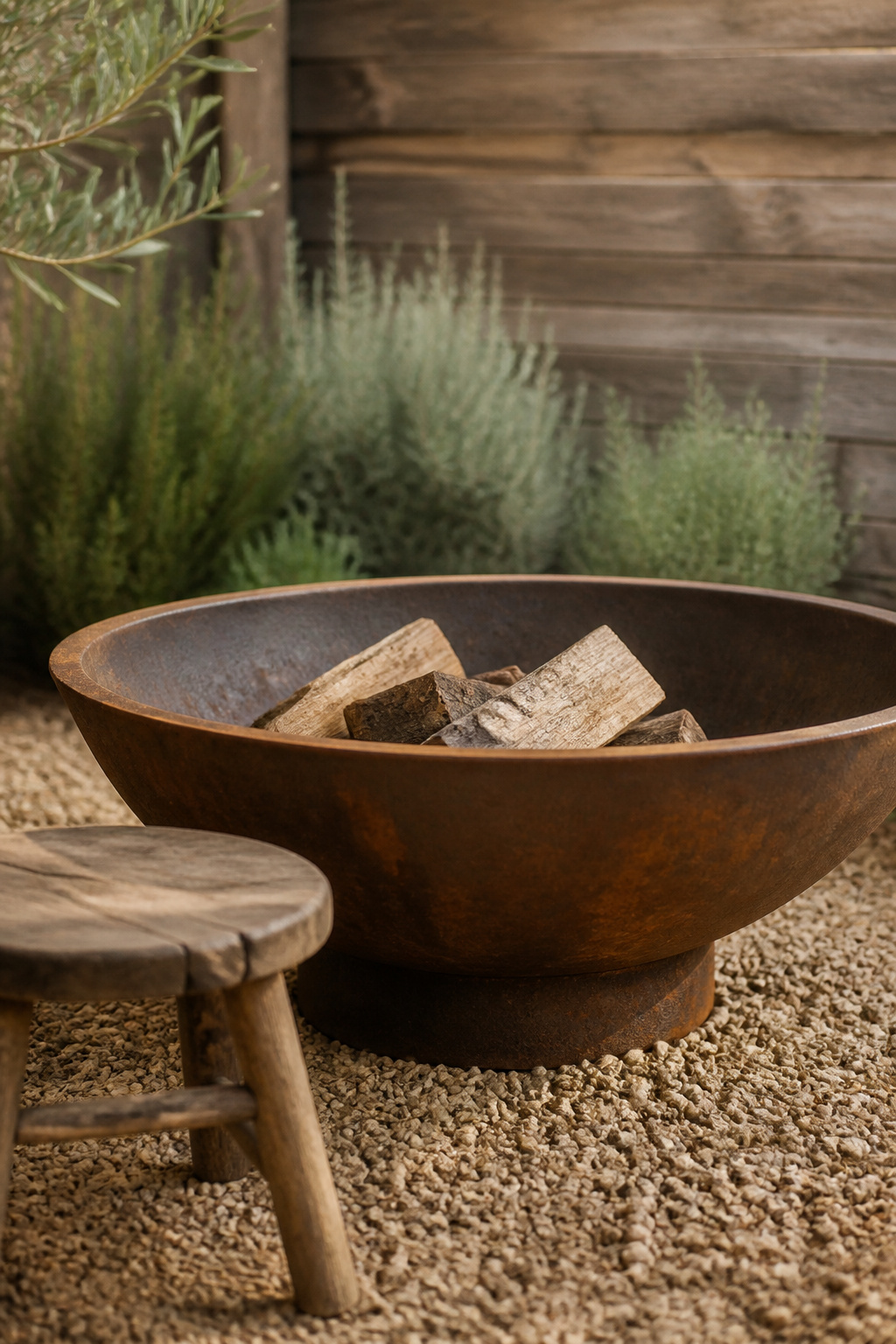
A fire pit and its safe zone want to stay within about a third of the patio’s area. It’s the feature people most want to add, and the instinct is to shrink the gathering circle to fit it. Do the opposite: hold the seating clearance the fire needs and scale down the pit itself — a smaller-diameter bowl — so the corner still gathers people. The clearances, gravel depth around heat and the non-combustible pad each have their own rules; see how to add a compact fire corner before you buy the bowl.
Greenery for Small Patios
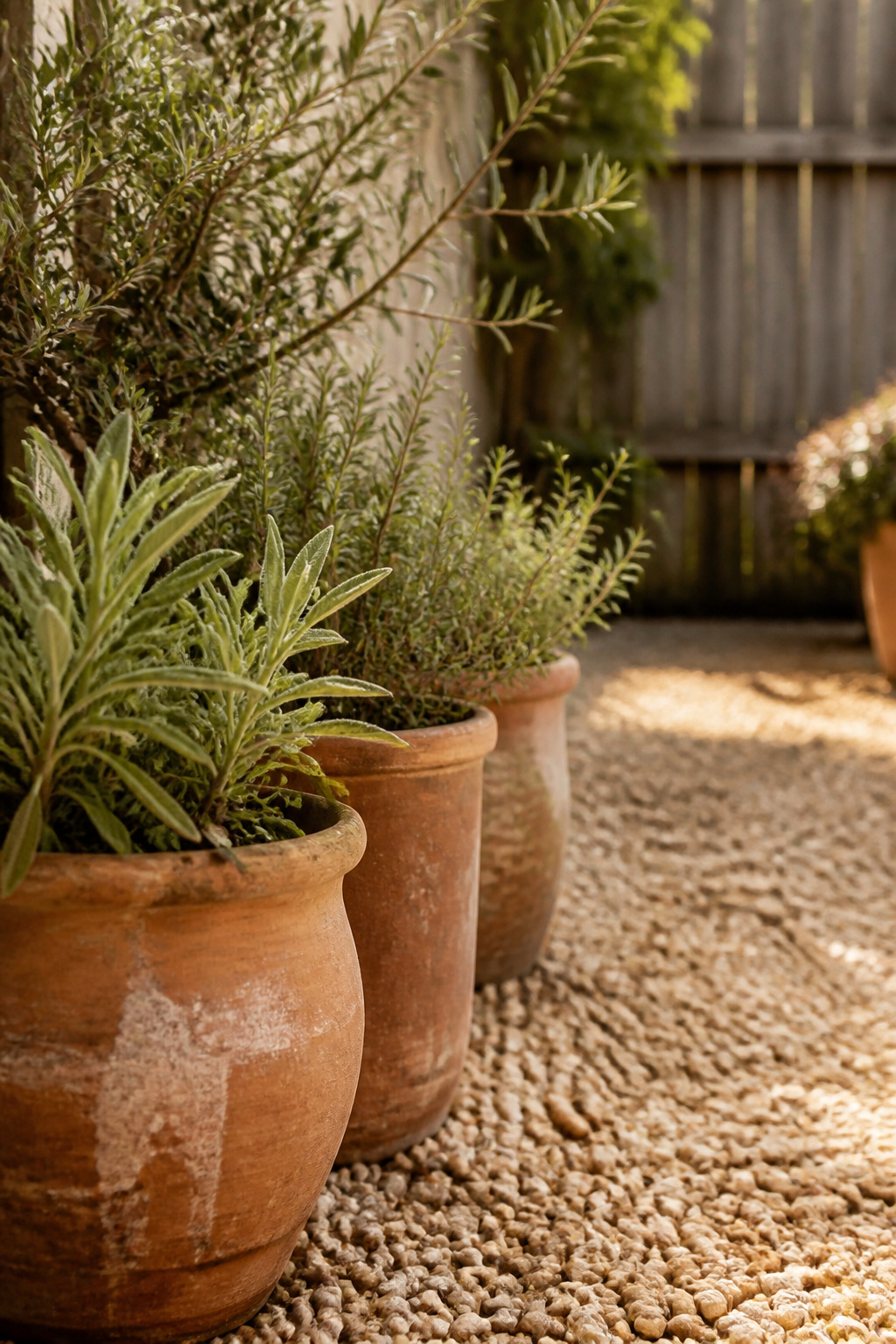
Planting does more work in a small patio than in a large one — it’s usually the only element with real height, carrying most of the load in making the corner feel designed, not merely paved. Gravel drains fast, which helps in a shaded corner, but it also means planting should lean drought-tolerant rather than thirsty. Species and placement are their own subject — start with greenery for small patios once the hardscape is set.
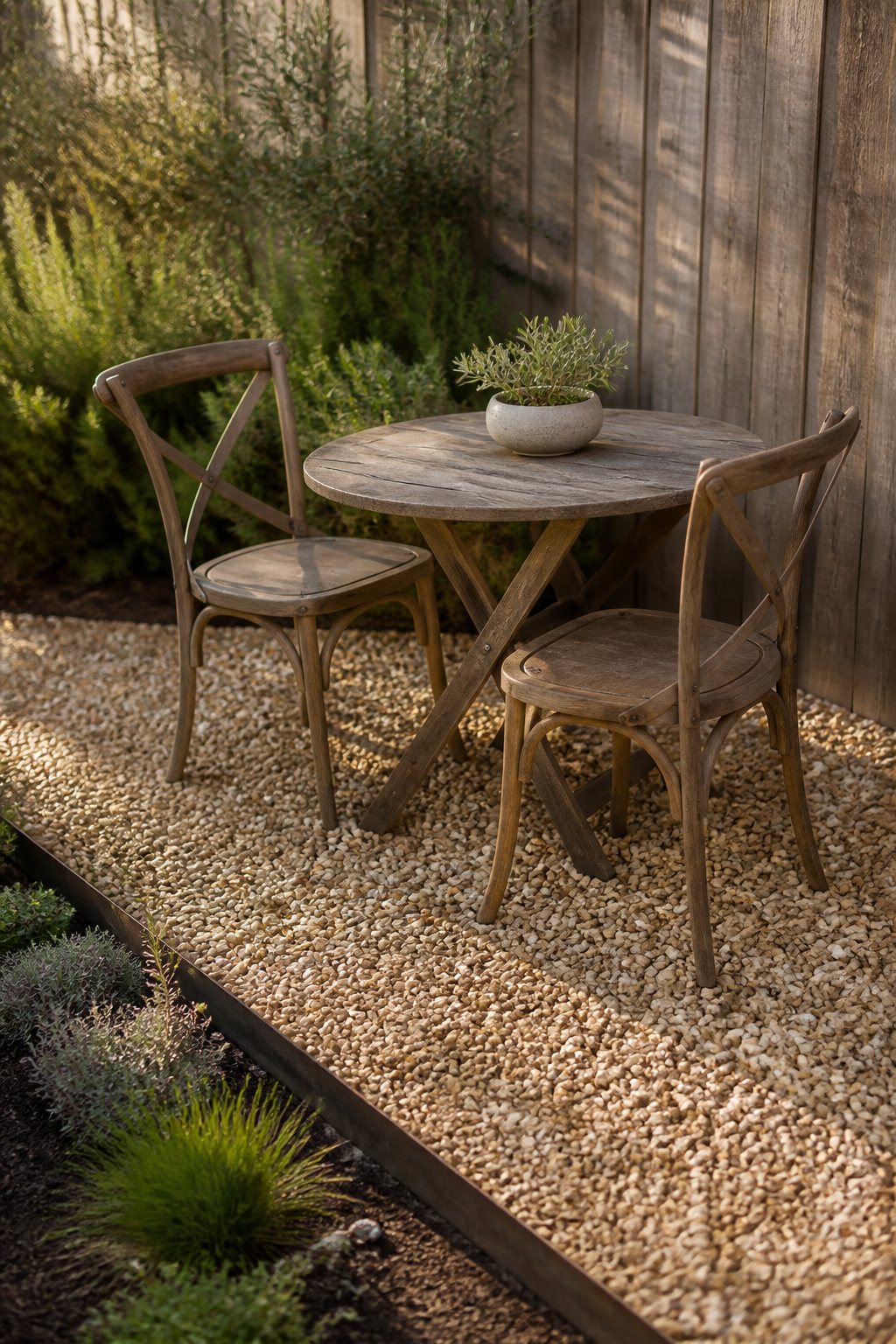
Go back to that corner. The fence hasn’t moved; the AC unit hasn’t either. What’s changed is you can now see the patio hiding in it: a 6-by-8-foot gravel floor, a bistro table turned off the square, each leg on a pad so nothing sinks, a shallow trench carrying the rain aside. That’s a real outdoor room, sized to the yard you actually have — not the one in the catalog photo. Mark out the footprint this weekend and sit in it at six; the light will tell you if you got the angle right.
FAQ
What’s the smallest size a gravel patio should be to still feel usable?
About 80 square feet comfortably handles a two-seat bistro set, the smallest usable configuration. Some guides put the practical minimum lower, near 6 by 8 feet (48 square feet), once chair clearance is counted. Below roughly 150 square feet, plan around a bistro table and foldable chairs, not a fixed dining set.
How do you keep a small gravel patio from looking cluttered?
Keep furniture to 40 to 55 percent of the floor area; past that, the space feels crowded whatever pieces you choose. Limit it to two functions at most — dining and lounging, say — instead of forcing three into one footprint. A diagonal layout and vertical elements like a trellis give the eye a focal point.
Is gravel a good choice for a small, shady backyard?
Yes, mainly for drainage: gravel sheds water where a shaded lawn patch would stay damp and muddy. Stone choice matters, though — flint-based gravel resists algae, while limestone or marble is more prone to green discoloration in shade. The trade-off is upkeep, not suitability: expect occasional raking and a top-up, since gravel shifts underfoot over time.