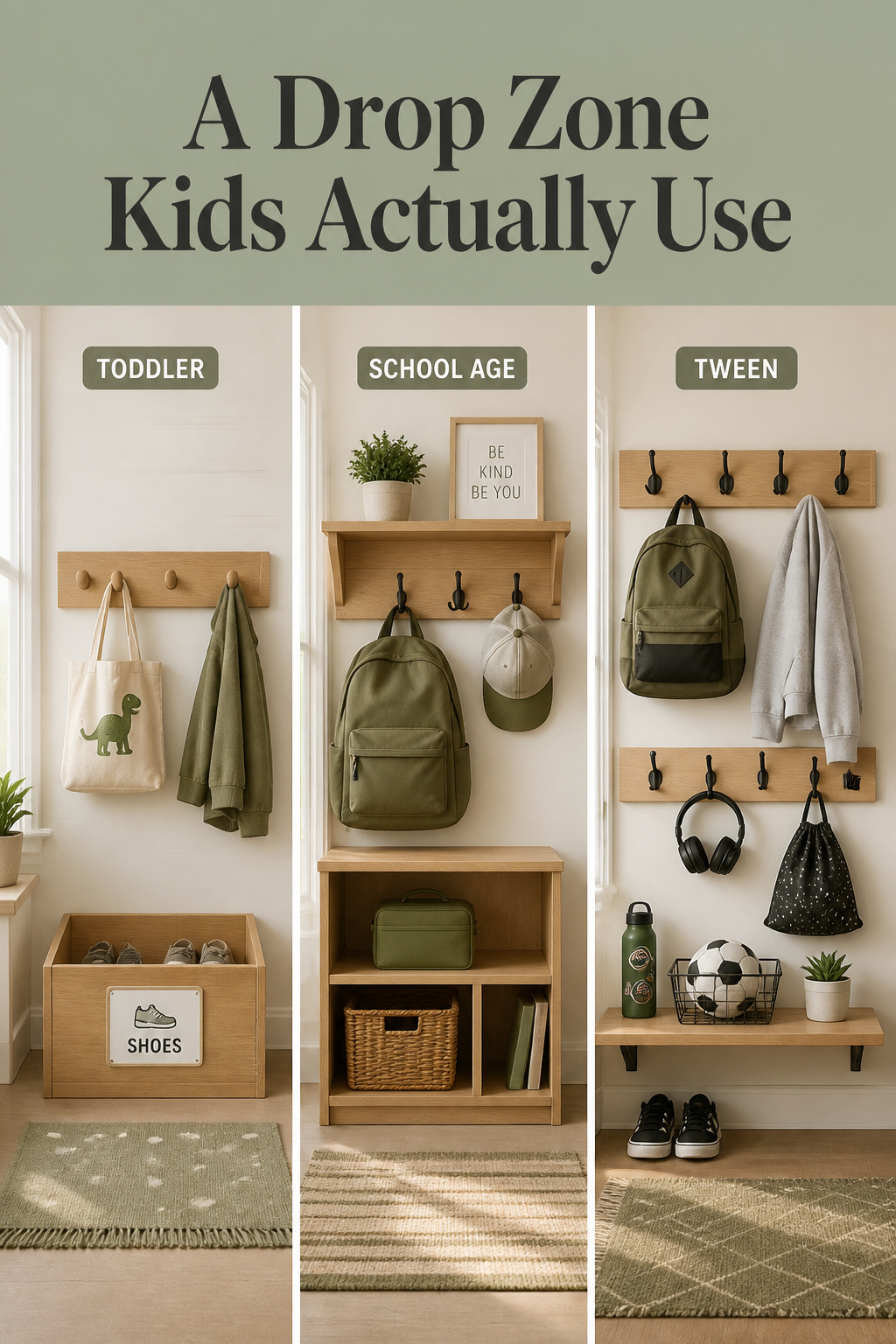
You hung the cutest hooks. You labeled the cubbies. And your kid still drops the backpack on the floor, inches from where it belongs. Before you decide your child is just messy, try this: crouch at the door until your eyes are about three and a half feet off the floor, and look at your drop zone from there. Most of it is above your child’s head. A kid-friendly drop zone that gets ignored is almost never a discipline problem — it’s a height problem, easy to fix once you stop measuring the wall from where you stand.
TL;DR
- Kids ignore a drop zone built at adult height and adult logic; the fix is designing it to the child’s actual reach and stage, not blaming the child.
- Match the setup to the age: a 36-inch hook row with open, picture-labeled bins for toddlers, a backpack-sized hook-and-cubby for school-age kids, and a raised row (48-54 inches) for tweens.
- Plan wall space for a second and third hook row from the start, so you raise the system in stages as the child grows instead of tearing it out and rebuilding.
The Reading Corner Lesson That Applies Here Too
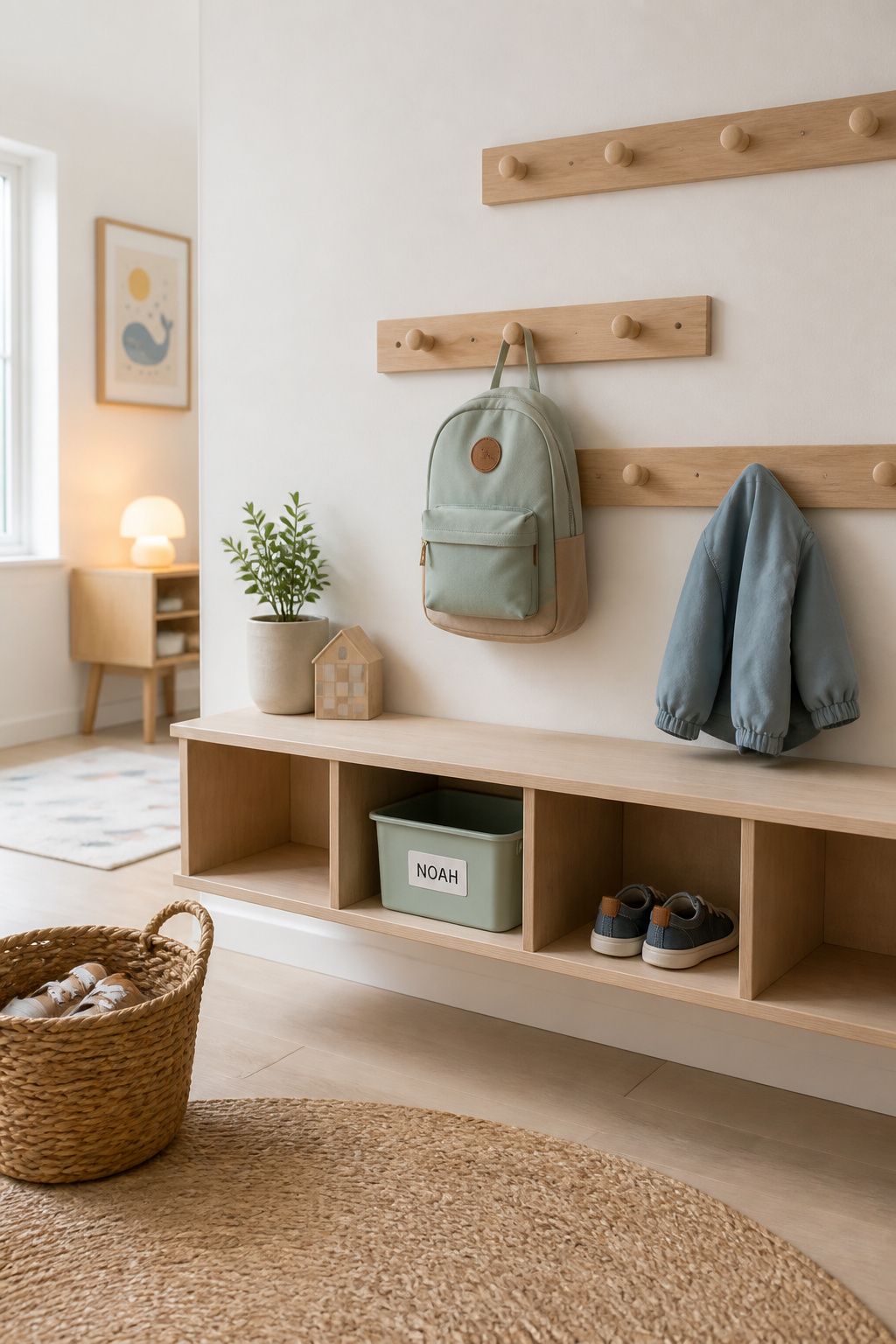
I spent my early career teaching kindergarten in Albuquerque, and I inherited a classroom with a behavior problem: meltdowns at cleanup, wandering at transitions, nobody settling. I tried every chart and reward system before I noticed the real culprit — the storage. It was all built for me: shelves at my height, bins I could reach and the children couldn’t. So I moved everything down, and within a couple of weeks the meltdowns faded. The kids weren’t misbehaving; they just couldn’t reach the space I’d called theirs.
That lesson is the whole article — here’s how it applies at your door.
Why kid-height, open storage is what actually gets used
Montessori design holds that shelving must sit at a height a child can reach unassisted, with a completely open front so every item is visible without help. Materials at a child’s height build ownership, which drives kids to select and return things themselves. Recommended shelf heights scale with age: 12 to 16 inches under two, maxing out around 24 inches for older toddlers. An entryway is just a classroom cubby wall with worse habits — and designers talk about removing their “adult goggles” to see the room from where a child actually stands, since a space designed from that vantage invites use.
The kneel test: what your entry looks like from a child’s eye level
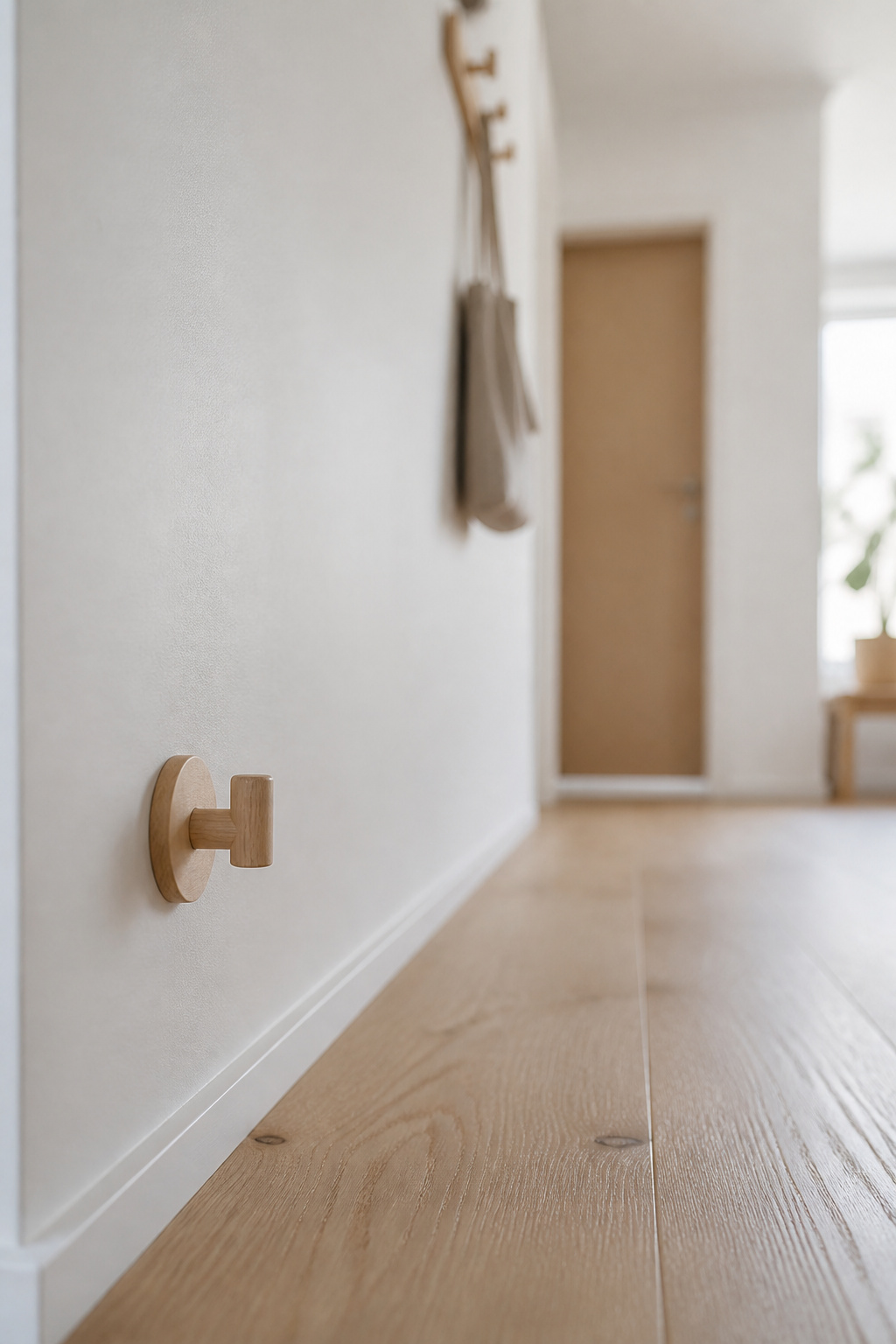
Here’s the ritual I use, and it costs nothing: before mounting a single hook, kneel at your entry until your eyes sit at roughly three and a half feet — a young child’s eye line. Architect Le Corbusier put an adult’s eye line near five and a half feet, a two-foot gap that pushes most adult-installed hooks out of a child’s view. Kneel first, and you’ll catch the defaults before they’re on the wall.
Getting Hook and Shelf Height Right for Little Kids
For the toddler and preschool years, three things matter: reachable hooks, open bins, and pre-reader labels.
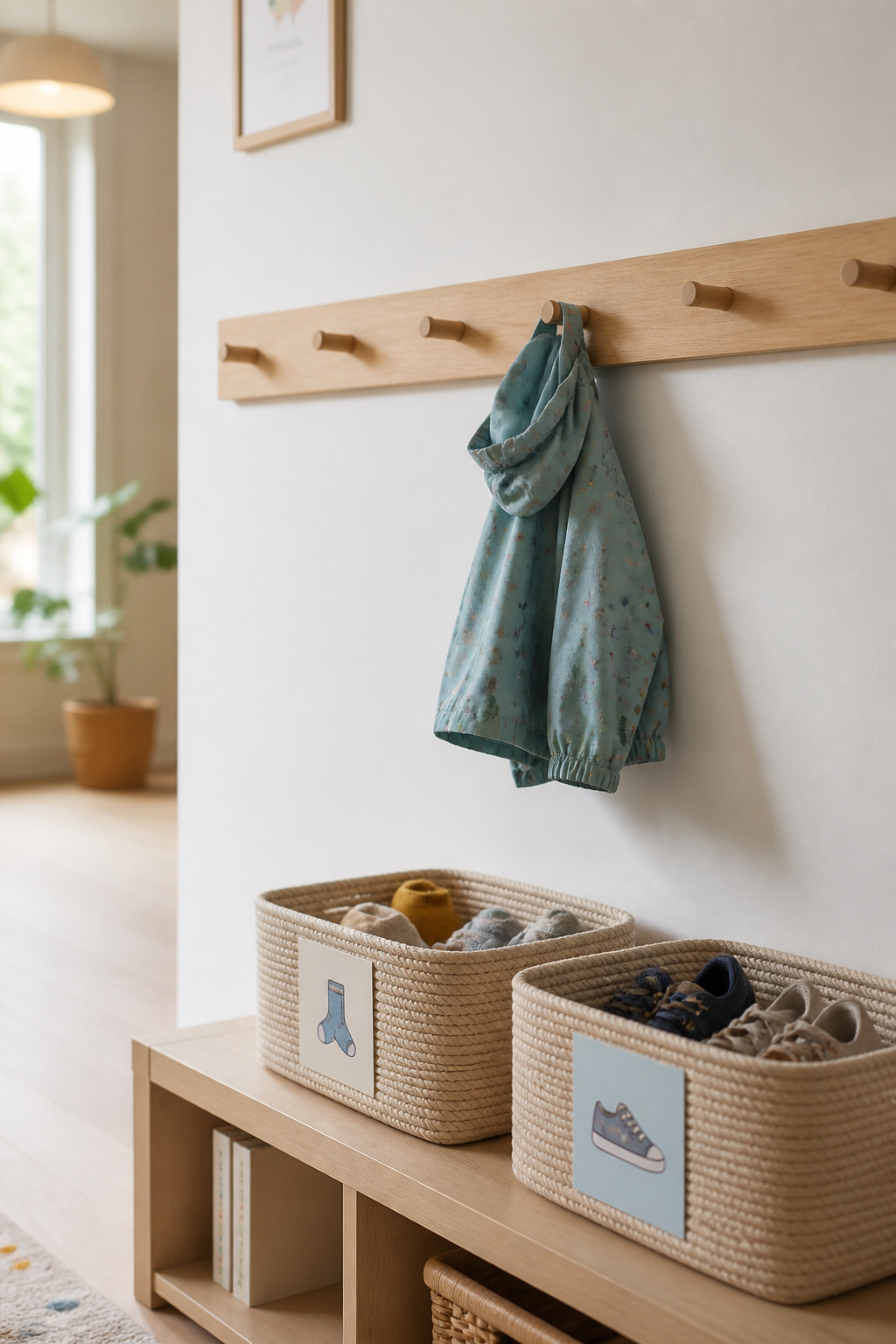
Reachable hook height for ages 2-5
Small children reach lower than most hooks are hung. Per ADA anthropometric data, a child aged 2 to 4 has an average high reach of just 33 inches; by ages 5 to 8 it’s 41 inches. The standard child-accessible hook height runs 36 to 42 inches, so for a toddler household mount that first row at 36, not 42.
Low cubbies and open bins over anything with a lid
Skip the lids. An open-top bin lets a child see what’s inside without dumping everything out, which makes putting away faster; if a child has to pry off a lid or work a latch, the item doesn’t get put away. Save lids for tiny loose pieces or long-term storage, never daily gear. Keep any bin’s shelf under about 24 inches, so contents sit in a stooping child’s line of sight.
Labeling with pictures before kids can read words
A child who can’t read can still read a picture — labels act like little maps for a child’s brain, showing where each thing belongs. For toddlers, a real photo of the actual item — a snapshot of their backpack, not a generic icon — works best, taped right to the bin. For the very youngest, glue a spare shoe insert or fabric swatch to the front so they recognize it by touch and sight.
Building a Backpack Station for School-Age Kids
Once a child starts school, a coat and shoes become a loaded backpack, a lunch box, folders, and a jacket — a bigger daily set than one coat hook can hold.
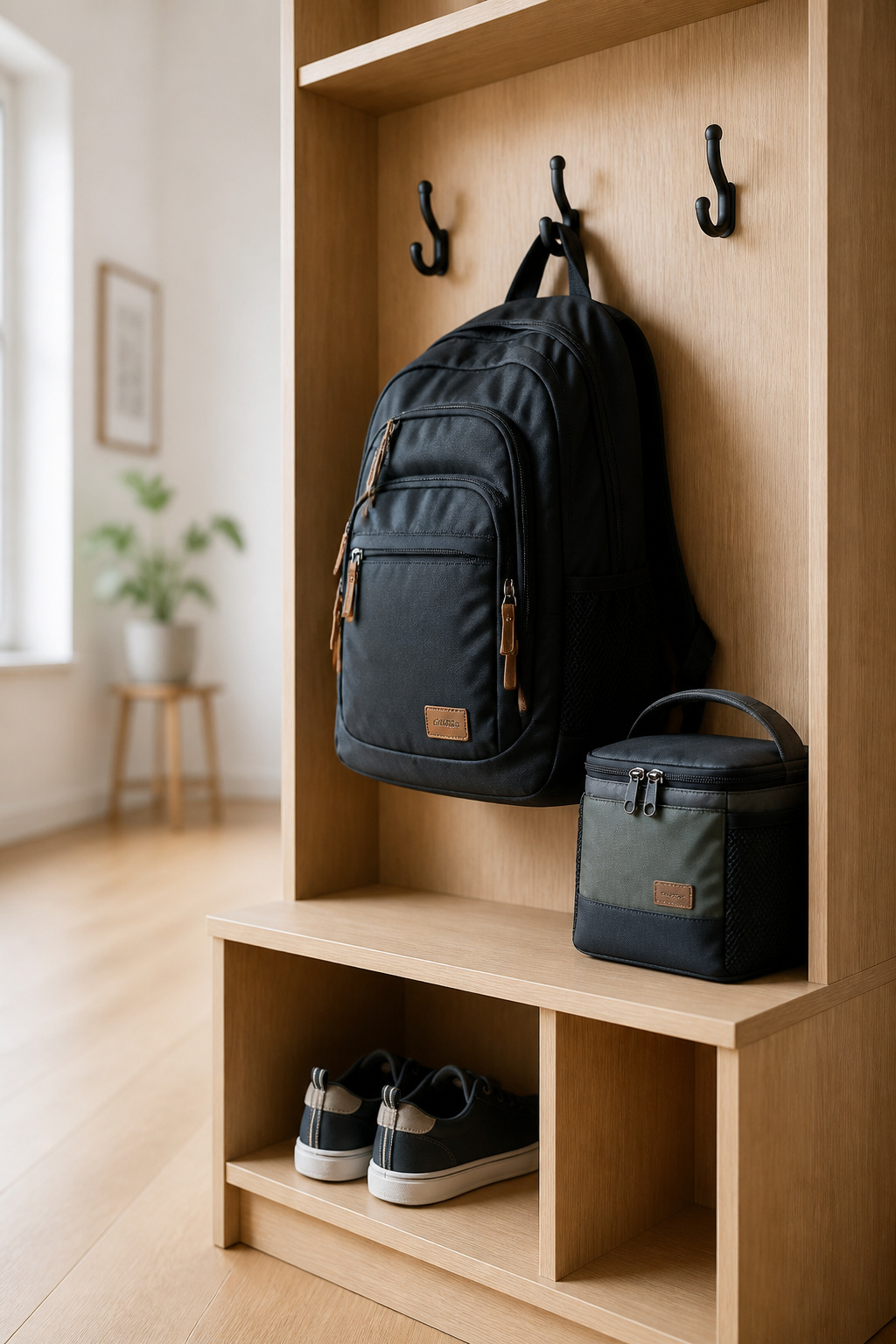
A hook-and-cubby combo sized to a backpack, not a coat
A backpack is not a coat, and it shouldn’t hang on coat hardware — a loaded bag needs a sturdy hook rated to hold 80 pounds or more. Children’s cubby-and-hook units typically run 48 to 51 inches tall, with compartments around 11 to 13 inches wide by 13 to 14 deep — figures from retail listings, so treat them as ranges, not a fixed standard. A common layout pairs a central hook with two lower compartments for shoes and a bin, plus a small separate shelf for the lunch box.
Testing it against a genuinely tired six-year-old, not a tidy photo
My rule: don’t test a system against a calm demo day — test it against a wrung-out six-year-old at 4 p.m. Put the hook or bin exactly where the bag naturally gets dropped, not somewhere tidier a few steps away. The whole nightly routine — backpack up, coat up, shoes in the bin — has to take less time than a quick phone check, or the bag hits the floor anyway.
Adapting the System as Kids Get Older
A drop zone sized for a five-year-old is wrong for a nine-year-old, because reach, gear, and independence shift together — which is why I tell parents to design for the stage after next.
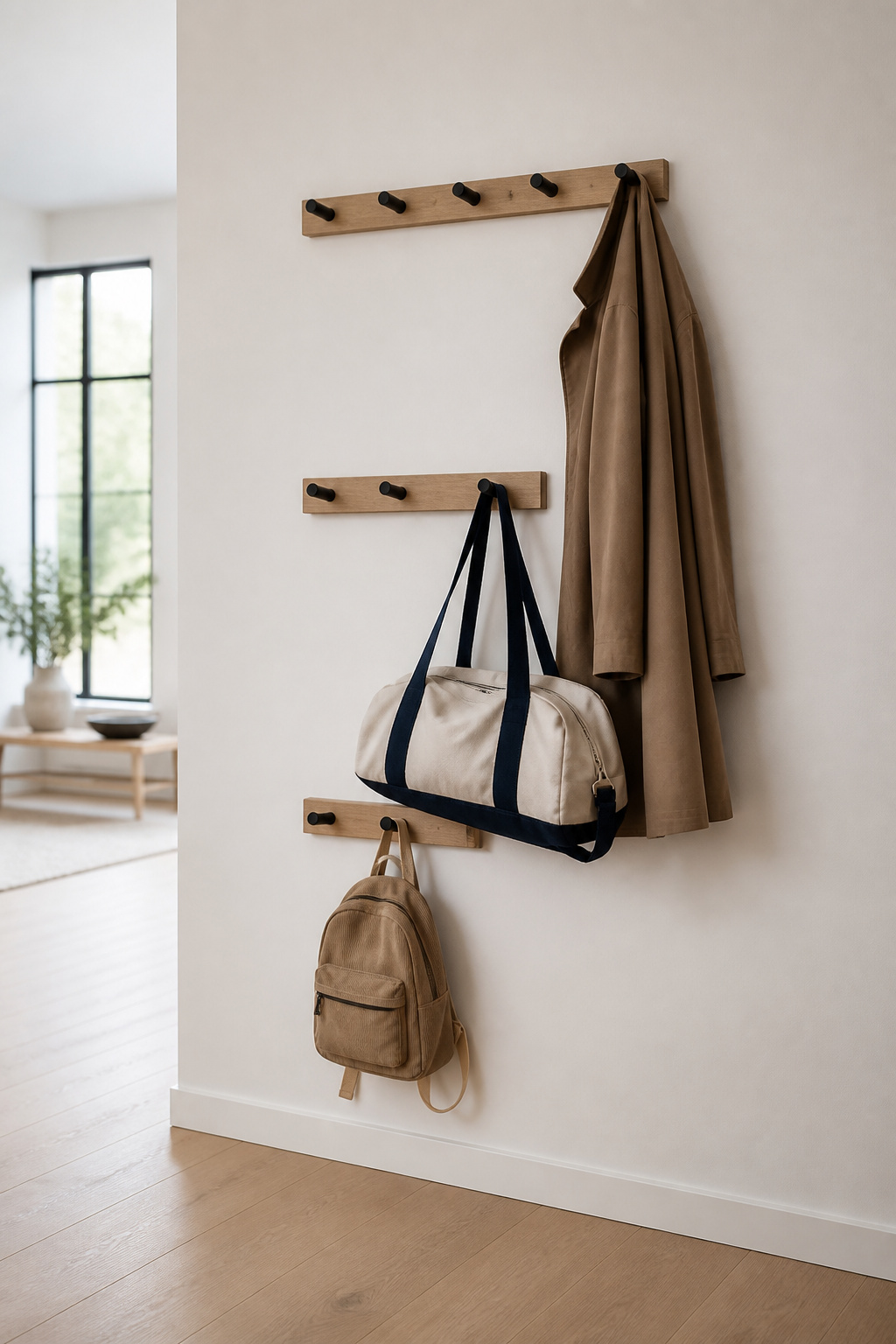
What an 8-year-old’s gear needs that a 5-year-old’s doesn’t
Reach grows slowly; gear grows fast. Average high reach moves from 41 inches at ages 5 to 8 to just 44 inches at 9 to 12. But the gear balloons: sports bags, instrument cases, bigger backpacks. An older child’s zone needs more hook capacity and deeper cubbies, not just higher placement, and middle-schoolers do better on their own row, commonly set at 48 to 54 inches.
Raising hooks and shelves in stages instead of rebuilding
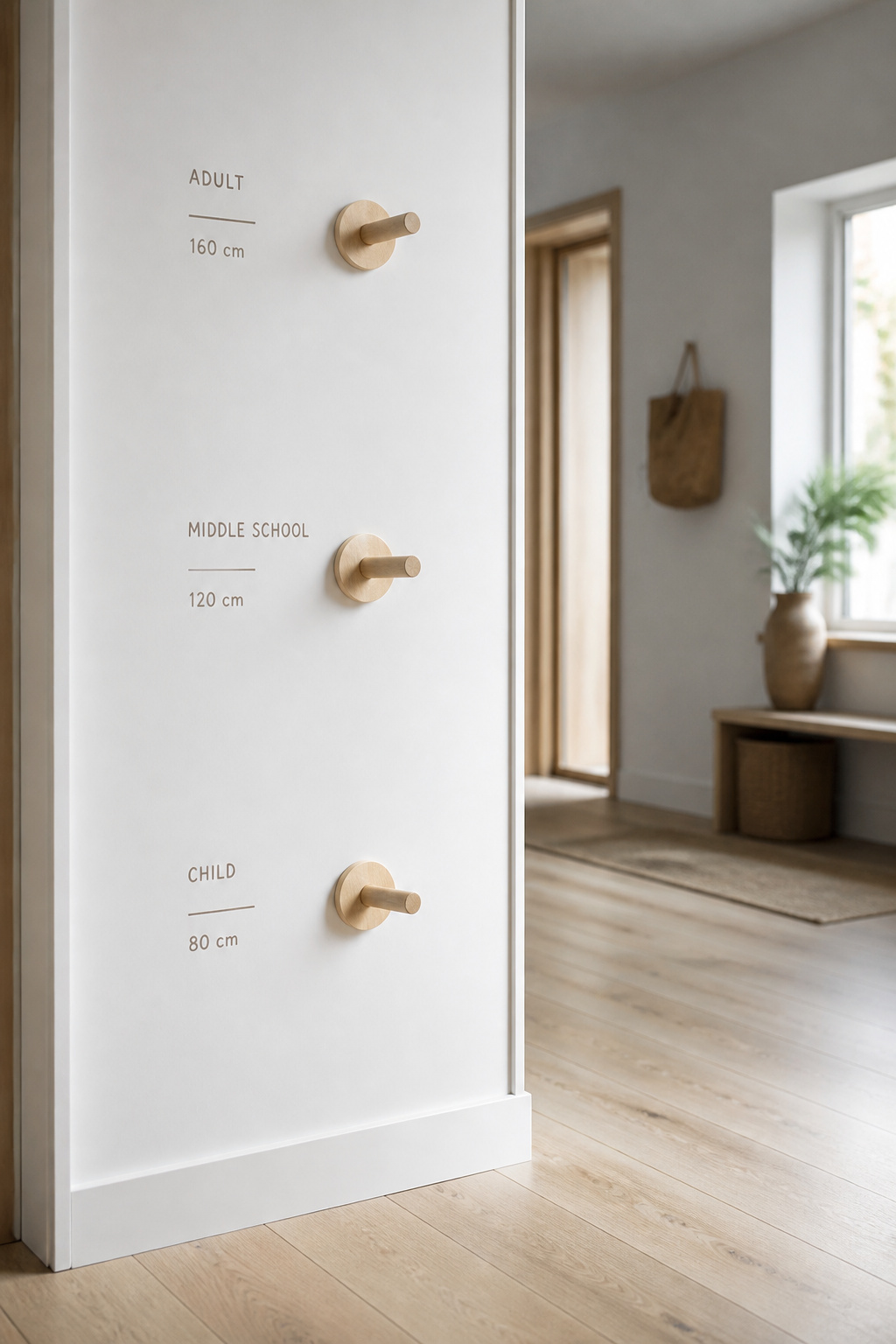
Practical family hook heights move in three stages — under-10s at 36 to 42 inches, middle-schoolers at 48 to 54, adults at 60 to 65 — so instead of tearing out and reinstalling, you just add the next row above the last. Plan wall space for that third row from the start. And hand over the space as you go: kids typically start taking real responsibility for belongings around ages 7 to 9, and by 10 to 12 most manage their gear without daily reminders — the point the zone shifts from parent-maintained to child-maintained.
A Simple Table: Age, Reach, and What Changes
Everything above collapses into one reference, with an adult row for a shared wall.
| Age band | Avg. reach | Hook height | Cubby / bin | Label type |
|---|---|---|---|---|
| 2-4 | 33 in | 36 in | Shallow open bins, shelf under 24 in | Picture or photo |
| 5-8 | 41 in | 36-42 in | Backpack cubby ~11-13 in W x 13-14 in D | Picture, then word-plus-picture |
| 9-12 | 44 in | 48-54 in | Deeper bin for sports/instrument gear | Word label or color-code |
| Adult (shared) | — | 60-66 in | Standard coat depth | None needed |
When to plan the next stage’s adjustment
Watch for one sign: a child reaching above shoulder height or going up on tiptoe to use a hook. Because reach moves in bands — 2-4, 5-8, 9-12 — you don’t need to remeasure yearly; line the adjustment up with each age transition, before the current row is a stretch.
Fitting This Into a Small Entryway
Not every family has a wide entry for three hook rows, and when space is tight the priorities change.
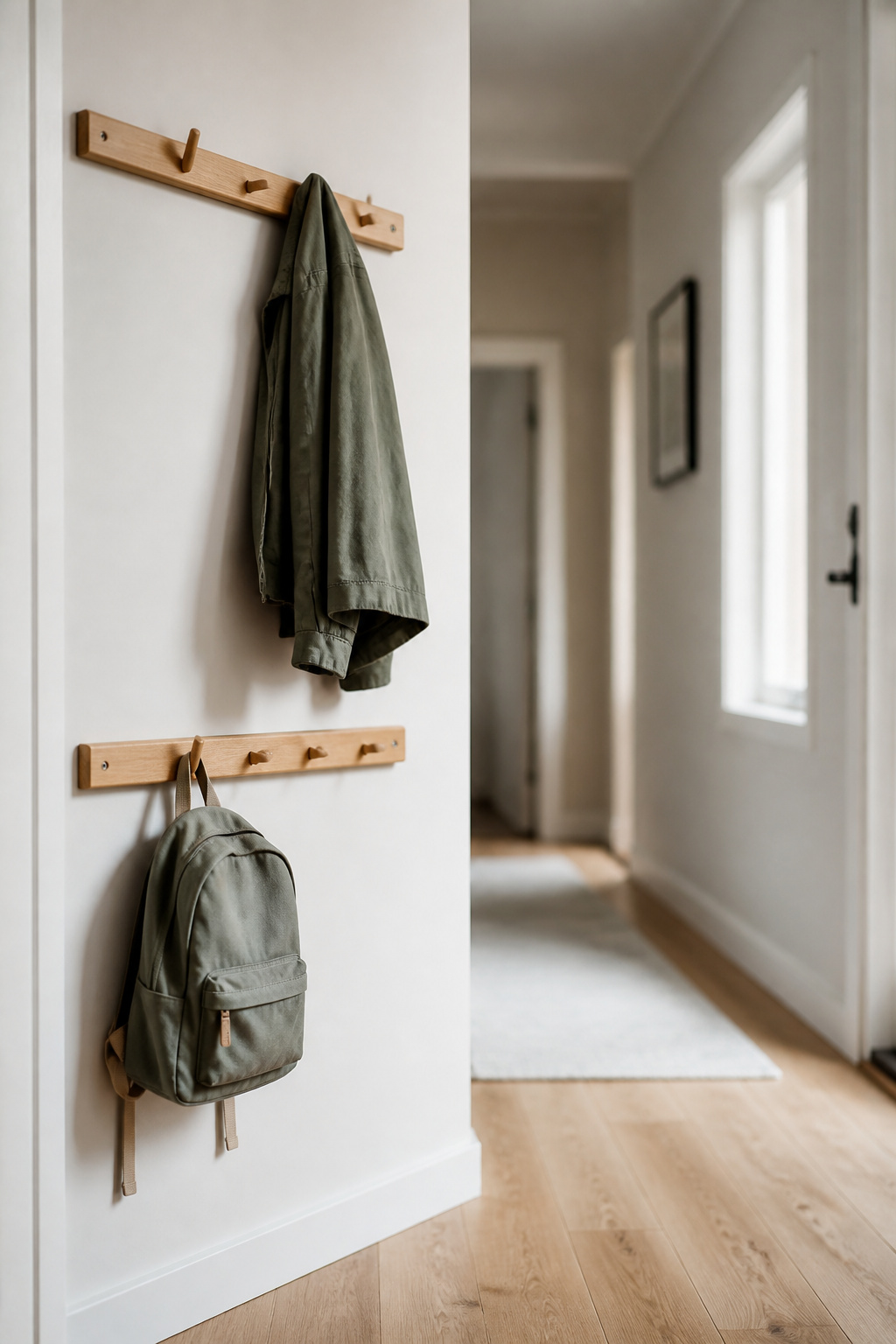
What to prioritize when floor space is tight
In a hallway too narrow for three rows, mount one child-height row (36 to 42 inches) below a single adult row (60 to 66) — that shared two-row wall covers most households and lets kids hang their own gear without a separate kids-only zone. A loaded backpack hangs lower and wider than a coat, so it crowds a narrow run faster; for more capacity with no spare wall, go vertical with hooks behind a door or a slim rail. For the full small-footprint playbook, see the guide on fitting a kid-friendly system into a small entry.
Keeping the Kid System Working Over Time
A kid drop zone isn’t a one-time install — it drifts faster than an adult one, because the child underneath it keeps changing.
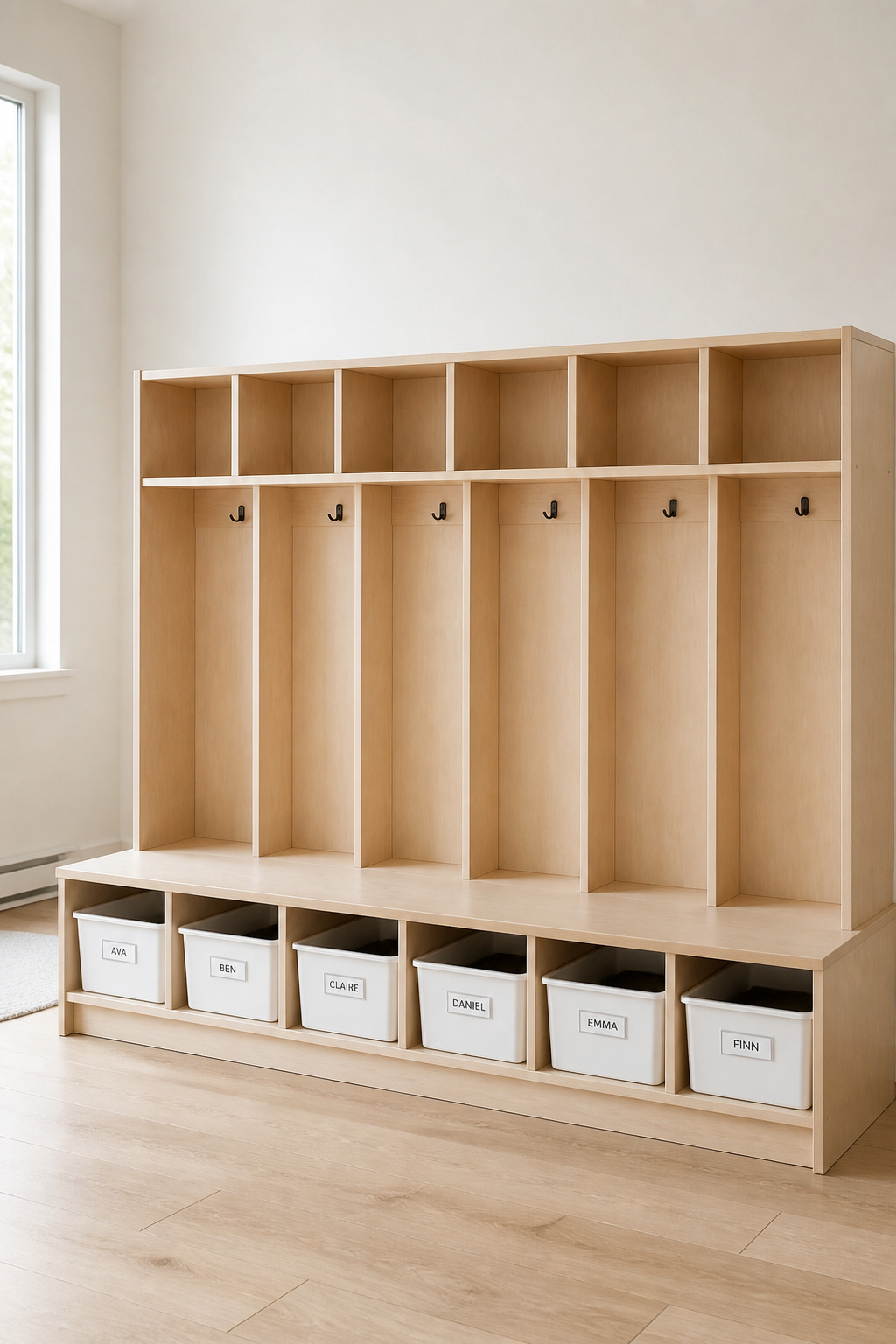
Why kid systems slide faster and the weekly check that stops it
Kid zones slide toward a pile faster than adult ones, because a child’s follow-through is inconsistent and their reach and gear keep shifting under a system built once and left alone. Two rhythms keep it alive. Daily, a 60-second sweep returns shoes and settles bags. Weekly, purge the hooks of what shouldn’t still be there — and, unique to kid zones, check for outgrown reach: is a hook now too low, a cubby too small, is the landing spot still where the gear actually lands? The bar it must clear is speed: the nightly reset has to stay faster than leaving gear on the floor. For the deeper habit-and-system design, see how to keep the kid system working over time.
Start with the kneel test tonight. Get down to your child’s eye level, mark where their hand lands comfortably, and mount the first hook there — not where the wall looks balanced to you. That single move, sizing the space to the child instead of the room, turns a drop zone kids walk past into one they’ll use, at every age from toddler to tween. For the wider picture, see our family entryway organization overview.
FAQ
At what age can kids use their own drop zone independently?
Most children begin taking real responsibility for belongings around ages 7 to 9, remembering where things go and taking pride in managing them. By 10 to 12, they typically manage independently without reminders. Independence still depends on the hooks matching their reach — a 36 to 42-inch setup supports earlier use than one left at toddler height.
What’s the best material for kid-height entryway hooks?
Impact-absorbing hooks made of nylon or a soft flexible material bend and spring back when bumped, rather than causing injury the way a rigid metal hook can — exposed metal hooks are flagged as a concern at a child’s head level. For loaded backpacks, choose hooks rated to hold 80 pounds or more.
How do you stop kids from dropping backpacks on the floor instead of in the cubby?
Correct the habit rather than fight it: place the hook or bin exactly where the backpack naturally lands, not somewhere tidier a few steps away. Hooks above a child’s reach for their age are a common cause of floor-dropping. Label the spot — a picture for younger kids, a name or color for older ones.