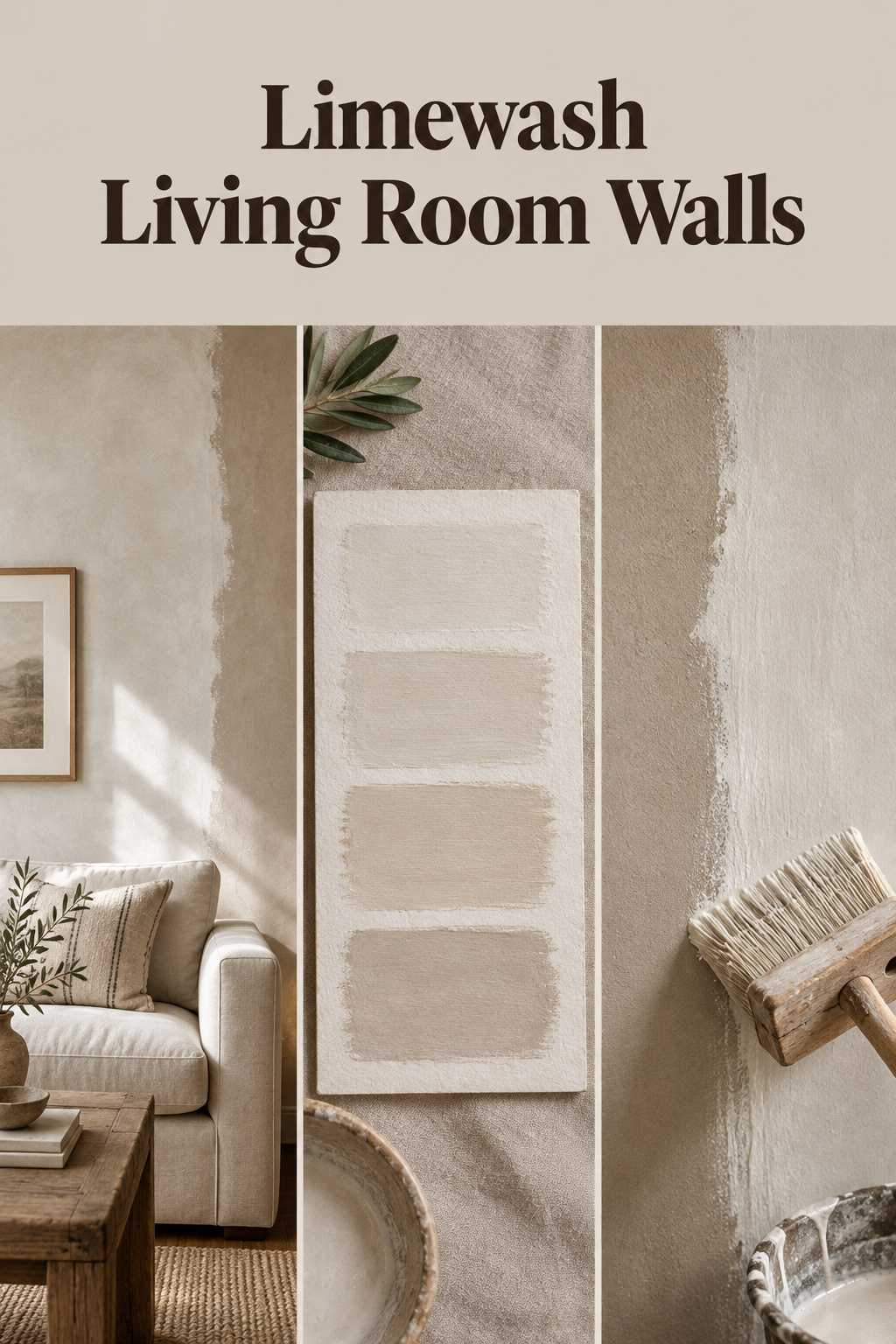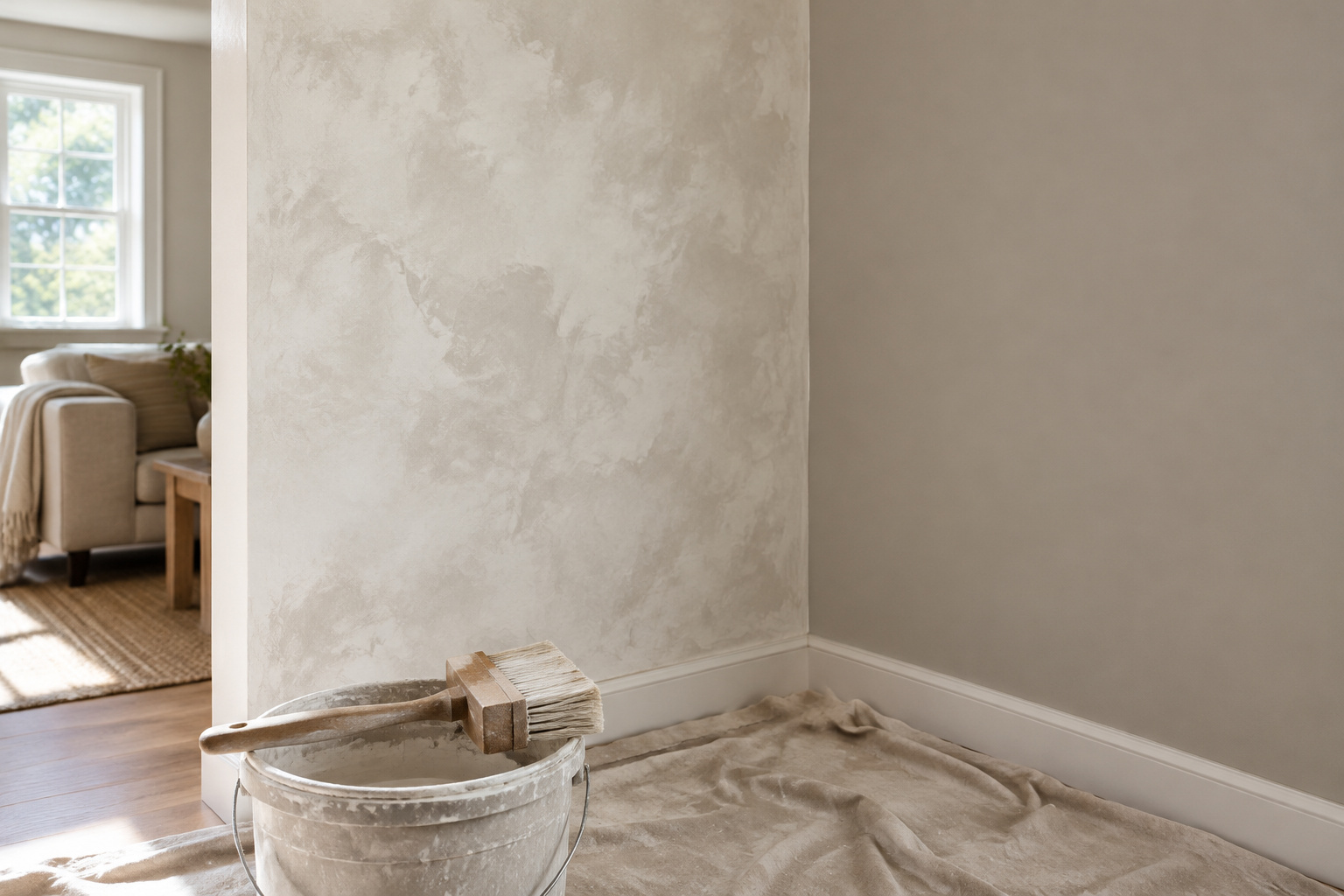

Ask the limewash makers what goes on painted drywall first and you get four answers. One wants a mineral primer. Another says any latex or PVA primer will do. A third sells its own acrylic undercoat, and a fourth wants a prep coat that it says isn’t a primer at all. Not one of them tells you to brush limewash straight onto an ordinary painted wall.
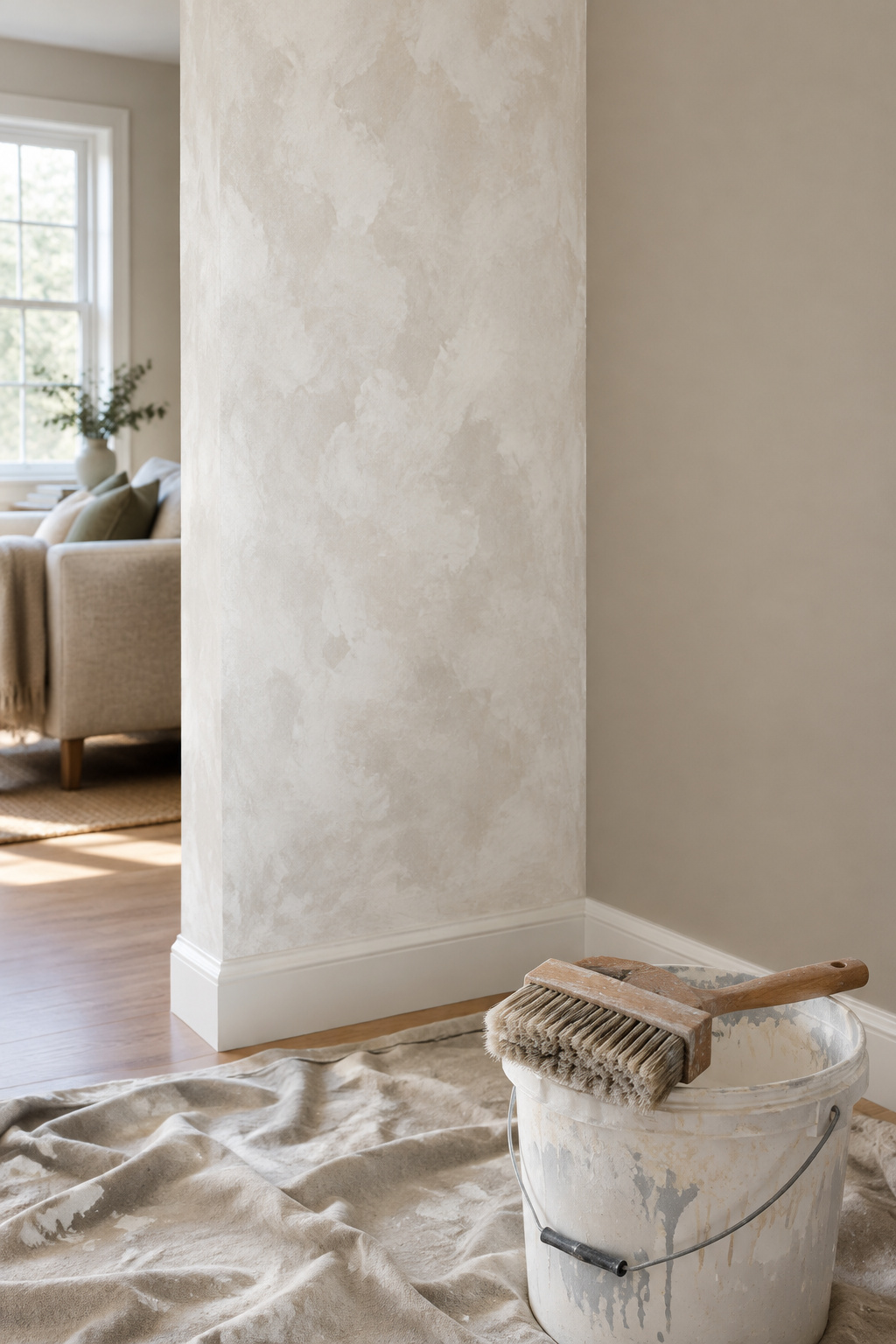
The photos leave that out, and people come away thinking limewash living room walls are paint with better manners, brushed on in an afternoon for about what paint costs. On latex-painted drywall, each piece of that is wrong. One 12 by 8 ft wall runs $162 to $206.50 in materials against $25 to $60 for a gallon of paint, and it takes two days with a drying wait in the middle.
TL;DR
- Over latex-painted drywall the makers want a primer or prep coat first, but not the same one, so use the product your maker names.
- Materials for one 12 x 8 ft wall come to about $162 to $206.50 with primer and a sample pot, against $25 to $60 for a gallon of paint, roughly $100 to $180 more.
- Test on a primed drywall offcut with two coats, because limewash dries lighter, and budget two days: primer first, two coats the second.
What Limewash Is, and What Your Wall Has to Be First
Limewash is slaked lime, water and mineral pigment. It isn’t a latex; it cures by carbonation and sets soft and chalky. (Lime plaster and Roman clay are different materials, not covered here.) KEIM says limewash has to penetrate the surface to grip it, and lists brick, stucco, lime plaster and masonry as the surfaces it suits. Drywall isn’t on that list.
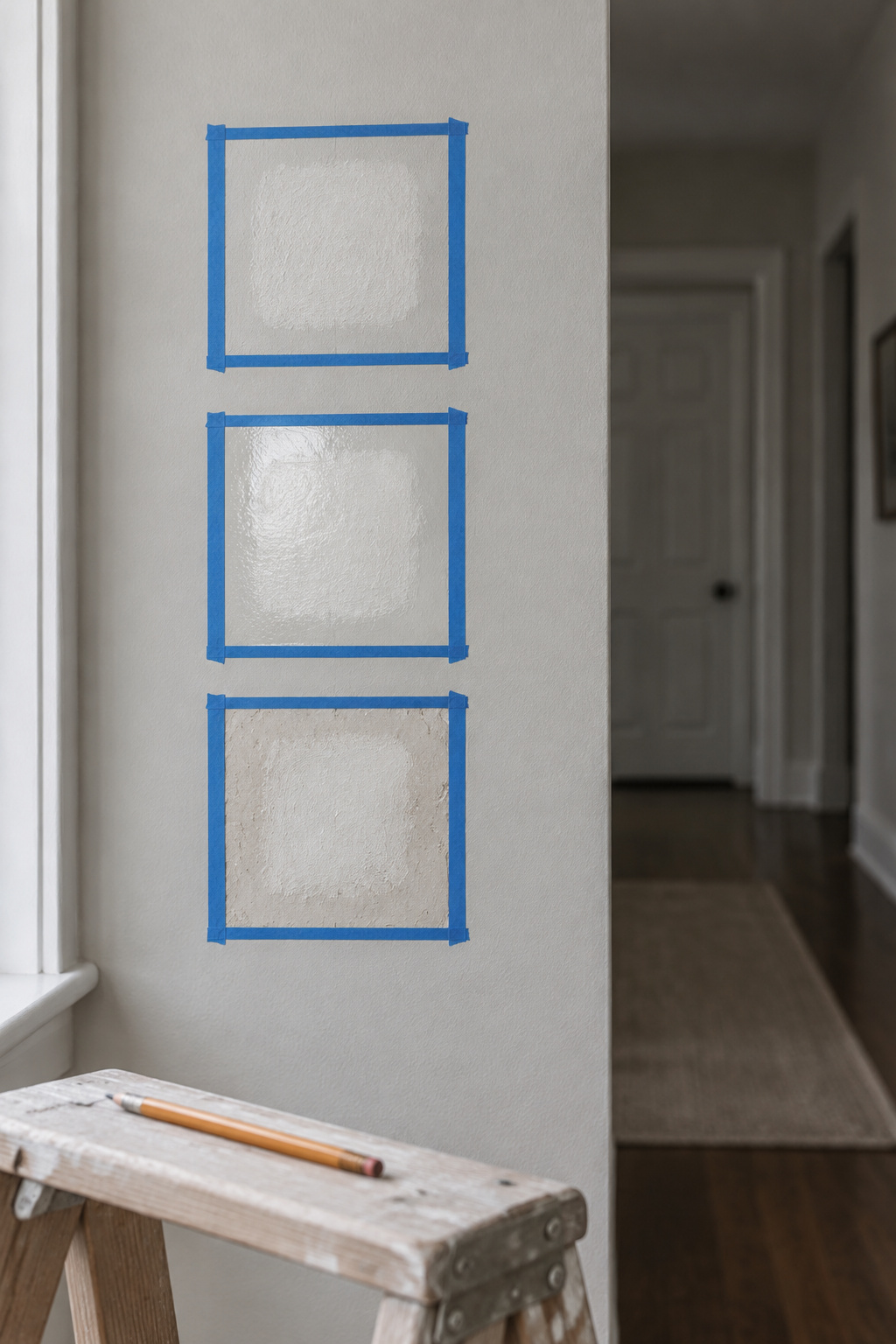
Look hard at the wall first. I once hung a shelf for a neighbor that should have been a one-hour job. It took three, because the stud finder was wrong twice. Walls lie. I check a wall myself before I trust any tool or label, and with limewash the slow part is finding out what you’re painting over.
The three walls you’re most likely to have need different things first:
| Your wall | What it needs before limewash | Limewash coats |
|---|---|---|
| Drywall in flat latex | Clean, patch, then the maker’s primer or prep coat | 2 |
| Drywall in satin or semi-gloss | Scuff-sand the sheen, wipe the dust, then the primer or prep coat (Portola wants two undercoat coats over semi-gloss) | 2 |
| Bare lime plaster | No primer; it’s the absorbent surface limewash was made for | 2 to 3 |
Old plaster that has been painted counts as a painted wall. Oil-based paint, epoxy, urethane or varnish underneath is a no: KEIM says don’t apply limewash over them at all. If yours is painted drywall, budget the primer and the extra day now.
Prep for Limewash Living Room Walls: Primer, Tools and the Extra Day
Rate this one “some builds.” Nothing in it is hard. It just can’t be rushed, and day one is all prep.
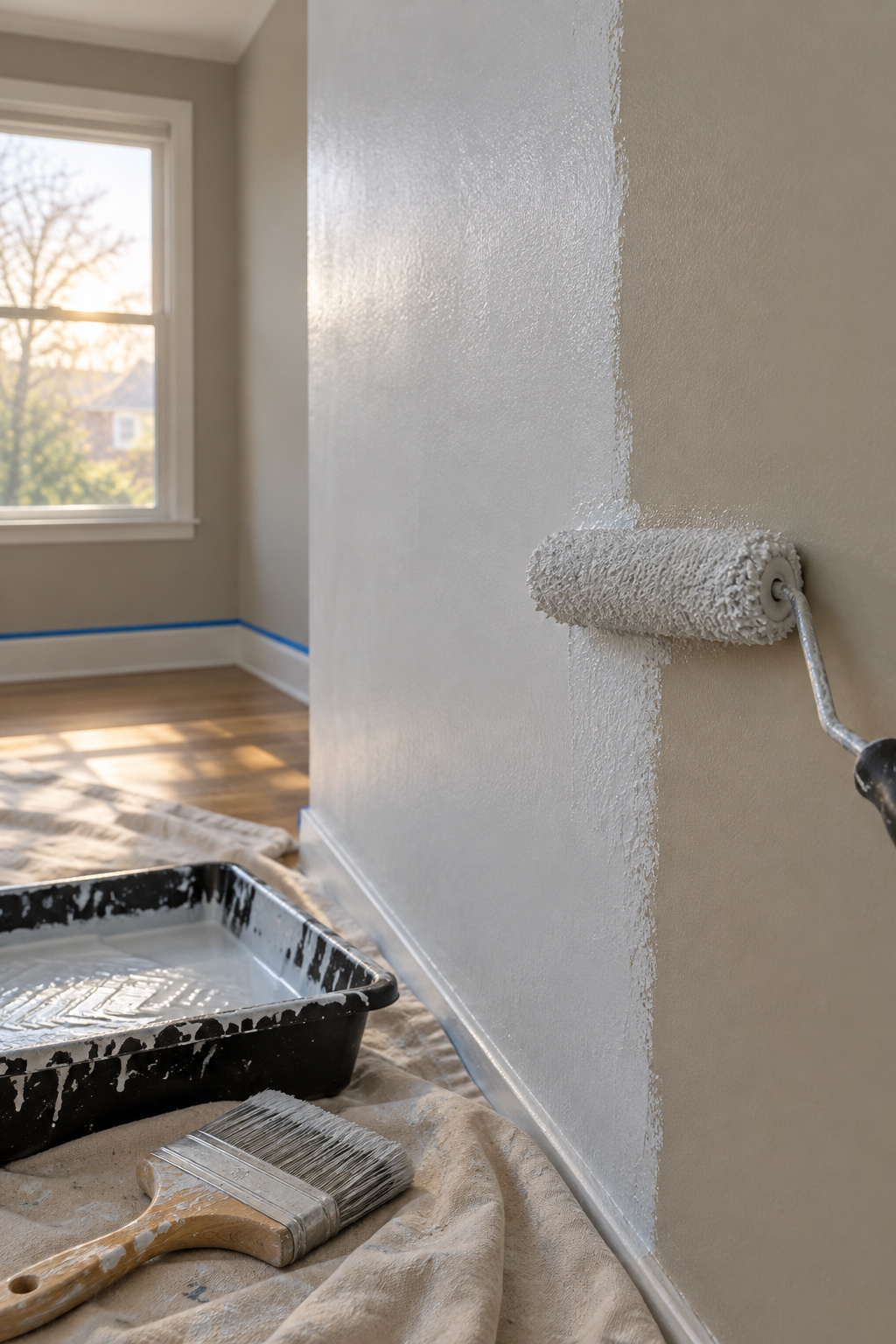
The primer split decides what you buy:
- KEIM and Vasari: a mineral primer (Vasari also accepts a recommended latex or acrylic primer).
- Earthaus: any latex or PVA primer.
- Portola: its own acrylic Limeproof Undercoat.
- Bauwerk: its Prep Coat, with a water-based sealer-primer underneath only if the wall has been patched.
Buy the whole system from one maker and follow that maker’s sheet.
- Clean the wall.
- Scuff-sand any sheen and wipe off the dust.
- Patch, and prime the patches. Limewash hides nothing, so old repairs ghost through.
- Finish the trim first. Tape pressed onto finished limewash can pull it off the wall.
- Roll or brush on the maker’s primer or prep coat and let it dry fully. Vasari wants at least 24 hours.
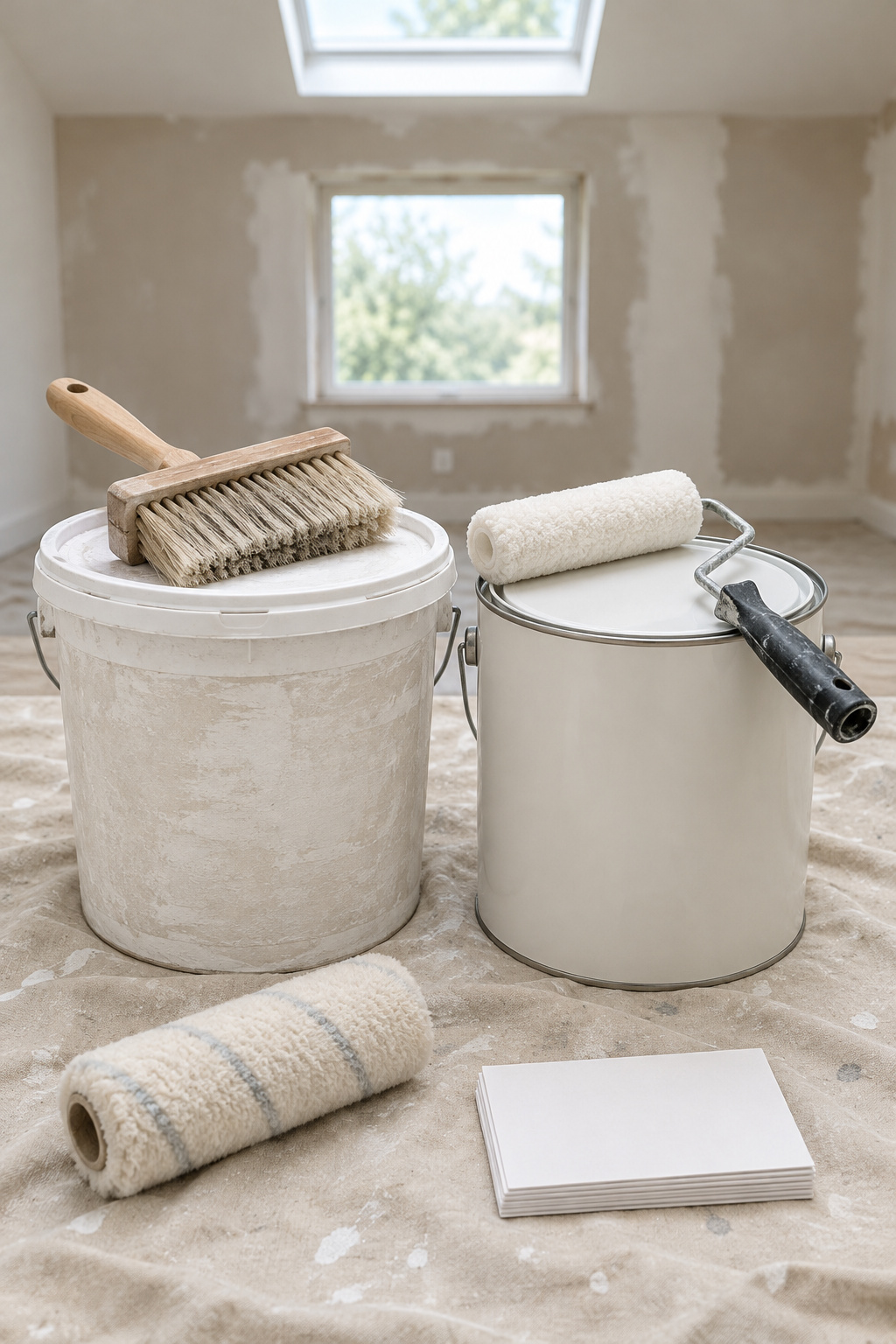
For tools you need a bristle block brush (Bauwerk’s 4 x 14 in is its most popular), or a 4 to 6 in stain brush if you’d rather take Portola’s cheaper route, plus a whisk and a working bucket holding only about 3 in of limewash.
I once skipped a primer coat to save a day and had to repaint the whole wall two weeks later. Skip the bridge coat and Bauwerk warns of an inconsistent finish, so schedule the primer day.
The Sample Board Is the Job: Test the Color Before the Wall
Wet limewash looks darker and almost see-through. As it dries it lightens to the color on the label and goes opaque, and Bauwerk tells you not to add more paint to chase the wet look.
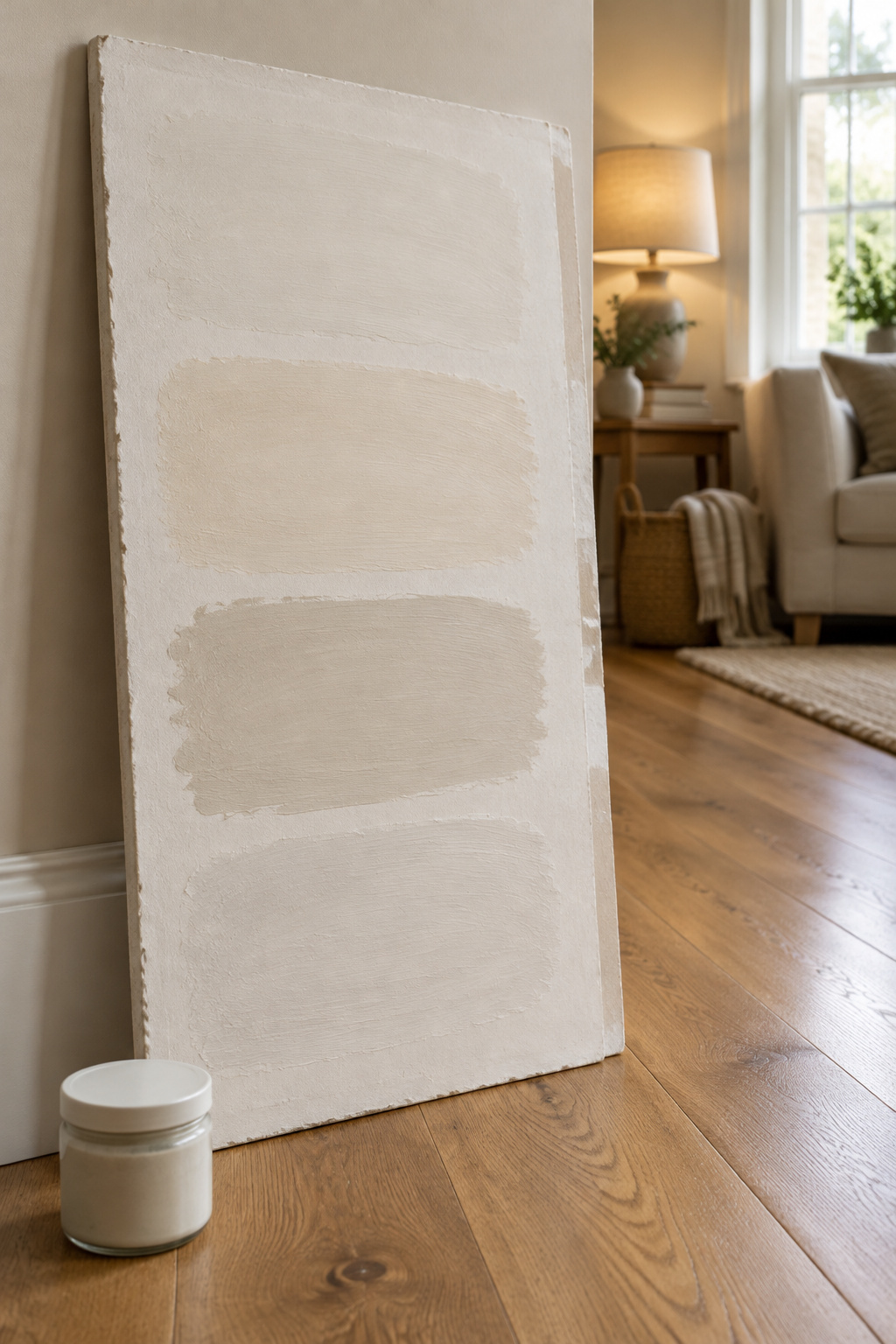
Make a proper sample instead. Portola recommends a loose piece of drywall. Bauwerk allows a board of similar material, or the prepped wall itself as long as you cover the swatches with Prep Coat afterwards. I’d use an offcut every time: prime it with the same primer or prep coat the wall will get, then give it two coats so you see the second-coat tone and the mottling.
A Portola sample jar is $10 and a Bauwerk pot is $18.50, so testing three colors costs $30 to $55.50 before shipping. Carry the board to a sunny wall and a shaded one, at more than one time of day, and hold it against the floor, the trim and the sofa, the same fixed things you’d judge any wall color by; the method for picking a greige that suits your floor works just as well here.
Don’t buy the full-size can until the board has been dry and in the room for a full day.
Two Coats With a Block Brush: How the Mottled Look Actually Happens
Functional beats perfect, and limewash is where I mean that most. It isn’t meant to go on smooth; the random strokes give it the patina people buy it for. Aim for an even amount of material, not an even look.
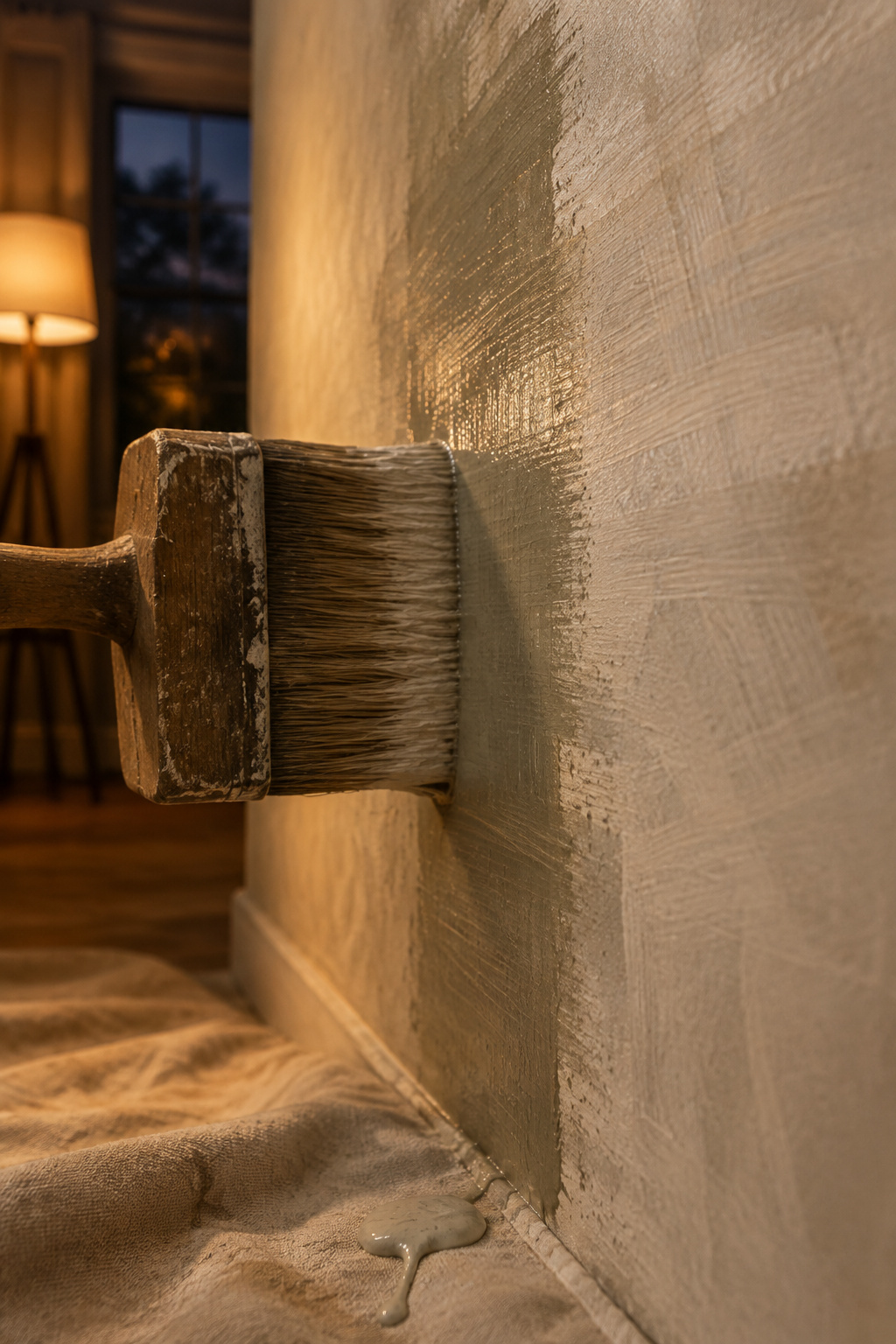
- Stir often, dip the brush, flick off the excess and start in a corner.
- Work in loose cross-hatch strokes about 1 to 2 ft long, changing direction constantly. Cut in as you go rather than first.
- Keep a wet edge and finish the wall in one go. Stopping halfway leaves seam lines, and going back over a drying patch causes white flashing.
- Wait between coats as long as your maker says: Bauwerk 1 to 2 hours, Portola 2 to 4 hours, KEIM 12 hours, Vasari 24 hours for the first coat.
- Put on the second coat faster and looser, wet-in-wet, then stop. More coats make it more opaque and flatten the texture you paid for.
The usual mistake is loading too much. Limewash that goes on too thick can’t cure properly, and you get white, powdery patches. Bauwerk’s fix is to wait 24 hours and put another thin coat over the area. Then leave it alone; it takes about two weeks to cure.
The cloudy movement shows when light rakes across the wall from the side and flattens under a ceiling fixture, so think about placing lamps to light a textured wall before you decide which wall gets the treatment.
Limewash vs Paint: What One Wall Really Costs
One wall, priced three ways: 12 by 8 ft, 96 sq ft with no openings, so two coats means 192 sq ft of coverage.
| One 96 sq ft wall | Bauwerk limewash | Portola limewash | Interior paint |
|---|---|---|---|
| Finish | 2 x 1 L at $49 = $98 | 1 gal = $84 | 1 gal = $25 to $60 |
| Underneath | Prep Coat, 2 x 1 L at $45 = $90 | Limeproof Undercoat, 1 gal = $68 | None on sound paint |
| Sample | $18.50 | $10 | Not included |
| Total | $206.50 | $162 | $25 to $60 |
| Per sq ft of wall | $2.15 | $1.69 | $0.26 to $0.63 |
| Time | Day one prep coat; day two two coats, 1 to 2 h apart | Day one undercoat; day two two coats, 2 to 4 h apart | No primer day |
No maker gives labor hours, so the time row is my estimate from their dry times. Coverage is where the makers drift apart. Bauwerk lists 107 to 161 sq ft per liter per coat, which at 3.785 liters to the gallon is 405 to 609 sq ft per gallon per coat. Portola lists 150 to 200 sq ft per gallon over two coats. Paint covers 350 to 400 sq ft per gallon per coat, so this wall needs 0.48 to 0.55 gallon. Order from your own product’s sheet.
Always buy 10% more material than the plan says. On the Bauwerk route the wall needs 1.19 to 1.79 liters of limewash; 10% on top of the high end is 1.97 liters, which still fits in the two 1-liter tins. Keep what’s left in a labeled jar for touch-ups.
So the premium for this wall is about $100 to $180 in materials, roughly three to eight times paint per square foot, plus one more day.
Cleaning, Touch-Ups and the One Wall Worth Doing
How to clean and touch up limewash
The makers disagree about washing. Bauwerk allows a light wipe with a clean, damp cloth, with no scrubbing, no soap and no excess water, and only after the wall has had up to two weeks to cure. Portola calls unsealed limewash a delicate, non-wipeable surface; only once it’s sealed with Portola’s matte wall sealer can you use a barely damp rag with a little mild dish soap.
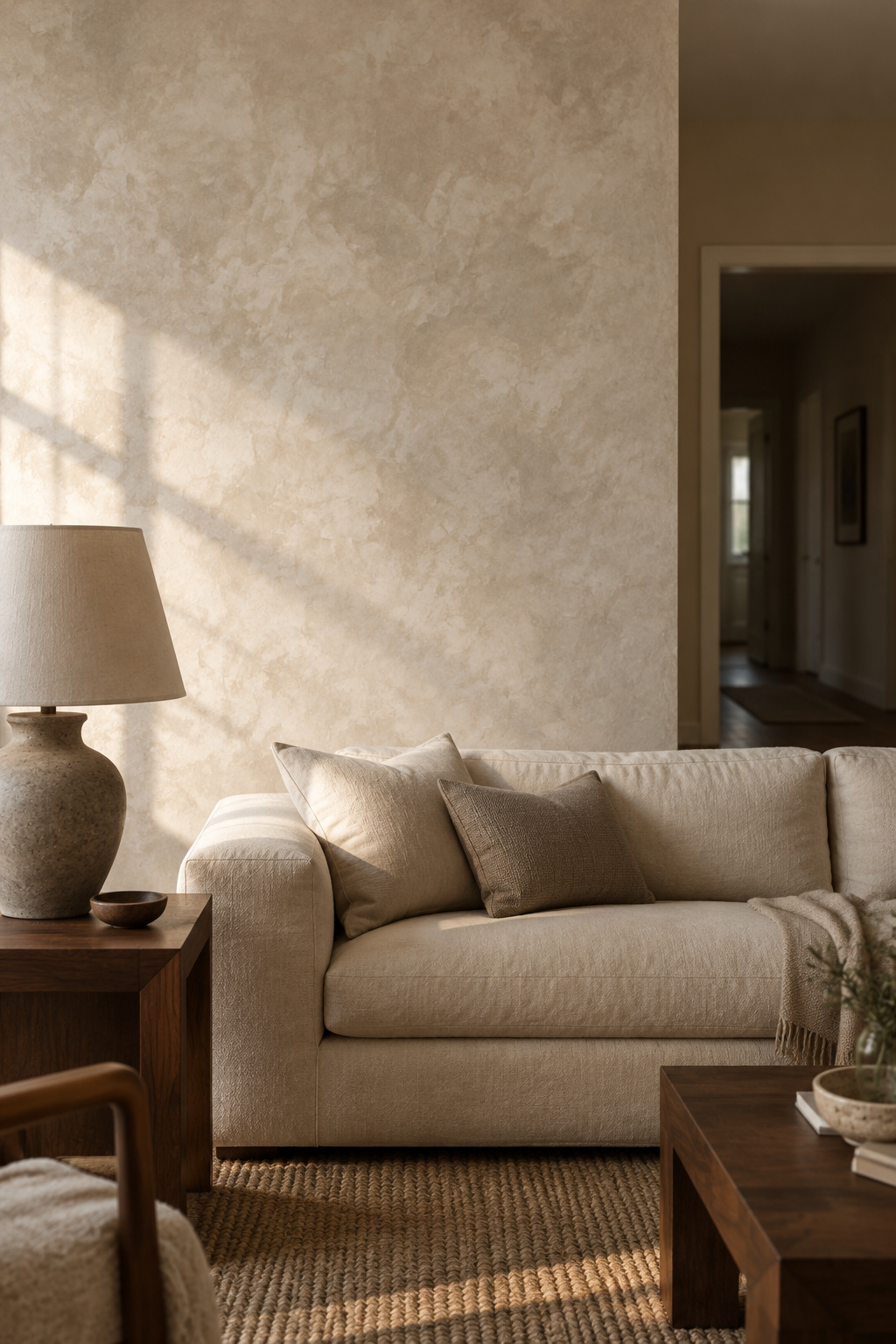
Touch-ups depend on color. Bauwerk says whites and light colors can be patched without a visible edge, while mid-tones and darks need recoating corner to corner with a wet edge. Test any touch-up on your sample board before it goes near the wall.
Which wall earns the effort
Pick the one wall that catches side light, ideally an unbroken stretch behind the sofa where nobody leans or wipes. Skip the wall by a kitchen pass-through, since oils mark the chalky surface. Paint the other three a flat warm color at $25 to $60 a gallon. If you’re thinking about the whole room, start with making a neutral living room cozy. Limewashing a brick fireplace is a separate job, covered in brick fireplace decorating ideas.
Know where your job stops. Old or damaged plaster needs a plasterer, not a block brush. If your sample board fails, call the maker’s rep before you buy more. And in an older house, sanding old paint can raise lead dust, which calls for a NIOSH-approved respirator and containment. That’s a pro job.
Drop the one-coat Saturday plan. You’re buying the maker’s primer, a board, two coats and a bill about $100 to $180 higher. Buy the primer and one sample pot, and paint the offcut first.
FAQ
Can you limewash over wallpaper or textured drywall?
Sometimes. Bauwerk says most paper wallpapers can take its limewash with the same prep as a painted wall: a primer-sealer, its Prep Coat, then two coats. Vasari accepts moderate texture such as orange peel or light skip trowel. Limewash is a thin coating, though, so seams and heavy texture will still show through.
Is limewash safe to handle, and do you need gloves and eye protection?
Wear both. KEIM’s safety data sheet for its limewash classes it as causing skin irritation and serious eye damage, and calls for gloves, protective clothing and eye protection. Farrow & Ball’s sheet adds that if any gets in your eyes, you should rinse cautiously with water for several minutes and call a poison center or a doctor.
How long does limewash last before a living room wall needs redoing?
There’s no tested lifespan in years for indoor limewash. Bauwerk says a limewashed wall lasts as long as a quality painted one, and you refresh it with a new coat rather than stripping it. One limewash seller’s own estimate is a touch-up or recoat every 5 to 7 years. It does best on low-traffic walls.