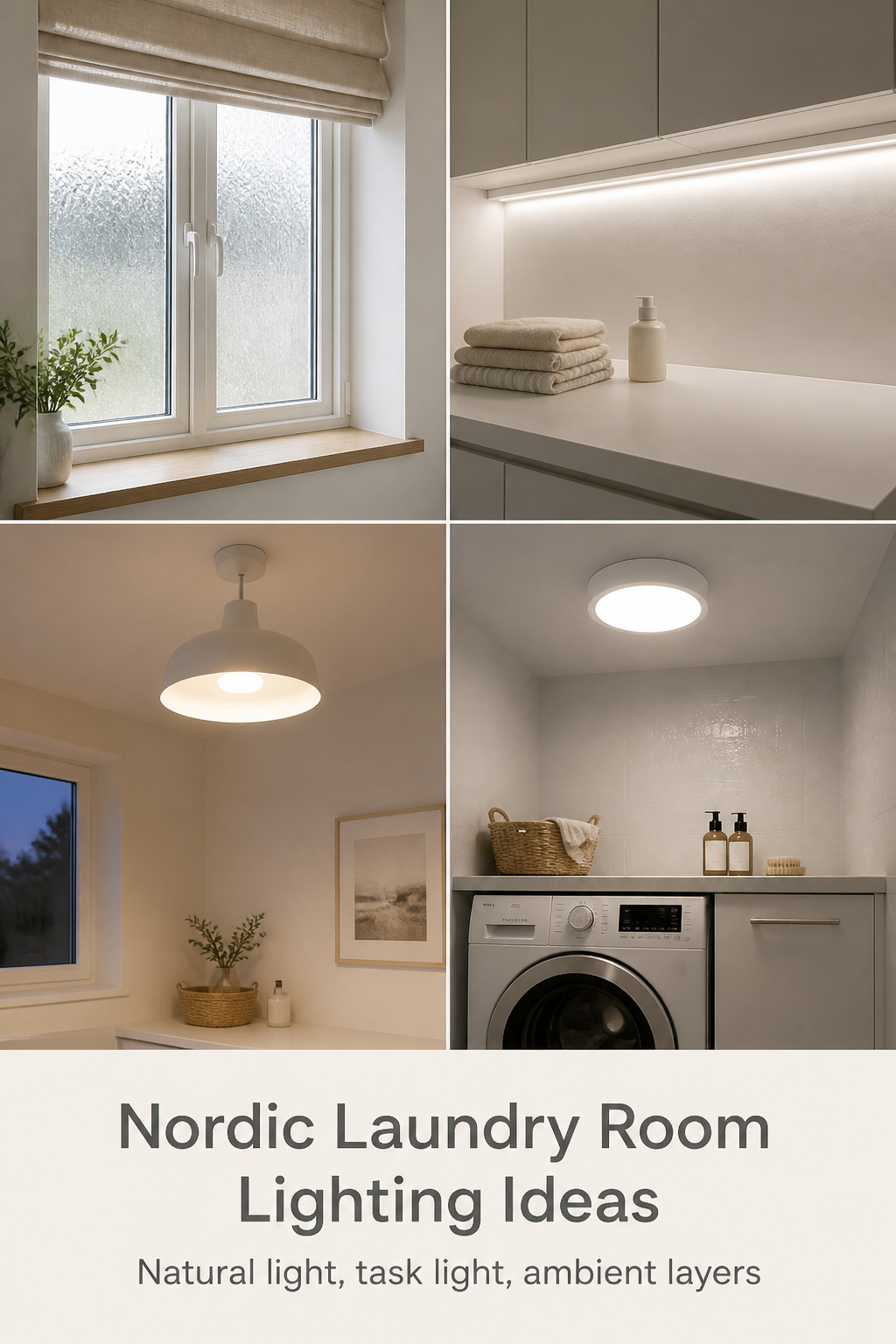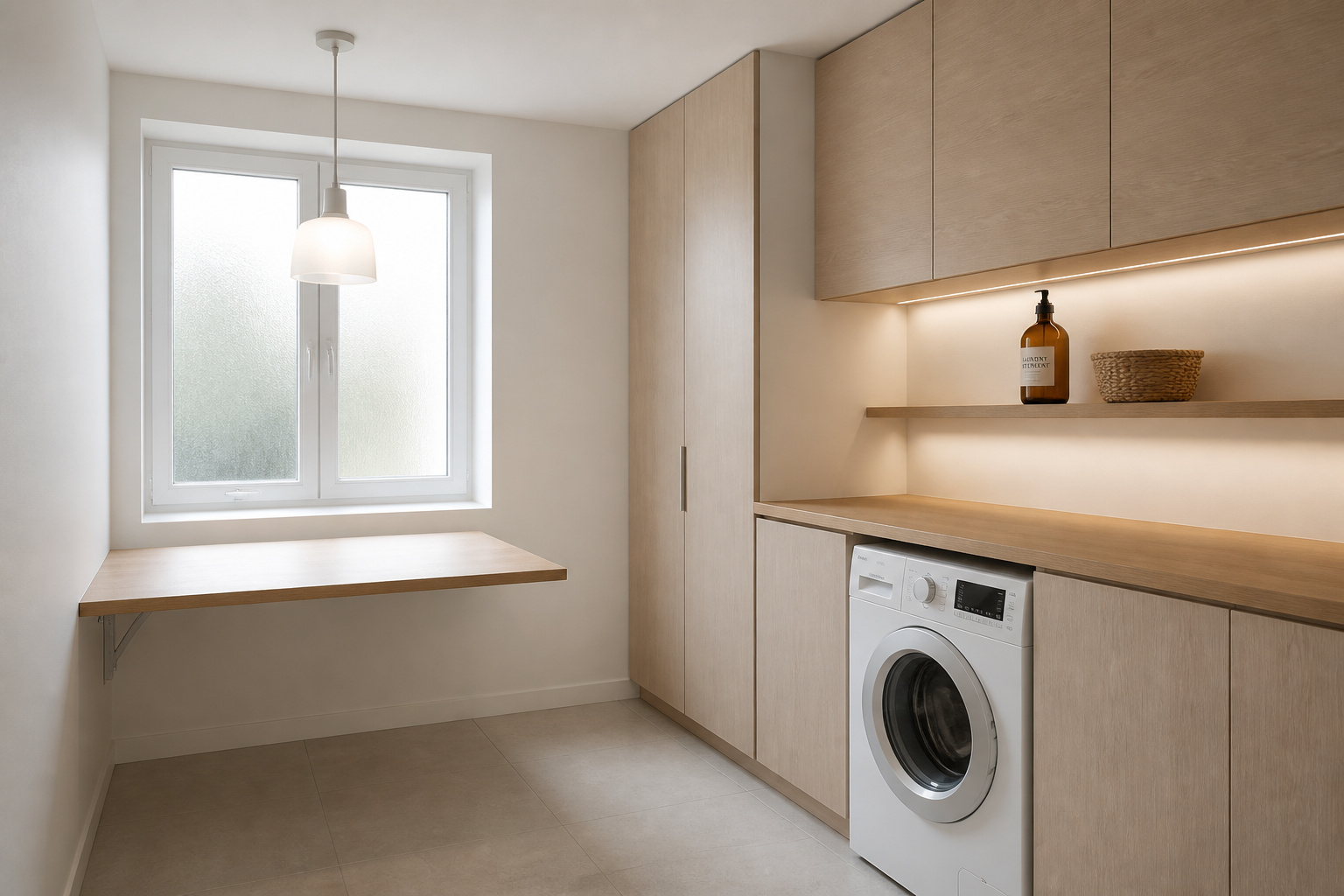
Step into a Nordic laundry room at seven in the morning, in February, before the sun is properly up. The walls are pale and they hold what little light there is. A soft band glows along the counter where you fold. Overhead, one warm lamp keeps the corners from going cold and grey. The room is quiet. This is not a utility cupboard you hurry out of. It is a room you do not mind standing in. Good Nordic laundry room lighting builds that feeling deliberately, layer by layer, and it starts long before you choose a single fixture.
TL;DR
- Build light in three layers: natural light first, 4000K task light at the counter and sink, and a warm 2700K ambient layer overhead — with a dimmer on the ambient circuit.
- Aim for 2,000–4,000 lumens total, CRI 90 or above for task light, and IP44-rated fittings minimum in the damp zone near machines and the sink.
- The single highest-impact change is adding a trailing-edge dimmer to the ambient circuit — it costs around £15–£30 and shifts the room from fixed brightness to something that softens through the day.
The Laundry That Feels Different at 7am
In Sweden, Norway and Denmark, winter hands you only a few hours of daylight. When the sun is a rare guest, light stops being decoration and becomes something closer to a survival strategy. That climate shaped the whole Nordic approach to lighting, and the laundry — usually the worst-lit room in the house — is exactly where it pays off.
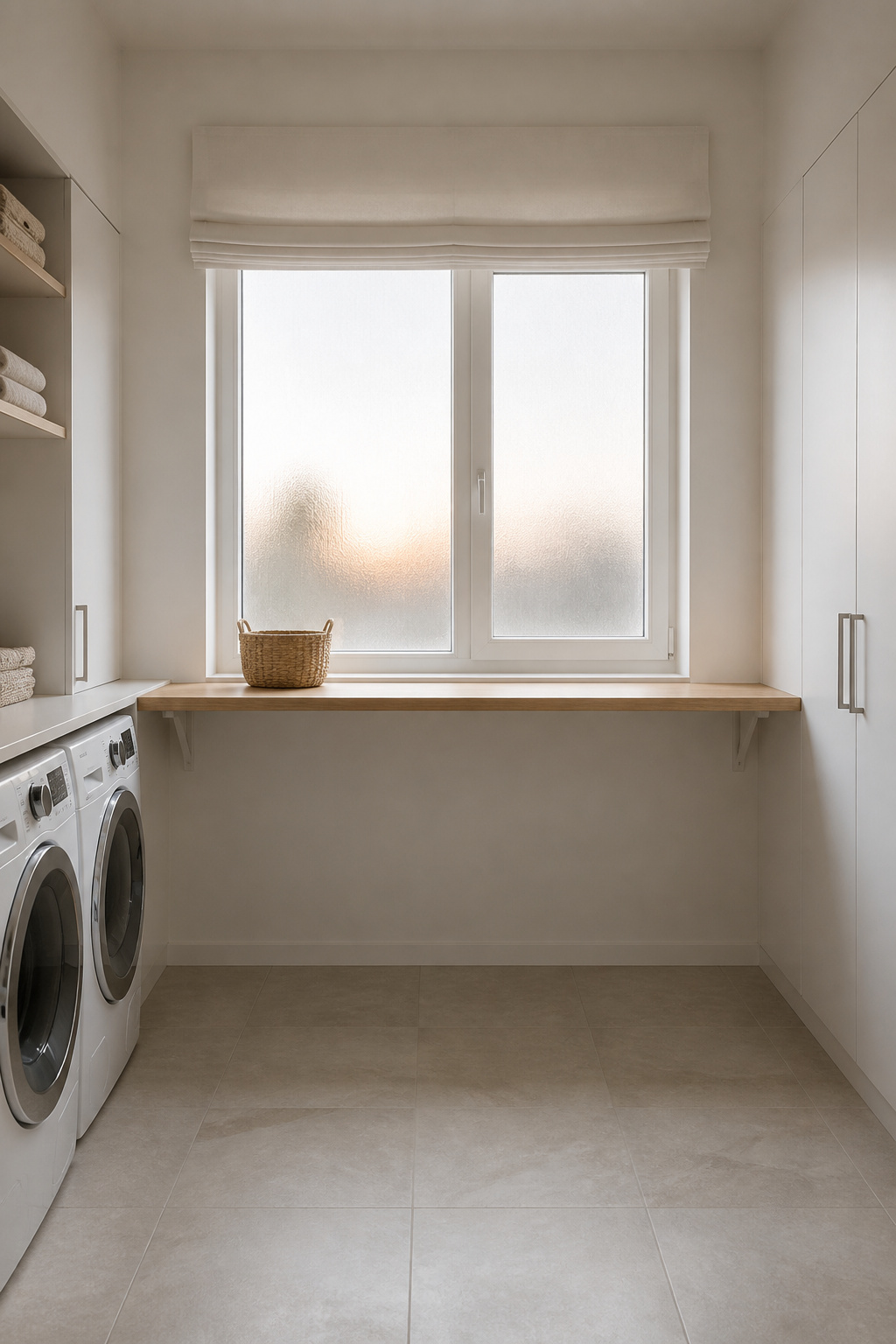
What good Nordic laundry lighting actually feels like — not what it measures
Scandinavian lighting rests on three plain principles: warm tones, soft shadows, and thoughtful layering. The goal is a room that feels calm the moment you step in. That calm is made by light before any other material does its work.
So Nordic rooms avoid a single harsh overhead source. Instead they layer several gentler ones, the way daylight shifts through a day — islands of warmth rather than one flat, clinical wash. As LED iBond, a Nordic lighting maker, puts it, light here is about “practicality and personal well-being.” In a laundry, that means you can see what you are doing and still want to be there.
Why a utility room needs better light than it usually gets
A laundry is detail work. You treat a stain, sort darks from navy, read a care label, fold without creasing. All of it needs clarity, and most laundries are given none. The professional benchmark is modest but real: the Illuminating Engineering Society recommends 30 foot-candles — roughly 323 lux — for a utility room. In practical terms, aim for a total of 2,000–4,000 lumens across the room, depending on its size.
That number is not the point, though. The point is what the room asks of you. Treat the laundry as beneath investment because it is “just” a utility space, and you get the dim, shadowed cupboard everyone tolerates. Nordic design rejects exactly that logic.
The three-layer approach: natural, task, ambient
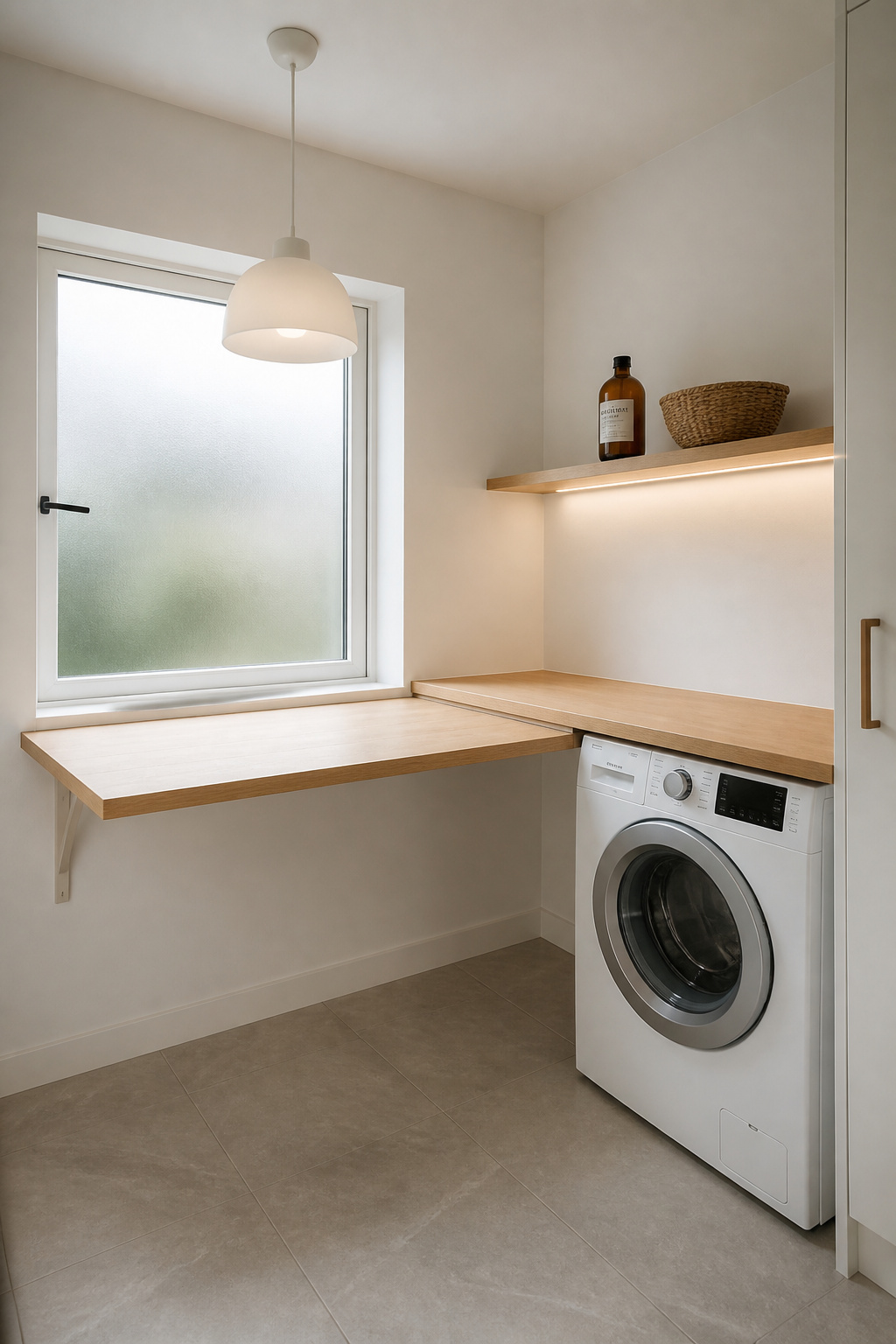
Everything that follows hangs on three layers. Natural light comes first — free, colour-accurate, and the thing every other choice is built around. Task light comes second, focused and cool, for the counter and sink. Ambient light comes third, warm and soft, the layer that decides whether the room feels liveable.
Layering gives you control. Bright for sorting and stain work; gentle for an evening load. The layers do not compete — each does one job. Get all three right and a small laundry stops feeling like a chore and starts feeling intentional. The same thinking runs through planning a Nordic-style laundry room as a whole.
Natural Light First: Making the Most of What the Room Has
Before you buy a fixture, work the daylight you already have. Scandinavian designers go to real lengths to let light in and make it count, and the laundry is no exception.
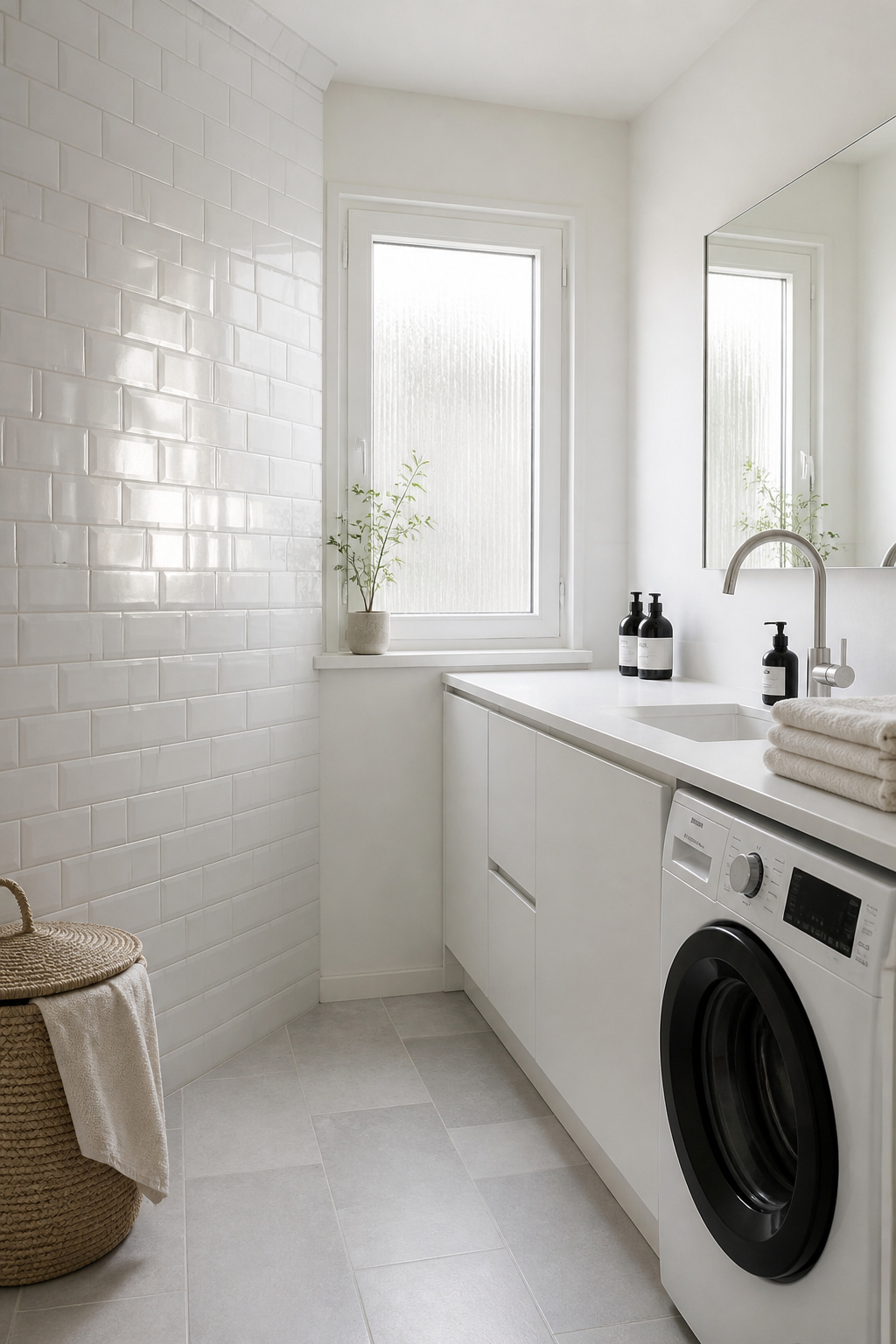
Window placement and the compass directions Nordic designers prefer for a laundry
If you have any say over the window, favour a north aspect. A north-facing window receives almost no direct sun, so its light is consistent, cool and diffuse from morning to evening. For a laundry that is close to ideal: no harsh shadows, no glare across a folding counter, and steady light all day for judging colour and spotting stains. It also runs cooler in summer, which helps in a room where the washer and dryer already add heat. I would treat this as sound reasoning rather than a hard rule — most of us cannot move a window — but where the choice exists, north earns it.
Reflective surfaces that multiply natural light — tiles, paint sheen, mirror panels
Whatever light enters, make the room give it back. Sheen matters here more than almost anywhere else in the house. Flat paint absorbs light; satin or eggshell is the minimum I would accept on a laundry wall, and it shrugs off splashes and wiping besides. Check the light reflectance value, not just the colour swatch — a pale colour in a flat finish still drinks the light.
Hard surfaces help too. White or near-white gloss tiles bounce daylight around the room and soften shadows. And a plain frameless mirror hung opposite the window does the most work of all: it effectively doubles the visible light by throwing daylight back across the space, while making a tight room read larger. This is also where lighting meets the wider palette — warm light animates pale oak and linen, cool light flattens them — but the full material story belongs to choosing the colour palette.
When there is no window: frosted glass doors and light tunnels
Plenty of laundries have no window at all. Two solutions stand out. A frosted glass interior door borrows light from a lit hallway through a wide frosted panel — privacy kept, clutter hidden, and a joiner can fit one with no structural work. Or route daylight from the roof with a tubular skylight: a Velux Sun Tunnel sends light down a 99% reflective tube to a ceiling diffuser, and a 14-inch model lights up to 300 square feet, the kind of change homeowners describe as transformative. One warning, the most common natural-light mistake of all: never block the light you have with a shelf, a tall appliance or a half-drawn blind.
Nordic Laundry Room Lighting: The Task Layer
Task light is the layer most laundries get wrong. It has a specific job — enough light, the right colour, in the right place — so you can read a stain accurately and tell navy from black.
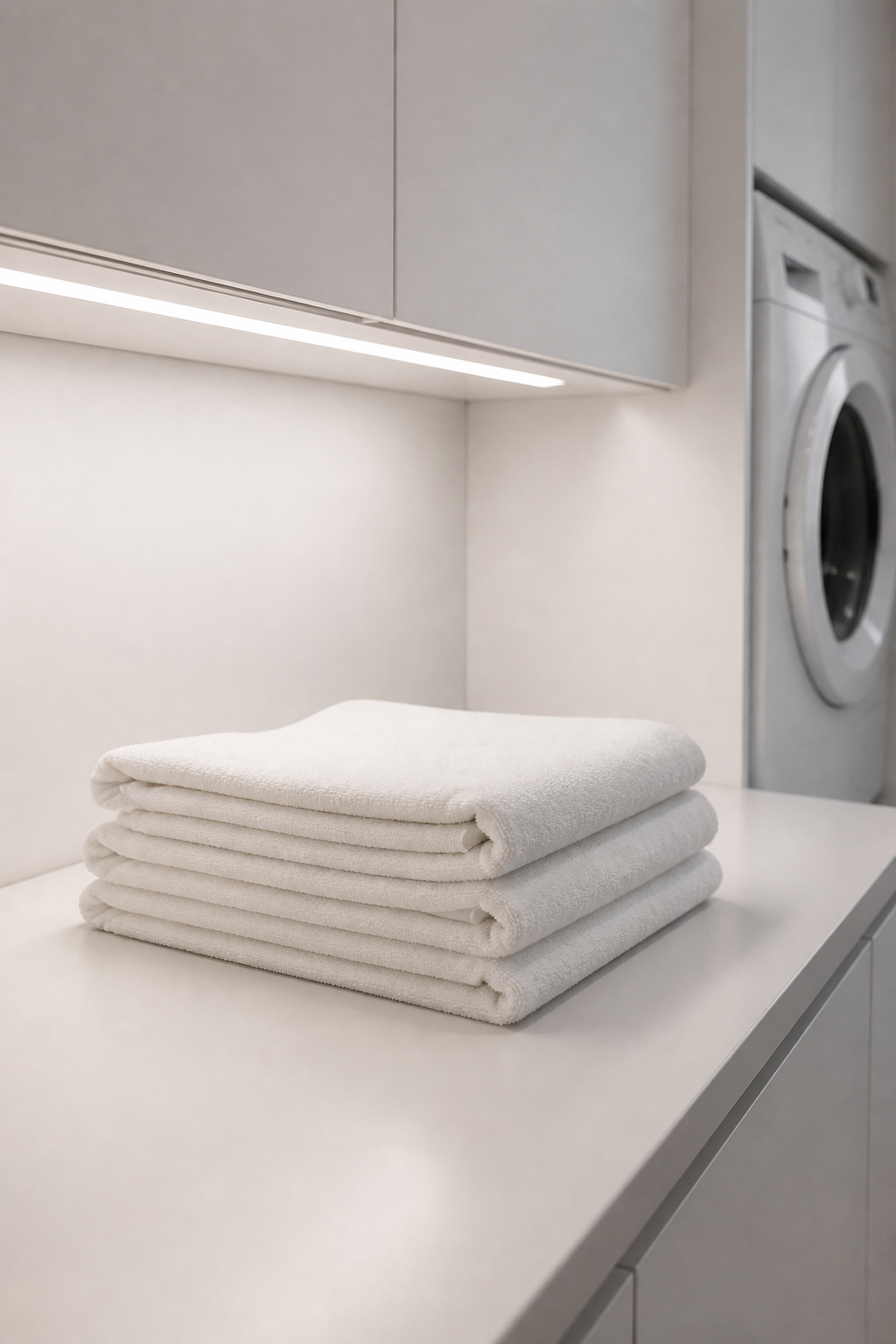
Where task light matters most — over the counter, at the machine, at the sink
Three zones earn focused light: the folding and sorting counter, the front of the machines for loading, and the sink for stain treatment. Each wants 500–1,000 lumens of its own, on top of the room’s general light. The classic mistake is a single recessed downlight at the ceiling centre — you stand between it and the counter, and your own shadow falls across the work. Put the light where the work happens, not above your head.
Colour temperature for a laundry: why 4000K beats 2700K over a work surface
Over a work surface, reach for 4000K — cool-neutral white. It mimics daylight, renders fabric colour accurately, and makes faint stains and similar tones readable. A warm 2700K bulb, lovely as it is elsewhere, slightly distorts colour: it suppresses the blue wavelengths you need to catch yellowing in whites and can make you misjudge a shade. Colour rendering matters as much as temperature. For accurate fabric work, CRI 90 is the minimum I would specify — below that, subtle stains and white tones get misread.
| Light position | Recommended CCT | Fixture type | Notes |
|---|---|---|---|
| Folding / sorting counter | 4000K | Under-cabinet LED strip | Shadow-free; CRI 90+ |
| Sink (stain treatment) | 4000K | Recessed or wall light | IP44 minimum near water |
| Machine front (loading) | 4000K–3000K | Surface ceiling fixture | General reach, not detail |
| Ambient ceiling / pendant | 2700K | Pendant or flush mount | Warm, on a dimmer |
If you read one row, read the first: a cool-neutral under-cabinet strip at the counter is the change that makes the room work.
Under-cabinet LED strips versus recessed ceiling light — which actually works
For the folding counter, an under-cabinet LED strip beats everything else. It sits above and in front of the surface, so it casts no shadow, and it hides behind the smallest cabinet lip. At 200–500 lumens per foot it delivers clean, even light exactly where your hands are. Recessed ceiling lights are the foundation; the strip is the finishing touch that removes the counter shadow they always cast. And if your ceiling is low or concrete, skip recessing entirely — a surface-mounted fixture installs with no ceiling work and is the more sensible choice. Buy the strip rated CRI 90 or better; the cheaper CRI 80 versions cost less and you will see the difference at the counter every time.
Ambient Lighting: Making a Utility Room Liveable
Task light lets you work. Ambient light decides whether you mind being in the room at all. This is the emotional layer, and it is the one that turns a chore space into somewhere you can stand for ten minutes without wanting to leave.
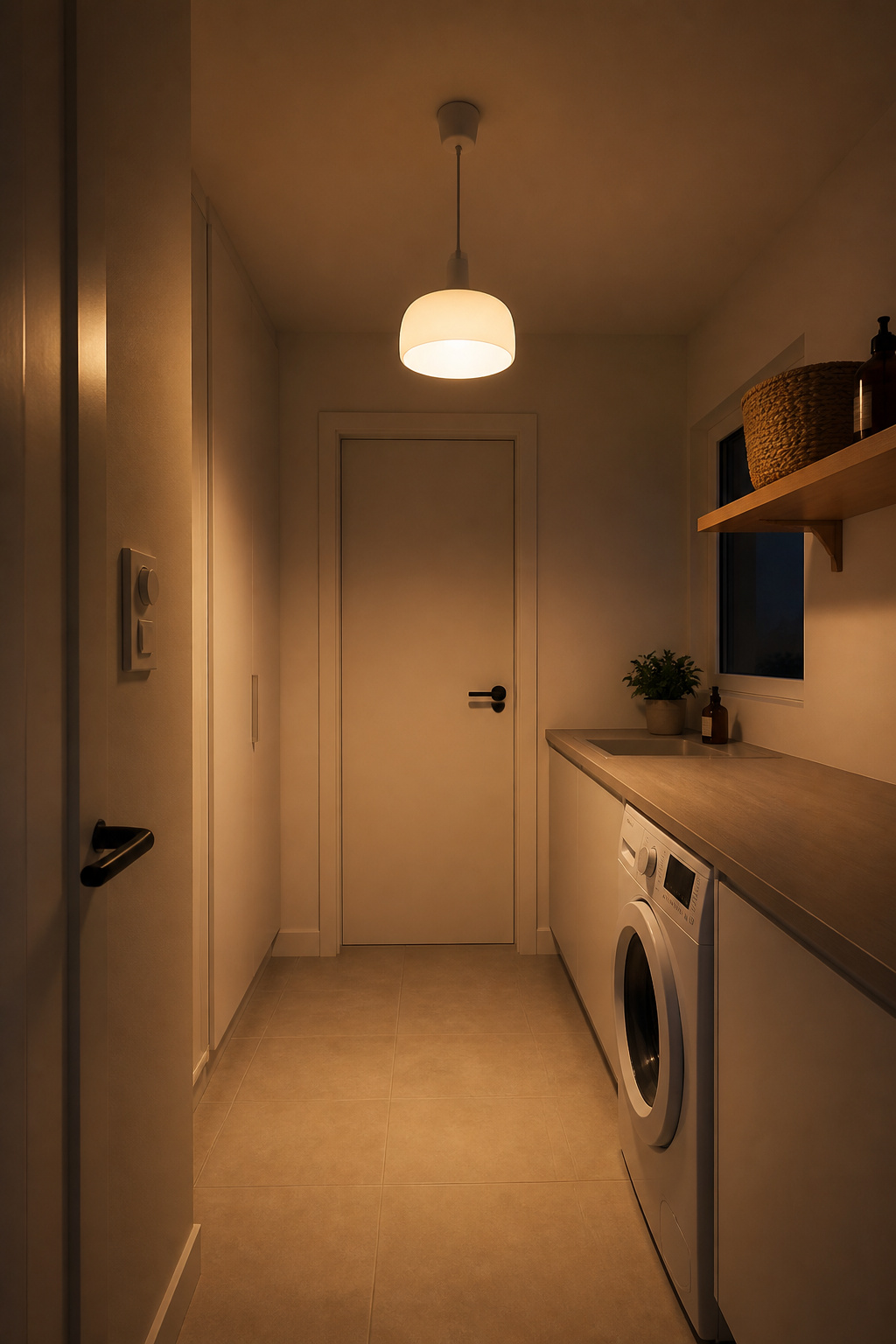
Why ambient light transforms how long you spend in a laundry
Light shapes mood through the body, not only the eye. Warm light in the evening — 2700–3000K — lowers cortisol and helps the brain settle toward rest; cool light above 4000K does the opposite and keeps you alert. A laundry visited at night should not be lit like a clinic. One warm pendant or sconce makes what Scandinavians call a small cave of light: an island of warmth that gives a plain room depth. Cold bulbs and overhead-only light are precisely why a room can feel “off” even when the palette and storage are right.
Warm versus neutral ambient: when 2700K belongs in a utility room
For the ambient layer, stay between 2700K and 3000K. 2700K gives a golden, restful glow; 3000K keeps warmth but adds a little clarity and reads slightly more modern. Go above 3500K here and a Nordic room starts to feel like a waiting room. There is a material reason too: warm light picks up the undertones in oak shelves, linen and seagrass, while cooler light greys them out and undermines the whole palette. So the two temperatures coexist by doing different jobs — 4000K at the counter, 2700K overhead — on separate circuits.
Dimmer switches in a laundry — yes or no, and why
Yes, without hesitation. A dimmer lets the room shift from bright function to quiet calm without changing a single bulb, and Nordic homes rarely use fixed brightness — light should soften as evening comes. One caution: use an LED-compatible trailing-edge dimmer and a bulb actually labelled “dimmable,” or you get buzz, flicker and failure at low load. Dimmed light also draws less power and extends bulb life, which matters in a room where the light stays on through long cycles.
Nordic Fixture Choices: Minimal, Warm, Nothing Surplus
Now the fixtures themselves. The Nordic rule is simple to state and easy to break: choose nothing that competes with the room. Clean shapes, matte or frosted finishes, materials that stay quiet.
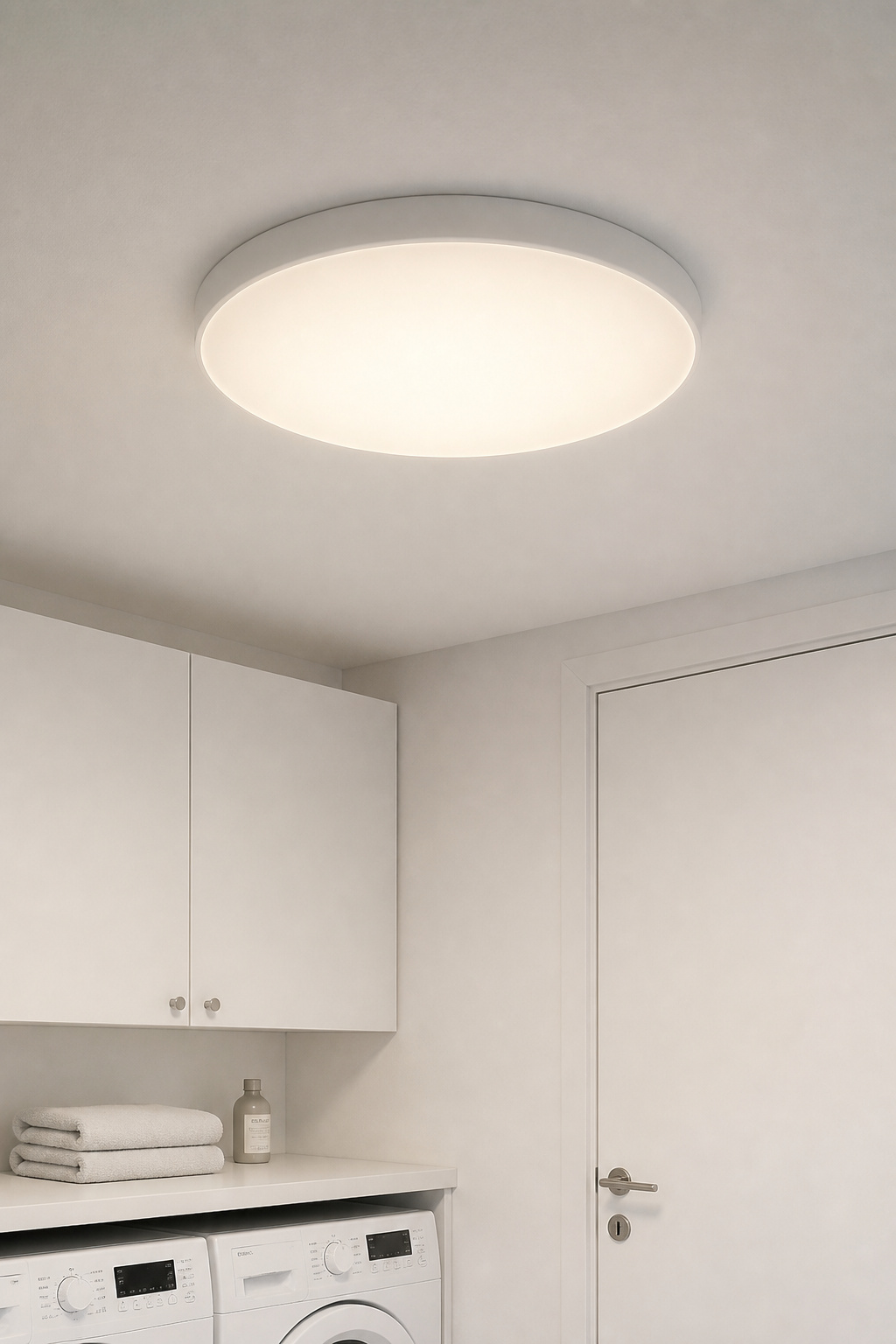
Ceiling fixtures that stay minimal — the Nordic fixture rule
A Nordic fixture works in harmony with the room rather than announcing itself. For a laundry that means a matte-white or brushed-steel flush mount, a frosted glass pendant, or a simple linear LED — nothing decorative, nothing that fights the material palette. Frosted glass and matte metal diffuse light softly instead of throwing glare or hard beam edges, which is the whole point. And resist the exposed-filament Edison pendant: it is too warm, too industrial, and wrong for a working room.
Surface-mounted versus recessed: what the ceiling height decides
Let the ceiling decide. Where recessing means cutting into concrete, a rented ceiling, or shallow joists, a surface-mounted or flush fixture is the practical winner — no structural work, lower cost, clean result. Recessed downlights suit a standard drywall ceiling where you want an unbroken plane, but only if you offset them from the counter so the beam lands on the work, not behind you. A dimmable Nordic linear light in surface-mount form gives you the clean look without the ceiling surgery.
IP ratings for laundry rooms — what the damp zone requires
A laundry is a damp room, and fittings near water need to be rated for it. The rule is short:
- IP44 — the minimum, everywhere in the room. Protects against splashes from any direction; right for general ceiling and wall fittings exposed to steam or the odd splash.
- IP54 — a step up near appliances. Adds dust protection; a sound choice for ceiling lights close to the washer and dryer.
- IP65 — directly above the sink or loading zone. Dust-tight and protected against water jets; also the choice if you ever hose or steam-clean the room.
One trap to avoid: IP44 is splash-proof, not waterproof, so do not site it where it takes sustained directed water. UK wiring rules also call for 30mA RCD protection on circuits serving rooms with water — worth confirming with your electrician. This layered-light thinking scales up to a whole-room space too, such as a mudroom-laundry layout, where the same fixtures set the mood across a larger floor.
The Room the Light Makes
Pull the three layers together and the room changes character. The principle I keep returning to is simple: light placed with intention, not light everywhere. A single pendant in the right position, a strip at the counter, a window left unobstructed — these three things do more than a dozen ceiling cans ever could. Surplus light does not make a room better. It makes it loud.
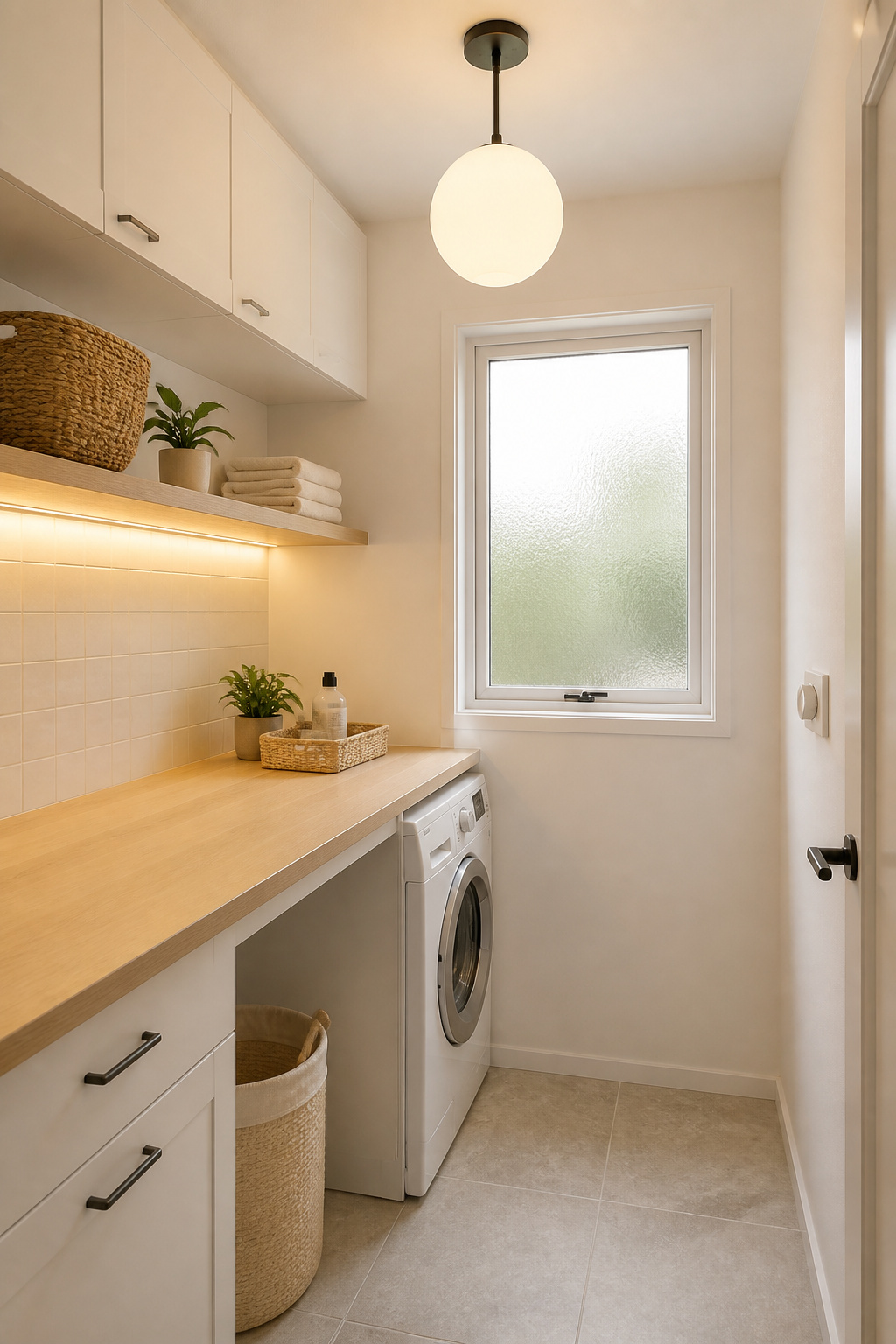
How natural, task and ambient layers work together rather than compete
Each layer keeps its own job. Natural light carries the daytime and ties the room to the world outside. The 4000K counter strip gives accuracy for sorting and stains. The 2700K ambient layer sets the register — the sense that the room is worth being in. Mixing warm and cool light at random reads as confusion, but here the split is spatial and deliberate: cool at the counter, warm overhead. The two temperatures serve the palette as much as the task — cool light reads whites truly, warm light animates the wood and linen.
The one lighting decision that changes a Nordic laundry more than any other
If you do one thing, do this: put a trailing-edge dimmer on the ambient circuit. Scandinavian design sources call it the single rule that instantly improves a room, and it costs as little as £15–£30. It turns a fixed-brightness utility space into one that moves with the day. A close second is swapping a cool fluorescent or 4000K overhead bulb for a 2700K warm-white one — the fastest way to stop a laundry looking, as one writer put it, like a dentist’s office.
Returning to the 7am test — and why it still matters
So come back to that February morning. In a country where daylight can vanish for months, the real test of a room is whether it feels liveable in the dark as much as the light. Stand in the finished laundry before dawn: if the warm overhead glow and the bright counter strip make the room feel calm and purposeful at that hour, the plan has worked. We spend most of our lives indoors, so light is not a small thing — least of all in a room you enter every day. Get the three layers right and the laundry stops being somewhere to escape and becomes, quietly, a room the light has made worth standing in. How that light pairs with the wider scheme comes down to choosing the colour palette the room is built on.
FAQ
What colour temperature is best for laundry room lighting?
Use 4000K cool-neutral white for task lighting over the folding counter and sink — it mimics daylight, renders fabric colours accurately and makes stain detection reliable. Use 2700–3000K warm white for the ambient ceiling or pendant layer, which animates natural materials and feels habitable. Choose CRI 90 or above for any task light.
Do I need an IP-rated light fitting in a laundry room?
Yes. A laundry is a damp indoor area where steam and splashing from washers, dryers and sinks are routine, so any fitting within splashing distance should be IP44 minimum. IP44 resists splashes from any direction; IP54 adds dust protection; choose IP65 directly above a sink. UK wiring rules also require 30mA RCD protection on these circuits.
How can I brighten a laundry room with no windows?
A frosted glass interior door is the cheapest route, borrowing light from an adjacent lit room without losing privacy. A Velux Sun Tunnel routes daylight from the roof through a reflective tube — a 14-inch model lights up to 300 square feet. Otherwise, use high-LRV satin paint, gloss tiles and 2,000–4,000 lumens of layered artificial light.