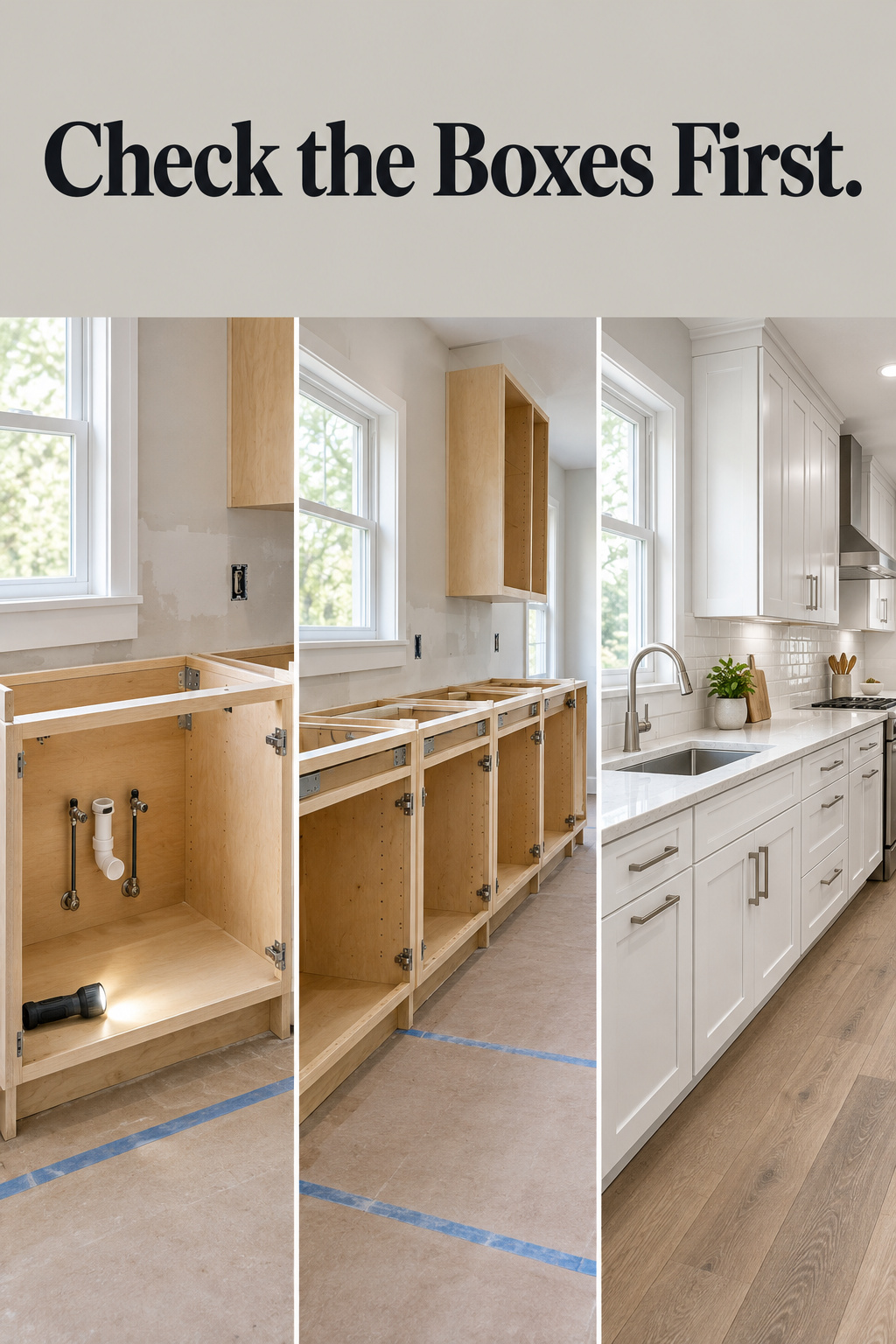
Three hours. That’s how long a one-hour shelf took at my neighbor’s place, because the stud finder was wrong twice. My neighbors call me when something falls off the wall, and that job left me with the rule I bring to anyone deciding whether to reface or replace kitchen cabinets: check it yourself before you trust the tool, the quote or the cost page. Here that means the boxes, because cost pages average whole kitchens and your boxes decide which route you can take.
TL;DR
- Inspect before you price: press the sink base floor, then check shelves, hinge screw holes, drawer runners and face frames, and measure both diagonals of a box with the door off.
- Sound boxes get paint ($200 to $600 in supplies for an average kitchen, or $2,000 to $6,500 for a pro), new doors ($2,200 to $6,600) or refacing ($150 to $450 per linear foot).
- Replace only boxes that have failed (water-swollen, racked or crumbling) or a layout that has to change, and sometimes that means replacing just the sink base.
The box inspection that picks your route
Pull the doors you can, grab a flashlight and a flat screwdriver, and work in this order.
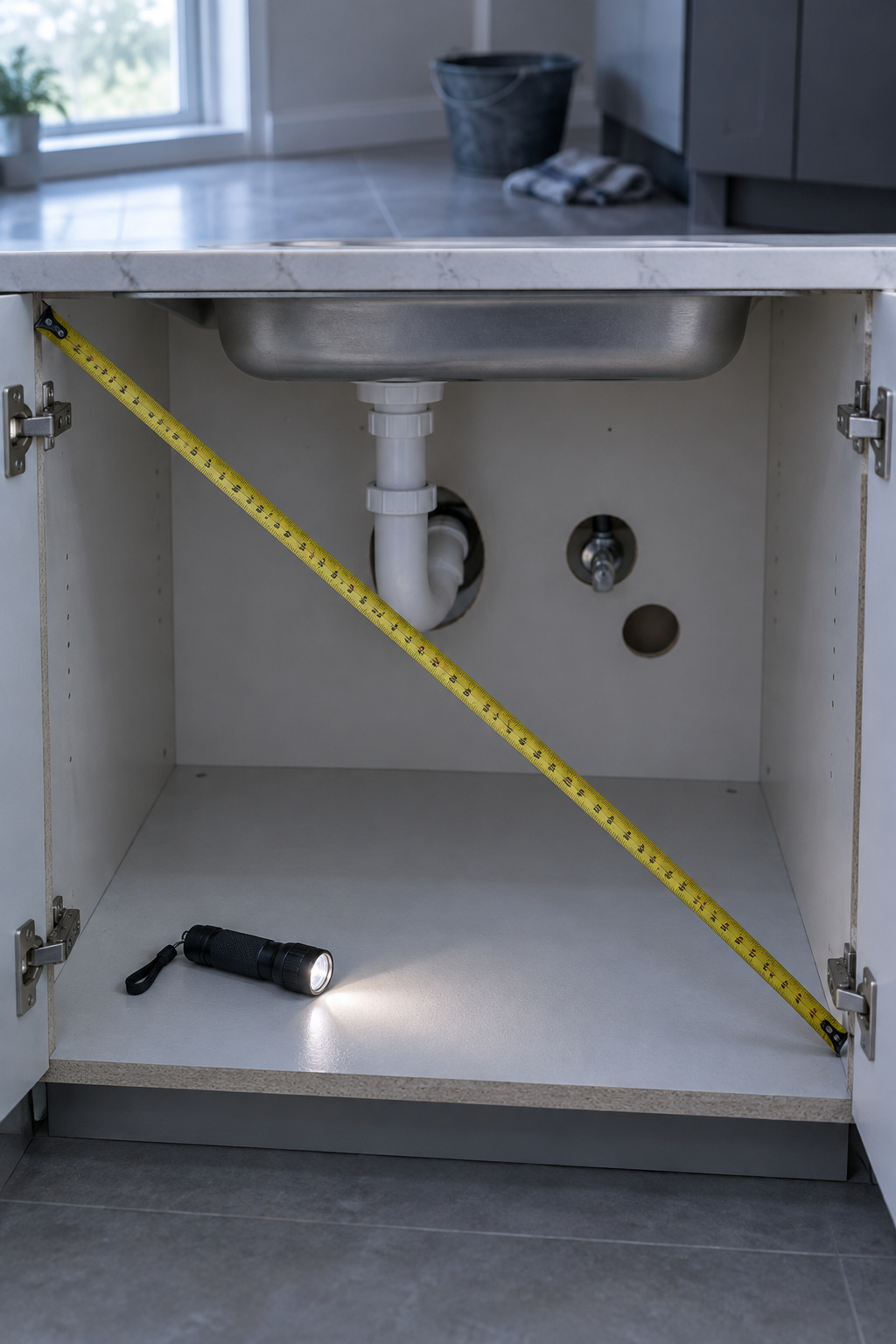
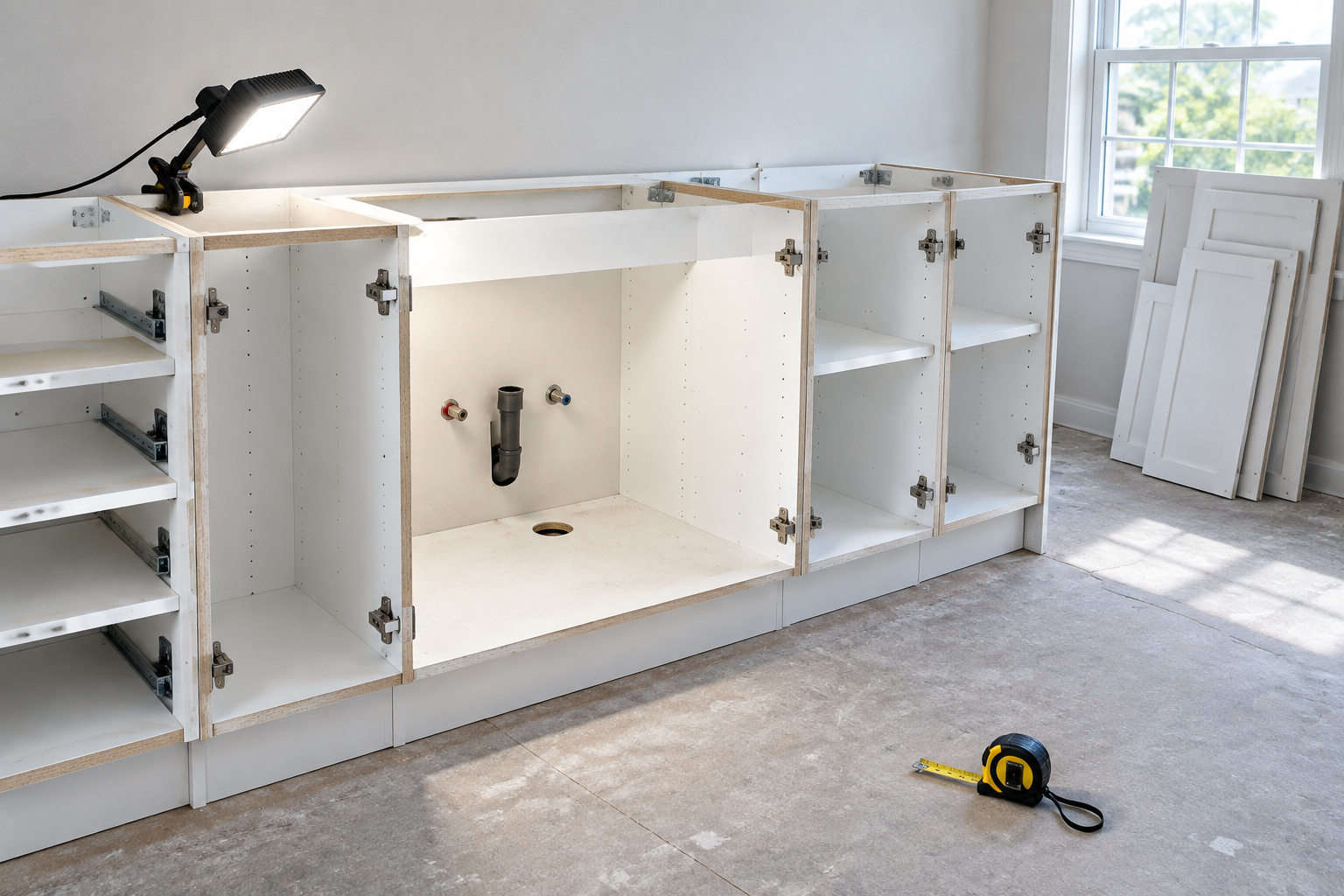
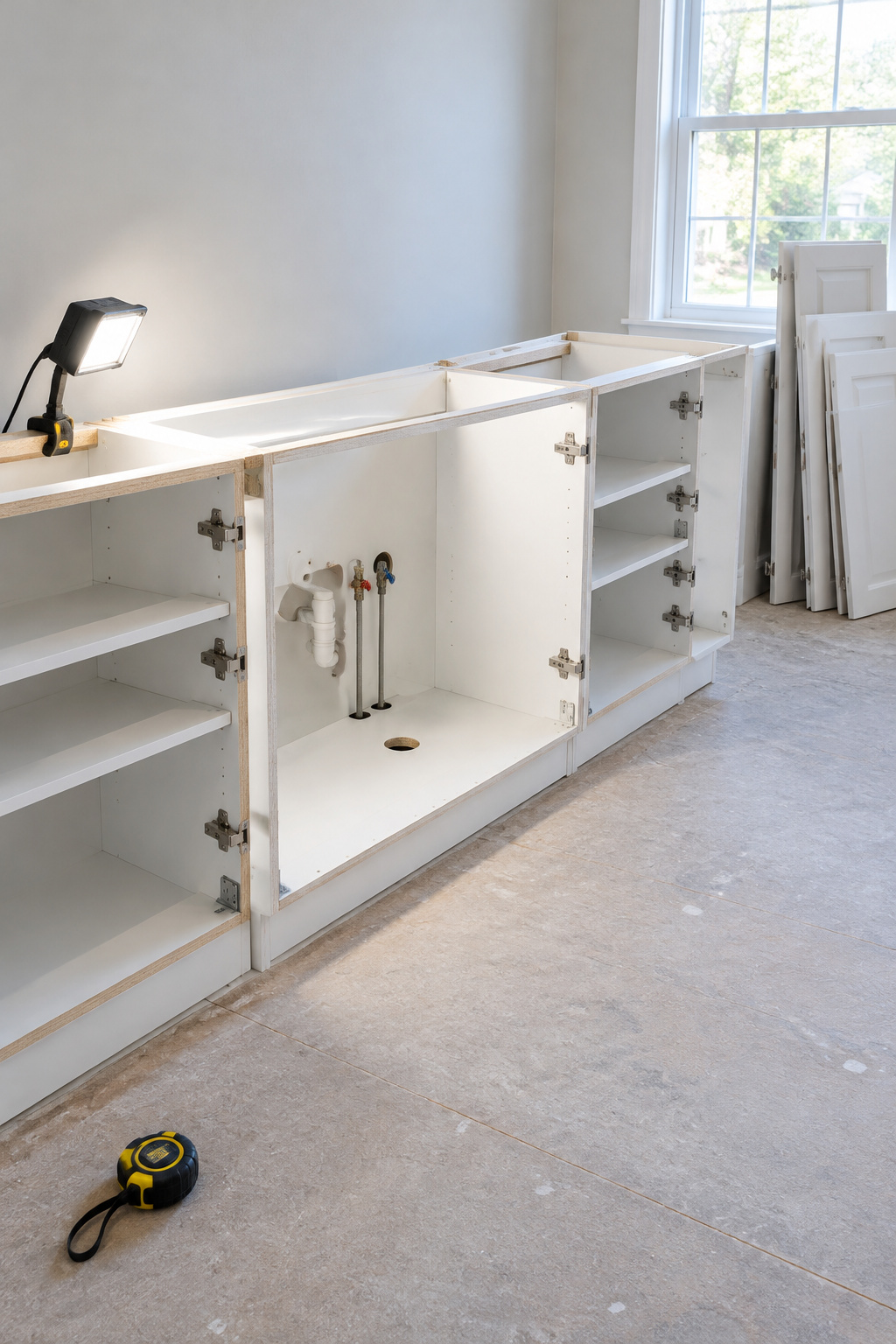
- Empty the sink base. Light up the floor, back corners and bottom edges of the sides, then press the floor around the drain and supply lines. A dark ring, a bulge or a spot that gives means water got in.
- Sight along every cabinet floor and shelf at eye level. One bowed shelf under the canned goods is a cheap fix; a bottom that dips or has pulled away from the side means the box has stopped holding its shape.
- Test the hinge screws. Back one out and drive it back by hand. If it spins freely through the last half turn, that hole is finished. One dead hole is a repair; dead holes in the third cabinet you check are a pattern, and those boxes won’t hold new hardware.
- Pull each drawer all the way out. Runners that drop or have torn their screws out mean the side panel is losing its grip.
- Check the front edges. A face frame should be tight and unsplit, and it’s a surface you can cover. Frameless boxes have bare edges, so look for chips and swelling, because new doors sit right on them.
- Press along the inside bottom inch of the side panels, especially by the dishwasher, and look for laminate that has lifted. That rules out refacing: nothing bonds to a surface that has already let go.
- Measure both diagonals of an open box and compare them, then try to rock each upper. A box with clearly unequal diagonals is out of square, and how its door hangs tells you whether that matters. An upper that moves isn’t properly fixed to the wall.
The mistake I see most is checking the cabinets that look worst and skipping the rest. The sink base and the dishwasher side hide the damage, and you find it after the deposit is paid. Don’t lean on the hinge, either: an adjustable one gives you roughly 2 mm on each axis, enough to straighten a door but not a racked box.
A swollen sink base is the one failure that rules out paint and refacing
Particleboard and MDF floors drink water and swell, sometimes with no change you can see on the face. The signs are a floor that feels like cork, a mushroomed or crumbling edge, finish peeling near the bottom, doors that stopped closing and a musty smell that outlasts cleaning. Push the screwdriver into the back corners: sound board pushes back, and board that dents or flakes is done.
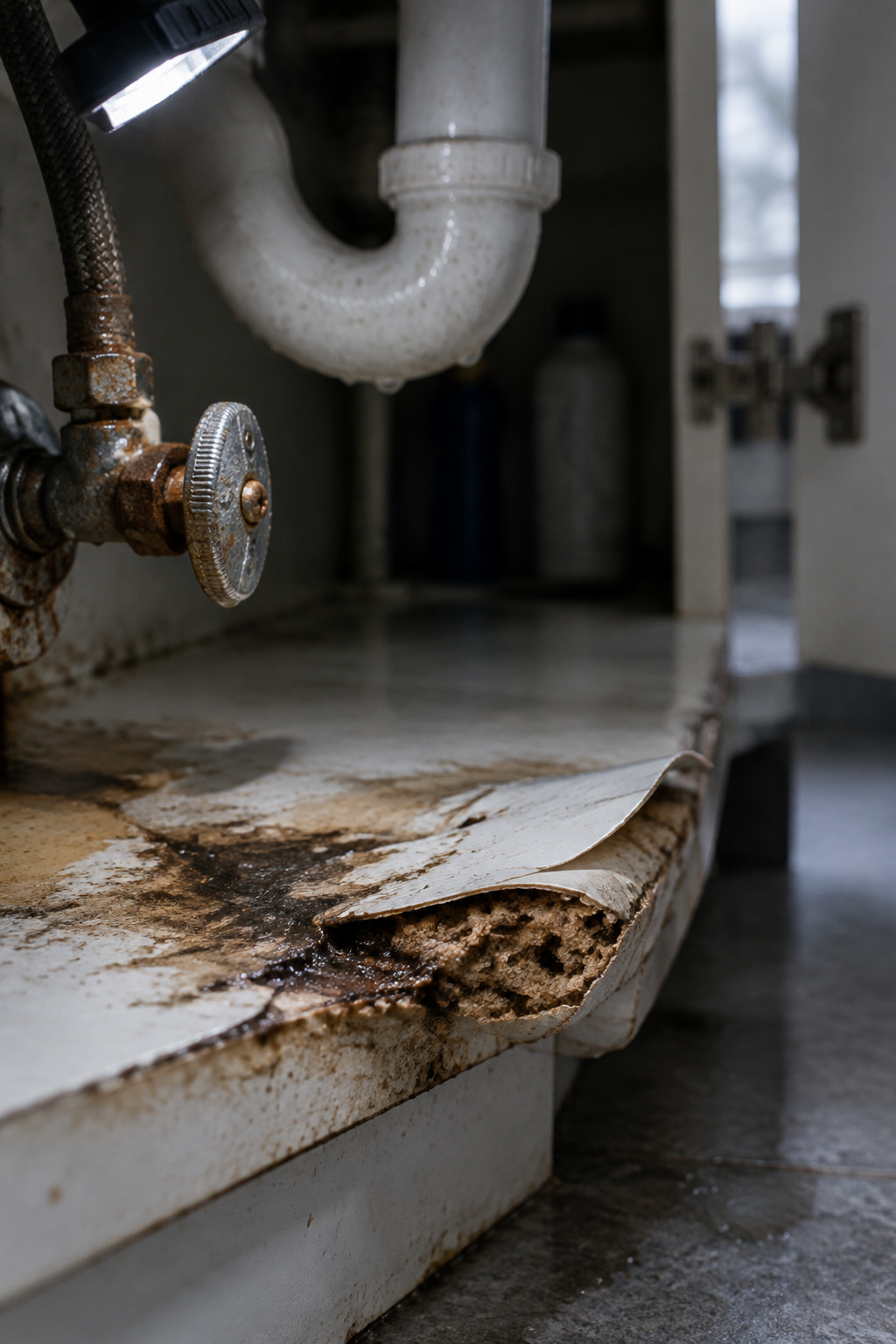
Drying won’t save it. Once water breaks the resin bond, swollen board stays fat and weak however dry it gets, so that box can’t be refaced, and paint or veneer over it is a skin on a failed core.
If only the floor is gone and the sides stayed dry and square, cut out the middle about 3 inches in from each edge and screw in a new 1/2-inch exterior-grade plywood floor sealed with urethane. If swelling has climbed the sides or back, replace that one cabinet; it’s screwed to its neighbors, so the rest of the run can still be painted or refaced. No cost page prices a single sink base, so get it quoted as its own line. Fix the leak first, ask for a plywood or moisture-resistant box, and leave the pipe work to a licensed plumber.
Reface or replace kitchen cabinets: what each route costs per door and per kitchen
| Route | Typical cost | What it keeps | Boxes must be |
|---|---|---|---|
| Paint, DIY | $200–$600 in supplies (average kitchen) | Everything | Sound, with sound frames |
| Paint, pro | $2,000–$6,500 | Everything | Sound, with sound frames |
| New doors and drawer fronts | $2,200–$6,600 | Boxes, frames, counters, plumbing | Sound |
| Refacing | $150–$450 per linear foot; most kitchens $4,000–$13,500 | Boxes, counters, usually the floor | Solid enough to take veneer |
| Replacement | Stock $100–$400 per linear foot installed, $4,500–$15,000+; custom $35,000–$60,000+ | Nothing | Anything, or a new layout |
The routes differ in time too. DIY paint is 30 to 60 hours over 7 to 14 days, refacing takes two to five days, and replacement means 2 to 6 weeks on site after 2 to 10 weeks of lead time, and usually new countertops too, because old ones rarely come off intact.
At 20 linear feet, refacing at the 2026 rate of $150 to $450 a foot is $3,000 to $9,000; at 30 feet it’s $4,500 to $13,500. Bob Vila’s older 2024 range runs higher per foot, $210 to $750, though the kitchen totals agree. Refacing a kitchen over 15 years old can add $500 to $2,000 of pre-work.
Price it per door: count the fronts first
Walk the kitchen and count every door and drawer front. Say you get 30. At the $200 to $300 per opening that new fronts cost in a refacing job, that’s $6,000 to $9,000. Divide the pro-paint range of $2,000 to $6,500 by 30 and you get about $67 to $217 a front; DIY paint on $200 to $600 of supplies is about $7 to $20. Your count will differ, so use yours.
New doors are the middle route nobody prices
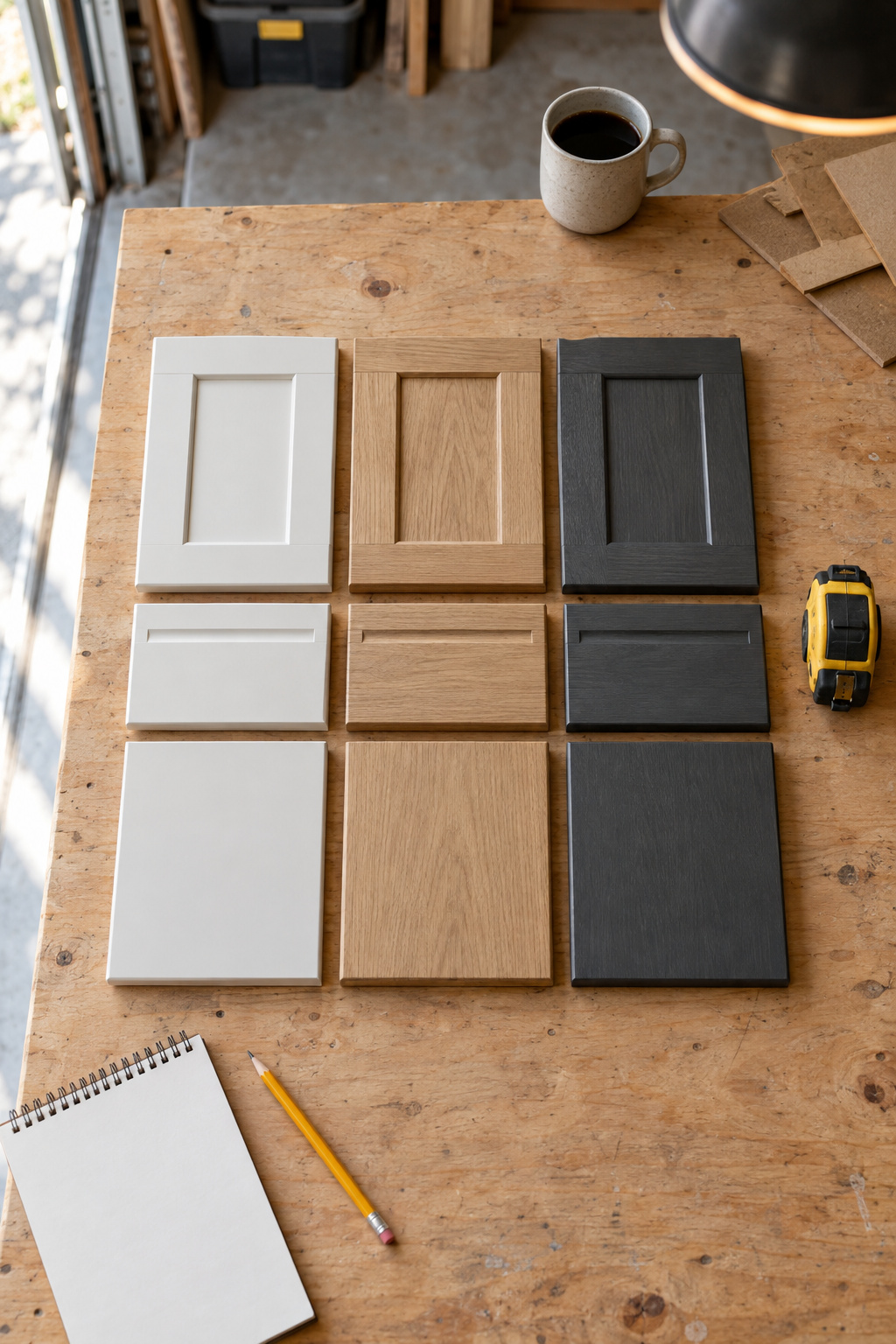
If the boxes are sound and you simply hate the doors, new doors and drawer fronts run $2,200 to $6,600, plus about $200 to $600 of installation when the boxes are in good shape. The difference from refacing is the frames: refacing veneers frames, side panels and toe kicks, while new doors leave the frames in their old finish. Door style is covered in choosing replacement Shaker doors.
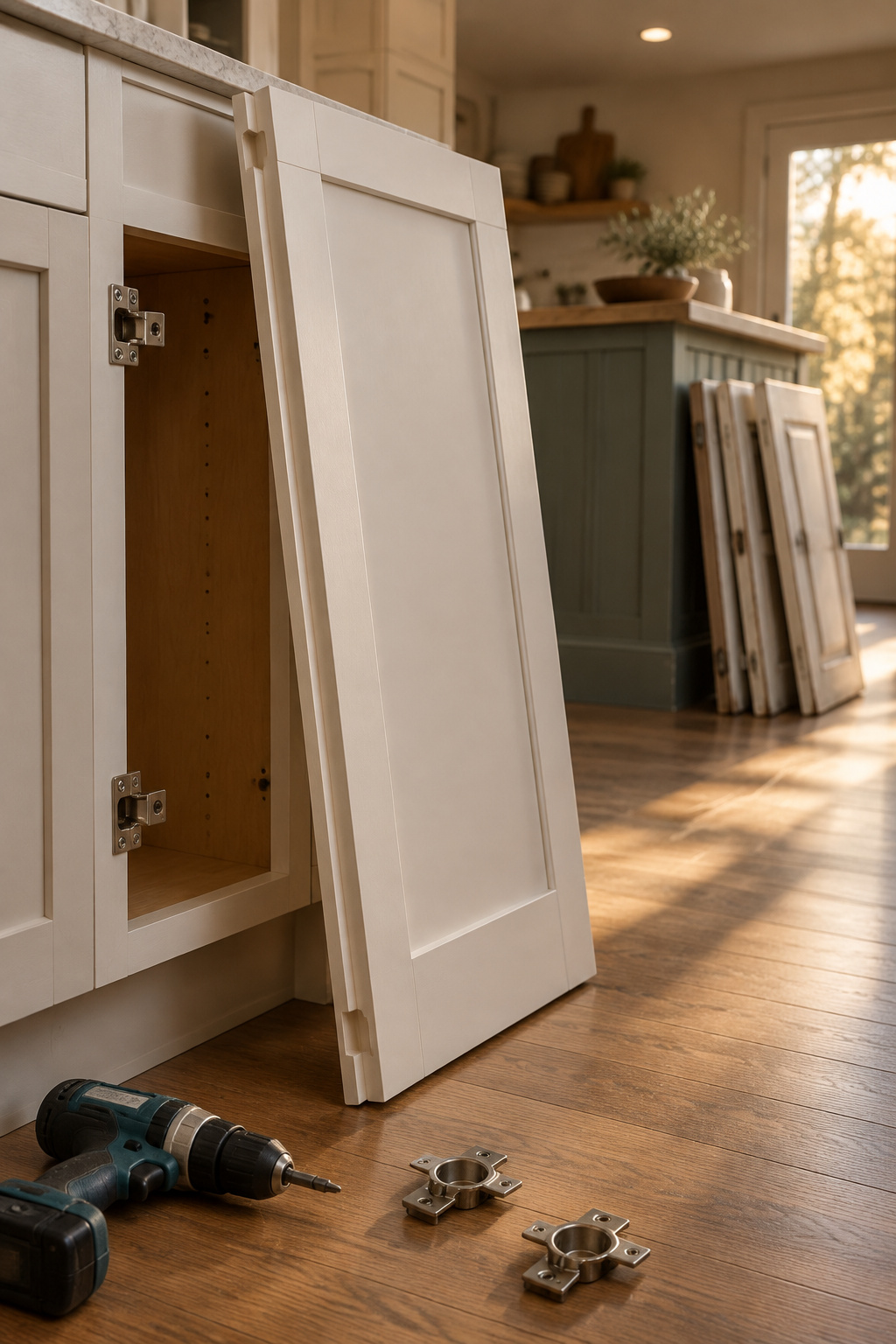
A standard overlay door covers 1/2 inch of frame on every side, so the door is the opening plus 1 inch each way. For a pair on a 28-inch opening, add the inch and halve it: 14.5 inches each, less a sixteenth for the gap. Match the door overlay to the hinge overlay.
Before ordering, write down each opening, measured twice to 1/16 inch, width before height, because a transposed pair is the most expensive typo in the job. If you’re reusing hinges, measure the door instead, including the top of the door to the center of every hinge cup and the cup size (35 mm set 3 mm from the edge is standard). If you’re fitting new hinges, measure the opening and work the door out from it. Frameless boxes often need new hinges or custom boring. Measure every door. Don’t measure one and multiply.
What thermofoil and laminate doors force on the decision
Thermofoil is thin PVC film pressed onto an MDF door, and heat and steam loosen the glue, which is why it lets go above the coffee maker and toaster oven first. One or two small lifts on a flat core can be reglued with contact cement. Lifted corners across the kitchen, or bulged MDF, won’t stay fixed.
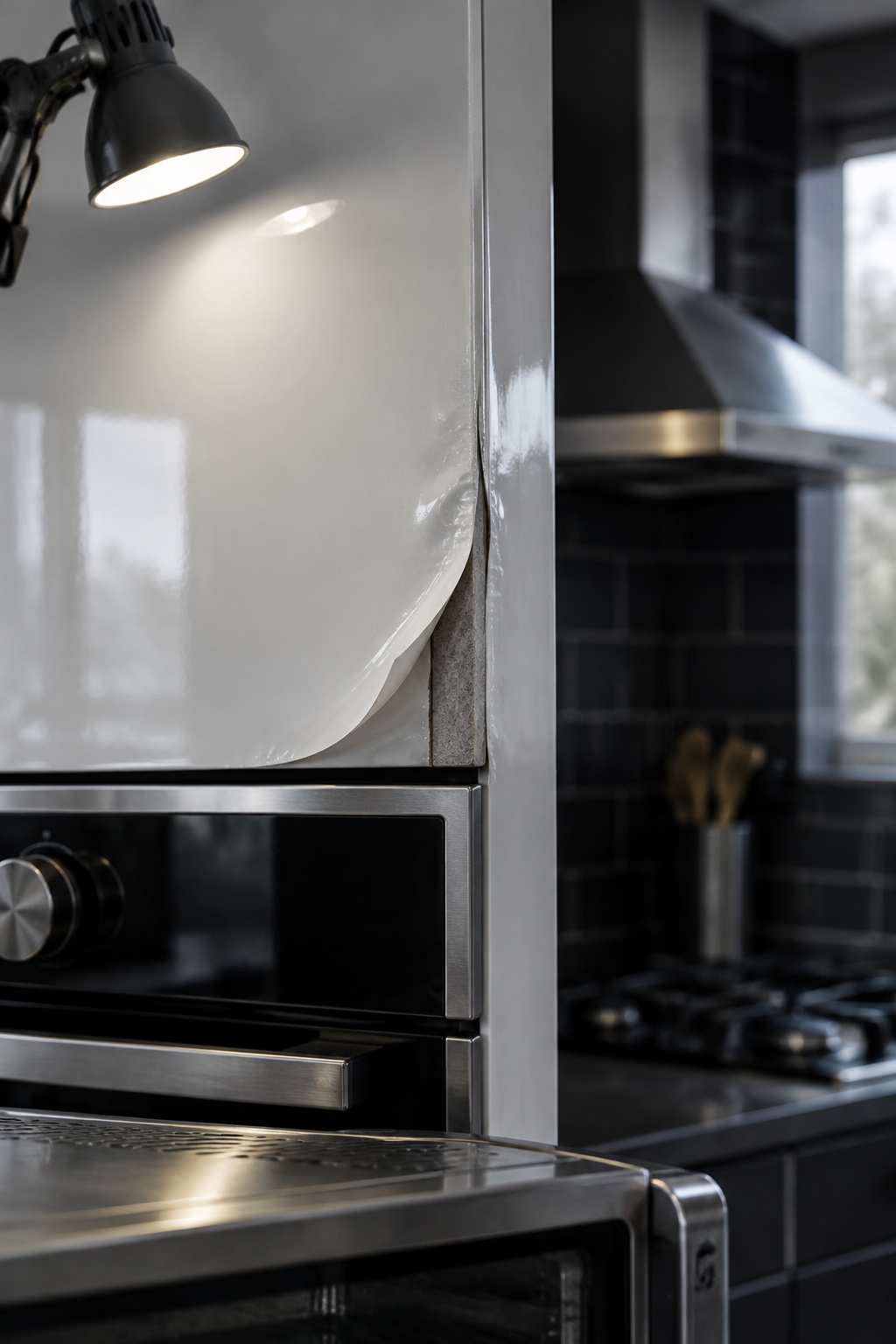
So the doors go, and the boxes decide how. On sound boxes, new doors or refacing both work. Move small heat appliances away from the new doors. Laminate lifting on a door is a door problem, but laminate lifting on the box by the dishwasher is a box failure and sends you back to the inspection. White thermofoil that has yellowed rather than peeled is a different diagnosis, covered in the guide on why white cabinets turn yellow.
Layout, not finish, is the only other reason to replace
Paint, new doors and refacing all keep every cabinet where it is. If the sink moves, the run changes or the cabinet sizes have to change, you need new boxes whatever shape the old ones are in. A bigger sink can force it too: an apron-front sink needs a base at least 3 inches wider than its nominal width, so a 30-inch sink wants a 33-inch base. If moving the range means moving a gas line, call a pro, however good the video looked.
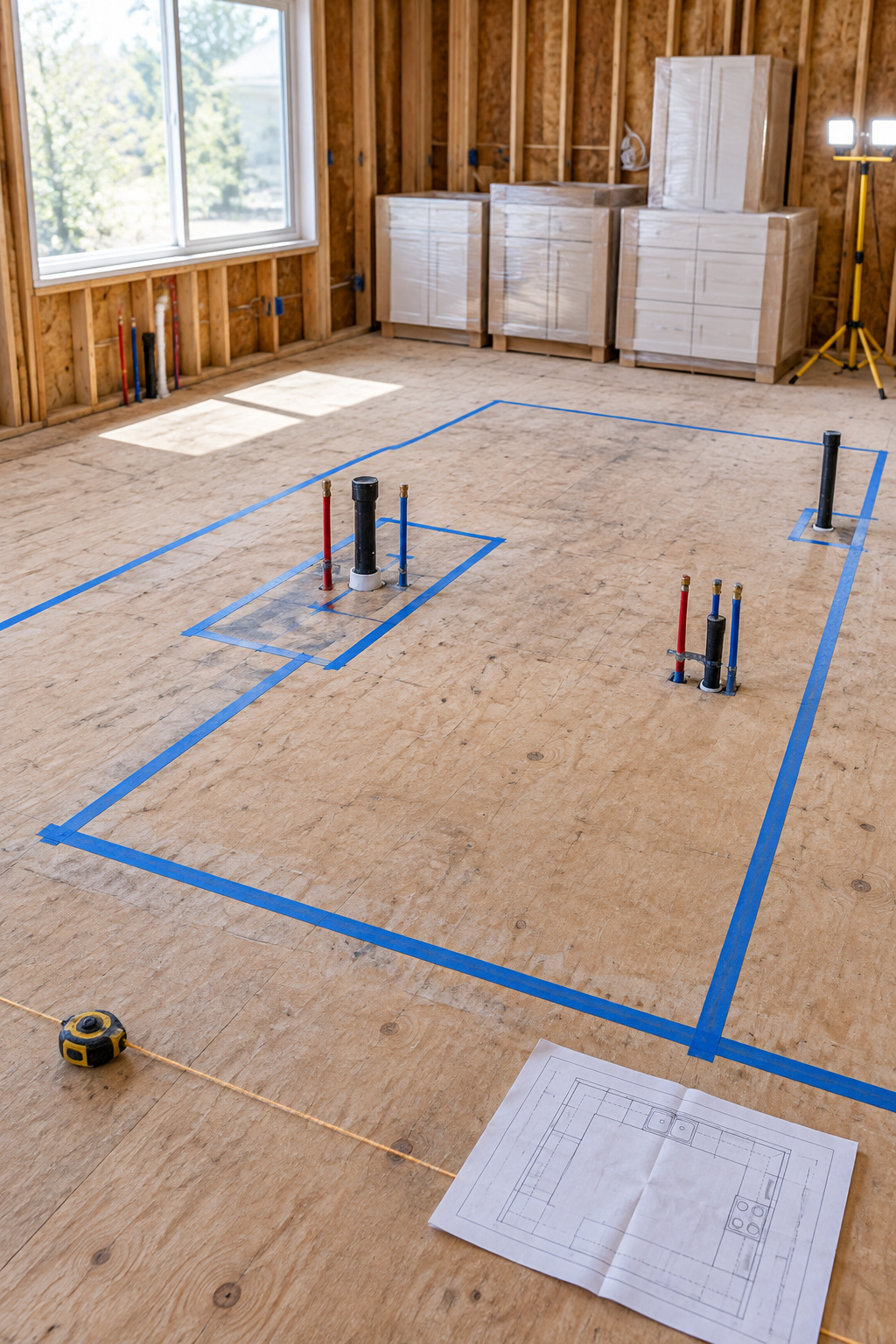
If the layout stays, the inspection decides, and the rule fits on a sticky note. Sound boxes, tired finish: paint. Sound boxes, tired or failed doors: new doors or refacing. A swollen sink base: fix or replace that one box and keep going. Racked, crumbling or wet boxes across the run, or a new layout: replace, and budget for countertops. For the rest of the choices in a white kitchen, from door to sheen to shade, start with planning white kitchen cabinets.
Start with the sink base: empty it, press the floor, sight along the shelves and back out one hinge screw. If all three pass, you’ve checked it yourself and know more than any cost page does. If the boxes are oak, the route forks again, because painting oak cabinets you decide to keep has its own catch, and it starts with one test door rather than a whole kitchen.
FAQ
Can you reface kitchen cabinets yourself?
Yes, if you’re a confident builder with time and patience, though Angi calls it possibly the toughest DIY cabinet project. Veneering narrow face frames is fiddly, so practice somewhere hidden first. You’ll need a band veneer trimmer (about $50), a veneer roller ($30 to $40) and pressure-sensitive veneer at roughly $4 to $6 a square foot.
Do the countertops have to come off to reface cabinets?
Usually not. Refacing crews work around installed countertops, and the cabinets and usually the floor stay put. Full replacement is different: it usually means new countertops as well, because old ones rarely come off the old boxes intact. Price any replacement quote with counters included.
Is refacing worth it in a house you plan to sell?
No study isolates refacing, so be wary of anyone quoting a refacing return as fact. The national Cost vs. Value report does show that a minor kitchen remodel, which keeps the layout and the boxes, recoups a larger share of its cost than a major remodel. Fixing what buyers see, on sound boxes, is the safer bet.