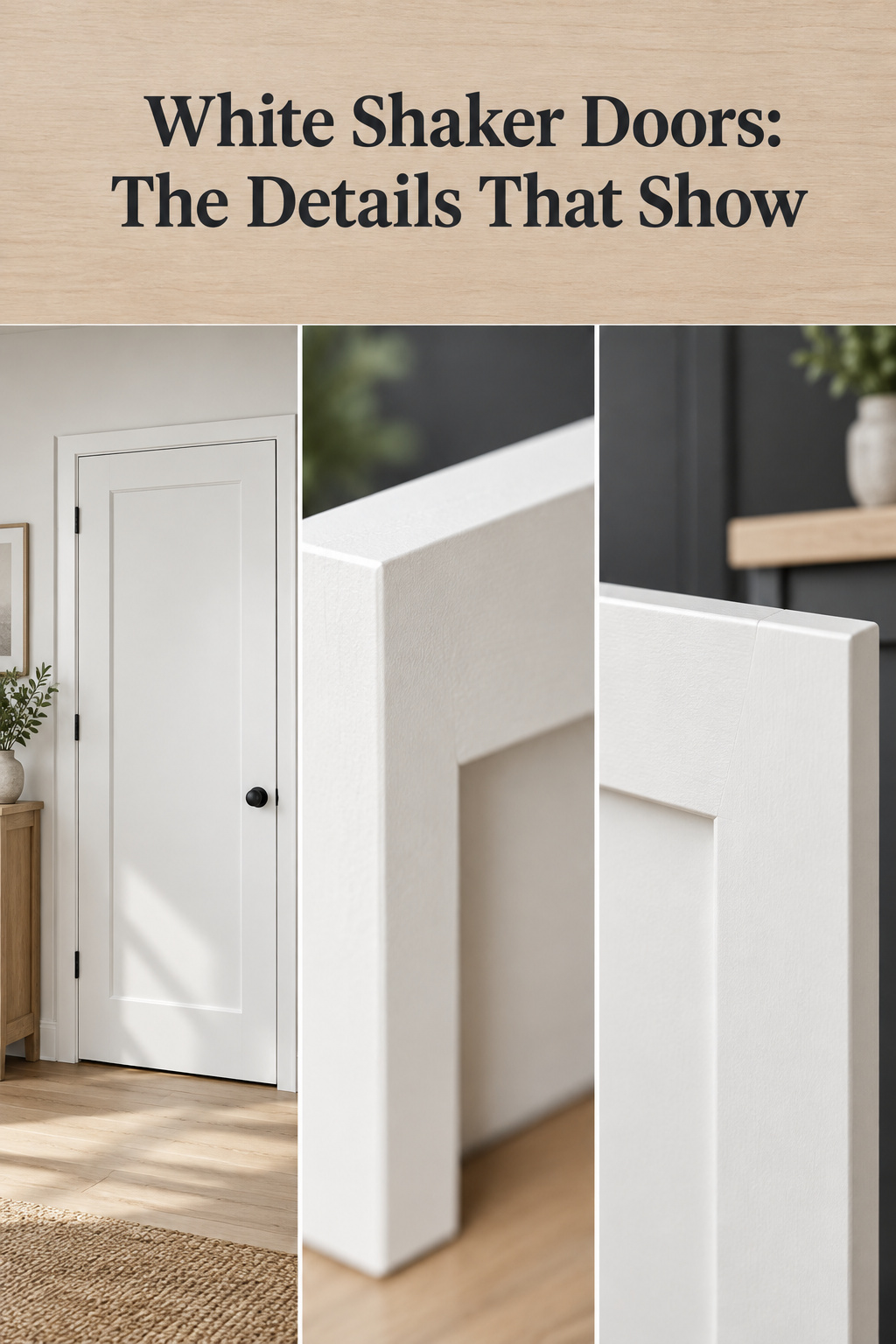
Stand two white Shaker doors side by side, bought at the same price and painted the same white, and why does one look crisp while the other looks a little cheap? White Shaker cabinets are a sound choice for most kitchens, and nothing here should talk you out of them. But white is the least forgiving color a door can wear. It shows how the door sits in its frame, how its inside edge was cut and how its corners were joined, and the catalog photo rarely tells you which of those you are buying. Let’s see what it’s made of.
TL;DR
- How the door sits comes first: an inset door sits flush inside the face frame, partial overlay leaves about half an inch of frame showing, and full overlay overlaps the frame by about 1 1/4 inches. Sellers quote roughly 15 to 40 percent more for inset.
- A square inside edge is the crispest Shaker profile. A bevel or cove softens the door, which is a fair choice if you want soft and the wrong one if you want crisp.
- Five-piece doors can show hairline cracks in the paint where rails meet stiles, while routed one-piece MDF doors have no seam but usually a slightly rounded inside corner, about 1/16 inch.
Inset, full overlay or partial overlay: how the door sits decides how Shaker it looks
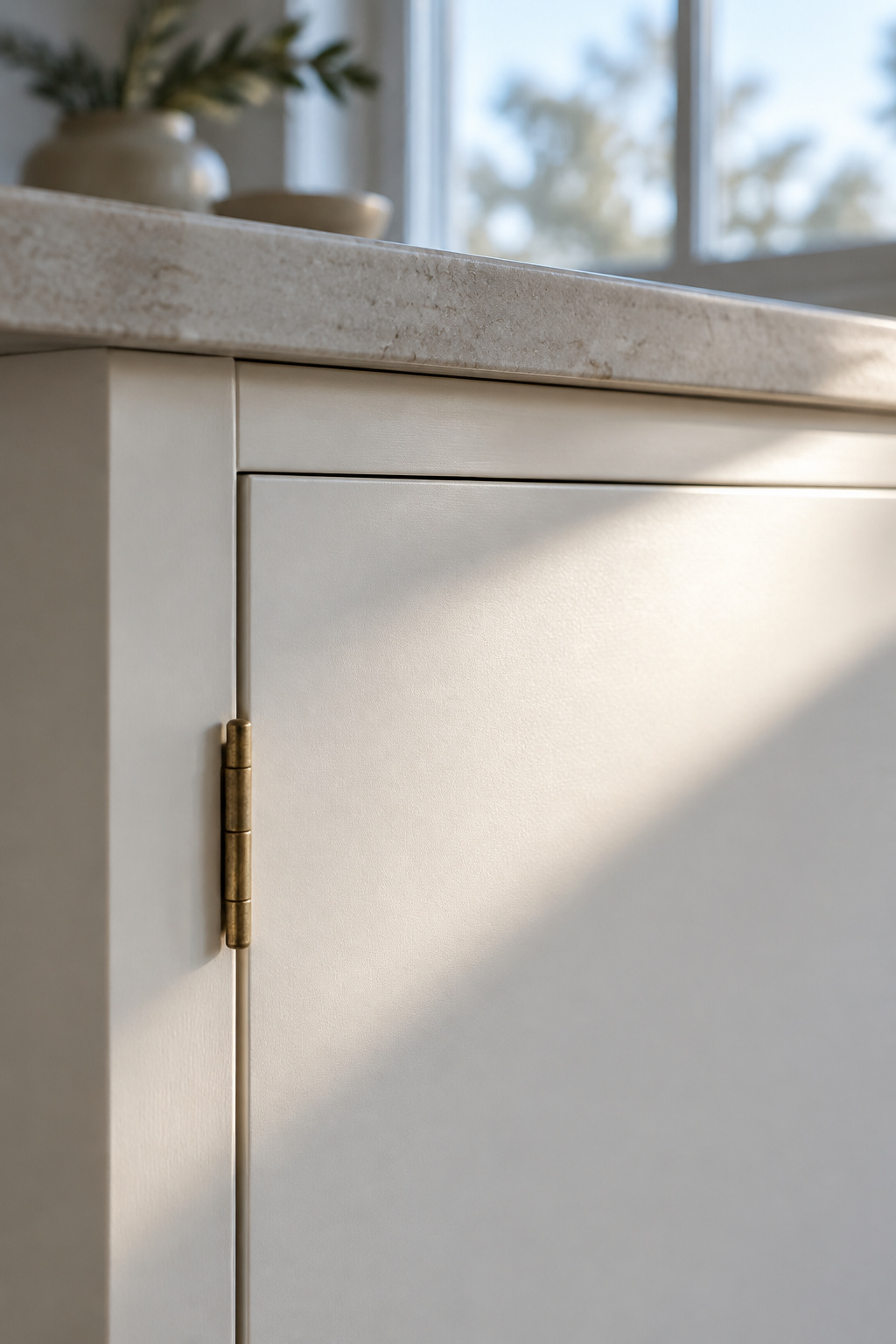
A white door gives the eye no grain and no color to wander across, so what you read is the line around it, and that line is set by how the door sits on the cabinet. An inset door sits inside the face frame, flush with it. An overlay door sits on top of the frame: partial overlay leaves about half an inch of frame showing, and full overlay covers nearly all of it. If you are still choosing between Shaker, slab and raised panel, start with the wider field of door styles for a white kitchen.
| Construction | How the door sits | What the eye sees in white | Relative cost |
|---|---|---|---|
| Inset | Flush inside the face frame | One even gap around every door, and any error in it | Highest; the extra is mostly fitting labor |
| Full overlay | Over the frame, about 1 1/4 in overlap | Doors running nearly edge to edge, little frame | Between the two |
| Partial overlay | On the frame, about 1/2 in of frame showing | A band of frame around each door | Lowest |
I would pick inset, with one condition: a fitter who has hung it before. Sellers quote roughly 15 to 40 percent more than comparable overlay, nearly all of it labor, fitting each door so the gap reads the same on every side and building the frame square to a closer tolerance. On white, an uneven reveal is the first thing anyone notices. Humid weather can also swell wood enough to make an inset door bind, so expect to adjust the hinges now and then. Without that fitter, I would take full overlay done well over inset done badly.
A square inside edge keeps a white Shaker door crisp
The first Shaker makers left their frames plain on principle. The Millennial Laws of 1821 said that “beadings, mouldings, and cornices, which are merely for fancy, may not be made by Believers.”
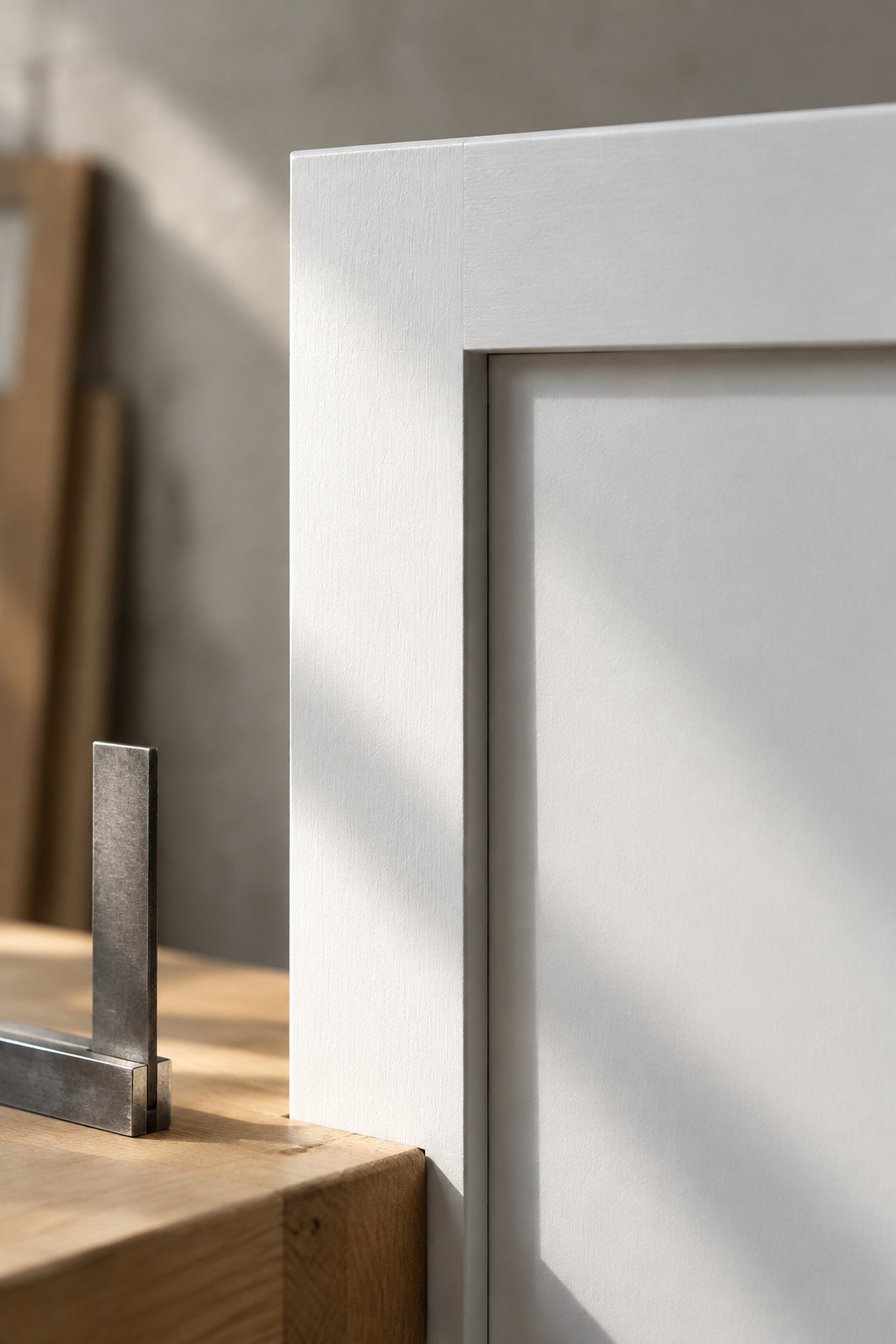
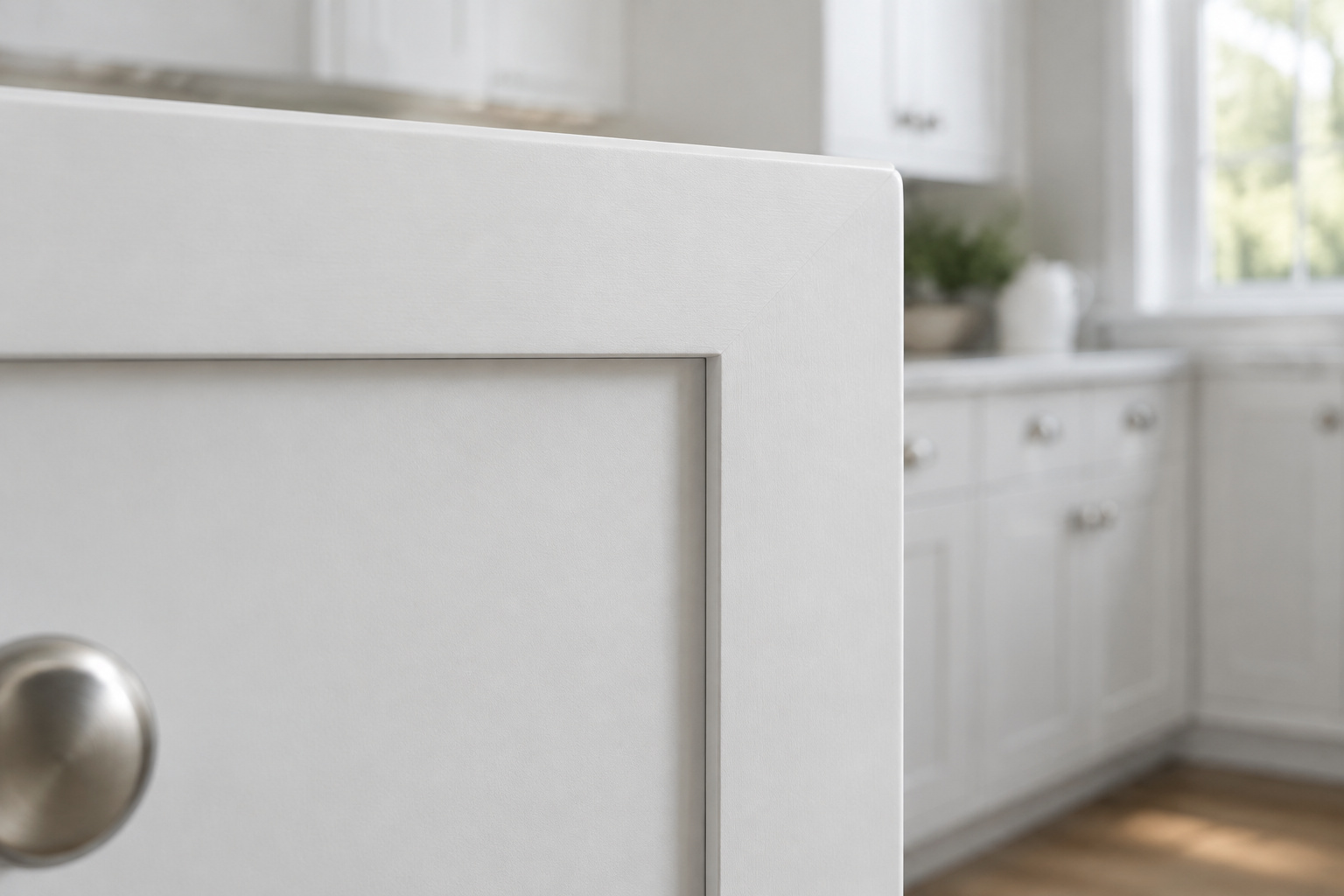
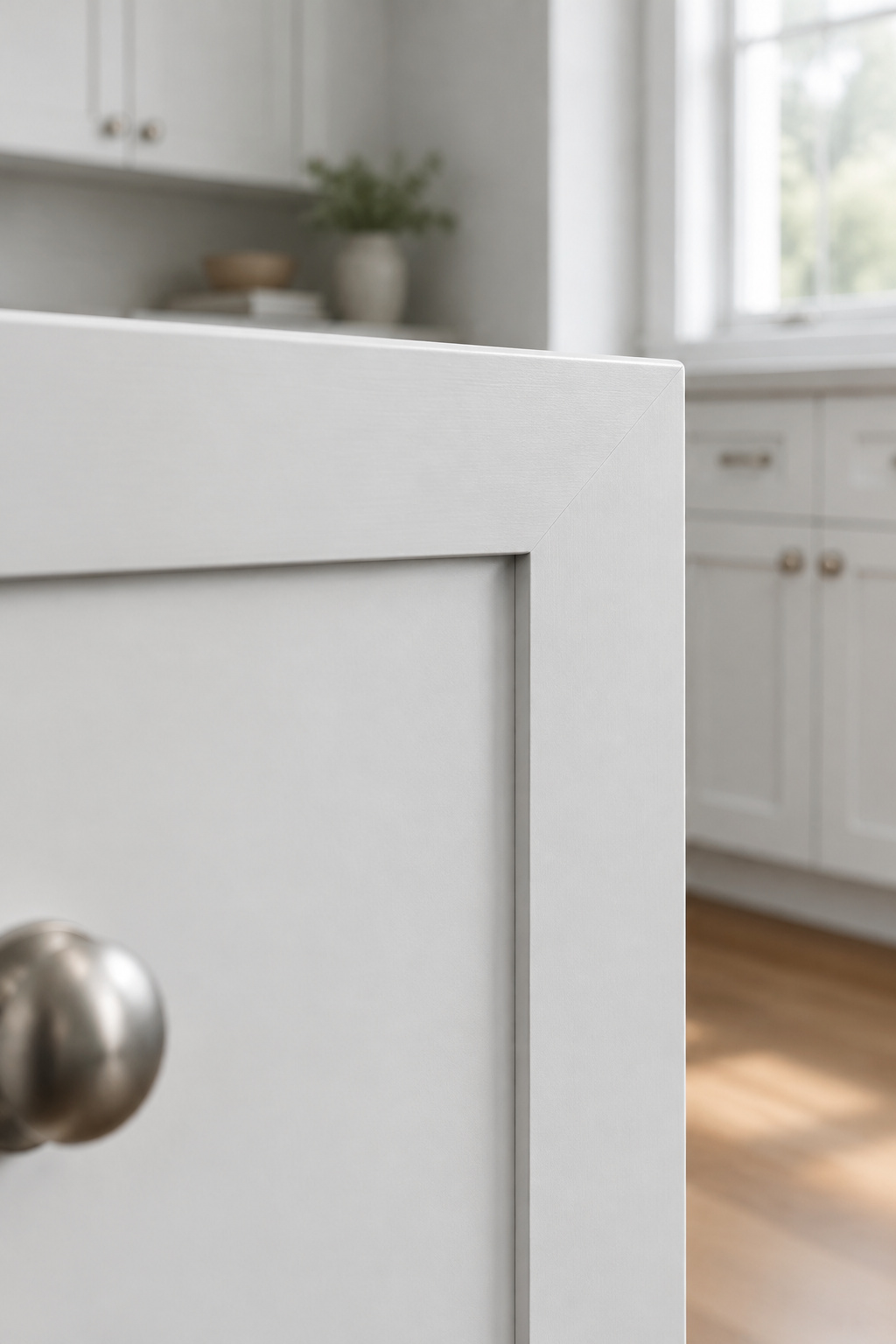
Modern Shaker doors keep that plainness, so between one door and the next the real differences are the width of the frame and the cut of the inside edge where frame meets panel. A square edge is the most severe version; a bevel or a cove softens it. On my bench, a fingertip dragged along that edge gives a white door away first.
In my view, a profiled edge is what tips a white Shaker door toward builder-grade. It isn’t wrong, but if you came to Shaker for crispness, a soft edge works against you, and the sheen on the panel changes how strongly light catches whichever edge you choose. The fair caveat runs the other way: a square edge leaves sharp bottom corners where dust packs in, and some owners pick a slight bevel because it wipes clean more easily.
If your oak doors already have a square inside edge, they may be good candidates for painting oak Shaker doors white.
Five-piece or routed one-piece: what white shaker cabinets show at the joints
A true Shaker door is five pieces: two stiles, two rails and a flat panel set into them. Rails and stiles meet at right angles and move in different directions, so paint bridges the joint, the joint moves, and a hairline appears. Cabinet King calls it a witness line and says owners tend to notice it about a year after install. It is normal wood behavior, not a defect, but a stained door hides it in the grain and a white one shows it plainly.
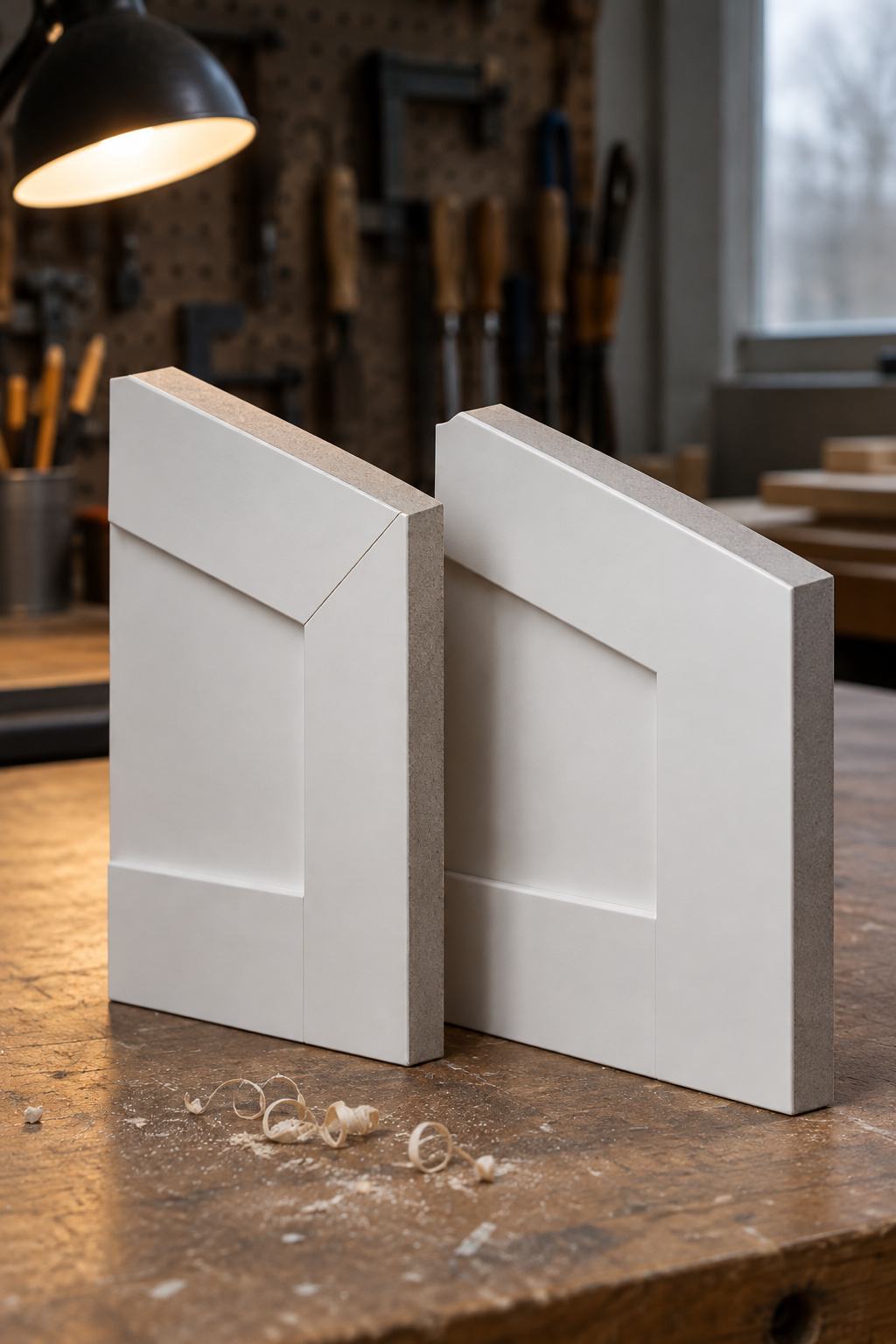
Mitered frames crack more than mortise-and-tenon. The old construction is better for physical reasons: the panel floats in its groove rather than being glued, so it can swell and shrink without cracking the frame or pushing it out of square. I would rather touch up a hairline now and then on a door built that way than own one that fights itself every winter.
The alternative is a one-piece door routed from a single sheet of MDF. With no joints there is no seam to crack. The router bit is round and cannot cut a perfectly square inside corner, so most routed doors come out with a small radius there, typically about 1/16 inch. Some designs are listed square, so ask. If you want truly square corners, five-piece is usually the better fit.
Panel material under paint: MDF, plywood or solid
A solid-wood panel floats so it can move, and when it shrinks in dry weather a thin unpainted strip can appear at its edge. An MDF panel stays put, which is why quality shops so often build painted doors as a solid-wood frame with an MDF center. Plywood divides cabinetmakers; at least one has watched its face veneer bubble under paint.
MDF has one weakness near a sink: water soaking an unsealed edge swells it, mostly permanently. Seal every edge, and touch up a chip near the sink before the water finds it.
Shaker on a budget: the corners not to cut on a white door, and the ones that don’t show
On a white door, spend on whatever the paint will show and save on whatever stays out of sight.
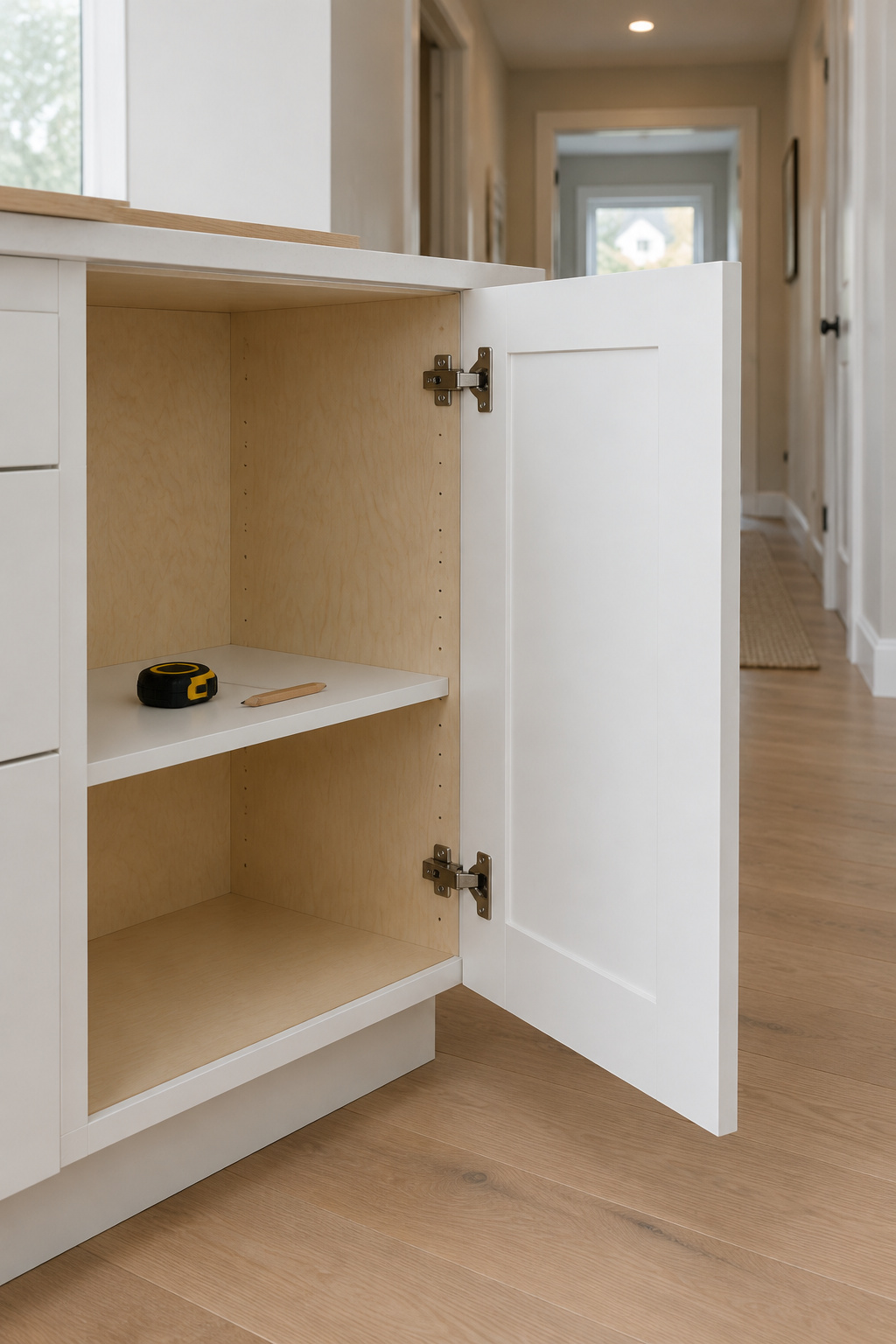
- Spend on the joint, the edge and the panel. A mortise-and-tenon frame cracks less than a mitered one, square or bevel is a factory routing choice you should make rather than accept by default, and a solid-wood frame with an MDF center needs finishing on every face and edge.
- Save on inset where the look allows. Well-fitted full overlay costs less and carries less fitting risk.
- Save where nobody looks: the back of the door and the inside of the box.
There is usually a salvaged door or two in the back of my old pickup. Nobody publishes what a plainer door back or a cheaper box interior saves, so ask your maker to price it both ways.
If your boxes are sound and it is only the look you want, new Shaker doors on your old boxes may get you there without a full replacement.
Why the Shakers mostly used color, and what that does and doesn’t mean for your white
I used to strip every painted door I met back to bare wood, until I learned that some doors were meant to be painted and their bare wood was never meant to be seen. The Met notes that most Shaker pieces were originally painted or stained, and that many now wearing clear finishes were repainted or refinished by later owners.
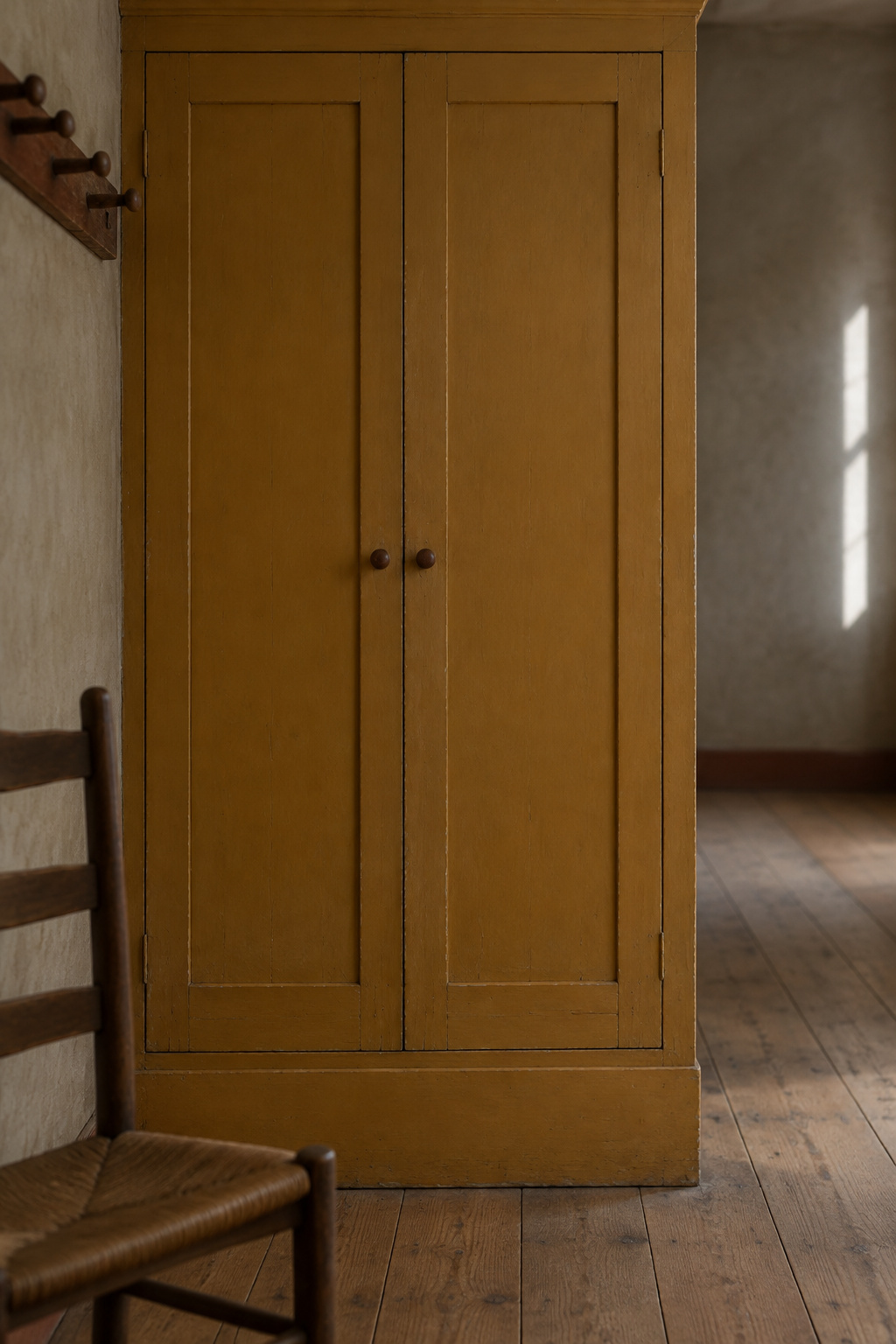
The colors were bold: chrome yellow on built-in cupboards, red ochre on built-ins and furniture, chrome green on bed frames and oval boxes, pigment ground in linseed oil, at its boldest between about 1820 and 1850. White was not absent, though. When the paint conservator Susan L. Buck examined a cupboard door from Enfield’s Great Stone Dwelling in 2014, its first coat turned out to be a warm off-white.
So copy the joinery, not the paint card. New work should be honest about being new, and a white kitchen built this year has no need to pretend it was painted in 1830. What it can borrow honestly is the plain frame, the floating panel and the square edge.
The sample-door check to run before you order white Shaker doors
Before you order a kitchen’s worth, have one sample of the actual door made, finished exactly as ordered, even if you pay for it. A chip and a catalog photo cannot show you a reveal or a corner. Ask for the wood, the finish type and the number of coats in writing, and whether the sample is five-piece or routed one-piece, with what center panel.
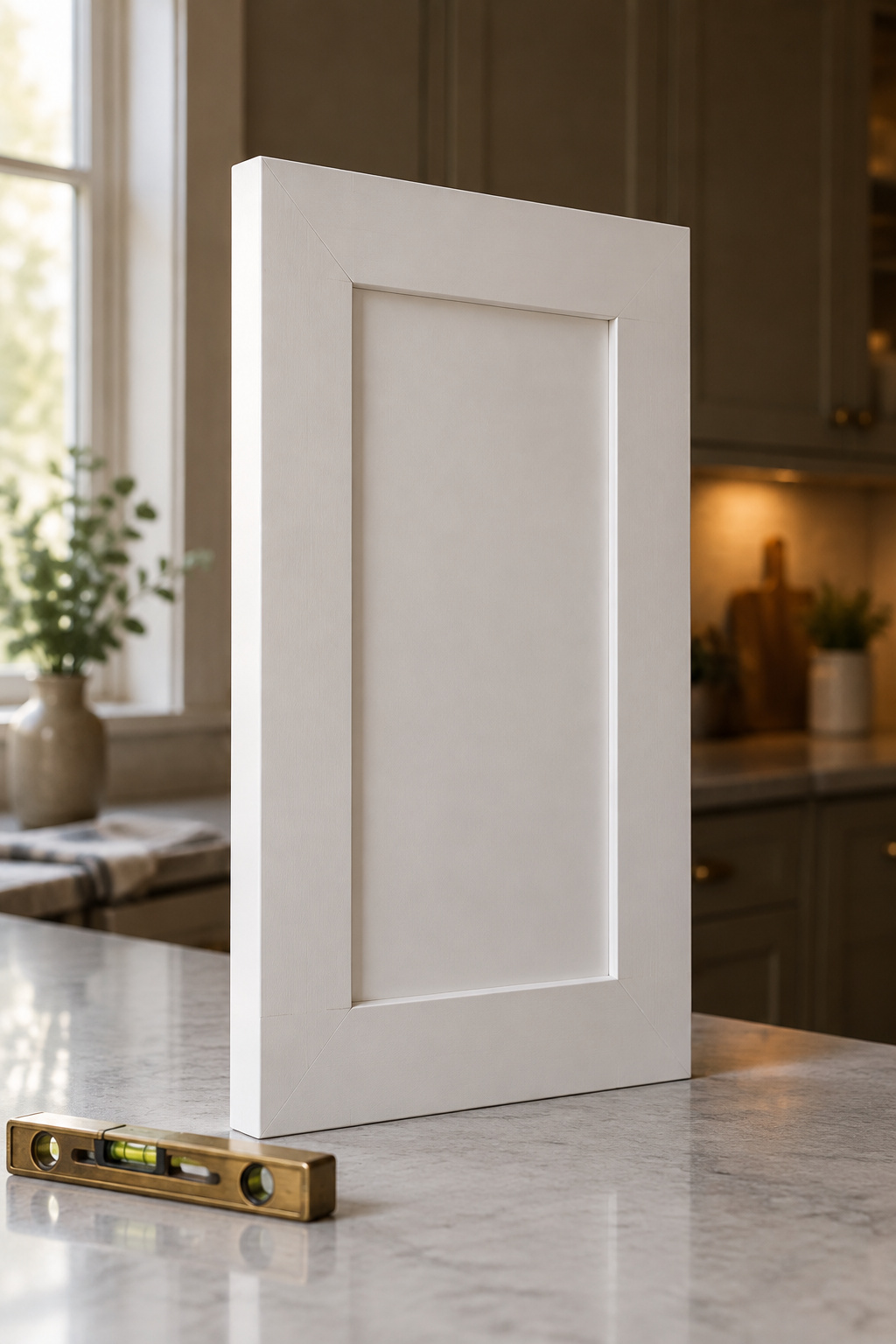
Then read it in a fixed order. How it sits: inset or overlay, and how even the gap is. The inside edge: square, bevel or ogee, and whether it is the one you chose. The joint: a seam where rail meets stile, or a rounded corner from the router. The panel, and whether every edge is sealed. Measure it twice against what you were promised.
Go back to those two white doors side by side. One sat true in its frame, kept its edge square and was joined to move without fighting itself; the other cut a corner the paint was always going to show. Now you can tell which is which before either goes on the wall.
FAQ
What is the difference between Shaker and flat-panel cabinets?
A flat-panel, or slab, door is one smooth panel with no frame or profile. A Shaker door is a five-piece frame of stiles and rails around a recessed flat panel. Slab wipes clean more easily, since Shaker corners trap dust and grease, but the Shaker frame is built to accommodate wood movement.
Can Shaker doors go on frameless European-style cabinet boxes?
Yes, for the door itself. A Shaker profile hangs as full overlay on frameless boxes, though with no face frame to hide error, door sizing and alignment must be tightly controlled. Inset is the exception: an inset door needs a face frame to sit in, so it is not an option on true frameless cabinets.
Do Shaker doors work in a small kitchen?
Yes. Classic stiles and rails run only about 2 to 2 1/4 inches wide, and a slim frame of about 2 inches reads almost as clean as slab while keeping some detail. The trade-off in a busy small kitchen is cleaning: slab doors wipe down fastest, while a Shaker door’s inside corners collect dust and need a little more attention.