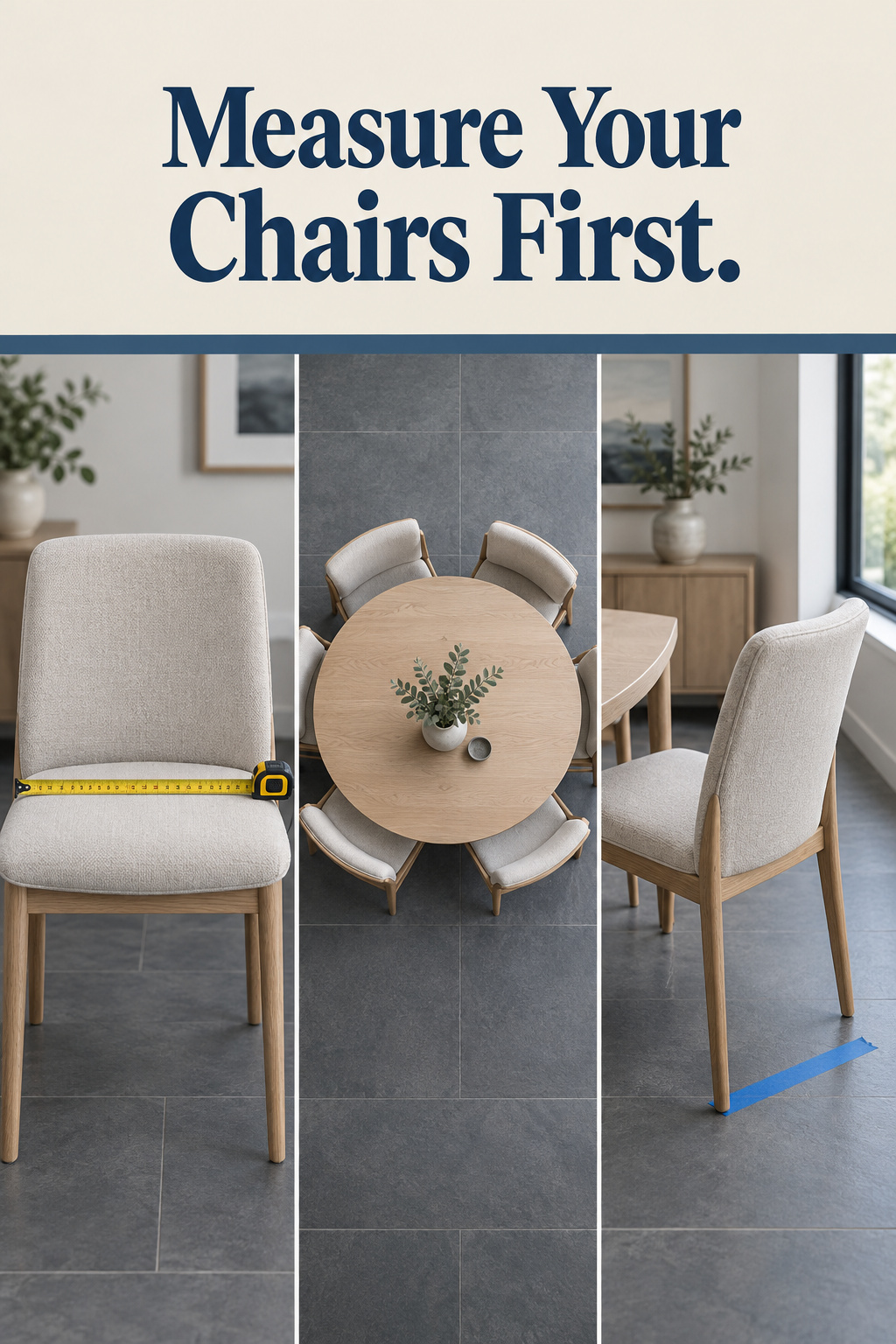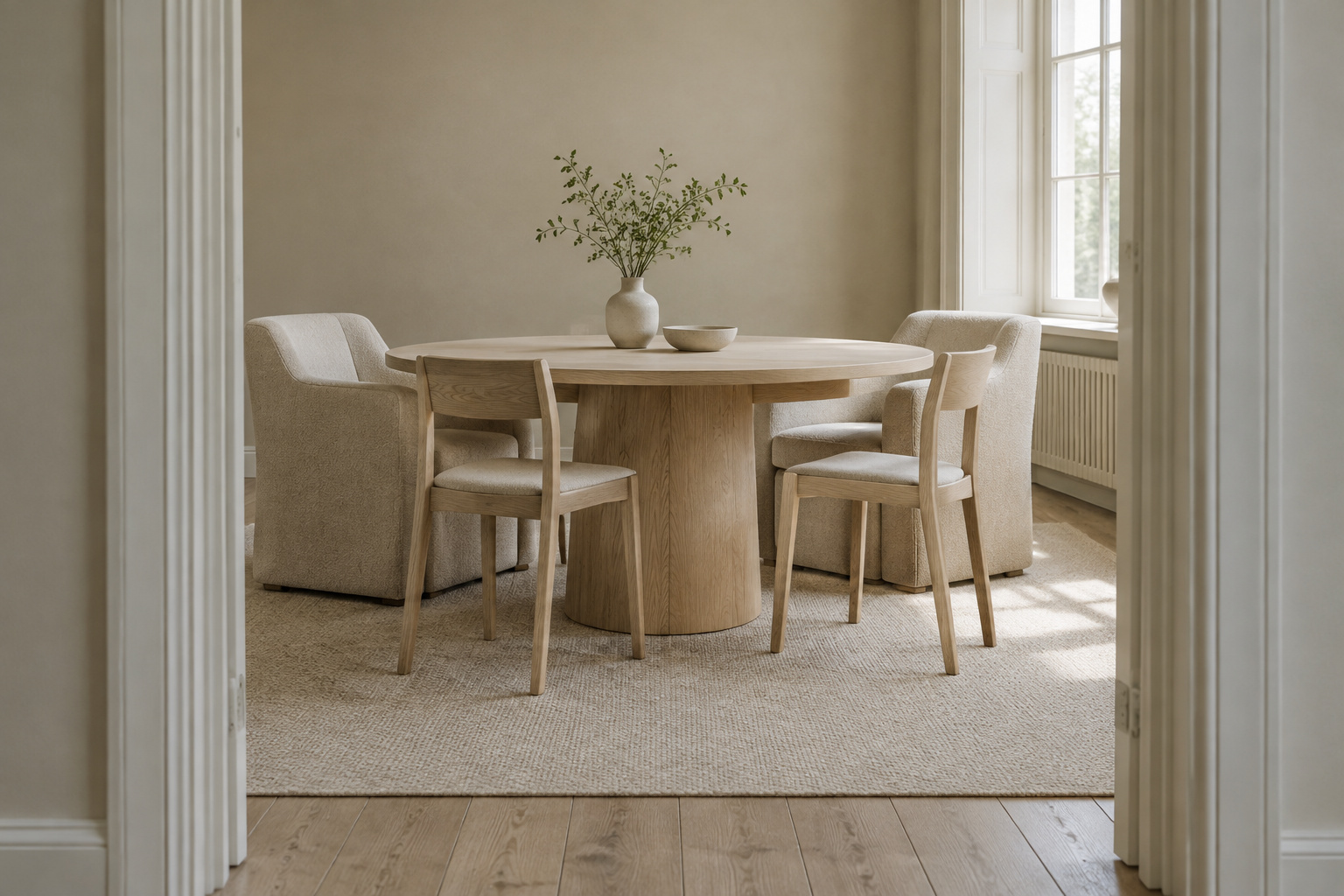

You have six chairs. The seat chart says a 48-inch round seats six. Six and six, so you order the 48, and the arithmetic feels finished. It isn’t, because the chart was never counting your chairs. Most round dining table size charts divide the edge of the table by the width of a chair they don’t show you, and if your chairs are wider than that one, the six turns into five the evening you sit down.
TL;DR
- Seat charts assume a chair about 20 in wide with 2 in of space either side, so 24 in of table edge for each person; armchairs usually need 28 to 30 in.
- Seats are the circumference (diameter times 3.14) divided by the edge each of your chairs needs, rounded down: six chairs that are each 5 in wider than the chart’s add 30 in of edge, which takes a 48-inch round to a 60.
- Then check the room: a 48-inch round needs a 10 ft room for 36 in behind each chair, 11 ft for 42 in and 12 ft for 48 in, and under about 9 ft the room wins and the 36-inch round is the least-bad choice.
What the Seat Chart Quietly Assumes: A Slim 20-Inch Chair
Most people read a seat chart with their own chairs in the next room, and few go in with a tape.
One table maker prints its basis under the chart: “the industry-standard 20″ chair with 2″ of breathing room on each side, or 24″ of table edge per person.” The same note admits that wider armchairs reduce capacity and armless side chairs may allow one more. A seat count is the edge of the table divided by 24 in, and the 24 belongs to a chair about 20 in wide, usually without arms.
Compare charts and the assumption shows. The same 48-inch round is sold as a four-seater, a five-seater and a six-seater. The circle never changes; only the chair the writer had in mind does. The count describes that chair, and a chart is no use until you know how yours compares with it.
Measure Your Chairs in Four Steps Before You Trust Any Chart
When I put a tape across one of my own chairs, the seat is where the tape goes first, and it is the wrong place. The number you want is the widest point of the whole chair.
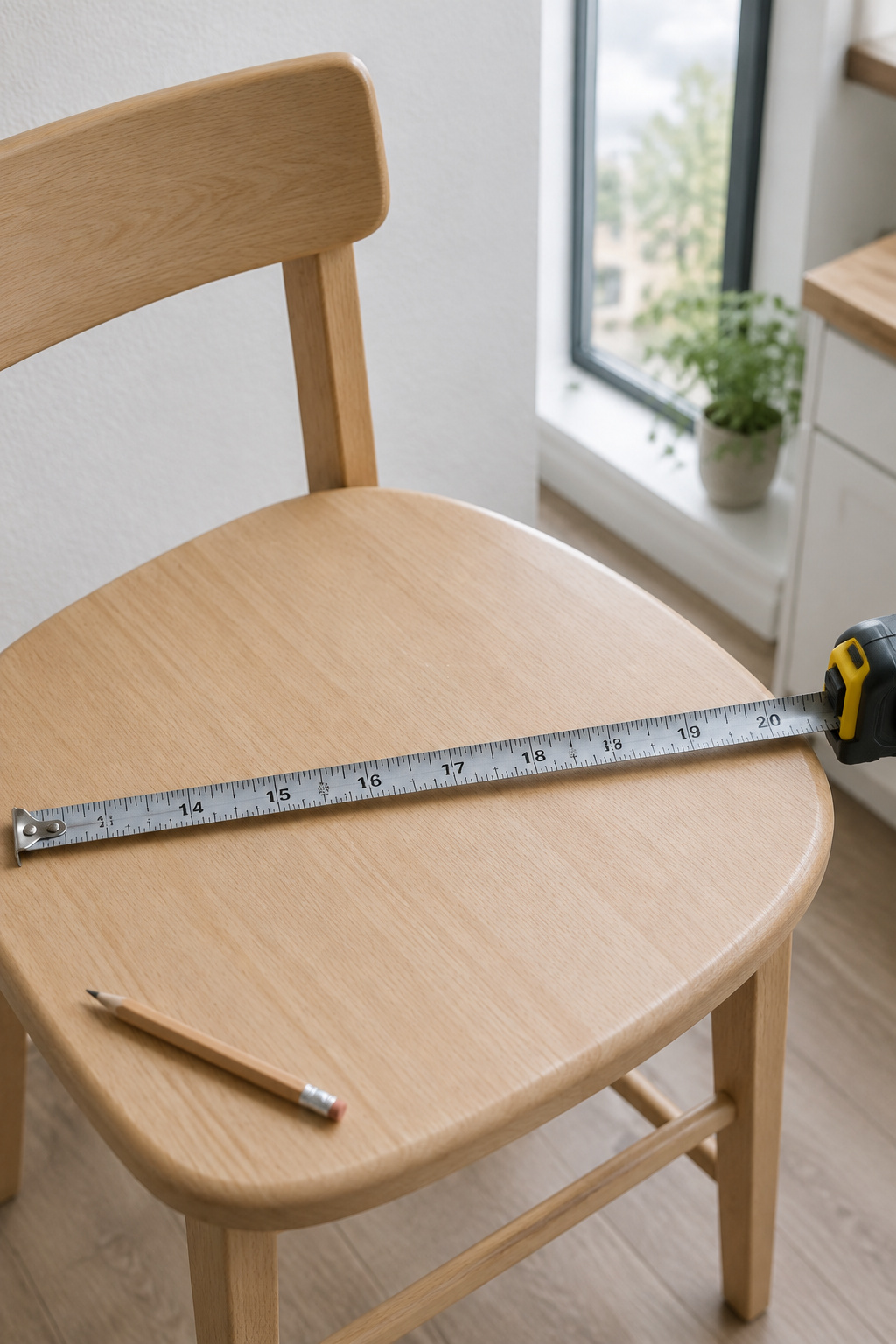
- Measure each chair at its widest point: across the arms if it has them, or across the back or the splayed legs if those reach further than the seat.
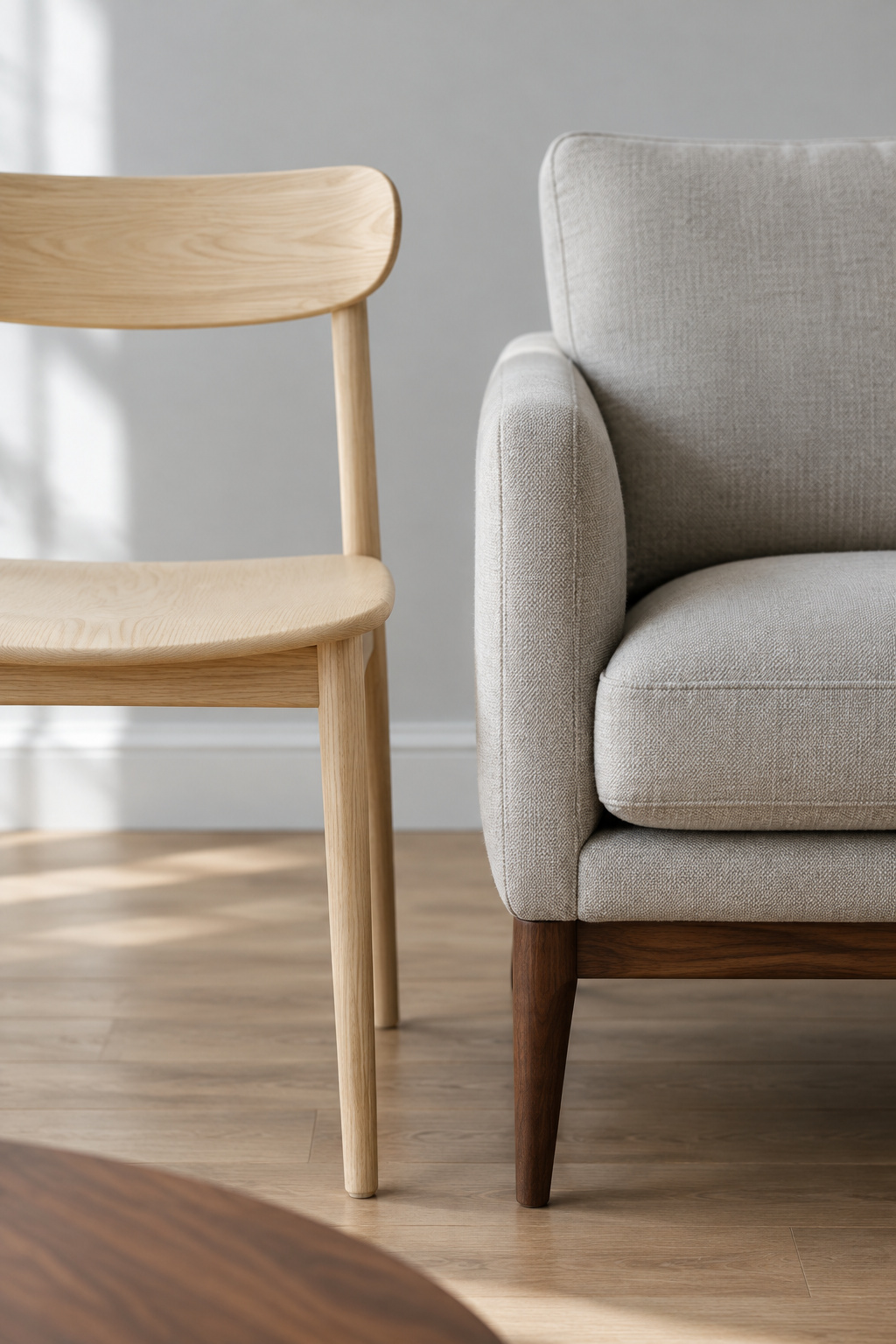
- Check the arms against the table. An armrest should sit at least 1 in lower than the table’s apron, or the chair can’t tuck in at all.
- Count the chairs you want around the table on an ordinary night, not the number you own.
- Keep only the chairs you would buy again.
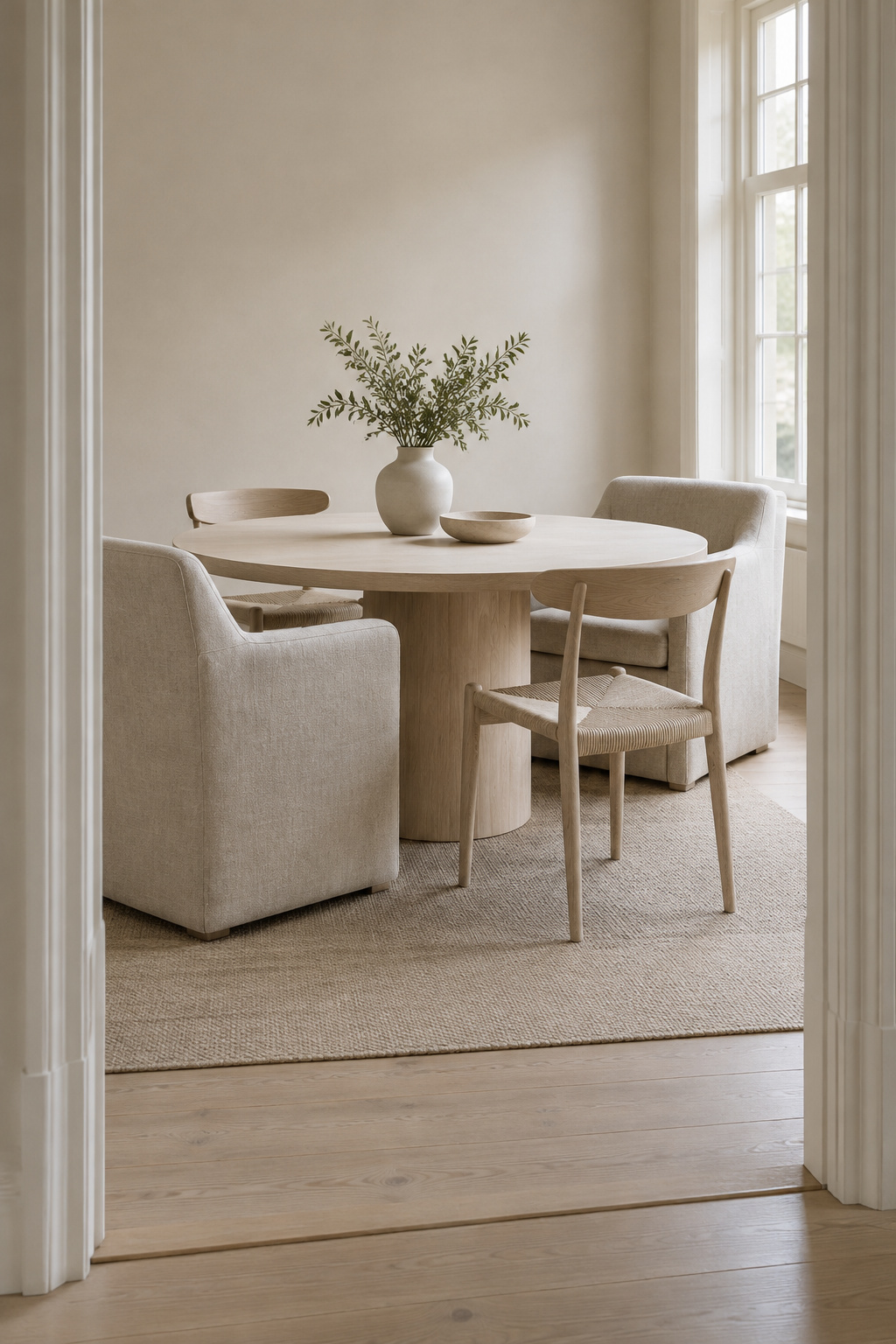
Arms make a bigger difference than people expect. One woven-rush collection makes its side chair 18 in wide and its armchair 23 in; an aluminum pair runs 20.25 and 26 in. A few armchairs add nothing to the width, so measure rather than assume.
I keep a short list taped inside a cupboard door of the things in the house I would buy again, and chairs get the same test. A chair you would replace anyway shouldn’t decide the diameter of a table you mean to keep for ten years. If a set of chairs is up for review, the survey of chair forms in our round dining table ideas is the place to start.
And the armchair that won’t fit round the table has a better job waiting. A hallway deserves a chair. It is more use by the door than as a sixth seat knocking elbows with the fifth.
Round Dining Table Size by Diameter: What Your Chair Width Actually Allows
Multiply the diameter by 3.14 to get the edge, divide by the edge each chair needs, and round down. Always down: half a person doesn’t sit anywhere.
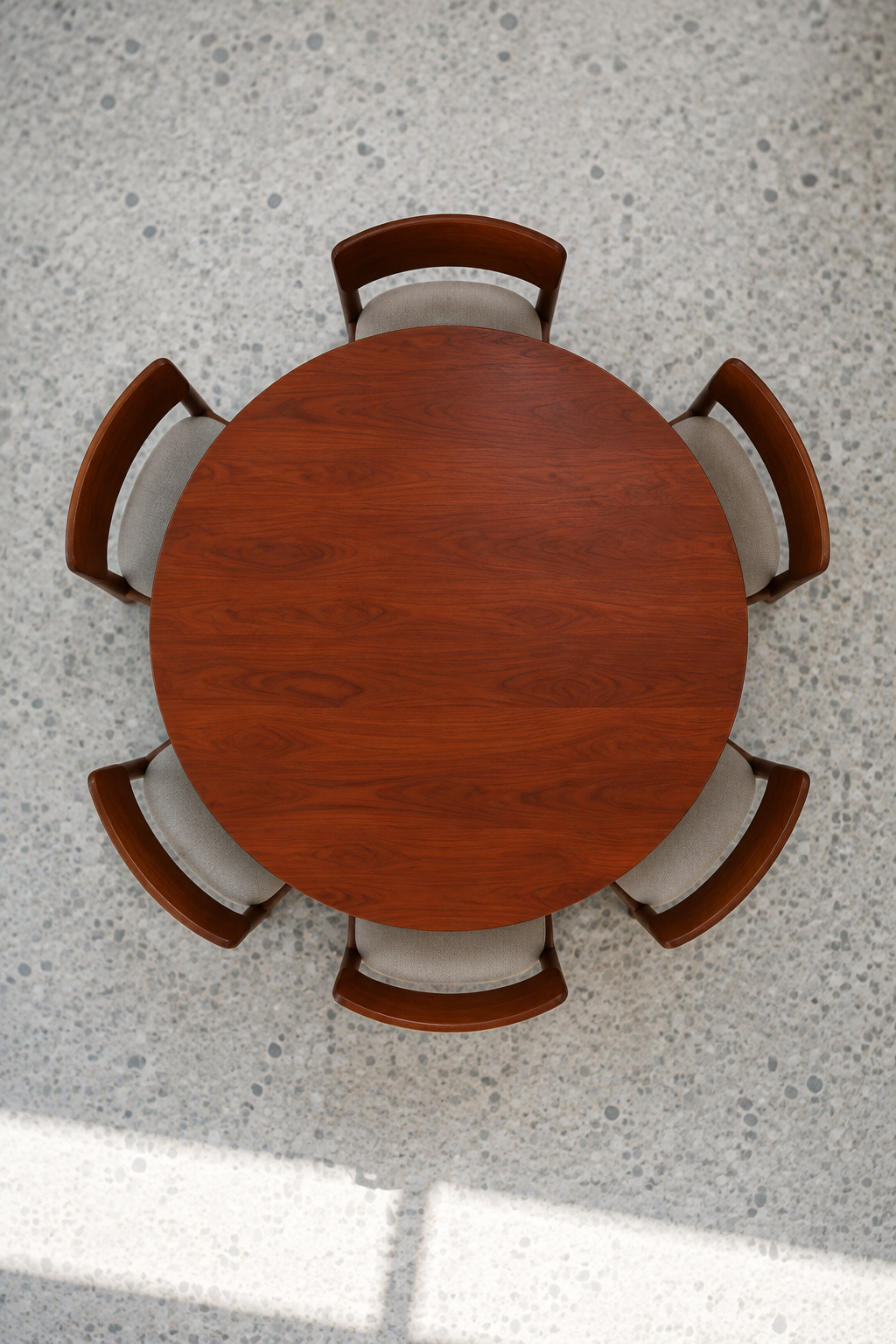
For the edge each chair needs, 24 in is the chart’s figure for a 20-inch chair. About 27.5 in feels comfortable rather than tight, and armchairs want 28 to 30 in. Here is what that does to the common stock sizes.
| Diameter | Edge (circumference) | Seats at 24 in | Seats at 28 in | Seats at 30 in |
|---|---|---|---|---|
| 36 in | 113.1 in | 4 | 4 | 3 |
| 42 in | 131.9 in | 5 | 4 | 4 |
| 48 in | 150.8 in | 6 | 5 | 5 |
| 54 in | 169.6 in | 7 | 6 | 5 |
| 60 in | 188.5 in | 7 | 6 | 6 |
| 66 in | 207.3 in | 8 | 7 | 6 |
| 72 in | 226.2 in | 9 | 8 | 7 |
Now put your own chair into it. Take the woven-rush pair from the last section: the armchair is 5 in wider than the side chair. Six of those armchairs need 30 in more edge than six side chairs. Divide 30 by 3.14 and the table needs about 9.5 in more diameter. A 48 plus 9.5 is about 58 in, and the next stock size is 60. That is how a 48 becomes a 60, with nothing changed but the chairs.
For four, the 42 works with slim armless chairs; with armchairs I would go to the 48, because chairs around a circle meet at their front corners first. For six people every night I would buy the 60 rather than the 54, even with slim chairs; the 54 is fine if six is occasional. The reason is in the right-hand columns.
Past 60 Inches, the Middle of the Table Moves Out of Reach
Pass a dish across a 72-inch round and you meet the other limit.
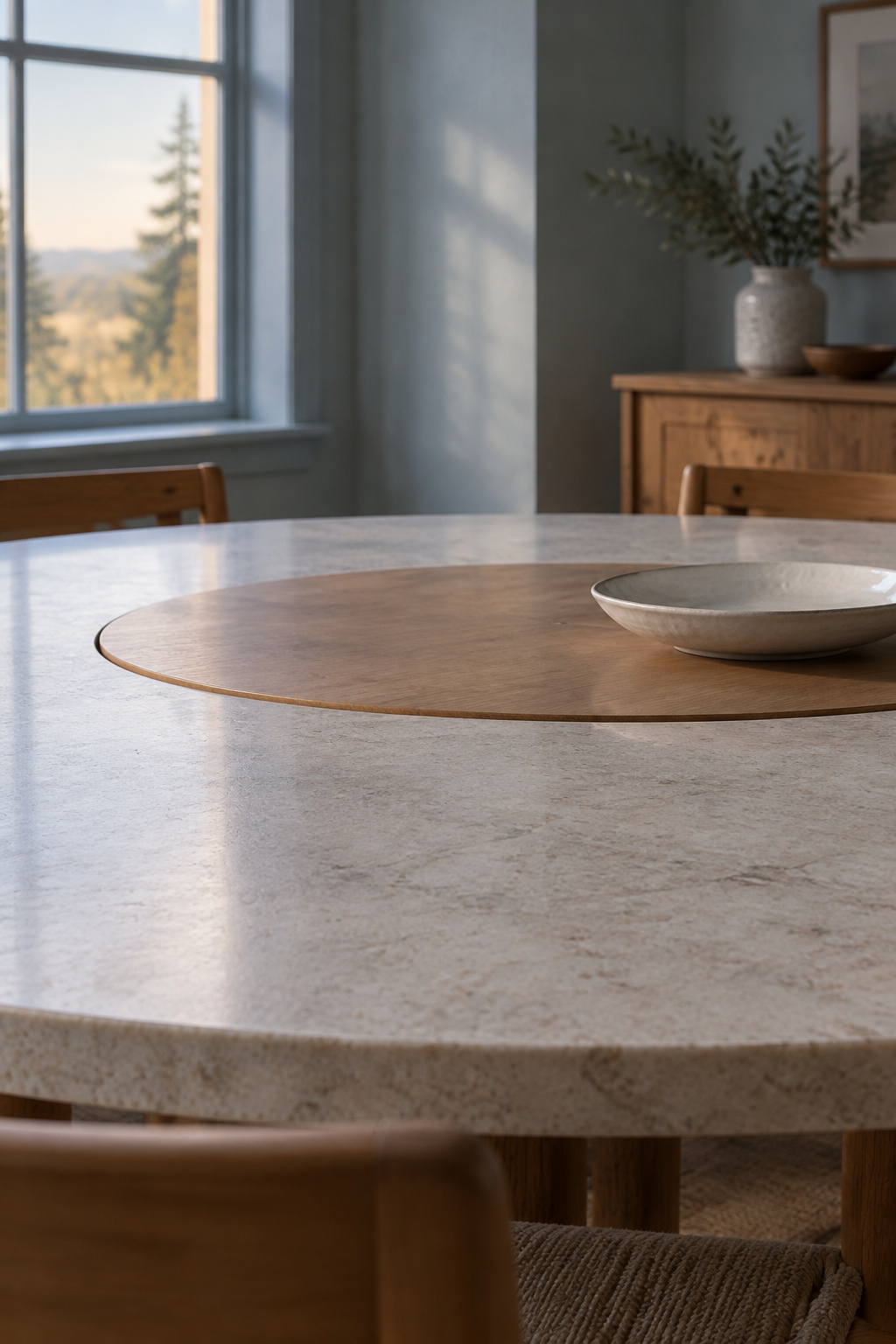
The center of a 60-inch round is 30 in from every edge. Plates and glasses take up the outer 12 to 15 in in front of each person, so the middle is still about 15 in beyond your plate. At 72 in the center is 36 in away, about 21 in past the plate. There is no agreed figure for how far a seated person can comfortably reach, but most of us know the answer in practice: you stand up, or you ask.
That is why a lazy Susan keeps appearing in the advice for big rounds. Houzz recommends one for tables 5 to 6 ft across. A woodworker who built an 80-inch round for ten called his turntable the solution to “passing the mustard across an 80-inch divide,” which is the most honest description of a large round table I know.
I stop at 60 unless a lazy Susan is going to live on the table. Past about six diners the question also stops being one of size and becomes one of shape, and it is worth reading when a rectangle seats your number better before you go bigger.
The Room Check: Diameter Plus Walk-Behind Space Decides What Fits
How much room behind a pulled-out chair
The chair method gives you a diameter. The room tells you whether you can have it.
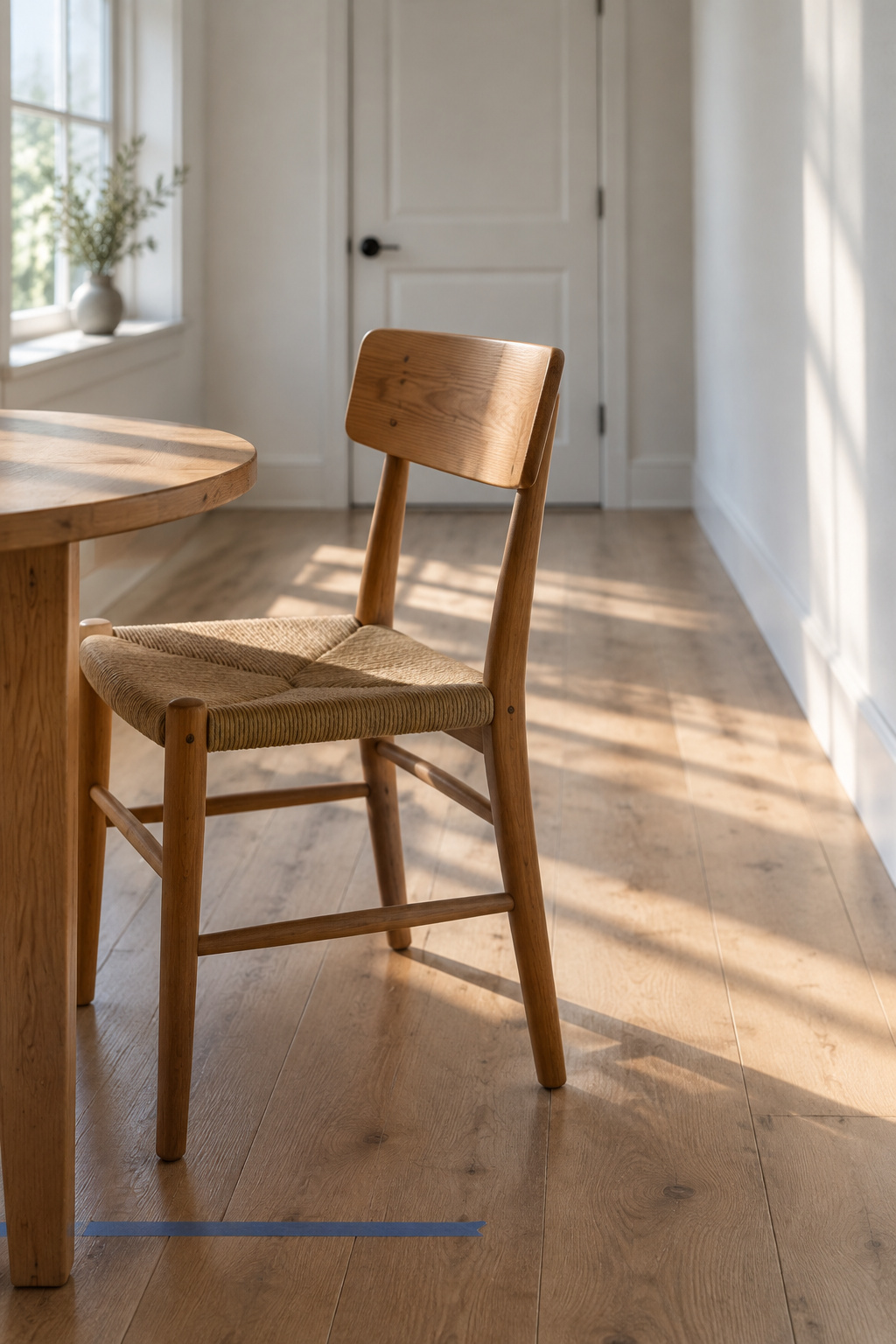
There are two sets of numbers for the space between the table edge and the wall, and they don’t quite agree. The trade convention is 36 in where nobody walks behind a seated diner, and 42 to 48 in where people do. The National Kitchen and Bath Association’s guideline for kitchen seating is a little tighter at the low end: 32 in with no traffic, 36 in for someone to edge past, 44 in to walk past. Neither is a building code. I plan to the trade figures, because a dining room usually has a door somebody needs.
The sum is the diameter plus the clearance on both sides. A 48-inch round with 36 in a side needs 48 + 72 = 120 in, a 10 ft room. With 42 in a side it needs 11 ft. With 48 in a side, so nobody turns sideways to pass, it needs 12 ft.
Rooms under about nine feet wide: the 36-inch round wins
Below about 9 ft, the room overrules the chairs. Nine feet is 108 in, which is 36 + 72: a 36-inch round leaves exactly 36 in a side. A 42 leaves 33 in, and a 48 leaves 30, under even the tighter kitchen figure. In a room narrower than nine feet even the 36 falls short of 36 in, which makes it the least-bad answer, and it is the same 36-inch round our small farmhouse dining nook guide recommends for rooms under 9 ft.
Before you buy, mark the circle on the floor in painter’s tape, pull a chair out to sitting position and look at what is left between it and the wall.
Size for the Number You Feed Every Week, Then Plan for the Crowd Separately
Don’t buy the table for the dinner that happens twice a year. The household that eats there on a Tuesday pays for that choice every Tuesday.
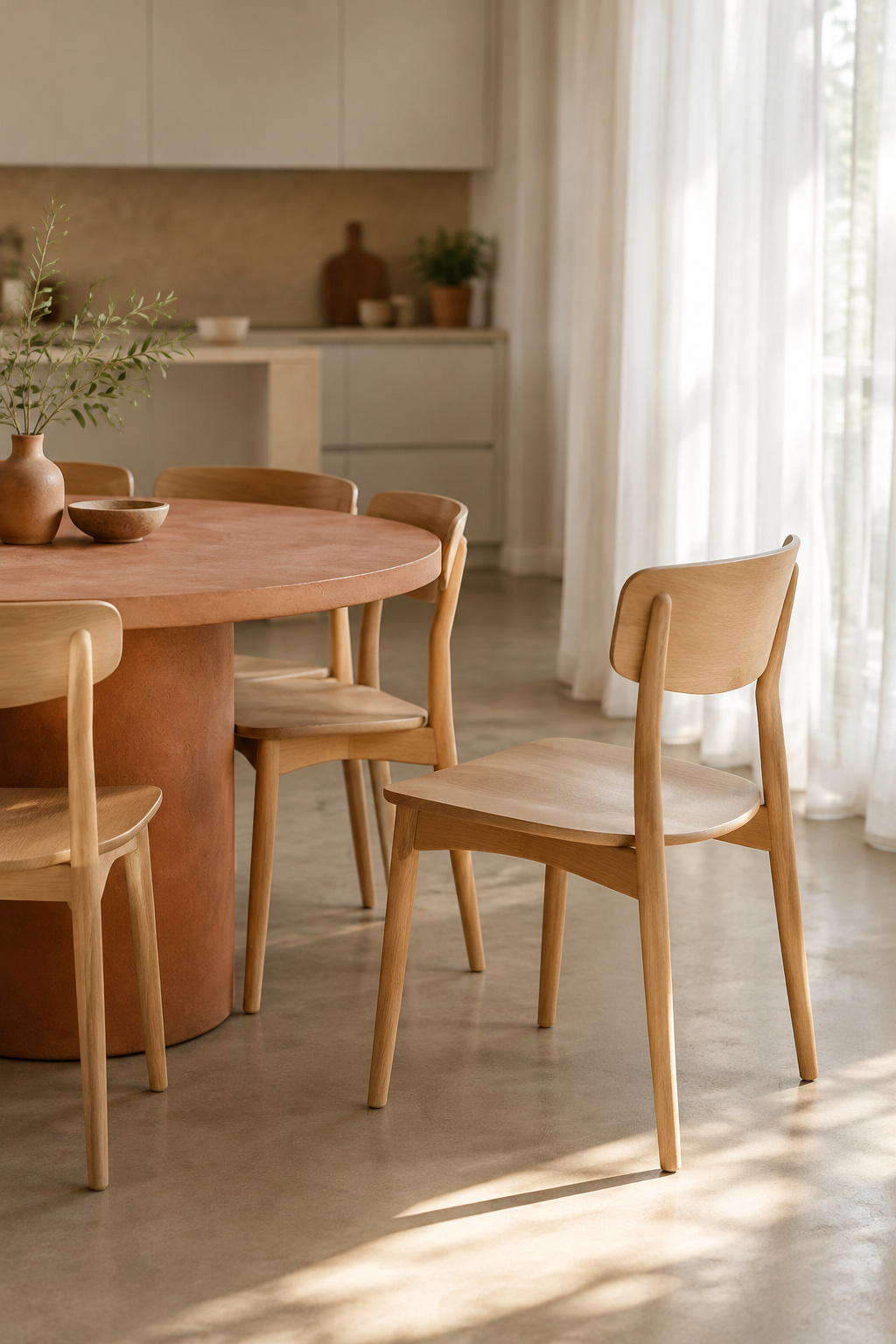
Keep the few rules that matter:
- Measure your chairs first, at the widest point, and compare them with the chart’s 20-inch chair.
- Work out the diameter from the edge your chairs need, then go one stock size up if the room allows.
- Stop at 60 in unless a lazy Susan lives on the table.
- Do the room check last, and let it win under about nine feet.
And avoid two things: trusting a chart’s seat count without knowing its chair, and sizing for the crowd. If the number at your table changes through the year, the better answer is usually a round table that opens for guests rather than a bigger fixed one. Enough is a good word.
So go back to the arithmetic you started with. Six chairs, each 5 in wider than the 20-inch chair the chart had in mind, add 30 in of edge and about 9.5 in of diameter, and that is what turns a 48 into a 60. It holds only if your chairs really are that much wider than the chart’s.
FAQ
How can I test a round table size on my floor before I buy?
Mark the circle on the floor with painter’s tape, or fold a bed sheet to the table’s shape, and set a chair at each place. Pull one chair out to sitting position and measure to the wall: 36 in where nobody passes, 42 to 48 in where people walk behind. A 48-inch round needs 10 ft.
What is the standard height for a round dining table?
Dining tables are usually 29 to 30 in high, with chair seats at 17 to 19 in, which leaves 10 to 12 in for your legs. Round tables follow the same figures as rectangular ones; nothing sets them apart. Let your chairs’ seat height decide, because one inch makes a real difference at the table.
Do round tables come in sizes between the standard ones, such as 54 inches?
Yes, 54 in is a standard size, and stock rounds generally run in steps of about 6 in from 36 to 72. A 54 has 169.6 in of edge, about 28 in each for six people. Some makers also cut custom diameters, though a custom size may not match a standard base or rug.