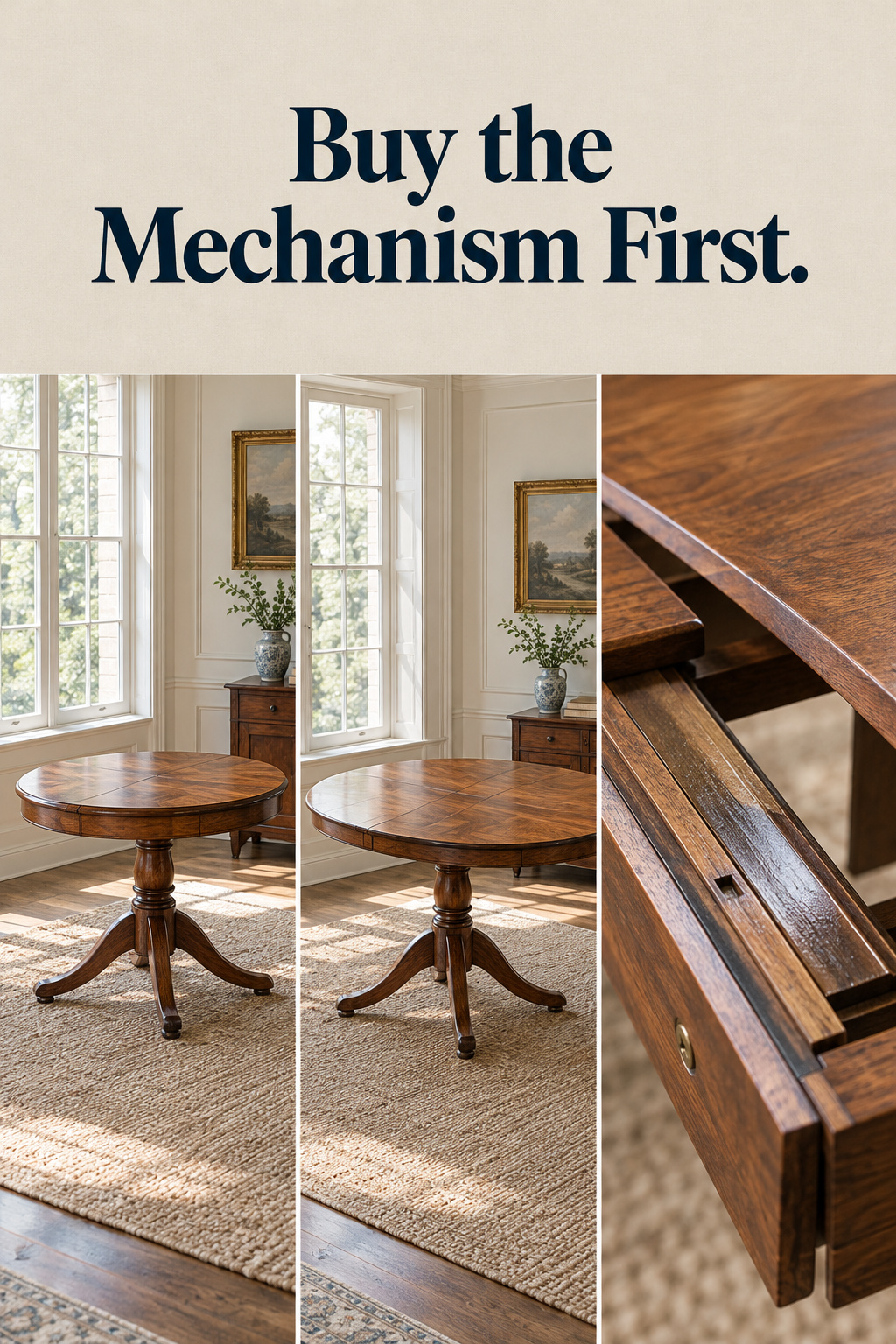
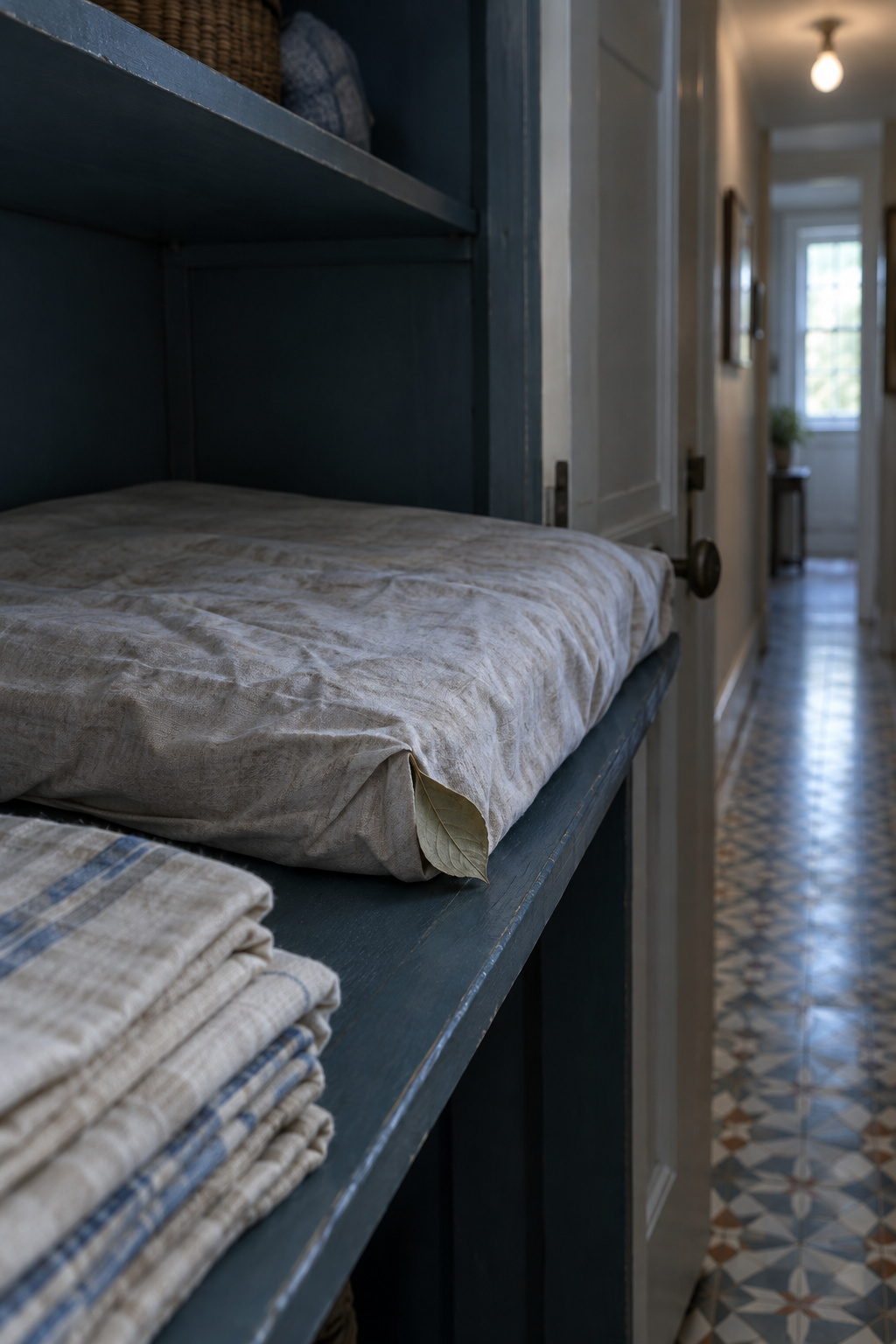
The leaf is in the hall closet, standing on its edge behind the vacuum, in a bath towel that has slipped halfway off. You know it better by touch than by sight: one smooth face, a rough underside, a row of small wooden pegs along one edge. It belongs to an extendable round dining table that feeds your household of four every night, and in three weeks eight people are coming for the holiday. Somebody will have to carry that board down the hall, drag the table halves apart against the dry groan of the slides and find the pegs. Or nobody will, and eight people will eat elbow to elbow around the closed circle.
Whether that leaf ever comes out has little to do with how big the oval gets. It depends on the mechanism, and on where the leaf spends the rest of the year.
TL;DR
- Choose by where the leaf lives: a butterfly leaf folds under the top and one person can usually open it, while a loose leaf is mechanically simpler but must be stored flat, wrapped and dry.
- One 18 in leaf takes a 42 in round to a 60 in oval, a 48 in round to 66 in and a 54 in round to 72 in; leaves also come in 12, 20 and 24 in widths.
- Before you condemn a stiff wooden slide, clean off the old grime and rub paraffin or a light wax on its hidden faces; replace it only if that fails.
The Leaf in the Hall Closet: A Nightly Four Becomes a Holiday Eight
On the evening itself, a loose leaf has to be wherever you stored it months ago, and a leaf left on its edge can bow. A table pushed against a wall usually has to be pulled forward before it will open at all. Once the leaf is in, run your palm across the seam; on some tables you can feel a small step. Look at it in daylight, too. A leaf kept in the dark stays darker while the top around it fades, so the oval wears a stripe across its middle. Then the chairs, spaced for a circle, get shuffled to the new ends.
The closed round is the table you live with, so start by sizing the closed round for the people who eat there every night. The mechanism then decides whether the holiday evening goes smoothly once, or every year.
Extendable Round Dining Table Mechanisms, Ranked by How Often the Leaf Gets Used
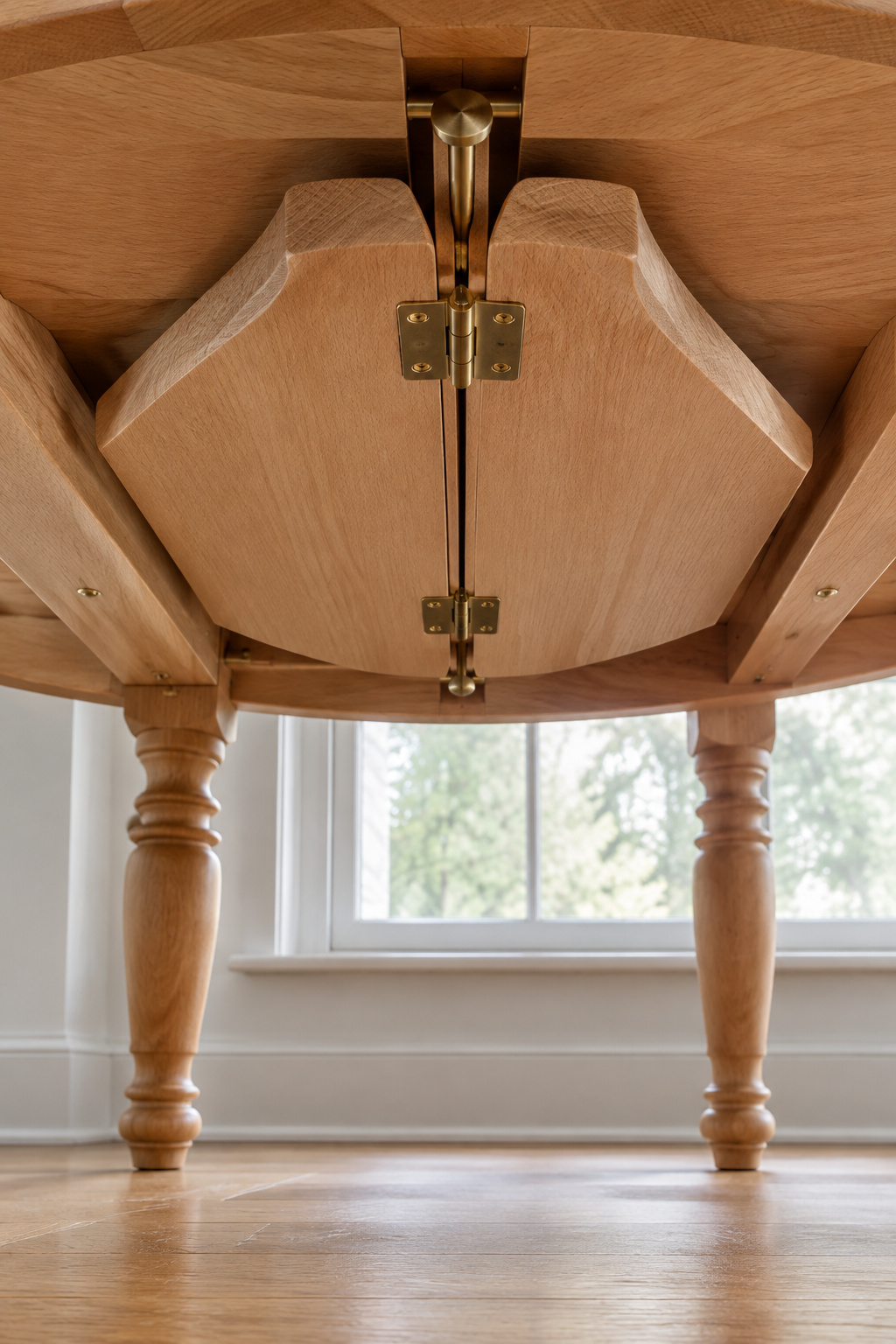
Five mechanisms cover nearly every extending round you’ll meet:
| Mechanism | Where the leaf lives | Opening it alone | The catch | Open shape |
|---|---|---|---|---|
| Self-storing butterfly | Folded in half under the top | Usually: pull the halves apart and the leaf rises and unfolds | Heavier table, deeper apron; hinges, tracks and locks must stay in line | Oval |
| Removable (loose) leaf | A closet or under a bed, flat | The leaf has to be carried in and set in the gap | Storage; a leaf can warp, go missing or stop matching | Oval |
| Split pedestal, loose leaf | Same as a loose leaf | A good slide spreads both halves when you pull one side | Slides, any centering gear and the table locks | Oval, supported along its length |
| Drop-leaf | Hinged to the center, hanging down | Yes: lift a leaf and set its bracket | Adds little seating; folded depth 14 to 22 in | The full top, leaves up |
| Gateleg | Hinged to the center, with swing-out legs | Yes | Adds little seating; folds narrower once the legs swing in | The full top, leaves up |
Nobody has measured how often households use their leaves, so this order is my judgement from the hardware. A leaf that lives inside the table and opens with one pair of hands should get used most, which puts the butterfly first. The furniture maker Michael Fortune summed up its appeal: “No struggle, and no loose leaves to store in a closet.” A loose leaf kept flat in a dry spot near the table comes second. A split pedestal is only as handy as wherever its leaf is kept, and drop-leaf and gateleg tables give the least extra room.
Gates Furniture’s buying guide argues the other way: it calls the removable leaf the most straightforward and generally more durable setup, with fewer moving parts. The easiest leaf to open and the mechanism with least to go wrong are different tables.
Split Pedestal or Fixed Base: What Opening the Table Does to the Legs
“It’s all about leverage,” is how Loewen Design Studios, a maker, puts the problem. A single pedestal sized for a closed round can get tippy at the ends of the oval, and one big enough for the open table eats knee room the rest of the year. A split base comes apart instead: closed, it looks like one column; opened, each half travels with its side of the top, so the whole length is supported.
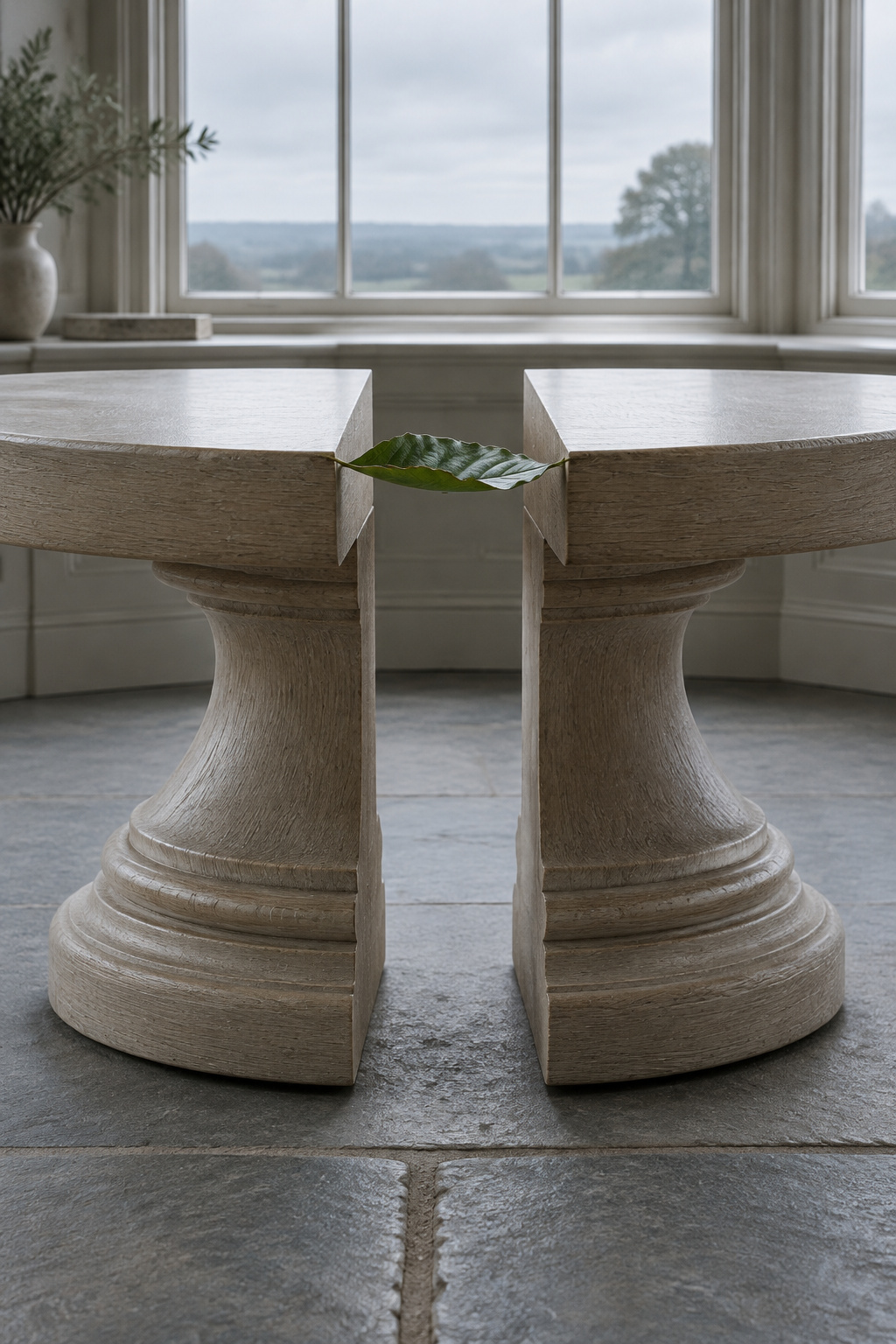
Makers who keep a single pedestal limit the leaves. David Lee Furniture caps its 42 to 54 in single-pedestal rounds at 66 in open and puts no leaf at all on a 60 in one. That is one company’s policy, not an industry rule, but the reasoning travels. The slides differ as well: equalizer slides suit a base that stays put, standard slides a four-legged table whose legs move out with the top. Open or closed, a split base faces the same stability tests as any pedestal, covered in the round pedestal guide.
Old tables need the same buying check. The draw-leaf is centuries old and usually rectangular, so on a round the old mechanism to check is the split pedestal. One woodworker who owns a factory-made example describes halves running on dovetail grooves and pins, with weak points in the nailed bridges between slide halves, a bed-bolt fastening and cast-iron table locks.
That list makes the case for simple mechanisms. A wooden slide, a pin and a bolt can be cleaned, eased and refitted by whoever opens the table next, and the repair can be undone if it was wrong.
Round Most Nights, Oval for Company: Open Sizes and What They Do to the Chairs
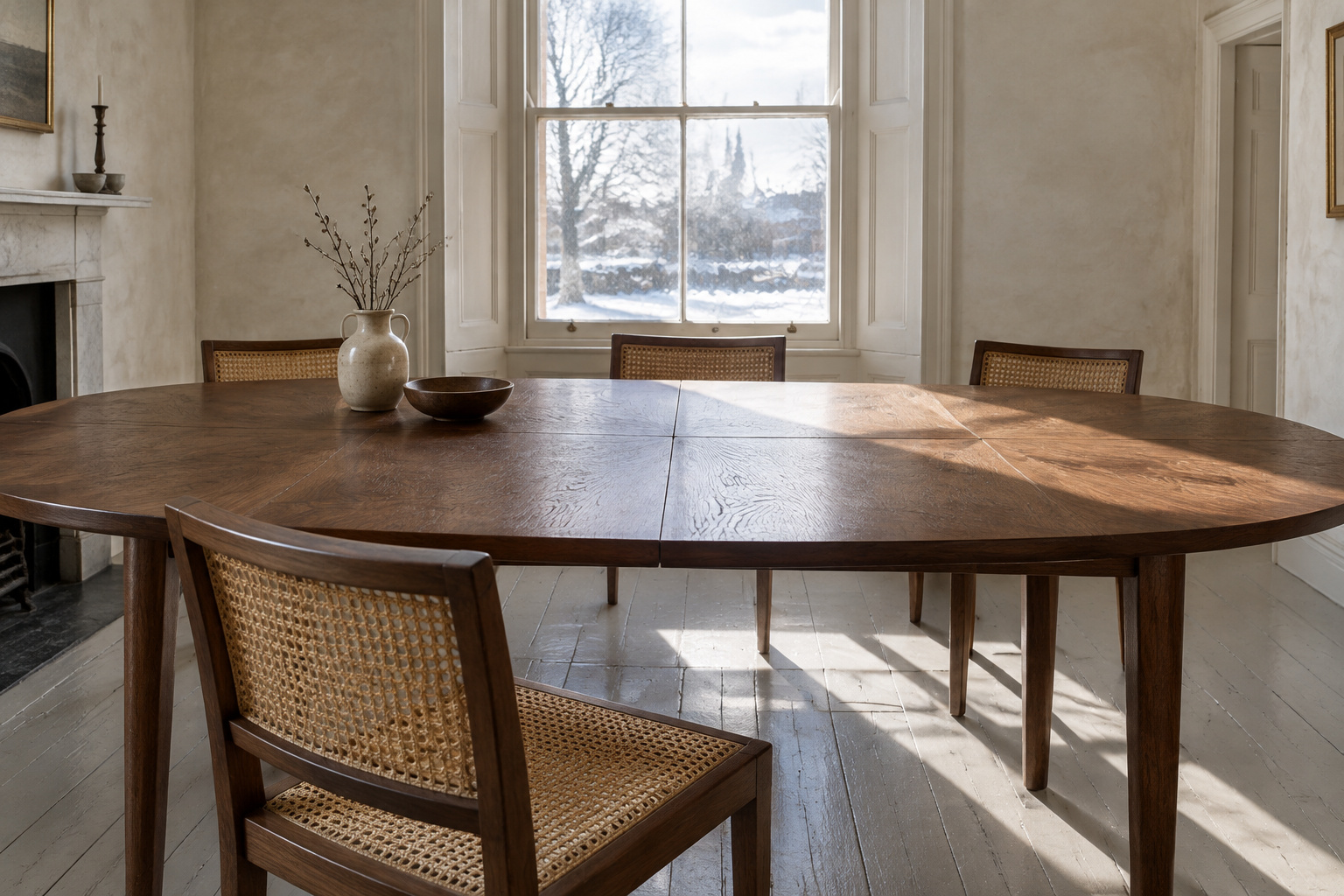
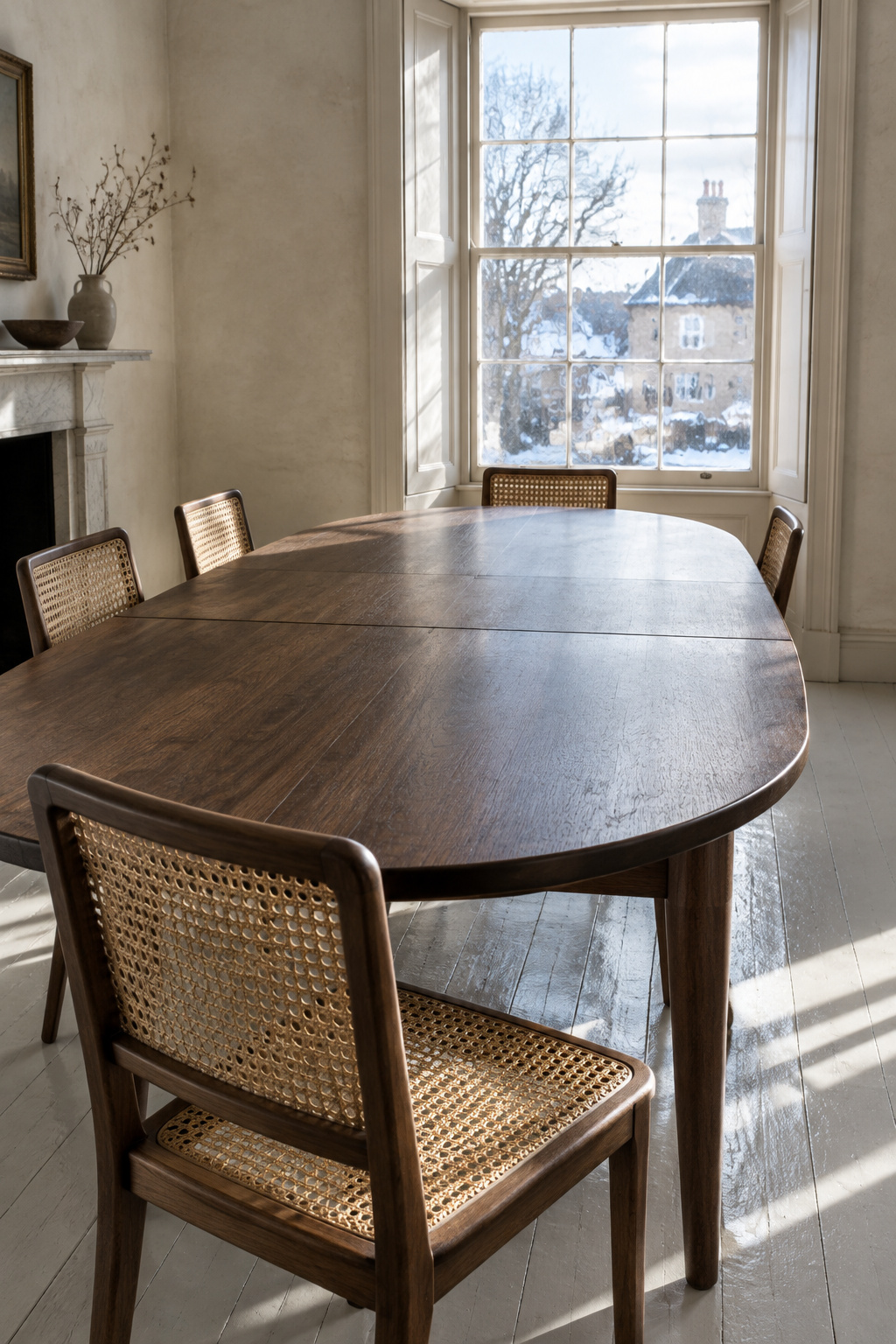
An extended round is an oval, and the chairs that sat evenly around a circle now face two long sides and two new ends. Wide armchairs crowd each other once the table opens; armless or slimmer chairs suit both shapes.
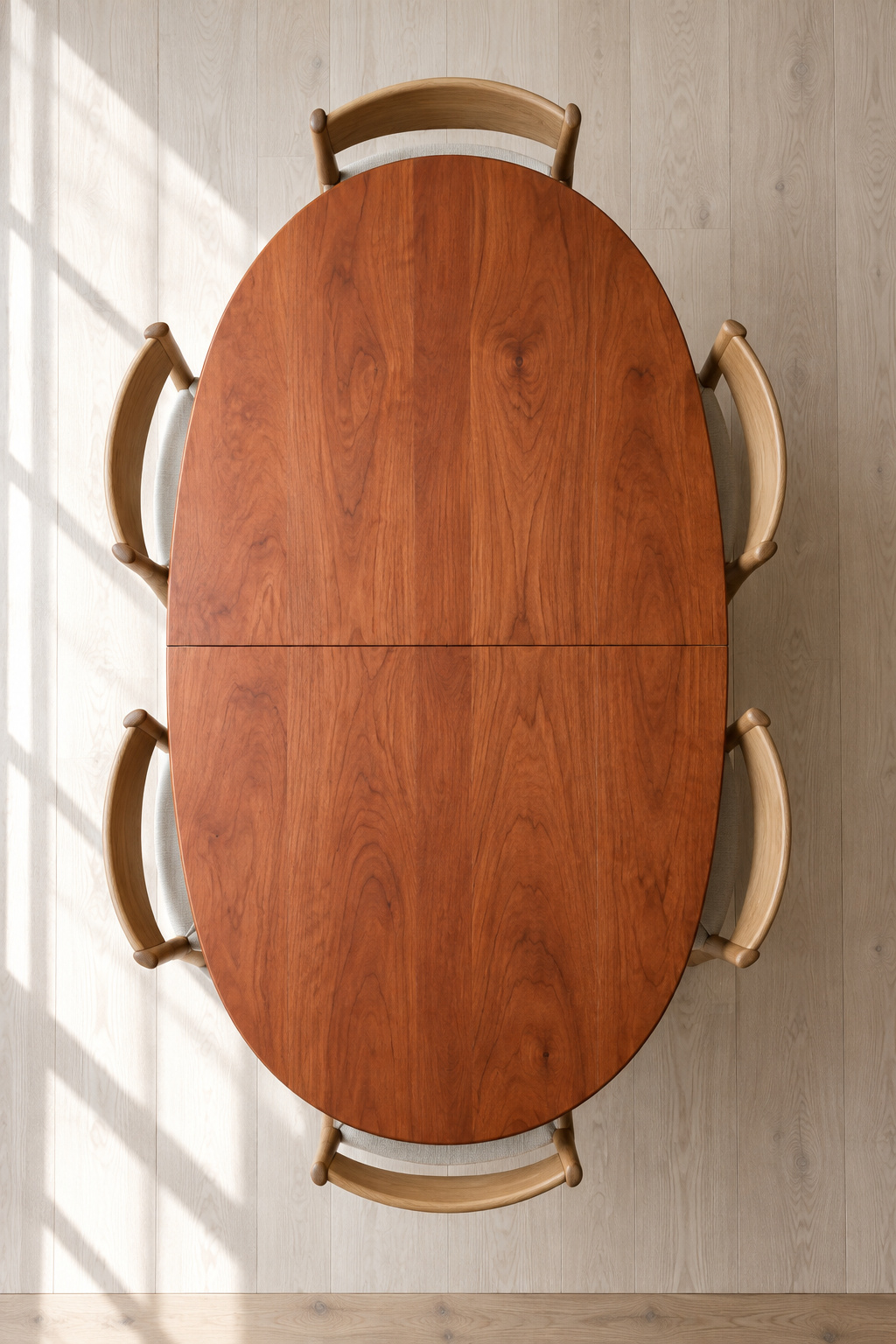
The room has to hold the open table as well. Allow the usual 36 in for pulling chairs back and a 66 in oval needs 66 + 36 + 36 = 138 in of clear floor along its length, about 11 ft 6 in, and, across its 48 in width, 48 + 72 = 120 in, 10 ft.
Typical open sizes of 42 to 54 inch rounds
Catalogs settle on a few pairings, and 18 in is the commonest leaf:
| Closed round | Leaf | Open oval |
|---|---|---|
| 42 in | 18 in | 60 in |
| 48 in | 12 in | 60 in |
| 48 in | 18 in | 66 in |
| 48 in | two 12 in | 72 in |
| 54 in | 18 in | 72 in |
Leaves also come in 20 and 24 in widths. A 47 in round that opens to a 63 in oval is running a leaf of about 16 to 18 in, well inside the usual range. These are makers’ pairings, not a standard, so read the listing for the leaf width rather than trusting the open size alone.
When the Slide Sticks: Clean and Wax Before You Condemn the Table
A client was once about to replace twelve original windows. I reglazed and weatherstripped one sash as a test, and the client kept all twelve. A stiff table slide deserves the same trial before anyone calls it broken.
What fails first: slides, pins and the leaf finish
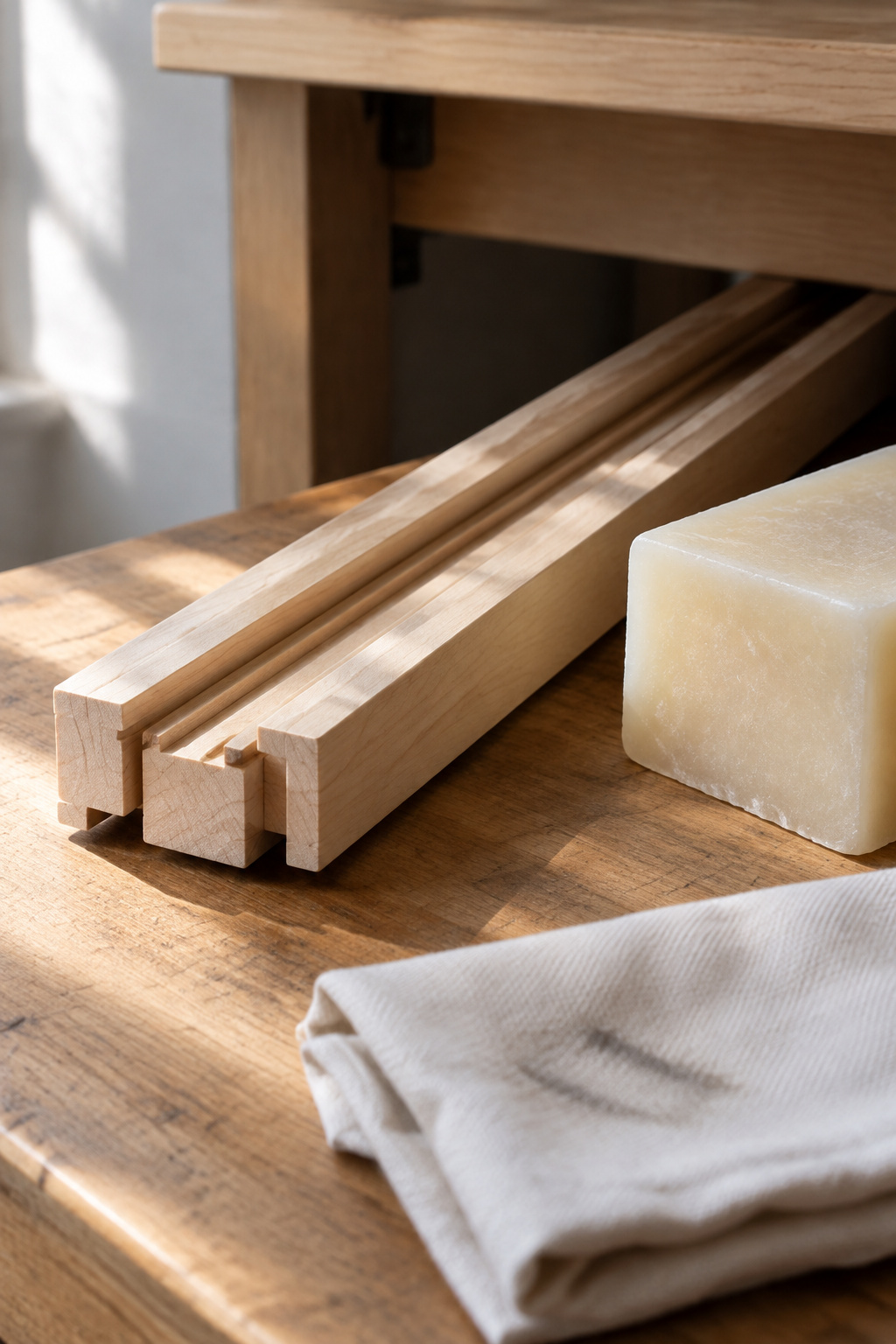
Slides stick for dull reasons. Osborne Wood Products, which makes them, names three: a spill that drips through the gap between top and leaf into the slides, excess sealant or glue gumming the sections together, and cleaners that leave a sticky film. Wood moves, too. Raising the humidity from 30% to 70% can swell it up to 2% across the grain, so a slide that ran freely in a dry spell can bind in humid weather. Too little clearance and the table is hard to open; too much and it sags at the seam.
On a butterfly, the pivot blocks carry the weight and the locating keys align the open leaf, so any drift shows as a stiff motion and an open seam. On a loose leaf, it is the finish that stops matching.
Cleaning and waxing a stiff slide, step by step
My workshop is a converted carriage house, cold in January and smelling of linseed oil all year. The steps are the same anywhere.
- Open the table all the way, take out any loose leaf and find the cause: a dried spill, old polish, grit or swollen wood.
- Brush off loose dust with a soft cloth or a soft-brush vacuum.
- Lift grime and old wax with a cloth barely dampened with mineral spirits, after testing a hidden spot, window open. Slides are usually bare wood, so keep water off them. Let them dry for several hours.
- Rub paraffin or unscented candle wax thinly along the contact faces, keeping it off metal fittings. Woodworkers argue about beeswax; paraffin is what I’d reach for.
- Work the slide in and out several times to spread the wax.
- Replace the slide only if that fails, matching the slide type to the base.
Wax belongs on the hidden slide faces only; it is far too soft a finish for a tabletop. Mineral spirits take wax off again, so waxing commits you to nothing.
Before You Buy or Inherit One: Where the Leaf Will Live and What to Test
New in a showroom or old in a relative’s dining room, run the same tests before it comes home. Open and close it yourself, alone, without forcing it, then press down on the middle of the open top; it should feel as steady open as closed. Check that the pins meet their holes and the seam closes evenly, with no step under your palm, and compare leaf and top in ordinary daylight, not a phone photograph: tone, grain direction, thickness. Look at the slides. Dirty ones can be cleaned; missing runners or broken hinges are a different job, and a new leaf won’t fix them. Last, ask where the leaf will live, and measure that spot.
If the rest of the decision is still open, choosing a round table for the dining room takes the base, top and chairs together.
Then go back to the hall closet. Take that leaf off its edge, lay it flat on a dry shelf and swap the towel for a bed sheet, never plastic. A good restorer leaves notes for the next one, and so should a household: tape a card to the underside saying which end the pegs go and which face is up. Next year nobody has to guess, and a leaf that comes out without a puzzle is the one that comes out at all.
FAQ
How should a table leaf be stored so it doesn’t warp?
Store it flat on its largest face, wrapped in a bed sheet or thick soft fabric, never plastic, which traps moisture. Keep it dry and out of the sun, ideally in the same room as the table so both see the same humidity. Standing it on edge against a wall is how leaves bow. Avoid basements, attics and garages.
Can you buy a replacement leaf for an older extending table?
Often, for a loose center leaf, but it has to be made and fitted to your table: level with the top, its pins lined up, its edge and finish matched as closely as wood allows. Some makers won’t supply a leaf for a table they didn’t build, and a new panel can’t replace missing hinges or runners.
Is an extendable round table harder to keep steady than a fixed one?
It can be, because the leaf adds a joint, and a pedestal sized for the closed round gets tippy at the ends of the oval, a matter of leverage. Open the table fully and press down on the middle; it should feel as steady open as closed. Slides with too much play let the open top sag.