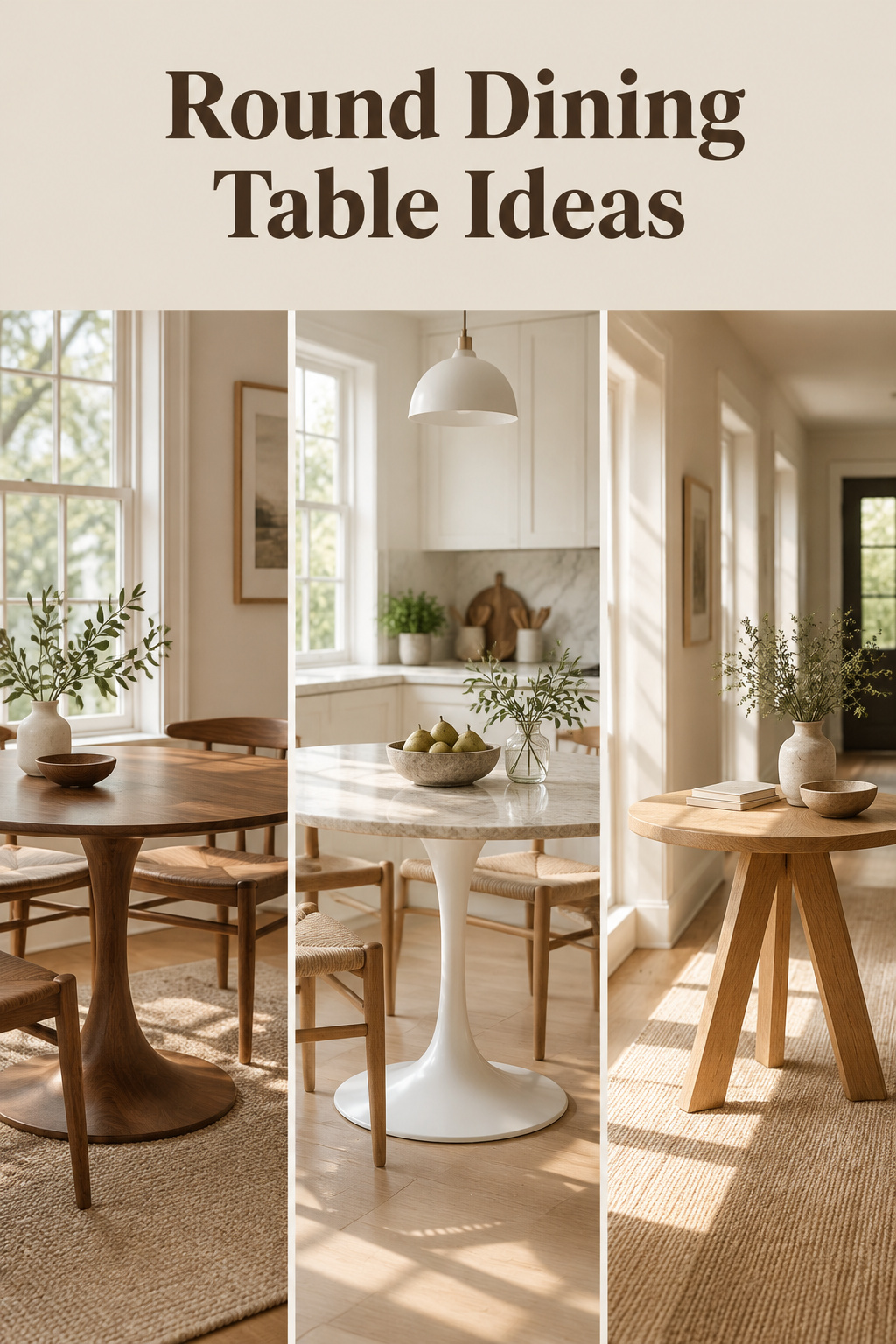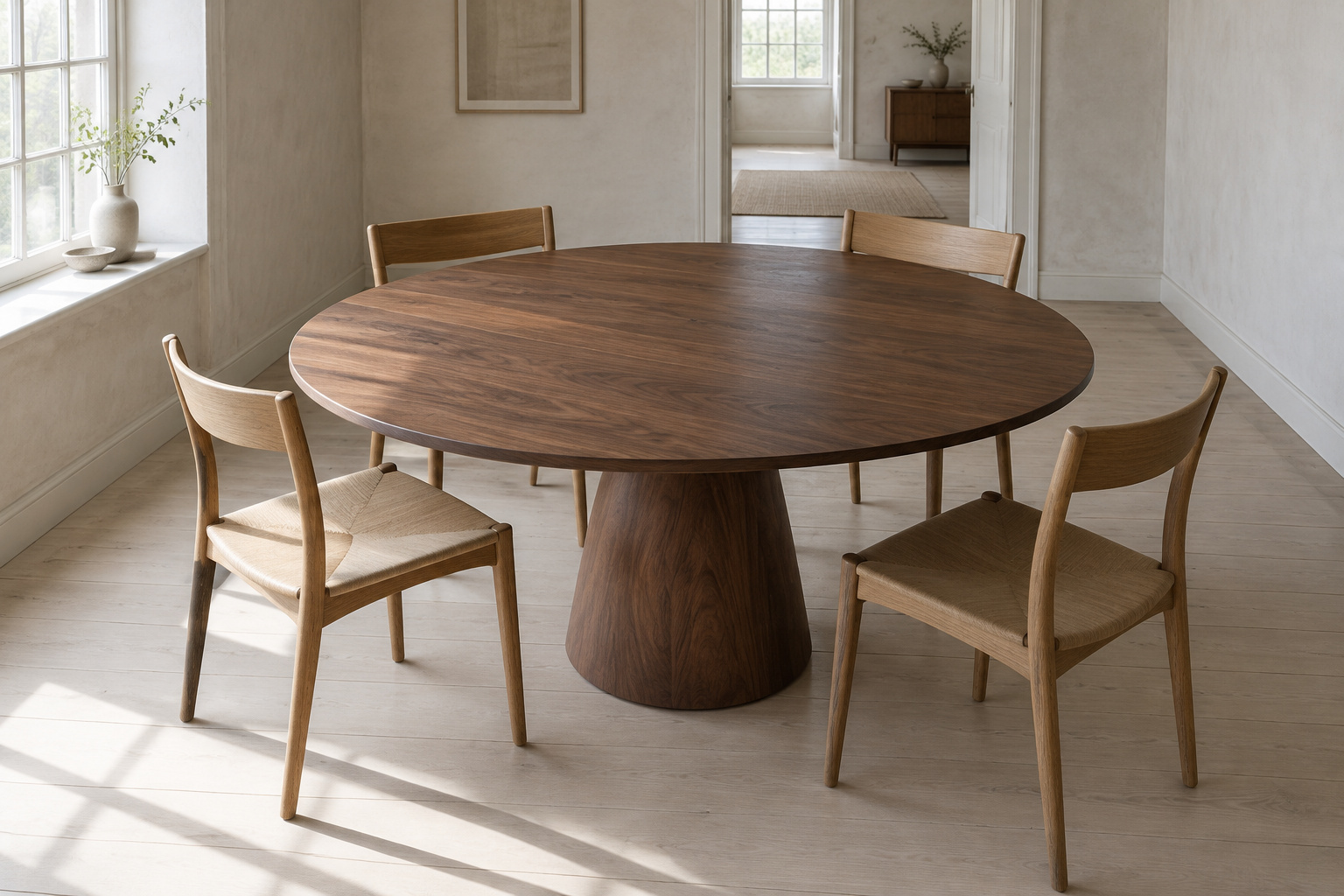

The chairs decide a round table. Every gallery of round dining table ideas shows you the table: a fluted pedestal under pale oak, a black tulip base under white stone, a walnut circle with a lazy Susan in the middle. Look again at the same photographs and ask how big each table is and what the chairs are doing. Nobody says. That is why one table looks generous in one picture and cramped in the next.
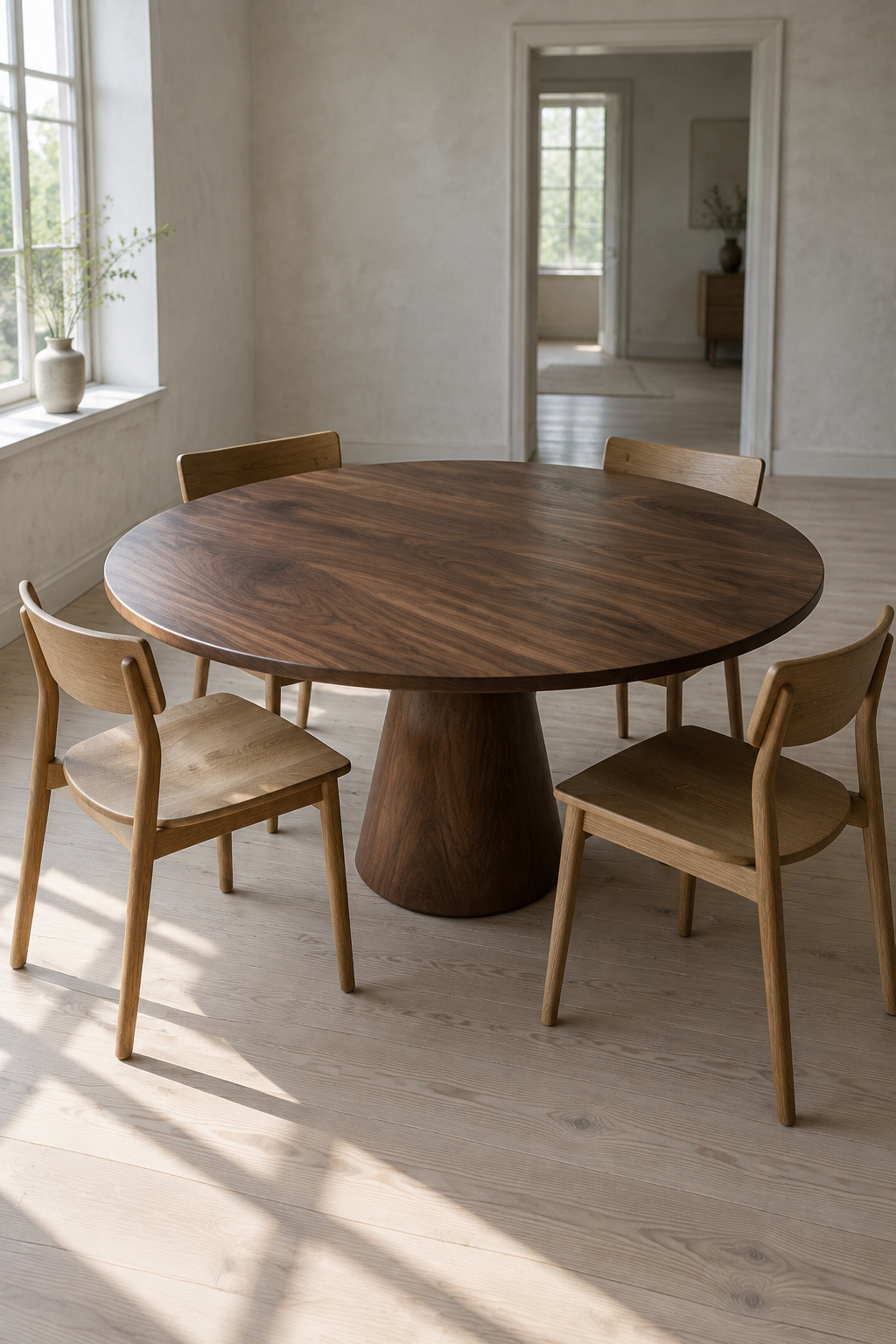
The pictures are sorted by style, and the decisions run in a different order. Where the table stands comes first, because a round can float. Its size and its chairs come next, together. Then the shape line, the base, the top, the rug and the light, each one easier once the step before it is settled.
My standard is a bigger table than you think, and plainer chairs. Take the decisions in that order, with the looks worth your attention at each step, and go deeper on any one of them when you need the numbers.
Let It Float: Where a Round Table Goes in the Room
Three placements hold up in real rooms. A round sits happily in the center of a square room. It tucks well into an alcove. A small one can float near a window as a kind of bubble between the living and cooking parts of a room. What none of them can do is go into a corner or sit flat against a wall the way a rectangle does. A round pushed against a wall looks parked, and it loses the seats on that side. So choose the spot first, before you look at a single table.
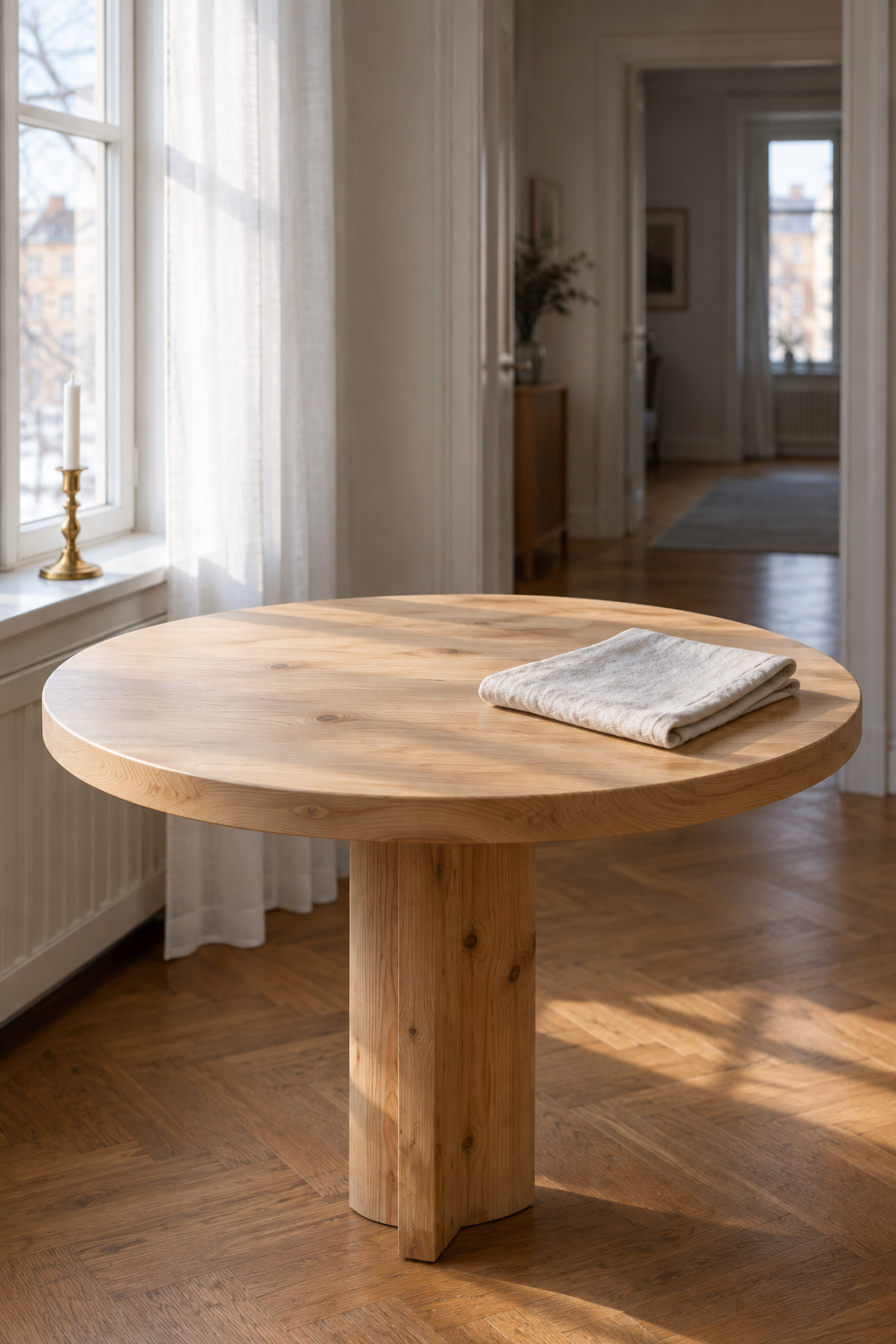
Then keep it out of the route. People cross a dining room to reach the kitchen, the garden door, the stairs. A table sitting in that line becomes an island in traffic, and every meal is interrupted by someone squeezing past a chair. Find the path people already walk and set the table beside it, with the usual clearance behind each chair. If one side of the table is the way into the room, give that side more space and let the table sit a little off center. The art and the light can hold the room’s center line instead.
In a kitchen eating area the same rule applies to the work zone: keep the table clear of the sink, the stove and the prep line, and leave a full path between it and any island seating. The small farmhouse dining nook guide on our site covers the tightest version of this. In an open plan, put it close enough to the kitchen that serving is easy, but far enough that nobody eats beside the countertop clutter.
I would also put it where the daylight falls. That is my own stance. In the kitchen in Uppsala where I grew up, my mother ironed at the kitchen table every Thursday, because that was where the light was best. Try it in February before you decide.
Amanda Huber of Dining Chair Co puts a brake on all this floating: a table in the middle of a room should not have so much floor around it that it looks lost. Empty space around a table is good when it is chosen, and the table still has to hold the room. That is the first argument for a bigger table.
Bigger Table, Plainer Chairs: The Verdict
Picture four chairs pulled up to the same round top. A plain armless chair with a straight back. A chair with low arms that swivels. A curved-back chair whose back follows the line of the seat. An upholstered armchair with wide, padded arms. All four are sold for round tables and all four photograph well. They do not take the same amount of table.
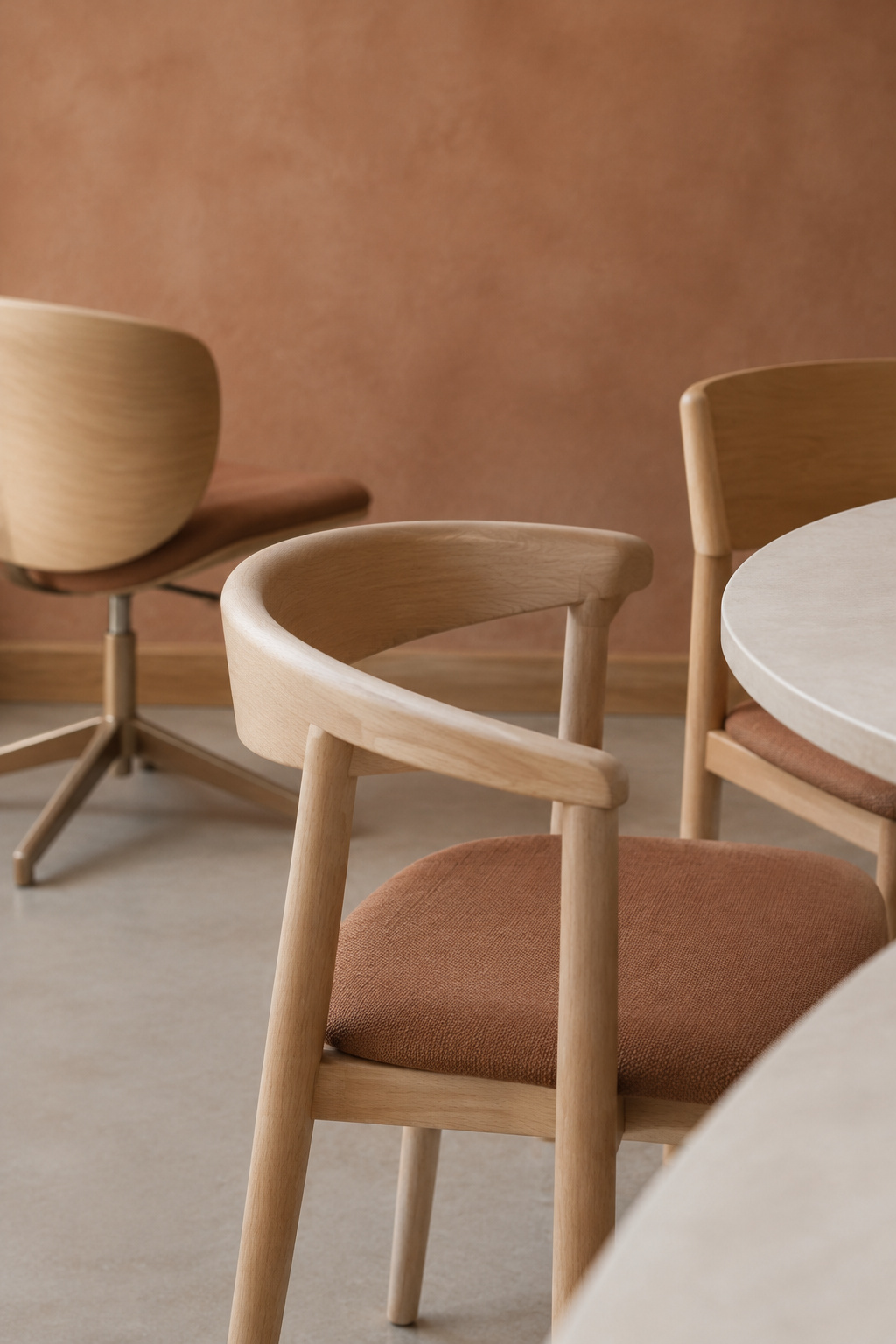
On a circle, chairs touch front corner to front corner before anything else does. Crea, a chair maker, makes the same point. A narrow armless chair lets its neighbor close. A wide armchair keeps everyone further apart, and on a circle there is no long side to absorb the difference.
My rule is that a dining table should be bigger than you think, and the chairs plainer than you think. That is my verdict, and here is the arithmetic behind it. A 48-inch round has 150.8 inches of edge. Six armless chairs at the usual 24 inches each take 144 of those inches, and they fit. Armchairs want 28 to 30 inches each, so five of them take 140 to 150 inches, and that is all the table holds. Same top, same room, and the sixth person at dinner is decided by the chairs.
Most seat charts assume the plain chair without saying so. When a listing says a round seats six, it is usually counting a slim armless chair you were never shown. That is why the verdict comes in two halves. If you love armchairs, the table has to grow to carry them. If the table cannot grow, the chairs have to get plainer. My wife calls my taste in chairs my monk phase. At a round table the monk is usually right.
One oak table maker tells its customers the same thing, always slightly bigger than you think, because people pick tables far too small for the room. One furniture store takes the opposite line: if the taped outline feels tight, go down one size. Both are right about different rooms. Swedes have a word for the right amount, lagom. A table that seats your household without anyone giving up an elbow is lagom, even when it is larger than the one you pictured.
The designer Laurel Bern says today’s chairs are frequently over-scale, and I agree with her. When in doubt, go narrower. Arms bring one more check. The top of the arm has to clear the underside of the tabletop or its apron. An arm that stops an inch short leaves the chair parked out in the room for good. Swivel chairs suit a round because every seat sits at an angle, but a swivel base sweeps a wider arc than its seat, so it is not automatically the compact choice.
The bigger half has a limit, and the room sets it. A table looks smaller in a large showroom than it will at home, so tape the footprint on your own floor before you trust your eye. Then check the room around it. The measuring method, the chart’s hidden chair and the room check all belong to sizing a round table from your chairs, which has you put a tape across the widest point of a chair you already own.
Round, Rectangular or Oval: The Shape Line
A 48-inch round for four, with room to spare. A 60-inch round in dark walnut with a lazy Susan turning in the middle. An oval in a longer room, or a round that opens into one, keeping its width and gaining length. These are the three shapes a round-table household moves between, and the line between them is simpler than the galleries make it look.
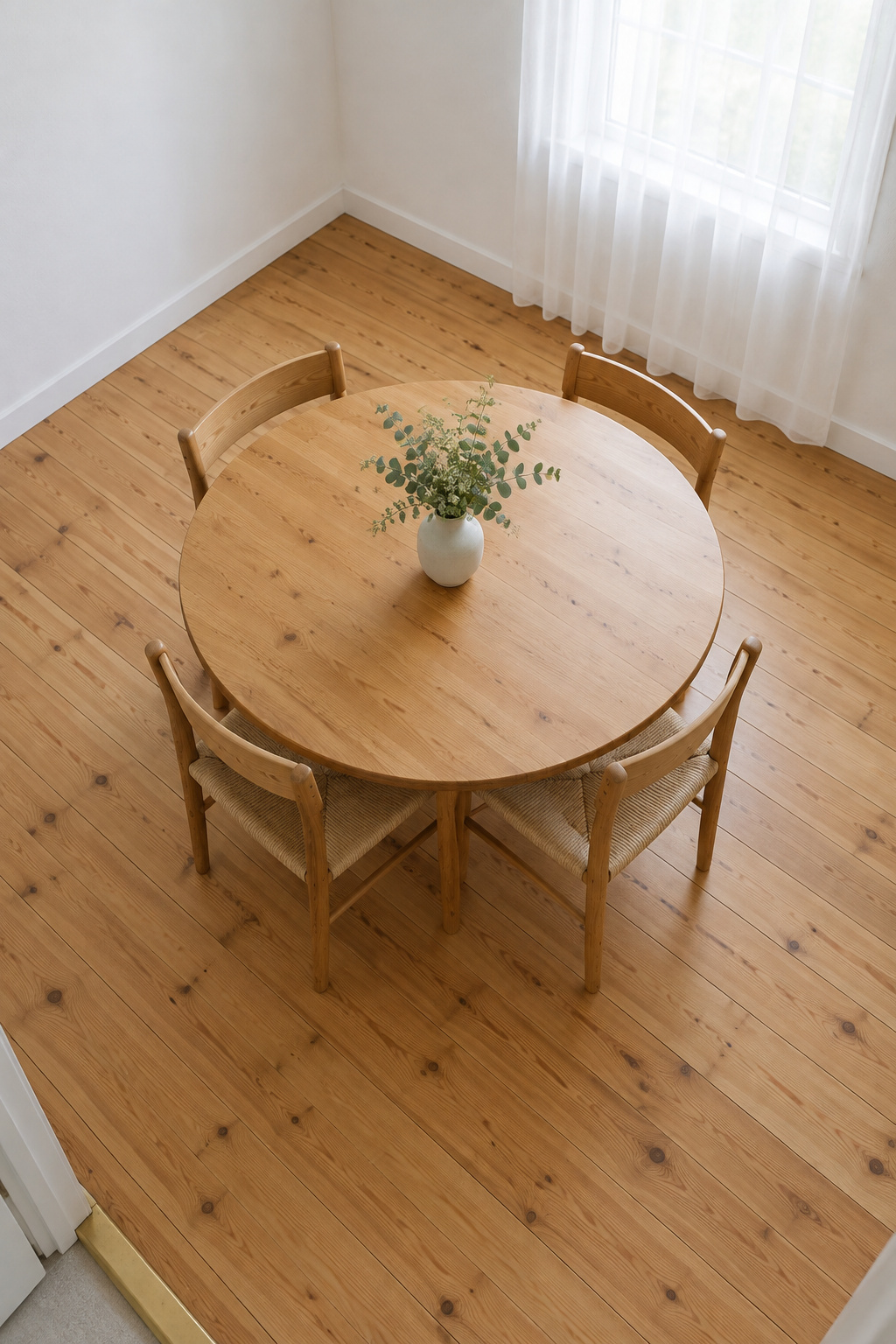
Round is comfortable for about six. Eight fits on a 60-inch round only as a squeeze and sits comfortably at about 66 to 72 inches; past eight, a rectangle or an oval does the job better. Plan for the number you feed on an ordinary week, not the number you host twice a year.
Be careful with the claim that round tables save space. A round or an oval frees the corners of a room, and that helps only if something uses those corners. In a small square nook a round does win. Elsewhere the floor it needs, once you add the chairs and the space behind them, comes out much the same as a rectangle seating the same number. Where space is truly short, Houzz makes a point I like: a table that seats a couple fewer guests and leaves people room to move can be the better buy.
A round table feels more sociable to me, and I will not dress that up as a finding. The interior designer Phillip Thomas asks the more useful question: do your guests talk across the whole table, or mostly to the person beside them? A round suits the first kind of evening. The shape question proper, from who reaches the bread to the footprint arithmetic, is laid out under round or rectangular for your household.
Round Dining Table Ideas by Base: Pedestal, Tulip, Tripod and Four-Leg
The base is where the galleries are most generous. A cylinder pedestal under an oak top. A fluted pedestal, painted. An hourglass pedestal under marble. A black tulip base under white stone. A tri-arch walnut base. A white X-base. A tripod of splayed legs. A plain four-leg round. Each of these is sold, and each changes what happens to your knees and your chairs.
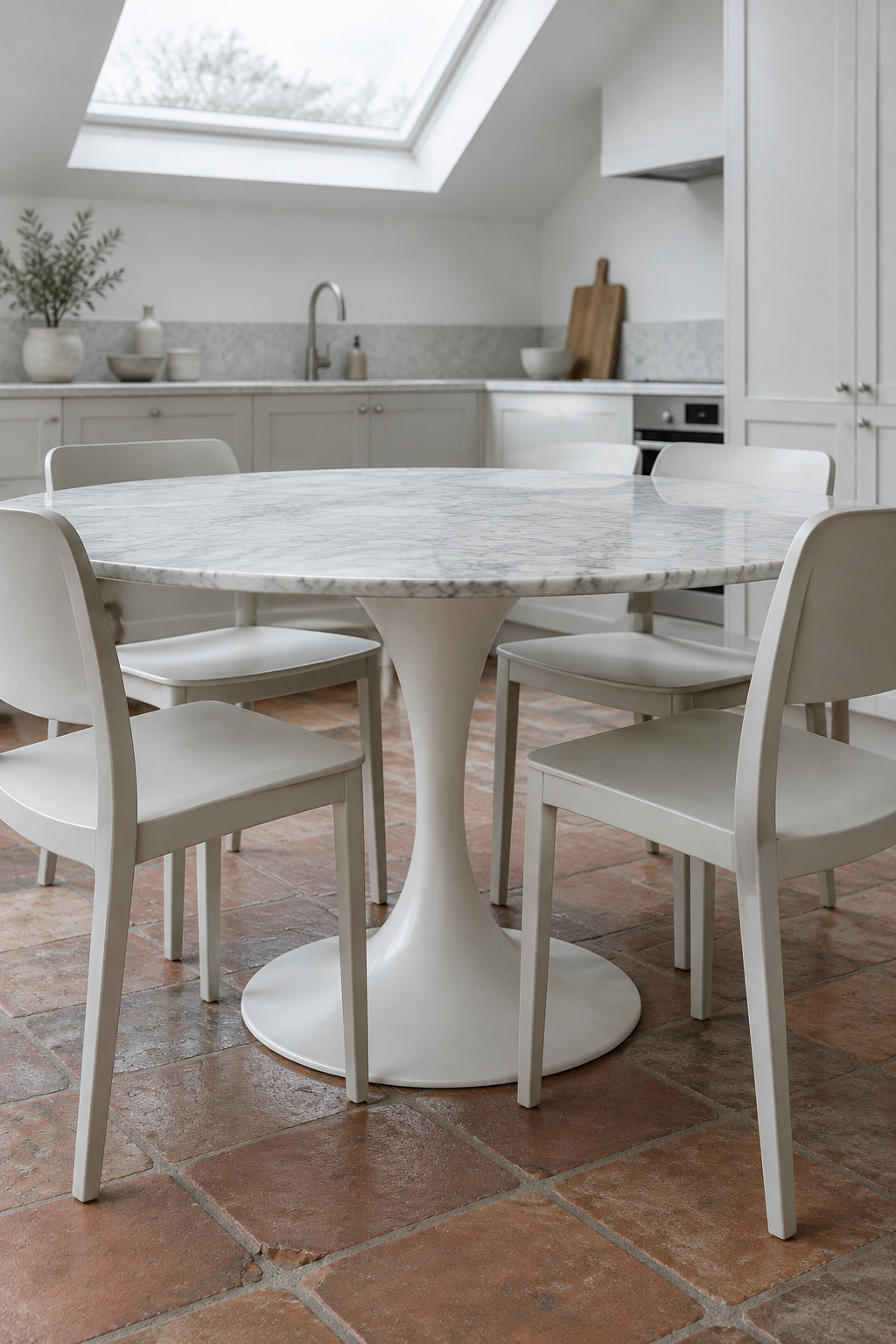
Pedestal, tulip and tripod: one column, free knees
The single-column look has a well-known origin. Eero Saarinen is often quoted as saying he designed his pedestal furniture to clear up “the slum of legs” in the American home, and the table that came of it is the Tulip, a single flared column under a round top. The logic is the one behind the bigger-table verdict. A central base leaves the whole edge free, so chairs go wherever people need them, and on a squeeze night there is often room for one more.
| Base | What it does for chairs and knees | What to check |
|---|---|---|
| Pedestal or tulip | Leaves the whole edge free; chairs go anywhere, often one more in a squeeze | Where the foot sits under your feet; whether a lean on the rim tips it |
| Tripod or splayed legs | Stable, with fewer knee clashes than four legs | How far the feet spread on a tight floor |
| Four legs | Classic and sturdy; one chair between each pair of legs fixes the count at four | Fine to about 48 in, awkward above; where legs meet chair legs |
| X or cross base | Stable and sculptural | Foot clearance; pairs best with slimmer chairs |
For most households I would choose the pedestal row, with plain chairs around it.
It is not unlimited legroom. The column, a wide foot or a platform still take space, so sit at the table in the shop and notice where your feet land. And the experts split on tight rooms: most makers say a central base frees the edge and can add a seat, while a designer quoted by Baer’s Furniture says that in a size-limited room legs give chairs more space than a wide central base. Sit at both kinds before you choose.
How far the feet should reach for the top you want, what to press and look under before you pay, and the order to work through if it rocks (floor first, then the glides, then the plate and bolt) are all in choosing a round pedestal dining table. A round set against a banquette or bench is its own question, and our banquette table size and shape guide answers it.
Rounds that grow: leaves and split pedestals
Some rounds open. A round with a leaf that turns it into an oval is Laurel Bern’s favorite look, and she notes that good ones are not easy to find. A butterfly leaf folds away under the top, so nothing waits in a closet. A split pedestal parts down the middle so each half of the base travels with its half of the top. When the table opens, the chairs that sat evenly around a circle face two long sides and two new ends, which is one more reason to keep them plain.
The leaf you never take out is not worth paying for, and a butterfly is only as good as its hinges. Buy the better hinge. Which mechanism gets used, where the leaf lives the rest of the year, and why the simple mechanisms are the ones that can be repaired are covered in extendable round tables and their leaves.
The Top: Stone, Oak or Glass, and Making Your Own
Carrara marble, still the stone people ask for first. Travertine, warm and softly pitted, the most relaxed of the natural stones. Sintered stone, non-porous and hard to stain. Oiled oak. Walnut. Clear glass. Round tops come in every one of these, and the photograph will not tell you which one suits your house.
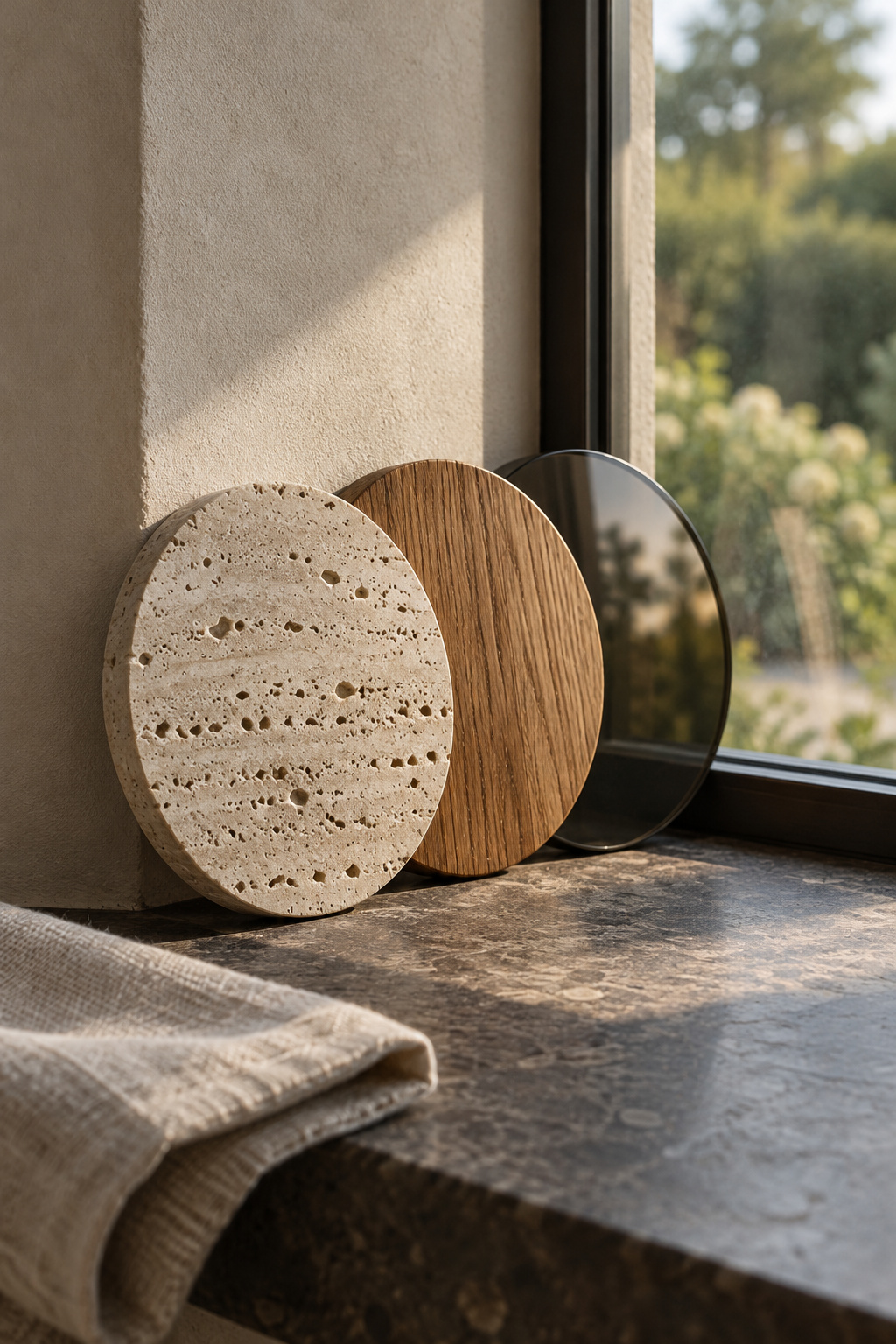
Stone, solid wood and glass: the wear you will live with
Every top wears, so choose the wear you are willing to live with, and know whether it can be undone.
Marble is porous, and an everyday spill left to sit can stain it for good. Sealing helps, but it does not make marble free of care. A solid marble top can almost always be restored by honing and re-polishing, which is a job for someone with the tools. Sintered stone resists stains, scratches and heat, and its weak point is the edge: a chipped corner is very hard to repair. Oak is dense and hard-wearing, and solid wood can be sanded back and refinished when it has had enough. Stain can darken oak and exaggerate its grain, so I would oil it and let the color come with age. Walnut is dark and strong, and it asks for a little more care. Glass is easy to wipe and reflects the light, and it shows every fingerprint.
Veneer deserves a fair word. Laurel Bern points out that some of the finest tables are veneered, because a veneered top is stable and does not warp. The difference is what happens when it wears. For telling solid wood from veneer, and for choosing a finish, our two-tone dining table series is the place to look.
I lean toward solid wood for most households, because it is the wear you can reverse yourself. The full comparison, including which marks stone keeps until someone re-hones it and why a stone top needs a base built for its weight, is in marble, wood or glass round tops.
Making the top yourself
A plywood circle with a solid-wood edge is a make-it-yourself look, and it is within reach of a careful beginner. The sensible split is to make the top and buy the base, so the part that carries the load comes with a maker’s rating. The cutting, edging and fastening are in building a round dining table yourself.
The Rug Under a Round Table
A square rug under a round table, lined up with the walls. A rectangle in a long room. A washable flat-weave in a house with children. A round rug, but only one sized well past the edge of the top. Those are the looks that work. The round rug that fails is the one sized to match the table: with so little past the rim, it rarely leaves enough rug for a chair that has been pushed back.
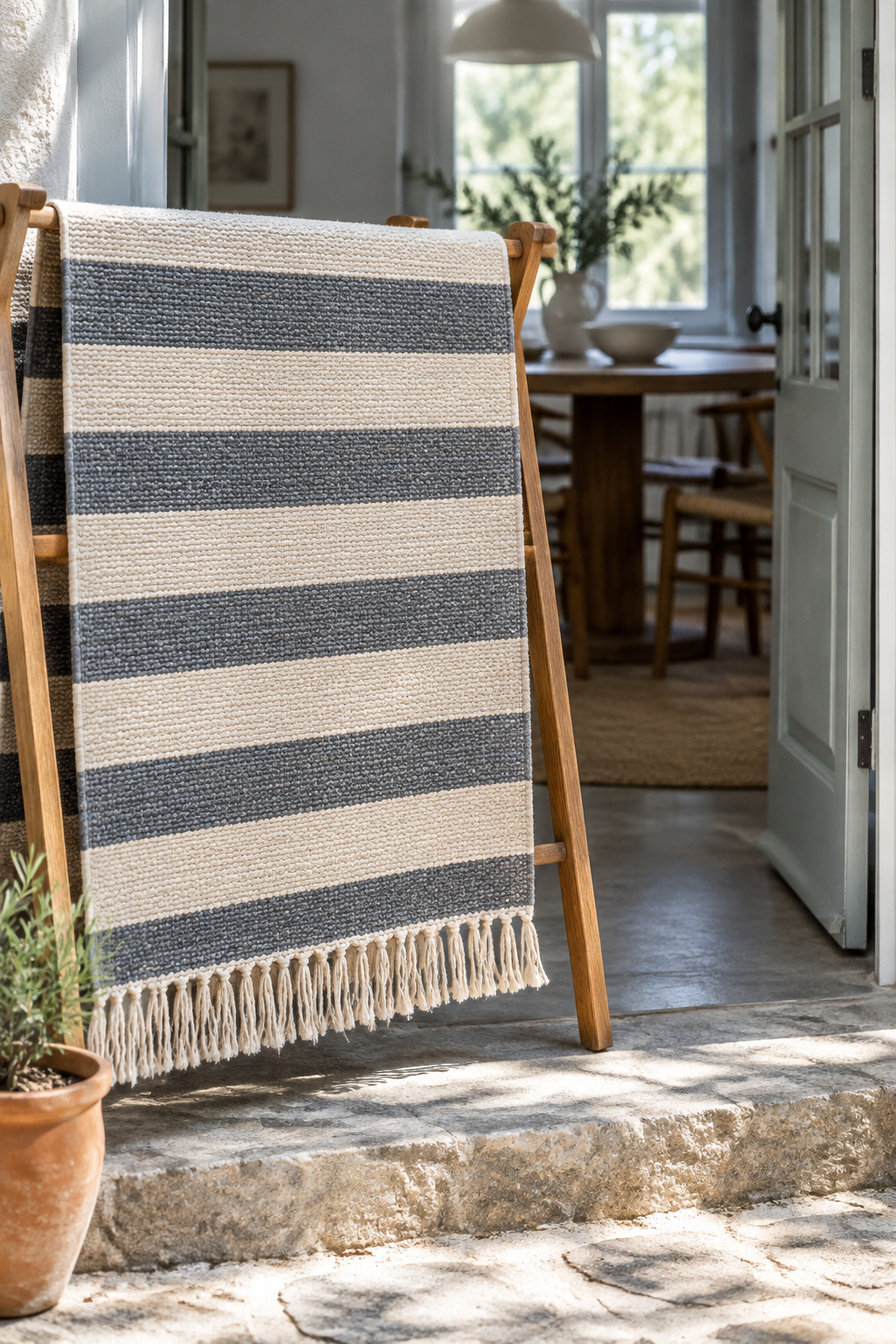
A rug under a round table earns its place at the chair legs. When someone stands up, all four legs of the chair should still be on it, or the chair catches on the edge as it comes back in. If the room cannot take a rug that large, a bare floor with felt pads is the better answer. Under a dining table I would add low pile or flat weave, because deep pile drags on chair legs.
The shape is the room’s to choose, not the table’s. How large to go for your diameter, and when to skip the rug altogether, are in the rug under a round dining table. Layering one rug over another is a different idea, and our guide to boho dining room rugs covers it.
Light Above, Tabletop Below
One fixture, centered
A single paper-shade pendant. A round chandelier. A round table sits well under one fixture centered above it, hung low enough to gather the table and high enough that nobody has to dodge it while talking. The fixture is often round itself, a nice echo of the table. In a kitchen, a pendant over the table also marks where the dining part begins. How large the fixture should be and exactly how high it hangs are in our chandelier size and height guide.
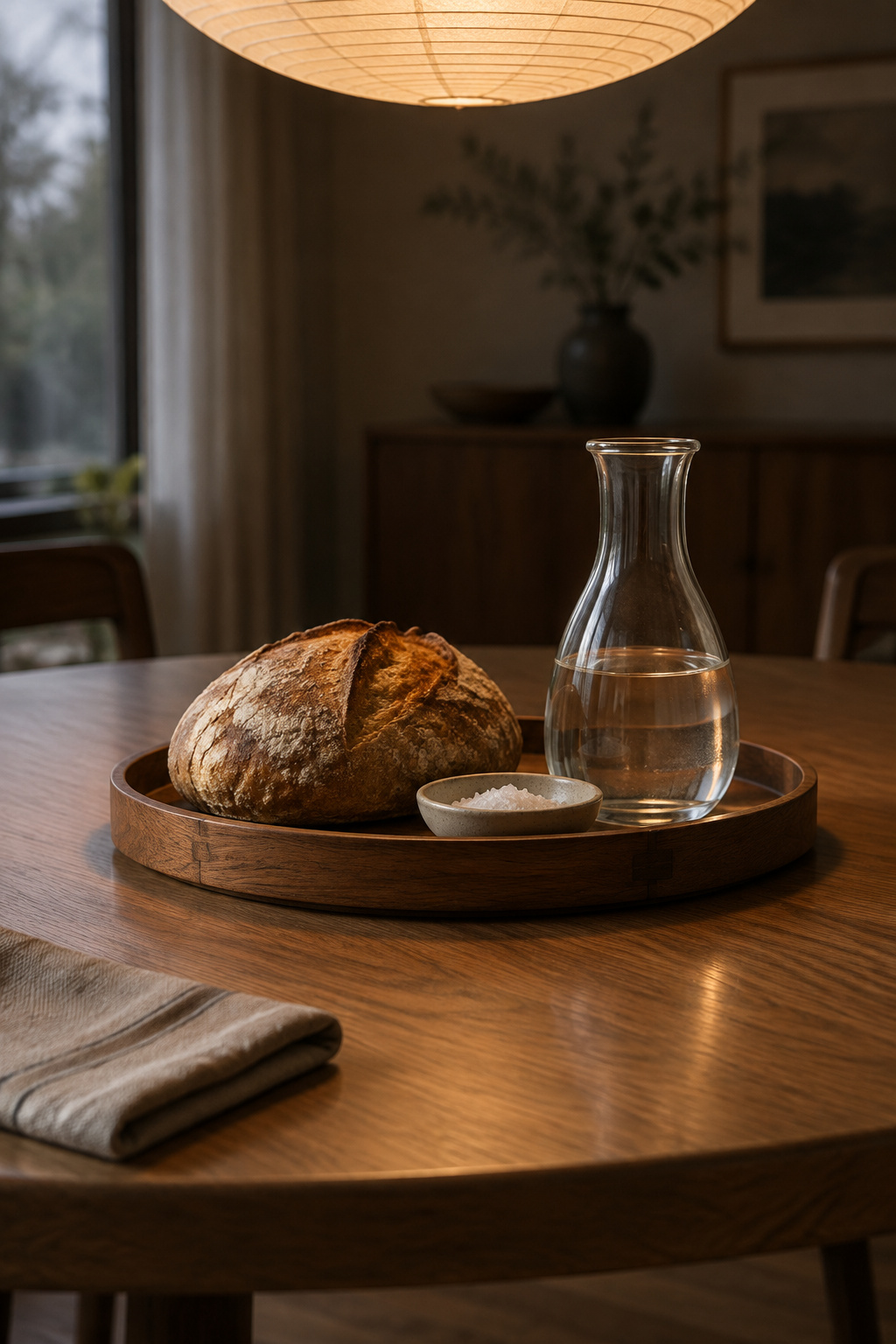
The tabletop: low and central
A low tray. A shallow bowl. A lazy Susan on a big round. Whatever sits in the middle should be low, central and reachable from every seat, and it should leave each place its full setting. The designer Alex Cheatwood allows about 24 by 15 inches per place for plate, glass and flatware, and a centerpiece that eats into that space is in the way. For what to put there, the farmhouse dining table centerpiece guide has ideas.
The Order That Ends the Scrolling
Go back to the galleries now. The fluted pedestal, the tulip base, the walnut circle with its lazy Susan. They are still beautiful, and now you can read them. Look past the table at the chairs, count the edge they need, and you will see why one picture feels generous and the next feels tight.
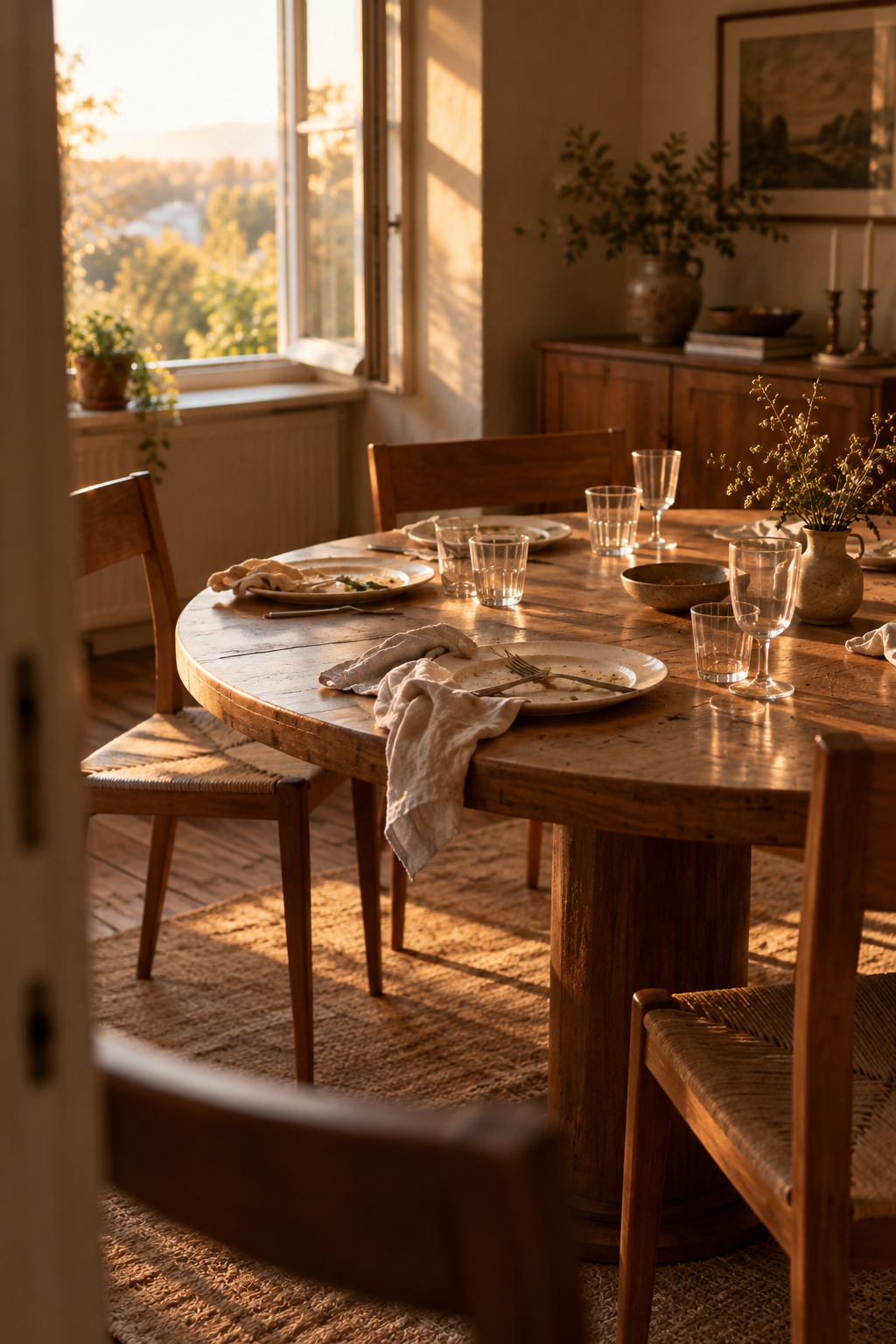
Choose where the table floats, out of the path and in the daylight. Choose the chairs and size the table to carry them, bigger than you first thought. Check the shape line for the number you feed every week. Pick a base that frees knees, a top whose wear you accept, a rug for the chair legs or none, and one light above.
I live in a 1950s house outside Duluth now, near Lake Superior, a long way from that kitchen in Uppsala, and I still choose a table this way. So stand in your own dining room and make the first decision today: pick the chair. Sit in it, measure it, and let the table grow around it.