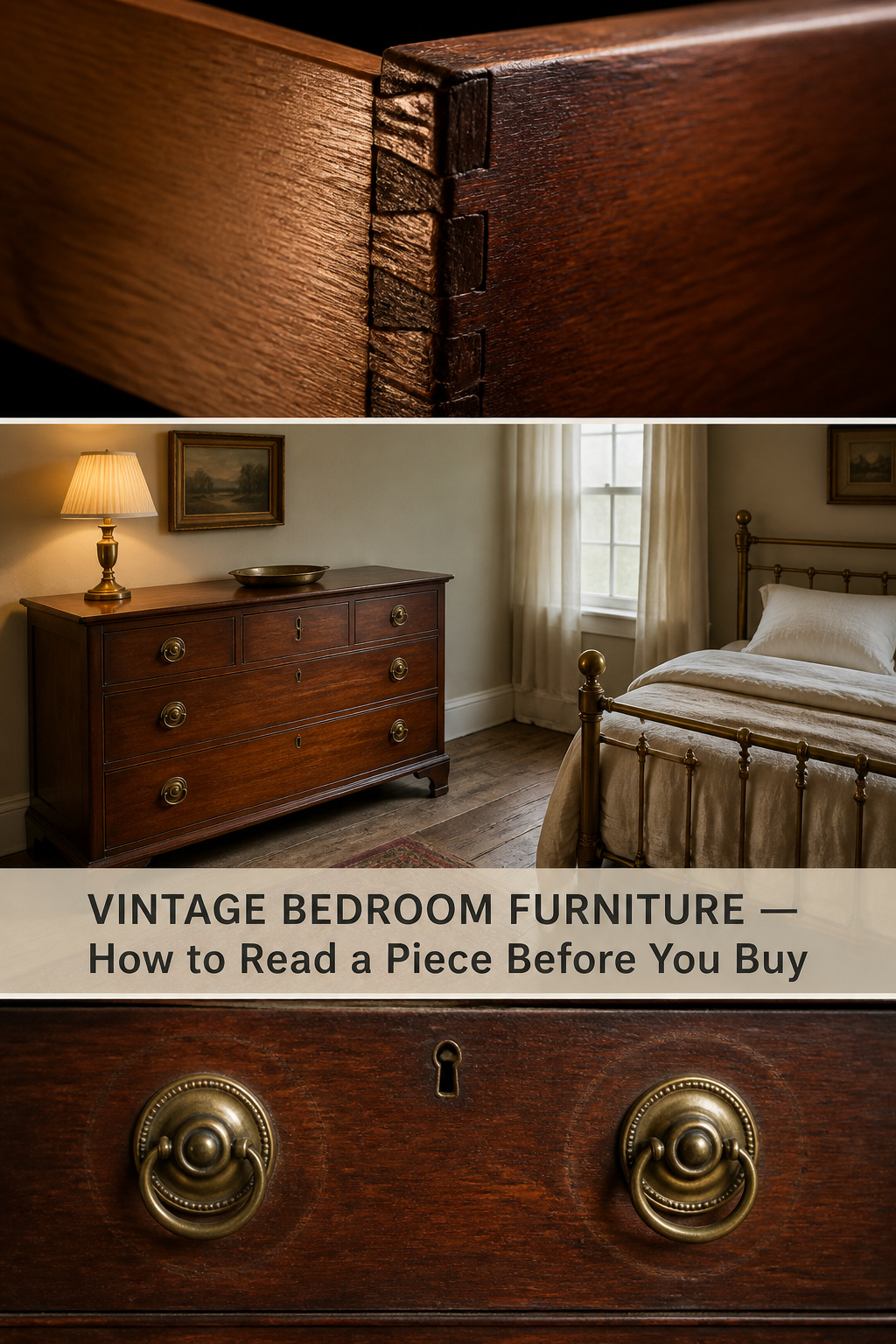
Walk any antique mall and you will find two walnut dressers side by side — near-identical from across the aisle, with a tenfold gap in their price tags. One is genuine vintage bedroom furniture, built around 1880 from old-growth timber and hand-cut to last. The other is a recent reproduction wearing a factory “vintage” sticker, and the labels rarely tell you which is which. That gap is where people lose money, paying antique prices for reproduction quality or styling a real find until it reads like clutter.
TL;DR
- Genuine antiques use old-growth timber with grain rings two to three times tighter than modern lumber; hand-cut dovetails (pre-1860 US, pre-1930 Europe) date a piece at a glance.
- The dresser is the highest-value anchor — place it opposite the bed with at least 36 inches of clearance, and never paint a piece with hand-cut joinery or a maker’s mark, which can halve its value.
- Aim for roughly 80 percent contemporary and 20 percent genuinely old, letting natural materials — linen, unlacquered brass, aged oak — bridge the eras.
Why Vintage Bedroom Furniture Is Worth Understanding Properly
The reason a Victorian dresser still slides its drawers smoothly after 130 years is physical, not sentimental. Pre-1900 case pieces came from old-growth trees harvested at 100 to 300 years of age, against the 20 to 40 of modern lumber — growth that packs the annual rings two to three times tighter and gives the timber far more resistance to warping.
What old-growth timber and hand joinery mean for durability
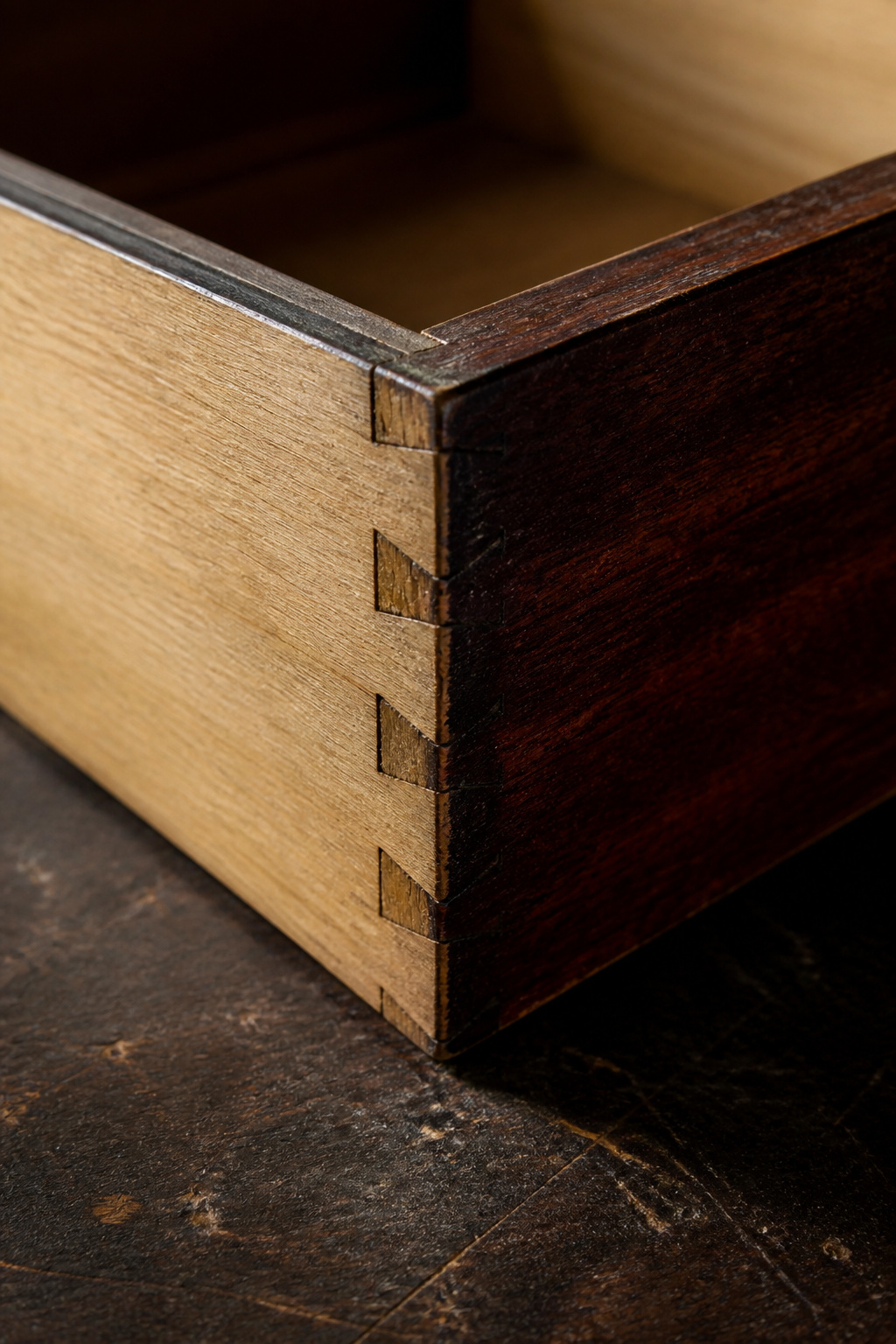
Construction matters as much as species. A well-made drawer box uses solid hardwood sides with dovetailed corners; particle board, MDF or PVC sides mark the piece as low-grade however handsome its face. Antique furniture wood has also completed decades of expansion and contraction cycles, so it moves less with seasonal humidity changes than a new piece still working through its initial dry-out.
Antique, vintage and vintage-inspired
These words are not interchangeable. In the trade, “antique” means at least 100 years old; “vintage” covers roughly 20 to 99; “vintage-inspired” guarantees nothing — it describes a look, not an age or standard of build. Appraisers grade on condition, authenticity and rarity, which is why a genuine oak or cherry dresser runs from $100 to $1,200.
Why the anchor sets everything else
In a vintage bedroom the furniture comes first: walls, textiles and lighting answer to the pieces, not the reverse. Decide the anchor — usually a chest of drawers — and the broader vintage bedroom decor choices fall into place.
Reading a Piece: The Construction Details That Date and Grade Furniture
Four diagnostic layers date most bedroom case pieces to within a couple of decades and a region: joinery, secondary wood, finish, and hardware. None requires special tools — only pulling the drawer all the way out, the single step most buyers skip.
Hand-cut dovetails vs machine-cut
Pull a drawer fully out and look at the side joint. Hand-cut dovetails are slightly trapezoidal and unevenly spaced, with faint chisel scoring at the pin bases — no two quite identical — indicating construction before about 1860 in the US and 1930 in Europe. Uniform, precisely matched machine-cut dovetails arrived around 1895. Between them sits the pin-and-cove “Knapp” joint: an American-only tell for 1870–1900.
What the drawer bottoms tell you
Secondary wood was always sourced locally, which turns drawer sides and bottoms into a regional map. White pine indicates New England; yellow (Southern) pine points to the US South; tulip poplar to the Mid-Atlantic. Oak or “deal” (Scots pine) is the British equivalent — American pine inside a nominally English piece means it was made, repaired, or reproduced in the US. Period hard pine also feels denser than the softer, wider-grained pine of reproductions.
Finish layers and patina
French polish — shellac and resin worked in by pad — gives a depth restorers call chatoyance that modern lacquer cannot copy. To test for shellac, touch a hidden spot with a denatured-alcohol swab: it turns soft within 30 seconds. True patina concentrates on high-touch areas and stays lighter on protected surfaces like back boards — almost impossible to fake convincingly on a reproduction.
The hardware that dates a piece
Fasteners changed sharply over two centuries: hand-wrought nails (pre-1800) taper on four sides, cut nails (1790s–1880s) have two tapered and two flat sides, and round wire nails mean post-1880 or a later repair. Original hardware left in place, still wearing its patina, is the single most reliable dating evidence on a piece — I trust an untouched back plate over any dealer’s tag.
The Bedroom Pieces Worth Prioritising — and the Ones to Skip
Not every category earns its place; spend where the impact and longevity are.
Dressers and chests: the anchor category
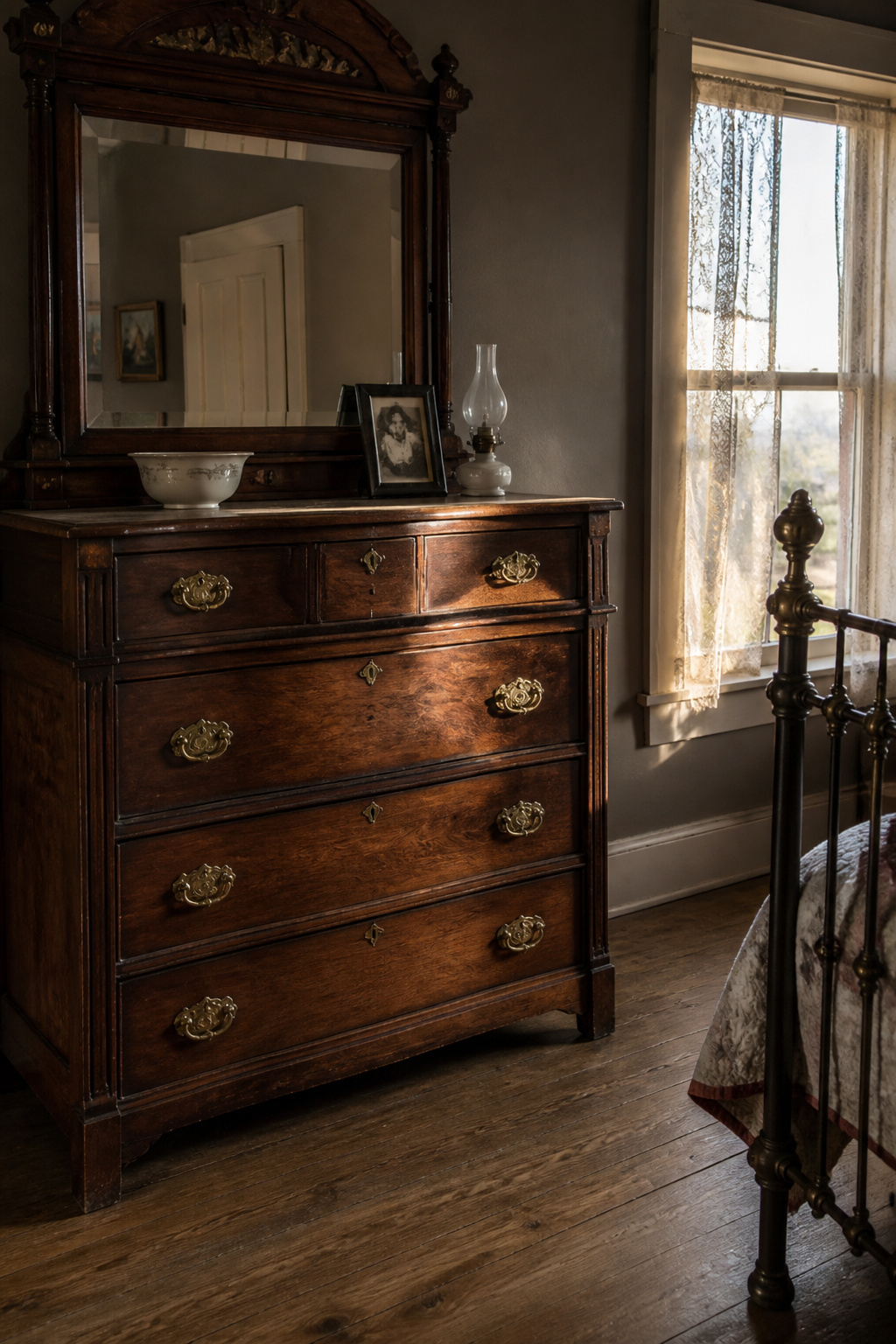
A dresser delivers the most room impact per pound spent and is the most likely to hold its value over time. A typical Victorian dresser with mirror runs about 71 inches high, 36 wide and 19 deep. Antiques typically sit at 16 to 18 inches deep against a modern 20 to 22, buying clearance in a tight room.
Antique bed frames: structure before style
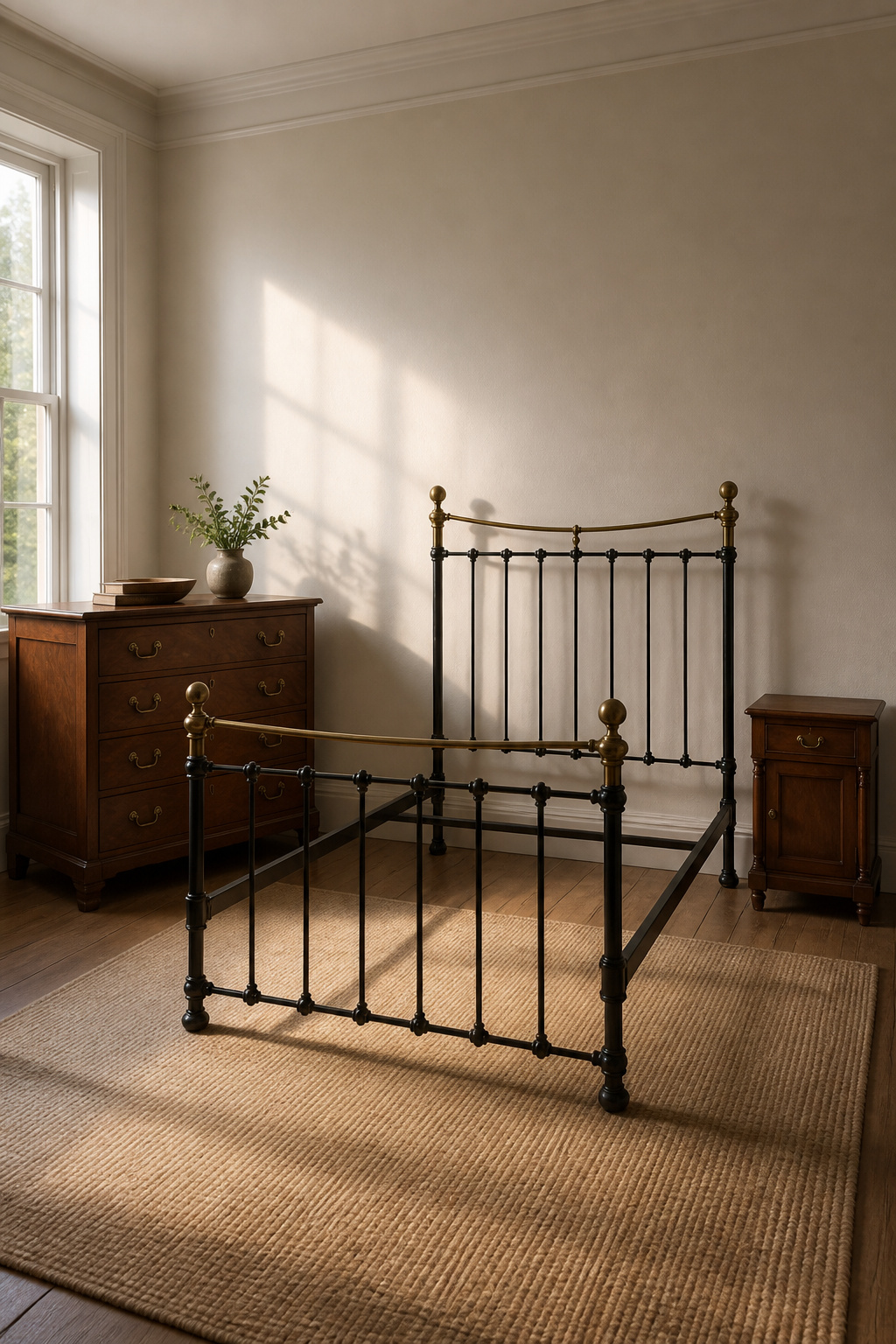
With beds, inspect the structure before you fall for the look. Most antique frames are a 3/4 size — about 48 by 75 inches — narrower than a modern queen at 60 by 80, so a custom mattress is part of the cost. As Brass Beds of Virginia note, the pieces that connect on a brass bed are held together with threaded screws, not welded or cast, and those joints fatigue. On iron frames, check the rails for rust, wiggle for loose joints, and look hard at the castings — a cracked one is the costliest repair.
Vintage nightstands: the safest first piece
A nightstand is the lowest-risk way to start: the category runs from French Empire to mid-century, so flexibility is wide and commitment small. Aim for a surface that holds a lamp, a glass and one book, at a height close to the mattress top — antique cabinets were built for lower beds, so you may need one taller than a standard Victorian bedside cupboard.
Trunks, blanket chests and vanities
A blanket chest at the foot of the bed adds storage and depth. For a standard bed with the mattress top at 24 to 26 inches, a chest of 18 to 22 works without cutting the room visually in half. Add vanities after the anchors are in place. Once you know what a quality piece looks like, the next question is where to source vintage pieces on a budget.
| Furniture type | Room impact | What to inspect | Condition risk |
|---|---|---|---|
| Dresser / chest | Highest — the anchor | Joinery, secondary wood, finish | Low if sound |
| Bed frame (iron/brass) | High | Castings, rails, joints | High — structural |
| Nightstand | Moderate | Joinery, height vs mattress | Low |
| Trunk / chest | Secondary | Hinges, interior, height | Low |
Placement Logic: How One Strong Piece Changes a Room
Selection is only half the work. An antique pushed flat against a wall and isolated looks staged; placed with intent, it carries the room.
The anchor principle
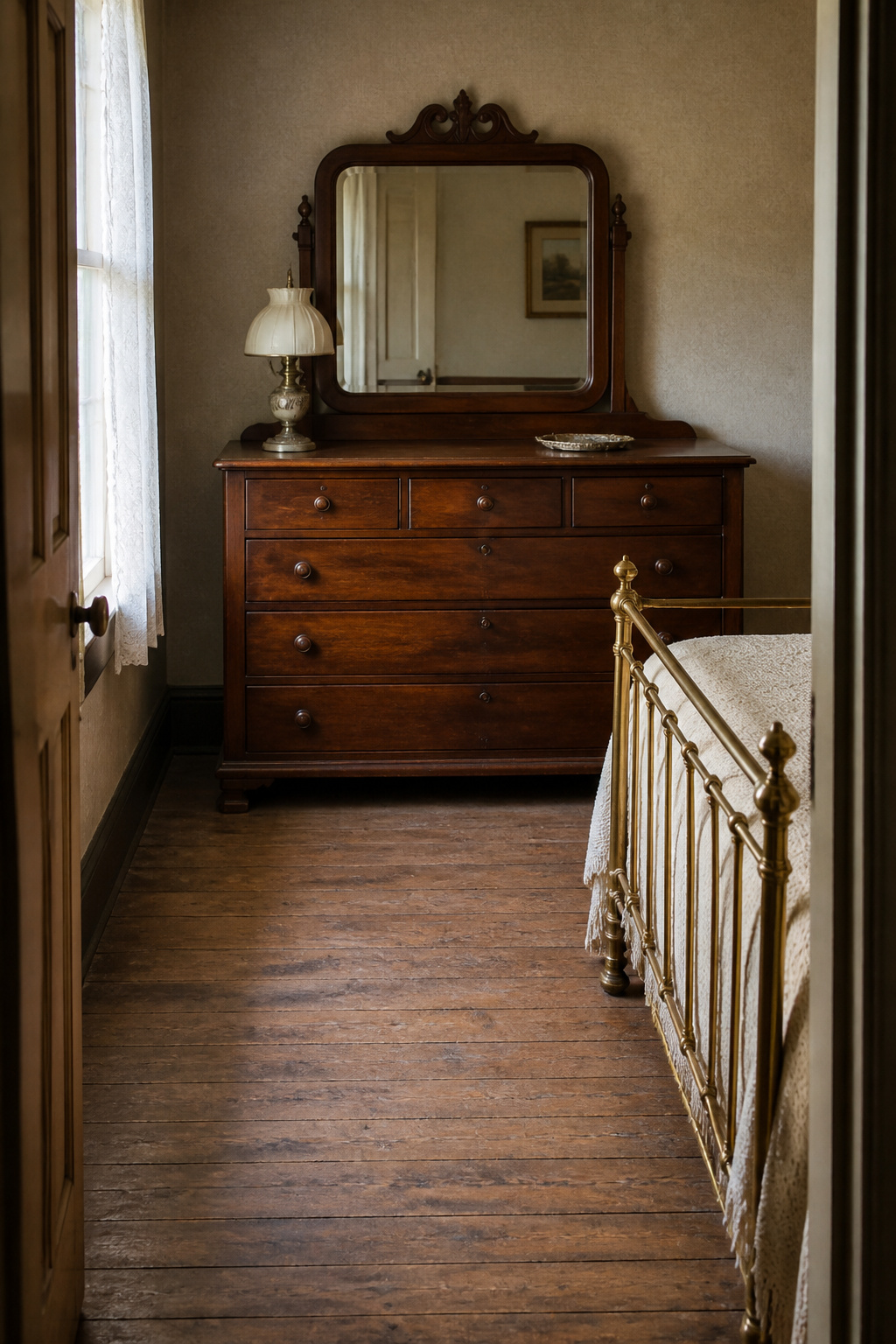
The dresser opposite the bed has the most visual authority — it is the first surface the eye meets from the most-used position in the room. Homes & Gardens recommends a mirror or artwork sized to half or two-thirds the dresser’s width, its bottom edge 4 to 6 inches above the surface. Style the top by the rule of three — one tall item, one horizontal, one sculptural — and stop there; past four or five objects, the piece loses authority. If the dresser carries its own mirror, set it on a side wall rather than directly opposite the foot of the bed.
Scale and proportion
Under-scaling is the most common antique mistake: a small Regency side table beside a large modern bed disappears, reading as fragile rather than considered. In a room with high ceilings and large-scale modern lines, a substantial antique — a wide Victorian dresser or a tall Georgian wardrobe — is what holds its ground. Match nightstand height to the mattress top; a tall bed may need a small chest instead.
Grouping vs isolation
Two related pieces read as a collection where one alone can read as an accident. A dresser and a wardrobe, or a pair of nightstands, work together even unmatched if they share species, period and hardware finish. Keep at least 36 inches of circulation around the bed; the shallower antique depth helps here.
The Refinishing Decision: What to Restore, What to Leave, What Not to Paint
After acquiring a piece, the instinct is to make it new. Resist it. The first antique I ever owned was a small oak chest I bought at nineteen, and within a week I had reached for the strongest solvent on the shelf to “clean it up.” I stripped the finish straight off, and the patina with it — decades of darkening in the grain gone in an afternoon, the wood left raw and characterless and worth a fraction of what I had paid. No conservator could put it back. That chest taught me finish-first humility before I had any business calling myself anything, and it is why I now intervene only when a finish has failed to the point of risking the wood itself.
The reversibility test
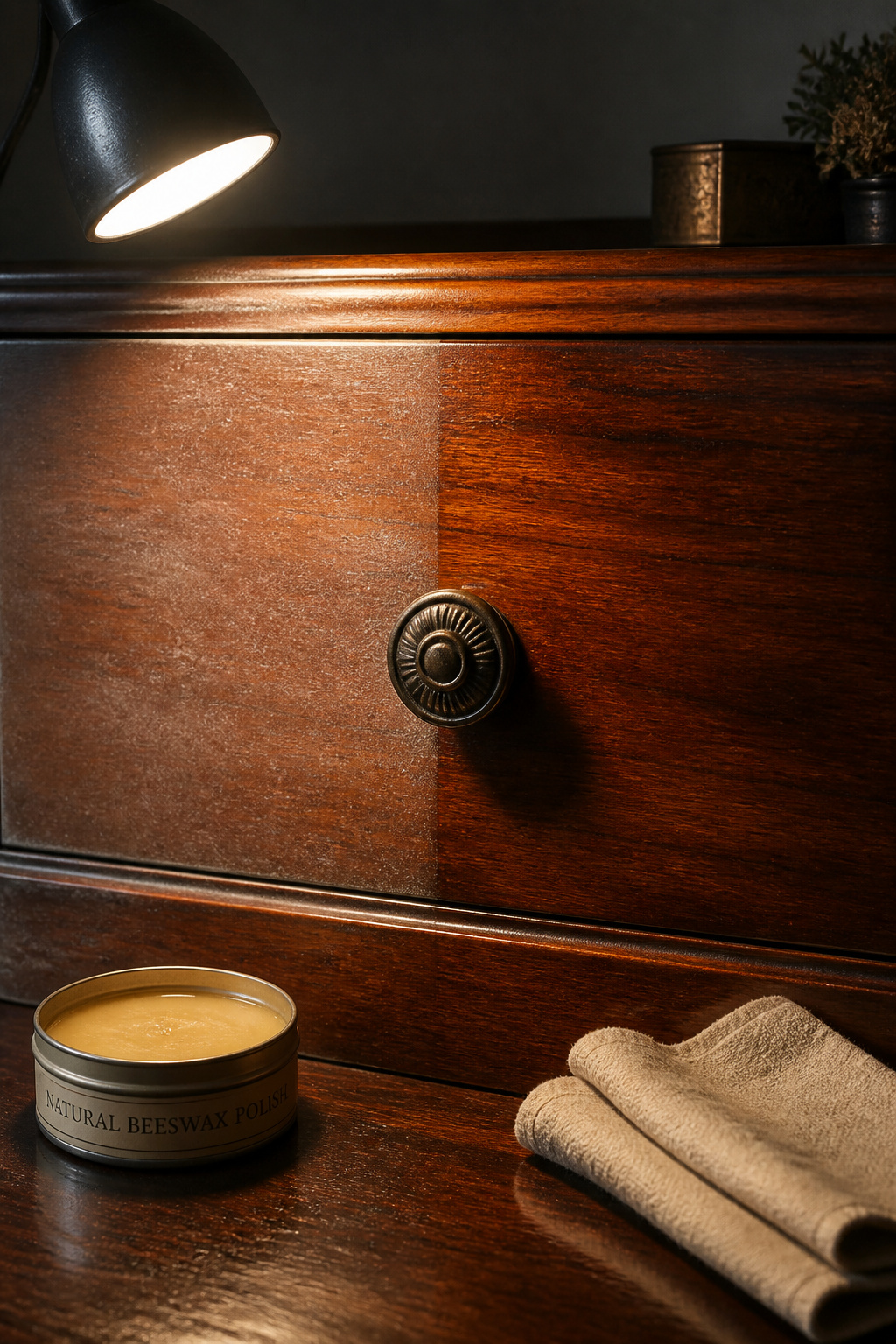
One question filters nearly every intervention: can the next owner undo it? Refinishing fails — patina lives in the outer surface of the wood, stripping pulls it out for good, and true antiques lose value from it. Three questions sharpen the decision:
- Will a specialist detect this intervention in five years?
- If they can detect it, can it be reversed?
- Is the piece a true antique, or post-1920s and already in poor condition?
A wax coat passes all three. A full strip-and-paint passes none.
Cleaning and waxing vs stripping
For a tired finish, the answer is almost always cleaning, not stripping — most old finishes need refreshing, not removing, to look right again. Clean with mineral spirits, then a dilute detergent on a damp cloth, dry overnight, and finish with two coats of paste wax. Strip only when the finish is failing to bare wood, the piece is post-1920s and already compromised, or a conservator has signed off.
When a piece is too good to paint
Hand-cut dovetails, a maker’s mark, genuine French-polish depth, or figured wood — quartersawn oak, bird’s-eye maple, burl walnut — are each a stop sign. The calculus only shifts for pieces already refinished, damaged, or of unclear origin. If yours passes the test and you want to go further, the full method lives in the guide to painting and refinishing furniture.
Mixing Genuine Antiques with New Pieces Without Losing Cohesion
A vintage bedroom should read as gathered over time, not as a museum or a theme — one or two real pieces carrying the character while the rest stays quiet.
How much of the room should be genuinely old
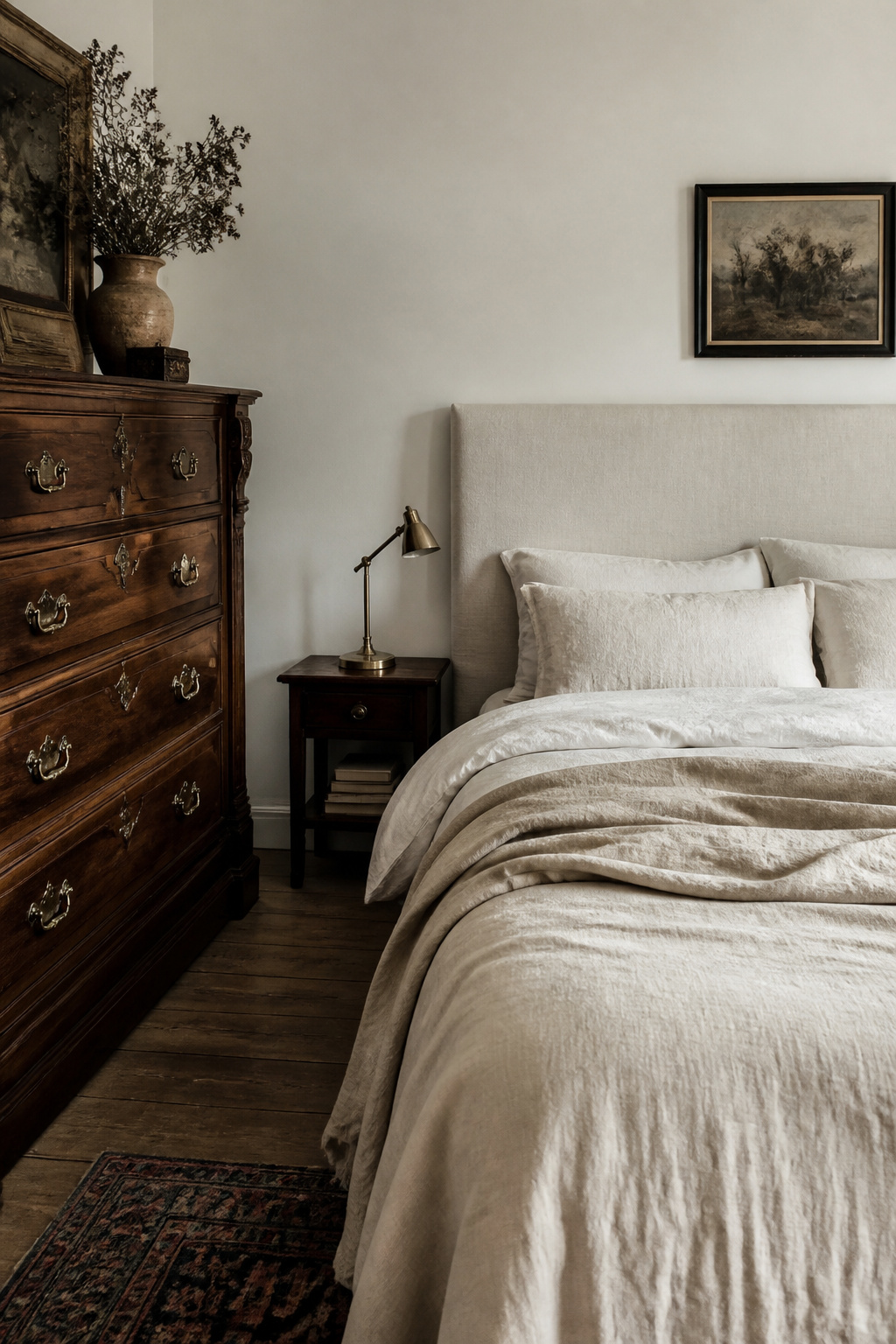
The widely used guide is 80/20: roughly 80 percent contemporary, 20 percent vintage anchors — and that genuine 20 percent is where the dresser and bed frame belong. Restraint matters most in a bedroom; every surface buried in period pieces tips it into stage-set territory.
Choosing new pieces that complement without competing
Start with a neutral palette — soft whites, warm greys, muted earth tones — because a shared colour does the unifying that matched wood never can. Let modern straight lines counterbalance Victorian carving, and avoid modern pieces that ape a period — faux-industrial, fake-rustic — since they compete rather than recede.
The materials that bridge old and new
Natural materials carry no fixed era, which is why they connect across periods. Unlacquered brass is the most effective bridge: original pulls warm toward honey over time, tying to any other warm metal in the room. Linen reads as historically right beside an antique and contemporary beside a modern frame at once. Resist matching wood tones exactly; slight variation reads as a collection gathered with a good eye, while a perfect match reads as a reproduction suite. With the anchor chosen, read, placed and left honestly alone, you hold the core of a vintage bedroom decor scheme — and the eye to tell the genuine from the costume.
FAQ
How do I know if a dresser is genuinely antique or just vintage-style?
Pull a drawer out and read the corner joints: hand-cut dovetails with uneven spacing and faint chisel marks mean pre-1860 US or pre-1930 European work, while uniform machine dovetails mean post-1895. Check that the secondary wood inside is solid regional hardwood, not MDF, and confirm differential patina — darker on high-touch edges, lighter on protected boards.
Is it safe to buy a vintage bed frame for everyday use?
Generally yes, if it is structurally sound. Inspect iron frames for rust, bending or cracked castings, and shake for loose joints. Brass beds need a close look at the threaded connection points, since brass is softer and those joints fatigue. Confirm too that the interior dimensions match an available mattress — many antique beds are a narrow 3/4 size.
What should I inspect before buying vintage furniture at an estate sale?
Pull every drawer fully out and check the joint type, secondary wood and nail or screw type, then look underneath for maker’s marks. Test the finish with a denatured-alcohol swab on a hidden spot. Cosmetic flaws are manageable; any wobble, loose joint or cracked casting is a structural repair to factor in.